
Selected Contents from Portfolio No. 1 — Winter 1950
The first issue of Portfolio arrived as a shock.
Conceived and designed by Alexey Brodovitch, Portfolio No. 1 was not a magazine in the conventional sense but an editorial experiment—treating photography, typography, illustration, and sequencing as a single expressive system. Layout was no longer a container, but an active force: rhythm, contrast, and white space became instruments of meaning.

This selection presents key spreads from the inaugural issue, reproduced from carefully unbound originals.
Read in sequence, they reveal Portfolio’s debut as a radical editorial experiment conceived by Alexey Brodovitch—not a conventional magazine, but a visual laboratory where photography, typography, illustration, and pacing form a single expressive system.
Alongside the images, Ikonographia preserves excerpts from the original texts, printed here in italics not as secondary commentary, but as primary material. These texts—often reproduced in full—are exceptional in their own right, defining an era and articulating Brodovitch’s vision with a precision and ambition that would be impossible to improve upon.
Most importantly, the newly unbound, full-spread reproductions restore the magazine’s true spatial architecture—alignments, axes, and transitions long obscured by binding—making visible design decisions that disappear in standard, cut-in-two reproductions.
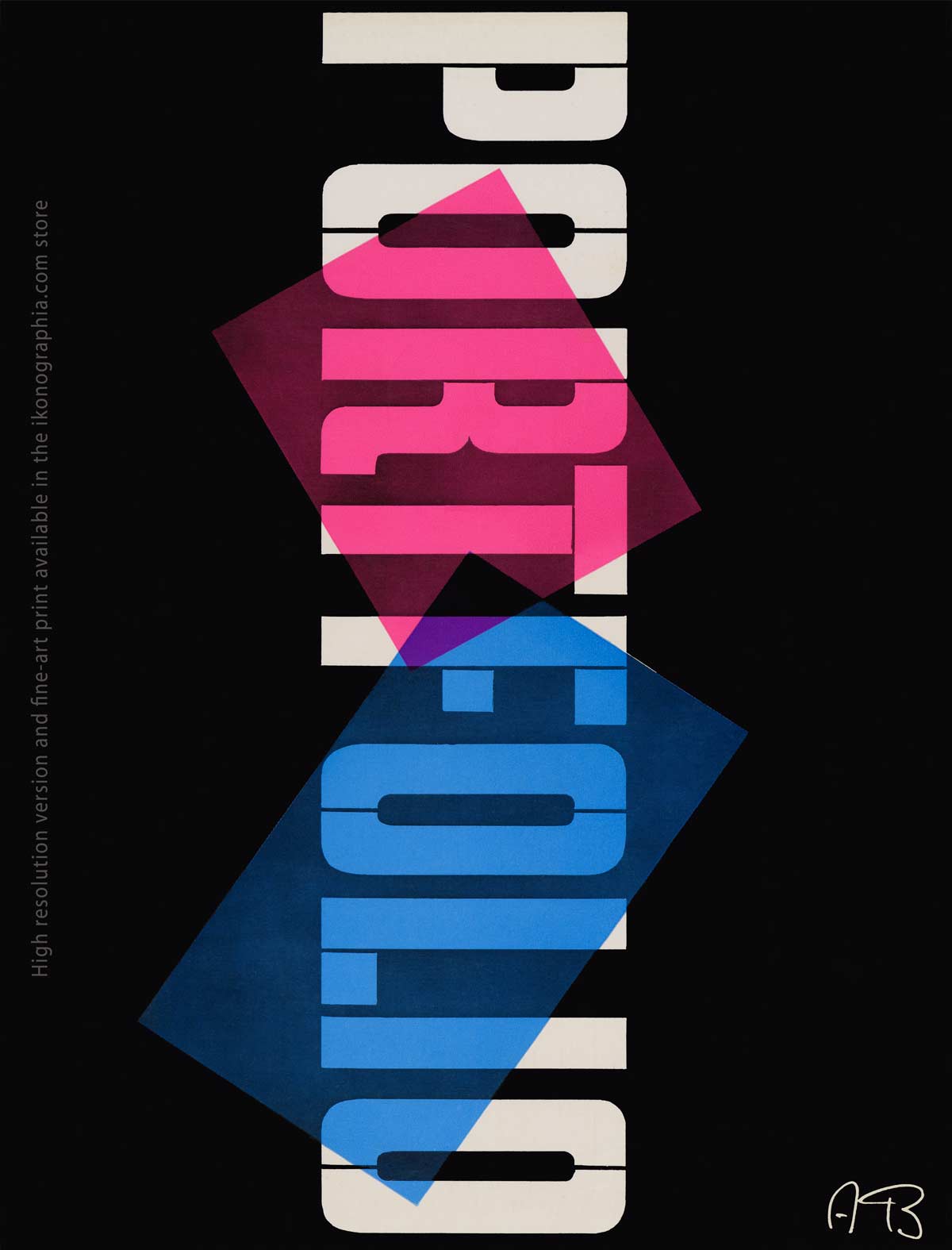
Portfolio Magazine N. 1
Winter 1950.
The first issue of Portfolio Magazine, entirely conceived and designed by Alexey Brodovitch, announcing a new editorial language built on sequence, contrast, and visual tension rather than fixed layout.
Selected Contents from Portfolio N.1 — The Bodoni Typeface
One day in 1787, in his printing shop in Philadelphia, Benjamin Franklin received a specimen sheet of typefaces from Giambattista Bodoni of Parma, Italy. This was the first time that Franklin had seen the work of the man considered Europe's foremost type designer and printer, and he was greatly impressed.
"I have had the great pleasure of receiving and perusing your excellent "Essai des Characteres de L'Imprimere," he wrote Bodoni. It is one of the most beautiful that Art has hitherto produced. As the first American to go on record in appreciation of the Bodoni typeface, sage old Ben Franklin pioneered a trend in U. S. typography, which was to have far-reaching effect on the design of printed matter in our time.

The Bodoni Typeface — pages 4-5
Before Giambattista Bodoni, roman letters had the form of the old-style A (opposite) with heavy stems and curving serifs, as in hand-writing.
This sheet (right) from Bodoni's Manuale Tipografica shows how he altered the design of printing types to give them a mechanical appearance. He emphasized the contrast between light and heavy strokes, with serifs forming sharp right angles with the upright strokes, producing the first modern typeface.

The Bodoni Typeface — pages 12-13
Florets, borders, and rules designed by Gian Battista Bodoni. A sample from the 1200 varieties of decorations created by Gian Battista Bodoni, an Italian typographer who created America's most widely used typeface.

The Bodoni Typeface — pages 14-15
Left: Arabic Numerals from Bodoni's "Manuale Tipografica."
Right: A reprint-as-the-original of Bodoni's Q. Horatii Flacci Opera 1791 (Horace's Opera.) This insert reproduces four specimen pages from books designed by Giambattista Bodoni in 18th Century Parma. They are printed by offset on hand-made paper from Cartiere Milani, the 675-year-old mill in Fabriano, Italy.
Design from Mathematicians
Portfolio was not conceived as a magazine in the conventional sense, but as a radical editorial experiment. Published between 1950 and 1951, it functioned as an open laboratory in which photography, typography, illustration, and sequencing were treated as a single expressive system rather than as separate disciplines.
Under the direction of Alexey Brodovitch, each issue rejected fixed layouts, recurring formats, and commercial constraints. Pages were assembled through contrast, rhythm, and interruption, allowing images and text to interact dynamically across spreads. White space, scale shifts, and abrupt visual transitions became active elements of meaning rather than neutral containers.
Produced without advertising and printed in limited numbers, Portfolio was financially unsustainable but intellectually decisive. Only three issues were released, yet their influence proved disproportionate: the magazine established a new model of editorial authorship, redefining the role of the art director as both editor and composer of visual narratives.
Seen today as a continuous sequence rather than a set of iconic pages, Portfolio remains a foundational document of modern editorial design.

Design From The Mathematicians — pages 20-21
Left: The saddle-shaped form of a hyperbolic paraboloid.
Right: an electron contour map of a molecule of phthalocyanine produces an interesting amoeba-like pattern.
Design From The Mathematicians — pages 22-23
Left: The saddle-shaped form of a hyperbolic paraboloid.
Right: An electron contour map of a molecule of phthalocyanine produces an interesting amoeba-like pattern.
Portfolio — The Hidden Architecture
Portfolio was bound with staples applied directly through the images. The central area of each double page — axes, alignments, transitions — was permanently obscured, even to contemporary subscribers. In the worst cases, the staples cut through figures, severing compositions that only made sense across the full width of the page.
The reconstruction process separated the pages, digitally realigned each half, and restored the complete spread. What follows is not a reproduction of Portfolio. It is Portfolio as Brodovitch designed it to be read — visible here for the first time.

Design From The Mathematicians — pages 24-25
Left: a wave curve with black and white parallel lines. Upper left, straight lines tangent to a hyperbole combined with a circle. Center, wave curve.
Right: upper left, a group of tangents to an astroid (star-shaped) curve. Upper right, catacaustic curve (reflected inside a cup) made with straight lines. Below is the design of the refraction of light.
Xerography — New Visual Effects with Powder and Electricity.
In his never-ending search for new ways of presenting the too-familiar, the experimental graphic artist has been given a new tool from an unexpected quarter—the electronics laboratory.
Recently, the Battelle Memorial Institute of Columbus, Ohio, an organization dealing in basic scientific research, began inviting selected representatives of the photographic world to a series of demonstrations of a new reproduction medium of their development, which they called Xerography, the first revolutionary development in rendering a photographic image since Daguerre coated his first plate 110 years earlier. It substitutes an electrically charged plate for the film now in use.
The Battelle demonstrator placed an ordinary plate holder into the back of a view camera. He made his exposure and disappeared with his holder into the darkroom. The onlookers settled down for a thirty-minute wait, but after one minute, the demonstrator returned, waving a dry, finished print.

Xerography Art — pages 42-43
New Visual Effects with Powder and Electricity.
Goblets variations.
Four xerographic studies of a water goblet show the various effects possible with the process.

Xerography Art — pages 44-45
New Visual Effects with Powder and Electricity.
This mysterious portrait resulted when the electrical charge on the xeroplate broke down.
Saul Steinberg — Drawings from his unpublished private sketchbooks.
Saul Steinberg, a Rumanian-born ex-architect, is one of the few U.S. cartoonists who also happens to be an artist at his work. When the Museum of Modern Art hung an exhibit of his drawings, one newspaper reviewer questioned the show with an article entitled "It's Funny—But Is It Art"?
But Steinberg's admirers seem to include most persons who have seen his drawings in The New Yorker, Harper's Bazaar, Town and Country, and other magazines; this was like asking if Charlie Chaplin could be taken seriously as a social critic because he wears baggy pants and crooked shoes.
Steinberg is compared with Chaplin because although the mediums they operate are two different things—their comic technique springs from the same source. Steinberg eschews the written word as Chaplin eschews the spoken word and speaks only through the pantomime of his pen.
His strange, silent world is peopled with chinless, blank-faced men, beady-eyed women with monstrous headdresses, precocious animals, and weird architectural fantasies, all drawn in a thin, wiry line that often wanders into an embellishment of scrolls and flourishes as Steinberg pauses to extract the Freudian implications of a cluttered interior, the curl of a beard, or just a plain doodle. At other times, the economy of his line is amazing, as in his drawing of the little man walking against a rain of empty clefs on a music sheet.
Reproduced here are eight pages of Steinberg drawings from his unpublished private sketchbooks.

Saul Steinberg — pages 84-85
A beady-eyed woman and chinless, blank-faced men sit at a bar counter.
Illustrations reproduced from a previously unpublished Saul Steinberg's private sketchbook.

Saul Steinberg — pages 86-87
A rare Steinberg colour drawing: a woman in motion, a fantastical automobile, the two figures in composition across the full spread.
On the upper left, a smaller drawing — a figure walking against a rain of empty clefs on a music sheet.

Saul Steinberg — pages 88-89
A typical example of Steinberg's weird architectural fantasies and fantastic animals, all drawn in a thin, wiry line that often wanders into an embellishment of scrolls and flourishes.

Saul Steinberg — pages 90-91
Two pages, two registers. Left: women drawn in loose ink and wash — figures in motion, observed, incomplete. Right: bearded male portraits on black, surrounded by Steinberg's fake cursive — calligraphic marks that perform the appearance of annotation without delivering meaning. Signatures that sign nothing. Notes that say nothing.
News Portfolio
The editorial and design news section of Portfolio — a jewel of design in itself.
Saul Steinberg, a Rumanian-born ex-architect, is one of the few U.S. cartoonists who also happens to be an artist at his work. When the Museum of Modern Art hung an exhibit of his drawings, one newspaper reviewer questioned the show with an article entitled "It's Funny—But Is It Art"?

The Albro Typeface — pages 126-127
A Typeface designed by Alexey Brodovitch.
The Albro Alphabet (after the first syllables of his name) was inspired by the signs and symbols of musical notation.
It was released through Photo-Lettering, Inc., New York.

For Art’s Sake, Artwork by Joan Miró — pages 128-129
Artwork by Joan Miró from the News Section.
The Alexey Brodovitxh design plays graphically with primary CMYK colors.
For Art's Sake
About 1100 art shows are held in New York annually, each of them spawning its own catalogue or brochure of the work exhibited. These publications have long since graduated from simple printed listings to productions of increasing originality. Shown here are a sampling of some of the season's more striking cover designs from 57th Street, ranging all the way from the huge serpentine signature of the Spanish painter Joan Miró (above) to bold typographic layouts and dramatic illustrations.
Copyright, Links And Credits
Portfolio Graphic Works, Copyright & Credits
© Ikonographia — Digital Restoration & Derivative Work Rights Reserved. These images are part of the Ikonographia Visual Archives: Portfolio Magazine Collection (1950–1951).
⸻
Copyright Status of Portfolio Magazine
Portfolio magazine (Issues 1–3, 1950–1951) was published in the United States and not renewed under U.S. copyright law. It is consequently in the public domain in the United States, and its editorial contents — including design, typography, and reproduced artworks — may be freely used.
⸻
Nature of Ikonographia's Work
The images presented here are not simple reproductions of the original magazine pages. They are reconstructed double-page spreads — a body of work that required the careful unbinding of original copies, precise digitization of individual pages, and their digital reassembly as unified visual fields.
This reconstruction reveals, for the first time, the complete compositions as Brodovitch intended them to be seen — hidden for decades by the tight binding of the original print edition.
Ikonographia's reconstructed spreads are original works and are protected as digital restorations and derivative works. They are available for licensed use through Ikonographia Visual Archives.
⸻
Terms of Use (Summary)
The images presented in this archive are copyrighted and available for licensed use only through Ikonographia Visual Archives.
You may not download, reproduce, publish, or distribute these images without a valid license. For commercial or editorial licensing, please refer to the product pages or contact Ikonographia directly. A full explanation of licensing terms is available in the Shop / Licensing Information section under "Ikonographia — Standard License" and "Ikonographia — Merchandising & Product Use Licenses."
⸻
Ikonographia Mission Statement
Ikonographia is committed to the accurate documentation, preservation, and ethical dissemination of twentieth-century visual culture.
⸻
Archival Notes
These reconstructed spreads were produced as part of Ikonographia's ongoing effort to preserve and make accessible significant works of twentieth-century graphic design.
Original copies of Portfolio were carefully unbound and digitized at high resolution. Individual pages were then reassembled with precision to restore the complete double-page compositions.
All images follow Ikonographia's internal archival standards for resolution, color accuracy, and metadata structure to ensure long-term consistency across the collection.
Ikonographia has made every effort to handle this material with accuracy and respect. We remain available for any inquiry or agreement regarding its use.
⸻
Credits
Portfolio magazine (1950–1951) was created by Frank Zachary and George Rosenthal (editors and co-founders) and Alexey Brodovitch (art director). Their vision produced one of the most significant editorial experiments of the twentieth century.
⸻
Further Reading — Selected Sources
⸻
Explore the Portfolio Archive
-

The Cover of the first number of Brodovitch’s Portfolio Magazine, 1950
€19.00 -

The Colophon of Portfolio Magazine N.1. Design by Brodovitch
€29.00 -
Editorial content on Giambattista Bodoni, Portfolio 1. Design by Brodovitch
€29.00 -
Bodoni’s Numerals and a reprint-as-the-original of Horace’s Opera
€29.00


About Alexey Brodovitch. A short bio.

Brodovitch at work in his studio.
Alexey Brodovitch (1898-1971)
Alexey Brodovitch was a Russian-born American designer, photographer, editor, and teacher whose work fundamentally reshaped twentieth-century visual culture. Best known as the art director of Harper's Bazaar (1934–1958) and the creator of Portfolio magazine, Brodovitch redefined the role of design as an active, expressive force rather than a neutral frame.
After leaving Russia, Brodovitch settled in Paris in 1920, where he absorbed Bauhaus principles, Italian Futurism, and the evolving languages of Cubism, Fauvism, Purism, and Surrealism. This plural exposure forged a visual sensibility grounded in movement, contrast, and disciplined freedom.
In the United States, Brodovitch became both a radical innovator and influential educator, mentoring generations of photographers and designers—including Richard Avedon, Irving Penn, Diane Arbus, and Garry Winogrand—establishing a legacy that continues to define modern editorial design.