New York City Art Deco Interiors Archive (1924-1939)
Archive Overview
NYC Art Deco Interiors — New York, 1924–1939
The decorative programs of Art Deco Manhattan — photographed in full and documented to primary sources.
Manhattan's commercial interiors of the late 1920s and 1930s were not incidental ornament. They were complete symbolic programs — conceived by architects, executed by sculptors and metalworkers, and designed to carry specific meaning. Bronze grilles, gilded elevator doors, painted vaults, and polychrome ceilings were not decoration added to architecture. They were the architecture.
Ikonographia documents these programs as they were intended to be read: in sequence, in context, and against the primary sources that define them. Sixty-five buildings photographed. Twenty photographs from this archive were published in FMR Magazine — Gotham Deco: Modern Metropolis. This Was Tomorrow — with an essay by Anthony W. Robins.
Historic Background
The 1925 Exposition Internationale des Arts Décoratifs in Paris set the terms. New York architects took the style and pushed it toward something different — taller, harder, more industrial. European glamour translated into verticality, machine-age materials, and the visual language of American commercial ambition.
The story begins in 1924. Edgar Brandt's frozen fountain on the Madison Belmont entrance — wrought iron with gold and bronze accents — was the first major application of what would become Art Deco on an American building. The motif had originated in Brandt's monumental gate at the 1925 Paris Exposition. It arrived in New York a year earlier. The building was not in the new style. The decoration was the exception — and became the symbol.
The Chanin Building, 1929. René Chambellan and Richard Delamarre designed eight gilt-bronze grilles for the vestibule — a complete symbolic cycle encoding the stages of human development in pure geometric abstraction. Anthony Robins — president of the Art Deco Society of New York and the pre-eminent authority on the subject — wrote the essay on these grilles for FMR Magazine. For decades the program was admired but not fully read. The key existed: a six-page article in The Architectural Forum, May 1929, in which Delamarre explained the program in his own words at the moment of completion. It was buried. Ikonographia found it, deciphered it, and used it as the editorial foundation for every caption and text in the Chanin series. Each grille can now be read exactly as Chambellan and Delamarre intended. The article is available to download.
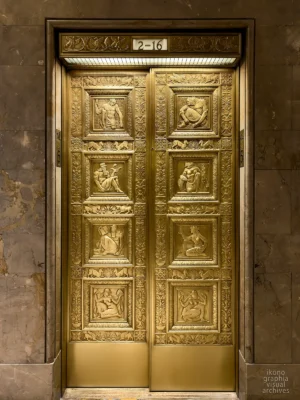
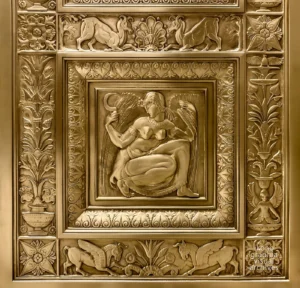
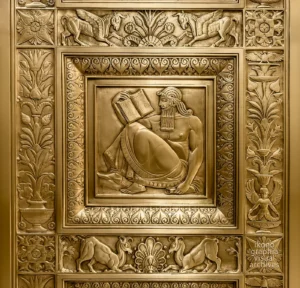
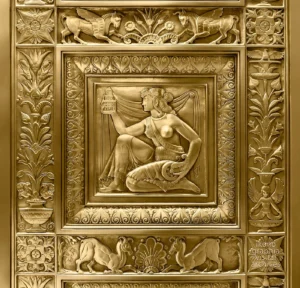
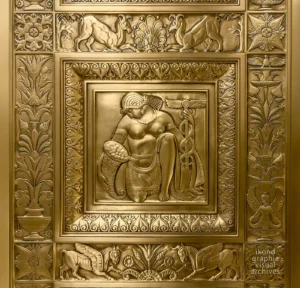
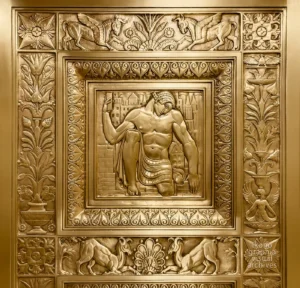
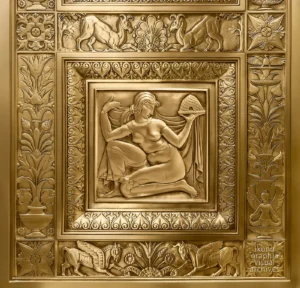
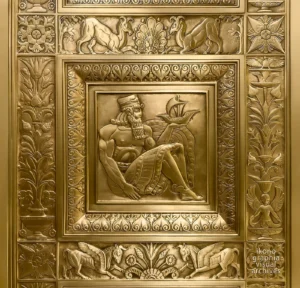
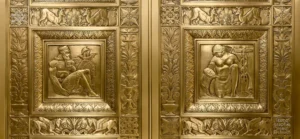
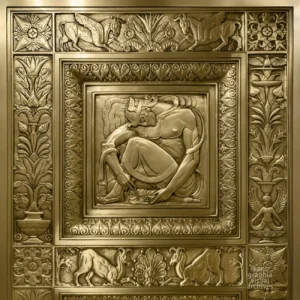
The Fred French Building, 1927. Architect H. Douglas Ives conceived a complete Mesopotamian environment for the lobby and assembled the hands capable of executing it. Vincent Glinsky created the bronze program: eight gilded elevator doors translating Fred French's four business pillars into a sculptural language drawn from ancient Mesopotamia, a monumental mailbox crowned with an American eagle, entrance reliefs dense with ancient Near Eastern imagery. Above, barrel-vaulted ceilings painted in gold, black, and vivid color continue the same visual language into mythology. A unified immersive space — the expression of a single vision.
Available Stories
- The City of Opportunity — Art Deco Grilles, Chanin Building, 1929
New York, 1929 — A City at Its Peak, Casting Its Ambitions in Bronze. - Art Deco Elevator Panels — Fred French Building, 1927 — Glinsky & Bach
Eight gilt-bronze elevator doors translating Fred French's four business pillars into a sculptural language drawn from ancient Mesopotamia. - When Babylon Met Fifth Avenue — Ives & Glinsky's Fred French Building, 1927 (forthcoming)
One architect's obsession with ancient Babylon. One sculptor's mastery in bronze. A New York landmark unlike any other.
The story places Glinsky's bronze griffins from the Fred French mailbox directly alongside their source: the stone reliefs of the Ishtar Gate at the Pergamon Museum in Berlin. The same creature. Four thousand years and six thousand kilometres apart. The comparison is exact.
Showing 1–12 of 23 resultsSorted by latest
-

The Symbolic Program — Elevator Doors, Fred French Building, New York
€95.00 -

The Harvester, Industry — Elevator Panel, Fred French Building, New York, 1927
€95.00 -

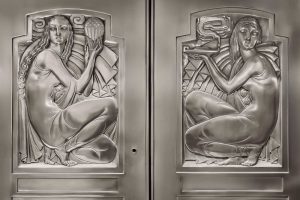
The March of Progress Elevator Doors — 20 Exchange Place, 1931
€95.00 -
The Wealth Bearer, Finance — Elevator Panel, Fred French Building, New York, 1927
€95.00 -
The Architect, Building — Elevator Panel, Fred French Building, New York, 1927
€95.00 -
The Wealth Bearer, Finance — Elevator Panel, Fred French Building, New York, 1927
€95.00 -
The Builder — Elevator Panel, Fred French Building, New York, 1927
€95.00 -
The Beekeeper, Commerce — Elevator Panel, Fred French Building, New York, 1927
€95.00 -
The Merchant, Commerce — Elevator Panel, Fred French Building, New York, 1927
€95.00 -

The Merchant & The Wealth Bearer — Art Deco Elevator Panels, Fred French Building, New York, 1927
€140.00 -

The Industrial Worker, Industry — Elevator Panel, Fred French Building, New York, 1927
€95.00 -

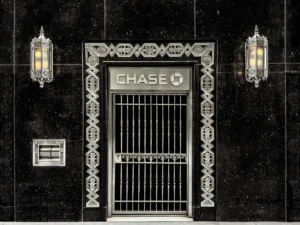
The NYC Art Deco Chase Bank Entrance, Chrysler Building (1930)
€95.00