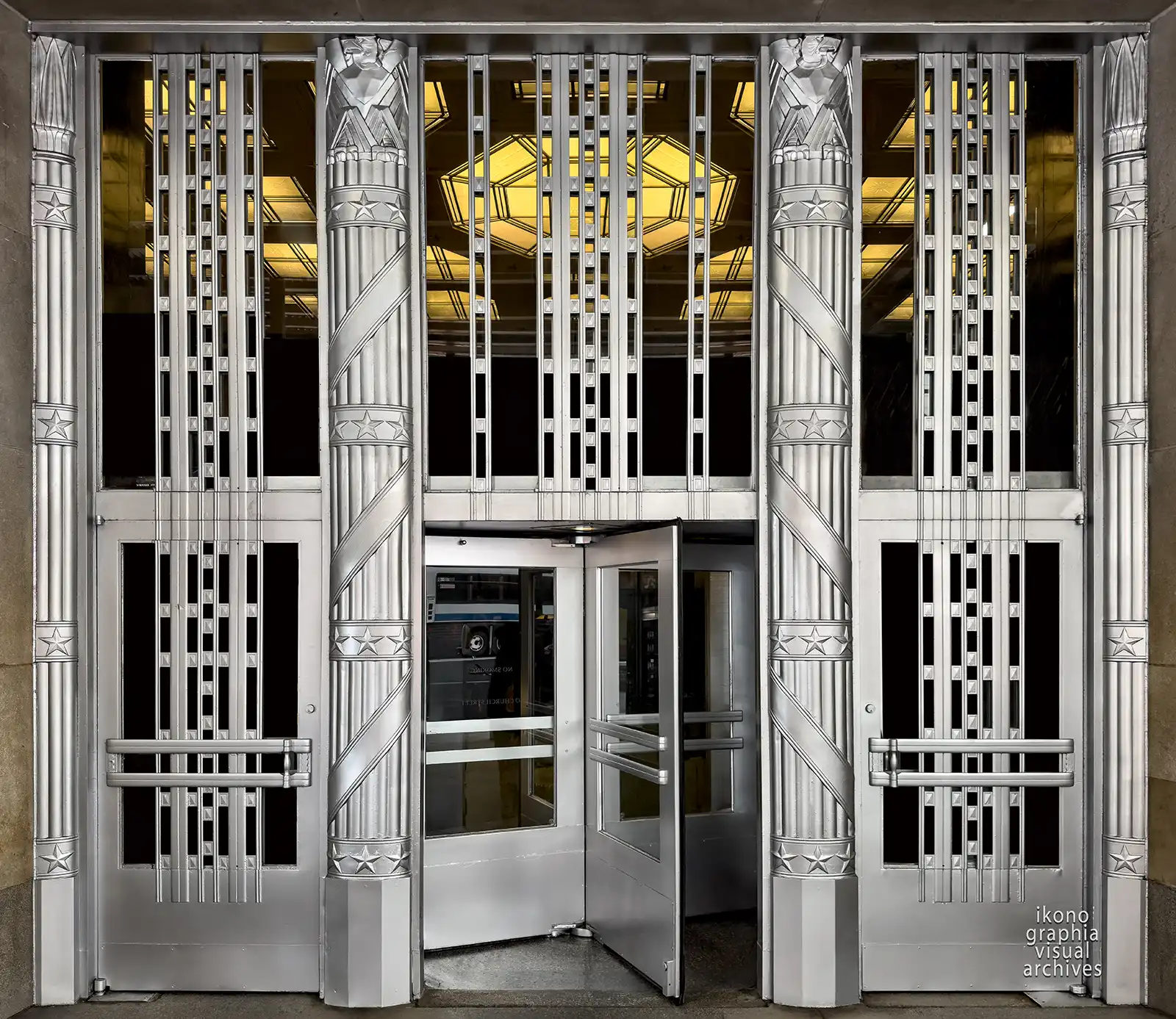
Federal Entrance — 90 Church Street, NYC, 1937 — Carl Paul Jennewein
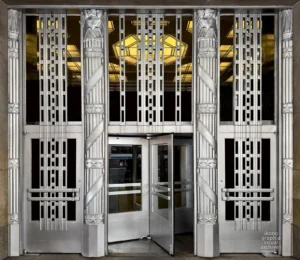
The aluminum grille frames the threshold between two worlds. Behind the POST·OFFICE lettering, the barrel vault of the public hall opens — chandelier visible at the end, the staircase rising. Dark marble on both sides, the aluminum screen above. Two registers of the same building, visible in a single frame.
Carl Paul Jennewein's decorative program runs through every surface — the grille, the lettering, the aluminum vocabulary that connects the federal lobby to the public post office. A building designed as a complete environment, from the street to the sorting room.
€95.00
Royalty-free JPG — 6858x5946px, 17.74MB.
© Ikonographia / Roberto Bigano
LICENSE TERMS
This image is provided under a royalty-free license by Ikonographia / Roberto Bigano. By purchasing and downloading this file, you are granted the following rights:
You May
- Use the image in print and digital media (books, magazines, websites, videos, educational materials, presentations, and advertisements).
- Use the image in editorial, corporate, or client work, including commissioned projects.
- Modify, crop, or combine the image with other elements for creative use.
- Create photographic prints for personal or internal company use only (display, offices, presentations).
You May Not
- Resell, redistribute, sublicense, or share the image file in any form that allows third-party access.
- Use the image in products for resale (prints, posters, merchandise, NFTs, templates, stock collections) without a separate extended license.
- Claim authorship of the image or remove copyright attribution.
Read our full Copyright & Licensing Policy for detailed information.
Copyright: © Ikonographia / Roberto Bigano. All rights reserved.
SUGGESTED USES
- Architecture and design publications.
- Educational materials or exhibitions.
- Interior design presentations and mood boards.
- Commercial, editorial, or creative projects.
Each download includes a royalty-free license for use in both print and digital media.
90 Church Street Federal Office Building, 1937 — Overview
The building stands at 90 Church Street in Lower Manhattan, completed in 1937 to designs by Cross & Cross. Built as a combined federal office building and public post office, it is infrastructure given the authority of a civic monument.
The facade makes Walker's — Cross & Cross's — argument from the street. Cast aluminum columns, star-banded and eagle-capped, announce federal authority before the door is reached. The building's skin combines limestone and aluminum — the modern metal of aviation and progress — in a deliberate statement about what the New Deal federal government stood for.
The Lobbies
Cross & Cross held that architecture should serve both function and symbolic purpose. The building demonstrates that conviction precisely: two distinct lobby environments — a federal office lobby and a public post office hall — each designed with the material richness appropriate to its function.
Dark green marble columns, aluminum screens, and terrazzo floors form a continuous surface system in which every element belongs to the whole. The decorative program was assigned entirely to Carl Paul Jennewein — the sculptor responsible for the complete program at the Department of Justice Building in Washington, D.C.
The Aluminum Program
Jennewein's most complete contribution at 90 Church Street is the aluminum decorative program — the element that defines the building before you enter it. Four entrance columns, star-banded and eagle-capped, cast in aluminum with a precision that stone cannot match. The vertical grilles, the screens, the door hardware — every metal surface part of a single decorative logic that runs from the street through every threshold.
Cast aluminum, not bronze: lighter, more precise, the metal of aviation and the New Deal era. The gold hexagonal ceiling blazes through the vertical grille from the street — the interior announcing itself before the door is reached. Authority stated before it is experienced.
Inside, the same vocabulary continues. The federal lobby: dark green marble columns with star capitals, aluminum screens behind. The post office entrance: the vertical grille carried inside, POST·OFFICE lettered in aluminum above the doors, a barrel vault beyond. Two separate spaces, one decorative intelligence.
The National Seal — War and Peace
Within that program, one element stands apart. The National Seal ceiling light — beveled crystal panels set in a bronze octagonal frame, backlit, installed in three identical lobbies — is Jennewein working in a different register entirely. The ceiling's geometric program mirrors the terrazzo and marble sunburst on the floor below. Light above, stone beneath, the same logic on both surfaces.
The central panel was designed to be reversed — the eagle facing either the olive branch or the arrows. War or peace, built into the architecture. In 1937, at the height of the New Deal, federal architecture carried political symbolism into its functional elements.
Day and Night
Two circular limestone reliefs on the facade complete the mythological frame. Day — a dynamic winged male figure — represents the vigor of federal service. Night — a winged female in repose — represents the oversight that continues after the workday ends. Both figures are winged — the 1930s obsession with aviation embedded into the permanent stone of a government building.
Leading architect and building design: Cross & Cross — Decorative program: Carl Paul Jennewein.
Available Stories
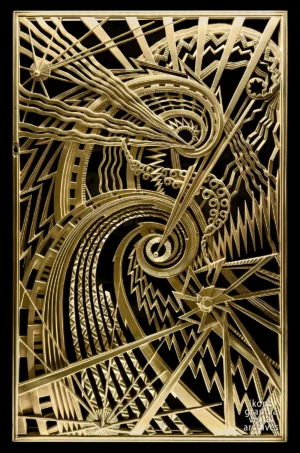
- The City of Opportunity — Art Deco Grilles, Chanin Building, 1929
New York, 1929 — A City at Its Peak, Casting Its Ambitions in Bronze. - Art Deco Elevator Panels — Fred French Building, 1927 — Glinsky & Bach
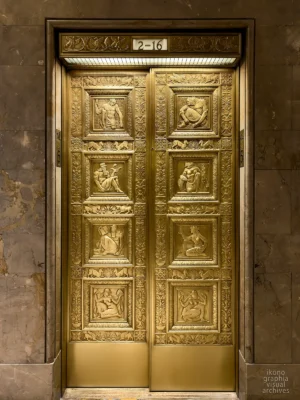
Eight gilt-bronze elevator doors translating Fred French's four business pillars into a sculptural language drawn from ancient Mesopotamia. - When Babylon Met Fifth Avenue — Ives & Glinsky's Fred French Building, 1927 (forthcoming)
One architect's obsession with ancient Babylon. One sculptor's mastery in bronze. A New York landmark unlike any other.
Browse the New York City Art Deco Archive
-

The Symbolic Program — Elevator Doors, Fred French Building, New York
€95.00 -

The Scholar Elevator Panel — Fred French Building, New York, 1927
€95.00 -

Art Deco Allegory of Effort — Gilded Grille, Chanin Building, New York, 1929
€95.00 -

Federal Entrance — 90 Church Street, NYC, 1937 — Carl Paul Jennewein
€95.00