Art Deco Elevator Panels — Fred French Building, 1927 — Glinsky & Bach

Art Deco Elevator Panels — Fred French Building, 1927 — Glinsky & Bach

Art Deco Elevator Panels — Fred French Building, 1927 — Glinsky & Bach

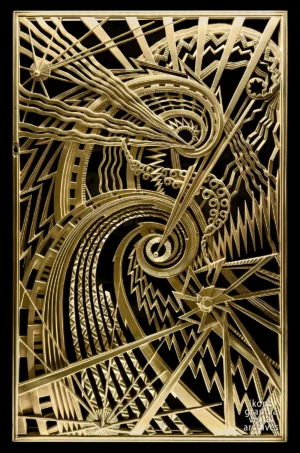
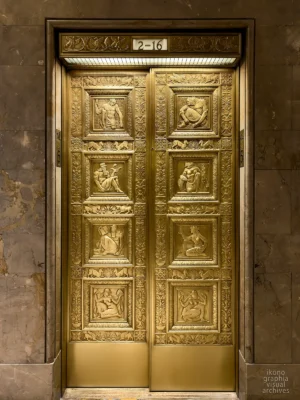
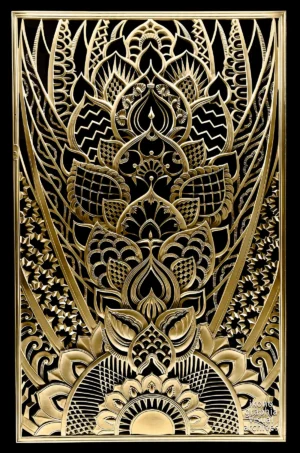
Eight gilt bronze panels — Industry, Commerce, Finance, and Building — conceived as a unified iconographic program.

A rare surviving ensemble of gilt bronze panels created in 1927 by Vincent Glinsky and Oscar Bach.
These elevator doors visualize the four pillars of Fred F. French’s real-estate empire—Industry, Commerce, Finance, and Building—through a sculptural language rooted in Art Deco geometry and documented Babylonian sources.
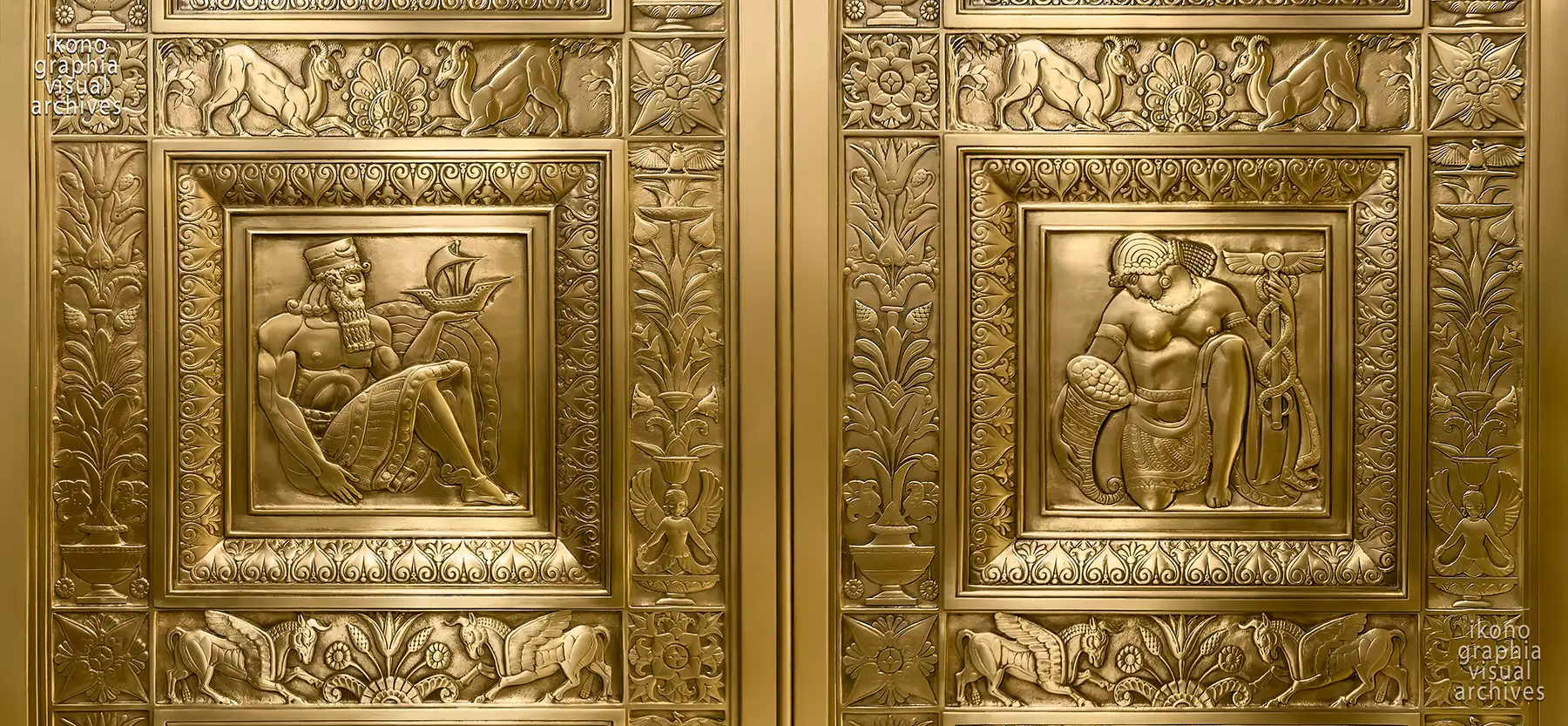
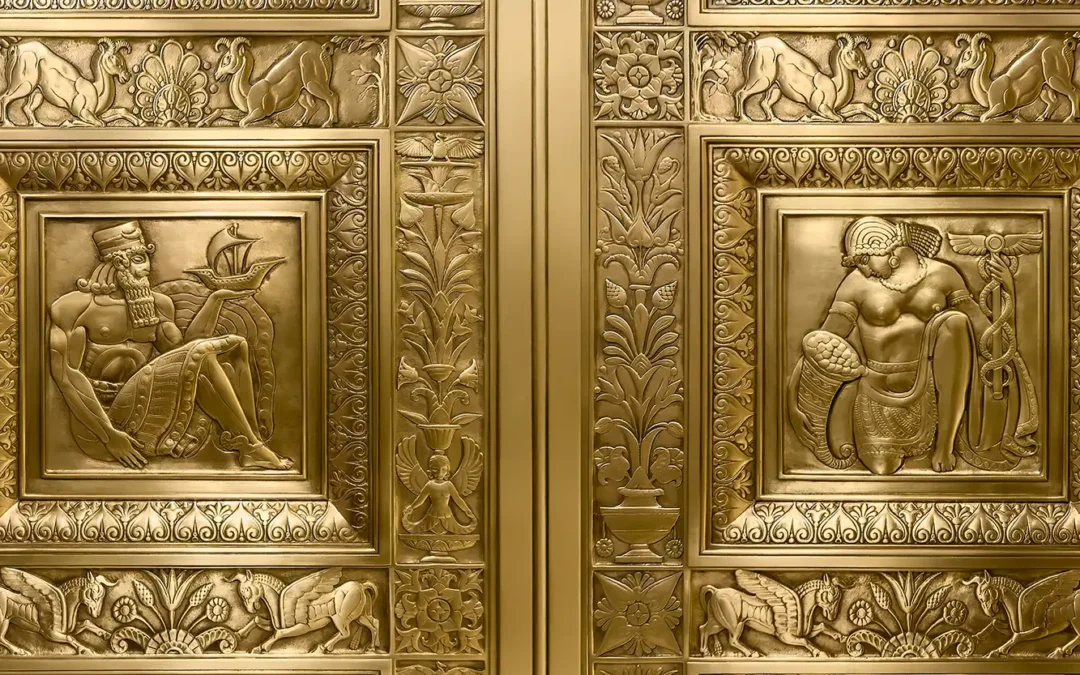
The Merchant and The Wealth Bearer — Art Deco elevator panels, Fred French Building, New York, 1927 — Glinsky & Bach

Completed in 1927, the Fred F. French Building stands as one of Manhattan’s finest expressions of the early Art Deco style. While the tower is admired for its stepped crown and gilded ornament, its most exceptional artworks lie hidden in the lobby: eight bronze elevator panels conceived by sculptor Vincent Glinsky and master metalworker Oscar Bach.

Commissioned to embody the vision of developer Fred Fillmore French, these doors translate the essential forces driving New York’s rise—labor, trade, wealth, and architecture—into a sophisticated visual program. Their hybrid style reflects Classical allegory, modern stylization, and the direct influence of Babylonian and Chaldean sources — documented by architect H. Douglas Ives in his own writing before a single panel was cast.
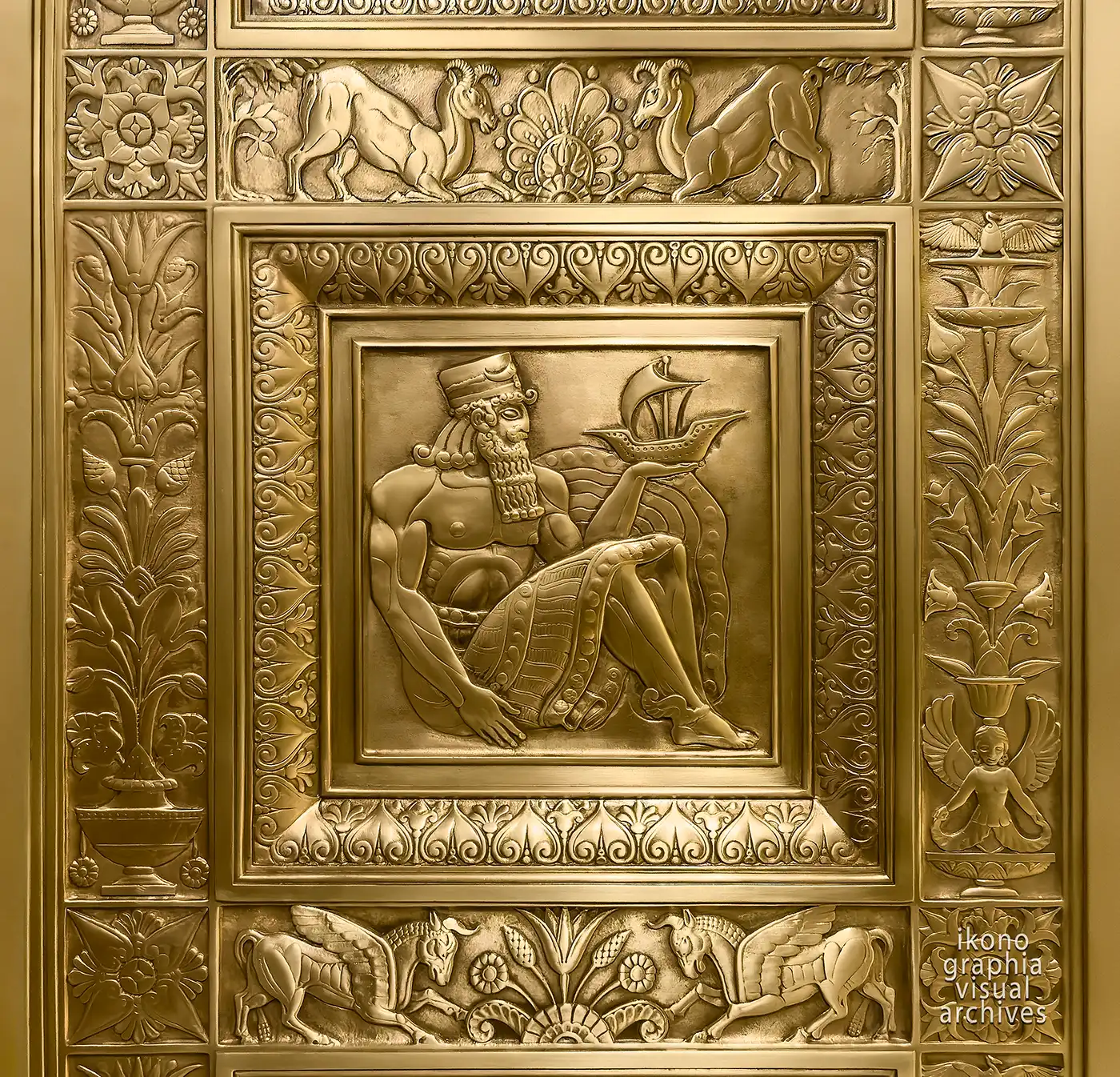
Allegory of Trade — The Merchant — Art Deco Elevator Panel, Fred French Building, New York — 1927 — Glinsky & Bach

The Merchant — Commerce.

Symbolizing maritime trade and international exchange.

Holding a ship in his hand, the bearded figure embodies maritime trade — the engine of international commerce in the early twentieth century.

His confident pose and the ship he carries identify him directly — a Mesopotamian merchant prince, translated into gilt bronze by Glinsky following Ives's documented sources.
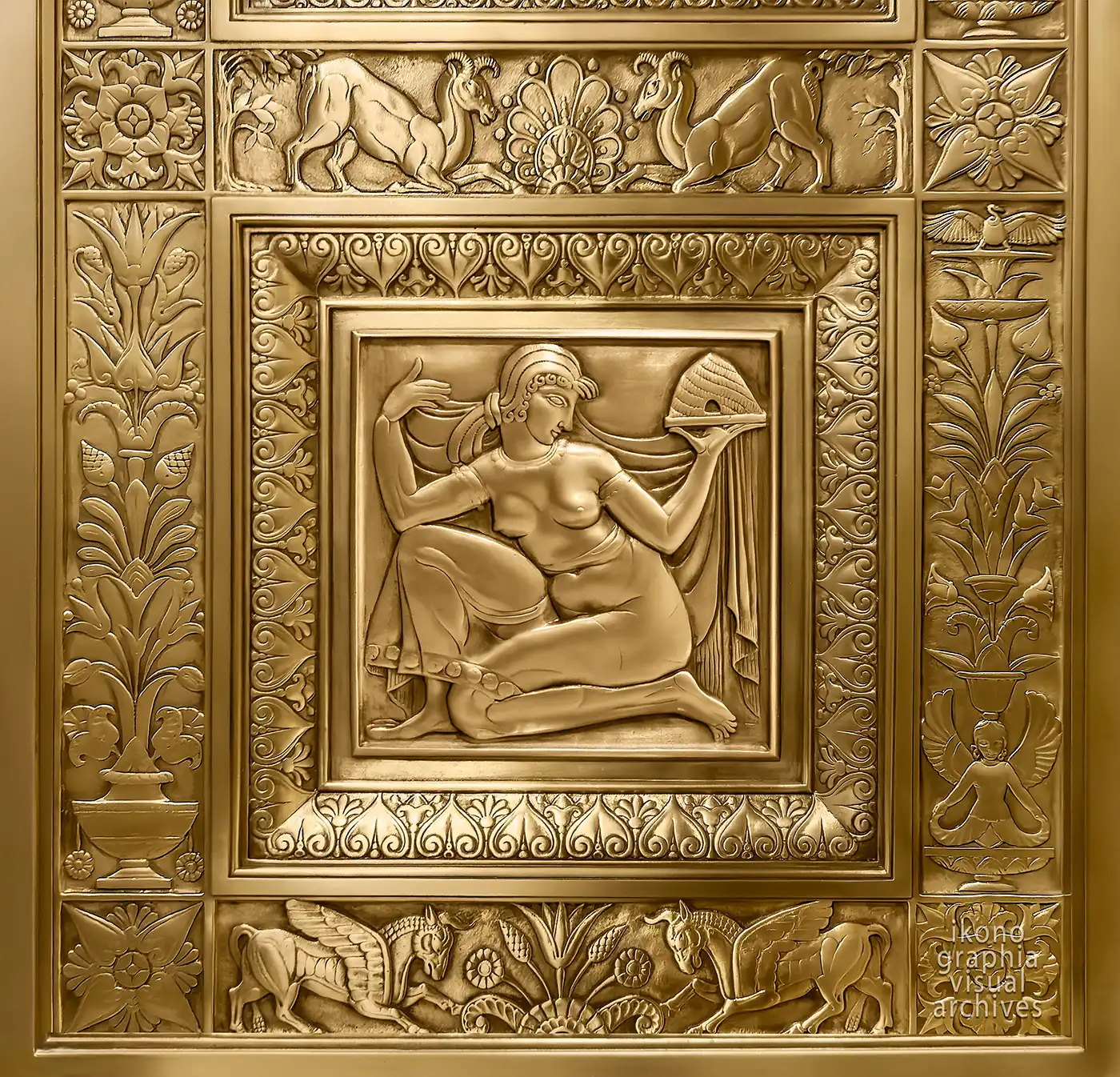
The Beehiver — Art Deco elevator panel, Fred French Building, New York, 1927 — Glinsky & Bach

The Beekeeper — Commerce.

Symbolizing industriousness, shared enterprise, and the organization of commerce.

A seated woman holds a beehive — the ancient emblem of collective effort and the wealth that organized labor produces.

Her pose and adornment place her within the same Babylonian visual tradition as the panels around: composed, frontal, deliberate. Commerce rendered not as transaction but as civilization.

The Artists & The Style

Glinsky & Bach: Sculptor and Metalwork Virtuoso.

Vincent Glinsky shaped the narrative sequences in low relief, giving the figures a compact mass and rhythmic energy typical of early Deco sculpture. Oscar Bach realized the panels in gilt bronze, applying the refined technical methods that made him one of the pre-eminent metalworkers of his era.

Together, they produced one of the most complete and coherent decorative cycles in American Art Deco. The vertical registers, crouching beasts, muscular torsos, and geometric borders follow a visual language Ives had studied directly — the Ishtar Gate of Babylon, reconstructed at Berlin's Pergamon Museum in the early twentieth century, and the enameled brick of ancient Chaldea. The source was not general fascination. It was specific research, translated into bronze.
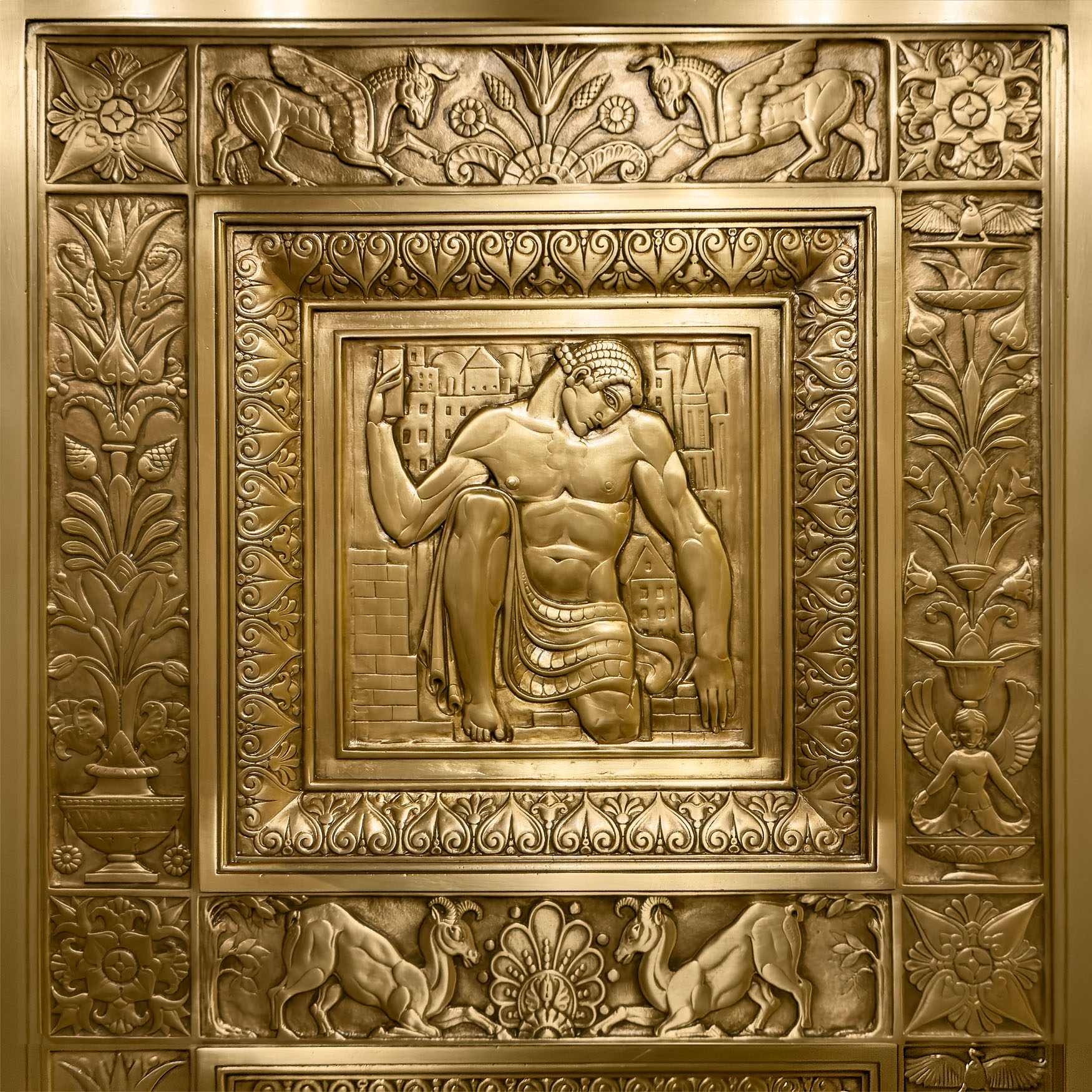
The Builder — Building.

Symbolizing skilled craft, technical mastery, and urban growth.

A kneeling figure, powerfully built, bends over his work with concentrated force — the architecture of the city rising behind him.

Where The Merchant carries trade and The Beehiver holds its product, the Builder is defined entirely by his labor. The body is the instrument. Glinsky's modelling here is at its most physical — the weight of the figure fully committed to the act of construction.
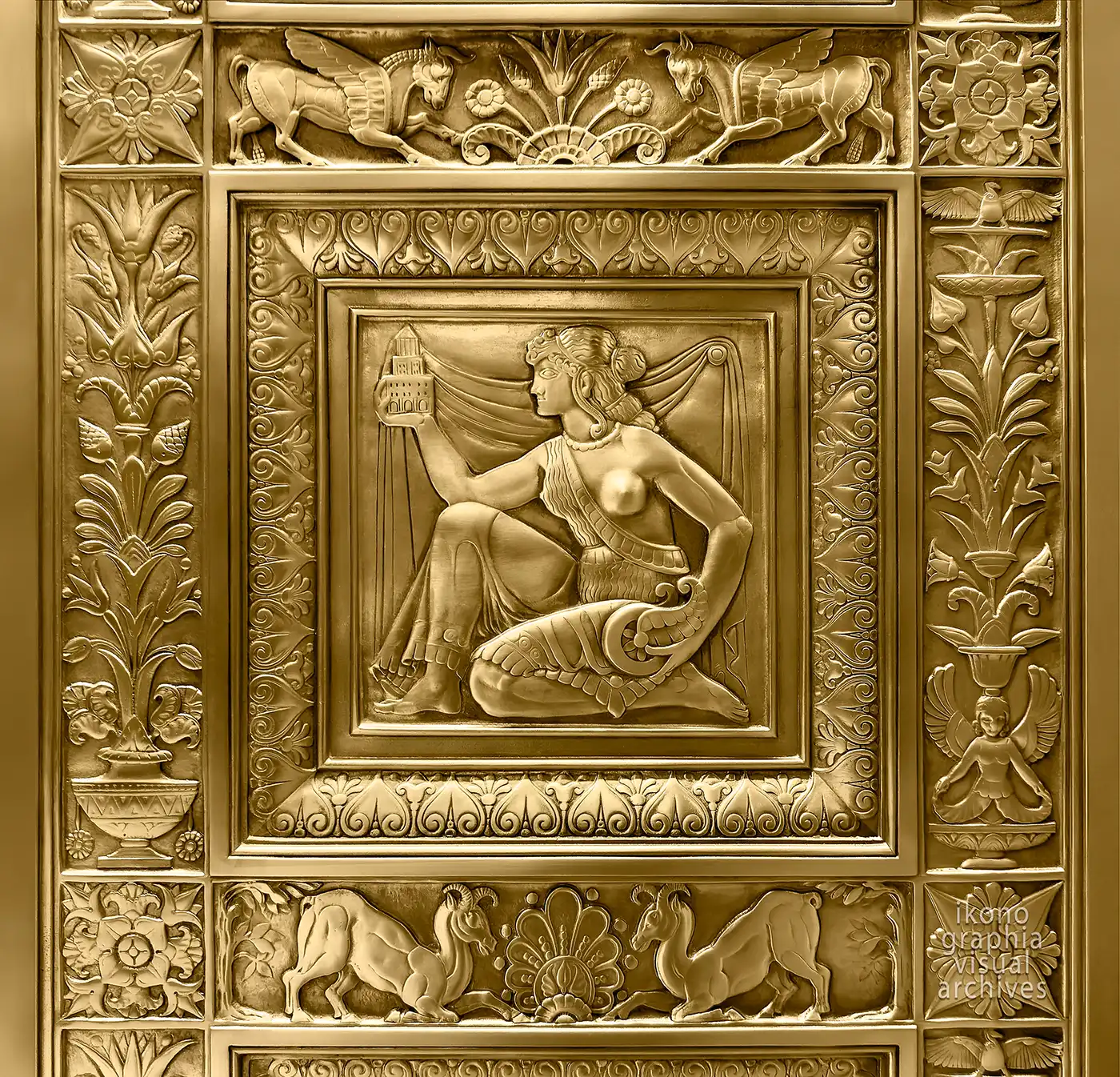
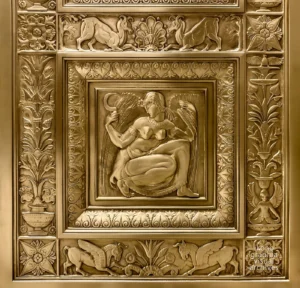
Allegory of Design — The Architect — Art Deco Elevator Panel, Fred French Building, New York — 1927 — Glinsky & Bach

The Architect — Building.

Symbolizing design, planning, and architectural vision.

A seated female figure holds a miniature building raised in her hand — the classical pose of the architect-as-creator, the city held and commanded rather than built by hand. Her posture is composed, her gaze inward.

Where the Builder is all physical effort, the Architect is stillness and conception. Together they complete Building's two movements: the idea and the labor that executes it.

The Four Pillars

Industry, Commerce, Finance, and Building.

Each elevator panel embodies one of the four sectors central to the French Companies:
 Industry — strength, engineering, infrastructure
 Commerce — exchange, trade, and refined goods
 Finance — wealth, investment, administration
 Building — architecture, planning, construction

Though allegorical, the imagery was designed for instant legibility. These were the forces shaping New York in the 1920s: the labor that built the skyline, the commerce animating Fifth Avenue, the financial system behind every development, and the architectural vision that defined modern urban life.
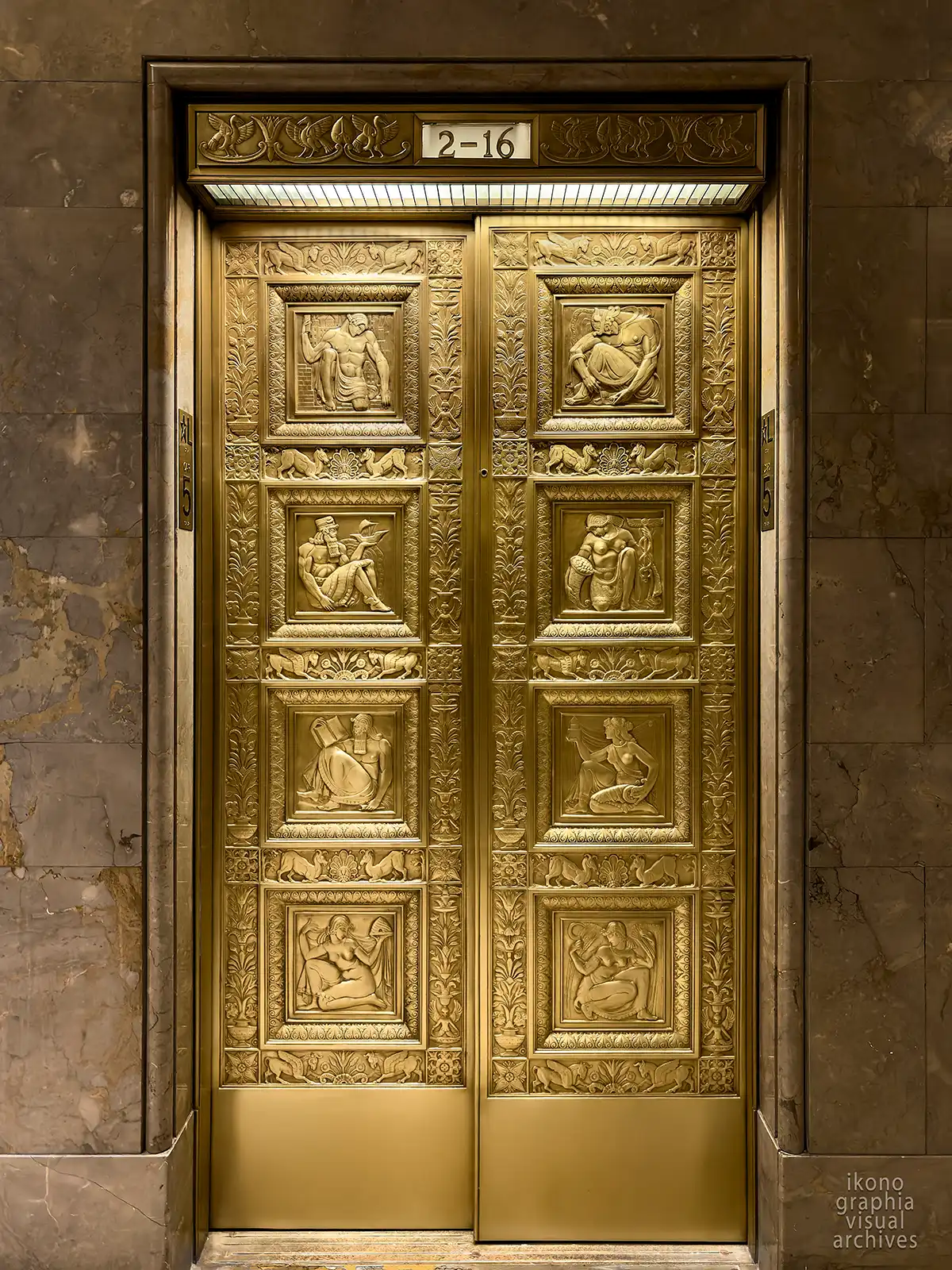
The Symbolic Program — Elevator Doors, Fred French Building, New York, 1927.

A complete symbolic program:
Commerce, Industry, Finance, and Building.

The eight gilded panels of the Fred French Building lobby — a sculptural cycle honoring the forces that powered New York's 1920s rise.

The arrangement is graphically balanced, not thematically ordered: the eye moves across figures and ornament before resolving into program. Ives's logic reveals itself slowly — four themes, eight figures, one coherent argument about what a city is and what sustains it.

The most complete Mesopotamian-themed decorative cycle in American Art Deco.
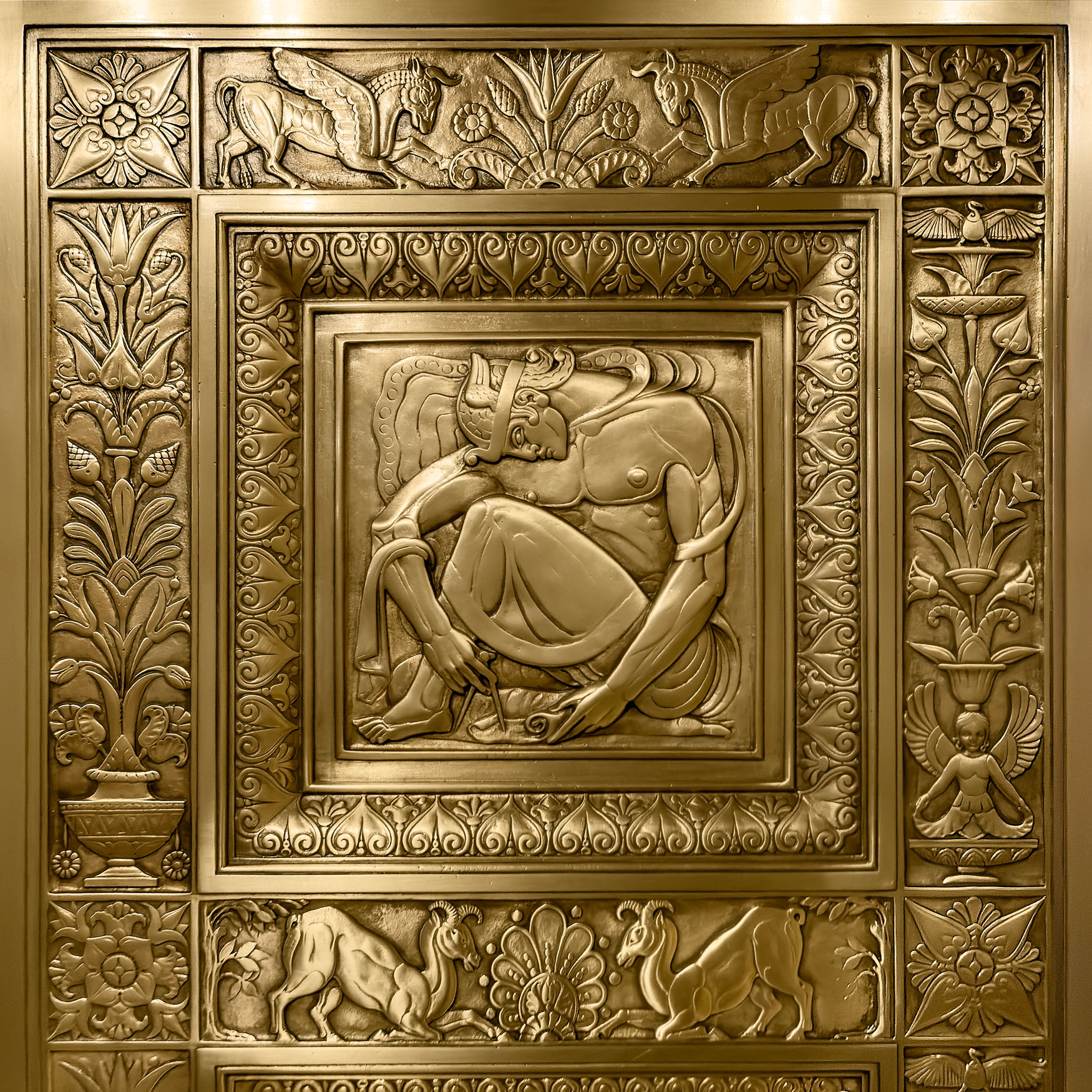
The Industrial Worker — Industry.

Symbolizing labor, engineering, and the infrastructure of the modern city.

A muscular figure crouches over his work, the full weight of his body engaged.
Where the Architect conceives and the Builder constructs, the Industrial Worker powers the infrastructure beneath both.

New York's modernization — its utilities, transport, and rising skyline — ran on this kind of labor. Glinsky gives it the same dignity as the figures of commerce.
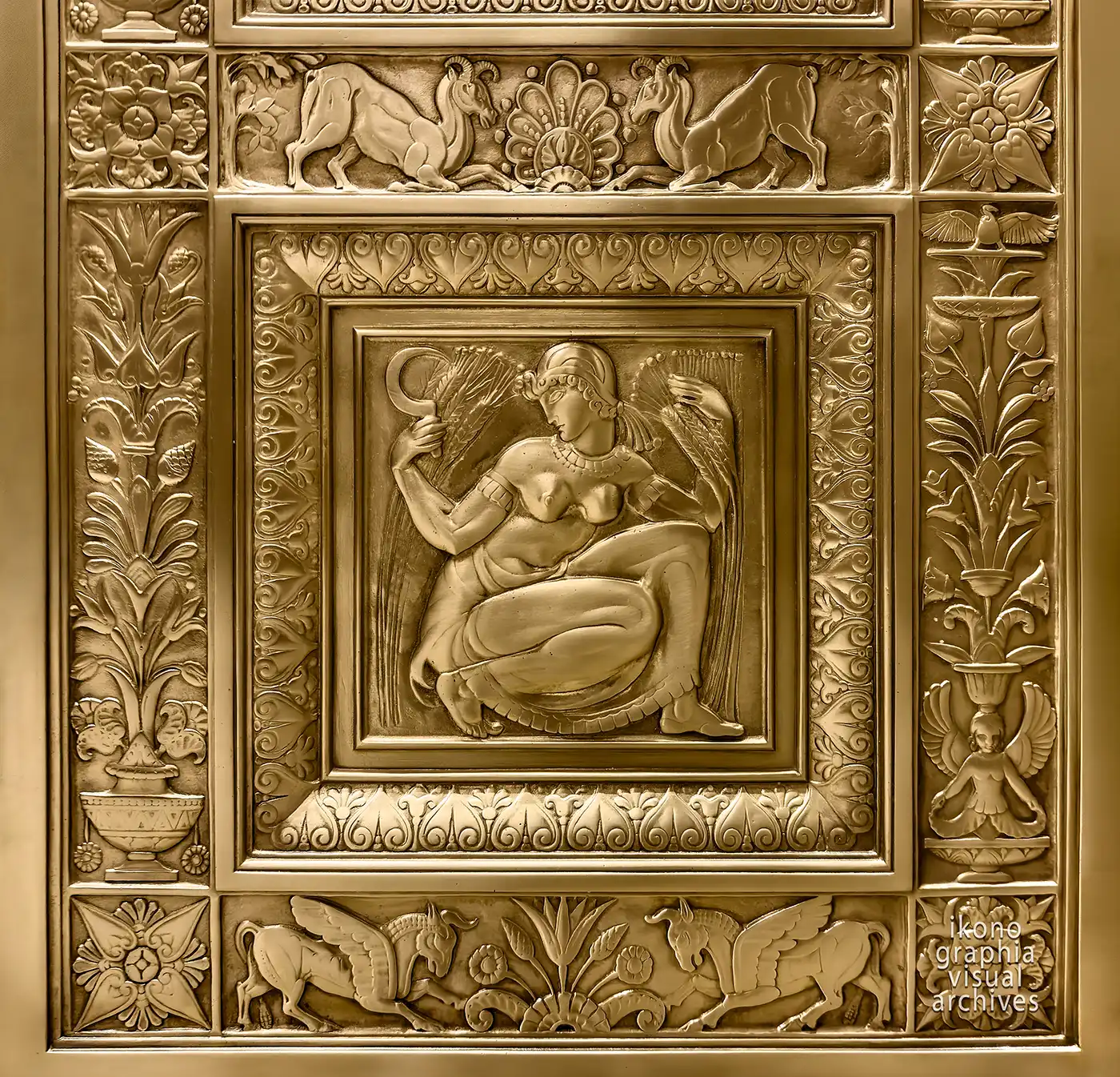
Art Deco allegory of agriculture — The Harvester Industry Elevator Panel, Fred French Building, New York, 1927. Gilt bronze relief by Vincent Glinsky and Oscar Bach.

The Harvester — Industry.

Symbolizing production, agriculture, and foundational industry.

A reclining female figure holds a bundle of wheat and a crescent sickle — the oldest symbols of harvest, drawn directly from the Mesopotamian tradition Ives had studied.

Industry here is not mechanical but elemental. Before the city rises, the land must yield. Glinsky places her with the same authority as the figures of commerce — the foundation that makes everything above possible.
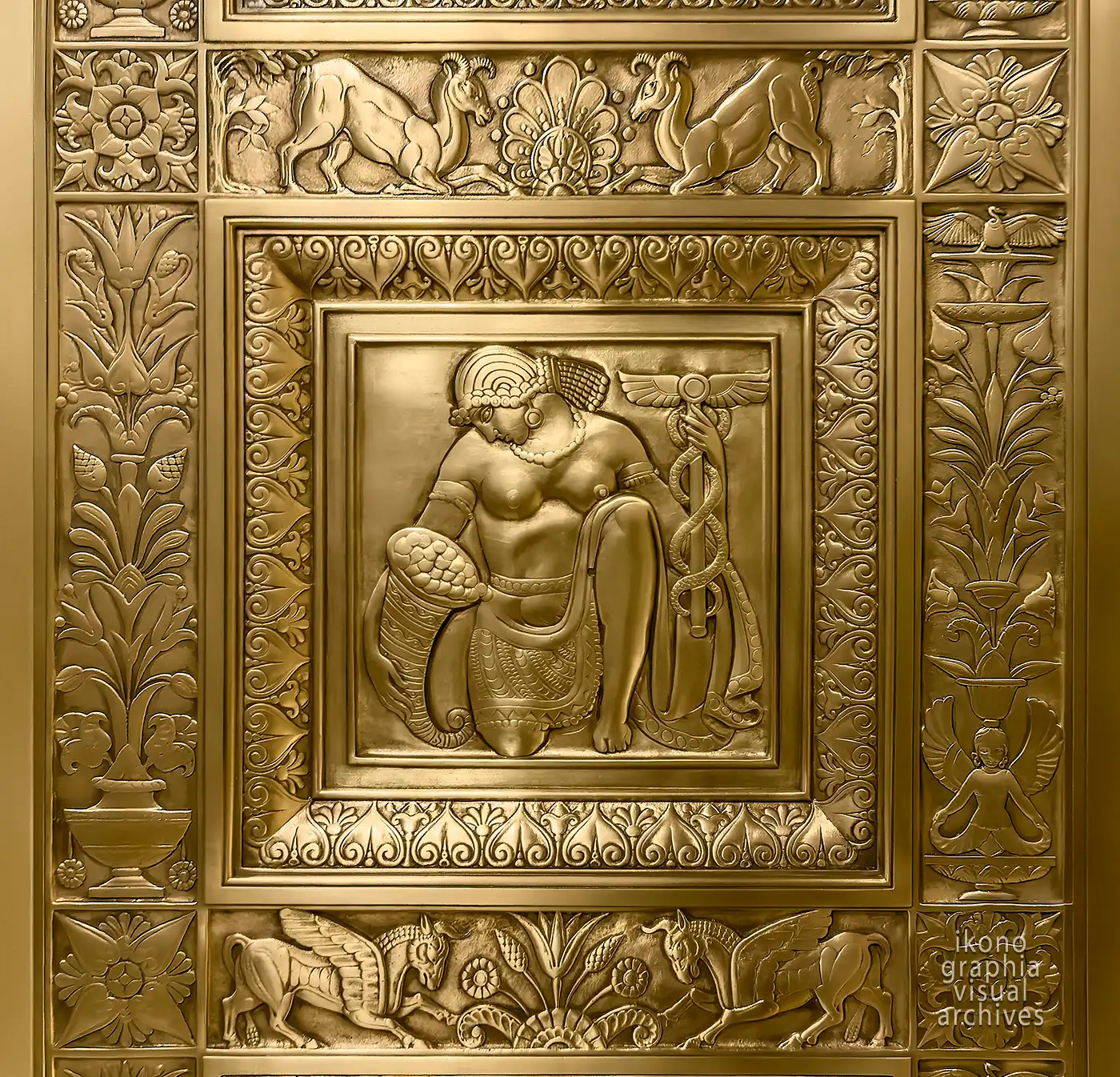
Allegory of Prosperity — The Wealth Bearer — Art Deco Elevator Panel, Fred French Building, New York — 1927 — Glinsky & Bach

The Wealth Bearer — Finance.

Symbolizing prosperity generated through investment and trade.

A seated figure holds a cornucopia and a caduceus — abundance in one hand, the instrument of exchange in the other. The objects are precisely chosen: not wealth accumulated, but wealth in motion.

Finance here is presented as a creative force, not a passive one. The building it occupies was itself a monument to that conviction — Fred French's own statement that capital, directed with ambition, builds cities.
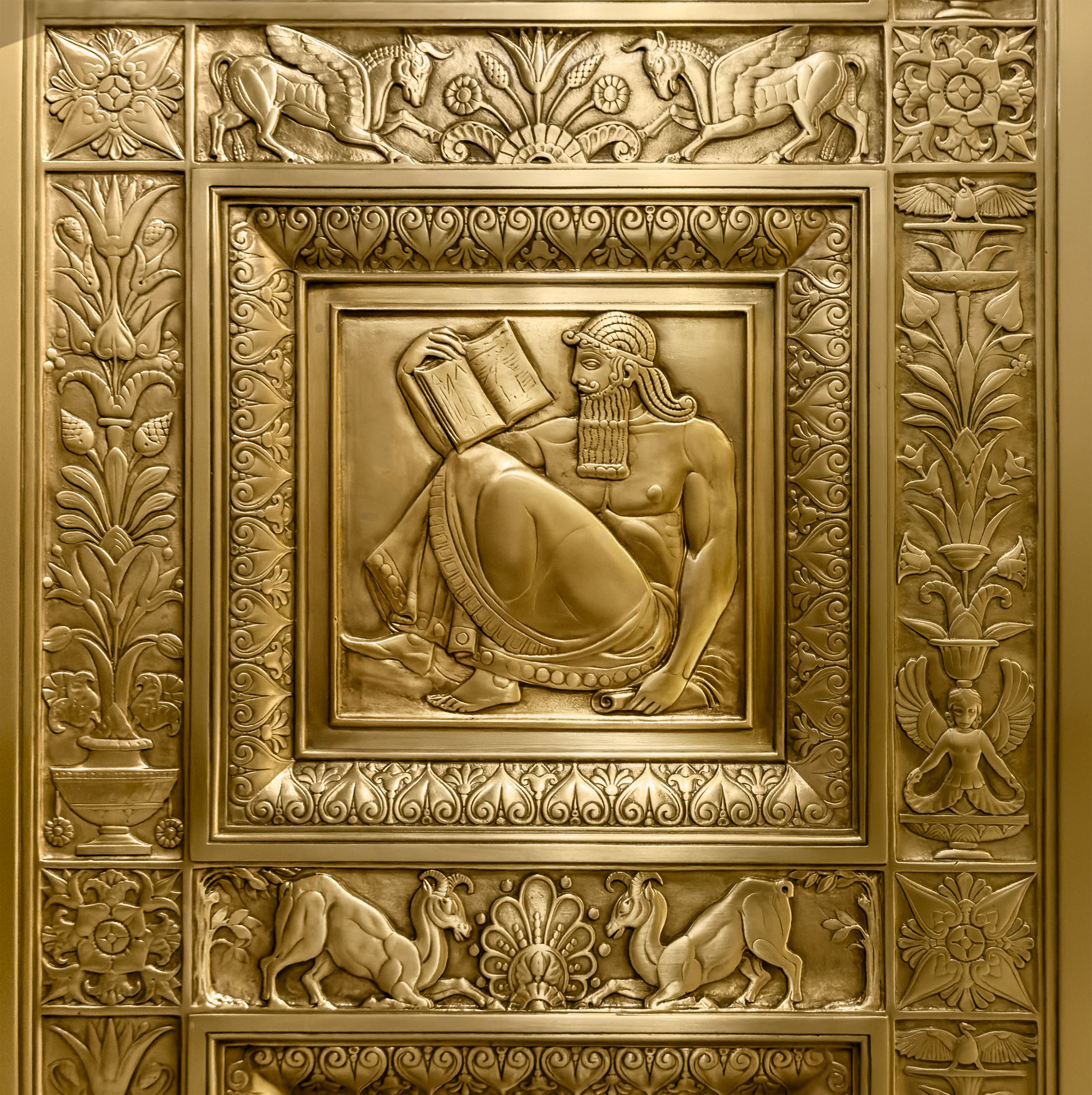
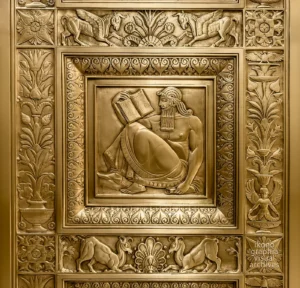
The Scholar — Finance.

Symbolizing knowledge, law, and administrative order.

A bearded figure holds an open tablet close to his face, absorbed in the text — the only figure in the program who reads, not acts, not carries.

Finance rests on law, record, and precedent. Where The Wealth Bearer puts capital in motion, the Scholar is the system that governs it — the written framework without which no transaction holds.
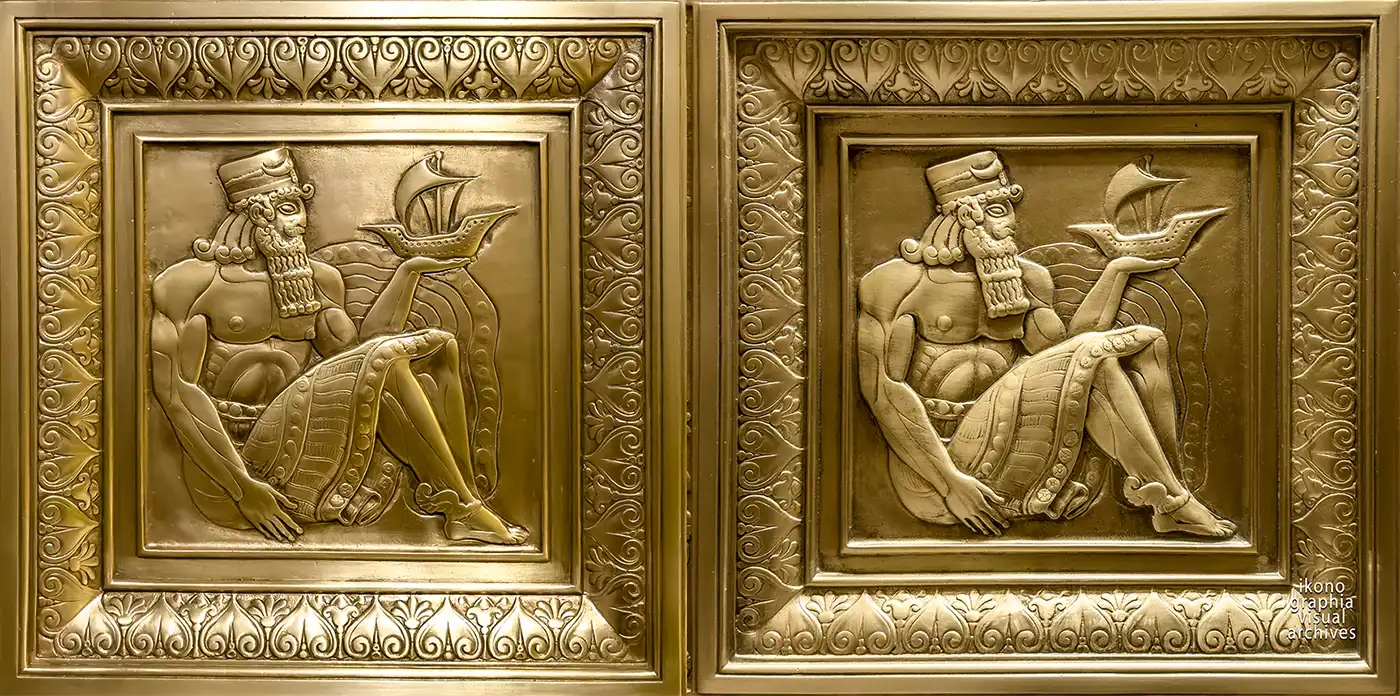
Two lighting conditions comparison — Elevator door panel, Fred French Building, New York, 1927.

The Elevator Doors Enigma — One Century Apart

The Merchant, from two different elevator doors, as shot — two entirely different surfaces, texture, color, with tones virtually inverted. The gilded coating makes the intent legible: a surface designed to hold light. Which rendition reflects Ives and Glinsky's original intent? The darker reading, however compelling, works against the material logic of the object.

On the Photographs

Eight doors. Forty versions. Three months.

These photographs were made in available light. Eight elevator doors line the lobby, sixty-four panels in total — the same subject, across different doors, produces entirely different surfaces, texture, color, with tones sometimes inverted. The only certain element was the light from above, embedded in the original design. Every additional light source introduced over a century was a question mark. Which one is closer to Ives and Glinsky's original intent was the editorial question.

Each door was documented as a complete object, the individual panels photographed separately. The tool that made this possible was an iPhone 15 Pro Max. Unobtrusive in a working lobby, it allowed multiple versions of each subject to be produced rapidly in the available light of the lobby. Imperfections in the files were compensated by the exceptional rendition of Apple ProRAW on gilt bronze.

Back at the desk, the range of versions — sometimes inverted in light and tone — became a tool for interpretation. The gilded coating makes the intent legible: a surface designed to hold light. The darker readings, however compelling, work against the material logic of the object. Choosing which version best served that intent was a subjective editorial decision. These photographs are an interpretation, a decoding attempt, not a record.

The Merchant and The Wealth Bearer were published full page in FMR Magazine. It was the first time in decades Roberto Bigano had worked without a Multi-Shot Hasselblad reproducing works of art.

CODA — A Declaration in Bronze

The elevator doors of the Fred French Building remain among the best-preserved Art Deco bronzes in Manhattan. The program has not dated — the symbolism is as legible today as it was in 1927.

In an ordinary lobby, the elevator is a utility. Here it is an argument — about what commerce is, what a city requires, and what ambition looks like when cast in gilt bronze.
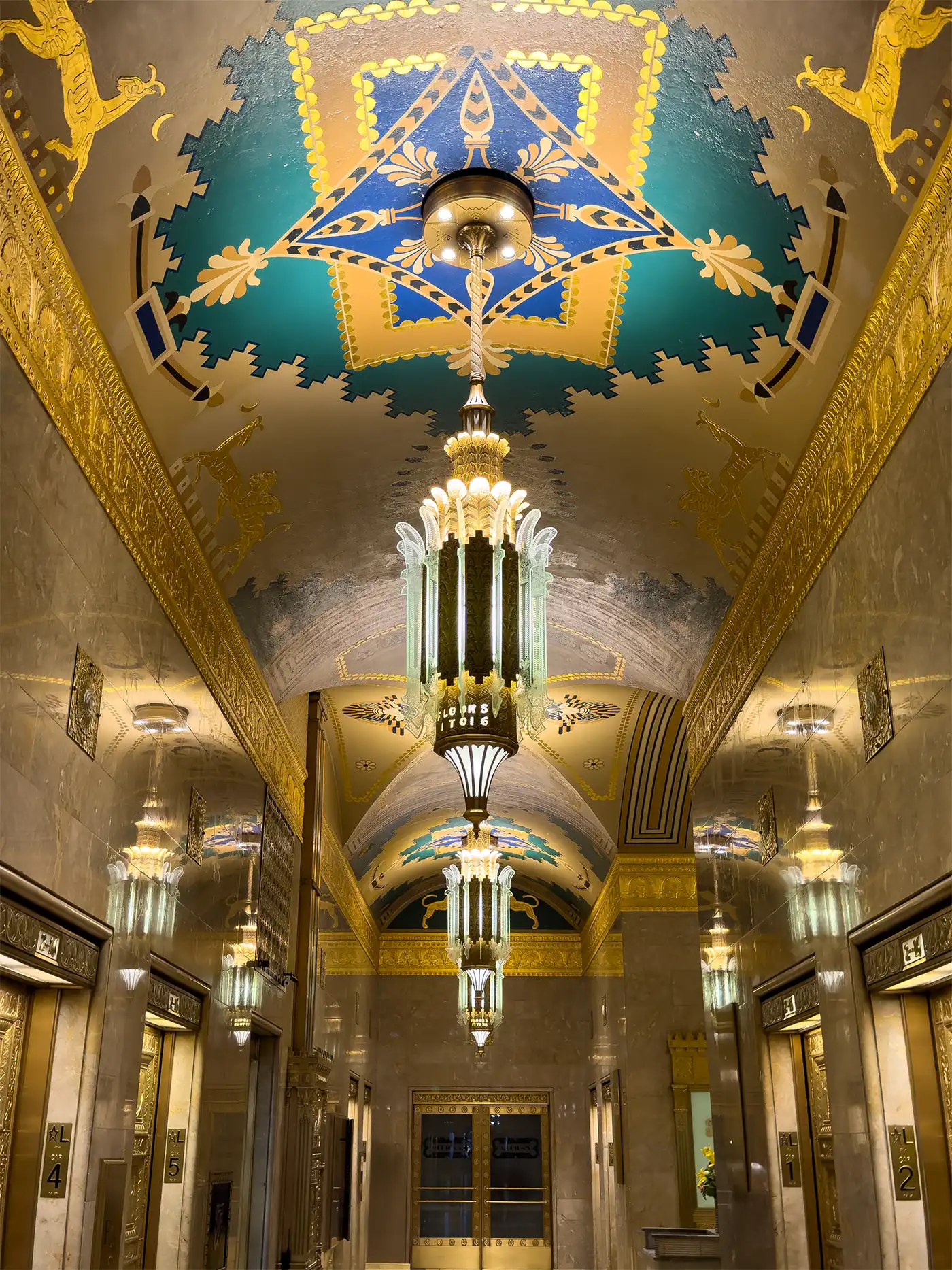
The Elevator Lobby.
Architecture as procession.

This view reveals the French Building's elevator lobby as a carefully staged passage: marble surfaces, gilded doors, and a richly painted ceiling guiding visitors toward the vertical heart of the building.

Light fixtures and ornament establish a measured rhythm, framing the elevators not as utilities but as destinations. The lobby does not simply connect — it prepares.

About Vincent Glinsky. A short bio.

Vincent Glinsky

Vincent Glinsky

Vincent Glinsky (1895–1975) was a Russian-born American sculptor whose work fused Beaux-Arts training with the emerging modernist vocabulary of the 1920s and 1930s. Educated in Petrograd and later active in New York, he developed a sculptural language marked by precise anatomies, architectural clarity, and an expressive narrative sense ideal for architectural relief.

His most ambitious commission, under the direction of architect H. Douglas Ives, was the bronze program for the Fred French Building on Fifth Avenue (1927) — eight gilded elevator panels, a monumental mailbox, and entrance reliefs forming the most complete Mesopotamian-themed decorative cycle in American Art Deco.

Realized in gilt bronze by master metalworker Oscar Bach, the panels translate four allegorical themes — Industry, Commerce, Finance, and Building — into a unified sculptural sequence of exceptional refinement. They remain the definitive example of his work at architectural scale, and among the finest surviving bronzes of the Art Deco era in New York.

About Oscar Bach. A short bio.
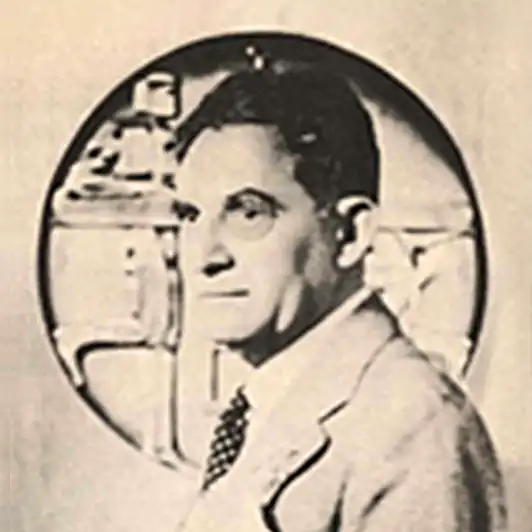
Oscar Bach

Oscar Bach

Oscar Bach

Oscar Bach was a German-born master metalworker whose technical innovation shaped some of the most celebrated interiors of early twentieth-century America. Trained in the European guild tradition, he brought exceptional skill in architectural bronze, iron, and nickel-silver to the United States after emigrating in 1911.

Working from his New York studio, Bach produced metalwork for major skyscrapers, department stores, civic buildings, and luxury residences. His commissions include the Empire State Building — where he executed the monumental Art Deco aluminum mural in the Fifth Avenue lobby — and Radio City Music Hall, where he realized the three eighteen-foot relief sculptures on the 50th Street facade in collaboration with artist Hildreth Meière. His style combined Old World ornament with modern geometric clarity, defining a distinctive branch of American Art Deco. His workshop became synonymous with excellence in decorative metal, leaving a legacy preserved in landmarked interiors across the country.

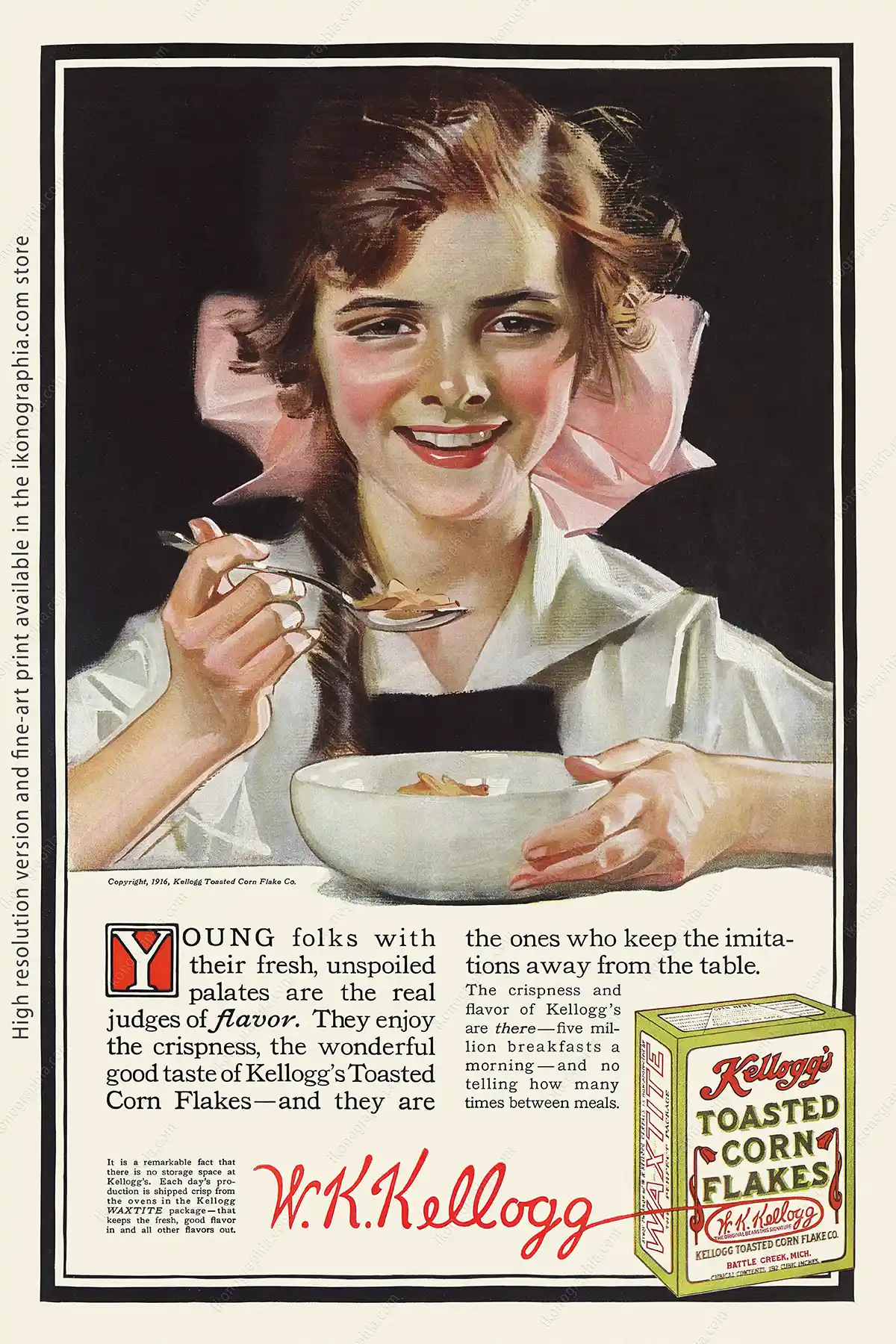
The Kellogg Kids, by Leyendecker. Corn Flakes Ads 1916-1917

The Kellogg Kids, by Leyendecker. Corn Flakes Ads 1916-1917

Roberto Bigano

Jul 30, 2025

J.C.Leyendecker-Kellog's-Kid

Joseph Christian Leyendecker


Joseph Christian Leyendecker was one of the most prominent and financially successful freelance commercial artists in the United States. From 1895 to 1951, he created hundreds of magazine covers for "Collier's Weekly" and "The Saturday Evening Post," as well as advertisements for prominent brands such as Kellogg's Corn Flakes, Kuppenheimer, and Arrow shirts. This last work is particularly famous, as it helped establish an iconic image of sophisticated American masculinity.
Leyendecker was also one of the few openly gay artists working in the United States during the early twentieth century.

Leyendecker's Young girl judging the flavor and crispness of flakes. Kellogg's ad, 1916

"Young folks with their fresh, unspoiled palates are the real judges of flavor. They enjoy the crispness, the wonderful good taste of Kellogg's Toasted Corn Flakes—and they are the ones who keep the imitations away from the table."

Advertisement for Kellogg's Corn Flakes.
Artwork by Joseph Christian Leyendecker.

Ladies’ Home Journal, February 1916

Leyendecker kids' illustration for Kellogg's Cornflakes, 1916 and 1917.


We showcase here Leyendecker's illustration for Kellogg's Corn Flakes' advertising campaign, which ran in the Ladies' Home Journal magazine in 1916 and 1917.
The extremely vivid illustrations convey positivity, health, and joy.
His illustration technique was remarkable, often utilizing complementary colors such as magenta/green, which reminds us of Italian late Middle Ages masters like Giotto, as shown in some close-ups.

It is notable for being one of the first advertising campaigns (together with Queen City Inks and Overland) to maintain a consistent corporate image.

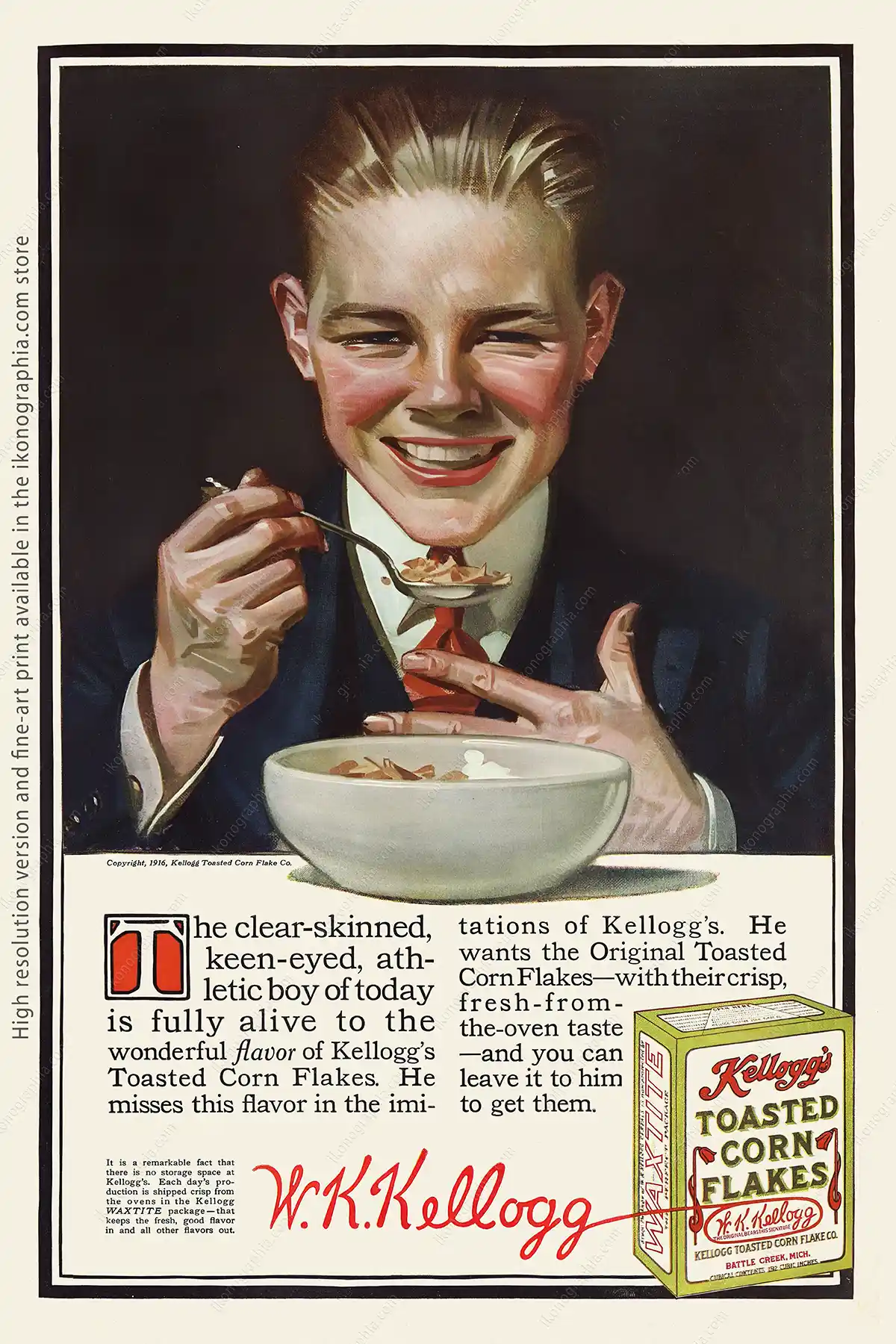
Leyendecker's clear-skinned boy enjoying corn flakes with milk. Kellogg ad, 1916 Advertisement for Kellogg's Corn flakes. Artwork by Joseph Christian Leyendecker. Ladies' Home Journal, March 1916

"The clear-skinned, keen-eyed, athletic boy of today is fully alive to the wonderful flavor of Kellogg's Toasted Corn Flakes."

Advertisement for Kellogg’s Corn Flakes.
Artwork by Joseph Christian Leyendecker.

Ladies’ Home Journal, March1916

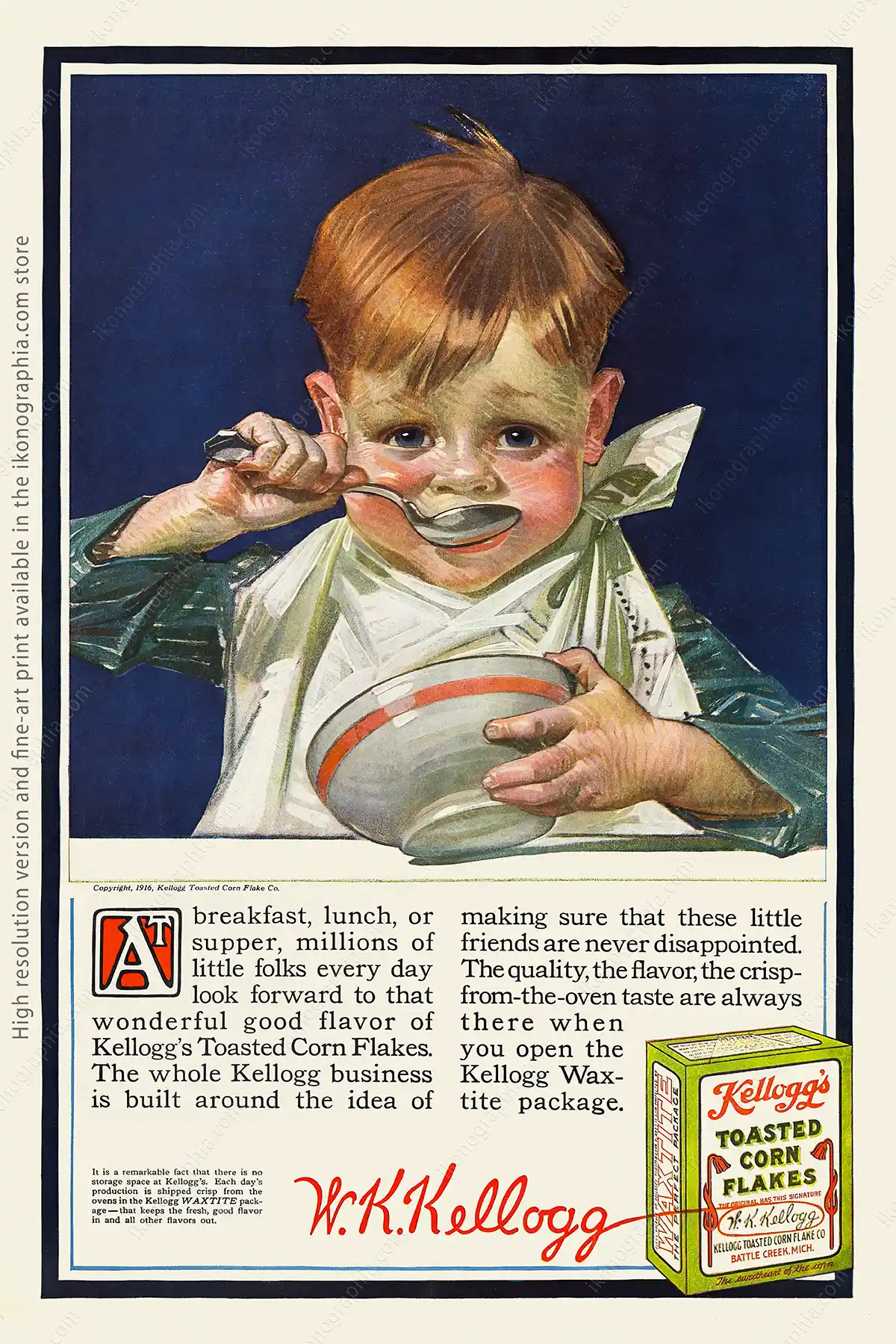
Advertisement for Kellogg's Corn flakes. Artwork by Joseph Christian Leyendecker. Ladies' Home Journal, April 1916

"At breakfast, lunch, or supper, millions of little folks every day look forward to that wonderful good flavor of Kellogg's Toasted Corn Flakes."

Advertisement for Kellogg’s Corn Flakes.
Artwork by Joseph Christian Leyendecker.

Ladies’ Home Journal, April 1916

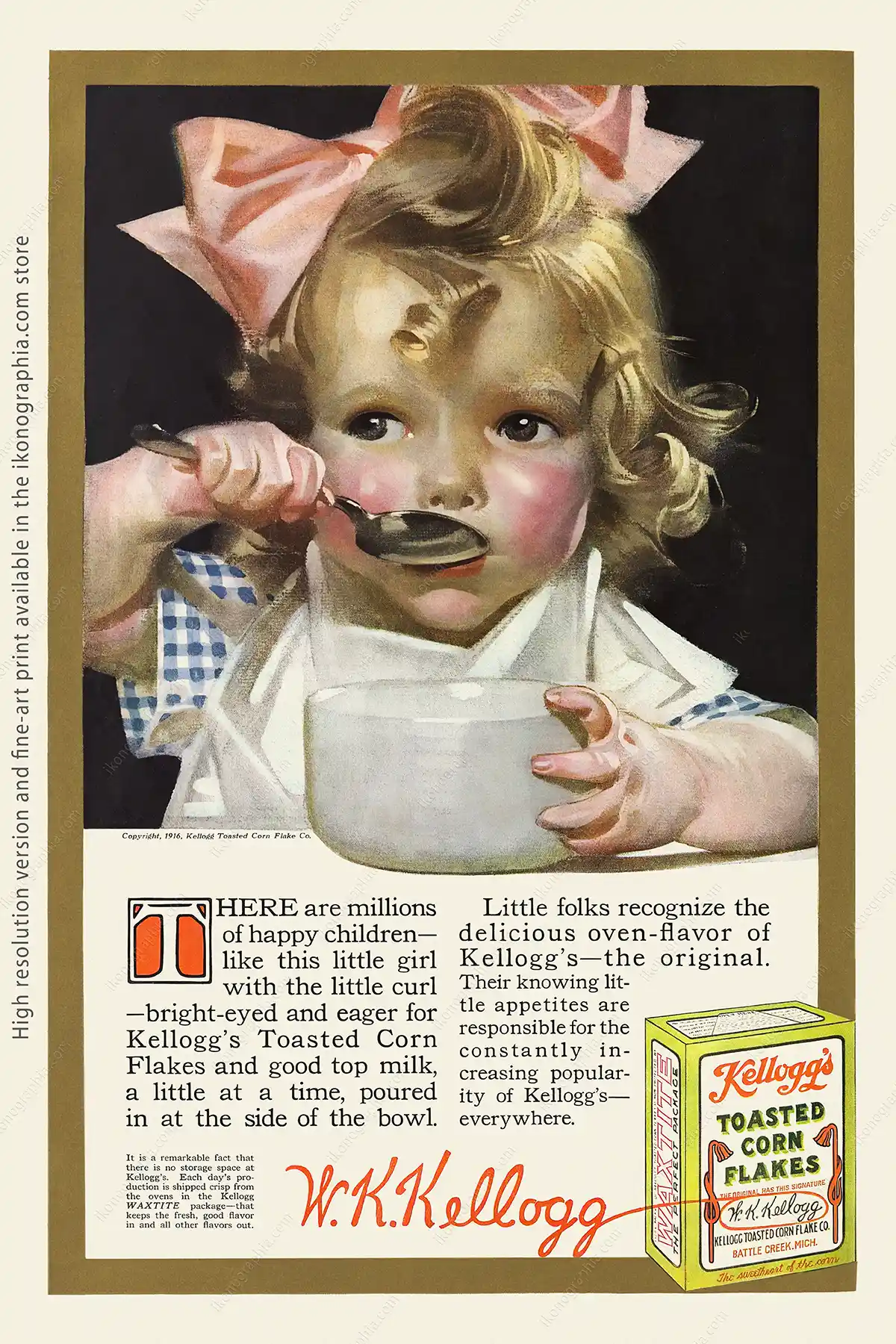
Leyendecker's baby girl enjoying cornflakes breakfast. Kellogg's ad, 1916

"There are millions of happy children like this little girl with the little curl, bright-eyed and eager for Kellogg’s Toasted Corn Flakes and good top milk, a little at a time, poured in at the side of the bowl."

Advertisement for Kellogg’s Corn Flakes.
Artwork by Joseph Christian Leyendecker.

Ladies’ Home Journal, May 1916

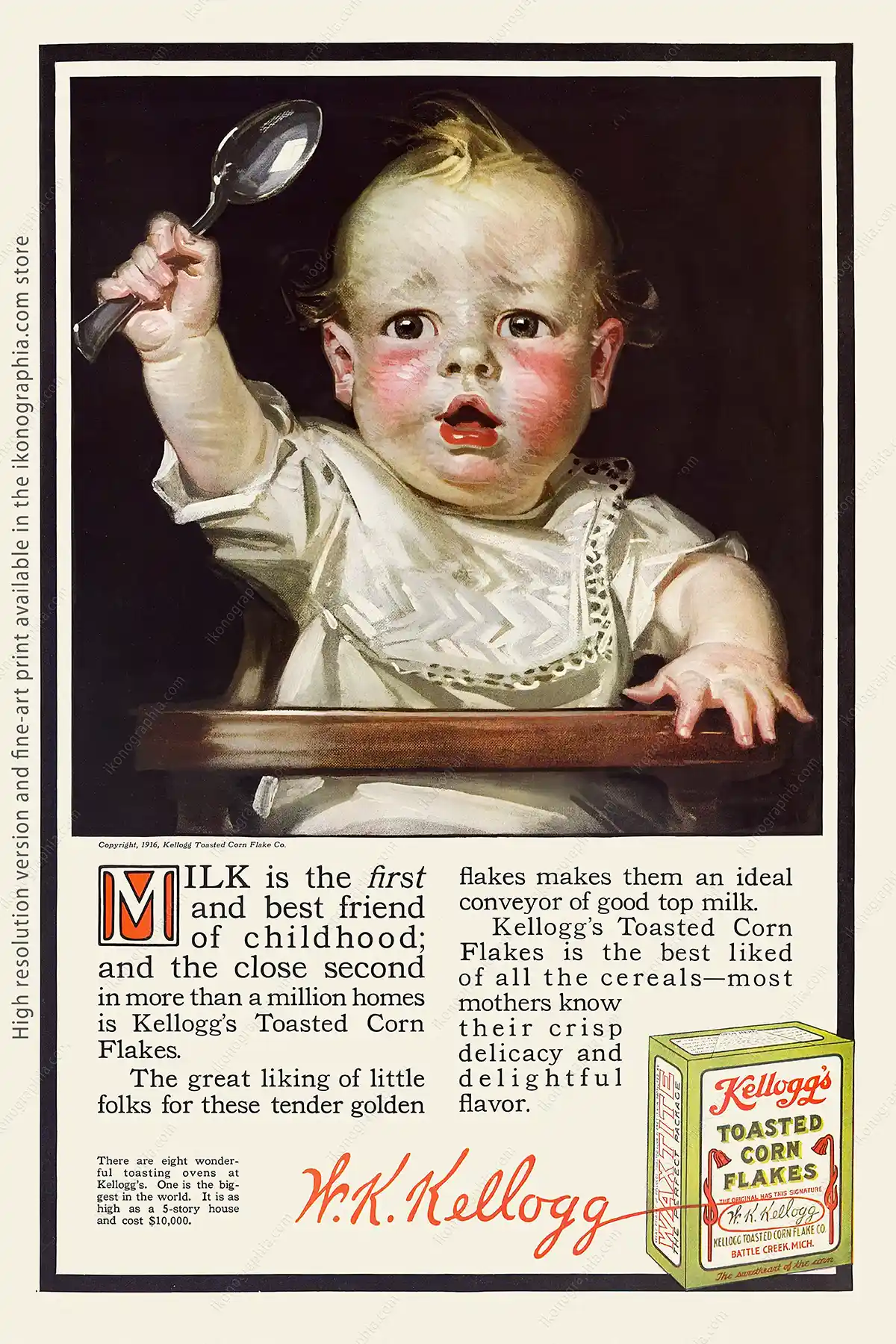
Leyendecker's baby claiming for milk and flakes. Kellogg ad, 1916 Advertisement for Kellogg's Corn flakes. Artwork by Joseph Christian Leyendecker. Ladies' Home Journal, June 1916

"Milk is the first and best friend of childhood; and the close second in more than a million homes is Kellogg's Toasted Corn Flakes. The great liking of little folks for these tender golden flakes makes them an ideal conveyor of good top milk."

Advertisement for Kellogg’s Corn Flakes.
Artwork by Joseph Christian Leyendecker.

Ladies’ Home Journal, June 1916

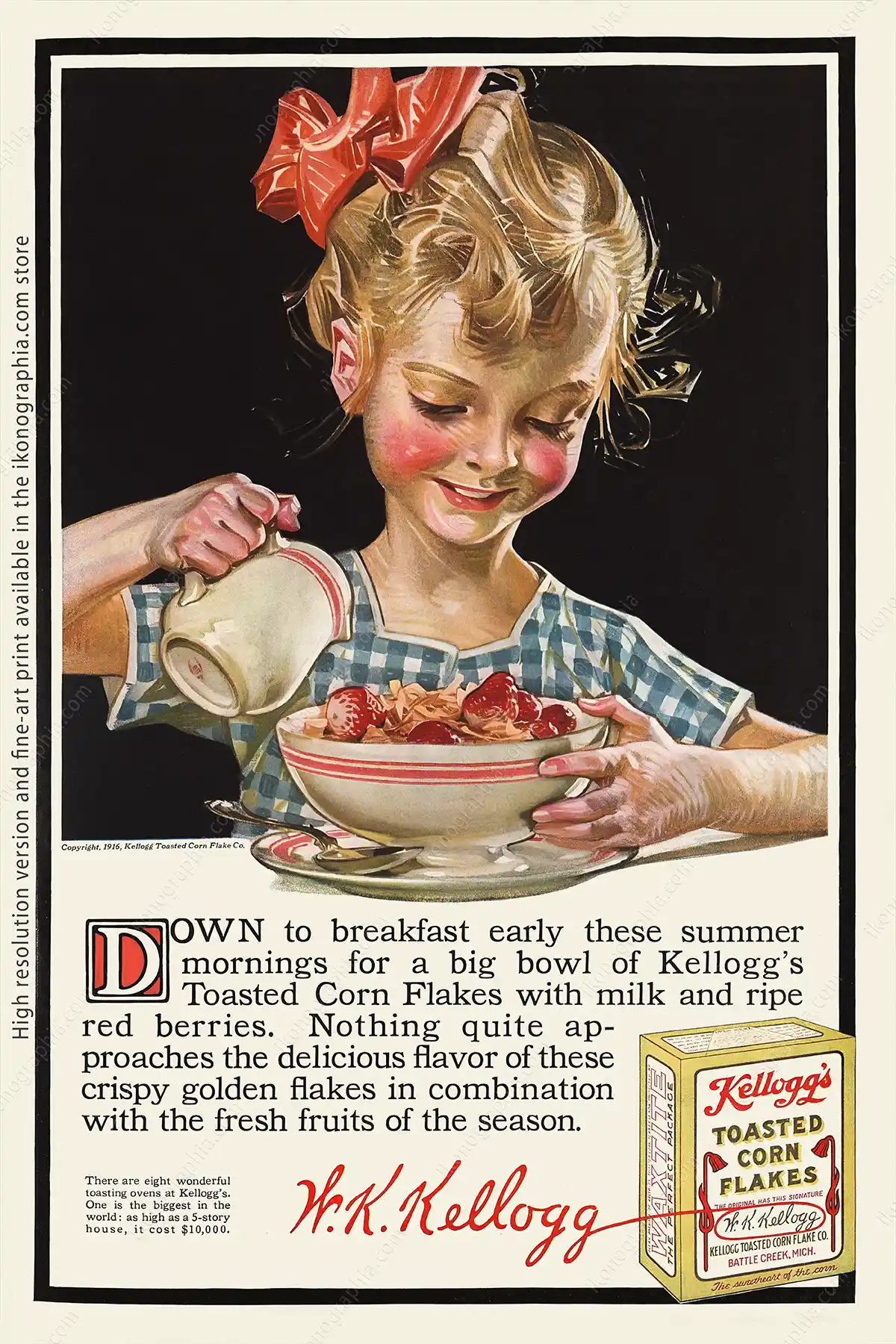
Leyendecker's Young girl enjoying corn flakes with milk and fresh fruits. Kellogg's ad, 1916 Advertisement for Kellogg's Corn flakes. Artwork by Joseph Christian Leyendecker. Ladies' Home Journal, July 1916

"Down to breakfast early these summer mornings for a big bowl of Kellogg's Toasted Corn Flakes with milk and ripe red berries. Nothing quite approaches the delicious flavor of these crispy golden flakes in combination with the fresh fruits of the season."

Advertisement for Kellogg’s Corn Flakes.
Artwork by Joseph Christian Leyendecker.

Ladies’ Home Journal, July 1916

The bugle call brings little troopers eagerly around the messtable. Kellogg's ad by Leyendecker, 1916 Advertisement for Kellogg's Corn flakes. Artwork by Joseph Christian Leyendecker. Ladies' Home Journal, September 1916 THE bugle call that brings all the little troopers eagerly around the mess-table is Kellogg's Toasted Corn Flakes. Kellogg's—the Original Toasted Corn Flakes, remain as original as ever–light, and dainty, appetizing in flavor, with a melting crispness on the tongue.

"The bugle call that brings all the little troopers eagerly around the mess-table is Kellogg's Toasted Corn Flakes. Kellogg's—the Original Toasted Corn Flakes, remain as original as ever–light, and dainty, appetizing in flavor, with a melting crispness on the tongue."

Advertisement for Kellogg’s Corn Flakes.
Artwork by Joseph Christian Leyendecker.

Ladies’ Home Journal, September 1916

The best liked of all cereals by the youngster. Kellogg's ad by Leyendecker, 1916 Advertisement for Kellogg's Corn flakes. Artwork by Joseph Christian Leyendecker. Ladies' Home Journal, October 1916

"The best liked of all the different cereals, and especially so by the youngsters, is Kellogg's Toasted Corn Flakes."

Advertisement for Kellogg’s Corn Flakes.
Artwork by Joseph Christian Leyendecker.

Ladies’ Home Journal, October 1916

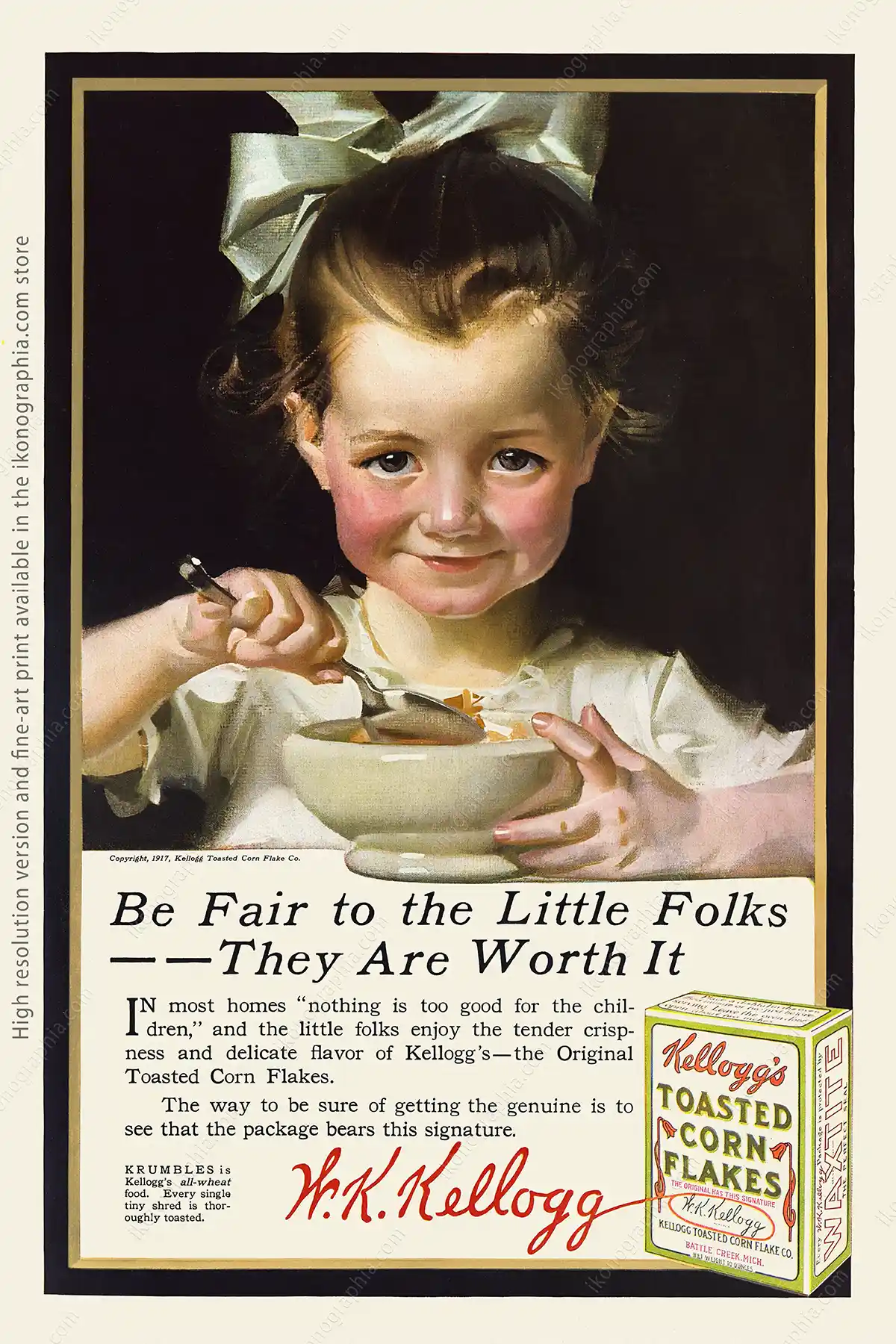
Be Fair to the Little Folks - They Are Worth It. Kellogg's ad by Leyendecker, 1917 Advertisement for Kellogg's Corn Flakes. Artwork by Joseph Christian Leyendecker. Ladies' Home Journal, March 1917

"Be Fair to the Little Folks They Are Worth It. In most homes "nothing is too good for the children," and the little folks enjoy the tender crispness and delicate flavor of Kellogg's the Original Toasted Corn Flakes."

Advertisement for Kellogg’s Corn Flakes.
Artwork by Joseph Christian Leyendecker.

Ladies’ Home Journal, March 1917

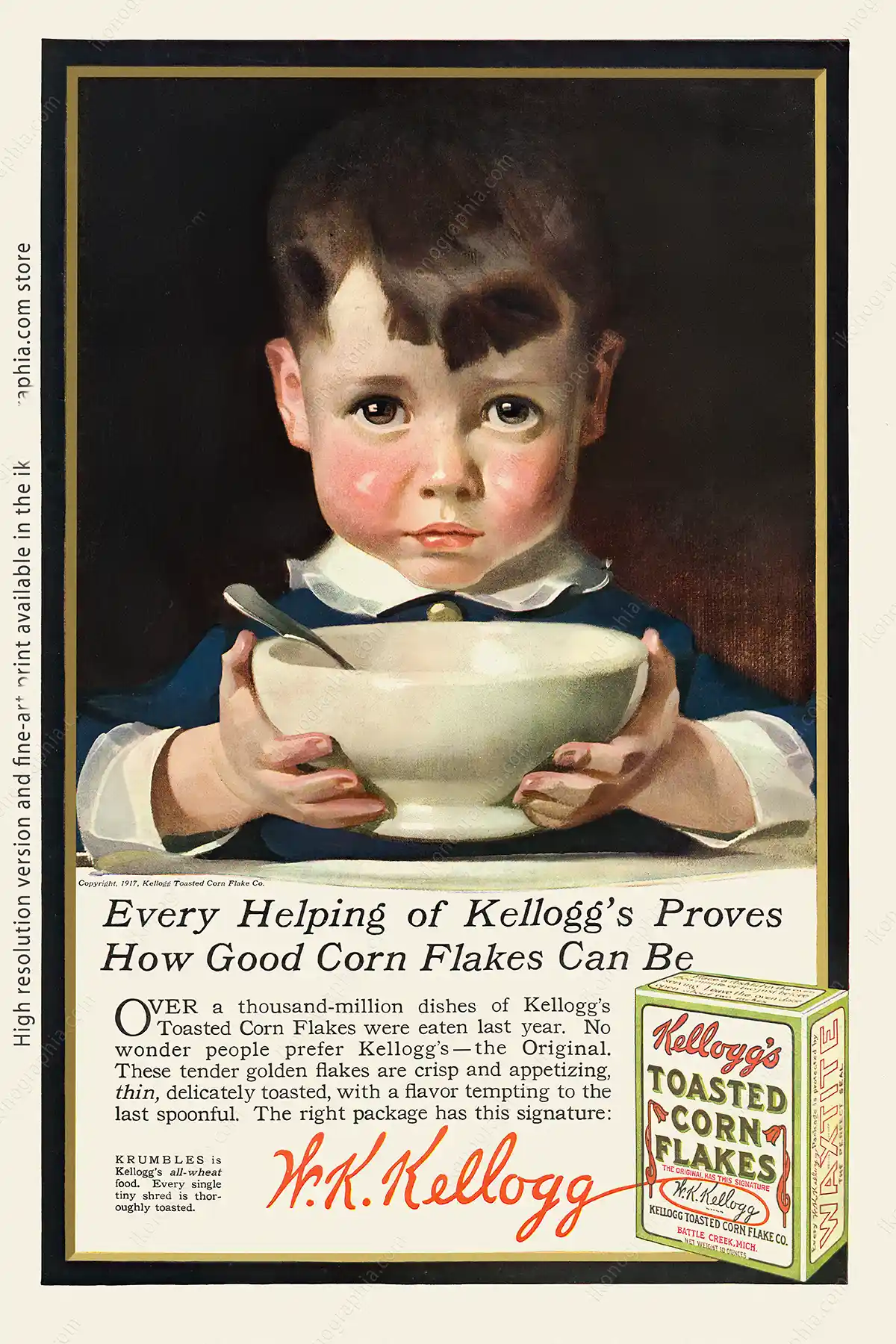
Every Helping of Kellogg's Proves How Good Corn Flakes Can Be, by Leyendecker 1917 Advertisement for Kellogg's Corn Flakes. Artwork by Joseph Christian Leyendecker. Ladies' Home Journal, April 1917

"Every Helping of Kellogg's Proves How Good Corn Flakes Can Be. Over a thousand-million dishes of Kellogg's Toasted Corn Flakes were eaten last year. No wonder people prefer Kellogg's—the Original. 

Advertisement for Kellogg’s Corn Flakes.
Artwork by Joseph Christian Leyendecker.

Ladies’ Home Journal, April 1917

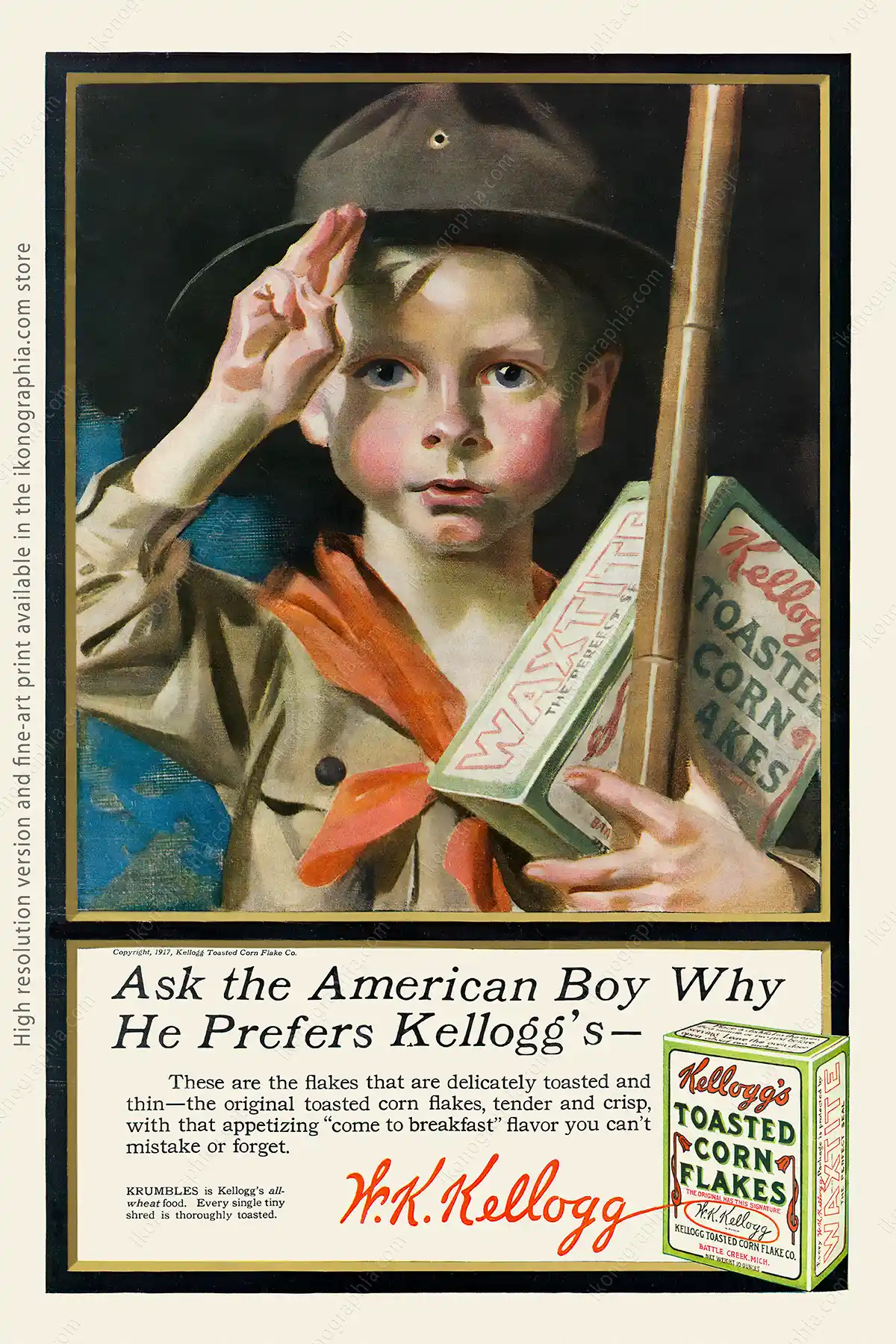
Ask the American Boy Why He Prefers Kellogg. Artwork by Leyendecker, 1917 Advertisement for Kellogg's Corn Flakes. Artwork by Joseph Christian Leyendecker. Ladies' Home Journal, May 1917

"Ask the American Boy Why He Prefers Kellogg — These are the flakes that are delicately toasted and thin the original toasted corn flakes, tender and crisp, with that appetizing "come to breakfast" flavor you can't mistake or forget."

Advertisement for Kellogg’s Corn Flakes.
Artwork by Joseph Christian Leyendecker.

Ladies’ Home Journal, May 1917

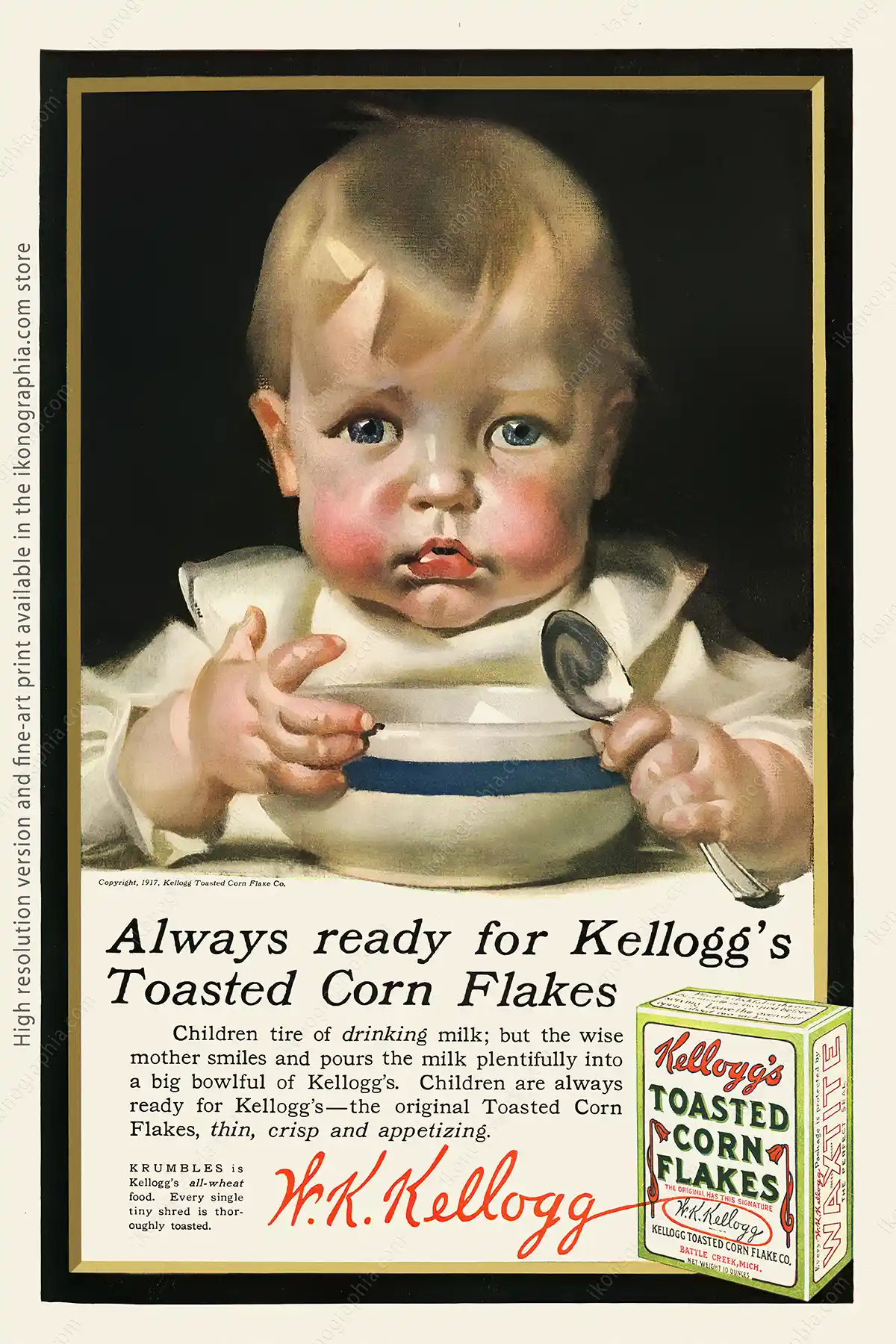
Always ready for Kellogg's Toasted Corn Flakes. Artwork by Leyendecker, 1917 Advertisement for Kellogg's Corn Flakes. Artwork by Joseph Christian Leyendecker. Ladies' Home Journal, June 1917

"Always ready for Kellogg's Toasted Corn Flakes.
Children tire of drinking milk; but the wise mother smiles and pours the milk plentifully into a big bowlful of Kellogg's.

Advertisement for Kellogg’s Corn Flakes.
Artwork by Joseph Christian Leyendecker.

Ladies’ Home Journal, June 1917

Kellogg's Will Always Maintain Quality. Artwork by Leyendecker, 1917 Advertisement for Kellogg's Corn Flakes. Artwork by Joseph Christian Leyendecker. Ladies' Home Journal, July 1917

"Kellogg's Will Always Maintain Quality.
You can be sure of Kellogg's—the original Toasted Corn Flakes — the Flakes that are delicate and thin. Whatever the times or the tendency, the quality of Kellogg's has our pledge and warranty the finest Corn Flakes possible to produce!


Advertisement for Kellogg’s Corn Flakes.
Artwork by Joseph Christian Leyendecker.

Ladies’ Home Journal, July 1917

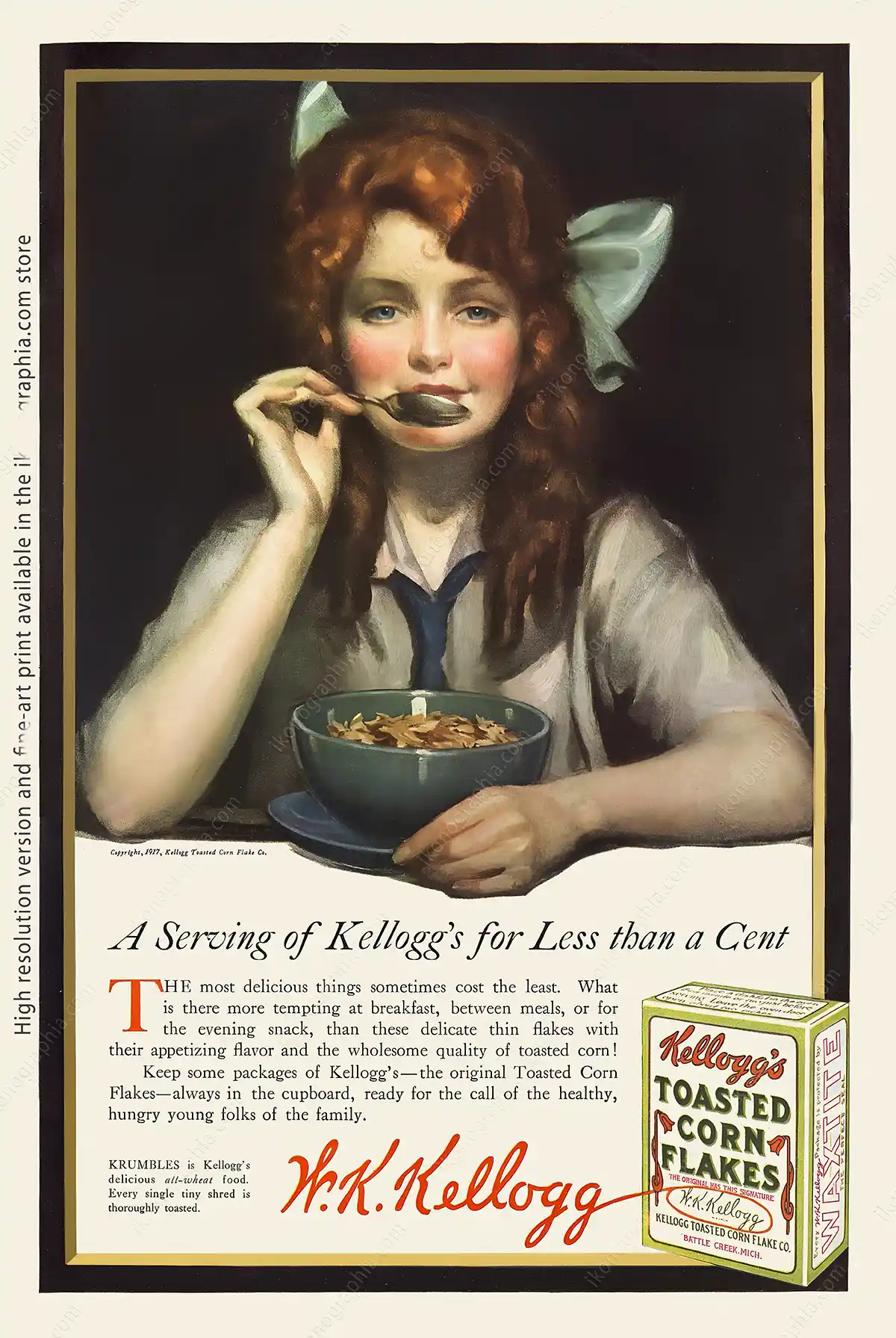
A Serving of Kellogg's for Less than a Cent. Artwork by Leyendecker, 1917 Advertisement for Kellogg's Corn Flakes. Artwork by Joseph Christian Leyendecker. Ladies' Home Journal, October 1917

"A Serving of Kellogg's for Less than a Cent The most delicious things sometimes cost the least. What is there more tempting at breakfast, between meals, or for the evening snack, than these delicate thin flakes with their appetizing flavor and the wholesome quality of toasted corn!"

Advertisement for Kellogg’s Corn Flakes.
Artwork by Joseph Christian Leyendecker.

Ladies’ Home Journal, October 1917

Help the Food Situation by Eating More Corn. Kellog's ad by Leyendecker, 1917 Advertisement for Kellogg's Corn Flakes. Artwork by Joseph Christian Leyendecker. Ladies' Home Journal, November 1917

"Help the Food Situation by Eating More Corn.

Boy sand girls, if you don't know how delicious a food Corn can be, try Kellogg's Toasted Corn Flakes. Patriotic housewives who are seeking foods that are tempting and inexpensive find that Kellogg's costs less than a penny a serving."

Advertisement for Kellogg’s Corn Flakes.
Artwork by Joseph Christian Leyendecker.

Ladies’ Home Journal, November 1917

Copyright, Links and credits

These works were published in the US before 1929, and the author died before 1954.
As a result, they are out of copyright worldwide.

Please notice that any advice or comment provided here is not and does not purport to be legal advice as defined by s.12 of the Legal Services Act 2007.

The Ivory Bible — Old Testament Carvings from Medieval Amalfi

The Ivory Bible — Old Testament Carvings from Medieval Amalfi

The Ivory Bible — Old Testament Carvings from Medieval Amalfi

Medieval Biblical narratives carved in ivory — an enigmatic masterwork from 11th century Southern Italy.

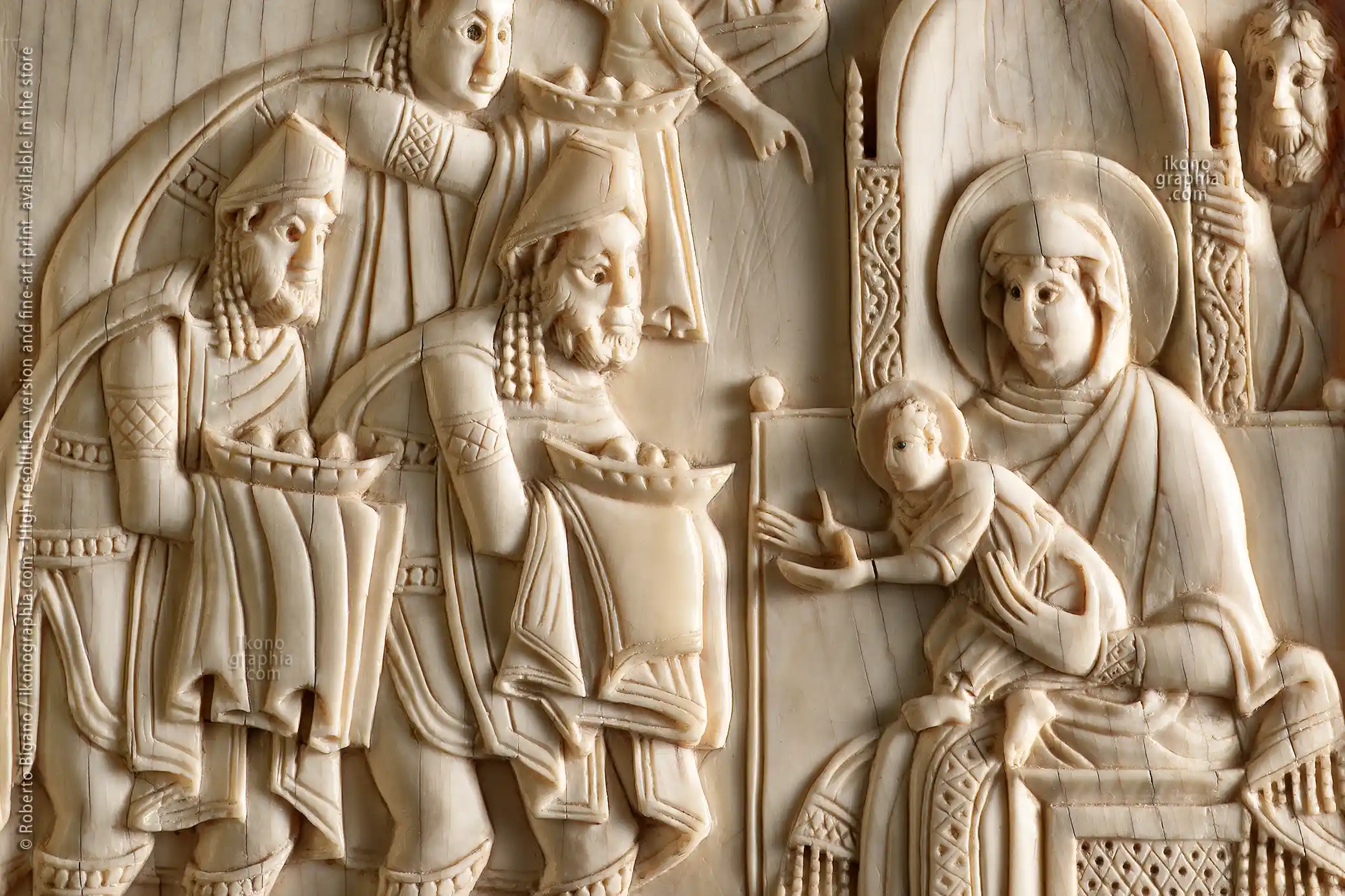
The Salerno Ivories are among the world's forgotten wonders. Carved in elephant ivory a thousand years ago, they form one of the most complete Biblical narrative cycles to survive from the medieval Mediterranean. Their origin remains mysterious—likely Amalfi, possibly elsewhere. Their artistic sophistication is undeniable. Yet they remain largely unknown, housed in a quiet museum on Italy's southern coast.

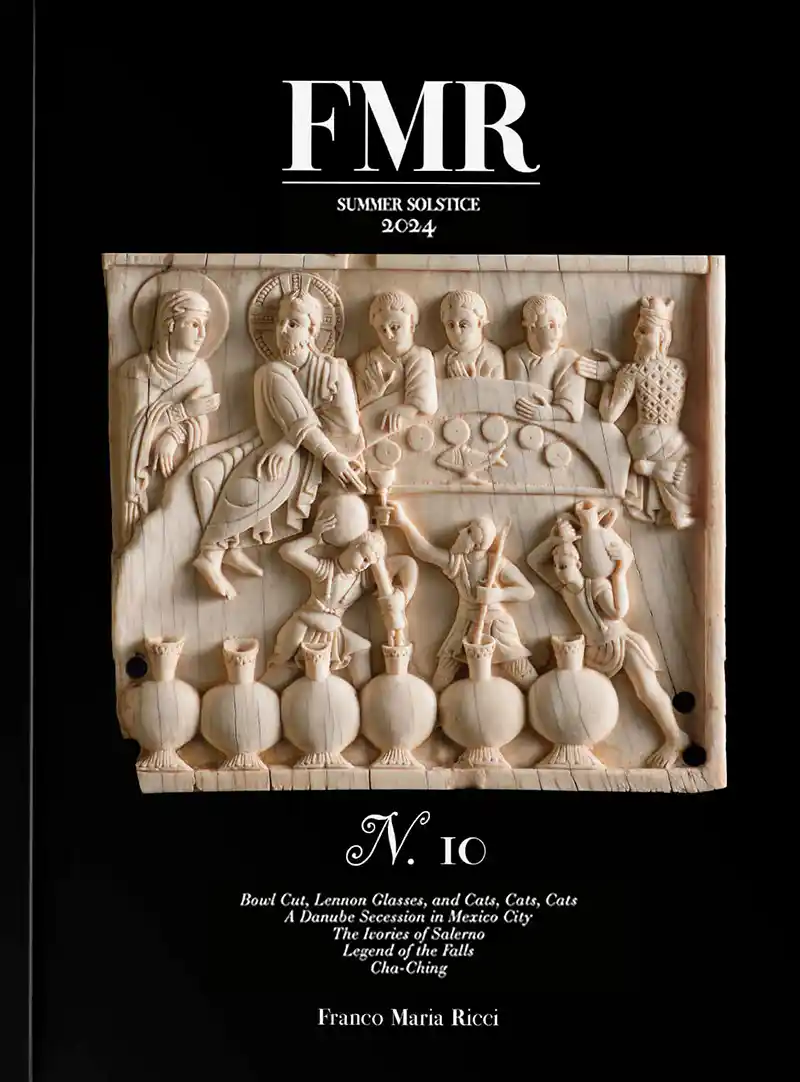
Published in FMR Magazine's as "The Greatest Story Ever Carved" — with photographs by Roberto Bigano.

The very first EB110 model made in epowood as designed by Benedini, with the rear wheels covered reminding the Bugatti Atlantic. Photo Roberto Bigano. Buy this image in the ikonographia.com store.

The Mystery of Origin

No signatures. No inscriptions. No definitive attribution

The Salerno Ivories resist easy classification. Too Western to be purely Byzantine, too Eastern to be purely Romanesque, they likely emerged from Amalfi—the maritime republic that dominated Mediterranean trade before its decline. But certainty eludes scholars. The carved panels could have come from Salerno, Montecassino, even Norman Sicily.

What matters more than origin is achievement: a synthesis of artistic traditions that could only have emerged where Christian, Islamic, and Byzantine cultures converged in a cosmopolitan port.

The very first EB110 model made in epowood as designed by Benedini, with the rear wheels covered reminding the Bugatti Atlantic. Photo Roberto Bigano. Buy this image in the ikonographia.com store.

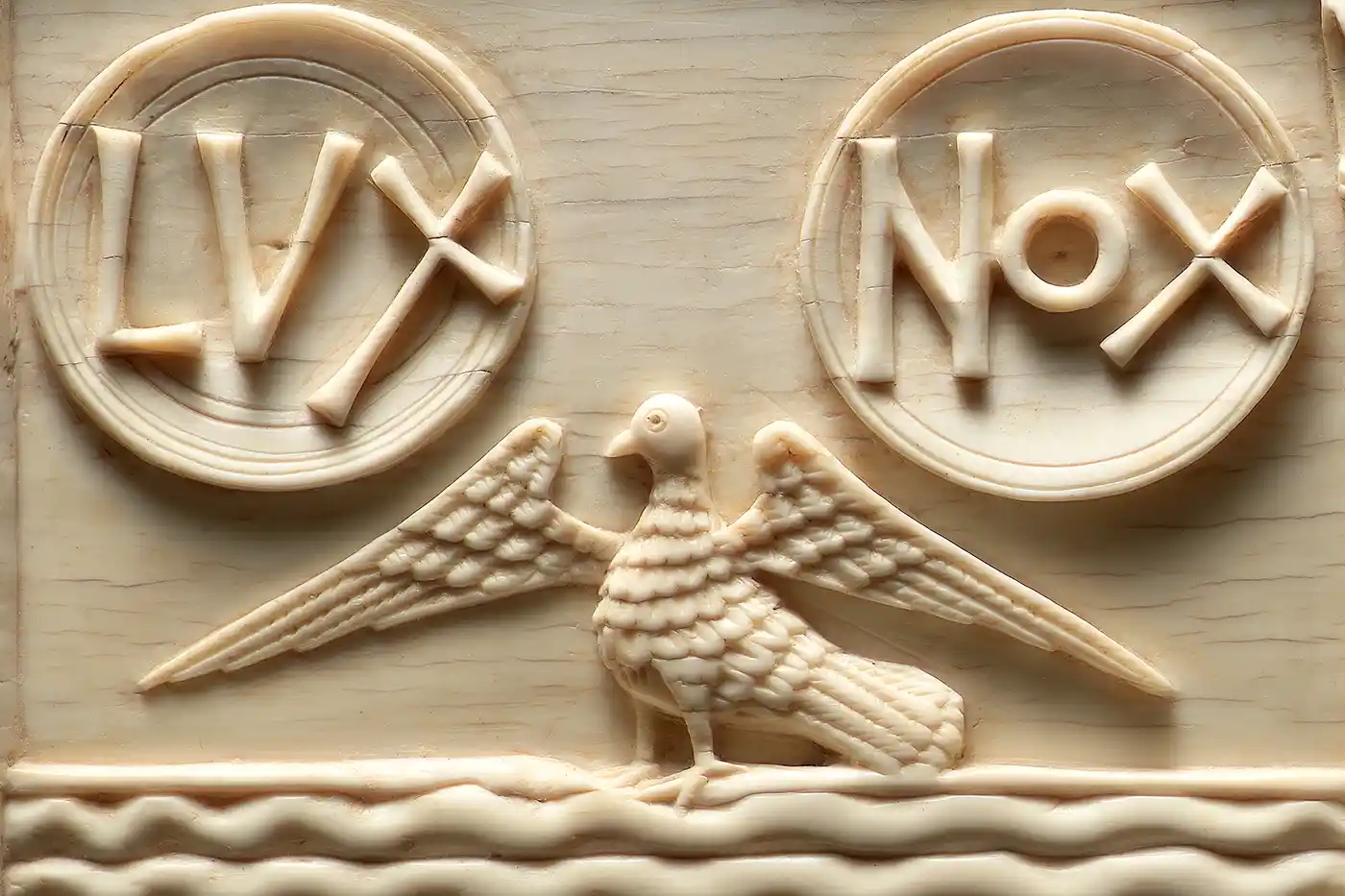
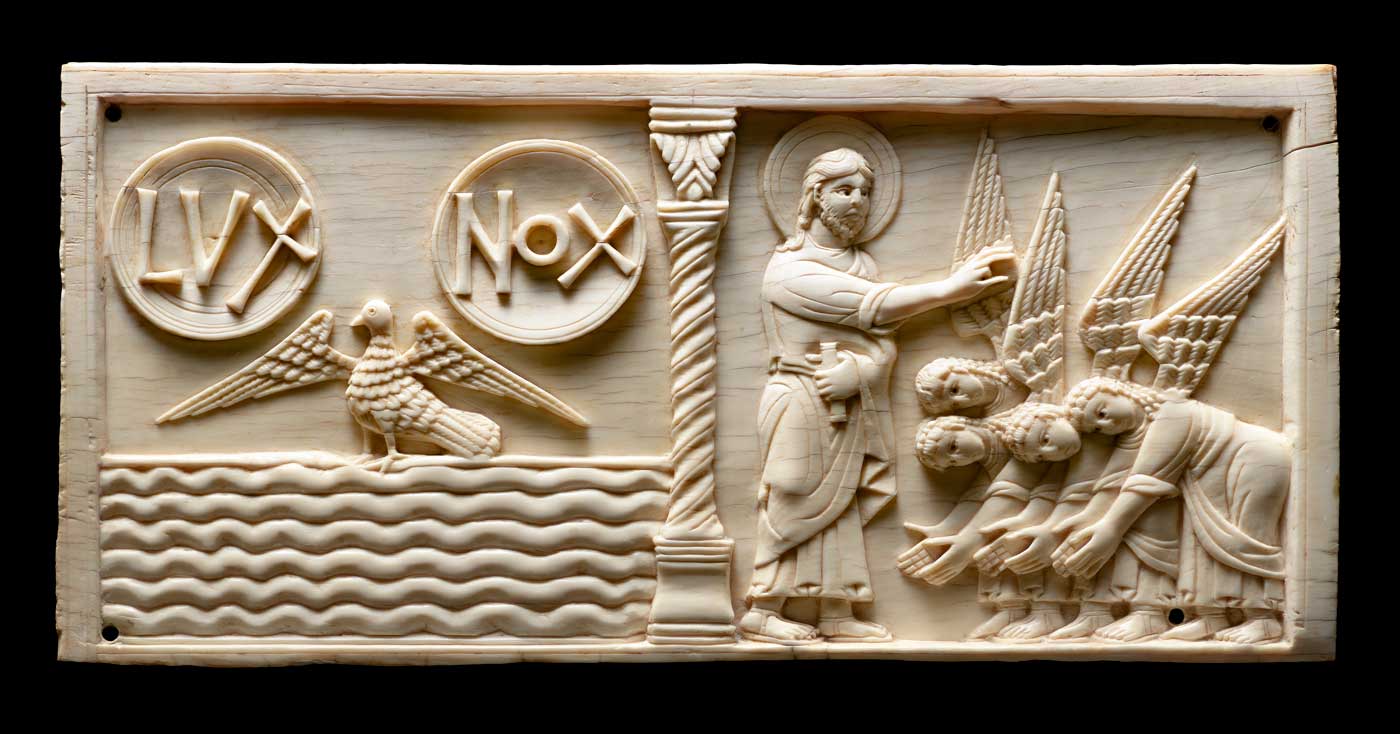
All the plaques on this page: Old Testament Ivory Carving. Amalfi School, late 11th – early 12th century. Housed at Museo Diocesano San Matteo in Salerno.

Left: The Spirit of God creates the Waters and separates the light from the darkness.Genesis 1:2
Right: creation of the Angels. Cm 10,2x 22.The Old Testament doesn’t explicitly state when angels were created.
However, it’s generally understood that they were created before the earth, likely during the first day of creation when God made the heavens.

The very first EB110 model made in epowood as designed by Benedini, with the rear wheels covered reminding the Bugatti Atlantic. Photo Roberto Bigano. Buy this image in the ikonographia.com store.

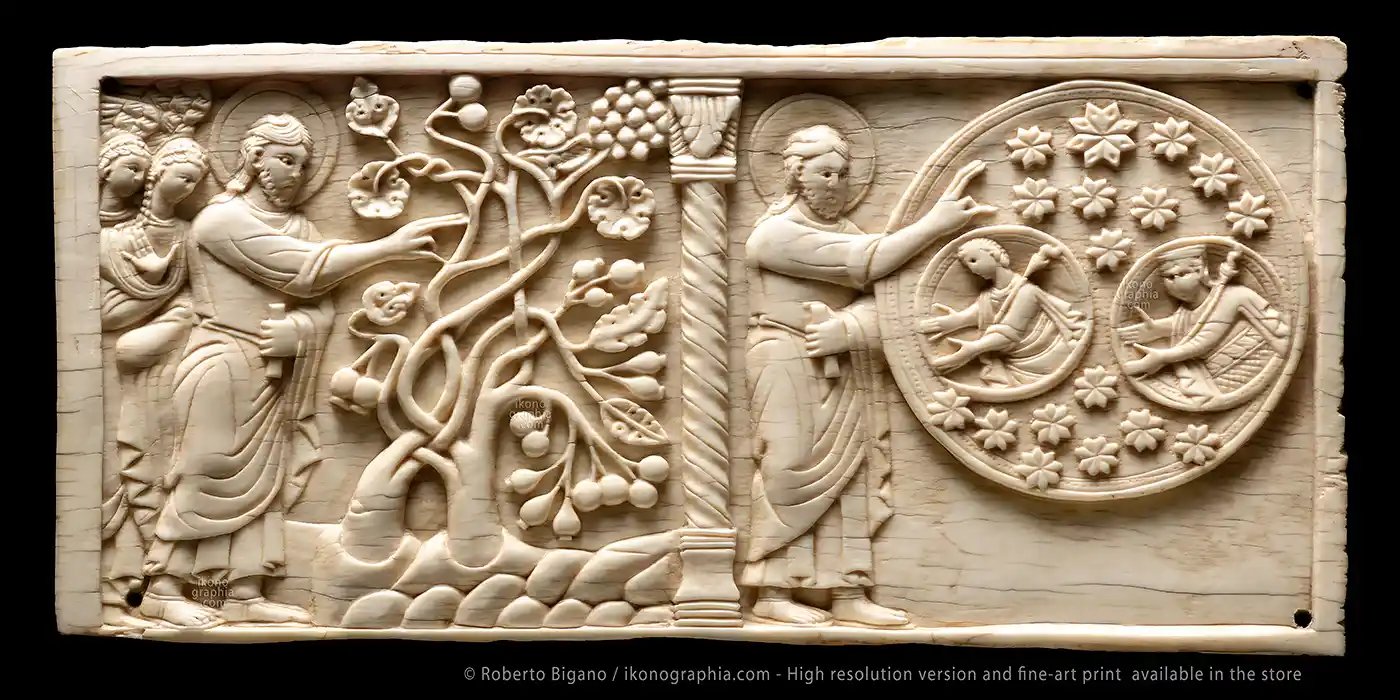
Left: Creation of vegetation and fruit trees. Genesis 1:11 / 1:12.
Right: Creation of the sun, the moon and the stars. Genesis 1:14 / 1:19. — Cm 10,2x 22

The very first EB110 model made in epowood as designed by Benedini, with the rear wheels covered reminding the Bugatti Atlantic. Photo Roberto Bigano. Buy this image in the ikonographia.com store.

Left: Creation of Eve. Genesis 2:21 / 2:23.
Right: Temptation and Original Sin. Genesis 3:6 / 3:7 / 1:19. — Cm 10,2x 22.

The very first EB110 model made in epowood as designed by Benedini, with the rear wheels covered reminding the Bugatti Atlantic. Photo Roberto Bigano. Buy this image in the ikonographia.com store.

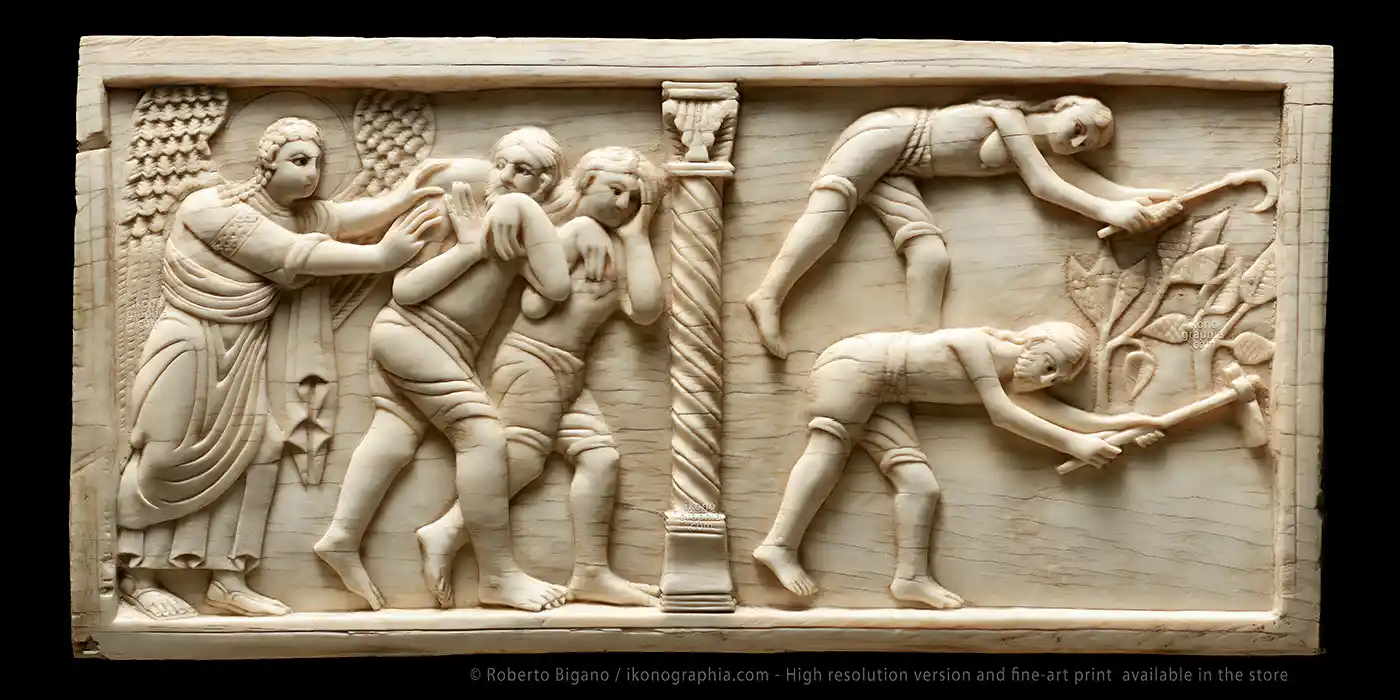
Left: Expulsion from the Garden of Eden. Genesis 3:23.
Right: Men destined to live by cultivating the land 3:24. Genesis 3:24 — Cm 10,7x21,9.

Old Testament Ivory Carving. God Commands Noah to build the Ark - Building the Ark

Left: God commands Noah to build the Ark. Genesis 6:14 / 6:21
Right: Noah building the Ark. Genesis 6.22
Cm 10,1x21,9.

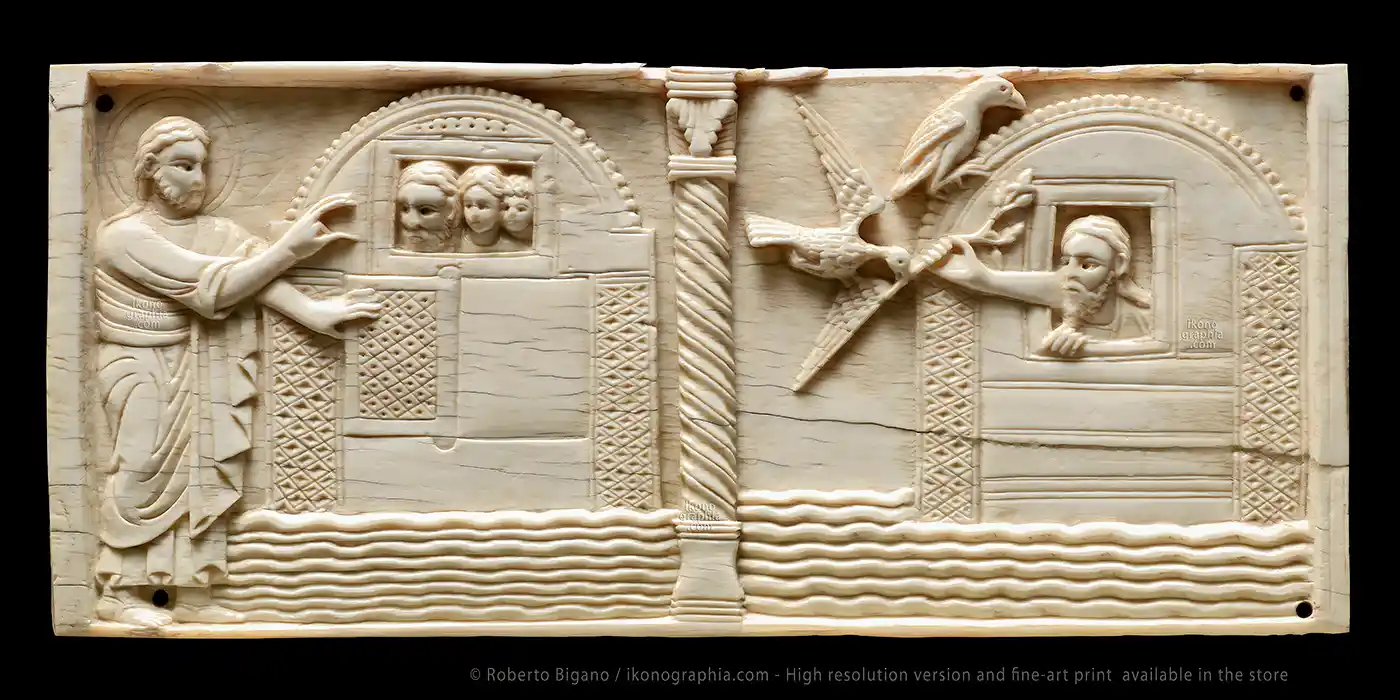
Old Testament Ivory Carving. God closes the door of the Ark - The Raven and the Dove.

Left: God closes the door of the Ark. Genesis 7:13/ 7:16
Right: The Raven and the Dove. Genesis 8:6:8/17
Cm 9.9 x 22.2.

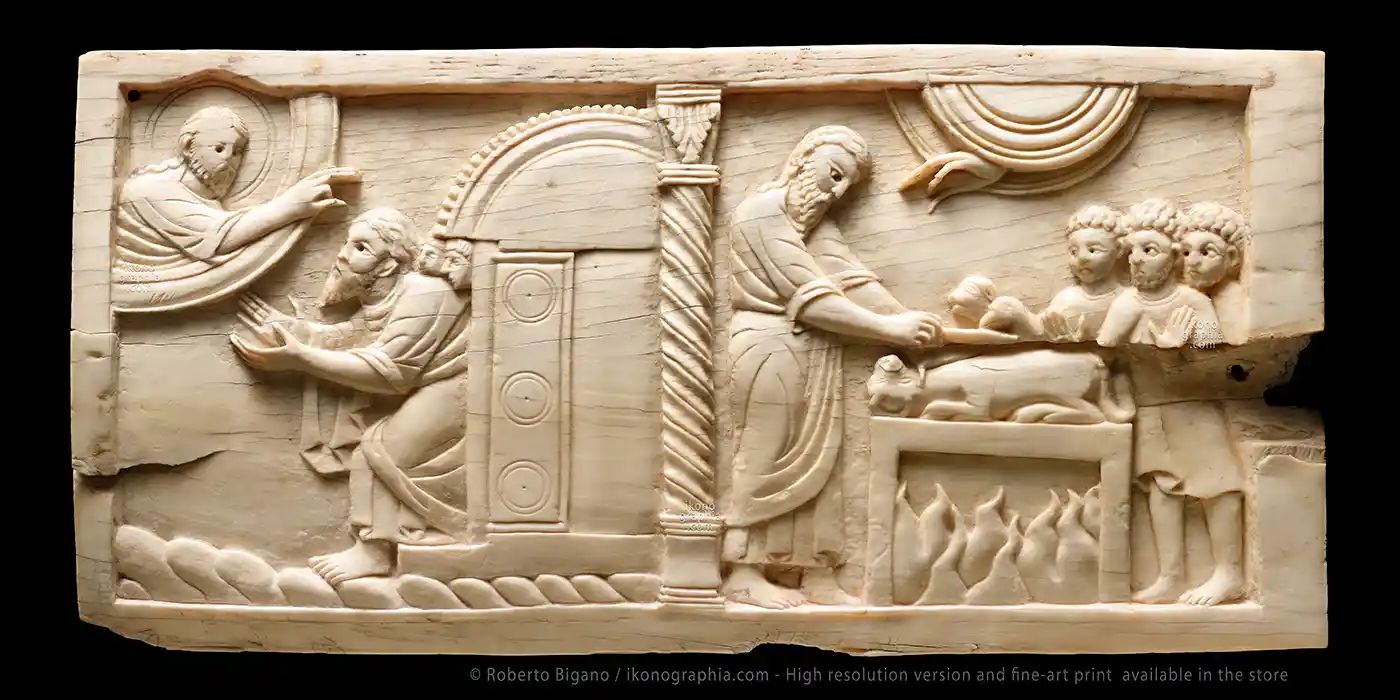
Old Testament Ivory Carving. Noah exits the Ark - Noah's sacrifice Left: Noah exits the Ark. Genesis 8:18 Right; Noah's sacrifice. Genesis 8:19 Cm 10.3x21.8 Old Testament Ivory Carving. Amalfi School, late 11th - early 12th century. Housed at Museo Diocesano San Matteo, in Salerno, Italy.

Left: Noah exits the Ark. Genesis 8:18
Right: Noah's sacrifice. Genesis 8:19
Cm 10,3 x 21.8.

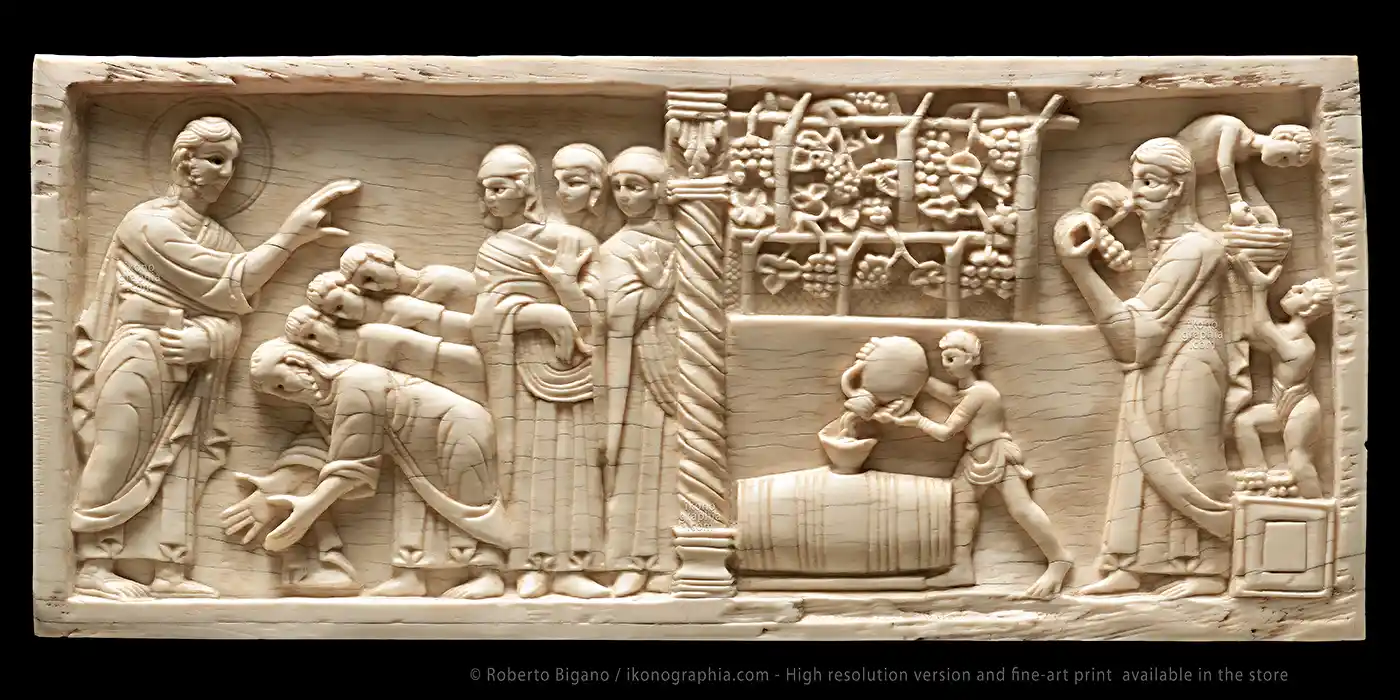
Old Testament Ivory Carving. God Blesses Noah and His Descendants - Noah the Winemaker.

Left: God Blesses Noah and His Descendants. Genesis 9:1 / 9:3.
Right: Noah the Winemaker. Genesis 9:20
Cm 10.6 x 24.1.

Roberto Bigano, the photographer, shares his story

A destiny written in the stars

I was reading a New York Times article from a series that shared fascinating stories about Italian lifestyle, food, scenic landscapes, and art. This chapter began with a bold statement: “Today is Friday, and we’ll visit the Collection of the Salerno Ivories. They are among the world’s wonders, yet few people know about them.”

I was surprised; I had never heard of this collection, which was unusual for me since I was quite familiar with the artistic scene of Naples and its surroundings, having often worked there.

Determined to learn more, I promised myself to delve deeper into this topic. However, I didn’t have much time to explore further. A couple of hours later, my colleague from Naples called me and said, “Hi Roberto, we need to photograph the ivories of Salerno.” It felt as if our destinies were written in the stars.

Babel Left: The Drunkenness of Noah. Genesis 9:20 / 9:23 Right: Pharaoh returns Sarah to Abraham. Genesis 11:1 / 11:9 Cm 10,5 x 24. Old Testament Ivory Carving. Amalfi School, late 11th - early 12th century. Housed at Museo Diocesano San Matteo, in Salerno, Italy.

Left: The Drunkenness of Noah. Genesis 9:20 / 9:23.
Right: The Tower of Babel. Genesis 11:1 / 11:9.
Cm 10,5 x 24.

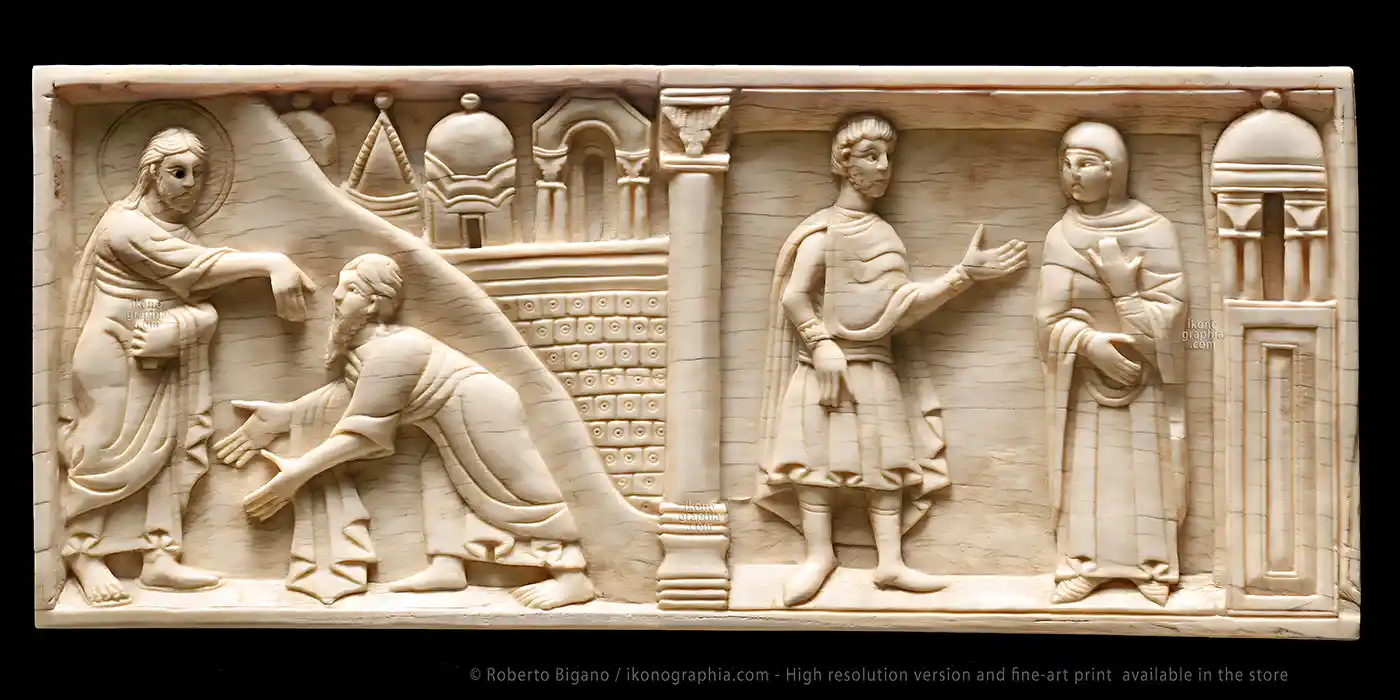
Old Testament Ivory Carving. God speaks to Abraham - Pharaoh returns Sarah to Abraham Left: God speaks to Abraham. Genesis 12:6 / 12:9 Right: Pharaoh returns Sarah to Abraham. Genesis 12:14 / 12:20 Cm 10,2 x 24.2. Old Testament Ivory Carving. Amalfi School, late 11th - early 12th century. Housed at Museo Diocesano San Matteo, in Salerno, Italy.

Left: God speaks to Abraham. Genesis 12:6 / 12:9.
Right: Pharaoh returns Sarah to Abraham. Genesis 12:14 / 12:20.
Cm 10,2x 24.2.

God tells Abraham to leave Harran - Blessing of Abraham. Left: God tells Abraham to leave Harran. Genesis 12:1 / 12:2 Right: Blessing of Abraham. Genesis 12:3 / 12:5 Cm 10,2 x 24.2. Old Testament Ivory Carving. Amalfi School, late 11th - early 12th century. Housed at Museo Diocesano San Matteo, in Salerno, Italy.

Left: God tells Abraham to leave Harran. Genesis 12:1 / 12:2
Right. Blessing of Abraham. Genesis 12:3 / 12:5.
Cm 10,3 x 24.1

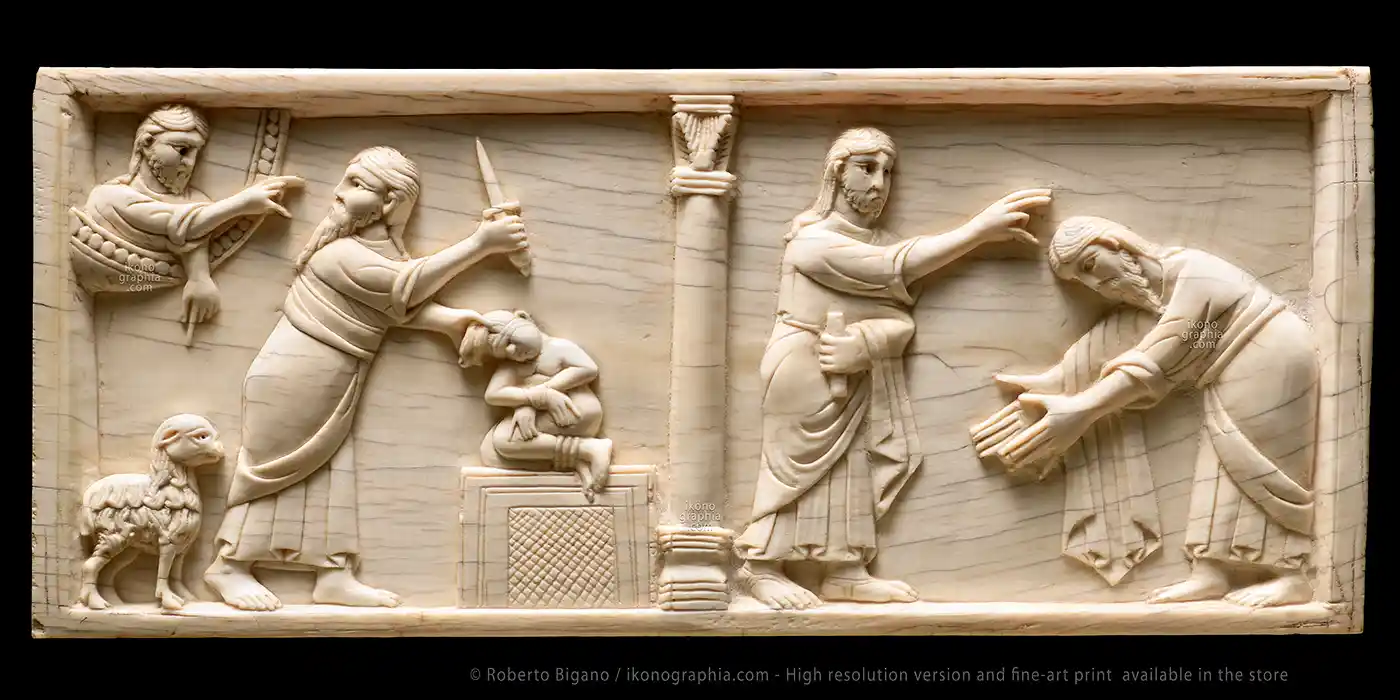
Left: Sacrifice of Isaac. Genesis 22.9 / 22.14 Right: Blessing of Abraham. Genesis 22.15 / 22.18 Cm 10,2 x 24.2. Old Testament Ivory Carving. Amalfi School, late 11th - early 12th century. Housed at Museo Diocesano San Matteo, in Salerno, Italy.

Left: Sacrifice of Isaac. Genesis 22:9 / 22:14
Right. Blessing of Abraham. Genesis 22.15 / 22.18.
Cm 10,2x 24.2.

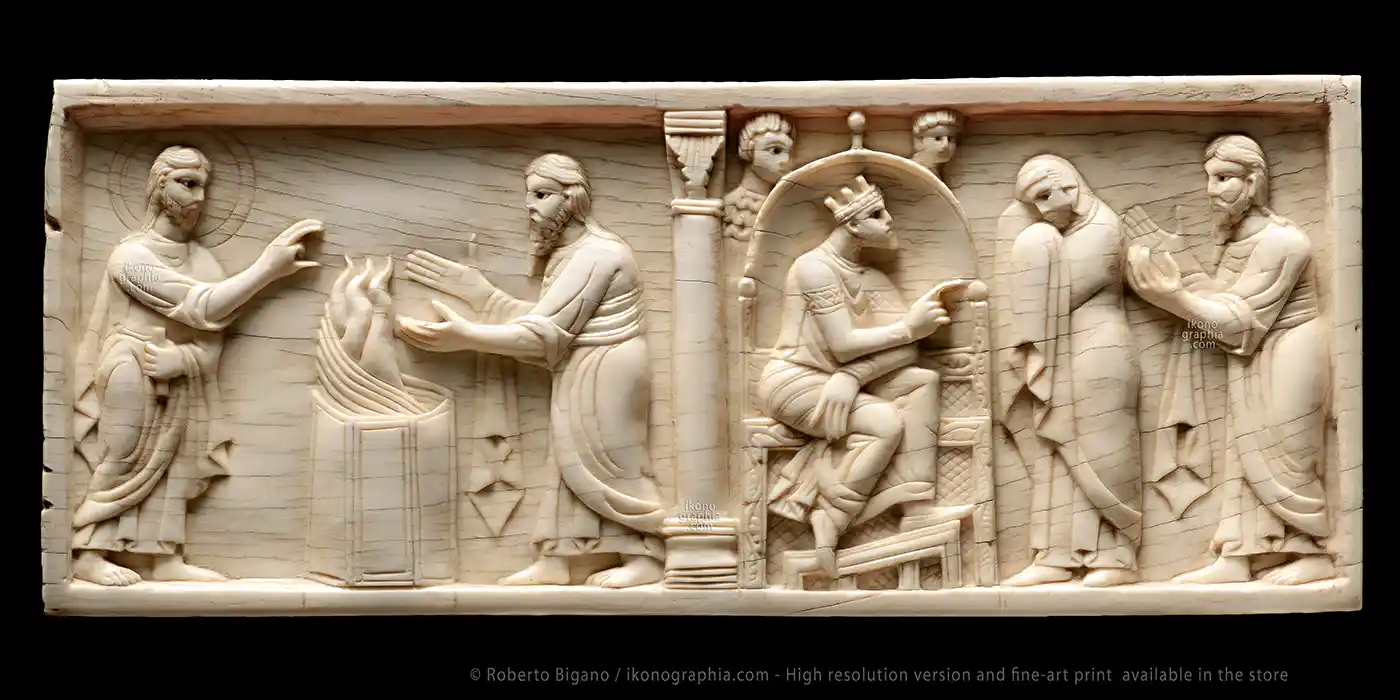
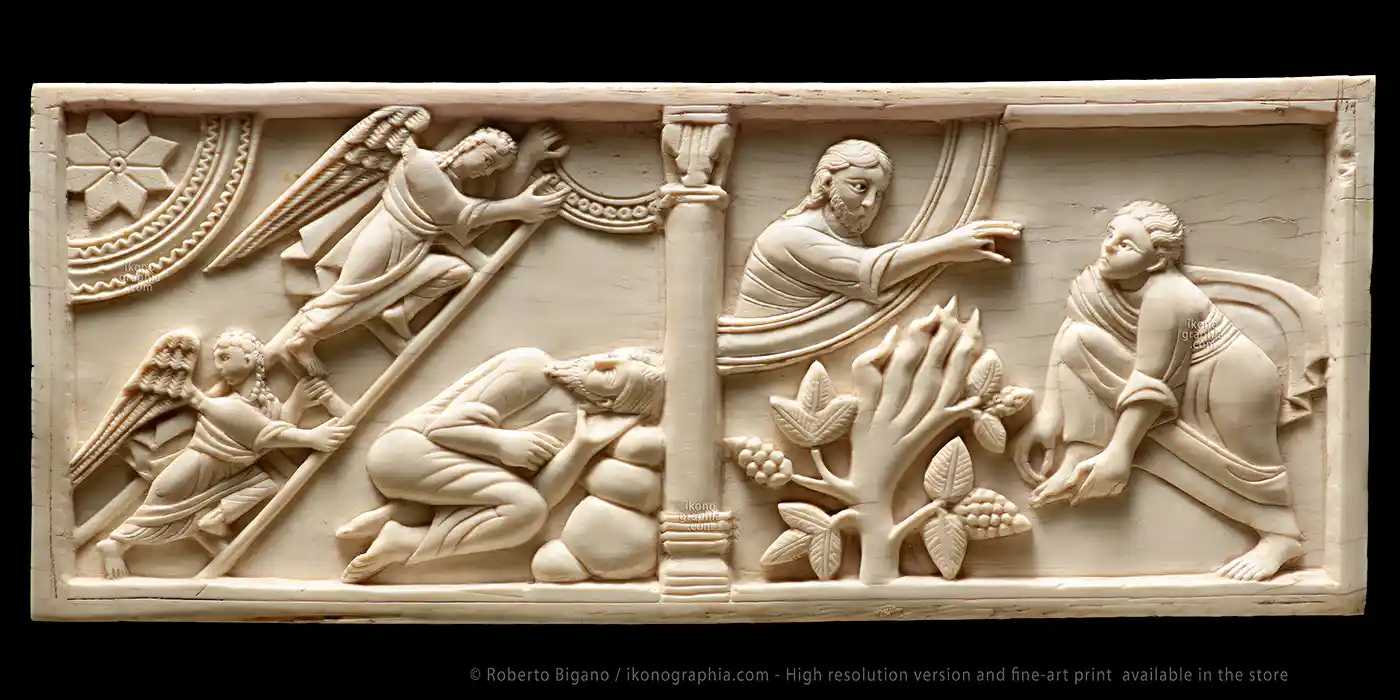
Left: Jacob's dream or the Jacob's Ladder. Genesis 28:10 / 28:17 Right. Moses and the burning bush. Exodus 3:1 / 3:5 Cm 9x 24.1. Old Testament Ivory Carving. Amalfi School, late 11th - early 12th century. Housed at Museo Diocesano San Matteo, in Salerno, Italy.

Left: Jacob's dream, also known as Jacob's Ladder. Genesis 28:10 / 28:17
Right: Moses and the burning bush. Genesis 1:14 / 1:19.
Cm 9,6x 24.1.

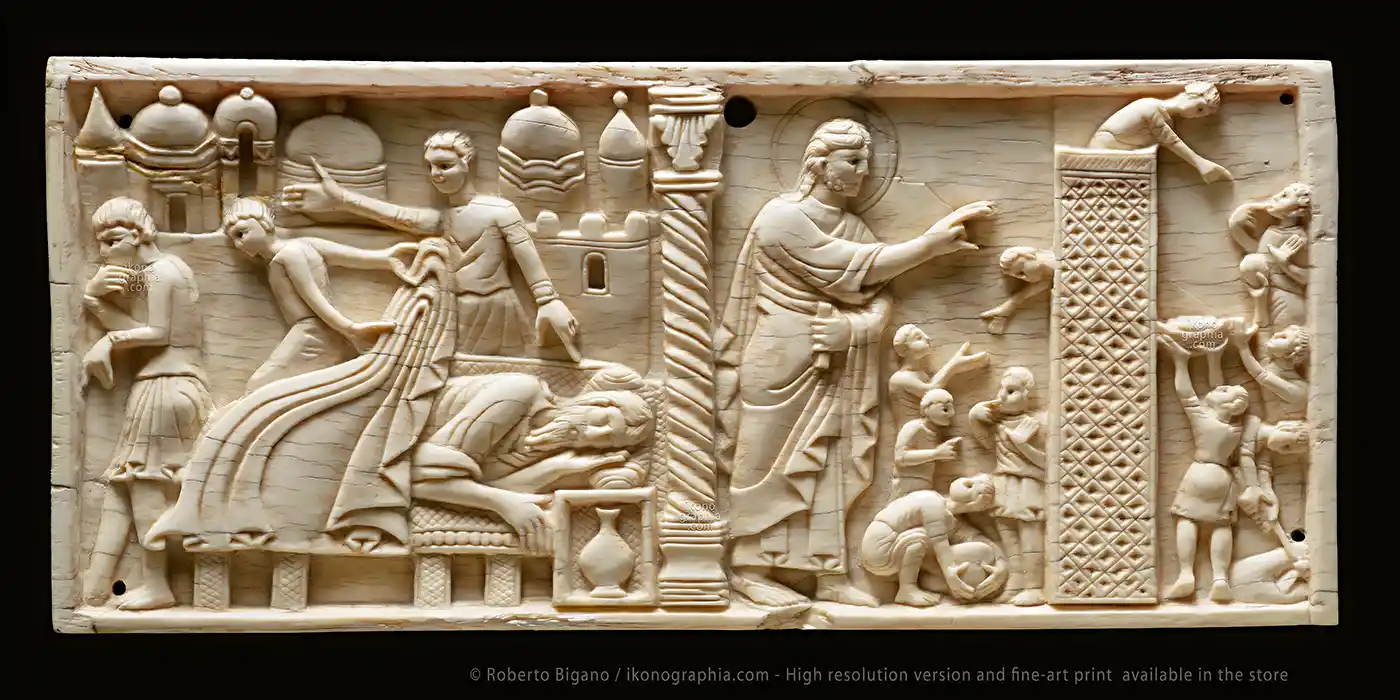
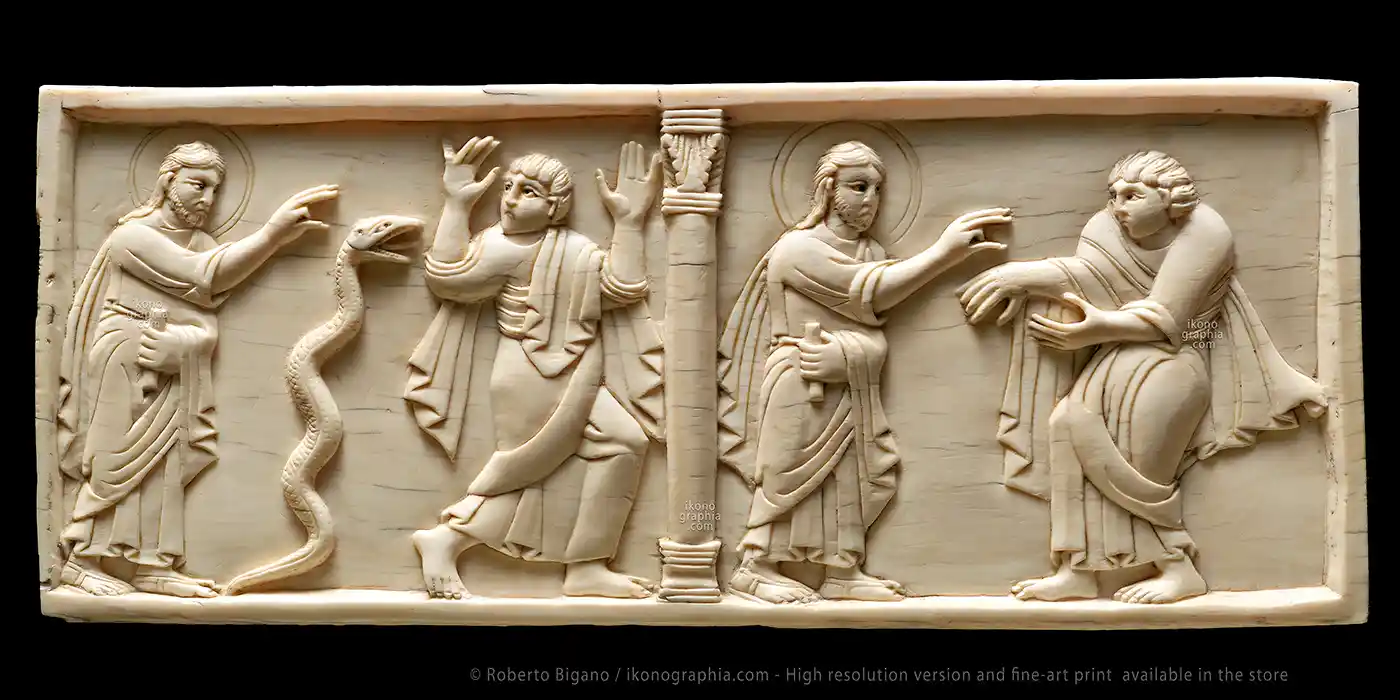
Left: Miracle of the rod turning into a serpent. Exodus 4:1 / 4:4 Right. Miracle of the leprous hand. Exodus 4:6 / 4:10 Cm 9x 24.1. Old Testament Ivory Carving. Amalfi School, late 11th - early 12th century. Housed at Museo Diocesano San Matteo, in Salerno, Italy.

Left: Miracle of the rod turning into a serpent. Exodus 4:1 / 4:4
Right. Miracle of the leprous hand. Exodus 4:6 / 4:10
Cm 9.8x24

The Exhibition & The Publication

An Exhibition — A Book — Cover and 16 pages on FMR Magazine

These photographs were commissioned for The Medieval Ivories Enigma — From Amalfi to Sorrento, an exhibition examining Southern Italy's ivory carving tradition. A selection later appeared in FMR Magazine's 2024 Summer Solstice issue, in an article titled "The Greatest Story Ever Carved" by Francesca Dall'Acqua.

For Ikonographia, the project created a visual archive allowing these works to be studied and appreciated beyond the museum's walls—documentation that transforms obscurity into access.

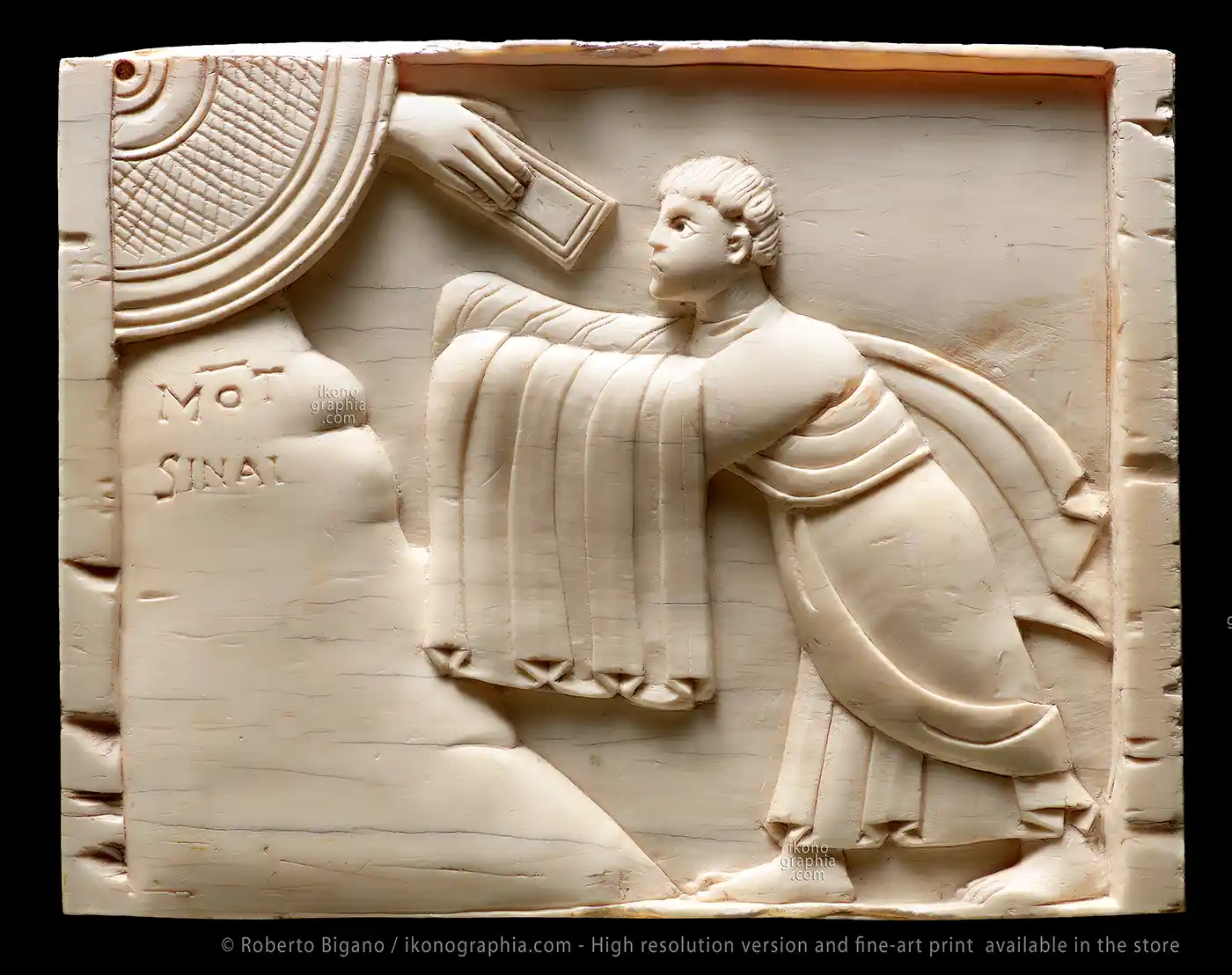
Moses at Mount Sinai. Old Testament Ivory Carving. Amalfi School, late 11th

Moses at Mount Sinai. Exodus 19:1 / 19:6
Cm 8.9x11.4

The Ivory Bible — NewTestament Carvings from Medieval Amalfi

The next episode will feature the entire collection of the New Testament series, which includes 27 plaques illustrating 51 scenes. These plaques were created a century later and boast more intricate designs, making them even more captivating than the Old Testament series.

Armor with grotesque mask-style visor owned by Wolf Dietrich von Hohenems of Lansquenets 1525
FMR Magazine - Summer Solstice Number 2024. Ivory Carving Article

A selection of images featuring Old and New Testament ivory carvings has been beautifully presented in the 2024 Summer Solstice edition of the iconic FMR Magazine.

The article, titled "The Greatest Story Ever Carved," is written by Francesca Dall'Acqua, with photographs by Roberto Bigano.


This issue is available in both English and Italian.

Copyright Links and Credits

Photography, Copyright & Credits

All photographs © Ikonographia / Roberto Bigano — All Rights Reserved. These images are part of the Ikonographia Visual Archives: — The Ivory Bible — Old and New Testament Carvings from Medieval Amalfi Archive

Terms of Use (Summary)

The images presented in this archive are copyrighted and available for licensed use only through Ikonographia Visual Archives.

You may not download, reproduce, publish, or distribute these images without a valid license. For commercial or editorial licensing, please refer to the product pages or contact Ikonographia directly. A full explanation of licensing terms is available in the Shop / Licensing Information section under "Ikonographia — Standard License" and "Ikonographia — Merchandising & Product Use Licenses"

Ikonographia Mission Statement

Ikonographia is committed to the accurate documentation, preservation, and ethical dissemination of twentieth-century visual culture.

Archival Notes — The Ivory Bible — Old and New Testament Carvings from Medieval Amalfi

Medieval Biblical narratives carved in ivory — an enigmatic masterwork from 11th century Southern Italy. The Salerno Ivories are among the world's forgotten wonders. Carved in elephant ivory a thousand years ago, they form one of the most complete Biblical narrative cycles to survive from the medieval Mediterranean. Their origin remains mysterious—likely Amalfi, possibly elsewhere. Their artistic sophistication is undeniable. Yet they remain largely unknown, housed in a quiet museum on Italy's southern coast. Published in FMR Magazine's as "The Greatest Story Ever Carved" — with photographs by Roberto Bigano.

All images follow Ikonographia's internal archival standards for resolution, color accuracy, and metadata structure to ensure long-term consistency across the collection.

Available Contents

Further Reading — Selected Sources

The most intriguing British Dunlop ads of the thirties.

The most intriguing British Dunlop ads of the thirties.

Roberto Bigano

Apr 30, 2025

The Bystander 1938-05-25_301 Dunlop

About Dunlop Tyre


Dunlop is an iconic British brand, created in 1888 by John Boyd Dunlop, who invented the pneumatic tire, a revolutionary creation that transformed the automotive industry. Inspired by his son's tricycle struggles with hard rubber tires, this practical air-filled tire, patented by Dunlop, laid the foundation for the Dunlop Pneumatic Tire Co. Ltd. in Dublin, Ireland.
By the start of World War II, Dunlop had become synonymous with success across a diverse range of industries. Not only did it dominate the tire market, both on and off the racetrack, but it also excelled in the production of brakes, wheels, golf and tennis balls, flooring, and other industrial rubber products.

The original Dunlop company no longer exists as a corporate entity; the name lives on in several Dunlop-branded products owned by different companies, including automotive, aerospatial, industrial, and sporting products around the world.

Distinction. Wealthy couple in evening dress. Dunlop Reinforced Tyre ad 1933

DISTINCTION.
Dunlop Reinforced Ad.
The Sketch Magazine.
March 22, 1933

Dunlop Advertisement in the United Kingdom.


Throughout the 20th century, Dunlop was one of the leading advertisers in the United Kingdom. In the 1930s, the company launched several advertising campaigns. Still, in this story, we will focus on the most intriguing campaign, from 1933 to 1938, featuring beautiful illustrations created by various artists.

The illustrations are carefully crafted to depict a variety of social situations, often of an exclusive nature. Even when the Dunlop tire is not the central focus, it manages to make a striking appearance, leaving a lasting impression.

Unfortunately, most artworks were not credited or signed, and it was impossible to trace the authors.
It's almost unbelievable, but despite the brand's significance and the hundreds of ads published, the documentation is incredibly scarce, underscoring the rarity and value of the information we do have.
One notable exception is a series of ads from 1936. In this campaign, the company made a significant move by hiring leading illustrators and painters. What's more, readers could even request a free reproduction of the artworks.

Aristocrats. Elegant lady with greyhounds. Dunlop Ad, by Neil Baylis. Britannia & Eve, February 1933

Aristocrats. Elegant lady with greyhounds.
Dunlop Tire Ad.
Artwork by Neil Baylis.

Britannia and Eve Magazine.
February 1933.

A wealthy couple's night Swim. Dunlop Ad. Britannia & Eve, August 1933

A wealthy, elegant couple night swim.
Dunlop Tire Ad.
Britannia and Eve Magazine.
August 1933

Masters. Rider and hounds leaving for fox hunting. Dunlop Ad on The Sketch, November 1933.

Masters. Riders and hounds leaving for fox hunting.
Dunlop Advertisement.

The Sketch, November 1933.

Goodwill. Dunlop season greetings for a 1933 advertisement. Britannia and Eve, December 1933.

Goodwill. Dunlop season greetings.

Britannia and Eve Magazine.
December 1933.

Greeting friends on the riverfront with a Dunlop Tire in the foreground . the Tatler, May 2, 1934.

Greeting friends on the riverfront with a Dunlop Tire in the foreground.
Dunlop Tire Ad.

The Tatler, May 2, 1934

Night traffic jam on icy streets. Dunlop Ad. The Tatler, October 31, 1934

Night traffic jam on icy streets.
Dunlop Tire Ad.

The Tatler, October 31, 1934.

Perfect Control. Traffic cop in London. Dunlop Fort 90 tire ad. Illustrated Sporting and Dramatic News - Friday 12 April 1935

Perfect Control. Traffic cop in London. Dunlop Fort 90 tire ad.

Illustrated Sporting and Dramatic New, August 9, 1935

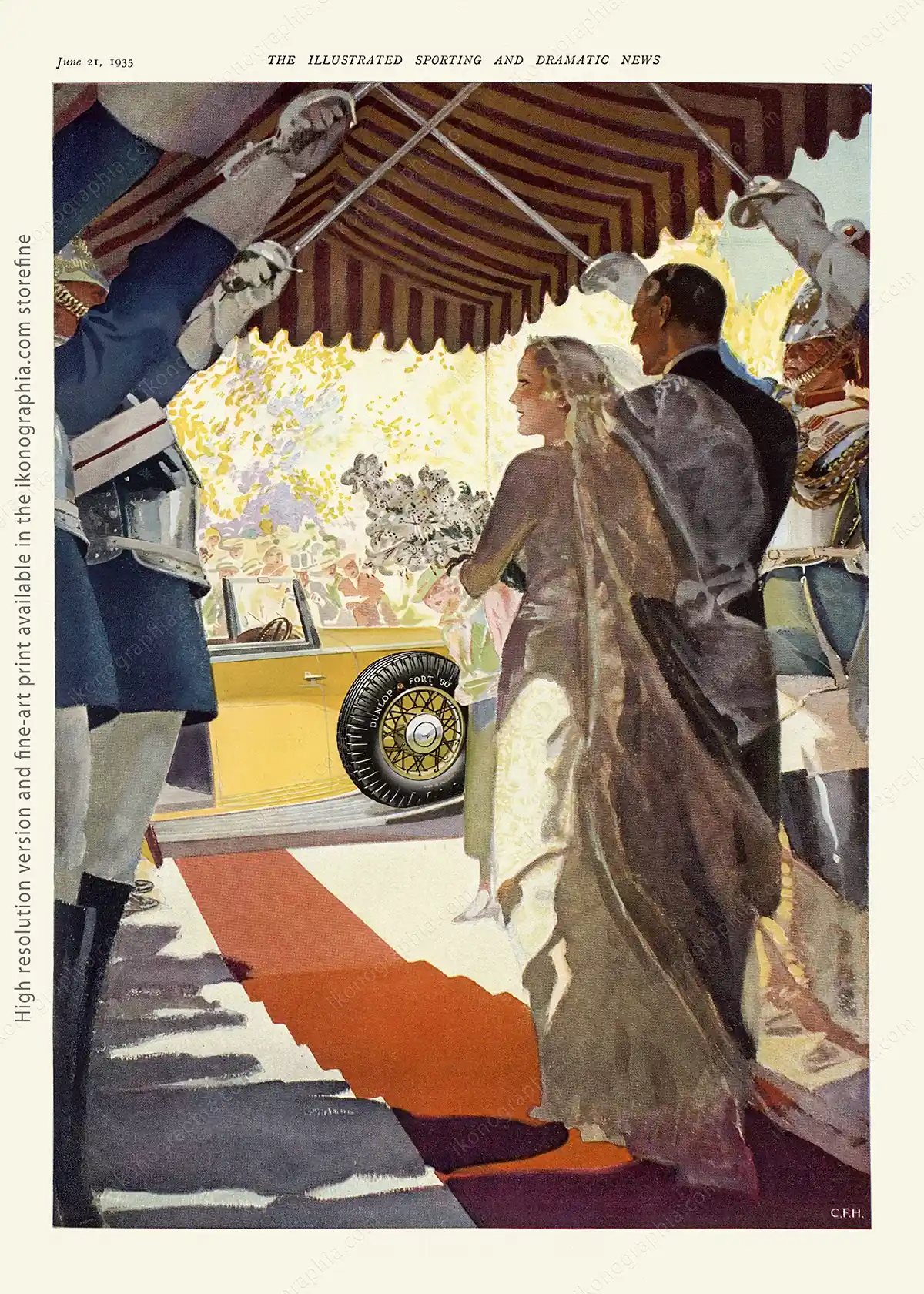
A military salute at an officer's wedding. Dunlop Fort 90 tire ad. Illustrated Sporting and Dramatic News, June 21, 1935.

A military salute at an officer's wedding.
Dunlop Tire Ad.

Illustrated Sporting and Dramatic News, June 21, 1935.

A peacock and a Dunlop Fort "90" tire. Illustrated Sporting and Dramatic New, August 9, 1935

A peacock and a Dunlop Fort "90" tire advertisement.

Illustrated Sporting and Dramatic News, August 9, 1935.

Dunlop Season Greetings 1935 with a car and a toy car with Dunlop Fort "90" tires. Illustrated Sporting and Dramatic News, December 13, 1935.

Dunlop Season Greetings 1935 with a car and a toy car with Dunlop Fort "90" tires.

Illustrated Sporting and Dramatic News, December 13, 1935.

Surreal fall landscape with a lake, art by Ernest Wallcousins. Dunlop ad 1935. Illustrated Sporting and Dramatic News October 4, 1935.

Surreal fall landscape with a lake.
Painting by Ernest Wallcousins.
Dunlop advertisement 1935.

Illustrated Sporting and Dramatic News, October 4, 1935

Merry Xmas. Dunlop season greetings 1936 advertisement. Art by Gerry Wood. Illustrated Sporting and Dramatic News, December 18, 1936.

Merry Xmas. Dunlop season greetings, 1936 ad.
Artwork by Gerry Wood.

Illustrated Sporting and Dramatic News, December 18, 1936.

The 1936 campaign by leading artists.


As said, until 1935, the company didn't credit the artists.
For the 1936 advertising campaign, Dunlop enlisted some of the leading artists of the time, primarily landscape painters, a different one for each ad. Readers could receive a free color reproduction of the original artwork.
W. Smithson Broadhead's illustration stood out as the most beautiful among these.

Fox hunting on a country road. Painting by Algernon Talmage. Dunlop ad. Illustrated Sporting and Dramatic News, February 21, 1936.

Fox hunting on a country road. Painting by Algernon Talmage. Dunlop ad.

Illustrated Sporting and Dramatic News, February 21, 1936.

Spring blossoms in a country village. Artwork by Ernest Wallcousins for a Dunlop ad. Illustrated Sporting and Dramatic News, May 22, 1936.

Spring blossoms in a country village. Artwork by Ernest Wallcousins.
Dunlop ad.

Illustrated Sporting and Dramatic News, May 22, 1936.

A giant bare tree in a country village. Dunlop ad. Painting by James Bateman. The Bystander, March 4, 1936

A giant bare tree in a country village. Dunlop ad. Painting by James Bateman.

The Bystander, March 4, 1936

A lady in sports attire at a polo match. Painting by Smithson Broadhead. Dunlop ad. Illustrated Sporting and Dramatic News, June 19, 1936.

A lady in sports attire at a polo match. Painting by Smithson Broadhead.
Dunlop ad.

Illustrated Sporting and Dramatic News, June 19, 1936.

An Idyllic fall landscape with a lake. Painting by Lamorna Birch. Dunlop ad. Illustrated Sporting and Dramatic News, October 2, 1936.

An Idyllic fall landscape with a lake. Painting by Lamorna Birch. Dunlop ad.

Illustrated Sporting and Dramatic News, June 19, 1936.

Driving on a winter night on a country road, Dunlop Ad 1936. Artwork by Christopher Nevinson. Illustrated Sporting and Dramatic, November 13, 1936

Driving on a winter night on a country road, Dunlop Ad 1936.
Artwork by Christopher Nevinson.

Illustrated Sporting and Dramatic, November 13, 1936

Lastly, the remarkable advertisements from 1938.


Lastly, the remarkable advertisements from 1938 are truly noteworthy. Unfortunately, the company once again neglected to credit the artists involved. We are diligently working to uncover their names or to decipher any signatures where available.
1938 marked the last time Dunlop used organic campaigns featuring color illustrations. In the years that followed, the company made significant changes to its advertising style.

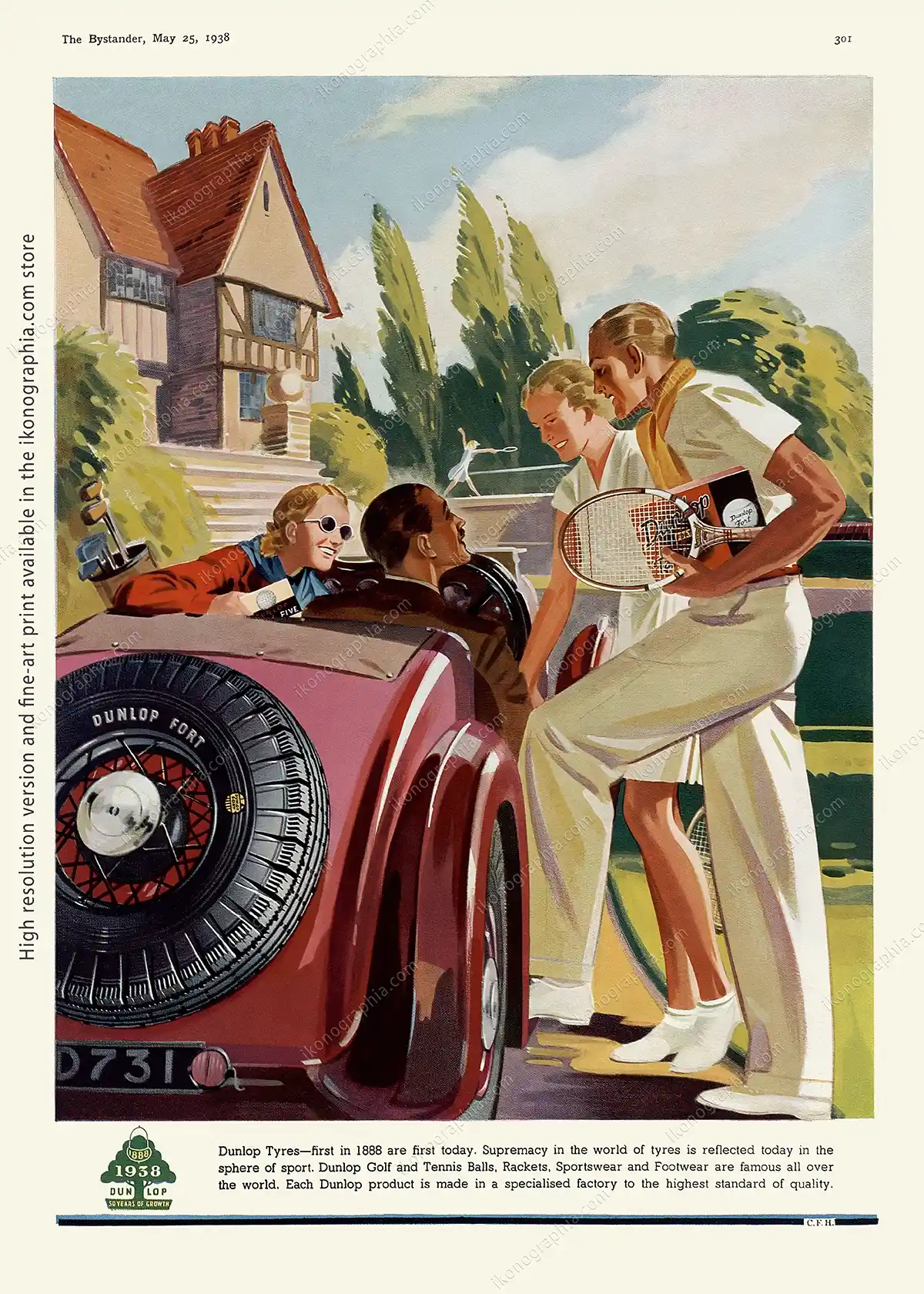
Tennis and golf players with Dunlop Fort tires and balls advertisement. The Bystander, March 25, 1938.

1938 Tennis and golf players’ advertisement, featuring the Dunlop range, including Dunlop tires, balls, rackets, and sportswear. 

The Bystander, March 25, 1938.


Dunlop Tyres-- first in 1888 are first today. Supremacy in the world of tyres is reflected today in the sphere of sport. Dunlop Golf and Tennis Balls, Rackets, Sportswear and Footwear are famous all over the world. Each Dunlop product is made in a specialised factory to the highest standard of quality.

A 1938 Dunlop ad featuring an Armstrong Whitworth Ensign of Imperial Airways aircraft and a classic car. The Bystander July 13, 1938. This image focuses on two of Dunlop's favorite topics: elegance and sophistication associated with luxury and the progress and innovation of the 1930s, highlighting technological advancements in air and land travel.

A 1938 Dunlop ad featuring an Armstrong Whitworth Ensign of Imperial Airways aircraft and a classic car.

The Bystander, July 13, 1938.

This image focuses on two of Dunlop's favorite topics: elegance and sophistication associated with luxury and the progress and innovation of the 1930s, highlighting technological advancements in air and land travel.


Had it not been for John Boyd Dunlop's invention of the pneumatic tyre in 1888, even man's conquest of the air might have been long delayed. It was the Dunlop tyre which made possible every form of smooth, swift progress on the ground or off it. More than that, landing Tyres have contributed materially to the progressive development of aviation. Trust yourself only to the first and still foremost of all tyres.

Trucks and transportation 1938 Dunlop advertisement. The Bystander, September 21, 1938.

Trucks and transportation 1938 Dunlop advertisement.

The Bystander, September 21, 1938.


The wheels of modern industry run more swiftly and more smoothly since Dunlop invented his pneumatic tyre in 1888. With the progress it initiated Dunlop keeps pace. Every tyre need for modern transport has been and will always be, met by Dunlop.

Trucks and transportation 1938 Dunlop advertisement. The Bystander, September 21, 1938.

Dunlop ad featuring a riding lady and Dunlop Fort tires.
Artwork by Jean Bowman.

The Bystander, November 9, 1938.


The dependability of DUNLOP Tyres and the safety they ensure are accepted universally. So now is the supreme excellence of DUNLOP Weather-wear and Sports-wear in which, again, the protective factor is inseparable from style, distinction, and inherent quality. In fact, the name is synonymous with safety and protection.

Copyright, Links and credits

All the photographs on this page are copyrighted to Roberto Bigano.

LINKS

The Architectural Forum. Reliefs And Grilles Of The Chanin Building Vestibules.
Architectural Design, May 1929, page 693 >

The Chanin Building Wikipedia >

Art Deco Glass Objects by Serge Roche, 1930s

Art Deco Glass Objects by Serge Roche, 1930s

Art Deco Glass Objects by Serge Roche — 1930s

The most complete visual documentation of Serge Roche's work — photographed for FMR Magazine.

Serge Roche — born in Paris in 1898 — was the defining figure of French Art Deco glass and mirror work. His studio on Boulevard Haussmann attracted the elite of the international art world for three decades. His clients included the Princess Aga Khan and the Countess of Polignac. His techniques — oxidation and verre églomisé — produced objects never replicated.

Roberto Bigano photographed the collection for FMR Magazine. Outside specialist circles, Roche remains largely unknown — almost nothing on him exists in English. This story is the most complete visual documentation of his work available in any language.

A Serge Roche Art Deco mirror fireplace, crafted in 1933 for a NYC customer.

Serge Roche, an eclectic artist, symbol of an irreplaceable era.


Serge Roche, born in France in 1898, was an eclectic artist, although he would be best defined as an interior decorator. He was also a remarkable antiquarian, sculptor, designer, and organizer of significant exhibitions.
His studio, located at 125 Boulevard Haussmann, served as a global hub for decades, attracting the elite of the Parisian and international artistic community. In 
1925, Roche participated in the International Exhibition of Modern Decorative and Industrial Arts, collaborating with the Manufacture de Sèvres to create a 16m² porcelain panel themed on the Earthly Paradise.

By 1934, he had developed a unique style that became the focus of his first exhibition, featuring mirrors and 'mirror and glass objects.' He combined two techniques: oxidation and eglomization.
Enjoy a selection of these stunning creations.

Obelisque in oxidized glass, with a crystal ball on top. Serge Roche 1933. Collection Laurent Marechal. Photo by Roberto Bigano.

Obelisque in oxidized glass, with a crystal ball on top, by Serge Roche, 1933.

Paris, collection Laurent Marechal.

Verre églomisé and oxidized glass.


Verre églomisé is a French term for applying and gilding glass to produce a mirror finish. This technique also involves the intriguing process of embedding foreign materials within glass paste, adding a layer of diversity to the art form.
The name verre églomisé is a tribute to the 18th-century French decorator and art dealer Jean-Baptiste Glomy, who played a pivotal role in its revival.
When a glass appears hazy and has an Etched look, it is called oxidized. Oxidation is typically seen as a flaw but can be creatively harnessed. Roche's innovative approach to using oxidation in eglomized glass led to unprecedented results.

To start, you can enjoy a series of his famous glass obelisks, which are his signature art objects.

Obelisque, by Serge Roche 1936. Obelisk in oxidized and eglomized glass.

Obelisque, by Serge Roche, 1936.

Obelisk in oxidized and eglomized glass.
Paris, collection Laurent Marechal.

Obelisque in oxidized and eglomized blue glass, by Serge Roche 1938

Obelisque by Serge Roche, 1938.

Obelisk in oxidized and eglomized blue glass.
Paris, collection Laurent Marechal.

Pair of obelisks in eglomized glass by Serge Roche 1935

Paire d'obélisques en verre églomisé by Serge Roche, 1935. Pair of obelisks in eglomized glass.
Paris, collection Laurent Marechal.

Vase "Médicis" in oxidized mirror, by Serge Roche 1934. One sample was sold to Princess Aga Khan.

Vase "Médicis" in oxidized mirror, by Serge Roche, 1934.

One sample was sold to Princess Aga Khan.

Mirrors table with stuccoed lion's feet by Serge Roche 1939

Mirror table with stuccoed lion's feet by Serge Roche 1939.

Pedestal table in oxidized glass and gilded stucco wood by Serge Roche 1936

Guéridon (pedestal table) in oxidized glass and gilded stucco wood by Serge Roche, 1936.

Serge Roche's console en verre églomisé, console in eglomised mirror, 1935.

Mirror table with stuccoed lion's feet by Serge Roche 1939.

A Serge Roche wrought iron table in the oxidized mirror and glass columns, 1932

A Serge Roche wrought iron table in the oxidized mirror and glass columns, 1932. Custom made for the Countess of Polignac.

Backstage with Serge Roche's obelisks of the 1930s at the collector's house, Paris, 2005.

Backstage with the obelisks at the collector's house, Paris, 2005. Suddenly, a ray of sunshine illuminated the obelisks, highlighting their shifting luminescence.

Two unbelievable masterpieces.


Before highlighting some fascinating non-glass art objects, we are proud to present two exceptional masterpieces created by this truly unique artist.

The first is an eglomisé octagonal mirror framed by panels featuring mythical creatures. The craftsmanship, a piece of history, was likely done by Max Ingrand in 1933 for the Maison Serge Roche.
The second object is a highly intricate mirror fireplace, crafted in 1934 by Serge Roche. This unique work was commissioned by Mr. C. Suydam's residence in New York City.

Eglomizedì octagonal mirror for Serge Roche by Max Ingrand 1933

"Eglomized" octagonal mirror framed by panels featuring mythical creatures by Maison Serge Roche. The craftsmanship was likely done by Max Ingrand in 1933. The Eglomization technique consisted of embedding foreign elements in the mirror's glass paste, producing an endless array of variations. Collection Laurent Marechal.

Detail of a mythical animal from an Art Deco mirror by Max Ingrand for Serge Roche 1933

Detail of a mythical animal from an Art Deco mirror by Max Ingrand for Serge Roche, 1933

Detail of a mythical animal from a mirror by Max Ingrand for Serge Roche 1933

Detail of a mythical animal from a mirror by Max Ingrand for Serge Roche 1933

A highly intricate eglomisé mirror fireplace with a shell on top, crafted in 1933 by Serge Roche as a unique piece for Mr. C. Suydam's Cutting in New York City. Paris, collection Laurent Marechal.

A highly intricate eglomisé mirror fireplace with a shell on top, crafted in 1933 by Serge Roche as a unique piece for Mr. C. Suydam's Cutting in New York City.
Paris, collection Laurent Marechal.

A highly intricate eglomisé mirror fireplace with a shell on top, crafted in 1933 by Serge Roche as a unique piece for Mr. C. Suydam's Cutting in New York City. Paris, collection Laurent Marechal.

A highly intricate eglomisé mirror fireplace with a shell on top, crafted in 1933 by Serge Roche as a unique piece for Mr. C. Suydam's Cutting in New York City. Front detail.
Paris, collection Laurent Marechal.

Mirror fireplace by Serge Roche, 1933, detail 2

A highly intricate eglomisé mirror fireplace with a shell on top, crafted in 1933 by Serge Roche as a unique piece for Mr. C. Suydam's Cutting in New York City. Side detail.
Paris, collection Laurent Marechal.

A corner detail of a Serge Roche Art Deco mirror fireplace, crafted in 1933 for a NYC customer

A highly intricate eglomisé mirror fireplace with a shell on top, crafted in 1933 by Serge Roche as a unique piece for Mr. C. Suydam's Cutting in New York City. Corner detail.
Paris, collection Laurent Marechal.

Serge Roche's works with materials other than glass and mirrors.


The last part of this story introduces you to Serge Roche's works with materials other than glass and mirrors.
At the end, you will have gained a comprehensive understanding of Roche's work, spanning from his creation of art objects to his furniture designs.

However, Roche's artistic repertoire extended far beyond glass and mirrors. He was a versatile artist, known for his work as a decorator and organizer of major exhibitions and events in France, Europe, and the United States.
For instance, Roche undertook a monumental project, spending five years to furnish and decorate the Chateau de Chalins, owned by the billionaire actress Ganna Walska.

Serge Roche wooden cabinet with drawings by Ismaël de la Serna, 1936

A wooden cabinet decorated with scagliola motifs.
The surrealist-inspired drawings were made by Ismaël de la Serna for Serge Roche. 1936.
Paris, collection Laurent Marechal.

Serge Roche wooden cabinet with drawings by Ismaël de la Serna, 1936 detail

A wooden cabinet decorated with scagliola motifs.
The surrealist-inspired drawings were made by Ismaël de la Serna for Serge Roche. 1936.
Paris, collection Laurent Marechal.

Serge Roche stuccoed-iron floor lamp, crafted in 1935 by Gilbert Poillerat

Serge Roche iron floor lamp stuccoed in white, crafted in 1935 by Gilbert Poillerat

Serge Roche's Atlas-shaped stucco column 1933

Serge Roche's Atlas-shaped stucco column 1933
Paris, collection Laurent Marechal.

Copyright Links and Credits

Photography, Copyright & Credits

All photographs © Ikonographia / Roberto Bigano — All Rights Reserved. These images are part of the Ikonographia Visual Archives:Art Deco Glass Objects by Serge Roche (1930s)

Roberto Bigano photographed this collection for FMR Magazine.

Terms of Use (Summary)

The images presented in this archive are copyrighted and available for licensed use only through Ikonographia Visual Archives.

You may not download, reproduce, publish, or distribute these images without a valid license. For commercial or editorial licensing, please refer to the product pages or contact Ikonographia directly. A full explanation of licensing terms is available in the Shop / Licensing Information section under "Ikonographia — Standard License" and "Ikonographia — Merchandising & Product Use Licenses."

Ikonographia Mission Statement

Ikonographia is committed to the accurate documentation, preservation, and ethical dissemination of twentieth-century visual culture.

USD United States (US) dollar
EUR Euro