The Kellogg Kids, by Leyendecker. Corn Flakes Ads 1916-1917

The Kellogg Kids, by Leyendecker. Corn Flakes Ads 1916-1917

1910s

Jul 30, 2025

J.C.Leyendecker-Kellog's-Kid

Joseph Christian Leyendecker


Joseph Christian Leyendecker was one of the most prominent and financially successful freelance commercial artists in the United States. From 1895 to 1951, he created hundreds of magazine covers for "Collier's Weekly" and "The Saturday Evening Post," as well as advertisements for prominent brands such as Kellogg's Corn Flakes, Kuppenheimer, and Arrow shirts. This last work is particularly famous, as it helped establish an iconic image of sophisticated American masculinity.
Leyendecker was also one of the few openly gay artists working in the United States during the early twentieth century.
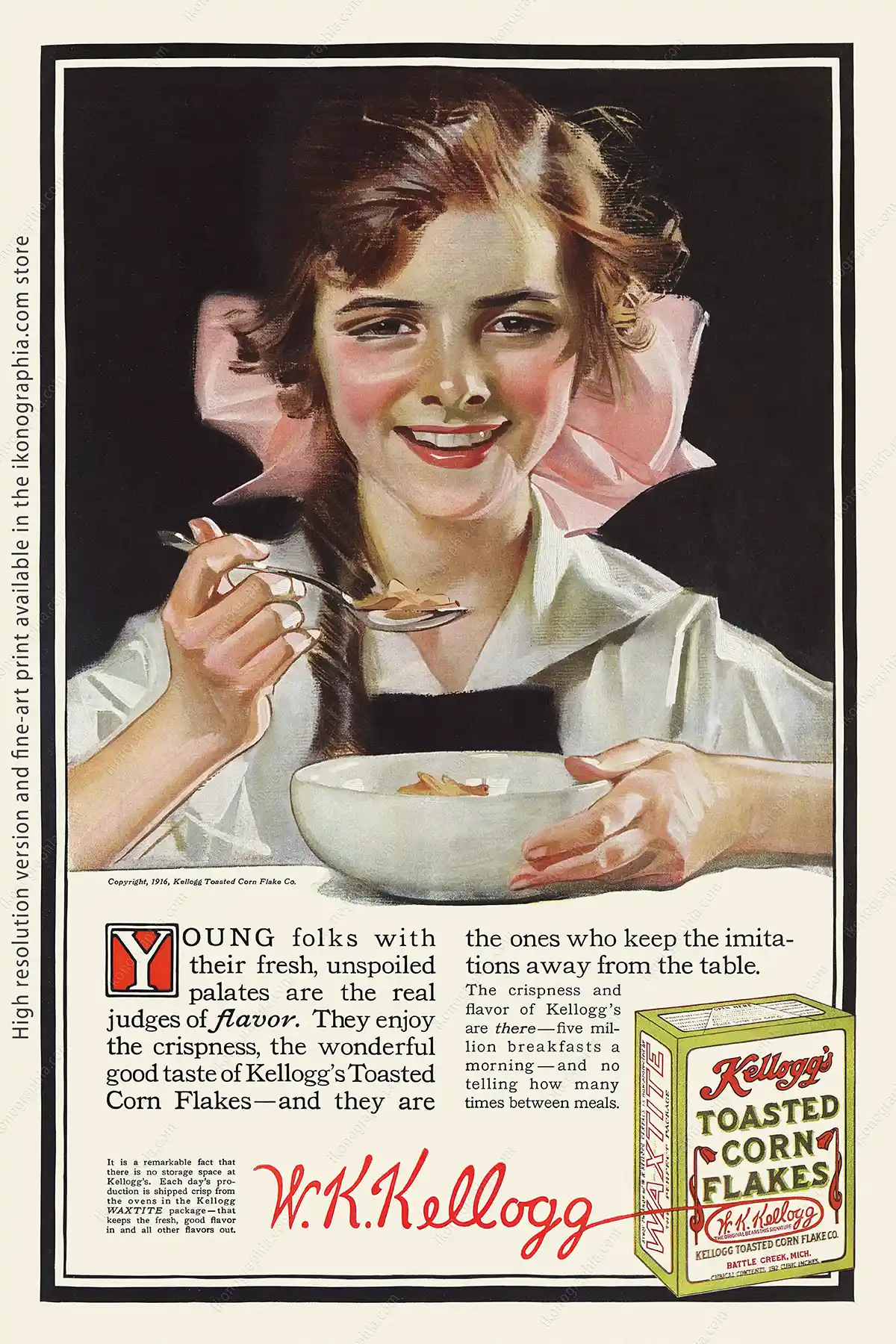
Leyendecker's Young girl judging the flavor and crispness of flakes. Kellogg's ad, 1916

"Young folks with their fresh, unspoiled palates are the real judges of flavor. They enjoy the crispness, the wonderful good taste of Kellogg's Toasted Corn Flakes—and they are the ones who keep the imitations away from the table."

Advertisement for Kellogg's Corn Flakes.
Artwork by Joseph Christian Leyendecker.

Ladies’ Home Journal, February 1916

Leyendecker kids' illustration for Kellogg's Cornflakes, 1916 and 1917.


We showcase here Leyendecker's illustration for Kellogg's Corn Flakes' advertising campaign, which ran in the Ladies' Home Journal magazine in 1916 and 1917.
The extremely vivid illustrations convey positivity, health, and joy.
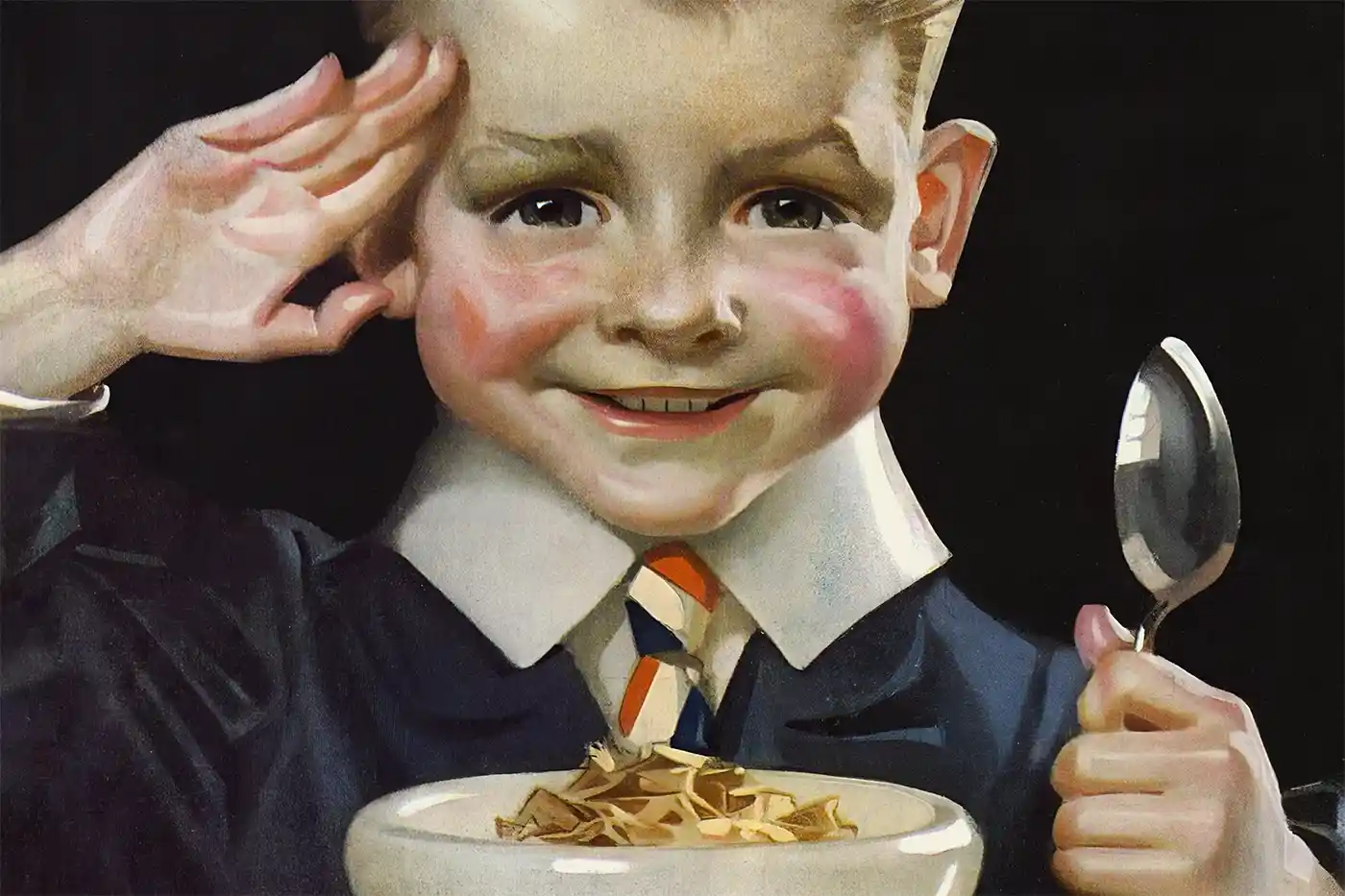
His illustration technique was remarkable, often utilizing complementary colors such as magenta/green, which reminds us of Italian late Middle Ages masters like Giotto, as shown in some close-ups.

It is notable for being one of the first advertising campaigns (together with Queen City Inks and Overland) to maintain a consistent corporate image.
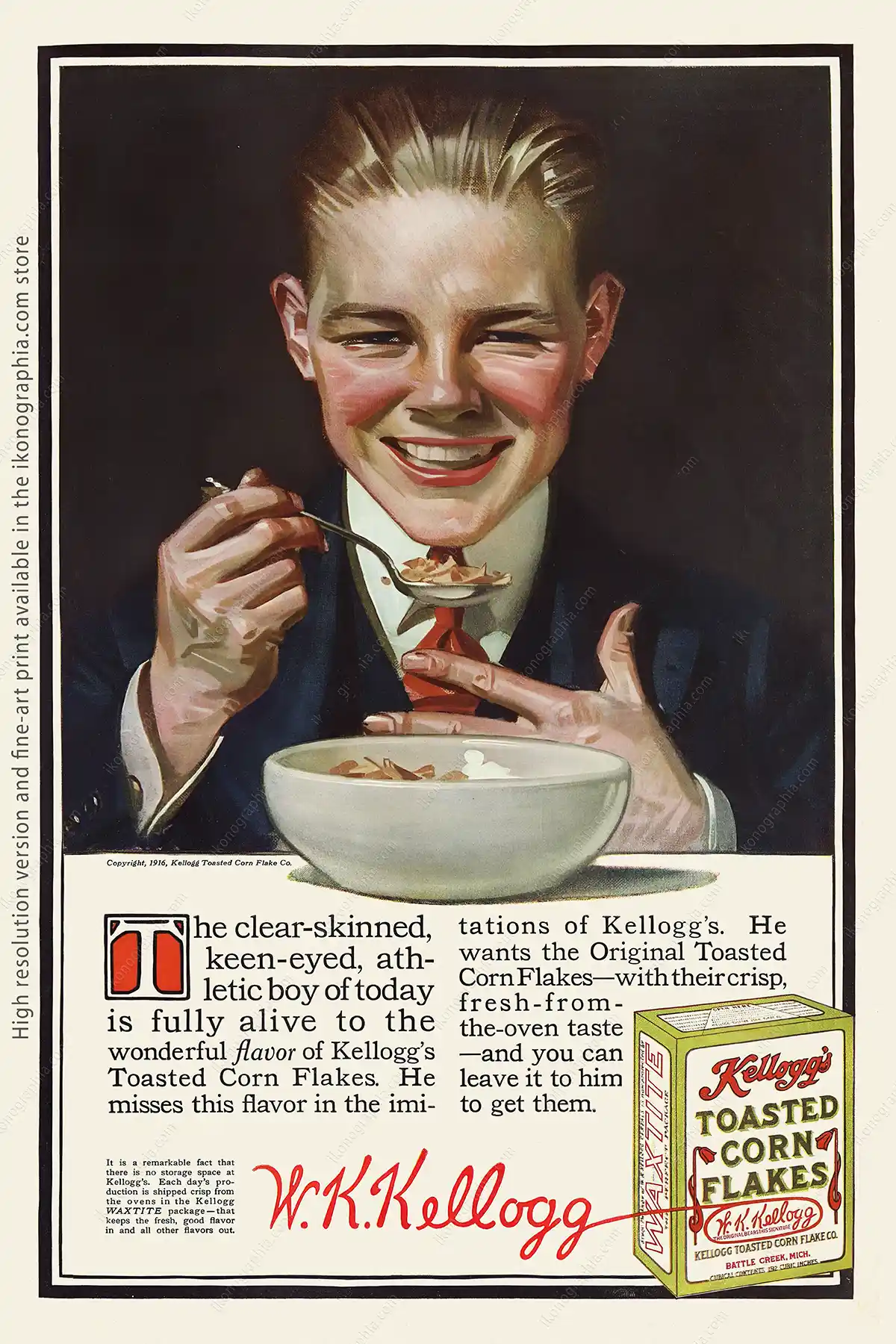
Leyendecker's clear-skinned boy enjoying corn flakes with milk. Kellogg ad, 1916 Advertisement for Kellogg's Corn flakes. Artwork by Joseph Christian Leyendecker. Ladies' Home Journal, March 1916

"The clear-skinned, keen-eyed, athletic boy of today is fully alive to the wonderful flavor of Kellogg's Toasted Corn Flakes."

Advertisement for Kellogg’s Corn Flakes.
Artwork by Joseph Christian Leyendecker.

Ladies’ Home Journal, March1916
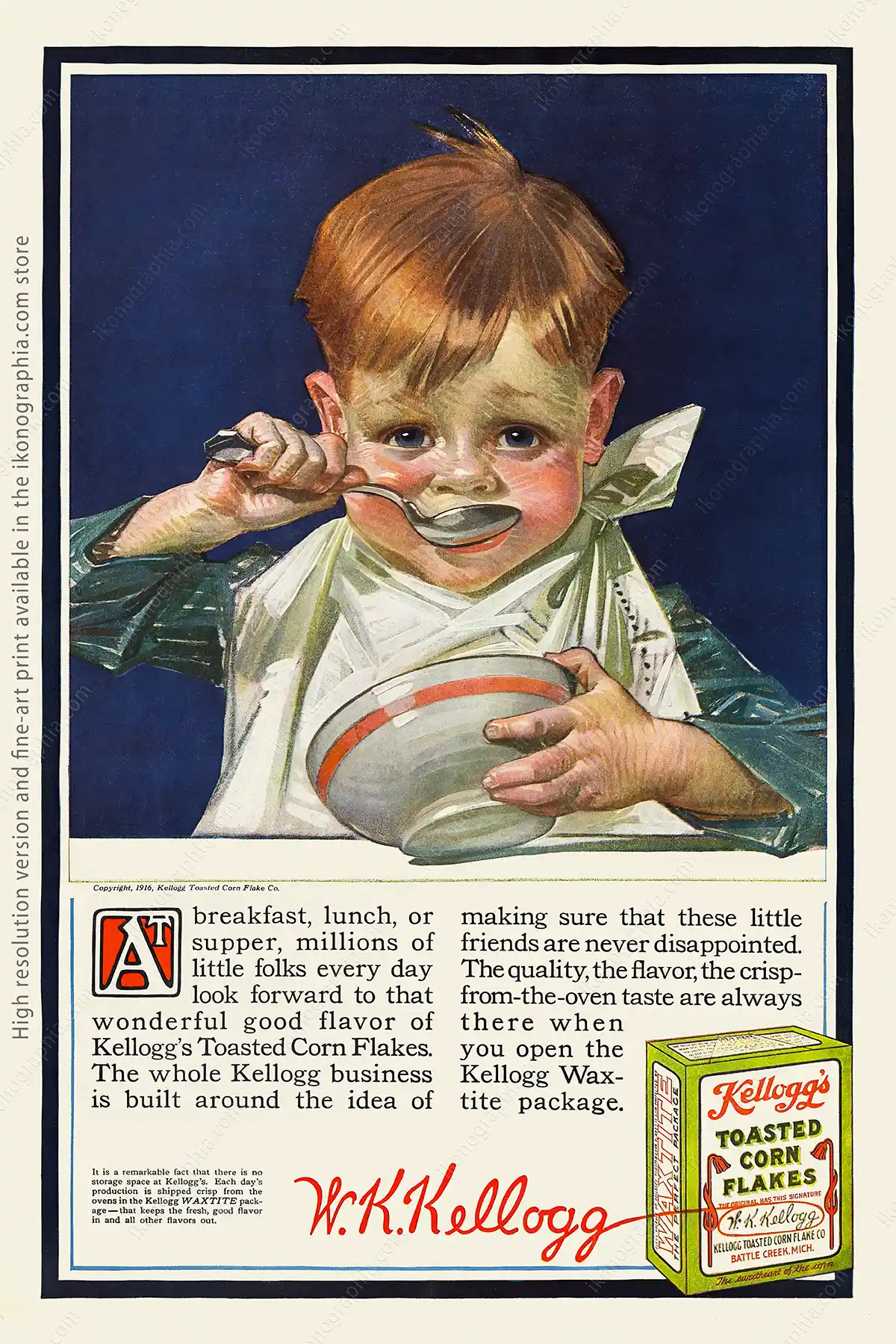
Advertisement for Kellogg's Corn flakes. Artwork by Joseph Christian Leyendecker. Ladies' Home Journal, April 1916

"At breakfast, lunch, or supper, millions of little folks every day look forward to that wonderful good flavor of Kellogg's Toasted Corn Flakes."

Advertisement for Kellogg’s Corn Flakes.
Artwork by Joseph Christian Leyendecker.

Ladies’ Home Journal, April 1916
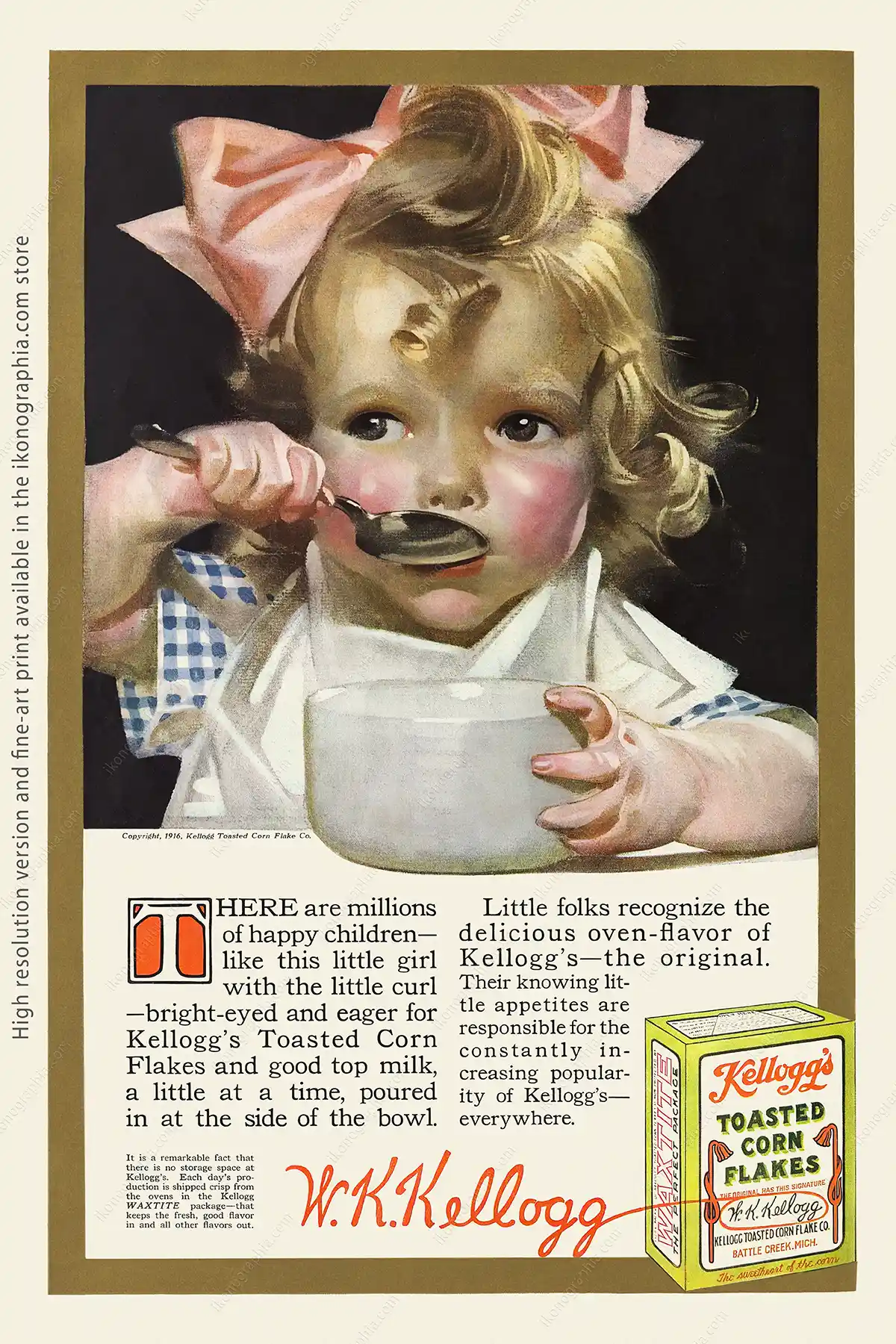
Leyendecker's baby girl enjoying cornflakes breakfast. Kellogg's ad, 1916

"There are millions of happy children like this little girl with the little curl, bright-eyed and eager for Kellogg’s Toasted Corn Flakes and good top milk, a little at a time, poured in at the side of the bowl."

Advertisement for Kellogg’s Corn Flakes.
Artwork by Joseph Christian Leyendecker.

Ladies’ Home Journal, May 1916
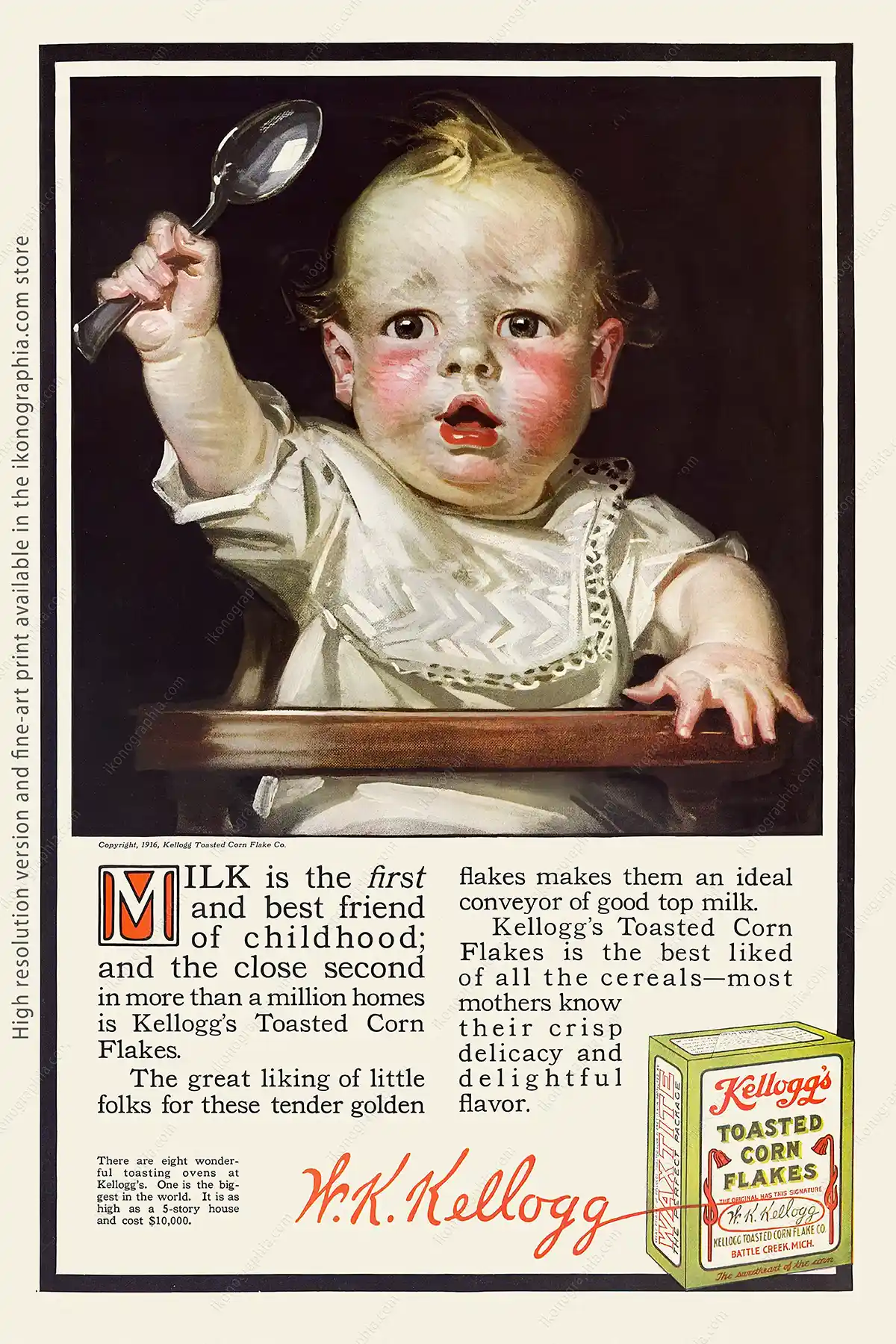
Leyendecker's baby claiming for milk and flakes. Kellogg ad, 1916 Advertisement for Kellogg's Corn flakes. Artwork by Joseph Christian Leyendecker. Ladies' Home Journal, June 1916

"Milk is the first and best friend of childhood; and the close second in more than a million homes is Kellogg's Toasted Corn Flakes. The great liking of little folks for these tender golden flakes makes them an ideal conveyor of good top milk."

Advertisement for Kellogg’s Corn Flakes.
Artwork by Joseph Christian Leyendecker.

Ladies’ Home Journal, June 1916
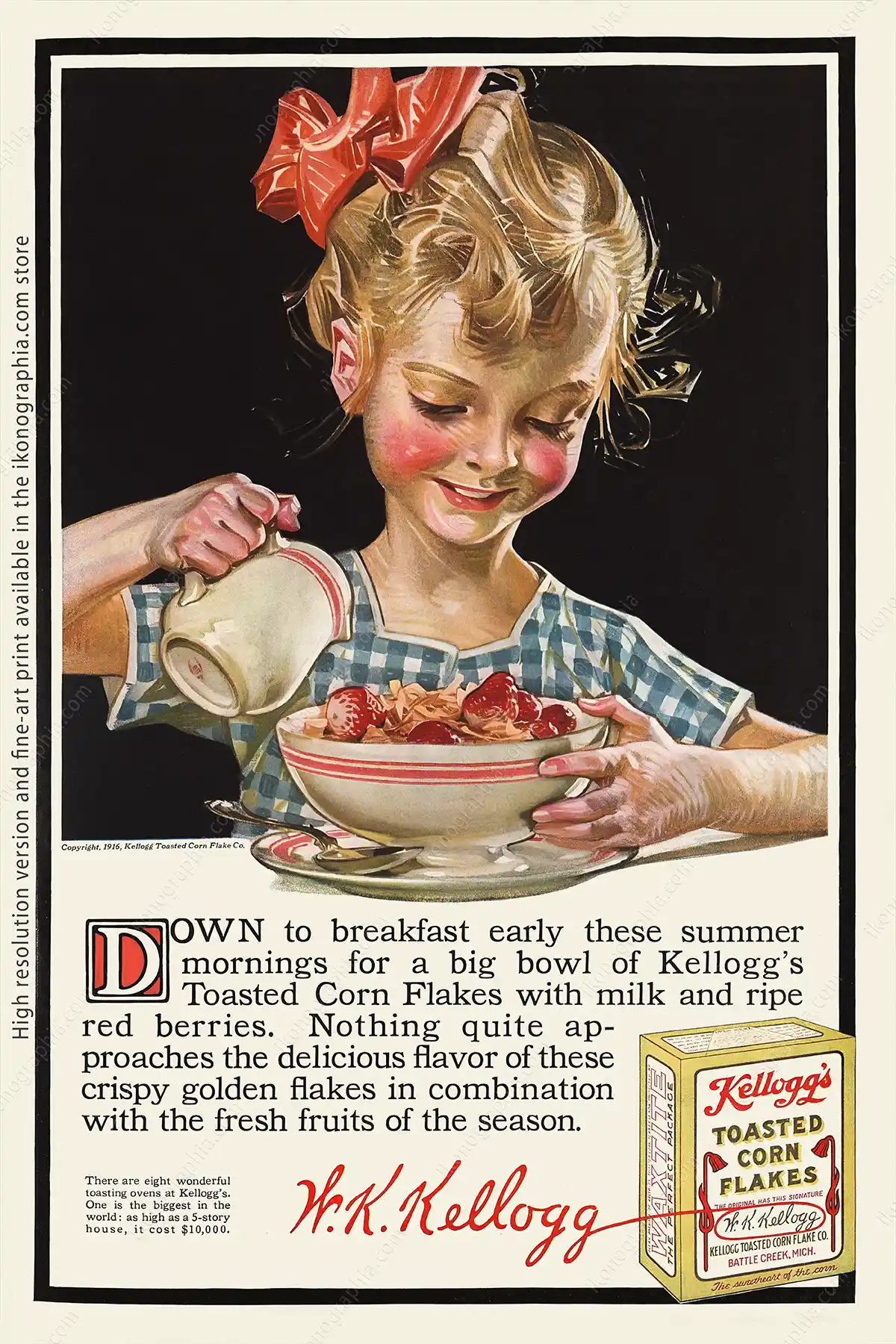
Leyendecker's Young girl enjoying corn flakes with milk and fresh fruits. Kellogg's ad, 1916 Advertisement for Kellogg's Corn flakes. Artwork by Joseph Christian Leyendecker. Ladies' Home Journal, July 1916

"Down to breakfast early these summer mornings for a big bowl of Kellogg's Toasted Corn Flakes with milk and ripe red berries. Nothing quite approaches the delicious flavor of these crispy golden flakes in combination with the fresh fruits of the season."

Advertisement for Kellogg’s Corn Flakes.
Artwork by Joseph Christian Leyendecker.

Ladies’ Home Journal, July 1916
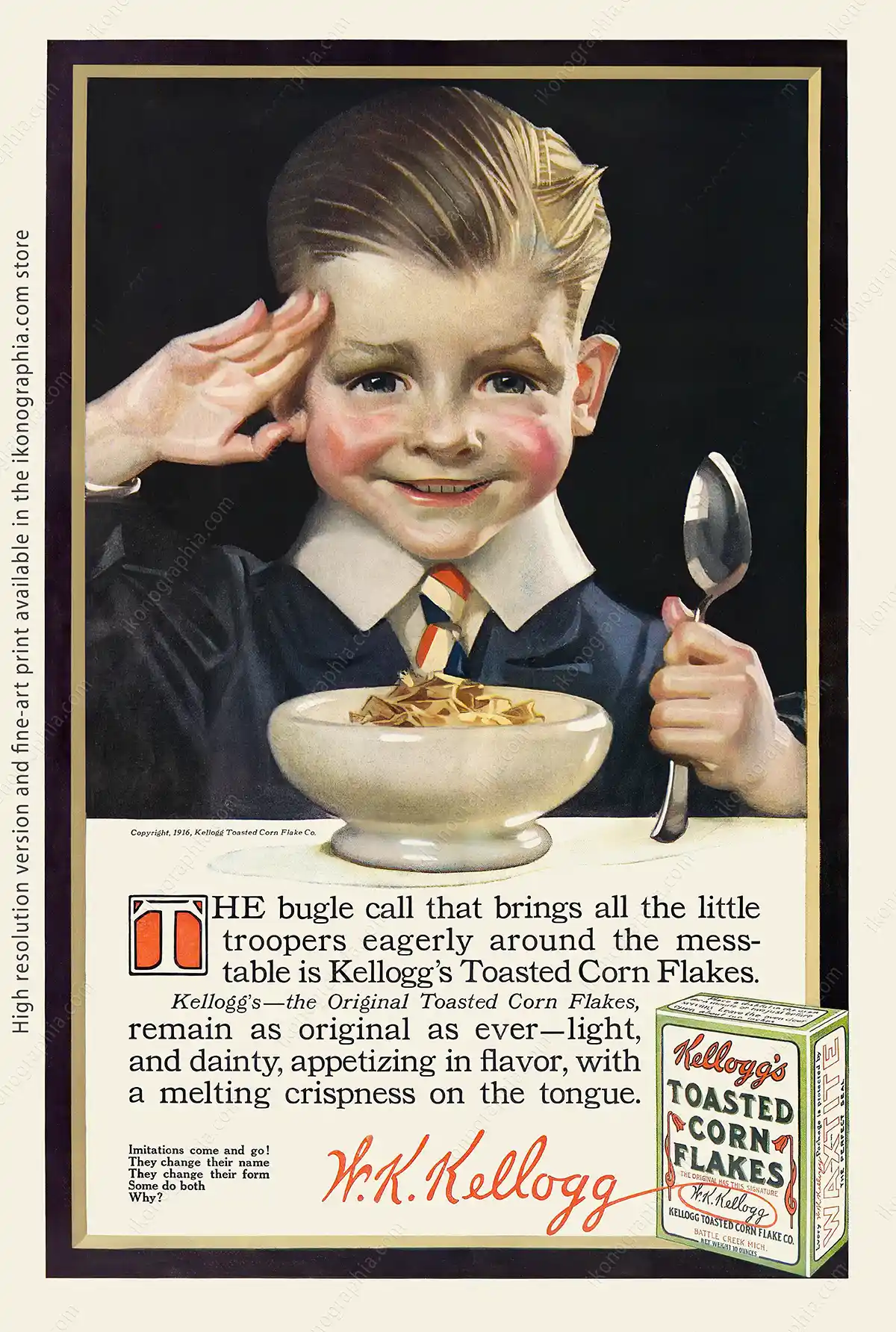
The bugle call brings little troopers eagerly around the messtable. Kellogg's ad by Leyendecker, 1916 Advertisement for Kellogg's Corn flakes. Artwork by Joseph Christian Leyendecker. Ladies' Home Journal, September 1916 THE bugle call that brings all the little troopers eagerly around the mess-table is Kellogg's Toasted Corn Flakes. Kellogg's—the Original Toasted Corn Flakes, remain as original as ever–light, and dainty, appetizing in flavor, with a melting crispness on the tongue.

"The bugle call that brings all the little troopers eagerly around the mess-table is Kellogg's Toasted Corn Flakes. Kellogg's—the Original Toasted Corn Flakes, remain as original as ever–light, and dainty, appetizing in flavor, with a melting crispness on the tongue."

Advertisement for Kellogg’s Corn Flakes.
Artwork by Joseph Christian Leyendecker.

Ladies’ Home Journal, September 1916
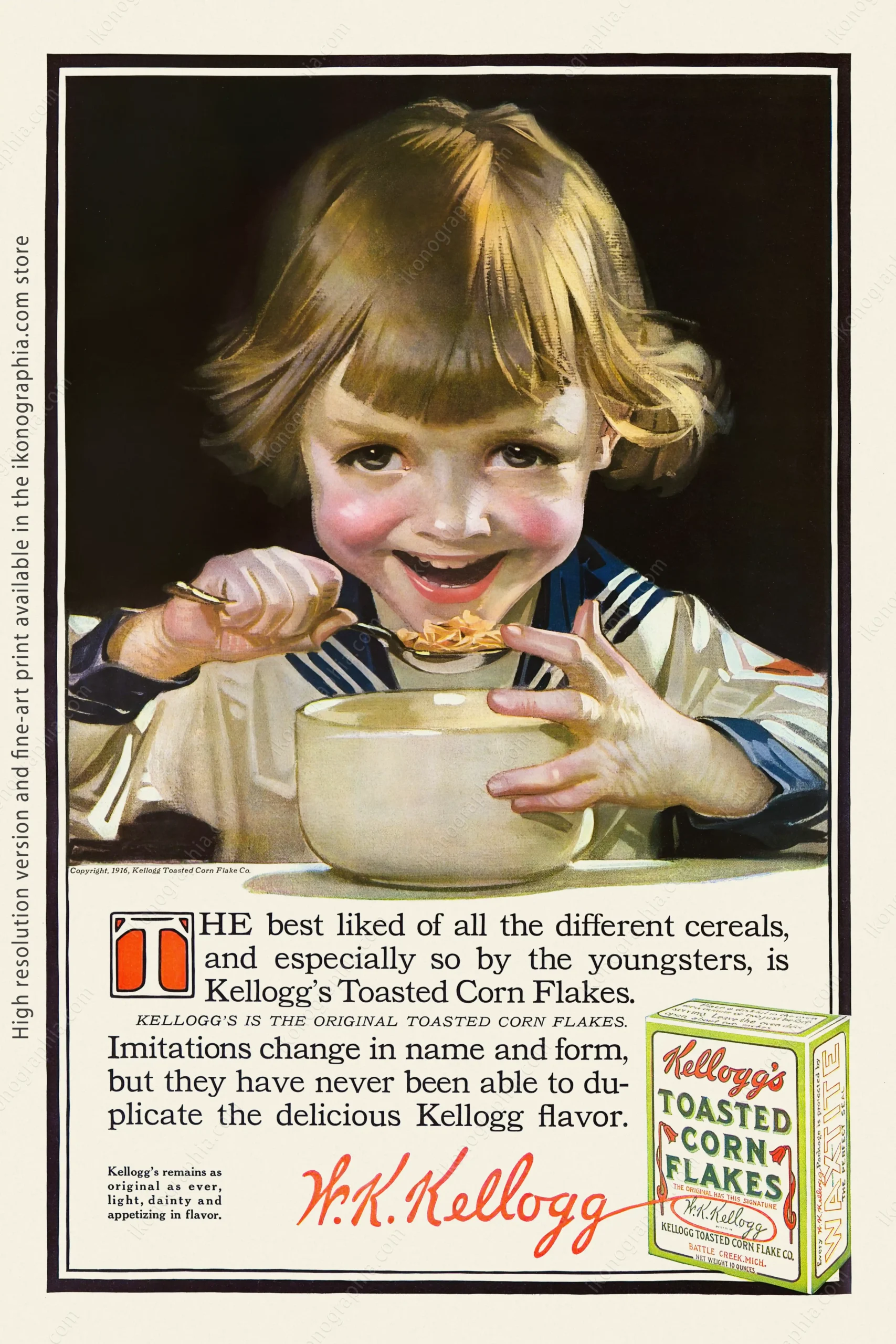
The best liked of all cereals by the youngster. Kellogg's ad by Leyendecker, 1916 Advertisement for Kellogg's Corn flakes. Artwork by Joseph Christian Leyendecker. Ladies' Home Journal, October 1916

"The best liked of all the different cereals, and especially so by the youngsters, is Kellogg's Toasted Corn Flakes."

Advertisement for Kellogg’s Corn Flakes.
Artwork by Joseph Christian Leyendecker.

Ladies’ Home Journal, October 1916
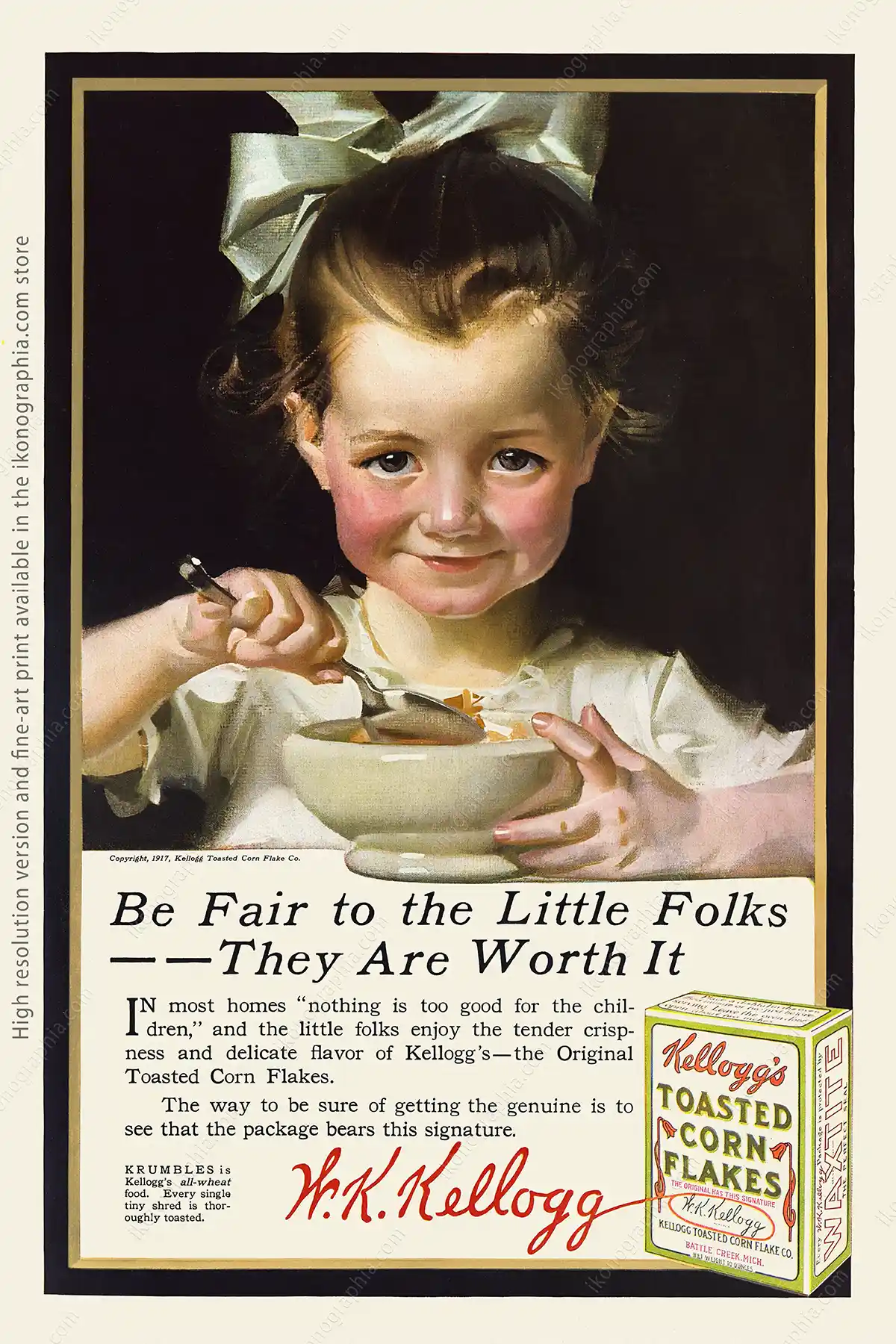
Be Fair to the Little Folks - They Are Worth It. Kellogg's ad by Leyendecker, 1917 Advertisement for Kellogg's Corn Flakes. Artwork by Joseph Christian Leyendecker. Ladies' Home Journal, March 1917

"Be Fair to the Little Folks They Are Worth It. In most homes "nothing is too good for the children," and the little folks enjoy the tender crispness and delicate flavor of Kellogg's the Original Toasted Corn Flakes."

Advertisement for Kellogg’s Corn Flakes.
Artwork by Joseph Christian Leyendecker.

Ladies’ Home Journal, March 1917
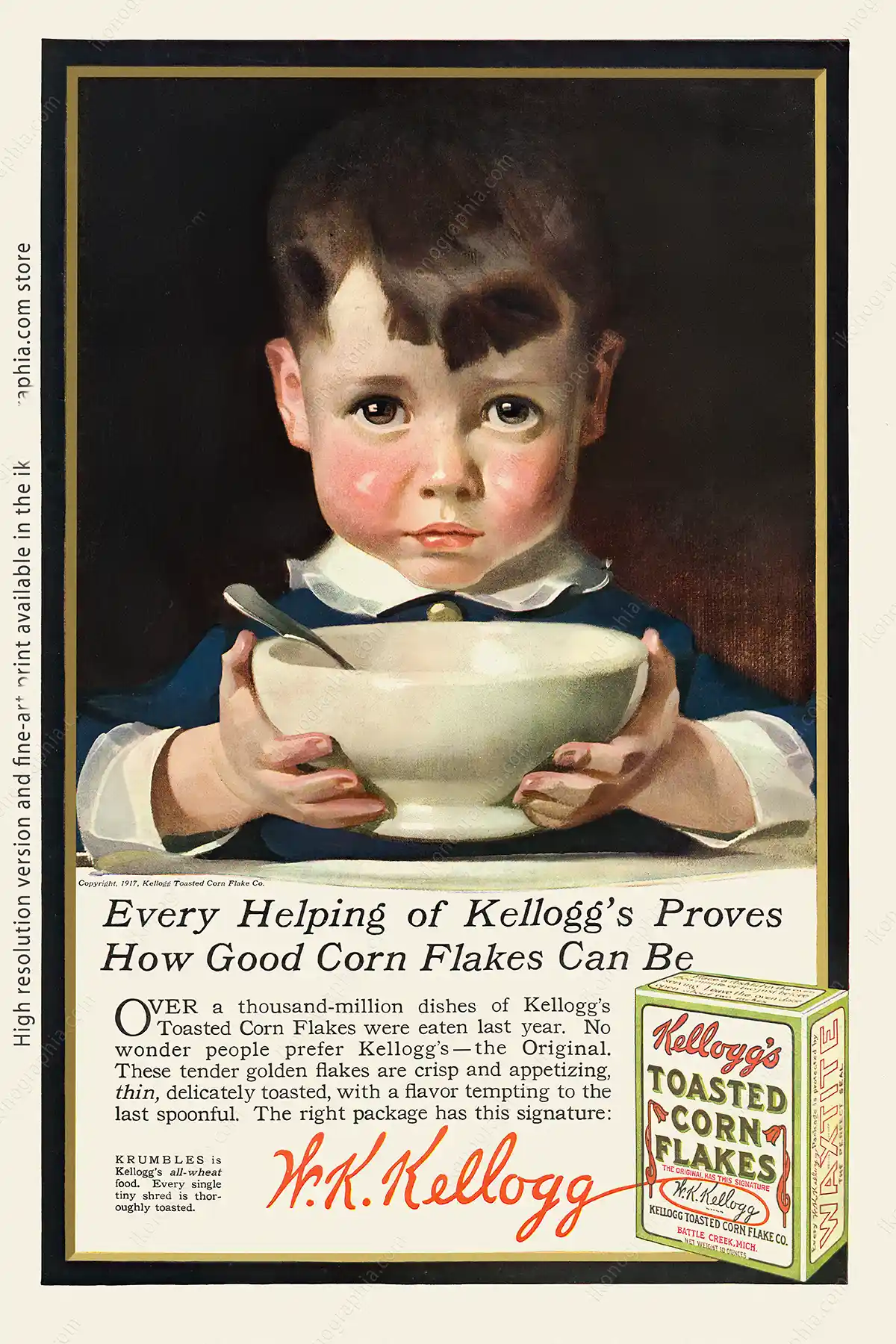
Every Helping of Kellogg's Proves How Good Corn Flakes Can Be, by Leyendecker 1917 Advertisement for Kellogg's Corn Flakes. Artwork by Joseph Christian Leyendecker. Ladies' Home Journal, April 1917

"Every Helping of Kellogg's Proves How Good Corn Flakes Can Be. Over a thousand-million dishes of Kellogg's Toasted Corn Flakes were eaten last year. No wonder people prefer Kellogg's—the Original. 

Advertisement for Kellogg’s Corn Flakes.
Artwork by Joseph Christian Leyendecker.

Ladies’ Home Journal, April 1917
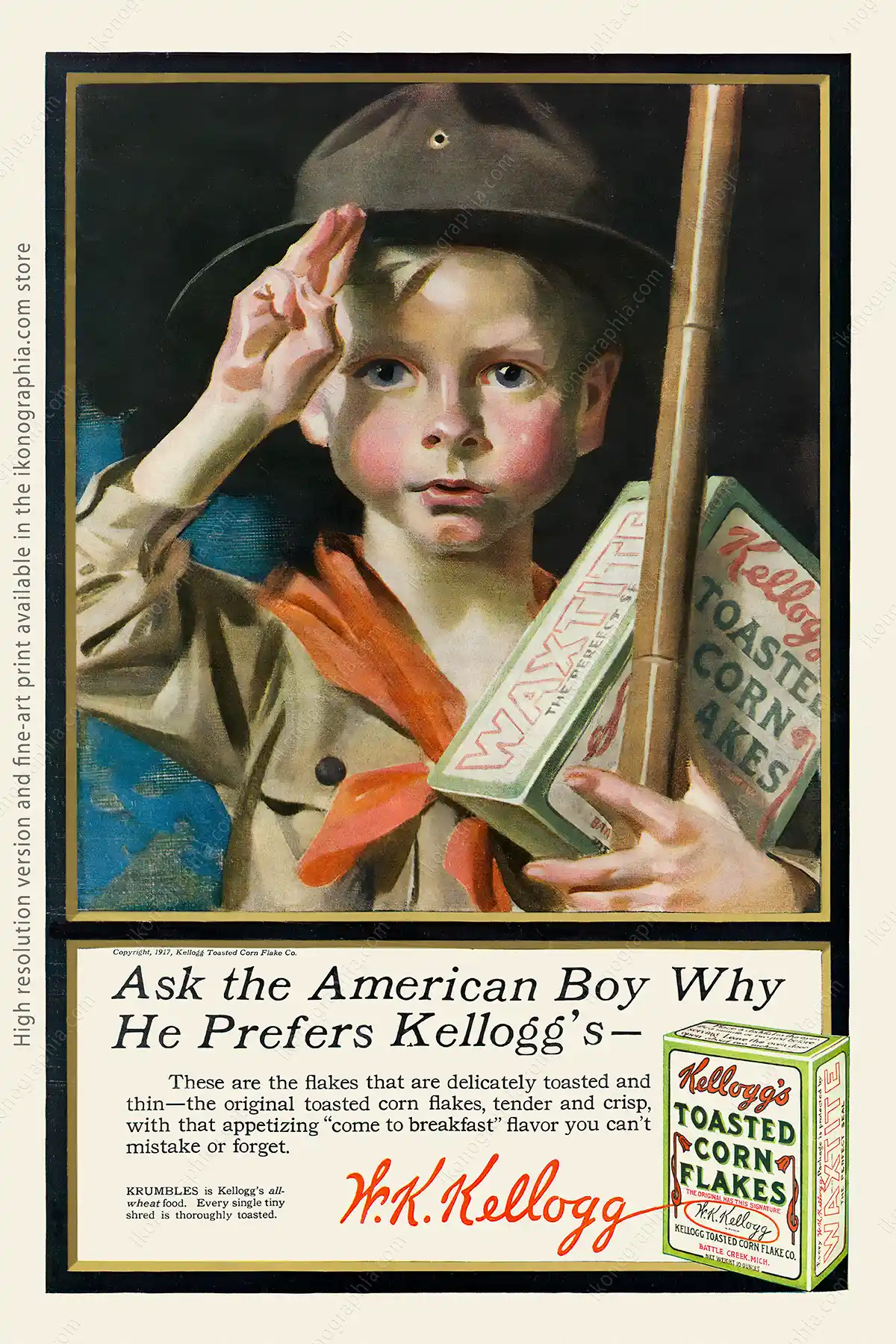
Ask the American Boy Why He Prefers Kellogg. Artwork by Leyendecker, 1917 Advertisement for Kellogg's Corn Flakes. Artwork by Joseph Christian Leyendecker. Ladies' Home Journal, May 1917

"Ask the American Boy Why He Prefers Kellogg — These are the flakes that are delicately toasted and thin the original toasted corn flakes, tender and crisp, with that appetizing "come to breakfast" flavor you can't mistake or forget."

Advertisement for Kellogg’s Corn Flakes.
Artwork by Joseph Christian Leyendecker.

Ladies’ Home Journal, May 1917
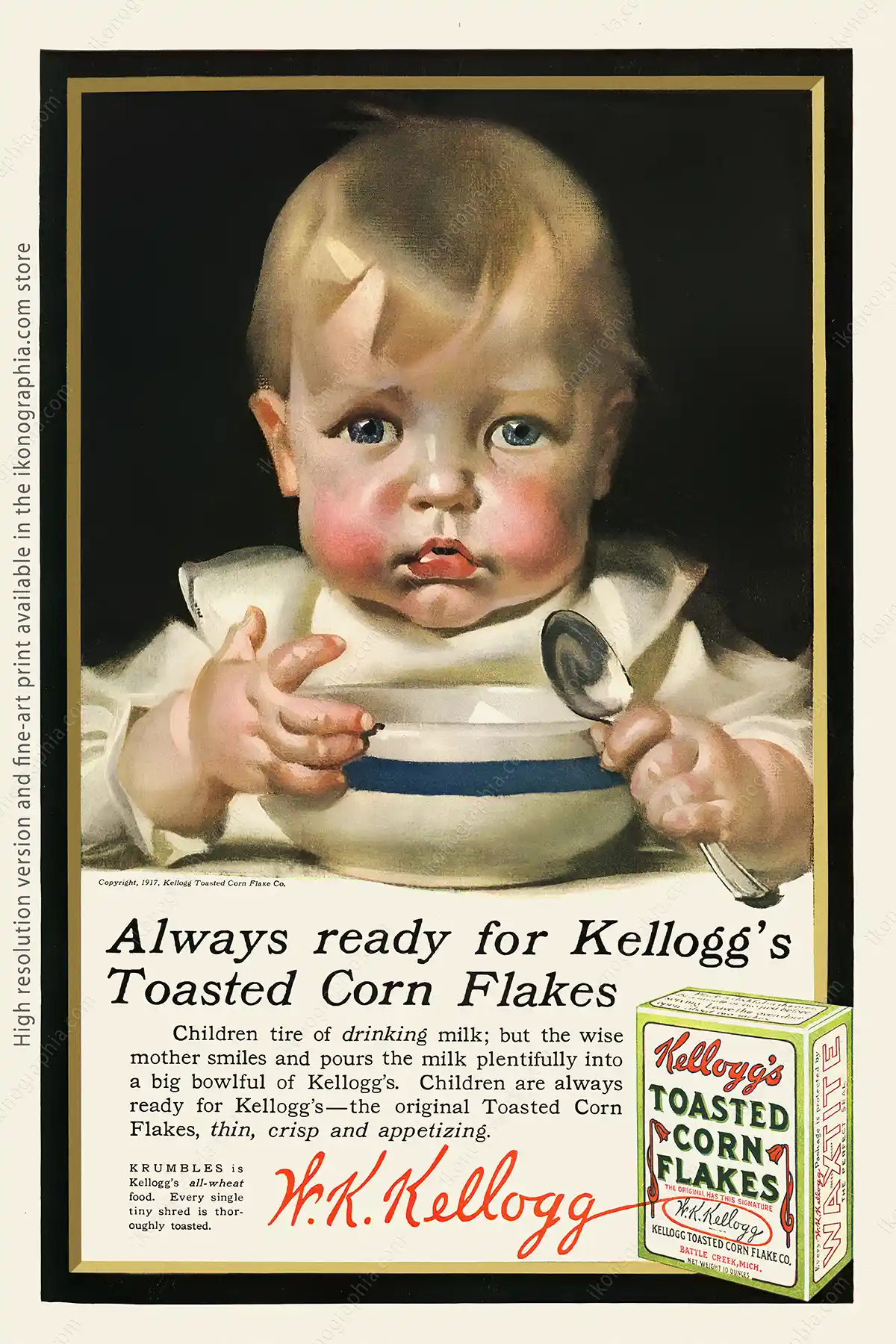
Always ready for Kellogg's Toasted Corn Flakes. Artwork by Leyendecker, 1917 Advertisement for Kellogg's Corn Flakes. Artwork by Joseph Christian Leyendecker. Ladies' Home Journal, June 1917

"Always ready for Kellogg's Toasted Corn Flakes.
Children tire of drinking milk; but the wise mother smiles and pours the milk plentifully into a big bowlful of Kellogg's.

Advertisement for Kellogg’s Corn Flakes.
Artwork by Joseph Christian Leyendecker.

Ladies’ Home Journal, June 1917
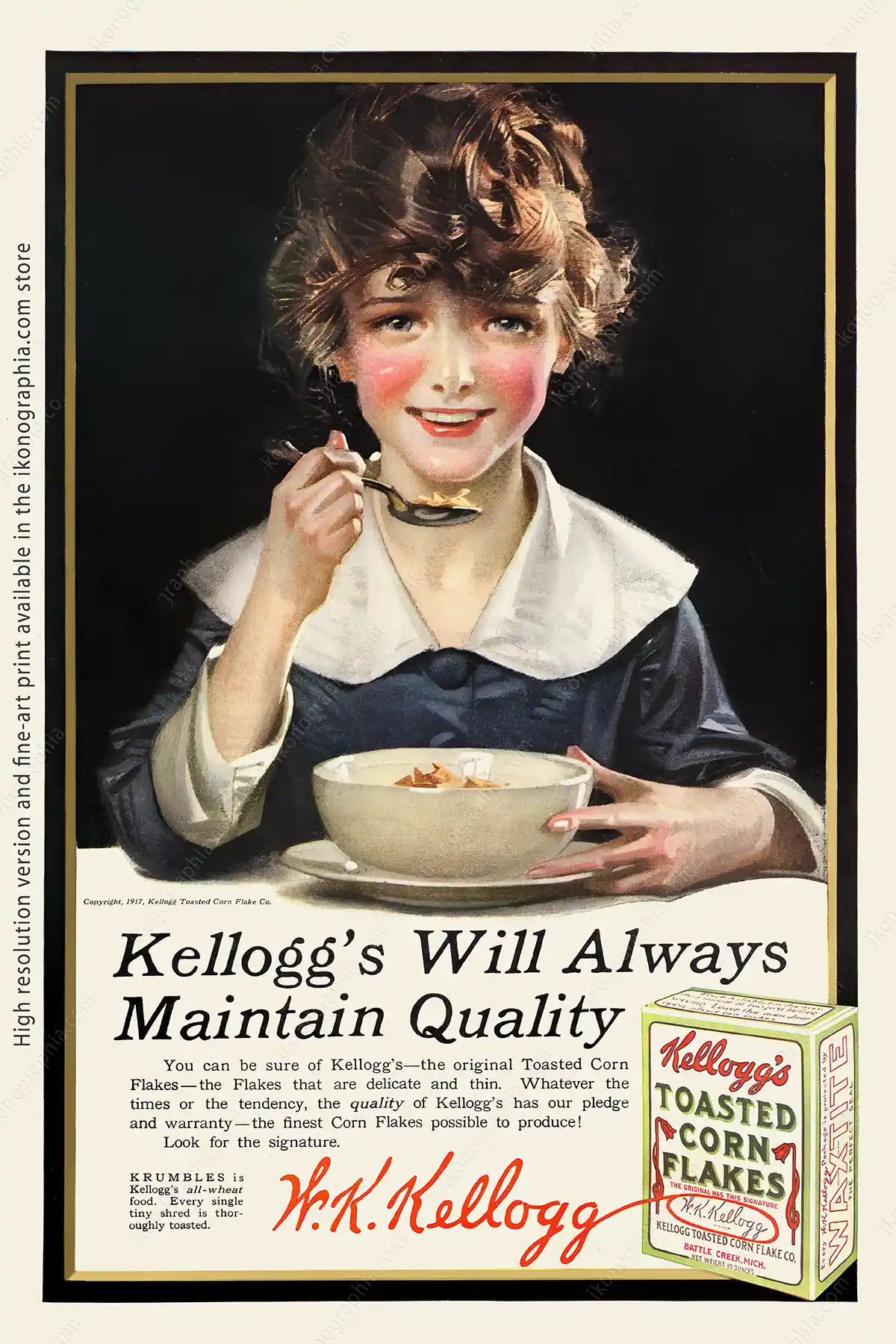
Kellogg's Will Always Maintain Quality. Artwork by Leyendecker, 1917 Advertisement for Kellogg's Corn Flakes. Artwork by Joseph Christian Leyendecker. Ladies' Home Journal, July 1917

"Kellogg's Will Always Maintain Quality.
You can be sure of Kellogg's—the original Toasted Corn Flakes — the Flakes that are delicate and thin. Whatever the times or the tendency, the quality of Kellogg's has our pledge and warranty the finest Corn Flakes possible to produce!


Advertisement for Kellogg’s Corn Flakes.
Artwork by Joseph Christian Leyendecker.

Ladies’ Home Journal, July 1917
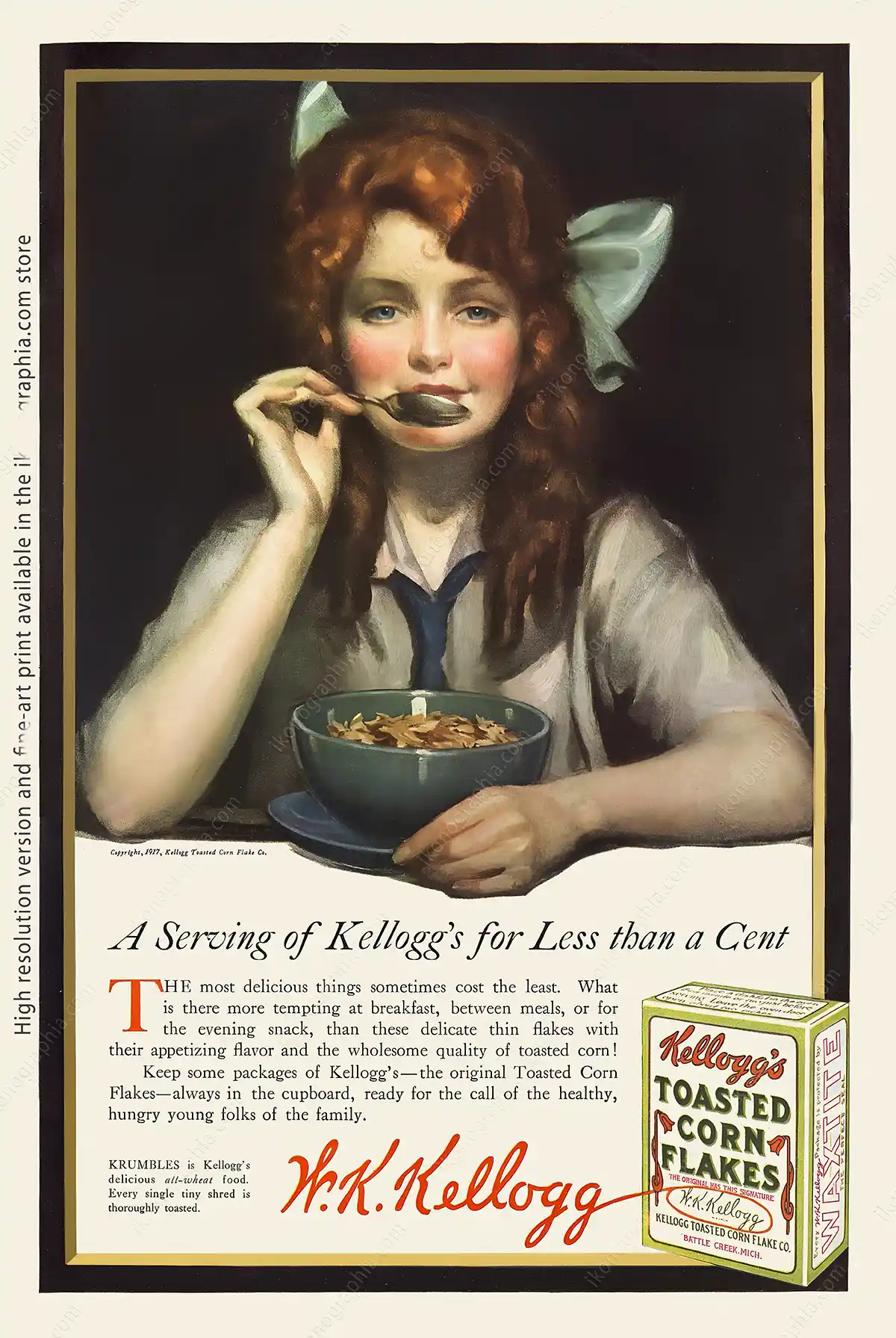
A Serving of Kellogg's for Less than a Cent. Artwork by Leyendecker, 1917 Advertisement for Kellogg's Corn Flakes. Artwork by Joseph Christian Leyendecker. Ladies' Home Journal, October 1917

"A Serving of Kellogg's for Less than a Cent The most delicious things sometimes cost the least. What is there more tempting at breakfast, between meals, or for the evening snack, than these delicate thin flakes with their appetizing flavor and the wholesome quality of toasted corn!"

Advertisement for Kellogg’s Corn Flakes.
Artwork by Joseph Christian Leyendecker.

Ladies’ Home Journal, October 1917
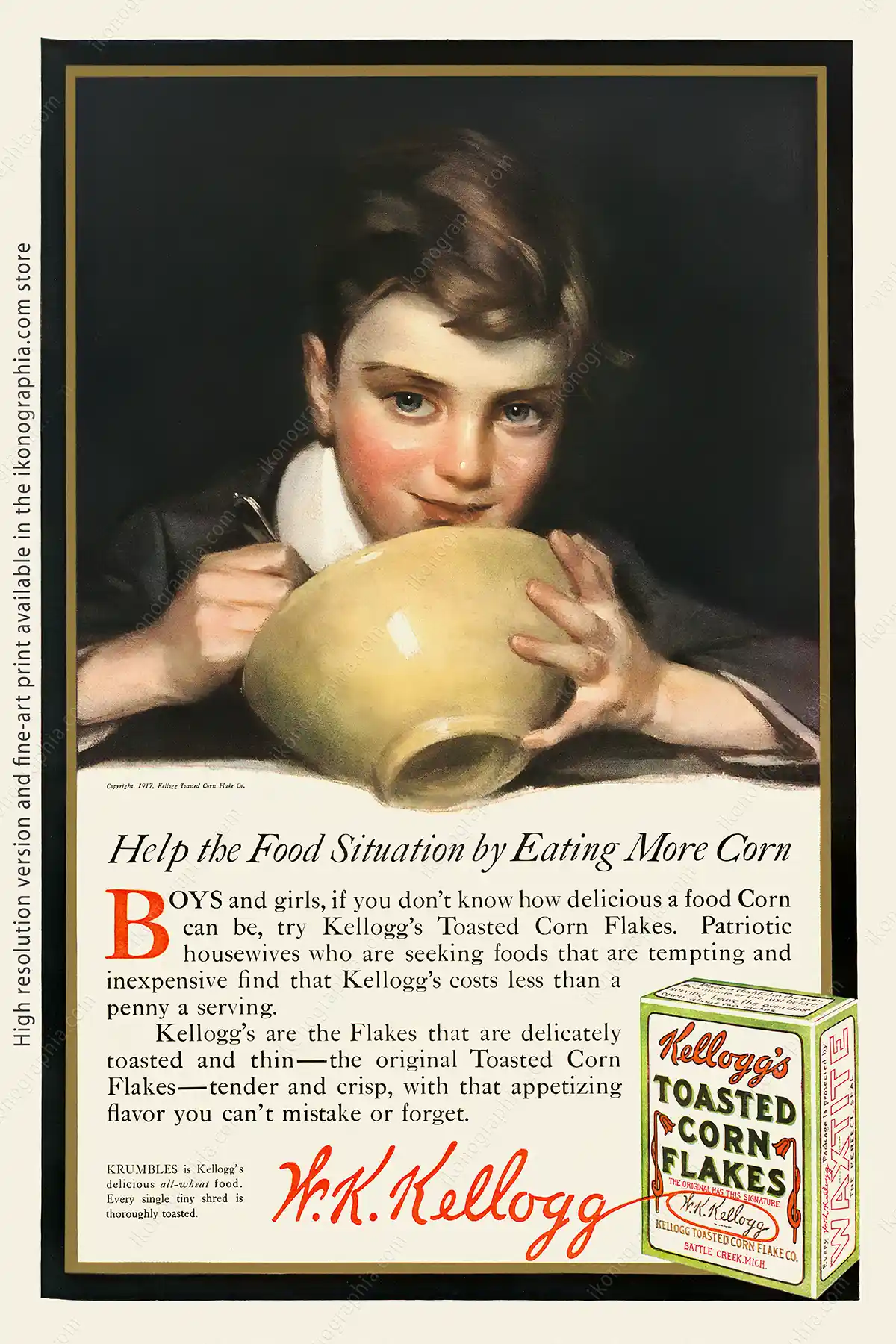
Help the Food Situation by Eating More Corn. Kellog's ad by Leyendecker, 1917 Advertisement for Kellogg's Corn Flakes. Artwork by Joseph Christian Leyendecker. Ladies' Home Journal, November 1917

"Help the Food Situation by Eating More Corn.

Boy sand girls, if you don't know how delicious a food Corn can be, try Kellogg's Toasted Corn Flakes. Patriotic housewives who are seeking foods that are tempting and inexpensive find that Kellogg's costs less than a penny a serving."

Advertisement for Kellogg’s Corn Flakes.
Artwork by Joseph Christian Leyendecker.

Ladies’ Home Journal, November 1917

Copyright, Links and credits

These works were published in the US before 1929, and the author died before 1954.
As a result, they are out of copyright worldwide.

Please notice that any advice or comment provided here is not and does not purport to be legal advice as defined by s.12 of the Legal Services Act 2007.

The Eve Book by Anne Harriet Fish — 1916

The Eve Book by Anne Harriet Fish — 1916

The Eve Book by Anne Harriet Fish — 1916

Fish and Fowl — a wartime collaboration that became a cultural phenomenon.

Between 1914 and 1916, Anne Harriet Fish and writer Olivia Maitland Davidson — publishing as "Fish" and "Fowl" — produced a weekly column for The Tatler titled "The Letters of Eve." From the same year, Fish was also contributing to Vanity Fair in New York, operating as a cultural bridge between London and American high society.
The character Eve — a fashionable, frivolous girl navigating wartime London — became a cultural phenomenon. Silent films and theatre productions followed.
The Eve Book, published simultaneously by Brentano's in New York and The Tatler in London in 1916, compiled the column's first run. Fish's drawings and Davidson's texts, inseparable from the start.

All pages reproduced from the original book.

The Eve Book Cover, by Anne Fish 1916

About the book


The "Eve Book," also known as "The First Book of Eve," is a historical gem published in 1916 by Brentano in the US and the Tatler in the UK. Introducing the new star illustrator, Anne Fish, it is a curated collection of drawings published on the Tatler from 1914 to 1916 in the column "The Letters of Eve," offering a unique glimpse into the dark days of World War I.

You can enjoy a selection of cartoons from the book here or visit this page, where all pages are available in high-resolution and professionally restored.

The Adventures of Eve 06-07. Eve as a Policeman and Some War-time Cooks. Drawings by Anne Fish, text by Fowl. Published by Brentano's, New York, 1916.

The Eve Book, pages 6-7. The Adventures of Eve. Eve as a Policeman and Some War-time Cooks.
Being an irresponsible record of some incidents in the career of a frivolous little lady—to say nothing of Adam, Aunt Matilda, Uncle Fred, and Tou-Tou.
Below, is an amazing detail of Jumping Policewomen

Eve as a Policeman and Some War-time Cooks. Jumping Policewomen. Detail from Eve as a Policeman and Some War-time Cooks.
The Eve Book 14-15. Just a Few Odds and Ends. Drawings by Anne Fish.

The Eve book, pages 14-15. Just a Few Odds and Ends.
The shortage in postmen grows apace. Eve, as ever, steps into the breach, and you can imagine the unadulterated joy of one of her admirers who, unshorn and untidy, opens the door of his flat to receive from her a pink and scented missive.

Cover of The Eve Book” (also known as “The First Book of Eve”), by Anne Fish, published in 1916 by Brentano’s in the US and the Tatler in the UK. It is a curated collection of drawings published on the Tatler from 1914 to 1916 in the column “The Letters of Eve,” offering a unique glimpse into the dark days of World War I.

The "Eve Book," also known as "The First Book of Eve, is a curated collection of drawings published on the Tatler from 1914 to 1916 in the column "The Letters of Eve," offering a unique glimpse into the dark days of World War I.

This historical gem was published in 1916 by Brentano's in the United States and by Constable and Co./The Tatler in the UK


The book cover is in color and, although beautiful, is unrelated to the book's drawing, all in black and white.
64 pages, 62 b&w plates + color cover.

Anne Fish was Tatler Magazine's star artist during those years. She gained a reputation for her inimitable black-and-white sketches.

Richard King, the Publisher introducing Fish


It is not often that an artist evolves a new comic type. "Eve" has now become a clearly recognized figure of modern life, along with George Belcher, Dana Gibson, Bateman, and that very small band of clever artists who have characteristics peculiar to themselves.

Few artists have more quickly sprung into worldwide popularity than "Eve." How great this popularity is may be judged by the numerous imitators who, while they copy many of Eve's mannerisms, lose all that humor and spirit that make Eve's art such a fascinating and irresistible thing. Eve possesses a gift that cannot be imitated, no matter how clever the artist who imitates her may be. Each person's sense of humor—or lack of it—belongs to them alone. And it is Eve's humor that makes her delightful drawings so appealing.

Fish has that sense of the "absurd," one of the rarest senses in all black-and-white art. And yet, while her irresistible humor makes one laugh, and her drawings fascinate us with their quaintness, she is never so far removed from reality as merely a painter of the human grotesque. Therein lies so much of her genius. She paints humanity with the eye of one who can see the comic in everyday people and things. Yet, she never lets her feeling for the ridiculous obliterate her feeling for Truth.

The Adventures of Eve 16-17. The Zeps Threaten Again. Drawings by Anne Fish, text by Fowl. Published by Brentano's, New York, 1916

The Eve book, pages 16-17. The Zeps Threaten Again.
Eve draws up a list of things to do if the Zeps do come. She is seen reading it to Tou-Tou, who is visibly impressed. She carefully tacks her hamper every night in case she may have to pic-nic out among the debris of her home the next day. Tou-Tou, as you see, is wearing his respirator.

The Adventures of Eve 18-19. Eve Mobilises her Sisters. Drawings by Anne Fish, text by Fowl. Published by Brentano's, New York, 1916

The Eve book, pages 18-19. Eve Mobilises her Sisters.
This is not the frivolous picture it appears, but represents little Eves in training for E.C.D.C. (Eve's Coastal Defence Corps). Of course, the first thing to do is to learn to swim. Eve cannot tell us where this is taking place, as it would give away the (amatory) disposition of the Grand Fleet, which anchored dangerously close in soon after operations commenced.

The Adventures of Eve 20-21. Eve's Adventure with the Gallant Submarine.

The Eve book, pages 20-21. Eve's Adventure with the Gallant Submarine.
The bold and wicked air-pirates grappled Eve as planned, but (hooray for the Navy !) the gallant officer on the conning tower was able to seize her shapely limbs as she drifted over him, and, with the help of his equally gallant crew, effected a rescue at the expense of Eve's already diminutive bathing creation——and, warm and happy, Eve is conveyed back to land at the slowest possible speed.

Eve Goes into the City and Relieves a Man for Active Service. The Adventures of Eve pages 22-23 Drawings by Anne Fish, text by Fowl. Published by Brentano's, New York, 1916

The Eve book, pages 22-23. Eve Goes into the City and Relieves a Man for Active Service.
Eve, patriotically wishful to release an able-bodied Adam for active service, applies for and obtains a situation as clerk in the office of a susceptible merchant–who in due course introduces her to his staff, who are no less pleasantly affected by our charming little friend than their stern and businesslike employer.

Social Events in 1920s High Society. By Fish

Social Events in 1920s High Society. By Fish

Social Events in 1920s High Society. By Fish

Fish on theatre, opera, country houses, and the social calendar.

The double-page plates of High Society are organized here into six thematic chapters. This second chapter covers the social calendar — theatre, opera, sporting events, country house weekends — the rituals through which high society performed itself in public.
First published in Vanity Fair between 1914 and 1920. Texts by Dorothy Parker and George S. Chappell.

All pages reproduced from the original book.

Can you guess whos' in th stage?

Can You Guess Who's on the Stage. Detail from Who's Who in the Audience.

A Pictorial Guide to Life in Upper Circles. Part Two.


This is the second story about Anne Fish’s work, which documents and satirizes high society at the turn of the 1910s to 1920s.
The double-page plates were first published in Vanity Fair between 1914 and 1920 and then re-published in the splendid book “High Society. Hints on how to Attain, Relish – and Survive It. A Pictorial Guide to Life in our Upper Circles.”, published in December 1920.
Any double-page plate focuses on a specific topic, providing a unique, rich lens into American and international high society’s lifestyles of the 1910s and 1920s. Rigorously in ink & pen, these inimitable sketches are completed with entertaining captions.
We grouped the plates into six sections, each on a central topic. This second one is on “Social Events in 1920s High Society”.

Index to High Society 1920s Stories.

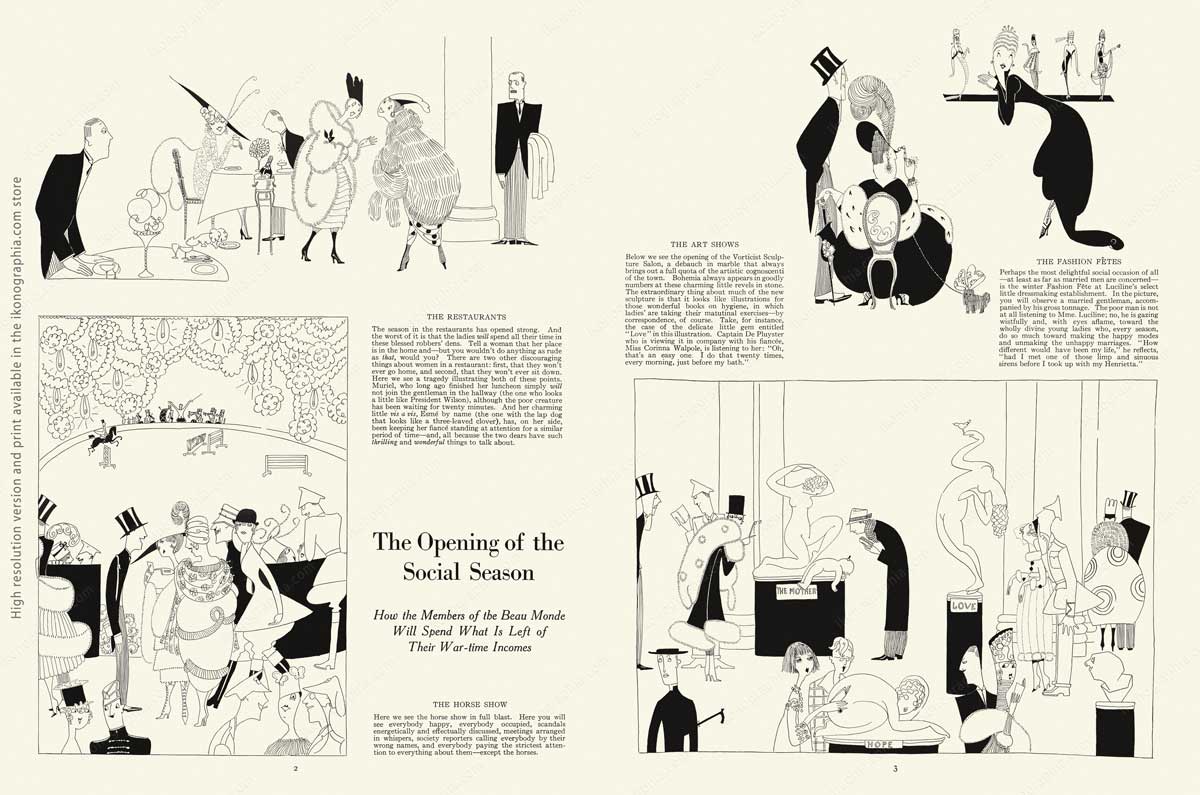
The Opening of the Social Season, from “High Society”, pages 02-03. By Anne Fish 1920 How the Members of the Beau Monde Will Spend What Is Left of Their War-time Incomes.

The Opening of the Social Season.
How the Members of the Beau Monde Will Spend What Is Left of Their War-time Incomes.
Initially published in Vanity Fair, November 1917.

EXCERPT FROM THE CAPTIONS

THE ART SHOWS.

Below we see the opening of the Vorticist Sculpture Salon, a debauch in marble that always brings out a full quota of the artistic cognoscenti of the town. Bohemia always appears in goodly numbers at these charming little revels in stone.

The extraordinary thing about much of the new sculpture is that it looks like illustrations for those wonderful books on hygiene, in which ladies' are taking their matutinal exercises—by correspondence, of course. Take, for instance, the case of the delicate little gem entitled "Love" in this illustration. Captain De Pluyster who is viewing it in company with his fiancée, Miss Corinna Walpole, is listening to her: "Oh, that's an easy one. I do that twenty times, every morning, just before my bath."

TOPIC LIST:

THE RESTAURANTS
THE HORSE SHOW
THE ART SHOWS
THE FASHION FÊTES

The full text is available in the metadata of the hi-res file in the shop.

EXCERPT FROM THE CAPTIONS

THE ART SHOWS.

Below we see the opening of the Vorticist Sculpture Salon, a debauch in marble that always brings out a full quota of the artistic cognoscenti of the town. Bohemia always appears in goodly numbers at these charming little revels in stone.

The extraordinary thing about much of the new sculpture is that it looks like illustrations for those wonderful books on hygiene, in which ladies' are taking their matutinal exercises—by correspondence, of course. Take, for instance, the case of the delicate little gem entitled "Love" in this illustration. Captain De Pluyster who is viewing it in company with his fiancée, Miss Corinna Walpole, is listening to her: "Oh, that's an easy one. I do that twenty times, every morning, just before my bath."

TOPIC LIST:

THE RESTAURANTS
THE HORSE SHOW
THE ART SHOWS
THE FASHION FÊTES

The full text is available in the metadata of the hi-res file in the shop.

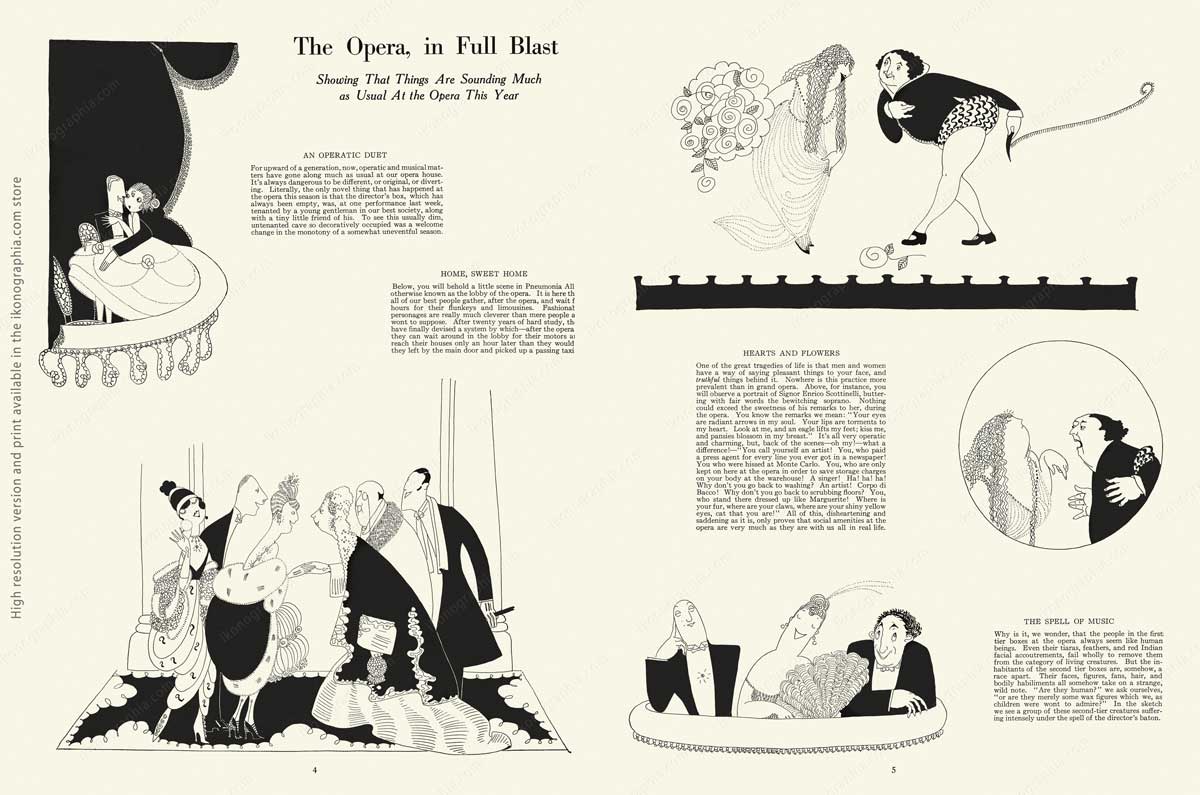
The Opera in Full Blast, from “High Society”, pages 04-05. Art by Anne Fish 1920

The Opera in Full Blast.
Showing That Things Are Sounding Much as Usual At the Opera This Year.
Initially published in Vanity Fair, January 1918.

EXCERPT FROM THE CAPTIONS

HOME, SWEET HOME.

Below, you will behold a little scene in Pneumonia Alley otherwise known as the lobby of the opera. It is here that all of our best people gather, after the opera, and wait for hours for their flunkeys and limousines. Fashionable personages are really much cleverer than mere people are wont to suppose. After twenty years of hard study, they have finally devised a system by which — after the opera — they can wait around in the lobby for their motors and reach their houses only an hour later than they would if they left by the main door and picked up a passing taxi.

TOPICS LIST:

AN OPERATIC DUET.
HOME, SWEET HOME.
HEARTS AND FLOWERS.
THE SPELL OF MUSIC.

The full text is available in the metadata of the hi-res file in the shop.

EXCERPT FROM THE CAPTIONS

HOME, SWEET HOME.

Below, you will behold a little scene in Pneumonia Alley otherwise known as the lobby of the opera. It is here that all of our best people gather, after the opera, and wait for hours for their flunkeys and limousines. Fashionable personages are really much cleverer than mere people are wont to suppose. After twenty years of hard study, they have finally devised a system by which — after the opera — they can wait around in the lobby for their motors and reach their houses only an hour later than they would if they left by the main door and picked up a passing taxi.

TOPICS LIST:

AN OPERATIC DUET.
HOME, SWEET HOME.
HEARTS AND FLOWERS.
THE SPELL OF MUSIC.

The full text is available in the metadata of the hi-res file in the shop.

Getting On, in Smart Society, from “High Society”, pages 08-09. By Anne Fish 1920 If, at First, You Don't Succeed, Dine 'em and Dine 'em Again Initially published in Vanity Fair, October 1916 with title GETTING ON IN NEW YORK SOCIETY If at First You Don’t Succeed, Dine ‘em and Dine ‘em again THE PEN AND THE INKS BY FISH

Getting On, in Smart Society.
If, at First, You Don't Succeed, Dine 'em and Dine 'em Again
Initially published in Vanity Fair, October 1916.

EXCERPT FROM THE CAPTIONS

HEARTS AND DIAMONDS.

The Higgingbothams were told that they could do nothing without a social secretary. They accordingly engaged Miss Audrey De Vere, a young lady of lineage. Audrey smokes, drinks, and plays "poker": she also knows how to get first-night tickets at the theatres and an outside table at a cabaret. She can mix eleven different kinds of cocktails with only one bottle of gin, one lemon, two bottles of Vermouth and a single olive. She is engaged to a war hero — her vis-a-vis at this table. The dinner has been cleared away and Audrey and her friends have just finished a little session with the cards. Net result: the T. Pennypacker Higgingbothams are minus the value of one small Texas oil well.

TOPIC LIST:

IN THE INTELLECTUAL SET.
HEARTS AND DIAMONDS.
THE RECEPTION COMMITTEE.
THE ATTACK ON BOHEMIA.
SUCCESS AT LAST.
HE'S A JOLLY GOOD FELLOW.

The full text is available in the metadata of the hi-res file in the shop.

EXCERPT FROM THE CAPTIONS

HEARTS AND DIAMONDS.

The Higgingbothams were told that they could do nothing without a social secretary. They accordingly engaged Miss Audrey De Vere, a young lady of lineage. Audrey smokes, drinks, and plays "poker": she also knows how to get first-night tickets at the theatres and an outside table at a cabaret. She can mix eleven different kinds of cocktails with only one bottle of gin, one lemon, two bottles of Vermouth and a single olive. She is engaged to a war hero — her vis-a-vis at this table. The dinner has been cleared away and Audrey and her friends have just finished a little session with the cards. Net result: the T. Pennypacker Higgingbothams are minus the value of one small Texas oil well.

TOPIC LIST:

IN THE INTELLECTUAL SET.
HEARTS AND DIAMONDS.
THE RECEPTION COMMITTEE.
THE ATTACK ON BOHEMIA.
SUCCESS AT LAST.
HE'S A JOLLY GOOD FELLOW.

The full text is available in the metadata of the hi-res file in the shop.

Who’s Who—in the Audience. Art Anne Fish 1920, Text by Dorothy Parker - High Society, pages 48-49. Showing That the Smart Playgoer, Not the Smart Play, Is Really the Thing.

Who’s Who—in the Audience.
Showing That the Smart Playgoer, Not the Smart Play, Is Really the Thing.
Initially published in Vanity Fair, April 1919.

EXCERPT FROM THE CAPTIONS

CAN YOU GUESS WHO'S ON THE STAGE?

You can always tell, by looking at the audience, just who is holding the center of the stage. When the masculine half of the audience occupies itself in reading the corset advertisements in the programmes or in looking restlessly about while the feminine half strains to catch every word—then you can be sure that the marcelled hero, in the jet-buttoned evening clothes, with the velvet collar, is standing in the spotlight and singing, or talking, rhapsodically about the age-old passion of LOVE.

TOPIC LIST:

IT'S ALL IN THE LINES.
CINEMA LOVERS.
CAN YOU GUESS WHO'S ON THE STAGE?
DOUBLE ENTENDRES.
FOR THE CHILDREN’S SAKE.
CAN YOU GUESS WHO'S ON THE STAGE NOW?

The full text is available in the metadata of the hi-res file in the shop.

EXCERPT FROM THE CAPTIONS

CAN YOU GUESS WHO'S ON THE STAGE?

You can always tell, by looking at the audience, just who is holding the center of the stage. When the masculine half of the audience occupies itself in reading the corset advertisements in the programmes or in looking restlessly about while the feminine half strains to catch every word—then you can be sure that the marcelled hero, in the jet-buttoned evening clothes, with the velvet collar, is standing in the spotlight and singing, or talking, rhapsodically about the age-old passion of LOVE.

TOPIC LIST:

IT'S ALL IN THE LINES.
CINEMA LOVERS.
CAN YOU GUESS WHO'S ON THE STAGE?
DOUBLE ENTENDRES.
FOR THE CHILDREN’S SAKE.
CAN YOU GUESS WHO'S ON THE STAGE NOW?

The full text is available in the metadata of the hi-res file in the shop.

Opening of the Opera Season - Blighters at Bridge. Art Anne Fish 1920, Text by Dorothy Parker - High Society, pages 54-55 A Terrifying Triumvirate of Familiar Lady Auction Pests

Opening of the Opera Season - Blighters at Bridge.
A Terrifying Triumvirate of Familiar Lady Auction Pests.
Initially published in Vanity Fair, August 1920.

EXCERPT FROM THE CAPTIONS

THE POOR, INNOCENT VICTIM.

What type of bridge player is the most spirit-blighting? Some favor the talking player; some the cheat — but we must vote, on every ballot, for the three girlies mirrored on this page. First, there is the creature shown above, who, after losing five rubbers, suddenly registers horror with the orbs, and exclaims in dismay: " Heavens! are we playing for money? I never dreamed of such a thing! I never play for anything!" Note the indifference of the other participants — intensified by financial anguish.

TOPIC LIST:

OPENING OF THE OPERA SEASON.
THE POOR, INNOCENT VICTIM.
THE BLIGHTER, PAR EXCELLENCE.
THE HOODOO-ED DOWAGER

The full text is available in the metadata of the hi-res file in the shop.

EXCERPT FROM THE CAPTIONS

THE POOR, INNOCENT VICTIM.

What type of bridge player is the most spirit-blighting? Some favor the talking player; some the cheat — but we must vote, on every ballot, for the three girlies mirrored on this page. First, there is the creature shown above, who, after losing five rubbers, suddenly registers horror with the orbs, and exclaims in dismay: " Heavens! are we playing for money? I never dreamed of such a thing! I never play for anything!" Note the indifference of the other participants — intensified by financial anguish.

TOPIC LIST:

OPENING OF THE OPERA SEASON.
THE POOR, INNOCENT VICTIM.
THE BLIGHTER, PAR EXCELLENCE.
THE HOODOO-ED DOWAGER

The full text is available in the metadata of the hi-res file in the shop.

Social Superstitions. Art Anne Fish 1920, Text by Dorothy Parker - High Society, pages 46-47 With Very Special Obeisances to Cupid

Social Superstitions.
With Very Special Obeisances to Cupid.
Initially published in Vanity Fair, October 1920 with title Social Superstitions Lovelorn sketches 

EXCERPT FROM THE CAPTIONS

SALT AND BATTERY.

Because Clarice Vanderhoff almost fainted when her fiancé, Teddy Ashhurst, spilled the salt, Ted natural! placated the Unknown Gods by throwing a handful of the offending seasoning over his left shoulder with his right hand. This is undoubtedly very pleasing to the Fates and Goddesses of Chance, but hardly as agreeable to the charming Mrs. Drexel-Drexel who, quite naturally, objects to being salted, like an almond — particularly in public.

TOPIC LIST:

THE SHEEP—AND THE GOAT.
THE SUIT AND THE SUITOR.
THE WORST IS YET TO COME .
SALT AND BATTERY .
THE CROIX DE COUTEAUX .
DANGEROUS DIANA.

The full text is available in the metadata of the hi-res file in the shop.

EXCERPT FROM THE CAPTIONS

SALT AND BATTERY.

Because Clarice Vanderhoff almost fainted when her fiancé, Teddy Ashhurst, spilled the salt, Ted natural! placated the Unknown Gods by throwing a handful of the offending seasoning over his left shoulder with his right hand. This is undoubtedly very pleasing to the Fates and Goddesses of Chance, but hardly as agreeable to the charming Mrs. Drexel-Drexel who, quite naturally, objects to being salted, like an almond — particularly in public.

TOPIC LIST:

THE SHEEP—AND THE GOAT.
THE SUIT AND THE SUITOR.
THE WORST IS YET TO COME .
SALT AND BATTERY .
THE CROIX DE COUTEAUX .
DANGEROUS DIANA.

The full text is available in the metadata of the hi-res file in the shop.

Flirting, Engagement, Weddings & Divorce in 1920s High Society

Flirting, Engagement, Weddings & Divorce in 1920s High Society

Flirting, Engagement, Weddings & Divorce in 1920s High Society

Fish and Parker on love, marriage, and the divorce special.

The double-page plates of High Society are organized here into six thematic chapters. This first chapter covers flirting, engagement, weddings, and divorce — the full romantic cycle as Fish and her collaborators saw it: absurd, theatrical, and entirely inevitable.
First published in Vanity Fair between 1914 and 1920. Texts by Dorothy Parker and George S. Chappell.

All pages reproduced from the original book.

On the Trail of a Wife . Art Anne Fish 1920,. High Society, pages 24-25 Detours on the Road to Matrimony.

Detail from “Another Blow” from the plate: On the Trail of a Wife. Detours on the Road to Matrimony.

A Pictorial Guide to Life in Upper Circles.


This is the second story about Anne Fish's work documenting and satirizing High Society at the turn of 1920.
The double-page plates were first published in Vanity Fair between 1914 and 1920 and then re-published in the splendid book "High Society. Hints on how to Attain, Relish - and Survive It. A Pictorial Guide to Life in our Upper Circles.", published in December 1920.

Any double-page plate focuses on a specific topic providing a unique, rich lens into American and international high society's lifestyles of the 1910s and 1920s. Rigorously in black and white, these inimitable sketches are completed with entertaining captions.
We grouped the plates into six sections, each on a main topic. This first one is on "Flirting, Engagement, Wedding & Divorce.

Index to High Society 1920s Stories.

Advice to the Lovelorn. Art Anne Fish 1920, Text by Dorothy Parker - High Society, pages 40-41 What Every Girl Should Know, Before Choosing a Husband Initially published in Vanity Fair, May 1919

Advice to the Lovelorn.
What Every Girl Should Know, Before Choosing a Husband.
Initially published in Vanity Fair, May 1919.

EXCERPT FROM THE CAPTIONS

LE PREMIER PAS.
The love interest really must come into the life of every young girl. There's no use talking, she simply can't get along without it. Her mother may weep, and her father may become dramatic about it, but a girl should remember that choosing a husband is the first step that counts in matrimony. After a girl has once been married, a second, third or even a fourth husband are simple matters. It's the first one that's tricky. Getting a husband is rather like getting the olives out of a bottle — after you get the first one, the rest come easily.

TOPIC LIST:

BEWARE THE SOCIETY FAVORITE
BEWARE THE MODERNIST POET
THE FUTURIST—WITH A PAST
WITH THIS RING
THE RIGHT MAN—AT LAST

The full text is available in the metadata of the hi-res file in the shop.

The Throes of First Love, in Society. Art Anne Fish 1920, Text by Dorothy Parker - High Society, pages 30-31 A Few Fashionable Little Variations on the Oldest Theme in the World

The Throes of First Love, in Society.
A Few Fashionable Little Variations on the Oldest Theme in the World.
Text by Dorothy Parker. Initially published in Vanity Fair, March 1920.

EXCERPT FROM THE CAPTIONS

THE AWAKENING TO SPRING.

If you are at all interested in tracing the love interest back to its very beginnings, all you have to do is to visit the nearest park, any bright Spring morning. Little scenes like this are going on all over the place; any member of the younger set, between the ages of two and five, can give you all the information you may require on just how wonderful nature really is. There is only one difference between love and any other contagious disease: once you have had the other disease, you are immune from a second attack.

TOPIC LIST:

HAIL, THE CONQUERING HERO!
THE PROFESSIONAL SIREN.
LOVE AT FIRST SIGHT.
THE DANGEROUS DÉBUTANTE.
FIRST LOVE—THE NOBLE THEATRICAL GOD.

The full text is available in the metadata of the hi-res file in the shop.

The Strategy and Finesse of Proposing. Art Anne Fish 1920 - High Society, pages 60-61 Advance Leaves from the 1921 Handbook of Courtship.

The Strategy and Finesse of Proposing.
Advance Leaves from the 1921 Handbook of Courtship.
Text by Dorothy Parker. Initially published in Vanity Fair, January 1917.

EXCERPT FROM THE CAPTIONS

THE PROPOSAL BY TELEPHONE

In a great progressive city like ours, especially with stocks jumping up about five points a day — you can't very well expect a chap to leave the stock-ticker in his club or in his café, trot up to the social z-one and loaf round a girl's house all day. And that merely to propose to her as soon as she has — at the end of an hour or so — consented to dress and give her hair and complexion the careful treatment which she always has to give them when she receives visitors. This is a very busy little world and a proposal over the wire often saves an immense amount of time — and sometimes two or three points margin at your brokers'. So, wherever she is, telephone! Don't waste time. Call her up anywhere, even in her bedroom. This little sketch shows the delightfully intimate relationship which is sometimes established between the dining-room at a man's Club and the bathing pavilion contiguous to a lady's sleeping room. It was a scene such as this that inspired the composer who in a moment of supreme inspiration, wrote that lyrical gem entitled "Hullo, Central, Give Me Heaven." In proposing by telephone, it is of course just as well to get the right girl on the wire. A friend of ours recently became a trifle confused — after being accepted by a female voice, to learn that the houri at the other end of the telephone was no less a dignitary than his lady-love's maiden aunt.

TOPIC LIST:

THE PROPOSAL BY LETTER.
THE PROPOSAL TERPSICHOREAN.
THE PROPOSAL, A LA PASHA.
THE PROPOSAL BY TELEPHONE.
THE PROPOSAL BY PHONOGRAPH LANDED AT LAST.

The full text is available in the metadata of the hi-res file in the shop.

On the Trail of a Wife. Art Anne Fish 1920. High Society, pages 24-25. Detours on the Road to Matrimony

On the Trail of a Wife.
Detours on the Road to Matrimony.
Text by Dorothy Parker. Initially published in Vanity Fair, December 1919.

EXCERPT FROM THE CAPTIONS

THE SAD CASE OF PEGGY.

And then there was Peggy. Really, he couldn't have found a more perfect helpmate than Peggy — civil to her parents, pleasant to have around a bridge table, fond of children and potted plants. Nothing could have been sweeter — until she took him out motoring. He is here registering a silent vow that if he ever gets home all in one piece, he will never permit himself to so much as gaze upon his adorable little Peggy again.

TOPIC LIST:

ENTER THE HERO.
THE SECOND ENTRY.
EXHIBIT C.
THE ORDEAL BY AIR.
THE SAD CASE OF PEGGY.
THE BITTER END.
ANOTHER BLOW.

The full text is available in the metadata of the hi-res file in the shop.

Hints on Honeymoons For the Very Rich, from “High Society”, pages 10-11. By Anne Fish 1920 How to Make a Smart Honeymoon — Comparatively Speaking — Agreeable Initially published in Vanity Fair, May 1917 with title A LITTLE HONEYMOON IS A DANGEROUS THING

Hints on Honeymoons — For the Very Rich.
How to Make a Smart Honeymoon — Comparatively Speaking — Agreeable.
Initially published in Vanity Fair, May 1917 with title "A Little Honeymoon — Comparatively Speaking — Agreeable.

EXCERPT FROM THE CAPTIONS

ALONE, AT LAST.

The moment in the honeymoon, which is pictured below, is technically known as the enfin seuls. The parents have been banished, the best man is still in wine; the bridemaids are at the photographer's, the footmen have gone to chase up the entree, and the lovers are at last alone with their J-HOY. What a blissful moment! Six months later a moment like this is a bit of a bore. Any third person then, even a dun from the tailor, would be welcome, for love, alas, is like caviare; a little indigestible— unless consumed in very small portions.

TOPIC LIST:

PEACE HATH HER VICTORIES.
THE COTTAGE OF DREAMS.
ALONE, AT LAST.
WATER, WATER, EVERYWHERE.
THE EXPRESS TO EDEN.
AMOUR DE VOYAGE.

The full text is available in the metadata of the hi-res file in the shop.

When Marriage Is a Failure Cherchez la Femme. Art Anne Fish 1920, Text by Dorothy Parker - High Society, pages 50-51 Have You a Little Failure In Your Home?

When Marriage Is a Failure Cherchez la Femme.
Have You a Little Failure In Your Home?
Initially published in Vanity Fair, November 1916.

EXCERPT FROM THE CAPTIONS

A CATALOGUE OF WIVES.

There are only six kinds of wives. They are all shown on these two pages, but only one of them can be — on a crossed heart- warmly recommended. Fortunately marriage — which is at best but a primitive substitute for friendship — is becoming less and less fashionable, so that every year fewer of our young society leaders are sacrificed on the wedding pyre. This is especially true among clever people. And now, reader, here is our first exhibit in wives, a very terrible kind, to be sure. She is known as the DEVOTED wife. She loves — and watches out for — her husband, especially in the early morning hours. Note the restraint exercised by our artist in refusing to introduce a cuckoo clock, a device usually inevitable in pictures of this kind.

TOPIC LIST:

A CATALOGUE OF WIVES.
THE LAPLAND MODEL.
THE SECRET SOLVED.
THE SENSITIVE WIFE.
THE "DRESSY" WIFE.
THE HUMAN BANK ACCOUNT.

The full text is available in the metadata of the hi-res file in the shop.

Divorce: A Great Indoor Sport . Art Anne Fish 1920. High Society, pages 26-27 It is Beginning to Rank Among Our Fashionable and Popular Pastimes

Divorce: A Great Indoor Sport.
It is Beginning to Rank Among Our Fashionable and Popular Pastimes.
Texts by Dorothy Parker. Initially published in Vanity Fair, January 1920.

EXCERPT FROM THE CAPTIONS

THE DIVORCE SPECIAL.

Any time that you want to sec a bit of life, go to an American railway station and watch the outgoing trains to Nevada. Several ticket agents have to be constantly on duty in the window where both-way tickets to Reno are sold; one man couldn't keep up with the rush of trade. A typical line at the ticket office is shown here-it is considered de rigueur for husbands to accompany their outgoing wives to the train. If you are contemplating a jaunt to the nation's reconstruction center in the near future, it is a bit safer to book seats several weeks ahead.

TOPIC LIST:

THE ENDLESS CHAIN.
THE DAWN OF A NEW LIFE.
THE FLAW.
THE DIVORCE SPECIAL.
OLD HOME WEEK.
BACK TO THE START AGAIN.

The full text is available in the metadata of the hi-res file in the shop.

EUR Euro