

The Nonexistent Knight — The Armour Collection of Ferdinand von Habsburg
The Nonexistent Knight — The Armour Collection of Ferdinand von Habsburg
Photographed by Roberto Bigano for Franco Maria Ricci. Published 1992.
From 1577, Ferdinand of Habsburg, Archduke of Tyrol, assembled the most complete armorial Wunderkammer of the Renaissance at Ambras Castle near Innsbruck. His obsession was armour worn by the most famous military figures of his era — princes, commanders, mercenary leaders. Related by blood to the ruling families of Europe, he had access no collector before or after him could replicate.
The brief from Franco Maria Ricci: "Mr Bigano, bring me ghosts coming out from nowhere."
The result was Il Cavaliere Inesistente — Italo Calvino's novel as the frame, Beaufort-Spontin's preface as the historical argument, Roberto Bigano's photographs as the evidence. 176 pages. 47 hand-applied colour plates on Fabriano blue-laid paper. Black silk binding with gold impressions. 3,000 numbered copies. Sold out.
One sequence was not in the book. The transparencies documenting the Hercules ceremonial armour of Maximilian II were the result of a dedicated colour developer — a personal formula designed to produce a three-dimensional effect. The series was lost after processing. Recovered twenty years later, they are published here for the first time.

Foot Tournament Armour — Milan, 1600
Gold decoration covers every surface — helmet, breastplate, pauldrons, gauntlets — worked in dense foliate patterns on darkened steel. No surface was left plain.
The armour reads as a complete object, not an assembly of parts. Commissioned for tournament, not battle. The man who wore it needed to be seen before he moved.
Owner: Archduke Ferdinand II of Inner Austria, Emperor Ferdinand II from 1619. Goldsmith: Master I.O., Milan, 1600.

Iron and Rivets — Tournament Costume Armour in the Form of Landsknecht Dress — Augsburg, 1525.
Beaten iron and rivets — no gold, no engraving. The decoration is the form itself: the armour replicates the slashed and puffed costume of the Landsknecht infantry in steel. Every fold, every ribbon, every seam pressed into metal.
The most feared soldiers of the 16th century wore cloth. Their commander wore this.
Owner: Count Wilhelm von Roggendorf. Gifted by Charles V. Goldsmith: Kolman Helmschmid. Carver: Daniel Hopfer. Augsburg, 1525.

Battle Armour of Jacob Hannibal von Hohenems — Innsbruck, 1625.
The Crucifixion rendered in gold on the breastplate — Christ flanked by two figures, set against blued steel with engraved borders. A soldier's declaration of faith pressed into the surface of a weapon. The goldsmith is unknown. The choice of subject is not.
Owner: Henry of Rantzau. Goldsmith: unknown, Braunschweig, 1559.

Armour with Religious Carvings — Henry of Rantzau — Braunschweig, Germany 1559
The Crucifixion rendered in gold on the breastplate — Christ flanked by two figures, set against blued steel with engraved borders. A soldier's declaration of faith pressed into the surface of a weapon. The goldsmith is unknown. The choice of subject is not.
Goldsmith: Unknown.

The Iron Mask — Combat Armet, Landshut, 1498.
Plain steel, no decoration. The bolt reads as a mouth. The visor slit as eyes. The geometry of the face is the geometry of the helmet — nothing added, nothing removed. The oldest piece in the sequence and the most modern looking. Five hundred years have not aged it.
Owner: John of Saxony. Goldsmith: Mattheus Deutsch, Landshut, 1498.

Armour of Emperor Maximilian I — Augsburg, 1485.
The breastplate reads as draped fabric — radiating folds pressed into polished steel, a V at the centre, scalloped edges in gold. The goldsmith made metal behave like cloth. A back view that reveals more about the maker's ambition than any front view could.
Owner: Emperor Maximilian I. Goldsmith: Lorenz Helmschmid, Augsburg, 1485.

Combat Armour of Ottheinrich, Count Palatine — Augsburg, Germany, 1516
Polished steel with engraved borders — fleurs-de-lis across the helmet, foliate scrolls at the gorget and breastplate. The decoration is restrained, the form precise. A fighting suit built for a man who became Elector of the Palatinate. The goldsmith who made it also made armour for Maximilian I.
Owner: Ottheinrich, Count of the Rhenish Palatinate, later Elector of the Palatinate. Goldsmith: Lorenz Helmschmid, Augsburg, 1516.

Horse Armour with Human Figure — Owner and Goldsmith Unknown.
The horse wears a steel face. Below the neck, pressed into the chest guard, a human figure in relief — serene, eyes closed, arms folded, holding a shield.
The figure is not a decoration. It is a presence. Owne r and goldsmith unrecorded. The image speaks without them.
The “Hercules” decorated armor of Maximilian II
The Hercules ceremonial armour of Emperor Maximilian II was designed in Paris by Etienne Delaune, court artist and engraver, and executed by the Antwerp goldsmith Eliseus Libaerts.
Every surface carries a program — winged figures, the labours of Hercules, mythological scenes in relief on darkened steel with gold accents. One of the most complete surviving examples of 16th-century ceremonial armour as theological and political statement. These photographs were not in the 1992 FMR publication.
The transparencies were the result of a dedicated colour developer — a personal formula designed to produce a three-dimensional effect. The series was lost after processing. Recovered twenty years later, they are published here for the first time.
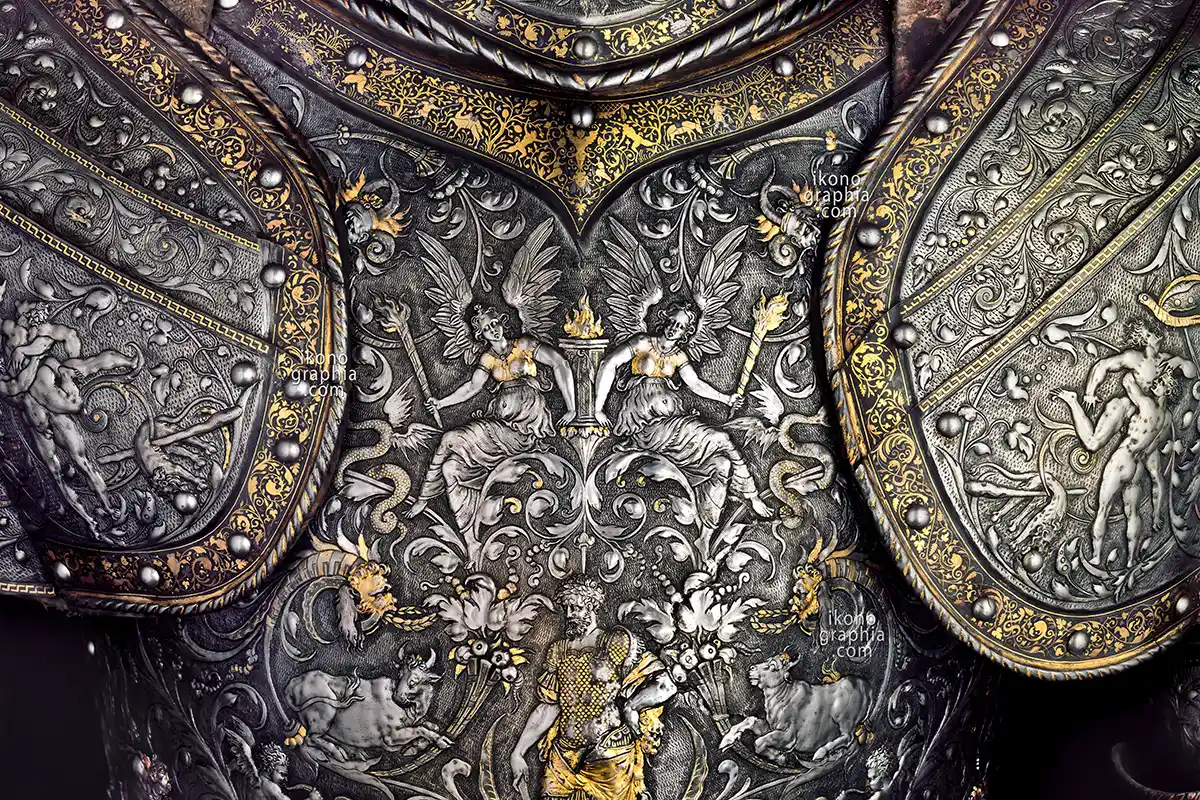
The "Hercules" Ceremonial Armour of Emperor Maximilian II, Breastplate detail — Paris, 1555.
Winged figures flank a central flame. Below them, Hercules among the labours — bull, lion, serpent — in high relief against a ground of gold foliate work. Delaune's program read at the distance it was designed for.

The "Hercules" Ceremonial Armour of Emperor Maximilian II, Front View — Paris, 1555.
The full programme visible as a complete surface. No plain steel anywhere — helmet, gorget, breastplate, pauldrons carrying the same density of carving from crown to shoulder.
Owner: Emperor Maximilian II. Goldsmith: Eliseus Libaerts. Carver: Etienne Delaune. Paris, France, 1555.

The "Hercules" Ceremonial Armour of Emperor Maximilian II, Side View — Paris, 1555.
The profile reveals the helmet's form — the visor line, the comb, the curve of the skull — all carved. Delaune designed for every angle. Libaerts executed every angle.
Owner: Emperor Maximilian II. Goldsmith: Eliseus Libaerts. Carver: Etienne Delaune. Paris, France, 1555.

The "Hercules" Ceremonial Armour of Emperor Maximilian II, Rear View — Paris, 1555.
The back of the helmet carries the same programme as the front. Figures among foliage, the twisted comb as spine. Nothing was left for the man behind the Emperor to see except more of the same argument.
Owner: Emperor Maximilian II. Goldsmith: Eliseus Libaerts. Carver: Etienne Delaune. Paris, France, 1555.

The "Hercules" Ceremonial Armour of Emperor Maximilian II, Detail — Paris, 1555.
Hercules at centre, gold on darkened steel, flanked by the labours. At this distance the individual tool marks are visible. This is what the transparencies contained. This is what twenty years preserved.
Owner: Emperor Maximilian II. Goldsmith: Eliseus Libaerts. Carver: Etienne Delaune. Paris, France, 1555.

Next Episode — The Anthropomorphic Armors.
Wolf Dietrich von Hohenems led the Landsknechts — the most feared mercenary infantry of the 16th century. In 1525 he fought at the Battle of Pavia in the service of Charles V. The face on the visor was designed to be recognised. It was also designed to frighten.

Il Cavaliere Inesistente, The Nonexistent Knight, by Italo CalvinoFranco Maria Ricci Editore 1992.
Photographs by Roberto Bigano.
Preface by Christian Beaufort-Spontin
This book is based on a novel by the renowned Italian writer Italo Calvino. "Il Cavaliere Inesistente" (The Nonexistent Knight) is perhaps Calvino's finest narrative masterpiece, and it is unique in that it conveys a story where clothes don't merely define the man; they become the man.
176 pages.
47 hand-applied color plates.
Luxury Fabriano blue-laid paper.
Black "Orient" silk binding with gold impressions.
Circulation: 3000 numbered copies.
The book was sold out for decades once a recent discovery made a few units available for purchase again.
Buy >
Copyright Links and Credits
Photography, Copyright & Credits
All photographs © Ikonographia / Roberto Bigano — All Rights Reserved. Photographed at the Kunsthistorisches Museum, Vienna. The armour collection of Ferdinand von Habsburg is held permanently at the Kunsthistorisches Museum, Vienna.
Roberto Bigano photographed this collection for the Franco Maria Ricci Book "Il Cavaliere Insesistente.)"
⸻
Credits & Acknowledgments
Ikonographia gratefully acknowledges Christian Beaufort-Spontin, Director of the Arms and Armour Collection at the Kunsthistorisches Museum in Vienna, whose decision to close the museum rooms and grant full access made this work possible.
⸻
Terms of Use (Summary)
The images presented in this archive are copyrighted and available for licensed use only through Ikonographia Visual Archives.
You may not download, reproduce, publish, or distribute these images without a valid license. For commercial or editorial licensing, please refer to the product pages or contact Ikonographia directly. A full explanation of licensing terms is available in the Shop / Licensing Information section under "Ikonographia — Standard License" and "Ikonographia — Merchandising & Product Use Licenses."
⸻
Ikonographia Mission Statement
Ikonographia is committed to the accurate documentation, preservation, and ethical dissemination of twentieth-century visual culture.
⸻


