Art Deco Elevator Panels — Fred French Building, 1927 — Glinsky & Bach

Art Deco Elevator Panels — Fred French Building, 1927 — Glinsky & Bach

Art Deco Elevator Panels — Fred French Building, 1927 — Glinsky & Bach

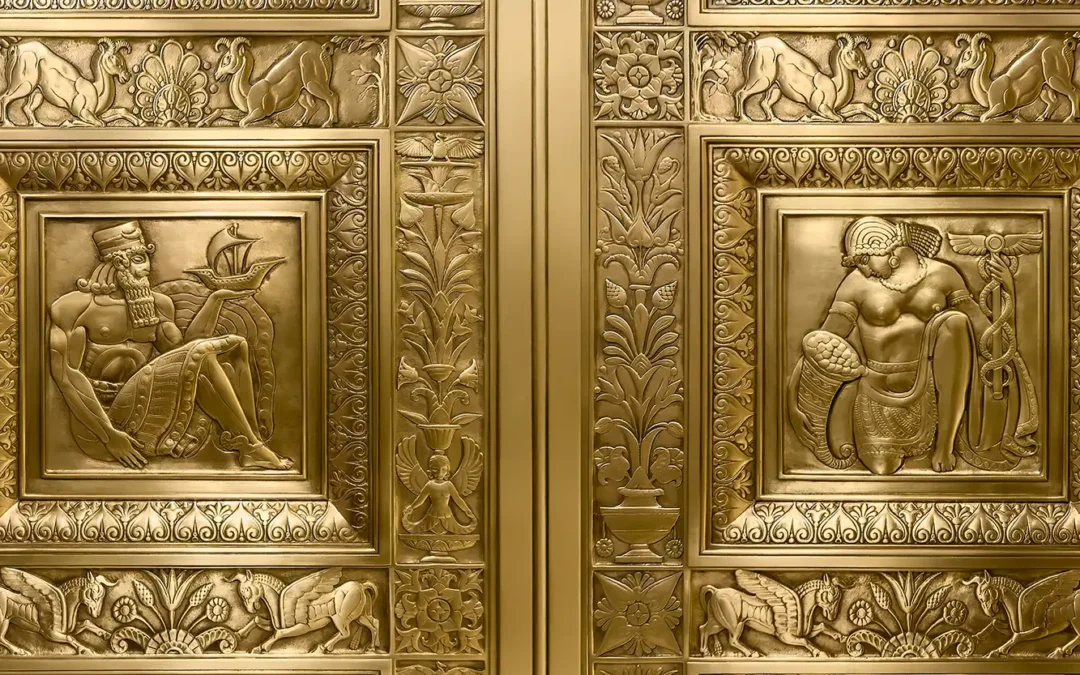
Eight gilt bronze panels — Industry, Commerce, Finance, and Building — conceived as a unified iconographic program.

A rare surviving ensemble of gilt bronze panels created in 1927 by Vincent Glinsky and Oscar Bach.
These elevator doors visualize the four pillars of Fred F. French’s real-estate empire—Industry, Commerce, Finance, and Building—through a sculptural language rooted in Art Deco geometry and documented Babylonian sources.
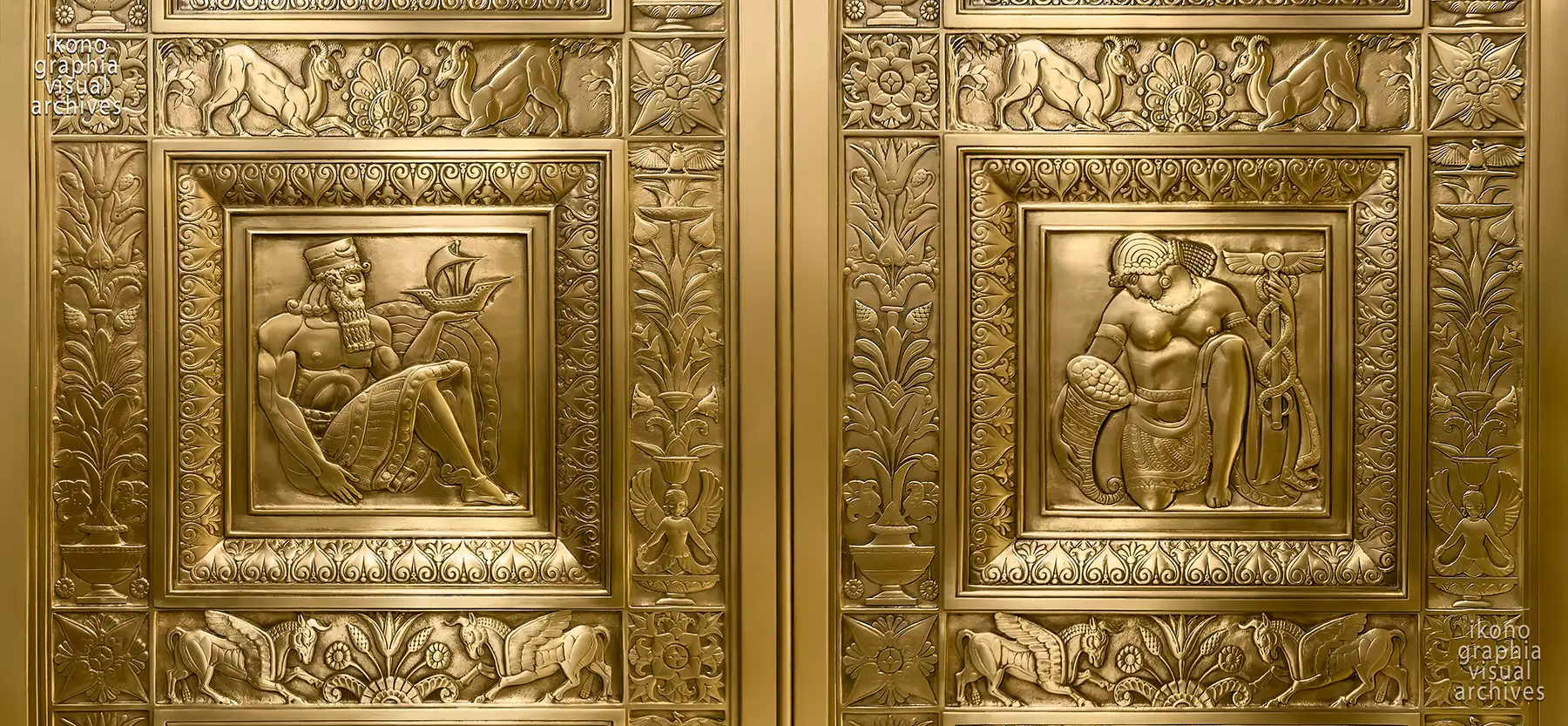
The Merchant and The Wealth Bearer — Art Deco elevator panels, Fred French Building, New York, 1927 — Glinsky & Bach

Completed in 1927, the Fred F. French Building stands as one of Manhattan’s finest expressions of the early Art Deco style. While the tower is admired for its stepped crown and gilded ornament, its most exceptional artworks lie hidden in the lobby: eight bronze elevator panels conceived by sculptor Vincent Glinsky and master metalworker Oscar Bach.

Commissioned to embody the vision of developer Fred Fillmore French, these doors translate the essential forces driving New York’s rise—labor, trade, wealth, and architecture—into a sophisticated visual program. Their hybrid style reflects Classical allegory, modern stylization, and the direct influence of Babylonian and Chaldean sources — documented by architect H. Douglas Ives in his own writing before a single panel was cast.
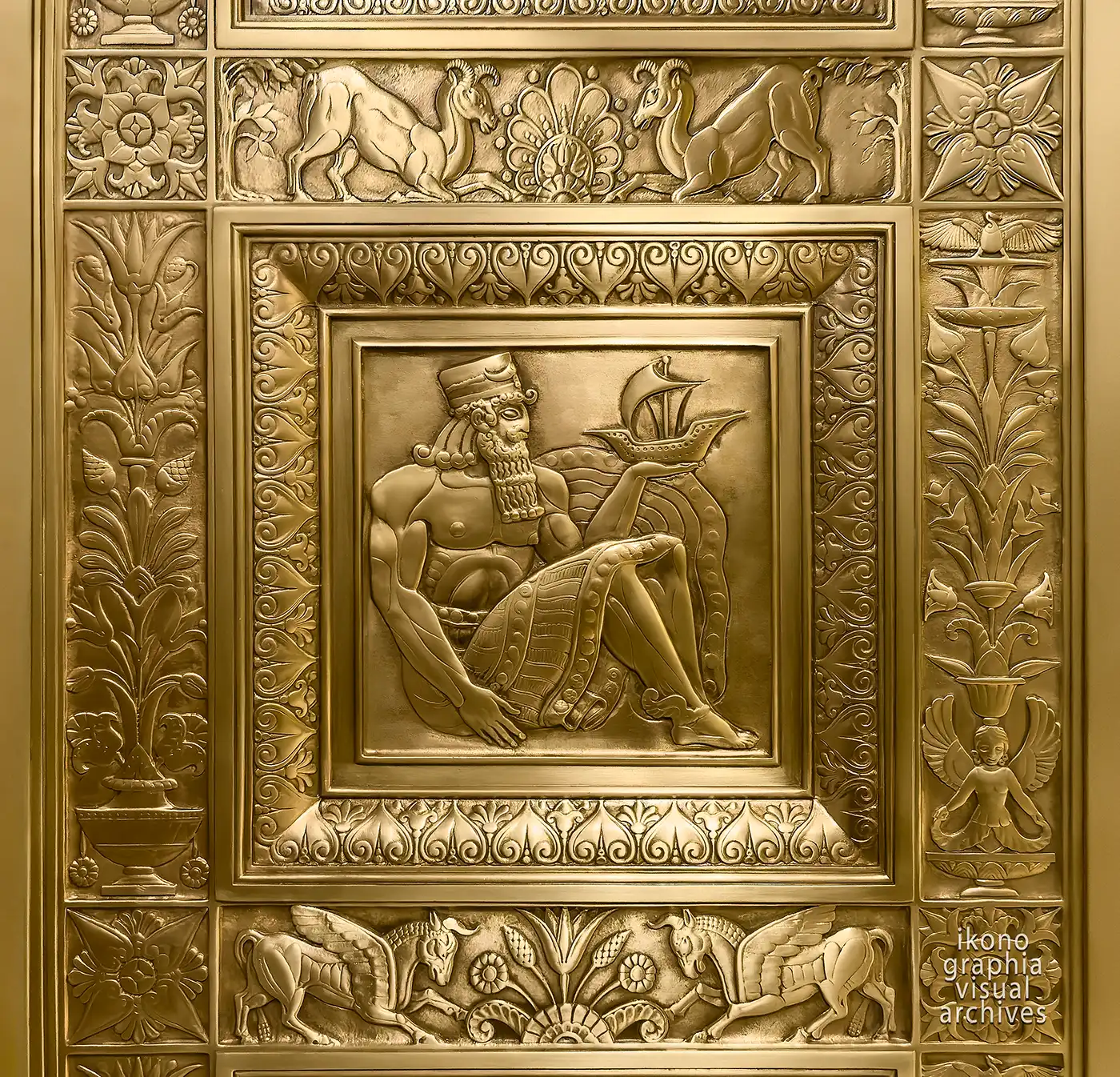
Allegory of Trade — The Merchant — Art Deco Elevator Panel, Fred French Building, New York — 1927 — Glinsky & Bach

The Merchant — Commerce.

Symbolizing maritime trade and international exchange.

Holding a ship in his hand, the bearded figure embodies maritime trade — the engine of international commerce in the early twentieth century.

His confident pose and the ship he carries identify him directly — a Mesopotamian merchant prince, translated into gilt bronze by Glinsky following Ives's documented sources.
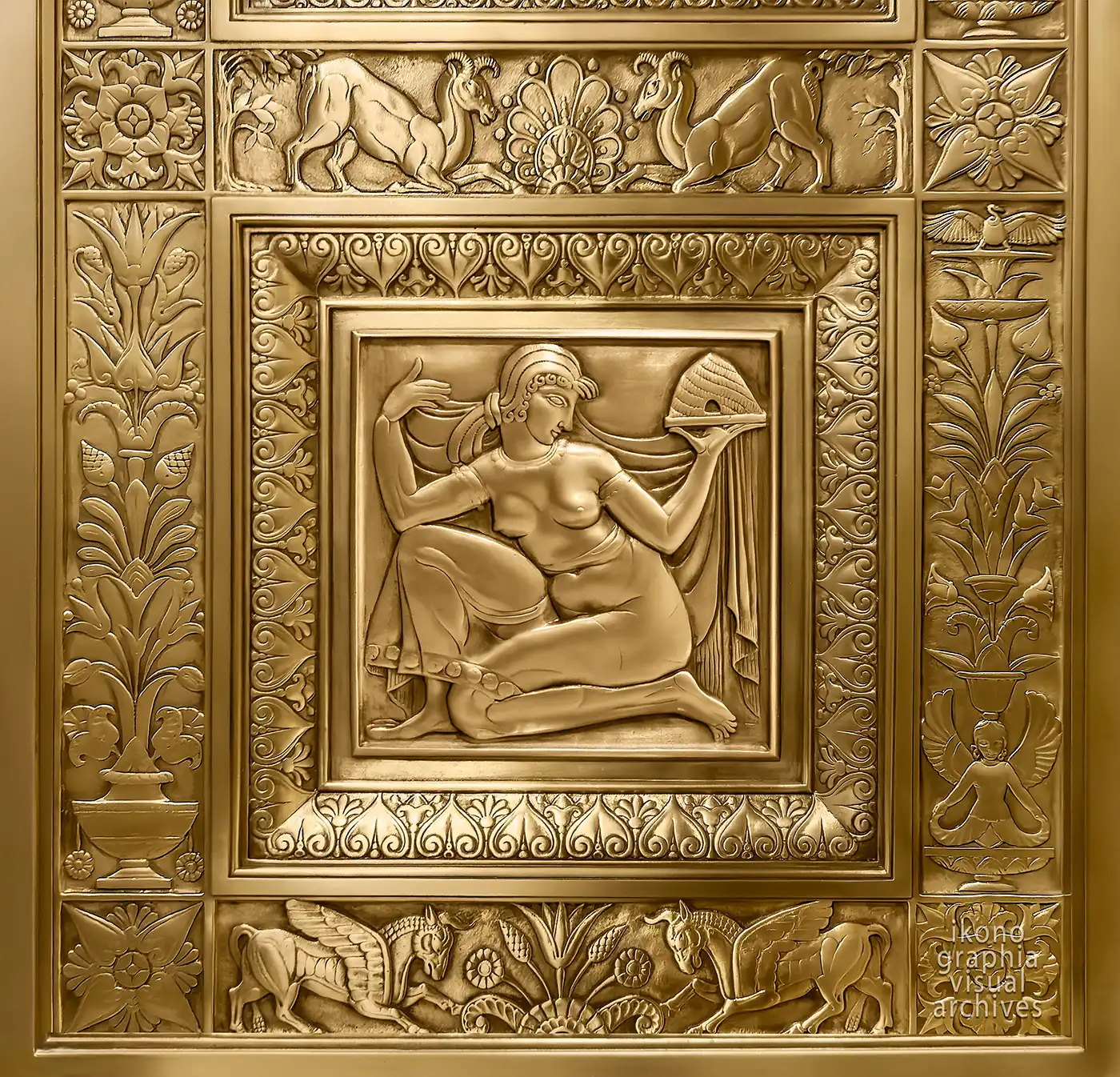
The Beehiver — Art Deco elevator panel, Fred French Building, New York, 1927 — Glinsky & Bach

The Beekeeper — Commerce.

Symbolizing industriousness, shared enterprise, and the organization of commerce.

A seated woman holds a beehive — the ancient emblem of collective effort and the wealth that organized labor produces.

Her pose and adornment place her within the same Babylonian visual tradition as the panels around: composed, frontal, deliberate. Commerce rendered not as transaction but as civilization.

The Artists & The Style

Glinsky & Bach: Sculptor and Metalwork Virtuoso.

Vincent Glinsky shaped the narrative sequences in low relief, giving the figures a compact mass and rhythmic energy typical of early Deco sculpture. Oscar Bach realized the panels in gilt bronze, applying the refined technical methods that made him one of the pre-eminent metalworkers of his era.

Together, they produced one of the most complete and coherent decorative cycles in American Art Deco. The vertical registers, crouching beasts, muscular torsos, and geometric borders follow a visual language Ives had studied directly — the Ishtar Gate of Babylon, reconstructed at Berlin's Pergamon Museum in the early twentieth century, and the enameled brick of ancient Chaldea. The source was not general fascination. It was specific research, translated into bronze.
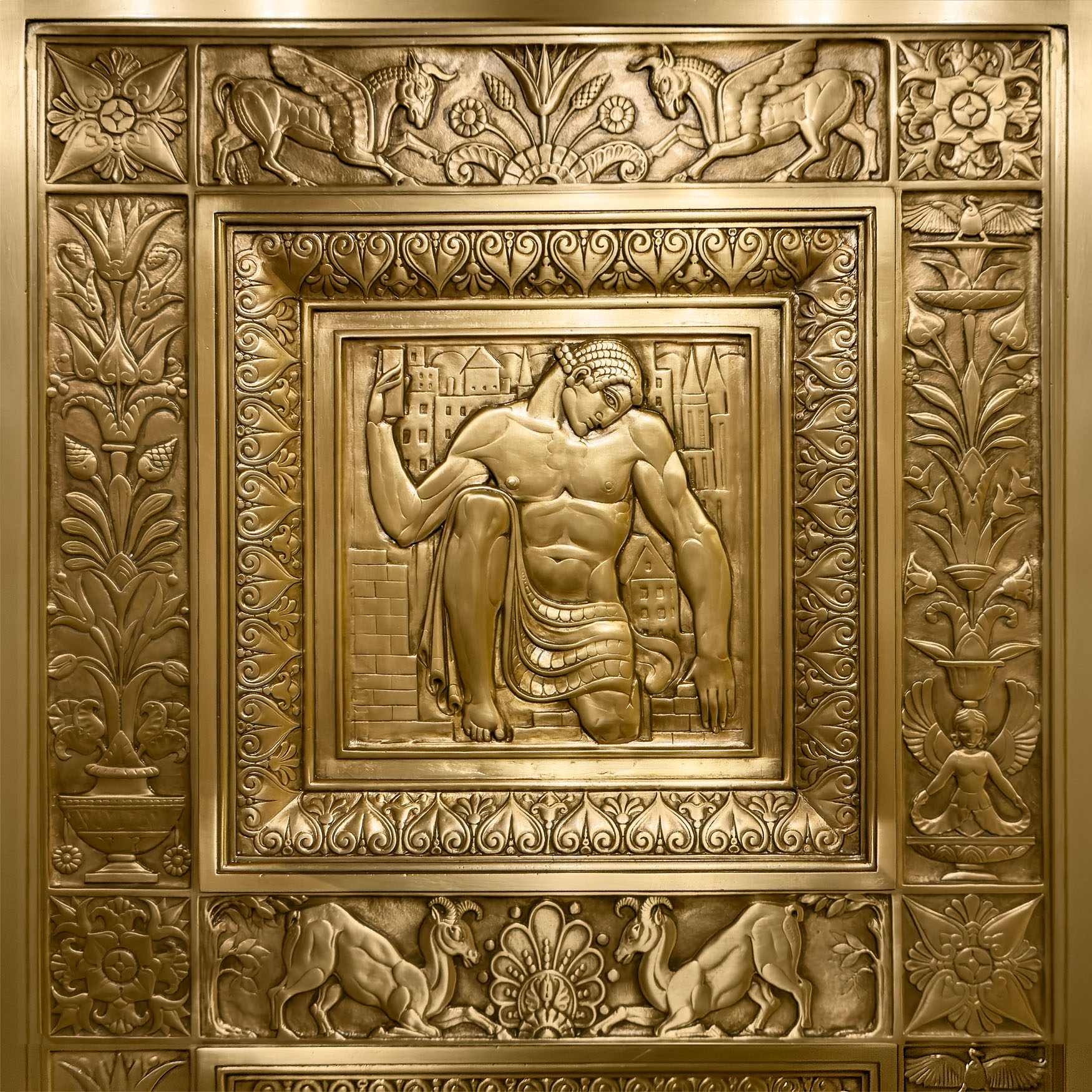
The Builder — Building.

Symbolizing skilled craft, technical mastery, and urban growth.

A kneeling figure, powerfully built, bends over his work with concentrated force — the architecture of the city rising behind him.

Where The Merchant carries trade and The Beehiver holds its product, the Builder is defined entirely by his labor. The body is the instrument. Glinsky's modelling here is at its most physical — the weight of the figure fully committed to the act of construction.
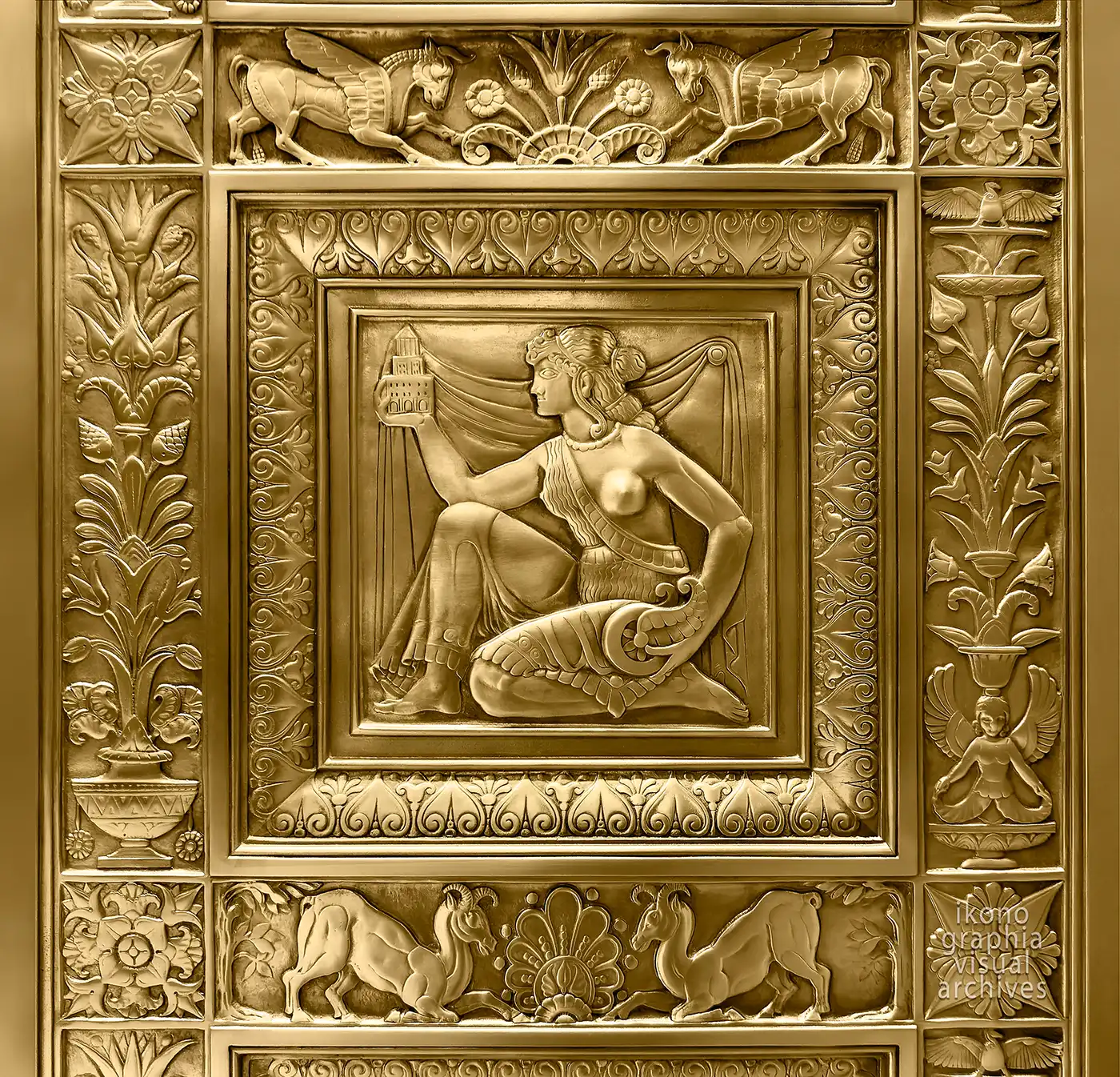
Allegory of Design — The Architect — Art Deco Elevator Panel, Fred French Building, New York — 1927 — Glinsky & Bach

The Architect — Building.

Symbolizing design, planning, and architectural vision.

A seated female figure holds a miniature building raised in her hand — the classical pose of the architect-as-creator, the city held and commanded rather than built by hand. Her posture is composed, her gaze inward.

Where the Builder is all physical effort, the Architect is stillness and conception. Together they complete Building's two movements: the idea and the labor that executes it.

The Four Pillars

Industry, Commerce, Finance, and Building.

Each elevator panel embodies one of the four sectors central to the French Companies:
 Industry — strength, engineering, infrastructure
 Commerce — exchange, trade, and refined goods
 Finance — wealth, investment, administration
 Building — architecture, planning, construction

Though allegorical, the imagery was designed for instant legibility. These were the forces shaping New York in the 1920s: the labor that built the skyline, the commerce animating Fifth Avenue, the financial system behind every development, and the architectural vision that defined modern urban life.
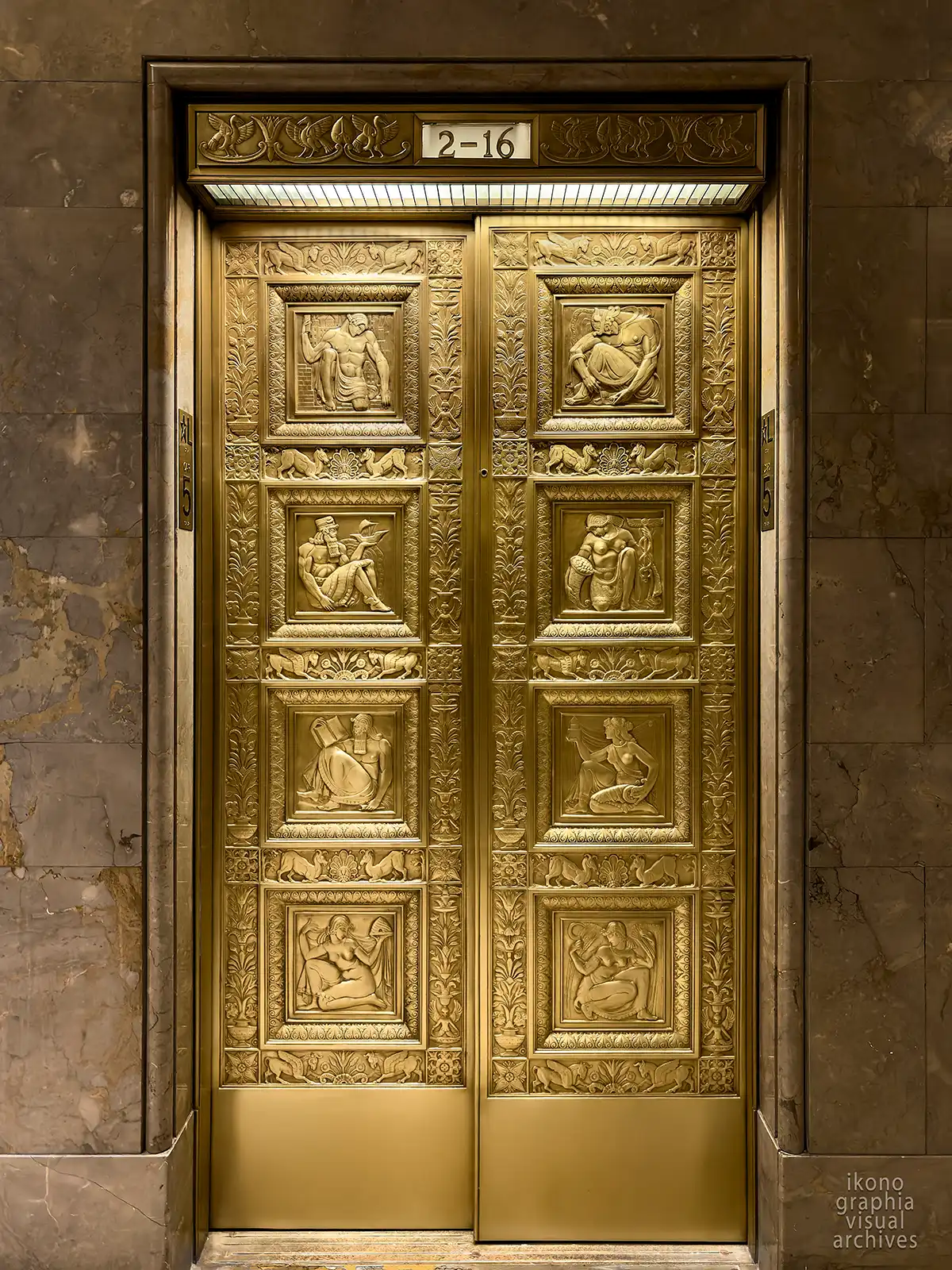
The Symbolic Program — Elevator Doors, Fred French Building, New York, 1927.

A complete symbolic program:
Commerce, Industry, Finance, and Building.

The eight gilded panels of the Fred French Building lobby — a sculptural cycle honoring the forces that powered New York's 1920s rise.

The arrangement is graphically balanced, not thematically ordered: the eye moves across figures and ornament before resolving into program. Ives's logic reveals itself slowly — four themes, eight figures, one coherent argument about what a city is and what sustains it.

The most complete Mesopotamian-themed decorative cycle in American Art Deco.
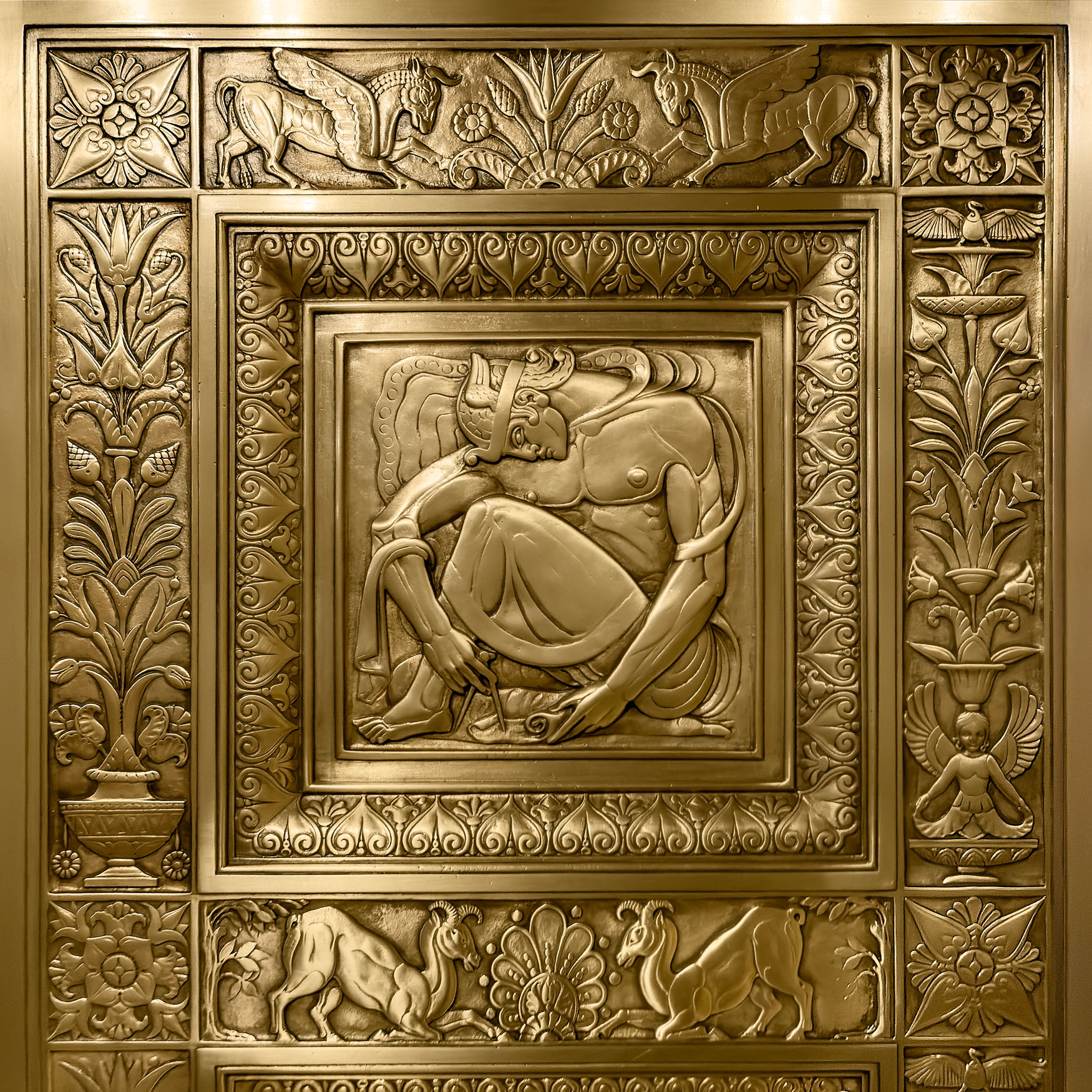
The Industrial Worker — Industry.

Symbolizing labor, engineering, and the infrastructure of the modern city.

A muscular figure crouches over his work, the full weight of his body engaged.
Where the Architect conceives and the Builder constructs, the Industrial Worker powers the infrastructure beneath both.

New York's modernization — its utilities, transport, and rising skyline — ran on this kind of labor. Glinsky gives it the same dignity as the figures of commerce.
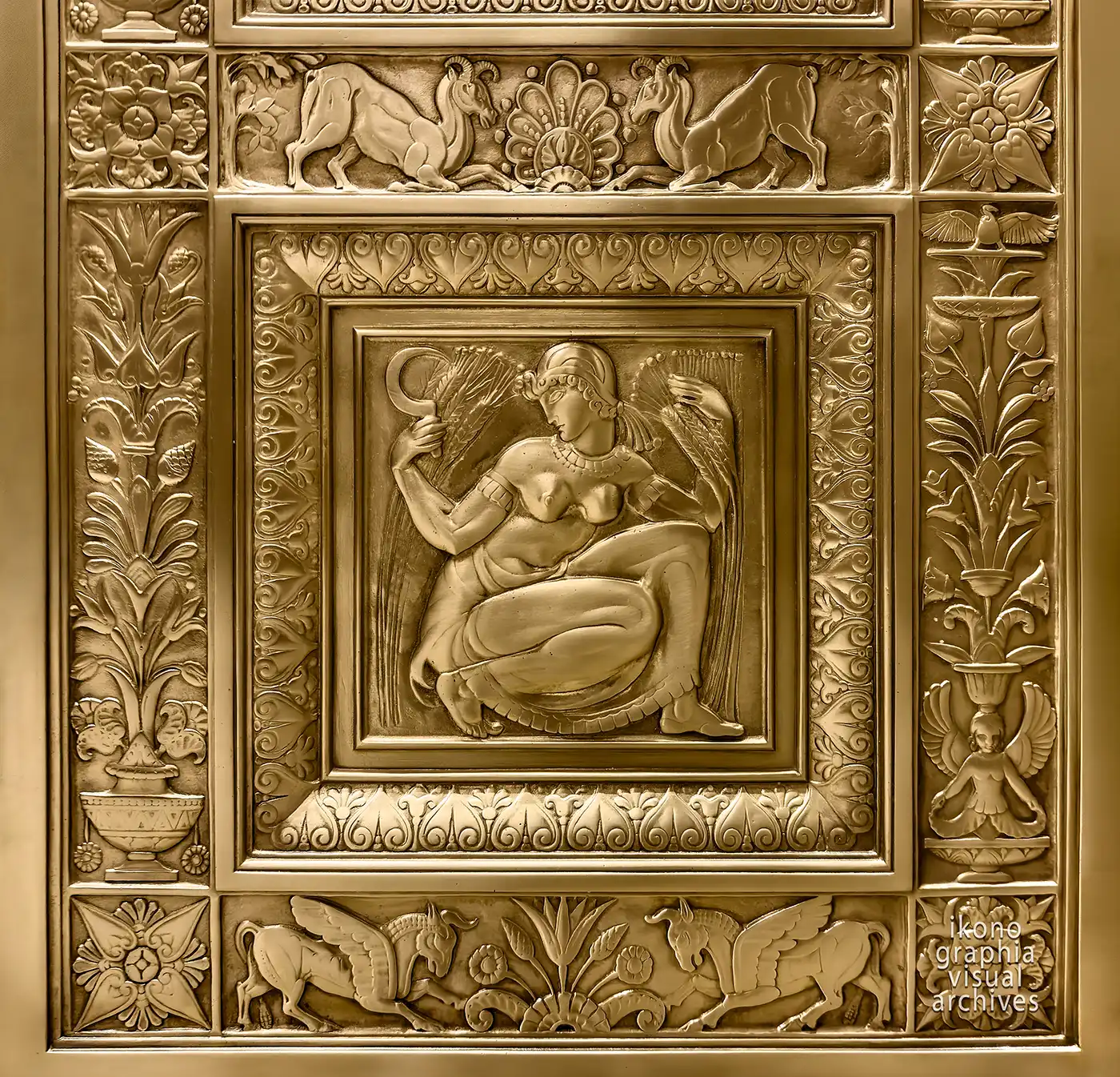
Art Deco allegory of agriculture — The Harvester Industry Elevator Panel, Fred French Building, New York, 1927. Gilt bronze relief by Vincent Glinsky and Oscar Bach.

The Harvester — Industry.

Symbolizing production, agriculture, and foundational industry.

A reclining female figure holds a bundle of wheat and a crescent sickle — the oldest symbols of harvest, drawn directly from the Mesopotamian tradition Ives had studied.

Industry here is not mechanical but elemental. Before the city rises, the land must yield. Glinsky places her with the same authority as the figures of commerce — the foundation that makes everything above possible.
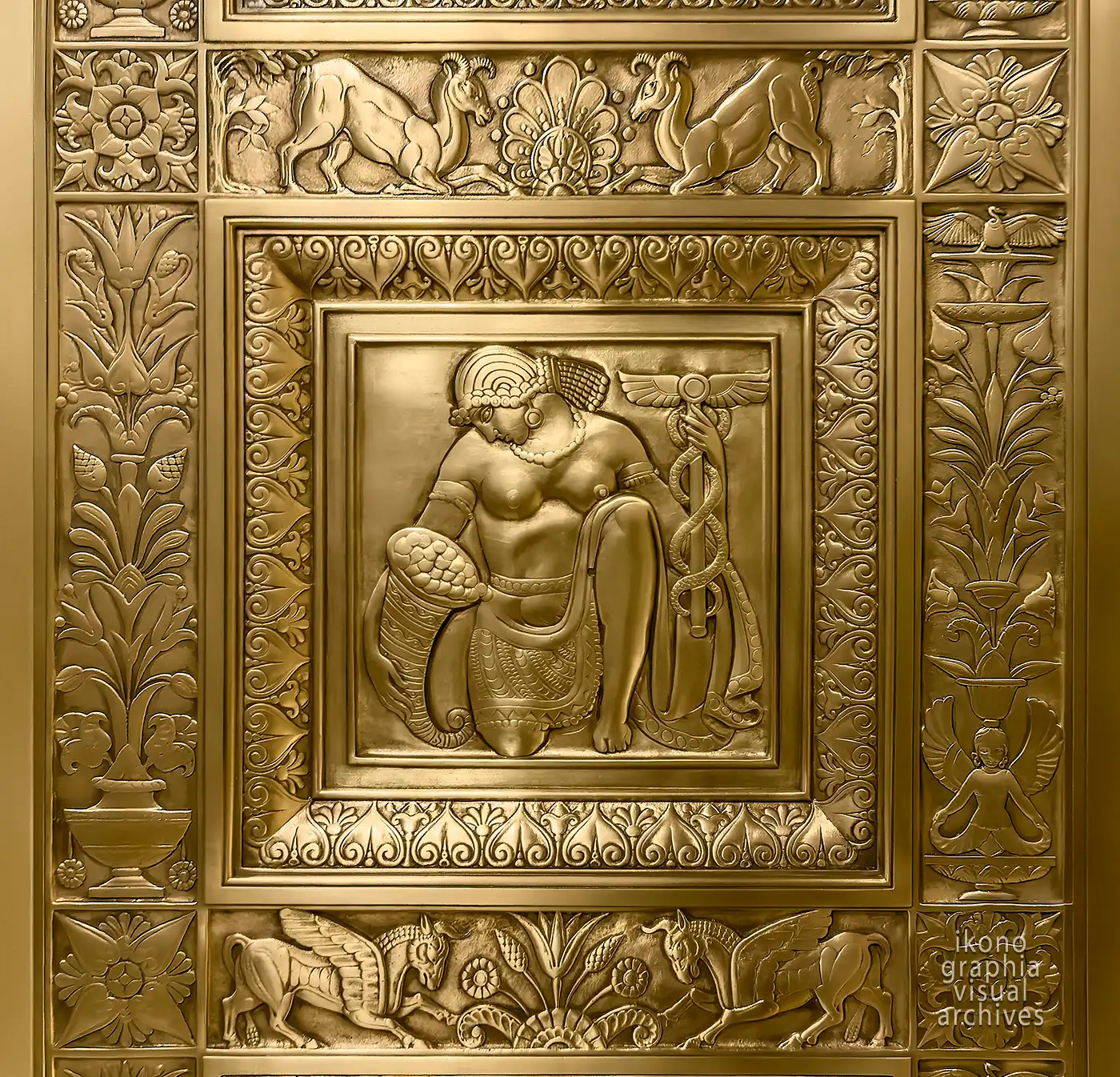
Allegory of Prosperity — The Wealth Bearer — Art Deco Elevator Panel, Fred French Building, New York — 1927 — Glinsky & Bach

The Wealth Bearer — Finance.

Symbolizing prosperity generated through investment and trade.

A seated figure holds a cornucopia and a caduceus — abundance in one hand, the instrument of exchange in the other. The objects are precisely chosen: not wealth accumulated, but wealth in motion.

Finance here is presented as a creative force, not a passive one. The building it occupies was itself a monument to that conviction — Fred French's own statement that capital, directed with ambition, builds cities.
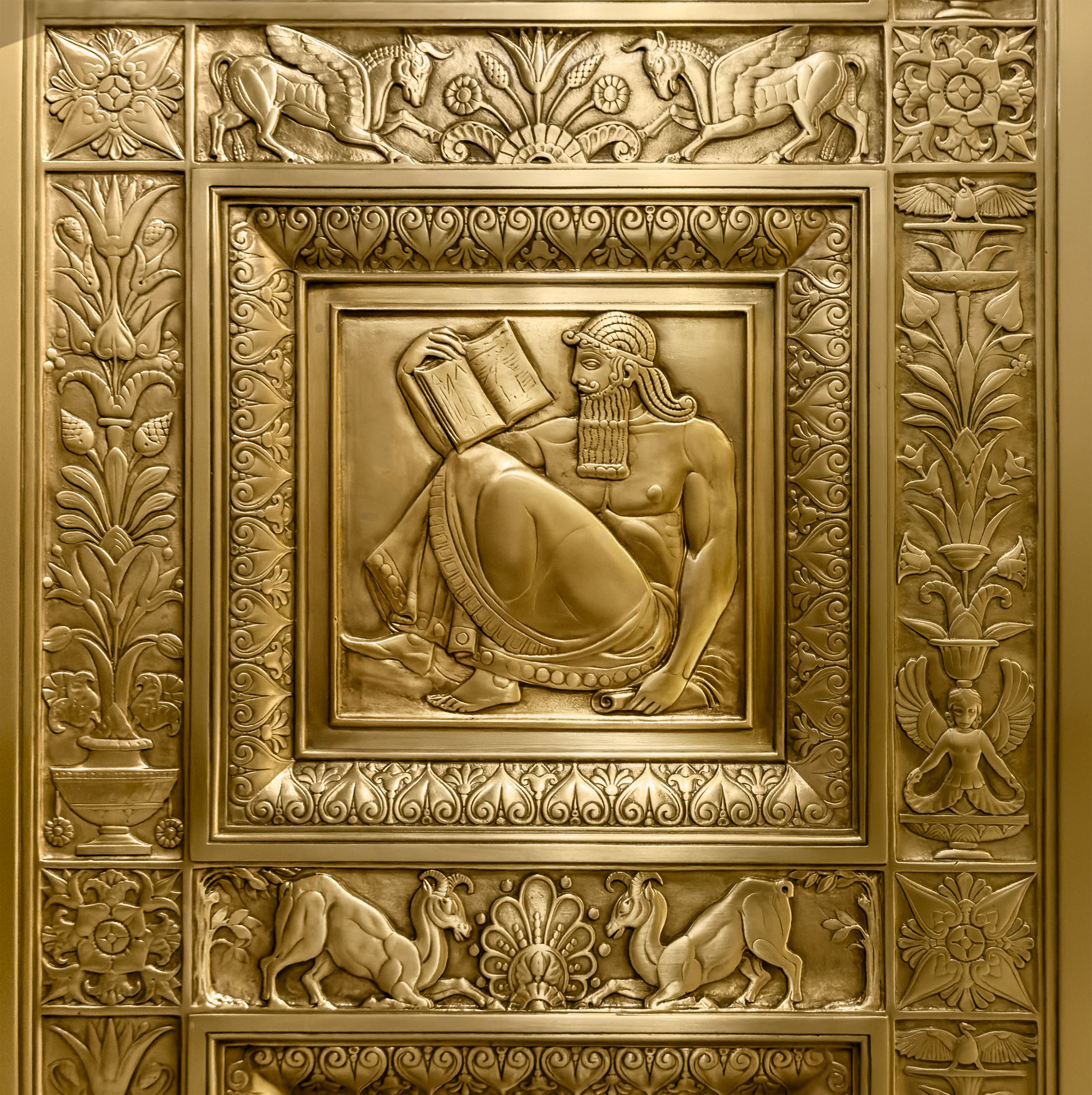
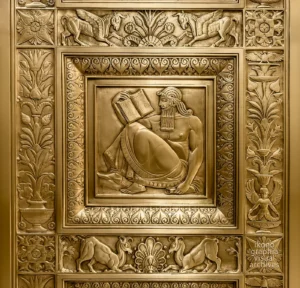
The Scholar — Finance.

Symbolizing knowledge, law, and administrative order.

A bearded figure holds an open tablet close to his face, absorbed in the text — the only figure in the program who reads, not acts, not carries.

Finance rests on law, record, and precedent. Where The Wealth Bearer puts capital in motion, the Scholar is the system that governs it — the written framework without which no transaction holds.
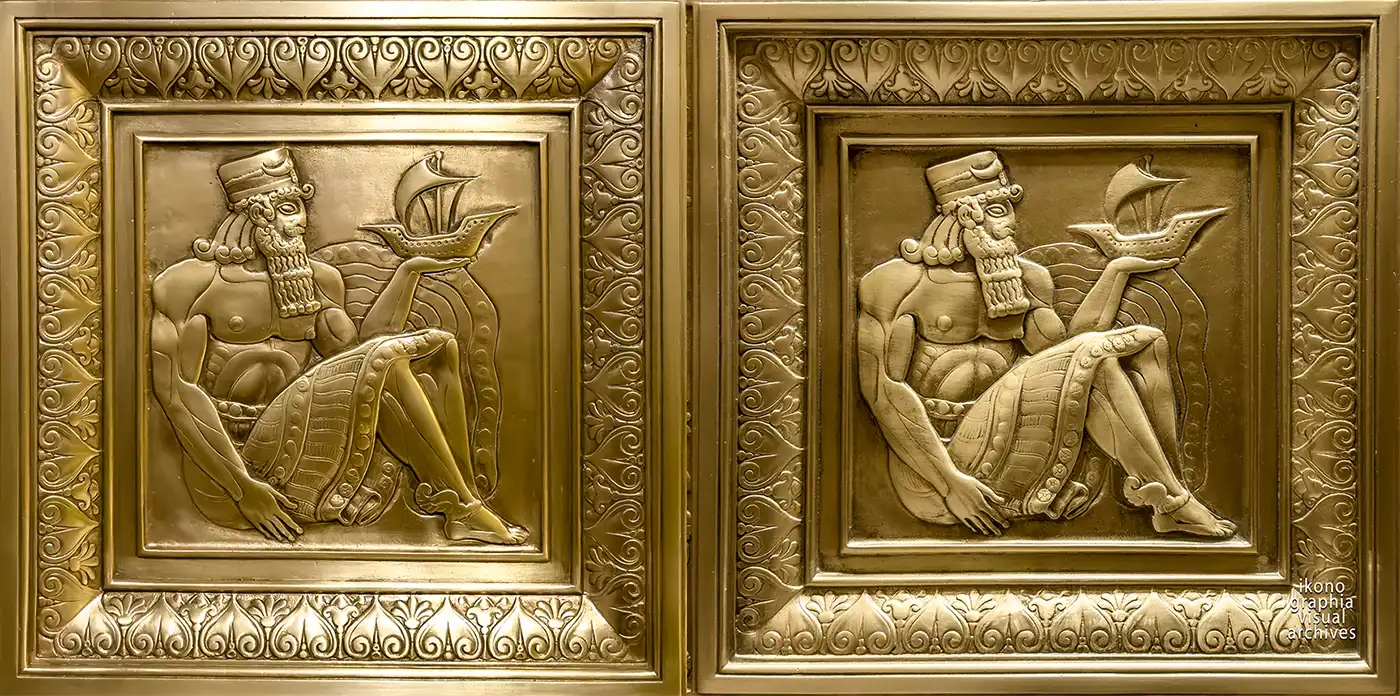
Two lighting conditions comparison — Elevator door panel, Fred French Building, New York, 1927.

The Elevator Doors Enigma — One Century Apart

The Merchant, from two different elevator doors, as shot — two entirely different surfaces, texture, color, with tones virtually inverted. The gilded coating makes the intent legible: a surface designed to hold light. Which rendition reflects Ives and Glinsky's original intent? The darker reading, however compelling, works against the material logic of the object.

On the Photographs

Eight doors. Forty versions. Three months.

These photographs were made in available light. Eight elevator doors line the lobby, sixty-four panels in total — the same subject, across different doors, produces entirely different surfaces, texture, color, with tones sometimes inverted. The only certain element was the light from above, embedded in the original design. Every additional light source introduced over a century was a question mark. Which one is closer to Ives and Glinsky's original intent was the editorial question.

Each door was documented as a complete object, the individual panels photographed separately. The tool that made this possible was an iPhone 15 Pro Max. Unobtrusive in a working lobby, it allowed multiple versions of each subject to be produced rapidly in the available light of the lobby. Imperfections in the files were compensated by the exceptional rendition of Apple ProRAW on gilt bronze.

Back at the desk, the range of versions — sometimes inverted in light and tone — became a tool for interpretation. The gilded coating makes the intent legible: a surface designed to hold light. The darker readings, however compelling, work against the material logic of the object. Choosing which version best served that intent was a subjective editorial decision. These photographs are an interpretation, a decoding attempt, not a record.

The Merchant and The Wealth Bearer were published full page in FMR Magazine. It was the first time in decades Roberto Bigano had worked without a Multi-Shot Hasselblad reproducing works of art.

CODA — A Declaration in Bronze

The elevator doors of the Fred French Building remain among the best-preserved Art Deco bronzes in Manhattan. The program has not dated — the symbolism is as legible today as it was in 1927.

In an ordinary lobby, the elevator is a utility. Here it is an argument — about what commerce is, what a city requires, and what ambition looks like when cast in gilt bronze.
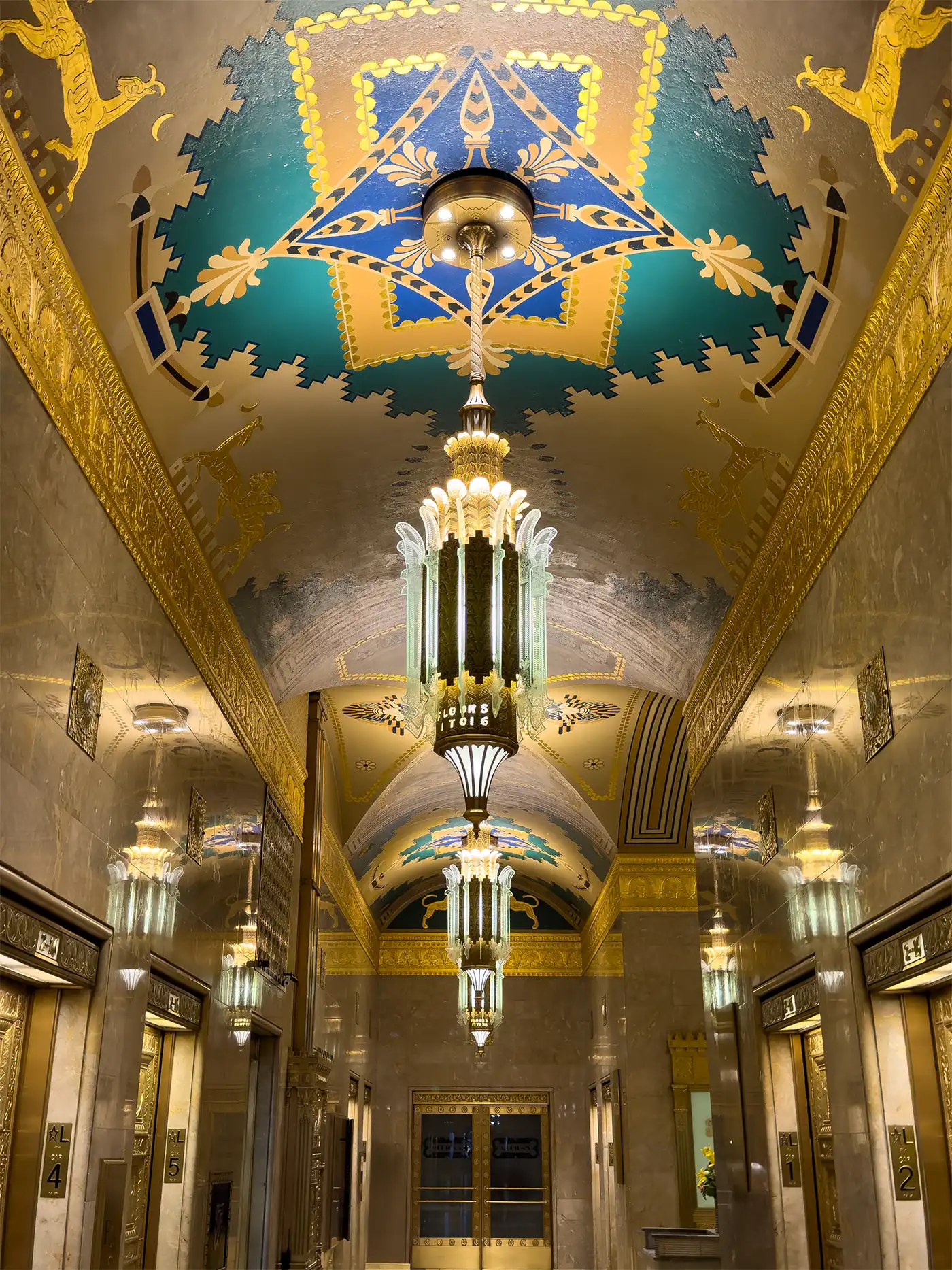
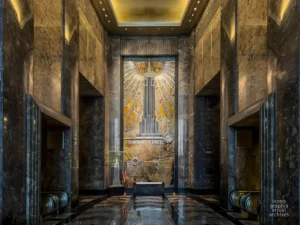
The Elevator Lobby.
Architecture as procession.

This view reveals the French Building's elevator lobby as a carefully staged passage: marble surfaces, gilded doors, and a richly painted ceiling guiding visitors toward the vertical heart of the building.

Light fixtures and ornament establish a measured rhythm, framing the elevators not as utilities but as destinations. The lobby does not simply connect — it prepares.

About Vincent Glinsky. A short bio.

Vincent Glinsky

Vincent Glinsky

Vincent Glinsky (1895–1975) was a Russian-born American sculptor whose work fused Beaux-Arts training with the emerging modernist vocabulary of the 1920s and 1930s. Educated in Petrograd and later active in New York, he developed a sculptural language marked by precise anatomies, architectural clarity, and an expressive narrative sense ideal for architectural relief.

His most ambitious commission, under the direction of architect H. Douglas Ives, was the bronze program for the Fred French Building on Fifth Avenue (1927) — eight gilded elevator panels, a monumental mailbox, and entrance reliefs forming the most complete Mesopotamian-themed decorative cycle in American Art Deco.

Realized in gilt bronze by master metalworker Oscar Bach, the panels translate four allegorical themes — Industry, Commerce, Finance, and Building — into a unified sculptural sequence of exceptional refinement. They remain the definitive example of his work at architectural scale, and among the finest surviving bronzes of the Art Deco era in New York.

About Oscar Bach. A short bio.
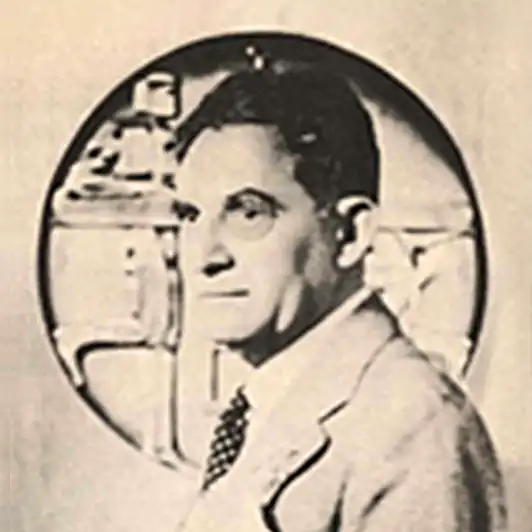
Oscar Bach

Oscar Bach

Oscar Bach

Oscar Bach was a German-born master metalworker whose technical innovation shaped some of the most celebrated interiors of early twentieth-century America. Trained in the European guild tradition, he brought exceptional skill in architectural bronze, iron, and nickel-silver to the United States after emigrating in 1911.

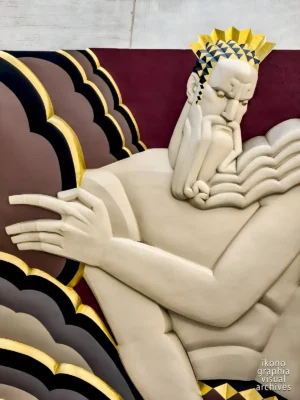
Working from his New York studio, Bach produced metalwork for major skyscrapers, department stores, civic buildings, and luxury residences. His commissions include the Empire State Building — where he executed the monumental Art Deco aluminum mural in the Fifth Avenue lobby — and Radio City Music Hall, where he realized the three eighteen-foot relief sculptures on the 50th Street facade in collaboration with artist Hildreth Meière. His style combined Old World ornament with modern geometric clarity, defining a distinctive branch of American Art Deco. His workshop became synonymous with excellence in decorative metal, leaving a legacy preserved in landmarked interiors across the country.
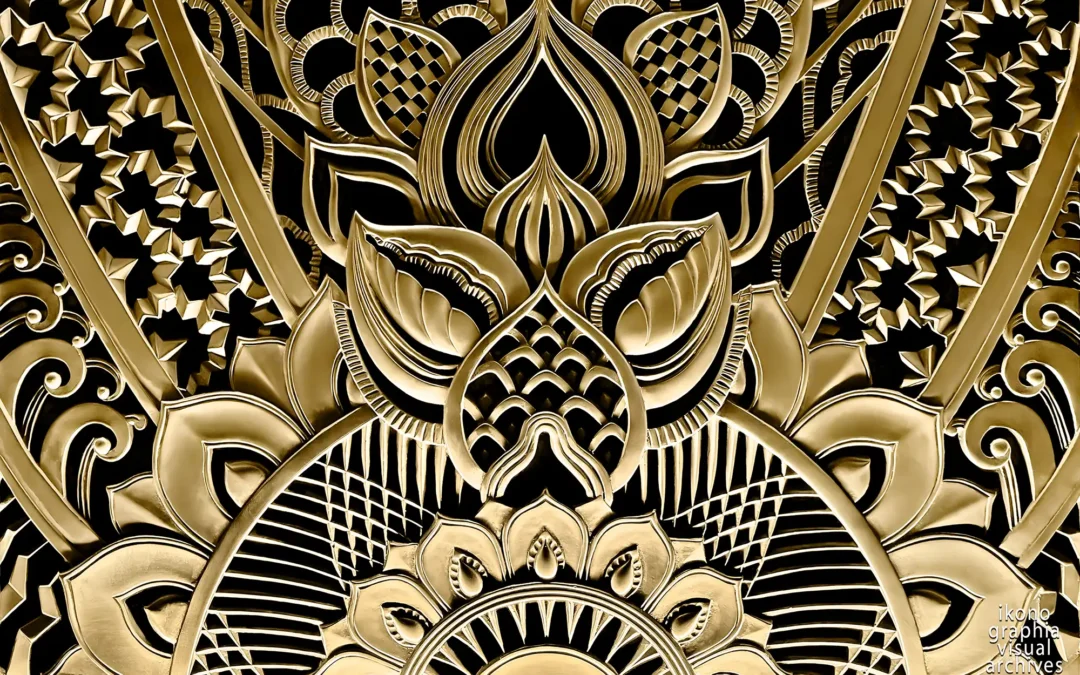
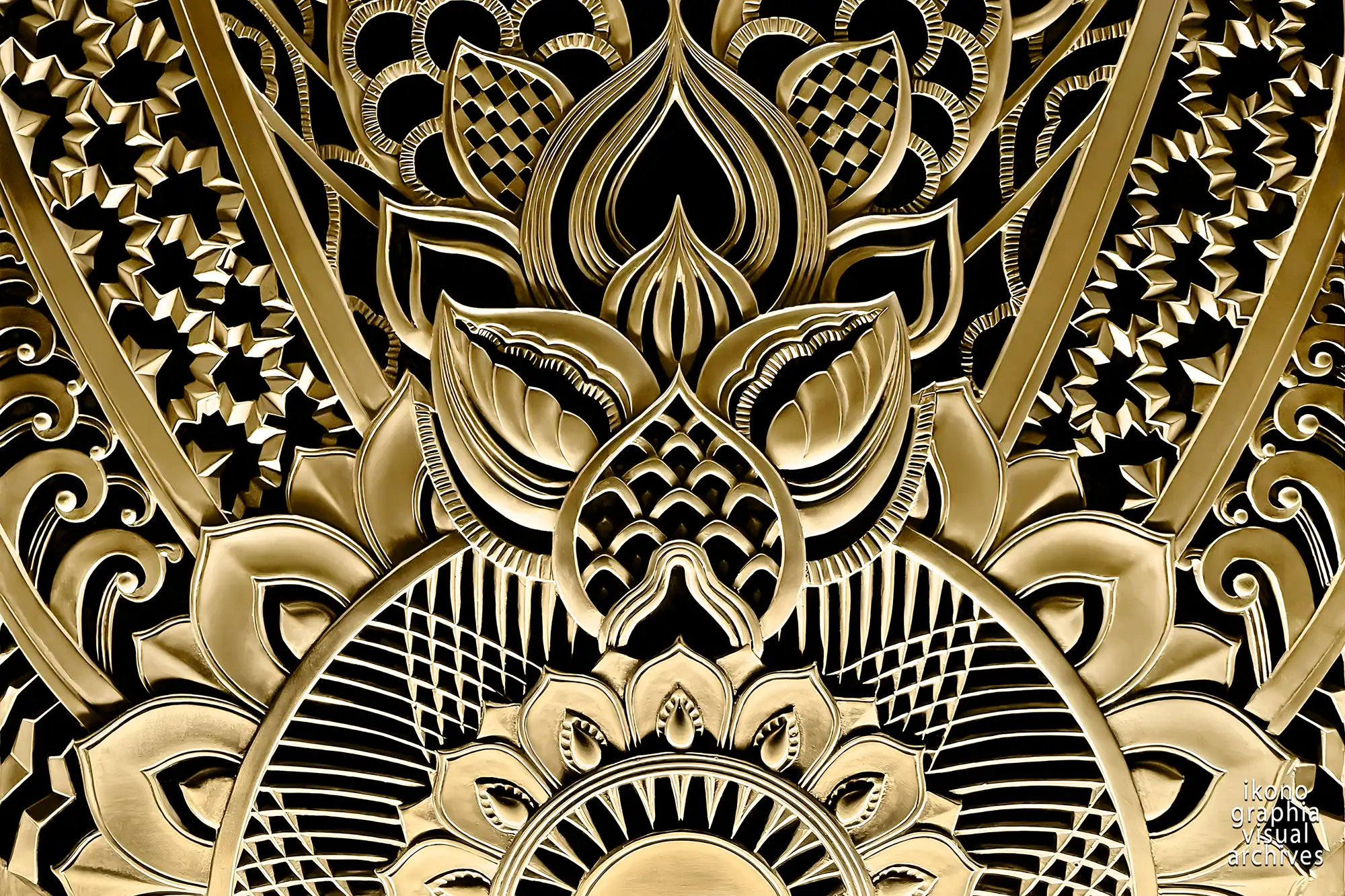
The City of Opportunity — Art Deco Grilles, Chanin Building, 1929

The City of Opportunity — Art Deco Grilles, Chanin Building, 1929

The City of Opportunity — Art Deco Grilles, Chanin Building, 1929

New York, 1929 — A City at its peak, casting its ambitions in bronze.

Completed in 1929 at the height of New York’s Jazz Age construction boom, the Chanin Building stands as one of the most intellectually ambitious expressions of American Art Deco. Its façade is admired, its lobby celebrated — but its most fully argued artworks are found in the vestibule: eight monumental gilt-bronze radiator grilles, conceived as a symbolic cycle of human development.

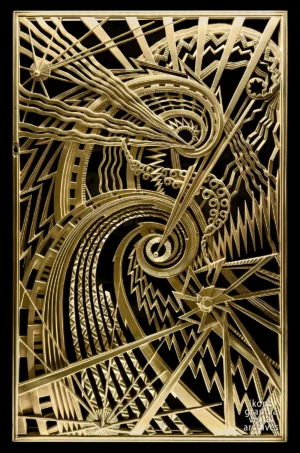
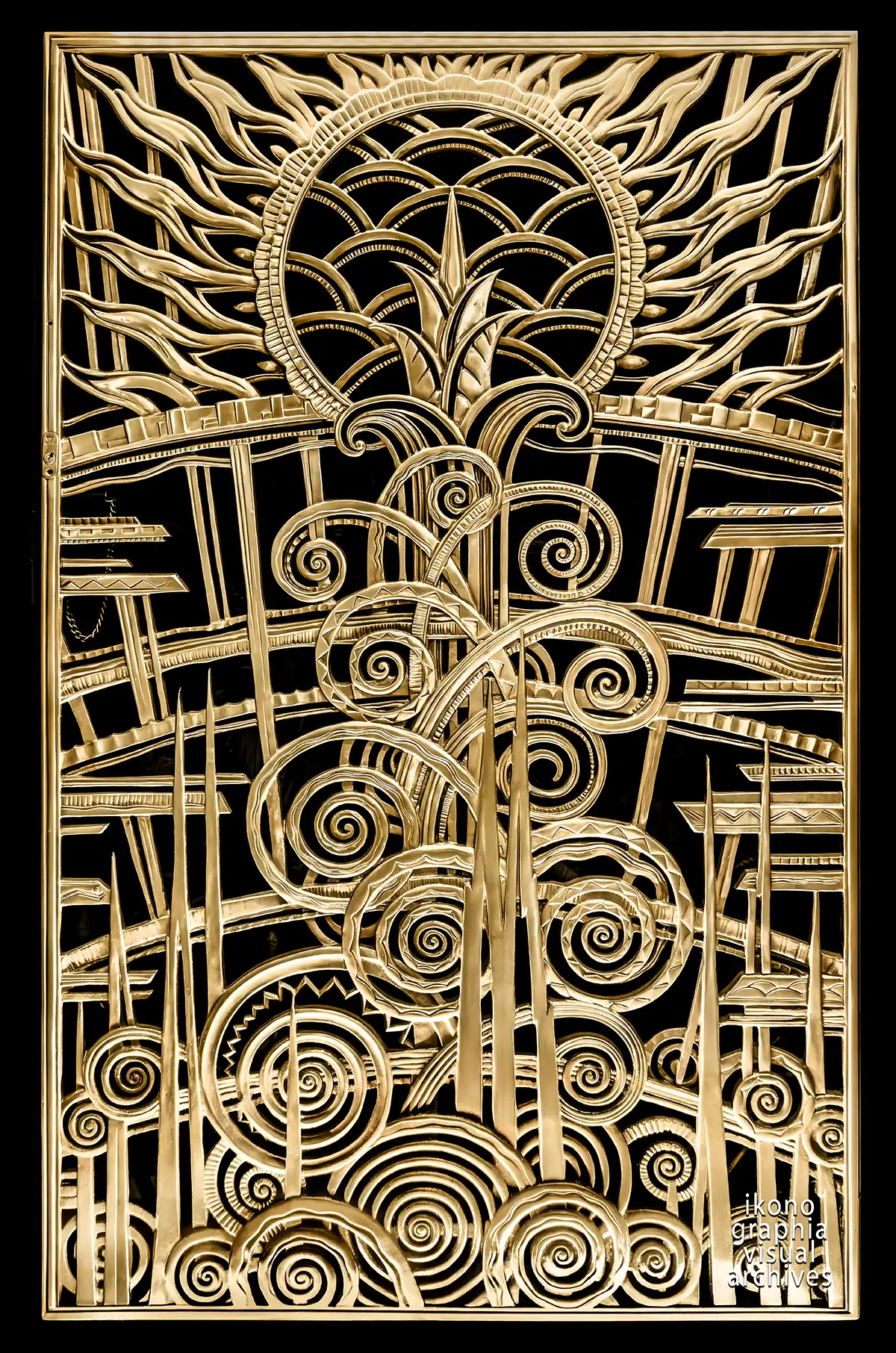
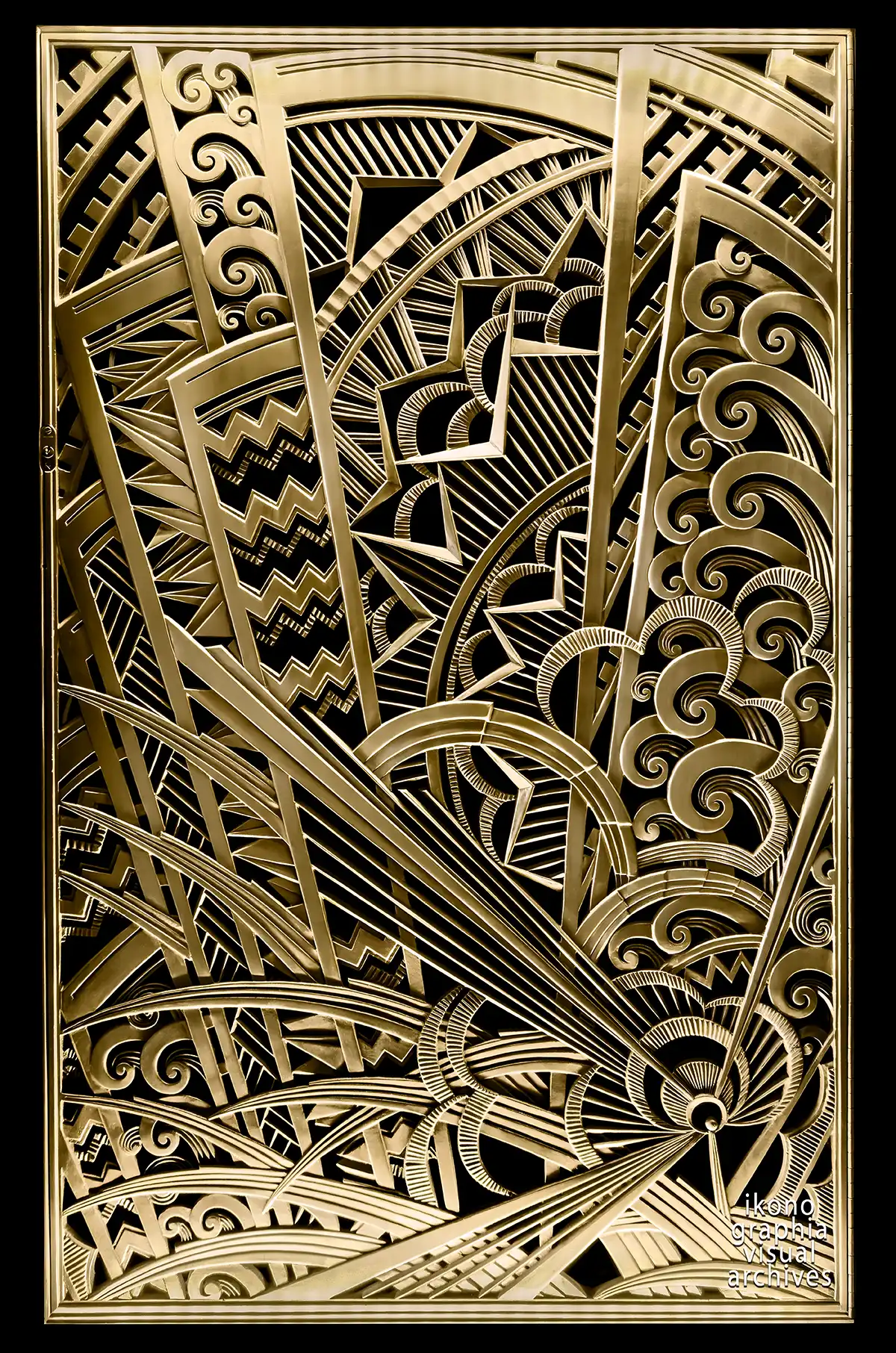
Allegory of Success — Gilded Grille, Chanin Building, New York — 1929 — René Paul Chambellan Success — The reward of sustained action. From "The City of Opportunity — Physical Series." A modern symbolic cycle in bronze. Symmetry returns, crowned with a radiant rising form. Success is rendered not as excess but as order — the balanced resolution of struggle. Spirals unfurl, energy flows upward, and the pattern resolves into harmony. Artist: René Paul Chambellan — Contributor: Jacques Delamarre Photographed by Roberto Bigano. NYC Art Deco Archive, Ikonographia. https://www.ikonographia.com/archive/the-new-york-city-art-deco-archive/

Designed by sculptor Rene Paul Chambellan and executed in collaboration with decorator Jacques Delamarre, these grilles form a complete visual philosophy. The program, titled “The City of Opportunity”, translates the psychological journey of a person’s life into geometric abstraction — a belief deeply rooted in the early 20th century fascination with symbolism, psychology, and the expressive power of line.

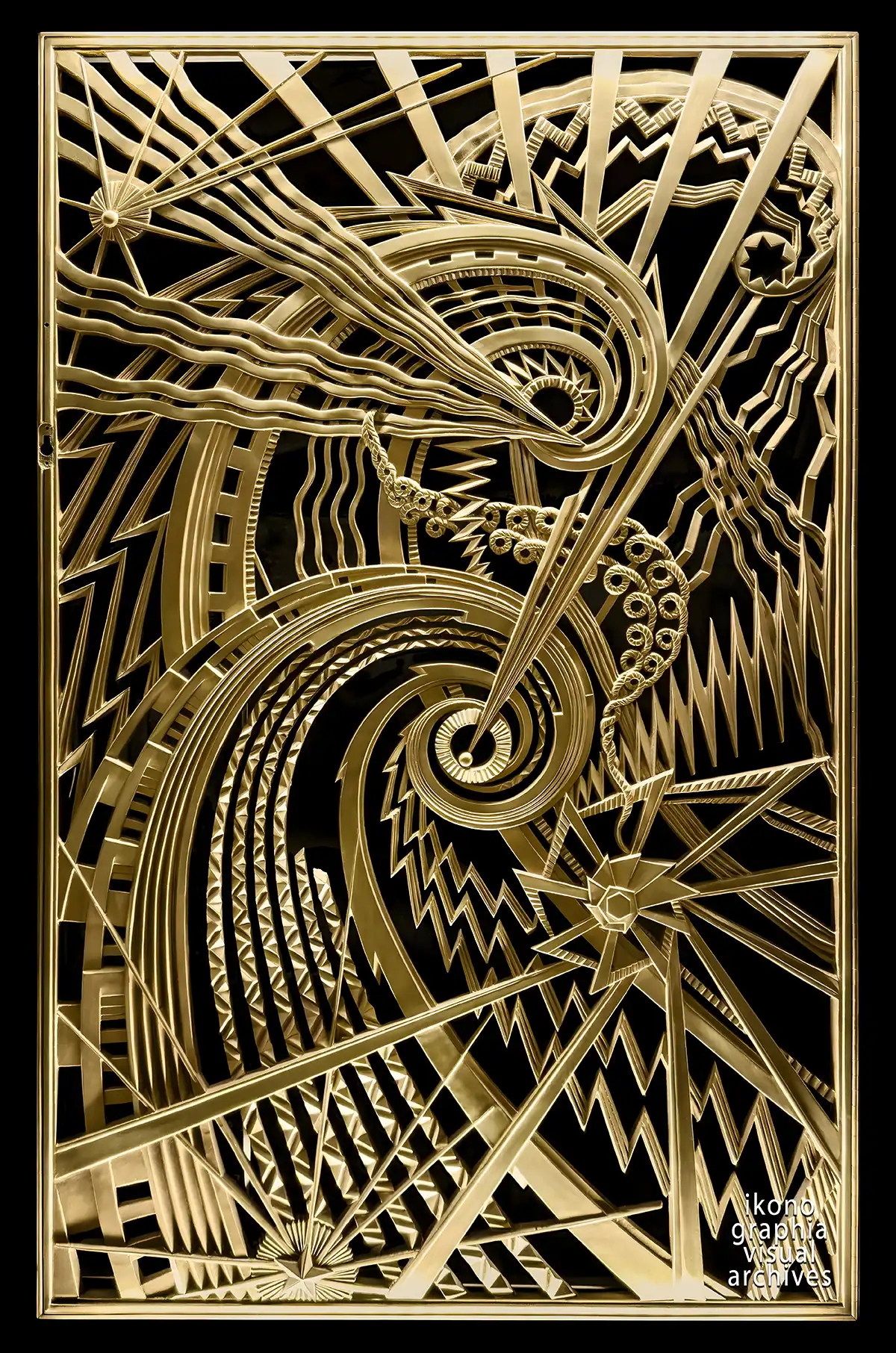
Art Deco Allegory of Agitation — gilded bronze grille by René Paul Chambellan, Chanin Building vestibule, New York, 1929.

Agitation.
The first stirrings of consciousness.
From "The City of Opportunity — Mental Series."

Sharp diagonals and restless lines convey the earliest motions of thought — the doubts, the questions, the uncertainty that precedes understanding. It is the unsettling beginning of inner life.

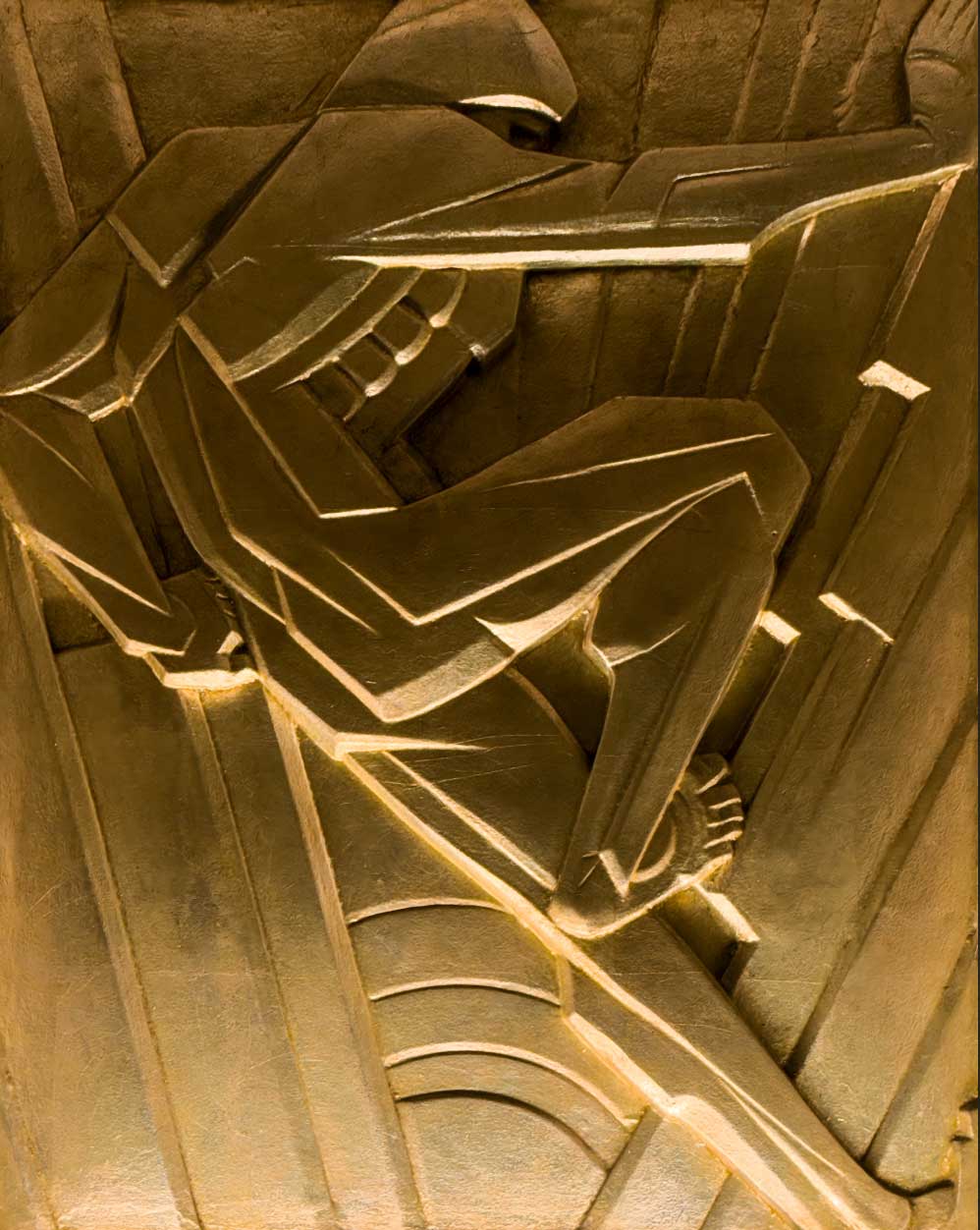
Art Deco Allegory of Vision — gilded bronze grille by René Paul Chambellan, Chanin Building vestibule, New York, 1929.

Vision.
The moment of illumination.
From “The City of Opportunity — Mental Series.”

Here, the composition centers on spiraling curves and backward radiance from the eye — Chambellan’s symbol for introspection. The bowed head of the figure suggests inward concentration, while strong supporting hands denote a gathering of intellectual strength. Vision is not simply sight — it is the birth of clarity.

The Vision Behind the Grilles

Geometry as Thought, Emotion, and Aspiration.

The Chanin program rests on a single conviction: that geometric lines and forms carry emotional meaning as precisely as figurative symbols — if designed with intention. Not decoration. Not ornament. A visual language capable of expressing the inner life of the mind and the outward force of physical action.

The program is divided into two parallel series, mental and physical, each tracing a complete arc of human development. The mental series moves from Agitation — the first, restless stirrings of consciousness — through Vision, Courage, and Achievement. The physical series runs alongside it: Activity, Effort, Endurance, and Success. Together they form a single argument: that the life of the mind and the life of the body are not separate, but two expressions of the same drive.

Each stage is expressed twice — once in a bas-relief figure, once in the grille beneath it. The figure shows a human state. The grille translates it into pure geometry. Spirals, rays, rings, and diagonals carry meanings as specific as words. The two read together as a complete symbolic sentence.

The source is a 1929 article in Architectural Forum, in which Rayne Adams — drawing directly on Jacques Delamarre — explains the program element by element, at the moment of completion. Not interpretation. The artists' own account.

Art Deco Allegory of Courage — gilded bronze grille by René Paul Chambellan, Chanin Building vestibule, New York, 1929.

Courage.
The resolve to act despite resistance.
From "The City of Opportunity — Mental Series."

In this panel, Chambellan visualizes determination as flowing arcs and tightly woven diagonals. The struggle is present, but so is forward momentum. Obstacles appear as counter-lines, yet purpose pushes through them. It is the geometry of bravery.

Art Deco Allegory of Achievement — gilded bronze grille by René Paul Chambellan, Chanin Building vestibule, New York, 1929.

Achievement.
The fruition of thought.
From "The City of Opportunity — Mental Series."

A rising sun, concentric spirals, and balanced symmetry mark the culmination of mental effort. The pattern is no longer restless but ordered, luminous, and harmonious. Achievement is not finality, but the moment when intention becomes reality.

The Artists Behind the Vision

Rene Paul Chambellan — Sculptor of the American Skyline.
Trained in low-relief technique, Chambellan brought to the Chanin commission a sculptor's understanding of how geometric line carries weight and movement — how a spiral tightens under pressure, how a diagonal conveys force. The nickel-silver elevator doors at 70 Pine Street and the Atlas modeling at Rockefeller Center place him among the defining contributors to New York Art Deco metalwork. The Chanin grilles are his most sustained intellectual work: a symbolic cycle that translates human psychology into architectural geometry.

Jacques Delamarre — The Program's Architect.
Delamarre's role was conceptual. Where Chambellan gave the grilles their sculptural form, Delamarre constructed the narrative — the two-series structure, the sequence from Agitation to Success, the decision to run mental and physical development as parallel arguments. The Architectural Forum article that survives as the primary document of the Chanin cycle is, in effect, Delamarre's account of his own design thinking.

Together they produced something with no direct equivalent in New York Deco: a complete symbolic program in which every geometric element carries a specific, intended meaning.

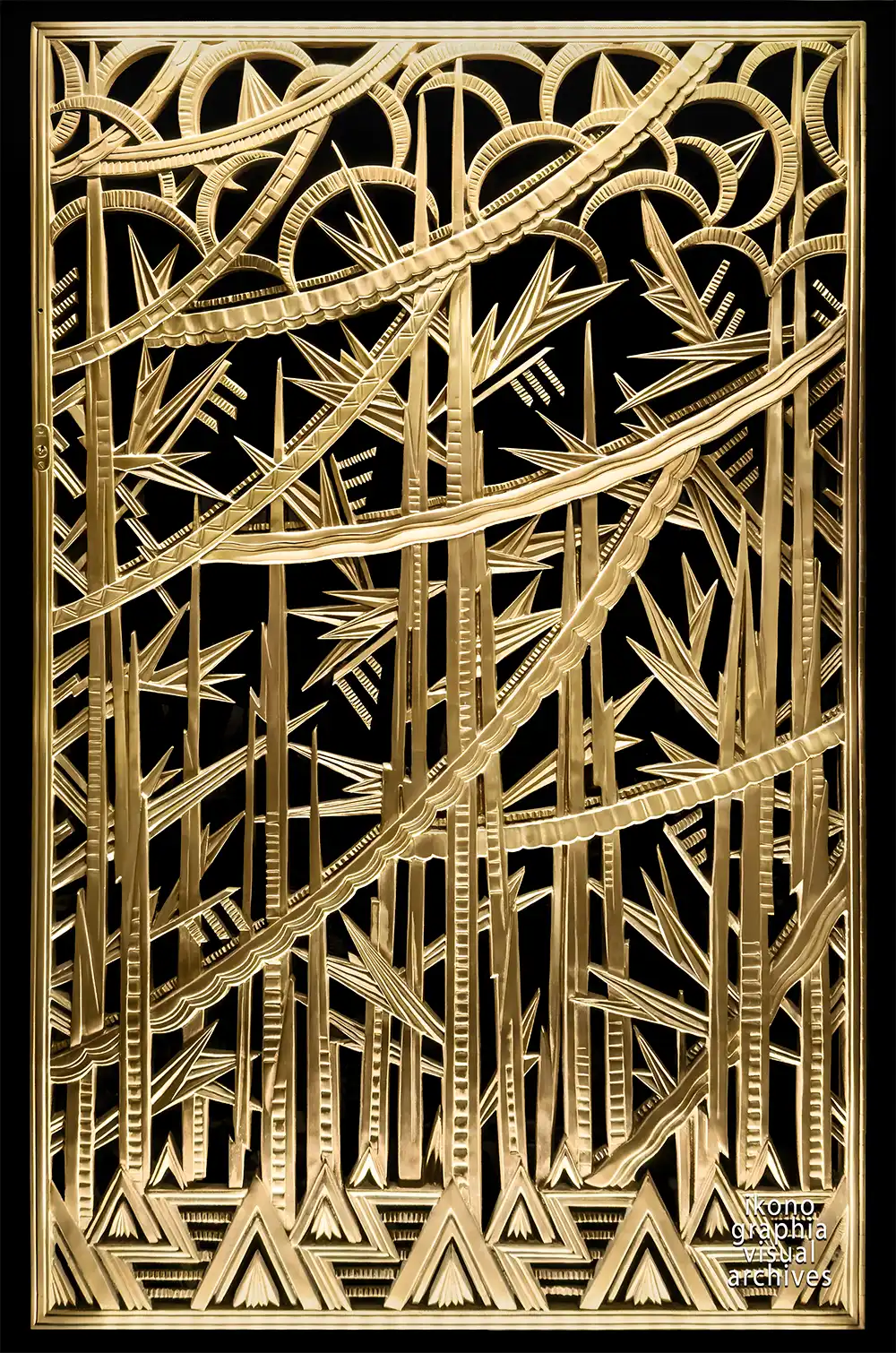
Art Deco Allegory of Activity — gilded bronze grille by René Paul Chambellan, Chanin Building vestibule, New York, 1929.

Activity.
The beginning of physical exertion. From "The City of Opportunity — Physical Series."

Interlocking rays and rising diagonals give this panel a kinetic rhythm — the first outward expression of purpose in the world. It is the geometry of initiation, the body waking into movement.

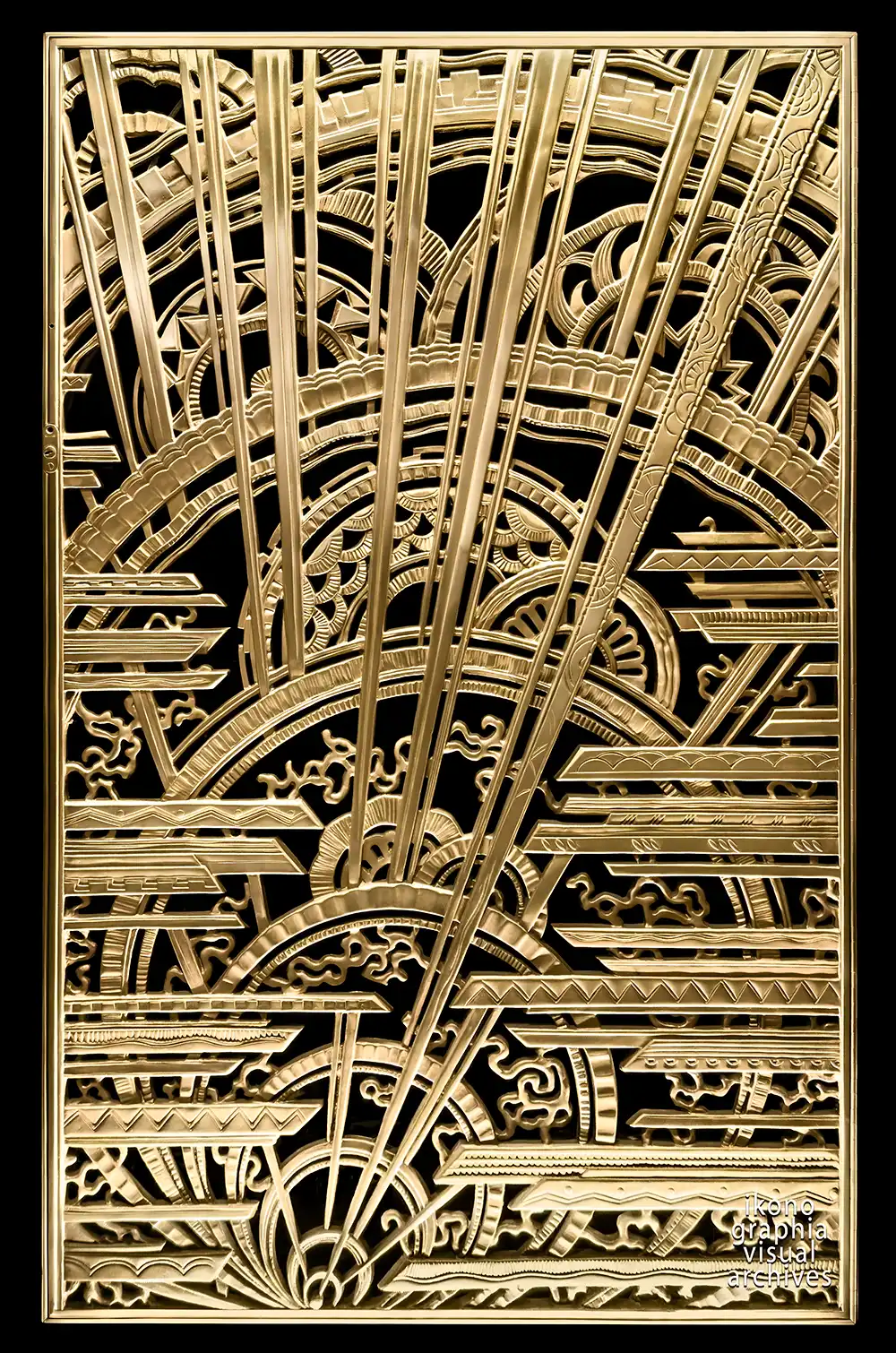
Art Deco Allegory of Effort — gilded bronze grille by René Paul Chambellan, Chanin Building vestibule, New York, 1929.

Effort.
The struggle against resistance.
From "The City of Opportunity — Physical Series."

Here, spirals tighten, diagonals collide, and curves appear compressed, as if bearing weight. The composition visualizes the tension between aspiration and the obstacles that define it. Effort is the architecture of perseverance.

Beyond Symbolism — The Human Story in Bronze

Viewed as a whole, the Chanin grilles offer something rare in architectural sculpture: a complete narrative of human development told through pure form. Geometry carries emotion. Abstraction carries argument. Eight panels, two sequences, one program — conceived in 1929 and still precise.

Nearly a century later, the panels hold their strange mixture of optimism and introspection — a Jazz Age faith in progress captured in metal. Chambellan's question was not rhetorical. It is there in every rising line, every spiraling curve, every radiant burst: what does it mean to strive? The eight grilles are the answer.

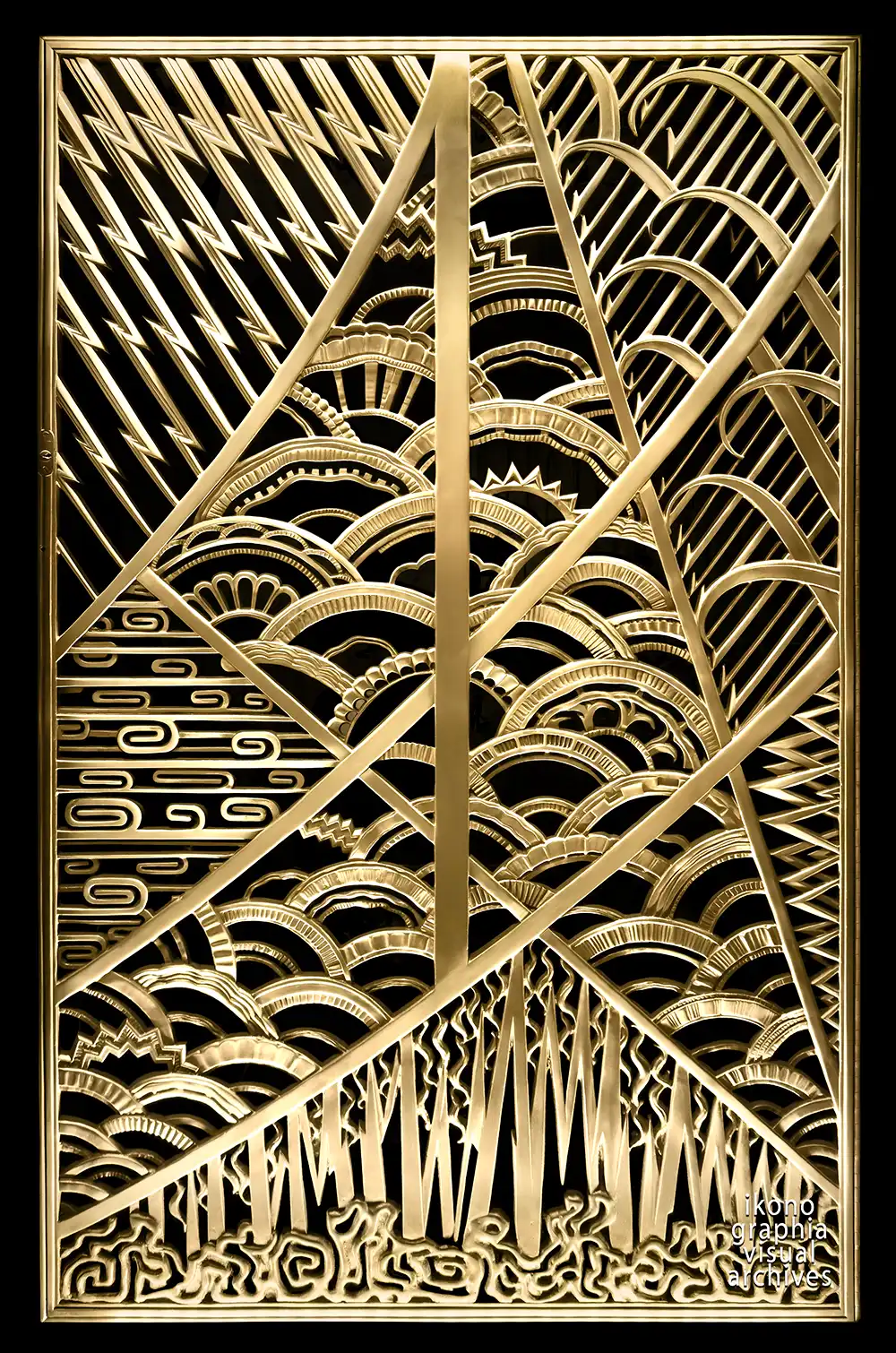
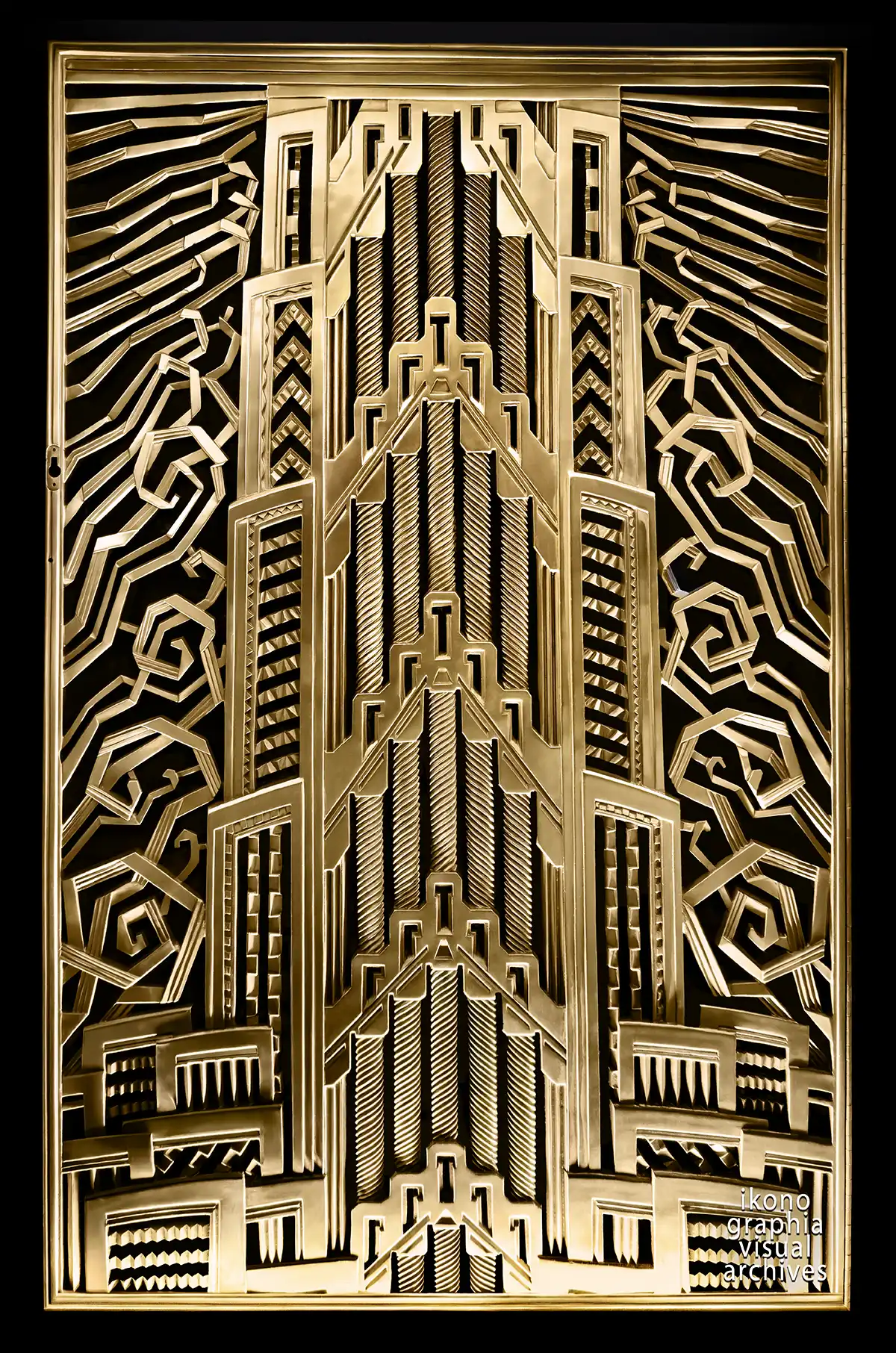
Art Deco Allegory of Endurance — gilded bronze grille by René Paul Chambellan, Chanin Building vestibule, New York, 1929.

Endurance.
The steady continuation of labor.
From "The City of Opportunity — Physical Series."

This grille stands tall and monumental — a symbolic skyscraper of human resilience. Vertical lines run uninterrupted through the panel, marking the steady, disciplined continuation of work. Its strength lies in repetition, in the refusal to break.

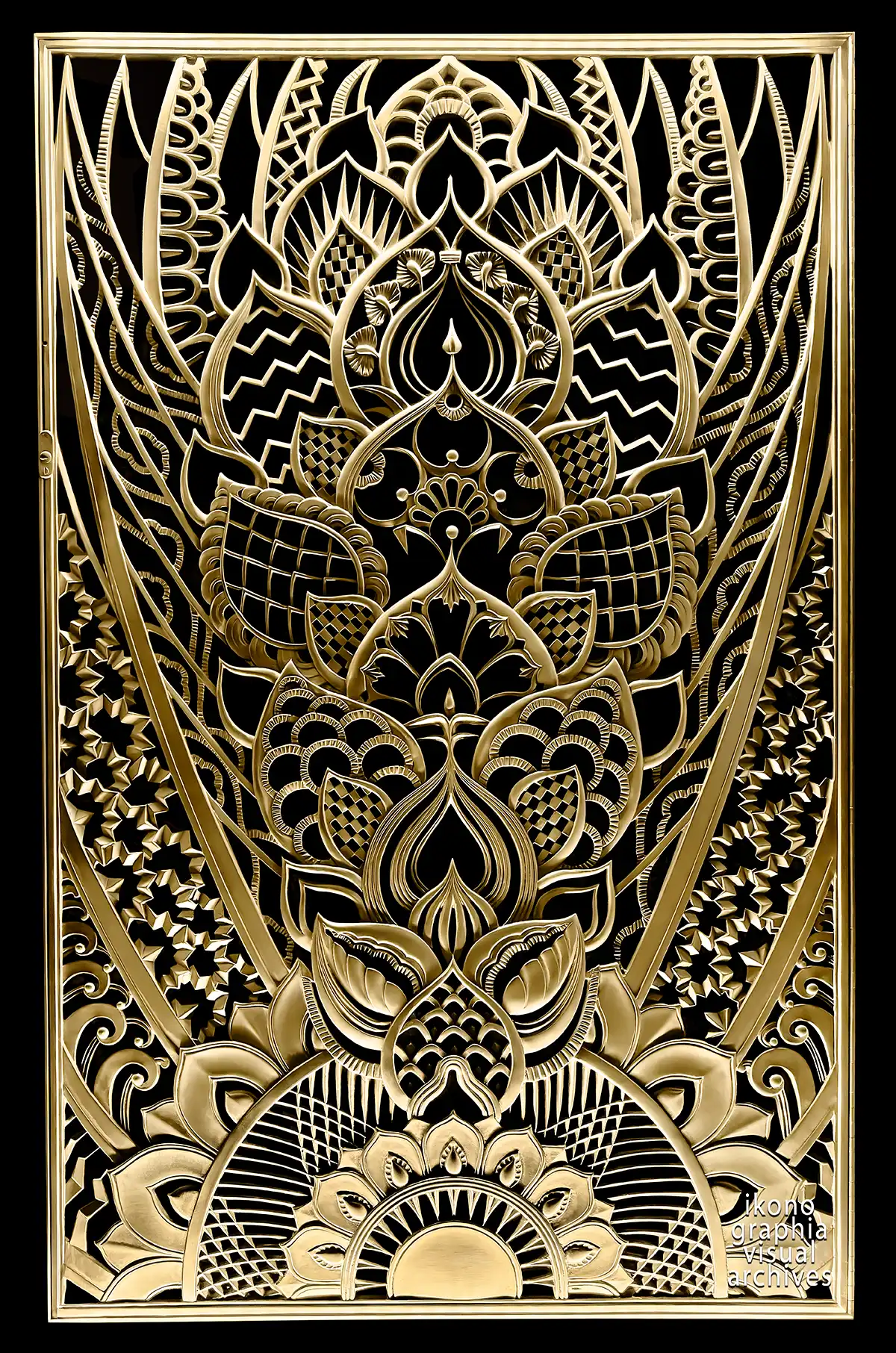
bule, New York, 1929.

Success.
The reward of sustained action.
From "The City of Opportunity — Physical Series."

Symmetry returns, crowned with a radiant rising form. Success is rendered not as excess but as order — the balanced resolution of struggle. Spirals unfurl, energy flows upward, and the pattern resolves into harmony.

The Chanin Building Symbolic Program

Eight Grilles, Eight Bas-Reliefs — A Dual Expression of Human Development

For decades, the Chanin grilles were admired but not understood. Visitors saw geometric patterns in bronze, felt their visual power, but couldn't decode their meaning. The symbolic program remained partially locked.

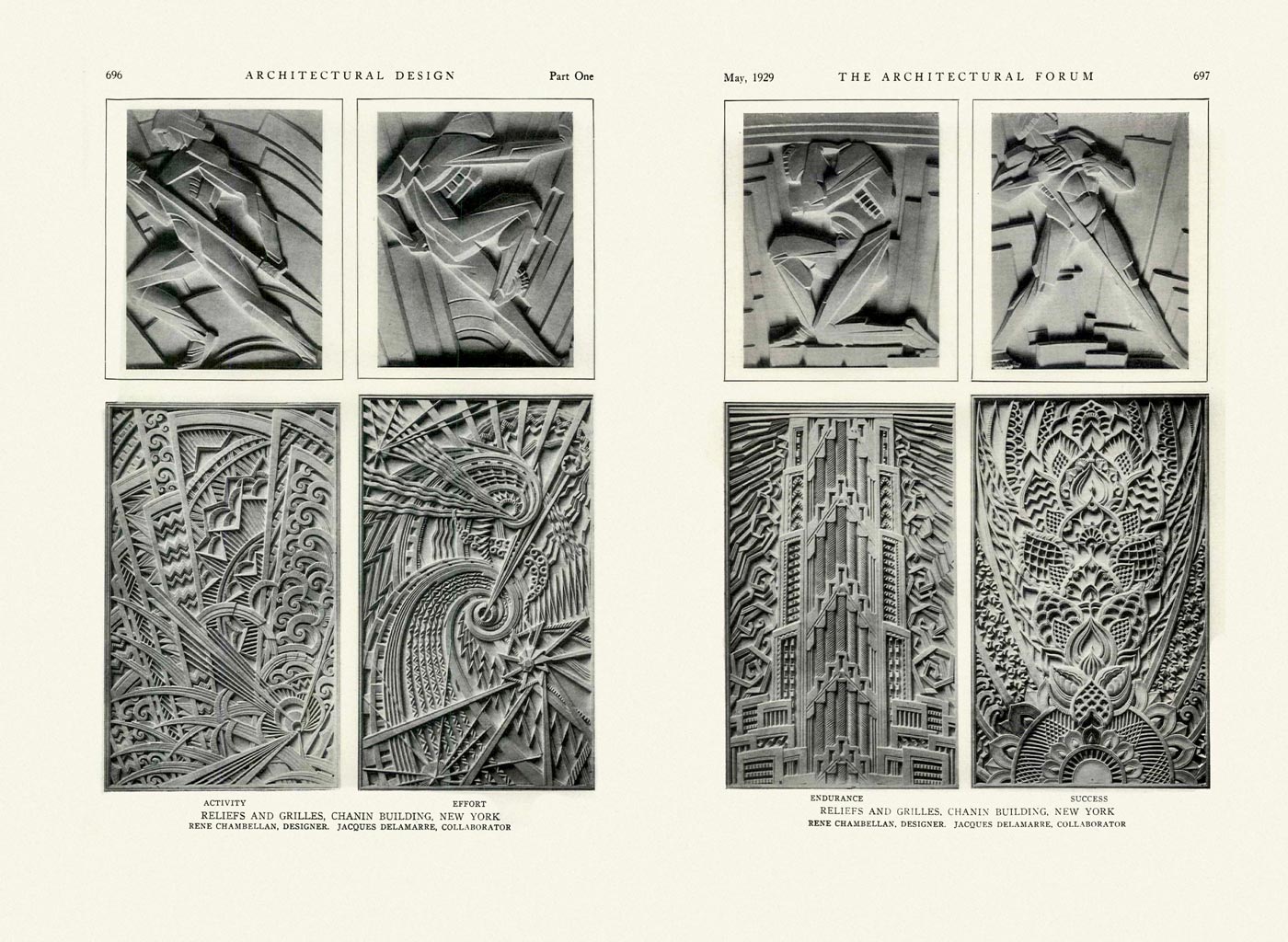
The key appeared in May 1929, just months after the building opened: a six-page article in The Architectural Forum written by Rayne Adams, featuring direct explanation from Jacques Delamarre—the collaborator who conceived the narrative structure with Chambellan.

This wasn't later interpretation. It was the artists explaining their own work at the moment of completion.

For Ikonographia's research, this text functioned as a Rosetta Stone: it allowed the grilles to be read as their creators intended, aligning what we see in the bronze with what Delamarre and Chambellan meant to express.

Vision bas-relief by René Paul Chambellan, Chanin Building vestibule, New York, 1929.

Vision Bas-relief.
The moment of illumination.
From "The City of Opportunity — Mental Series."

Excerpts From "Architectural Forum", May 1929 — Primary Source: Jacques Delamarre

The entire article is included in the downloadable document. What follows are the passages that most directly illuminate the symbolic program.


The Philosophical Foundation: Geometry as Emotional Language

Why geometric abstraction? Why not traditional allegory?

Rayne Adams begins by defending the decision to use pure geometric forms rather than conventional symbolism:

"Most designs are conceived and executed with little thought... The common run of decorative design follows along no intellectual line of effort which is in any way exacting. If we have to portray winter, we picture it as 'a weak old king who feels, like Lear, upon his withered face, Cordelia's tears.' And all select a bluebird as a symbol for happiness."

This conventional symbolism, Adams argues, is "labored" and "lacks subtlety." But there's another path:

"The dominant idea which they have sought to set forth is the significance of geometric lines and their capacity to symbolize emotions and abstractions of thought and deed... A consensus of opinion has established certain characteristics which are associated with types of line and of form. For vexation or perplexity we all scribble a confused scrawl; the flowing curve suggests ease and grace; the circle suggests completeness."

This is the conceptual core: geometric forms can carry emotional meaning just as powerfully as figurative symbols—if designed with intention.


The Structure: Two Parallel Series

Each grille corresponds to a stage of human development, divided into mental and physical progression:

"In these reliefs and grilles they have envisaged this life under two commonly accepted categories,—that which sets forth the physical life and that which sets forth the mental life."

"Certain phases of development under each category are presented by a panel figure in relief supplemented by a grille design placed immediately beneath."

The Mental Series (consciousness developing):

  1. Agitation — "the first conscious stirrings; the first doubts, the first questions and uncertainties"
  2. Vision — "the birth of conscious planning and the formation of a definite and compelling ideal"
  3. Courage — "the man at work,—following out, with firm resolution and steady purpose, those ideals which are his, beset by obstructions, yet achieving"
  4. Achievement — "the fulfillment of his work"

The Physical Series (action manifesting):

  • Activity, Effort and Endurance, and Success — "exemplifies in its way the characteristics presented by the series showing the mental development"

How to Read the Grilles: The Case of Vision

Adams provides a detailed reading of one grille to show how the geometric language works:

"In the relief, showing a crouching figure, we see the vacant look,—'the light drawn backwards from the eye'—betokening introspection and concentration; the bowed head characteristic of the thinker, and the supporting hands,—that gesture which has always something pathetic about it—as though the strong hands of the body were giving support to the troubled mind."

The corresponding grille translates this into pure geometry:

"The mental world of this thinker is symbolically represented by the spiral convolutions, expanding in wider and wider sweeps, while his inspirations or impulses for action are marked by the indented, radial lines."

"The deepest indentation marks the definitive and determining inspiration under the aegis of which he will, for good or ill, follow through his life to some significant end."

"The grille design supplementary to this relief bears out this thought. The dominant inspiration is represented by the continuous ray, which, passing through the barriers of doubt and ignorance, pursues its unbroken way. Other inspirations, other compulsions, are represented by the non-continuous rays; these are less perfect. The tangent rings of successively increasing diameter represent the successive phases of his life."

This is how the system works: each geometric element—spirals, rays, rings, indentations—carries specific symbolic meaning, allowing complex psychological states to be expressed through abstract pattern.


The Grilles and Reliefs as Unified Language

Critically, the grilles are not decoration—they are translation:

"The supplementary grille panels, wholly geometric in conception, present a symbolism which, interpreted, bears out the meaning of the corresponding relief figures."

The bas-relief shows a human figure embodying an emotional state. The grille beneath translates that same state into geometric abstraction. Together, they form a complete symbolic language: one figurative, one abstract, both expressing the same idea.


Adams' Final Assessment

Despite the intellectual complexity of the program, Adams judges the work on aesthetic grounds:

"Whether the union has brought forth progeny whose aesthetic quality will stand, is something for the critics to decide. As an expression of a method of achievement, the work may be characterized assuredly as not lacking in the spirit of adventure."

"For my own part, I confess that I have rarely looked upon relief figures which have struck me as more worthy of praise than these. To say that they are masterly is not enough; they hold, for those of us who care for abstractions, what is far more important,—something of genius."


Primary Source Document

The complete 1929 article by Rayne Adams is available as an attached document for researchers who wish to read the full philosophical argument and additional symbolic details.

[Download: "The Reliefs and Grilles of the Chanin Building Vestibules" – Architectural Forum, May 1929]


What this text provides:

A contemporary explanation of the grilles by their creators, allowing Ikonographia's photographic documentation to be read with the precision the artists intended—not through later guesswork, but through direct alignment between visual evidence and original meaning.

Architectural Forum, May 1929 — Chanin Building reliefs and grilles by René Paul Chambellan, with Jacques Delamarre as collaborator.

Architectural Forum, May 1929

Contemporary publication illustrating René Chambellan’s reliefs and grilles for the Chanin Building, New York.
Here the symbolic program of the vestibule bas-reliefs and grilles is explained directly by Jacques Delamarre, the collaborator responsible for articulating their narrative structure.
It is a sort of "Rosetta Stone" to decipher the complex project of "The City of Opportunity,”

CODA — Seventy Pine Street: A Related Masterwork

Another remarkable Chambellan work— The "Evolution of Fuel" Elevator Doors

Though separate from the Chanin cycle, the nickel-silver Evolution of Fuel elevator doors at 70 Pine Street deserve their own reading — created for the Cities Service Oil Company.

Chambellan was a master at exploring new metal alloys. Here he worked in nickel silver (German silver) — a corrosion-resistant copper-nickel-zinc alloy prized in Art Deco design for its silvery-white luster, warm tone and durability. Despite its name, it contains no actual silver; the nickel provides the distinctive metallic sheen.

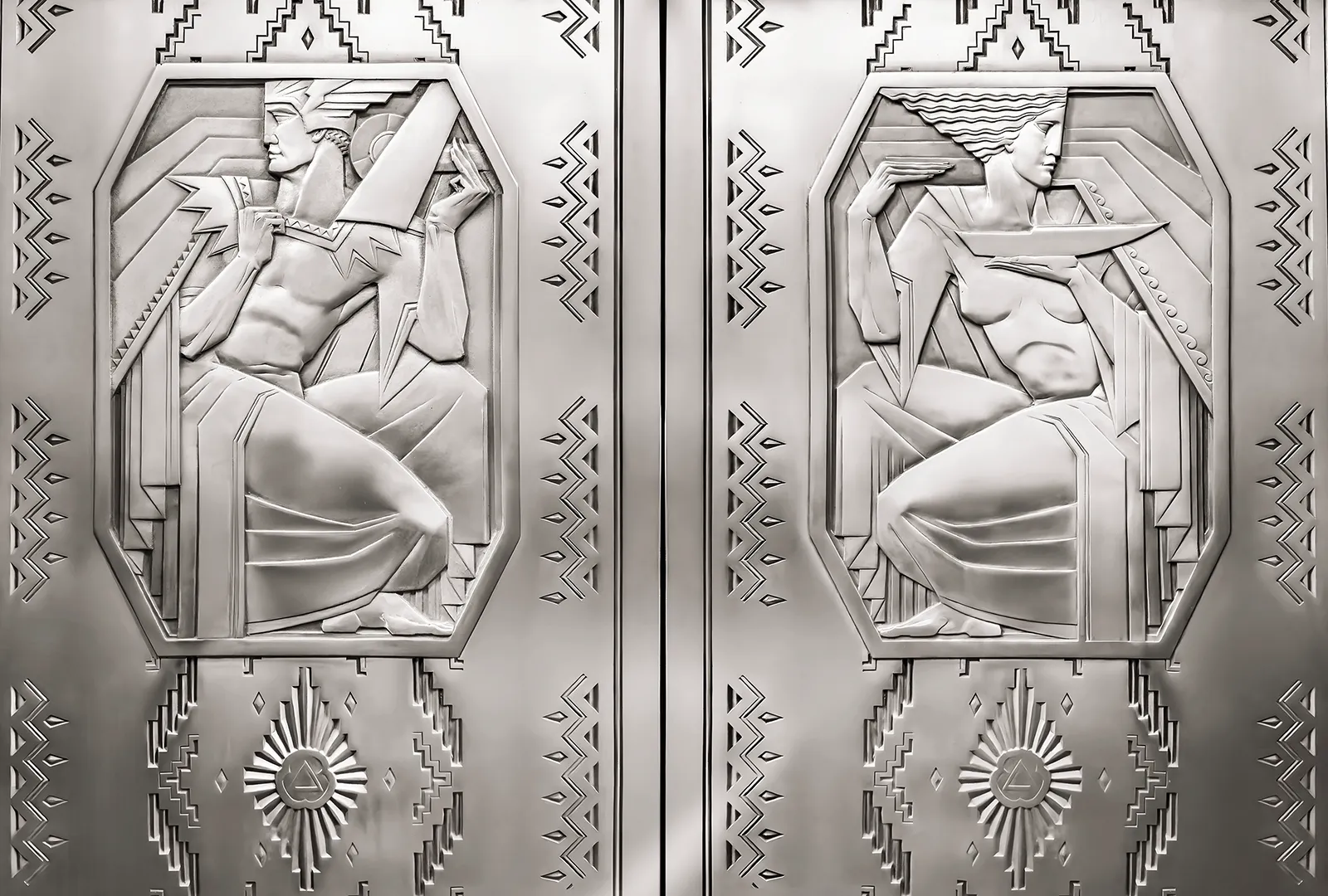
On the right, a woman holds an antique oil lamp — a symbol of the past.
On the left, a man grips an electric turbine — an emblem of the future.
Together they form a transition between eras — a direct counterpart to the philosophical program of the Chanin grilles.

The elevator doors shows a pair of nickel-silver reliefs

The Evolution of Fuel  Elevator Doors — 1931 circa — by Rene Paul Chambellan — 70 Pine St., New York

Past and future rendered in nickel silver — the material that made the transition visible.

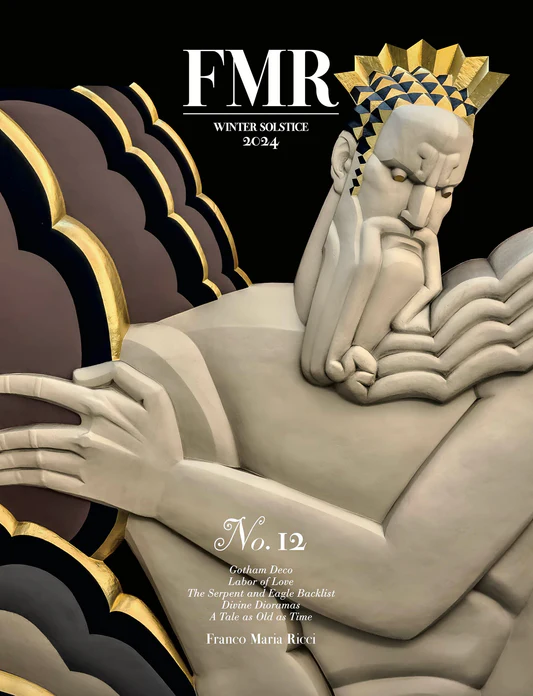
FMR Magazine — Gotham Deco

Photographs from this page were published in FMR Magazine Winter Solstice 2024.

"Gotham Deco — Modern Metropolis. This Was Tomorrow" — published in FMR Magazine with an essay by Anthony W. Robins and photographs by Roberto Bigano — documents New York Art Deco as a complete interior program: the Chanin Building radiator grilles, the Fred French Building elevator panels, the light and sound installations of Rockefeller Center, and the decorative vocabulary that ran through an entire generation of Manhattan architecture. A cover and twenty-four pages.

Robins is the pre-eminent authority on New York Art Deco. President of the Art Deco Society and author of "New York Art Deco: A Guide to Gotham's Jazz Age Architecture" — widely cited as the definitive guide to the subject.

FMR was founded in Milan in 1982 by Franco Maria Ricci. For four decades, among curators, collectors, and art historians on both sides of the Atlantic, FMR set the standard for visual scholarship and for the most demanding editorial photography.
Jacqueline Kennedy called it the most beautiful magazine in the world.

Copyright, links and credits

Photography, Copyright & Credits

All photographs © Ikonographia / Roberto Bigano — All Rights Reserved.
These images are part of the Ikonographia Visual Archives: New York City Art Deco Collection.

Terms of Use (Summary)

The images presented in this archive are copyrighted and available for licensed use only through Ikonographia Visual Archives.

You may not download, reproduce, publish, or distribute these images without a valid license. For commercial or editorial licensing, please refer to the product pages or contact Ikonographia directly. A full explanation of licensing terms is available in the Shop / Licensing Information section under "Ikonographia — Standard License" and "Ikonographia — Merchandising & Product Use Licenses"

Artwork & Building Attribution

Designed for the Chanin Building, 122 East 42nd Street, New York City, by sculptor Rene Paul Chambellan and executed in collaboration with decorator Jacques Delamarre, these grilles form a complete visual philosophy. The program, titled “The City of Opportunity”, translates the psychological journey of a person’s life into geometric abstraction — a belief deeply rooted in the early 20th century fascination with symbolism, psychology, and the expressive power of line.

Copyright Status Clarification

Building & Artwork:
The architectural design of this buildingis in the public domain under U.S. copyright law. Buildings constructed before the Architectural Works Copyright Protection Act (1990) are not protected as architectural works, and their exteriors and interiors may be freely photographed.

Photographs:
All photographs on this page, however, are copyrighted works of Ikonographia / Roberto Bigano and require a license for any reuse.

Ikonographia Mission Statement

Ikonographia is committed to the accurate documentation, preservation, and ethical dissemination of twentieth-century visual culture.

Archival Notes

These photographs were produced as part of Ikonographia’s ongoing documentation of significant examples of twentieth-century visual culture. Image preparation includes controlled lighting, accurate color management, and perspective correction to preserve architectural integrity and material detail.

Further Reading - Selected Sources

• FMR Magazine No. 12, Winter Solstice 2024 — "Gotham Deco" — Special issue devoted to the Art Deco transformation of 1920s New York, with contributions by Anthony W. Robbins and photography by Roberto Bigano. Cover and 24 pages featuring comprehensive documentation of the Chanin Building radiator grilles, the Fred French Building elevator panels and polychrome ceilings, the Light and Sound sculpture at Rockefeller Center, and a curated selection of the city's finest Art Deco interiors.

• Anthony W. Robbins, New York Art Deco: A Guide to Gotham’s Jazz Age Architecture.
• David Stravitz, The Chrysler Building: Creating a New York Icon Day by Day.
• Cervin Robinson & Rosemarie Haag Bletter, Skyscraper Style: Art Deco New York.
• Christopher Gray (archives), The New York Times, “Streetscapes” columns.
• New York City Landmarks Preservation Commission reports (Fred F. French Building).
• The Metropolitan Museum of Art – Digital Collections (historic metalwork and architectural ornament references).

Acknowledgments

Ikonographia gratefully acknowledges the institutions, archivists, scholars, and architectural historians whose research and preservation efforts help illuminate the cultural significance of New York’s Art Deco heritage.

Agitation. Gilded Bronze Radiator Grill in the vestibule of the Chanin Building. By Rene Paul Chambellan 1929.

Achievement.
The fruition of thought.
From "The City of Opportunity — Mental Series."

A rising sun, concentric spirals, and balanced symmetry mark the culmination of mental effort.
The pattern is no longer restless but ordered, luminous, and harmonious. Achievement is not finality, but the moment when intention becomes reality.

About René Chambellan – A short bio

Rene Paul Chambellan in his Studio

Chambellan at work in his studio.

René Chambellan (1893–1955)

René Paul Chambellan was a French-born sculptor and modeler active in New York during the late 1920s. Trained in architectural ornament and low-relief techniques, he contributed to the emergence of the French Modern Style—later known as Zig-Zag Moderne or Art Deco—translating its geometric elegance into architectural sculpture.

His collaboration with Jacques Delamarre on the Chanin Building’s Mental and Physical Series stands as his most distinctive achievement, blending expressive figuration with stylized geometric structure.

Beyond the Chanin commission, Chambellan also contributed sculptural modeling to major projects of the period, including elements for the famous Atlas statue (1937) at Rockefeller Center. His work exemplifies the refined craftsmanship and symbolic vocabulary that shaped New York’s Jazz Age architecture.

USD United States (US) dollar
EUR Euro