
Art Deco Elevator Panels at Fred French Building (1927) — Glinsky & Bach
Gilded Art Deco Masterpieces at 551 Fifth Avenue, New York City.
A rare surviving ensemble of gilded bronze panels created in 1927 by Vincent Glinsky and Oscar Bach.
These elevator doors visualize the four pillars of Fred F. French’s real-estate empire—Industry, Commerce, Finance, and Building—through a sculptural language blending Art Deco geometry with echoes of ancient Mesopotamian reliefs.
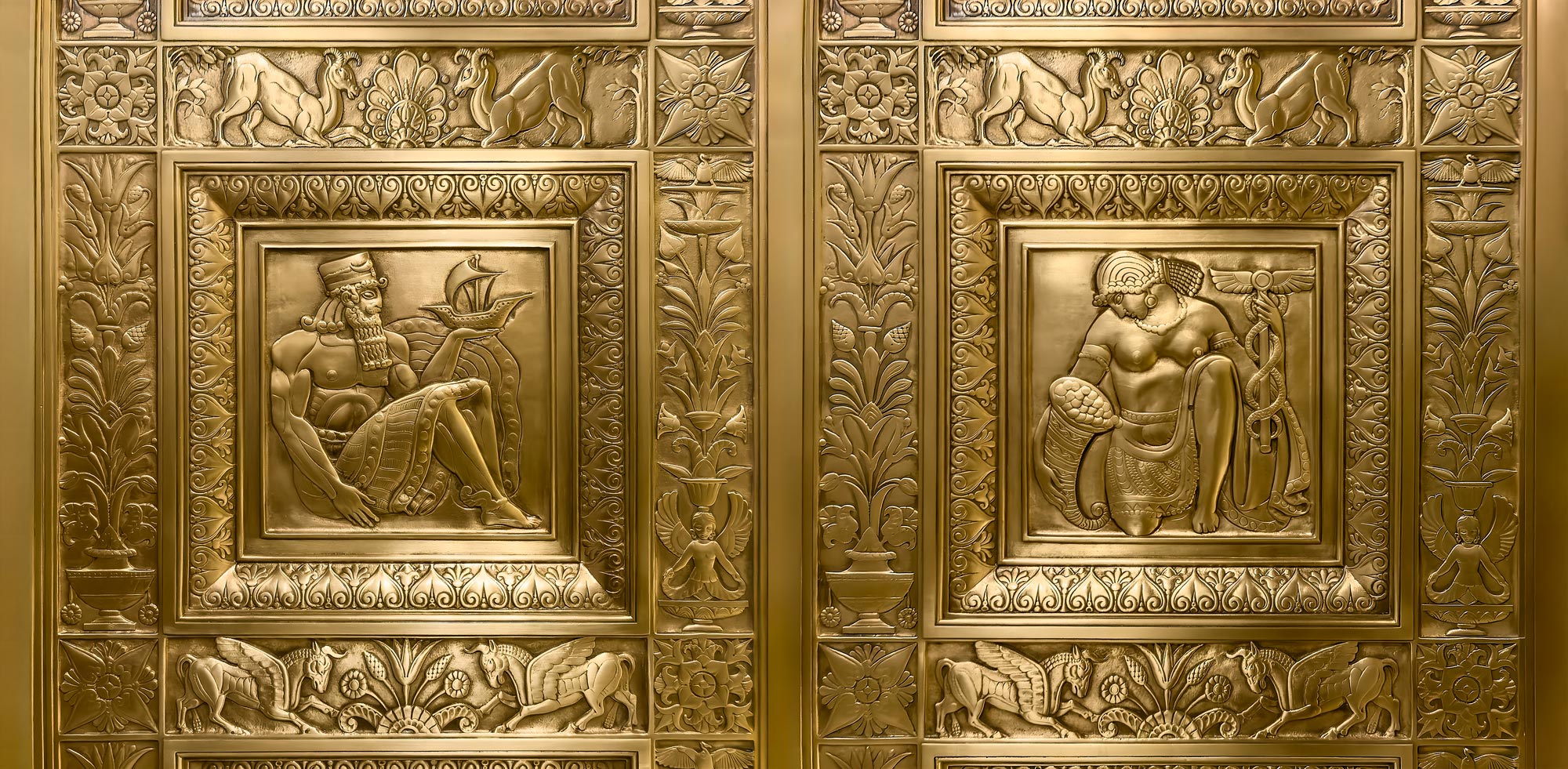
Completed in 1927, the Fred F. French Building stands as one of Manhattan’s finest expressions of the early Art Deco style. While the tower is admired for its stepped crown and gilded ornament, its most exceptional artworks lie hidden in the lobby: eight bronze elevator panels conceived by sculptor Vincent Glinsky and master metalworker Oscar Bach.
Commissioned to embody the vision of developer Fred Fillmore French, these doors translate the essential forces driving New York’s rise—labor, trade, wealth, and architecture—into a sophisticated visual program. Their hybrid style reflects Classical allegory, modern stylization, and distinct echoes of Assyrian and Mesopotamian palace reliefs, which were widely studied and admired in 1920s New York.

The Merchant — Commerce.
Symbolizing trade, exchange, and the movement of goods.
Holding a ship in his hand, the bearded figure embodies maritime trade — the engine of international commerce in the early 20th century. His confident pose and flowing drapery echo ancient depictions of Hermes, god of trade.
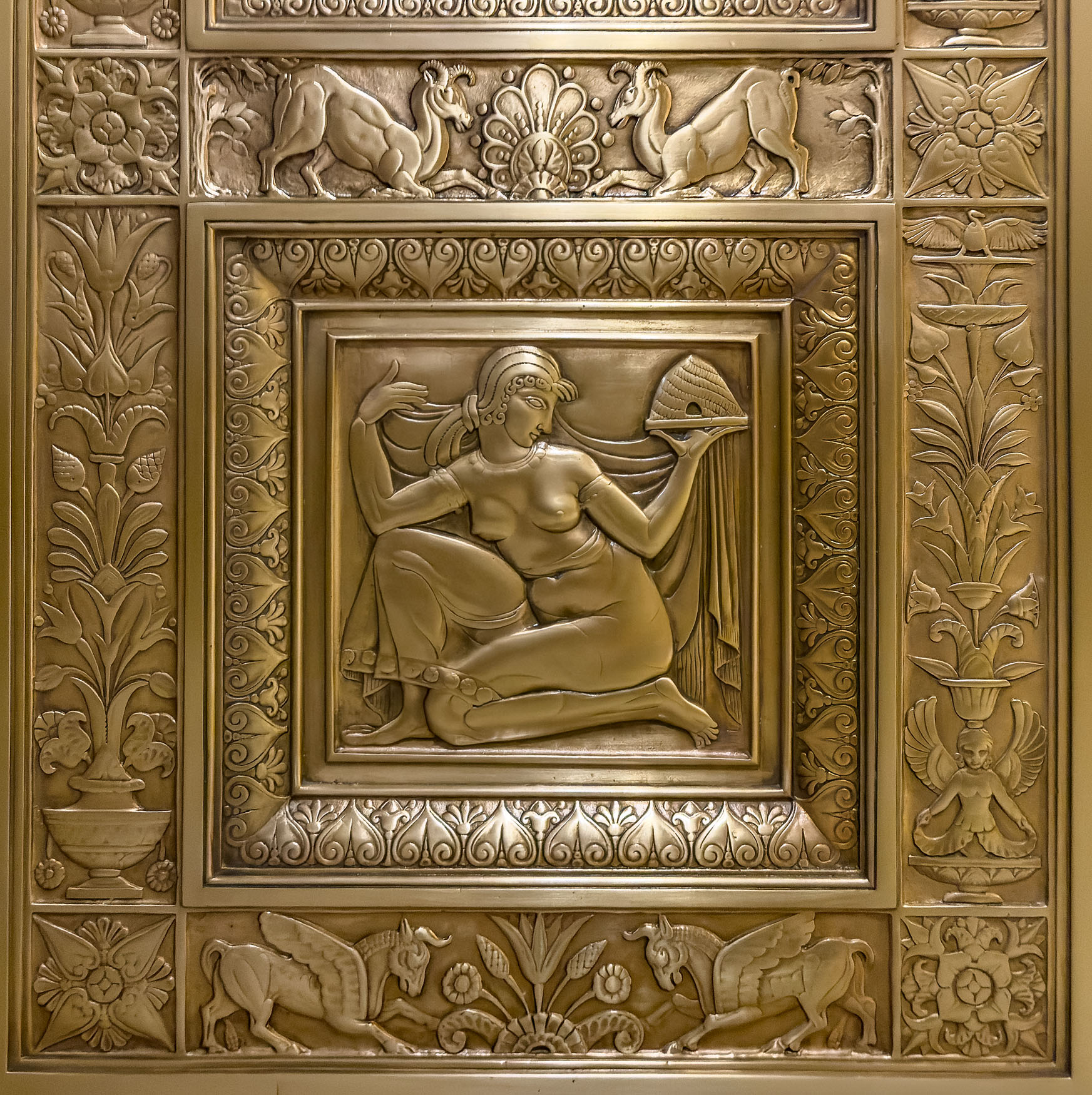
Woman with Beehive— Commerce.
Symbolizing luxury goods, services, and
refined exchange.
A seated woman holds a beehive, a traditional emblem of collective labor and productive order. The motif presents commerce as a coordinated system in which refinement and luxury arise from shared effort.
The Artists & The Style
Glinsky & Bach: Sculptor and Metalwork Virtuoso.
Vincent Glinsky shaped the narrative sequences in low relief, giving the figures a compact mass and rhythmic energy typical of early Deco sculpture. Oscar Bach realized the panels in gilt bronze, applying the refined technical methods that made him one of the pre-eminent metalworkers of his era.
Together, they produced one of the most complete and coherent decorative cycles in American Art Deco. The vertical registers, crouching beasts, muscular torsos, and geometric borders reveal a deliberate engagement with Neo-Assyrian art—an archaeological fascination fueled by recent discoveries at Nineveh and Khorsabad, and by the Metropolitan Museum’s expanding Near Eastern collection.
This modern–ancient fusion allowed the French Building to project both contemporary ambition and timeless authority.
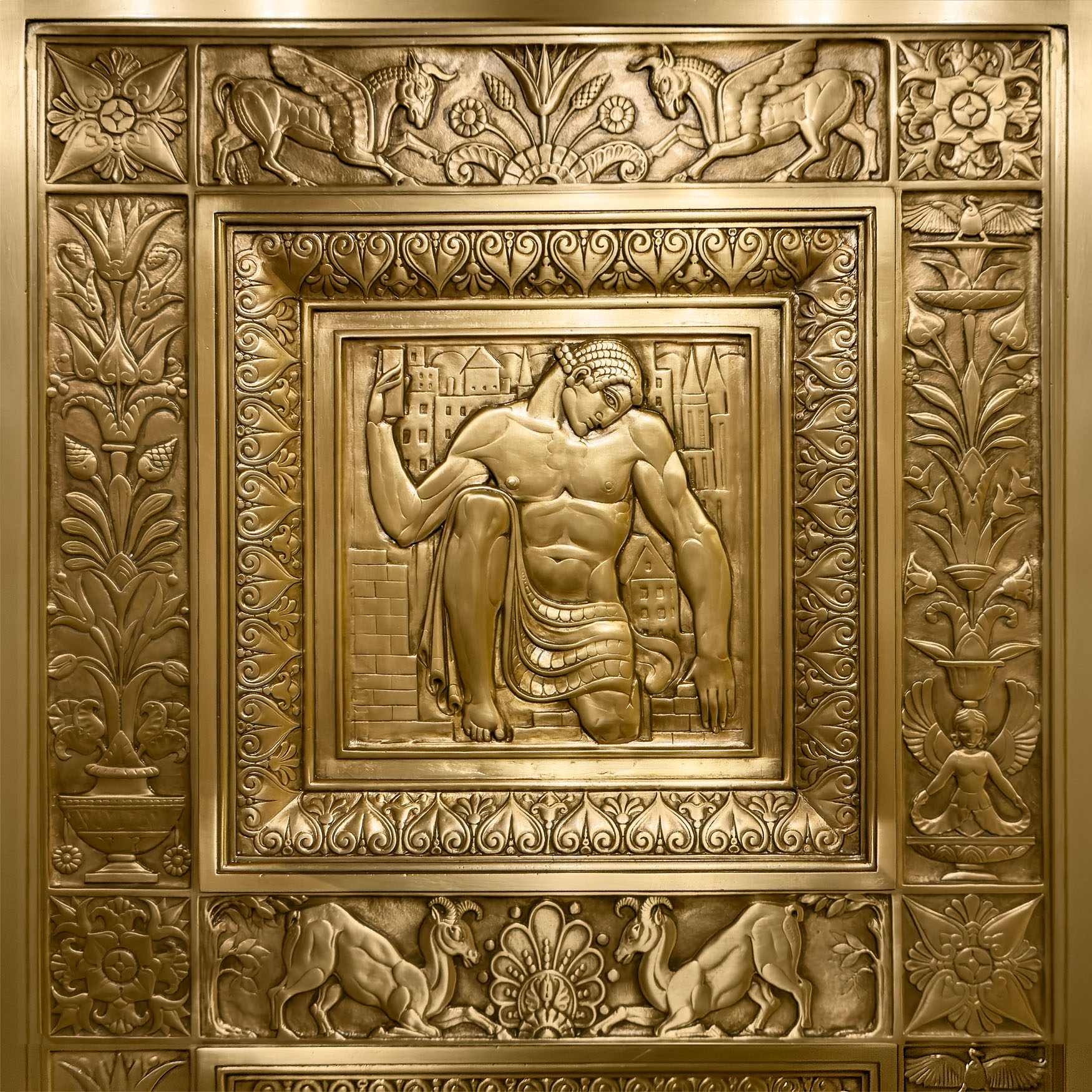
The Kneeling Builder — Building.
Symbolizing skilled craft and technical mastery.
A kneeling mechanic adjusts a stylized component with deliberate care. He personifies the technical skill, precision, and problem-solving at the heart of modern engineering.
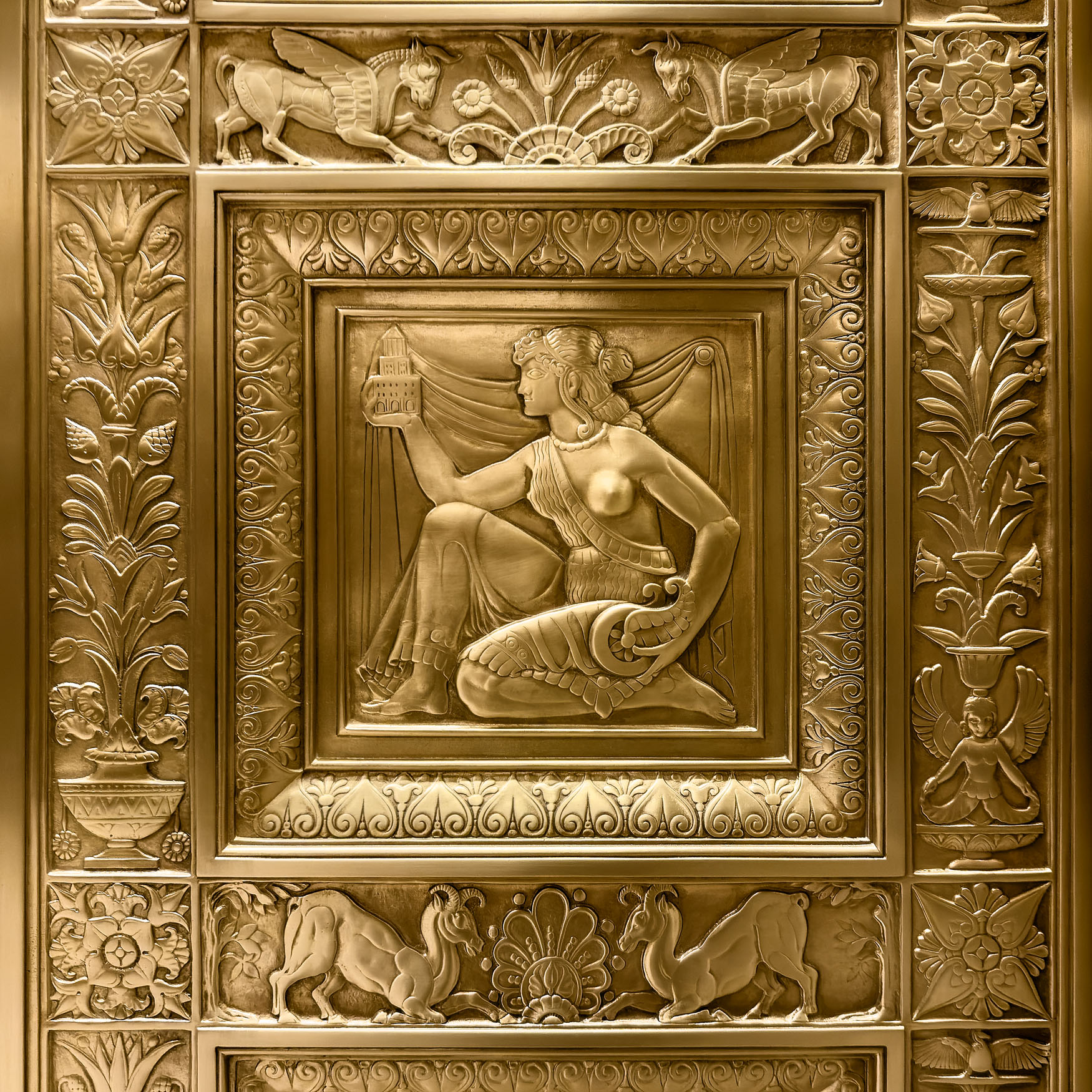
The Architect — Building
Symbolizing design, planning, and the intellectual foundations of construction.
A female figure holding a miniature building—sometimes a tower, sometimes a pavilion—represents architectural imagination and refinement.
She is the emblem of design, planning, and the visionary impulse that guided Fred French’s developments.
The Four Pillars
Industry, Commerce, Finance, and Building.
Each elevator panel embodies one of the four sectors central to the French Companies:
• Industry — strength, engineering, infrastructure
• Commerce — exchange, trade, and refined goods
• Finance — wealth, investment, administration
• Building — architecture, planning, construction
Though allegorical, the imagery was designed for instant legibility. These were the forces shaping New York in the 1920s: the labor that built the skyline, the commerce animating Fifth Avenue, the financial system behind every development, and the architectural vision that defined modern urban life.
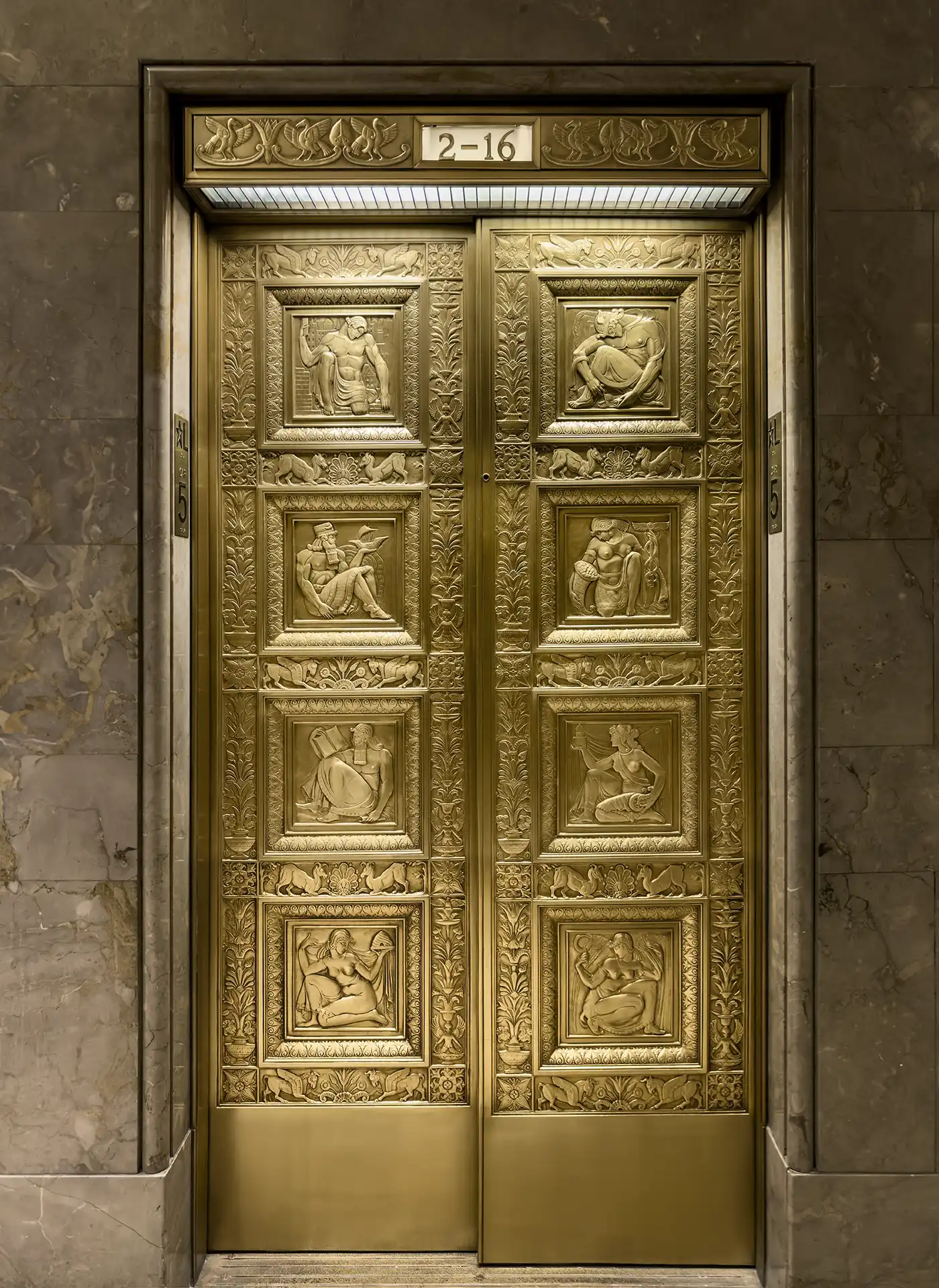
A complete symbolic program:
Commerce, Industry, Finance, and Building.
Seen together, the eight gilded panels reveal the French Building’s full narrative — a sculptural cycle honoring the forces that powered New York’s 1920s rise. The hybrid Art Deco–Mesopotamian style becomes especially clear in this unified view.
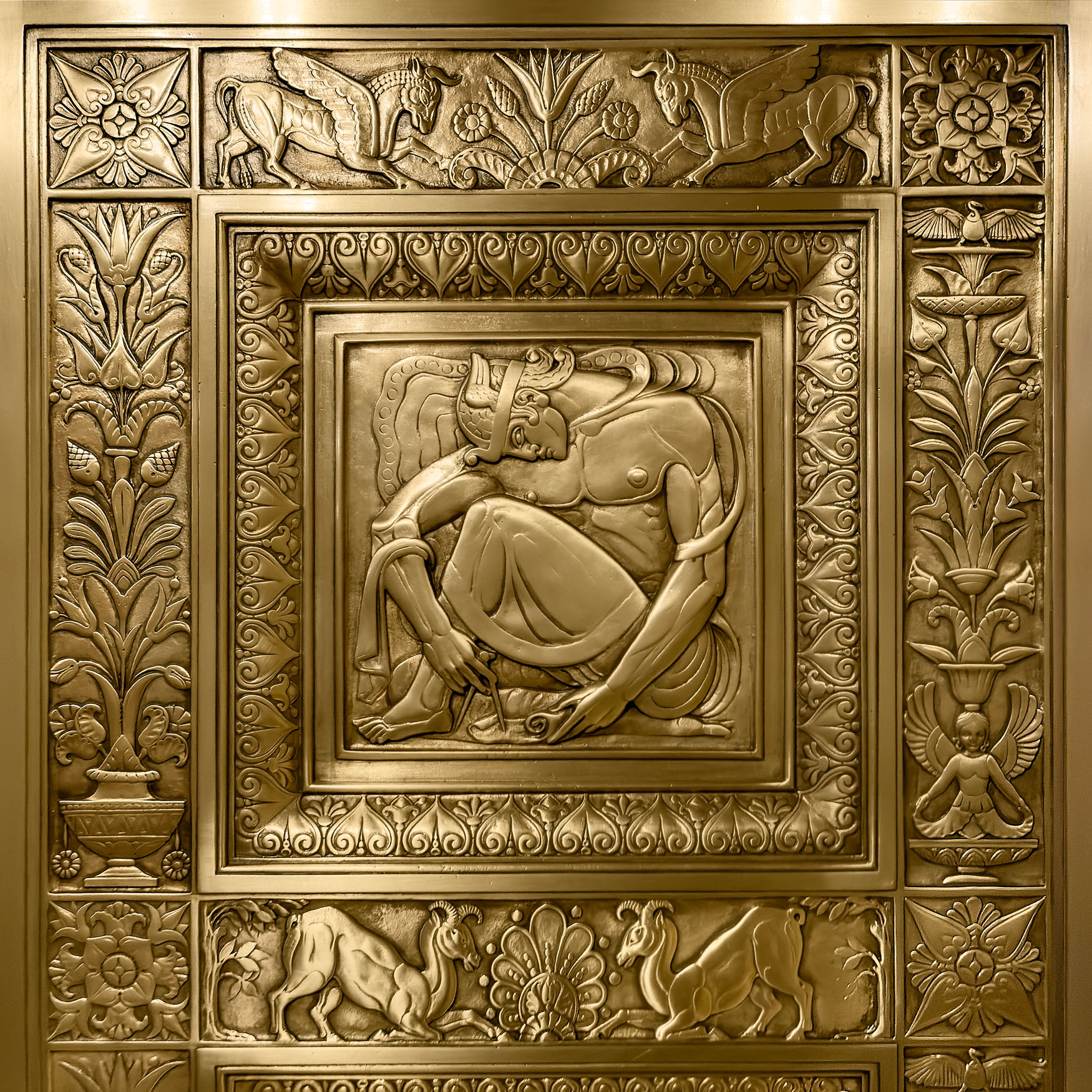
Industry — The Industrial Worker.
Symbolizing labor, engineering, and urban growth.
Bent over cablework, the muscular worker represents the physical strength behind New York’s modernization — utilities, transport systems, and the infrastructure that sustained a rising metropolis.
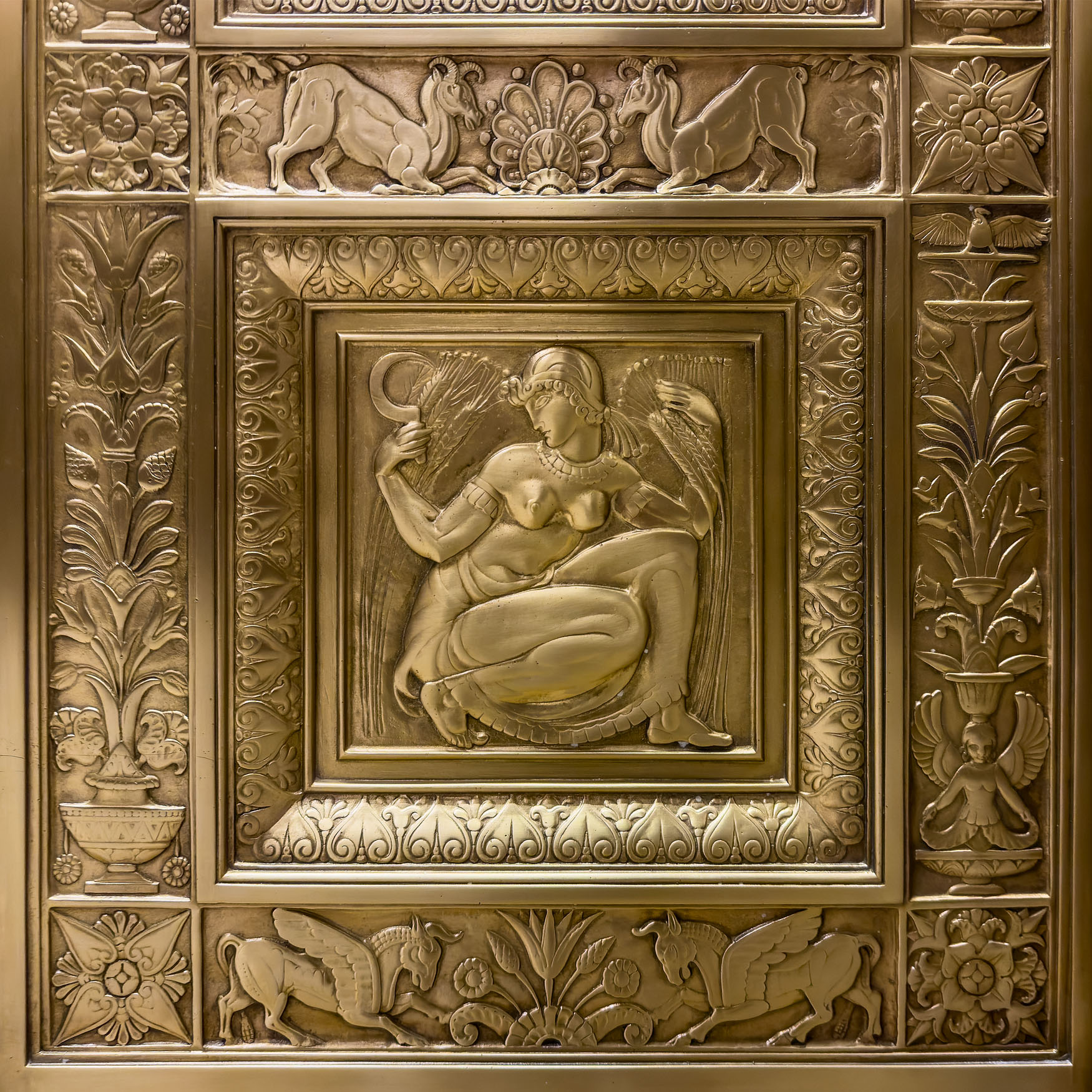
Industry — The Harvest Worker.
Symbolizing production, labor, and the foundational industries.
A reclining female figure holds a bundle of wheat and a crescent sickle — timeless symbols of harvest and abundance. Her calm yet powerful pose evokes the essential role of agriculture and food production in sustaining urban life.
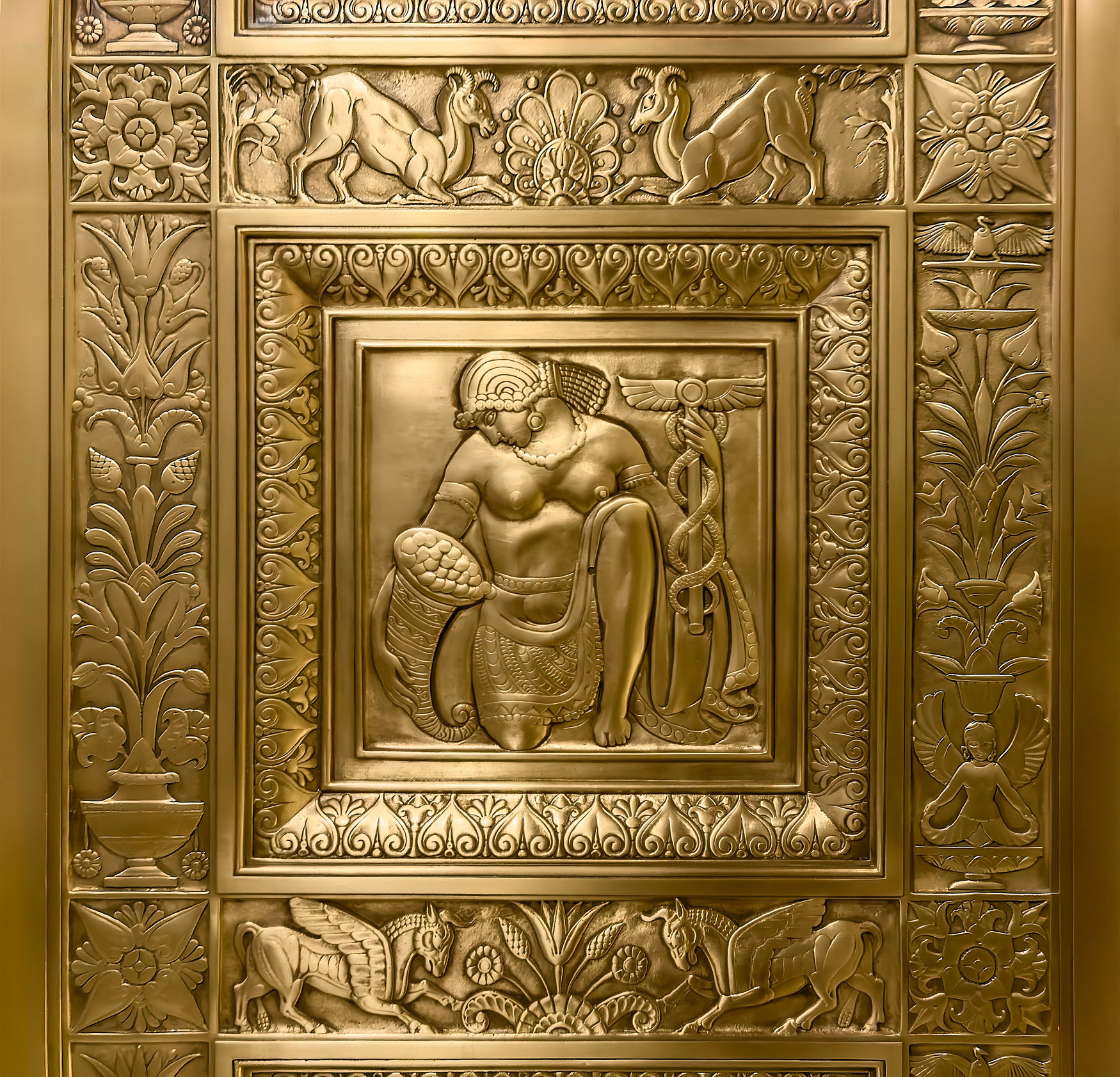
The Wealth Bearer — Finance
Symbolizing prosperity generated through trade and investment.
Holding a cornucopia and caduceus, the seated figure represents abundance flowing from exchange and financial growth. She personifies the prosperity and confidence of Jazz-Age New York.
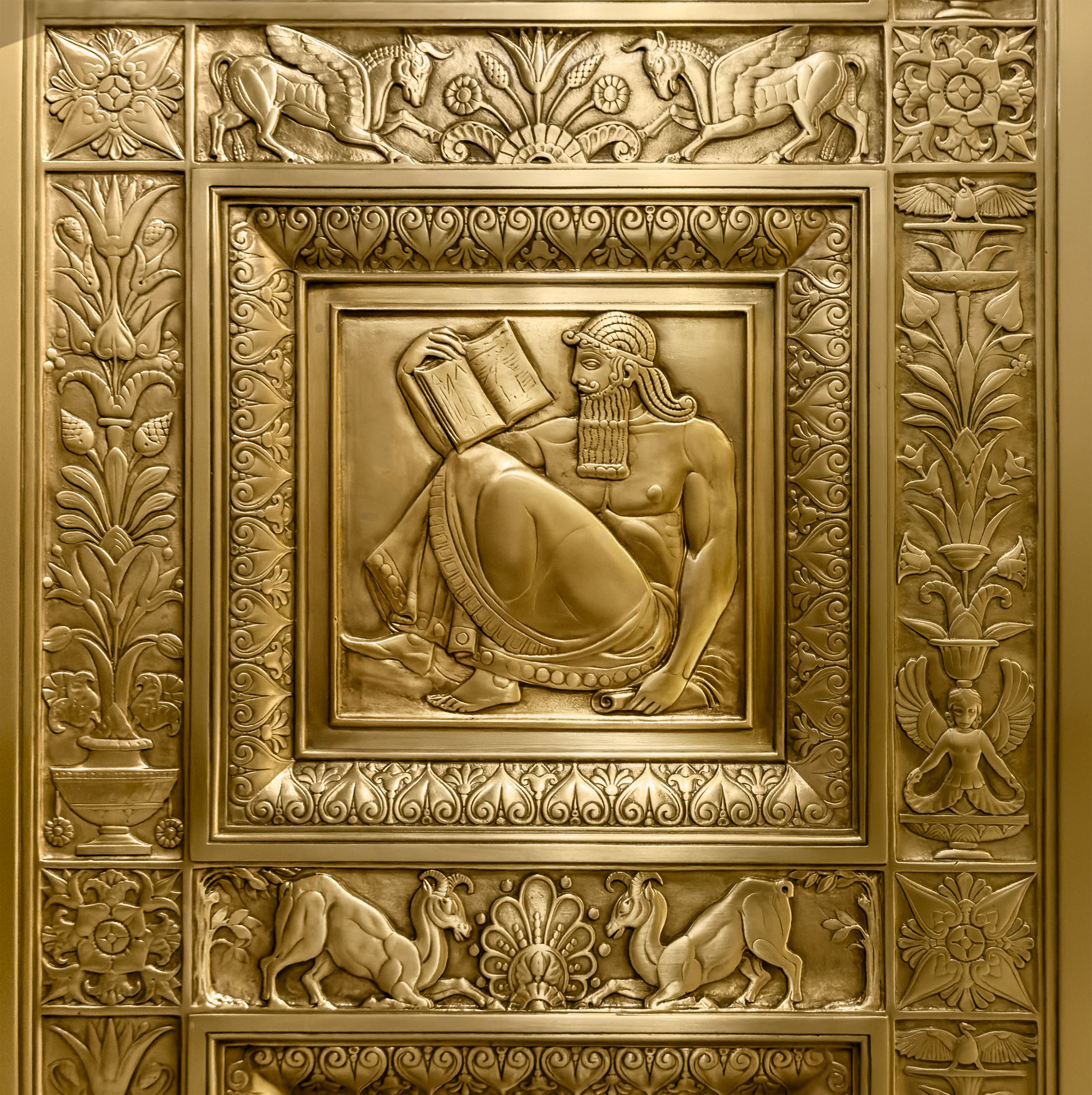
The Scholar — Finance.
Symbolizing knowledge, law, and administrative order.
A reflective scholar reads from an oversized book — an allegory for planning, regulation, and the intellectual frameworks supporting commerce and finance.
Legacy & Meaning
A Gilded Narrative of New York’s Rise
Nearly a century later, the elevator doors of the Fred F. French Building remain among the most beautifully preserved Art Deco bronzes in Manhattan. Their luminous surfaces and sculptural symbolism still communicate the optimism, discipline, and creative ambition that defined the era.
In an ordinary lobby, the elevator is a utility.
Here, it becomes a declaration of identity—a manifesto in bronze celebrating the forces that shaped the city.
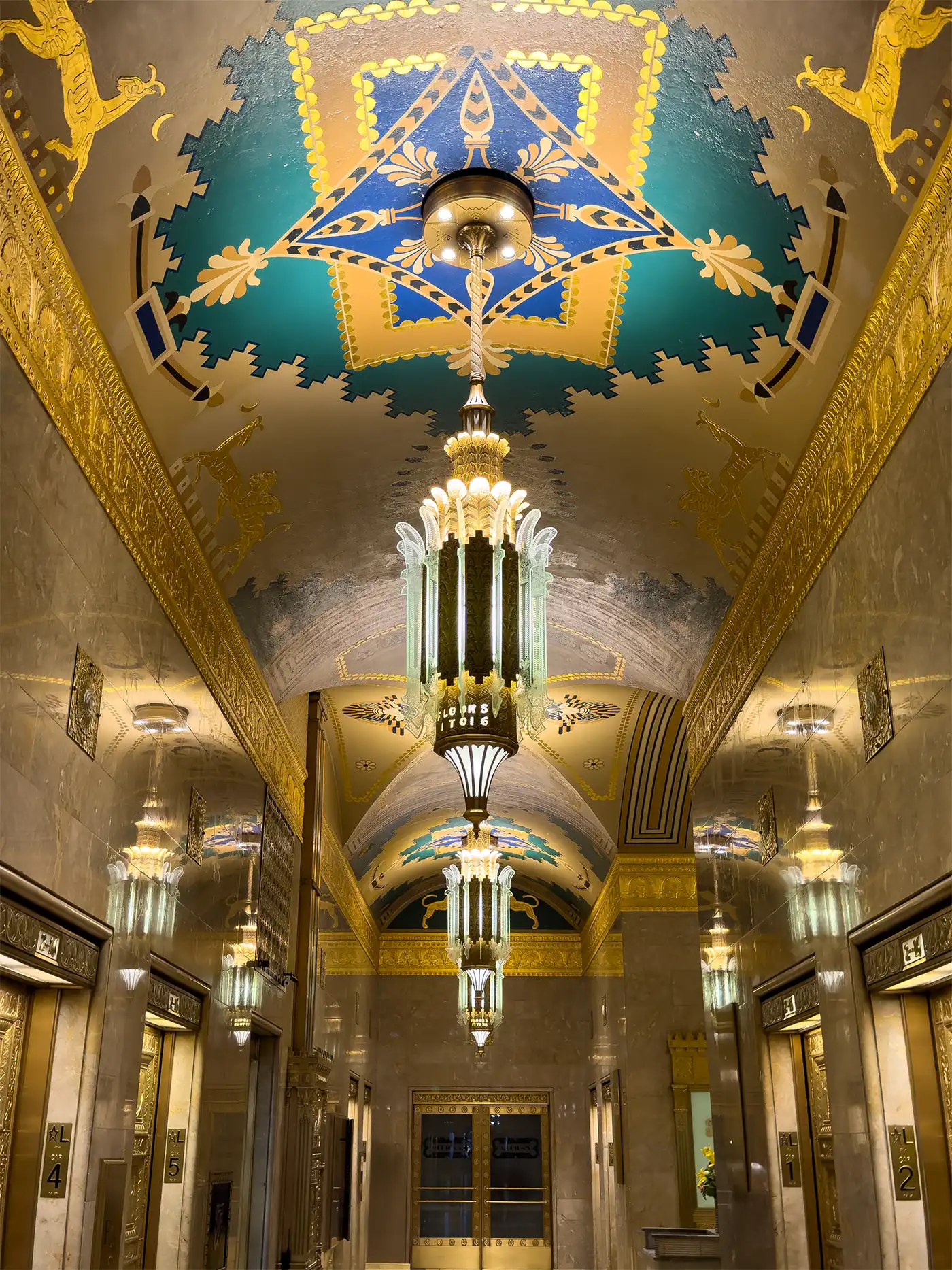
The Elevator Lobby.
Architecture as procession.
This view reveals the French Building’s elevator lobby as a carefully staged passage: marble surfaces, gilded doors, and a richly painted ceiling guiding visitors toward the vertical heart of the building.
Light fixtures and ornament establish a measured rhythm, framing the elevators not as utilities, but as monuments to modern efficiency and ambition.
Copyright, Links and credits
Photography, Copyright & Credits
All photographs © Ikonographia / Roberto Bigano — All Rights Reserved.
These images are part of the Ikonographia Visual Archives.
The elevator panels were designed in 1927 by sculptor Vincent Glinsky and master metalworker Oscar Bach for the Fred F. French Building, 551 Fifth Avenue, New York City.
These images are part of the Ikonographia Visual Archives: New York City Art Deco Collection.
⸻
Copyright Status of the Building
The architectural design of the Fred F. French Building (1927) is in the public domain under U.S. copyright law.
Buildings constructed before the Architectural Works Copyright Protection Act (1990) are not protected as architectural works, and their exteriors and interiors may be freely photographed.
All photographs on this page, however, are copyrighted works of Ikonographia / Roberto Bigano and require a license for any reuse.
⸻
Terms of Use (Summary)
The images presented in this story are:
• copyrighted,
• not in the public domain, and
• available for licensed use only through Ikonographia Visual Archives.
You may not download, reproduce, publish, or distribute these images without a valid license.
For commercial or editorial licensing, please refer to the product pages or contact Ikonographia directly.
A full explanation of licensing terms is available in the Shop / Licensing Information section on the site.
⸻
Ikonographia Mission Statement
Ikonographia is committed to the accurate documentation, preservation, and ethical dissemination of twentieth-century visual culture.
⸻
Archival Notes
These photographs were produced as part of Ikonographia’s ongoing documentation of significant examples of twentieth-century visual culture. Image preparation includes controlled lighting, accurate color management, and perspective correction to preserve architectural integrity and material detail.
Whenever possible, artworks and architectural elements are photographed in situ to convey their authentic spatial context. All images follow Ikonographia’s internal archival standards for resolution, color accuracy, and metadata structure to ensure long-term consistency across the collection.
⸻
Further Reading (Selected Sources)
• Anthony W. Robbins, New York Art Deco: A Guide to Gotham’s Jazz Age Architecture.
• David Stravitz, The Chrysler Building: Creating a New York Icon Day by Day.
• Cervin Robinson & Rosemarie Haag Bletter, Skyscraper Style: Art Deco New York.
• Christopher Gray (archives), The New York Times, “Streetscapes” columns.
• New York City Landmarks Preservation Commission reports (Fred F. French Building).
• The Metropolitan Museum of Art – Digital Collections (historic metalwork and architectural ornament references).
⸻
Acknowledgments
Ikonographia gratefully acknowledges the institutions, archivists, scholars, and architectural historians whose research and preservation efforts help illuminate the cultural significance of New York’s Art Deco heritage.
Special thanks to the building staff and management who facilitated photographic access, and to the broader community of researchers and design historians whose work supports the accurate documentation of these artworks.
Browse the New York City Art Deco Archive


About Vincent Glinsky. A short bio.

Bettentan at work in his studio.
Vincent Glinsky (1895–1975)
Vincent Glinsky was a Russian-born American sculptor whose work fused Beaux-Arts training with the emerging modernist vocabulary of the 1920s and 1930s. Educated in Petrograd and later active in New York, he developed a sculptural language marked by precise anatomies, architectural clarity, and an expressive narrative sense ideal for architectural relief.
By the 1920s he became a sought-after collaborator on major Art Deco projects, translating complex symbolic programs—commerce, industry, finance, and civic identity—into refined low-relief compositions. His works remain key examples of American Art Deco humanism, distinguished by rhythmic modeling, monumental simplicity, and sensitivity to architectural settings.
About Oscar Bach. A short bio.
Bettentan at work in his studio.
Oscar Bach (1884–1957)
Oscar Bach was a German-born master metalworker whose technical innovation shaped some of the most celebrated interiors of early twentieth-century America. Trained in the European guild tradition, he brought exceptional skill in architectural bronze, iron, and nickel-silver to the United States after emigrating in 1911.
Working from his New York studio, Bach produced metalwork for major skyscrapers, department stores, civic buildings, and luxury residences. His style combined Old World ornament with modern geometric clarity, defining a distinctive branch of American Art Deco. His workshop became synonymous with excellence in decorative metal, leaving a legacy preserved in landmarked interiors across the country.
