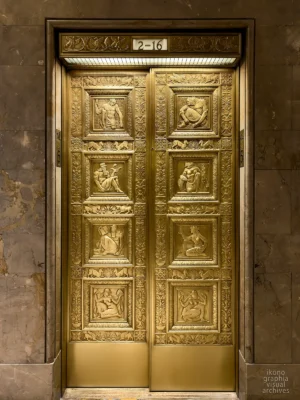

The Evolution of Fuel — Art Deco Elevator Doors, René Chambellan, 1931
An Allegory of Fuel — NYC Art Deco Archive
70 Pine Street's elevator doors feature a pair of nickel-silver reliefs symbolizing the Evolution of Energy.
On the right door, a woman holds an antique oil lamp — a symbol of the past. On the left, a man grasps an electric turbine — an emblem of the future. The surrounding decoration incorporates Native American-inspired zigzags and sunbursts alongside the Cities Service logo.
Chambellan worked here in nickel silver — a corrosion-resistant copper-nickel-zinc alloy with no actual silver content, prized in Art Deco design for its warm tone and casting precision. Both are visible in the relief.
Artwork by René Paul Chambellan.
Published in FMR Magazine, Winter Solstice 2024.
$145
Royalty-free JPG — 10836x7100px, 27.49MB.
© Ikonographia / Roberto Bigano
LICENSE TERMS
This image is provided under a royalty-free license by Ikonographia / Roberto Bigano. By purchasing and downloading this file, you are granted the following rights:
You May
- Use the image in print and digital media (books, magazines, websites, videos, educational materials, presentations, and advertisements).
- Use the image in editorial, corporate, or client work, including commissioned projects.
- Modify, crop, or combine the image with other elements for creative use.
- Create photographic prints for personal or internal company use only (display, offices, presentations).
You May Not
- Resell, redistribute, sublicense, or share the image file in any form that allows third-party access.
- Use the image in products for resale (prints, posters, merchandise, NFTs, templates, stock collections) without a separate extended license.
- Claim authorship of the image or remove copyright attribution.
Read our full Copyright & Licensing Policy for detailed information.
Copyright: © Ikonographia / Roberto Bigano. All rights reserved.
SUGGESTED USES
- Architecture and design publications.
- Educational materials or exhibitions.
- Interior design presentations and mood boards.
- Commercial, editorial, or creative projects.
Each download includes a royalty-free license for use in both print and digital media.
70 Pine Street, 1931 — Overview
From Oil Empire to Architectural Monument
70 Pine Street was commissioned by the Cities Service Oil Company — one of the largest energy corporations of the early 1930s. The building was designed by architects Clinton & Russell, Holton & George and completed in May 1932. Upon opening it was the world's third-tallest building and the first to feature double-deck elevators, serving two floors simultaneously.
A selection of images from 70 Pine Street was published in FMR Magazine, Winter Solstice 2024.
Elevator Doors
René Paul Chambellan designed the elevator doors circa 1931, during the building's construction phase. The date is frequently misattributed to 1929 — which refers to his concurrent work at the Chanin Building — but the 70 Pine Street commission is a distinct and later project, completed during the Depression years.
Nickel Silver
The doors are cast in nickel silver — a copper-nickel-zinc alloy containing no actual silver. Also known as German Silver — sold in some markets as Alpaca. It was prized in Art Deco architectural metalwork for its silvery-white luster, warm tone, and resistance to corrosion. Unlike sterling silver, it does not blacken with age. Chambellan favored it for its precision casting properties — the alloy holds fine low-relief detail with exceptional clarity.
Lobby Ceiling and Cast-Glass Fixtures
The lobby ceiling is white plaster, featuring faceted patterns and stepped polychrome corbels with gold, bronze, and copper-leaf relief bands — a thematic reference to the Cities Service Company's business in light, heat, and power. The space is illuminated by hand-cut translucent cast-glass fixtures decorated with bronze metalwork by Cliff Parkhurst. The light ripples across the ceiling's wave patterns, reinforcing the building's identity as a monument to energy and modern progress.
Architecture by Clinton & Russell, Holton & George, 1932.
Elevator doors by René Paul Chambellan, circa 1931.
Browse the New York City Art Deco Archive
-

The Symbolic Program Elevator Doors — Fred French Building, New York
$110 -

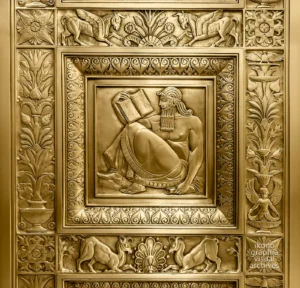
The Scholar Elevator Panel — Fred French Building, New York, 1927
$110 -

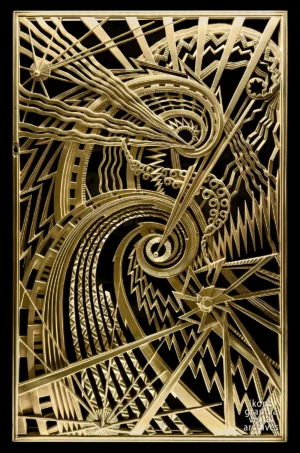
Art Deco Allegory of Effort — Gilded Grille, Chanin Building, New York, 1929
$110 -

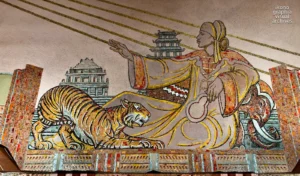
Asia — Continents Linked by Telephone and Wireless Silhouette Mosaic — Hildreth Meière, 1932
$110