PRODUCT SEARCH | CURRENCY | INDEX >

Six Brands of Week-End Hostesses. From “High Society.” Art by Anne Fish 1920
€35.00
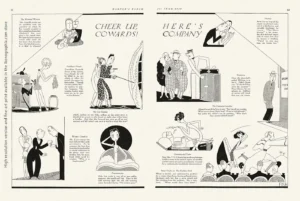
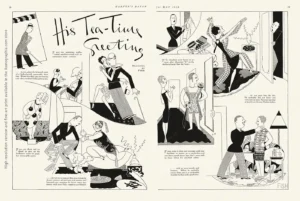
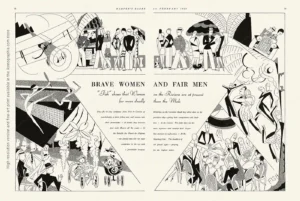
Sketches by Anne Fish, from “High Society,” published in 1920. Pages 36-37.
Six Brands of Week-End Hostesses.
It's a Lusty Life if You Don't Week-End.
High-Resolution file from the original book, digitally restored. Max-Quality jpg (10000x6625px, 29.6MB).
Full editable texts in the metadata.
Read more on this topic
Browse the Anne Fish Archive
or browse previous-next new
Copyright Notice
This work was published in the United States before 1930 and is in the public domain due to copyright expiration.
Source – Copyright Page
Please notice that any advice or comment provided here is not and does not purport to be legal advice as defined by s.12 of the Legal Services Act 2007.
High Society 1920 - By Anne Fish
Anne Fish and the Vanity Fair Circle
In December 1920, G.P. Putnam's Sons published High Society — Hints on how to Attain, Relish, and Survive It, collecting six years of Fish's drawings from Vanity Fair. Dowagers, debutantes, amateur vampires, tango addicts, trick butlers — Fish drew them all with an eye that was satirical without malice, and precise without cruelty. Vanity Fair editor Heyworth Campbell called her "the most distinguished of satirical black-and-white illustrators" of her generation.
Fish herself was something rarer than a satirist. She reduced every social type to its essential silhouette — the posture, the costume, the gesture that gave the game away. Vanity Fair editor Heyworth Campbell called her "the most distinguished of satirical black-and-white illustrators" of her generation. Ikonographia holds one of the largest archives of her work in existence.
What makes the drawings last is the method. Fish reduced every social type to its essential silhouette — the posture, the costume, the gesture that gave the game away. Nothing is caricature in the gross sense. Everything is observation pushed one degree past comfort.
The World Invented by Anne Fish — And the Writers Who Lived In It
Fish did not work in isolation. The drawings and texts in High Society were produced inside the same creative circle, for the same magazine, often for the same issue. The writers knew exactly what Fish was drawing. The complicity was almost certainly direct.
George S. Chappell (1877–1953) is the author of the book itself. An architect and prolific humorist who wrote for both Vanity Fair and The New Yorker, Chappell specialized in dissecting the rituals of the smart set with the detachment of a man who had studied its load-bearing walls. He wrote the texts. Fish drew the world he described. They made one thing together.
Dorothy Parker wrote the Vanity Fair pieces that entered the book with an irony so precise it barely left a mark. Her voice and Fish's line shared the same instinct: both understood that the most devastating portrait is the one that appears sympathetic.
Frank Crowninshield (1872–1947), editor of Vanity Fair from 1914 to 1936, was the intelligence that held the circle together. He built the magazine into the defining publication of American modern taste, blending sophisticated wit with a genuine appetite for the avant-garde. He introduced the book. He had already introduced Fish to America.
Read the full original texts in the Ikonographia Reader →
Illustration by Anne Fish — G.P. Putnam's Sons, New York, 1920 — Originally published in Vanity Fai