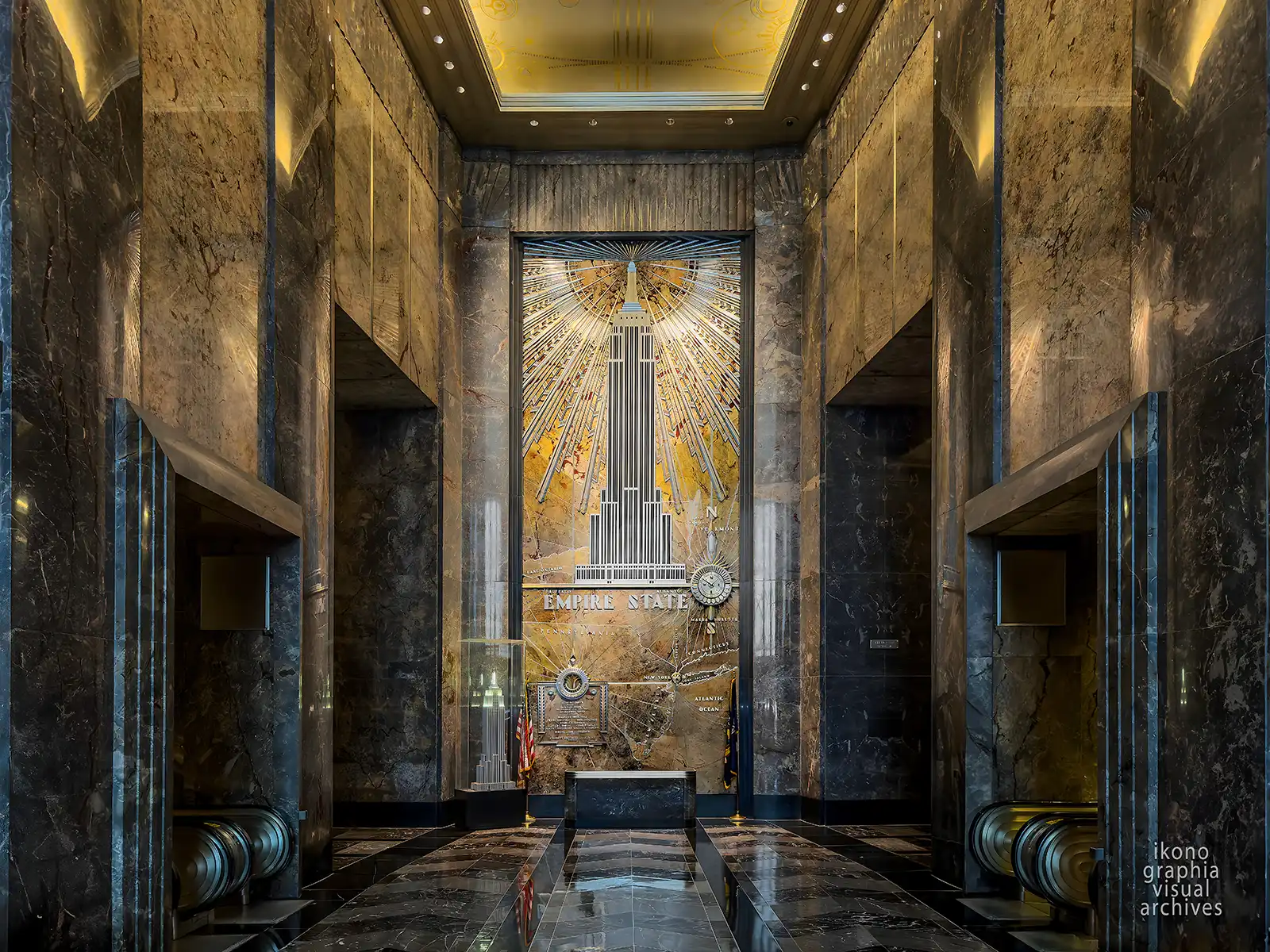
The Empire State Relief — A Machine Age Altar, NYC, 1931 — Oscar Bach
Empire State Series — NYC Art Deco Archive
In 1931, the Empire State Building was the tallest structure ever built — 102 floors, 443 meters, constructed in 410 days at the depth of the Great Depression. It was not merely a building. It was a declaration of what human ambition and industrial precision could achieve together.
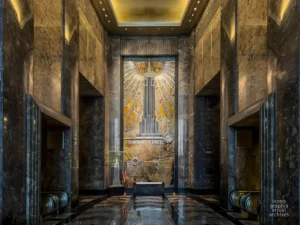
The lobby was designed to match that ambition. Terrazzo floors, marble walls, a ceiling mural of celestial rays — a floor axis that draws the eye to a single point: the aluminum bas-relief by Oscar Bach, positioned exactly where the sun's rays of the ceiling mural converge. The architecture ensures it is the first and only thing visible on entering.
Bach depicted the building as the center of the world — surrounded by a map of the tristate area, radiating celestial rays. In 1931, aluminum was the material of the Machine Age: modern, industrial, the metal of human ambition. The relief was not decoration. It was the argument made permanent.
Published in FMR Magazine, N.12/2024, Gotham Deco.
€125.00
Royalty-free JPG — 8000x6000px, 26.48MB.
© Ikonographia / Roberto Bigano
LICENSE TERMS
This image is provided under a royalty-free license by Ikonographia / Roberto Bigano. By purchasing and downloading this file, you are granted the following rights:
You May
- Use the image in print and digital media (books, magazines, websites, videos, educational materials, presentations, and advertisements).
- Use the image in editorial, corporate, or client work, including commissioned projects.
- Modify, crop, or combine the image with other elements for creative use.
- Create photographic prints for personal or internal company use only (display, offices, presentations).
You May Not
- Resell, redistribute, sublicense, or share the image file in any form that allows third-party access.
- Use the image in products for resale (prints, posters, merchandise, NFTs, templates, stock collections) without a separate extended license.
- Claim authorship of the image or remove copyright attribution.
Read our full Copyright & Licensing Policy for detailed information.
Copyright: © Ikonographia / Roberto Bigano. All rights reserved.
SUGGESTED USES
- Architecture and design publications.
- Educational materials or exhibitions.
- Interior design presentations and mood boards.
- Commercial, editorial, or creative projects.
Each download includes a royalty-free license for use in both print and digital media.
The Empire State Lobby, 1931 — Overview
The Empire State Building was completed on April 11, 1931 — 410 days after the first shovel broke ground. It was the tallest building in the world. The Depression was at its depth. The building was not a response to the Depression. It was a declaration against it — the Jazz Age's final and most permanent statement, cast in limestone and aluminum, rising 1,454 feet above Fifth Avenue.
The Altar of the Machine Age
The lobby was designed as a procession toward a single object. The floor, the walls, the ceiling — all calculated to deliver the visitor to one point. Every material, every surface, every decorative decision serves that purpose. This is not a lobby. It is a constructed argument about what human ambition can produce — and the aluminum relief by Oscar Bach is its conclusion. Positioned exactly where the rays of the ceiling mural converge, it was not placed there. It was designed to be there. The architecture does not decorate the relief. It worships it.
The Relief
The Empire State Relief depicts the building at the center of the world — not America, not New York City, but the Empire State of New York. A stylized map of New York State surrounds it. Celestial rays radiate outward. The building is the beacon. Everything else is context.
This is not modesty. In 1931, at the depth of the Depression, placing the Empire State at the center of a world map — not Washington, not the continent, but a single building on Fifth Avenue — was a political act. The Jazz Age had produced its monument. The relief says so in aluminum, at eye level, where no visitor entering the lobby could miss it.
The photographs document the relief at multiple scales. The full composition establishes the argument. The details deliver the craft — the compass rose, the map's rendered coastlines, the aluminum surface at close range, the transition from architectural drawing to decorative object. The dedication plaque, photographed at the same proximity, shows the same hand: the lotus medallion, the sunburst, the geometric border. Oscar Bach working in one material, at one standard, across every element of the program. The Machine Age applied with the discipline of a goldsmith.
The Material
Aluminum in 1931 was not a common material. It was expensive, difficult to work, and associated with the most advanced industrial production of the era. The Machine Age had found its metal. Bach used it for the relief, the dedication plaque, and the medallions honoring the tradesmen — masons, painters, electricians — who built the tower. Every decorative element in the lobby speaks the same material language.
The ceiling mural by Leif Neandross completes the program above. The rays radiate from the center and converge on the relief below. The alignment is not incidental.
The floor is gray-and-lilac terrazzo, laid in a zigzag pattern that moves the visitor east to west — toward the relief. The walls rise in Tennessee red marble at the base, transitioning to gray Italian marble above. The ceiling carries gold leaf. Every material was chosen for the same reason: to make the procession feel inevitable. By the time the visitor reaches the aluminum relief, the lobby has already told them what to think of it.
The Plaque and the Medallions
The dedication plaque — Alfred E. Smith as President, the Board of Directors, architects Shreve Lamb and Harmon, builders Starrett Brothers and Eken — is Oscar Bach's work. The same hand, the same material, the same vocabulary as the relief at the end of the lobby. The sunburst, the lotus medallion, the geometric border: the Machine Age applied to a document of record.
The bronze medallions on the lobby walls honor the tradesmen who built the tower. 410 days. 7 million man-hours. The medallions are not commemorative. They are architectural — part of the same program that produced the relief and the plaque.
___________
Architecture by Shreve, Lamb and Harmon. Overall and conceptual design by William F. Lamb. Relief design and manufacture by Oscar Bach. Ceiling mural by Leif Neandross.
The New York City Art Deco Archive — Available Stories
- The City of Opportunity — Art Deco Grilles, Chanin Building, 1929
New York, 1929 — A City at Its Peak, Casting Its Ambitions in Bronze. - Art Deco Elevator Panels — Fred French Building, 1927 — Glinsky & Bach
Eight gilt-bronze elevator doors translating Fred French's four business pillars into a sculptural language drawn from ancient Mesopotamia. - When Babylon Met Fifth Avenue — Ives & Glinsky's Fred French Building, 1927 (forthcoming)
One architect's obsession with ancient Babylon. One sculptor's mastery in bronze. A New York landmark unlike any other.
Browse the New York City Art Deco Archive
-

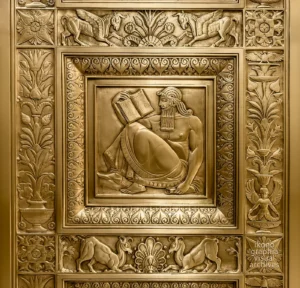
The Scholar Elevator Panel — Fred French Building, New York, 1927
€95.00 -

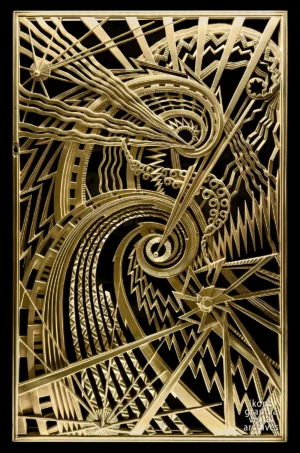
Art Deco Allegory of Effort — Gilded Grille, Chanin Building, New York, 1929
€95.00 -

The Empire State Relief — A Machine Age Altar, NYC, 1931 — Oscar Bach
€125.00 -

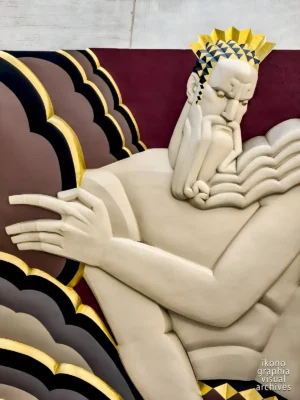
Wisdom — 30 Rockefeller Plaza, New York, 1933 — Lee Lawrie
€95.00