
Art Deco Radiator Grilles at Chanin Building (1929) — by Chambellan
“The City of Opportunity” — A Modern Symbolic Cycle in Bronze.
Completed in 1929 at the height of New York’s Jazz Age construction boom, the Chanin Building stands as one of the most intellectually ambitious expressions of American Art Deco. Its façade is admired, its lobby celebrated — but its most extraordinary artworks are found in the vestibule: eight monumental gilt-bronze radiator grilles, conceived as a symbolic cycle of human development.

Designed by sculptor Rene Paul Chambellan and executed in collaboration with decorator Jacques Delamarre, these grilles form a complete visual philosophy. The program, titled “The City of Opportunity”, translates the psychological journey of a person’s life into geometric abstraction — a belief deeply rooted in the early 20th century fascination with symbolism, psychology, and the expressive power of line.
In these panels, Art Deco becomes something greater than ornament: it becomes a language.

Agitation.
The first stirrings of consciousness.
From “The City of Opportunity – Mental Series.”
Sharp diagonals and restless lines convey the earliest motions of thought — the doubts, the questions, the uncertainty that precedes understanding. It is the unsettling beginning of inner life — a door barely opened.

Vision.
The moment of illumination.
From “The City of Opportunity — Mental Series.”
Here, the composition centers on spiraling curves and backward radiance from the eye — Chambellan’s symbol for introspection. The bowed head of the figure suggests inward concentration, while strong supporting hands denote a gathering of intellectual strength. Vision is not simply sight — it is the birth of clarity.
The Vision Behind the Grilles
Geometry as Thought, Emotion, and Aspiration.
The idea behind the Chanin program was bold for its time:
that geometric lines and forms could represent the inner life of the human mind — the stirrings of thought, the resolve of effort, the triumph of achievement.
This idea was not fantasy. It drew upon:
• Modern psychology — then newly popular
• Symbolist art theory
• Deco’s belief that emotion could be encoded through line, rhythm, and abstraction
• Ancient design traditions — Assyrian, Near-Eastern, and Mesopotamian influences
• Irwin S. Chanin’s personal vision — imagining his building as a temple to modern progress
Each grille represents a phase of mental or physical development, creating an alphabet of human experience expressed through rising curves, radiating rays, concentric spirals, and dynamic diagonals.
The cycle is divided into two intertwined sequences:
The Mental Series
The symbolic development of human consciousness.
This series follows the psychological journey of a mind awakening to itself — from primitive impulses to fully directed purpose.
The Physical Series
The expression of force, labor, and worldly action.
Parallel to the mental series, the physical sequence translates energy, strength, and human endeavor into the visual language of Art Deco dynamism.

Courage.
The resolve to act despite resistance.
From “The City of Opportunity – Mental Series.”
In this panel, Chambellan visualizes determination as flowing arcs and tightly woven diagonals. The struggle is present, but so is forward momentum. Obstacles appear as counter-lines, yet purpose pushes through them. It is the geometry of bravery.

Achievement.
The fruition of thought.
From “The City of Opportunity — Mental Series.”
A rising sun, concentric spirals, and balanced symmetry mark the culmination of mental effort. The pattern is no longer restless but ordered, luminous, and harmonious. Achievement is not finality, but the moment when intention becomes reality.
The Artists Behind the Vision
Rene Paul Chambellan — Sculptor of the American Skyline.
“Chambellan (1893–1955) stands among the masters of American Art Deco. His sculptural language shaped New York’s skyline, from the luminous nickel-silver elevator reliefs at 70 Pine Street — a masterpiece of Deco craftsmanship — to his modeling of the celebrated Atlas (1937) with Lee Lawrie at Rockefeller Center.
Few artists captured the city’s modern mythology with such precision and imagination.”
His work is characterized by:
• Rhythmic low relief — characteristic sculptural softness and fluidity
• Dynamic geometric stylization — forms distilled into symbolic abstraction
• Architectural integration — sculpture conceived as part of the building
• A sculptural language bridging classicism & modernity
At the Chanin Building, Chambellan created his most intellectually ambitious cycle — a symbolic program that turns human psychology into architecture.
Jacques Delamarre — Collaborator and Stylistic Architect
Delamarre brought a designer’s discipline to the compositions, refining Chambellan’s symbols into cohesive decorative programs. His work helped articulate the building’s visual identity: a synthesis of French Art Deco, American verticality, and modernist energy.
Together, they produced one of the most complete symbolic schemes in New York Deco.

Activity.
The beginning of physical exertion.
From “The City of Opportunity – Physical Series.”
Interlocking rays and rising diagonals give this panel a kinetic rhythm — the first outward expression of purpose in the world. It is the geometry of initiation, the body waking into movement.

Effort.
The struggle against resistance.
From “The City of Opportunity — Physical Series.”
Here, spirals tighten, diagonals collide, and curves appear compressed, as if bearing weight. The composition visualizes the tension between aspiration and the obstacles that define it. Effort is the architecture of perseverance.
Beyond Symbolism — The Human Story in Bronze
Wiewed as a whole, the Chanin grilles offer something rare in architectural sculpture:
a complete narrative of human development, told through pure form.
They remind us that:
• geometry can feel
• abstraction can speak
• architecture can express the rhythms of life itself
Nearly a century later, the panels still vibrate with this strange mixture of optimism and introspection — a Jazz Age faith in progress captured in metal.
In an era obsessed with acceleration, Chambellan asked a quieter question:
What does it mean to strive?
And in these eight grilles — in every rising line, every spiraling curve, every radiant burst —
he carved the answer: a vision of human effort made visible in broze.

Endurance.
The steady continuation of labor.
From “The City of Opportunity — Physical Series.”
This grille stands tall and monumental — a symbolic skyscraper of human resilience. Vertical lines run uninterrupted through the panel, marking the steady, disciplined continuation of work. Its strength lies in repetition, in the refusal to break.

Success.
The reward of sustained action.
From “The City of Opportunity — Physical Series.”
Symmetry returns, crowned with a radiant rising form. Success is rendered not as excess but as order — the balanced resolution of struggle. Spirals unfurl, energy flows upward, and the pattern resolves into harmony.
Deciphering the Symbolic Program of the Chanin Building (1929)
Origin of the bas-reliefs and their relationship to the grilles
The symbolic program of the Chanin Building is articulated through two parallel but distinct media: figural bas-reliefs and architectural metal grilles. The bas-reliefs—modeled by René Bellentan in collaboration with Jacques Delamarre—present the narrative content through human figures, embodying stages of mental and physical development.
The grilles do not merely frame or decorate these sculptures. Instead, they translate the same concepts into abstract, geometric form. Each grille corresponds thematically to a bas-relief, translating figuration into rhythm, structure, and movement. Together, sculpture and metalwork form a unified visual language in which symbolism is expressed simultaneously through representation and abstraction.
This dual system allows the program to be read on multiple levels: intuitively through the figures, and architecturally through pattern and structure—an approach that was both innovative and emblematic of New York’s mature Art Deco synthesis.
The six-page article published in The Architectural Forum (May 1929) is not a later critical interpretation but a contemporaneous explanation of the project, produced at the time of the Chanin Building’s completion.
Crucially, the symbolic program of the vestibule bas-reliefs and grilles is explained directly by Jacques Delamarre, the collaborator responsible for articulating their narrative structure. The article records Delamarre’s own account of the conceptual logic linking sculpture and metalwork, making it a primary source rather than a retrospective analysis.
For Ikonographia, this text provides a uniquely authoritative key: it allows the visual program to be read through the words of its original author, aligning precise photographic documentation with the intentions expressed at the moment of creation.
What we have done here—through a collaborative process of photographic documentation and historical research—achieves something rare: the symbolic program of the Chanin Building can be read through a direct alignment between visual evidence and a contemporary primary source, rather than through later retrospective interpretation.
EXCERPTS FROM "ARCHITECTURAL FORUM", MAY 1929 — PRIMARY SOURCE: JACQUES DELAMARRE
Purpose of the program.
“The Chanin Building’s vestibule reliefs and grilles, designed and modeled by René Chambellan in collaboration with Jacques Delamarre of the architectural staff of the Chanin Company, are an open expression of this attempt.
The dominant idea which they have sought to set forth is the significance of geometric lines and their capacity to symbolize emotions and abstractions of thought and deed.”
Mental vs Physical series.
“In these reliefs and grilles they have envisaged this life under two commonly accepted categories,—that which sets forth the physical life and that which sets forth the mental life.”
“This distinction being granted, certain phases of development under each category are presented by a panel figure in relief supplemented by a grille design placed immediately beneath.”
The Mental Series explicit enumeration — The Rosetta Stone of the entire program.
“In brief summary, that series which represents the mental development shows these various groups:
(1) Agitation. This portrays the first conscious stirrings; the first doubts, the first questions and uncertainties.
(2) Vision. We see here the representation of the birth of conscious planning and the formation of a definite and compelling ideal.
(3) Courage. This shows the man at work,—following out, with firm resolution and steady purpose, those ideals which are his, beset by obstructions, yet achieving.
(4) Achievement. Here we see the fulfillment of his work.”
The Physical Series mirrors the Mental Series
“The physical series, which contains the groups named,—Activity, Effort and Endurance, and Success,—exemplifies in its way the characteristics presented by the series showing the mental development.”
Explicit statement of relief–grille correspondence
“The supplementary grille panels, wholly geometric in conception, present a symbolism which, interpreted, bears out the meaning of the corresponding relief figures.”
Case study: Vision – deep confirmation
“I have chosen the relief called Vision and its supplementing grille design, to set forth as a typical example of the symbolism which runs through all the work.”
“The mental world of this thinker is symbolically represented by the spiral convolutions… The grille design supplementary to this relief bears out this thought.”
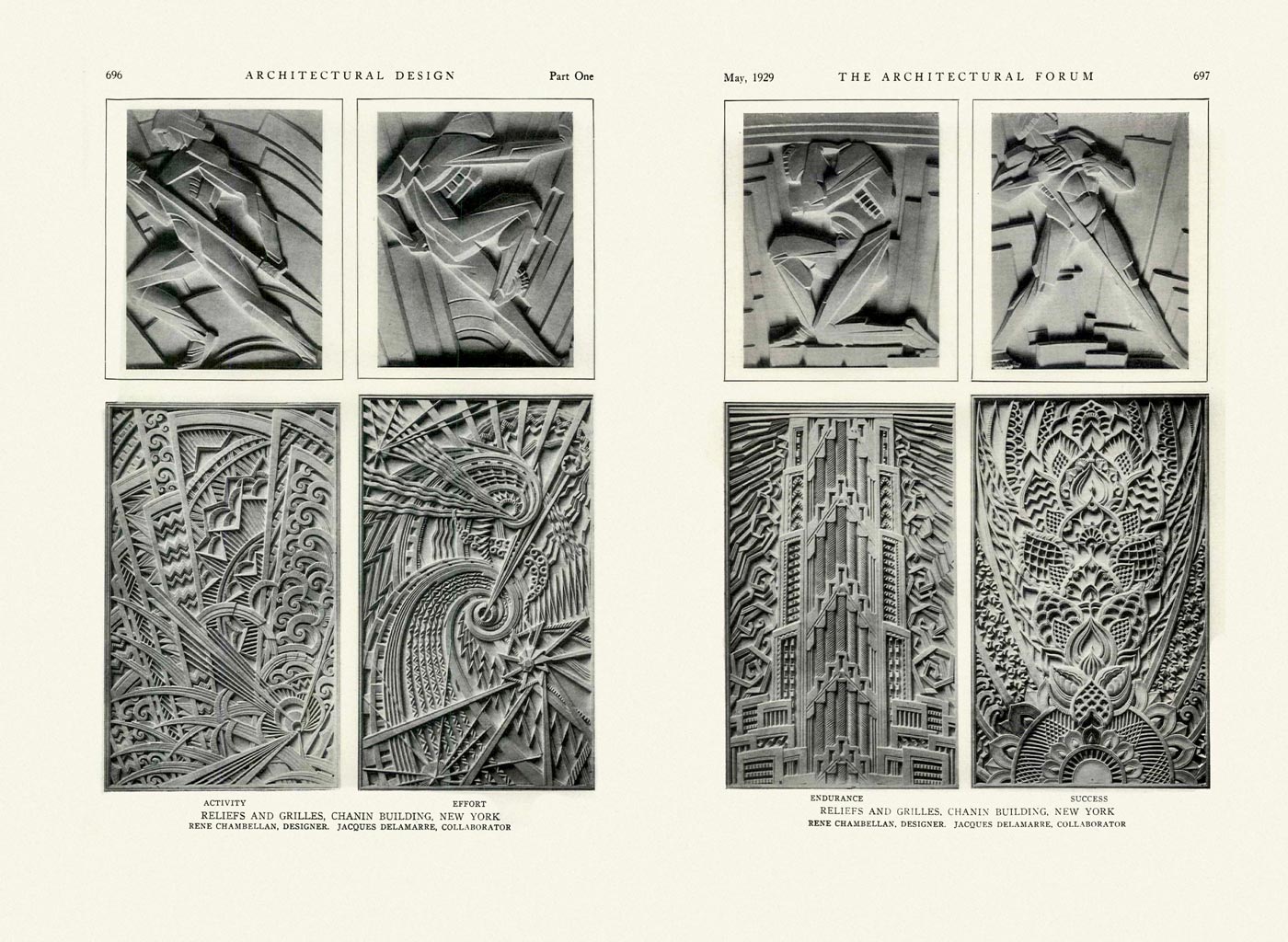
Architectural Forum, May 1929.
Contemporary publication illustrating René Chambellan’s reliefs and grilles for the Chanin Building, New York.
CODA — Seventy Pine Street: A Related Masterwork
Though separate from the Chanin cycle, another remarkable Chambellan work deserves mention:
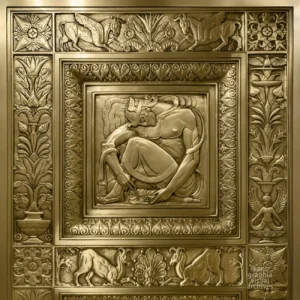
the nickel-silver Evolution of Fuel elevator doors at 70 Pine Street, created for the Cities Service Oil Company.
On the right, a woman holds an antique oil lamp — a symbol of the past.
On the left, a man grips an electric turbine — an emblem of the future.
Together they form a lyrical transition between eras, a perfect complement to the philosophical spirit of the Chanin grilles.

Seventy Pine Street was originally built for Cities Service Oil Company. Its elevator doors feature a pair of nickel-silver reliefs designed by René Paul Chambellan, representing the evolution of fuel. On the right door, a woman holds an antique oil lamp — a symbol of the past; on the left, a man grasps an electric turbine — an emblem of the future.
Copyright, Links and credits
Photography, Copyright & Credits
All photographs © Ikonographia / Roberto Bigano — All Rights Reserved.
These images are part of the Ikonographia Visual Archives.
The elevator panels were designed in 1929 by sculptor René Bellentan for the Chanin Building,122 East 42nd Street, New York City.
These images are part of the Ikonographia Visual Archives: New York City Art Deco Collection.
⸻
Copyright Status of the Building
The architectural design of the Chanin Building, (1927) is in the public domain under U.S. copyright law.
Buildings constructed before the Architectural Works Copyright Protection Act (1990) are not protected as architectural works, and their exteriors and interiors may be freely photographed.
All photographs on this page, however, are copyrighted works of Ikonographia / Roberto Bigano and require a license for any reuse.
⸻
Terms of Use (Summary)
The images presented in this story are:
• copyrighted,
• not in the public domain, and
• available for licensed use only through Ikonographia Visual Archives.
You may not download, reproduce, publish, or distribute these images without a valid license.
For commercial or editorial licensing, please refer to the product pages or contact Ikonographia directly.
A full explanation of licensing terms is available in the Shop / Licensing Information section on the site.
⸻
Ikonographia Mission Statement
Ikonographia is committed to the accurate documentation, preservation, and ethical dissemination of twentieth-century visual culture.
⸻
Archival Notes
These photographs were produced as part of Ikonographia’s ongoing documentation of significant examples of twentieth-century visual culture. Image preparation includes controlled lighting, accurate color management, and perspective correction to preserve architectural integrity and material detail.
Whenever possible, artworks and architectural elements are photographed in situ to convey their authentic spatial context. All images follow Ikonographia’s internal archival standards for resolution, color accuracy, and metadata structure to ensure long-term consistency across the collection.
⸻
Further Reading (Selected Sources) — Chanin Radiator Grilles
• Anthony W. Robbins, New York Art Deco: A Guide to Gotham’s Jazz Age Architecture — A foundational reference on Art Deco in Manhattan, including the sculptural programs of landmark buildings such as the Chanin Building.
• FMR Magazine No. 12, Winter Solstice 2024 — “Gotham Deco” — Special issue devoted in part to the Art Deco transformation of 1920s New York, with contributions by Anthony W. Robbins and photography by Roberto Bigano
• New York City Landmarks Preservation Commission reports — Official documentation on the Chanin Building’s architectural and ornamental significance
⸻
Acknowledgments
Ikonographia gratefully acknowledges the institutions, archivists, scholars, and architectural historians whose research and preservation efforts help illuminate the cultural significance of New York’s Art Deco heritage.
Special thanks to the building staff and management who facilitated photographic access, and to the broader community of researchers and design historians whose work supports the accurate documentation of these artworks.
Browse the New York City Art Deco Archive


About René Chambellan – A short bio

Chambellan at work in his studio.
René Chambellan (1898–1971)
René Paul Chambellan was a French-born sculptor and modeler active in New York during the late 1920s. Trained in architectural ornament and low-relief techniques, he contributed to the emergence of the French Modern Style—later known as Zig-Zag Moderne or Art Deco—translating its geometric elegance into architectural sculpture.
His collaboration with Jacques Delamarre on the Chanin Building’s Mental and Physical Series stands as his most distinctive achievement, blending expressive figuration with stylized geometric structure.
Beyond the Chanin commission, Bellentan also contributed sculptural modeling to major projects of the period, including elements for the famous Atlas statue (1937) at Rockefeller Center. His work exemplifies the refined craftsmanship and symbolic vocabulary that shaped New York’s Jazz Age architecture.
