
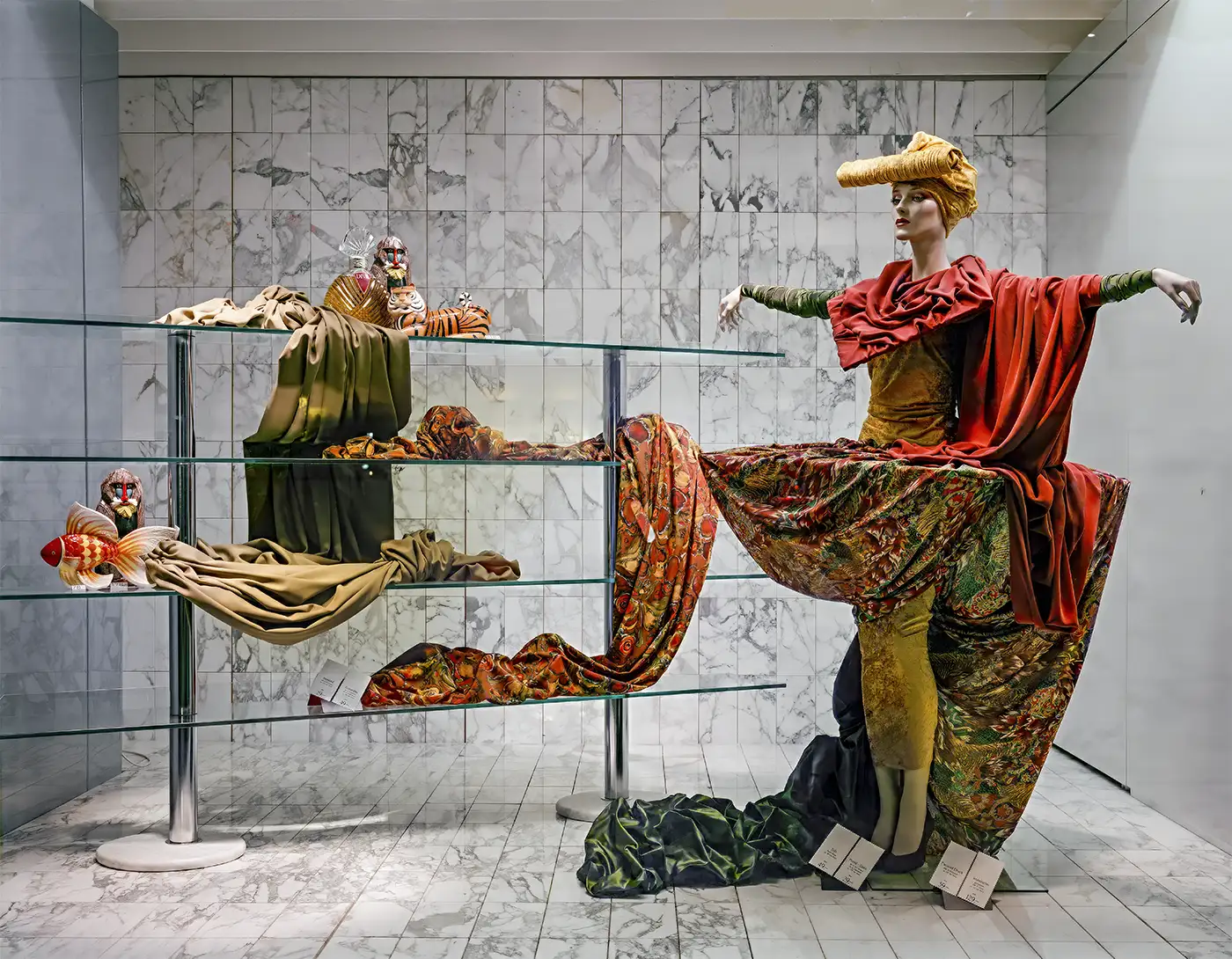
Hieratic mannequin dressed with fabrics — KaDeWe, Berlin, 1990
KaDeWe, Berlin, West Germany — August 1990
From Plastic Girls: 50 Years of Artificial Beauty.
A hieratic mannequin staged with ceremonial stillness and sculptural precision in the fabric department window of KaDeWe (Kaufhaus des Westens). Elongated proportions, controlled gesture, and layered textiles transform fashion display into a form of visual authority, where fabric becomes structure, elegance becomes posture, and excess is held in deliberate suspension.
$110
Royalty-free JPG — 8000x6000px, 26.48MB.
© Ikonographia / Roberto Bigano
LICENSE TERMS
This image is provided under a royalty-free license by Ikonographia / Roberto Bigano. By purchasing and downloading this file, you are granted the following rights:
You May
- Use the image in print and digital media (books, magazines, websites, videos, educational materials, presentations, and advertisements).
- Use the image in editorial, corporate, or client work, including commissioned projects.
- Modify, crop, or combine the image with other elements for creative use.
- Create photographic prints for personal or internal company use only (display, offices, presentations).
You May Not
- Resell, redistribute, sublicense, or share the image file in any form that allows third-party access.
- Use the image in products for resale (prints, posters, merchandise, NFTs, templates, stock collections) without a separate extended license.
- Claim authorship of the image or remove copyright attribution.
Read our full Copyright & Licensing Policy for detailed information.
Copyright: © Ikonographia / Roberto Bigano. All rights reserved.
SUGGESTED USES
- Architecture and design publications.
- Educational materials or exhibitions.
- Interior design presentations and mood boards.
- Commercial, editorial, or creative projects.
Each download includes a royalty-free license for use in both print and digital media.
Plastic Girls — 50 Years of Artificial Beauty (1978–2026)
A long-term photographic study of window mannequins as cultural artifacts of their time — by Roberto Bigano.
Created over nearly fifty years, the project examines how artificial female bodies were designed and displayed in public space, reflecting changing ideals of beauty, femininity, desire, and social aspiration. Read as a continuous sequence rather than isolated images, the series reveals how consumer culture repeatedly shaped—and reshaped—the representation of the female form.
All photographs were taken from the street, through shop-window glass, without special access or permissions. Nothing is staged or arranged for the camera: the images record what is openly visible yet rarely observed with sustained attention.
Over time, this accumulation exposes patterns no single moment could reveal—recurring gestures, evolving materials, racial and anatomical codifications, and a gradual movement from abstraction to hyper-realism. The project seeks neither irony nor nostalgia, but sustained looking.
Available Chapters
- Plastic Girls: 50 Years of Artificial Beauty — A long-term photographic study of window mannequins as cultural artifacts of their time.
- Plastic Girls — The Age of Plastic Innocence (1978–1980) — Early Works. Shop-window mannequins before the rise of performative display.
- American Mannequins — Journey into Hyperreality (1982–1988) — Artificial bodies and performative realism in American retail display.
- Plastic Girls — Glamour, Aggression, and Display (1980–1997) — A shared escalation toward excess, beyond style, geography, or chronology.
- Spain (1997) — Glamorous Brides — Ritual, spectacle, and artificial femininity in Andalusian display culture.


