
American Mannequins — Journey into Hyperreality (1982–1988)
Artificial bodies and performative realism in American retail display.
Between 1982 and 1988, American shop windows increasingly adopted mannequins modeled for presence rather than display. Lifelike faces, controlled gestures, and carefully staged interiors transformed retail figures into instruments of visual persuasion, occupying a space where realism no longer represented reality but actively produced it.

Photographed from the street without staged intervention, the images were made using a 4×5 view camera, a process that imposed slowness, distance, and sustained attention. In this context, mannequins emerge not as neutral supports for clothing, but as performative bodies through which American hyperreality takes shape.
These photographs belong to "Plastic Girls: 50 Years of Artificial Beauty", a long-term photographic project developed over nearly five decades, in which shop windows are approached as a continuous site of cultural observation.

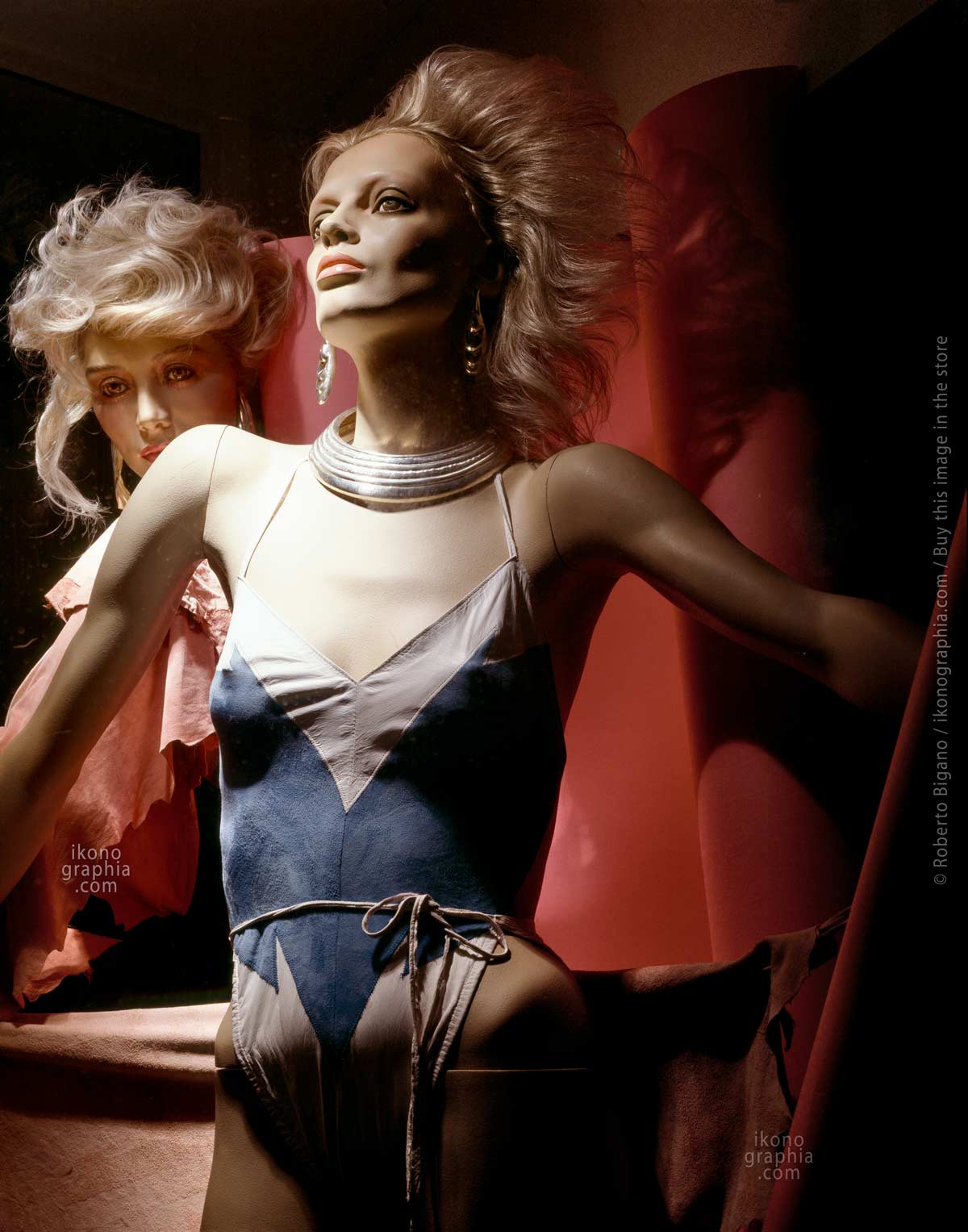
August 1982
Beverly Hills, United States — Rodeo Drive.
The hyper-detailed facial modeling and naturalistic stance collapse the distance between mannequin and living figure. The pose signals an early movement toward simulated presence, where realism begins to replace display as the dominant visual language.
Featured image above:
August 1984 — Rodeo Drive — Beverly Hills, United States.
An earlier generation of mannequin carving, distinguished by sculpted features rather than molded realism.
The face—particularly the mouth and eyes—retains a hand-shaped expressiveness, poised between elegance and emotional distance.
Set against the quiet intrusion of national symbolism, the tilted head and relaxed arm introduce a note of vulnerability, transforming the display into a composed study of desire and aspiration.
August 1982.
Hollywood, United States — Melrose Avenue.
Here the mannequin recedes into light and shadow, its presence shaped more by illumination than form. The body becomes a graphic element within the window, signaling a shift toward cinematic display and atmospheric staging rather than direct representation.
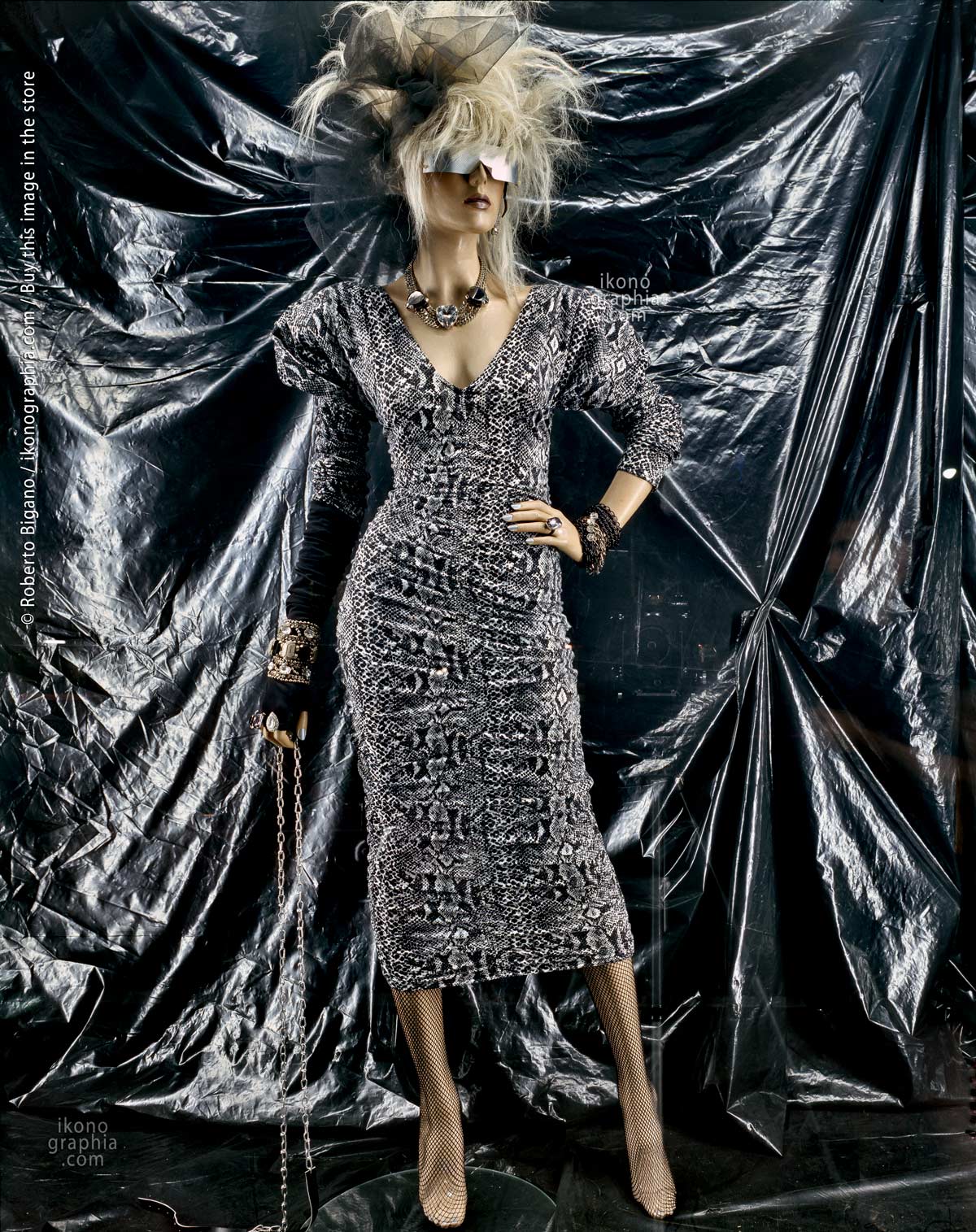
August 1984.
Los Angeles, United States — Santa Monica Blvd.
High-contrast materials, confrontational styling, and rigid posture define a form of West Coast display that flirts with provocation rather than elegance.
Set against industrial plastic backdrops, the mannequin stages the body as surface and attitude—borrowing visual cues from underground fashion, fetish aesthetics, and club culture.

August 1982
Los Angeles, United States — Santa Monica Blvd.
Bold chromatic contrasts and graphic styling echo the visual optimism surrounding the Los Angeles Olympics.
Commercial display mirrors a broader corporate aesthetic, where color signals confidence and spectacle.

August 1983 — Boca Raton, Florida
Close-up with glasses and red lips, photographed on 4×5" film with a 45-minute exposure.
The view camera required carefully balanced composition on the ground glass—even more critical with such a challenging long exposure.
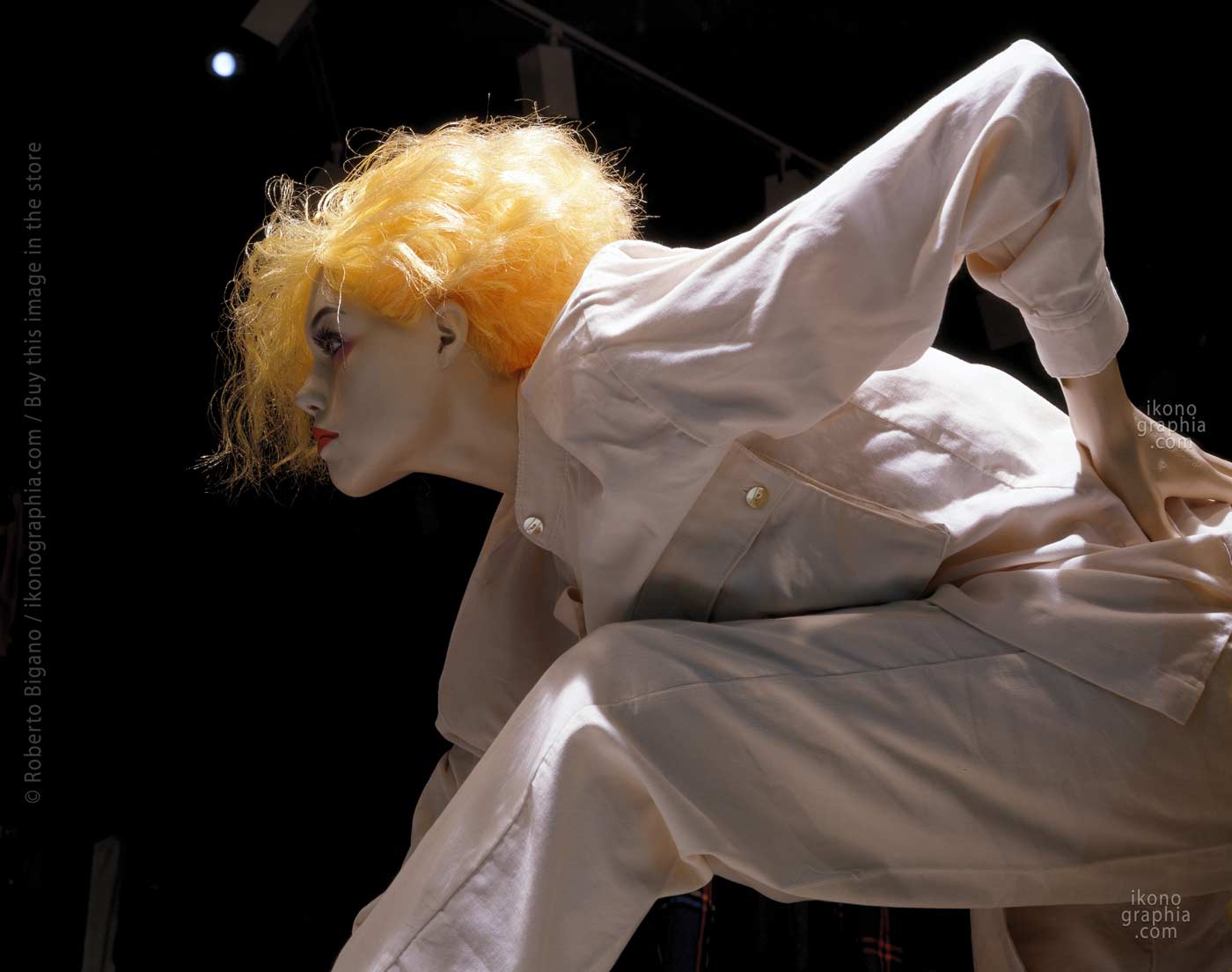
August 1985.
Suset Strip — Hollywood, United States
An elongated posture and stylized expression detach the mannequin from narrative context.
Reduced in scale, the figure reads as an object of study rather than a theatrical presence.

August 1985 —Two Cowgilrs, Beverly Hills, United States
Two identical mannequins in cowboy costume, arms raised. Artificial femininity performing a national identity.

August 1985
Hollywood, United States — Elegant shop on Sunset Strip.
The hyperreal modeling of the face and the restrained, naturalistic pose collapse the distance between mannequin and living figure. Rather than theatrical display, the figure conveys a quiet, inward presence, signaling the rise of psychological realism in mid-1980s American shop-window design.

August 1985
Beverly Hills, United States — J. Magnin Dept Store
Hyperreal facial modeling, refined posture, and controlled lighting elevate the mannequin beyond display into a near-portrait.
Luxury retail adopts the visual language of high fashion photography, collapsing the distance between artificial figure and idealized reality.

August 1988 — Rockland, Maine, United States — Senter & Crunes Dept. Store.
The contrast between photographic portrait and mannequin construction foregrounds the tension between lived presence and manufactured realism.

August 1988 — New York City — Lord & Taylor.
The display aligns American fashion with institutional recognition, as Lord & Taylor applauds American design through the work of Calvin Klein, presenting fashion as cultural achievement rather than seasonal novelty.

August 1988 — Beverly Hills, California — Altman’s Dept. Store
The extended tonal range—from luminous silk highlights to dense, articulated blacks—supports precise chromatic balance and compositional clarity.
Technical fidelity becomes inseparable from the image’s aesthetic authority, reinforcing realism as a constructed visual language.
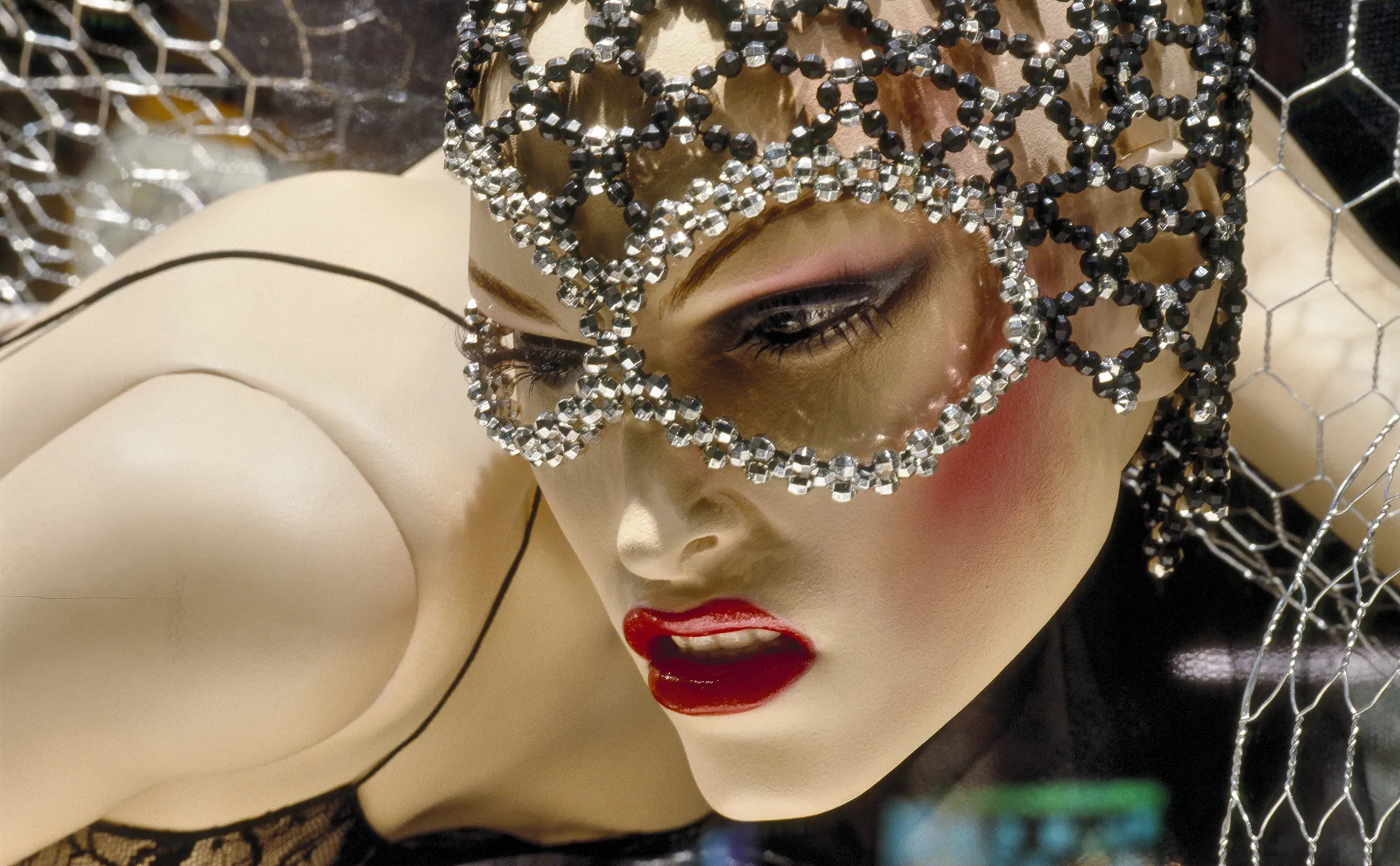
Plastic Girls — Glamour, Aggression, and Display (1980–1997)
A shared escalation toward excess, beyond style, geography, or chronology.
This chapter documents the moment when artificial femininity becomes overtly cosmetic, sexualized, and confrontational. .
Copyright, Links And Credits
Photography, Copyright & Credits
All photographs © Ikonographia / Roberto Bigano — All Rights Reserved.
These images are part of the Ikonographia Visual Archives: — Plastic Girls: 50 Years of Artificial Beauty — Plastic Girls / Mannequins Archive (1978–2026).
⸻
Terms of Use (Summary)
The images presented in this archive are copyrighted and available for licensed use only through Ikonographia Visual Archives.
You may not download, reproduce, publish, or distribute these images without a valid license. For commercial or editorial licensing, please refer to the product pages or contact Ikonographia directly. A full explanation of licensing terms is available in the Shop / Licensing Information section under "Ikonographia — Standard License" and "Ikonographia — Merchandising & Product Use Licenses"
⸻
Ikonographia Mission Statement
Ikonographia is committed to the accurate documentation, preservation, and ethical dissemination of twentieth-century visual culture.
⸻
Archival Notes — Plastic Girls: 50 Years of Artificial Beauty
This archive began in 1978 as a street photography project and is still ongoing.
All images were taken from public streets through shop-window glass without special access, permissions, or staging.
The archive's coherence was recognized retrospectively—only years later, during high-resolution digitization, did isolated images reveal themselves as a continuous visual record spanning nearly fifty years. The project documents mannequins as cultural artifacts: their evolving materials, poses, facial treatments, and display contexts across changing urban and commercial landscapes.
All images follow Ikonographia's internal archival standards for resolution, color accuracy, and metadata structure to ensure long-term consistency across the collection.
⸻
Further Reading — Selected Sources
- Plastic Girls (1978-2011), by Roberto Bigano — A photographic monograph collecting earlier phases of this archive, published as a limited edition on Blurb.


