Bugatti Heritage Archive (1909–1952) — Photography & Graphics
A curated archive combining licensable images with editorial content and historical research.
A photographic and graphic archive documenting Bugatti's evolution from Ettore's early engineering to Jean's coachbuilt masterpieces. Featuring studio photography, rare factory drawings, heliographic sheets, brochures, catalogues, and posters — tracing the marque's technical innovation, and aesthetic vision across four decades.
Published in stages. The complete archive runs significantly deeper.
Royalty-free high-resolution files for editorial, commercial, and large-format reproduction.
Bugatti Heritage Archive (1909–1952) — Overview
Between 1990 and 2009, photographer Roberto Bigano documented Bugatti with a level of access that no longer exists and cannot be replicated. The relationship began with Romano Artioli — the Italian entrepreneur who had just acquired the Bugatti name and was preparing its revival at Campogalliano — who gave Roberto carte blanche to work inside the factory, the archive, and every event that followed. No brief. No restrictions. No supervision.
What resulted is not a single project but five distinct bodies of work: the factory technical drawings reproduced before they disappeared, two major photographic commissions on the historic cars, a complete documentary record of the Bugatti International Centenary Meeting in Tuscany, and an Alsatian reportage made inside Molsheim before the restoration began. Together they form one of the most complete private archives of Bugatti heritage in existence — most of it unpublished until now, some of it available nowhere else.
The archive is not a celebration of the marque. It is a record made by someone who was trusted enough to be inside it, at the precise moment when its past and its future were in the same room.
PHOTOGRAPHY ARCHIVES
Divina Bugatti
In 1991, Franco Maria Ricci — the most demanding publisher in Italy — commissioned photographer Roberto Bigano to document the historic Bugatti collection at the Musée National de l'Automobile in Mulhouse. Ricci had seen the first transparencies and said: "But they are lit." He immediately assigned all future FMR projects. The resulting book, Divina Bugatti, was published in two editions of 5,000 copies each — Italian and French — at a price that made it inaccessible to most. Both editions sold out. One image from the session was rejected by Ricci as "not objective." It spent seventee gatti in the Bugatti Photo Masterpieces collection, and separately within the Enthusiasts archive, where each car carries its own story. Photography by Roberto Bigano.
Bugatti Glamour
An Ikonographia project developed in close collaboration with the president of Bugatti Club Italia and supported by Hasselblad and Manfrotto. Where Divina Bugatti was built around the Mulhouse collection, Bugatti Glamour followed the historic cars in the context of the Centenary celebrations — a different setting, a different light, the same discipline. The archive sits alongside Divina Bugatti in the Bugatti Photo Masterpieces collection, and separately within the Enthusiasts archive, where each car carries its own story. Photography by Roberto Bigano.
The Bugatti International Meeting — Tuscany, 2009
The Bugatti Centenary Meeting brought together owners and their cars across several days in Tuscany — at Marone-Cinzano estate, in the medieval piazza of Massa Marittima, on roads that had no reason to be driven any faster than a Bugatti would drive them. The archive documents everything: the cars, the owners, the landscape, the lunch under the cypresses with the collection parked on the lawn.
GRAPHIC ARCHIVES
The Lost Bugatti Factory Drawings (1923-1935)
In 1990, the original Bugatti factory technical drawings held in the Campogalliano archive were photographed for the first time — body designs, mechanical cross-sections, wheel specifications, production templates. The drawings were subsequently lost. Their current location is unknown. What was photographed that year may be the only surviving record of documents that defined how the cars were built. The archive covers the period from 1922 to 1935, from the early Type 22 through the Type 57 range. The photographs are by Roberto Bigano. They were never published until now.
The Literature
Bugatti's catalogs, brochures, and posters were made inside Molsheim under the same standards as the cars. Ettore and Jean directed everything — the typography, the photography, the choice of illustrators. Alexis Kow signed his drawings. The company photographer Carabin was credited on selected images. Everyone else worked without attribution, which in Molsheim was the norm. The Ikonographia archive covers the full range of Bugatti printed literature from the 1920s through 1939 — the year Jean died and the pre-war chapter closed.
High-Resolution Files & License
High-resolution files, offered with a royalty-free license and prepared for editorial use, research, and large-format reproduction.
Showing 1–12 of 56 resultsSorted by latest
-

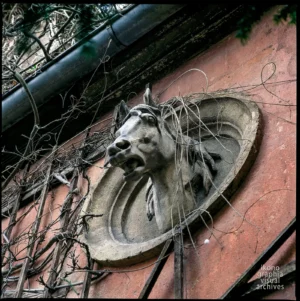
The Bugatti Horse Symbol — Château Saint-Jean, Molsheim, 1990
€95.00 -

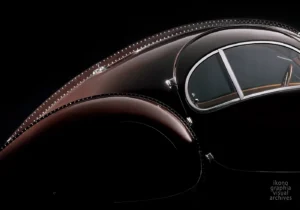
The Riveted Spine — Bugatti Type 57SC Coupé Atlantic, 1937
€85.00 -

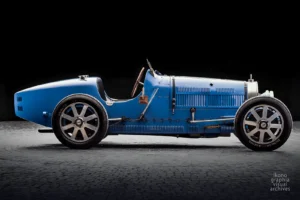
The Queen of Racing — Bugatti Type 35B Grand Prix, 1927
€95.00 -

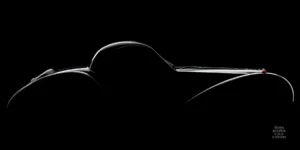
The Atlantic Roofline — Bugatti Type 57SC Coupé Atlantic, 1937
€125.00 -
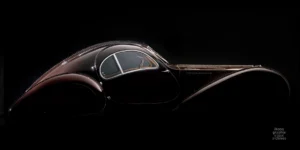
The Silhouette — Bugatti Type 57SC Coupé Atalante, 1938
€350.00 -

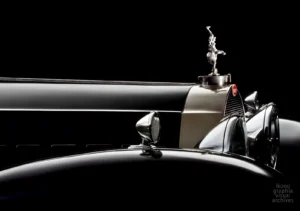
Bugatti Type 41 Royale Coupé Napoléon — Bonnet and Rampant Elephant, 1929
€189.00 -

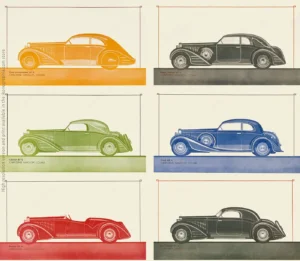
Six monochrome pages from the Carrosserie Gangloff catalog, for Bugatti 1935
€35.00 -

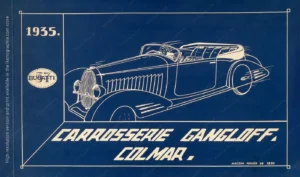
Carrosserie Gangloff for Bugatti. The cover of the 1935 catalog.
€29.00 -

Bugatti Type 57 Modelès 1939 Brochure. Cabriolet Stelvio
€34.00 -

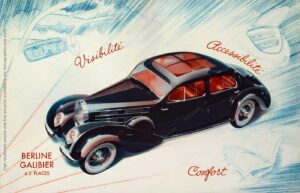
Bugatti Type 57 Modelès 1939 Brochure. Berline Galibier.
€34.00 -

Bugatti Type 57 Range Brochure 1936 in blueprint style drawings
€39.00 -

Bugatti Type 44 nouvelle 3 litres catalog 1925, Weissmann bodywork
€29.00