Bugatti — Photography, Drawings, Literature

Bugatti — Photography, Drawings, Literature

Bugatti — Photography, Drawings, Literature

Exclusive archives documenting Bugatti from the inside — available nowhere else.

Between 1909 and 1939, Bugatti produced fewer than 8,000 cars in Molsheim, Alsace. Ettore designed the machines and directed everything around them — the coachwork, the literature, the posters, the domain itself. Jean brought the body to its highest form. What remained was a body of objects — cars, drawings, catalogs, posters — of exceptional rarity and cultural weight.

The legendary Ettore Bugatti's signature on the engine head of a 1921 Type 13 Brescia. Photo by Roberto Bigano. Buy this image in the ikonographia.com store.

This featured story is an editorial hub, conceived as a new re-editing of multiple existing stories and archival materials. It brings together previously separate contents into a single, coherent narrative framework — photography, technical drawings, and printed literature documenting Bugatti heritage from 1909 to 1952.

The archive was built between 1990 and 2009 by photographer Roberto Bigano, working with a level of access that no longer exists and cannot be replicated. It began with Romano Artioli — the Italian entrepreneur who revived the Bugatti name at Campogalliano — who gave Bigano unrestricted entry to the factory, the drawings archive, and every event that followed. No brief. No restrictions. No supervision.

This collection is not a celebration of the marque. It is a record made by someone who was trusted enough to be inside it, at the precise moment when its past and its future were in the same room.

0360-13 Mannequin in a shop window in Braunschweig, Germany, September 1979 | From "Plastic Girls" series. Photo by Roberto Bigano. Buy this image in the ikonographia.com store.

Two Bugatti Type 13 Brescia — Marone-Cinzano Estate, Tuscany, 2009.

Resting in the shade during the owners' lunch — one of 120 cars gathered for the Bugatti International Meeting.

Featured image above


Ettore Bugatti's signature — Engine head of the Type 13 Brescia, 1921.

Not a badge. Not a plate. Ettore cast his own handwriting into the metal of the engine head — his name made part of the machine itself.

The Type 13 Brescia won the first four places at the 1921 Brescia Grand Prix. This is what he signed.

Five Bodies of Work — One Complete Archive

What resulted is not a single project. It is five distinct bodies of work — factory drawings, printed literature, posters, studio photography, and documentary reportage — built across two decades, most of it unpublished until now. Together they form the most complete visual record of Bugatti heritage in private hands.
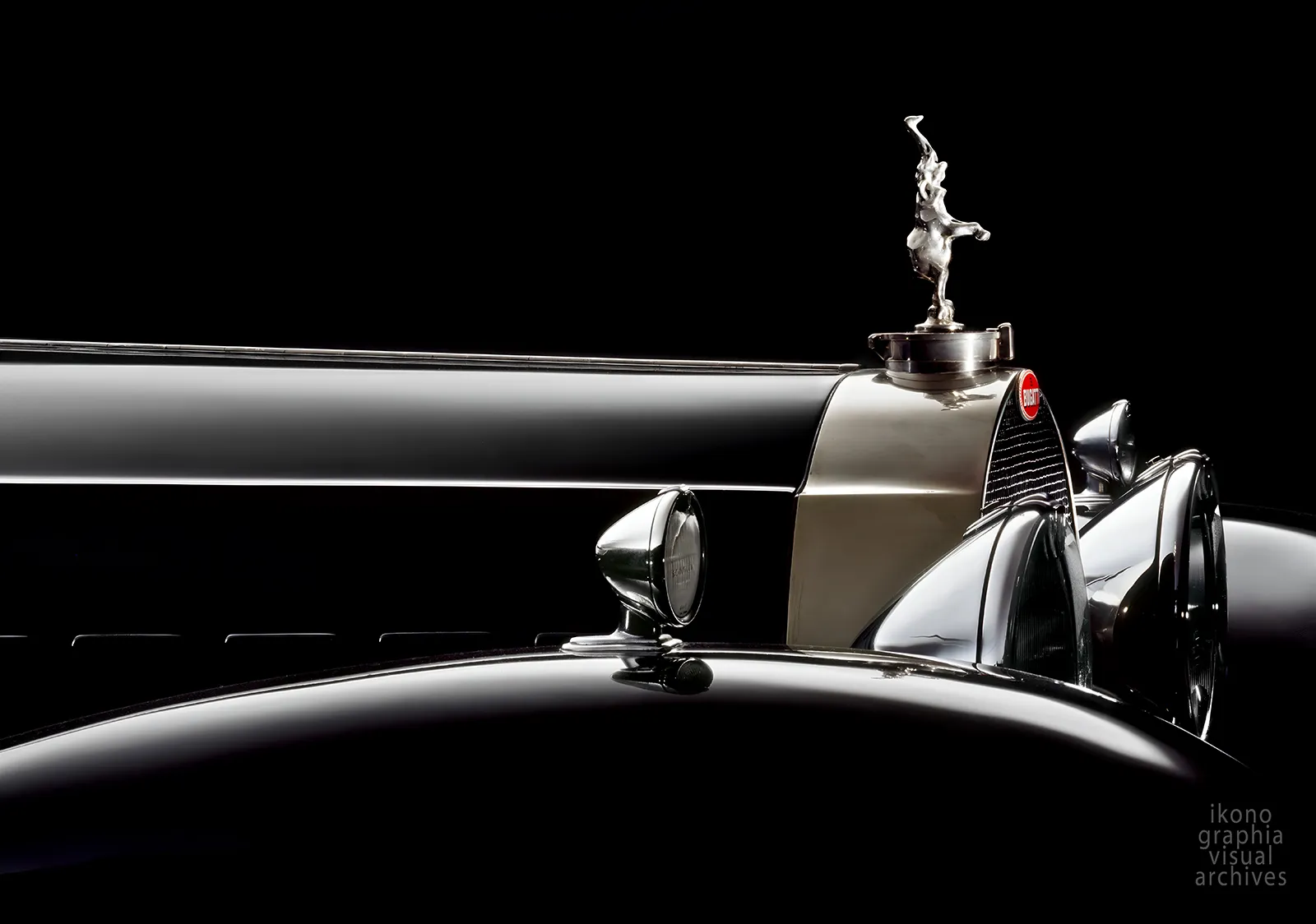
Bugatti Type 41 Royale Coupé Napoléon, 1929 — bonnet detail with Rembrandt Bugatti elephant mascot. Photographed by Roberto Bigano at the Musée National de l'Automobile, Mulhouse.

Bugatti Type 41 Royale Coupé Napoléon — Bonnet and Rampant Elephant, 1929

Ettore's personal car — 7.2 metres long, the largest automobile ever built, conceived for royalty and driven by its maker.

The elephant on the radiator was sculpted by Rembrandt Bugatti, Ettore's younger brother, one of the great animal sculptors of his generation. Six Royales were completed. This is one of them.

The Lost Factory Drawings

Between 1922 and 1935, the Molsheim factory produced the technical drawings that defined how Bugatti cars were built — body designs, mechanical specifications, production templates, drawn by hand on paper and cloth.

Reproduced in 1990 before disappearing, these images may be the only surviving record. Ikonographia presents them in three chapters — Form, Function, and Obsession — examining why they remain unique.
August 1984 - Beverly Hills, California - From "Plastic Girls" series. Photo Roberto Bigano.

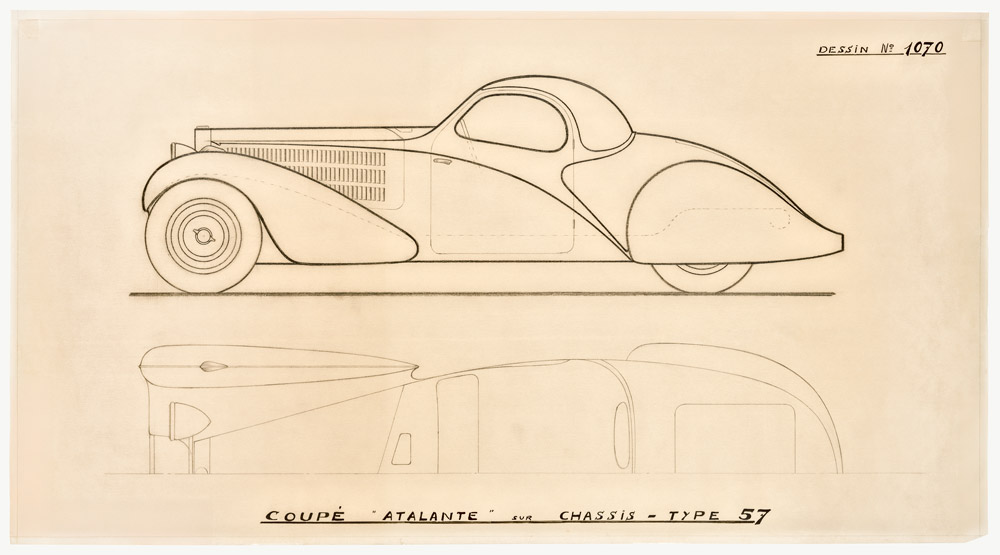
Dessin N° 1070 — Coupé Atalante sur Chassis Type 57 — 1935

Side elevation and plan view. Pencil on tracing paper. The body design was Jean Bugatti's. The factory drawings were the work of his technical team at Molsheim. 
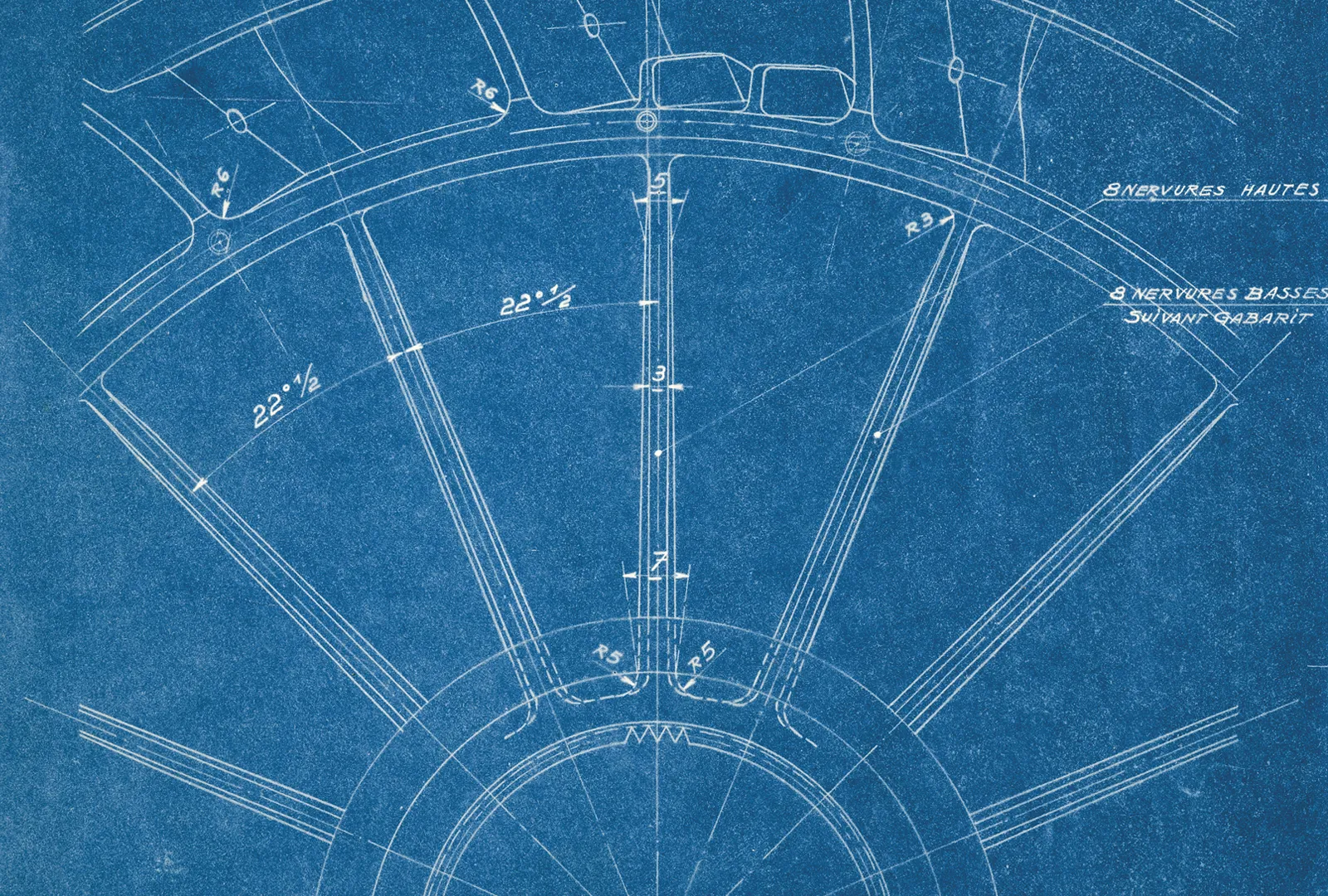
Detail of Bugatti’s patented Monobloc aluminum wheel design from a 1932 technical drawing.

The Bugatti Monobloc Cast Aluminum Wheel — Patented 1924

The first single-piece cast aluminum wheel in automotive history. This heliographic print, dated 22 July 1932, is a first-generation factory copy made directly from the original drawing and distributed to the production department. The spoke section shown here specifies eight high ribs and eight low ribs following the template, with all radii and tolerances called out in millimeters.
The geometry is not only structural — the alternating rib heights reduce weight while maintaining rigidity, a solution that remained technically advanced for its era. Eight years after the original patent, the drawing shows no uncertainty. Every line was already resolved.

Like the Vitruvian Man, it is a study in proportion where engineering and beauty become the same thing.
August 1984 - Beverly Hills, California - From "Plastic Girls" series. Photo Roberto Bigano.

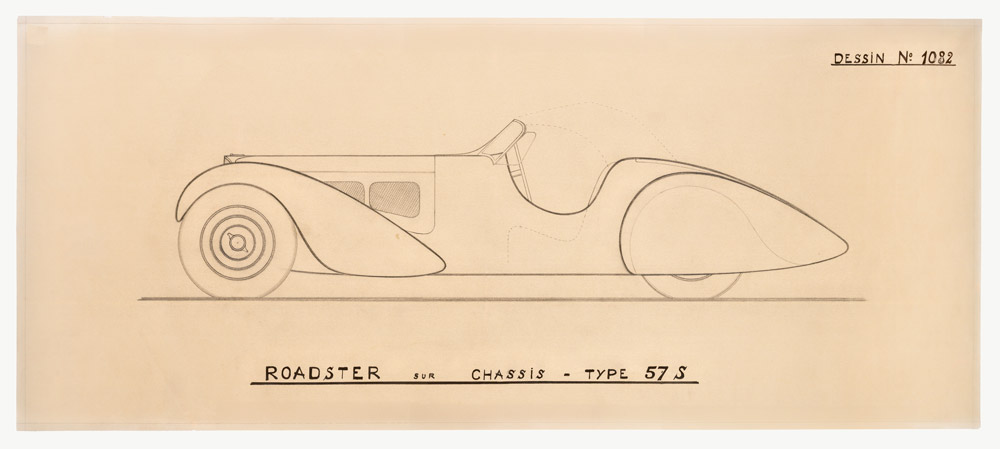
Dessin N° 1082 — Roadster sur Chassis Type 57S — 1935.

The surbaissé chassis — lowered by passing the rear axle through the frame members. Jean Bugatti's final and most aerodynamic variant of the Type 57 line. Pencil on tracing paper.

Bugatti Catalogs and Literature

Bugatti's catalogs and brochures were produced inside Molsheim under the same standards as the cars. Ettore and Jean directed everything — the typography, the photography, the choice of illustrators. The archive covers the full range of printed literature from the 1920s through 1939, the year Jean died and the pre-war chapter closed.

Depliant Bugatti Type 44 3 litres 1929

Dépliant Bugatti Type 44, 3 litres — Centerfold, 1929.

The centerfold of the Type 44 folder places the car in front of Château Saint-Jean — Bugatti's headquarters in Molsheim. T

he two figures beside it are Lidia and Michel Bugatti, two of Ettore's children. The photograph is not incidental. Molsheim was not a factory with a family attached. It was a domain, and the catalog knew it.

Bugatti Berline 3 places avec spider sur chassis 3 litres. Photo

Bugatti Berline 3 places avec spider sur chassis 3 litres. — Central double spread.
Photo Carabin.

The second body variant in the same 1928 brochure series. Same photographer, same studio discipline.

The two Carabin photographs and the two Hemjic covers were designed as pairs — the machine and its ancestry, facing each other across the fold.
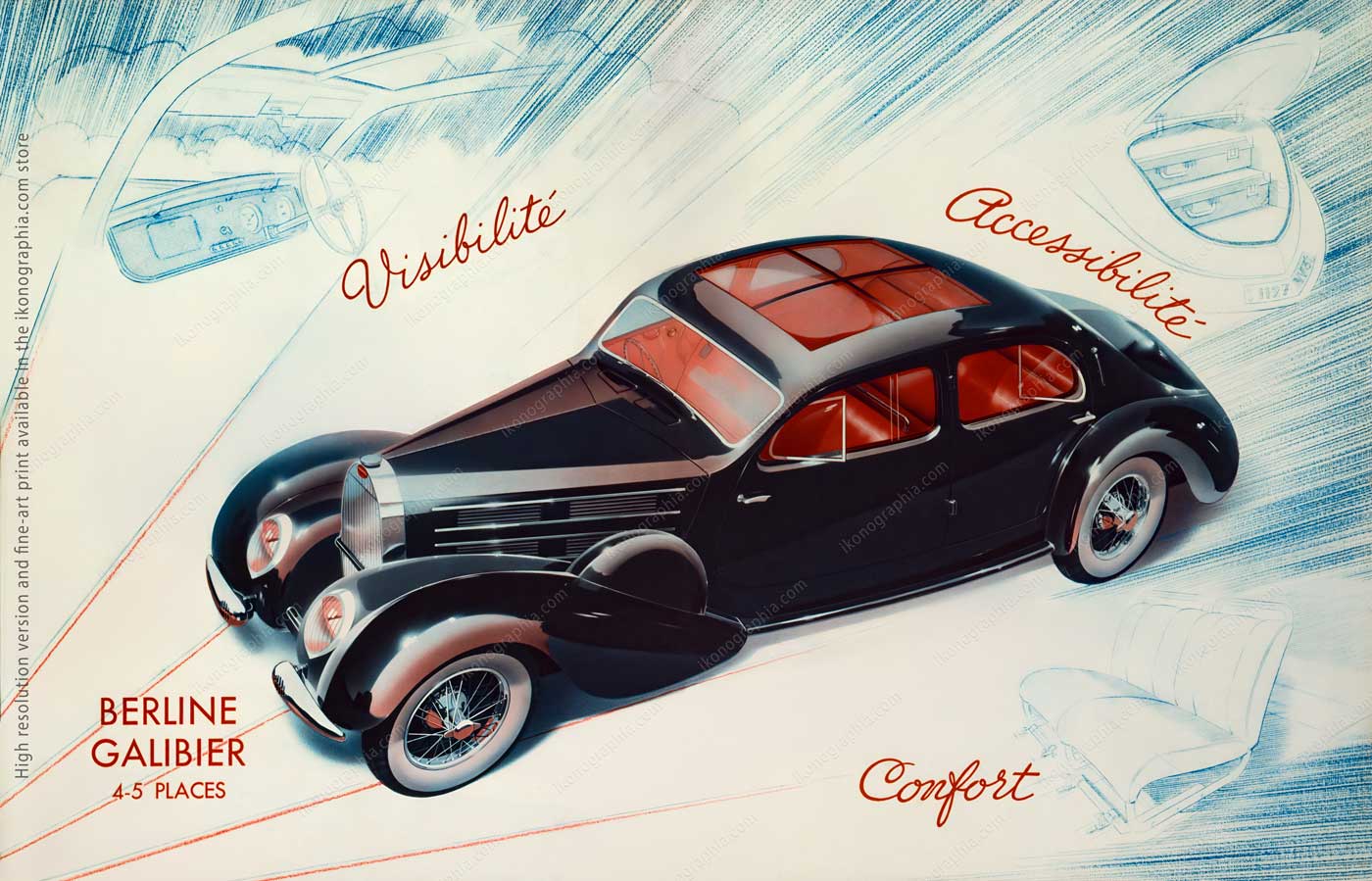
Bugatti Type 57 Modeles 1939

Bugatti Type 57 Modèles 1939. Berline Galibier 4-5 places. Visibilité. Accessibilité. Confort.reet and Regent Street series.

The three words beneath the model name are the brochure's argument in miniature — the same logic that organized the 1936 catalog, compressed into a single line.

The Galibier was the largest body in the Type 57 range. The claims are precise and in the correct order.

Bugatti Posters

Bugatti commissioned its advertising posters from the finest graphic artists of the era — Cassandre, Marcello Dudovich, René Vincent, Geo Ham. The results are among the most celebrated works in automotive poster art. Cassandre's 1935 Le Pur-Sang des Automobiles remains the definitive image of the marque. Dudovich's 1922 C'è una Bugatti, non si passa is a masterpiece of symbolic compression.

The originals were held in the Campogalliano archive. Roberto Bigano borrowed and reproduced them in his studio — the same access that produced the factory drawings. The archive presents the most significant surviving examples, reproduced directly from the originals.
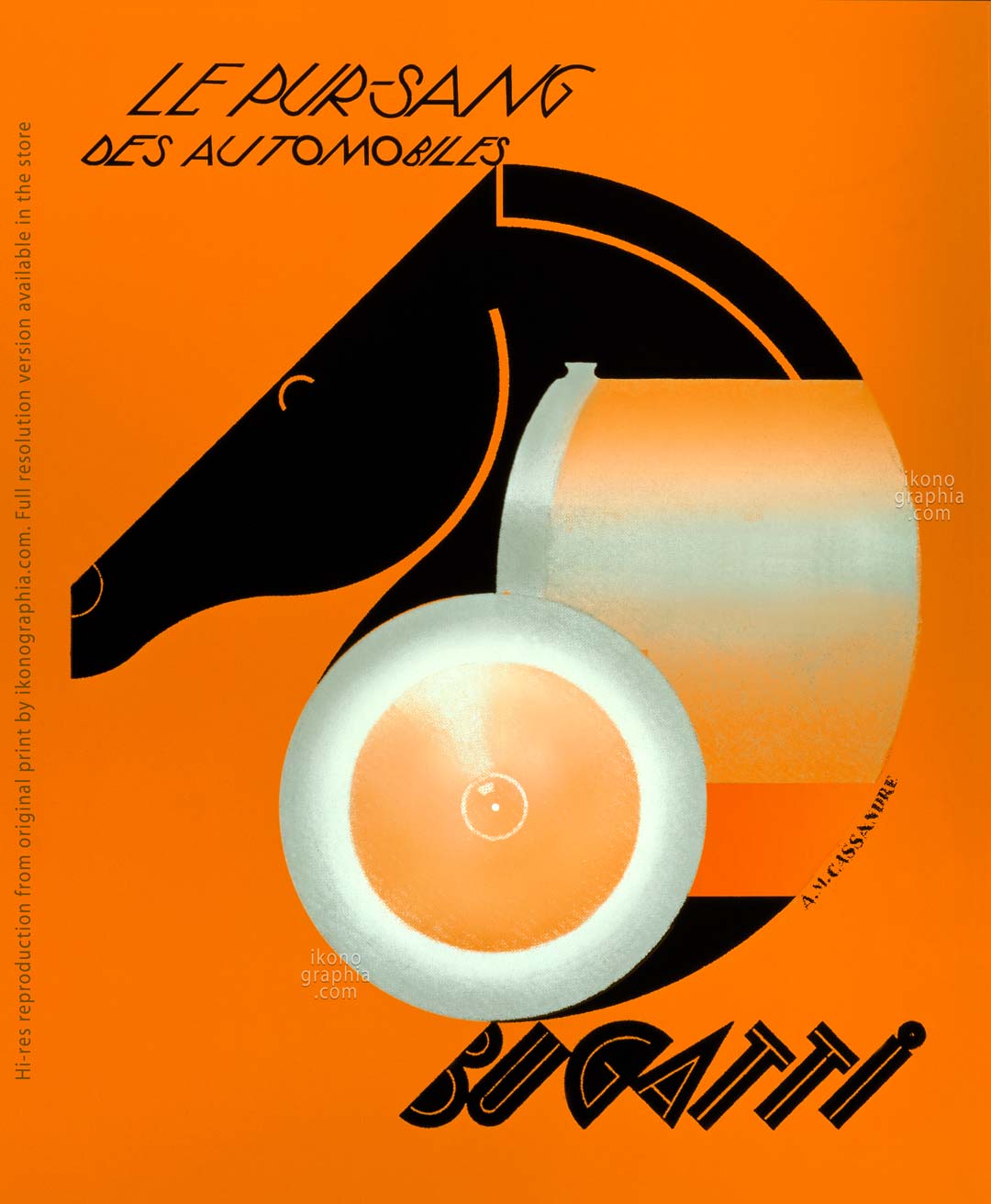
Le Pur-Sang Des Automobiles. Art by Cassandre 1935. An iconic 1935 Bugatti Poster by Cassandre, pseudonym of Adolphe Jean-Marie Mouron.

Le Pur-Sang des Automobiles — Cassandre, 1935.

The image that defined Bugatti's identity for a century — by the greatest poster artist of its time.
Reproduced from the original

C’è una Bugatti, non si passa (There's a Bugatti, you can't pass.) Poster by Marcello Dudovich 1922 Dimensions: 195x140 cm Printer: Edizioni STAR . Officine IGAP, Milano This masterpiece is rich in symbolism, beginning with the title that emphasizes Bugatti's legendary invincibility. The model portrayed is the Type 13 Brescia.

C'è una Bugatti, non si passa — Marcello Dudovich, 1922

A masterpiece of symbolic compression: the title declares Bugatti's invincibility, the red scarf trailing from the figure echoes the death of Isadora Duncan — who died when her scarf caught in the wheel of a Bugatti.

Except that happened five years later. Dudovich was simply ahead of events.
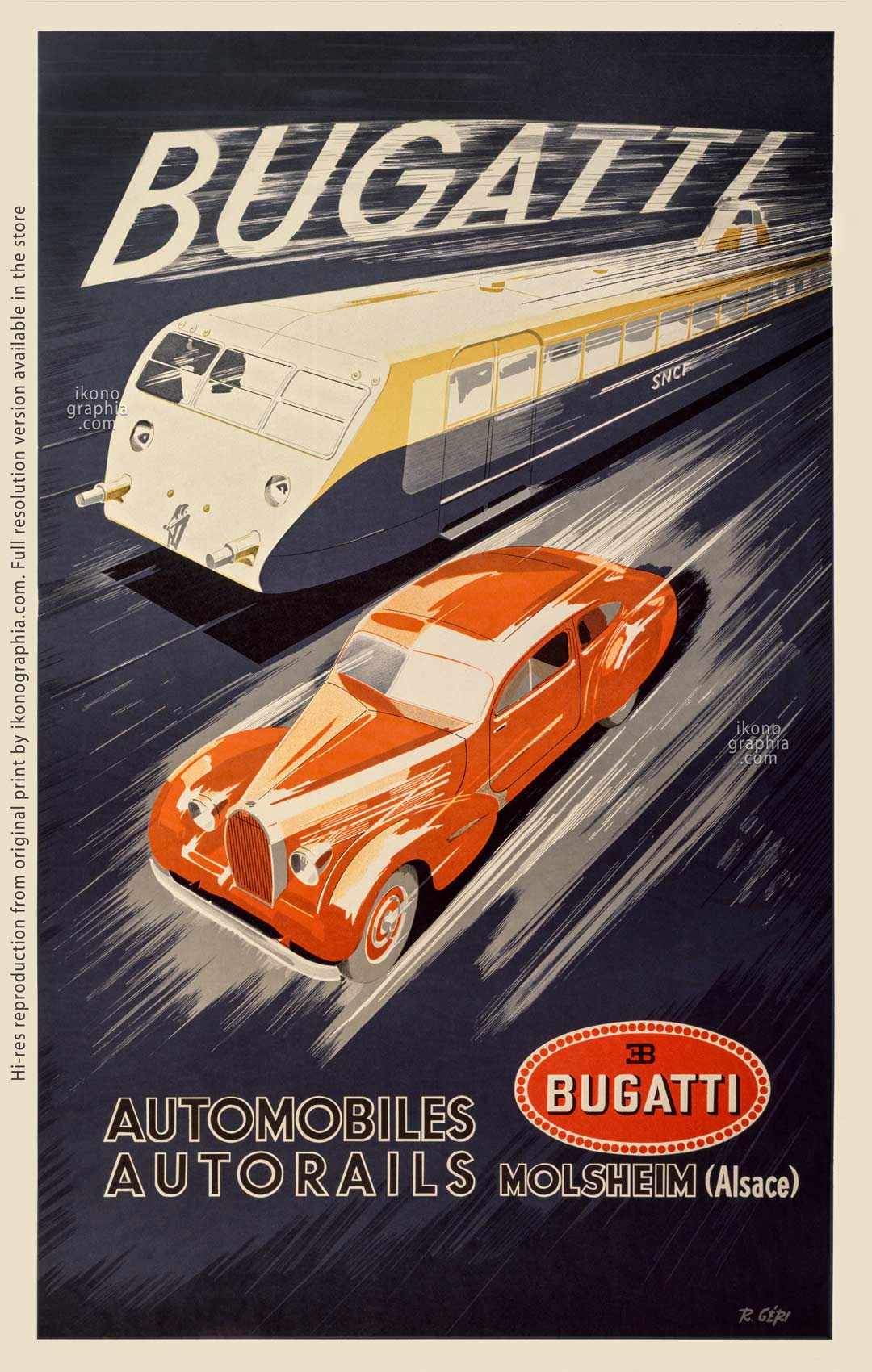
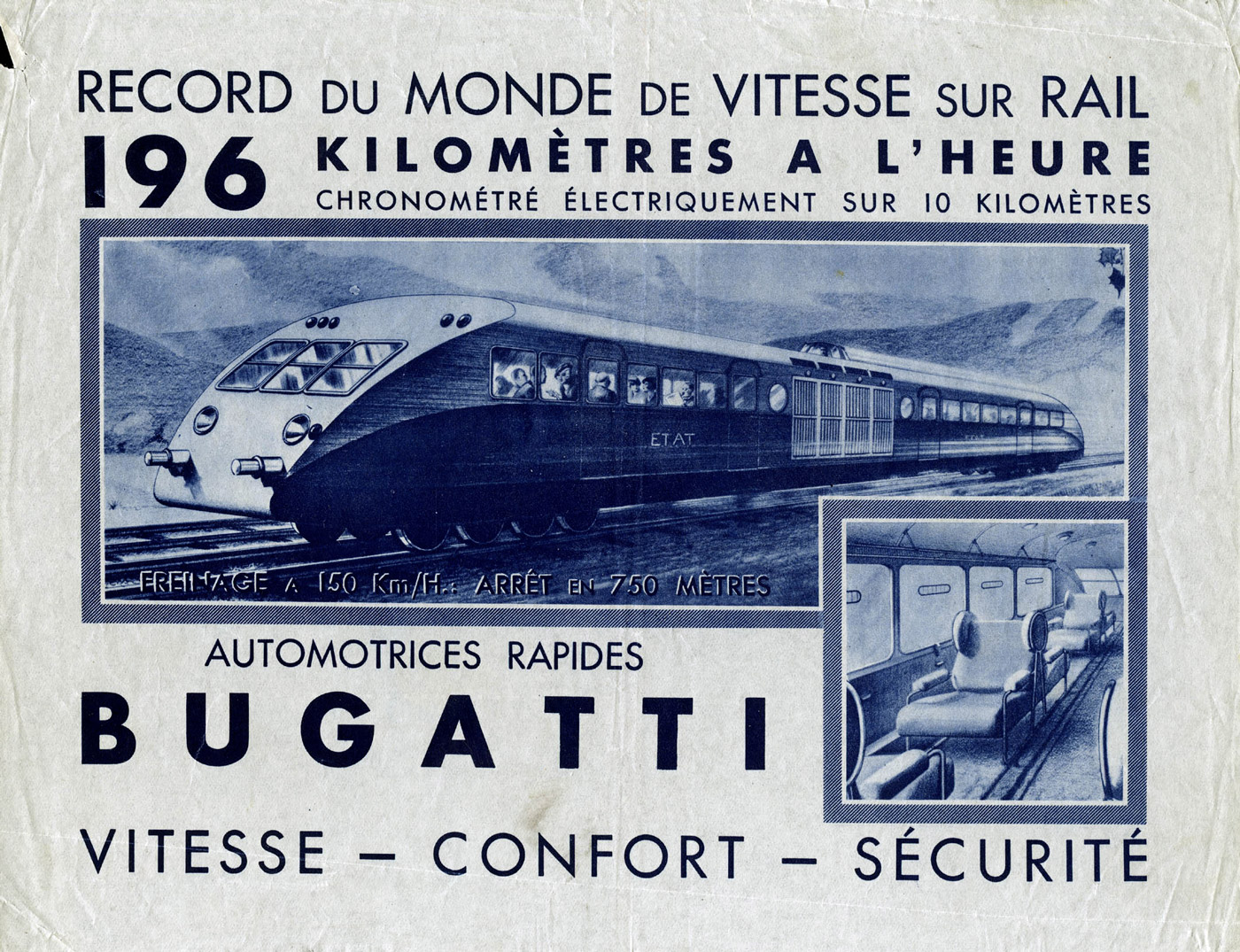
Bugatti Automobiles et Autorails. 1935 - Art by R.Geri

Bugatti Automobiles et Autorails — R. Geri, 1935

One of the rarest original Bugatti posters — printed in Strasbourg by A. Michel on thin paper.
The subject is the Bugatti autorail, the high-speed diesel railcar that Ettore designed for SNCF alongside his automobiles. Geri's full name remains untraced.

The poster is better documented than its maker.
Reproduced from the original.

Divina Bugatti

In 1991, Franco Maria Ricci — the most exacting publisher in Italy — commissioned Roberto Bigano to document the historic Bugatti collection at the Musée National de l'Automobile in Mulhouse.
The resulting book set the visual standard for Bugatti photography. Published in two editions of 5,000 copies each, both sold out.

One image from the session was rejected by Ricci as "not objective." It spent seventeen years in a box. It is now the profile banner of this archive.

The Elephant carved by Rembrandt Bugatti, right on top of the radiator grill of the Type 41 Royale Coupé Napoleon, the personal car of Ettore Bugatti. It was an elephant standing on his back legs, with the erect trunk as a symbol of aggression and coupling (1929) - Courtesy: Musée National de l'Automobile, Mulhouse. Photo by Roberto Bigano. Courtesy: Courtesy: Musée National de l’Automobile Mulhouse. Buy this image at Ikonographia.com store

The Elephant carved by Rembrandt Bugatti, right on top of the radiator grill of the Type 41 Royale Coupé Napoleon, the personal car of Ettore Bugatti.

It was an elephant standing on his back legs, with the erect trunk as a symbol of aggression and coupling (1929).

Courtesy: Musée National de l'Automobile, Mulhouse.

A 1937 Bugatti Type 57SC Coupé Atlantic. Detail of the windshield and wipers emphasizing the riveted crest. Jean Bugatti designed the half-body ending in a crest. He then reverted the first part right-left and finally joined the two pieces with rivets in one of the most daring automotive designs. Photo by Roberto Bigano. Courtesy: British Garage, Paris. Buy this image at Ikonographia.com store

Bugatti Type 57SC Coupé Atlantic — Detail of the riveted crest, 1937.

Jean Bugatti designed the half-body ending in a crest, reversed it, and joined the two halves with rivets — one of the most daring forms in automotive history.

This image and the two Royale photographs were the only non-orthogonal pictures Franco Maria Ricci ever published. He approved them with a stern expression and a warning: "I never publish this kind of image. These are so beautiful that I must. Please don't do it again."

Courtesy: British Garage, Paris

Bugatti Type 35B Sport Two-seater, US Coachwork (1927). Photo by Roberto Bigano. Courtesy: Courtesy: Musée National de l’Automobile Mulhouse. Buy this image at Ikonographia.com store

Bugatti Type 35B Sport Two-seater, US Coachwork — Rear view, 1927.

Purists consider the American coachwork a deviation from the original design.
The photograph disagreed.

Courtesy: Musée National de l'Automobile, Mulhouse.

Bugatti Masterpieces of the 1920s and 1930s

A gallery of the most significant models documented by Roberto Bigano — from the Type 13 Brescia and the Type 35 Grand Prix to the Type 41 Royale and the Type 57 Atlantic. Each model presented with exclusive photography and historical context.

Bugatti Type 35B Grand Prix Biplace Course - Two Seater Racing

Bugatti Type 35B Grand Prix Biplace Course Two-Seater Racing — 1927.

Produced between 1924 and 1930, the Type 35 was phenomenally successful — over 1,000 race victories, 14 weekly wins at its peak, five consecutive Targa Florios from 1925 through 1929. No racing car of its era approached this record.

Photographed at Campogalliano on the rotating platform of the circular building — the same archive that held the factory drawings.
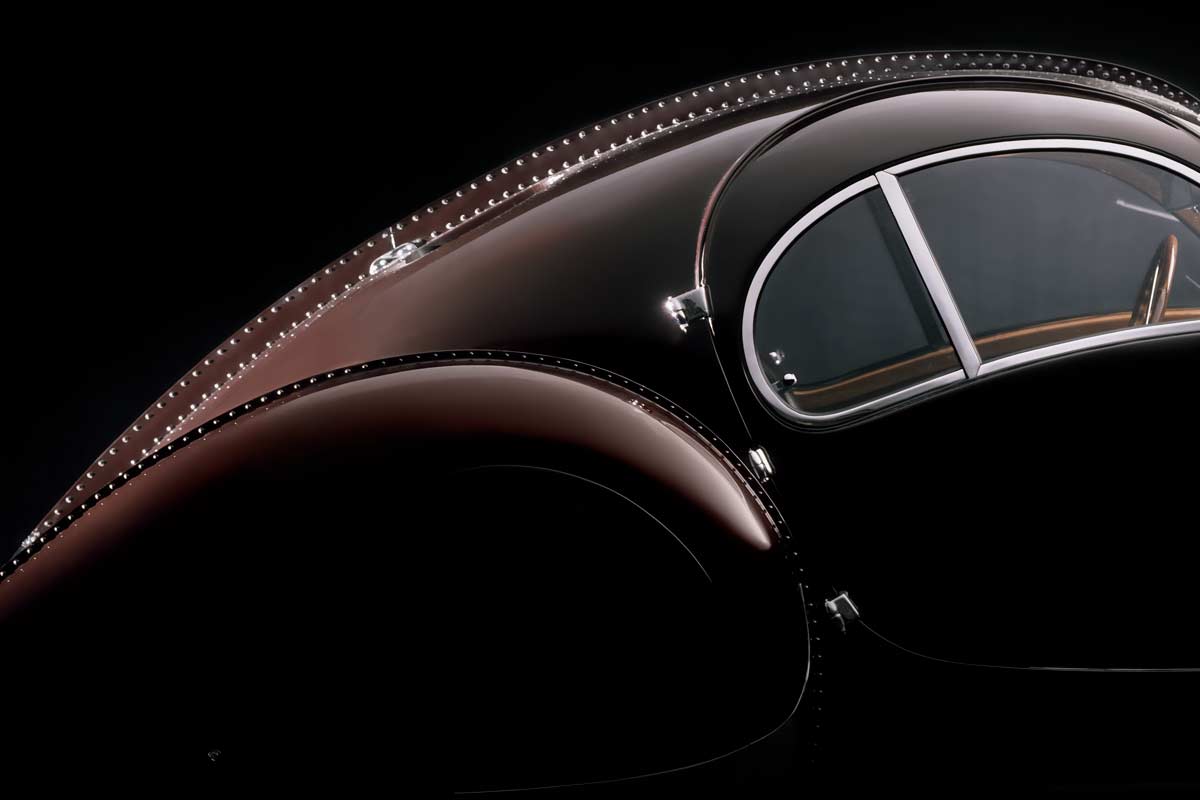
A 1937 Bugatti Type 57SC Coupé Atlantic lightened in silhouette mode to emphasize the flowing coupé lines

Bugatti Type 57SC Coupé Atlantic — Roofline and riveted spine, 1937.

Shot through the night at British Garage, Paris — exhausted, hungry, unable to properly light the riveted crest. My assistant was moving across the set with a Fresnel spot still open. For a moment the light caught the spine exactly as it should. "Stop." The photograph happened.

The dust on the bodywork made it unusable for twenty years, until Photoshop made the restoration possible.

Bugatti Type 32 Biplace Course "Tank" (1923). This striking, unexpected rear view emphasizes the aerodynamics of the design. Photo by Roberto Bigano. Courtesy: Courtesy: Musée National de l’Automobile Mulhouse. Buy this image at Ikonographia.com store

Bugatti Type 32 Biplace Course "Tank" — Rear view, 1923.

One of the first racing cars designed around aerodynamic principles — the body enclosing the wheels, the silhouette a single uninterrupted form.

This rear view reveals the engineering logic: everything hidden, everything intentional. Among the first racing cars to use four-wheel braking.
Courtesy: Musée National de l'Automobile, Mulhouse.

Bugatti Glamour

Four nights of open-air studio sessions during the Centenary celebrations — the historic cars photographed not in a museum but in the hands of their owners, who followed the shoots, helped position the cars, and sometimes stepped in front of the lens themselves.

Roberto Bigano also audio-recorded the owners telling the story of their relationship with the marque. At least four of these recordings are exceptional primary source documents of Bugatti history — among them, the son of the former owner of the silhouetted Atalante.

Bugatti Type 37A, "Flighty" (1928) - Owners, Frederica and Simon Fitzpatrick, Guernsey © Roberto Bigano/ ikonographoa.com Browse the Bugatti Archive https://www.ikonographia.com/archive/the-bugatti-archive/

Bugatti Type 37A "Flighty," 1928. Owners: Frederica and Simon Fitzpatrick, Guernsey.

The Fitzpatricks named and treated their 65 cars as members of the family — from their oldest Bugattis to their latest VW Golf. On the last night of the sessions, Roberto Bigano presented Frederica with a large print of this photograph. She went immediately to show it to the car. "Flighty is enthusiast," she said. Would you sell your son just because he's old?
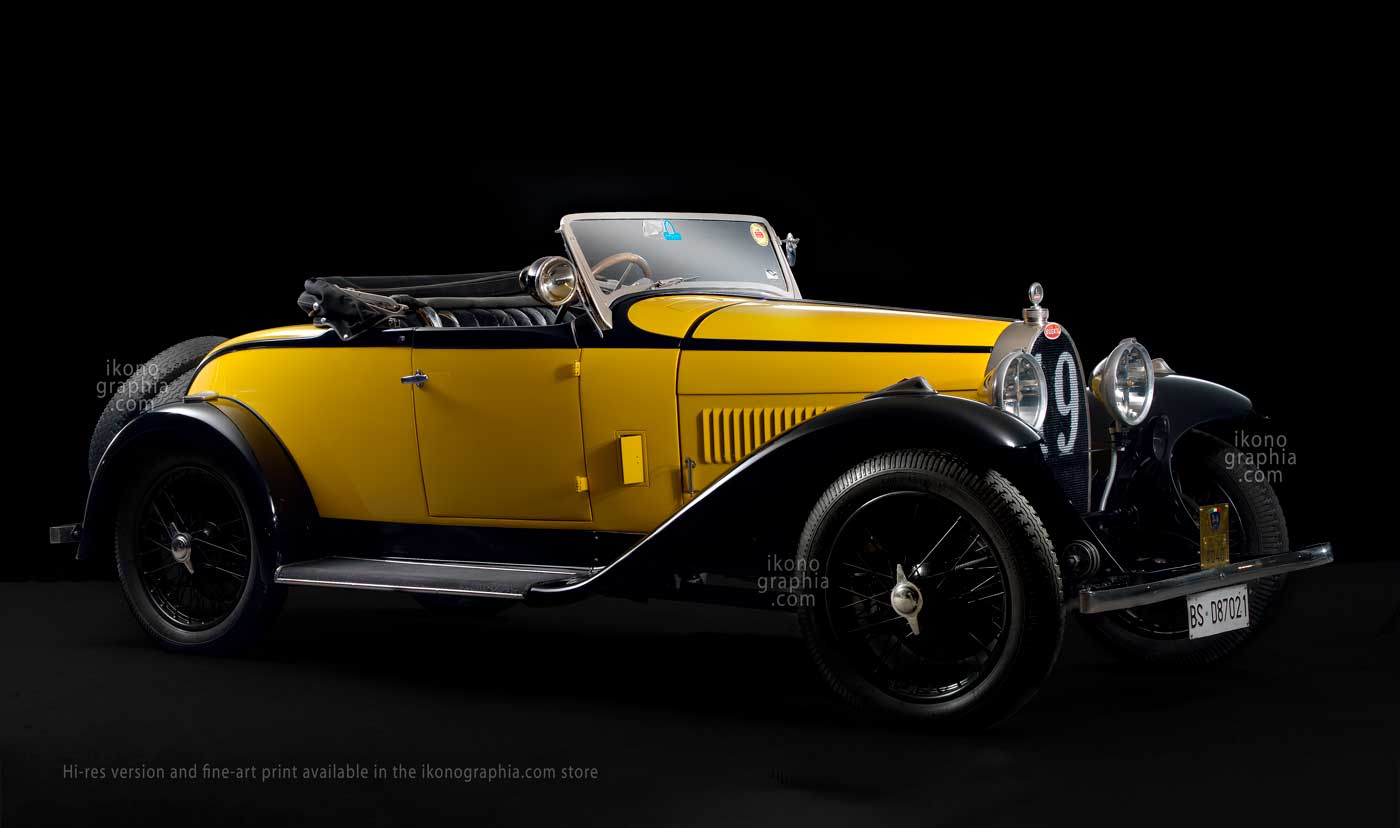
Bugatti Type 40A 1931. Owner Ivanno Frascari, Italy. Photo Roberto Bigano. https://www.ikonographia.com/archive/the-bugatti-archive/

Bugatti Type 40A — Owner: Ivanno Frascari, Italy, 1931.

The yellow and black livery was the factory's own choice — Bugatti's colours from the beginning. Frascari brought it to Castiglione for the Centenary Meeting.

Bugatti Type 57S Atalante 1931 Chassis 001, back view. Owner Franz Wassmer

Bugatti Type 57S Atalante — Chassis 001, 1931. Owner: Franz Wassmer, Switzerland.

Franz Wassmer's father owned the Atalante now held at the Musée National de l'Automobile in Mulhouse. In summer, the car's cabin became unbearably hot. His mother's solution was to rest her feet out of the window. His father's solution was final: "Enlève tes pieds de la fenêtre, sinon je vends la voiture." He sold it.

Franz was a boy. He loved that car. The sale left a wound that decades of ordinary life could not close.

He became a billionaire. He bought Chassis 001.
Roberto Bigano recorded him at Castiglione telling this story. The voice on the recording is not that of a billionaire. It is that of a boy who never stopped wanting his father's car back.

This image and the full account were published in Victor, the Hasselblad magazine.

The Bugatti International Meeting — Tuscany, 2009

Developed with the Bugatti Club Italia and supported by Hasselblad and Manfrotto, this archive followed the historic cars through the Centenary celebrations — in motion, in context, in the hands of their owners.

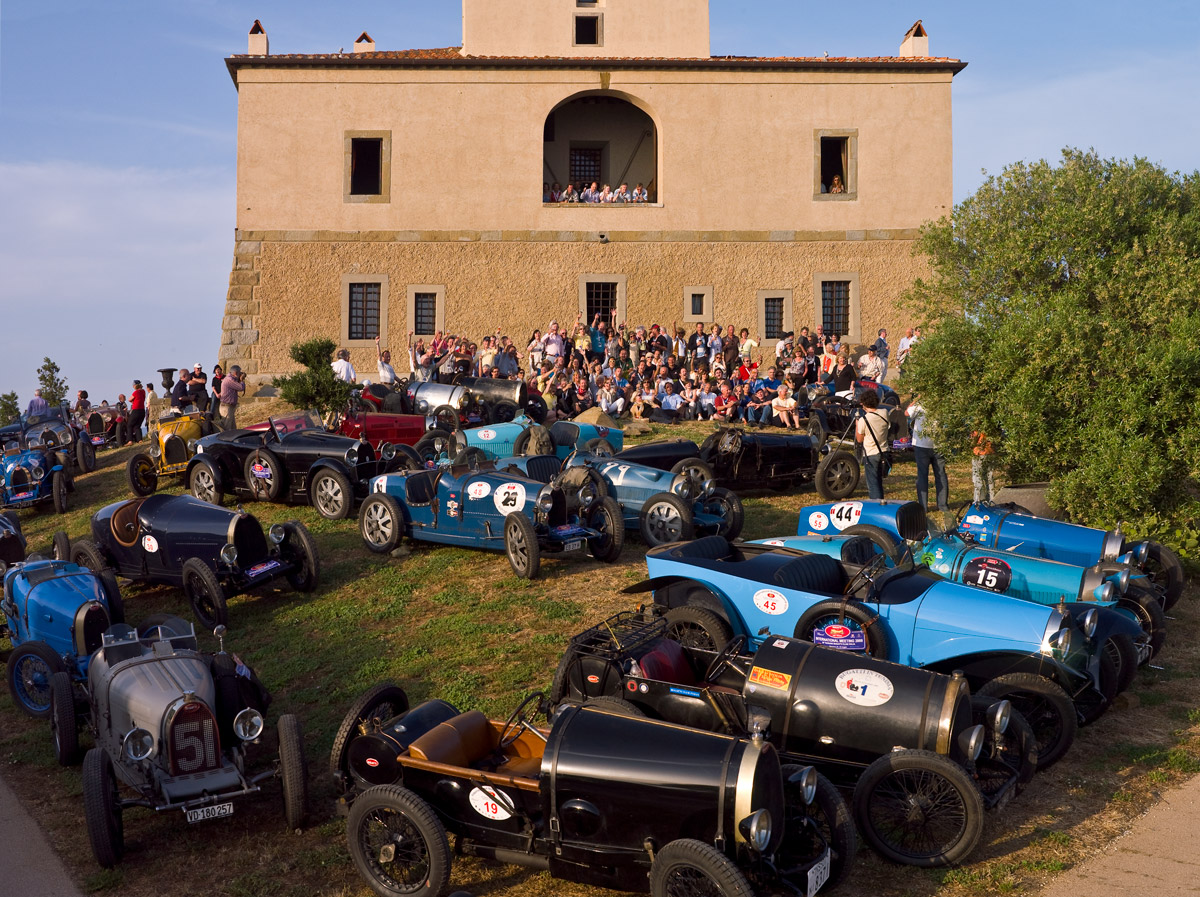
Among its most significant chapters: 120 owners and their cars gathered in Tuscany — on the lawn at Marone-Cinzano, in the medieval piazza of Massa Marittima. The panoramic photograph of that afternoon — 13,000 pixels wide, a single stitched frame — is the most complete document of what the meeting actually was.

0360-13 Mannequin in a shop window in Braunschweig, Germany, September 1979 | From "Plastic Girls" series. Photo by Roberto Bigano. Buy this image in the ikonographia.com store.

Bugatti International Meeting — Piazza Garibaldi, Massa Marittima, Tuscany, 2009.

One hundred and twenty Bugattis gathered in a medieval piazza in front of a thirteenth-century cathedral. Owners from across the world — Europe, the Americas, Australia.

Detail of Bugatti’s Monobloc Cast Aluminum Wheel drawing, dated July 27, 1932 (Roue Bugatti brevetée en aluminium coulé).

Bugatti International Meeting — Marone-Cinzano Estate, Tuscany, 2009

The Bugatti Centenary. Two hundred and fifty owners gathered from across the world on one of Tuscany's great estates — lunching under the cypresses, Brunello di Montalcino on the table. On the lawn, 125 historic Bugattis on open display: the largest gathering of the marque ever assembled in one place.

Documented from above, stitching multiple Hasselblad frames from a 12-metre tripod into a single panoramic frame 13,000 pixels wide. An event that will not happen again, recorded as it deserved to be.
Bugatti Type 57S Atalante 1931 Chassis 001, back view. Owner Franz Wassmer

Bugatti International Meeting — Castello Colle Massari, Tuscany, 2009.

A stop at a medieval fortress in the Maremma — a toast, the cars clustered on the grass, the owners still laughing. No programme, no ceremony. Just two hundred and fifty people who shared the same unreasonable passion, in one of the most beautiful corners of Tuscany, at the end of a Bugatti day.

A collective portrait that needed no posing.

The Spirit of Bugatti — Alsace, 1990

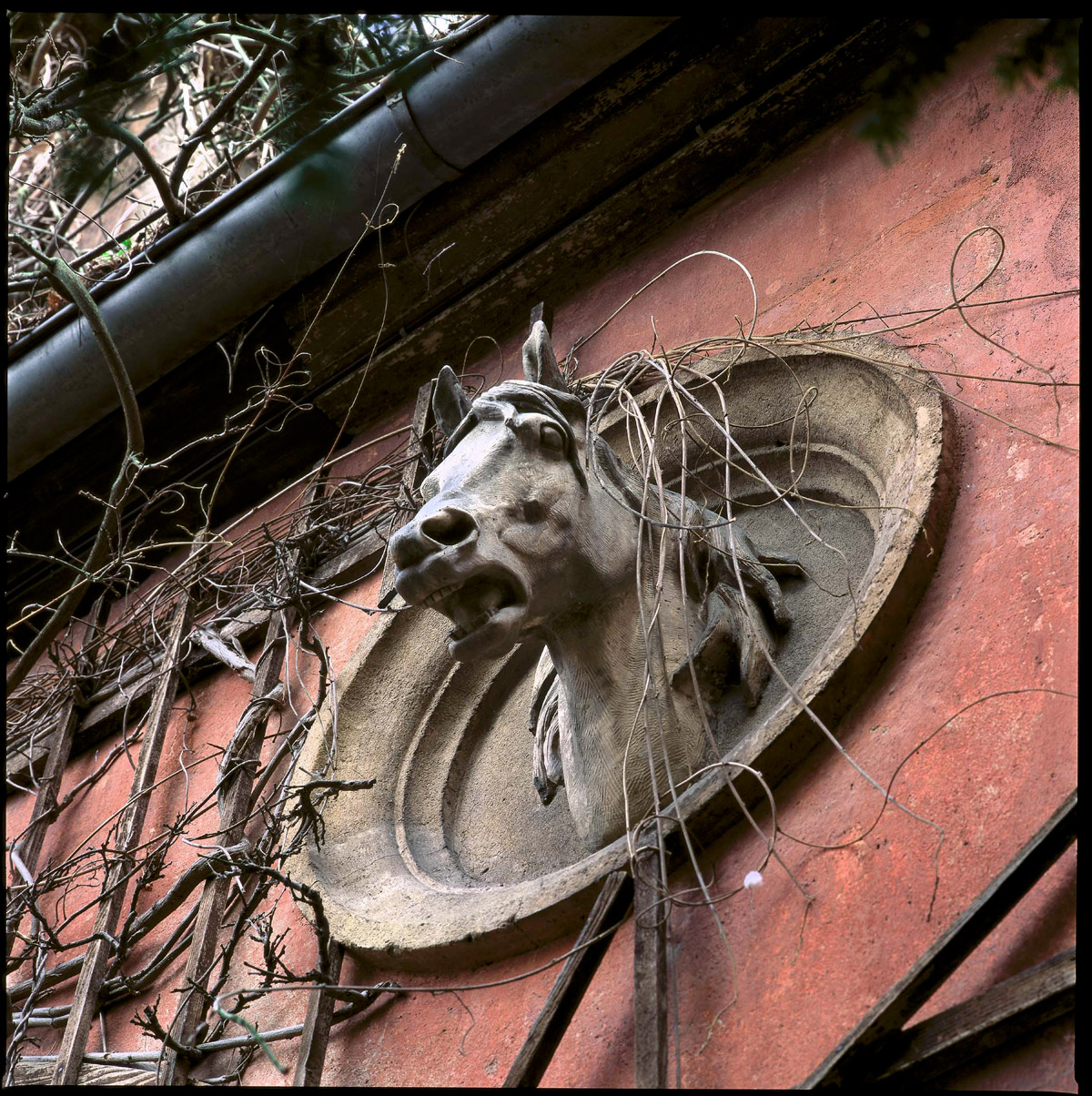
Before the restoration of Molsheim began, Roberto Bigano documented what remained of the original Bugatti world — the factory, the château, the surroundings — in the last months before Bugatti Automobili's revival would briefly transform it. The horse on the wall of Château Saint-Jean, tangled in dead vines: Ettore's symbol surviving in a building no one was looking after.

Bugatti Type 57S Atalante 1931 Chassis 001, back view. Owner Franz Wassmer

The Portal of Château Saint-Jean — Molsheim, Alsace, 1990.

The entrance to Ettore Bugatti's former headquarters — once the center of an estate with workshops, a hotel, and a way of receiving clients that had no equivalent in the industry. If your car needed attention, you came to Molsheim. You were a guest until it was ready.

Photographed a year before the revival began. The portal was still standing. Not much else was.
Detail of Bugatti’s Monobloc Cast Aluminum Wheel drawing, dated July 27, 1932 (Roue Bugatti brevetée en aluminium coulé).

Château Saint-Jean, Molsheim, Alsace, 1990 — Ettore Bugatti's horse.

Ettore Bugatti bred thoroughbreds at Molsheim with the same obsessive standards he applied to his cars. The horse was his personal symbol — cast into the wall of Château Saint-Jean, the domain's heart, where it had presided over the estate for decades.

By 1990, no one was looking after it. The vines had grown across the facade and through the relief itself, threading through the stone as if reclaiming it. The building was between two lives.

The image was never published. It was never proposed as the symbol of the rebirth it was about to witness. It should have been.

Copyright, Links And Credits

Photography, Copyright & Credits

These images are part of the Ikonographia Visual Archives: — Bugatti Heritage Collection —  Bugatti Factory Drawings  Archive.
All drawings reproduced by Roberto Bigano in 1990 from originals held in the Bugatti factory archive. The current location of the originals is unknown.
All photographs © Ikonographia / Roberto Bigano — All Rights Reserved.

Terms of Use (Summary)

The images presented in this archive are copyrighted and available for licensed use only through Ikonographia Visual Archives.

You may not download, reproduce, publish, or distribute these images without a valid license. For commercial or editorial licensing, please refer to the product pages or contact Ikonographia directly. A full explanation of licensing terms is available in the Shop / Licensing Information section under "Ikonographia — Standard License" and "Ikonographia — Merchandising & Product Use Licenses"

The Ikonographia Bugatti Heritage Archive

Between 1990 and 2009, photographer Roberto Bigano documented Bugatti with a level of access that no longer exists and cannot be replicated. The relationship began with Romano Artioli — the Italian entrepreneur who had just acquired the Bugatti name and was preparing its revival at Campogalliano — who gave Roberto carte blanche to work inside the factory, the archive, and every event that followed. No brief. No restrictions. No supervision.

What resulted is not a single project but five distinct bodies of work: the factory technical drawings reproduced before they disappeared, two major photographic commissions on the historic cars, a complete documentary record of the Bugatti International Centenary Meeting in Tuscany, and an Alsatian reportage made inside Molsheim before the restoration began. Together they form one of the most complete private archives of Bugatti heritage in existence — most of it unpublished until now, some of it available nowhere else.

The archive is not a celebration of the marque. It is a record made by someone who was trusted enough to be inside it, at the precise moment when its past and its future were in the same room.

Credits & Acknowledgments

Ikonographia gratefully acknowledges the fundamental contribution of Romano Artioli, founder of Bugatti Automobili, without whose trust and unrestricted access this archive would not exist.

Ikonographia Mission Statement

Ikonographia is committed to the accurate documentation, preservation, and ethical dissemination of twentieth-century visual culture.

Archival Notes

These drawings were reproduced by Roberto Bigano in 1990, during the preparation for the revival of Bugatti Automobili at Campogalliano. Access to the Bugatti factory archive was granted by Romano Artioli. The drawings document the original Molsheim factory production.

Further Reading (Selected Sources)

The Kellogg Kids, by Leyendecker. Corn Flakes Ads 1916-1917

The Kellogg Kids, by Leyendecker. Corn Flakes Ads 1916-1917

Illustration

Jul 30, 2025

J.C.Leyendecker-Kellog's-Kid

Joseph Christian Leyendecker


Joseph Christian Leyendecker was one of the most prominent and financially successful freelance commercial artists in the United States. From 1895 to 1951, he created hundreds of magazine covers for "Collier's Weekly" and "The Saturday Evening Post," as well as advertisements for prominent brands such as Kellogg's Corn Flakes, Kuppenheimer, and Arrow shirts. This last work is particularly famous, as it helped establish an iconic image of sophisticated American masculinity.
Leyendecker was also one of the few openly gay artists working in the United States during the early twentieth century.

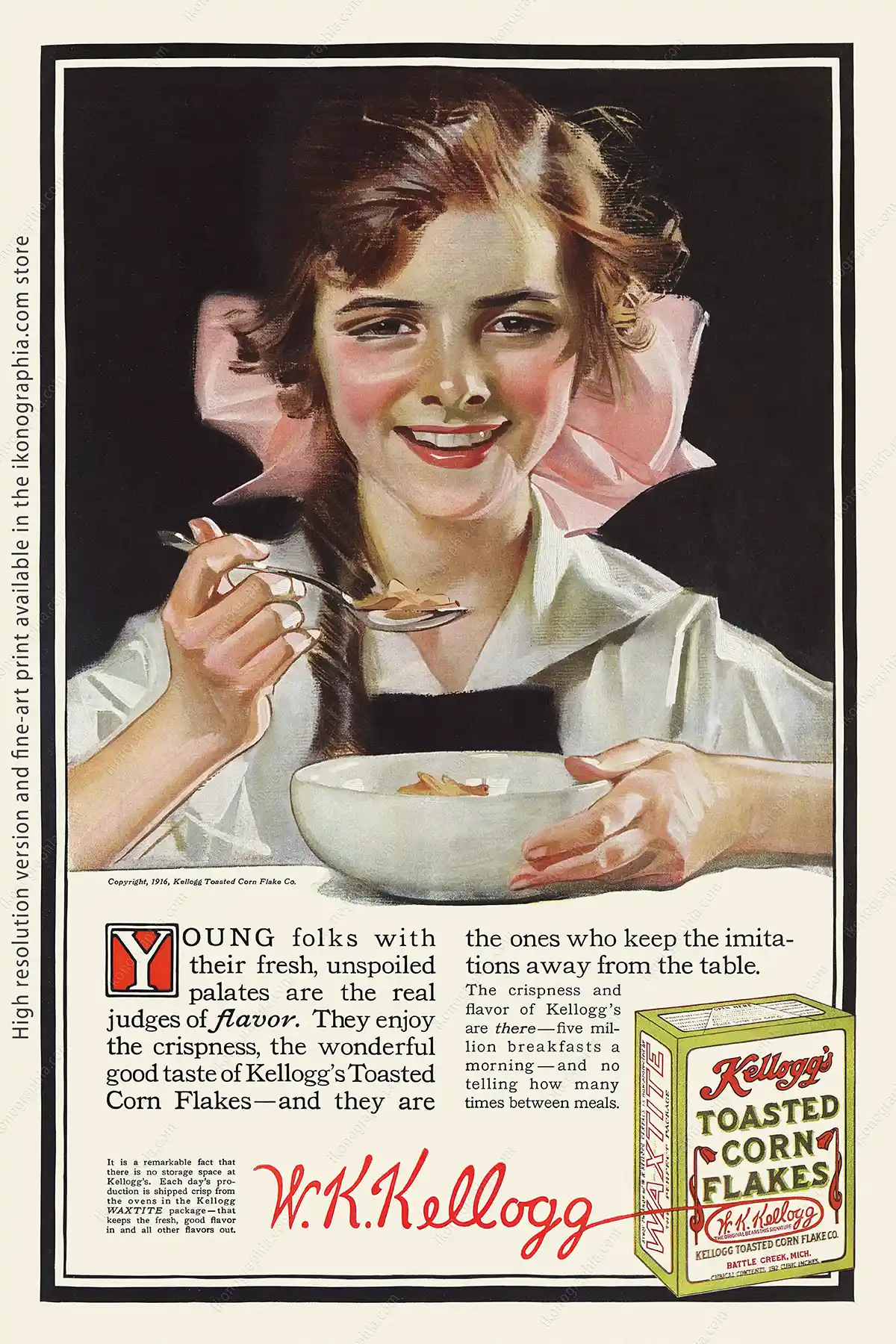
Leyendecker's Young girl judging the flavor and crispness of flakes. Kellogg's ad, 1916

"Young folks with their fresh, unspoiled palates are the real judges of flavor. They enjoy the crispness, the wonderful good taste of Kellogg's Toasted Corn Flakes—and they are the ones who keep the imitations away from the table."

Advertisement for Kellogg's Corn Flakes.
Artwork by Joseph Christian Leyendecker.

Ladies’ Home Journal, February 1916

Leyendecker kids' illustration for Kellogg's Cornflakes, 1916 and 1917.


We showcase here Leyendecker's illustration for Kellogg's Corn Flakes' advertising campaign, which ran in the Ladies' Home Journal magazine in 1916 and 1917.
The extremely vivid illustrations convey positivity, health, and joy.
His illustration technique was remarkable, often utilizing complementary colors such as magenta/green, which reminds us of Italian late Middle Ages masters like Giotto, as shown in some close-ups.

It is notable for being one of the first advertising campaigns (together with Queen City Inks and Overland) to maintain a consistent corporate image.

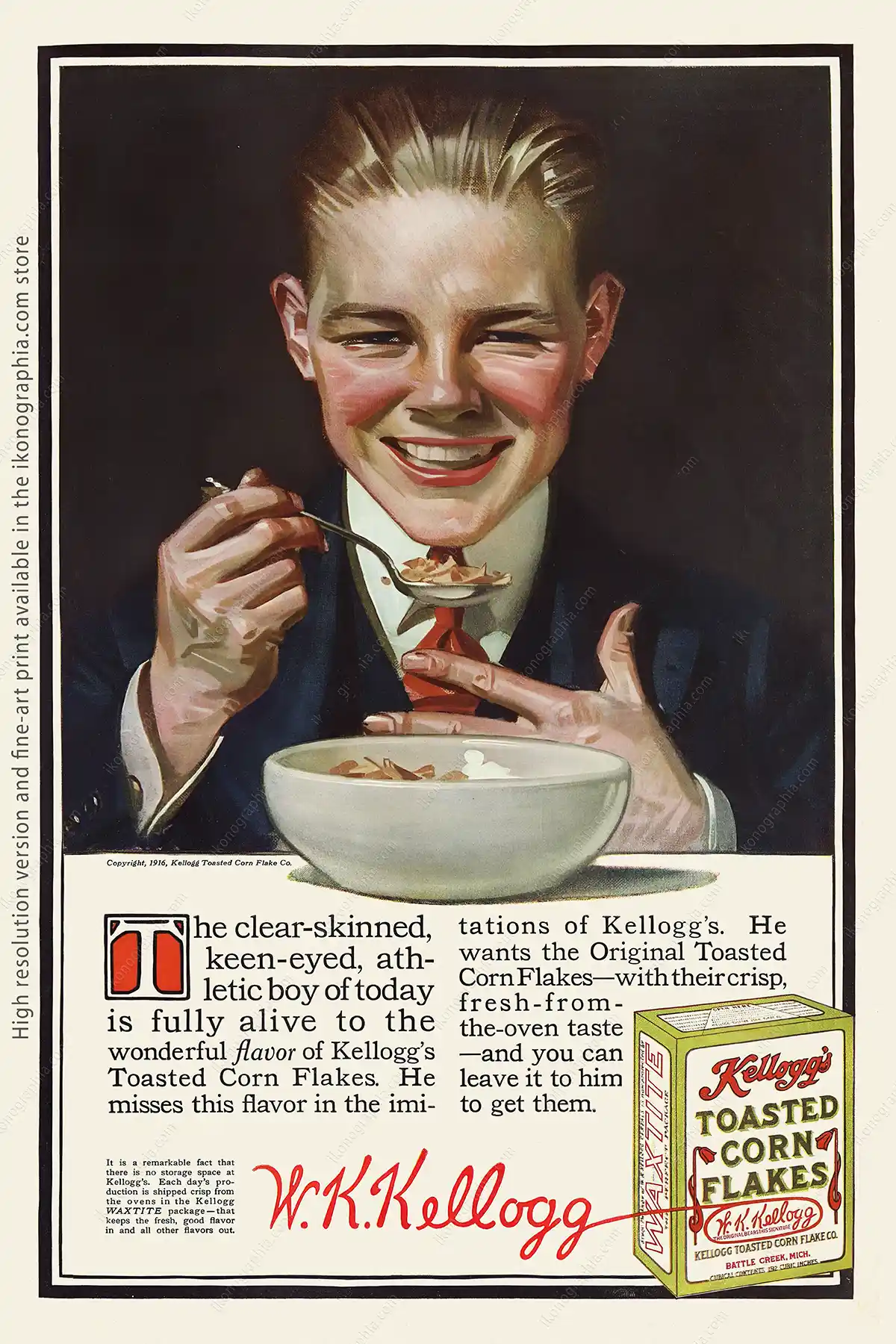
Leyendecker's clear-skinned boy enjoying corn flakes with milk. Kellogg ad, 1916 Advertisement for Kellogg's Corn flakes. Artwork by Joseph Christian Leyendecker. Ladies' Home Journal, March 1916

"The clear-skinned, keen-eyed, athletic boy of today is fully alive to the wonderful flavor of Kellogg's Toasted Corn Flakes."

Advertisement for Kellogg’s Corn Flakes.
Artwork by Joseph Christian Leyendecker.

Ladies’ Home Journal, March1916

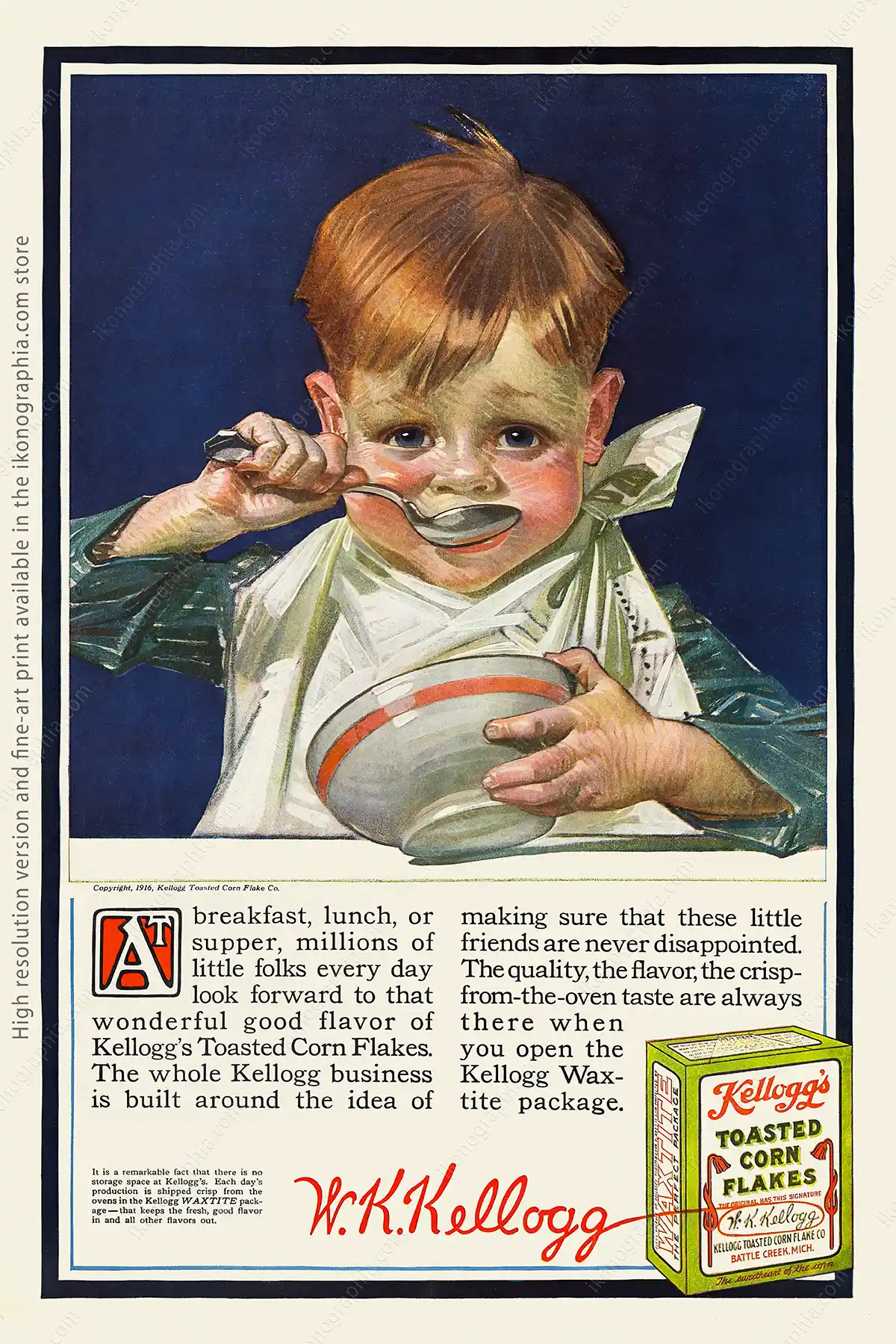
Advertisement for Kellogg's Corn flakes. Artwork by Joseph Christian Leyendecker. Ladies' Home Journal, April 1916

"At breakfast, lunch, or supper, millions of little folks every day look forward to that wonderful good flavor of Kellogg's Toasted Corn Flakes."

Advertisement for Kellogg’s Corn Flakes.
Artwork by Joseph Christian Leyendecker.

Ladies’ Home Journal, April 1916

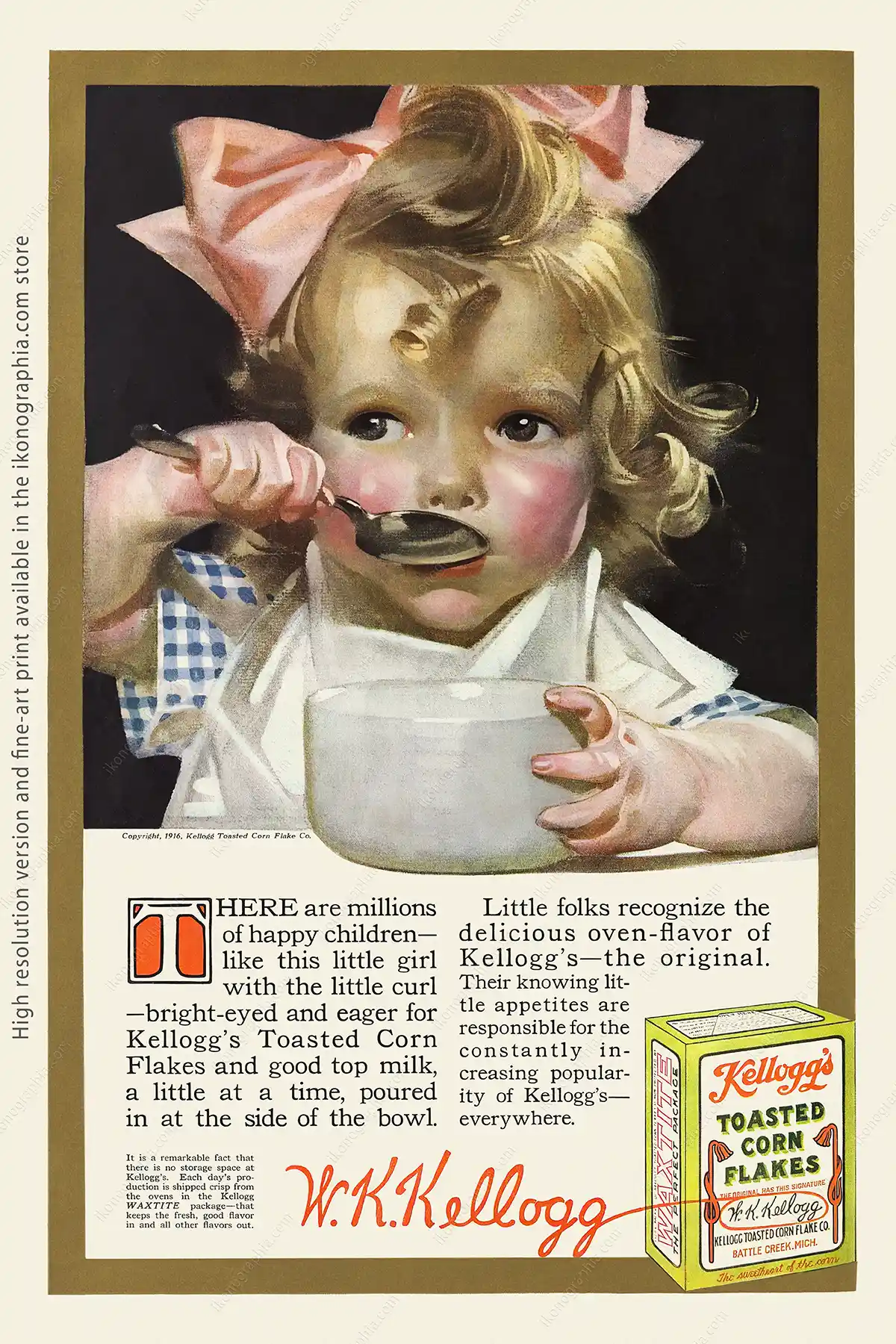
Leyendecker's baby girl enjoying cornflakes breakfast. Kellogg's ad, 1916

"There are millions of happy children like this little girl with the little curl, bright-eyed and eager for Kellogg’s Toasted Corn Flakes and good top milk, a little at a time, poured in at the side of the bowl."

Advertisement for Kellogg’s Corn Flakes.
Artwork by Joseph Christian Leyendecker.

Ladies’ Home Journal, May 1916

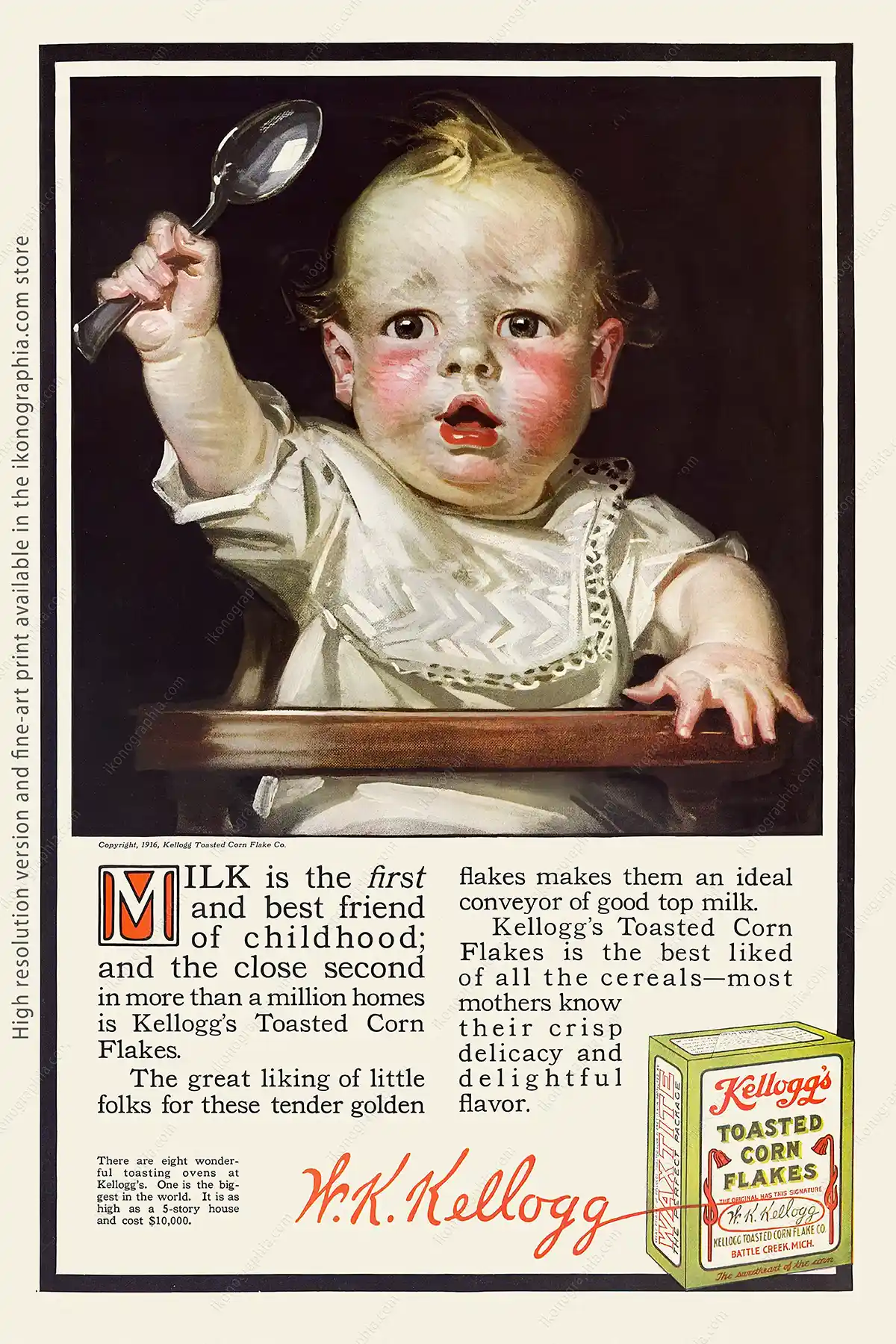
Leyendecker's baby claiming for milk and flakes. Kellogg ad, 1916 Advertisement for Kellogg's Corn flakes. Artwork by Joseph Christian Leyendecker. Ladies' Home Journal, June 1916

"Milk is the first and best friend of childhood; and the close second in more than a million homes is Kellogg's Toasted Corn Flakes. The great liking of little folks for these tender golden flakes makes them an ideal conveyor of good top milk."

Advertisement for Kellogg’s Corn Flakes.
Artwork by Joseph Christian Leyendecker.

Ladies’ Home Journal, June 1916

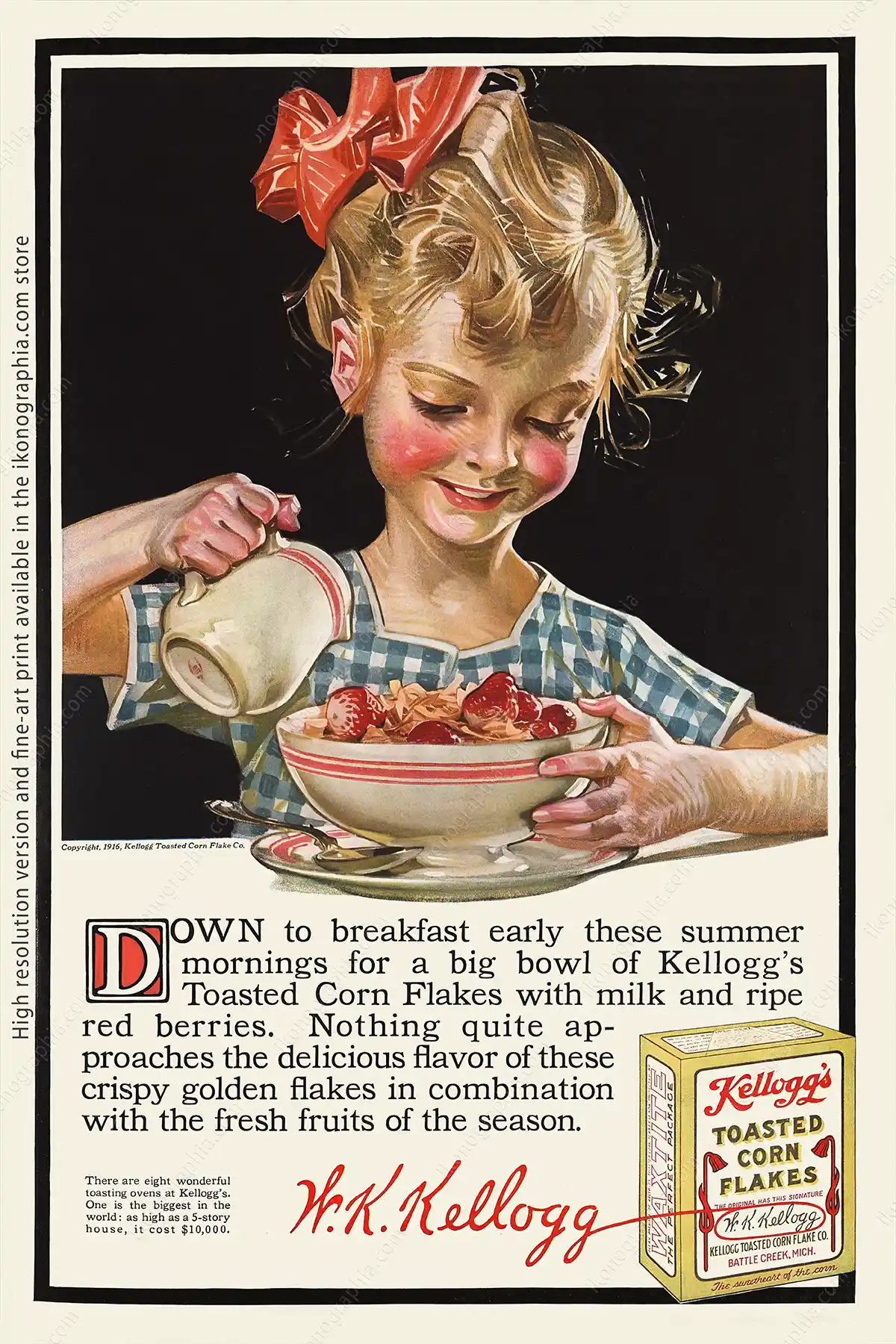
Leyendecker's Young girl enjoying corn flakes with milk and fresh fruits. Kellogg's ad, 1916 Advertisement for Kellogg's Corn flakes. Artwork by Joseph Christian Leyendecker. Ladies' Home Journal, July 1916

"Down to breakfast early these summer mornings for a big bowl of Kellogg's Toasted Corn Flakes with milk and ripe red berries. Nothing quite approaches the delicious flavor of these crispy golden flakes in combination with the fresh fruits of the season."

Advertisement for Kellogg’s Corn Flakes.
Artwork by Joseph Christian Leyendecker.

Ladies’ Home Journal, July 1916

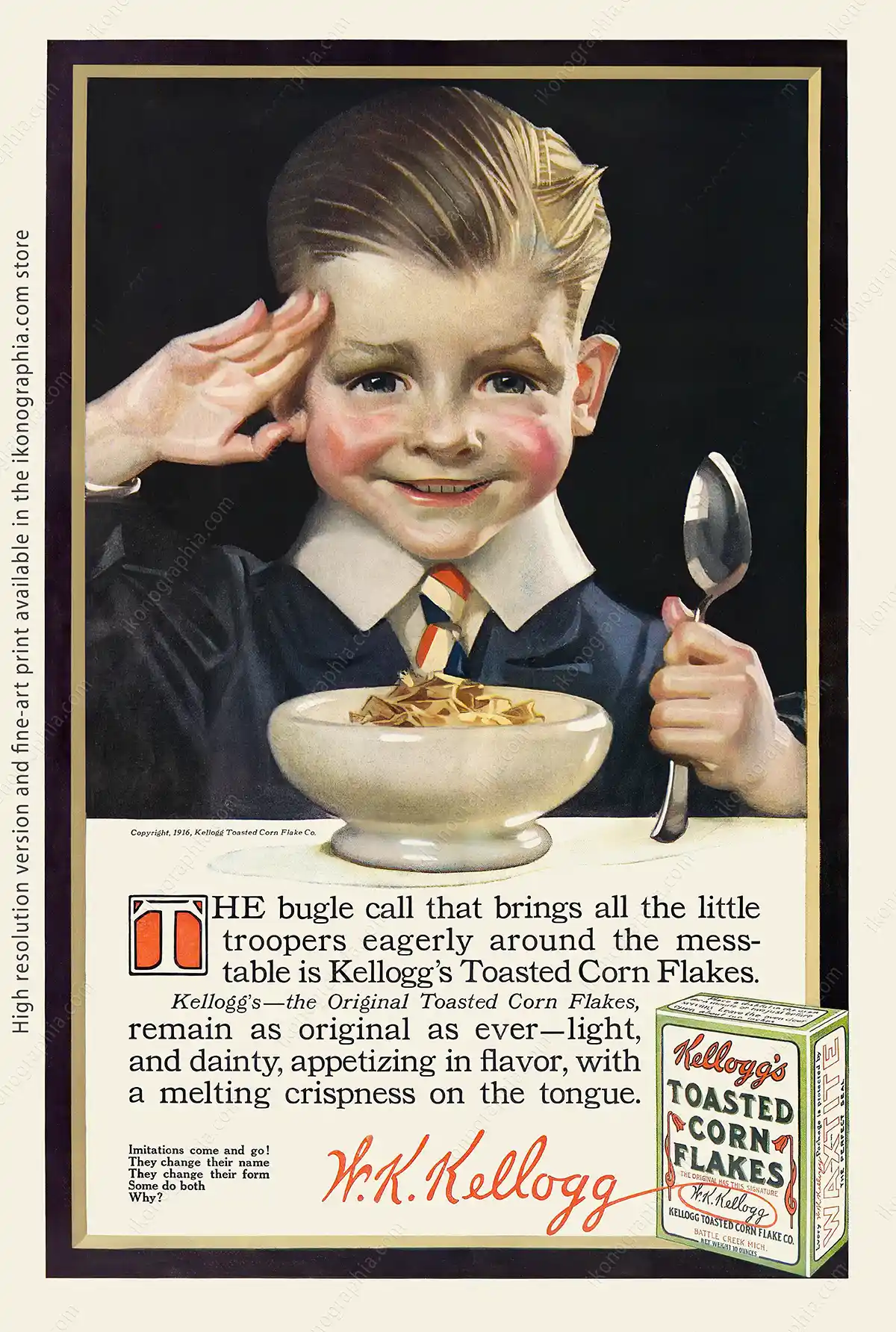
The bugle call brings little troopers eagerly around the messtable. Kellogg's ad by Leyendecker, 1916 Advertisement for Kellogg's Corn flakes. Artwork by Joseph Christian Leyendecker. Ladies' Home Journal, September 1916 THE bugle call that brings all the little troopers eagerly around the mess-table is Kellogg's Toasted Corn Flakes. Kellogg's—the Original Toasted Corn Flakes, remain as original as ever–light, and dainty, appetizing in flavor, with a melting crispness on the tongue.

"The bugle call that brings all the little troopers eagerly around the mess-table is Kellogg's Toasted Corn Flakes. Kellogg's—the Original Toasted Corn Flakes, remain as original as ever–light, and dainty, appetizing in flavor, with a melting crispness on the tongue."

Advertisement for Kellogg’s Corn Flakes.
Artwork by Joseph Christian Leyendecker.

Ladies’ Home Journal, September 1916

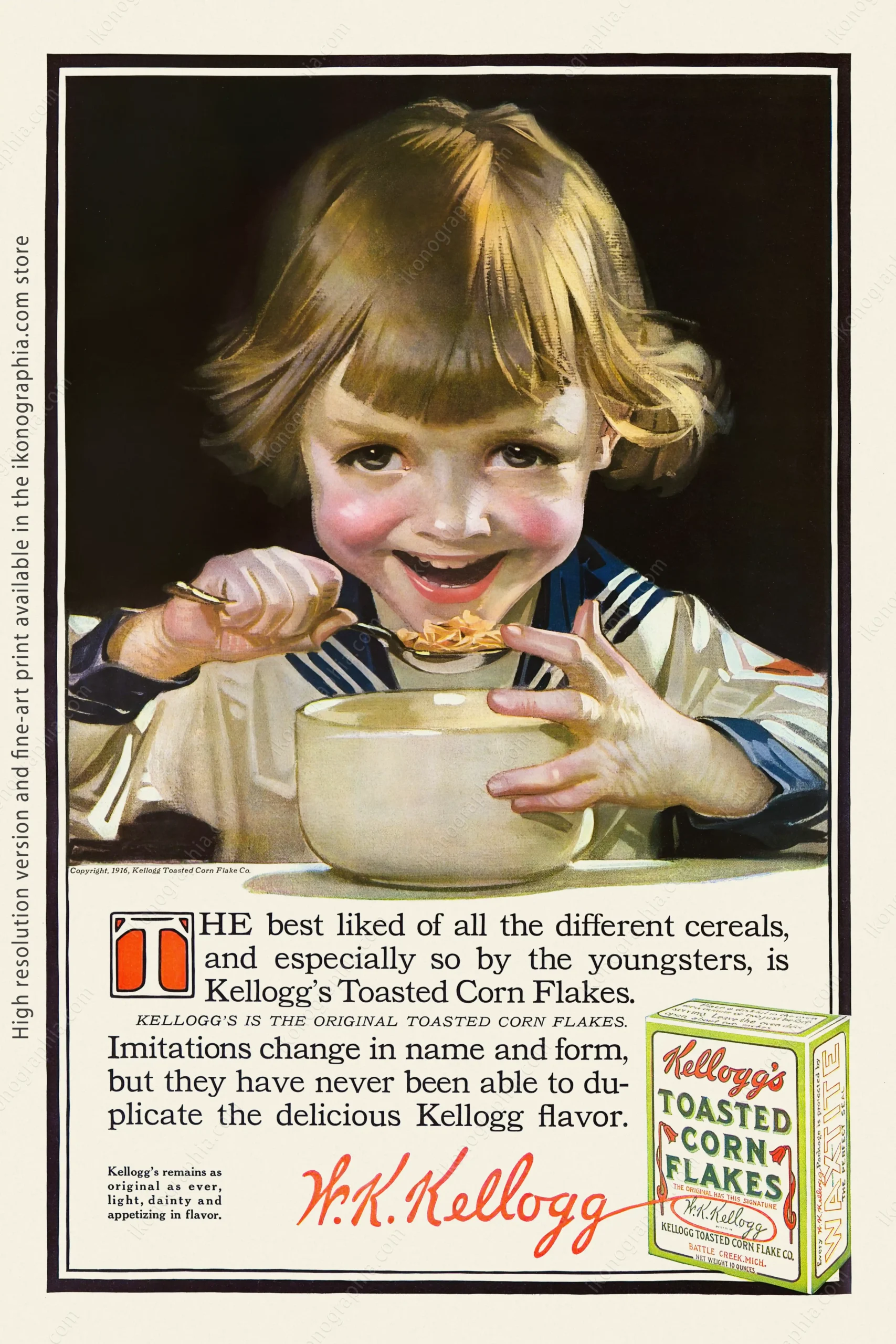
The best liked of all cereals by the youngster. Kellogg's ad by Leyendecker, 1916 Advertisement for Kellogg's Corn flakes. Artwork by Joseph Christian Leyendecker. Ladies' Home Journal, October 1916

"The best liked of all the different cereals, and especially so by the youngsters, is Kellogg's Toasted Corn Flakes."

Advertisement for Kellogg’s Corn Flakes.
Artwork by Joseph Christian Leyendecker.

Ladies’ Home Journal, October 1916

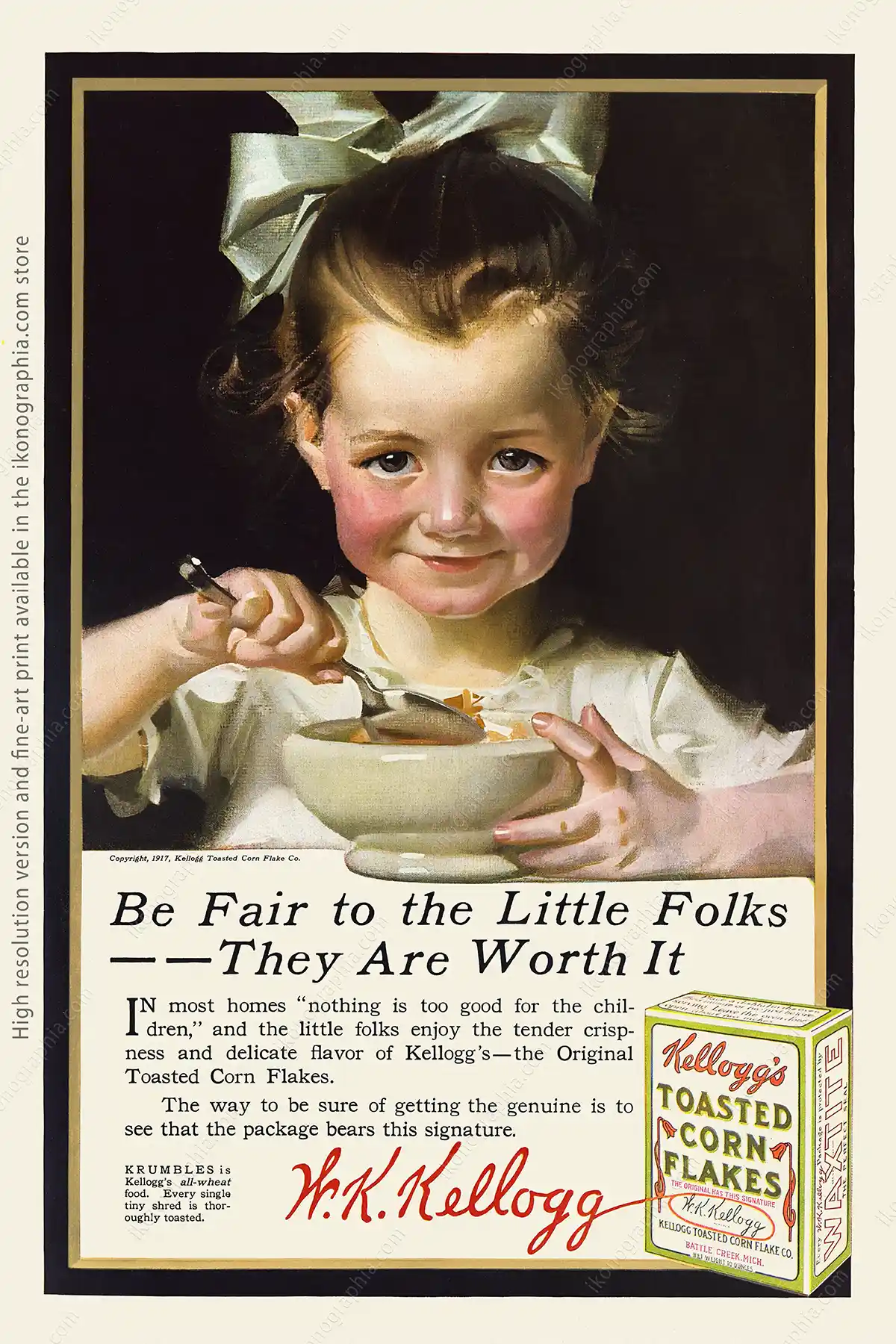
Be Fair to the Little Folks - They Are Worth It. Kellogg's ad by Leyendecker, 1917 Advertisement for Kellogg's Corn Flakes. Artwork by Joseph Christian Leyendecker. Ladies' Home Journal, March 1917

"Be Fair to the Little Folks They Are Worth It. In most homes "nothing is too good for the children," and the little folks enjoy the tender crispness and delicate flavor of Kellogg's the Original Toasted Corn Flakes."

Advertisement for Kellogg’s Corn Flakes.
Artwork by Joseph Christian Leyendecker.

Ladies’ Home Journal, March 1917

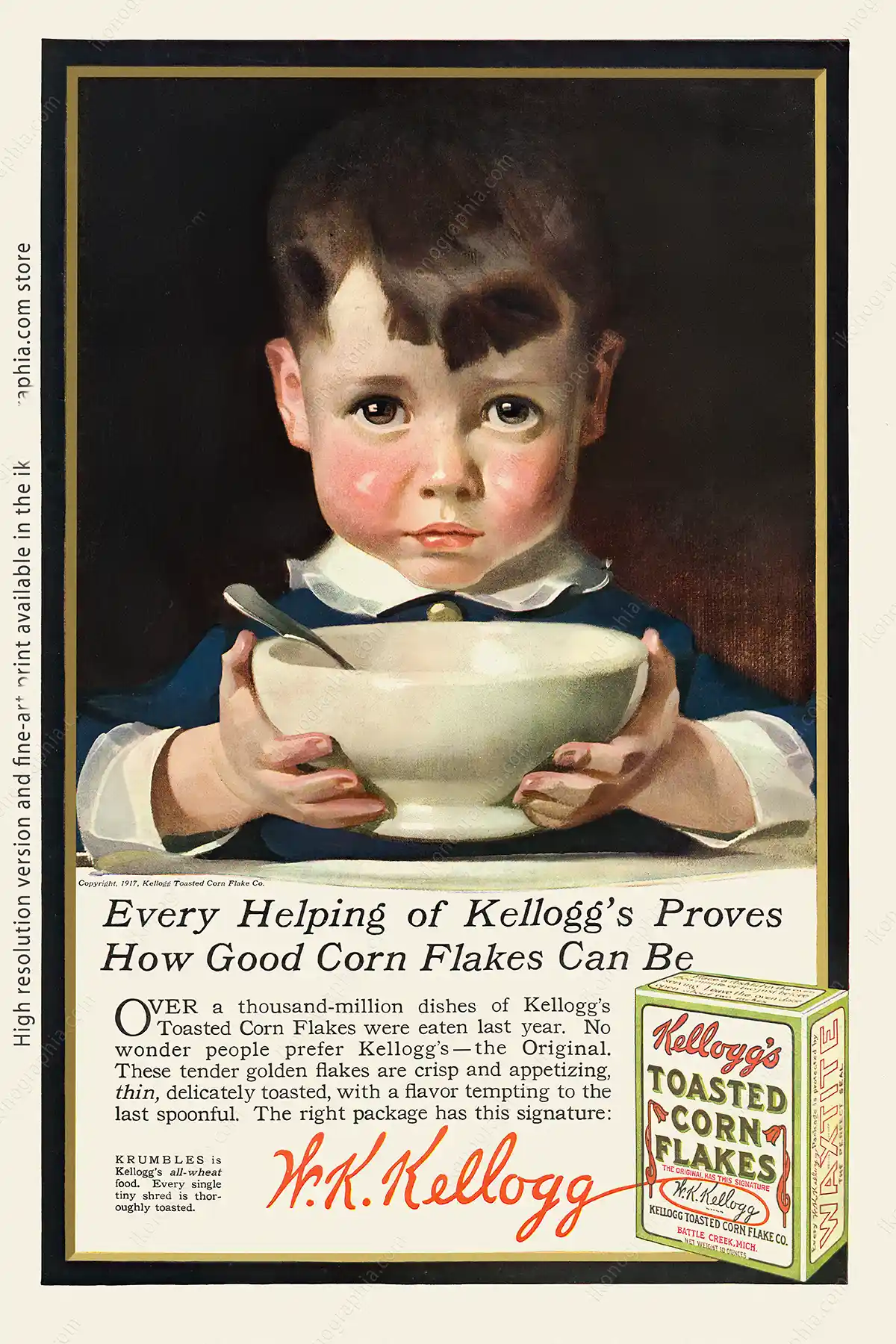
Every Helping of Kellogg's Proves How Good Corn Flakes Can Be, by Leyendecker 1917 Advertisement for Kellogg's Corn Flakes. Artwork by Joseph Christian Leyendecker. Ladies' Home Journal, April 1917

"Every Helping of Kellogg's Proves How Good Corn Flakes Can Be. Over a thousand-million dishes of Kellogg's Toasted Corn Flakes were eaten last year. No wonder people prefer Kellogg's—the Original. 

Advertisement for Kellogg’s Corn Flakes.
Artwork by Joseph Christian Leyendecker.

Ladies’ Home Journal, April 1917

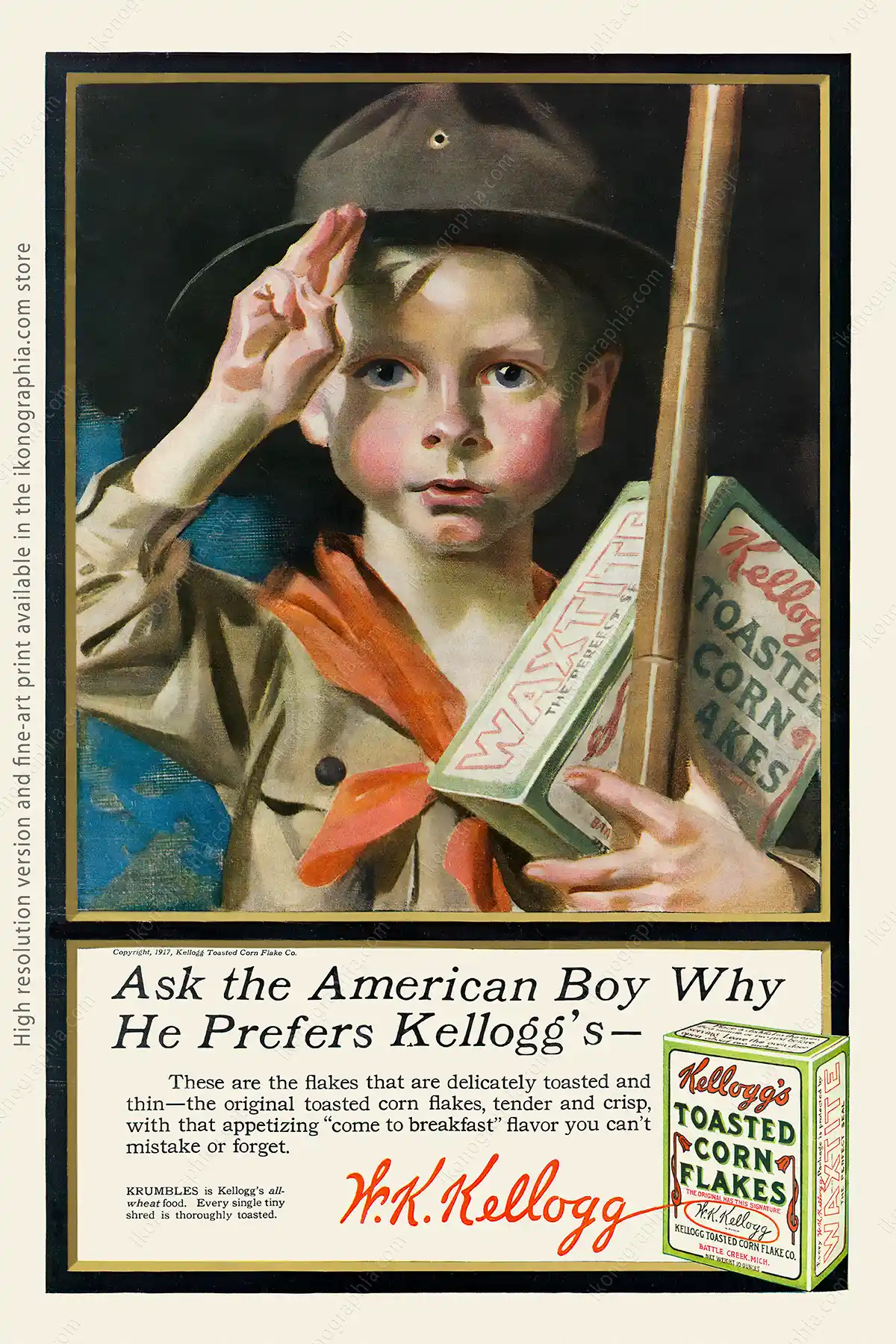
Ask the American Boy Why He Prefers Kellogg. Artwork by Leyendecker, 1917 Advertisement for Kellogg's Corn Flakes. Artwork by Joseph Christian Leyendecker. Ladies' Home Journal, May 1917

"Ask the American Boy Why He Prefers Kellogg — These are the flakes that are delicately toasted and thin the original toasted corn flakes, tender and crisp, with that appetizing "come to breakfast" flavor you can't mistake or forget."

Advertisement for Kellogg’s Corn Flakes.
Artwork by Joseph Christian Leyendecker.

Ladies’ Home Journal, May 1917

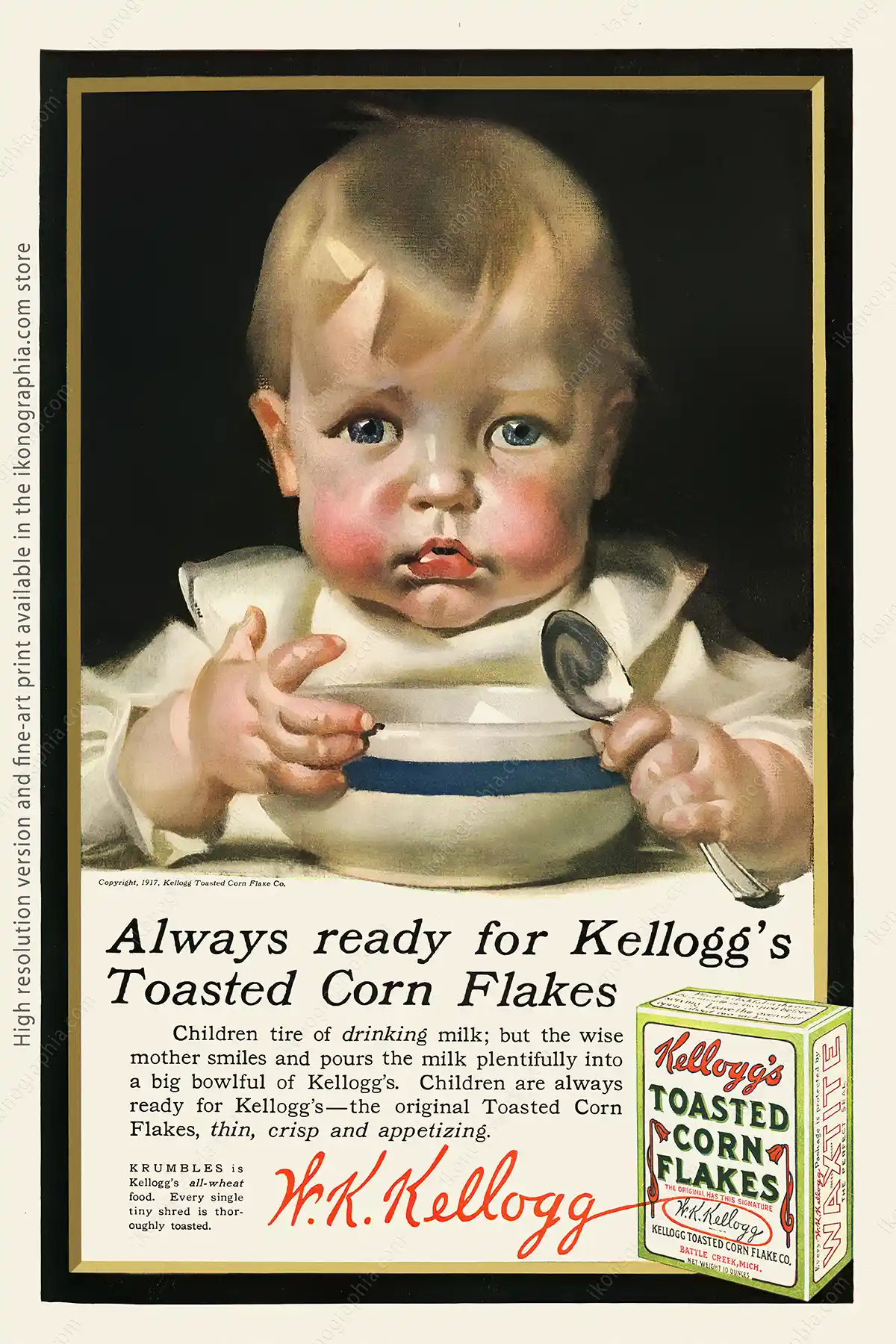
Always ready for Kellogg's Toasted Corn Flakes. Artwork by Leyendecker, 1917 Advertisement for Kellogg's Corn Flakes. Artwork by Joseph Christian Leyendecker. Ladies' Home Journal, June 1917

"Always ready for Kellogg's Toasted Corn Flakes.
Children tire of drinking milk; but the wise mother smiles and pours the milk plentifully into a big bowlful of Kellogg's.

Advertisement for Kellogg’s Corn Flakes.
Artwork by Joseph Christian Leyendecker.

Ladies’ Home Journal, June 1917

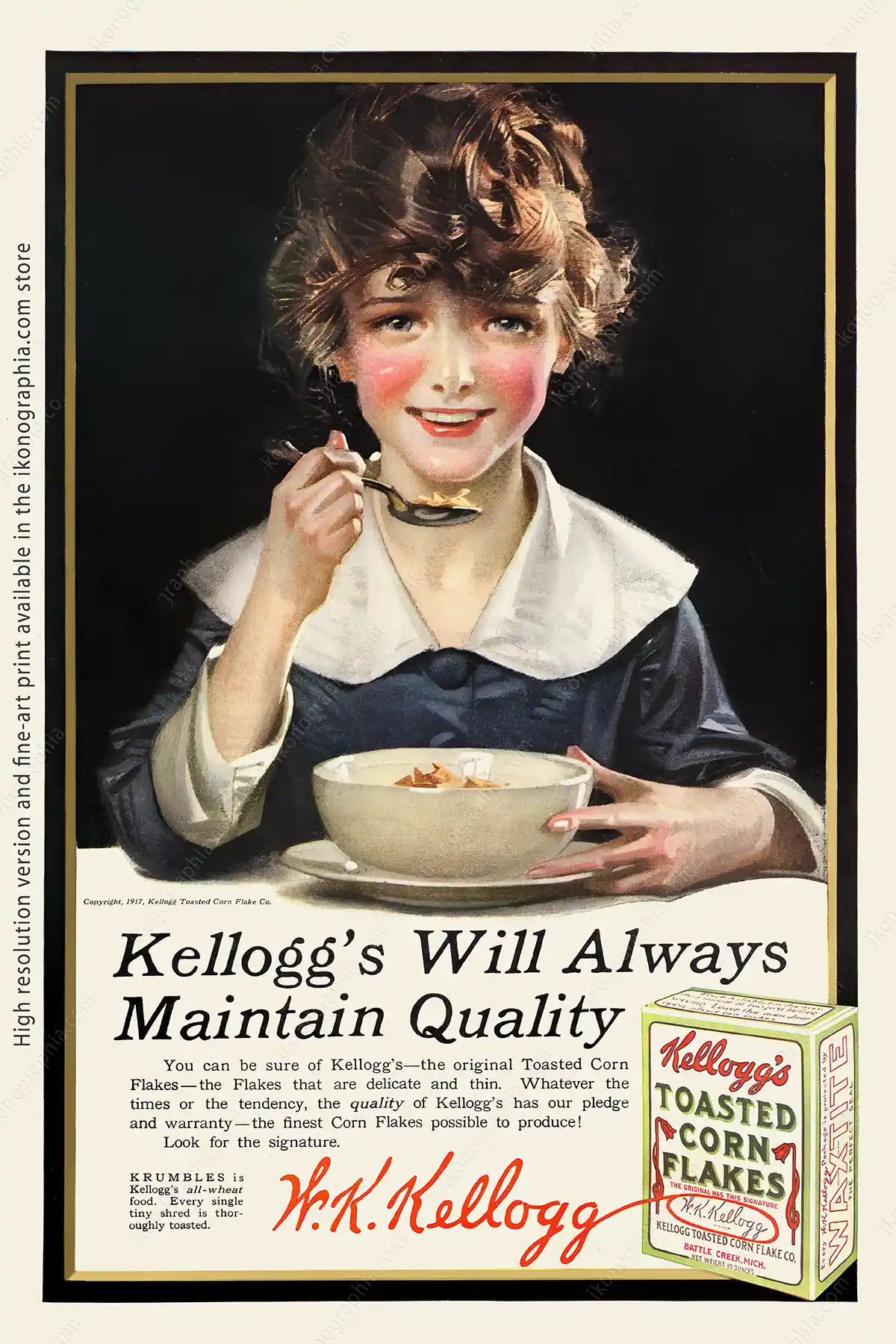
Kellogg's Will Always Maintain Quality. Artwork by Leyendecker, 1917 Advertisement for Kellogg's Corn Flakes. Artwork by Joseph Christian Leyendecker. Ladies' Home Journal, July 1917

"Kellogg's Will Always Maintain Quality.
You can be sure of Kellogg's—the original Toasted Corn Flakes — the Flakes that are delicate and thin. Whatever the times or the tendency, the quality of Kellogg's has our pledge and warranty the finest Corn Flakes possible to produce!


Advertisement for Kellogg’s Corn Flakes.
Artwork by Joseph Christian Leyendecker.

Ladies’ Home Journal, July 1917

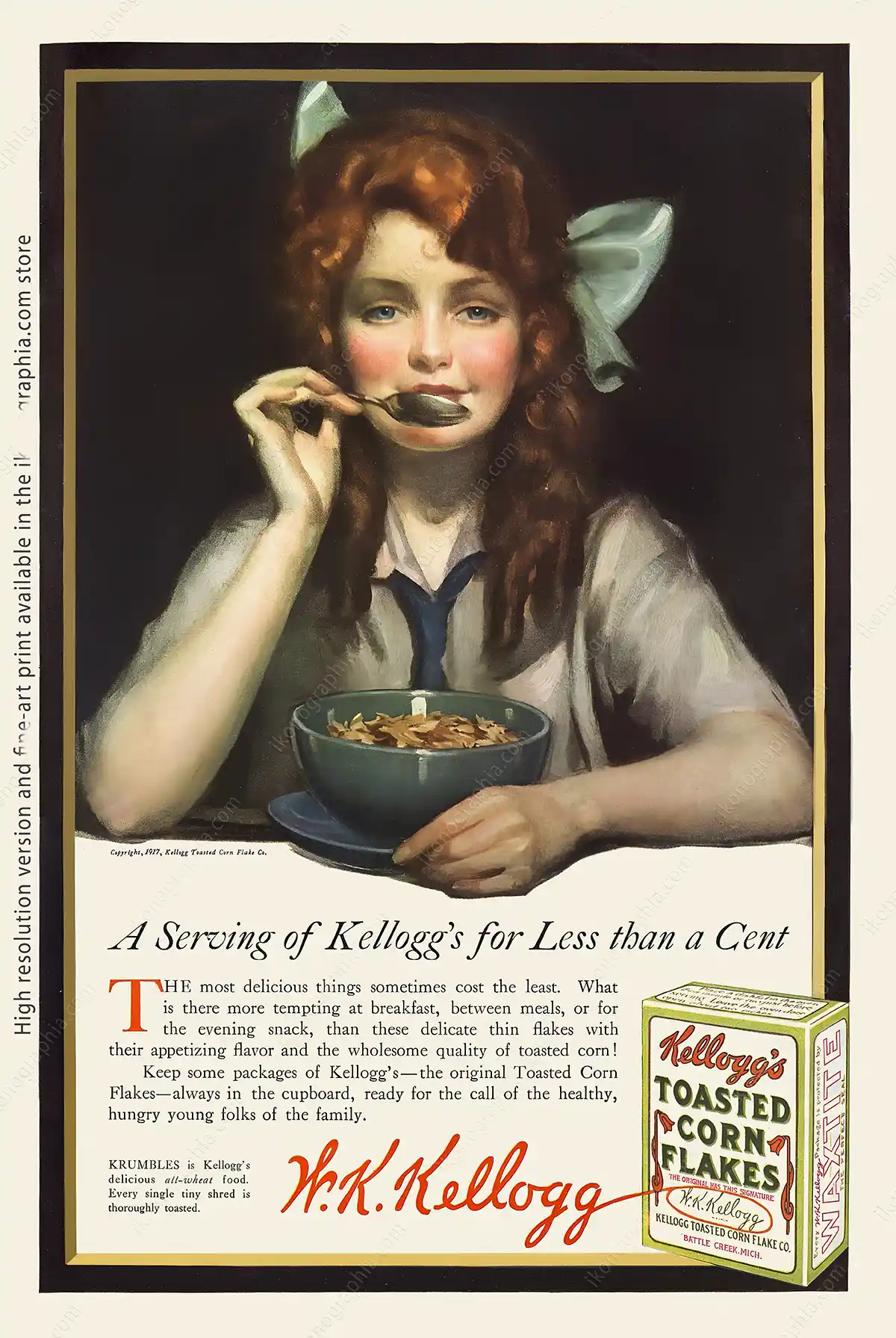
A Serving of Kellogg's for Less than a Cent. Artwork by Leyendecker, 1917 Advertisement for Kellogg's Corn Flakes. Artwork by Joseph Christian Leyendecker. Ladies' Home Journal, October 1917

"A Serving of Kellogg's for Less than a Cent The most delicious things sometimes cost the least. What is there more tempting at breakfast, between meals, or for the evening snack, than these delicate thin flakes with their appetizing flavor and the wholesome quality of toasted corn!"

Advertisement for Kellogg’s Corn Flakes.
Artwork by Joseph Christian Leyendecker.

Ladies’ Home Journal, October 1917

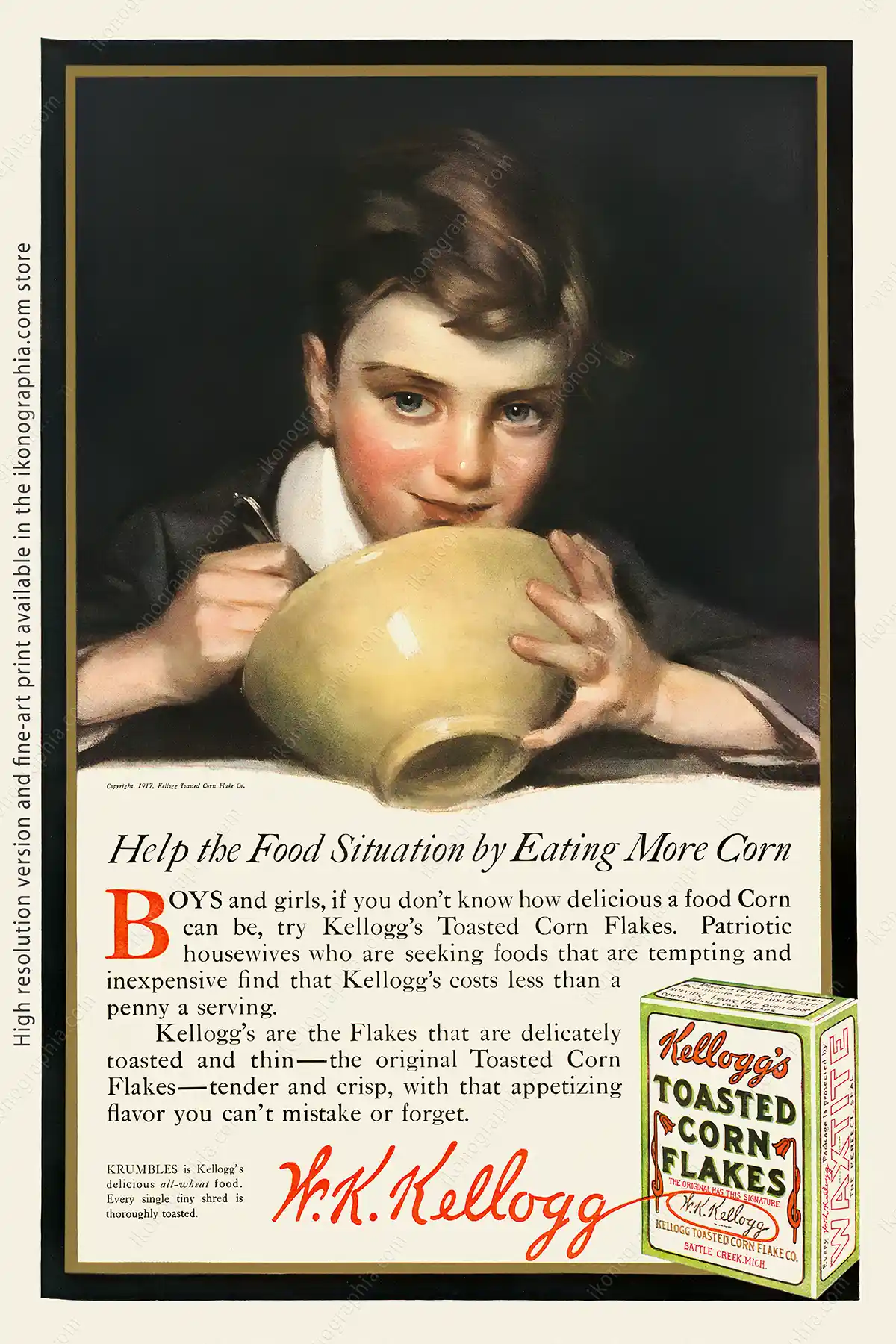
Help the Food Situation by Eating More Corn. Kellog's ad by Leyendecker, 1917 Advertisement for Kellogg's Corn Flakes. Artwork by Joseph Christian Leyendecker. Ladies' Home Journal, November 1917

"Help the Food Situation by Eating More Corn.

Boy sand girls, if you don't know how delicious a food Corn can be, try Kellogg's Toasted Corn Flakes. Patriotic housewives who are seeking foods that are tempting and inexpensive find that Kellogg's costs less than a penny a serving."

Advertisement for Kellogg’s Corn Flakes.
Artwork by Joseph Christian Leyendecker.

Ladies’ Home Journal, November 1917

Copyright, Links and credits

These works were published in the US before 1929, and the author died before 1954.
As a result, they are out of copyright worldwide.

Please notice that any advice or comment provided here is not and does not purport to be legal advice as defined by s.12 of the Legal Services Act 2007.

The most intriguing British Dunlop ads of the thirties.

The most intriguing British Dunlop ads of the thirties.

Illustration

Apr 30, 2025

The Bystander 1938-05-25_301 Dunlop

About Dunlop Tyre


Dunlop is an iconic British brand, created in 1888 by John Boyd Dunlop, who invented the pneumatic tire, a revolutionary creation that transformed the automotive industry. Inspired by his son's tricycle struggles with hard rubber tires, this practical air-filled tire, patented by Dunlop, laid the foundation for the Dunlop Pneumatic Tire Co. Ltd. in Dublin, Ireland.

By the start of World War II, Dunlop had become synonymous with success across a diverse range of industries. Not only did it dominate the tire market, both on and off the racetrack, but it also excelled in the production of brakes, wheels, golf and tennis balls, flooring, and other industrial rubber products.

The original Dunlop company no longer exists as a corporate entity; the name lives on in several Dunlop-branded products owned by different companies, including automotive, aerospatial, industrial, and sporting products around the world.

Distinction. Wealthy couple in evening dress. Dunlop Reinforced Tyre ad 1933

DISTINCTION.
Dunlop Reinforced Ad.
The Sketch Magazine.
March 22, 1933

Dunlop Advertisement in the United Kingdom.


Throughout the 20th century, Dunlop was one of the leading advertisers in the United Kingdom. In the 1930s, the company launched several advertising campaigns. Still, in this story, we will focus on the most intriguing campaign, from 1933 to 1938, featuring beautiful illustrations created by various artists.

The illustrations are carefully crafted to depict a variety of social situations, often of an exclusive nature. Even when the Dunlop tire is not the central focus, it manages to make a striking appearance, leaving a lasting impression.

Unfortunately, most artworks were not credited or signed, and it was impossible to trace the authors.
It's almost unbelievable, but despite the brand's significance and the hundreds of ads published, the documentation is incredibly scarce, underscoring the rarity and value of the information we do have.
One notable exception is a series of ads from 1936. In this campaign, the company made a significant move by hiring leading illustrators and painters. What's more, readers could even request a free reproduction of the artworks.

Aristocrats. Elegant lady with greyhounds. Dunlop Ad, by Neil Baylis. Britannia & Eve, February 1933

Aristocrats. Elegant lady with greyhounds.
Dunlop Tire Ad.
Artwork by Neil Baylis.

Britannia and Eve Magazine.
February 1933.

A wealthy couple's night Swim. Dunlop Ad. Britannia & Eve, August 1933

A wealthy, elegant couple night swim.
Dunlop Tire Ad.
Britannia and Eve Magazine.
August 1933

Masters. Rider and hounds leaving for fox hunting. Dunlop Ad on The Sketch, November 1933.

Masters. Riders and hounds leaving for fox hunting.
Dunlop Advertisement.

The Sketch, November 1933.

Goodwill. Dunlop season greetings for a 1933 advertisement. Britannia and Eve, December 1933.

Goodwill. Dunlop season greetings.

Britannia and Eve Magazine.
December 1933.

Greeting friends on the riverfront with a Dunlop Tire in the foreground . the Tatler, May 2, 1934.

Greeting friends on the riverfront with a Dunlop Tire in the foreground.
Dunlop Tire Ad.

The Tatler, May 2, 1934

Night traffic jam on icy streets. Dunlop Ad. The Tatler, October 31, 1934

Night traffic jam on icy streets.
Dunlop Tire Ad.

The Tatler, October 31, 1934.

Perfect Control. Traffic cop in London. Dunlop Fort 90 tire ad. Illustrated Sporting and Dramatic News - Friday 12 April 1935

Perfect Control. Traffic cop in London. Dunlop Fort 90 tire ad.

Illustrated Sporting and Dramatic New, August 9, 1935

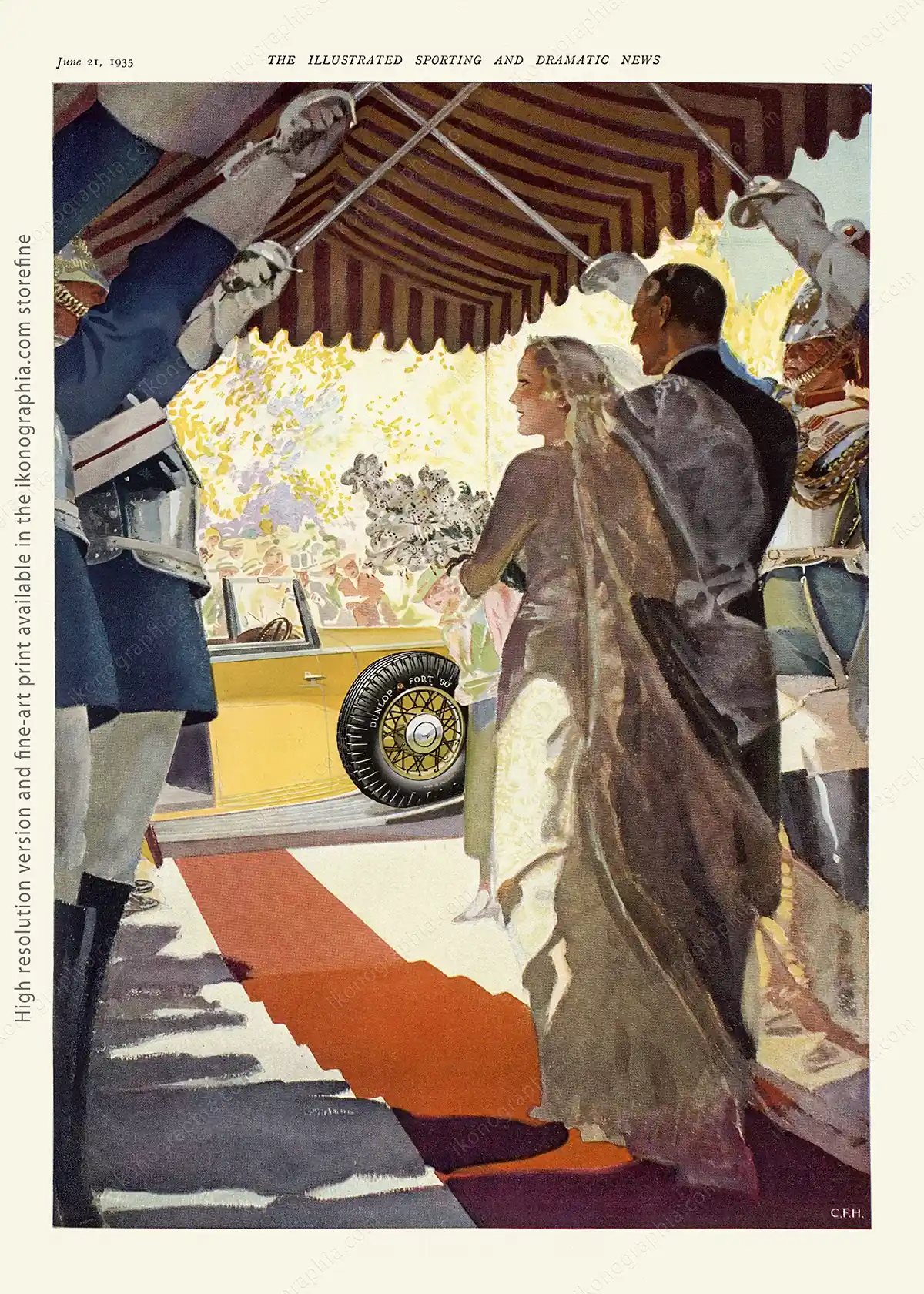
A military salute at an officer's wedding. Dunlop Fort 90 tire ad. Illustrated Sporting and Dramatic News, June 21, 1935.

A military salute at an officer's wedding.
Dunlop Tire Ad.

Illustrated Sporting and Dramatic News, June 21, 1935.

A peacock and a Dunlop Fort "90" tire. Illustrated Sporting and Dramatic New, August 9, 1935

A peacock and a Dunlop Fort "90" tire advertisement.

Illustrated Sporting and Dramatic News, August 9, 1935.

Dunlop Season Greetings 1935 with a car and a toy car with Dunlop Fort "90" tires. Illustrated Sporting and Dramatic News, December 13, 1935.

Dunlop Season Greetings 1935 with a car and a toy car with Dunlop Fort "90" tires.

Illustrated Sporting and Dramatic News, December 13, 1935.

Surreal fall landscape with a lake, art by Ernest Wallcousins. Dunlop ad 1935. Illustrated Sporting and Dramatic News October 4, 1935.

Surreal fall landscape with a lake.
Painting by Ernest Wallcousins.
Dunlop advertisement 1935.

Illustrated Sporting and Dramatic News, October 4, 1935

Merry Xmas. Dunlop season greetings 1936 advertisement. Art by Gerry Wood. Illustrated Sporting and Dramatic News, December 18, 1936.

Merry Xmas. Dunlop season greetings, 1936 ad.
Artwork by Gerry Wood.

Illustrated Sporting and Dramatic News, December 18, 1936.

The 1936 campaign by leading artists.


As said, until 1935, the company didn't credit the artists.
For the 1936 advertising campaign, Dunlop enlisted some of the leading artists of the time, primarily landscape painters, a different one for each ad. Readers could receive a free color reproduction of the original artwork.
W. Smithson Broadhead's illustration stood out as the most beautiful among these.

Fox hunting on a country road. Painting by Algernon Talmage. Dunlop ad. Illustrated Sporting and Dramatic News, February 21, 1936.

Fox hunting on a country road. Painting by Algernon Talmage. Dunlop ad.

Illustrated Sporting and Dramatic News, February 21, 1936.

Spring blossoms in a country village. Artwork by Ernest Wallcousins for a Dunlop ad. Illustrated Sporting and Dramatic News, May 22, 1936.

Spring blossoms in a country village. Artwork by Ernest Wallcousins.
Dunlop ad.

Illustrated Sporting and Dramatic News, May 22, 1936.

A giant bare tree in a country village. Dunlop ad. Painting by James Bateman. The Bystander, March 4, 1936

A giant bare tree in a country village. Dunlop ad. Painting by James Bateman.

The Bystander, March 4, 1936

A lady in sports attire at a polo match. Painting by Smithson Broadhead. Dunlop ad. Illustrated Sporting and Dramatic News, June 19, 1936.

A lady in sports attire at a polo match. Painting by Smithson Broadhead.
Dunlop ad.

Illustrated Sporting and Dramatic News, June 19, 1936.

An Idyllic fall landscape with a lake. Painting by Lamorna Birch. Dunlop ad. Illustrated Sporting and Dramatic News, October 2, 1936.

An Idyllic fall landscape with a lake. Painting by Lamorna Birch. Dunlop ad.

Illustrated Sporting and Dramatic News, June 19, 1936.

Driving on a winter night on a country road, Dunlop Ad 1936. Artwork by Christopher Nevinson. Illustrated Sporting and Dramatic, November 13, 1936

Driving on a winter night on a country road, Dunlop Ad 1936.
Artwork by Christopher Nevinson.

Illustrated Sporting and Dramatic, November 13, 1936

Lastly, the remarkable advertisements from 1938.


Lastly, the remarkable advertisements from 1938 are truly noteworthy. Unfortunately, the company once again neglected to credit the artists involved. We are diligently working to uncover their names or to decipher any signatures where available.

1938 marked the last time Dunlop used organic campaigns featuring color illustrations. In the years that followed, the company made significant changes to its advertising style.

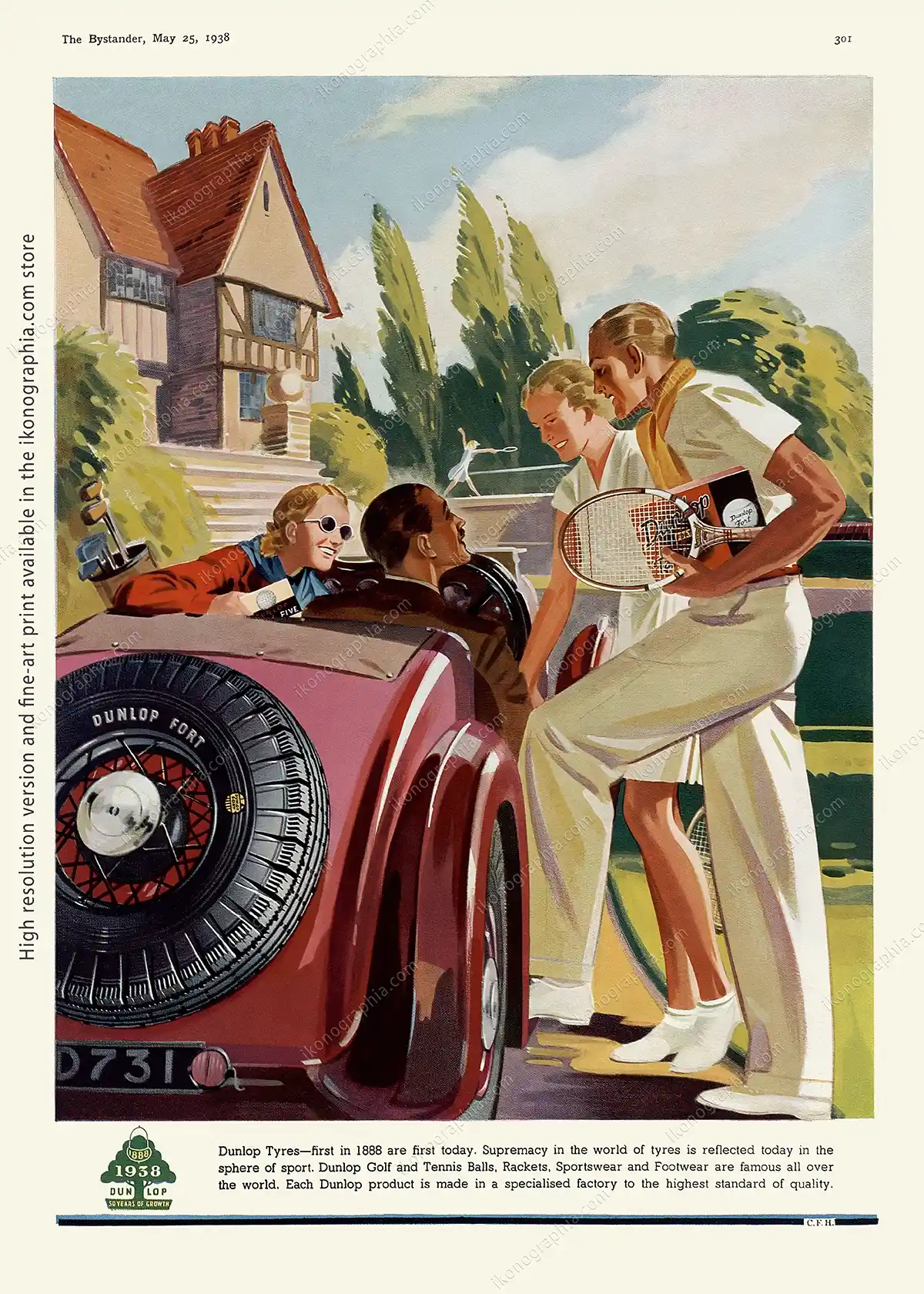
Tennis and golf players with Dunlop Fort tires and balls advertisement. The Bystander, March 25, 1938.

1938 Tennis and golf players’ advertisement, featuring the Dunlop range, including Dunlop tires, balls, rackets, and sportswear. 

The Bystander, March 25, 1938.


Dunlop Tyres-- first in 1888 are first today. Supremacy in the world of tyres is reflected today in the sphere of sport. Dunlop Golf and Tennis Balls, Rackets, Sportswear and Footwear are famous all over the world. Each Dunlop product is made in a specialised factory to the highest standard of quality.

A 1938 Dunlop ad featuring an Armstrong Whitworth Ensign of Imperial Airways aircraft and a classic car. The Bystander July 13, 1938. This image focuses on two of Dunlop's favorite topics: elegance and sophistication associated with luxury and the progress and innovation of the 1930s, highlighting technological advancements in air and land travel.

A 1938 Dunlop ad featuring an Armstrong Whitworth Ensign of Imperial Airways aircraft and a classic car.

The Bystander, July 13, 1938.

This image focuses on two of Dunlop's favorite topics: elegance and sophistication associated with luxury and the progress and innovation of the 1930s, highlighting technological advancements in air and land travel.


Had it not been for John Boyd Dunlop's invention of the pneumatic tyre in 1888, even man's conquest of the air might have been long delayed. It was the Dunlop tyre which made possible every form of smooth, swift progress on the ground or off it. More than that, landing Tyres have contributed materially to the progressive development of aviation. Trust yourself only to the first and still foremost of all tyres.

Trucks and transportation 1938 Dunlop advertisement. The Bystander, September 21, 1938.

Trucks and transportation 1938 Dunlop advertisement.

The Bystander, September 21, 1938.


The wheels of modern industry run more swiftly and more smoothly since Dunlop invented his pneumatic tyre in 1888. With the progress it initiated Dunlop keeps pace. Every tyre need for modern transport has been and will always be, met by Dunlop.

Trucks and transportation 1938 Dunlop advertisement. The Bystander, September 21, 1938.

Dunlop ad featuring a riding lady and Dunlop Fort tires.
Artwork by Jean Bowman.

The Bystander, November 9, 1938.


The dependability of DUNLOP Tyres and the safety they ensure are accepted universally. So now is the supreme excellence of DUNLOP Weather-wear and Sports-wear in which, again, the protective factor is inseparable from style, distinction, and inherent quality. In fact, the name is synonymous with safety and protection.

Copyright, Links and credits

All the photographs on this page are copyrighted to Roberto Bigano.

LINKS

The Architectural Forum. Reliefs And Grilles Of The Chanin Building Vestibules.
Architectural Design, May 1929, page 693 >

The Chanin Building Wikipedia >

The Eve Book by Anne Harriet Fish — 1916

The Eve Book by Anne Harriet Fish — 1916

The Eve Book by Anne Harriet Fish — 1916

Fish and Fowl — a wartime collaboration that became a cultural phenomenon.

Between 1914 and 1916, Anne Harriet Fish and writer Olivia Maitland Davidson — publishing as "Fish" and "Fowl" — produced a weekly column for The Tatler titled "The Letters of Eve." From the same year, Fish was also contributing to Vanity Fair in New York, operating as a cultural bridge between London and American high society.
The character Eve — a fashionable, frivolous girl navigating wartime London — became a cultural phenomenon. Silent films and theatre productions followed.
The Eve Book, published simultaneously by Brentano's in New York and The Tatler in London in 1916, compiled the column's first run. Fish's drawings and Davidson's texts, inseparable from the start.

All pages reproduced from the original book.

The Eve Book Cover, by Anne Fish 1916

About the book


The "Eve Book," also known as "The First Book of Eve," is a historical gem published in 1916 by Brentano in the US and the Tatler in the UK. Introducing the new star illustrator, Anne Fish, it is a curated collection of drawings published on the Tatler from 1914 to 1916 in the column "The Letters of Eve," offering a unique glimpse into the dark days of World War I.

You can enjoy a selection of cartoons from the book here or visit this page, where all pages are available in high-resolution and professionally restored.

The Adventures of Eve 06-07. Eve as a Policeman and Some War-time Cooks. Drawings by Anne Fish, text by Fowl. Published by Brentano's, New York, 1916.

The Eve Book, pages 6-7. The Adventures of Eve. Eve as a Policeman and Some War-time Cooks.
Being an irresponsible record of some incidents in the career of a frivolous little lady—to say nothing of Adam, Aunt Matilda, Uncle Fred, and Tou-Tou.
Below, is an amazing detail of Jumping Policewomen

Eve as a Policeman and Some War-time Cooks. Jumping Policewomen. Detail from Eve as a Policeman and Some War-time Cooks.
The Eve Book 14-15. Just a Few Odds and Ends. Drawings by Anne Fish.

The Eve book, pages 14-15. Just a Few Odds and Ends.
The shortage in postmen grows apace. Eve, as ever, steps into the breach, and you can imagine the unadulterated joy of one of her admirers who, unshorn and untidy, opens the door of his flat to receive from her a pink and scented missive.

Cover of The Eve Book” (also known as “The First Book of Eve”), by Anne Fish, published in 1916 by Brentano’s in the US and the Tatler in the UK. It is a curated collection of drawings published on the Tatler from 1914 to 1916 in the column “The Letters of Eve,” offering a unique glimpse into the dark days of World War I.

The "Eve Book," also known as "The First Book of Eve, is a curated collection of drawings published on the Tatler from 1914 to 1916 in the column "The Letters of Eve," offering a unique glimpse into the dark days of World War I.

This historical gem was published in 1916 by Brentano's in the United States and by Constable and Co./The Tatler in the UK


The book cover is in color and, although beautiful, is unrelated to the book's drawing, all in black and white.
64 pages, 62 b&w plates + color cover.

Anne Fish was Tatler Magazine's star artist during those years. She gained a reputation for her inimitable black-and-white sketches.

Richard King, the Publisher introducing Fish


It is not often that an artist evolves a new comic type. "Eve" has now become a clearly recognized figure of modern life, along with George Belcher, Dana Gibson, Bateman, and that very small band of clever artists who have characteristics peculiar to themselves.

Few artists have more quickly sprung into worldwide popularity than "Eve." How great this popularity is may be judged by the numerous imitators who, while they copy many of Eve's mannerisms, lose all that humor and spirit that make Eve's art such a fascinating and irresistible thing. Eve possesses a gift that cannot be imitated, no matter how clever the artist who imitates her may be. Each person's sense of humor—or lack of it—belongs to them alone. And it is Eve's humor that makes her delightful drawings so appealing.

Fish has that sense of the "absurd," one of the rarest senses in all black-and-white art. And yet, while her irresistible humor makes one laugh, and her drawings fascinate us with their quaintness, she is never so far removed from reality as merely a painter of the human grotesque. Therein lies so much of her genius. She paints humanity with the eye of one who can see the comic in everyday people and things. Yet, she never lets her feeling for the ridiculous obliterate her feeling for Truth.

The Adventures of Eve 16-17. The Zeps Threaten Again. Drawings by Anne Fish, text by Fowl. Published by Brentano's, New York, 1916

The Eve book, pages 16-17. The Zeps Threaten Again.
Eve draws up a list of things to do if the Zeps do come. She is seen reading it to Tou-Tou, who is visibly impressed. She carefully tacks her hamper every night in case she may have to pic-nic out among the debris of her home the next day. Tou-Tou, as you see, is wearing his respirator.

The Adventures of Eve 18-19. Eve Mobilises her Sisters. Drawings by Anne Fish, text by Fowl. Published by Brentano's, New York, 1916

The Eve book, pages 18-19. Eve Mobilises her Sisters.
This is not the frivolous picture it appears, but represents little Eves in training for E.C.D.C. (Eve's Coastal Defence Corps). Of course, the first thing to do is to learn to swim. Eve cannot tell us where this is taking place, as it would give away the (amatory) disposition of the Grand Fleet, which anchored dangerously close in soon after operations commenced.

The Adventures of Eve 20-21. Eve's Adventure with the Gallant Submarine.

The Eve book, pages 20-21. Eve's Adventure with the Gallant Submarine.
The bold and wicked air-pirates grappled Eve as planned, but (hooray for the Navy !) the gallant officer on the conning tower was able to seize her shapely limbs as she drifted over him, and, with the help of his equally gallant crew, effected a rescue at the expense of Eve's already diminutive bathing creation——and, warm and happy, Eve is conveyed back to land at the slowest possible speed.

Eve Goes into the City and Relieves a Man for Active Service. The Adventures of Eve pages 22-23 Drawings by Anne Fish, text by Fowl. Published by Brentano's, New York, 1916

The Eve book, pages 22-23. Eve Goes into the City and Relieves a Man for Active Service.
Eve, patriotically wishful to release an able-bodied Adam for active service, applies for and obtains a situation as clerk in the office of a susceptible merchant–who in due course introduces her to his staff, who are no less pleasantly affected by our charming little friend than their stern and businesslike employer.

The Coca-Cola History Through Ads. 1 – 1886-1919

The Coca-Cola History Through Ads. 1 – 1886-1919

The Coca-Cola History Through Ads — N.1 (1886-1919)

From Pemberton's back pain to the Coca-Cola Controversy.

The Coca-Cola history told through its own advertising — from the first glass sold in Atlanta in 1886 to the consolidation of a global brand by 1919. Trademark registration, logo design, the cocaine removal from the recipe, and the first systematic campaign against imitation products: each chapter documented through the visual record Coca-Cola left behind.

This first part covers 1886–1919. The series continues into the 1960s.

Trademark registration by The Coca Cola Company for Coca-Cola brand Nutrient or Tonic Beverages. January 31, 1983

It all started with Dr. Pemberton's severe back pain.

Dr. John Pemberton, an Atlanta pharmacist and Confederate Colonel wounded in the American Civil War, was addicted to morphine to fight severe back pain. Thanks also to his medical degree, he began to search for a substitute for the problematic drug.
After several attempts, Dr. Pemberton blended an extract of cocaine-rich coca leaves and caffeine-rich cola nuts. These ingredients formed the basis of the original Coca-Cola recipe.
Initially conceived as a patent medicine, the drink was also marketed as a temperance drink. This dual purpose reflected the prevailing health concerns and social attitudes of the time.

On May 8, 1886, he sold the first glass of the drink, later named Coca-Cola, in his pharmacy in Atlanta. During that year, an average of nine drinks a day were sold, marking the humble beginnings of a global phenomenon.

Trademark registration by The Coca Cola Company for Coca-Cola brand Nutrient or Tonic Beverages. January 31, 1983

Trademark registration by The Coca-Cola Company for the Coca-Cola brand Nutrient or Tonic Beverages.

Patent N. 22,406, Filed on January 31, 1893, in Atlanta, Ga.

This file, digitally reproduced from the original, is freely downloadable in high resolution at the Library of Congress.

August 1984 - Beverly Hills, California - From "Plastic Girls" series. Photo Roberto Bigano.

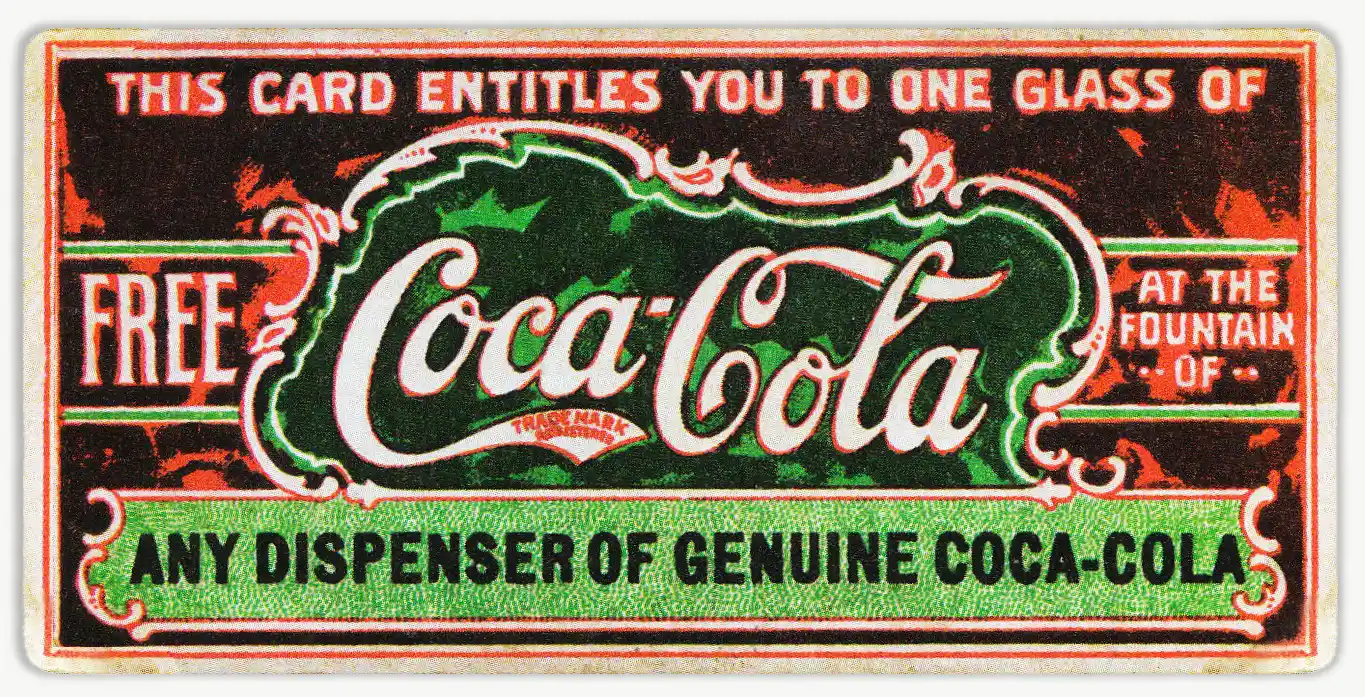
Ticket for a free glass of Coca-Cola — Atlanta 1888

This is believed to be the first coupon ever

Asa Griggs Candler

Dr. Pemberton, though a brilliant mind, faced challenges in the business. His partnership with Asa Griggs Chandler, a visionary businessman, was a turning point.
Mr. Candler, from 1886 to 1888, bought the Coca‑Cola formula and patents from John Pemberton and his partners. In a few decades, Candler's innovative marketing tactics led Coca-Cola to dominate the global soft drink market.
The first crucial move was the creation of a distinctive logo featuring the two Cs in a Spencerian script. This logo would become a cornerstone of Coca-Cola's branding strategy.
On May 14, 1892, The Coca-Cola Company registered, with patent N. 22,406, name, logo, and trademark as a "Nutrient or Tonic Beverage."
By the late 1890s, Coca-Cola had become a household name and America's most popular fountain drink. The scale of its success was staggering, with Coca-Cola sales skyrocketing from one million a year in 1890 to an astonishing one hundred million in 1900.

Coca-Cola Logo original desiign 1893 and current

The original Coca-Cola Trade-Mark, as registered on January 31, 1893, and the current one.

Considering the one-hundred-and-forty years spam, they are impressively similar.

1901. Removing Cocaine from the Recipe for Racial Reasons

The medical community viewed tonics like Coca-Cola—advertised to white, middle-class consumers for their aphrodisiac qualities—as harmless. The situation changed dramatically when black workers in the New Orleans area began using Cocaine to cope with the grueling demands of long, physically taxing workdays. The use of Cocaine spread to workers on plantations and in urban areas throughout the South, becoming a recreational drug in Black and mixed-race neighborhoods as well. Source

Medical journals warned of the so-called “Negro cocaine menace,” and newspapers claimed that the drug drove black men to commit crimes, particularly the rape of white women. Despite these concerns, the company continued to include Cocaine in its formula. However, this approach became increasingly problematic in 1899 when the company expanded its sales of bottled Coke to a national market, and Coca-Cola became accessible outside of white soda fountains to anyone with a nickel, including Black men. Source
1901 the company removed Cocaine from the recipe, replacing it with more sugar and caffeine.

Coca-Cola Delicious Refreshing At Soda Founts 5c Good Housekeeping Magazine, June 1905.

Coca-Cola Delicious Refreshing At Soda Founts, 5¢.
Good Housekeeping Magazine, June 1905.

Patent N. 22,406, Filed on January 31, 1893, in Atlanta, Ga.

This file, digitally reproduced from the original, is freely downloadable in high resolution at the Library of Congress.

Hilda Clark. The first Coca-Cola Model

The model Hilda Clark, a testimonial of the brand, was a popular music hall singer and actress. She became famous as a model in 1895 when she was the first woman featured on a tin Coca-Cola tray. She remained the advertising “face” of Coca-Cola until February 1903.

Drink Coca-Cola 5 cents Poster 1885. Model Hilda Clark, the advertising face of the brand. An 1890s advertisement showing model Hilda Clark in formal 19th-century attire. The ad is entitled Drink Coca-Cola 5¢.

Drink Coca-Cola 5 cents—an amazing poster from 1885

The model Hilda Clark, a testimonial of the brand, was a popular music hall singer and actress. The artist's signature is unreadable.

Text in the sheet: Home Office
The Coca-Cola Co. Atlanta, Ga.
Branches: Chicago, Philadelphia, Los Angeles, Dallas.

This is a file from the Library of Congress's digital archive that we digitally restored.

First Coca-Cola Advertisements

The first ads for Coca‑Cola appeared in national magazines in 1904, but the oldest we found was from 1905.
Given the brand's meteoric and impactful success, it's a stretch to say that the company's first advertisements, Hilda Clarks one's aside, were poor and lacked even a minimum corporate image.

Of course, we are discussing something published at the turn of the century. Still, in those years, several companies, such as Kellogg's Corn Flakes or Queen City Printing Inks, released organic ad campaigns with an excellent corporate, coordinated image.

Good Housekeeping 1905-05_604 Coca-Cola by Massegale-Atlanta

Coca-Cola Revives and Sustains Ad
Good Housekeeping Magazine, May 1905.
Design by Massengale, Atlanta

Take one glass of Coca Cola when weary with shopping. It imparts energy and vigor.

Coca-Cola Delicious Refreshing 5¢, Harper's Bazaar, May 1905, advertisement bt Massengale, Atlanta.

Coca-Cola Delicious Refreshing 5¢, Ad
Harper's Bazaar, May 1905.
Design by Massengale, Atlanta.

It is a beverage in which a toast to health and happiness becomes and accomplished fact, as well as a delightful pleasure. At all founts and in bottles

1905 Good Housekeeping 1906-05_677 Coca-Cola

Drink Coca-Cola. The Ideal Beverage for Discriminating People.
Good Housekeeping Magazine, May 1906..

It is a beverage in which a toast to health and happiness becomes and accomplished fact, as well as a delightful pleasure. At all founts and in bottles

Coca-Cola Ad From the Realm of Fancy to Reality, artwork by A.T.Farrel. Good Housekeeping Magazine, July 1907

Coca-Cola Ad From the Realm of Fancy to Reality.
Artwork by A.T.Farrel.
Good Housekeeping Magazine, July 1907.

Drink Coca-Cola.
The Satisfying Beverage.
Relieves the fatigue that comes from-over-play, over-work, and over-thinking.
Delicious! Refreshing! Thirst-Quenching!

Coca-Cola Ad "An Act Not On The Bill. Coca-Cola The "Star" Performance" Good Housekeeping Magazine, September 1907

Coca-Cola Ad From the Realm of Fancy to Reality.
Artwork by A.T.Farrel.
Good Housekeeping Magazine, July 1907.

Coca-Cola makes it possible for you to make your appearance with light step, sparkling eye, steady hand and nerves, and, above all, with a clear head capable of lucid thinking and logical reasoning.

This advertisement can be seen as a company's policy statement listing all the drink's magic features, with the dual purpose of being a healthy mind brightener and refresher. It is a company's Manifesto.

An ingenious idea underappreciated for twenty-four years

In July 1910, a brilliant designer created the Coca-Cola Red Circle with primary red as the color code. In the ads, the logo appeared red on white or white on red inside the circle. The company did not recognize its value — the Red Circle was used only a handful of times in the following decades.

Only in 1935 was it revived, becoming one of the cornerstones of Coca-Cola's branding strategy. From then on, it appeared in practically every ad.

Whenever you see an Arrow Think of Coca-Cola Advertisement on Red Book Magazine, July 1910

Whenever you see an Arrow, Think of Coca-Cola — Get What You Ask For. Red Book Magazine, July 1910

This is probably the first advertisement showcasing the Red Circle, which would later become a cornerstone of Coca-Cola Branding.

Coca-Cola Branding Journey and Imitations Fighting

As Coca-Cola's popularity grew, so did attempts to imitate it. Starting in 1908, the first response to this imitation was the introduction of "Follow the Arrow," which featured arrow-shaped signs to promote Soda Fountains selling the original. The Arrow was also widely used in advertisements during this time.

From 1910, the company, to protect the brand from imitations, began publishing an impressive number of text ads, often double-page spreads, warning against imitations. Sometimes, these ads directly address the reader. In some cases, they were even threatening, particularly towards druggists who sold other drinks that imitated Coca-Cola's names and features.
While these ads may make us smile, they are a blast from the past and a reminder of a bygone era.

Hot Sun- Much Thirst - A Notice to Druggists Coca Cola Ad, Reed Book Magazine, August 1910

Hot Sun- Much Thirst  A Notice to Druggists

Red Book Magazine, July 1910

Here's to Your Good Health and Pleasure - The Why of Imitations Coca Cola Ad, Reed Book Magazine, August 1911

Here's to Your Good Health and Pleasure —The Why of Imitations

Red Book Magazine, August 1911

The Answer. Coca-Cola Advertisement. Red Book Magazine, August 1912

Here's to Your Good Health and Pleasure — The Why of Imitations

Red Book Magazine, August 1911

Harvey Washington Wiley and the "Coca-Cola Controversy"

Harvey Washington Wiley was an American physician and chemist known for his successful advocacy for the passage of the landmark Pure Food and Drug Act of 1906. Following this achievement, he worked at the Good Housekeeping Institute laboratories.
He was the first commissioner of the United States Food and Drug Administration. Wiley's advocacy for stricter food and drug regulations indirectly contributed to Coca-Cola's decision to remove cocaine from its formula in the early 20th century.

After his government tenure ended in 1912, Harvey Washington Wiley took charge of the laboratories at Good Housekeeping Magazine as the Director of the Bureau of Foods, Sanitation, and Health.
In September 1912, the magazine published a daring ten-page essay titled "The Coca-Cola Controversy." This piece, which featured both text and cartoons, openly criticized the popular beverage, warning about the dangers associated with "artificial" caffeine. This move is astonishing by today’s standards, especially considering that Coca-Cola was a vital advertiser.

Good Housekeeping 1912-09_386-387 The Coca-Cola Controversy

The Coca-Cola Controversy.
Good Housekeeping Magazine, September 1912.

A daring ten-page essay titled "The Coca-Cola Controversy": The Facts and Dr. Wiley's Opinion, Together with a Talk on the Drugging of Soft Drinks.
This piece, which featured both text and cartoons, openly criticized the popular beverage, warning about the dangers associated with "artificial" caffeine.

This move is astonishing by today’s standards, especially considering that Coca-Cola was a vital advertiser.

Good Housekeeping 1912-09_388-389The Coca-Cola Controversy

The Coca-Cola Controversy.
Good Housekeeping Magazine, September 1912.

This essay is astonishing by today’s standards, especially considering that Coca-Cola was a vital advertiser.

The Pivotal Coca-Cola Trial — United States v. Coca-Cola, 1912

In a famous action brought against The Coca-Cola Company in 1911, Mr. Wiley contended that it was illegal to use the name Coca-Cola when there was no actual cocaine in the drink and also that it was unlawful for it to contain caffeine as an additive.

With the threat of having to remove caffeine, Coca-Cola was teetering on the edge of a defeat that could have been catastrophic. The Company faced a challenge in finding a renowned psychologist to validate the non-dangerousness of caffeine. In a stroke of luck, Coca-Cola enlisted the services of a brilliant doctoral student, Harry Hollingworth, who needed research funds.
With the trial looming, the need for results was pressing. In a race against time, Hollingworth devised a series of three studies that were completed in just 40 days. These studies, known for their methodological sophistication, were crucial to the case.

We won't tell you the whole story here, but Coca-Cola ultimately won in this existential trial.
Hollingworth was nicknamed "the man who saved Coca-Cola.

Cartoon against lobbying Coca-Cola in the caffeine trial

The Coca-Cola Controversy.
Good Housekeeping Magazine, September 1912.
Cartoon detail.

A number of the experts who testified as to the harmlessness of caffeine had formerly expressed different opinions.

Bugatti Catalogs and Literature — 1920s and 1930s

Bugatti Catalogs and Literature — 1920s and 1930s

Bugatti Catalogs and Literature — 1920s and 1930s

Sales literature from Molsheim — spare, original, and entirely their own.

Bugatti's catalogs and brochures were rarely credited to outside agencies. With limited budgets and no inherited house style, the results reflect the same standards applied to the cars — functional, precise, occasionally brilliant. The 1937 Type 57 range catalog is the centerpiece: Alexis Kow's cover, the only signed work in the catalog, pairs the Le Mans-winning Type 57 Sport with Ettore's streamlined Autorail — the locomotive he designed in a week to keep his workforce employed.

Detail of Bugatti’s Monobloc Cast Aluminum Wheel drawing, dated July 27, 1932 (Roue Bugatti brevetée en aluminium coulé).

Ettore, Jean and the Bugatti Literature

Most people know the Bugatti posters — Cassandre, Dudovich, René Vincent, Géo Ham. The catalogs are less studied, and less understood. They should not be.

Ettore Bugatti trained at the Brera School of Art in Milan before he built his first engine. That formation never left him. Everything Bugatti produced — the cars, the furniture, the factory buildings, the printed literature — was subject to the same standard: nothing without necessity, nothing without form. The catalogs were not marketing material handed to an agency. They were made inside Molsheim, under the same scrutiny as the chassis.

From 1930, Ettore progressively passed the design pen to his son Jean, who had grown up inside the factory and understood its logic from the inside. The catalogs changed with him — leaner, more confident, the typography tightened, the illustrations more willing to let the car speak without explanation.

Bugatti Type 44 catalog double spread. Nouvelle 3 litres 8 cylindres 17 cv, Weissman Bodywork, circa 1925

Bugatti Type 44, Nouvelle 3 litres 8 cylindres 17 CV. Double spread with three body variants by Weissman, circa 1925.

Three coachwork interpretations of the same chassis on a single spread. The layout is spare — photograph, body designation, nothing more.

Weissman's bodywork is presented as a catalogue of possibilities rather than a hierarchy. The customer chose. The chassis was already resolved.

Depliant Bugatti Type 44 3 litres 1929

Dépliant Bugatti Type 44, 3 litres — Centerfold, 1929.

The centerfold of the Type 44 folder places the car in front of Château Saint-Jean — Bugatti's headquarters in Molsheim.

The two figures beside it are Lidia and Michel Bugatti, two of Ettore's children. The photograph is not incidental. Molsheim was not a factory with a family attached. It was a domain, and the catalog knew it.

A Literature Without Credits

Bugatti brochures were almost never signed. The company had no advertising department in the modern sense. Ettore and Jean directed everything, and the people who executed their directions worked without attribution.

Two exceptions: Alexis Kow, the leading French automobile illustrator of the period, signed the 1937 Type 57 catalog drawings. And the company photographer, Mr. Carabin, is credited on several of the 1928 brochure photographs. Everyone else remains anonymous — which, in Molsheim, was the norm rather than the exception.

The budget was modest by the standards of the major manufacturers. It never showed.

Bugatti Type 57 Catalog 1937. The 3 litres engine specifications.

Bugatti Type 57, 3 litres engine specifications. Double spread from the 1937 catalog.

Left: Artist Joseph Low pulling an impression on his hand press. Below: Low inside his rural New Jersey studio-print shop with its old-fashioned stove (bottom), a linoleum block locked up in a printing form, and the finished print. Right page: An enlarged detail from the same linoleum print displays the vigor and fantasy of Low’s engraving style. Photographs by Ed Feingersh. Pages 64-65

The 1928 Brochures and the Carriage Argument

The 1928 catalogs make an argument that no other car manufacturer would have dared. On the cover: a vintage carriage, drawn by Marcel Jacques Hemjic — an eighteenth-century chaise, or a mid-nineteenth century coupé à huit ressorts, rendered with the precision of a period engraving. Inside: Carabin's photographs of the current Bugatti model, the Type 44 or the Berline, sitting on its chassis in studio light.

The pairing was Ettore's idea. He collected carriages. He believed the Bugatti, in its proportions and its attention to coachwork, was the direct heir to the finest horse-drawn vehicles — not a rupture with that tradition but its continuation in a new material. The catalogs said so without a word of explanation.

Bugatti Coupè Berline 2-3 places avec spider sur chassis 3 litres. Photo by Carabin for a 1928 catalog

Bugatti Coupé Berline 2-3 places avec spider sur chassis 3 litres — Central double spread.
Photo Carabin.

Carabin was the company photographer — one of two people credited by name in the entire Bugatti catalog archive. The studio light is controlled and neutral. The car requires no setting.

Bugatti Coupè Berline 2-3 places avec spider sur chassis 3 litres. Coupé a huit resorts. Milieu du XIX Siecle.(Eight-spring coupe. Mid-19th century.) Artwork by Marcel Jacques Hemjic for a 1928 brochure cover.

Bugatti Berline 3 places avec spider sur chassis 3 litres — Cover.
Vintage carriage artwork by Marcel Jacques Hemjic.

The cover did not show the car being sold. It showed an eighteenth-century coupé à huit ressorts — an eight-spring carriage from the mid-nineteenth century, drawn with the precision of a period engraving. Ettore collected carriages. He believed the Bugatti was their direct heir, and the catalog said so without explanation.

Bugatti Berline 3 places avec spider sur chassis 3 litres. Photo

Bugatti Berline 3 places avec spider sur chassis 3 litres. — Central double spread.
Photo Carabin.

The second body variant in the same 1928 brochure series. Same photographer, same studio discipline.

The two Carabin photographs and the two Hemjic covers were designed as pairs — the machine and its ancestry, facing each other across the fold.

Bugatti Berline 3 places avec spider sur chassis 3 litres. Chaise Monte Sur son train. XVIII siècle. Artwork by Marcel Jacques Hemjic for a 1928 brochure cover.

Bugatti Berline 3 places avec spider sur chassis 3 litres — Cover — Chaise montée sur son train, XVIIe siècle.
Vintage carriage artwork by Marcel Jacques Hemjic.

A seventeenth-century travelling chaise, suspended on its carriage frame. The argument is the same as the facing cover — lineage rather than novelty.

In 1928, every other car manufacturer was selling the future. Bugatti was selling continuity with the finest things ever built on wheels.

The 1936 Blueprint Brochure

The Type 57 range brochure of 1936 took a different approach entirely. Four fold-out leaflets, each presenting one body version in blueprint-style line drawings: the Galibier, the Ventoux, the Atalante, the Stelvio. The drawing method borrowed from the factory floor — technical authority applied to a commercial document.

Two models were missing: the Atlantic and the Roadster. No explanation was given then or since.

Bugatti Type 57 Range Brochure 1936 in a blueprint style drawings.. Four pages.

Bugatti Type 57 range brochure, 1936 — Four fold-out leaflets in blueprint-style drawings: Galibier, Ventoux, Atalante, Stelvio.

The drawing method came from the factory floor — technical authority applied to a commercial document. Each model received its own leaflet, its own set of lines.

Two variants in the range were not included: the Atlantic and the Roadster. No explanation was given then or since.

The 1937 Catalog and Alexis Kow

The 1937 Type 57 range catalog is the most complete statement of Jean's commercial vision. Kow's illustrations stretch the car slightly — the proportions are pushed toward elegance, the shadow work emphasizes speed over mass. It is illustration rather than technical record, and it reads as Jean would have wanted: the car as an object of desire, not a specification sheet.

The cover pairs the Type 57 Sport — winner at Le Mans, holder of the 218 km/h speed record — with the streamlined Bugatti Autorail. Two worlds Bugatti occupied simultaneously: the road and the railway, both made faster than they had any right to be.


Bugatti Type 57 Catalog 1937. Cover drawing by Alexis Kow

Bugatti Type 57 catalog, 1937 — Cover drawing by Alexis Kow.

The cover pairs two Bugatti worlds: the Type 57 Sport, winner at Le Mans and holder of the 218 km/h speed record, and the streamlined Autorail — the locomotive Ettore designed in a week to save his workforce.

Kow's illustration was the only signed work in the catalog. Everything else was Molsheim's.

Bugatti Type 57 Catalog 1937. The T57 3 litres engine Grand Prix Winner

Bugatti Type 57, 3 litres engine. "Vainqueur." From the 1937 Type 57 range catalog.

Vainqueur — winner.
The 1936 season: Grand Prix de l'ACF, de La Marne, de Deauville, du Comminges, and the speed record at 218 km/h.

In 1937, Jean-Pierre Wimille and Robert Benoist won the 24 Hours of Le Mans and covered 3,287 kilometres in 24 hours. The catalog did not need to say more.

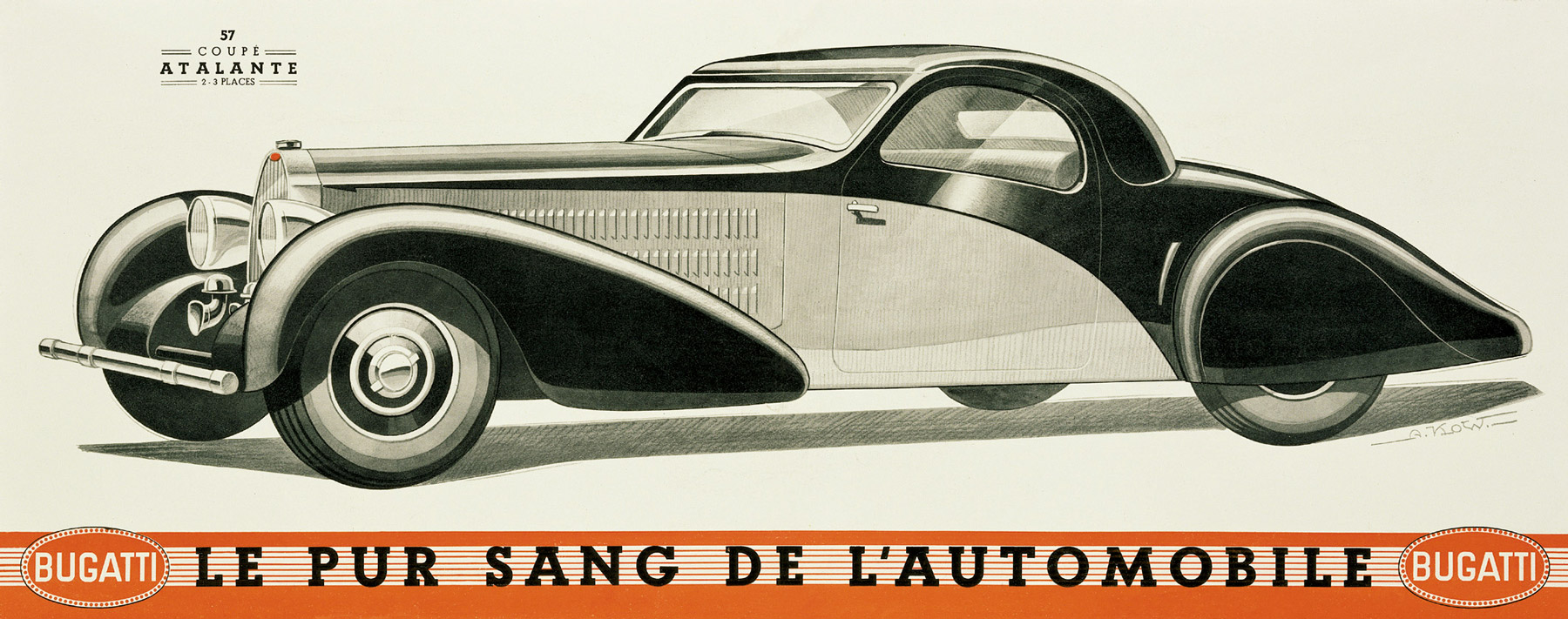
Bugatti Type 57 Brochure 1937 Coupé Atalante, page 6,7. Drawing by Alexis Kow

Bugatti Type 57 Coupé Atalante. Double spread from the 1937 catalog. Drawing by Alexis Kow.

The Atalante roofline resolves in a single continuous arc from windshield to tail — a curve that Jean drew once and never needed to revise. Kow understood that the illustration's job was to follow the line, not interpret it.

Bugatti Type 57 Catalog 1937, Coupé Atlantic. Drawing by Alexis

Bugatti Type 57S Coupé Atlantic. From the 1937 catalog. Drawing by Alexis Kow.

The Atlantic was built in four examples. Its body was riveted along the spine — the seam running from nose to tail — because the magnesium alloy panels could not be welded without risk of fire.

A constraint became the most recognizable detail in the car's history.

Bugatti Type 57 Brochure 1937 Roadster Sport, page 9. Drawing by Alexis Kow

Bugatti Type 57S Roadster Sport 2 places. From the 1937 catalog. Drawing by Alexis Kow.

The lightest body in the Type 57 range. Ultra-light alloy construction, competition-type profiling.

Kow gave it the longest shadow of any car in the catalog — the one concession to drama in an otherwise disciplined set of drawings.

Bugatti Type 57 Brochure 1937, page 10 Coach Ventoux Drawing by Alexis Kow. 4-5 Places

Bugatti Type 57 Coach Ventoux 4-5 places. From the 1937 catalog. Drawing by Alexis Kow.

The Ventoux was the family car in the Type 57 range — four to five seats, the most practical body Jean designed. It carried the same name logic as the Stelvio and the Aravis: a mountain pass, a road with a reason to be driven.

From Ettore to Jean — The 1939 Catalog

The cover of the 1939 Type 57 Modèles brochure is the last major statement in Bugatti's pre-war literature. Jean designed it, or directed its design, with the same compression he brought to the cars themselves. The typography is spare. The image carries everything.

Jean died in a car crash a few months after this catalog appeared. The brochure had no way of knowing it was a conclusion.

Bugatti Type 57 Modeles 1939

Bugatti Type 57 Modèles 1939. Brochure cover.

Jean designed this cover, or directed its design, with the same compression he brought to the cars.
The typography is spare. The image carries everything.

He died in a car crash a few months after it appeared.

Bugatti Type 57 Modeles 1939

Bugatti Type 57 Modèles 1939. Berline Galibier 4-5 places. Visibilité. Accessibilité. Confort.reet and Regent Street series.

The three words beneath the model name are the brochure's argument in miniature — the same logic that organized the 1936 catalog, compressed into a single line.

The Galibier was the largest body in the Type 57 range. The claims are precise and in the correct order.

Bugatti Type 57 Modeles 1939 Brochure Cabriolet Stelvio - Aravis Cabriolet Stelvio 4 Places Cariolet Aravis 2-3 Places

Bugatti Type 57 Modèles 1939. Cabriolet Stelvio 3 places. Cabriolet Aravis 2-3 places.

Two open bodies on the same page, the Stelvio and the Aravis distinguished by seating capacity and hood treatment.

The mountain names were Jean's choice — the Stelvio Pass, the Col de l'Aravis. He named his cars after roads worth driving.

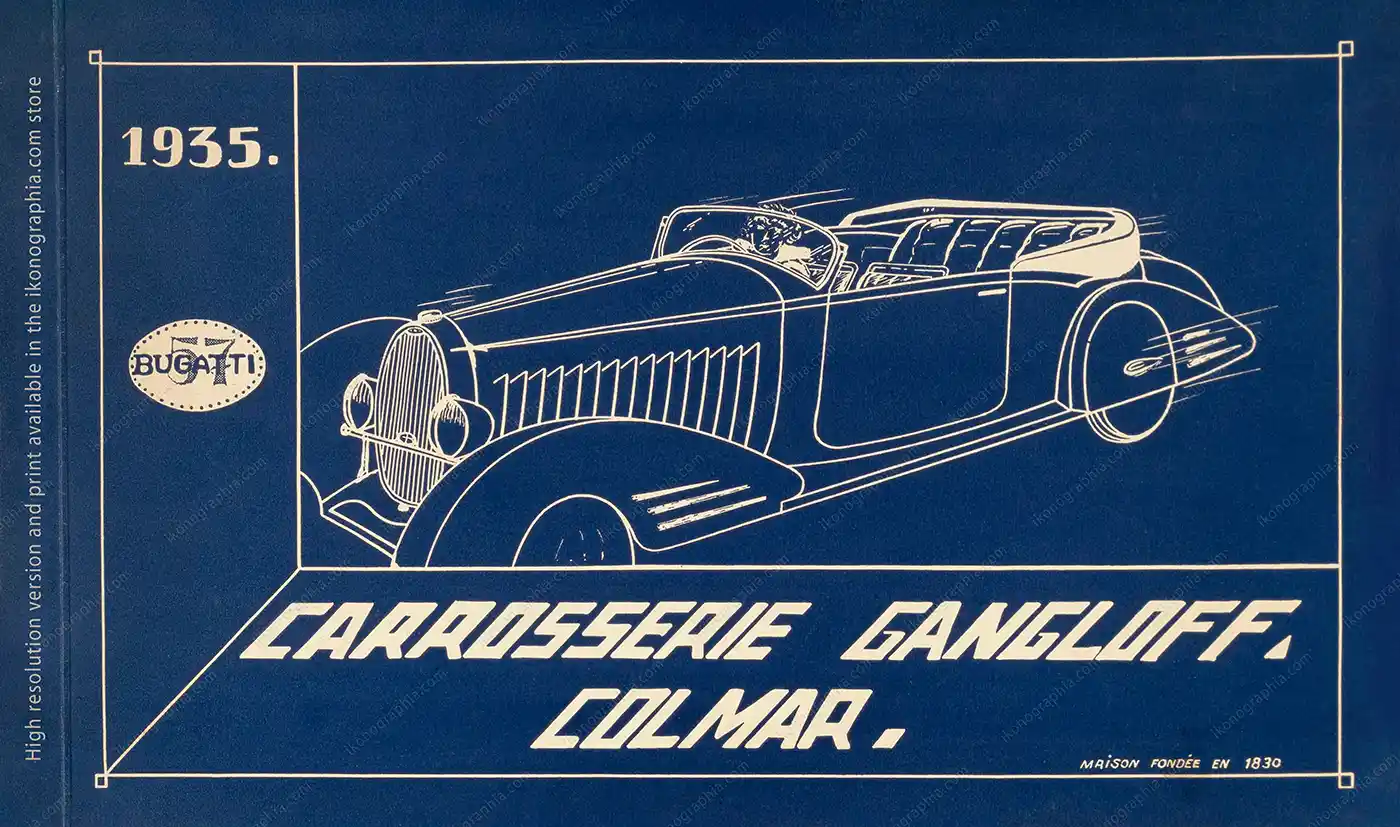
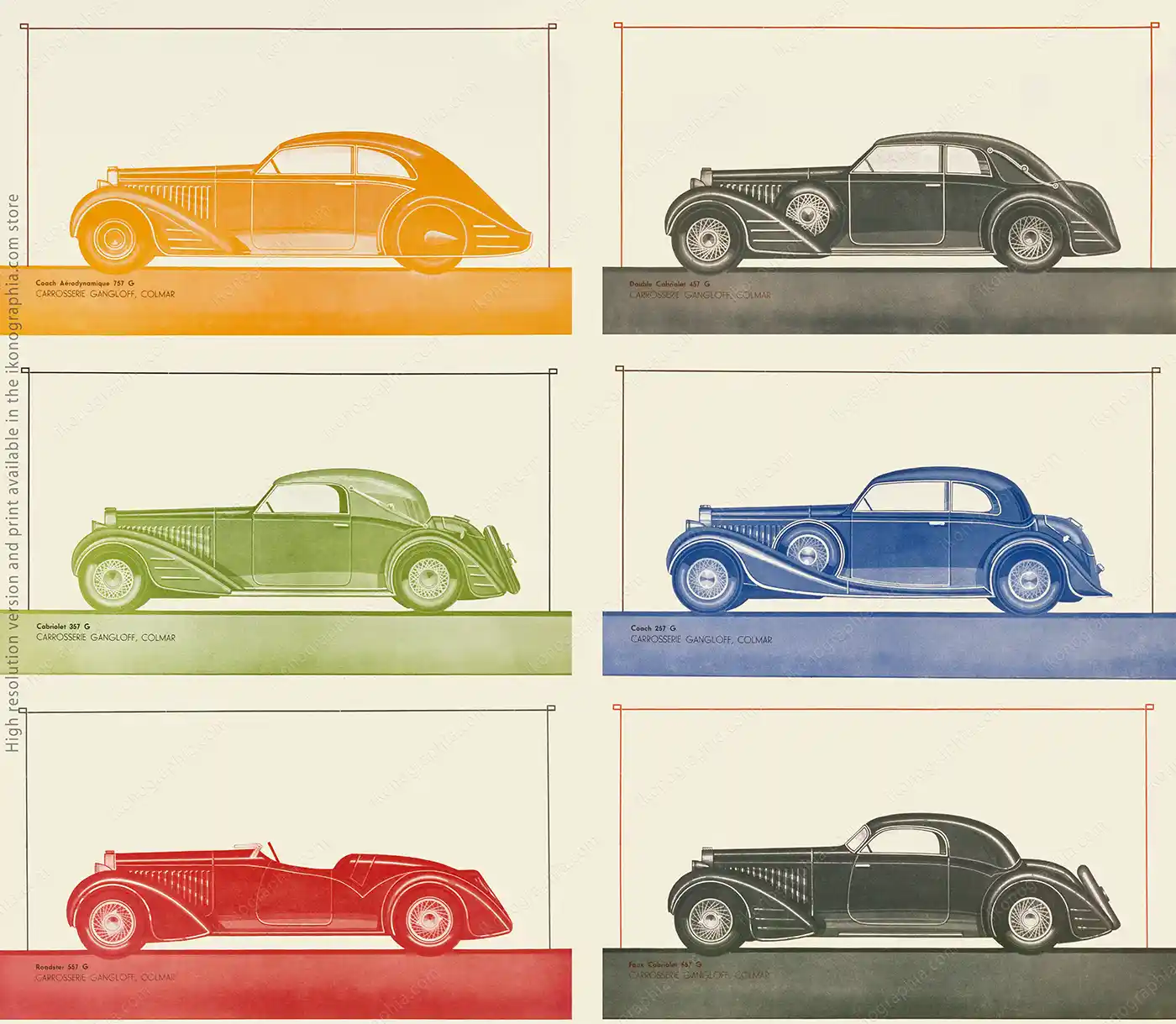
Carrosserie Gangloff, 1935

Before Jean's body designs became the standard, Bugatti's principal coachbuilder was Carrosserie Gangloff in Colmar, Alsace.
The 1935 Gangloff catalog documents six Type 57 and 57SC body variants — the Coach Aérodynamique, the Cabriolet, the Roadster, the Double Cabriolet, the Coach, the Faux Cabriolet. The photography is monochrome and functional. The cars do not need flattery.

Carrosserie Gangloff, Colmar for Bugatti. The cover of the 1935 catalog.

Carrosserie Gangloff, Colmar. Cover of the 1935 catalog for the Bugatti Type 57.

Gangloff of Colmar was Bugatti's principal coachbuilder before Jean's body designs became the standard.
The 1935 catalog documented what was available before the Atalante, the Atlantic, and the Stelvio existed. A world about to be replaced.

Carrosserie Gangloff, Colmar for Bugatti. Six monochrome pages from the 1935 catalog. Coach Aérodynamique 757 G, Cabriolet 357 G, Roasdster 557 G, Double Cabriolet 147 G, Coach 257G, Faux Cabriolet 657 G.

Carrosserie Gangloff, Colmar — Six pages from the 1935 catalog: Coach Aérodynamique 757G, Cabriolet 357G, Roadster 557G, Double Cabriolet 147G, Coach 257G, Faux Cabriolet 657G.

Six body variants, each assigned a Gangloff reference number.

The Coach Aérodynamique — 757G — was the most forward-looking of the six, the one that acknowledged where design was heading. Within two years, Jean had taken it further than Gangloff had imagined.

The Trains

In the early 1930s, Bugatti faced a financial crisis serious enough that the company's accountant presented the only rational solution: reduce the workforce by at least a third.

Ettore did not respond. He disappeared for a week.

When he came back, he gathered the entire workforce and told them to move all equipment into the smaller building. When they asked why, the answer was short: they would build trains.

In that week alone he had already designed the program. Within two years, the Bugatti Autorail existed: a streamlined railcar unlike anything running on European tracks. Ettore designed ergonomic seats that reversed direction so passengers always faced forward, with fold-out tables built into the backrest. To power the locomotives he used four modified engines from the Type 41 Royale — 12,763cc each, the largest production car engine ever built, now repurposed for rail.

The Autorail set the world rail speed record: 196 km/h, electrically timed over 10 kilometres. The previous record was around 122. He didn't improve it. He erased it.

The French national railway bought the trains. Nobody was let go.

The brochure that documents all of this is printed in blue monochrome — the same controlled hand as every other piece of Bugatti literature. At the bottom, three words: Vitesse. Confort. Sécurité. Not a promise. A statement of fact from a man who had just proved all three.

Carrosserie Gangloff, Colmar for Bugatti. Six monochrome pages from the 1935 catalog. Coach Aérodynamique 757 G, Cabriolet 357 G, Roasdster 557 G, Double Cabriolet 147 G, Coach 257G, Faux Cabriolet 657 G.

Automotive rapides Bugatti — Vitesse — Confort - Sécurité.
Advertisement Sheet 1934.

Record du monde de vitesse sur rail — 196 Kilomètres a l'heure — Chronométreé électriquement sur 10 kilomètres.
October 24, 1934.

Copyright, Links And Credits

Photography, Copyright & Credits

These images are part of the Ikonographia Visual Archives: — Bugatti Heritage Collection —  Bugatti Factory Drawings  Archive.
All drawings reproduced by Roberto Bigano in 1990 from originals held in the Bugatti factory archive. The current location of the originals is unknown.
All photographs © Ikonographia / Roberto Bigano — All Rights Reserved.

Terms of Use (Summary)

The images presented in this archive are copyrighted and available for licensed use only through Ikonographia Visual Archives.

You may not download, reproduce, publish, or distribute these images without a valid license. For commercial or editorial licensing, please refer to the product pages or contact Ikonographia directly. A full explanation of licensing terms is available in the Shop / Licensing Information section under "Ikonographia — Standard License" and "Ikonographia — Merchandising & Product Use Licenses"

The Ikonographia Bugatti Heritage Archive

Between 1990 and 2009, photographer Roberto Bigano documented Bugatti with a level of access that no longer exists and cannot be replicated. The relationship began with Romano Artioli — the Italian entrepreneur who had just acquired the Bugatti name and was preparing its revival at Campogalliano — who gave Roberto carte blanche to work inside the factory, the archive, and every event that followed. No brief. No restrictions. No supervision.

What resulted is not a single project but five distinct bodies of work: the factory technical drawings reproduced before they disappeared, two major photographic commissions on the historic cars, a complete documentary record of the Bugatti International Centenary Meeting in Tuscany, and an Alsatian reportage made inside Molsheim before the restoration began. Together they form one of the most complete private archives of Bugatti heritage in existence — most of it unpublished until now, some of it available nowhere else.

The archive is not a celebration of the marque. It is a record made by someone who was trusted enough to be inside it, at the precise moment when its past and its future were in the same room.

Credits & Acknowledgments

Ikonographia gratefully acknowledges the fundamental contribution of Romano Artioli, founder of Bugatti Automobili, without whose trust and unrestricted access this archive would not exist.

Ikonographia Mission Statement

Ikonographia is committed to the accurate documentation, preservation, and ethical dissemination of twentieth-century visual culture.

Archival Notes

These drawings were reproduced by Roberto Bigano in 1990, during the preparation for the revival of Bugatti Automobili at Campogalliano. Access to the Bugatti factory archive was granted by Romano Artioli. The drawings document the original Molsheim factory production.

Further Reading (Selected Sources)

EUR Euro