Celebrating the Art Deco Centenary. 1925-2025

Celebrating the Art Deco Centenary. 1925-2025

Celebrating the Art Deco Centenary — 1925-2025

A hundred years since the 1925 Paris Exhibition gave the movement its name — Ikonographia's response.

In 1925, the Exposition Internationale des Arts Décoratifs et Industriels Modernes in Paris gave Art Deco its name and its international reach. A hundred years later, the movement's visual legacy remains active — in the metalwork of Manhattan's lobbies, in the graphic language of Erté and Cassandre, in the automotive design of Bugatti and the decorative glass of Serge Roche.

This page brings together Ikonographia's existing Art Deco archives and stories as a single centenary overview — photography, illustration, graphic design, and decorative arts, documented across a century.

NYC Art Deco, Elevator Doors' Nickel-Silver Relief, 20 Exchange Place

NYC Art Deco Elevator’s door silver-nickel (a rare alloy of copper and nickel) decorative ironwork. 1931
New York City, 20 Exchange Place, formerly the City Bank–Farmers Trust Building. 

What is Art Deco


Art Deco, short for "Arts Décoratifs," is a visual arts, architecture, and product design movement emerged in Paris during the 1910s and gained prominence in the U.S. and Europe from the 1920s to the early 1940s. Popularized by designers like Erté and Paul Poiret, it became the dominant style following the 1925 Exhibition in Paris.

At its peak in the late 1920s, Art Deco was more than just a style; it was a movement, a way of thinking that symbolized luxury, glamour, and exuberance. Above all, it represented hope and confidence in social and technological progress.

Characterized by exquisite craftsmanship, luxury, glamour, and innovative materials such as stainless steel and plastic, Art Deco represented hope and confidence in technological progress. Its influence can be seen in architecture, from skyscrapers to everyday objects, as well as in advertising and illustration, leaving a lasting impact on 20th-century culture.

Les choses de Paul Poiret 1911 Hat Design artwork by Georges Lepape

Hat Design by Paul Poiret; artwork by Georges Lepape, from the 1911 Catalog "Les choses de Paul Poiret."
The Art Deco movement emerged in Paris during the 1910s, popularized by designers like Erté and Paul Poiret.

The International Exhibition of Modern Decorative and Industrial Arts


The International Exhibition of Modern Decorative and Industrial Arts (Exposition Internationale des arts décoratifs et industriels modernes) was held in Paris in 1925. During its seven-month run, 15,000 exhibitors from twenty countries and sixteen million people visited the exhibition, which had an enormous impact worldwide.

The term "Art Deco" originated from this exposition. While the style debuted in Paris during the 1910s, it is conventionally considered officially established in 1925. Thus, 2025 marks the centenary of Art Deco, and Ikonographia is preparing to celebrate with twelve monthly stories honoring this iconic movement.
This first part is a preview of what we are going to publish.

Exposition International Des Arts Decoratifs 1925, poster by Robert Bonfils International Exhibition of Modern Decorative and Industrial Arts, held in Paris in 1925.

Exposition International Des Arts Decoratifs 1925, poster by Robert Bonfils.
International Exhibition of Modern Decorative and Industrial Arts, held in Paris in 1925.

New York City Art Deco Architecture


Although the United States did not officially participate in the Exhibition, many talented American architects and artists from New York City attended and returned inspired. They embraced the Art Deco style and reinvented it, making American Art Deco a distinctly original architectural movement.

Art Deco flourished in New York City during the 1920s and 1930s, influenced by global decorative arts trends, mechanization, and the 1916 Zoning Resolution, which promoted innovative designs with setbacks. This style broke traditional norms, featuring verticality, ornamentation, and new materials like plastics and metals.

The economic boom of the Roaring Twenties led to a citywide building surge, with Art Deco evident in everything from soaring skyscrapers to modest homes and municipal buildings. Lavishly decorated skyscrapers defined Manhattan’s skyline until the Great Depression curtailed their construction.

Frozen Fountain Decoration, inspired by Edgar Brandt's gates, exhibited at the 1925 Exposition in Paris. Madison Belmont Building, 183 Madison Avenue

Art Deco Frozen Fountain Decoration, inspired by Edgar Brandt’s gates, exhibited at the 1925 Exposition in Paris. Madison Belmont Building, 183 Madison Avenue, New York City. Photo by Roberto Bigano.

Art Deco got its name in 1966


The term 'Art Deco' wasn't officially used until 1966, initially referred to as "Le Style Moderne" or "Jazz Moderne." It gained prominence after the Museum of Decorative Arts in Paris’s 1966 exhibition, 'Les Années 25.' The name was solidified in 1968 during a scholarly reappraisal.

Although Art Deco originated in the 1910s in France, we celebrate its centenary in 2025 because the 1925 Exhibition marked a significant moment in art and design, leading to its growth, especially in the United States.

Les Annes '25' Art Deco. Bauhaus. Stijl. Esprit nouveau. Poster 1966

Les Annes ’25’ Art Deco. Bauhaus. Stijl. Esprit nouveau. Poster 1966.
This exhibition made the debut of the term “Art Deco.”

The Chanin Building Radiator Grilles by Rene Paul Chambellan


The New York City Chanin Building was built for Irwin S. Chanin in 1929. The Chanin Building in New York City was constructed for Irwin S. Chanin in 1929. It is a prime example of Art Deco architecture, housing a collection of exceptional masterpieces.
The lobby is designed around the concept of the "City of Opportunity," featuring a geometric motif that symbolizes human thought and emotion.

We'll focus on the notable Radiator Grilles in the vestibules of the building, crafted by Paul Bellentan on a concept by Jaques Delamarre. With a geometric, abstract design symbolizing human thought and emotion. These grilles are among the finest illustrations of the concept, design, and craftsmanship of Art Deco in New York City, highlighting the movement's significance.

Success. Gilded Bronze Radiator Grill in the vestibule of the Chanin Building. By Rene Paul Chambellan 1929.

Success. Art Deco Gilded Bronze Radiator Grill in the vestibule of the Chanin Building in Manhattan. By Rene Paul Chambellan 1929.

From "The City of Opportunity - Physical Series."

The Eglomized Glass and Mirrors by Serge Roche


Serge Roche, born in France in 1898, was an eclectic artist, though he would best be defined as an interior decorator. In addition to this, he was a remarkable antiquarian, sculptor, designer, and organizer of significant exhibitions. His studio, located at 125 Boulevard Haussmann, served as a global hub for decades, attracting the elite of the Parisian and international artistic community.

By 1934, he had developed a unique style that became the focus of his first exhibition, featuring mirrors and ‘mirror and glass objects.’ He employed a technique known as 'Eglomization,' which involves embedding foreign materials within glass paste. The upcoming article will showcase a selection of these stunning creations.

Eglomizedì octagonal mirror for Serge Roche by Max Ingrand 1933

“Eglomized” octagonal mirror framed by panels featuring mythical creatures by Maison Serge Roche. The craftsmanship was likely done by Max Ingrand in 1933. The eglomization technique consisted of embedding foreign elements in the mirror’s glass paste, producing an endless array of variations. Collection Laurent Marechal.

The Lavish Interiors of the Assyrian-themed Fred French Building in NYC.


The Fred French Building, styled with Assyrian themes, stands out as one of the city's most elaborate and extravagant examples of Art Deco architecture. At the time, there was a great interest in Ancient Egypt and the Ancient Near East.

The lobby walls are clad with marble and contain decorative details such as chevrons, palmettes, volutes, merlons, and lotus flowers, as well as representations of animals such as lions and winged bulls.
The elevator lobby features several decorative bronze features, the most notable of which are the eight panels of the gilt-bronze double-leaf elevator doors.
Lastly, an impressive Assyrian Revival mailbox features a bald eagle, the United States Post Office symbol, and two winged griffins.

The Fred French Building, New York City. The vestibule of the entrance from 45th Street, as seen from the elevator lobby. 1927

Whenever you see an Arrow, Think of Coca-Cola - Get What You Ask For. Red Book Magazine, July 1910.

The London Underground Art-Deco Posters


Poster art flourished in Britain during the 1920s and 1930s, thanks to progressive clients such as the Great Western Railway (GWR), the London North Eastern Railway (LNER), and Shell-Mex.
However, the most impressive and trending production came from the London Underground. They utilized London’s most prominent advertising spaces, which functioned like a public art gallery, reaching a vast audience and creating iconic images.
We will showcase a selection of these masterpieces.

Smelling The Riches Of London, poster 1927 by Frederick Charles Herrick for London's Underground

Smelling The Riches Of London.
A 1927 poster by Frederick Charles Herrick for London’s Underground.

The poster is part of a series of four inviting to enjoy London through the senses: smelling, tasting, seeing, and hearing.
The use of color was highly innovative, with distinct tones assigned to each subject.

Art Deco in U.S Advertisement


The Art Deco style was prominently featured in advertising across the United States. We will showcase a collection of the finest advertisements from magazines such as Fortune, Harper's Bazaar, The New Yorker, Vanity Fair, and others, highlighting brands like Cadillac, Rolls Royce, Timken, and more.

Art Deco Automotive by John Whitcombe. On and on they go, Timken Bearings, Fortune, December 1934

Art Deco Automotive Advertisement by John Whitcombe. On and on they go, Timken Bearings, Fortune, December 1934

Art Deco in Magazine Covers


The Art Deco style was exceptionally suited for magazine cover design. We will present a captivating selection of iconic covers from the 1920s, featuring renowned titles such as The New Yorker, The Chicagoan, Harper's Bazaar, and Vanity Fair, created by both well-known and lesser-known artists.

1929 Chicago by Night. Art Deco Cover by Nat Karson. The Chicagoan Magazine September 28, 1929.

1929 Chicago by Night. Art Deco Cover by Nat Karson, with its unmistakable style

The Chicagoan Magazine September 28, 1929.

Art Deco Iconic Cartoons by Anne Fish for Harper's Bazaar.


From 1914 to 1926, Anne Harriet Fish created hundreds of covers and cartoons for Vanity Fair.

In October 1927, an advertisement in the New Yorker titled "The Biggest Catch of The Season" solemnly announced that "The internationally known"Fish" has just been landed to join the Bazar Staff. This springhty English artist will present to the appreciative audience of Harper's Bazar a first interpretation of its vanities and vagaries—in the December issue."

With this new batch of cartoons, Anne Fish refreshed her style, incorporating some Art Deco elements while preserving her distinctive wit. We will be publishing a selection of double-page cartoons from 1928 and 1929.

New Year Resolution are made to be broken. But these are quite easy to Keep. Anne Fish for Harper's Bazaar, January 1928, pages 64-65.

New Year Resolutions are made to be broken. But these are quite easy to Keep.
Anne Fish for Harper’s Bazaar, January 1928.

Erté and Art Deco


Romain de Tirtoff, aka Erté, pioneered the Art Deco style.
After designing his first cover for Harper’s Bazaar in 1915, Erté secured a ten-year exclusive contract with the magazine. This decision proved to be highly perceptive.

Between 1915 and 1936, Erté created over 240 covers featuring his signature Art Deco-style illustrations, which combined bold areas of solid color with intricate, whimsical details.
While Erté is most recognized for his covers, his editorial content—often in double-page spreads with original designs—set fashion trends for decades.

Harper's Bazar Cover by Erté, December 1924, Christmas Number

A splendid design by Ertè for Harper’s Bazar, December 1924, Christmas Number.

Art Deco Ads Illustration for British Dunlop


During the 1930s, British Dunlop produced a striking series of ads, each featuring an image of Dunlop tires on Cars, Trucks, and Planes. What makes these ads stand out is their depiction of diverse social situations, which provides a rich insight into ​​the society of the time.

Despite their publication in prominent British magazines, the illustrators' names and other crucial details of these ads remain mysterious.

Distinction. Wealthy couple in evening dress. Dunlop Reinforced Tyre ad 1933

Distinction. Wealthy couple in evening dress. Dunlop Reinforced Tyre ad 1933.

From the Bystander Magazine, March 22, 1933

Copyright, Links and credits

NYC Art Deco and Serge Roche Photographs are copyrighted to Roberto Bigano.

LINKS:
The Art Story: Summary of Art Deco >

The Architectural Forum, May 1929
Reliefs And Grilles Of The Chanin Building Vestibules. Page 693 >
By Rayne Adams.

French Building & Fred French Bio >

The Coca-Cola History Through Ads. 1 – 1886-1919

The Coca-Cola History Through Ads. 1 – 1886-1919

The Coca-Cola History Through Ads — N.1 (1886-1919)

From Pemberton's back pain to the Coca-Cola Controversy.

The Coca-Cola history told through its own advertising — from the first glass sold in Atlanta in 1886 to the consolidation of a global brand by 1919. Trademark registration, logo design, the cocaine removal from the recipe, and the first systematic campaign against imitation products: each chapter documented through the visual record Coca-Cola left behind.

This first part covers 1886–1919. The series continues into the 1960s.

Trademark registration by The Coca Cola Company for Coca-Cola brand Nutrient or Tonic Beverages. January 31, 1983

It all started with Dr. Pemberton's severe back pain.

Dr. John Pemberton, an Atlanta pharmacist and Confederate Colonel wounded in the American Civil War, was addicted to morphine to fight severe back pain. Thanks also to his medical degree, he began to search for a substitute for the problematic drug.
After several attempts, Dr. Pemberton blended an extract of cocaine-rich coca leaves and caffeine-rich cola nuts. These ingredients formed the basis of the original Coca-Cola recipe.
Initially conceived as a patent medicine, the drink was also marketed as a temperance drink. This dual purpose reflected the prevailing health concerns and social attitudes of the time.

On May 8, 1886, he sold the first glass of the drink, later named Coca-Cola, in his pharmacy in Atlanta. During that year, an average of nine drinks a day were sold, marking the humble beginnings of a global phenomenon.

Trademark registration by The Coca Cola Company for Coca-Cola brand Nutrient or Tonic Beverages. January 31, 1983

Trademark registration by The Coca-Cola Company for the Coca-Cola brand Nutrient or Tonic Beverages.

Patent N. 22,406, Filed on January 31, 1893, in Atlanta, Ga.

This file, digitally reproduced from the original, is freely downloadable in high resolution at the Library of Congress.

August 1984 - Beverly Hills, California - From "Plastic Girls" series. Photo Roberto Bigano.

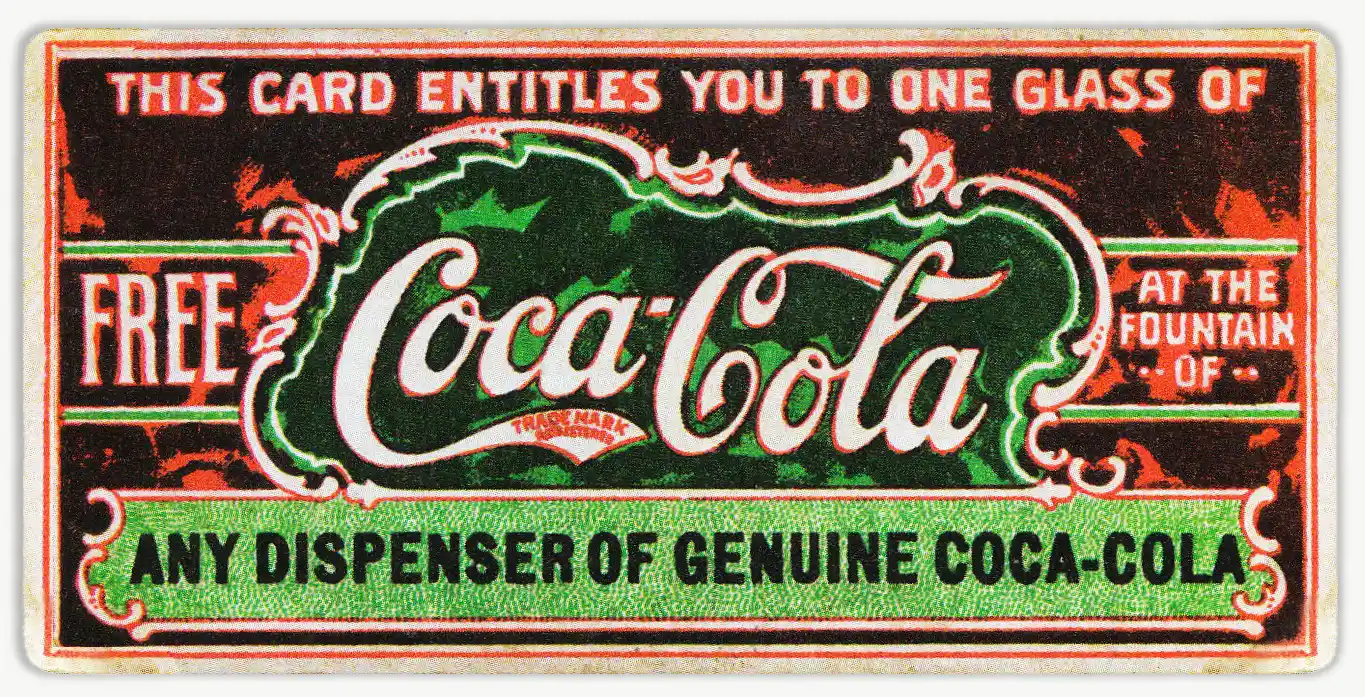
Ticket for a free glass of Coca-Cola — Atlanta 1888

This is believed to be the first coupon ever

Asa Griggs Candler

Dr. Pemberton, though a brilliant mind, faced challenges in the business. His partnership with Asa Griggs Chandler, a visionary businessman, was a turning point.
Mr. Candler, from 1886 to 1888, bought the Coca‑Cola formula and patents from John Pemberton and his partners. In a few decades, Candler's innovative marketing tactics led Coca-Cola to dominate the global soft drink market.
The first crucial move was the creation of a distinctive logo featuring the two Cs in a Spencerian script. This logo would become a cornerstone of Coca-Cola's branding strategy.
On May 14, 1892, The Coca-Cola Company registered, with patent N. 22,406, name, logo, and trademark as a "Nutrient or Tonic Beverage."
By the late 1890s, Coca-Cola had become a household name and America's most popular fountain drink. The scale of its success was staggering, with Coca-Cola sales skyrocketing from one million a year in 1890 to an astonishing one hundred million in 1900.

Coca-Cola Logo original desiign 1893 and current

The original Coca-Cola Trade-Mark, as registered on January 31, 1893, and the current one.

Considering the one-hundred-and-forty years spam, they are impressively similar.

1901. Removing Cocaine from the Recipe for Racial Reasons

The medical community viewed tonics like Coca-Cola—advertised to white, middle-class consumers for their aphrodisiac qualities—as harmless. The situation changed dramatically when black workers in the New Orleans area began using Cocaine to cope with the grueling demands of long, physically taxing workdays. The use of Cocaine spread to workers on plantations and in urban areas throughout the South, becoming a recreational drug in Black and mixed-race neighborhoods as well. Source

Medical journals warned of the so-called “Negro cocaine menace,” and newspapers claimed that the drug drove black men to commit crimes, particularly the rape of white women. Despite these concerns, the company continued to include Cocaine in its formula. However, this approach became increasingly problematic in 1899 when the company expanded its sales of bottled Coke to a national market, and Coca-Cola became accessible outside of white soda fountains to anyone with a nickel, including Black men. Source
1901 the company removed Cocaine from the recipe, replacing it with more sugar and caffeine.

Coca-Cola Delicious Refreshing At Soda Founts 5c Good Housekeeping Magazine, June 1905.

Coca-Cola Delicious Refreshing At Soda Founts, 5¢.
Good Housekeeping Magazine, June 1905.

Patent N. 22,406, Filed on January 31, 1893, in Atlanta, Ga.

This file, digitally reproduced from the original, is freely downloadable in high resolution at the Library of Congress.

Hilda Clark. The first Coca-Cola Model

The model Hilda Clark, a testimonial of the brand, was a popular music hall singer and actress. She became famous as a model in 1895 when she was the first woman featured on a tin Coca-Cola tray. She remained the advertising “face” of Coca-Cola until February 1903.

Drink Coca-Cola 5 cents Poster 1885. Model Hilda Clark, the advertising face of the brand. An 1890s advertisement showing model Hilda Clark in formal 19th-century attire. The ad is entitled Drink Coca-Cola 5¢.

Drink Coca-Cola 5 cents—an amazing poster from 1885

The model Hilda Clark, a testimonial of the brand, was a popular music hall singer and actress. The artist's signature is unreadable.

Text in the sheet: Home Office
The Coca-Cola Co. Atlanta, Ga.
Branches: Chicago, Philadelphia, Los Angeles, Dallas.

This is a file from the Library of Congress's digital archive that we digitally restored.

First Coca-Cola Advertisements

The first ads for Coca‑Cola appeared in national magazines in 1904, but the oldest we found was from 1905.
Given the brand's meteoric and impactful success, it's a stretch to say that the company's first advertisements, Hilda Clarks one's aside, were poor and lacked even a minimum corporate image.

Of course, we are discussing something published at the turn of the century. Still, in those years, several companies, such as Kellogg's Corn Flakes or Queen City Printing Inks, released organic ad campaigns with an excellent corporate, coordinated image.

Good Housekeeping 1905-05_604 Coca-Cola by Massegale-Atlanta

Coca-Cola Revives and Sustains Ad
Good Housekeeping Magazine, May 1905.
Design by Massengale, Atlanta

Take one glass of Coca Cola when weary with shopping. It imparts energy and vigor.

Coca-Cola Delicious Refreshing 5¢, Harper's Bazaar, May 1905, advertisement bt Massengale, Atlanta.

Coca-Cola Delicious Refreshing 5¢, Ad
Harper's Bazaar, May 1905.
Design by Massengale, Atlanta.

It is a beverage in which a toast to health and happiness becomes and accomplished fact, as well as a delightful pleasure. At all founts and in bottles

1905 Good Housekeeping 1906-05_677 Coca-Cola

Drink Coca-Cola. The Ideal Beverage for Discriminating People.
Good Housekeeping Magazine, May 1906..

It is a beverage in which a toast to health and happiness becomes and accomplished fact, as well as a delightful pleasure. At all founts and in bottles

Coca-Cola Ad From the Realm of Fancy to Reality, artwork by A.T.Farrel. Good Housekeeping Magazine, July 1907

Coca-Cola Ad From the Realm of Fancy to Reality.
Artwork by A.T.Farrel.
Good Housekeeping Magazine, July 1907.

Drink Coca-Cola.
The Satisfying Beverage.
Relieves the fatigue that comes from-over-play, over-work, and over-thinking.
Delicious! Refreshing! Thirst-Quenching!

Coca-Cola Ad "An Act Not On The Bill. Coca-Cola The "Star" Performance" Good Housekeeping Magazine, September 1907

Coca-Cola Ad From the Realm of Fancy to Reality.
Artwork by A.T.Farrel.
Good Housekeeping Magazine, July 1907.

Coca-Cola makes it possible for you to make your appearance with light step, sparkling eye, steady hand and nerves, and, above all, with a clear head capable of lucid thinking and logical reasoning.

This advertisement can be seen as a company's policy statement listing all the drink's magic features, with the dual purpose of being a healthy mind brightener and refresher. It is a company's Manifesto.

An ingenious idea underappreciated for twenty-four years

In July 1910, a brilliant designer created the Coca-Cola Red Circle with the color code primary red. In the ads, the logo was red on white or white on red inside the circle. The company executives did not understand the value of this intuition, and the Red Circle was used only a couple of times in the following decades. Only in 1935 was it revived and became one of the cornerstones of the Coca-Cola Branding Strategy. From then on, the Red Circle was used in practically every ad.

Whenever you see an Arrow Think of Coca-Cola Advertisement on Red Book Magazine, July 1910

Whenever you see an Arrow, Think of Coca-Cola — Get What You Ask For. Red Book Magazine, July 1910

This is probably the first advertisement showcasing the Red Circle, which would later become a cornerstone of Coca-Cola Branding.

Coca-Cola Branding Journey and Imitations Fighting

As Coca-Cola's popularity grew, so did attempts to imitate it. Starting in 1908, the first response to this imitation was the introduction of "Follow the Arrow," which featured arrow-shaped signs to promote Soda Fountains selling the original. The Arrow was also widely used in advertisements during this time.

From 1910, the company, to protect the brand from imitations, began publishing an impressive number of text ads, often double-page spreads, warning against imitations. Sometimes, these ads directly address the reader. In some cases, they were even threatening, particularly towards druggists who sold other drinks that imitated Coca-Cola's names and features.
While these ads may make us smile, they are a blast from the past and a reminder of a bygone era.

Hot Sun- Much Thirst - A Notice to Druggists Coca Cola Ad, Reed Book Magazine, August 1910

Hot Sun- Much Thirst  A Notice to Druggists

Red Book Magazine, July 1910

Here's to Your Good Health and Pleasure - The Why of Imitations Coca Cola Ad, Reed Book Magazine, August 1911

Here's to Your Good Health and Pleasure —The Why of Imitations

Red Book Magazine, August 1911

The Answer. Coca-Cola Advertisement. Red Book Magazine, August 1912

Here's to Your Good Health and Pleasure — The Why of Imitations

Red Book Magazine, August 1911

Harvey Washington Wiley and the "Coca-Cola Controversy"

Harvey Washington Wiley was an American physician and chemist known for his successful advocacy for the passage of the landmark Pure Food and Drug Act of 1906. Following this achievement, he worked at the Good Housekeeping Institute laboratories.
He was the first commissioner of the United States Food and Drug Administration. Wiley's advocacy for stricter food and drug regulations indirectly contributed to Coca-Cola's decision to remove cocaine from its formula in the early 20th century.

After his government tenure ended in 1912, Harvey Washington Wiley took charge of the laboratories at Good Housekeeping Magazine as the Director of the Bureau of Foods, Sanitation, and Health.
In September 1912, the magazine published a daring ten-page essay titled "The Coca-Cola Controversy." This piece, which featured both text and cartoons, openly criticized the popular beverage, warning about the dangers associated with "artificial" caffeine. This move is astonishing by today’s standards, especially considering that Coca-Cola was a vital advertiser.

Good Housekeeping 1912-09_386-387 The Coca-Cola Controversy

The Coca-Cola Controversy.
Good Housekeeping Magazine, September 1912.

A daring ten-page essay titled "The Coca-Cola Controversy": The Facts and Dr. Wiley's Opinion, Together with a Talk on the Drugging of Soft Drinks.
This piece, which featured both text and cartoons, openly criticized the popular beverage, warning about the dangers associated with "artificial" caffeine.

This move is astonishing by today’s standards, especially considering that Coca-Cola was a vital advertiser.

Good Housekeeping 1912-09_388-389The Coca-Cola Controversy

The Coca-Cola Controversy.
Good Housekeeping Magazine, September 1912.

This essay is astonishing by today’s standards, especially considering that Coca-Cola was a vital advertiser.

The Pivotal Coca-Cola Trial — United States v. Coca-Cola, 1912

In a famous action brought against The Coca-Cola Company in 1911, Mr. Wiley contended that it was illegal to use the name Coca-Cola when there was no actual cocaine in the drink and also that it was unlawful for it to contain caffeine as an additive.

With the threat of having to remove caffeine, Coca-Cola was teetering on the edge of a defeat that could have been catastrophic. The Company faced a challenge in finding a renowned psychologist to validate the non-dangerousness of caffeine. In a stroke of luck, Coca-Cola enlisted the services of a brilliant doctoral student, Harry Hollingworth, who needed research funds.
With the trial looming, the need for results was pressing. In a race against time, Hollingworth devised a series of three studies that were completed in just 40 days. These studies, known for their methodological sophistication, were crucial to the case.

We won't tell you the whole story here, but Coca-Cola ultimately won in this existential trial.
Hollingworth was nicknamed "the man who saved Coca-Cola.

Cartoon against lobbying Coca-Cola in the caffeine trial

The Coca-Cola Controversy.
Good Housekeeping Magazine, September 1912.
Cartoon detail.

A number of the experts who testified as to the harmlessness of caffeine had formerly expressed different opinions.

Plastic Girls — Glamour, Aggression, and Display (1980–1997)

Plastic Girls — Glamour, Aggression, and Display (1980–1997)

Plastic Girls — Glamour, Aggression, and Display (1980–1997)

A shared escalation toward excess, beyond style, geography, or chronology.

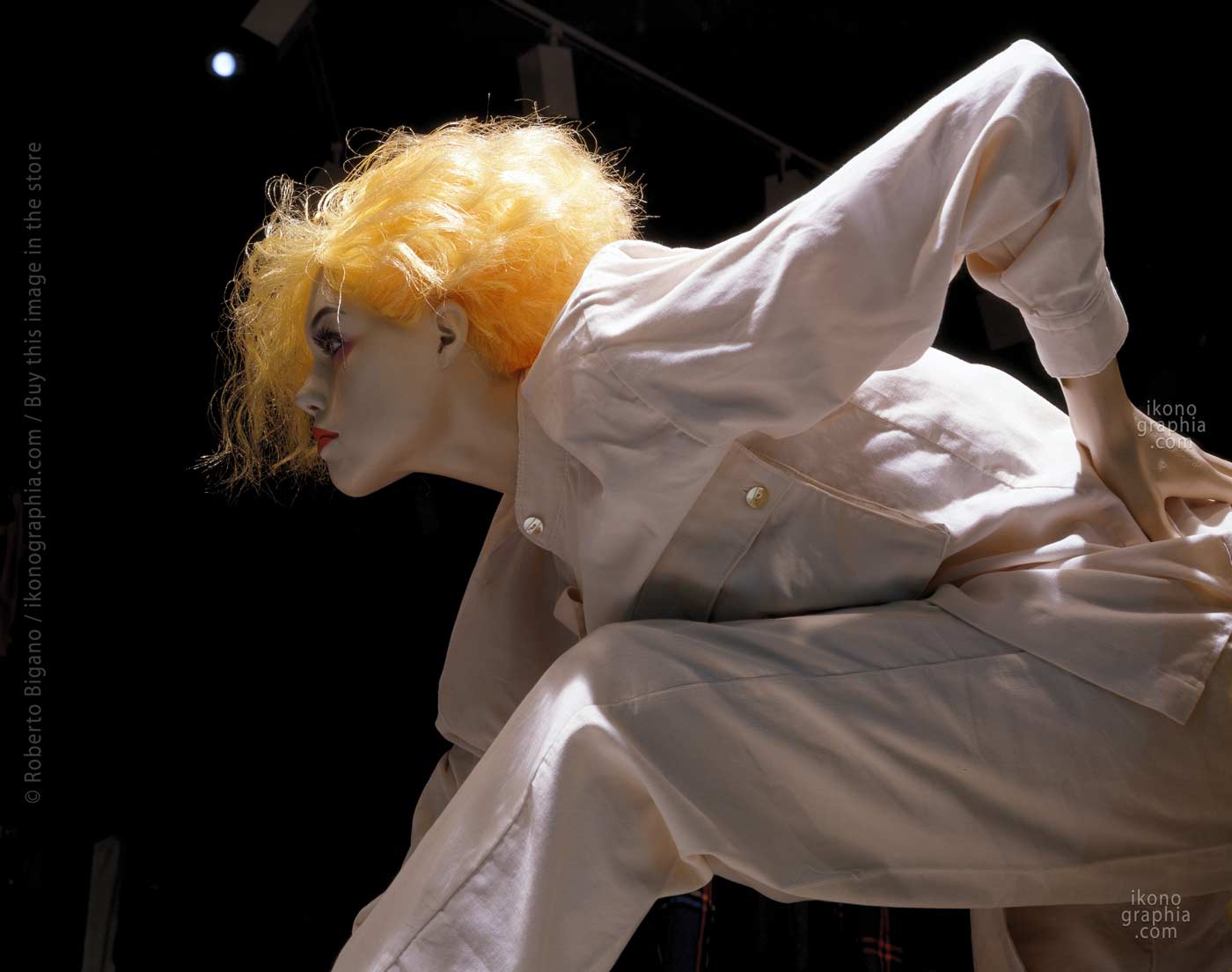
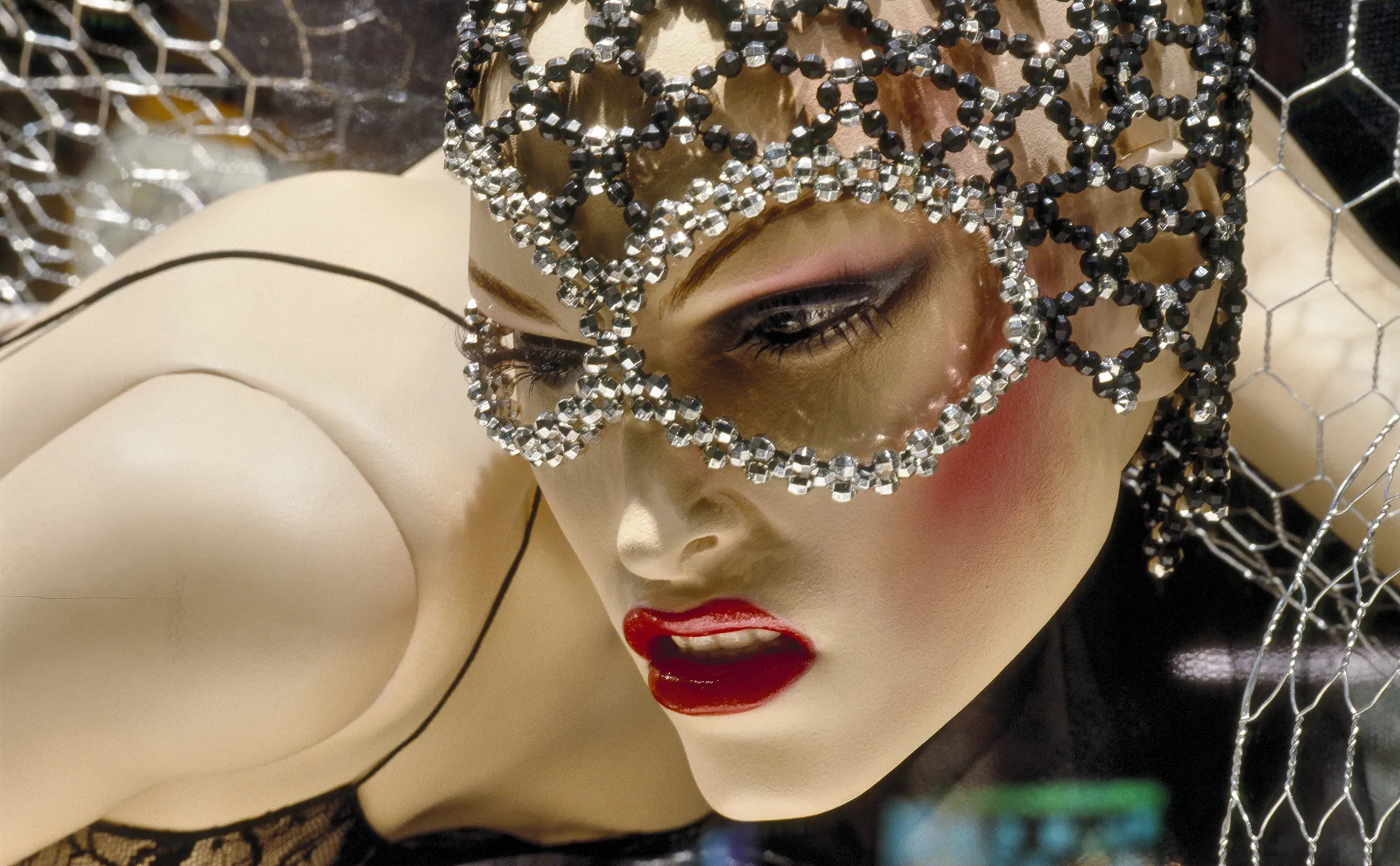
This chapter documents the moment when artificial femininity becomes overtly cosmetic, sexualized, and confrontational. Across different countries and contexts, mannequins adopt exaggerated makeup, exposed poses, and aggressive gazes, turning the female face and body into surfaces of visual pressure rather than neutral display. What unites these images is not style, geography, or chronology, but a shared escalation toward excess as a dominant mode of representation.

The very first EB110 model made in epowood as designed by Benedini, with the rear wheels covered reminding the Bugatti Atlantic.  Photo Roberto Bigano. Buy this image in the ikonographia.com store.

Photographed from the street, without access or intervention, these images record what shop windows openly displayed at the time. Seen together, they show how exaggerated cosmetics, exposed poses, and confrontational gazes accumulated across different contexts, forming a shared visual condition rather than isolated stylistic choices.

These photographs belong to "Plastic Girls: 50 Years of Artificial Beauty", a long-term photographic project developed over nearly five decades, in which shop windows are approached as a continuous site of cultural observation.

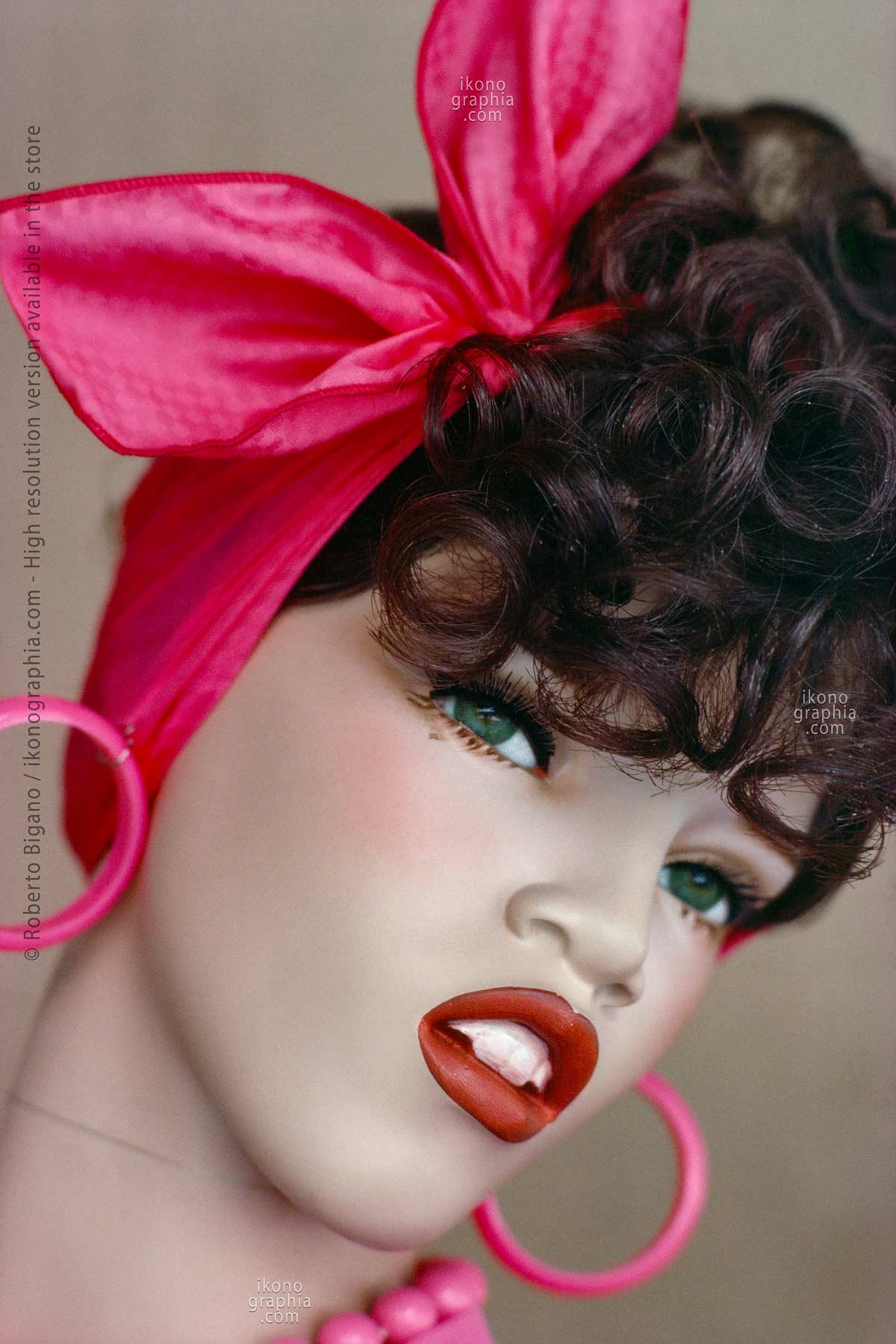
0462_38 Dummy in San Sebastian, Spain. 1980. Photo Roberto Bigano. Buy this image in the ikonographia.com store.

May 1980.
San Sebastian, Spain.
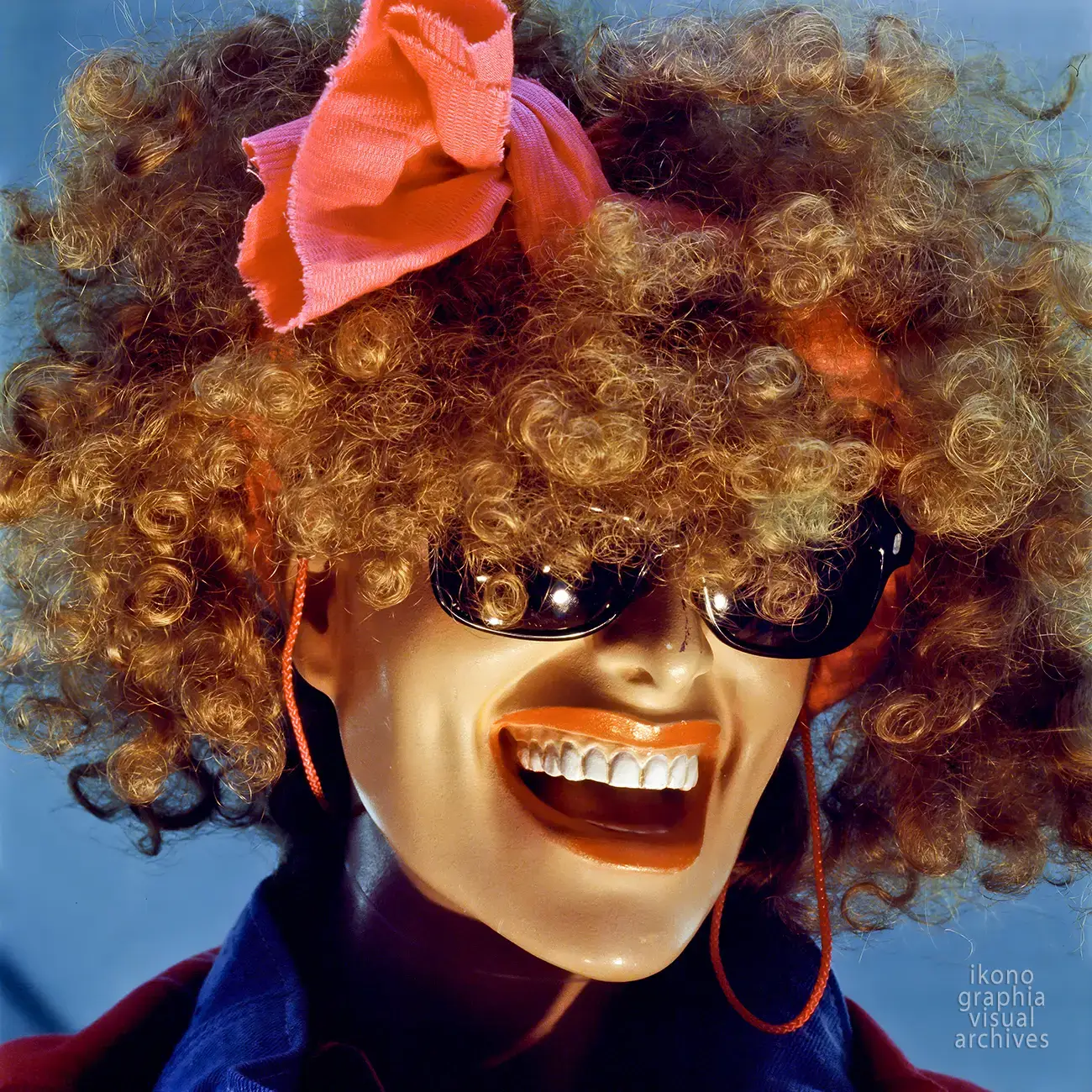
Impudent mannequin in Gitana look.

Provocative pose, and pure pin-up energy. Pink bow, oversized hoop earrings — the full costume assembled with complete conviction.

Artificial femininity at its most playful and deliberate.

0462_38 Dummy in San Sebastian, Spain. 1980. Photo Roberto Bigano. Buy this image in the ikonographia.com store.

May 1980.
San Sebastian, Spain.

Naturalistic posture and coordinated styling suggest ease and approachability rather than confrontation. At this stage, display favors balance and coherence, with realism serving persuasion without yet turning aggressive.

Fixed smile, exposed teeth, and dark lenses produce a hypnotic and surreal effect, holding the viewer’s attention while withholding emotional response.

August 1986.
Copenhagen, Denmark.

Fixed smile, exposed teeth, and dark lenses produce a hypnotic and surreal effect, holding the viewer’s attention while withholding emotional response.

Shop-window mannequin with dramatic makeup and confrontational pose in Copenhagen boutique window, Denmark, 1986.

August 1986.
Copenhagen, Denmark — Graziano Boutique.

Cosmetics, costume, and posture collapse into a single surface of exposure.
Here, realism is pushed toward theatrical excess, reflecting a broader mid-1980s Scandinavian shift toward confrontational display, where mannequins abandon neutrality and assert presence through visual aggression.

Shop-window aggressive mannequin at Annabell Boutique, Copenhagen, 1986

August 1986.
Copenhagen, Denmark — Annabell Boutique

Aggression becomes fully articulated.
Makeup, gesture, and facial tension no longer simulate life but enforce confrontation, confirming a local display language where artificial bodies are designed to provoke, not attract, and excess replaces illusion as the dominant strategy.

Spain (1997) — Glamorous Brides

Ritual, spectacle, and artificial femininity in Andalusian display culture

Within this broader escalation, bridal mannequins occupy a specific role. Ritual costume does not temper display, but intensifies it. Lace, veils, makeup, and carefully staged expressions turn the bridal figure into a concentrated surface of glamour, where idealization slips into exposure and display becomes explicit.

2588_01 Sexy mannequin in wedding dress, in Seville Spain. Photo Roberto Bigano. Buy this image in the ikonographia.com store.

March 1997.
Sevilla, Spain — Wedding dress shop.

In Andalusian culture, the bride carries the full weight of ceremony, tradition, and social identity.

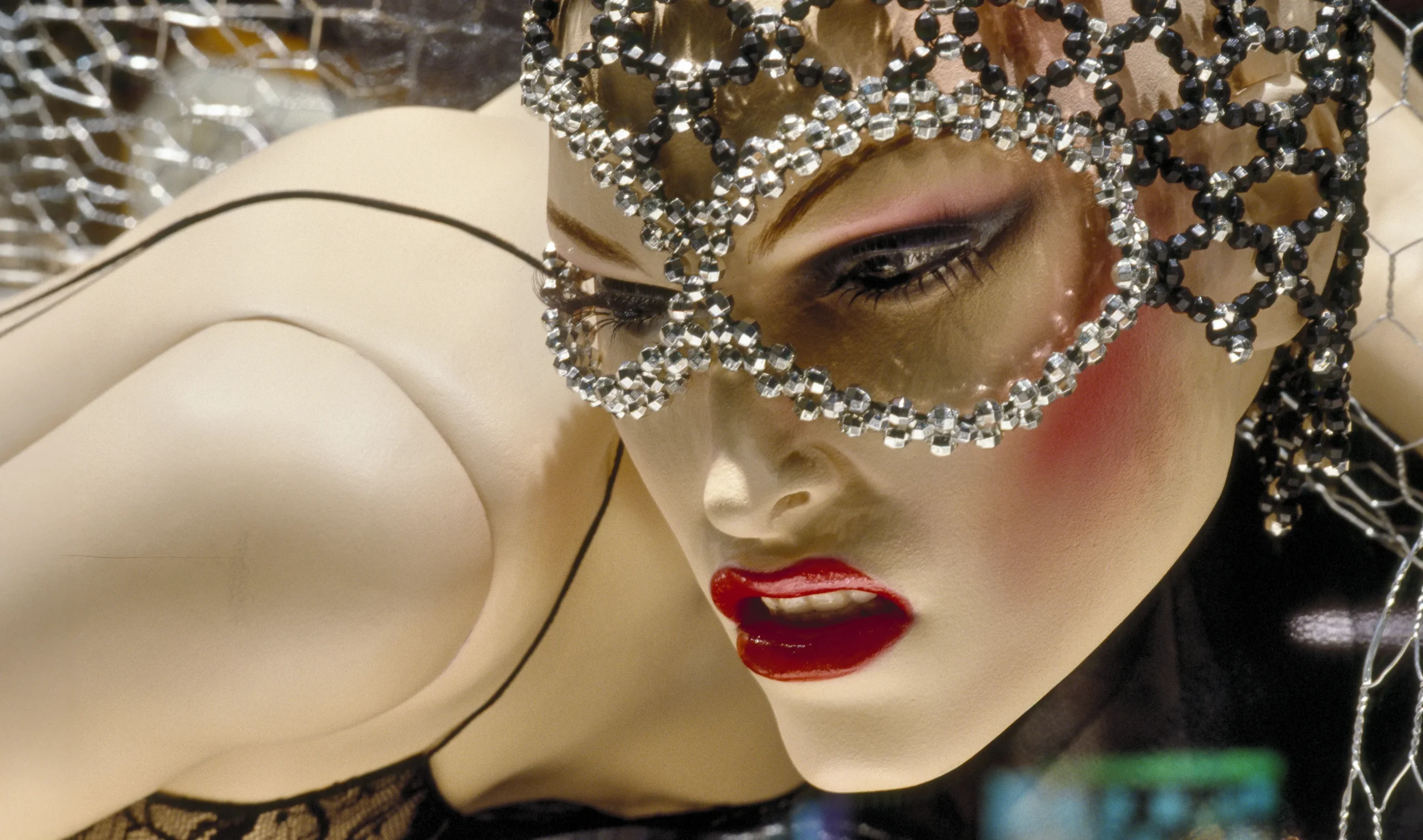
This mannequin discards all of it. Exaggerated makeup, sculpted lips, and theatrical pose transform the ceremonial figure into a fetishized doll — artificial femininity shifted from cultural symbol to erotic object.

2587_37 Mannequin in wedding dress in Seville, Spain 1997. Photo Roberto Bigano. Buy this image in the ikonographia.com store.

March 1997.
Sevilla, Spain — Wedding dress shop.

Heavy makeup and sculpted features intensify the bridal figure beyond ceremony. Here, glamour operates as pressure, transforming the ritual costume into a vehicle for visual exposure rather than restraint.

2588_18 Charming mannequin in a wedding dress in Seville, Spain. Photo Roberto Bigano. Buy this image in the ikonographia.com store.

March 1997.
Sevilla, Spain — Wedding dress shop.

The mannequin’s face is modeled with extreme smoothness and precision: porcelain skin, sharply defined lips, and a distant upward gaze.

The bridal figure is isolated as a sculpted surface of desire, where makeup, hair, and veil function as visual intensifiers rather than cultural markers.

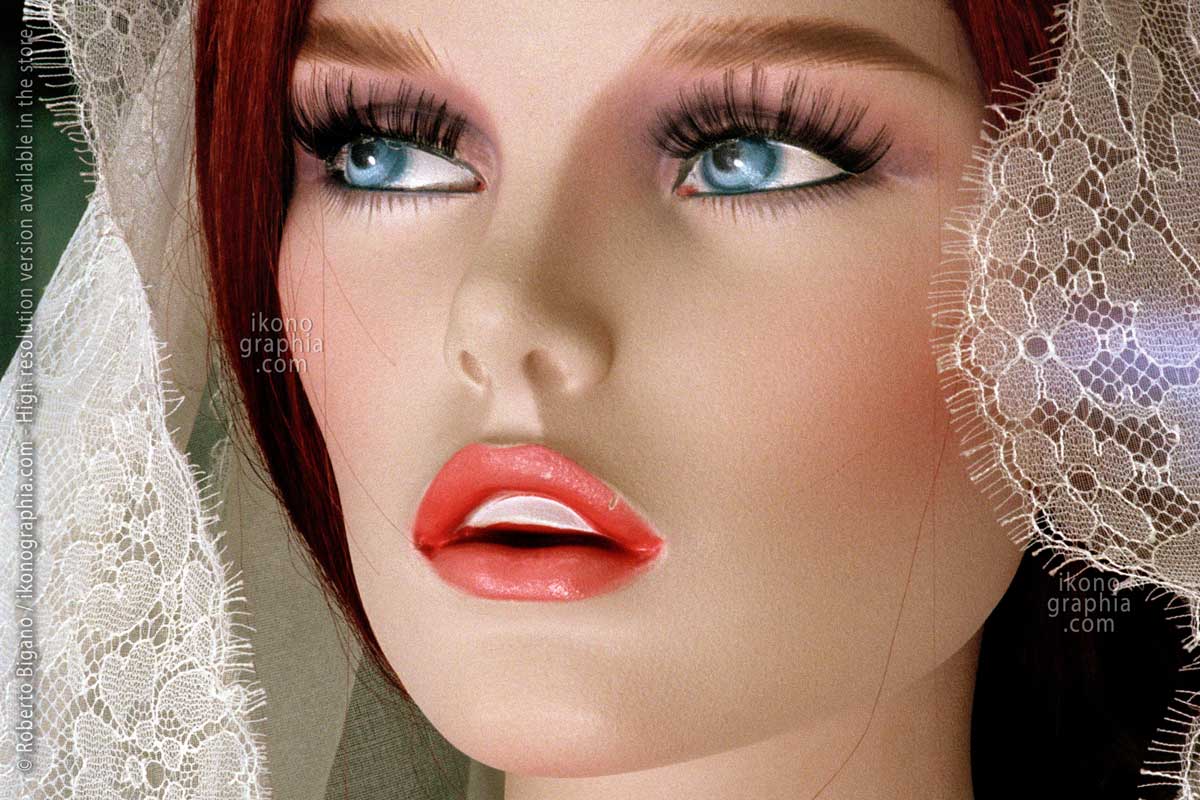
2587_27 Alluring Andalusian mannequin in Seville, Spain 1997. Photo Roberto Bigano. Buy this image in the ikonographia.com store.

March 1997.
Sevilla, Spain — Wedding dress shop.

The gaze holds. Red hair, blue eyes, lips barely parted — everything assembled for maximum presence. The veil and lace are bridal convention; the face beneath them is something else entirely.

This is the sequence's most direct confrontation — artificial femininity that neither withdraws nor performs, but simply arrests.

Copyright, Links And Credits

Photography, Copyright & Credits

All photographs © Ikonographia / Roberto Bigano — All Rights Reserved.
These images are part of the Ikonographia Visual Archives: — Plastic Girls: 50 Years of Artificial Beauty —  Plastic Girls / Mannequins Archive (1978–2026).

Terms of Use (Summary)

The images presented in this archive are copyrighted and available for licensed use only through Ikonographia Visual Archives.

You may not download, reproduce, publish, or distribute these images without a valid license. For commercial or editorial licensing, please refer to the product pages or contact Ikonographia directly. A full explanation of licensing terms is available in the Shop / Licensing Information section under "Ikonographia — Standard License" and "Ikonographia — Merchandising & Product Use Licenses"

Ikonographia Mission Statement

Ikonographia is committed to the accurate documentation, preservation, and ethical dissemination of twentieth-century visual culture.

Archival Notes — Plastic Girls: 50 Years of Artificial Beauty

This archive began in 1978 as a street photography project and is still ongoing.
All images were taken from public streets through shop-window glass without special access, permissions, or staging.

The archive's coherence was recognized retrospectively—only years later, during high-resolution digitization, did isolated images reveal themselves as a continuous visual record spanning nearly fifty years. The project documents mannequins as cultural artifacts: their evolving materials, poses, facial treatments, and display contexts across changing urban and commercial landscapes.

All images follow Ikonographia's internal archival standards for resolution, color accuracy, and metadata structure to ensure long-term consistency across the collection.

Further Reading — Selected Sources

  • Plastic Girls (1978-2011), by Roberto Bigano — A photographic monograph collecting earlier phases of this archive, published as a limited edition on Blurb.
American Mannequins — Journey into Hyperreality (1982–1988)

American Mannequins — Journey into Hyperreality (1982–1988)

American Mannequins — Journey into Hyperreality (1982–1988)

Artificial bodies and performative realism in American retail display.

Between 1982 and 1988, American shop windows increasingly adopted mannequins modeled for presence rather than display. Lifelike faces, controlled gestures, and carefully staged interiors transformed retail figures into instruments of visual persuasion, occupying a space where realism no longer represented reality but actively produced it.

August 1984 - Beverly Hills, California - From "Plastic Girls" series. A forty-year project by the Italian photographer Roberto Bigano documenting mannequins.

Photographed from the street without staged intervention, the images were made using a 4×5 view camera, a process that imposed slowness, distance, and sustained attention. In this context, mannequins emerge not as neutral supports for clothing, but as performative bodies through which American hyperreality takes shape.

These photographs belong to "Plastic Girls: 50 Years of Artificial Beauty", a long-term photographic project developed over nearly five decades, in which shop windows are approached as a continuous site of cultural observation.

August 1982 - Rodeo Drive, Beverly Hills, California. - From "Plastic Girls" series. Photo Roberto Bigano.

August 1982
Beverly Hills, United States — Rodeo Drive.

The hyper-detailed facial modeling and naturalistic stance collapse the distance between mannequin and living figure. The pose signals an early movement toward simulated presence, where realism begins to replace display as the dominant visual language.

 Featured  image above:


August 1984 — Rodeo Drive — Beverly Hills, United States.

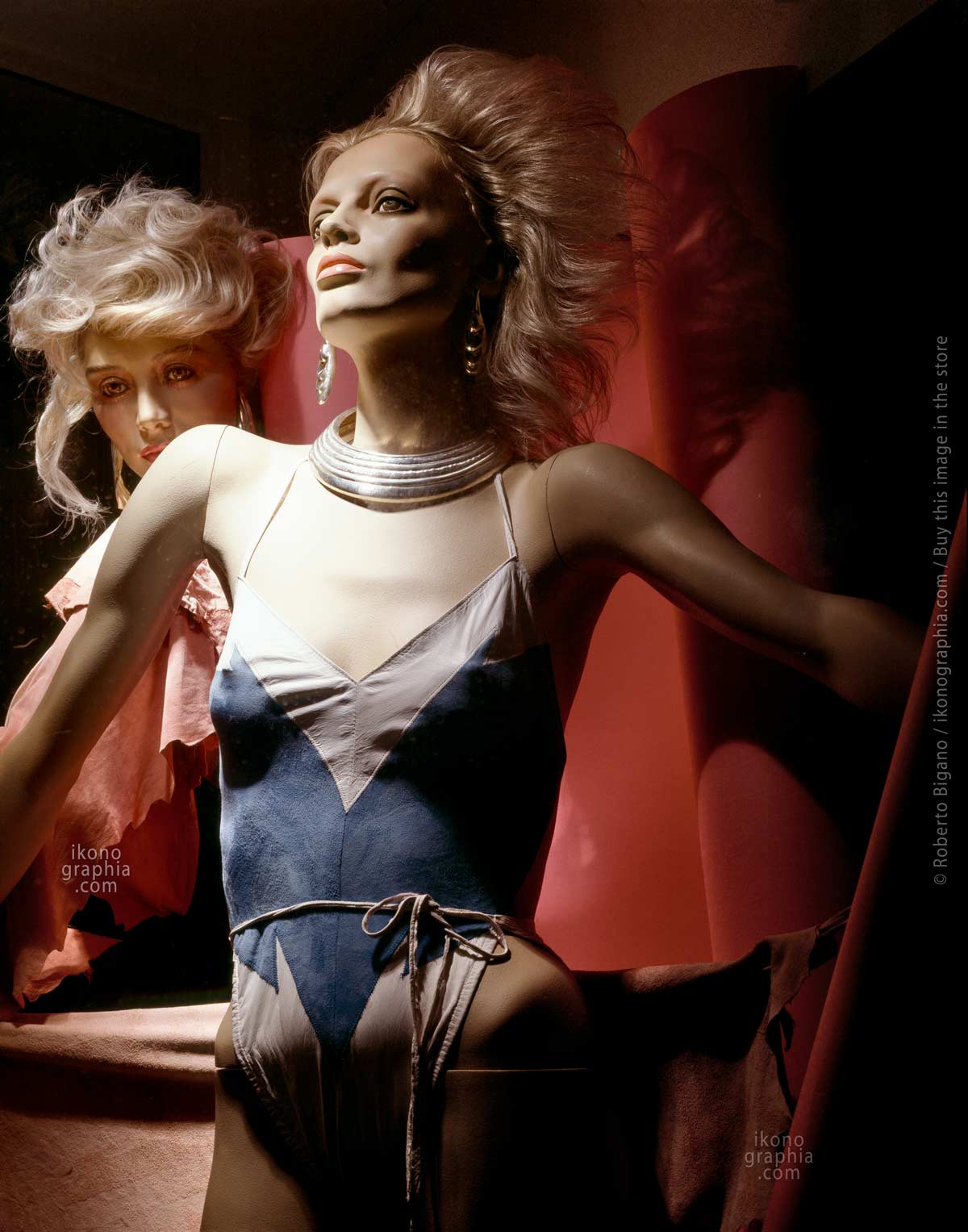
An earlier generation of mannequin carving, distinguished by sculpted features rather than molded realism.
The face—particularly the mouth and eyes—retains a hand-shaped expressiveness, poised between elegance and emotional distance.

Set against the quiet intrusion of national symbolism, the tilted head and relaxed arm introduce a note of vulnerability, transforming the display into a composed study of desire and aspiration.

August 1984 - Melrose Ave. Hollywood, California - From "Plastic Girls" series. Photo Roberto Bigano

August 1982.
Hollywood, United States — Melrose Avenue.

Here the mannequin recedes into light and shadow, its presence shaped more by illumination than form. The body becomes a graphic element within the window, signaling a shift toward cinematic display and atmospheric staging rather than direct representation.

August 1984 - Santa Monica Blvd. Hollywood, California - From "Plastic Girls" series. Photo Roberto Bigano

August 1984.
Los Angeles, United States — Santa Monica Blvd.

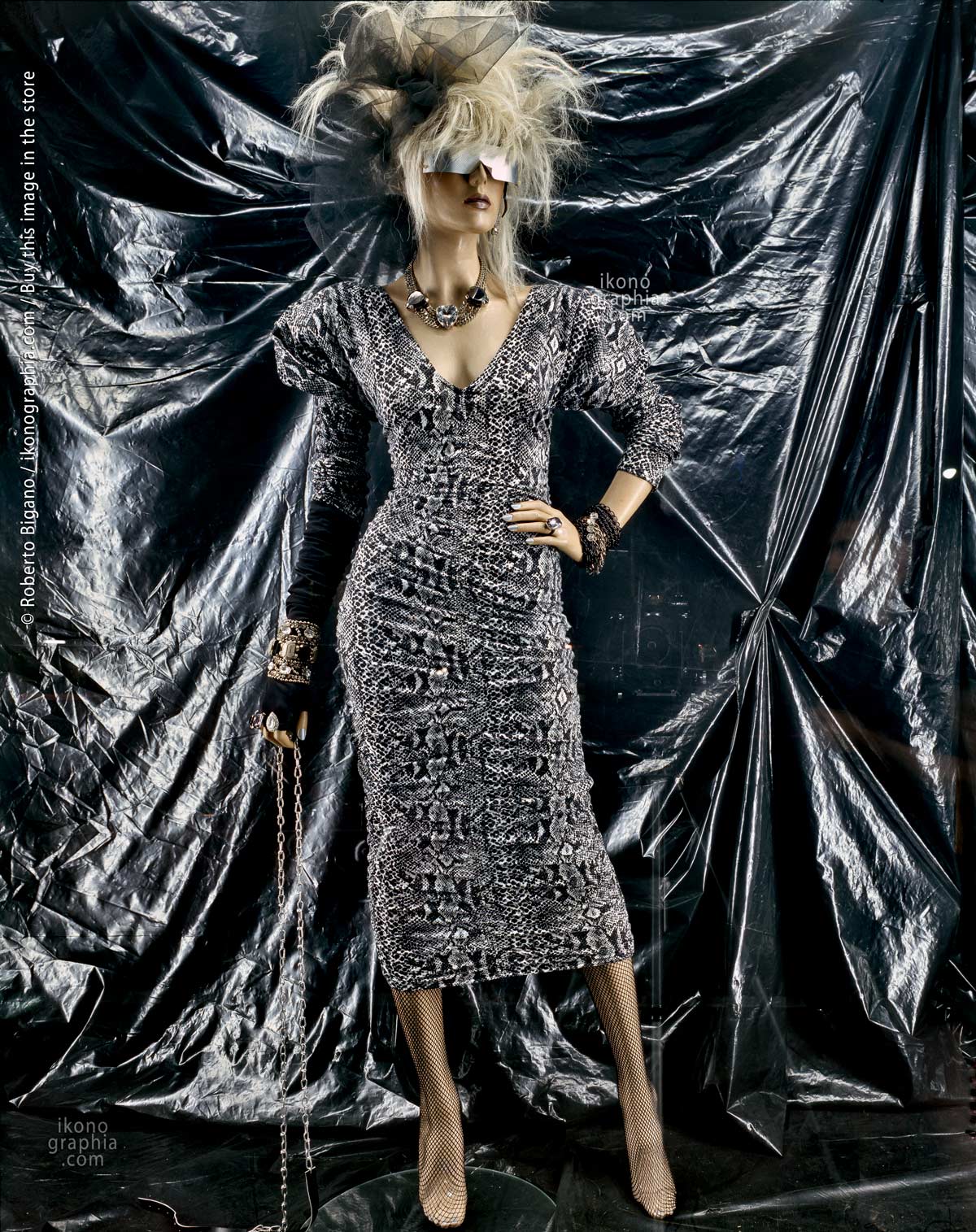
High-contrast materials, confrontational styling, and rigid posture define a form of West Coast display that flirts with provocation rather than elegance.

Set against industrial plastic backdrops, the mannequin stages the body as surface and attitude—borrowing visual cues from underground fashion, fetish aesthetics, and club culture.

August 1984 - Santa Monica Blvd. Los Angeles, California - From "Plastic Girls" series. Photo Roberto Bigano.

August 1982
Los Angeles, United States — Santa Monica Blvd.

Bold chromatic contrasts and graphic styling echo the visual optimism surrounding the Los Angeles Olympics.

Commercial display mirrors a broader corporate aesthetic, where color signals confidence and spectacle.

August 1983 - Boca Raton, Florida. - From "Plastic Girls" series..Photo Roberto Bigano.

August 1983 — Boca Raton, Florida

Close-up with glasses and red lips, photographed on 4×5" film with a 45-minute exposure.

The view camera required carefully balanced composition on the ground glass—even more critical with such a challenging long exposure.

August 1985 - Sunset Strip, Hollywood, California - From "Plastic Girls" series.. Photo Roberto Bigano.

August 1985.
Suset Strip — Hollywood, United States

An elongated posture and stylized expression detach the mannequin from narrative context.
Reduced in scale, the figure reads as an object of study rather than a theatrical presence.

August 1985 - Beverly Hills, California - From "Plastic Girls" series. Photo Roberto Bigano.

August 1985 - Beverly Hills, United States

Left: Artist Joseph Low pulling an impression on his hand press. Below: Low inside his rural New Jersey studio-print shop with its old-fashioned stove (bottom), a linoleum block locked up in a printing form, and the finished print. Right page: An enlarged detail from the same linoleum print displays the vigor and fantasy of Low’s engraving style. Photographs by Ed Feingersh. Pages 64-65

August 1985 - Sunset Strip, Hollywood, California - From "Plastic Girls" series. Photo Roberto Bigano.

August 1985
Hollywood, United States — Elegant shop on Sunset Strip.

The hyperreal modeling of the face and the restrained, naturalistic pose collapse the distance between mannequin and living figure. Rather than theatrical display, the figure conveys a quiet, inward presence, signaling the rise of psychological realism in mid-1980s American shop-window design.

August 1985 - J. Magnin Dept. Store, Beverly Hills, California - From "Plastic Girls" series. Photo Roberto Bigano.

August 1985
Beverly Hills, United States — J. Magnin Dept Store

Hyperreal facial modeling, refined posture, and controlled lighting elevate the mannequin beyond display into a near-portrait.
Luxury retail adopts the visual language of high fashion photography, collapsing the distance between artificial figure and idealized reality.

August 1988. Senter & Crunes Dept Store. Rockland, Maine. From "Plastic Girls" series. Photo Roberto Bigano.

August 1988 — Rockland, Maine, United States — Senter & Crunes Dept. Store.

The contrast between photographic portrait and mannequin construction foregrounds the tension between lived presence and manufactured realism.

August 1988. A Calvin Klein Window at Lord & Taylor. New York City. Photo Roberto Bigano.

August 1988 — New York City — Lord & Taylor.

The display aligns American fashion with institutional recognition, as Lord & Taylor applauds American design through the work of Calvin Klein, presenting fashion as cultural achievement rather than seasonal novelty.

August 1988. Altman's Dept. Store. New York City. From "Plastic Girls" series. Photo Roberto Bigano.

August 1988 —  Beverly Hills, California — Altman’s Dept. Store

The extended tonal range—from luminous silk highlights to dense, articulated blacks—supports precise chromatic balance and compositional clarity.
Technical fidelity becomes inseparable from the image’s aesthetic authority, reinforcing realism as a constructed visual language.

0419-13 Trendy dummies, West Berlin 1980, Germany, February 1980 | From "Plastic Girls" series. Photo by Roberto Bigano. Buy this image in the ikonographia.com

Plastic Girls — Glamour, Aggression, and Display (1980–1997)

A shared escalation toward excess, beyond style, geography, or chronology.

This chapter documents the moment when artificial femininity becomes overtly cosmetic, sexualized, and confrontational. .

Copyright, Links And Credits

Photography, Copyright & Credits

All photographs © Ikonographia / Roberto Bigano — All Rights Reserved.
These images are part of the Ikonographia Visual Archives: — Plastic Girls: 50 Years of Artificial Beauty —  Plastic Girls / Mannequins Archive (1978–2026).

Terms of Use (Summary)

The images presented in this archive are copyrighted and available for licensed use only through Ikonographia Visual Archives.

You may not download, reproduce, publish, or distribute these images without a valid license. For commercial or editorial licensing, please refer to the product pages or contact Ikonographia directly. A full explanation of licensing terms is available in the Shop / Licensing Information section under "Ikonographia — Standard License" and "Ikonographia — Merchandising & Product Use Licenses"

Ikonographia Mission Statement

Ikonographia is committed to the accurate documentation, preservation, and ethical dissemination of twentieth-century visual culture.

Archival Notes — Plastic Girls: 50 Years of Artificial Beauty

This archive began in 1978 as a street photography project and is still ongoing.
All images were taken from public streets through shop-window glass without special access, permissions, or staging.

The archive's coherence was recognized retrospectively—only years later, during high-resolution digitization, did isolated images reveal themselves as a continuous visual record spanning nearly fifty years. The project documents mannequins as cultural artifacts: their evolving materials, poses, facial treatments, and display contexts across changing urban and commercial landscapes.

All images follow Ikonographia's internal archival standards for resolution, color accuracy, and metadata structure to ensure long-term consistency across the collection.

Further Reading — Selected Sources

  • Plastic Girls (1978-2011), by Roberto Bigano — A photographic monograph collecting earlier phases of this archive, published as a limited edition on Blurb.
WWII according to Fascist Propaganda in Achille Beltrame’s Drawings

WWII according to Fascist Propaganda in Achille Beltrame’s Drawings

Popular Culture

Oct 18, 2020

A detail for a cover of “La Domenica del Corriere”. Italian infantry against British troops in North Africa.

Achille's Beltrame war plates for "La Domenica del Corriere" 1939-1942


Like all media controlled by strict censorship, the magazine "La Domenica del Corriere" reflected the Fascist Party’s view of the war, like a good vs. bad fight, enhancing Axis victories. In some cases, they were absolutely fake-news; in other cases, they told a sort of “Alternative Truth.”

Achille Beltrame was an Italian painter and illustrator. His color plates for "La Domenica del Corriere," the most popular Italian periodical, became the magazine's hallmark. They cover the whole history of Italian customs and society of the first half of the 20th century, masterfully summarizing news, sports, and war.
Beltrame made them alive and current in the eyes of a population not yet completely out of illiteracy. He never moved from Milan, where he designed all his tables. Nevertheless, he managed to represent places, facts, people, and things he had never seen in person, thanks to his innate imagination and curiosity, combined with a rigorous sense of realism. The graphic composition of his works is still a reference.
From 1899 to 1945, he drew for the magazine 4,662 front and back covers. Below a selection in chronological order.

Leggi in italiano

Illustrazioni di Achille Beltrame sulla seconda guerra mondiale per ”La Domenica del Corriere” 1939-1942.

Come tutte le pubblicazioni italiane, sottoposte a stretta censura, anche la “Domenica” rifletteva il punto di vista del Partito Nazional Fascista, di una sorta di lotta del bene contro il male. Le vittorie dell’asse venivano enfatizzate a dismisura. Le notizie dal fronte erano spesso delle “fake-news” o per lo meno davano una “versione alternativa" della realtà.
Fanno eccezione le tavole sulla guerra in Africa del Nord o alcune battaglie nel Mediterraneo, dove gli italiani si batterono valorosamente e dettero molto filo da torcere agli inglesi.

Le tavole di Beltrame per la “Domenica del Corriere”, divennero fiore all’occhiello e marchio di fabbrica della rivista raccontando magistralmente notizie, costume, sport e guerra nella prima metà del 1900.
Le copertine di Beltrame erano vive e comprensibili ad una popolazione non ancora completamente uscita dall’analfabetismo. Nonostante non si fosse mai mosso da Milano, fu in grado di raccontare in modo preciso e realistico, fatti, persone e luoghi che non aveva mai visto di persona, grazie alla sua immaginazione, curiosità e realismo. La composizione grafica delle tavole è tuttora una riferimento di livello assoluto.

Dal 1899 al 1945, Beltrame disegnò per la rivista 4662 copertine e retro copertine. Qui sotto una selezione in ordine cronologico.

A plate by Achille Beltrame for “La Domenica del Corriere”. Mines war in the North Sea around England.

December 3, 1939.

Mines War.

Every day, in the North Sea and around England, belligerent or neutral, merchants or warships collide with the numerous mines that infest all routes. A terrible explosion shakes the steamer that has come into contact with the dangerous device, debris flying in every direction, the ship overturns wounded… And in a short time, the sea swallows a new victim.

Buy the hi-res file 


Original Italian copy.
La guerra delle mine. Ogni giorno, nel Mare del Nord e attorno all’Inghilterra, navi belligeranti o neutrali, mercantili o da guerra urtano contro le numerosissime mine che infestano tutte le rotte. Un tremendo scoppio squassa il piroscafo che è venuto a contatto col pericolosissimo ordigno, rottami volano in ogni direzione, la nave si rovescia ferita… E in poco tempo il mare inghiotte una nuova vittima.

A plate by Achille Beltrame for “La Domenica del Corriere”. Playing football and cheering in the shadow of the guns.

December 3, 1939

Cheering in the shadow of the guns.

Taking advantage of the calm that reigns on the front, the gunners of a German anti-aircraft battery organize cheerful football matches behind the Siegfried line. The fellow soldiers, all around, cheer the players on joyfully.

Buy the hi-res file 


Original Italian copy.
Il “tifo” all’ombra dei cannoni. Approfittando della calma che regna sul fronte, gli artiglieri di una batteria antiaerea tedesca organizzano, dietro la linea di Sigfrido, allegre partite di calcio. I commilitoni, tutt’intorno, incitano i giocatori festosamente.

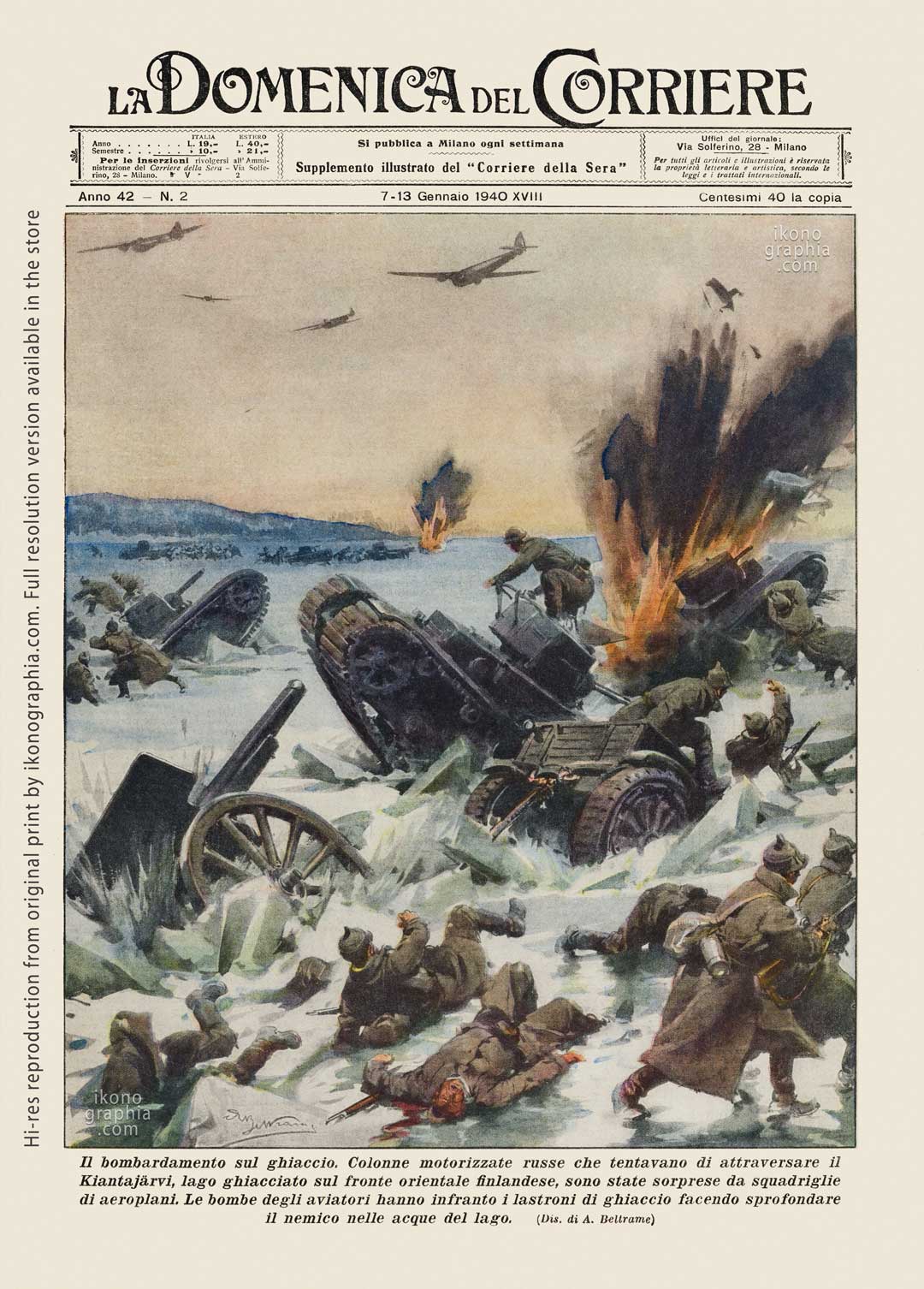
A plate by Achille Beltrame for “La Domenica del Corriere”. Bombing the Reds on the ice.

January 7, 1940.

Bombing the Reds on the ice.

Russian motorized columns attempting to cross the Kiantajärvi, a frozen lake on the Finnish eastern front, were surprised by airplanes' squadrons. The aviators' bombs broke the ice sheets causing the enemy to sink into the waters of the lake.

Buy the hi-res file 


Original Italian copy.
Il bombardamento sul ghiaccio. Colonne motorizzate russe che tentavano di attraversare il Kiantajärvi, lago ghiacciato nel fronte orientale finlandese sono state sorprese da squadriglie di aeroplani. Le bombe degli aviatori hanno infranto i lastroni di ghiaccio facendo sprofondare il nemico nelle acque del lago.

A plate by Achille Beltrame for “La Domenica del Corriere”. The war on the Indian Sea.

March 10, 1940.

The war on the Indian Sea.

An English steamship with a crew of 150 Indians was attacked by a German aircraft and fatally hit by three bombs. The ship caught fire.

Buy the hi-res file 


Original Italian copy.
La guerra sul mare. Un piroscafo inglese sul quale viaggiavano 150 indiani è stato attaccato da un aeroplano tedesco e colpito in pieno da tre bombe. La nave si è incendiata.

An iconic 1939 illustration by Achille Beltrame for “La Domenica del Corriere”. Mines War in the North Sea around England.

May 5, 1940.

The fight in Norway.

Among the deep gorges of the Gudbrand valley, German columns are advancing fighting towards Trondhjem.

Buy the hi-res file 


Original Italian copy.
La lotta in Norvegia. Fra le gole profonde della vallata di Gudbrand colonne tedesche avanzano combattendo verso Trondhjem.

A plate by Achille Beltrame for “La Domenica del Corriere”. The devastated central London with the surviving St Paul's Cathedral

January 12, 1941

The devastated central London with the surviving St Paul's Cathedral.
Among the ruins of the "City". After the German bombing, British soldiers and firefighters complete the destruction of central London, blowing up the walls still standing and crumbling with dynamite. In the background, St. Paul's  Cathedral, which has remained intact in the midst of so much decay.

Buy the hi-res file 


Original Italian copy.
Tra le rovine della “City”. Dopo i bombardamenti tedeschi, soldati inglesi e vigili del fuoco, completano la distruzione del centro di Londra, facendo saltare con la dinamite le mura rimaste ancora in piedi e pericolanti. Sullo sfondo, la cattedrale di San Paolo, rimasta intatta in mezzo a tanto sfacelo.

A plate by Achille Beltrame for “La Domenica del Corriere”. Germans greeted as liberators in a concentration camp in Russia.

July 13, 1941.

Germans greeted as liberators.

The moment of liberation. In the prison of a city taken to the Soviets, German soldiers are greeted with enthusiasm and emotion by hundreds of political prisoners, including older men and women, who greet them as liberators and beg for bread.

Buy the hi-res file 


Original Italian copy.
Il momento della liberazione. Nella prigione di una città strappata ai sovietici, i soldati tedeschi vengono accolti con entusiasmo e commozione da centinaia di detenuti politici, vecchi e donne compresi, che li salutano come libertori e implorano un pò di pane.

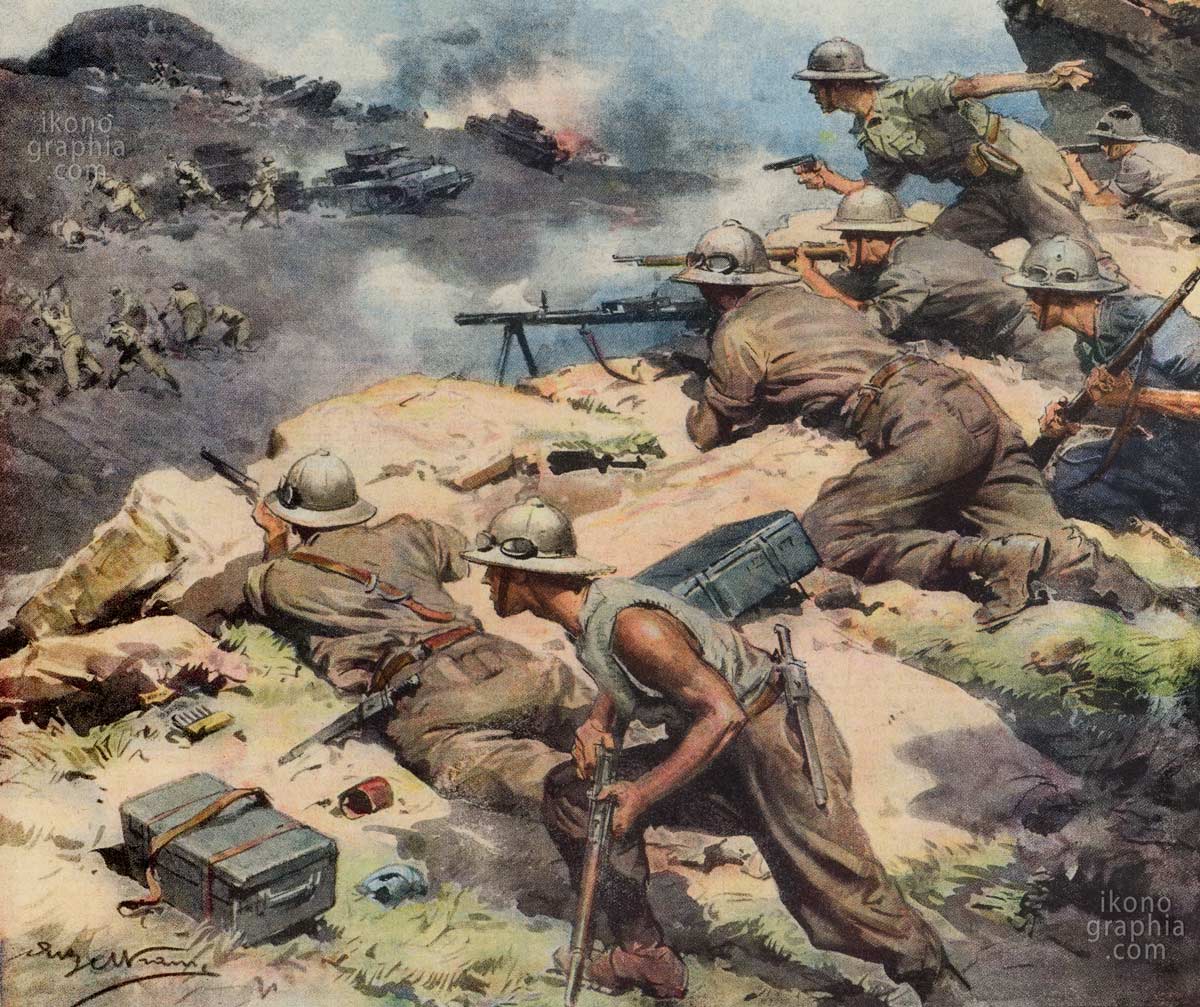
A plate by Achille Beltrame for “La Domenica del Corriere”. Italian infantry against British troops in North Africa.

July 13, 1941.

Italian infantry against British troops in North Africa.
The fierce Italian resistance in the Gondar area. Clinging to the ground, taking advantage of every possibility of defense, our heroic soldiers repel violent enemy attacks with indomitable courage.

Buy the hi-res file 


Original Italian copy.
La fiera resistenza italiana nella zona di Gondar. Aggrappati al terreno, sfruttando ogni possibilità di difesa, i nostri eroici soldati respingono con indomabile ardimento i violenti attacchi nemici.

A plate by Achille Beltrame for “La Domenica del Corriere”. Italians push-off the British attacks to keep Tobruk.

August 17, 1941.

Italians push-off the British attacks to keep Tobruk.
Alarm in the desert. One of the almost daily British attempts to break the iron circle around Tobruk: while the desert wind rages, enemy tanks and airplanes try to get closer to our positions; but the move is warned, and the batteries open fire on the opponent, forcing him to retreat once again.

Buy the hi-res file 


Original Italian copy.
Allarme nel deserto. Uno dei quasi quotidiani tentativi inglesi di rompere la ferrea cerchia intorno a Tobruk: mentre infuria il vento del deserto, carri armati e aereoplani nemici cercano di avvicinarsi alle nostre posizioni; ma la mossa è avvertita e le batterie aprono il fuoco contro l’avversario, costringendolo ancora una volta a ritirarsi.

The United States in Fascist Propaganda.


According to the Italian press, in the early years of war, the United States was an exhausted country that had not yet recovered from the effects of the Great Depression of 1930s.. Mussolini believed that a possible entry of the United States into the war would have been irrelevant since the American production capacity in the war sector was behind.

Even after the Japanese attack on Pearl Harbor and the subsequent declaration of war, the hypothesis of real US involvement in the conflict in the European and Mediterranean theater was considered unlikely.

Leggi in italiano

L’immagine degli Americani e dell’America nella propaganda italiana di guerra.


Gli Stati Uniti, per la stampa italiana dei primi anni del conflitto, erano un paese allo stremo non ancora risollevatosi dagli effetti della Grande Depressione degli anni ‘30. È nota la convinzione mussoliniana secondo la quale una eventuale entrata in guerra degli Stati Uniti sarebbe stata assolutamente ininfluente in quanto la capacità produttiva americana nel settore bellico era praticamente irrilevante.

Anche dopo l’attacco giapponese a Pearl Harbour e la successiva dichiarazione di guerra agli Usa, l’ipotesi di un reale coinvolgimento degli Stati Uniti nel conflitto nel teatro di operazioni europeo e sul Mediterraneo era considerata come improbabile. Fonte

A plate by Achille Beltrame for “La Domenica del Corriere”. Mines war in the North Sea around England.

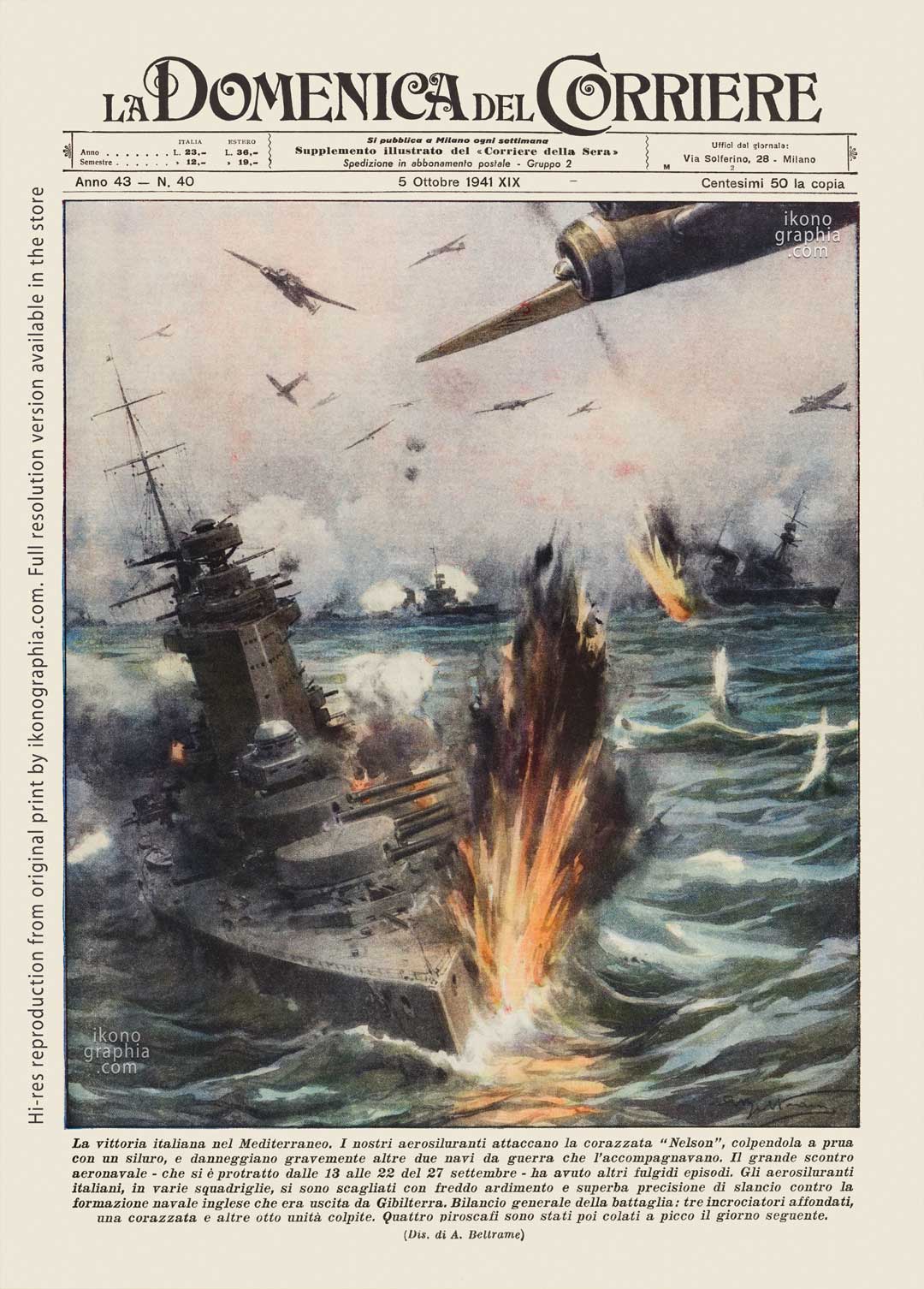
La vittoria italiana nel Mediterraneo. Original Italian Copy

La vittoria italiana nel Mediterraneo. I nostri aerosiluranti attaccano la corazzata “Nelson”, colpendola a prua con un siluro, e danneggiando gravemente altre due navi da guerra che l’accompagnavano.
Il grande scontro aeronavale - che si è protatto dalle 13 alle 22 del 27 settembre - ha avuto altri fulgidi episodi. Gli aerosiluranti italiani, in varie squadriglie, si sono scagliati con freddo ardimento e superba precisione di slancio contro la formazione navale inglese che era uscita da Gibilterra.
Bilancio generale della battaglia: tre incrociatori affondati più una corazzata e altre otto unità colpite. Quattro piroscafi sono stati poi colati a picco il giorno seguente.


October 10, 1941.

The Italian victory in the Mediterranean.

Our torpedo bombers attacked the battleship “Nelson,” hitting it in the bow with a torpedo and severely damaging two other escort warships. The great air-naval clash lasted from 1 to 10 PM on September 27 and had other shining episodes. The Italian torpedo bombers, in various squadrons, hurled themselves with cold courage and superb precision against the English naval formation that had left Gibraltar. Overall battle balance: three sunken cruisers, one battleship, and eight other units hit. Four steamers were then sunk the following day.

Buy the hi-res file 


Read the original Italian copy in the tabbed content below

A plate by Achille Beltrame for “La Domenica del Corriere”. Firestorm on the British columns.

November 30, 1941.

Firestorm on the British columns.

Axis aircraft squadrons swoop down on the British motorized columns attacking in Marmarica and heavily bombarding, smashing many wagons, and pinning others to the ground.

Buy the hi-res file 


Original Italian copy.
Tempesta di fuoco. Squadre di aeroplani dell’Asse piombano in picchiata sulle colonne motorizzate inglesi che attaccano nella Marmarica e le tempestano di bombe fracassando molti carri e inchiodandone altri al terreno.

A plate by Achille Beltrame for “La Domenica del Corriere”. The commander of an Italian submarine at the periscope. The enemy in sight!

December 28, 1941.

The commander at the periscope. The enemy in sight!

Inside one of our submarines immersed, among the thousand complicated devices of the very modern ship, the commander scrutinizes the opponent's moves, waiting to transmit the orders to the crew.

Buy the hi-res file 


Original Italian copy.
Nemico in vista! Nell’interno di un nostro sommergibile immerso, tra i mille complicati congegni della modernissima nave, il comandante scruta le mosse dell’avversario, in attesa di trasmettere gli ordini all’equipaggio.

A plate by Achille Beltrame for “La Domenica del Corriere”. An Italian submarine sinking an American tanker.

April 5, 1942.

An Italian submarine sinking an American tanker.

Italian submarines in American waters. The last moments of an enemy tanker hit with a torpedo and then with cannon fire.

Buy the hi-res file 


Original Italian copy.
I sommergibili italiani nelle acque americane. Gli ultimi istanti di una petroliera nemica colpita con un siluro e poi a cannonate.

A plate by Achille Beltrame for “La Domenica del Corriere”. Axis aircraft bombing Malta.

May 3, 1942

Axis airplanes devasting Malta.
Malta under the storm of bombs. The armor-piercing shells and two-thousand-kilo bombs, thrown by Axis airplanes on the fortifications of Malta during their relentless offensive, also led to the destruction of the English's underground deposit base. "Malta" - said an eyewitness - "is a hell of ruins"...

Buy the hi-res file 


Original Italian copy.
Malta sotto la tempesta di bombe. I proiettili perforanti e le bombe da duemila chili, gettati dagli aeroplani dell’Asse sulle fortificazioni di Malta durante la loro implacabile offensiva, hanno portato alla distruzione anche dei depositi sotterranei della base inglese. “Malta” - ha detto un testimone oculare - “è un inferno di rovine”.

A plate by Walter Molino, Beltrame's most talented pupil. for “La Domenica del Corriere. Japanese kamikaze attack on the aircraft carrier Yorktown.

1942, March 8
Artwork by Walter Molino, Beltrame's most talented pupil. He drew some covers since 1941 and then became the exclusive creator for almost thirty years

Kamikaze

"Taiatari," which means the body's impact, is the Japanese system of the suicide attack. The airplane throws itself at the target with its deadly load of bombs, guided by the pilot, who sacrifices himself but hits infallibly. With the "Taiatari," the North American aircraft carrier "Yorktown" was attacked: the bomber crashed in the middle of the aircraft lined up on the bridge, burning and destroying everything.

Buy the hi-res file 


Original Italian copy.
“Taiatari”, cioè l’urto del corpo, è il sistema giapponese di attacco in picchiata. L’aeroplano si getta sull’obbiettivo col suo mortale carico di bombe: precipita guidato dal pilota, che si sacrifica ma colpisce in maniera infallibile. Col “Taiatari” è stata assalita la portaerei nord-americana “Yorktown: il bombardiere s’è abbattuto in mezzo ai velivoli allineati sul ponte incendiando e distruggendo tutto.

A plate by Walter Molino, Beltrame's most talented pupil. for “La Domenica del Corriere. Sublime heroism in North Africa.

1941, July 13.
Artwork by Walter Molino.

Sublime heroism.

A correspondence from North Africa reports that a sergeant of the Bersaglieri, mutilated in the arm by the explosion of a grenade, took the limb and threw it at an advancing enemy tank.

Buy the hi-res file 


Original Italian copy.
Eroismo sublime. Una corrispondenza dall’Africa Settentrionale segnala che un sergente dei bersaglieri, mutilato di un braccio per lo scoppio di una granata, ha preso l’arto e lo ha scagliato contro un carro armato nemico che avanzava.

Links , copyright and credits

Links:
Wikipedia English
Wikipedia Italiano
Il “nemico” nella propaganda fascista
Politiche di propaganda nell’Italia Fascista
L'occhio del regime sulla Grande guerra: l'Istituto Luce tra informazione, memoria e propaganda
L’immagine dei nemici. L’America e gli Americani nella propaganda italiana della Seconda guerra mondiale 

Rights Advisory: "Corriere della Sera" Plates.
No known restrictions on publication.
Achille Beltrame artworks
No known restrictions on publication.
Walter Molino artworks
Ikonographia believes that this item is in the public domain under the laws of the United States, but did not make a determination as to its copyright status under the copyright laws of other countries. This item may not be in the public domain under the laws of other countries.

Plastic Girls — The Age of Plastic Innocence (1977–1980)

Plastic Girls — The Age of Plastic Innocence (1977–1980)

Plastic Girls — The Age of Plastic Innocence (1978–1980)

Early Works – Shop-window mannequins before the rise of performative display.

Between 1977 and 1980, shop-window mannequins across Europe were defined by restraint. Controlled gestures, neutral composure, bodies designed to present clothing, not perform identity. Display had not yet become theatre.

This chapter marks the earliest phase of the Plastic Girls project, begun by Roberto Bigano in 1978 and still ongoing. These images are the beginning of a record that only revealed its full coherence decades later. They were not made as a project. They were made by instinct — the kind that precedes understanding by decades.

The very first EB110 model made in epowood as designed by Benedini, with the rear wheels covered reminding the Bugatti Atlantic.  Photo Roberto Bigano. Buy this image in the ikonographia.com store.

All photographs were taken from the street, through shop-window glass, without special access or permissions. Nothing is staged or arranged for the camera: the images record what is openly visible yet rarely observed with sustained attention.

Over time, this accumulation exposes patterns no single moment could reveal—recurring gestures, evolving materials, racial and anatomical codifications, and a gradual movement from abstraction to hyper-realism. The project seeks neither irony nor nostalgia, but sustained looking.

0360-13 Mannequin in a shop window in Braunschweig, Germany, September 1979 | From "Plastic Girls" series. Photo by Roberto Bigano. Buy this image in the ikonographia.com store.

September 1979.
Braunschweig, West Germany — Delmod Department Store.

A figure of complete stillness, seated with precise composure, the clothing subordinate to the pose. No performance, no psychological charge. The delmod logo visible at the bottom grounds it in a specific commercial moment.

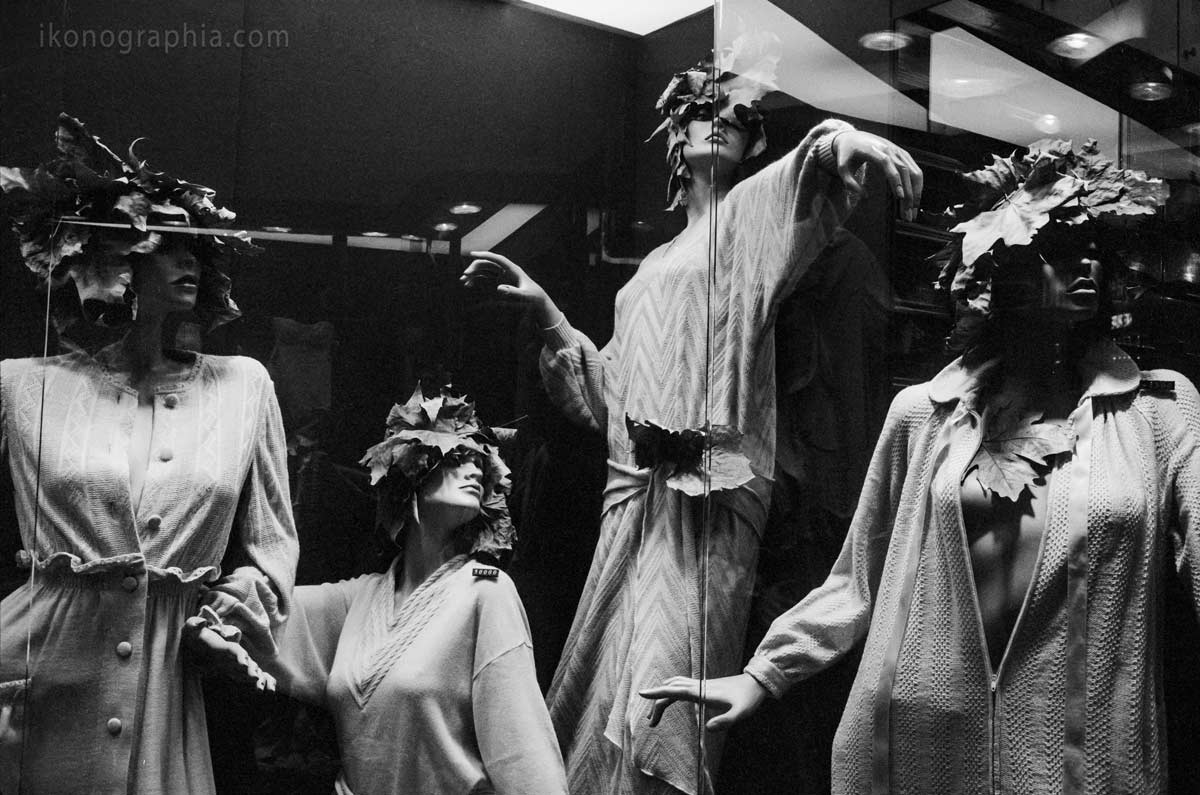
0175-17 Shop window in Rome on vintage theme, November 1978 | From "Plastic Girls" series. Photo by Roberto Bigano. Buy this image in the ikonographia.com store.

November 1978 — Rome, Italy.

A shop-window ensemble staged around a grape-harvest motif, with mannequins arranged in a shallow theatrical space. The restrained gestures and lowered gazes temper the decorative theme, shifting emphasis from seasonal display toward a composed study of collective presence and controlled femininity.

0359_35 Dummy at Strick dept. store, Braunschweig, Germany. September 1979 | From "Plastic Girls" series. Photo by Roberto Bigano. Buy this image in the ikonographia.com store.

September 1979.
Braunschweig, Germany — Strick Fabrics Store.

The figure’s elongated pose and sharply articulated headpiece introduce a heightened sense of stylization within an otherwise restrained stance. Here, realism and display coexist: naturalistic body proportions support an emerging language of visual impact driven by accessories and controlled exaggeration.

0370-29 Retro Mannequin, Stockholm, Sweden, September 1979 | From "Plastic Girls" series. Photo by Roberto Bigano. Buy this image in the ikonographia.com store.

September 1979 — Stockholm, Sweden

A retro mannequin displayed in an upscale vintage second-hand boutique in Gamla Stan (The Old city) where curated accessories and restrained presentation reflect a refined approach to reuse, distinct from mass-market thrift.

0364_15 Dummy in Copenhagen, Denmark, September 1979 | From "Plastic Girls" series. Nikon FM 50mm f 1.4 – Ilford HP5 Photo by Roberto Bigano. Buy this image in the ikonographia.com store.

November 1978.
Copenhagen, Denmark

The mannequin stands frontally,the posture defined by balance and containment.
Soft facial modeling and elongated hands, held low and inactive, suppress theatricality, anticipating a late-1970s turn toward understated realism in Northern European shop-window design.

West Berlin — Avant-Garde and Contrast (1980)

Where experimental display confronted tradition in a divided city.

West Berlin's shop windows reflected the city's unique cultural position: an island of capitalist abundance surrounded by the Eastern Bloc. Avant-garde boutiques staged mannequins as sculptural provocations—angular poses, exaggerated silhouettes, and confrontational gestures—while traditional department stores maintained conservative elegance.

The contrast intensified when viewed against East Berlin's restrained, utilitarian displays visible across the Wall. These windows documented not just fashion, but competing visions of modernity separated by concrete and ideology.

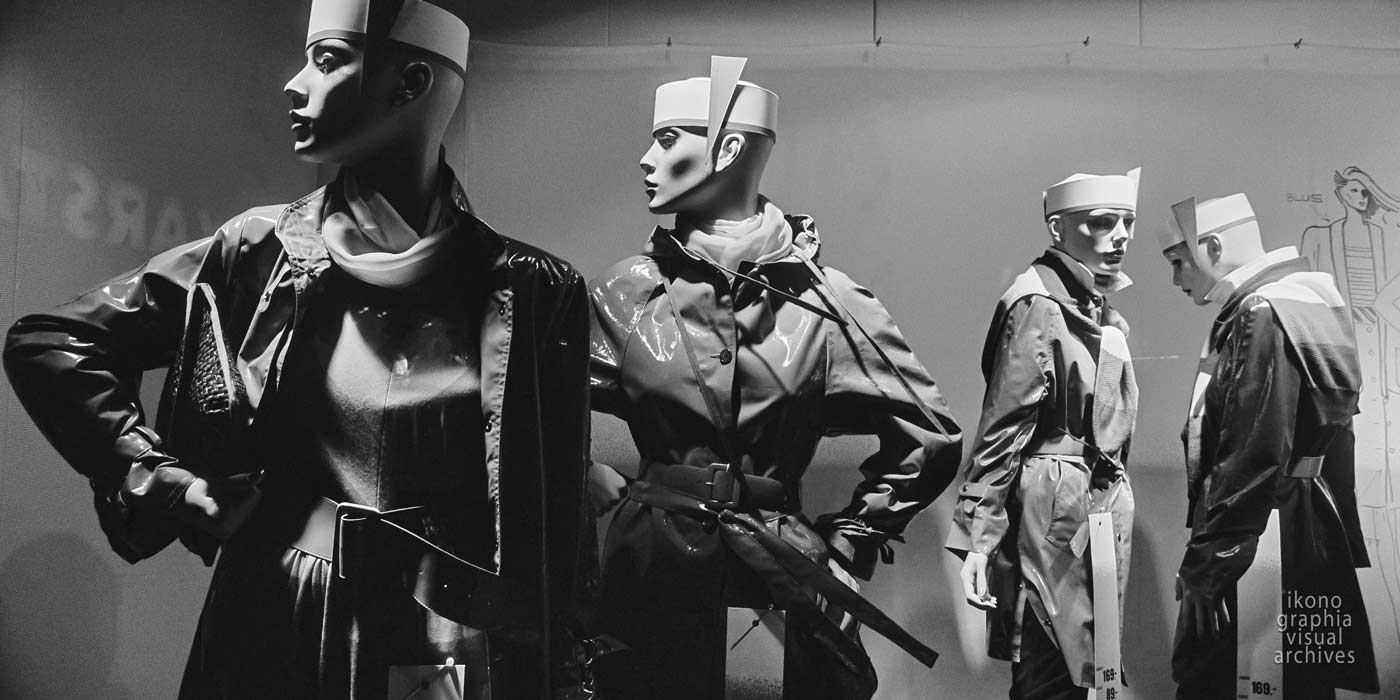
0415-21 Stylish dummies at Streifen Dept. Store, Berlin, Germany, February 1980 | From "Plastic Girls" series. Photo by Roberto Bigano. Buy this image in the ikonographia.com

February 1980.
KaDeWe Luxury Dept. Store — Berlin, West Germany — Streisen Design

Two figures, conical hats, mirror poses. Behind them, the fashion sketch — design and execution in the same frame.

Berlin in 1980 had made avant-garde fashion its own visual dialect: experimental, theatrical, and uncompromising. The shop window was not displaying clothing. It was staging a proposition.

Berlin 1980.

West Berlin in February 1980 was electric. Avant-garde boutiques staged mannequins as sculptural provocations. Traditional department stores maintained conservative elegance.

A few kilometres away, across the Wall, East Berlin shop windows presented a different world: modest clothing, limited materials, the female figure defined by role, not desire.
Five days, hundreds of images — mannequins one thread among many in a city that demanded sustained attention. What is presented here is the edit: the moments when the shop window concentrated everything the city was saying about itself.

0417-14 Frauentag / Women’s Day East Berlin, DDR, February 1980 | From "Plastic Girls" series. Photo by Roberto Bigano. Buy this image in the ikonographia.com store.

February 1980 — Berlin, East Germany — Frauentag (Woman’s Day)

A shop-window staged for International Women's Day. Modest clothing, limited materials, restrained gesture.

The female figure defined by role — a symbolic recipient of flowers, not an active presence. East Berlin, February 1980.

0419-13 Trendy dummies, West Berlin 1980, Germany, February 1980 | From "Plastic Girls" series. Photo by Roberto Bigano. Buy this image in the ikonographia.com

February 1980 — KaDeWe (Kaufhaus des Westens) — Berlin, West Germany — Streisen Design

Same city, same month, opposite side of the Wall. Four figures in military-inflected fashion, angular poses, the sketch on the back wall placing design and execution in the same frame.

The shop window as a studio for propositions about what clothing could mean.

0415-13 Mannequins in West Berlin, Germany, February 1980 | From "Plastic Girls" series. Photo by Roberto Bigano. Buy this image in the ikonographia.com store.

February 1980 — Berlin, West Germany

A conventional fashion display grounded in late-1970s aesthetics.

Naturalistic poses, familiar styling, and decorative restraint prioritize wearability and continuity over experimentation, presenting fashion as product rather than performance.

0419-05 Store window Berlin 1980, Germany, February 1980 | From "Plastic Girls" series. Photo by Roberto Bigano. Buy this image in the ikonographia.com store.

February 1980 — Berlin, West Germany

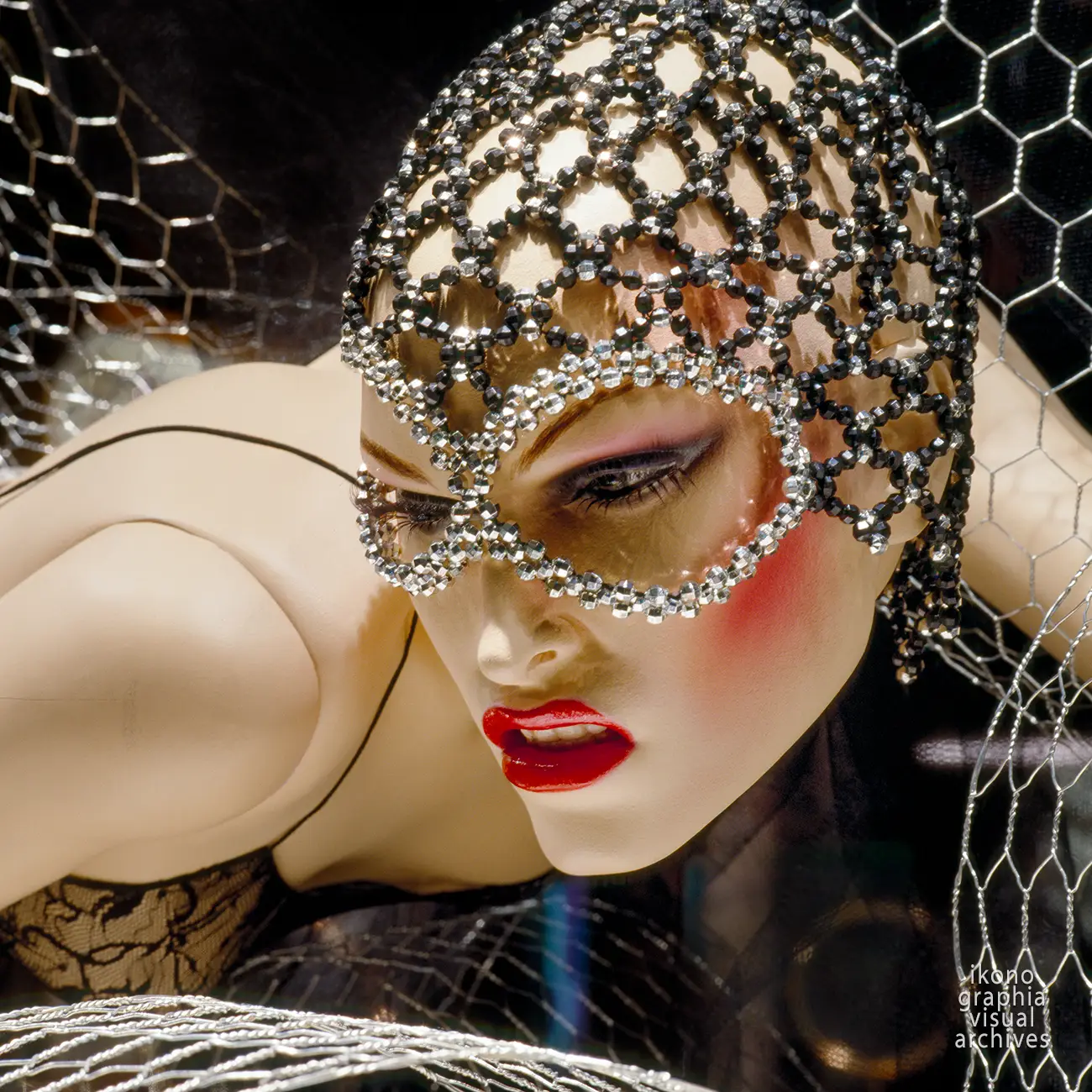
A shop-window tableau staged around intimacy and domestic fantasy rather than fashion display.

The mannequin’s reclining posture, lingerie-like styling, and surrounding household objects collapse the boundary between private interior and commercial spectacle, anticipating a late-twentieth-century shift toward lifestyle-driven retail narrative

0419_R The proof sheet of roll N.419 includes at least six interesting subjects. February 1980.

February 1980 - Berlin, West Germany

An exceptional contact sheet preserving a concentrated burst of visual discovery. Five frames from this single session—three included in this archive, two more equally compelling—capture West Berlin at a moment of extraordinary cultural intensity.

This density of compelling images reflects both the photographer's sustained attention and the city's exceptional vitality. Most contact sheets yield one or two keepers; this roll captured a moment when subject and circumstance aligned.

London — Elegance and Tradition (1980)

Refined display in the capital's iconic shopping districts.

London's Knightsbridge, Regent Street, and Oxford Street presented mannequins as bearers of restrained sophistication. Poised figures in carefully coordinated ensembles embodied British retail tradition—composure, quality, and understated aspiration.

Unlike the performative intensity emerging elsewhere, London windows maintained a language of elegance through stillness, where mannequins projected confidence without confrontation. These displays captured the final moment before globalized retail homogenized urban window culture.

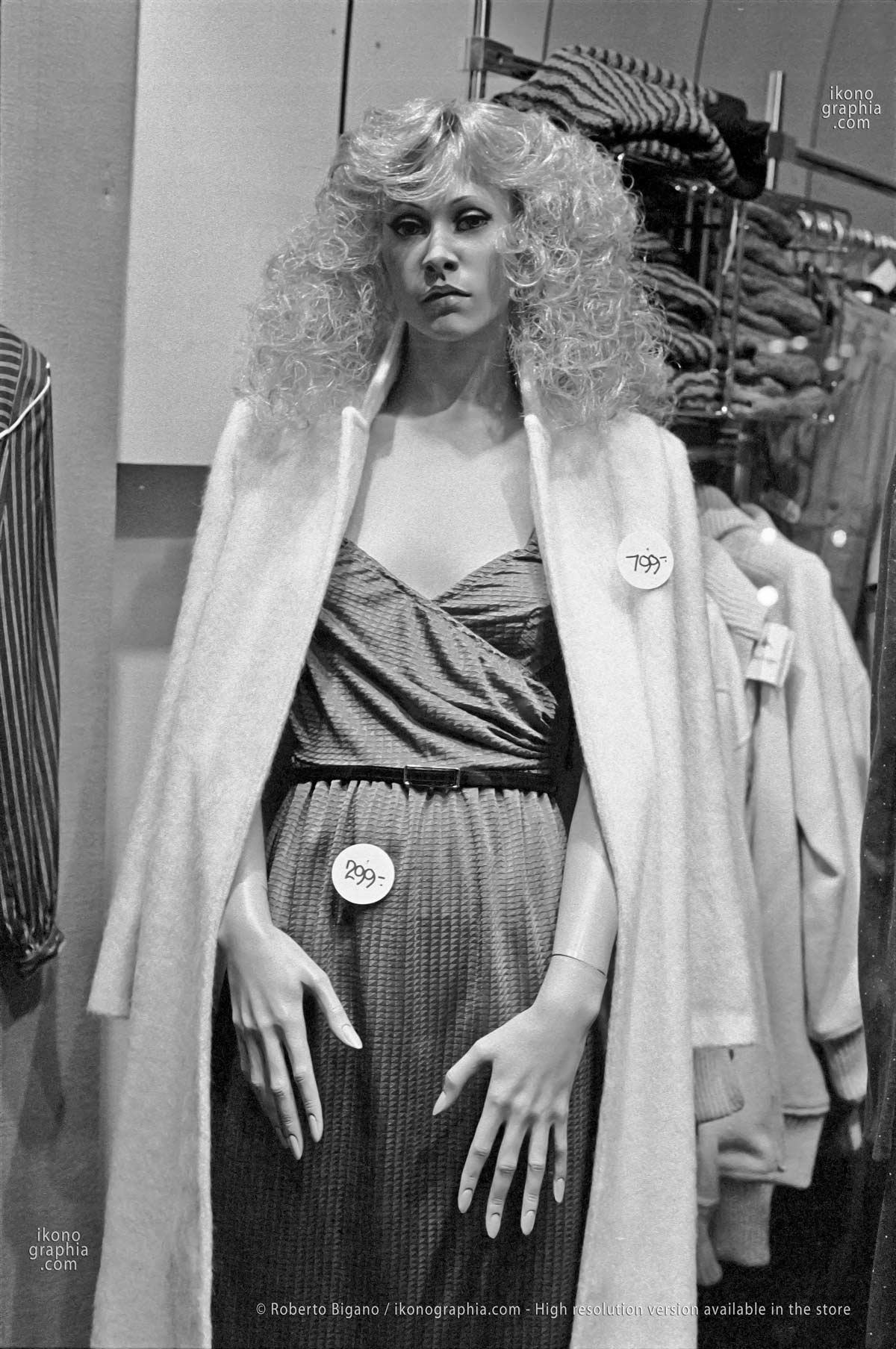
0568-29 Blonde dummy, London Knightsbridge, UK September 1980 | From "Plastic Girls" series. Photo by Roberto Bigano. Buy this image in the ikonographia.com store.

September 1980 — London, Knightsbridge — United Kingdom Oxford Street and Regent Street series

The hyper-detailed facial modeling and naturalistic stance collapse the distance between mannequin and living figure.

The pose signals an early movement toward simulated presence, where realism begins to replace display as the dominant visual language

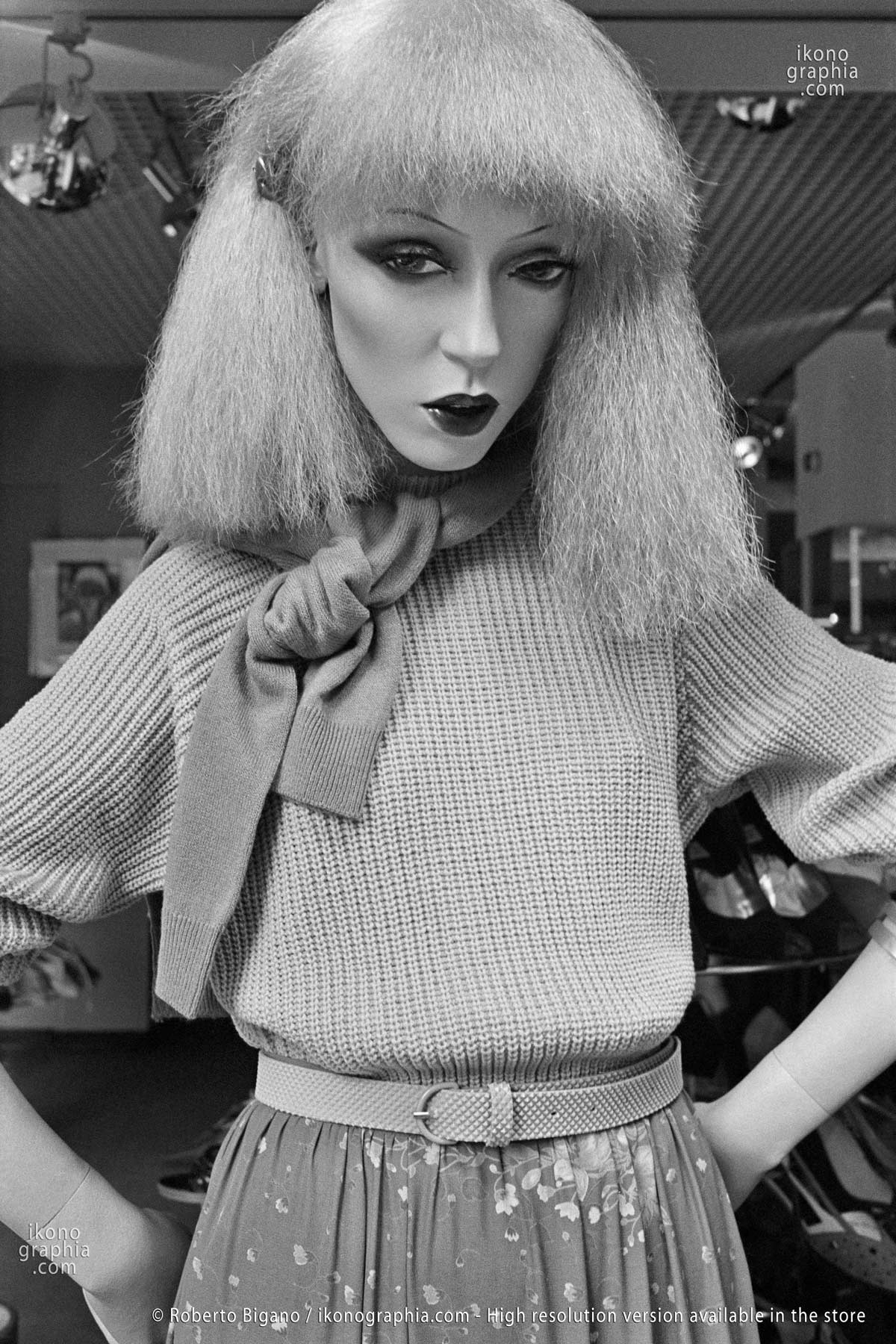
0564-23 Blonde mannequin in Regent St, London, September 1980, 1980 Nikon FM 50/1.4. Film Kodak PlusX Pan Photo by Roberto Bigano. Buy this image in the ikonographia.com store.

September 1980 — Regent Street — London, United Kingdom

Geometric severity challenging traditional femininity. The platinum hair cut in sharp architectural angles, heavy eye makeup, and dark lipstick create a face of deliberate confrontation — not glamour but refusal. The demure outfit intensifies the provocation. Propriety worn as costume.

London in 1980 was absorbing New Wave and post-punk visual language. The direct gaze reads as challenge, not invitation.

0564-23 Blonde dummy in Regent St, London, UK September 1980 | From "Plastic Girls" series. Photo by Roberto Bigano. Buy this image in the ikonographia.com store.

September 1980 — Regent Street — London, United Kingdom

Platinum hair in exaggerated volume, heavy kohl-lined eyes, and deep lipstick transform the mannequin into a figure of controlled drama.

The shell earring and crisp turtleneck ground the excess in wearable fashion. Glamour as performance — contained, precise, and deliberate.

0564-26 Mannequin in Regent St., London, UK September 1980 | From "Plastic Girls" series. Photo by Roberto Bigano. Buy this image in the ikonographia.com store.

September 1980 — Regent Street — London, United Kingdom

Sculpted platinum hair in 1940s waves, downcast eyes, contemplative pose — film-star refinement in a 1980 shop window. The dark cardigan over white collar creates tonal restraint. The hand's placement introduces vulnerability beneath composed surfaces. Beauty presented as melancholic, not aspirational.

London — The Luxury Triangle and Soho

London in September 1980 meant three distinct worlds within walking distance of each other. Knightsbridge and the luxury triangle — Regent Street, Oxford Street, Brompton Road — maintained the restrained elegance of British retail tradition.

A few streets south, Soho was something else entirely: music, fashion, and nightlife converging in the same few blocks, the underground surfacing into shop windows.

Both were documented in the same day, on the same rolls of film. A student in London for one day — no second chance, no return visit. The contrast was the point — and the choice.

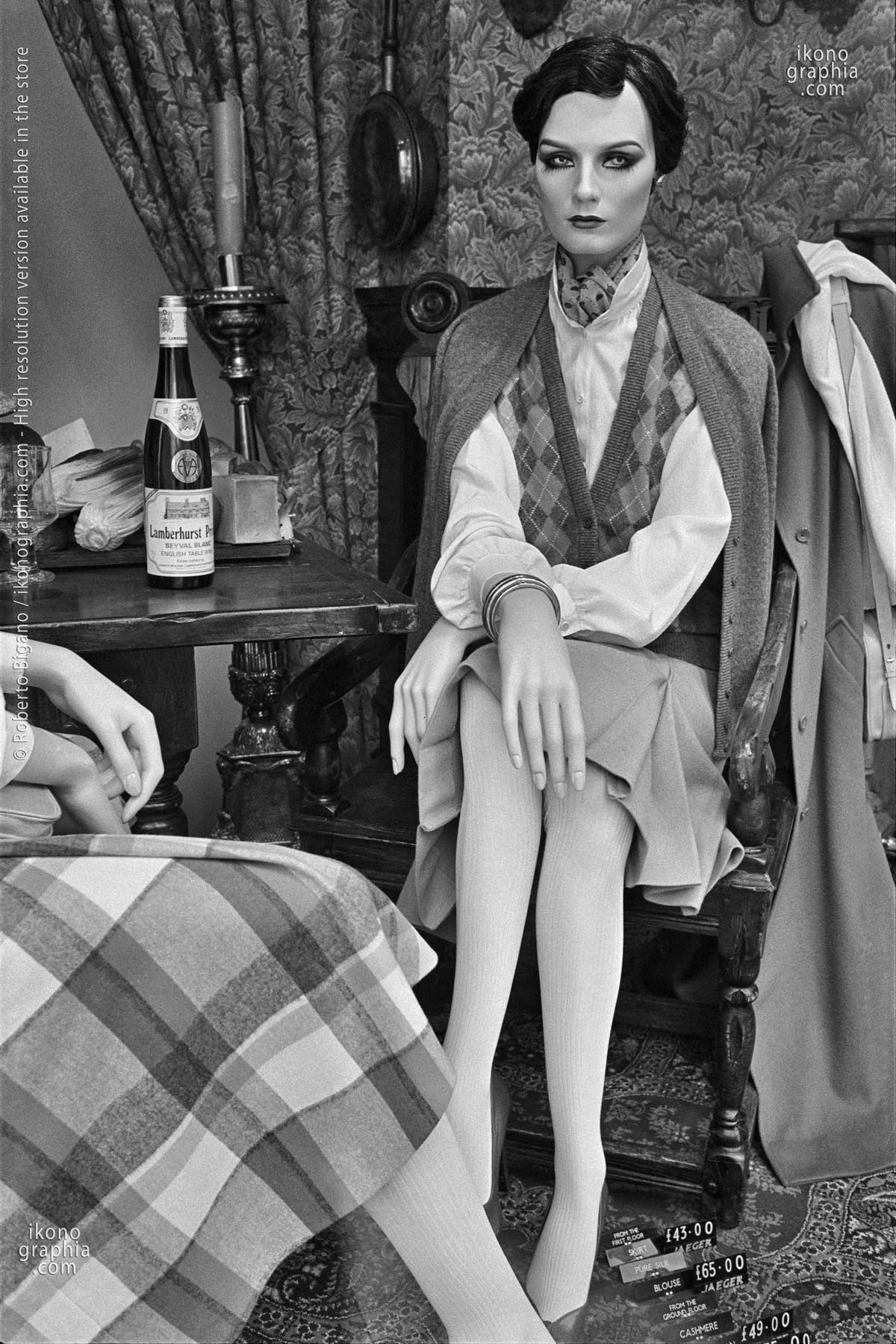
Shop window in Regent St, London, UK | September 1980

September 1980 — Soho, London, United Kingdom

Three figures in coordinated formation — voluminous curls, layered chains, draped ethnic-influenced garments. Collective glamour over individual pieces. The group is the statement.

0564-33 Mannequins, Soho, London, UK September 1980 | From "Plastic Girls" series. Photo by Roberto Bigano. Buy this image in the ikonographia.com store.

September 1980 — Soho, London, Unite Kingdom

Two mannequins in close proximity, mirrored gazes, stylized accessories. Attitude foregrounded over garment.

The display is about presence, not clothing.

0564-34 Mannequin, London, UK September 1980 | From "Plastic Girls" series Nikon FM 50/1.4. Film Kodak PlusX Pan Photo by Roberto Bigano. Buy this image in the ikonographia.com store.

September 1980 — Regent Street — London, United Kingdom

Classical Hollywood elegance rendered in stillness and introspection. The sculpted platinum hair styled in 1940s waves, downcast eyes, and contemplative pose evoke film-star refinement rather than contemporary fashion energy. 

London retail maintaining connection to mid-century glamour traditions—not theatrical performance or punk defiance, but timeless feminine introspection. The mannequin presents beauty as melancholic rather than aspirational, offering an alternative visual language within the same commercial landscape.

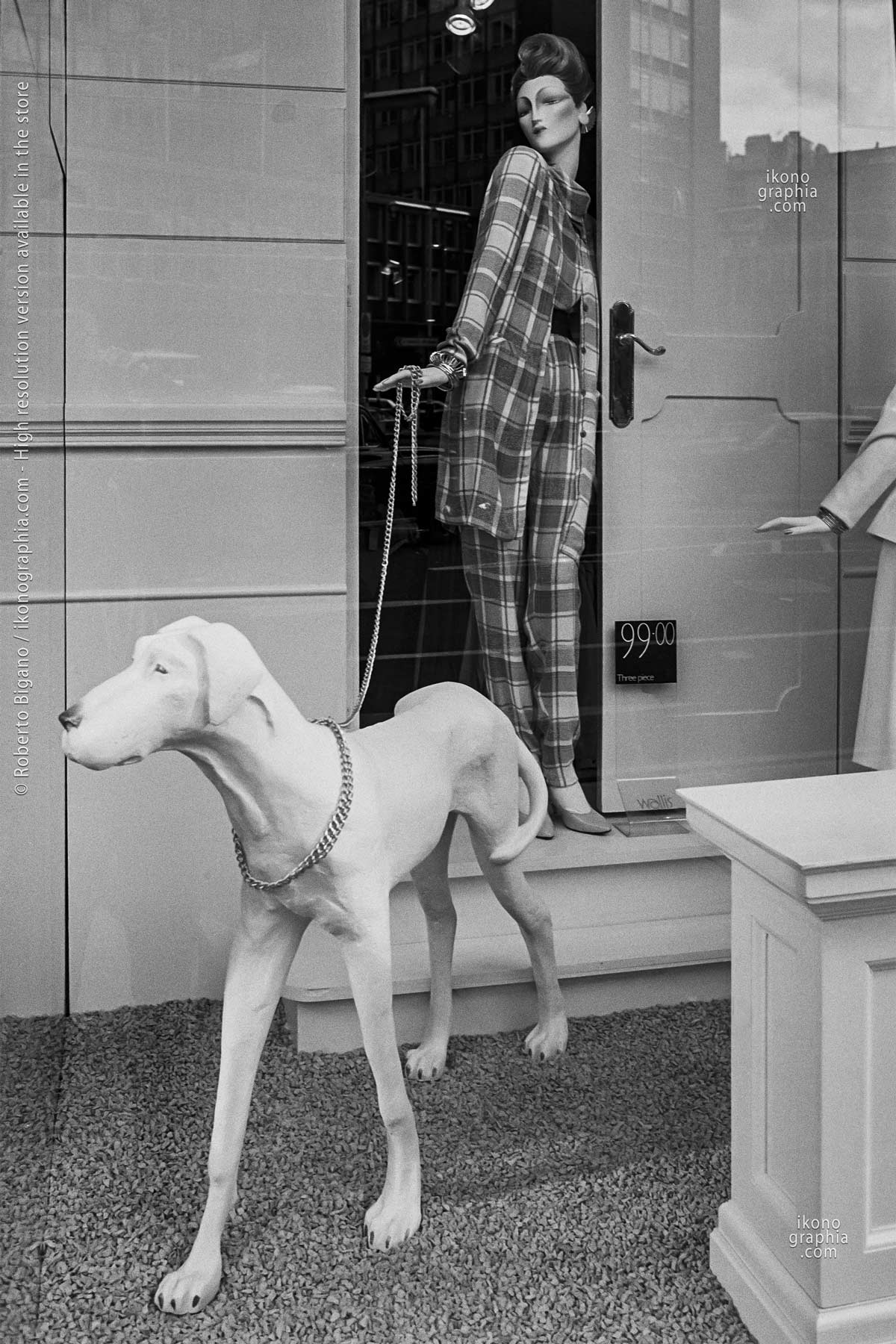
0568-27 Elegant mannequin with greyhound, London Knightsbridge, UK September 1980 | From "Plastic Girls" series. Photo by Roberto Bigano. Buy this image in the ikonographia.com store.

September 1980.
London, United Kingdom — Knightsbridge.

An elegant shop-window composition pairing a poised mannequin with a greyhound, projecting refinement through restraint rather than display.

The controlled posture, tailored styling, and classical animal form evoke Knightsbridge’s association with discretion and status, translating luxury into a language of composure and quiet confidence.

0566-33 The Bionic Woman, London, UK September 1980 | From "Plastic Girls" series. Photo by Roberto Bigano. Buy this image in the ikonographia.com sto

September 1980.
London, United Kingdom.

Not a mannequin — a doll. The Bionic Woman, £5.74, photographed through shop-window glass like everything else in this archive. The face is indistinguishable from the mannequins beside it. That is the point.

August 1984 - Beverly Hills, California - From "Plastic Girls" series. A forty-year project by the Italian photographer Roberto Bigano documenting mannequins.

American Mannequins — Journey into Hyperreality (1982–1988)

Artificial bodies and performative realism in American retail display.

Between 1982 and 1988, American shop windows increasingly adopted mannequins modeled for presence rather than display. Lifelike faces, controlled gestures, and carefully staged interiors transformed retail figures into instruments of visual persuasion, occupying a space where realism no longer represented reality but actively produced it.

Copyright, Links And Credits

Photography, Copyright & Credits

All photographs © Ikonographia / Roberto Bigano — All Rights Reserved.
These images are part of the Ikonographia Visual Archives: — Plastic Girls: 50 Years of Artificial Beauty —  Plastic Girls / Mannequins Archive (1978–2026).

Terms of Use (Summary)

The images presented in this archive are copyrighted and available for licensed use only through Ikonographia Visual Archives.

You may not download, reproduce, publish, or distribute these images without a valid license. For commercial or editorial licensing, please refer to the product pages or contact Ikonographia directly. A full explanation of licensing terms is available in the Shop / Licensing Information section under "Ikonographia — Standard License" and "Ikonographia — Merchandising & Product Use Licenses"

Ikonographia Mission Statement

Ikonographia is committed to the accurate documentation, preservation, and ethical dissemination of twentieth-century visual culture.

Archival Notes — Plastic Girls: 50 Years of Artificial Beauty

This archive began in 1978 as a street photography project and is still ongoing.
All images were taken from public streets through shop-window glass without special access, permissions, or staging.

The archive's coherence was recognized retrospectively—only years later, during high-resolution digitization, did isolated images reveal themselves as a continuous visual record spanning nearly fifty years. The project documents mannequins as cultural artifacts: their evolving materials, poses, facial treatments, and display contexts across changing urban and commercial landscapes.

All images follow Ikonographia's internal archival standards for resolution, color accuracy, and metadata structure to ensure long-term consistency across the collection.

Further Reading — Selected Sources

  • Plastic Girls (1978-2011), by Roberto Bigano — A photographic monograph collecting earlier phases of this archive, published as a limited edition on Blurb.

Browse Plastic Girls Book


Ikonographia is proud to publish "Plastic Girls," an impressive forty years-long work by the Italian photographer Roberto Bigano 

See my published books
EUR Euro