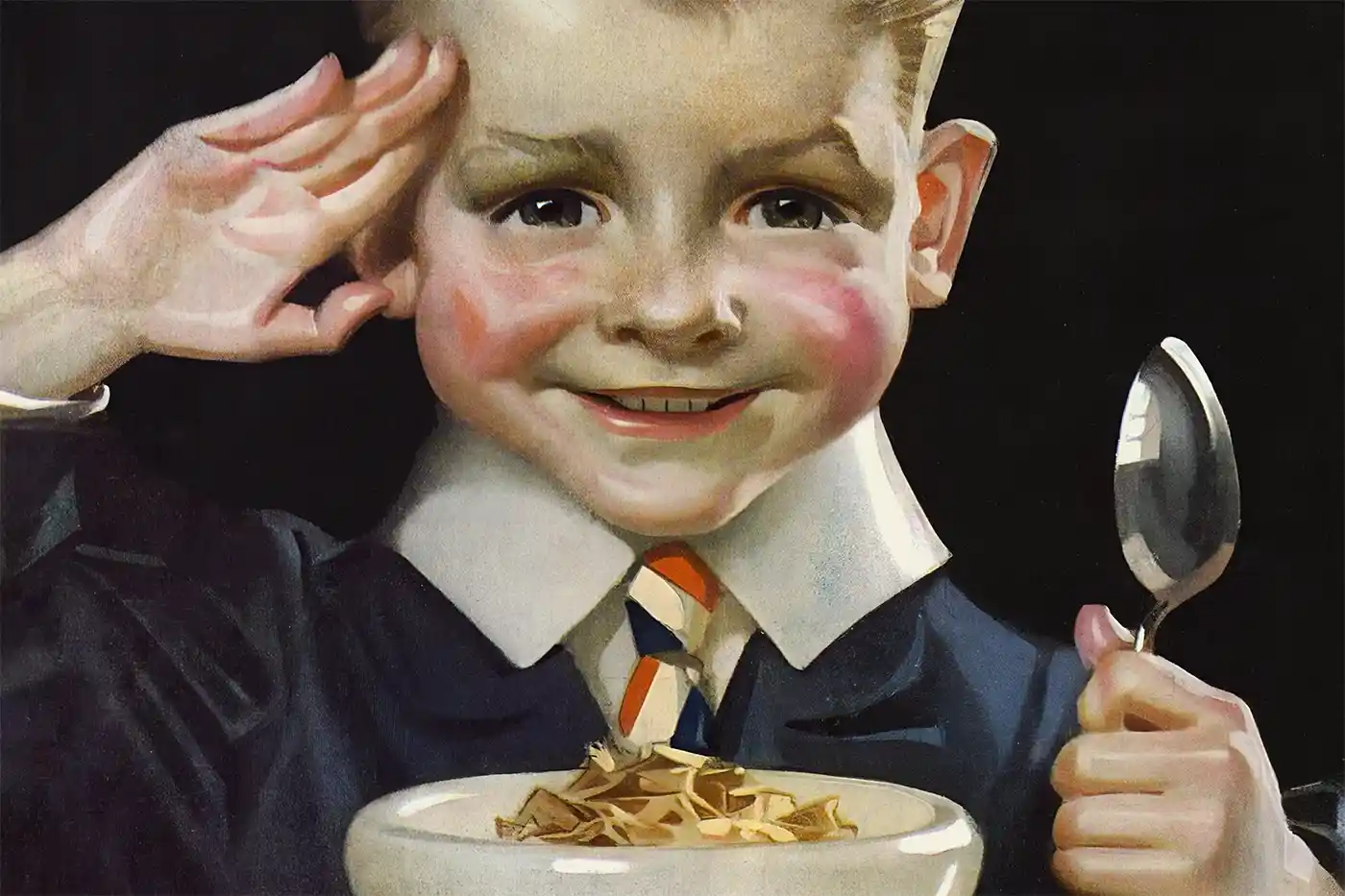
The Kellogg Kids, by Leyendecker. Corn Flakes Ads 1916-1917

The Kellogg Kids, by Leyendecker. Corn Flakes Ads 1916-1917

Stories

Jul 30, 2025

J.C.Leyendecker-Kellog's-Kid

Joseph Christian Leyendecker


Joseph Christian Leyendecker was one of the most prominent and financially successful freelance commercial artists in the United States. From 1895 to 1951, he created hundreds of magazine covers for "Collier's Weekly" and "The Saturday Evening Post," as well as advertisements for prominent brands such as Kellogg's Corn Flakes, Kuppenheimer, and Arrow shirts. This last work is particularly famous, as it helped establish an iconic image of sophisticated American masculinity.
Leyendecker was also one of the few openly gay artists working in the United States during the early twentieth century.
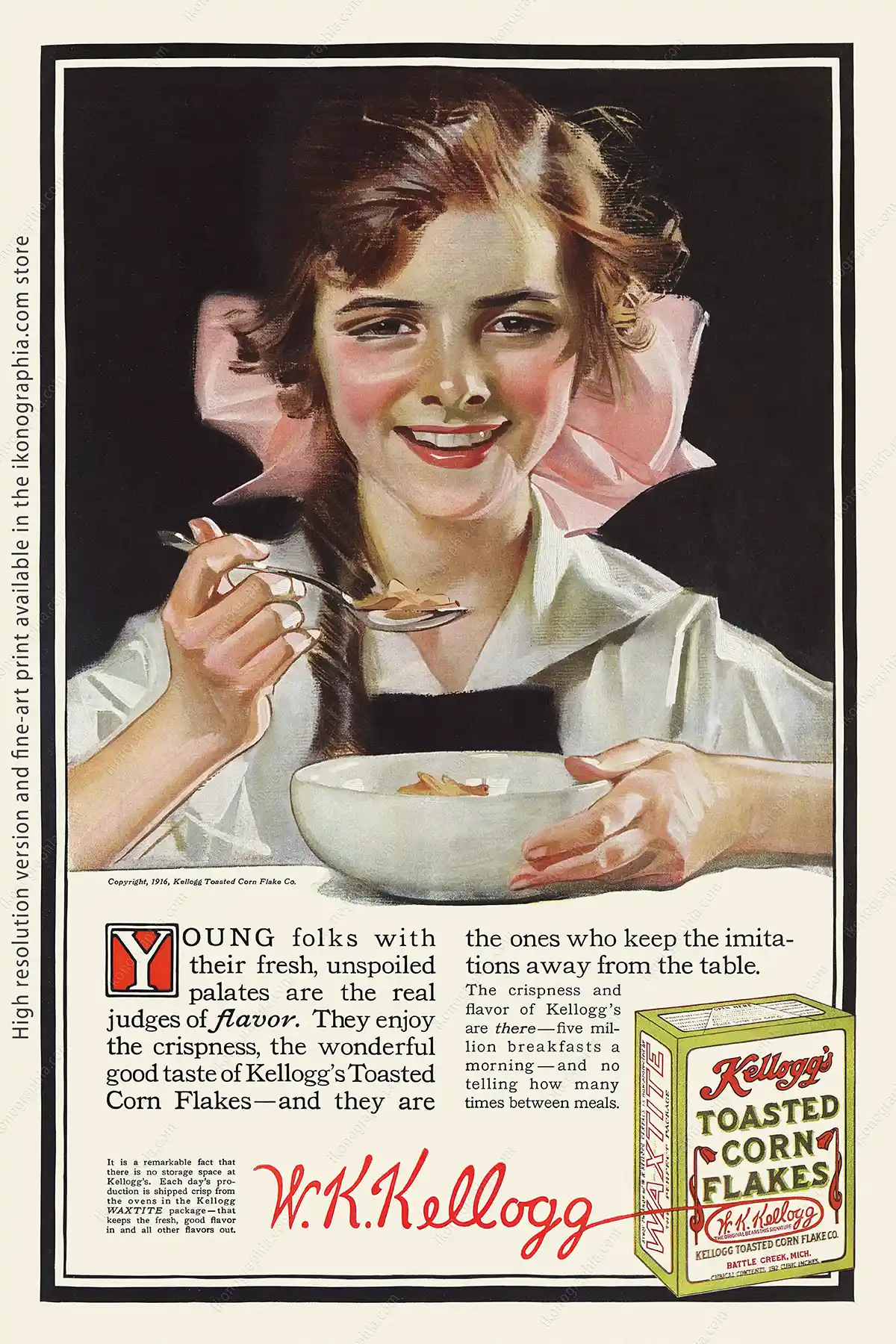
Leyendecker's Young girl judging the flavor and crispness of flakes. Kellogg's ad, 1916

"Young folks with their fresh, unspoiled palates are the real judges of flavor. They enjoy the crispness, the wonderful good taste of Kellogg's Toasted Corn Flakes—and they are the ones who keep the imitations away from the table."

Advertisement for Kellogg's Corn Flakes.
Artwork by Joseph Christian Leyendecker.

Ladies’ Home Journal, February 1916

Leyendecker kids' illustration for Kellogg's Cornflakes, 1916 and 1917.


We showcase here Leyendecker's illustration for Kellogg's Corn Flakes' advertising campaign, which ran in the Ladies' Home Journal magazine in 1916 and 1917.
The extremely vivid illustrations convey positivity, health, and joy.
His illustration technique was remarkable, often utilizing complementary colors such as magenta/green, which reminds us of Italian late Middle Ages masters like Giotto, as shown in some close-ups.

It is notable for being one of the first advertising campaigns (together with Queen City Inks and Overland) to maintain a consistent corporate image.
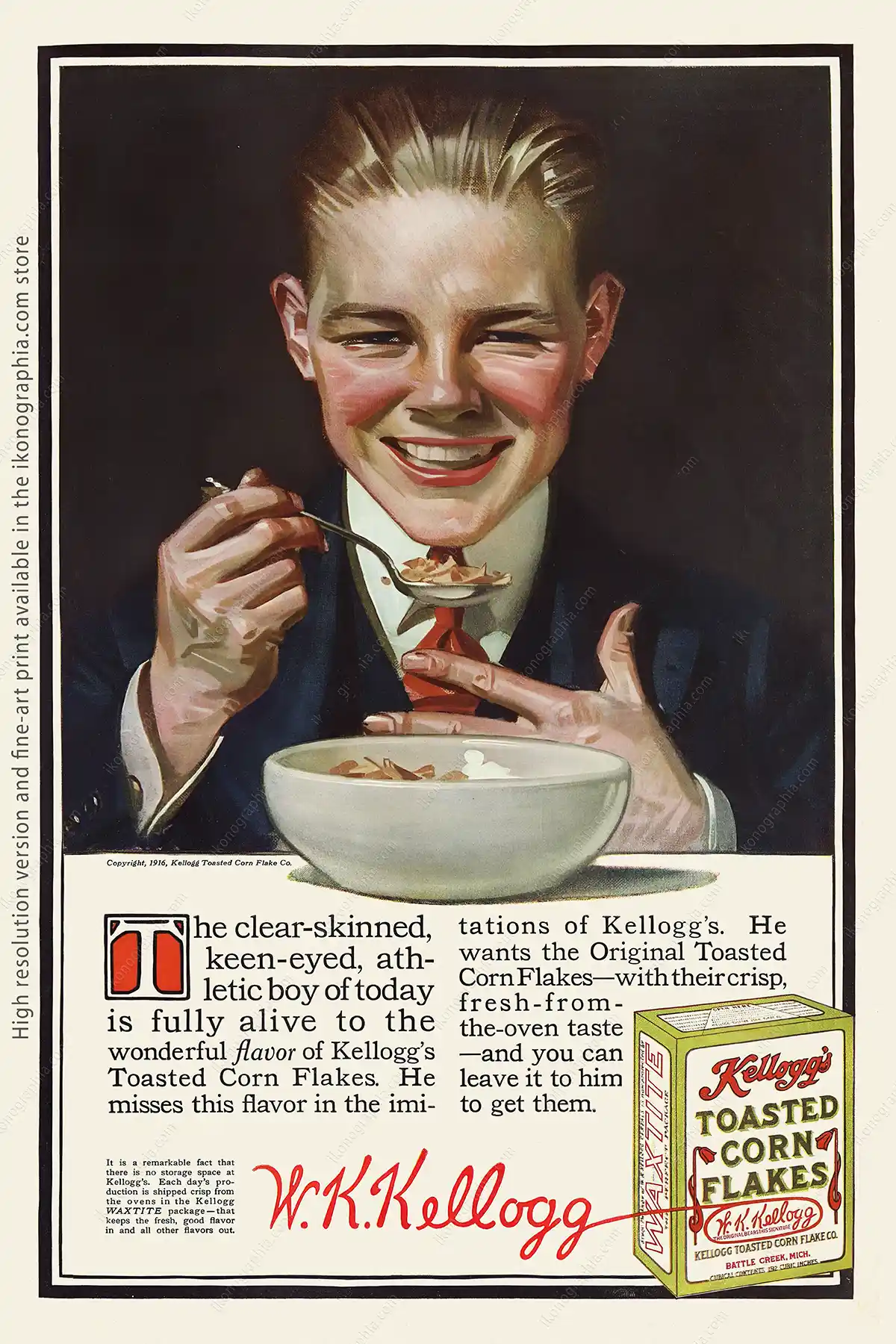
Leyendecker's clear-skinned boy enjoying corn flakes with milk. Kellogg ad, 1916 Advertisement for Kellogg's Corn flakes. Artwork by Joseph Christian Leyendecker. Ladies' Home Journal, March 1916

"The clear-skinned, keen-eyed, athletic boy of today is fully alive to the wonderful flavor of Kellogg's Toasted Corn Flakes."

Advertisement for Kellogg’s Corn Flakes.
Artwork by Joseph Christian Leyendecker.

Ladies’ Home Journal, March1916
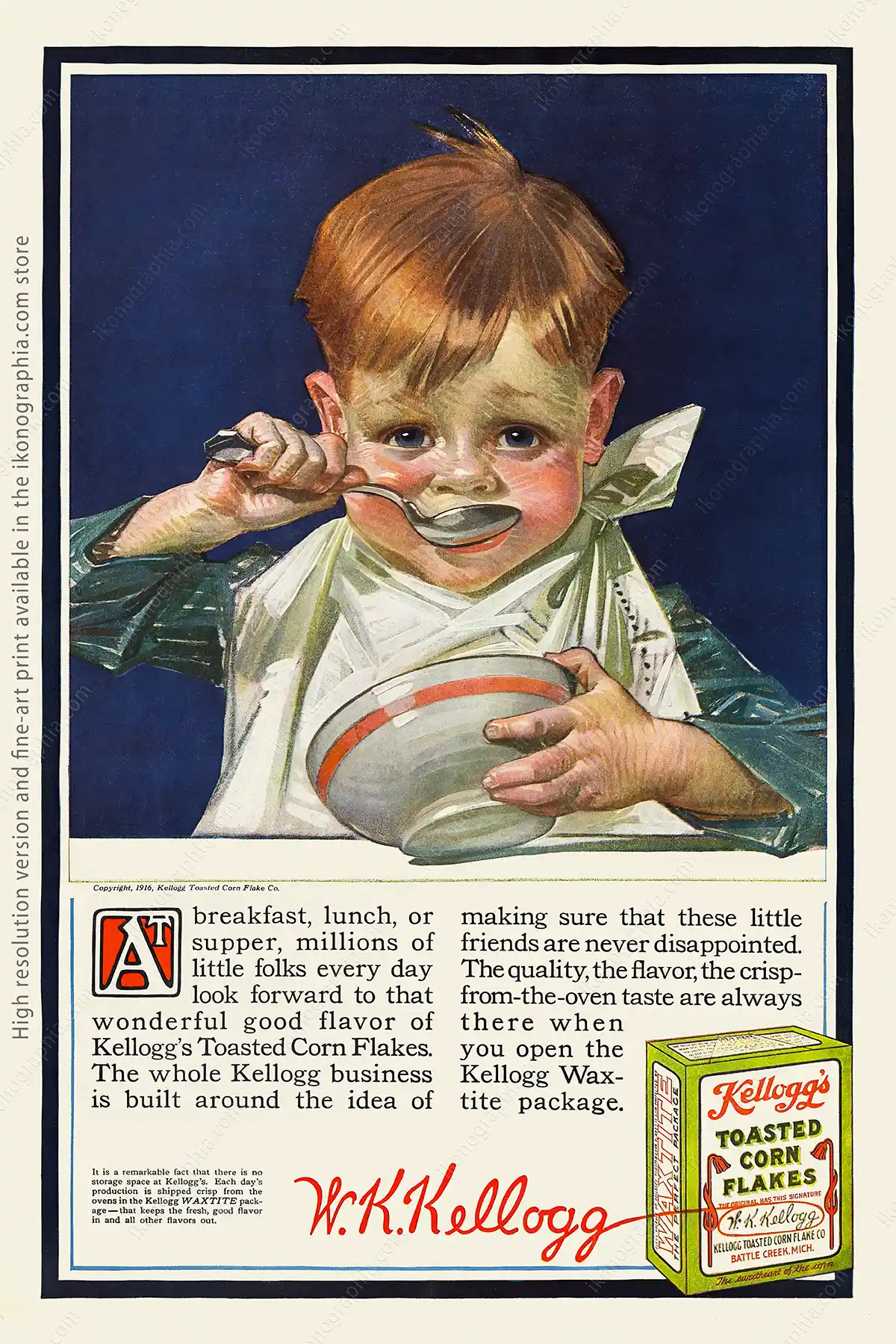
Advertisement for Kellogg's Corn flakes. Artwork by Joseph Christian Leyendecker. Ladies' Home Journal, April 1916

"At breakfast, lunch, or supper, millions of little folks every day look forward to that wonderful good flavor of Kellogg's Toasted Corn Flakes."

Advertisement for Kellogg’s Corn Flakes.
Artwork by Joseph Christian Leyendecker.

Ladies’ Home Journal, April 1916
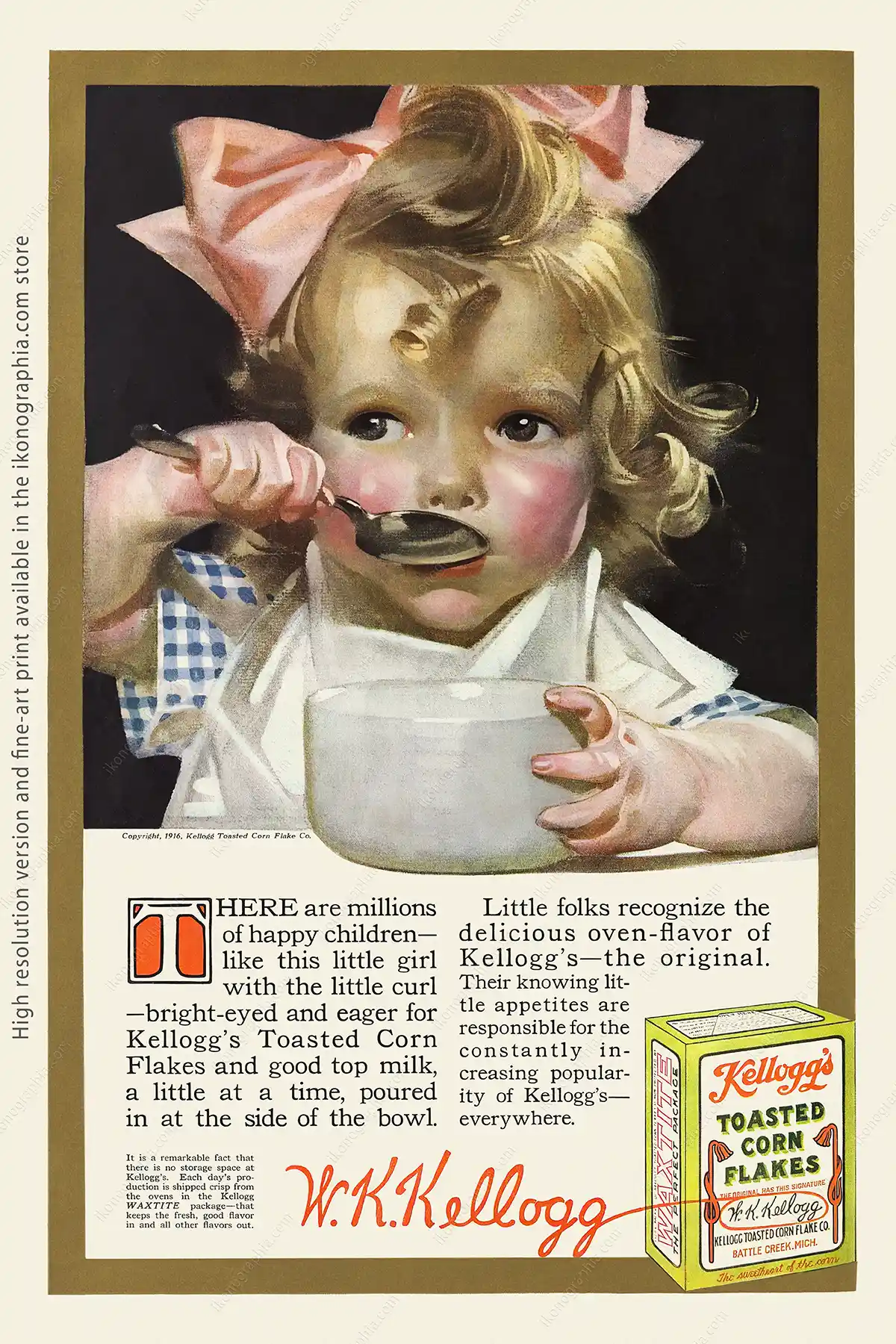
Leyendecker's baby girl enjoying cornflakes breakfast. Kellogg's ad, 1916

"There are millions of happy children like this little girl with the little curl, bright-eyed and eager for Kellogg’s Toasted Corn Flakes and good top milk, a little at a time, poured in at the side of the bowl."

Advertisement for Kellogg’s Corn Flakes.
Artwork by Joseph Christian Leyendecker.

Ladies’ Home Journal, May 1916
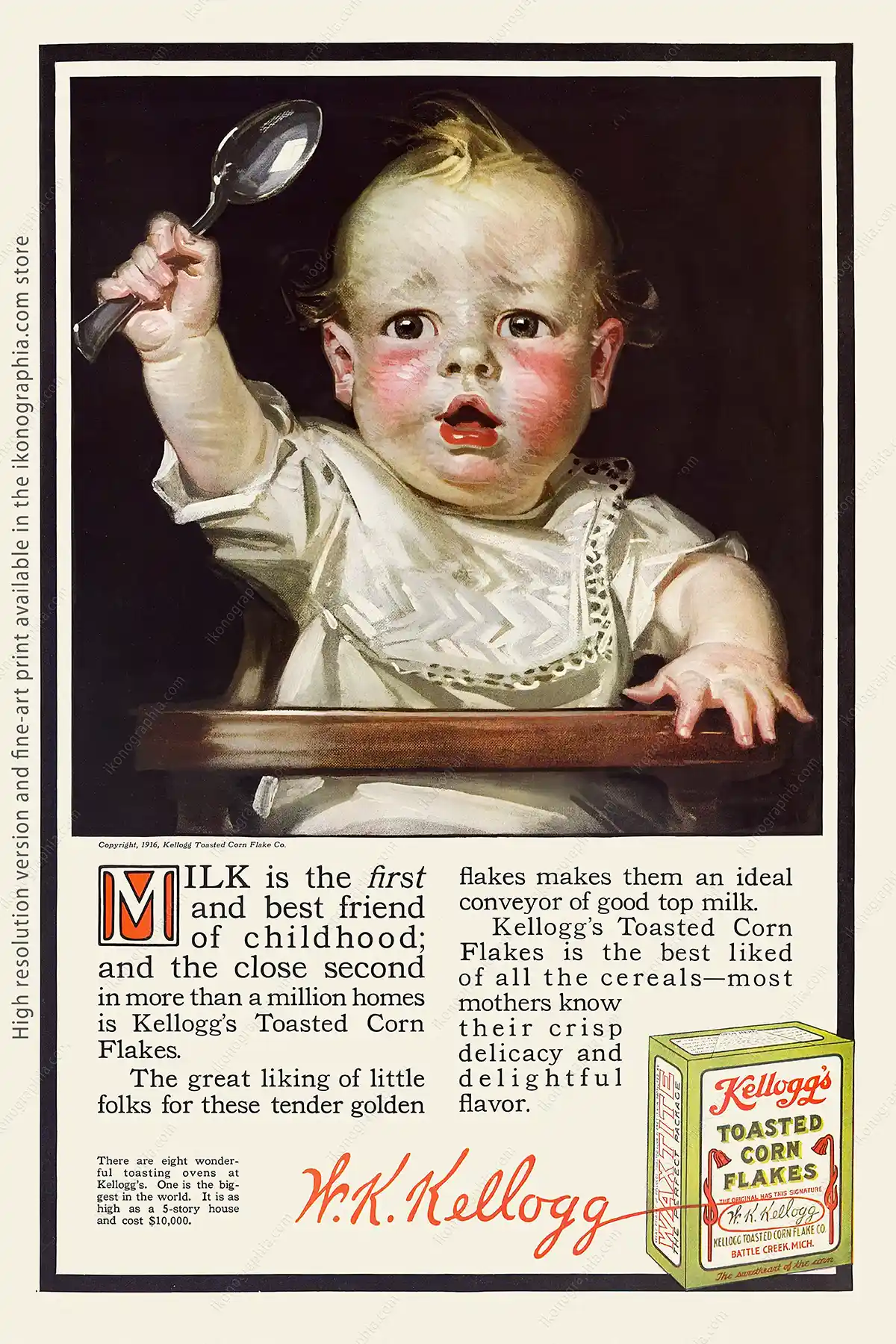
Leyendecker's baby claiming for milk and flakes. Kellogg ad, 1916 Advertisement for Kellogg's Corn flakes. Artwork by Joseph Christian Leyendecker. Ladies' Home Journal, June 1916

"Milk is the first and best friend of childhood; and the close second in more than a million homes is Kellogg's Toasted Corn Flakes. The great liking of little folks for these tender golden flakes makes them an ideal conveyor of good top milk."

Advertisement for Kellogg’s Corn Flakes.
Artwork by Joseph Christian Leyendecker.

Ladies’ Home Journal, June 1916
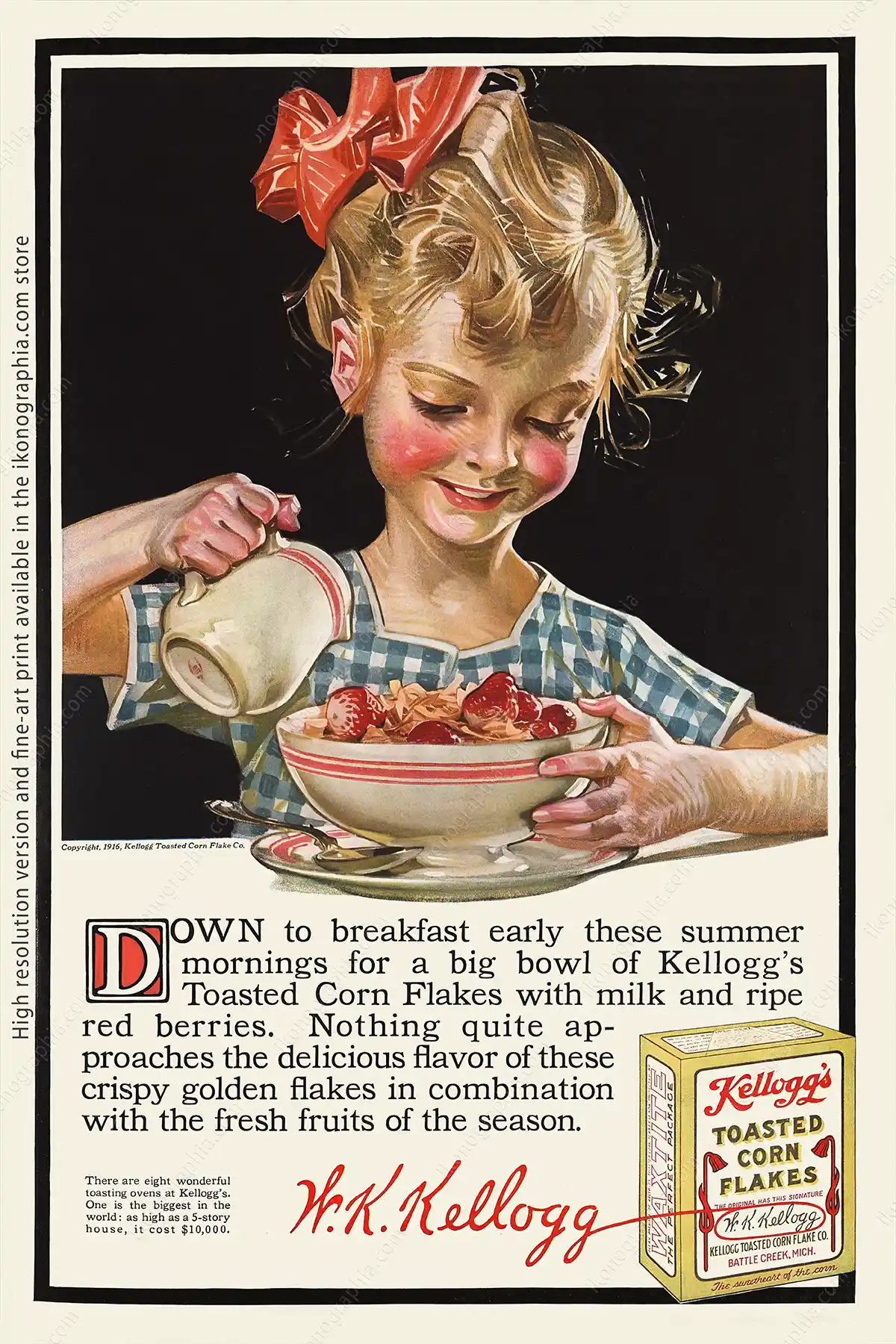
Leyendecker's Young girl enjoying corn flakes with milk and fresh fruits. Kellogg's ad, 1916 Advertisement for Kellogg's Corn flakes. Artwork by Joseph Christian Leyendecker. Ladies' Home Journal, July 1916

"Down to breakfast early these summer mornings for a big bowl of Kellogg's Toasted Corn Flakes with milk and ripe red berries. Nothing quite approaches the delicious flavor of these crispy golden flakes in combination with the fresh fruits of the season."

Advertisement for Kellogg’s Corn Flakes.
Artwork by Joseph Christian Leyendecker.

Ladies’ Home Journal, July 1916
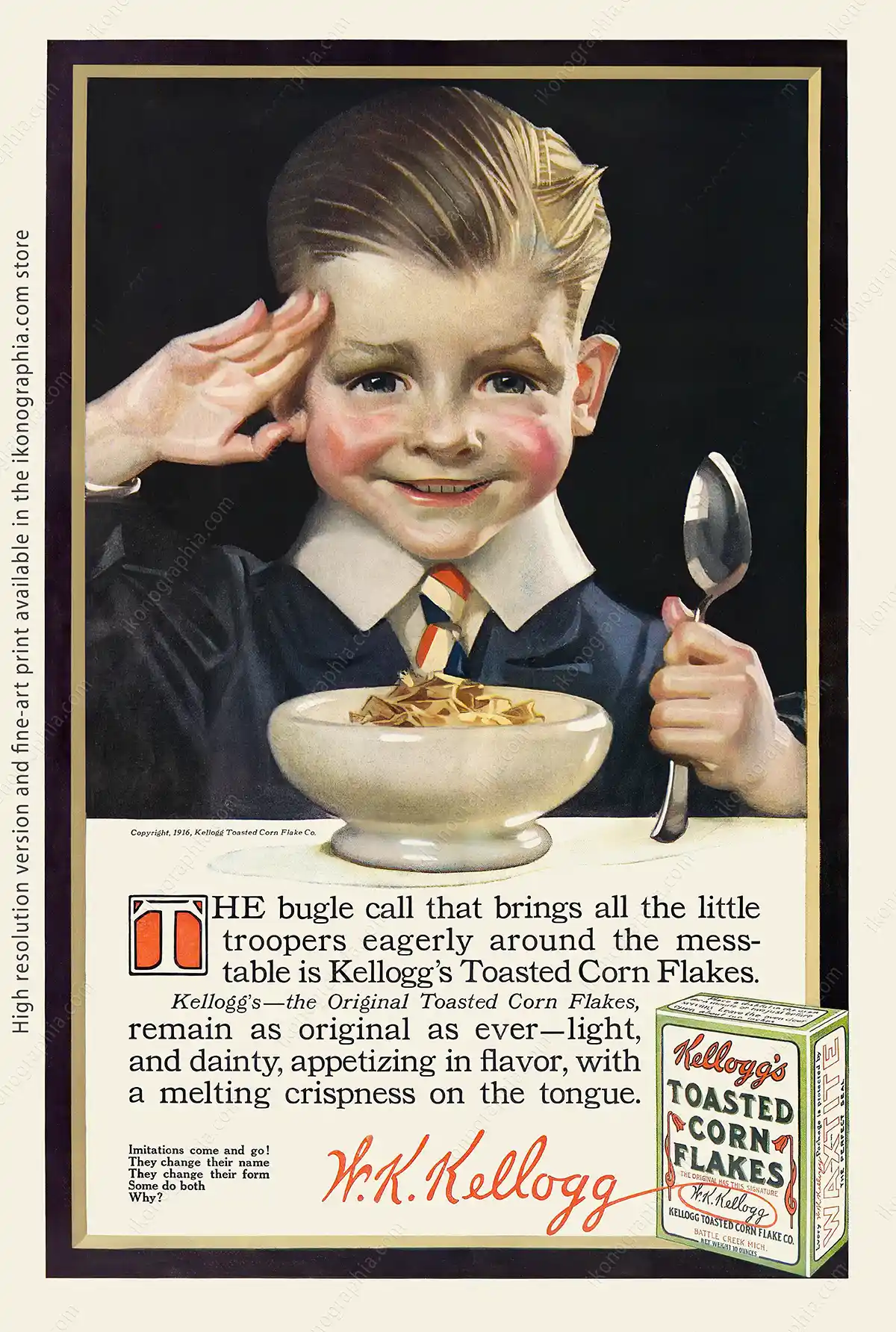
The bugle call brings little troopers eagerly around the messtable. Kellogg's ad by Leyendecker, 1916 Advertisement for Kellogg's Corn flakes. Artwork by Joseph Christian Leyendecker. Ladies' Home Journal, September 1916 THE bugle call that brings all the little troopers eagerly around the mess-table is Kellogg's Toasted Corn Flakes. Kellogg's—the Original Toasted Corn Flakes, remain as original as ever–light, and dainty, appetizing in flavor, with a melting crispness on the tongue.

"The bugle call that brings all the little troopers eagerly around the mess-table is Kellogg's Toasted Corn Flakes. Kellogg's—the Original Toasted Corn Flakes, remain as original as ever–light, and dainty, appetizing in flavor, with a melting crispness on the tongue."

Advertisement for Kellogg’s Corn Flakes.
Artwork by Joseph Christian Leyendecker.

Ladies’ Home Journal, September 1916
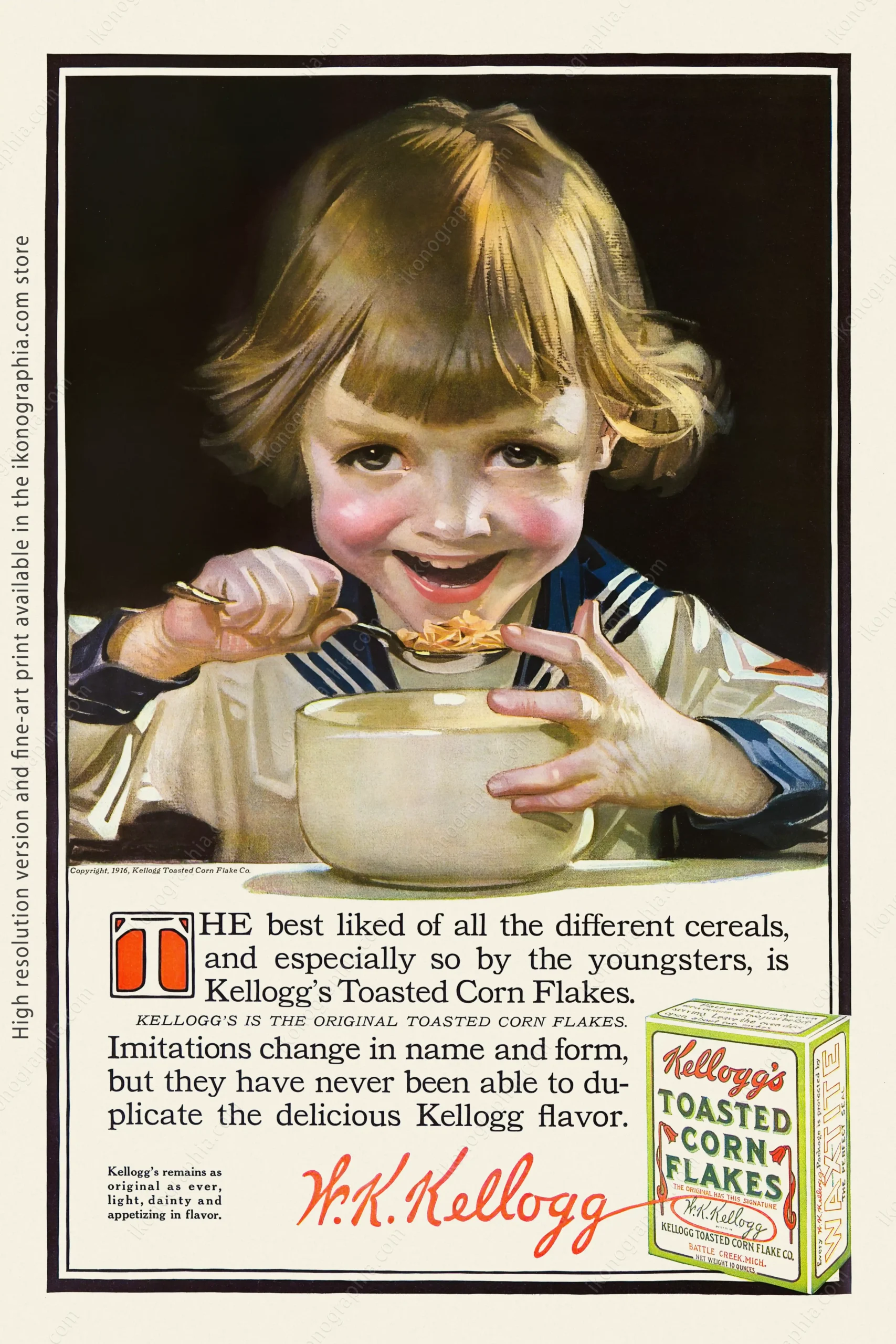
The best liked of all cereals by the youngster. Kellogg's ad by Leyendecker, 1916 Advertisement for Kellogg's Corn flakes. Artwork by Joseph Christian Leyendecker. Ladies' Home Journal, October 1916

"The best liked of all the different cereals, and especially so by the youngsters, is Kellogg's Toasted Corn Flakes."

Advertisement for Kellogg’s Corn Flakes.
Artwork by Joseph Christian Leyendecker.

Ladies’ Home Journal, October 1916
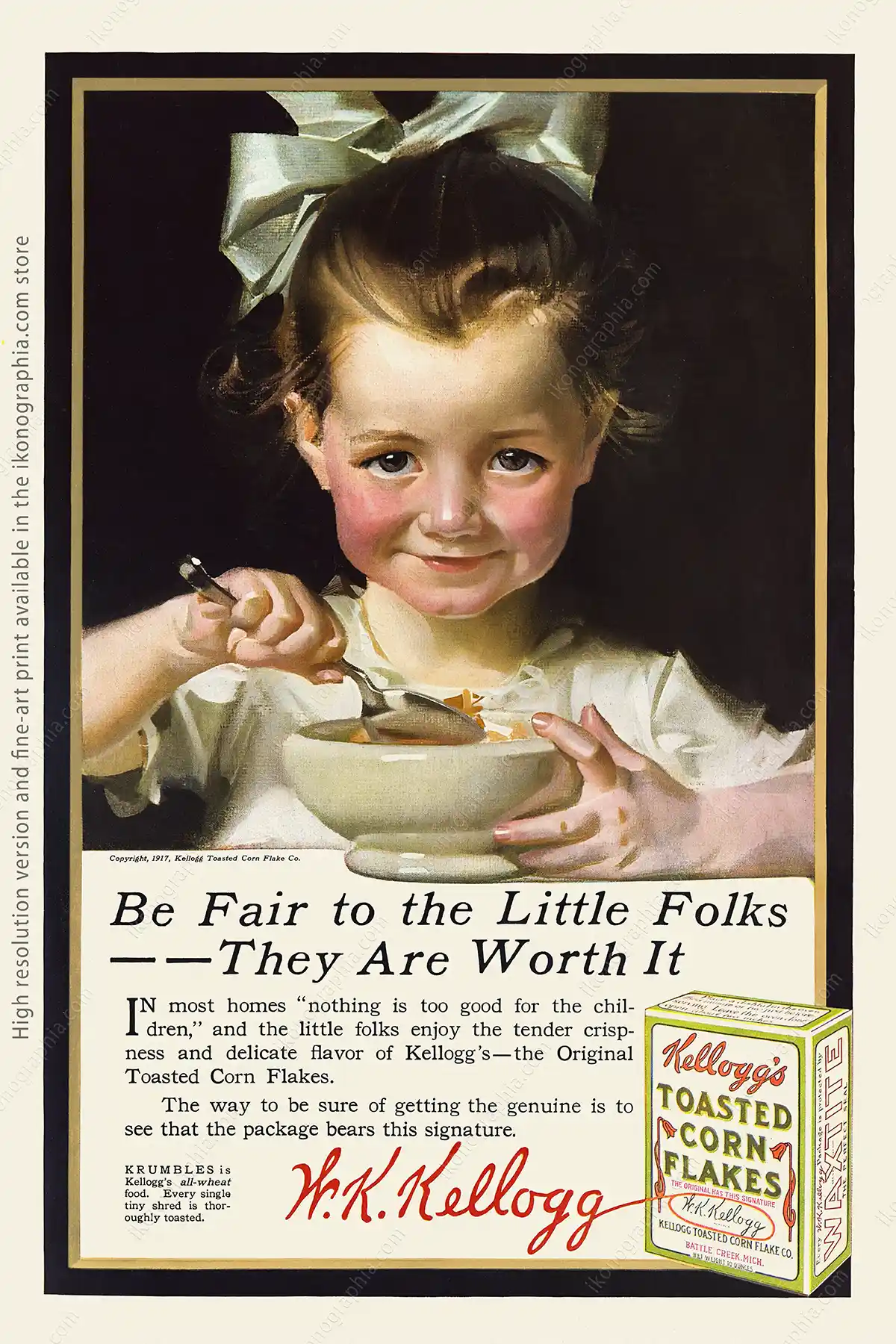
Be Fair to the Little Folks - They Are Worth It. Kellogg's ad by Leyendecker, 1917 Advertisement for Kellogg's Corn Flakes. Artwork by Joseph Christian Leyendecker. Ladies' Home Journal, March 1917

"Be Fair to the Little Folks They Are Worth It. In most homes "nothing is too good for the children," and the little folks enjoy the tender crispness and delicate flavor of Kellogg's the Original Toasted Corn Flakes."

Advertisement for Kellogg’s Corn Flakes.
Artwork by Joseph Christian Leyendecker.

Ladies’ Home Journal, March 1917
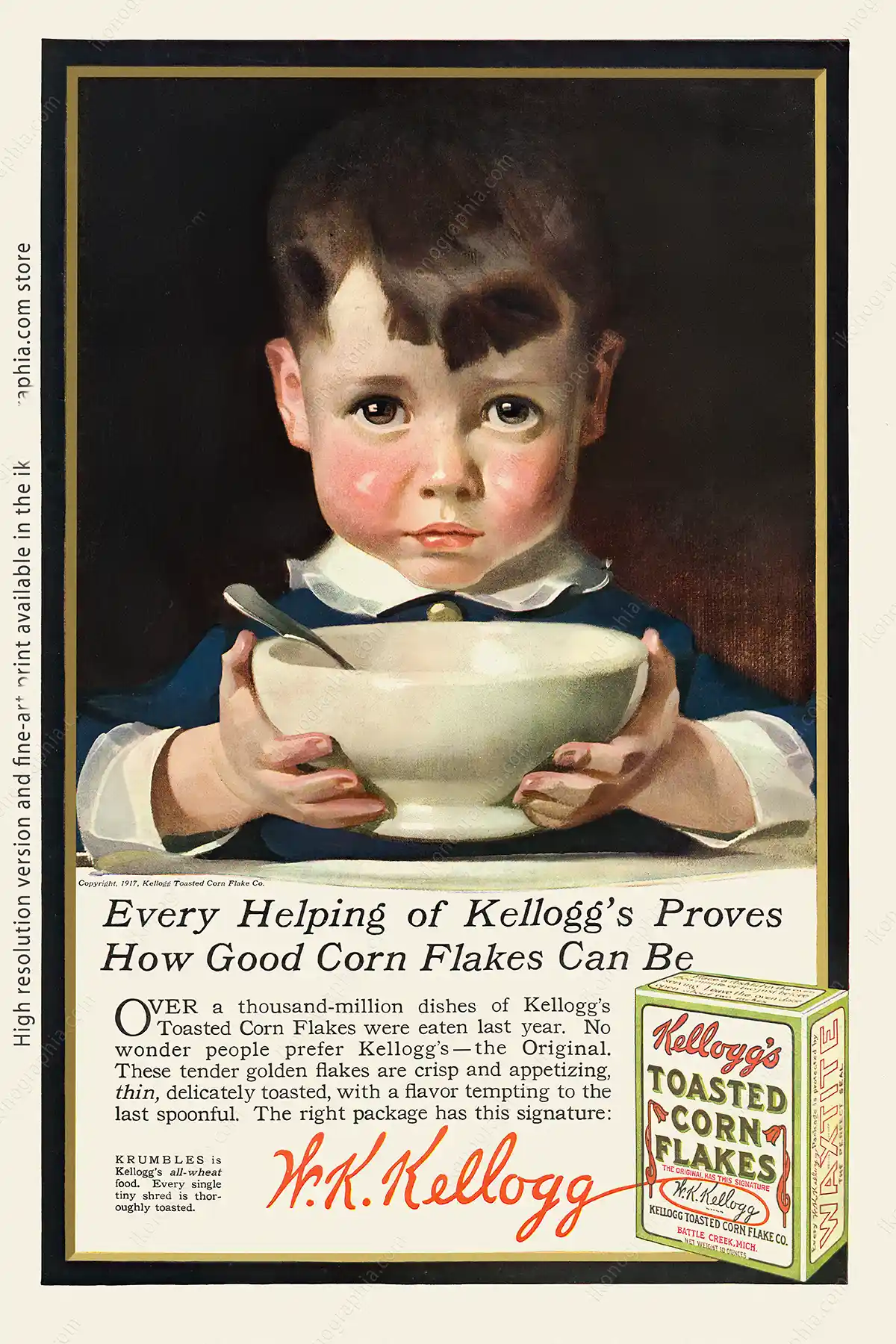
Every Helping of Kellogg's Proves How Good Corn Flakes Can Be, by Leyendecker 1917 Advertisement for Kellogg's Corn Flakes. Artwork by Joseph Christian Leyendecker. Ladies' Home Journal, April 1917

"Every Helping of Kellogg's Proves How Good Corn Flakes Can Be. Over a thousand-million dishes of Kellogg's Toasted Corn Flakes were eaten last year. No wonder people prefer Kellogg's—the Original. 

Advertisement for Kellogg’s Corn Flakes.
Artwork by Joseph Christian Leyendecker.

Ladies’ Home Journal, April 1917
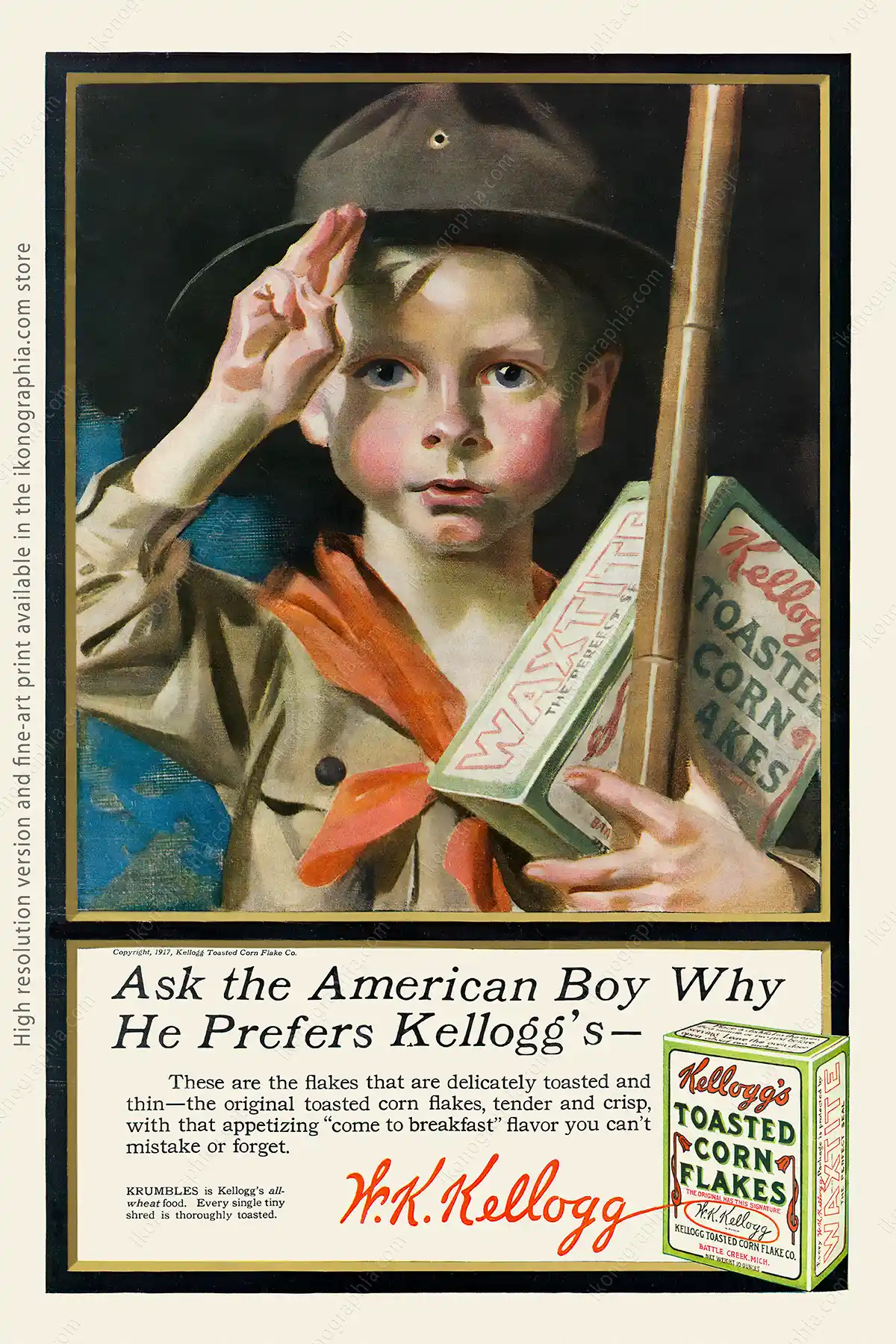
Ask the American Boy Why He Prefers Kellogg. Artwork by Leyendecker, 1917 Advertisement for Kellogg's Corn Flakes. Artwork by Joseph Christian Leyendecker. Ladies' Home Journal, May 1917

"Ask the American Boy Why He Prefers Kellogg — These are the flakes that are delicately toasted and thin the original toasted corn flakes, tender and crisp, with that appetizing "come to breakfast" flavor you can't mistake or forget."

Advertisement for Kellogg’s Corn Flakes.
Artwork by Joseph Christian Leyendecker.

Ladies’ Home Journal, May 1917
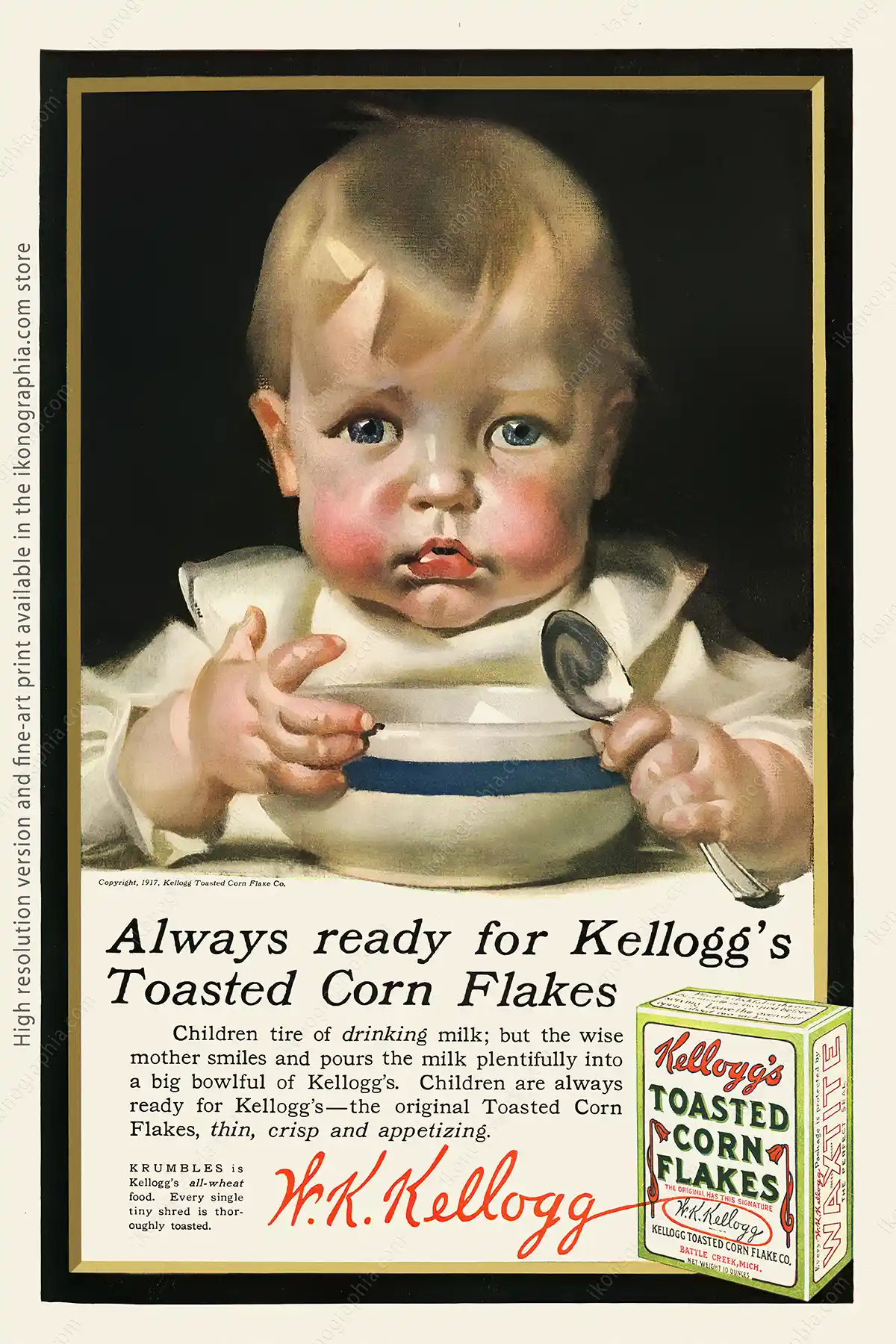
Always ready for Kellogg's Toasted Corn Flakes. Artwork by Leyendecker, 1917 Advertisement for Kellogg's Corn Flakes. Artwork by Joseph Christian Leyendecker. Ladies' Home Journal, June 1917

"Always ready for Kellogg's Toasted Corn Flakes.
Children tire of drinking milk; but the wise mother smiles and pours the milk plentifully into a big bowlful of Kellogg's.

Advertisement for Kellogg’s Corn Flakes.
Artwork by Joseph Christian Leyendecker.

Ladies’ Home Journal, June 1917
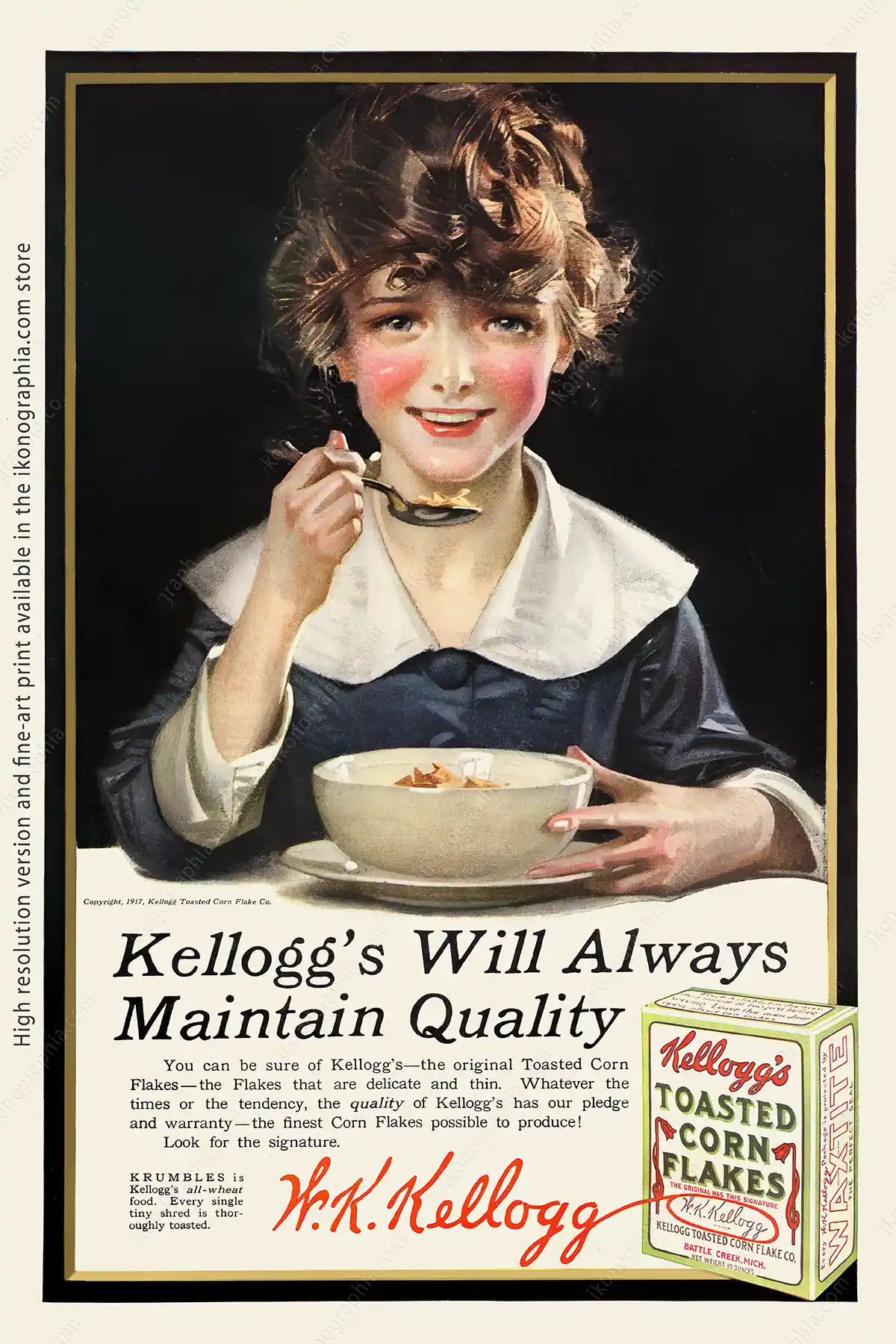
Kellogg's Will Always Maintain Quality. Artwork by Leyendecker, 1917 Advertisement for Kellogg's Corn Flakes. Artwork by Joseph Christian Leyendecker. Ladies' Home Journal, July 1917

"Kellogg's Will Always Maintain Quality.
You can be sure of Kellogg's—the original Toasted Corn Flakes — the Flakes that are delicate and thin. Whatever the times or the tendency, the quality of Kellogg's has our pledge and warranty the finest Corn Flakes possible to produce!


Advertisement for Kellogg’s Corn Flakes.
Artwork by Joseph Christian Leyendecker.

Ladies’ Home Journal, July 1917
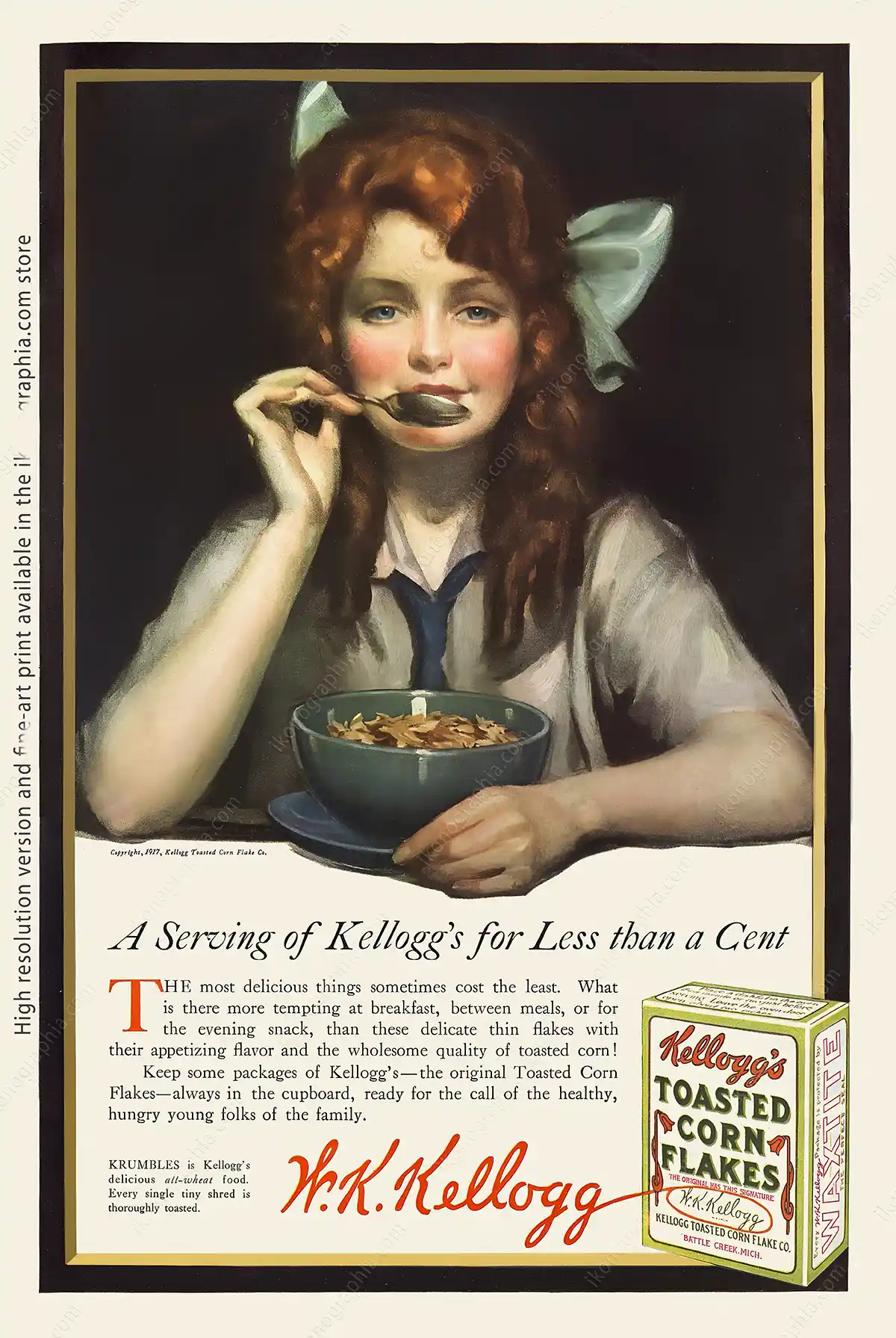
A Serving of Kellogg's for Less than a Cent. Artwork by Leyendecker, 1917 Advertisement for Kellogg's Corn Flakes. Artwork by Joseph Christian Leyendecker. Ladies' Home Journal, October 1917

"A Serving of Kellogg's for Less than a Cent The most delicious things sometimes cost the least. What is there more tempting at breakfast, between meals, or for the evening snack, than these delicate thin flakes with their appetizing flavor and the wholesome quality of toasted corn!"

Advertisement for Kellogg’s Corn Flakes.
Artwork by Joseph Christian Leyendecker.

Ladies’ Home Journal, October 1917
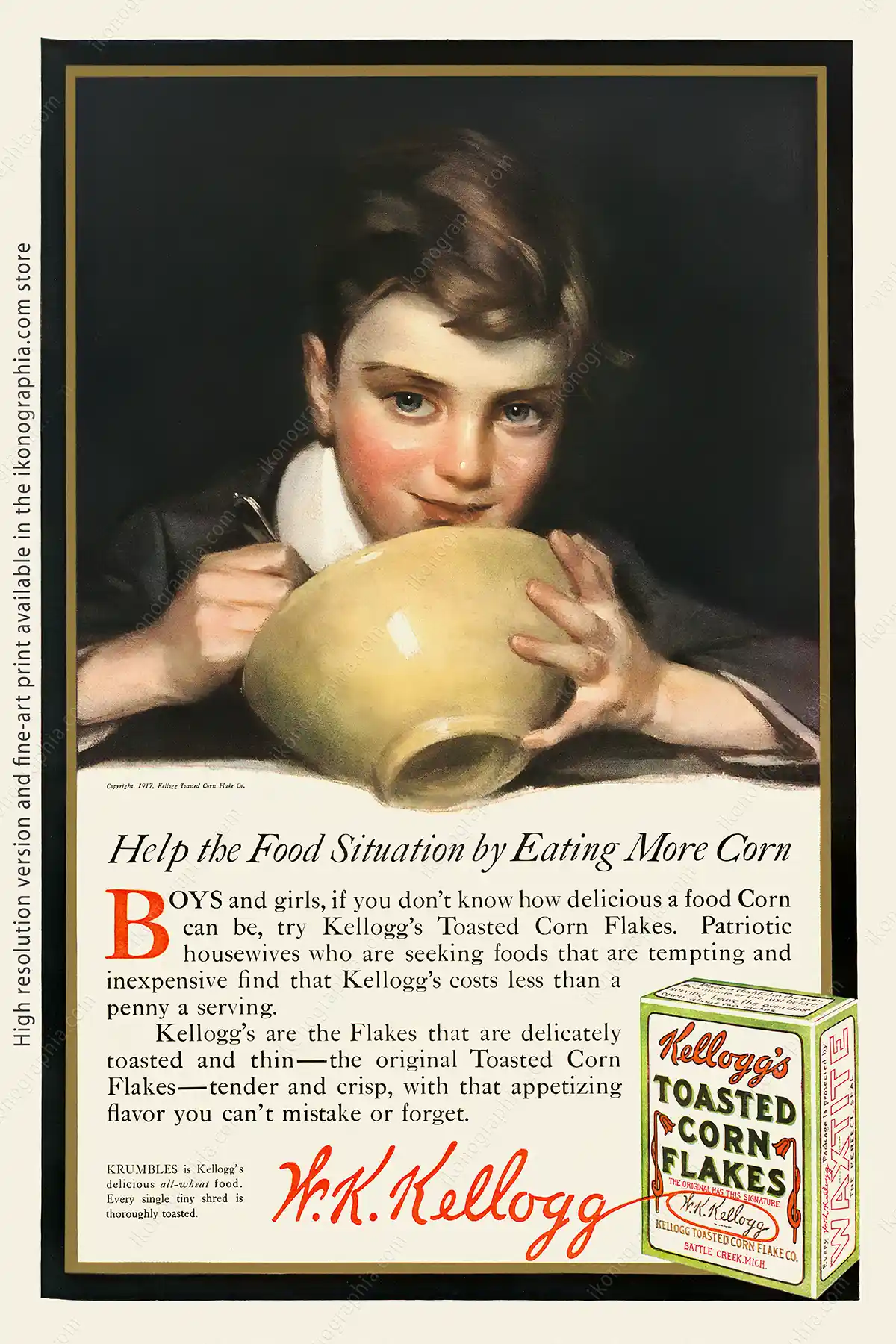
Help the Food Situation by Eating More Corn. Kellog's ad by Leyendecker, 1917 Advertisement for Kellogg's Corn Flakes. Artwork by Joseph Christian Leyendecker. Ladies' Home Journal, November 1917

"Help the Food Situation by Eating More Corn.

Boy sand girls, if you don't know how delicious a food Corn can be, try Kellogg's Toasted Corn Flakes. Patriotic housewives who are seeking foods that are tempting and inexpensive find that Kellogg's costs less than a penny a serving."

Advertisement for Kellogg’s Corn Flakes.
Artwork by Joseph Christian Leyendecker.

Ladies’ Home Journal, November 1917

Copyright, Links and credits

These works were published in the US before 1929, and the author died before 1954.
As a result, they are out of copyright worldwide.

Please notice that any advice or comment provided here is not and does not purport to be legal advice as defined by s.12 of the Legal Services Act 2007.

The most intriguing British Dunlop ads of the thirties.

The most intriguing British Dunlop ads of the thirties.

Stories

Apr 30, 2025

The Bystander 1938-05-25_301 Dunlop

About Dunlop Tyre


Dunlop is an iconic British brand, created in 1888 by John Boyd Dunlop, who invented the pneumatic tire, a revolutionary creation that transformed the automotive industry. Inspired by his son's tricycle struggles with hard rubber tires, this practical air-filled tire, patented by Dunlop, laid the foundation for the Dunlop Pneumatic Tire Co. Ltd. in Dublin, Ireland.

By the start of World War II, Dunlop had become synonymous with success across a diverse range of industries. Not only did it dominate the tire market, both on and off the racetrack, but it also excelled in the production of brakes, wheels, golf and tennis balls, flooring, and other industrial rubber products.

The original Dunlop company no longer exists as a corporate entity; the name lives on in several Dunlop-branded products owned by different companies, including automotive, aerospatial, industrial, and sporting products around the world.

Distinction. Wealthy couple in evening dress. Dunlop Reinforced Tyre ad 1933

DISTINCTION.
Dunlop Reinforced Ad.
The Sketch Magazine.
March 22, 1933

Dunlop Advertisement in the United Kingdom.


Throughout the 20th century, Dunlop was one of the leading advertisers in the United Kingdom. In the 1930s, the company launched several advertising campaigns. Still, in this story, we will focus on the most intriguing campaign, from 1933 to 1938, featuring beautiful illustrations created by various artists.

The illustrations are carefully crafted to depict a variety of social situations, often of an exclusive nature. Even when the Dunlop tire is not the central focus, it manages to make a striking appearance, leaving a lasting impression.

Unfortunately, most artworks were not credited or signed, and it was impossible to trace the authors.
It's almost unbelievable, but despite the brand's significance and the hundreds of ads published, the documentation is incredibly scarce, underscoring the rarity and value of the information we do have.
One notable exception is a series of ads from 1936. In this campaign, the company made a significant move by hiring leading illustrators and painters. What's more, readers could even request a free reproduction of the artworks.

Aristocrats. Elegant lady with greyhounds. Dunlop Ad, by Neil Baylis. Britannia & Eve, February 1933

Aristocrats. Elegant lady with greyhounds.
Dunlop Tire Ad.
Artwork by Neil Baylis.

Britannia and Eve Magazine.
February 1933.

A wealthy couple's night Swim. Dunlop Ad. Britannia & Eve, August 1933

A wealthy, elegant couple night swim.
Dunlop Tire Ad.
Britannia and Eve Magazine.
August 1933

Masters. Rider and hounds leaving for fox hunting. Dunlop Ad on The Sketch, November 1933.

Masters. Riders and hounds leaving for fox hunting.
Dunlop Advertisement.

The Sketch, November 1933.

Goodwill. Dunlop season greetings for a 1933 advertisement. Britannia and Eve, December 1933.

Goodwill. Dunlop season greetings.

Britannia and Eve Magazine.
December 1933.

Greeting friends on the riverfront with a Dunlop Tire in the foreground . the Tatler, May 2, 1934.

Greeting friends on the riverfront with a Dunlop Tire in the foreground.
Dunlop Tire Ad.

The Tatler, May 2, 1934

Night traffic jam on icy streets. Dunlop Ad. The Tatler, October 31, 1934

Night traffic jam on icy streets.
Dunlop Tire Ad.

The Tatler, October 31, 1934.

Perfect Control. Traffic cop in London. Dunlop Fort 90 tire ad. Illustrated Sporting and Dramatic News - Friday 12 April 1935

Perfect Control. Traffic cop in London. Dunlop Fort 90 tire ad.

Illustrated Sporting and Dramatic New, August 9, 1935

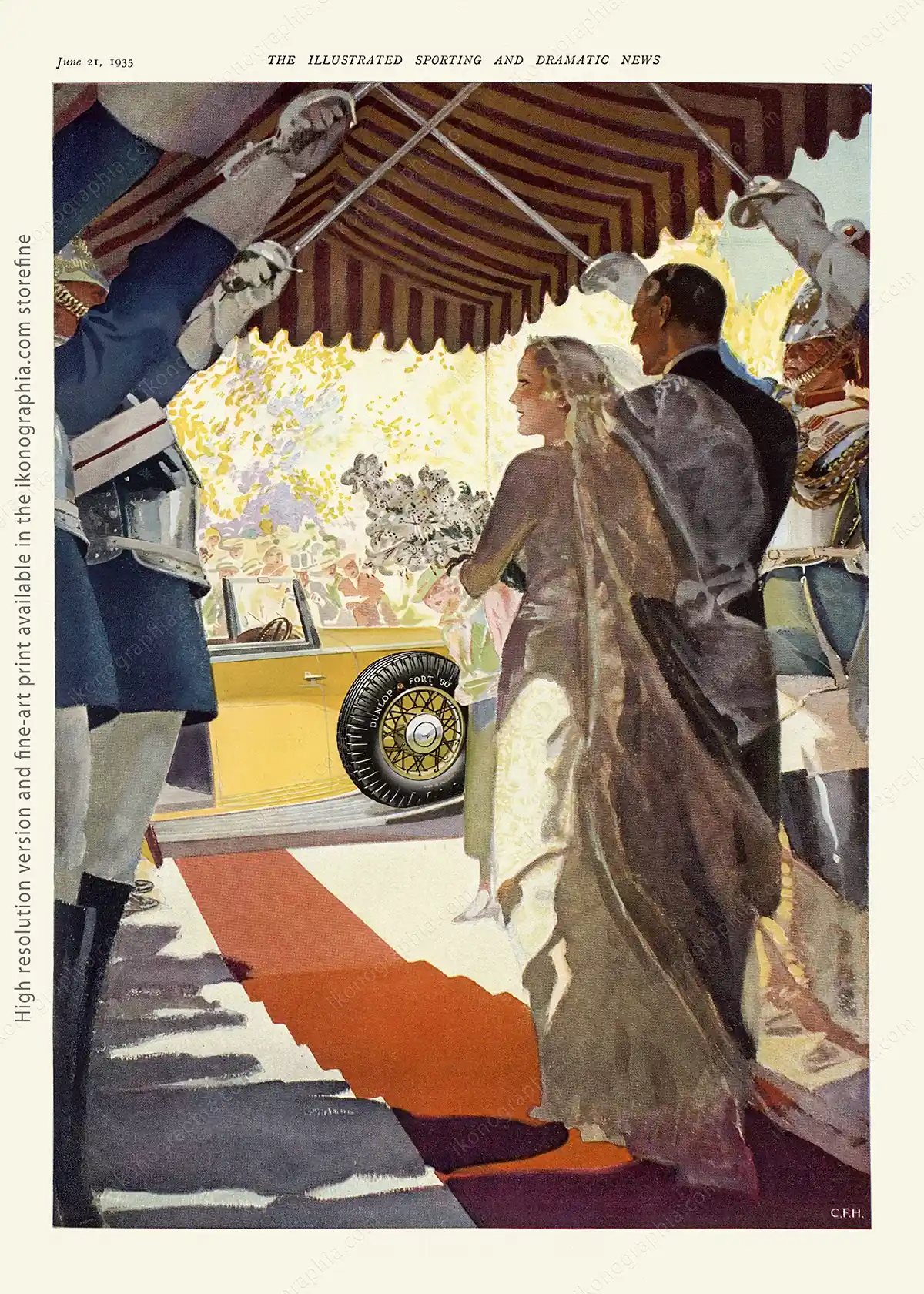
A military salute at an officer's wedding. Dunlop Fort 90 tire ad. Illustrated Sporting and Dramatic News, June 21, 1935.

A military salute at an officer's wedding.
Dunlop Tire Ad.

Illustrated Sporting and Dramatic News, June 21, 1935.

A peacock and a Dunlop Fort "90" tire. Illustrated Sporting and Dramatic New, August 9, 1935

A peacock and a Dunlop Fort "90" tire advertisement.

Illustrated Sporting and Dramatic News, August 9, 1935.

Dunlop Season Greetings 1935 with a car and a toy car with Dunlop Fort "90" tires. Illustrated Sporting and Dramatic News, December 13, 1935.

Dunlop Season Greetings 1935 with a car and a toy car with Dunlop Fort "90" tires.

Illustrated Sporting and Dramatic News, December 13, 1935.

Surreal fall landscape with a lake, art by Ernest Wallcousins. Dunlop ad 1935. Illustrated Sporting and Dramatic News October 4, 1935.

Surreal fall landscape with a lake.
Painting by Ernest Wallcousins.
Dunlop advertisement 1935.

Illustrated Sporting and Dramatic News, October 4, 1935

Merry Xmas. Dunlop season greetings 1936 advertisement. Art by Gerry Wood. Illustrated Sporting and Dramatic News, December 18, 1936.

Merry Xmas. Dunlop season greetings, 1936 ad.
Artwork by Gerry Wood.

Illustrated Sporting and Dramatic News, December 18, 1936.

The 1936 campaign by leading artists.


As said, until 1935, the company didn't credit the artists.
For the 1936 advertising campaign, Dunlop enlisted some of the leading artists of the time, primarily landscape painters, a different one for each ad. Readers could receive a free color reproduction of the original artwork.
W. Smithson Broadhead's illustration stood out as the most beautiful among these.

Fox hunting on a country road. Painting by Algernon Talmage. Dunlop ad. Illustrated Sporting and Dramatic News, February 21, 1936.

Fox hunting on a country road. Painting by Algernon Talmage. Dunlop ad.

Illustrated Sporting and Dramatic News, February 21, 1936.

Spring blossoms in a country village. Artwork by Ernest Wallcousins for a Dunlop ad. Illustrated Sporting and Dramatic News, May 22, 1936.

Spring blossoms in a country village. Artwork by Ernest Wallcousins.
Dunlop ad.

Illustrated Sporting and Dramatic News, May 22, 1936.

A giant bare tree in a country village. Dunlop ad. Painting by James Bateman. The Bystander, March 4, 1936

A giant bare tree in a country village. Dunlop ad. Painting by James Bateman.

The Bystander, March 4, 1936

A lady in sports attire at a polo match. Painting by Smithson Broadhead. Dunlop ad. Illustrated Sporting and Dramatic News, June 19, 1936.

A lady in sports attire at a polo match. Painting by Smithson Broadhead.
Dunlop ad.

Illustrated Sporting and Dramatic News, June 19, 1936.

An Idyllic fall landscape with a lake. Painting by Lamorna Birch. Dunlop ad. Illustrated Sporting and Dramatic News, October 2, 1936.

An Idyllic fall landscape with a lake. Painting by Lamorna Birch. Dunlop ad.

Illustrated Sporting and Dramatic News, June 19, 1936.

Driving on a winter night on a country road, Dunlop Ad 1936. Artwork by Christopher Nevinson. Illustrated Sporting and Dramatic, November 13, 1936

Driving on a winter night on a country road, Dunlop Ad 1936.
Artwork by Christopher Nevinson.

Illustrated Sporting and Dramatic, November 13, 1936

Lastly, the remarkable advertisements from 1938.


Lastly, the remarkable advertisements from 1938 are truly noteworthy. Unfortunately, the company once again neglected to credit the artists involved. We are diligently working to uncover their names or to decipher any signatures where available.

1938 marked the last time Dunlop used organic campaigns featuring color illustrations. In the years that followed, the company made significant changes to its advertising style.

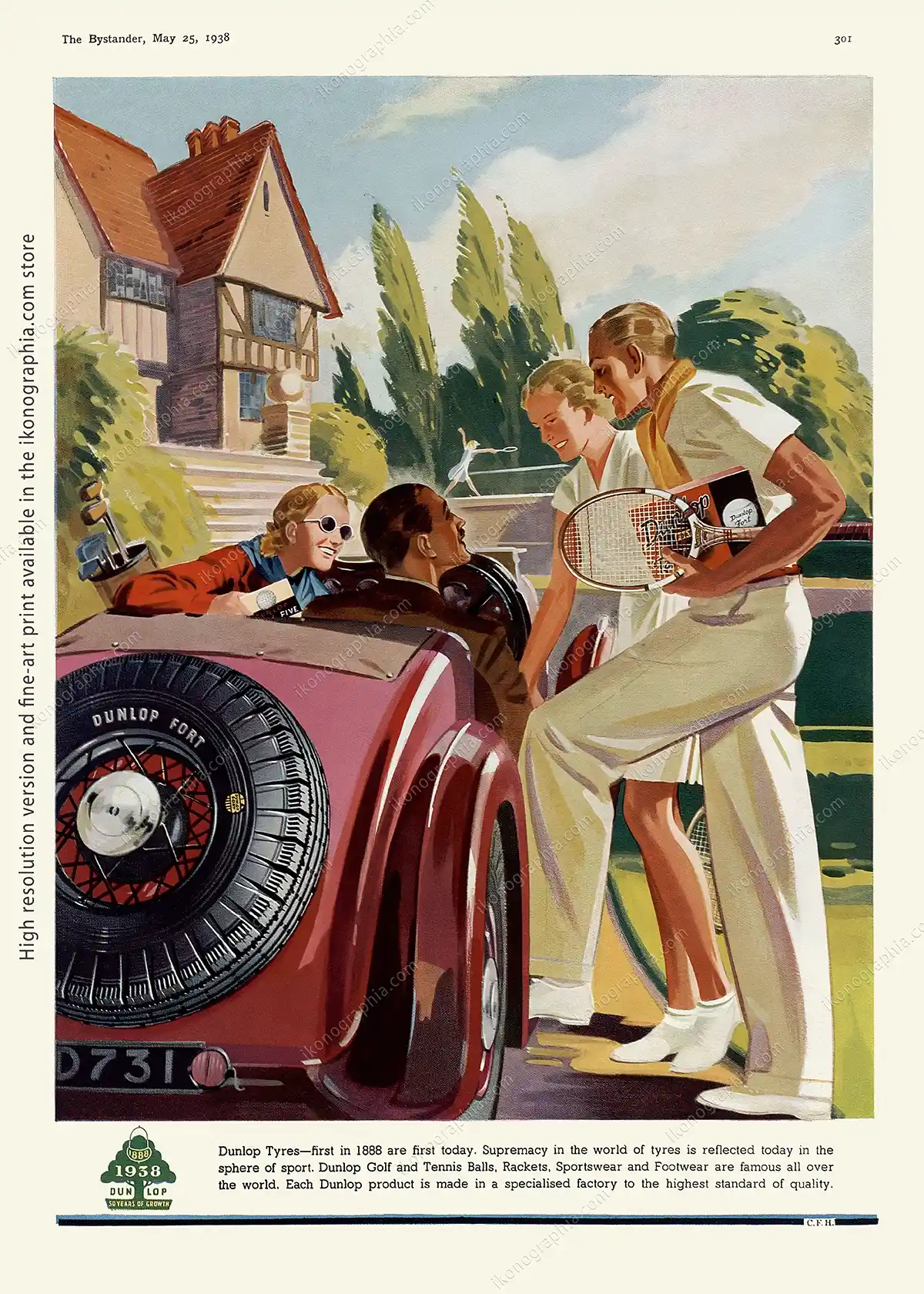
Tennis and golf players with Dunlop Fort tires and balls advertisement. The Bystander, March 25, 1938.

1938 Tennis and golf players’ advertisement, featuring the Dunlop range, including Dunlop tires, balls, rackets, and sportswear. 

The Bystander, March 25, 1938.


Dunlop Tyres-- first in 1888 are first today. Supremacy in the world of tyres is reflected today in the sphere of sport. Dunlop Golf and Tennis Balls, Rackets, Sportswear and Footwear are famous all over the world. Each Dunlop product is made in a specialised factory to the highest standard of quality.

A 1938 Dunlop ad featuring an Armstrong Whitworth Ensign of Imperial Airways aircraft and a classic car. The Bystander July 13, 1938. This image focuses on two of Dunlop's favorite topics: elegance and sophistication associated with luxury and the progress and innovation of the 1930s, highlighting technological advancements in air and land travel.

A 1938 Dunlop ad featuring an Armstrong Whitworth Ensign of Imperial Airways aircraft and a classic car.

The Bystander, July 13, 1938.

This image focuses on two of Dunlop's favorite topics: elegance and sophistication associated with luxury and the progress and innovation of the 1930s, highlighting technological advancements in air and land travel.


Had it not been for John Boyd Dunlop's invention of the pneumatic tyre in 1888, even man's conquest of the air might have been long delayed. It was the Dunlop tyre which made possible every form of smooth, swift progress on the ground or off it. More than that, landing Tyres have contributed materially to the progressive development of aviation. Trust yourself only to the first and still foremost of all tyres.

Trucks and transportation 1938 Dunlop advertisement. The Bystander, September 21, 1938.

Trucks and transportation 1938 Dunlop advertisement.

The Bystander, September 21, 1938.


The wheels of modern industry run more swiftly and more smoothly since Dunlop invented his pneumatic tyre in 1888. With the progress it initiated Dunlop keeps pace. Every tyre need for modern transport has been and will always be, met by Dunlop.

Trucks and transportation 1938 Dunlop advertisement. The Bystander, September 21, 1938.

Dunlop ad featuring a riding lady and Dunlop Fort tires.
Artwork by Jean Bowman.

The Bystander, November 9, 1938.


The dependability of DUNLOP Tyres and the safety they ensure are accepted universally. So now is the supreme excellence of DUNLOP Weather-wear and Sports-wear in which, again, the protective factor is inseparable from style, distinction, and inherent quality. In fact, the name is synonymous with safety and protection.

Copyright, Links and credits

All the photographs on this page are copyrighted to Roberto Bigano.

LINKS

The Architectural Forum. Reliefs And Grilles Of The Chanin Building Vestibules.
Architectural Design, May 1929, page 693 >

The Chanin Building Wikipedia >

Celebrating the Art Deco Centenary. 1925-2025

Celebrating the Art Deco Centenary. 1925-2025

Celebrating the Art Deco Centenary — 1925-2025

A hundred years since the 1925 Paris Exhibition gave the movement its name — Ikonographia's response.

In 1925, the Exposition Internationale des Arts Décoratifs et Industriels Modernes in Paris gave Art Deco its name and its international reach. A hundred years later, the movement's visual legacy remains active — in the metalwork of Manhattan's lobbies, in the graphic language of Erté and Cassandre, in the automotive design of Bugatti and the decorative glass of Serge Roche.

This page brings together Ikonographia's existing Art Deco archives and stories as a single centenary overview — photography, illustration, graphic design, and decorative arts, documented across a century.

NYC Art Deco, Elevator Doors' Nickel-Silver Relief, 20 Exchange Place

NYC Art Deco Elevator’s door silver-nickel (a rare alloy of copper and nickel) decorative ironwork. 1931
New York City, 20 Exchange Place, formerly the City Bank–Farmers Trust Building. 

What is Art Deco


Art Deco, short for "Arts Décoratifs," is a visual arts, architecture, and product design movement emerged in Paris during the 1910s and gained prominence in the U.S. and Europe from the 1920s to the early 1940s. Popularized by designers like Erté and Paul Poiret, it became the dominant style following the 1925 Exhibition in Paris.

At its peak in the late 1920s, Art Deco was more than just a style; it was a movement, a way of thinking that symbolized luxury, glamour, and exuberance. Above all, it represented hope and confidence in social and technological progress.

Characterized by exquisite craftsmanship, luxury, glamour, and innovative materials such as stainless steel and plastic, Art Deco represented hope and confidence in technological progress. Its influence can be seen in architecture, from skyscrapers to everyday objects, as well as in advertising and illustration, leaving a lasting impact on 20th-century culture.

Les choses de Paul Poiret 1911 Hat Design artwork by Georges Lepape

Hat Design by Paul Poiret; artwork by Georges Lepape, from the 1911 Catalog "Les choses de Paul Poiret."
The Art Deco movement emerged in Paris during the 1910s, popularized by designers like Erté and Paul Poiret.

The International Exhibition of Modern Decorative and Industrial Arts


The International Exhibition of Modern Decorative and Industrial Arts (Exposition Internationale des arts décoratifs et industriels modernes) was held in Paris in 1925. During its seven-month run, 15,000 exhibitors from twenty countries and sixteen million people visited the exhibition, which had an enormous impact worldwide.

The term "Art Deco" originated from this exposition. While the style debuted in Paris during the 1910s, it is conventionally considered officially established in 1925. Thus, 2025 marks the centenary of Art Deco, and Ikonographia is preparing to celebrate with twelve monthly stories honoring this iconic movement.
This first part is a preview of what we are going to publish.

Exposition International Des Arts Decoratifs 1925, poster by Robert Bonfils International Exhibition of Modern Decorative and Industrial Arts, held in Paris in 1925.

Exposition International Des Arts Decoratifs 1925, poster by Robert Bonfils.
International Exhibition of Modern Decorative and Industrial Arts, held in Paris in 1925.

New York City Art Deco Architecture


Although the United States did not officially participate in the Exhibition, many talented American architects and artists from New York City attended and returned inspired. They embraced the Art Deco style and reinvented it, making American Art Deco a distinctly original architectural movement.

Art Deco flourished in New York City during the 1920s and 1930s, influenced by global decorative arts trends, mechanization, and the 1916 Zoning Resolution, which promoted innovative designs with setbacks. This style broke traditional norms, featuring verticality, ornamentation, and new materials like plastics and metals.

The economic boom of the Roaring Twenties led to a citywide building surge, with Art Deco evident in everything from soaring skyscrapers to modest homes and municipal buildings. Lavishly decorated skyscrapers defined Manhattan’s skyline until the Great Depression curtailed their construction.

Frozen Fountain Decoration, inspired by Edgar Brandt's gates, exhibited at the 1925 Exposition in Paris. Madison Belmont Building, 183 Madison Avenue

Art Deco Frozen Fountain Decoration, inspired by Edgar Brandt’s gates, exhibited at the 1925 Exposition in Paris. Madison Belmont Building, 183 Madison Avenue, New York City. Photo by Roberto Bigano.

Art Deco got its name in 1966


The term 'Art Deco' wasn't officially used until 1966, initially referred to as "Le Style Moderne" or "Jazz Moderne." It gained prominence after the Museum of Decorative Arts in Paris’s 1966 exhibition, 'Les Années 25.' The name was solidified in 1968 during a scholarly reappraisal.

Although Art Deco originated in the 1910s in France, we celebrate its centenary in 2025 because the 1925 Exhibition marked a significant moment in art and design, leading to its growth, especially in the United States.

Les Annes '25' Art Deco. Bauhaus. Stijl. Esprit nouveau. Poster 1966

Les Annes ’25’ Art Deco. Bauhaus. Stijl. Esprit nouveau. Poster 1966.
This exhibition made the debut of the term “Art Deco.”

The Chanin Building Radiator Grilles by Rene Paul Chambellan


The New York City Chanin Building was built for Irwin S. Chanin in 1929. The Chanin Building in New York City was constructed for Irwin S. Chanin in 1929. It is a prime example of Art Deco architecture, housing a collection of exceptional masterpieces.
The lobby is designed around the concept of the "City of Opportunity," featuring a geometric motif that symbolizes human thought and emotion.

We'll focus on the notable Radiator Grilles in the vestibules of the building, crafted by Paul Bellentan on a concept by Jaques Delamarre. With a geometric, abstract design symbolizing human thought and emotion. These grilles are among the finest illustrations of the concept, design, and craftsmanship of Art Deco in New York City, highlighting the movement's significance.

Success. Gilded Bronze Radiator Grill in the vestibule of the Chanin Building. By Rene Paul Chambellan 1929.

Success. Art Deco Gilded Bronze Radiator Grill in the vestibule of the Chanin Building in Manhattan. By Rene Paul Chambellan 1929.

From "The City of Opportunity - Physical Series."

The Eglomized Glass and Mirrors by Serge Roche


Serge Roche, born in France in 1898, was an eclectic artist, though he would best be defined as an interior decorator. In addition to this, he was a remarkable antiquarian, sculptor, designer, and organizer of significant exhibitions. His studio, located at 125 Boulevard Haussmann, served as a global hub for decades, attracting the elite of the Parisian and international artistic community.

By 1934, he had developed a unique style that became the focus of his first exhibition, featuring mirrors and ‘mirror and glass objects.’ He employed a technique known as 'Eglomization,' which involves embedding foreign materials within glass paste. The upcoming article will showcase a selection of these stunning creations.

Eglomizedì octagonal mirror for Serge Roche by Max Ingrand 1933

“Eglomized” octagonal mirror framed by panels featuring mythical creatures by Maison Serge Roche. The craftsmanship was likely done by Max Ingrand in 1933. The eglomization technique consisted of embedding foreign elements in the mirror’s glass paste, producing an endless array of variations. Collection Laurent Marechal.

The Lavish Interiors of the Assyrian-themed Fred French Building in NYC.


The Fred French Building, styled with Assyrian themes, stands out as one of the city's most elaborate and extravagant examples of Art Deco architecture. At the time, there was a great interest in Ancient Egypt and the Ancient Near East.

The lobby walls are clad with marble and contain decorative details such as chevrons, palmettes, volutes, merlons, and lotus flowers, as well as representations of animals such as lions and winged bulls.
The elevator lobby features several decorative bronze features, the most notable of which are the eight panels of the gilt-bronze double-leaf elevator doors.
Lastly, an impressive Assyrian Revival mailbox features a bald eagle, the United States Post Office symbol, and two winged griffins.

The Fred French Building, New York City. The vestibule of the entrance from 45th Street, as seen from the elevator lobby. 1927

Whenever you see an Arrow, Think of Coca-Cola - Get What You Ask For. Red Book Magazine, July 1910.

The London Underground Art-Deco Posters


Poster art flourished in Britain during the 1920s and 1930s, thanks to progressive clients such as the Great Western Railway (GWR), the London North Eastern Railway (LNER), and Shell-Mex.
However, the most impressive and trending production came from the London Underground. They utilized London’s most prominent advertising spaces, which functioned like a public art gallery, reaching a vast audience and creating iconic images.
We will showcase a selection of these masterpieces.

Smelling The Riches Of London, poster 1927 by Frederick Charles Herrick for London's Underground

Smelling The Riches Of London.
A 1927 poster by Frederick Charles Herrick for London’s Underground.

The poster is part of a series of four inviting to enjoy London through the senses: smelling, tasting, seeing, and hearing.
The use of color was highly innovative, with distinct tones assigned to each subject.

Art Deco in U.S Advertisement


The Art Deco style was prominently featured in advertising across the United States. We will showcase a collection of the finest advertisements from magazines such as Fortune, Harper's Bazaar, The New Yorker, Vanity Fair, and others, highlighting brands like Cadillac, Rolls Royce, Timken, and more.

Art Deco Automotive by John Whitcombe. On and on they go, Timken Bearings, Fortune, December 1934

Art Deco Automotive Advertisement by John Whitcombe. On and on they go, Timken Bearings, Fortune, December 1934

Art Deco in Magazine Covers


The Art Deco style was exceptionally suited for magazine cover design. We will present a captivating selection of iconic covers from the 1920s, featuring renowned titles such as The New Yorker, The Chicagoan, Harper's Bazaar, and Vanity Fair, created by both well-known and lesser-known artists.

1929 Chicago by Night. Art Deco Cover by Nat Karson. The Chicagoan Magazine September 28, 1929.

1929 Chicago by Night. Art Deco Cover by Nat Karson, with its unmistakable style

The Chicagoan Magazine September 28, 1929.

Art Deco Iconic Cartoons by Anne Fish for Harper's Bazaar.


From 1914 to 1926, Anne Harriet Fish created hundreds of covers and cartoons for Vanity Fair.

In October 1927, an advertisement in the New Yorker titled "The Biggest Catch of The Season" solemnly announced that "The internationally known"Fish" has just been landed to join the Bazar Staff. This springhty English artist will present to the appreciative audience of Harper's Bazar a first interpretation of its vanities and vagaries—in the December issue."

With this new batch of cartoons, Anne Fish refreshed her style, incorporating some Art Deco elements while preserving her distinctive wit. We will be publishing a selection of double-page cartoons from 1928 and 1929.

New Year Resolution are made to be broken. But these are quite easy to Keep. Anne Fish for Harper's Bazaar, January 1928, pages 64-65.

New Year Resolutions are made to be broken. But these are quite easy to Keep.
Anne Fish for Harper’s Bazaar, January 1928.

Erté and Art Deco


Romain de Tirtoff, aka Erté, pioneered the Art Deco style.
After designing his first cover for Harper’s Bazaar in 1915, Erté secured a ten-year exclusive contract with the magazine. This decision proved to be highly perceptive.

Between 1915 and 1936, Erté created over 240 covers featuring his signature Art Deco-style illustrations, which combined bold areas of solid color with intricate, whimsical details.
While Erté is most recognized for his covers, his editorial content—often in double-page spreads with original designs—set fashion trends for decades.

Harper's Bazar Cover by Erté, December 1924, Christmas Number

A splendid design by Ertè for Harper’s Bazar, December 1924, Christmas Number.

Art Deco Ads Illustration for British Dunlop


During the 1930s, British Dunlop produced a striking series of ads, each featuring an image of Dunlop tires on Cars, Trucks, and Planes. What makes these ads stand out is their depiction of diverse social situations, which provides a rich insight into ​​the society of the time.

Despite their publication in prominent British magazines, the illustrators' names and other crucial details of these ads remain mysterious.

Distinction. Wealthy couple in evening dress. Dunlop Reinforced Tyre ad 1933

Distinction. Wealthy couple in evening dress. Dunlop Reinforced Tyre ad 1933.

From the Bystander Magazine, March 22, 1933

Copyright, Links and credits

NYC Art Deco and Serge Roche Photographs are copyrighted to Roberto Bigano.

LINKS:
The Art Story: Summary of Art Deco >

The Architectural Forum, May 1929
Reliefs And Grilles Of The Chanin Building Vestibules. Page 693 >
By Rayne Adams.

French Building & Fred French Bio >

The Coca-Cola History Through Ads. 1 – 1886-1919

The Coca-Cola History Through Ads. 1 – 1886-1919

The Coca-Cola History Through Ads — N.1 (1886-1919)

From Pemberton's back pain to the Coca-Cola Controversy.

The Coca-Cola history told through its own advertising — from the first glass sold in Atlanta in 1886 to the consolidation of a global brand by 1919. Trademark registration, logo design, the cocaine removal from the recipe, and the first systematic campaign against imitation products: each chapter documented through the visual record Coca-Cola left behind.

This first part covers 1886–1919. The series continues into the 1960s.

Trademark registration by The Coca Cola Company for Coca-Cola brand Nutrient or Tonic Beverages. January 31, 1983

It all started with Dr. Pemberton's severe back pain.

Dr. John Pemberton, an Atlanta pharmacist and Confederate Colonel wounded in the American Civil War, was addicted to morphine to fight severe back pain. Thanks also to his medical degree, he began to search for a substitute for the problematic drug.
After several attempts, Dr. Pemberton blended an extract of cocaine-rich coca leaves and caffeine-rich cola nuts. These ingredients formed the basis of the original Coca-Cola recipe.
Initially conceived as a patent medicine, the drink was also marketed as a temperance drink. This dual purpose reflected the prevailing health concerns and social attitudes of the time.

On May 8, 1886, he sold the first glass of the drink, later named Coca-Cola, in his pharmacy in Atlanta. During that year, an average of nine drinks a day were sold, marking the humble beginnings of a global phenomenon.

Trademark registration by The Coca Cola Company for Coca-Cola brand Nutrient or Tonic Beverages. January 31, 1983

Trademark registration by The Coca-Cola Company for the Coca-Cola brand Nutrient or Tonic Beverages.

Patent N. 22,406, Filed on January 31, 1893, in Atlanta, Ga.

This file, digitally reproduced from the original, is freely downloadable in high resolution at the Library of Congress.

August 1984 - Beverly Hills, California - From "Plastic Girls" series. Photo Roberto Bigano.

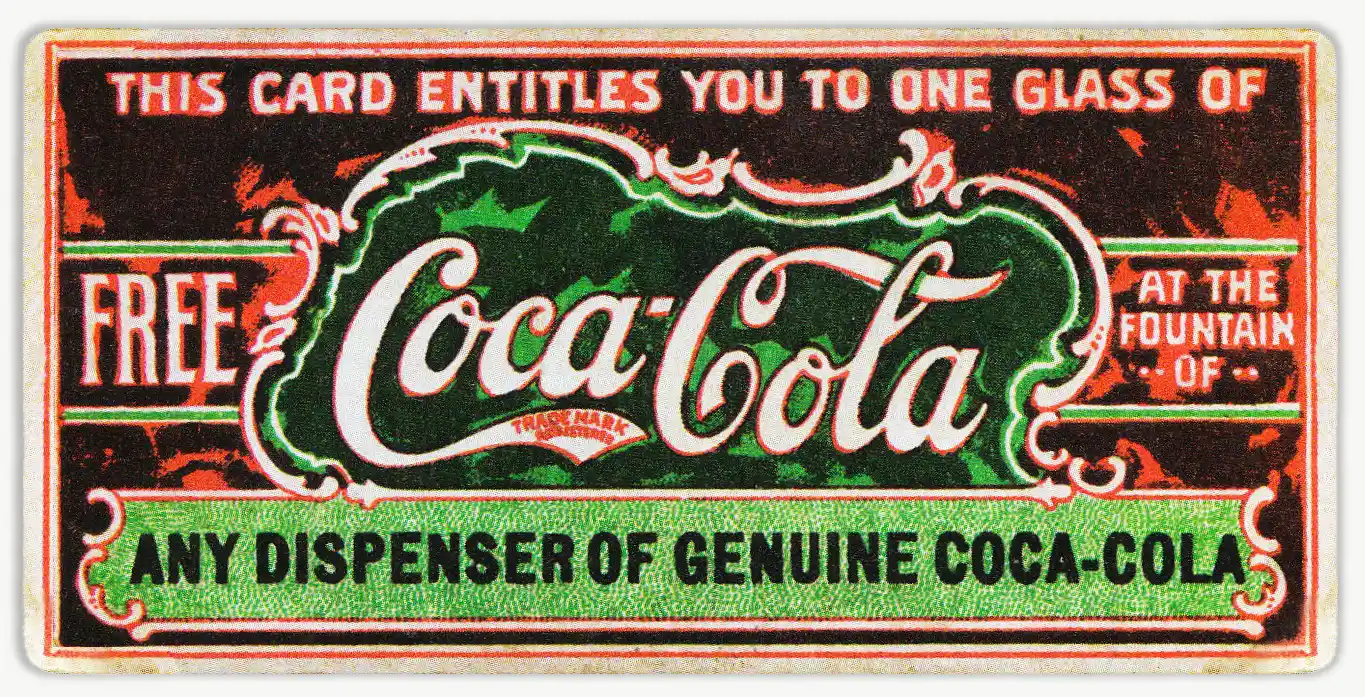
Ticket for a free glass of Coca-Cola — Atlanta 1888

This is believed to be the first coupon ever

Asa Griggs Candler

Dr. Pemberton, though a brilliant mind, faced challenges in the business. His partnership with Asa Griggs Chandler, a visionary businessman, was a turning point.
Mr. Candler, from 1886 to 1888, bought the Coca‑Cola formula and patents from John Pemberton and his partners. In a few decades, Candler's innovative marketing tactics led Coca-Cola to dominate the global soft drink market.
The first crucial move was the creation of a distinctive logo featuring the two Cs in a Spencerian script. This logo would become a cornerstone of Coca-Cola's branding strategy.
On May 14, 1892, The Coca-Cola Company registered, with patent N. 22,406, name, logo, and trademark as a "Nutrient or Tonic Beverage."
By the late 1890s, Coca-Cola had become a household name and America's most popular fountain drink. The scale of its success was staggering, with Coca-Cola sales skyrocketing from one million a year in 1890 to an astonishing one hundred million in 1900.

Coca-Cola Logo original desiign 1893 and current

The original Coca-Cola Trade-Mark, as registered on January 31, 1893, and the current one.

Considering the one-hundred-and-forty years spam, they are impressively similar.

1901. Removing Cocaine from the Recipe for Racial Reasons

The medical community viewed tonics like Coca-Cola—advertised to white, middle-class consumers for their aphrodisiac qualities—as harmless. The situation changed dramatically when black workers in the New Orleans area began using Cocaine to cope with the grueling demands of long, physically taxing workdays. The use of Cocaine spread to workers on plantations and in urban areas throughout the South, becoming a recreational drug in Black and mixed-race neighborhoods as well. Source

Medical journals warned of the so-called “Negro cocaine menace,” and newspapers claimed that the drug drove black men to commit crimes, particularly the rape of white women. Despite these concerns, the company continued to include Cocaine in its formula. However, this approach became increasingly problematic in 1899 when the company expanded its sales of bottled Coke to a national market, and Coca-Cola became accessible outside of white soda fountains to anyone with a nickel, including Black men. Source
1901 the company removed Cocaine from the recipe, replacing it with more sugar and caffeine.

Coca-Cola Delicious Refreshing At Soda Founts 5c Good Housekeeping Magazine, June 1905.

Coca-Cola Delicious Refreshing At Soda Founts, 5¢.
Good Housekeeping Magazine, June 1905.

Patent N. 22,406, Filed on January 31, 1893, in Atlanta, Ga.

This file, digitally reproduced from the original, is freely downloadable in high resolution at the Library of Congress.

Hilda Clark. The first Coca-Cola Model

The model Hilda Clark, a testimonial of the brand, was a popular music hall singer and actress. She became famous as a model in 1895 when she was the first woman featured on a tin Coca-Cola tray. She remained the advertising “face” of Coca-Cola until February 1903.

Drink Coca-Cola 5 cents Poster 1885. Model Hilda Clark, the advertising face of the brand. An 1890s advertisement showing model Hilda Clark in formal 19th-century attire. The ad is entitled Drink Coca-Cola 5¢.

Drink Coca-Cola 5 cents—an amazing poster from 1885

The model Hilda Clark, a testimonial of the brand, was a popular music hall singer and actress. The artist's signature is unreadable.

Text in the sheet: Home Office
The Coca-Cola Co. Atlanta, Ga.
Branches: Chicago, Philadelphia, Los Angeles, Dallas.

This is a file from the Library of Congress's digital archive that we digitally restored.

First Coca-Cola Advertisements

The first ads for Coca‑Cola appeared in national magazines in 1904, but the oldest we found was from 1905.
Given the brand's meteoric and impactful success, it's a stretch to say that the company's first advertisements, Hilda Clarks one's aside, were poor and lacked even a minimum corporate image.

Of course, we are discussing something published at the turn of the century. Still, in those years, several companies, such as Kellogg's Corn Flakes or Queen City Printing Inks, released organic ad campaigns with an excellent corporate, coordinated image.

Good Housekeeping 1905-05_604 Coca-Cola by Massegale-Atlanta

Coca-Cola Revives and Sustains Ad
Good Housekeeping Magazine, May 1905.
Design by Massengale, Atlanta

Take one glass of Coca Cola when weary with shopping. It imparts energy and vigor.

Coca-Cola Delicious Refreshing 5¢, Harper's Bazaar, May 1905, advertisement bt Massengale, Atlanta.

Coca-Cola Delicious Refreshing 5¢, Ad
Harper's Bazaar, May 1905.
Design by Massengale, Atlanta.

It is a beverage in which a toast to health and happiness becomes and accomplished fact, as well as a delightful pleasure. At all founts and in bottles

1905 Good Housekeeping 1906-05_677 Coca-Cola

Drink Coca-Cola. The Ideal Beverage for Discriminating People.
Good Housekeeping Magazine, May 1906..

It is a beverage in which a toast to health and happiness becomes and accomplished fact, as well as a delightful pleasure. At all founts and in bottles

Coca-Cola Ad From the Realm of Fancy to Reality, artwork by A.T.Farrel. Good Housekeeping Magazine, July 1907

Coca-Cola Ad From the Realm of Fancy to Reality.
Artwork by A.T.Farrel.
Good Housekeeping Magazine, July 1907.

Drink Coca-Cola.
The Satisfying Beverage.
Relieves the fatigue that comes from-over-play, over-work, and over-thinking.
Delicious! Refreshing! Thirst-Quenching!

Coca-Cola Ad "An Act Not On The Bill. Coca-Cola The "Star" Performance" Good Housekeeping Magazine, September 1907

Coca-Cola Ad From the Realm of Fancy to Reality.
Artwork by A.T.Farrel.
Good Housekeeping Magazine, July 1907.

Coca-Cola makes it possible for you to make your appearance with light step, sparkling eye, steady hand and nerves, and, above all, with a clear head capable of lucid thinking and logical reasoning.

This advertisement can be seen as a company's policy statement listing all the drink's magic features, with the dual purpose of being a healthy mind brightener and refresher. It is a company's Manifesto.

An ingenious idea underappreciated for twenty-four years

In July 1910, a brilliant designer created the Coca-Cola Red Circle with the color code primary red. In the ads, the logo was red on white or white on red inside the circle. The company executives did not understand the value of this intuition, and the Red Circle was used only a couple of times in the following decades. Only in 1935 was it revived and became one of the cornerstones of the Coca-Cola Branding Strategy. From then on, the Red Circle was used in practically every ad.

Whenever you see an Arrow Think of Coca-Cola Advertisement on Red Book Magazine, July 1910

Whenever you see an Arrow, Think of Coca-Cola — Get What You Ask For. Red Book Magazine, July 1910

This is probably the first advertisement showcasing the Red Circle, which would later become a cornerstone of Coca-Cola Branding.

Coca-Cola Branding Journey and Imitations Fighting

As Coca-Cola's popularity grew, so did attempts to imitate it. Starting in 1908, the first response to this imitation was the introduction of "Follow the Arrow," which featured arrow-shaped signs to promote Soda Fountains selling the original. The Arrow was also widely used in advertisements during this time.

From 1910, the company, to protect the brand from imitations, began publishing an impressive number of text ads, often double-page spreads, warning against imitations. Sometimes, these ads directly address the reader. In some cases, they were even threatening, particularly towards druggists who sold other drinks that imitated Coca-Cola's names and features.
While these ads may make us smile, they are a blast from the past and a reminder of a bygone era.

Hot Sun- Much Thirst - A Notice to Druggists Coca Cola Ad, Reed Book Magazine, August 1910

Hot Sun- Much Thirst  A Notice to Druggists

Red Book Magazine, July 1910

Here's to Your Good Health and Pleasure - The Why of Imitations Coca Cola Ad, Reed Book Magazine, August 1911

Here's to Your Good Health and Pleasure —The Why of Imitations

Red Book Magazine, August 1911

The Answer. Coca-Cola Advertisement. Red Book Magazine, August 1912

Here's to Your Good Health and Pleasure — The Why of Imitations

Red Book Magazine, August 1911

Harvey Washington Wiley and the "Coca-Cola Controversy"

Harvey Washington Wiley was an American physician and chemist known for his successful advocacy for the passage of the landmark Pure Food and Drug Act of 1906. Following this achievement, he worked at the Good Housekeeping Institute laboratories.
He was the first commissioner of the United States Food and Drug Administration. Wiley's advocacy for stricter food and drug regulations indirectly contributed to Coca-Cola's decision to remove cocaine from its formula in the early 20th century.

After his government tenure ended in 1912, Harvey Washington Wiley took charge of the laboratories at Good Housekeeping Magazine as the Director of the Bureau of Foods, Sanitation, and Health.
In September 1912, the magazine published a daring ten-page essay titled "The Coca-Cola Controversy." This piece, which featured both text and cartoons, openly criticized the popular beverage, warning about the dangers associated with "artificial" caffeine. This move is astonishing by today’s standards, especially considering that Coca-Cola was a vital advertiser.

Good Housekeeping 1912-09_386-387 The Coca-Cola Controversy

The Coca-Cola Controversy.
Good Housekeeping Magazine, September 1912.

A daring ten-page essay titled "The Coca-Cola Controversy": The Facts and Dr. Wiley's Opinion, Together with a Talk on the Drugging of Soft Drinks.
This piece, which featured both text and cartoons, openly criticized the popular beverage, warning about the dangers associated with "artificial" caffeine.

This move is astonishing by today’s standards, especially considering that Coca-Cola was a vital advertiser.

Good Housekeeping 1912-09_388-389The Coca-Cola Controversy

The Coca-Cola Controversy.
Good Housekeeping Magazine, September 1912.

This essay is astonishing by today’s standards, especially considering that Coca-Cola was a vital advertiser.

The Pivotal Coca-Cola Trial — United States v. Coca-Cola, 1912

In a famous action brought against The Coca-Cola Company in 1911, Mr. Wiley contended that it was illegal to use the name Coca-Cola when there was no actual cocaine in the drink and also that it was unlawful for it to contain caffeine as an additive.

With the threat of having to remove caffeine, Coca-Cola was teetering on the edge of a defeat that could have been catastrophic. The Company faced a challenge in finding a renowned psychologist to validate the non-dangerousness of caffeine. In a stroke of luck, Coca-Cola enlisted the services of a brilliant doctoral student, Harry Hollingworth, who needed research funds.
With the trial looming, the need for results was pressing. In a race against time, Hollingworth devised a series of three studies that were completed in just 40 days. These studies, known for their methodological sophistication, were crucial to the case.

We won't tell you the whole story here, but Coca-Cola ultimately won in this existential trial.
Hollingworth was nicknamed "the man who saved Coca-Cola.

Cartoon against lobbying Coca-Cola in the caffeine trial

The Coca-Cola Controversy.
Good Housekeeping Magazine, September 1912.
Cartoon detail.

A number of the experts who testified as to the harmlessness of caffeine had formerly expressed different opinions.

Augustus Jansson’s Ink Beasts Parade for Queen City Ink 1905

Augustus Jansson’s Ink Beasts Parade for Queen City Ink 1905

Augustus Jansson's Ink Beasts Parade for Queen City Ink 1905

A corporate communication strategy built around the product itself — a decade before anyone else thought of it.

In 1905, Augustus Jansson designed a campaign for Queen City Printing Ink that had no precedent. A sustained corporate narrative — consistent characters, recognisable visual identity, each ad building on the last — printed in the high-density colors Queen City produced. The ink demonstrated itself. Systematic brand communication of this kind would not become standard practice for another decade.

Magenta Ponies entered in Ink beast Parade. By The Queen City Printing Ink company. Ad Art by Augustus Jansson. June 1905.

Magenta Ponies entered in Ink Beast Parade.

Augustus Jansson and Queen City Printing Ink


Augustus Jansson, a Swedish-American illustrator and designer, established a reputation through his original and superior work when he began a seven-year working period for Queen City Printing Ink.

He produced striking ads, often considered ahead of their time, including the renowned Ink Beasts Parade featuring its Magenta Ponies, the Heliotrope Purple Cow, the Orange-Yellow Ibexiatucus, and more. Also relevant is a series of doll-like figures.

The ads were printed on special paper using high-density colors, with a gamut far exceeding that of CMYK print. For this reason, we made a dedicated post-production to fit the original colors as much as possible.
All images are available as hi-res files or fine-art prints.

The Yellow Elephant for The Ink Beast Parade. The Queen City Printing Ink Ad, April 1905. Art by Augustus Jansson

The Yellow Elephant for The Ink Beast Parade.
The Queen City Printing Ink Ad.
The Inland Printer Magazine, April 1905.
Artwork art ad design by Augustus Jansson.

Only Heliotrope Cow in the world for The Ink Beast Parade. The Queen City Printing Ink Ad, May 1905. Art by Augustus Jansson

Only Heliotrope Cow for The Ink Beast Parade.
The Queen City Printing Ink Ad.
The Inland Printer Magazine, May 1905.
Artwork art ad design by Augustus Jansson.

Magenta Ponies for The Ink Beast Parade. The Queen City Printing Ink Ad, June 1905. Art by Augustus Jansson

Magenta Ponies entering The Ink Beast Parade. 
The Queen City Printing Ink Ad.
The Inland Printer Magazine, June 1905.
Artwork art ad design by Augustus Jansson.

Some Striking Designs


The striking designs used by the Queen City Printing Ink Company in the printing trade journals for some months past have been the subject of criticism — good, bad and indifferent by advertising experts.
The grotesque character of the designs gave opportunity for broad color effects, and the brilliancy and striking character of the inks used were thus forced on the attention of the public.

The arguments used in favor of " something more interesting in itself," such as a landscape or a pretty picture as a medium to exploit the inks of the company, did not convince the advertising man in charge, and no matter what opinion one may hold, no one can deny that these angular, staring and stolid figures have made good results, and that their gorgeous raiment has made them as closely identified with the Queen City Printing Ink Company as the Brownies were identified with Palmer Cox.
Excerpt from " The Inland Printer", August 1904.

The Blue Camel for The Ink Beast Parade. The Queen City Printing Ink Ad, July 1905. Art by Augustus Jansson

The Blue Camel for The Ink Beast Parade. 
The Queen City Printing Ink Ad.
The Inland Printer Magazine, July 1905.
Artwork and Ad design by Augustus Jansson.

The Orange Buffalo for The Ink Beast Parade. The Queen City Printing Ink Ad, August 1905. Art by Augustus Jansson

Orange Buffalo for The Ink Beast Parade. 
The Queen City Printing Ink Ad.
The Inland Printer Magazine, August 1905.
Artwork and Ad design by Augustus Jansson.

The Green Giraffe for The Ink Beast Parade. The Queen City Printing Ink Ad, September 1905. Art by Augustus Jansson

Green Giraffe for The Ink Beast Parade. 
The Queen City Printing Ink Ad.
The Inland Printer Magazine, September 1905.
Artwork and Ad design by Augustus Jansson.

Not just a display of creativity but a catalyst for it.


As said, the Ink Beast Parade Ad Campaign was decades ahead of his time.
The ad series was carefully scheduled, introducing the company's most innovative products. The artworks were printed on special paper using the company's exclusive, one-of-a-kind tints; these colors were impossible to reproduce using the standard CMYK palette, adding an element of intrigue to the campaign.

At the bottom of the page, the color codes were listed for ordering purposes and to inspire customers with the creative potential of these unique colors. In short, the campaign was not just a display of creativity but a catalyst for it.
All this may look normal today, but we are speaking of a campaign created 120 years ago!

Yellow and Sapphire Bear for The Ink Beast Parade. The Queen City Printing Ink Ad, August 1905. Art by Augustus Jansson

The Yellow and Sapphire Bear for The Ink Beast Parade. 
The Queen City Printing Ink Ad.
The Inland Printer Magazine, October 1905.
Artwork and Ad design by Augustus Jansson.

The Bronze Red Lion for The Ink Beast Parade. The Queen City Printing Ink Ad, November 1905. Art by Augustus Jansson

Bronze Red Lion for The Ink Beast Parade. 
The Queen City Printing Ink Ad.
The Inland Printer Magazine, November 1905.
Artwork and Ad design by Augustus Jansson.

The Orange Tiger Bear for The Ink Beast Parade. The Queen City Printing Ink Ad, December 1905. Art by Augustus Jansson

Orange Tiger f for The Ink Beast Parade. 
The Queen City Printing Ink Ad.
The Inland Printer Magazine, December 1905.
Artwork and Ad design by Augustus Jansson.

The Bronze Blue Unicorn in Ink beast Parade. By The Queen City Printing Ink company. Ad Art by Augustus Jansson. January 1906.

Bronze Blue Unicorn for The Ink Beast Parade. 
The Queen City Printing Ink Ad.
The Inland Printer Magazine, January 1906.
Artwork and Ad design by Augustus Jansson.

The Yellow Ibex for The Ink Beast Parade. The Queen City Printing Ink Ad, February 1906. Art by Augustus Jansson

Yellow Ibex for The Ink Beast Parade. 
The Queen City Printing Ink Ad.
The Inland Printer Magazine, February 1906.
Artwork and Ad design by Augustus Jansson.

The Red Boar for The Ink Beast Parade. The Queen City Printing Ink Ad, September 1906. Art by Augustus Jansson

Read Boar for The Ink Beast Parade. 
The Queen City Printing Ink Ad.
The Inland Printer Magazine, February 1906.
Artwork and Ad design by Augustus Jansson.

Copyright and credits

Arworks and ads design by Augustus Janson.
The adverts are from 1905 and 1906 and the artist passed away in 1931. Consequently the copyright of all images has expired.

Bugatti Masterpieces of 1920s and 1930s. By Roberto Bigano

Bugatti Masterpieces of 1920s and 1930s. By Roberto Bigano

Bugatti Masterpieces of 1920s and 1930s. By Roberto Bigano

Two sessions, two decades apart — the museum and the meeting.

Vintage Bugatti masterpieces photographed by Roberto Bigano across two sessions. The iconic Atalante and Atlantic from the Divina Bugatti sessions at the Musée National de l'Automobile in Mulhouse — the FMR commission. The legendary Type 13, Type 35, and Type 40A from the Bugatti Glamour Sessions — four nights of open-air studio photography during the Centenary celebrations in Tuscany, with the owners present — two bodies of work. Available nowhere else.

Bugatti Type 37A, "Flighty" (1928) - Owners, Frederica and Simon Fitzpatrick, Guernsey © Roberto Bigano/ ikonographoa.com Browse the Bugatti Archive https://www.ikonographia.com/archive/the-bugatti-archive/

Bugatti Type 37A, "Flighty" (1928) - Owners Frederica and Simon Fitzpatrick, Guernsey.

Bugatti Masterpieces. A gallery of the most iconic models.


Ikonographia is proud to showcase a gallery of the most iconic vintage Bugatti models, highlighted by the splendid images of Roberto Bigano. The models range from the legendary Type 13 and Type 35 racing models to the stylish Type 57 Atalante and Atlantic designed by Jean Bugatti.
All the images are available in high-resolution or fine-art prints.
This is a work-in-progess page. We are going to add more contents. Please stay in touch.

A 1937 Bugatti Type 57SC Coupé Atlantic lightened in silhouette mode to emphasize the flowing coupé lines

A 1937 Bugatti Type 57SC Coupé Atlantic. Detail of the windshield and wipers emphasizing the riveted crest.
Jean Bugatti designed the half-body ending in a crest. He then reverted the first part right-left and finally joined the two pieces with rivets in one of the most daring automotive designs. Courtesy: British Garage, Paris.

About Ettore and Jean Bugatti.


Automobiles Ettore Bugatti was a French car manufacturer of high-performance cars, founded in 1909 in Molsheim, Alsace, France, by the Italian industrial designer Ettore Bugatti. The firm produced about 8,000 cars and is known for its design beauty and many race victories.

Ettore Bugatti himself designed his creations (together with his highly talented son Jean, who later took to the drawing board alone). This extraordinary man had attended the Brera School of Art as a youth, yielding an artistic streak inherited from his father, Carlo (a fine cabinet-maker). The founding genius of the Bugatti firm also demonstrated an astonishing ability for mechanical engineering and an amazingly eclectic mind in general.

This flair had also gone to his brother Rembrandt, the talented sculptor whose works include the little elephant triumphing on the Royale’s bonnet. 

The legendary Ettore Bugatti's signature on the engine head of a 1921 Type 13 Brescia. Photo by Roberto Bigano. Buy this image in the ikonographia.com store.

The legendary Ettore Bugatti's signature on the engine head of a 1921 Type 13 Brescia.

A gallery of Masterpieces. Let's start with the Type 13 Brescia.


The Bugatti Type 13, Brescia, was the first actual Bugatti produced from 1910 to 1926. Thanks to the race victories, Bugatti became known as pur-sang (thoroughbred), keeping with Ettore Bugatti's feelings for his designs.
The Bugatti Type 13, Brescia, was fast and technically superior, making it virtually unbeatable. This was evident in the 1921 Brescia Grand Prix, where Bugatti's cars finished in the top four places, sparking a surge in orders. With the introduction of the "Brescia," Ettore Bugatti fundamentally changed the racing scene, as his cars won almost every competition they entered in the 1920s, cementing their place in racing history.

The initial Brescia featured a basic, functional design so rudimentary and simplistic that it earned the nickname "Bagnoire" (bathtub), a term reflecting its unique shape and design.
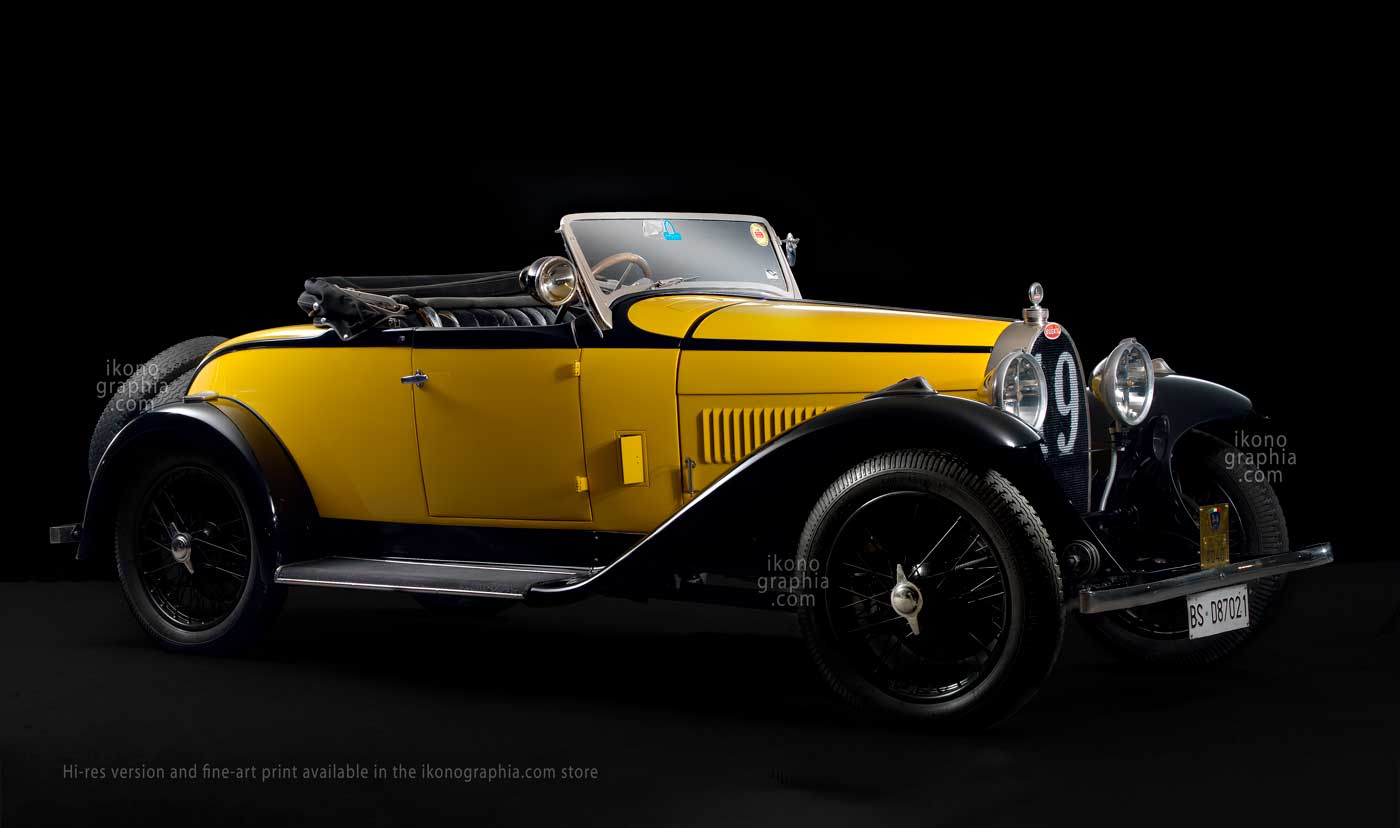
The Brescia design was later refined, as evidenced by the exquisite yellow sample below.

Bugatti Type 13 Brescia, 1921. Photo by Roberto Bigano. Buy this image at https://www.ikonographia.com/archive/the-bugatti-archive/

Bugatti Type 13 Brescia Cabriolet, 1923.

The Bugatti Type 35.


The Bugatti Type 35 is an iconic race car design produced between 1924 and 1930. It was phenomenally successful, winning over 1,000 races in its time. In 1926, it took the Grand Prix World Championship after winning 351 races and setting 47 records in the two prior years.

At its height, the Type 35 averaged 14 weekly race wins, including the prestigious Targa Florio for five consecutive years, from 1925 through 1929.

Bugatti Type 35B Grand Prix Biplace Course - Two Seater Racing

Bugatti Type 35B Grand Prix Biplace Course Two-Seater Racing 1927.
The Type 35 is an iconic race car design produced between 1924 and 1930. It was phenomenally successful, winning over 1,000 races in its time. At its height, the Type 35 averaged 14 weekly race wins, including the prestigious Targa Florio for five consecutive years, from 1925 through 1929.

Dashboard of a Bugatti Type 35B Grand-Prix (1927) - Courtesy: Musée National de l’Automobile Mulhouse

The dashboard of a Bugatti Type 35B Grand-Prix (1927) – Courtesy: Musée National de l’Automobile Mulhouse.

Bugatti Type 35A, 1926. Owned by Gigi Baulino & Enrica Varese. © Roberto Bigano/ ikonographoa.com Browse the Bugatti Archive https://www.ikonographia.com/archive/the-bugatti-archive/

Bugatti Type 35A, 1926. Owners Gigi Baulino & Enrica Varese, Italy. Picture taken at Bugatti International Meeting 2009. Hasselblad 39 Multishot Camera High-resolution file.
The owner forbade the photographer from washing the car so as not to erase the dirt from the race, which made it fascinating.
Watch the video of this event >

The Bugatti Type 41 Royale.


The Bugatti Type 41 Royale was gorgeous in its seven-meter length. It was enormous, had the most oversized wheels, and was the longest and tallest limo. Her design and form would smoothly conceal the captivating exuberance of an eight-cylinder motor for an impressive 12,773 cubic meters capacity that defines once and for all the original idea of a car.

Only seven Royales were produced. We showcase the "Coupè Napoleon," Ettore Bugatti's car, and the Bugatti Type 41 Esders Roadster, probably the most elegant.

Bugatti Type 41 Royale Coupé Napoleon (1929) The personal car of Ettore Bugatti. Courtesy: Musée National de l'Automobile, Mulhouse. Photo by Roberto Bigano. Courtesy: Courtesy: Musée National de l’Automobile Mulhouse. Buy this image at Ikonographia.com store

Bugatti Type 41 Royale Coupé Napoleon (1929), the personal car of Ettore Bugatti. On top of the radiator grill is the symbol of the Royales, the Elephant carved by Rembrandt Bugatti. Courtesy: Museé National de l'Automobile, Mulhouse.

The Bugatti Royale's Prancing Elephant, according to Antonio Tabucchi.


There has never been such an expensive car. Only seven Bugatti Royale were built, each one different. Upon the radiator grill, the Royale and the Petit Royale had a prancing elephant carved by Rembrandt Bugatti, Ettore's brother, as a symbol.  You can find it described in Rebus, a short tale by Antonio Tabucchi. Here is an excerpt.

The Bugatti Royale, according to Antonio Tabucchi.

It really was a Bugatti Royale, a Coupé de Ville; I don't know if that means anything to you, Monsieur […] Albert couldn't believe his eyes. It's not possible; it's not possible, he repeated to himself while stroking the long-tempered bumpers.

I don't know if you understand, but a Bugatti gives one the idea of a woman's body lying down on her back with her legs forward […] The elephant was missing from the bonnet. That was the only awful surprise. Maybe you may not know, or perhaps you just haven't noticed, that Bugatti had a figurine of a silver statue of an elephant on the bonnet, right on top of the radiator grill. It was a sculpture by Ettore's brother, Rembrandt Bugatti. It wasn't only a trademark, like the Rolls Royce Winged Victory of Samothrace or the Packard's Swan, but a tangible symbol to be deciphered like every other symbol. It was an elephant standing on his back legs, with the erect trunk symbolizing aggression and coupling.

Does it seem too easy to explain? Perhaps. But think about it: a Bugatti Royale lying on its back, going slowly uphill, wings spread open, ready to speed up, ready for the thrill, with that fabulous radiator grill protecting its pulsating life and energy, and on the top an elephant with an erect trunk.
Excerpt from the short story "Rebus" in "Little Misunderstandings of No Importance" "(Piccoli equivoci senza importanza), by Antonio Tabucchi.

Leggi il testo originale italiano.

"Rebus." Da "Piccoli equivoci senza importanza."


“Era proprio una Bugatti Royale, un coupé de ville, non so se a lei dice qualcosa, Monsieur (...) Albert non credeva ai suoi occhi, non è possibile, ripeteva, non è possibile, e accarezzava i parafanghi affusolati e lunghi, non so se lei riesce a capire, ma nella Bugatti c'è l'idea del corpo femminile, una donna, appoggiata sulla schiena con le gambe in avanti (...)

Mancava l'elefante sul cofano, fu l'unica brutta sorpresa (...) Forse lei non lo sa, o non ci ha mai fatto caso, ma la Bugatti aveva sul cofano, proprio all'apice della volta della griglia, la statuetta d'argento di un elefante. Era una scultura del fratello di Ettore, Rembrandt Bugatti, e non era solo un marchio della casa, come la vittoria alata della Rolls o il cigno della Packard, quello era un vero simbolo, misterioso da decifrare come tutti i simboli, era un elefante in piedi sulle zampe posteriori e la proboscide eretta in un barrito di aggressione o di accoppiamento.

The Elephant carved by Rembrandt Bugatti, right on top of the radiator grill of the Type 41 Royale Coupé Napoleon, the personal car of Ettore Bugatti. It was an elephant standing on his back legs, with the erect trunk as a symbol of aggression and coupling (1929) - Courtesy: Musée National de l'Automobile, Mulhouse

The Elephant by Rembrandt Bugatti, right on top of the radiator grill of the Type 41 Royale Coupé Napoleon, the personal car of Ettore Bugatti (1929). It was the symbol of the Royales. 

Bugatti Type 55 Sport Roadster and Coupé


The Type 55 was introduced at the 1931 Paris Motor Show. It was produced until 1935 in 38 samples, Roadster and Coupé, most of which had factory bodywork elegantly designed by Jean Bugatti.
Like many high-end automakers, Bugatti used its success in competition to promote its road cars. This already happened with the Type 13 Brescia and the Type 35.
The Type 55 was a direct descendant of the Type 51 race car and was similarly powered by a supercharged 2.3-litre dual-overhead-cam inline-eight.

We showcase here two pictures of the Roadster and Coupé, with the classic factory bodywork by Jean Bugatti.

Bugatti Type 55 Sport Roadster 1932. Road version of the Type 51 Grand Prix, produced in 38 smaples from 1932 to 1935.

Bugatti Type 55 Roadster, as designed by Jean Bugatti.  Courtesy: Museé National de l'Automobile, Mulhouse.

Bugatti Type 55 Sport Coupe 1932. Road version of the Type 51 Grand Prix, produced in 38 smaples from 1932 to 1935.

Bugatti Type 55 Coupé, as designed by Jean Bugatti.  Courtesy: Museé National de l'Automobile, Mulhouse.

Bugatti Type 59-50B Grand Prix Monoplace Course - Single Seater 1938 - Courtesy: Musée National de l’Automobile Mulhouse

Bugatti Type 59-50B Grand Prix Monoplace Course - Single Seater 1938