Social Events in 1920s High Society. By Fish

Social Events in 1920s High Society. By Fish

Social Events in 1920s High Society. By Fish

Fish on theatre, opera, country houses, and the social calendar.

The double-page plates of High Society are organized here into six thematic chapters. This second chapter covers the social calendar — theatre, opera, sporting events, country house weekends — the rituals through which high society performed itself in public.
First published in Vanity Fair between 1914 and 1920. Texts by Dorothy Parker and George S. Chappell.

All pages reproduced from the original book.

Can you guess whos' in th stage?

Can You Guess Who's on the Stage. Detail from Who's Who in the Audience.

A Pictorial Guide to Life in Upper Circles. Part Two.


This is the second story about Anne Fish’s work, which documents and satirizes high society at the turn of the 1910s to 1920s.
The double-page plates were first published in Vanity Fair between 1914 and 1920 and then re-published in the splendid book “High Society. Hints on how to Attain, Relish – and Survive It. A Pictorial Guide to Life in our Upper Circles.”, published in December 1920.
Any double-page plate focuses on a specific topic, providing a unique, rich lens into American and international high society’s lifestyles of the 1910s and 1920s. Rigorously in ink & pen, these inimitable sketches are completed with entertaining captions.
We grouped the plates into six sections, each on a central topic. This second one is on “Social Events in 1920s High Society”.
Index to High Society 1920s Stories.

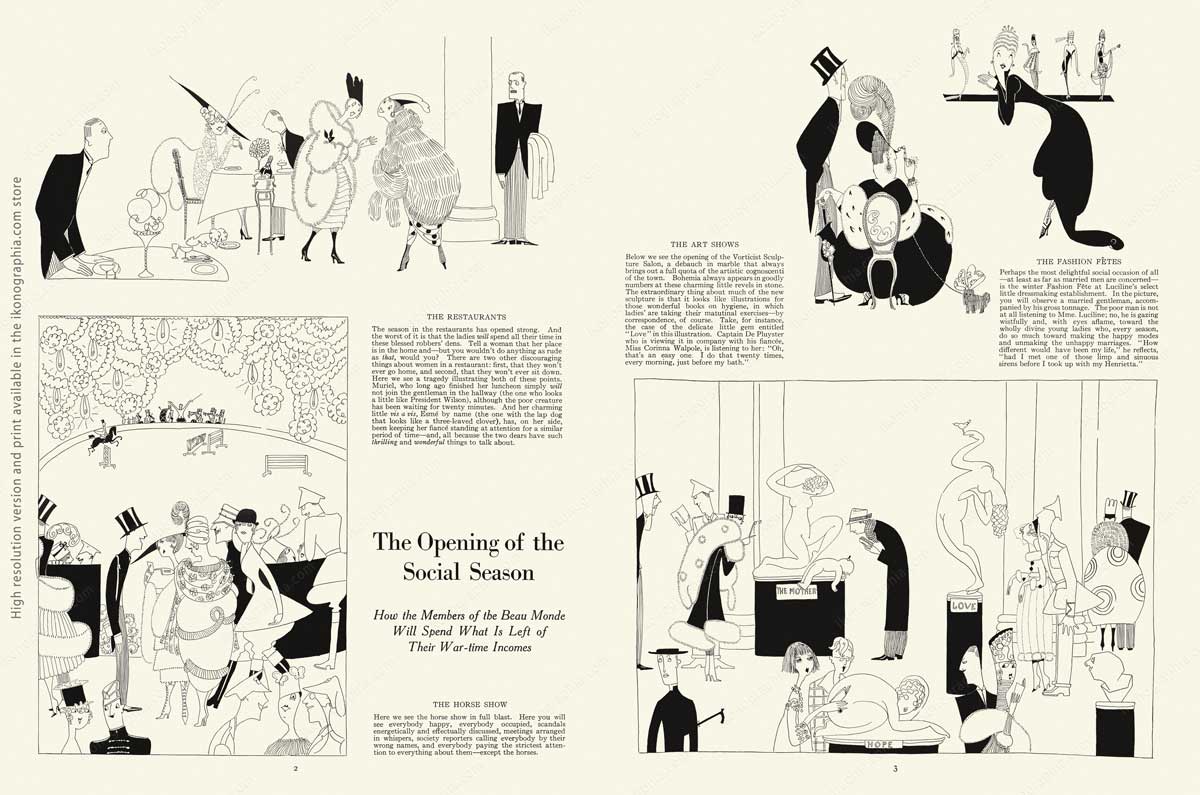
The Opening of the Social Season, from “High Society”, pages 02-03. By Anne Fish 1920 How the Members of the Beau Monde Will Spend What Is Left of Their War-time Incomes.

The Opening of the Social Season.
How the Members of the Beau Monde Will Spend What Is Left of Their War-time Incomes.
Initially published in Vanity Fair, November 1917.

EXCERPT FROM THE CAPTIONS

THE ART SHOWS.

Below we see the opening of the Vorticist Sculpture Salon, a debauch in marble that always brings out a full quota of the artistic cognoscenti of the town. Bohemia always appears in goodly numbers at these charming little revels in stone.

The extraordinary thing about much of the new sculpture is that it looks like illustrations for those wonderful books on hygiene, in which ladies' are taking their matutinal exercises—by correspondence, of course. Take, for instance, the case of the delicate little gem entitled "Love" in this illustration. Captain De Pluyster who is viewing it in company with his fiancée, Miss Corinna Walpole, is listening to her: "Oh, that's an easy one. I do that twenty times, every morning, just before my bath."

TOPIC LIST:

THE RESTAURANTS
THE HORSE SHOW
THE ART SHOWS
THE FASHION FÊTES

The full text is available in the metadata of the hi-res file in the shop.
EXCERPT FROM THE CAPTIONS

THE ART SHOWS.

Below we see the opening of the Vorticist Sculpture Salon, a debauch in marble that always brings out a full quota of the artistic cognoscenti of the town. Bohemia always appears in goodly numbers at these charming little revels in stone.

The extraordinary thing about much of the new sculpture is that it looks like illustrations for those wonderful books on hygiene, in which ladies' are taking their matutinal exercises—by correspondence, of course. Take, for instance, the case of the delicate little gem entitled "Love" in this illustration. Captain De Pluyster who is viewing it in company with his fiancée, Miss Corinna Walpole, is listening to her: "Oh, that's an easy one. I do that twenty times, every morning, just before my bath."

TOPIC LIST:

THE RESTAURANTS
THE HORSE SHOW
THE ART SHOWS
THE FASHION FÊTES

The full text is available in the metadata of the hi-res file in the shop.

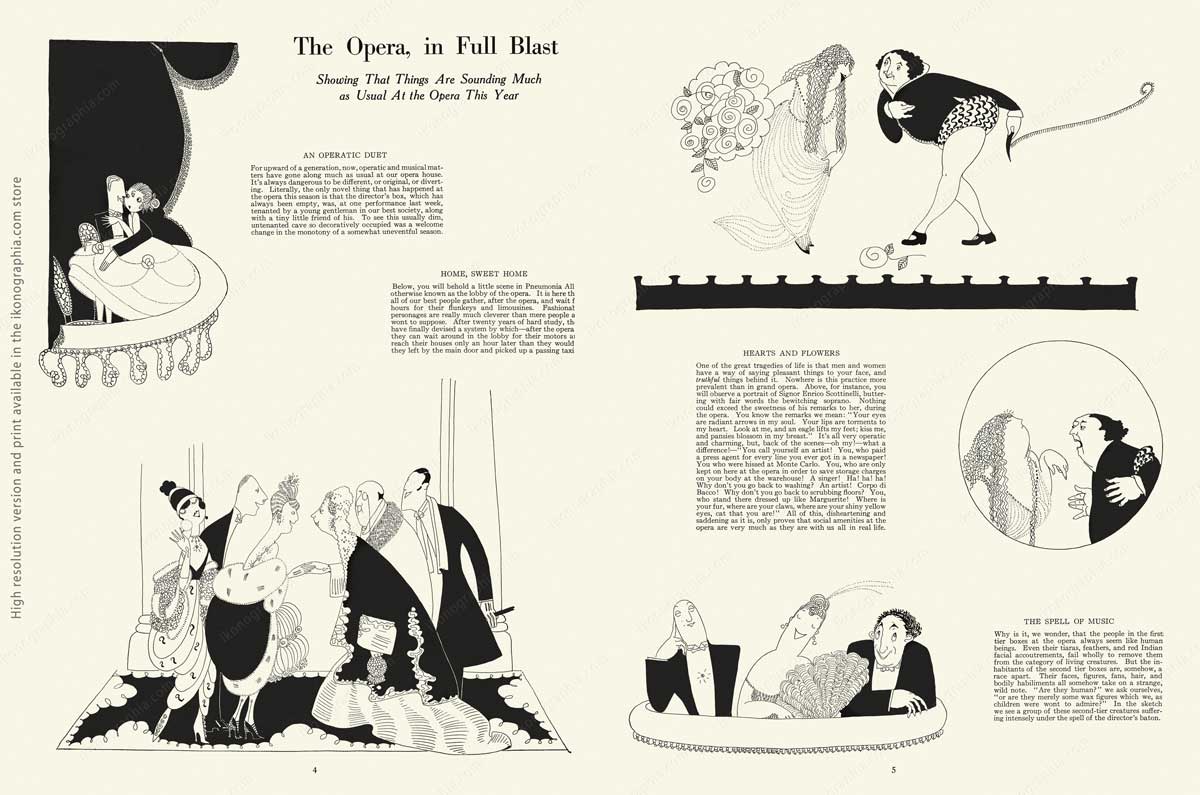
The Opera in Full Blast, from “High Society”, pages 04-05. Art by Anne Fish 1920

The Opera in Full Blast.
Showing That Things Are Sounding Much as Usual At the Opera This Year.
Initially published in Vanity Fair, January 1918.

EXCERPT FROM THE CAPTIONS

HOME, SWEET HOME.

Below, you will behold a little scene in Pneumonia Alley otherwise known as the lobby of the opera. It is here that all of our best people gather, after the opera, and wait for hours for their flunkeys and limousines. Fashionable personages are really much cleverer than mere people are wont to suppose. After twenty years of hard study, they have finally devised a system by which — after the opera — they can wait around in the lobby for their motors and reach their houses only an hour later than they would if they left by the main door and picked up a passing taxi.

TOPICS LIST:

AN OPERATIC DUET.
HOME, SWEET HOME.
HEARTS AND FLOWERS.
THE SPELL OF MUSIC.

The full text is available in the metadata of the hi-res file in the shop.

EXCERPT FROM THE CAPTIONS

HOME, SWEET HOME.

Below, you will behold a little scene in Pneumonia Alley otherwise known as the lobby of the opera. It is here that all of our best people gather, after the opera, and wait for hours for their flunkeys and limousines. Fashionable personages are really much cleverer than mere people are wont to suppose. After twenty years of hard study, they have finally devised a system by which — after the opera — they can wait around in the lobby for their motors and reach their houses only an hour later than they would if they left by the main door and picked up a passing taxi.

TOPICS LIST:

AN OPERATIC DUET.
HOME, SWEET HOME.
HEARTS AND FLOWERS.
THE SPELL OF MUSIC.

The full text is available in the metadata of the hi-res file in the shop.

Getting On, in Smart Society, from “High Society”, pages 08-09. By Anne Fish 1920 If, at First, You Don't Succeed, Dine 'em and Dine 'em Again Initially published in Vanity Fair, October 1916 with title GETTING ON IN NEW YORK SOCIETY If at First You Don’t Succeed, Dine ‘em and Dine ‘em again THE PEN AND THE INKS BY FISH

Getting On, in Smart Society.
If, at First, You Don't Succeed, Dine 'em and Dine 'em Again
Initially published in Vanity Fair, October 1916.

EXCERPT FROM THE CAPTIONS

HEARTS AND DIAMONDS.

The Higgingbothams were told that they could do nothing without a social secretary. They accordingly engaged Miss Audrey De Vere, a young lady of lineage. Audrey smokes, drinks, and plays "poker": she also knows how to get first-night tickets at the theatres and an outside table at a cabaret. She can mix eleven different kinds of cocktails with only one bottle of gin, one lemon, two bottles of Vermouth and a single olive. She is engaged to a war hero — her vis-a-vis at this table. The dinner has been cleared away and Audrey and her friends have just finished a little session with the cards. Net result: the T. Pennypacker Higgingbothams are minus the value of one small Texas oil well.

TOPIC LIST:

IN THE INTELLECTUAL SET.
HEARTS AND DIAMONDS.
THE RECEPTION COMMITTEE.
THE ATTACK ON BOHEMIA.
SUCCESS AT LAST.
HE'S A JOLLY GOOD FELLOW.

The full text is available in the metadata of the hi-res file in the shop.

EXCERPT FROM THE CAPTIONS

HEARTS AND DIAMONDS.

The Higgingbothams were told that they could do nothing without a social secretary. They accordingly engaged Miss Audrey De Vere, a young lady of lineage. Audrey smokes, drinks, and plays "poker": she also knows how to get first-night tickets at the theatres and an outside table at a cabaret. She can mix eleven different kinds of cocktails with only one bottle of gin, one lemon, two bottles of Vermouth and a single olive. She is engaged to a war hero — her vis-a-vis at this table. The dinner has been cleared away and Audrey and her friends have just finished a little session with the cards. Net result: the T. Pennypacker Higgingbothams are minus the value of one small Texas oil well.

TOPIC LIST:

IN THE INTELLECTUAL SET.
HEARTS AND DIAMONDS.
THE RECEPTION COMMITTEE.
THE ATTACK ON BOHEMIA.
SUCCESS AT LAST.
HE'S A JOLLY GOOD FELLOW.

The full text is available in the metadata of the hi-res file in the shop.

Who’s Who—in the Audience. Art Anne Fish 1920, Text by Dorothy Parker - High Society, pages 48-49. Showing That the Smart Playgoer, Not the Smart Play, Is Really the Thing.

Who’s Who—in the Audience.
Showing That the Smart Playgoer, Not the Smart Play, Is Really the Thing.
Initially published in Vanity Fair, April 1919.

EXCERPT FROM THE CAPTIONS

CAN YOU GUESS WHO'S ON THE STAGE?

You can always tell, by looking at the audience, just who is holding the center of the stage. When the masculine half of the audience occupies itself in reading the corset advertisements in the programmes or in looking restlessly about while the feminine half strains to catch every word—then you can be sure that the marcelled hero, in the jet-buttoned evening clothes, with the velvet collar, is standing in the spotlight and singing, or talking, rhapsodically about the age-old passion of LOVE.

TOPIC LIST:

IT'S ALL IN THE LINES.
CINEMA LOVERS.
CAN YOU GUESS WHO'S ON THE STAGE?
DOUBLE ENTENDRES.
FOR THE CHILDREN’S SAKE.
CAN YOU GUESS WHO'S ON THE STAGE NOW?

The full text is available in the metadata of the hi-res file in the shop.

EXCERPT FROM THE CAPTIONS

CAN YOU GUESS WHO'S ON THE STAGE?

You can always tell, by looking at the audience, just who is holding the center of the stage. When the masculine half of the audience occupies itself in reading the corset advertisements in the programmes or in looking restlessly about while the feminine half strains to catch every word—then you can be sure that the marcelled hero, in the jet-buttoned evening clothes, with the velvet collar, is standing in the spotlight and singing, or talking, rhapsodically about the age-old passion of LOVE.

TOPIC LIST:

IT'S ALL IN THE LINES.
CINEMA LOVERS.
CAN YOU GUESS WHO'S ON THE STAGE?
DOUBLE ENTENDRES.
FOR THE CHILDREN’S SAKE.
CAN YOU GUESS WHO'S ON THE STAGE NOW?

The full text is available in the metadata of the hi-res file in the shop.

Opening of the Opera Season - Blighters at Bridge. Art Anne Fish 1920, Text by Dorothy Parker - High Society, pages 54-55 A Terrifying Triumvirate of Familiar Lady Auction Pests

Opening of the Opera Season - Blighters at Bridge.
A Terrifying Triumvirate of Familiar Lady Auction Pests.
Initially published in Vanity Fair, August 1920.

EXCERPT FROM THE CAPTIONS

THE POOR, INNOCENT VICTIM.

What type of bridge player is the most spirit-blighting? Some favor the talking player; some the cheat — but we must vote, on every ballot, for the three girlies mirrored on this page. First, there is the creature shown above, who, after losing five rubbers, suddenly registers horror with the orbs, and exclaims in dismay: " Heavens! are we playing for money? I never dreamed of such a thing! I never play for anything!" Note the indifference of the other participants — intensified by financial anguish.

TOPIC LIST:

OPENING OF THE OPERA SEASON.
THE POOR, INNOCENT VICTIM.
THE BLIGHTER, PAR EXCELLENCE.
THE HOODOO-ED DOWAGER

The full text is available in the metadata of the hi-res file in the shop.

EXCERPT FROM THE CAPTIONS

THE POOR, INNOCENT VICTIM.

What type of bridge player is the most spirit-blighting? Some favor the talking player; some the cheat — but we must vote, on every ballot, for the three girlies mirrored on this page. First, there is the creature shown above, who, after losing five rubbers, suddenly registers horror with the orbs, and exclaims in dismay: " Heavens! are we playing for money? I never dreamed of such a thing! I never play for anything!" Note the indifference of the other participants — intensified by financial anguish.

TOPIC LIST:

OPENING OF THE OPERA SEASON.
THE POOR, INNOCENT VICTIM.
THE BLIGHTER, PAR EXCELLENCE.
THE HOODOO-ED DOWAGER

The full text is available in the metadata of the hi-res file in the shop.

Social Superstitions. Art Anne Fish 1920, Text by Dorothy Parker - High Society, pages 46-47 With Very Special Obeisances to Cupid

Social Superstitions.
With Very Special Obeisances to Cupid.
Initially published in Vanity Fair, October 1920 with title Social Superstitions Lovelorn sketches 

EXCERPT FROM THE CAPTIONS

SALT AND BATTERY.

Because Clarice Vanderhoff almost fainted when her fiancé, Teddy Ashhurst, spilled the salt, Ted natural! placated the Unknown Gods by throwing a handful of the offending seasoning over his left shoulder with his right hand. This is undoubtedly very pleasing to the Fates and Goddesses of Chance, but hardly as agreeable to the charming Mrs. Drexel-Drexel who, quite naturally, objects to being salted, like an almond — particularly in public.

TOPIC LIST:

THE SHEEP—AND THE GOAT.
THE SUIT AND THE SUITOR.
THE WORST IS YET TO COME .
SALT AND BATTERY .
THE CROIX DE COUTEAUX .
DANGEROUS DIANA.

The full text is available in the metadata of the hi-res file in the shop.

EXCERPT FROM THE CAPTIONS

SALT AND BATTERY.

Because Clarice Vanderhoff almost fainted when her fiancé, Teddy Ashhurst, spilled the salt, Ted natural! placated the Unknown Gods by throwing a handful of the offending seasoning over his left shoulder with his right hand. This is undoubtedly very pleasing to the Fates and Goddesses of Chance, but hardly as agreeable to the charming Mrs. Drexel-Drexel who, quite naturally, objects to being salted, like an almond — particularly in public.

TOPIC LIST:

THE SHEEP—AND THE GOAT.
THE SUIT AND THE SUITOR.
THE WORST IS YET TO COME .
SALT AND BATTERY .
THE CROIX DE COUTEAUX .
DANGEROUS DIANA.

The full text is available in the metadata of the hi-res file in the shop.

Gluyas Williams Cartoons — Ourselves as Others See Us (1928)

Gluyas Williams Cartoons — Ourselves as Others See Us (1928)

Gluyas Williams Cartoons — Ourselves as Others See Us (1928)

The complete run on Cosmopolitan, 1928 — the only merged reproductions known to exist.

The complete run of Gluyas Williams's double-page illustrations from the series "Ourselves as Others See Us," published in Cosmopolitan in 1928. A single issue of Cosmopolitan in that period could contain a double spread by Williams, one by Anne Fish, and one by Charles Dana Gibson. The standard was not accidental.

Cosmopolitan printed these illustrations across two separate pages, adding a blank gutter between them. Ikonographia digitally merged the two halves to restore each spread as Williams drew it. No other merged reproductions are known to exist.
The 1929 and 1930 runs follow.

Cosmopolitan 1928-10_096-097 The After Dinner Speech, by Gluyas Williams from "0urselves as Others See Us" series.

Gluyas Williams Cartoons for Cosmpolitan 1928.


Gluyas Williams was an American Cartoonist whose best work lasted from the 1920s to the 1940s. His most notable work was for Life, The New Yorker, and Cosmopolitan.

His unique style combined tiny, apparently fragile lines with solid, flat blacks without detail or shadows. The subjects were social situations where many people gathered, reaching their peak in the complex double pages. Some cartoons display hundreds of characters with mesmerizing compositions, anyone with a unique and robust personality.

We cannot write more without copying the splendid, ultimate essay of Robert C. Harvey. that we strongly encourage you to read. He called Williams the "Master of Complexity and Simplicity."

This story features the entire run of double-page illustrations published in Cosmopolitan in 1928. This was the golden age of the magazine's illustration, featuring splendid plates from artists such as Gluyas Williams, Charles Dana Gibson, and  Anne Harriet Fish in the same issues. These masterpieces finally fell into the Public Domain on January 1, 2024.

Cosmopolitan 1928-05_096-097 Going to the Movies, by Gluyas Williams from "0urselves as Others See Us" series.

Going to the Movies.
From "Ourselves as Others See Us" series. Published on Cosmopolitan in May 1928.

Cosmopolitan 1928-06_102-103 Bridge, by Gluyas Williams from "0urselves as Others See Us" series.

Bridge.
From "Ourselves as Others See Us" series. Published on Cosmopolitan in June 1928

Cosmopolitan 1928-07_104-105 The One-Arm Lunch, by Gluyas Williams from "0urselves as Others See Us" series.

The One-Arm Lunch.
Published on Cosmopolitan in July 1928.

Cosmopolitan 1928-08_106-107 The Picnic, by Gluyas Williams from "0urselves as Others See Us" series.

The Picnic.
Published on Cosmopolitan in August 1928

Cosmopolitan 1928-09_108-109 The End of Vacation, by Gluyas Williams from "0urselves as Others See Us" series.

The End of Vacation.
Published on Cosmopolitan in September 1928.

Cosmopolitan 1928-10_096-097 The After Dinner Speech, by Gluyas Williams from "0urselves as Others See Us" series.

The After Dinner Speech.
Published on Cosmopolitan in October 1928.

Cosmopolitan 1928-11_090-091 Football, by Gluyas Williams from "0urselves as Others See Us" series.

Football.
Published on Cosmopolitan in November 1928.

Cosmopolitan 1928-12_094-095 In the Diner, by Gluyas Williams from "Ourselves as Others See Us" series.

In the Diner.
Published on Cosmopolitan in December 1928.

How we reproduced the double-page images.


Cosmopolitan printed these double-page illustrations across two separate pages, adding a blank gutter between them. The original compositions were designed as a single image — split for production, never reassembled.

Ikonographia digitally merged the two halves to restore each spread as Williams drew it. These are the only merged reproductions in existence.

Cosmopolitan 1928-11_090-091 Football, by Gluyas Williams from "0urselves as Others See Us" series.
Cosmopolitan 1928-10_096-097 The After Dinner Speech, by Gluyas Williams - Original pages with Gutter

In the bound magazine, the image was visually correct. However, the plain reproduction of the two mages, including the blank gutter, was unacceptable.

Flair Magazine — Fleur Cowles and the Twelve-Issue Revolution (1950)

Flair Magazine — Fleur Cowles and the Twelve-Issue Revolution (1950)

Flair Magazine — Fleur Cowles and the Twelve-Issue Revolution (1950)

Twelve issues. No budget limits. Killed by its own ambition.

In 1950, Fleur Cowles produced twelve issues of Flair — a magazine that combined art, fashion, literature, and travel into a single tactile object, with no precedent and no budget constraints. It lasted one year. Production costs made it unsustainable.

Ikonographia holds all twelve original issues and the Almanack. Full-spread reproductions from carefully unbound originals — restored to a standard the bound copies never allowed.

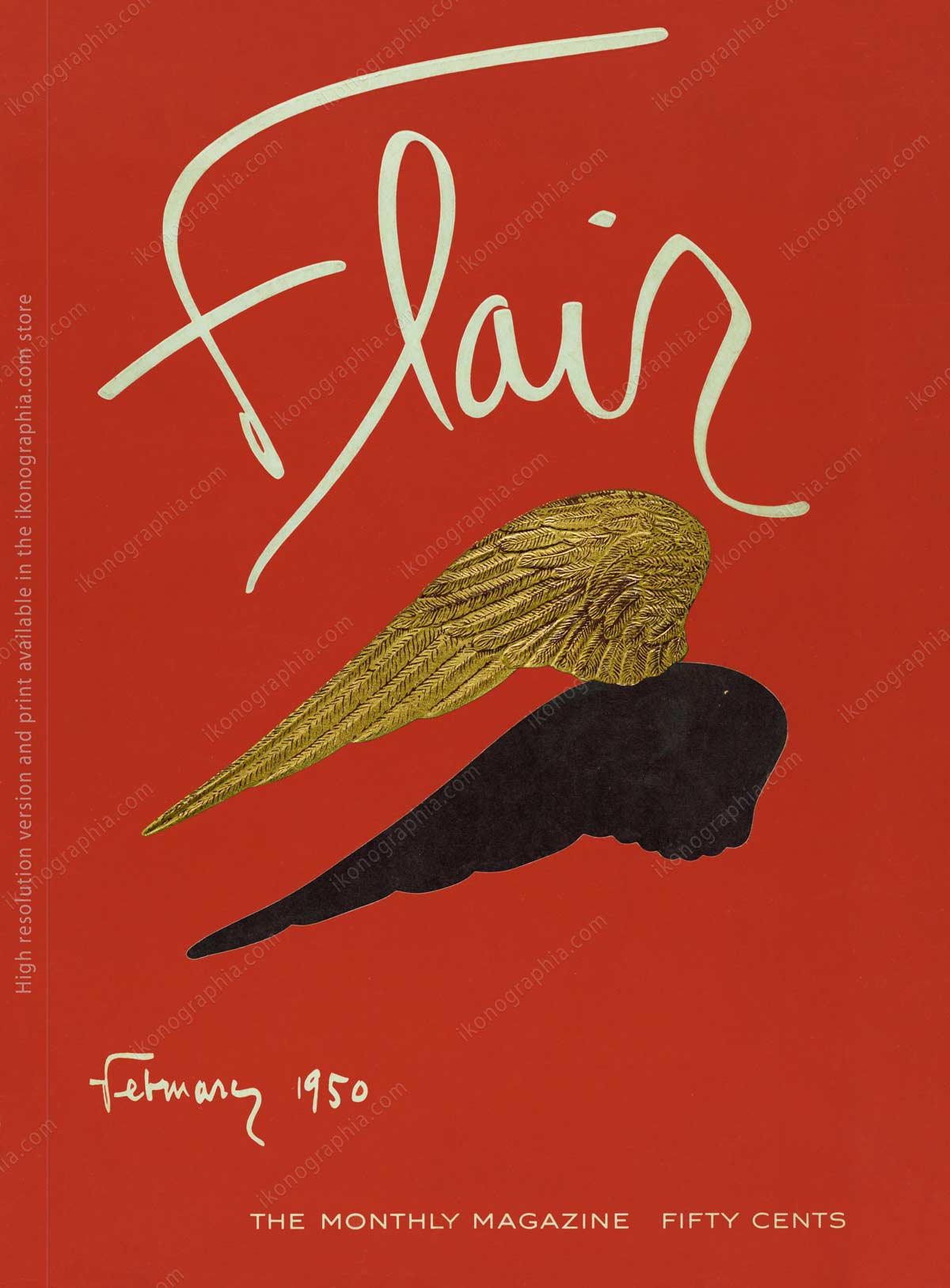
The Logo of the first number of Flair Magazine, February 1950.

1950. The Turning Point in Magazine Publishing.


In 1950, two new magazines were published. Both were highly innovative and destined to strongly influence all publishing in the following years.

The first was Portfolio, by Alexei Brodovitch, the Art Director of Harper’s Bazaar, which had revolutionized magazine design in previous years. The second one was Flair by Fleur Cowles.
Both were produced without budget limits, and both ceased publication after one year only because of the cost of production, which killed the magazines since the expensive special costs could not be supported in the long run.

The cover of the first issue of Portfolio Magazine, winter 1950. Designed by Alexei Brodovitch with Art Director Frank Zachary. Portfolio has been widely acknowledged as perhaps the definitive graphic design magazine of the twentieth century.

The first issue of Flair Magazine, February 1950, and the first issue of Portfolio, Winter 1950.

Flair. "The Monthly Magazine for Moderns"


On September 1949, Fleur Cowles released s a pre-publication advertiser's issue announcing Flair as 'the monthly magazine for moderns.' Here is an excerpt from the Time Magazine review.

Fleur's Flair, which will be shown this week in a limited edition to 5,000 potential advertisers and subscribers, looks like a fancy bouillabaisse of Vogue, Town & Country, Holiday, etc. By covering "fashion, art, literature, travel, decor, theater and entertainment," Editor Cowles expects to lure enough readers to guarantee advertisers a circulation of 200,000 (at 50¢ a copy) at the start.

Flair's sample issue has an off-white hardcover with a second illustrated cover visible through a triangular peephole. Flair abounds with other tricks. There is an accordion-style pull-out on interior decoration, a pocket-sized book insert, a swatch of cotton fabric, and even a page written in invisible ink that can be read when heated by a lighted match.
Source >

A Strong Navy. Art by Gruau - Flair Magazine, March 1950

A strong navy. Flair Magazine, March 1950. An elegant and "modern" design printed on two different papers to emphasize Renè Gruau's art showing creation by Christian Dior, Monte Sano, Sara Ripault, Patullo-Jo Copeland, Neiman-Marcus, and John-Frederics' hats.

FULL PAGES TEXT

A Strong Navy.. Art by Gruau - Flair Magazine, March 1950

NAVY blue with white is a spring natural .. . the magnificent whiteness that Melville, writing of his Moby-Dick, calls the —colorless, all color . . . stiffens and dramatizes the classic blue of schoolgirls and seafarers.
This spring the whiteness is no small measure confined to a slender ruffle, a small piping, but is laid against the blue in dense bold strokes that catch the eye like flashes of light.

Top: White checks are giant on Monte Sano's hip-length wool coat—shoulders sloping, back flaring, sleeves folding back below the elbows in wide cuffs.
Center: Dior mounts great white piqué cuffs buttoned in bone (top button left free) on the minute sleeves of a thin wool dress. Below: White piqué triangles accent the triangular décolletage of Sara Ripault's yarn-dyed twill dress and finish the sleeves. (A pocket on one hip balances a drape on the other.)
Opposite: The vent at the back of Patullo-Jo Copeland's distinguished dress coat of silk barathea buttons twice, swings open to bestow glimpses of a snowy lining of silk surah. A loop of fur worn like a cowl; of ermine, or white mutation mink, designed by Neiman-Marcus. John-Frederics' white hat.

Flair, according to Fleur Cowles

In February 1950, Fleur Cowles wrote her manifesto by hand. It was printed in gold relief on expensive blue paper and bound into the first issue of Flair. She did not know she was writing her obituary..

There have been Great adventures in paper and in printing and in the presentation of the graphic arts in the last decade… Unhappily, few of them for the public at large.
I have longed to introduce a magazine daring enough to utilize the best of these adventures. A magazine which combines for the first time under one set of covers, the best in the arts: literature, fashion, humour, decoration, travel and entertainment.
This copy of Flair shows that it can be done; it is proof that a magazine need no longer be stolidly frozen to the familiar format. Flair can an will, vary from issue to issue, from year to year, assuring you that most delicious of rewards - a sense of surprise, a joy of discovery. For the young in heart, men and women, I believe our efforts will help give a vital contemporary direction and fullness to American life.

Fleur Cowles, Editor

"A magazine need no longer be stolidly frozen to the familiar format." Twelve issues later, production costs made it unsustainable. Flair ceased publication in January 1951.
The manifesto is still the best description of what the magazine was, and why it could not survive.

The Opening of the Social Season, from “High Society”, pages 02-03. By Anne Fish 1920 How the Members of the Beau Monde Will Spend What Is Left of Their War-time Incomes.

Flair N.1, February 1950. The presentation of Flair hand-written by the Editor, Fleur Cowles.

An innovative Magazine.


Fleur Cowles was a design catalyst, creating an innovative magazine not just for 1950.
The magazine pages had hinged doors, pamphlet inserts, and spreads with flipbooks with captions underneath the main image. The pages did not come in a single stock, with a mix of papers in the same issue, from heavy cardstock to slight, onionskin translucent prints to glossy, smooth, and slippery pages.

Flair was designed to be a sensory feast for the readers that could touch, smell and enjoy the always-different art.
Someone defined Flair's design as an "elegant cacophony"; others "a fancy bouillabaisse of Vogue, Town & Country, Holiday."
Call it as you prefer; Flair was and still is unique.


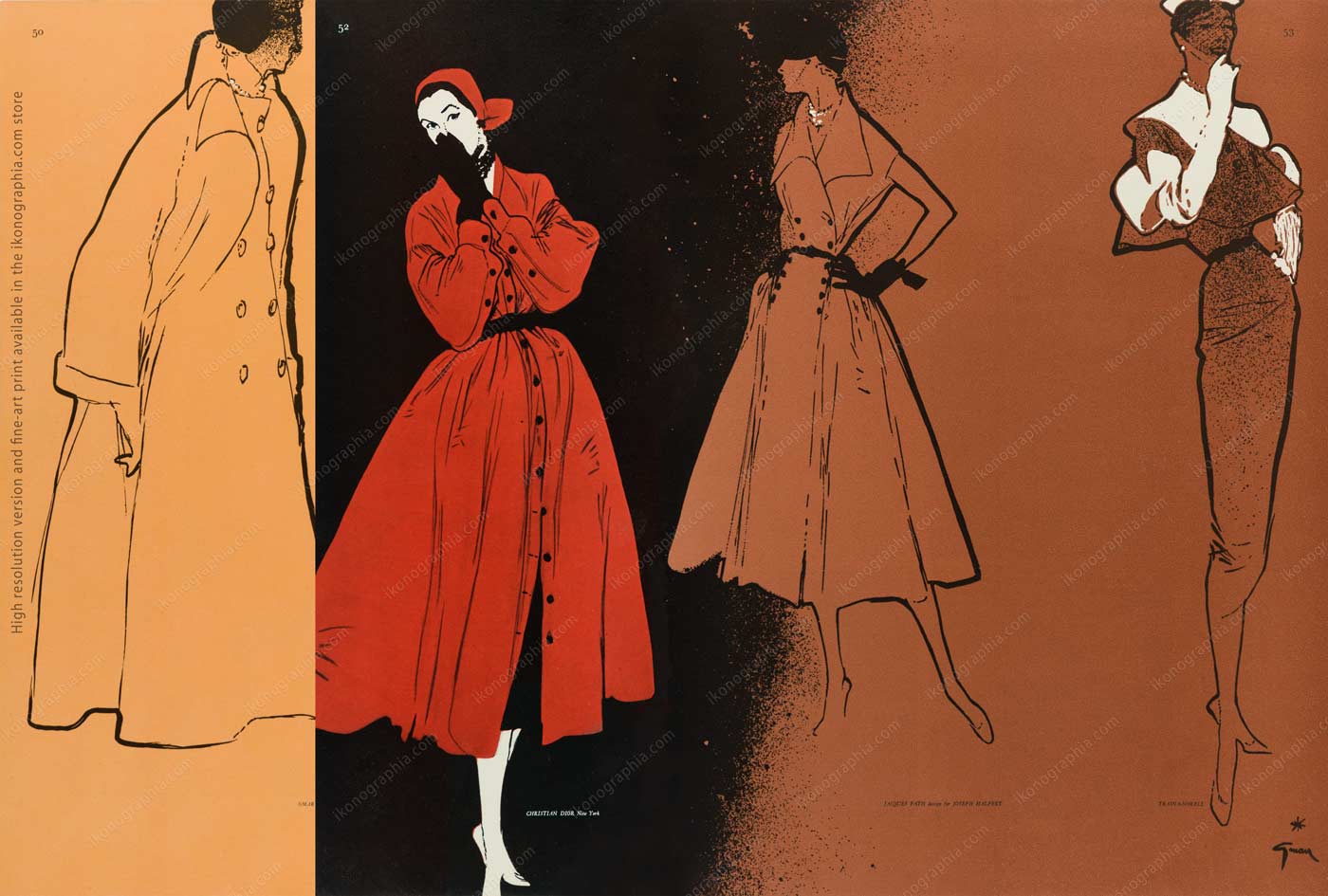
You are known by the color you keep. Flair Magazine, February 1950. Pages 50/53. Artwork by Renè Gruau.
Creations by Omar Kiam, Christian Dior of New York, Jaques Fath for Joseph Halpert, and Traina Norell.
Use arrows to flip pages.

FULL PAGES TEXT

YOU ARE KNOWN BY THE COLORS YOU KEEP.
Color may be the expression by which your world knows you best. You must unerringly know your range; perhaps the whole gamut is yours, perhaps only one color or two. The colors you wear should not be random choices: they are convictions to be carried through with unfaltering assurance.

Consider a great-coat (left), its collar jutting out like a separate jacket, in a peach beige with an affinity for navy blue. Against a wool skirt and velvet collar of black, a tawny beige cavalry twill jacket, a flash of red in the print blouse (right). Turn the flap and find spring's surprise, blazing red: a swaggering silk taffeta coat over a black strapless dress. In the beige range again, iridescent shantung takes on a true taupe cast, the sharpness of black accents. And the perennial freshness of small black and white checks is given further élan by the wand cut of a dress, a pullover jacket's starchy, winged white linen collars and cuffs.

Credits: left: OMAR KIAN of BEN REIG. center and right: TRAINA-NORELL.


Autumn is a city season. Flair Magazine, September 1950, pages 36-37. Use arrows to flip pages.
Below is the original magazine with pages 36 to 39 with flaps.

FULL PAGES TEXT

All Brim or All Crown. Photos by Maria Martel, Flair , March 1950 Pages 46, 49, including the flap page. Pages transcript: All Brim or All Crown. There are two hats this spring—the restless free shape flaring into space like a Calder mobile; or the close, crushed-to-the-head cap. The free shapes: Lilly Daché's milan wheat (page 46), its deep cantilever brim faced in black velvet. Braagaard's white organdy (above) with bands of stitching, bound in navy blue to accent its adventurous outlines. The close caps: 1. A coif, half purple and half white violets. 2. A cushion beret with a mound of pink roses shrouded in moss green veiling—the whole netted in heavy black mesh. 3. A small hillock of lilacs, green leaves and pink roses, springing from a white organdy cap. (These three, Lilly Daché.) 4. A cap and a crushed side bow of amber satin. 5. A lightly brimmed cap of lemon yellow felt, narrowly belted in rhinestones; a honey-colored face-veil. (These two, Mme. Andrée at Bonwit Teller.) 6. A minute helmet of pale blue straw with a bird on the brim and a misty black nose-veil. (Made to order at Bergdorf Goodman.)

Captions page 46: DIAMOND EARRINGS, CARTIER.
Caption, page 47: 2. RUBY AND DIAMONDS EARRINGS, VAN CLEEF & ARPELS.
Caption, page 48: PWARL AND DIAMON EARRINGS, SEAMAN SCHEPPS.
Caption, page 49: PEARL NECKLACES, DAVID WEBB.

Autumn is a city season. Flair Magazine, September 1950, pages 36/39. Drawing by René Gruau, Photos by Maria Martel.

Fashion is an Eye. Flair Magazine, February 1950. Photo by George Hoyningen-Huene.
Use arrows to flip the page

FULL PAGES TEXT

Fashion is an Eye.
You will find her, the brooding and uncertain woman opposite, wherever a dress may be bought.
The scene might be the Place Vendome, a New York store, a small-town dress shop. Maybe she hasn't even bothered to ask the price; or she might have scrimped for months to allow herself this one purchase. Whoever she may be, whatever her purse, she is a soul in misery — a fact the men in her life would never suspect. Probably she could not tell them why.
The unwelcome presence of other customers may have contributed. The most casual glance she interprets as a hard scrutiny, and her pleasant suit suddenly appears faded, worn.

The sales-girl may have held up one dress too insistently and aroused the cringing suspicion that some impossible thing is being palmed off on an easy victim. Or, worse mischance of all, this unhappy woman may have faced the mirror and found in its sly depths an unfamiliar reflection, so that every secret doubt she has ever had as to her looks and desirability now furiously possesses her.

At last she has decided; she is free to lift herself from her chair. How could she be so uncertain, so confused? Yet often she has reached the street before she regains her normal self-possession and sees, sees with her own eyes, again. What causes this temporary blindness? Not too little; perhaps too much. Ironically, as far as American women are concerned, this symptom of insecurity may be all the greater because fashion has never given them a wider choice nor made the work of the finest designers available to so many.

The public is familiar as never before with significant trends and important names in fashion — a result highly praiseworthy in all respects but one.
Fashion has ceased to be personal. In choosing a dress, the American woman is aware of many eyes upon her, and in turn she tries to judge what is before her by every high standard she knows . . . except her own. Fashion is an eye.

Every woman's eye. Your eye. And inevitably, fashion begins with the inner eye, with self-awareness, with understanding of all your powers, physical, mental, spiritual. It must calmly estimate all that you may claim as potentials for beauty. It demands the fullest expression of your own nature. It insists that you absorb the influences, the knowledges, the disciplines that will be permanently useful to you. It gives mature direction to the outer eye, guiding it to those possessions that are rightfully yours.

It forbids you from seeking refuge in those eccentricities of taste that reveal an insecurity far more destructive than the most slavish acceptance of the usual arbitrary norms.
It allows you to contemplate the fashions that FLAIR will report for you, to claim only those that are your own. Serene and sure, your eye will no longer waver from the image of beauty you have set for yourself. You will then be free to communicate your gaiety, your warmth, your self-confidence.

HOYNINGEN-HUENE. DIAMONDS BY HARRY WINSTON


All Brim or All Crown. Photos by Maria Martel, Flair, March 1950, pages 46-47. Use arrows to flip pages.

FULL PAGES TEXT

All Brim or All Crown. Photos by Maria Martel, Flair , March 1950 Pages 46, 49, including the flap page. Pages transcript: All Brim or All Crown. There are two hats this spring—the restless free shape flaring into space like a Calder mobile; or the close, crushed-to-the-head cap. The free shapes: Lilly Daché's milan wheat (page 46), its deep cantilever brim faced in black velvet. Braagaard's white organdy (above) with bands of stitching, bound in navy blue to accent its adventurous outlines. The close caps: 1. A coif, half purple and half white violets. 2. A cushion beret with a mound of pink roses shrouded in moss green veiling—the whole netted in heavy black mesh. 3. A small hillock of lilacs, green leaves and pink roses, springing from a white organdy cap. (These three, Lilly Daché.) 4. A cap and a crushed side bow of amber satin. 5. A lightly brimmed cap of lemon yellow felt, narrowly belted in rhinestones; a honey-colored face-veil. (These two, Mme. Andrée at Bonwit Teller.) 6. A minute helmet of pale blue straw with a bird on the brim and a misty black nose-veil. (Made to order at Bergdorf Goodman.)
Captions page 46: DIAMOND EARRINGS, CARTIER.
Caption, page 47: 2. RUBY AND DIAMONDS EARRINGS, VAN CLEEF & ARPELS.
Caption, page 48: PWARL AND DIAMON EARRINGS, SEAMAN SCHEPPS.
Caption, page 49: PEARL NECKLACES, DAVID WEBB.

Be like a rose. Flair, May 1950, Pages 40-41. Photo by Paul Himmel

Flair, May 1950. A double page from the Spring number. The issue, dedicated to the rose, was infused with an expensive rose fragrance, decades before scent strips became common in magazines.

FULL PAGES TEXT

The Opening of the Social Season.

How the Members of the Beau Monde Will Spend What Is Left of Their War-Time Income.

THE RESTAURANTS.
The season in the restaurants has opened strong. And the worst of it is that the ladies will spend all their time in these blessed robbers' dens. Tell a woman that her place is in the home and — but you wouldn't do anything as rude as that, would you? There are two other discouraging things about women in a restaurant: first, that they won't ever go home, and second, that they won't ever sit down. Here we see a tragedy illustrating both of these points. Muriel, who long ago finished her luncheon simply will not join the gentleman in the hallway (the one who looks a little like President Wilson), although the poor creature has been waiting for twenty minutes. And her charming little vis a vis, Esme by name (the one with the lap dog that looks like a three-leaved clover), has, on her side, been keeping her fiance standing at attention for a similar period of time — and, all because the two dears have such thrilling and wonderful things to talk about.

THE HORSE SHOW.
Here we see the horse show in full blast. Here you will see everybody happy, everybody occupied, scandals energetically and effectually discussed, meetings arranged in whispers, society reporters calling everybody by their wrong names, and everybody paying the strictest attention to everything about them — except the horses.

THE ART SHOWS.
Below we see the opening of the Vorticist Sculpture Salon, a debauch in marble that always brings out a full quota of the artistic cognoscenti of the town. Bohemia always appears in goodly numbers at these charming little revels in stone. The extraordinary thing about much of the new sculpture is that it looks like illustrations for those wonderful books on hygiene, in which ladies' are taking their matutinal exercises—by correspondence, of course. Take, for instance, the case of the delicate little gem entitled "Love" in this illustration. Captain De Pluyster who is viewing it in company with his fiancée, Miss Corinna Walpole, is listening to her: "Oh, that's an easy one. I do that twenty times, every morning, just before my bath."

THE FASHION FÊTES:
Perhaps the most delightful social occasion of all — at least as far as married men are concerned — is the winter Fashion Fete at Luciline's select little dressmaking establishment. In the picture, you will observe a married gentleman, accompanied by his gross tonnage. The poor man is not at all listening to Mme. Luciline; no, he is gazing wistfully and, with eyes aflame, toward the wholly divine young ladies who, every season, do so much toward making the happy modes and unmaking the unhappy marriages. "How different would have been my life," he reflects, "had I met one of those limp and sinuous sirens before I took up with my Henrietta."

A visionary talent-hiring editor


Conceived and produced by visionary editor Fleur Cowles, Flair magazine existed for only one year and twelve issues, from February 1950 to January 1951. The magazine combined art, fashion, travel, and reportage to take the most out of its Editor's formidable ability to promote European and American talent.

Cowles hired the best illustrators and photographers. The most impacting was Gruau at the peak of his career.
In one year only, Flair published the work of Jean Cocteau, Lucien Freud, Saul Steinberg, Salvador Dalí, Simone De Beauvoir, Walker Evans, Bernard Baruch, George Bernard Shaw, Tennessee Williams, Gloria Swanson, Eleanor Roosevelt, Gypsy Rose Lee, and Colette.

Paris Collections Spring 1950. This is the shade of tangerine that is everywhere in Paris, will be everywhere in America. Art by René Gruau. Flair, March 1950.

Flair, March 1950. Paris Collections Spring 1950. This is the shade of tangerine that is everywhere in Paris, and will be everywhere in America. From left, creations by Dior, Dior, and Molyneux. Art by René Gruau., left page.

FULL PAGES TEXT

Paris Collections Spring 1950. This is the shade of tangerine that is everywhere in Paris, and will be everywhere in America.

Pages text transcript

FIRST . . . THIS IS THE SHADE OF TANGERINE THAT IS EVERYWHERE IN PARIS, WILL BE EVERYWHERE IN AMERICA IN NEWS: The straight and narrow silhouette sometimes relieved by a bloused back, a big bib-collar, a bow of fantastic size; or by over-all tucking, ruching, fluttering petals; a floor-length pouf or panel; a starched or pleated flare below the hips, below the knees, toward the hem.

. . .The occasional break from the straight into belling and even bouffant evening skirts.... The fluctuating hemline-in-transition—an average fifteen inches for day; every length for evening.

... IN COLOR White, white everywhere; then black and white, navy and white, and a ranging spectrum of blond and amber tones culminating in striking doses everywhere of tangerine.

. . . IN SPOT NEWS: The décolleté, cuffed, horseshoe neckline on suits and street dresses. . . . Dior's mannish dusters of silk tussor in natural or in pale colors over darker dresses; his fabulously tailored chiffon evening coats. . . . The flowing peignoir coat, often sleeveless. . . . The narrow sleeveless dress. . . . The overlong, crushed-down gloves worn with both.

... IN PROPHETIC TENDENCY: The straightening silhouette, the heightening hemline, the slowly but surely descending waistline. Opposite: Dior's black taffeta with an immense white bib-collar, starched and nun-like, tied with a whisker bow of black net. Right: Dior's black-and-white tweed smoking jacket, narrowed at the hem, its deep horseshoe neckline cuffed with tuxedo revers; over a black wool dress with a white Byronic collar, a big black taffeta bow tied outside. Far right: Molyneux's double-breasted gray wool with a bril-handy cut envelope fold at the front of its skirt, a taffeta sash tied in a bold bow. An optional straight, pleated wool overskirt changes its looks but not its lines.

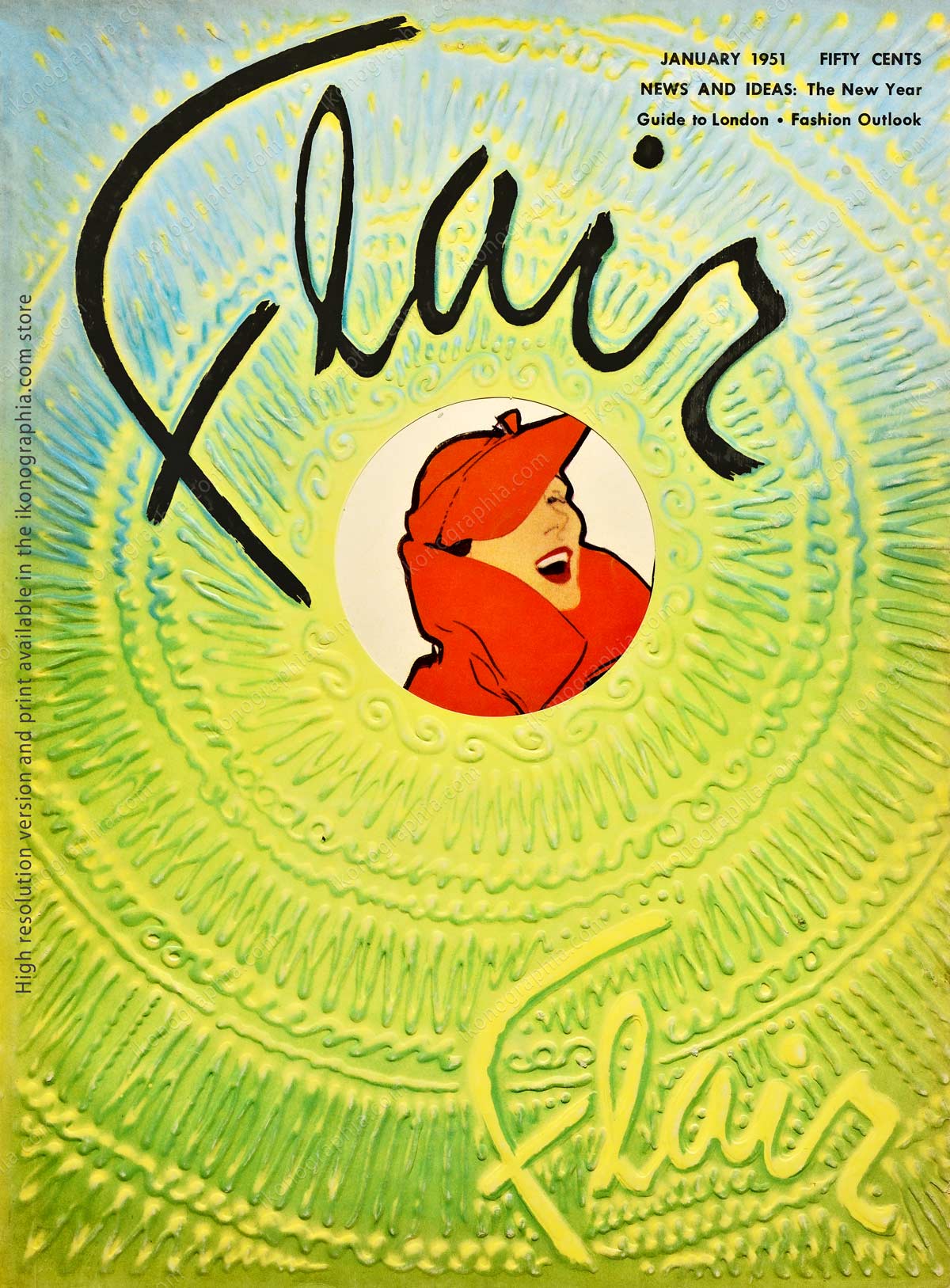
The Cover of the last number of Flair Magazine, January 1951. Painting of sun by Victor Vasarely. A cut-out door partially reveals the Undercover’ image: “Bear and Warmer”, by Rene Gruau.

The cover of the last number of Flair of January 1951 is "The Painting of Sun," by Victor Vasarely, a Master of Optical Art.
The image that comes out from the peephole, is "Bear and Warmer," by Gruau.

Cadillac’s World War II Iconic Advertisements

Cadillac’s World War II Iconic Advertisements

Cadillac's World War II Iconic Advertisements

How a luxury car manufacturer became a war machine — told through its own advertising.

On January 16, 1942, 39 days after Pearl Harbor, President Roosevelt created the War Production Board to convert peacetime industrial production to meet the needs of war. Only 55 days after automobile production ended, Cadillac delivered the first tank. Seventeen days later, the second was shipped.

The advertisements Cadillac ran throughout the war documented this transformation in real time — institutional campaigns replacing consumer promotion, illustrated by James Bingham, John Vickery, and others. Published in Life Magazine and reproduced here from original issues.

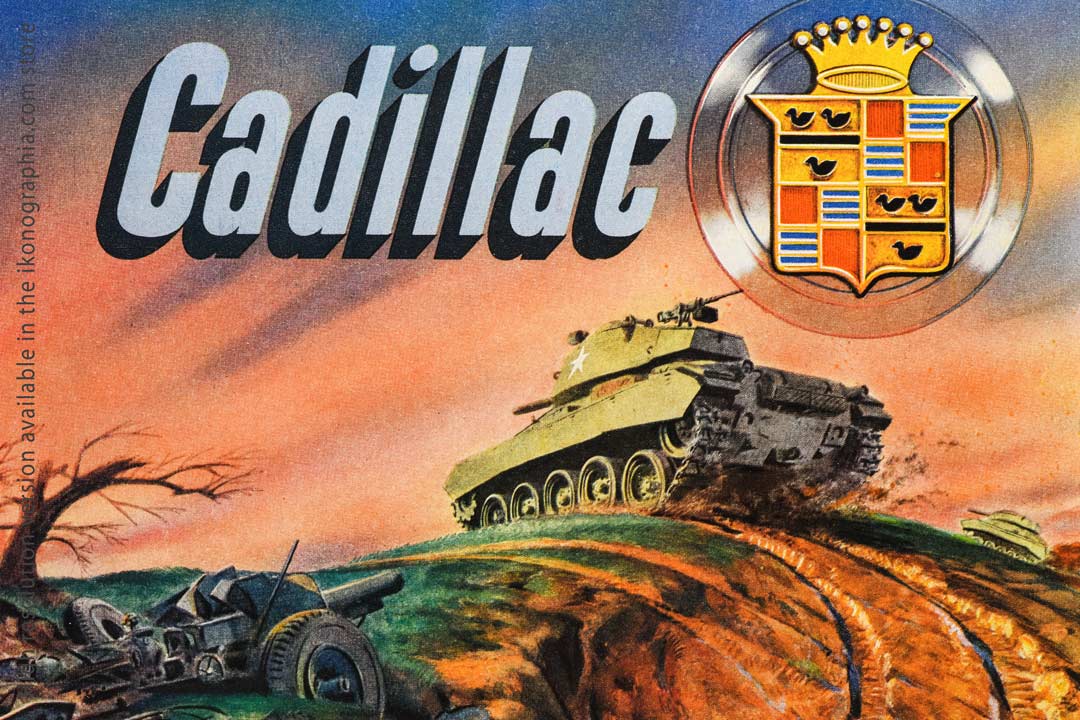
An M24 Tank in a Cadillac 1945 ad. Artwork by Artworks are by James Bingham

Cadillac Goes to War.


On January 16, 1942, 39 days after Pearl Harbor, President Roosevelt, with an executive order, created the War Production Board (WPB) to convert peacetime industrial production to meet the needs of the war, along with setting priorities and prohibiting the manufacture of non-essential goods.

Only 55 days after automobile production ended, Cadillac delivered the first tank. Just 17 days later, the second was shipped. Production was beginning to roll and soon to become a flood.

Cadillac WWII Ad. Pay-off for Pearl Harbor ! Aircrafits with Allison Engines. Art by John Vickery. Life, November 6, 1944

Pay-off for Pearl Harbor!
Artwork by John Vickery.
Life, November 6, 1944

A P-38 Lockheed Lightning Aircraft bombing Japan. The P-38 was powered by twin General Motors Allison engines, several parts of which were built by Cadillac.

Excerpt from the ad's text.
"Three years ago, the sneak attack on Pearl Harbor found America unprepared to defend its rights. Yet, even at that early date, Cadillac was in its third year of building aircraft engine parts for military use.

Cadillac World War II Production.


From 1942 to 1945, Cadillac produced 10,670 Tanks and Armored Vehicles, including 5000 M5 and M5A1 Light Tanks, 3,592 M24 Light Tanks, 1,778 M8 77mm Howitzer Motor Carriages, and 300 M19 Twin 40mm Gun Motor Carriages.

Additionally, for the Allison V-12 engine powering several aircraft, Cadillac produced several parts, including crankshafts, camshafts, connecting rods, super-charger gears, impellers, and other component units. — Source

Cadillac WWII Ad. Peacetime Power with a Wartime Job ! The M-5 Light Tank. Life, March 19, 1945

Peacetime Power with a Wartime Job!
Life, March 19 1945

When Cadillac discontinued motor car production, its engine assembly line continued to roll. For the famous Cadillac V-type engine, and Hydra-Matic transmission, had been adapted to war. This Cadillac "power-train" was first used in the M-5, a light tank designed by Cadillac under the direction of Army Ordnance technicians. Thousands of these tanks—as well as its companion, the M-8 Howitzer Motor Carriage—were produced by Cadillac, and are fighting in battles all over the world.

The M5 and M5A1 light tanks.


The M5 light tank, later replaced by an improved version, the M5A1, was used for armed reconnaissance, duties, and supporting infantry actions. It was produced by Cadillac and Massey Harris from 1942 to 1944 in 5,000 units.

The M5 was powered by two Cadillac V-8 Engines developing 110hp each with a Twin Hydramatic transmission system. The armament was a main 37mm gun, three machine guns, and a smoke mortar. — Source

An excerpt from the ad's body:
The M-5 incorporates all that is latest and best in light tank practice plus two innovations from Cadillac peace-time engineering. This accounts for its high speed and great maneuverability. Likewise entrusted to us are more than 170 vital parts manufactured to extremely close tolerances for America's foremost liquid-cooled aircraft engine.

OUTMANEUVERED at every turn by the harrying tactics of a squadron of high-speed American M-5 light tanks, this formidable Nazi Mark IV tank has been immobilized by a well-placed hit in its vital mechanism. The M-5 incorporates all that is latest and best in light tank practice plus two innovations from Cadillac peace-time engineering. This accounts for its high speed and great maneuverability. Likewise entrusted to us are more than 170 vital parts manufactured to extremely close tolerances for America's foremost liquid-cooled aircraft engine.

Making its mark.. on a Nazi Mark IV
Art by Walter Richmonds.
Life, August 30, 1943

OUTMANEUVERED at every turn by the harrying tactics of a squadron of high-speed American M-5 light tanks, this formidable Nazi Mark IV tank has been immobilized by a well-placed hit in its vital mechanism.

Note: its properties and gun system didn't allow it to compete with heavier German Panzers.

The M8 77mm Howitzer Motor Carriage.


Utilizing a Cadillac-built tank chassis—powered by two Cadillac V-type engines with Hydra-Matic transmissions—this M-8 Howitzer gives demolition artillery a degree of mobility it has never known before.

The M-8 is not only fast—it is highly maneuverable as well. This is one of the weapons Cadillac has built for the Allied arsenal. Cadillac also helped to design the M-5 light tank—and produced it in quantity. 

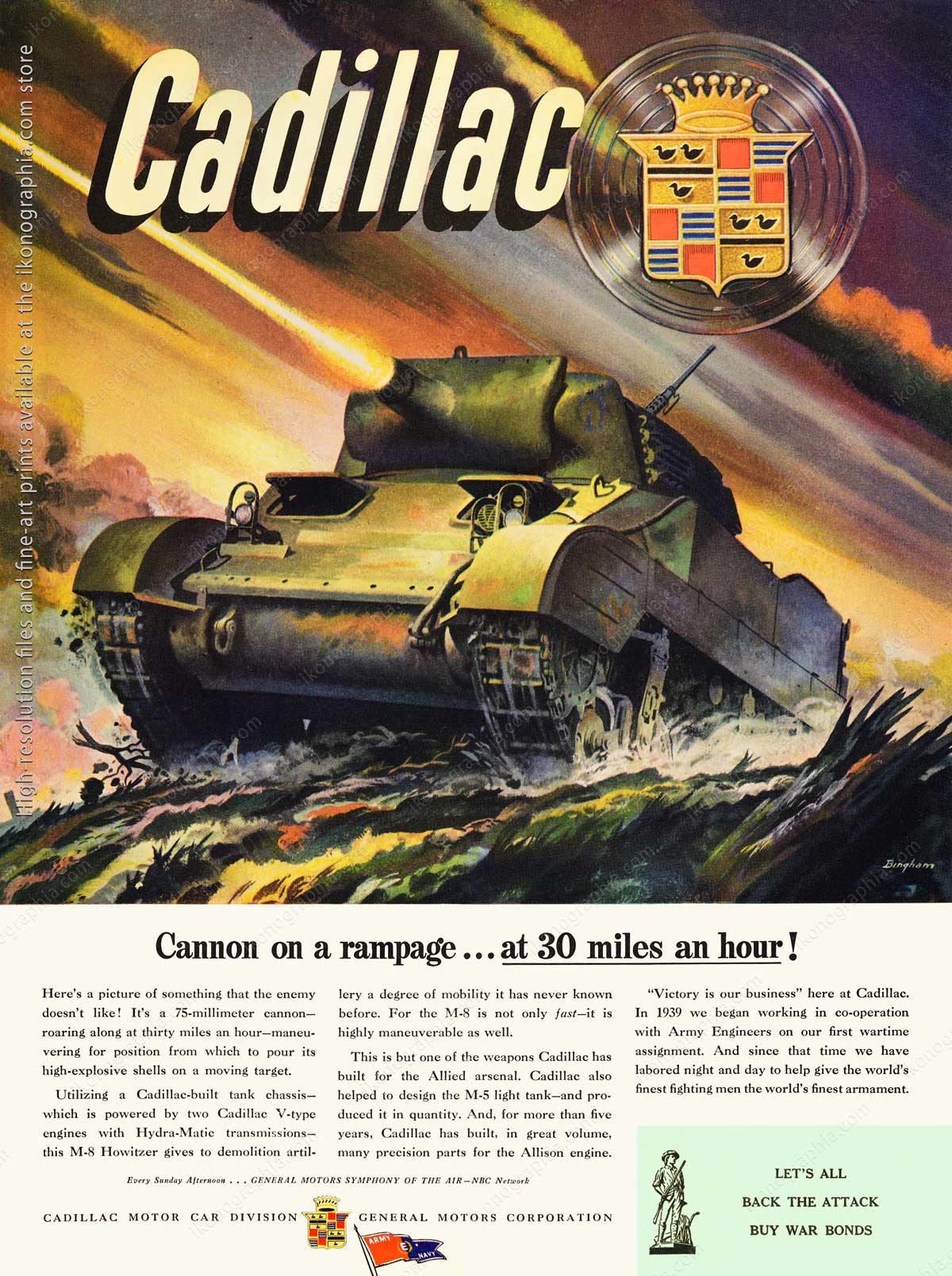
Cadillac WWII Ad. Cannon on a rampage ... at 30 miles an hour! A Cadillac-built tank chassis powered by two Cadillac V-type engines. Art by James Bingham. Life, September 18, 1944

Cannon on a rampage ... at 30 miles an hour!
Artwork by James Bingham.
Life, September 18, 1944

Here's a picture of something that the enemy doesn't like! It's a 75-millimeter cannon—roaring along at thirty miles an hour—maneuvering for position from which to pour its high-explosive shells on a moving target.

The Cadillac M24 Light Tank.


The Light Tank, M24, was an improved version of the popular M5 light tank, which was replaced in 1944. It was produced by Cadillac and Massey Harris in 3,592 units and was used for armed reconnaissance, duties, and supporting infantry actions.

The M24 was powered by two Cadillac V-type engines developing 110hp each, driving through Cadillac Hydra-Matic transmissions. The armament was a main 75mm gun, three machine guns, and a smoke mortar.

Cadillac WWII Ad. Preview of Cadillac Power. M-24 Tank. Life, February 12, 1945

Preview of Cadillac Power!
Life, February 12, 1945

If you were to watch the new M-24 wide-tread tank in action—watch it tear its way through heartbreaking mud and over all kinds of difficult terrain—you would surely conclude that it had some specially-designed, heavy-duty motive power.

But like its predecessors—the M-5 light tank and the M-8 Howitzer Motor Carriage —this new Cadillac-built weapon is powered by two Cadillac V-type engines, driving through Cadillac Hydra-Matic transmissions.

Fundamentally, these are the same famous engines and transmissions that had piled up millions of miles of service in passenger cars long before Cadillac and U. S. Army Ordnance Engineers adapted them to tank design. However, they have been vastly improved as a result of their hard usage on the battlefield.
We doubt whether any other power units originally designed for passenger car use have ever been put to such a grueling test. We feel sure they will prove a revelation when peace returns.

Cadillac WWI Ad. Imprint of Cadillac Power with the M24 Tank. Art by John Vickery Fortune, May 1945

Imprint of Cadillac Power!
Artwork by James Bingham.
Fortune Magazine, May 1945

Deep in German mud, this M-24 has left its imprint of Cadillac power. For, like more than 10,000 tanks that have gone before it, the M-24 is powered by two Cadillac V-type engines, driving through two Cadillac Hydra-Matic transmissions.

The Cadillac V-type, 8-cylinder engine.


All Tanks and Armoured Vehicles produced by Cadillac were powered by Twin V-8 engines developing 110hp each with a Twin Hydramatic transmission system.

An excerpt from the ad's body:
As a result, the Cadillac V-type engine has been carried to a remarkable state of perfection. Prior to the war, it was made available with the Cadillac Hydra-Matic Transmission.
Cadillac engines and transmissions have been installed in more than ten thousand Cadillac-built tanks—two units for each tank. They have won the highest distinction for performance and dependability on fighting fronts. Improvement, of course, has gone consistently ahead. As a result, the Cadillac "power train" is now an even greater unit than when it went to war.

Cadillac WWII Ad. Famous in Peace-Distinguished in Battle! TheV-type , 8-cylinder. Art by John Vickery. Life, June 4, 1945

Famous in Peace -Distinguished in Battle!
Life, June 4, 1945

More than thirty years ago, Cadillac built the first V-type, 8-cylinder automotive power plant ever produced in this country.

Throughout all these years, Cadillac has held to this principle of engine design. Consequently, our research and engineering have been concentrated on improvement and development—rather than on experimentation as to basic engine types.


The rhythmic roar of the P-38 tells more eloquently than words of the superb fighting qualities built into its two perfectly synchronized engines. Foremost of the American-designed and built liquid-cooled aircraft engines is the Allison, which powers several of our top fighter craft and for which we at Cadillac produce vital precision assemblies.

Thus with every Cadillac V-8 engine produced today, Cadillac literally contributes its own V to Victory. Cadillac pioneered the V-type engine 29 years ago and has continuously developed and improved it ever since.
This uninterrupted application of traditional Cadillac precision craftsmanship has naturally brought it to a high state of perfection—and, by virtue of its inherent simplicity, ruggedness, great power, and compactness of design, made it ideally adapted to the responsible task as a tank power plant.

The Cadillac-built M-5 tank has made its name on several fronts. It is widely hailed as the best and most versatile of light tanks, with speed and maneuverability unmatched by any other full-tracked vehicle. Building the M-5 is only one of our wartime assignments.

WWII Ad.Cadillac's Own V for Victory with the V-type Engine. Art by John Vickery. Life, November 15, 1943

Cadillac's Own V for Victory
Artwork by John Vickery.
Life, October 18, 1943

The fundamental soundness of the Cadillac V-type engine, that made it outstanding in the automotive world, was an important factor in its adaptation to the M-5 light tank by Cadillac and Army Ordnance Engineers.

Cadillac/Allison Engine powering Lockheed aircraft.


Cadillac produced several parts for the Allison V-12 engine powering several aircraft, including crankshafts, camshafts, connecting rods, super-charger gears, impellers, and other component units.

The Cadillac/Allison engine powered the following aircraft.
P-38 Lockheed Lightning: a fast-climbing, twin-engined, twin-fuselage aircraft. Germans referred to the 'plane as the fork-tailed devil.
P-39 Lockheed Airacobra: a speedy low-altitude fighter.
P-40 Lockheed Warhawk: favorite plane of the Flying Tigers, a daring crew of WW2 fighter pilots under General Claire Chennault.

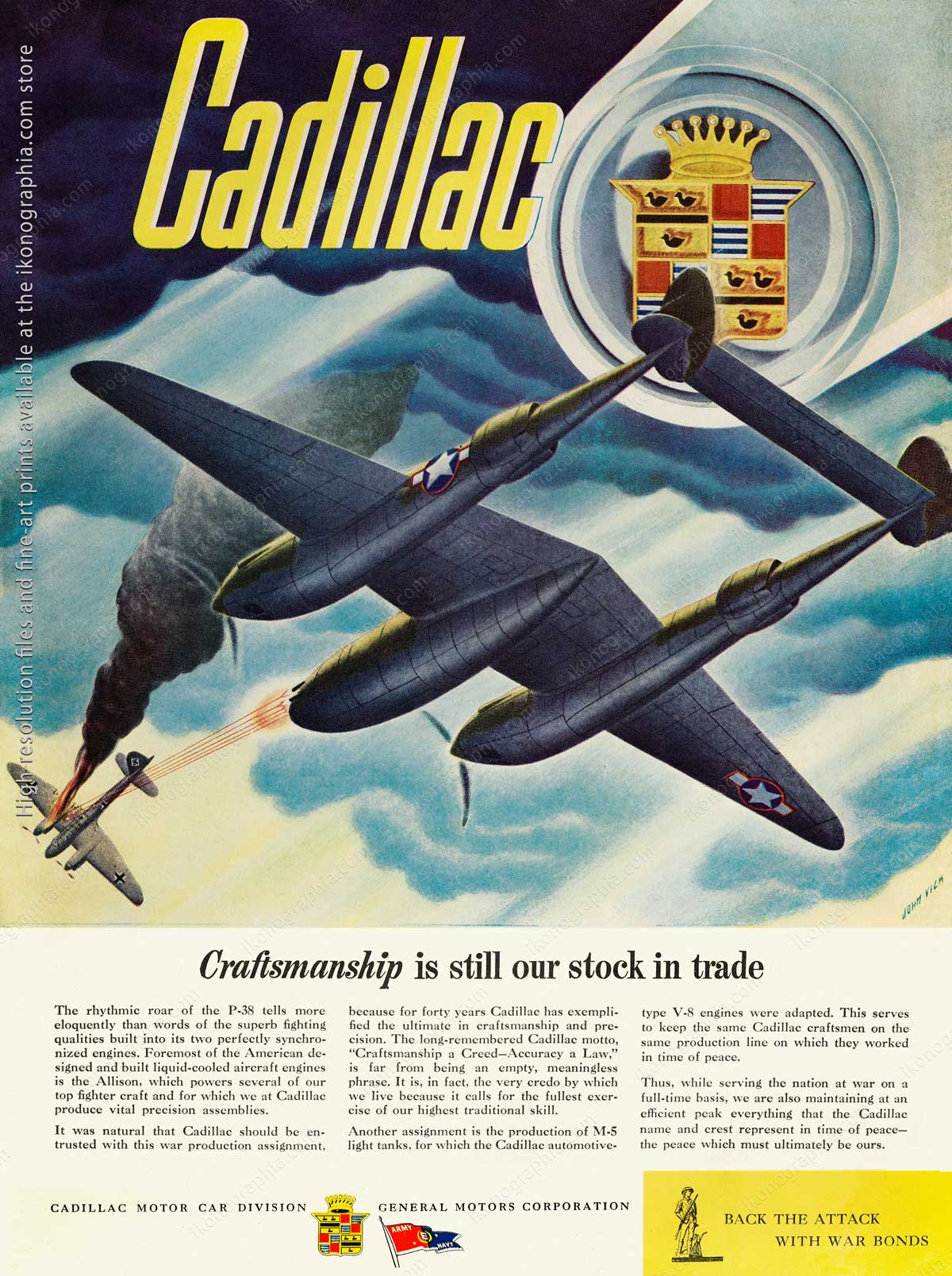
Cadillac WWII Ad. Craftsmanship is still our stock in trade, with Lockheed P38 Aircraft. Art by John Vickery. Life, October 18, 1943

Craftsmanship is still our stock in trade
Life, October 18, 1943
Artwork by John Vickery, an Australian illustrator who moved to New York in 1935.

P-38 Lockheed Lightning: A 400 mph, fast-climbing, twin-engined fighter plane, the rudders of which inspired the first fish-tail fins on the 1948 Cadillac. Germans referred to the 'plane as the fork-tailed devil. The plane was powered by twin General Motors Allison engines, several parts of which were built by Cadillac.

The rhythmic roar of the P-38 tells more eloquently than words of the superb fighting qualities built into its two perfectly synchronized engines. Foremost of the American-designed and built liquid-cooled aircraft engines is the Allison, which powers several of our top fighter craft and for which we at Cadillac produce vital precision assemblies.

It was natural that Cadillac should be entrusted with this war production assignment because, for forty years, Cadillac has exemplified the ultimate in craftsmanship and precision.

Cadillac WWII Ad. We've put 44 million man-hours in the air! with parts for the Allison Engine. Art by John Vickery. Life, February 14, 1944

We've put 44 million man-hours in the air!
Artwork by John Vickery.
Life, February 14, 1944

In March of 1939—nearly three years before Pearl Harbor—Cadillac, working in cooperation with the Army Air Forces, accepted its original arms assignment. It called for volume production of vital precision parts and assemblies for the Allison, America's first and foremost aviation engine of liquid-cooled design.

Thus, when America launched its aircraft production program "to blacken the sky with planes," Cadillac was well qualified to meet the requirements of Army Air Force technicians. The tremendous new demands made us ready—with experience, equipment, methods, and skills developed by 40 years of adherence to the principle—"Craftsmanship A Creed—Accuracy A Law."

Cadillac is proud that its background of experience has enabled it to accept so important an assignment in such a vital division of America's armament program. It has enabled us to apply 44 million man-hours in the production of these vital parts—all to the rigid specifications of one of the most exacting buyers in the world—the U. S. Army Air Forces.

Cadillac WWII Ad. Stalkers of Hidden Devilfish. with parts for the Allison Engine. Art by John Vickery. Life, May 1, 1944

Stalkers of Hidden Devilfish
Artwork by John Vickery.
Life, May 1, 1944

Searching for enemy submarines. Three P-40 Curtiss Warhawk of the "Flying Tigers," a daring crew of WW2 fighter pilots under General Claire Chennault. Cadillac produced several parts for the Allison V-12 engine powering these aircraft.

"during the five years of the war, millions of Allison parts—crankshafts, camshafts, connecting rods, super-charger gears, impellers, and other component units—have "gone to war" bearing the imprint of Cadillac's precision workmanship."

Cadillac’s “From Peace to War” 1943 booklet.


An excerpt from the booklet:
Our country has now been actively at war for two years. We have now reached a point where the story of the important war job we at Cadillac have been doing during this period can be told. In the beginning, there were those who said our country couldn't prepare for war in time to do any good.

That's what Hitler thought, and the Japs, too. It is true that overnight our war needs were enormous, and the facilities for producing such goods seemed pitifully inadequate. Our own organization, along with all other American industry, was faced suddenly with the tremendous job of building instruments of warfare in place of the peacetime products we had been accustomed to making.Source

Links, credits, and copyright

In the United States, anything published without a copyright notice between 1928 and 1977 is in the public domain and is free to use.

Works published with copyright advice in the United States until 1963 fell into the Public Domain if the copyright was not renewed with the Copyright Office during the 28th year after publication. Ad copyright was never renewed and fell into the Public Domain.

More info on our "Copyright and Public Domain" page.

Please notice that any advice or comment provided here is not and does not purport to be legal advice as defined by s.12 of Legal Services Act 2007.

US Bald Eagle Emblem in 1930s Art Deco Architecture

US Bald Eagle Emblem in 1930s Art Deco Architecture

Stories

Apr 19, 2021

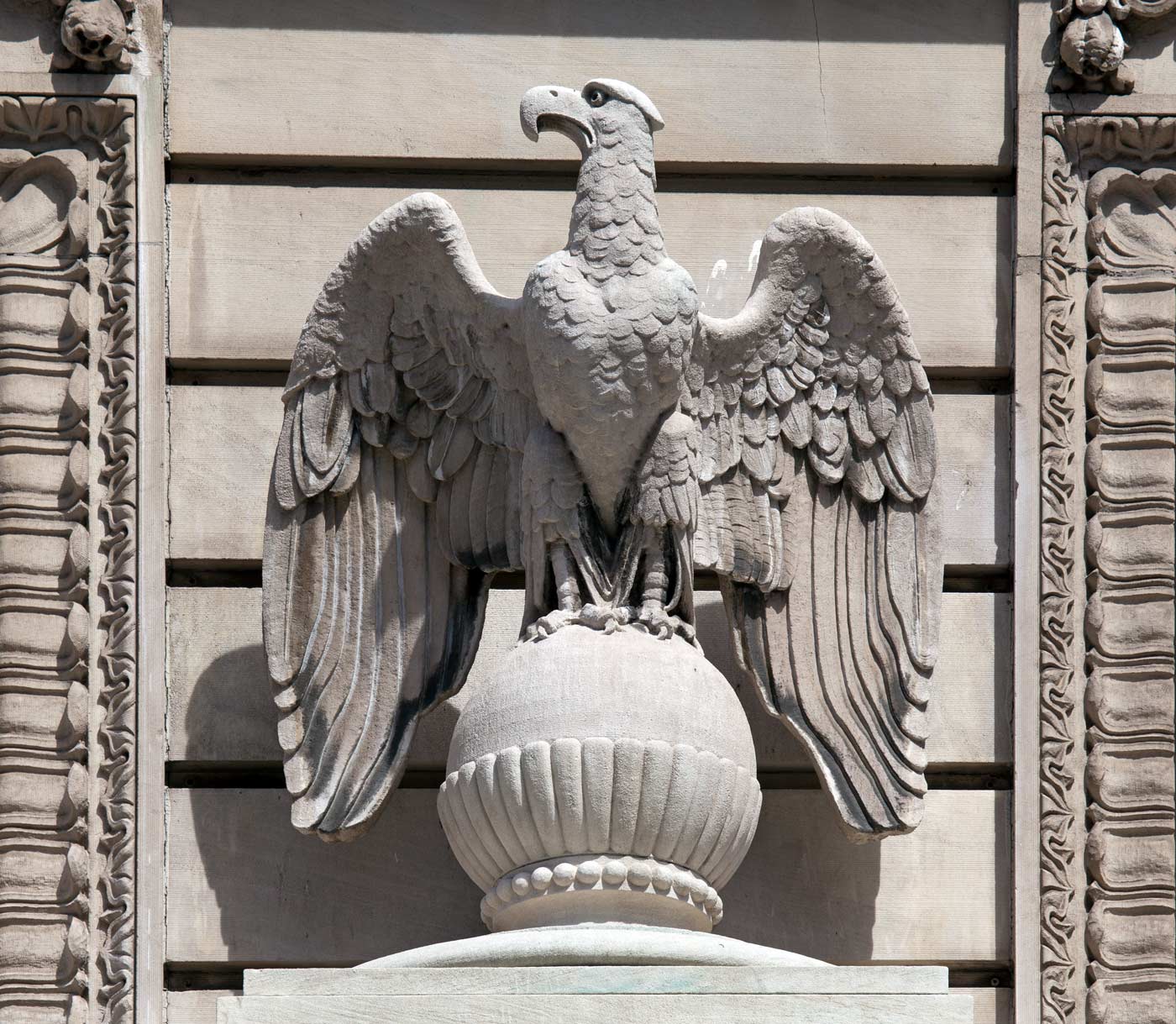
Art Deco Bald Eagle - U.S. Courthouse, El Paso, Texas 1922 - Carol M. Highsmith

1936 U.S. Courthouse Eagle Detail, El Paso, Texas. Neoclassical, Art Deco designed by architect McGhee Fraser Lippencott. BUY A FINE ART PRINT

The US Emblem in the Art Deco architecture. By Carol M. Highsmith


Here an impressive selection of clean and essential pictures on the U.S. Symbol in US Courthouses and public buildings built from 1929 to 1939. All pictures, by Carol M. Highsmith are taken with a large-format view camera and the most recent with the finest professional digital equipment.

Art Deco Bald Eagle - Art Deco Bald Eagle - U.S. Courthouse, El Paso, Texas 1922 - Carol M. Highsmith

1931. Eagle detail on the Colorado Building, Washington, D.C. Designed by architect Ralph S. Townsend.

BUY FINE-ART PRINT

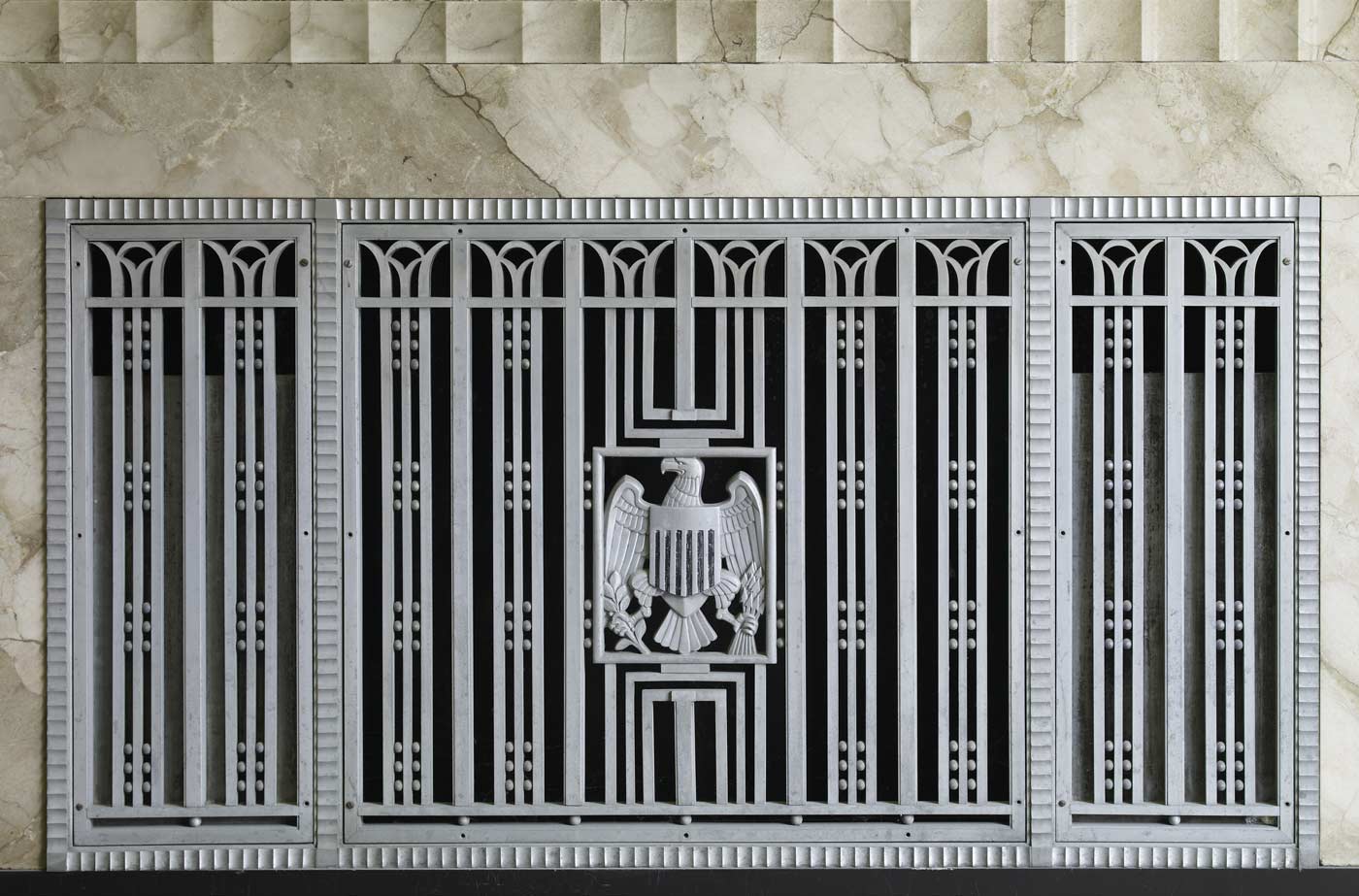
Interior grill detail, James T. Foley U.S. Post Office and Court

1932. James T. Foley U.S. Post Office and Courthouse, Albany, New York. Interior grill detail.

BUY FINE-ART PRINT

Interior grill detail, James T. Foley U.S. Post Office and Court

1932. James T. Foley U.S. Post Office and Courthouse, Albany, New York. Interior eagle detail.

BUY FINE-ART PRINT

Art Deco US Bald Eagle. 1931 interior inlays in wood lobby detail. James T. Foley U.S. Post Office and Courthouse, Albany, New York Photo by Carol M. Highsmith1

1932. James T. Foley U.S. Post Office and Courthouse, Albany, New York. Interior lobby detail. Wood inlay eagle seal.

BUY FINE-ART PRINT

A legacy of the New Deal’s policies and WPA.


During the ‘1930s and 1940’ the public works and employment programs instituted by the Roosevelt administration, part of the government’s response to the Great Depression, created thousands of new buildings, and public artworks across the country. Source

The program was expanded with the creation of WPA, the Works Progress Administration. It was an American New Deal agency, employing millions of job-seekers (mostly unskilled men) to carry out public works projects, including the construction of public buildings and roads. It was established on May 6, 1935, by presidential order, as a key part of the Second New Deal. Source.

The legacy of these programs is invaluable.

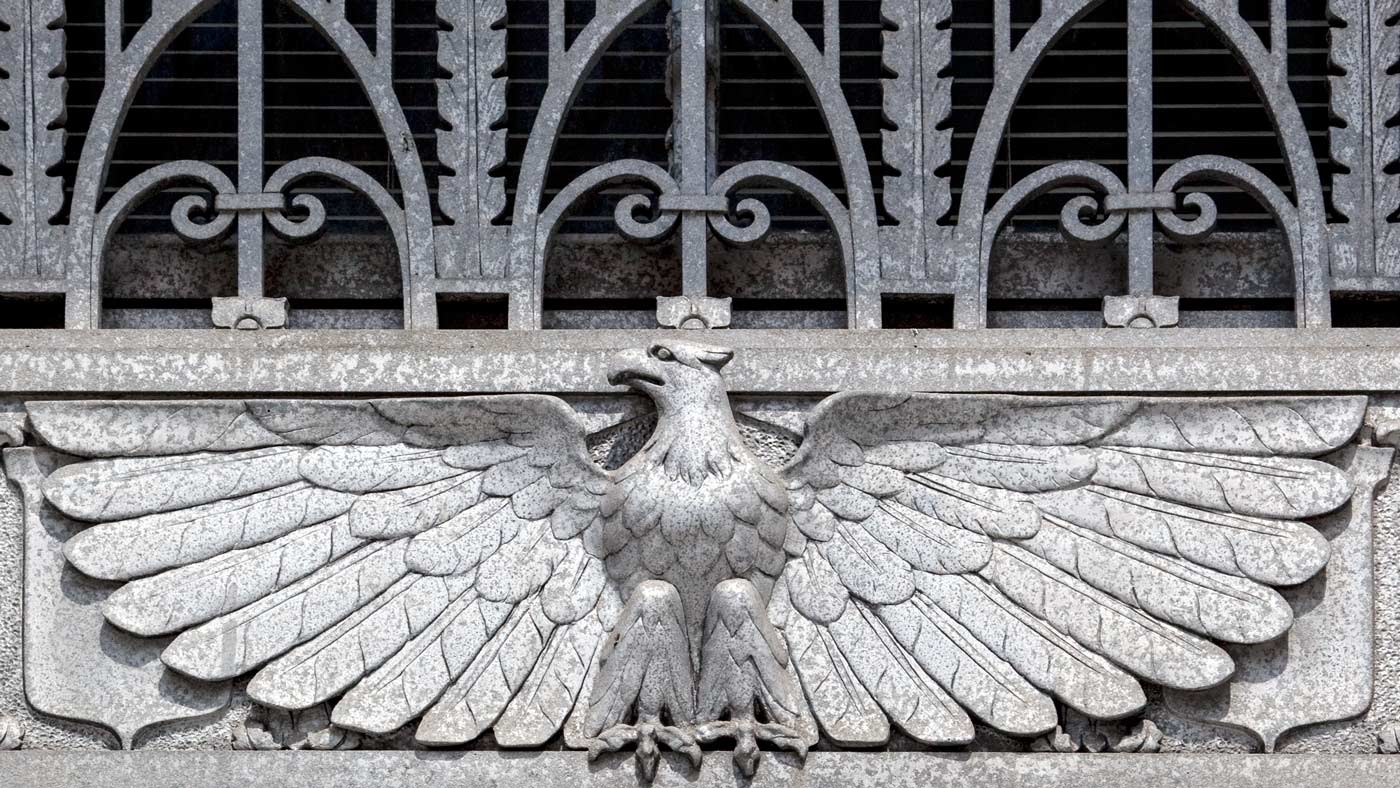
Art Deco Bald Eagle 1932 Clarkson S. Fisher Federal Building & U.S. Courthouse, Trenton, NJ - Carol M. Highsmith

1932. Exterior detail: eagle on stone. Clarkson S. Fisher Federal Building & U.S. Courthouse, Trenton, New Jersey.

The building is significant as a large WPA project. The exterior is a well-executed design with a "Stripped Neo-Classical" form featuring both Classical and Art Deco terra cotta detailing and fine grillwork. The interior of the building includes fine marble, brass, copper, and tile finishes, "New Deal Art" murals by Charles Wells, and impressive, almost completely intact courtrooms, public corridors, and judges’ chambers. More

BUY FINE-ART PRINT

Exterior details, Clarkson S. Fisher Federal Building & U.S. Cou

1932. Exterior detail: eagle on iron. Clarkson S. Fisher Federal Building & U.S. Courthouse, Trenton, New Jersey.

BUY FINE-ART PRINT

Exterior details, Clarkson S. Fisher Federal Building & U.S. Cou

1932
Clarkson S. Fisher Federal Building & U.S. Courthouse, Trenton, New Jersey.
Exterior detail.

BUY FINE-ART PRINT

The Kennedy-Warren apartment building, 3133 Connecticut Ave., NW, Washington, D.C. 1931

1931
The Kennedy-Warren apartment building.
Washington, D.C.
Architect: Joseph Younger.

The Kennedy-Warren, also known as the "Old Lady", was constructed from 1929 to 1931, and is considered the largest and best example of an Art Deco building in Washington.

BUY FINE-ART PRINT

John W. McCormack U.S. Post Office and Courthouse, Boston, Massa

1933. The John W. McCormack Post Office and U.S. Courthouse. Boston, Massachusetts. Architect: Ralph Adams Cram.

A superb example of monumental Art Deco civic architecture, the John W. McCormack U.S. Post Office and Courthouse presents intriguing exceptions to typical narratives of 1930s federal architecture. The use of Art Deco on large-scale federal buildings of that decade is rare. Originally named the U.S. Post Office, Courthouse, and Federal Building, it was designed by an architect famous for Gothic Revival ecclesiastical work. More

BUY FINE-ART PRINT

The Sidney M. Aronovitz U.S. Courthouse, Post Office and Custom

1933. The Sidney M. Aronovitz U.S. Courthouse, Post Office, and Customs House. Key West, Florida. Supervising Architect: James Alfonso Wetmore.

The passage of the Public Buildings Act of 1926 precipitated a period of building construction that was unprecedented in the United States. The Act specified that the office of the Supervising Architect of the Department of the Treasury would be responsible for the design and construction of all public buildings. The Key West Federal Building was constructed during this period, in 1930-1932.
The building is a two-story limestone-clad building. It is constructed of Key Largo limestone quarried at the Windley key quarry, a site now owned by the state of Florida. It is a Deco interpretation of a classical style. Source

BUY FINE-ART PRINT

The Sidney M. Aronovitz U.S. Courthouse, Post Office and Custom
1934 Interior grill with eagle. Art Deco style Federal Building

1933 Monroe Post Office and US Courthouse. Monroe, Louisiana. Interior art grill. Architect: James Alonso Wetmore. Image source. The courthouse is a four-story building comprised of over 45,000 square feet and was built in 1933 by the Works Progress Administration, a U.S. government workforce consisting of citizens that were out of work. These men used A-model vehicles to hoist sandstone, brick, and mortar to construct this structure. The original inside walls were made of plaster, most of which has been replaced by gypsum wallboard. Source

BUY FINE-ART PRINT

1936 Courtroom eagle at U.S. Court House, Austin, Texas

1936. Courtroom eagle at U.S. Court House, Austin, Texas, Austin. Architects Charles H. Page /  Kenneth Franzheim

An excellent example of Depression-era Moderne architecture. This style is revealed in its central massing, the rectangular form, the vertical flow of the window bays, the decorative metal grilles, and the geometric details. The exterior is also defined by reed-like pilasters, which enhance the vertical flow of the building while reflecting an element of restrained Neo-Classical influence.

BUY FINE-ART PRINT

Exterior medallion, Robert N.C. Nix Federal Building, Philadelph

1937. Exterior Medallion. Robert N.C. Nix Federal Building. Philadelphia, Pennsylvania. Architect: Harry Sternfeld.

A representative example of a relatively large, federally-funded, Depression-era project. Built under the auspices of the Public Works Administration (PWA), the building displays the stylistic approach of much late-1930s PWA architecture. A product of the locally prominent architect Harry Sternfeld (1888-1976) in association with the Ballinger Company (fl. 1920-present), it is one of a small number of high-quality Art Deco buildings constructed in Philadelphia. More

BUY FINE-ART PRINT

Exterior medallion, Robert N.C. Nix Federal Building, Philadelph

1937. Exterior Medallion. Robert N.C. Nix Federal Building. Philadelphia, Pennsylvania. Architect: Harry Sternfeld.

BUY FINE-ART PRINT

1937 Courtroom detail Robert Nix Federal Building Philadelphia P

1937. Courtroom interior wooden detail. Robert N.C. Nix Federal Building. Philadelphia, Pennsylvania. Architect: Harry Sternfeld.

BUY FINE-ART PRINT

Eagle at Federal Building and U.S. Court House, Peoria, Illinois

1938. Eagle at Federal Building and U.S. Court House, Peoria, Illinois. Architect Howard Lovewell Cheney.

This building was designed in the streamlined Art Moderne style, which was very popular in the late 1920s and the 1930s. This style emphasized the massing of simple geometric forms, as well as the use of repetitive window openings (typically grouped in multi-story, recessed vertical bands); contrasting light and dark building components; bas-relief wall ornamentation; and highly stylized (often geometric) forms for decorative design elements such as exterior lamps, handrails, and stone sculptures. More

BUY FINE-ART PRINT

Eagle at Federal Building and U.S. Court House, Peoria, Illinois

1939-1944
Appraisers building.
San Francisco, California
Front exterior eagle detail.
Architect: Gilbert Stanley Underwood.

The United States Immigration Station and Appraisers Stores, San Francisco (now commonly called the Appraisers Building)  housed immigration and customs agencies of the Federal government since its completion in 1944. The building embodies distinctive architectural characteristics spanning two significant periods in American architecture, the Depression and World War II.

BUY FINE-ART PRINT

Bald-Eagle-about-to-launch-Kachemak-Bay-Alaska

A Bald Eagle about to launch. Kachemak Bay, Alaska. Photo by Andy Morffew.

Theodore Roosevelt, Benjamin Franklin, and the Bald Eagle.


Seal of the President of the United States

Today the Bald Eagle is an immovable symbol, the pride of any U.S. citizen, and no one would ever dare criticize or replacing it. It hasn't always been like this.

Benjamin Franklin, for instance, called the Bald Eagle "A Bird of Bad Moral Character. "You may have seen him perched on some dead Tree near the River, where, too lazy to fish for himself, he watches the Labour of the Fishing Hawk. When that diligent bird has at length taken a fish, the Bald Eagle pursues him and takes it from him."

President Teddy Roosevelt once said that he did not understand why the Bald Eagle was chosen as US national symbol. He said that it should have been the Grizzly Bear. About the Bald Eagle, he said "It is nothing more than a glorified vulture!"
It even seems he ordered to replace the eagle with the grizzly, but overwhelmed by a sea of protests, he gave up.

Copyright, links and credits


All the images in this post are taken by Carol M.Highsmith, who donated her life's work of more than 100,000 images, royalty-free, to the Library of Congress, which established a rare, one-person archive.
If you use her pictures, we do recommend credit.


Carol Highsmith's America. Highly recommended.
Carol Highsmith Archive at the Library of Congress
Wikipedia Page

American Streamlined Trains — Striking Ads of the 1940s

American Streamlined Trains — Striking Ads of the 1940s

American Streamlined Trains — Striking Ads of the 1940s

The railroads told their own story. These are the words they used.

From the mid-1930s, American railroads faced competition from buses, airlines, and interstate highways. The answer was the streamliner — deluxe passenger trains built around speed, comfort, and the visual language of modernity.
The advertisements, pamphlets, and menus they produced were primary documents of rare quality. The writing matched the ambition of the trains themselves. This story presents the most significant examples — reproduced from original issues of Life Magazine and other period publications.
The series continues with two further chapters: Dining on the Train, and Trains and WWII.

Power to Pace the Future. A Streamlined train of American Railroads.

A "long streamlined giant capable of speed up to 120 miles an hour." Pennsylvania Railroad Ad on Life of January 22, 1945.

Celebrating American Technological Progress.


Starting from the mid-thirties, many railroads were driven progressively out of business due to competition from buses, airlines, and Interstate highways.
The answer was the development of deluxe passenger trains, the streamliners. Some became legendary and profoundly influenced popular culture by focusing on concepts such as power, speed, technological progress, comfort, and luxury service.

Railroads' advertisements, pamphlets, and even menus were extremely impacting, and it was not easy to select the best. We have divided this post into three parts. The second one will be "Dining on the train" and the third one on trains and WWII.

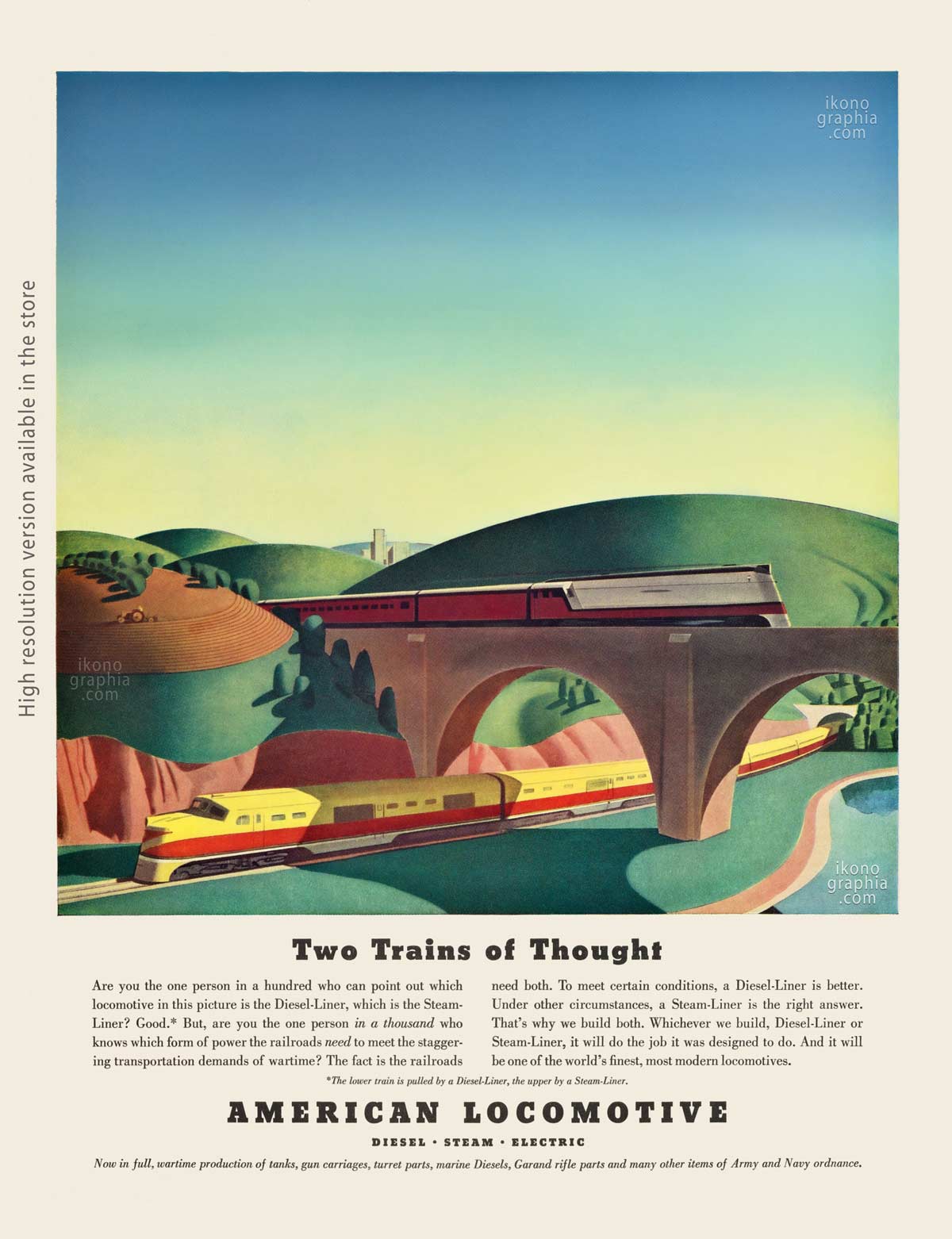
American Locomotive. Two Trains of Thought. Life Magazine. February 16, 1942

American Locomotive.
Two Trains of Thought
Life Magazine. February 16, 1942.


Are you the one person in a hundred who can point out which locomotive in this picture is the Diesel-Liner, which is the Steam-Liner? Good.*
But are you the one person in a thousand who knows which form of power the railroads need to meet the staggering transportation demands of wartime? The fact is the railroads need both. To meet certain conditions, a Diesel-liner is better. Under other circumstances, a Steam-Liner is the right answer.
That’s why we build both. Whichever we build, Diesel-Liner or Steam-Liner, it will do the job it was designed to do. And it will be one of the world’s finest, most modern locomotives.

*The lower train is pulled by a Diesel-Liner, the Upper by a Steam-Liner.

The Streamlined Trains


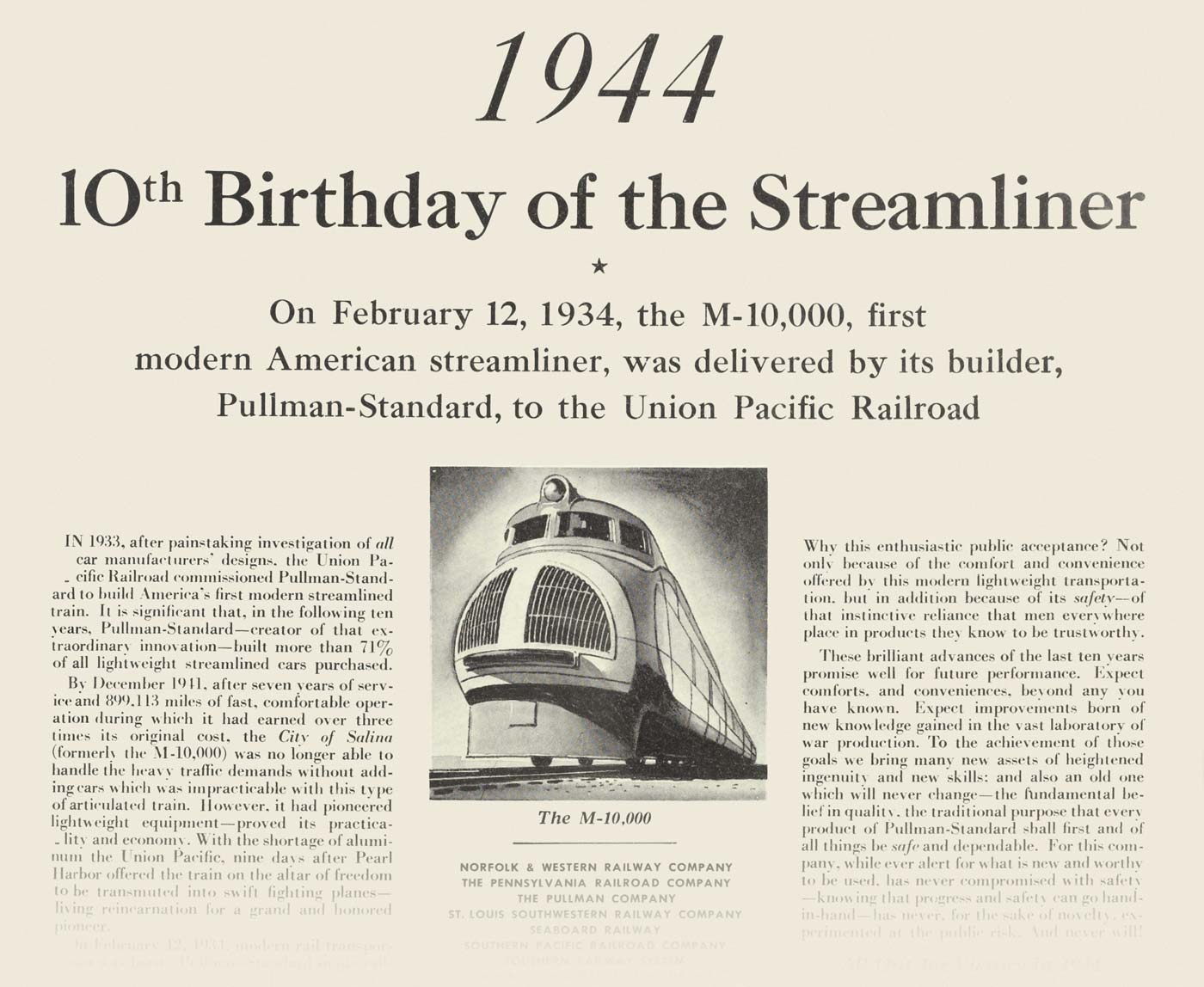
A streamliner is a vehicle designed to reduce air resistance. Let this Pullman-Standard ad tell you all the story of its birth.

In 1933, after a painstaking investigation of all car manufacturers’ design, the Union Pacific Railroad commissioned Pullman-Standard to build America’s first modern, streamlined train. It is significant that, in the following ten years, Pullman Standard—creator of that extraordinary innovation—built more than 71% of all lightweight cars purchased.

On February 12, 1934, the M-10,000, the first modern American streamliner, was delivered by his builder, Pullman Standard, to the Union Pacific Railroad.

By December 1941, after seven years of service and 899,113 miles of fast, comfortable operation during which it had earned over three times its original costs, the City of Salina (formerly the M-10,000) was no longer able to handle the heavy traffic demands without adding cars which was impracticable with this type of articulated train. However, it had pioneered lightweight equipment—proved its practicality and economy.
With the shortage of aluminum, the Union Pacific, nine days after Perl Harbor, offered the train on the altar of freedom to be transmuted into swift fighting planes—being reincarnation for a grand and honored pioneer.

Toy bread in form of bag. Nuoro, Sardinia

Pullman-Standard. 1944 - 10th Birthday of the Streamliner. Fortune Magazine, March 1944.

Power and Speed


The text of the Pennsylvania Railroad ad below perfectly summarizes what we said. It was published on Life on January 22, 1945.

Capable of speed up to 120 miles an hour, this long streamlined giant not only marks another forward stride in the science of railroading — it is indicative of the spirit of progress in an industry vital to the welfare of America. now and in the future.

Power to Pace the future - Pennsylvania Railroad ad - Life Magazine. January 22, 1945

Pennsylvania Railroad.
POWER TO PACE THE FUTURE
Life Magazine. January 22, 1945.


Here’s the drama that comes of a drawing board . . . first of a series of new engines now in service in the East-West route of the Pennsylvania Railroad!

Capable of speed up to 120 miles an hour, this long streamlined giant not only marks another forward stride in the science of railroading — it is indicative of the spirit of progress in an industry vital to the welfare of America. now and in the future.


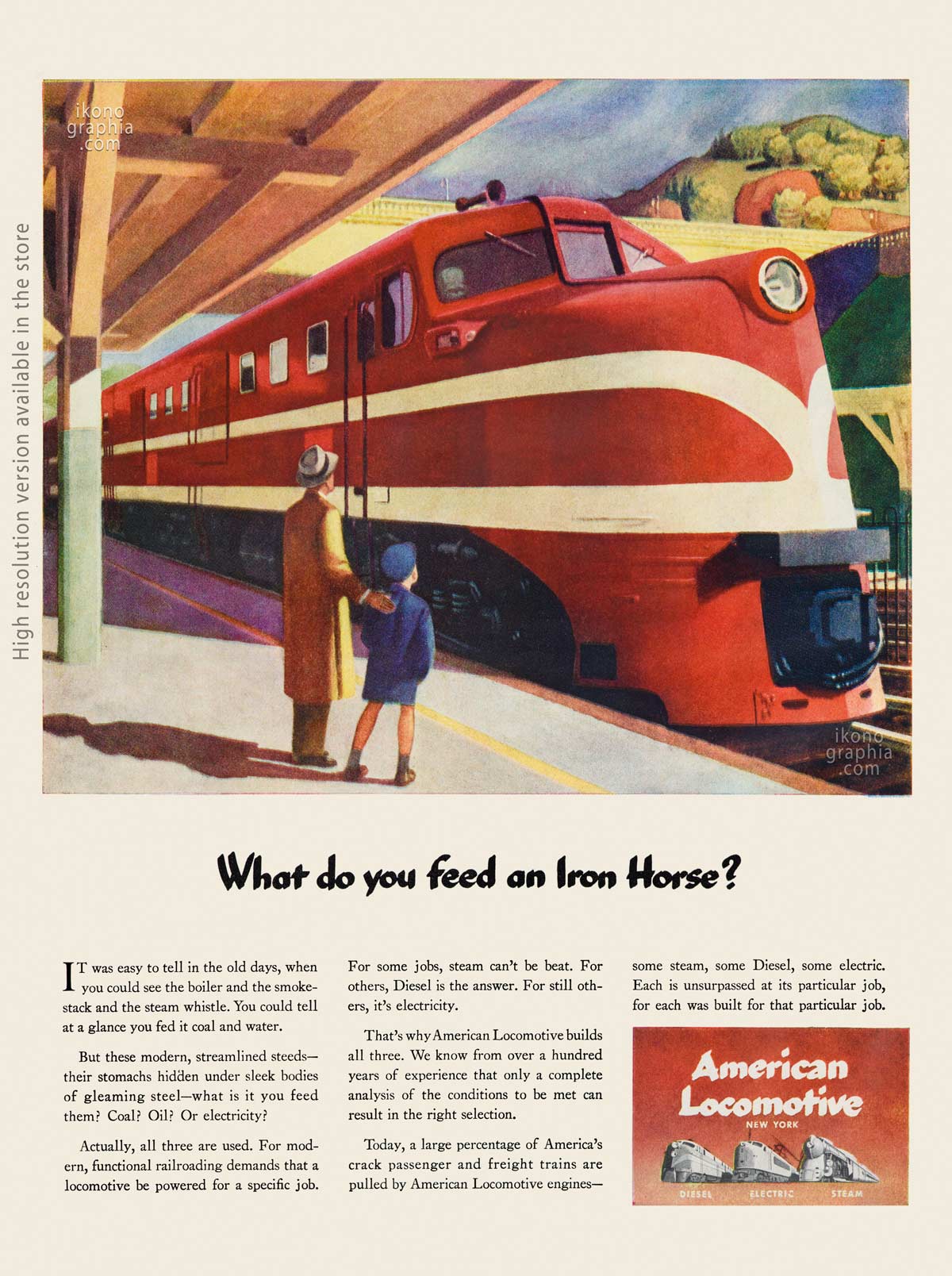
What do you feed an Iron Horse? - American Locomotive Ad - Life Magazine. February 21, 1944 - Artwork by Edward Hopper

American Locomotive.
What do you feed an Iron Horse?
Life Magazine. February 21, 1944.

Artwork with the unmistakable surreal style of Edward Hopper.

Read the ad's full text in the tab below


Read the ad's text


It was easy to tell in the old days when you could see the boiler and the smokestack and the steam whistle. You could tell at a glance you fed it coal and water.

But these modern streamliners steeds—their stomach hidden under sleek inside bodies of gleaming steel—what is it you feed them? Coal? Oil? Or electricity?
Actually, all three are used. For modern functional railroading demands that a locomotive be powered for a specific job.
For some jobs, steam can’t be beat. For others, Diesel is the answer. For still others, it’s electricity.

That’s why American Locomotives builds all there. We know from over a hundred years of experience that only a complete analysis of the conditions to be met can return in the right selection.
Today, a large percentage of America’s crack passenger and freight trains are pulled by American locomotive engines—some Steam, some Diesel, some Electric. Each is unsurpassed at its particular job, for each was built for that particular job.

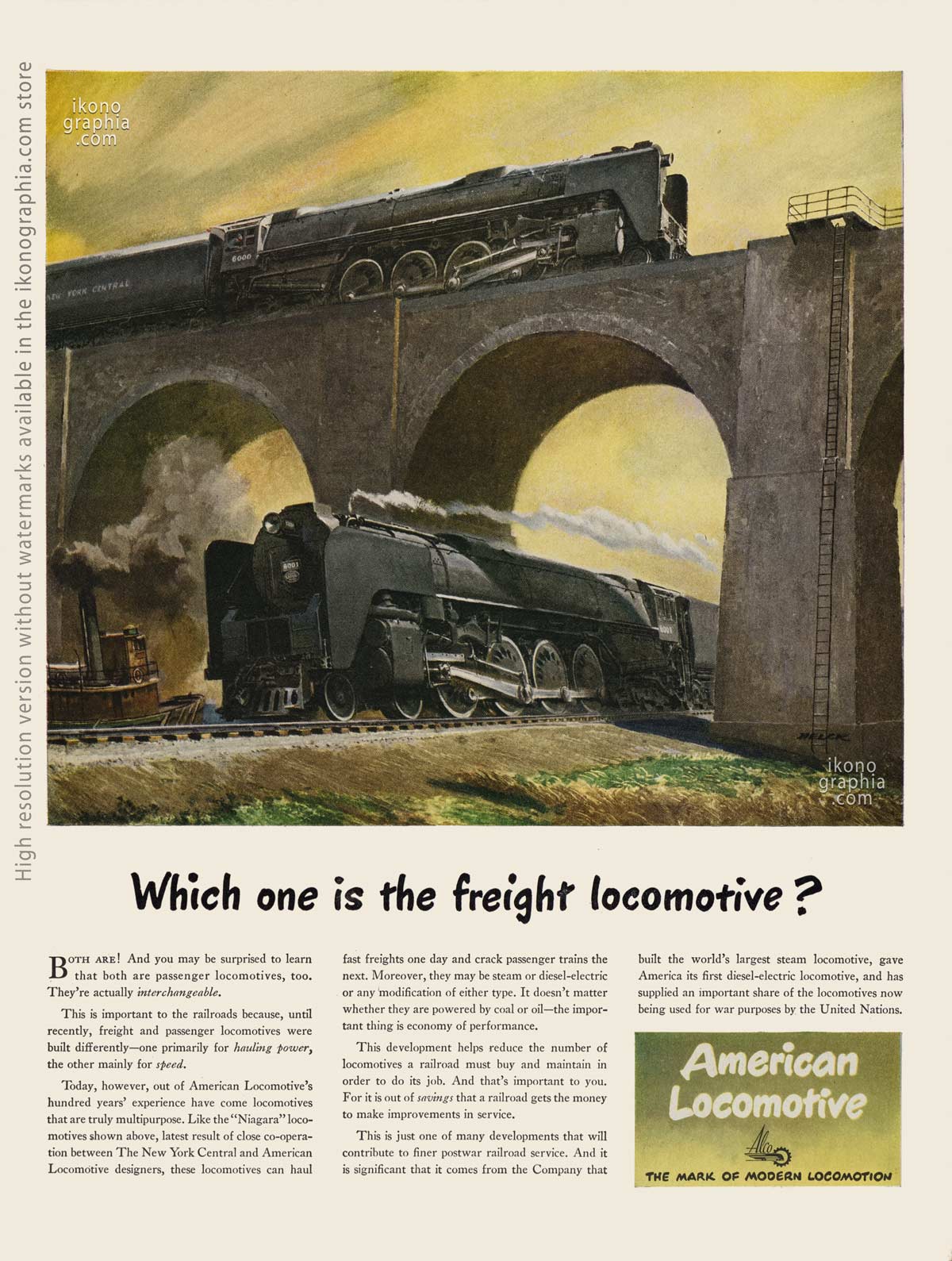
Which one is the freight locomotive? - American Locomotive ad, artwork by Peter Helck - Life Magazine. June 25, 1945

American Locomotive.
Which one is the freight locomotive?
Life Magazine. June 25, 1945.

Artwork by Peter Helck.

Read the ad's full text in the tab below.


Read the ad's text


Which one is the freight locomotive?

BOTH ARE! And you may be surprised to learn that both are passenger locomotive, too. They are actually interchangeable.

This is important to the railroads because, until recently, freight and passenger locomotives were built differently-one primarily for hauling power, the other mainly for speed.

Today, however, out of American Locomotive’s hundred years’ experience have come locomotives that are truly multipurpose. Like the “Niagara” locomotives shown above, latest result of co-operation between The New York central and American Locomotive designers, these locomotives can haul fast freights one day and crack passenger trains the next. Moreover, they may be steam or diesel-electric or any modification of either type. It doesn’t matter whether they are powered by coal or oil-the important thing is economy of performance.

This development helps reduce the number of locomotives a railroad must buy and maintain in order to do its job. And that’s important to you. For it is out of savings that a railroad gets the money to make improvements in service.

This is just one of many developments that will contribute to finer postwar railroad service. And it is significant that it comes from the Company that built the world’s largest steam locomotive, gave America its first diesel-electric locomotive, and has supplied an important share of the locomotives now being used for war purposes by the United Nations.

American Locomotive
THE MARK OF MODERN LOCOMOTION

Quick - what's it pulling, boxcars or berths? - American Locomotive ad, artwork by Peter Helck - Life Magazine. April 16, 1945

American Locomotive.
Quick - what's it pulling, boxcars or berths?
Life Magazine. April 16, 1945.

Artwork by Peter Helck.

Read the ad's full text in the tab below.


Read the ad's text


Quick - what's it pulling, boxcars or berths?

Even a railroad man couldn’t tell–until he sees more than the locomotive.
For this particular locomotive–built by American Locomotive and General Electric for the New Haven–is the product of an important development.

You see, for years, the railroads have had to bear the terrific expense of buying and maintaining different types of locomotive for freight and passenger service. But today–as a result of American Locomotive’s hundred years of experience in railroading–this problem has been licked.

Locomotives are now being built that are interchangeable–that can haul fast freight trains one day and crack passenger trains the next. And the maybe Diesel-Electric or steam or any modification of either type. It doesn’t matter whether they use oil or coal–the important thing is economy of performance.

This development means big savings for the railroads because it helps to reduce the number of locomotives a railroad must buy and maintain. And that’s important to you. For it is out of a railroad’s savings that improvements in service can be offered.

This is just one of many developments that will contribute to finer postwar railroad service. And, significantly, it comes from the Company that built the world’s largest steam locomotive, gave America its first diesel-electric locomotive, and has supplied an important share of the locomotives now being used for war purposes by the United Nations.

American Locomotive
THE MARK OF MODERN LOCOMOTION

Something New on the table! - Pennsylvania Railroad ad - Life Magazine. December 3, 1945

Pennsylvania Railroad.
Something New ON THE TABLE!

Life Magazine. December 3, 1945.


Read the ad's text


Something New ON THE TABLE!

For the first time, a way has been found to put into a locomotive the same kind of power that sends big battleships forward–turbine drive!

Developed by Pennsylvania Railroad research in conjunction with engineering staffs Westinghouse Electric Corporation and the Baldwin Locomotive Works, this new kind of locomotive power adds extra smoothness in fast runs–and many other notable advantages.

No bigger than your electric refrigerator, the steam turbine itself can produce power to pull the heaviest loads at high speeds. And the engineman controls the whole operation with a single small lever which works like a gear-shift on an automobile!

One of the most important changes in the power principle of the steam locomotive in over 100 years, the turbine drive engine gives promos of a great future in the field of train transportation.

PENNSYLVANIA RAILROAD
Serving the Nation

BUY UNITED STATES VICTORY BONDS AND STAMPS

ONE HUNDRED YEARS 1846-1946 - Pennsylvania Railroad ad - Life Magazine. February 18, 1946

Pennsylvania Railroad.
ONE HUNDRED YEARS 1846-1946

Life Magazine. February 18, 1946.


Read the ad's text


ONE HUNDRED YEARS 1846-1946

THIS YEAR–1946–marks a century of progress by the Pennsylvania Railroad in service to the American people. Reflecting the tremendous industrial growth of the Country itself, this service has steadily advanced from a few trains a day to 1,340 passenger trains and 3,170 freight trains daily, operating over 10,114 miles of line extending from the Atlantic to the Mississippi. Now, as we prepare to move into a second century, our combined research, engineering, and shop facilities are producing new trains, new locomotives, new cars, new comforts, and new technical achievements . . . to add still another chapter of transportation progress that has continued for one hundred years,

PENNSYLVANIA RAILROAD
Serving the Nation

Captions:

The “John Bull,” built in 1931–America’s oldest original locomotive

A Pennsylvania Railroad Locomotive of 1865

Power in 1902 for Pennsylvania Special, forerunner of Broadway Limited

Comfort and Service


We introduce this chapter using the text of this ad American Railroads which is an extraordinary blast into the spirit of the era.

It's a day coach. Looks pretty nice, doesn't it? And it's nice! Light, bright, roomy, and comfortably air-conditioned. Smooth riding at high speeds with pillow-soft seats that fairly invite you to sink down and relax — wide windows that provide a sweeping view of the scenic landscape — and dozens of important little travel conveniences.

• Where will you find such coaches as this? Many of them were built before the war began and are now in use. Hundreds more had been planned but never built — you know the reason why. • We haven’t been able to use scarce materials and manpower to build trains as we’d like to have them. There’s a war to win and doing our level best to meet the nation’s wartime transportation needs. • But we offer this little glimpse of the future because we want you to know, when you ride on our trains today, that railroads are looking ahead, planning better trains for tomorrow.

Like to ride on a train like this? - American Railroads artwork by John Vickery - Life. May 22, 1944

American Railroads.
Like to ride on a train like this?
Life. May 22, 1944

Artwork by John Vickery, an Australian illustrator who moved to New York in 1935.


Leisure and vacation


Excerpt from a Pennsylvania Railroad ad published on Life on June 13, 1949.

Choose your own vacationland. . . bur for extra pleasure . . . go by train!
It’s much more enjoyable. And the train is so comfortable, convenient and dependable. There’s room to roam, room to relax . . . weather you go, coach or Pullman. Your carefree vacation starts the moment you step aboard any of the 1100 daily trains that make up Pennsylvania Railroad’s great passenger fleets. No matter where you’re bound, there’s a train ready to take out on the day you play to go.

Holiday for Two! New York Central Ad - Life. May 31, 1948

New York Central.
Holidate for two! on New York Central's New Luxury Coaches.

Life Magazine. May 31, 1948.


Read the ad's text


Holidate for Two! on Mew York Central’s New Luxury Coaches We Couldn’t Budge on Our Budget! It looked a stay-home vacation for us . . . until we started figuring on New York Central’s low coach fares and round-trip savings. But Now Our Vacation Outlook’s Great . . . Water Level Route scenery’s a swell background for dining car meals. It makes great sightseeing, too, from the wide windows of our air-cooled coach. We’ll Have More to Spend at the Other End! Coach fares save us enough for extra vacation fun of our trip aboard world’s largest new luxury coach fleet. FREE-1948 Vacation Guide Are you summer-dreaming of the Adirondacks, Niagara Falls, New England, Canada, the Great Lakes or the Western Wonderlands? Then you’ll want this Vacation Guide, with its many pictures and fascinating fun map. For FREE copy, mail coupon to New York Central, Room 1334-L, 466 Lexington Avenue, New York 17, New York. New York Central System NEW YORK CENTRAL The Scenic Water Level Route

“North Western” ENLARGES ITS GREAT “400” FLEET. Pullman-Standard ad - Life. November 2, 1946

Pullman Standard.
"North Western" enlarges its great "400" fleet. Built by Pullman Standard.

Life Magazine. February 11, 1946.


Read the ad's text


“North Western” ENLARGES ITS GREAT “400” FLEET BUILT BY PULLMAN-STANDARD Fast, luxurious, dependable, the “400”s have won distinction among the great trains of America. You, the millions who have patronized the “400”s, have given them a service record which have few equals–bot in passengers volume and operating result.

Now come the first postwar additions to this busy popular fleet–new Pullman-Standard built the first lightweight, streamlined cars for any railroad. The North Western, likewise , has a long record of successful operation of this new equipment. Since 1933, we have built 141 lightweight cars for this railroad, or for its joint operation with Union Pacific and Southern Pacific. Watch for Pullman-Standard’s “Trains of Today!” For the safest and finest in modern rail transportation travel on trains which feature Pullman-Standard-built cars,

Pullman-Standard CAR MANUFACTURING COMPANY CHICAGO • ILLINOIS offices in seven cities . . .
Manufacturing plants in six cities World’s largest builders of modern streamlined railroad cars Caption:
The “400” Fleet operates between Chicago and Milwaukee, Wisconsin, southern Minnesota and the Upper Peninsula of Michigan.

It’s always fair weather. Pennsylvania Railroad ad - Life. June 30, 1941

Pennsylvania Railroad.
It's always fair weather...when you ride this great All-WEATHER FLEET!

Life Magazine. June 30, 1941.


Read the ad's text

Pennsylvania Railroad. It’s always fair weather Life Magazine June 30, 1941

It’s always fair weather – when you ride this great ALL-WEATHER FLEET! “It’s always fair weather”. . . . because Pennsylvania’s Railroad’s great Fleet goes 365 days a year – come rain, come hail, come storm, come sun. In fact, weather has nothing to do with its smooth, punctual service.

It always goes–it always gets you there! In comfort, in safety–economically! That is why business men, travelers with appointments to keep and people to meet, vacationists eager to go–chose the fine modern trains of this vast fleet. Do as they do!

Enjoy train travel at its best! Relax in air-conditioned Lounges gayly reminiscent of the smartest clubs…enjoy foods that have home-cooked flavor…retire to the privacy of Roomettes, Duplex Rooms, Bedrooms, Compartments, Drawing Rooms, Master Rooms–and sleep in real beds! Improved Section Sleepers, too. Best of all, whether you go Pullman or in restful reclining-seat Coach, FARES ARE LOW. Why, then, consider any other travel “way”?

Box: Now Two DE LUXE ALL-COACH TRAINS New-York-Chicago The TRAILBLAZER New York-St.Louis The JEFFERSONIAN ENJOY fast service, Observation-Buffet-Lounge Cars … Radios … mart Diners serving complete dinner for 75c, luncheon 65c, breakfast 50c … Reserved individual reclining seats … Attendants. Completely air-conditioned. Low coach fares. Also through service, Washington-Chicago and Washington-St. Louis, Captions: Fair inside too! No matter how hot is outside, you enjoy the coolness of air-conditioning inside. An innovation in privacy! Duplex Rooms. Completely self-contained private rooms on two different floor levels. Individual toilet facilities–many features! THE SHORTEST ROUTE BETWEEN EAST AND WEST. Serves America’s largest cities as shown on map. Through car service to principal points in New England and the South. Convenient connections to all the West. See America for $90 in coaches. Grand Circle Tour. Coast to coast. In Pullmans –$135 plus berth charge. NEW YORK - CHICAGO . . . 18 trains daily Led by Broadway Limited, The General NEW YORK - ST. LOUIS . . . 8 trains daily WASHINGTON - ST. LOUIS . . . 8 trains daily Led by “Spirit of St. Louis” WASHINGTON - CHICAGO . . . 11 trains daily Led by Liberty Limited WASHINGTON - CHICAGO . . . 11 trains daily Led by The Congressional NEW YORK - WASHINGTON . . . 40 trains daily Led by The Congressional Plus a fleet daily serving Philadelphia, Baltimore, Pittsburgh, Columbus, Cincinnati, Akron, Cleveland, Detroit, Louisville and other important cities. GO NOW–PAY LATER. Ask about Travel-Credit Plan.

Picture your family in a train like this! American Railroads, artwork by John Clymer - Life. December 2, 1946

American Locomotive.
PICTURE YOUR FAMILY IN A TRAIN LIKE THIS!

Life Magazine. December 2, 1946.

Artwork by John Clymer


CHILDREN’S HOUR—ON WHEELS

One day soon you’ll board a brand -new train with the kids—and every hour of the trip will be “The Children’s Hour.”
Skilled attendants will entertain your youngsters in a wonder room made especially for children. There’ll be a building blocks, story books, slippery slides, movies, and games galore to keep their trip—and yours—from being tiresome.
This is not a blue-sky promise. Children’s playrooms are just one of the new features of crack postwar trains which are now going into production. There will also be club cars that convert into theaters or night clubs, telephone service en route, coaches with lounge-cars luxuries, and sleeping quarters with the comforts of a good hotel.
These improvements are all part of a modernization program estimated at $1,600,000,000—the greatest in the history of the American railroads. They’re coming—not in the vague future—but as soon as the modern postwar trains make their first runs.

LOCOMOTIVES AS REVOLUTIONARY AS THE TRAINS THEY PULL

Many of America’s trains will sweep down the tracks behind American Locomotive’s Diesel-Electric takes advantage of important wartime research. The turbo-supercharged engines, mass-produced on a moving assembly line, pack more power in less weight than any other railway diesel.
These super locomotives are years ahead in speed, power, smoothness and economy operation. The line includes passenger and freight diesels, road and yard switchers—an Also diesel for every railroad hauling job.
Builder of more locomotives than any other company in the world. Also has introduced many basic improvements in locomotives. Among many “first,” American Locomotive built the first Diesel-Electric back in 1925.
When you board the new wonder trains powered by American Locomotive, you’ll be riding behind the finest locomotives ever built.

Trains for Tomorrow


We introduce this chapter using the text taken from the Bohn ad shown below.

Today America's manufacturing processes are concentrated solidly on war materials for Victory. From this gigantic effort will spring many new developments of vast economic consequence to the entire universe. The City of the Future will be born—startling new architectural designs will be an everyday occurrence! New alloys—new materials—new applications—designs engineered by Bohn will be an important contributing factor in making possible a world of new products.

It's years ahead of schedule. General Motor's Exciting New Train of Tomorrow. artwork by John Clymer - Life. June 16, 1947

General Motors.
It's years ahead of schedule. General Motor's Exciting New Train of Tomorrow.
Life Magazine June 16, 1947


Starting from this month, this Diesel-powered train of the future will bring to many leading American cities a preview of some luxurious comforts in store for railroad travelers.
This new and wonderful train is unlike any that ever rolled into your local station. As yet, it isn’t on the schedule of any railroad. But in it you’ll see equipment and appointments which we hope will provide new enjoyment, comfort, and utility in future railway travel.
Stroll through the Train of Tomorrow and see the many new and better things for the first time assembled in one complete train.

Conceived by General Motors engineers and stylists, this new train, from the powerful Diesel locomotive to its unique and beautiful observation car, is packed throughout with vivid and stimulating ideas for future travel pleasure. Among these, there is the Astra Dome, a 32-foot glass-enclosed observation deck built into the roof of every car—giving passengers a giraffe’s-eye view of the passing landscape and skyscape.

You’ll see a roof garden diner - a sleeping car rich in space, good taste, and comfort. You’ll see a super-restful, roomy chair — a luxuriously appointed observation lounge.

Trains for the Modern World. Budd ad - Nation's Business. September 1944

Edward G.Budd Manifacturing.
Trains for the Modern World
Nation's Business. September 1944.

Two of the famed Rock Island "Rockets" in Las Salle Street Station,Chicago.

Read the ad's text

Two of the famed Rock Island "Rockets" in Lo Salle Street Station, Chicago

Trains for the Modern World

From the heart of Chicago, the Rock Island Lines fan out to serve important cities of the Mississippi Valley, the Plains states and on to the Pacific Coast. Typical of their modern service is the Peoria Rocket, a Budd-built stainless steel streamliner which flashes over the 161 miles between Chicago and Peoria four times a day, seven days a week. Since 1938, this one train has made more than 9000 trips and has carried well over a million passengers. Similar Rocket service links Chicago and Des Moines, Kansas City and Minneapolis, and scores of other fortunate cities on this progressive railway system.

Budd-built trains are constructed of stainless steel, the strongest and safest material for car-building. Now represented on the foremost railroads in America, they will be seen in far greater numbers in post-war years, bringing still more advanced ideas of comfort, luxury and convenience for the traveling public. Budd builds for the future.
EDWARD G. BUDD MANUFACTURING CO. PHILADELPHIA 32, PA.

Originators of ALLSTEEL* auto bodies, stainless steel lightweight trains and highway truck trailers. Designers and makers of airplane and marine structures. Inventors of the SHOTWELD* system of fabricating hi-tensile steel.

BUDD

Trains of thought for the Future. American Railroads ad - Life. March 27, 1944

American Railroads.
Train of Thought for the Future

Life Magazine. March 27, 1944.

Artwork by James Bingham


Read the ad's text

TRAIN OF THOUGHT FOR THE FUTURE

Some day this war will be won by America and her Allies.
Our first duty meanwhile is to meet the demands of the war. This we are doing.
The going hasn’t always been easy or comfortable. We believe you understand the reasons, and we appreciate your patience, your good-humored acceptance of inconvenience.
And we’d like you to know our ideas of comfort and style go far beyond what we’re able to offer today. That’s why we print the picture below.
It will give you some idea of how we’d like to serve you — how we’re looking and planning ahead right now to make future railroad travel a thrillingly pleasant experience.
It can’t be done all at once. It will take money and time.
But you can be sure of one thing. Our goal is to give future America the finest transportation the world has ever seen.

ASSOCIATION OF AMERICAN RAILROADS
ALL UNITED FOR VICTORY

Forecasting the Future


We introduce this chapter using the text taken from the Bohn ad shown below.

Today America's manufacturing processes are concentrated solidly on war materials for Victory. From this gigantic effort will spring many new developments of vast economic consequence to the entire universe. The City of the Future will be born—startling new architectural designs will be an everyday occurrence! New alloys—new materials—new applications—designs engineered by Bohn will be an important contributing factor in making possible a world of new products.

A dream train comes True - Bohn ad. atwork by George W. Walker - Fortune. January 1943

Bohn Aluminum and Brass
A DREAM TRAIN COMES TRUE

Fortune. January 1943

Artwork by George W. Walker, an American industrial and automotive designer based in Detroit. His most notable work was the original Ford Thunderbird.


Forecasting a city of the future, art George Walker. Bohn Ad, Nation's Business, April 1943

Bohn Aluminum and Brass
Forecasting by Bohn

Nation's Business. April 1943

Artwork by George W. Walker, an American industrial and automotive designer based in Detroit. His most notable work was the original Ford Thunderbird.


Read the ad's text

NATION'S BUSINESS for April, 1943

FORECASTING BY BOHN

Today America's manufacturing processes are concentrated solidly on war materials for Victory. From this gigantic effort will spring many new developments of vast economic consequence to the entire universe. The City of the Future will be born—startling new architectural designs will be an every day occurrence! New alloys—new materials—new applications—designs engineered by Bohn will be an important contributing factor in making possible a world of new products. Remember the name Bohn. Our advanced knowledge will be most helpful to many manufacturers in redesigning their products of tomorrow.

BOHN

BOHN ALUMINUM AND BRASS CORPORATION, DETROIT, MICHIGAN
GENERAL OFFICES—LAFAYETTE BUILDING
Designers and Fabricators—ALUMINUM • MAGNESIUM • BRASS • AIRCRAFT-TYPE BEARINGS

All the Comforts of Roam. American Railroads ad, artwork by James Bingham - Life. April 24, 1944

American Railroads.
All the Comforts of Roam

Life Magazine. April 24, 1944.

Artwork by James Bingham


Read the ad's text

ALL THE Comforts OF ROAM!

The day is coming when a train trip will again be something to look forward to eagerly — something to be enjoyed at ease, in spacious comfort — and all at moderate price.
That of course will be after the war is won. It will be when the armed forces no longer need nearly half of all our passenger equipment to move fighting men. It will be when many coaches and Pullmans now busy in war service can be honorably retired to make way for new cars with comfort, convenience and thoughtful appointments beyond anything the past has known.
That will take money — vast sums of money . It will take time. But we believe that it is worth while today to tell you what we plan for tomorrow — to help you realize that the wartime service we are able to give today is by no means a sample of what’s in store for the future.

ASSOCIATION OF AMERICAN RAILROADS
ALL UNITED FOR VICTORY

A prediction by Lurelle Guild


Lurelle Van Arsdale Guild was an architect, industrial and interior designer, illustrator and writer. In this 1944 ad for the Weatherhead Company, he predicts the future of railroad cars.

The railroad car of tomorrow will make today’s deluxe cars resemble the stagecoach by comparison. I have designed for one of the country’s largest railroads a train embodying numerous new and practical features, including super-efficient heating and cooling to eliminate dust, germs, and draft.

Coach passengers will have club car comforts. You’ll experience the restful quietness of acoustically-correct, fabric coated walls; color-corrected, cold cathode lighting with pinpoint lights to spotlight at night individually reclining sets that will face the windows. Your luggage will be safely secured in individual lockers, and all cars will be wired for sound and telephone connections.
Yes, your War Bonds will buy you many delightful experiences on the railroad trains of tomorrow.

I Predict … by Lurelle Guild - The Weatherhead Company ad. artwork by Lurelle Guild

The Weatherhead Company
I Predict...by Lurelle Guild

Fortune. February 1944

Artwork by Lurelle Van Arsdale Guild, an architect, industrial and interior designer.


EUR Euro