
Divina Bugatti. A Timeless Legend Celebrated in a Timeless Book
Franco Maria Ricci's most celebrated automotive book — photographed by Roberto Bigano at the Musée National de l'Automobile, Mulhouse, 1991.
In 1991, Franco Maria Ricci — the publisher Fellini called "La Perla Nera" — commissioned Roberto Bigano to photograph the historic Bugatti collection at the Musée National de l'Automobile in Mulhouse. The pictures were taken over six nights, with a 4×5 view camera, in a closed museum. Two editions of 5,000 copies each. Both sold out.

Divina Bugatti's Story. Characters and Background.
We will tell you the story of the book "Divina Bugatti." It was created as a joint effort between Romano Artioli, owner of Bugatti Automobili, and Franco Maria Ricci, a legendary Italian publisher—the photographs by Roberto Bigano. Before we begin, let us introduce the characters and put them in context.
Automobiles Ettore Bugatti was a French high-performance car manufacturer founded in 1909 in Molsheim, Alsace, France, by the Italian industrial designer Ettore Bugatti. The firm produced about 8,000 cars and is known for its design beauty and many race victories.
Romano Artioli is an Italian visionary entrepreneur who bought the Bugatti brand in 1987 and revived it in Campogalliano, Modena, as a builder of its time's fastest series-production car. Bugatti Automobili produced a total of 128 cars. Read all the stories here.
Franco Maria Ricci was one of the most refined editors the world had ever seen. His iconic Magazine, FMR, and splendid books are still a reference. However, FMR was also an often unattainable goal for any photographer. Laura Casalis, Franco Maria Ricci's widow, recently relaunched the FMR magazine and Publishing House with outstanding publications.
Roberto Bigano was Bugatti's photographer at the beginning of the 1990s, documenting the birth of the new Bugatti. Roberto will introduce us to the fascinating vintage Bugatti world.


Bugatti Type 57SC Coupè Atalante (1937) in two lighting modes
Use the arrows or tap on devices to see the two versions. Courtesy: Musée National de l’Automobile Mulhouse.
Roberto Bigano and Divina Bugatti
Let Roberto Bigano tell us how the Divina Bugatti book project started and went through.
"In 1991, I was working for Bugatti Automobili. One day, the refined publisher Franco Maria Ricci, who already desired to celebrate the myth of the Bugatti, suggested the idea of a book on the legendary brand to Romano Artioli, the Bugatti company owner. They reached an agreement, and the plan went through. Naturally, Artioli mentioned "the best photographer in the world" to Ricci, encouraging my candidacy for the job. Ricci, as expected, was skeptical. "I have my photographers, ones I trust," he said with a half smile. The persistence of Artioli gained me a meeting with Ricci. "Go and take a few shots; we'll see," he said to get rid of me."
From Roberto Bigano's "1976-1992. A very serious, semi-serious biography."

Dashboard of a Bugatti Type 35B Grand-Prix (1927).
Courtesy: Musée National de l’Automobile Mulhouse.
Roberto Bigano and Divina Bugatti
I felt well-equipped for my departure—one hundred forty-five different accessories packed in the trunk of my station wagon. For months, I had been working on how to build a mobile set around a Bugatti on location. Before violating that holy ground, I carried out a test: I photographed a Lancia Thema in a large shed. It worked, so I decided to go ahead.
Upon arriving at the National Automobile Museum of Mulhouse in Alsace, I embarked on my nocturnal marathon. Cloaked in the atmosphere of suspense, in the eery silence, I came face to face with The Divine. The situation reminded me of one of Hemingway's stories: the bull and the lion, still before the charge. I was almost worried that the steel muscles would explode, at any time, in all their power, and the beast within would run me over like a train. I had an emotional outburst; I felt as if I were running a fever. Like a robot, I kept shooting and opening Polaroids. I looked at her, but I could not see inside her. Fatigue and tension made everything even more dramatic. "What am I doing here in France, in the middle of the night, in a dark museum? Why didn't I stay home?" I started thinking.
From Roberto Bigano's "1976-1992. A very serious, semi-serious biography."

The "Turning Point" Polaroid
Suddenly, I had reached the turning point: I opened yet another Polaroid, but this time, I found the courage to look at it with a photographer’s eye. I had recognized her, THE Bugatti, in all her dazzling beauty. “I am yours. Only you will be able to possess me,” she was saying. I started dancing as if I was in the middle of the Rio de Janeiro carnival parade. I didn’t feel tired anymore. “I’ve done it!” I said, my voice echoing in the empty museum.
I’d finally gotten a hold of the situation. I’d jumped on the wild horse and was riding as a Native American would.
From Roberto Bigano's "1976-1992. A very serious, semi-serious biography."

The Backstage for Divina Bugatti — Musée National de l'Automobile, Mulhouse, Alsace, France — June 1991.
All the pictures were taken with a 4x5 Plaubel Wiew Camera, Makro Sironar 300mm lens, and Ektachrome Professional film.
The Presentation at Franco Maria Ricci.
I arrived at Franco Maria Ricci’s, feeling confident and appearing as cold-blooded as a contract killer. I knew I was in the presence of one of the most refined editors the world had ever seen. Still, I also knew that I could not fail: if he had any taste at all – and it could not be otherwise – he could not still be indifferent after seeing my work.
Ricci received me with a gentler than polite smile, the smile you would give a child showing you their drawing. His expression changed and suddenly brightened after his eyes settled on the first transparency. “But they are… lit!” he whispered to himself. “Of course they are! Did you think I would bring you the dark ones?” I answered in a friendly yet amused manner. It felt like I was watching from the outside as if I were the spectator to a film. Franco Maria Ricci picked up the phone. “Come and look at something sensational!” he said, running down the corridor enthusiastically. “Call the others and tell them to come to my office!” He looked at me excitedly in front of all his associates, as if I were a superhero, and offered me some incredible projects: on Spanish baroque style, on medieval armor, on the town of Parma, and on French cabinet-makers. He had just assigned me all his future projects.
I had managed to impress Franco Maria Ricci, the king of aesthetics!
From Roberto Bigano's "1976-1992. A very serious, semi-serious biography."

The Backstage for Divina Bugatti — Musée National de l'Automobile, Mulhouse, Alsace, France — June 1991.
All the pictures of the Royale were taken at night in this set, which was highly problematic. The Royale was 7.2m / 24 feet and was very difficult to lighten.
Selected pictures from the book
Selected images from the book — The most iconic Bugattis, documented under the most demanding editorial standards in the world.
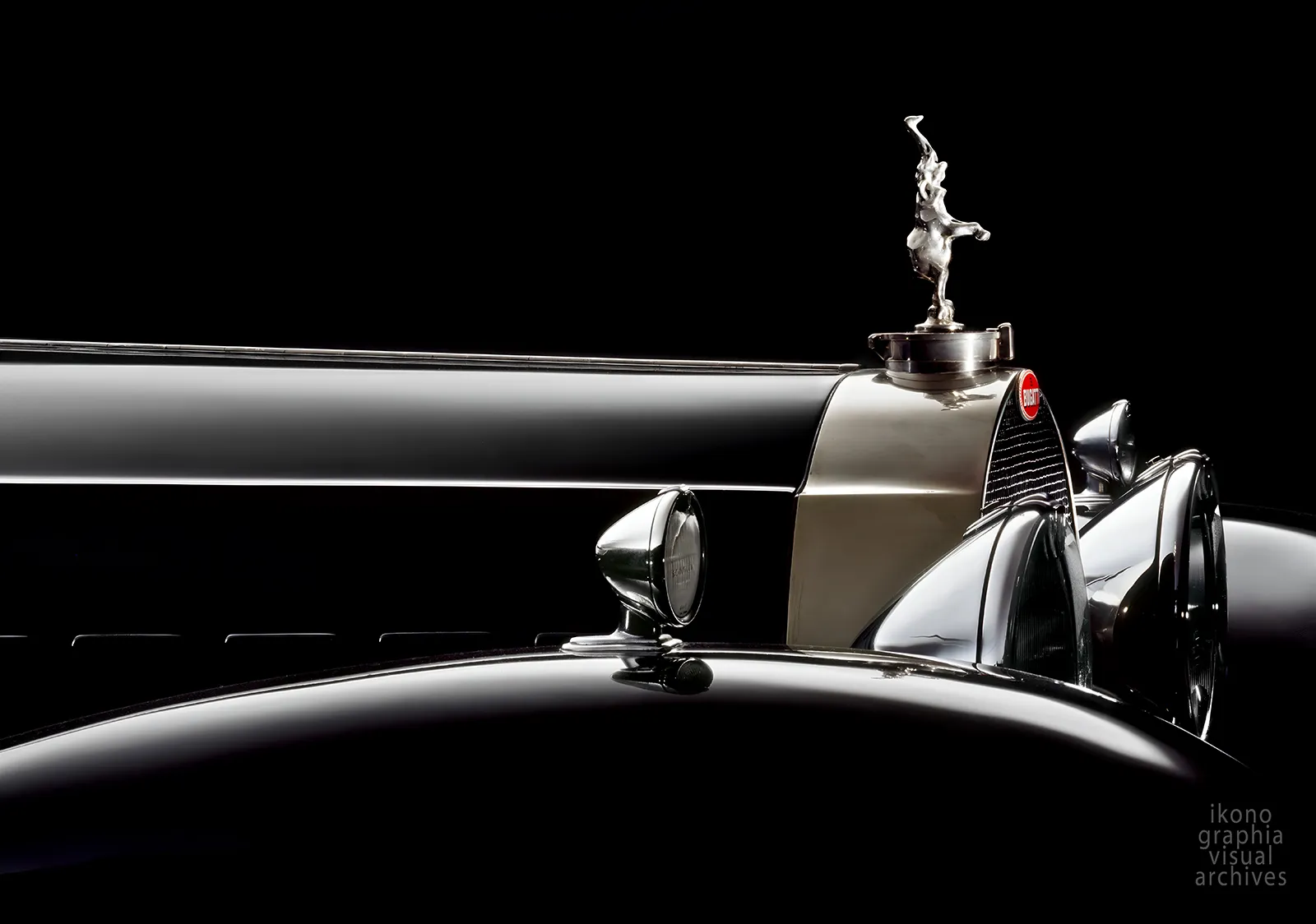
Bugatti Type 41 Royale Coupé Napoléon — Bonnet and Rampant Elephant, 1929
The personal car of Ettore Bugatti. Engine: 12,763 cc. Photographed for Divina Bugatti — Franco Maria Ricci's most celebrated automotive book.
Ricci's rule was absolute: no non-orthogonal images. His response: "We never publish this kind of photograph, but this image is so beautiful that I must. Please don't do it again." The world's most demanding publisher broke his own rule for this picture.

The Elephant carved by Rembrandt Bugatti placed atop the radiator grill of Ettore Bugatti's Type x41 Royale Coupé Napoleon.
An elephant standing on its back legs, with the erect trunk symbolizing aggression and coupling (1929).

Bugatti Type 57SC Coupé Atlantic — 1937
Detail of the windshield and wipers emphasizing the riveted crest. Jean Bugatti designed the half-body ending in a crest. He then reverted the first part right-left and finally joined the two pieces with rivets in one of the most daring automotive designs.

Bugatti Type 32 Biplace Course "Tank" — Rear view, 1923.
One of the first racing cars designed around aerodynamic principles — the body enclosing the wheels, the silhouette a single uninterrupted form.
This rear view reveals the engineering logic: everything hidden, everything intentional. Among the first racing cars to use four-wheel braking.

Bugatti Type 35B Sport Two-seater, US Coachwork — Rear view, 1927.
Purists consider the American coachwork a deviation from the original design.

Bugatti Type 59-50B Grand Prix Monoplace Course — Single Seater, 1938
The last racing Bugatti.

The First Epowood Model of Bugatti EB110 — Unveiled in Divina Bugatti.
The early EB110 epowood maquette produced during the 1991 restyling phase led by architect Gianpaolo Benedini. The model introduces the covered rear wheels, a deliberate reference to the Bugatti Atlantic and Aérolithe, reconnecting the modern EB110 project to the marque’s most radical pre-war designs and marking a decisive step toward the final EB110 GT.

DIVINA BUGATTI — Storia di un capolavoro meccanico
Divina Bugatti. Storia di un capolavoro meccanico.
Divine Bugatti. Histoire d'un chef dœuvre de la mécanique.
Franco Maria Ricci Editore 1991.
Photographs by Roberto Bigano.
Texts by Giuseppe Maghenzani, Ivo Ceci, Norbert Steinhauser, Paul Kestler.
204 pages.
72 color prints on matte-coated paper.
15 hand-applied color plates.
29 reproductions 30 x 30 cm.
Luxury Fabriano blue-laid paper.
Black "Orient" silk binding with gold impressions.
Circulation of Italian Edition, 5000 numbered copies.
Circulation of French Edition, 5000 numbered copies.
Copyright, Links And Credits
Photography, Copyright & Credits
These images are part of the Ikonographia Visual Archives: — Bugatti Heritage Collection — Bugatti Factory Drawings Archive.
All drawings reproduced by Roberto Bigano in 1990 from originals held in the Bugatti factory archive. The current location of the originals is unknown.
All photographs © Ikonographia / Roberto Bigano — All Rights Reserved.
⸻
Terms of Use (Summary)
The images presented in this archive are copyrighted and available for licensed use only through Ikonographia Visual Archives.
You may not download, reproduce, publish, or distribute these images without a valid license. For commercial or editorial licensing, please refer to the product pages or contact Ikonographia directly. A full explanation of licensing terms is available in the Shop / Licensing Information section under "Ikonographia — Standard License" and "Ikonographia — Merchandising & Product Use Licenses"
⸻
The Ikonographia Bugatti Heritage Archive
Between 1990 and 2009, photographer Roberto Bigano documented Bugatti with a level of access that no longer exists and cannot be replicated. The relationship began with Romano Artioli — the Italian entrepreneur who had just acquired the Bugatti name and was preparing its revival at Campogalliano — who gave Roberto carte blanche to work inside the factory, the archive, and every event that followed. No brief. No restrictions. No supervision.
What resulted is not a single project but five distinct bodies of work: the factory technical drawings reproduced before they disappeared, two major photographic commissions on the historic cars, a complete documentary record of the Bugatti International Centenary Meeting in Tuscany, and an Alsatian reportage made inside Molsheim before the restoration began. Together they form one of the most complete private archives of Bugatti heritage in existence — most of it unpublished until now, some of it available nowhere else.
The archive is not a celebration of the marque. It is a record made by someone who was trusted enough to be inside it, at the precise moment when its past and its future were in the same room.
⸻
Credits & Acknowledgments
Ikonographia gratefully acknowledges the fundamental contribution of Romano Artioli, founder of Bugatti Automobili, without whose trust and unrestricted access this archive would not exist.
⸻
Ikonographia Mission Statement
Ikonographia is committed to the accurate documentation, preservation, and ethical dissemination of twentieth-century visual culture.
⸻
Archival Notes
These drawings were reproduced by Roberto Bigano in 1990, during the preparation for the revival of Bugatti Automobili at Campogalliano. Access to the Bugatti factory archive was granted by Romano Artioli. The drawings document the original Molsheim factory production.
⸻
Further Reading (Selected Sources)
- Romano Artioli, Bugatti & Lotus Thriller — A first-person account of the Bugatti Automobili project by its founder: the dream, the factory, the cars, and the dramatic events that brought it all to an end. Available in English — Amazon US · Italian — Amazon IT
- Romano Artioli — Official Website The story of a boy with a big four-wheel dream.
⸻


