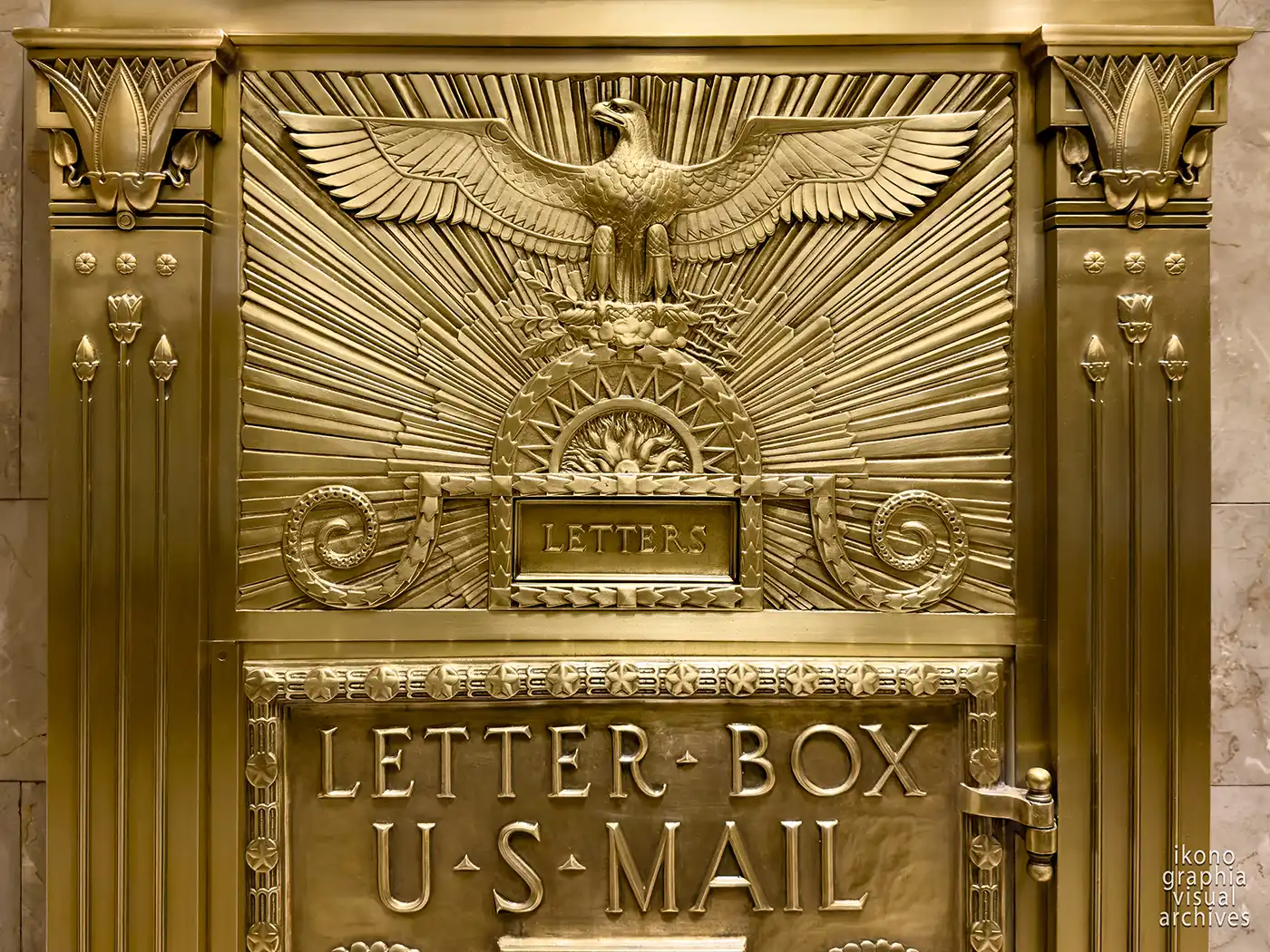
Art Deco Eagle and Sunburst — Fred French Building Mailbox, NYC, 1927
The American eagle with outstretched wings, set against radiating sunburst rays. At this distance the precision of Bach's metalwork becomes visible — the feathering, the geometry of the rays, the weight of the form against the flat ground. National symbol and ancient ornament in a single casting.
This is the crowning element of a mailbox that carries three symbolic registers simultaneously — American federal, Babylonian, and corporate. The eagle presides over all of them. Oscar Bach executed the metalwork. Vincent Glinsky conceived the program. The casting is gilded bronze.
Artwork by Vincent Glinsky — Metalwork by Oscar Bach.
Program by Douglas Ives.
€95.00
Royalty-free JPG — 8000x6000px, 26.48MB.
© Ikonographia / Roberto Bigano
LICENSE TERMS
This image is provided under a royalty-free license by Ikonographia / Roberto Bigano. By purchasing and downloading this file, you are granted the following rights:
You May
- Use the image in print and digital media (books, magazines, websites, videos, educational materials, presentations, and advertisements).
- Use the image in editorial, corporate, or client work, including commissioned projects.
- Modify, crop, or combine the image with other elements for creative use.
- Create photographic prints for personal or internal company use only (display, offices, presentations).
You May Not
- Resell, redistribute, sublicense, or share the image file in any form that allows third-party access.
- Use the image in products for resale (prints, posters, merchandise, NFTs, templates, stock collections) without a separate extended license.
- Claim authorship of the image or remove copyright attribution.
Read our full Copyright & Licensing Policy for detailed information.
Copyright: © Ikonographia / Roberto Bigano. All rights reserved.
SUGGESTED USES
- Architecture and design publications.
- Educational materials or exhibitions.
- Interior design presentations and mood boards.
- Commercial, editorial, or creative projects.
Each download includes a royalty-free license for use in both print and digital media.
The Fred French Building, 1927 — Overview
An Architect's Obsession, A Sculptor's Mastery
Completed in 1927, the Fred French Building on Fifth Avenue contains the most complete Mesopotamian-themed decorative cycle in American Art Deco. While its stepped crown and gilded façade are widely admired, its most exceptional achievement lies within: a decorative program conceived by architect H. Douglas Ives and executed in bronze by sculptor Vincent Glinsky — a lobby conceived as a complete Mesopotamian environment.
Ives documented his own obsession in writing: the Tower of Seven Planets at Babylon, the Ishtar Gate, Chaldean enameled brick. The iconographic program was not intuition — it was research translated into architecture.
The Bronze Program
Glinsky's contribution spans the building's interior in bronze throughout. Working through 1926 and into 1927, he produced entrance reliefs, elevator doors, mailboxes, door surrounds, and ornamental wall panels — a comprehensive sculptural environment, not a series of isolated commissions. Oscar Bach executed the metalwork in gilt bronze, bringing Glinsky's models into their final material form.
More than fifty distinct sculptural subjects, each carrying the same visual authority as the next. The lobby does not have decorated surfaces. It has a program.
The Panels
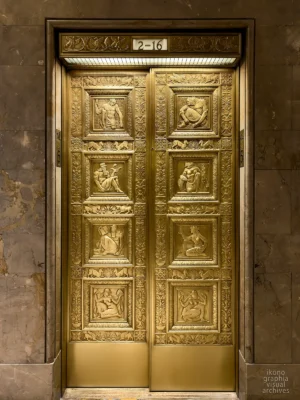
Eight gilt bronze panels embodying Industry, Commerce, Finance, and Building — the four pillars of Fred F. French's real-estate empire, translated into a sculptural language rooted in Art Deco geometry and documented Babylonian sources.
The arrangement on the doors is graphically balanced, not thematically ordered. The eye moves across figures and ornament before resolving into program. The logic reveals itself slowly — four themes, eight figures, one coherent argument about what a city is and what sustains it.
The hybrid style reflects Classical allegory, modern stylization, and the direct influence of Assyrian and Chaldean sources — documented by Ives in his own writing before a single panel was cast. These are not decorative objects that happen to carry meaning. They are arguments that happen to be beautiful.
The Mailbox
At the center of the lobby stands Glinsky's gilt bronze mailbox — and it states the entire symbolic program of the building in a single object.
A monumental American eagle crowns the composition, wings spread against radiating sunburst rays. Below it, paired Babylonian griffins flank the slot — not as ornament, but as allegory. They occupy the position where profile eagles would normally appear. The American federal symbol is replaced by Assyrian authority — and the substitution is total. The same posture, the same symmetry, a different civilization. One griffin grips a medallion bearing the Fred French Company monogram in its beak.
National symbol and ancient mythology. The same statement, in two languages simultaneously. In a single object, the entire symbolic program of the lobby — compressed.
The Polychrome Ceilings
The barrel-vaulted lobby ceilings are painted in gold, black, and bold colour, depicting Babylonian mythological figures: dragons, bulls, lions, and winged griffins drawn from the same sources that informed Glinsky's bronze. The painted vaults complete what the bronze begins — every surface in the lobby speaks the same visual language.
Who painted these vaults has not been confirmed in primary sources. What is certain is that whoever did so was working within a visual language already fully established by the bronze program surrounding them.
The Mesopotamian Connection
The Ishtar Gate — excavated from Babylon and reconstructed in Berlin's Pergamon Museum in the early 1900s — provided direct visual sources for the lions, dragons, and decorative borders throughout the building. Ives and Glinsky were not inventing an exotic style. They were quoting one of the oldest monumental gateways in human history, in gilt bronze, on Fifth Avenue.
When Ives wrote in The Voice in February 1927 that the building's massing recalled the Babylonian ziggurat — and that its colour should follow the enameled brick of ancient Chaldea — he was not speaking metaphorically. He had studied the sources directly and understood exactly what he wanted to bring to Fifth Avenue.
Architecture and decoration supervision by H. Douglas Ives — Bronze program by Vincent Glinsky — Metalwork by Oscar Bach — Exterior faience by Leif Neandross / Rambusch Company
Browse the New York City Art Deco Archive
-

The Symbolic Program — Elevator Doors, Fred French Building, New York
€95.00 -

The Scholar Elevator Panel — Fred French Building, New York, 1927
€95.00 -

Art Deco Allegory of Effort — Gilded Grille, Chanin Building, New York, 1929
€95.00 -

Telephone Wires and Radio Unite to Make Neighbors of Nations — AT&T Building, New York, 1932 — Hildreth Meière
€95.00