Telephone Wires and Radio Unite to Make Neighbors of Nations — AT&T, New York 1932 — Hildreth Meière
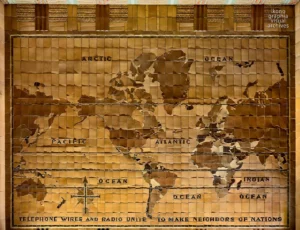
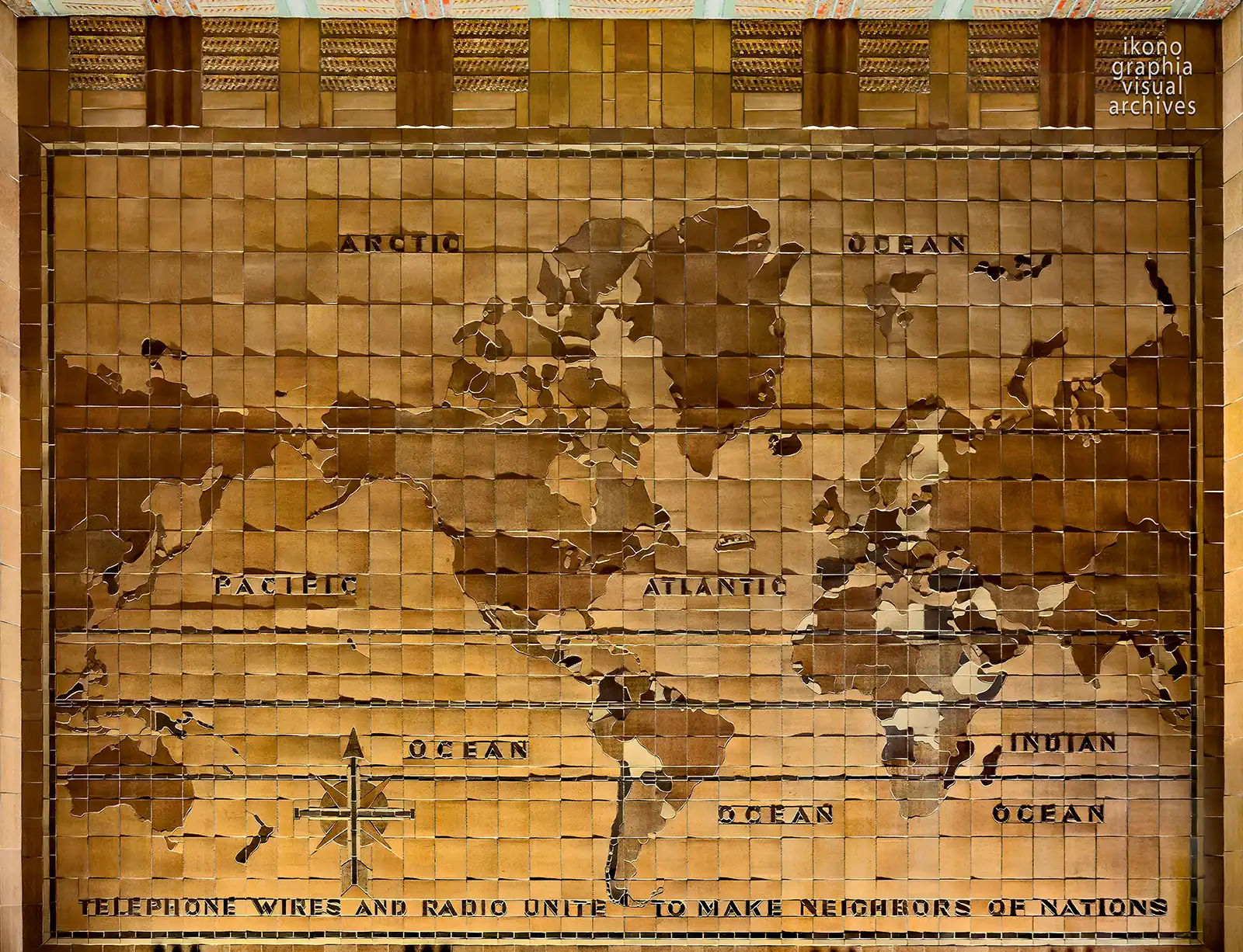
World map tile mosaic by Hildreth Meière, 32 Avenue of the Americas, New York, 1932. The map occupies an entire end wall of the lobby. Every continent rendered in terracotta tile tones, oceans labeled, compass rose in the lower left.
Inscription along the bottom: "Telephone Wires and Radio Unite to Make Neighbors of Nations." A statement of corporate purpose — AT&T's reason for existing — rendered in permanent material at architectural scale.
Mosaic by Hildreth Meière — Architect: Ralph Walker.
€95.00
Royalty-free JPG — 8000x6000px, 26.48MB.
© Ikonographia / Roberto Bigano
LICENSE TERMS
This image is provided under a royalty-free license by Ikonographia / Roberto Bigano. By purchasing and downloading this file, you are granted the following rights:
You May
- Use the image in print and digital media (books, magazines, websites, videos, educational materials, presentations, and advertisements).
- Use the image in editorial, corporate, or client work, including commissioned projects.
- Modify, crop, or combine the image with other elements for creative use.
- Create photographic prints for personal or internal company use only (display, offices, presentations).
You May Not
- Resell, redistribute, sublicense, or share the image file in any form that allows third-party access.
- Use the image in products for resale (prints, posters, merchandise, NFTs, templates, stock collections) without a separate extended license.
- Claim authorship of the image or remove copyright attribution.
Read our full Copyright & Licensing Policy for detailed information.
Copyright: © Ikonographia / Roberto Bigano. All rights reserved.
SUGGESTED USES
- Architecture and design publications.
- Educational materials or exhibitions.
- Interior design presentations and mood boards.
- Commercial, editorial, or creative projects.
Each download includes a royalty-free license for use in both print and digital media.
The AT&T Long Distance Building, 1932 — Overview
The Building stands at 32 Avenue of the Americas in Tribeca, completed in 1932 to designs by Ralph Walker. Built as the operational hub of AT&T's long-distance telephone network, it was infrastructure given the surface logic of a civic monument.
The facade makes Walker's argument from the street. Brick in multiple tones of red, orange, and grey, laid in woven patterns — a direct reference to AT&T's description of its telephone operators as Weavers of Speech. The building's outer skin is the company's identity made structural.
The Lobby
Ralph Walker held that skyscrapers should be designed for mental comfort as much as physical function. The lobby demonstrates that conviction precisely: an equipment facility for millions of telephone circuits, designed with the material richness of a cathedral.
Terracotta tile, terrazzo, and bronze form a continuous surface system in which every element — clock, grille, sconce, door — belongs to the whole. Walker chose the palette deliberately. The same amber and ochre that cover the walls are the color temperature Hildreth Meière used for the mosaic ground above. The wall and the ceiling were designed as one surface, in two materials.
Continents Linked by Telephone and Wireless
Hildreth Meière's silhouette mosaic program covers the ceiling in five continental allegories, a central messenger figure, and a web of gold telephone wires connecting every continent to the center. The Americas occupy the center — the largest and most prominent panel. Asia, Africa, Europe, and Oceania occupy the perimeter, each represented by an allegorical figure with a recognizable emblem.
The technique — tesserae embedded in coral cement while still wet — makes the ground itself luminous. The messenger at the center holds lightning bolts: electricity as a classical attribute, telecommunications given the iconography of myth. The ceiling is a diagram of the network and a statement about what that network meant.
"Telephone Wires and Radio Unite to Make Neighbors of Nations" — The World Map
Hildreth Meière's second program at 32 Avenue of the Americas covers the full end wall of the lobby — a world map in terracotta tile, every continent rendered in tonal variation, every ocean labeled, a compass rose in the lower left. The inscription along the base defines the building's purpose: Telephone Wires and Radio Unite to Make Neighbors of Nations. Completed in 1932, three years into the Depression, it was a deliberate act of optimism — the belief that connection was the answer, rendered in permanent material at architectural scale.
The compass rose is set within the half-dome above what was originally the public telegram lobby, where any citizen could send a message to any point on the planet. The location is the argument.
___________
Leading Architect and building design: Ralph Walker — Continent Mosaics and The World Map: Hildreth Meière.
The New York City Art Deco Archive — Available Stories
- The City of Opportunity — Art Deco Grilles, Chanin Building, 1929
New York, 1929 — A City at Its Peak, Casting Its Ambitions in Bronze. - Art Deco Elevator Panels — Fred French Building, 1927 — Glinsky & Bach
Eight gilt-bronze elevator doors translating Fred French's four business pillars into a sculptural language drawn from ancient Mesopotamia. - When Babylon Met Fifth Avenue — Ives & Glinsky's Fred French Building, 1927 (forthcoming)
One architect's obsession with ancient Babylon. One sculptor's mastery in bronze. A New York landmark unlike any other.
Browse the New York City Art Deco Archive
-

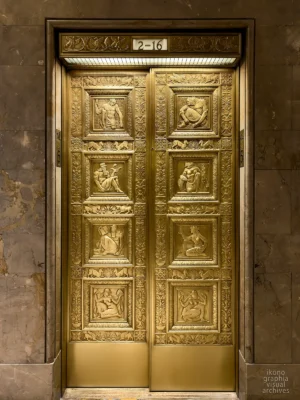
The Symbolic Program — Elevator Doors, Fred French Building, New York
€95.00 -

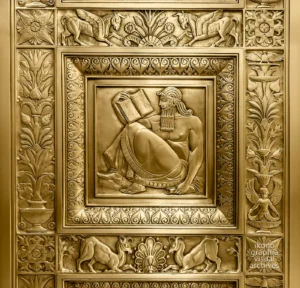
The Scholar Elevator Panel — Fred French Building, New York, 1927
€95.00 -

Art Deco Allegory of Effort — Gilded Grille, Chanin Building, New York, 1929
€95.00 -

Telephone Wires and Radio Unite to Make Neighbors of Nations — AT&T Building, New York, 1932 — Hildreth Meière
€95.00