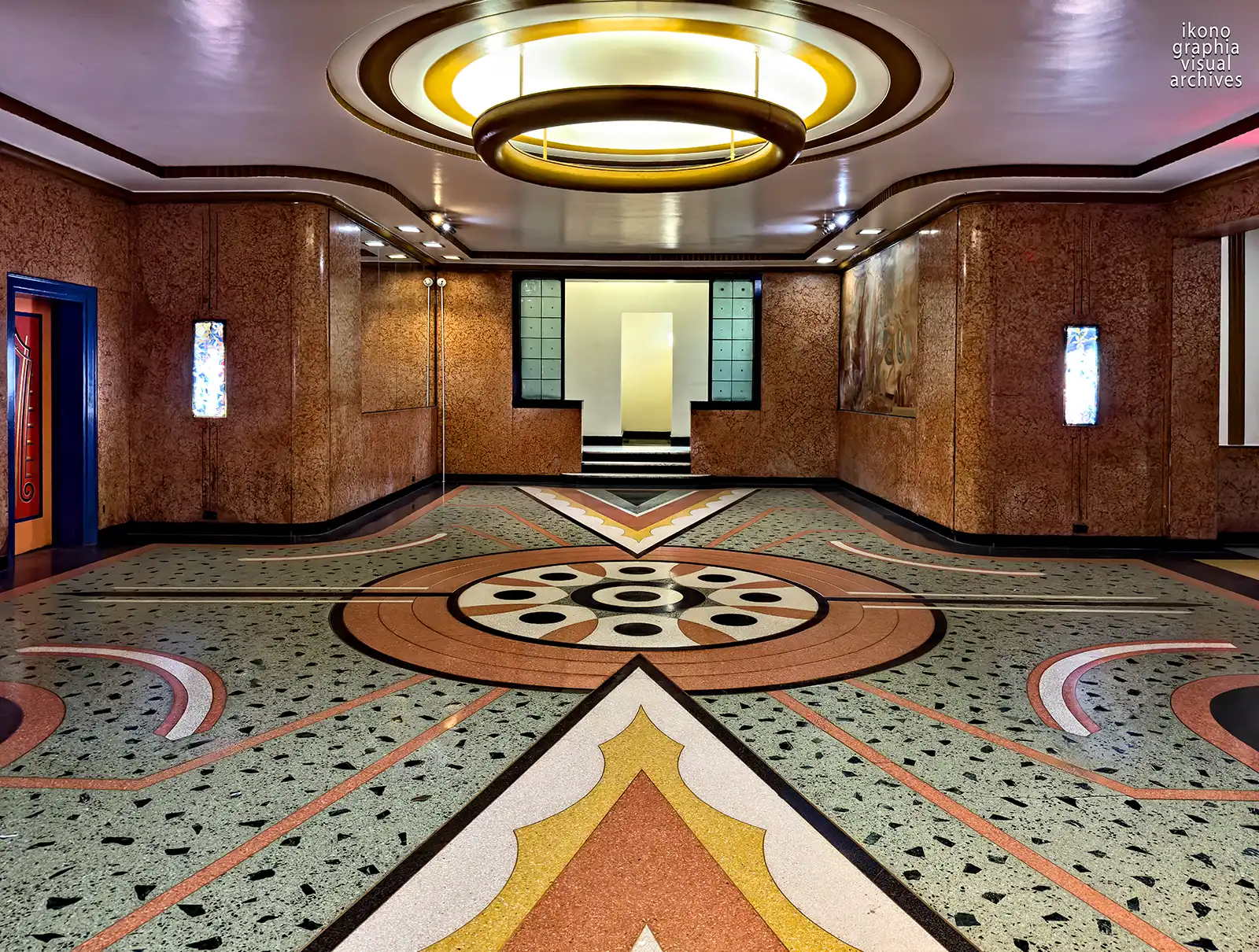
Art Deco Terrazzo and the UFO Chandelier — 1150 Grand Concourse, the Bronx, 1937
The circular ceiling light — bronze rings, frosted glass, the geometry of a spacecraft — dominates the lobby axis. Below it, the terrazzo floor extends wall to wall as a single geometric program: radiating forms, concentric rings, chevrons in red, green, and gold. Everything is original. Nothing is incidental.
The Grand Concourse was the Park Avenue of the Bronx, its buildings conceived with exceptional architectural ambition. 1150 Grand Concourse, known as the Fish Building for its polychrome mosaic facade on an aquatic theme, is among the finest. The terrazzo floors were executed by terazzeri from Pordenone and Spilimbergo in the Friuli region — the aristocracy of the immigrant labor force. Their names were never recorded. Their work has outlasted nearly everything around it.
€95.00
Royalty-free JPG — 8000x6000px, 26.48MB.
© Ikonographia / Roberto Bigano
LICENSE TERMS
This image is provided under a royalty-free license by Ikonographia / Roberto Bigano. By purchasing and downloading this file, you are granted the following rights:
You May
- Use the image in print and digital media (books, magazines, websites, videos, educational materials, presentations, and advertisements).
- Use the image in editorial, corporate, or client work, including commissioned projects.
- Modify, crop, or combine the image with other elements for creative use.
- Create photographic prints for personal or internal company use only (display, offices, presentations).
You May Not
- Resell, redistribute, sublicense, or share the image file in any form that allows third-party access.
- Use the image in products for resale (prints, posters, merchandise, NFTs, templates, stock collections) without a separate extended license.
- Claim authorship of the image or remove copyright attribution.
Read our full Copyright & Licensing Policy for detailed information.
Copyright: © Ikonographia / Roberto Bigano. All rights reserved.
SUGGESTED USES
- Architecture and design publications.
- Educational materials or exhibitions.
- Interior design presentations and mood boards.
- Commercial, editorial, or creative projects.
Each download includes a royalty-free license for use in both print and digital media.
1150 Grand Concourse — The Fish Building — Overview
The Park Avenue of the Bronx
1150 Grand Concourse, known as the Fish Building, is one of the finest surviving examples of Art Deco residential architecture in New York City. Completed in 1937 and designed by Horace Ginsbern and Marvin Fine, it stands on the Grand Concourse — the great boulevard of the Bronx, conceived in the early twentieth century as the borough's answer to Park Avenue and the Champs-Élysées. At its peak in the 1930s, the Concourse was the most prestigious residential address in the Bronx, lined with buildings of exceptional architectural ambition. The Fish Building is among the best of them.
The Entrance Mosaics
The building earned its nickname from the polychrome mosaic program that frames the main entrance — tropical fish, sea anemones, and stylized aquatic plants covering the facade in hand-laid tesserae. The forms are Picasso-influenced in their abstraction: organic, fluid, and composed with the freedom of a painted canvas. No two tesserae are identical in tone. The chromatic transitions are deliberate juxtapositions — warm ochres against cold blues, deep burgundy against yellow-green. The artist was never identified. The work has survived eighty-seven years on a Bronx street corner.
The exterior mosaics are distinct in craft and tradition from the terrazzo floors inside. Mosaic and terrazzo were separate specializations, executed by different workers with different training. The two programs share a building and a visual vocabulary — nothing else.
The Lobby
The circular interior lobby is one of the most complete Art Deco interiors surviving in the Bronx. The terrazzo floor — red, green, and gold, executed by terazzeri from Pordenone and Spilimbergo in the Friuli region of northeast Italy — extends from wall to wall as a single geometric program. The circular ceiling light anchors the axis. The elevator doors carry the geometric vocabulary upward in terracotta, cobalt blue, and gold. Interior aquatic-themed murals by René and C.P. Graves complete the program. Nothing is incidental.
The terazzeri — skilled artisans from Friuli who held a virtual monopoly on terrazzo work in New York's Art Deco buildings during the 1920s and 1930s — were considered the aristocracy of the immigrant labor force. They brought centuries-old techniques to Art Deco geometry, translating its abstract ambitions into durable, seamless surfaces. Their names were never recorded. Their work has outlasted nearly everything around it.
About Terrazzo
Terrazzo is a composite flooring technique developed in 15th-century Venice — marble chips embedded in a binder, ground and polished to a seamless finish. It reached New York in the early 20th century, but three innovations in 1924 transformed it into a precision design system: brass divider strips allowing sharp geometric patterns without color bleed, electric grinding machines replacing hand polishing, and Portland cement enabling the full Art Deco color palette.
The Fish Building floor is among the finest surviving examples — red, green, and gold, executed by terazzeri from Pordenone and Spilimbergo in the Friuli region of northeast Italy. Not the corporate sobriety of Manhattan's landmark lobbies, but exuberance. The New York Times called 1150 Grand Concourse the borough's most celebrated Art Deco apartment house. The terrazzo is a large part of the reason.
Landmark Status
The building was designated a New York City Landmark in 2011 as part of the Grand Concourse Historic District — one of the few remaining concentrations of intact Art Deco residential architecture in the United States.
Architecture by Horace Ginsbern and Marvin Fine, 1937. Interior murals by René and C.P. Graves. Terrazzo floors by Friulian terazzeri from Pordenone and Spilimbergo. Exterior mosaics — artist unknown.
Browse the New York City Art Deco Archive
-

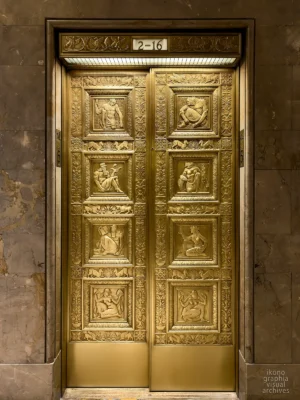
The Symbolic Program — Elevator Doors, Fred French Building, New York
€95.00 -

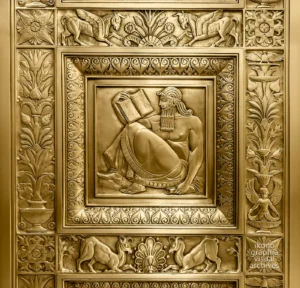
The Scholar Elevator Panel — Fred French Building, New York, 1927
€95.00 -

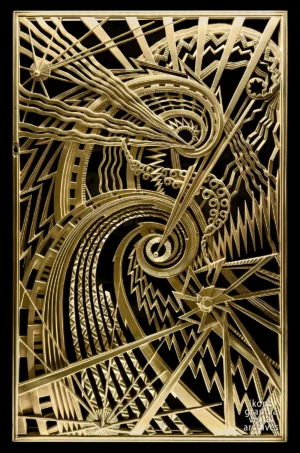
Art Deco Allegory of Effort — Gilded Grille, Chanin Building, New York, 1929
€95.00 -

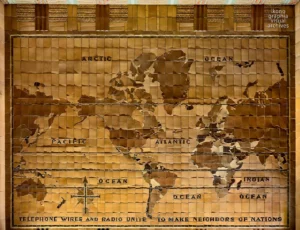
Telephone Wires and Radio Unite to Make Neighbors of Nations — AT&T Building, New York, 1932 — Hildreth Meière
€95.00