
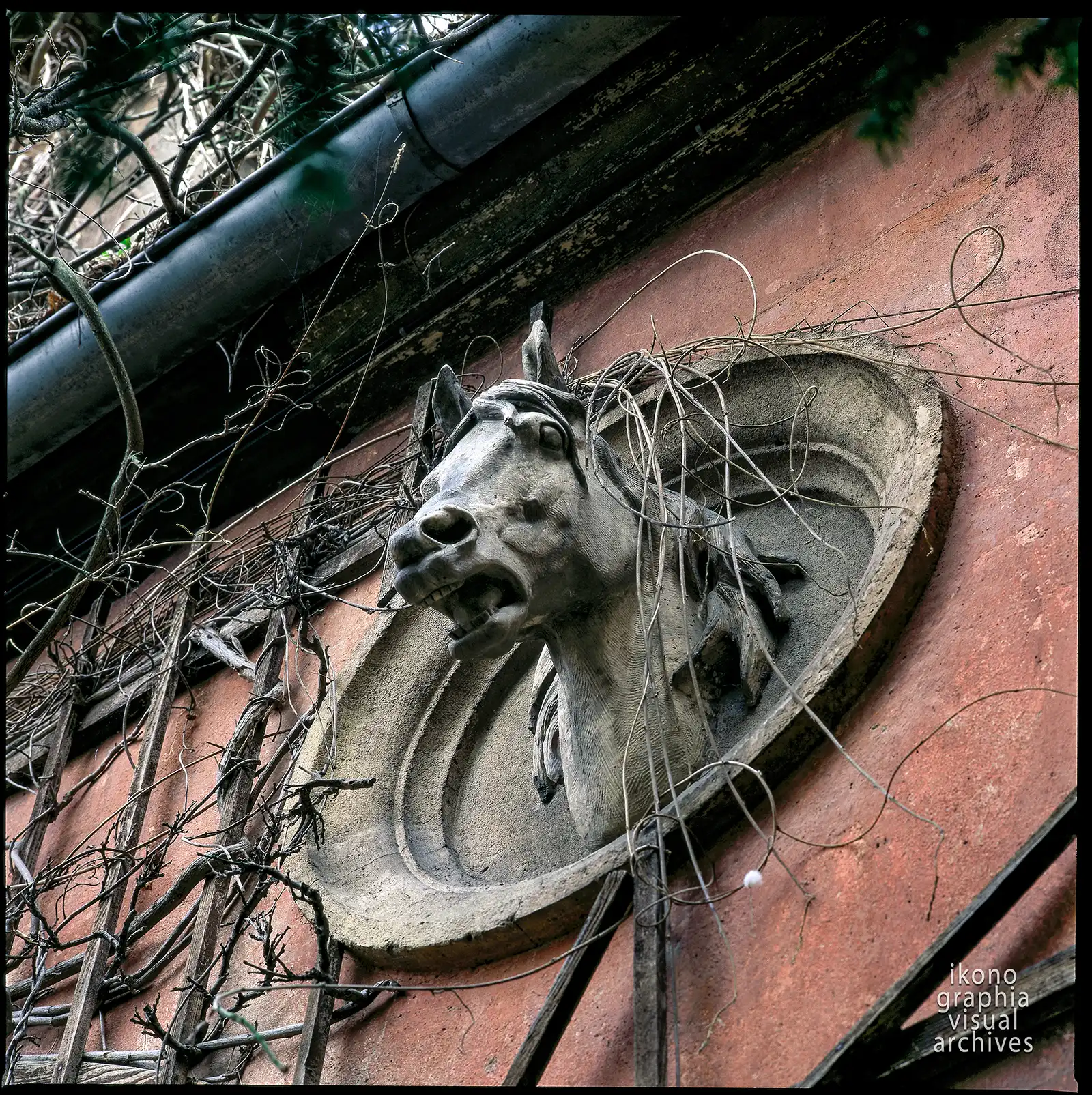
The Bugatti Horse Symbol — Château Saint-Jean, Molsheim, 1990
Château Saint-Jean, Molsheim, Alsace, 1990. Ettore Bugatti bred thoroughbreds at Molsheim with the same obsessive standards he applied to his cars. The horse was his personal symbol — cast into the wall of Château Saint-Jean, the domain's heart, where it had presided over the estate for decades.
By 1990, no one was looking after it. The vines had grown across the facade and through the relief itself, threading through the stone as if reclaiming it. The building was between two lives.
The image was never published. It was never proposed as the symbol of the rebirth it was about to witness. It should have been.
$110
Royalty-free JPG —5000x5017px, 20.04MB.
© Ikonographia / Roberto Bigano
LICENSE TERMS
This image is provided under a royalty-free license by Ikonographia / Roberto Bigano. By purchasing and downloading this file, you are granted the following rights:
You May
- Use the image in print and digital media (books, magazines, websites, videos, educational materials, presentations, and advertisements).
- Use the image in editorial, corporate, or client work, including commissioned projects.
- Modify, crop, or combine the image with other elements for creative use.
- Create photographic prints for personal or internal company use only (display, offices, presentations).
You May Not
- Resell, redistribute, sublicense, or share the image file in any form that allows third-party access.
- Use the image in products for resale (prints, posters, merchandise, NFTs, templates, stock collections) without a separate extended license.
- Claim authorship of the image or remove copyright attribution.
Read our full Copyright & Licensing Policy for detailed information.
Copyright: © Ikonographia / Roberto Bigano. All rights reserved.
SUGGESTED USES
- Architecture and design publications.
- Educational materials or exhibitions.
- Interior design presentations and mood boards.
- Commercial, editorial, or creative projects.
Each download includes a royalty-free license for use in both print and digital media.
Divina Bugatti — Bugatti Heritage Archive — Overview
The most celebrated automotive photography book of the twentieth century — commissioned by the most demanding publisher in Europe.
The Commission
In 1991, Franco Maria Ricci commissioned Roberto Bigano to document the historic Bugatti collection at the Musée National de l'Automobile in Mulhouse. Ricci had seen the first transparencies and said: "But they are lit." He immediately assigned all future FMR projects.
Ricci's rule was absolute: no non-orthogonal images. His response: "We never publish this kind of photograph, but this image is so beautiful that I must. Please don't do it again." The world's most demanding publisher broke his own rule for this picture.
The Book
Divina Bugatti was published in two editions of 5,000 copies each — Italian and French — at a price that made it inaccessible to most. Both editions sold out. For four decades FMR had set the standard for visual scholarship and editorial photography among curators and art historians on both sides of the Atlantic. Divina Bugatti was its most celebrated automotive title.
Six Nights in a Closed Museum
A 4×5 view camera. A lighting system built around a six-by-six metre white diffusion panel on a frame, with Arri Fresnel spots positioned behind it. The light reaching the car was not direct — it was the reflection of the lamp's shape in the screen. Moving the position of a spot changed everything: the line, the gradation, the surface reading. The technique had never been used on location before.
The session produced two images that did not appear in the book — for different reasons. Both are in this archive. Both went into a drawer for seventeen years. Both are among the strongest photographs Roberto Bigano made in Mulhouse.
The Atalante Silhouette
The Bugatti Type 57SC Coupé Atalante — here, the lighting system was pushed to its extreme, creating a single continuous line against the black — The essence of Jean Bugatti Design.
Franco Maria Ricci reviewed the transparencies. He picked the Atalante silhouette with two fingers and set it aside. "Questa no." Not objective. After seventeen years it was rediscovered and became Roberto's signature image. The image that Ricci refused, paid for Roberto Bigano's daughter's education in the United States..
The Atlantic Riveted Spine
The Atlantic roofline was photographed in Paris, at night. The assistant moved the Arri Fresnel without switching it off. The light found the riveted spine exactly as it should. "Stop." The photograph happened.
The surface was not cleaned. Years later, digital restoration made it possible. The accident of exhaustion made the image.
Photography by Roberto Bigano. Published by Franco Maria Ricci, Milan, 1991.


