
Edgar Brandt's Frozen Fountain — Madison Belmont, New York, 1924
First American Art Deco — The NYC Art Deco Archive
The frozen fountain motif on the Madison Belmont entrance was designed by French iron master Edgar Brandt. The motif — stylized water cascading in symmetrical curves — originated in Brandt's monumental gate at the 1925 Paris Exposition.
Here, in wrought iron with gold and bronze accents, it became the first major application of what would later be called Art Deco on an American building. The building itself was not in the new style. The decoration was the exception — and became the symbol.
Published in FMR Magazine, Winter Solstice 2024.
€95.00
Royalty-free JPG — 5000x6667px, 21.07MB. ©Ikonographia / Roberto Bigano
LICENSE TERMS
This image is provided under a royalty-free license by Ikonographia / Roberto Bigano. By purchasing and downloading this file, you are granted the following rights:
You May
- Use the image in print and digital media (books, magazines, websites, videos, educational materials, presentations, and advertisements).
- Use the image in editorial, corporate, or client work, including commissioned projects.
- Modify, crop, or combine the image with other elements for creative use.
- Create photographic prints for personal or internal company use only (display, offices, presentations).
You May Not
- Resell, redistribute, sublicense, or share the image file in any form that allows third-party access.
- Use the image in products for resale (prints, posters, merchandise, NFTs, templates, stock collections) without a separate extended license.
- Claim authorship of the image or remove copyright attribution.
Read our full Copyright & Licensing Policy for detailed information.
Copyright: © Ikonographia / Roberto Bigano. All rights reserved.
SUGGESTED USES
- Architecture and design publications.
- Educational materials or exhibitions.
- Interior design presentations and mood boards.
- Commercial, editorial, or creative projects.
Each download includes a royalty-free license for use in both print and digital media.
Edgar Brandt's Frozen Fountain — Madison Belmont, 1924
The Madison Belmont Building
The frozen fountain on the Madison Belmont entrance at 181 Madison Avenue was designed by Edgar Brandt — the foremost ironworker in France — and commissioned by the Cheney Brothers Silk Company for the building's first three floors. The motif, a stylized cascade of water in symmetrical curves, originated in Brandt's monumental gate at the 1925 Paris Exposition. Sixty tons of iron, accented with bronze and gold-colored brass. The building itself, designed by Warren & Wetmore — architects of Grand Central Terminal — was a transitional structure, its Neoclassical form carrying a detail that belonged to a different world entirely.
That detail became the argument. In wrought iron with gold and bronze accents, the frozen fountain was the first major application of what would become Art Deco on an American building. The building was not in the new style. The decoration was the exception — and became the symbol. The Madison Belmont facade and lobby were designated New York City landmarks in 2011.
NYC Art Deco Interiors — New York, 1924–1939
The decorative programs of Art Deco Manhattan — photographed in full and documented to primary sources.
Manhattan's commercial interiors of the late 1920s and 1930s were not incidental ornament. They were complete symbolic programs — conceived by architects, executed by sculptors and metalworkers, and designed to carry specific meaning. Bronze grilles, gilded elevator doors, painted vaults, and polychrome ceilings were not decoration added to architecture. They were the architecture.
Ikonographia documents these programs as they were intended to be read: in sequence, in context, and against the primary sources that define them. Sixty-five buildings photographed. Twenty photographs from this archive were published in FMR Magazine — Gotham Deco: Modern Metropolis. This Was Tomorrow — with an essay by Anthony W. Robins.
Historic Background
The 1925 Exposition Internationale des Arts Décoratifs in Paris set the terms. New York architects took the style and pushed it toward something different — taller, harder, more industrial. European glamour translated into verticality, machine-age materials, and the visual language of American commercial ambition.
The story begins in 1924. Edgar Brandt's frozen fountain on the Madison Belmont entrance — wrought iron with gold and bronze accents — was the first major application of what would become Art Deco on an American building. The motif had originated in Brandt's monumental gate at the 1925 Paris Exposition. It arrived in New York a year earlier. The building was not in the new style. The decoration was the exception — and became the symbol.
Browse the New York City Art Deco Archive
-

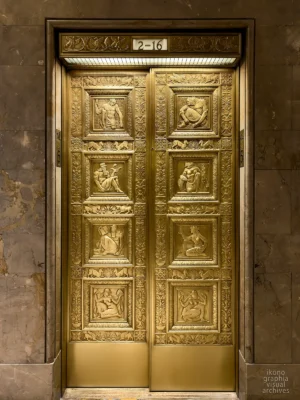
The Symbolic Program — Elevator Doors, Fred French Building, New York
€95.00 -

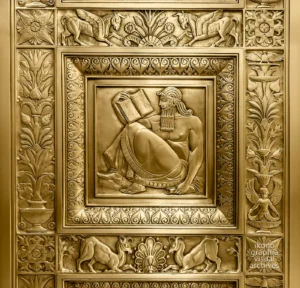
The Scholar Elevator Panel — Fred French Building, New York, 1927
€95.00 -

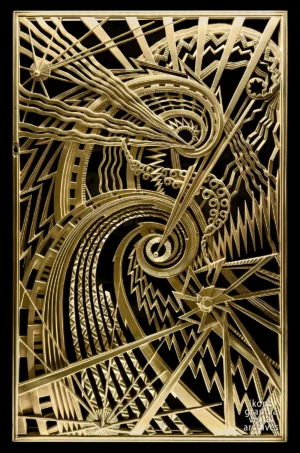
Art Deco Allegory of Effort — Gilded Grille, Chanin Building, New York, 1929
€95.00 -

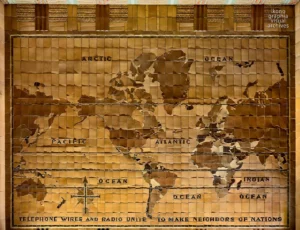
Telephone Wires and Radio Unite to Make Neighbors of Nations — AT&T Building, New York, 1932 — Hildreth Meière
€95.00