
Bugatti — Photography, Drawings, Literature
Bugatti — Photography, Drawings, Literature
Exclusive archives documenting Bugatti from the inside — available nowhere else.
Between 1909 and 1939, Bugatti produced fewer than 8,000 cars in Molsheim, Alsace. Ettore designed the machines and directed everything around them — the coachwork, the literature, the posters, the domain itself. Jean brought the body to its highest form. What remained was a body of objects — cars, drawings, catalogs, posters — of exceptional rarity and cultural weight.

This featured story is an editorial hub, conceived as a new re-editing of multiple existing stories and archival materials. It brings together previously separate contents into a single, coherent narrative framework — photography, technical drawings, and printed literature documenting Bugatti heritage from 1909 to 1952.
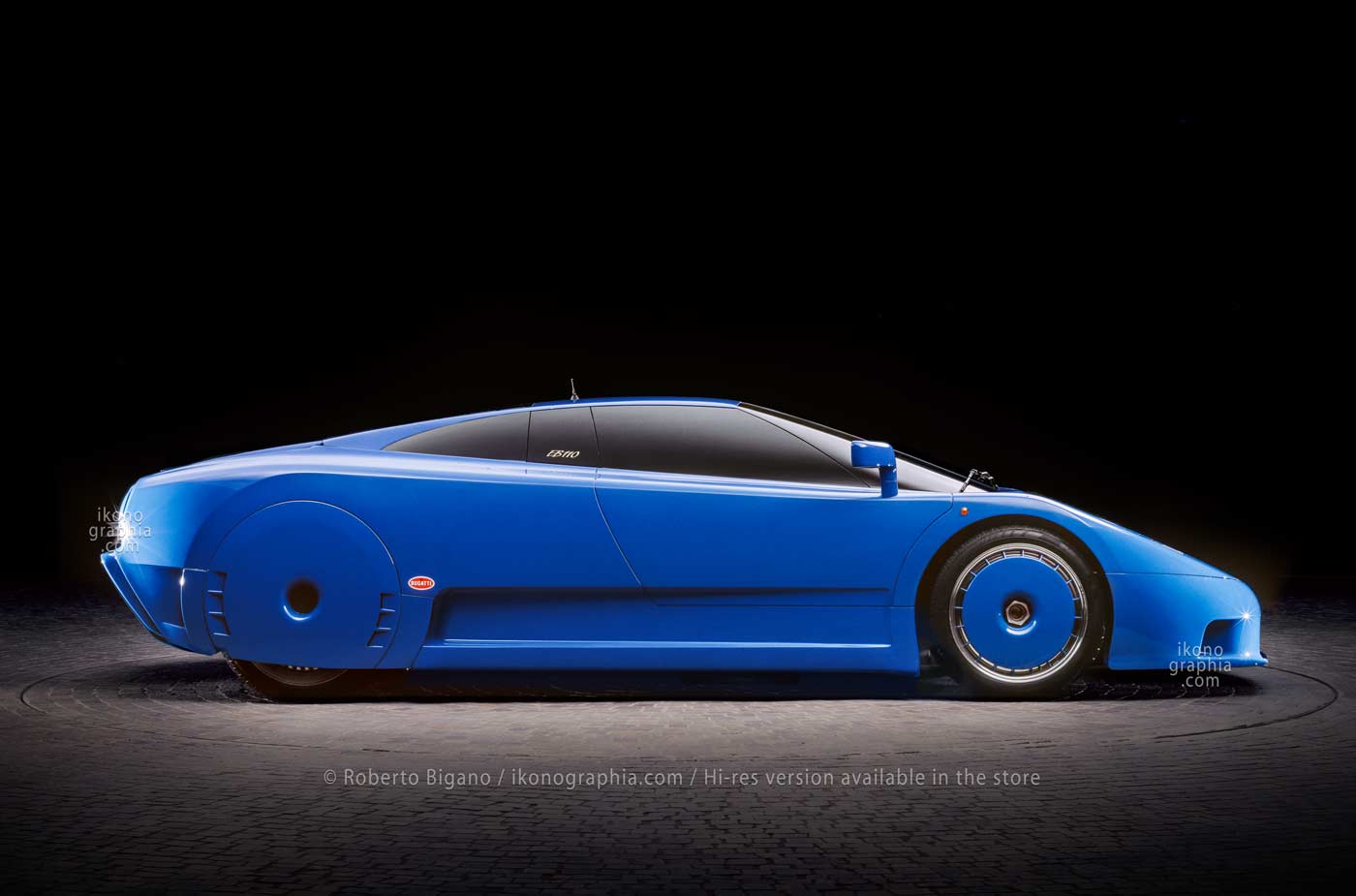
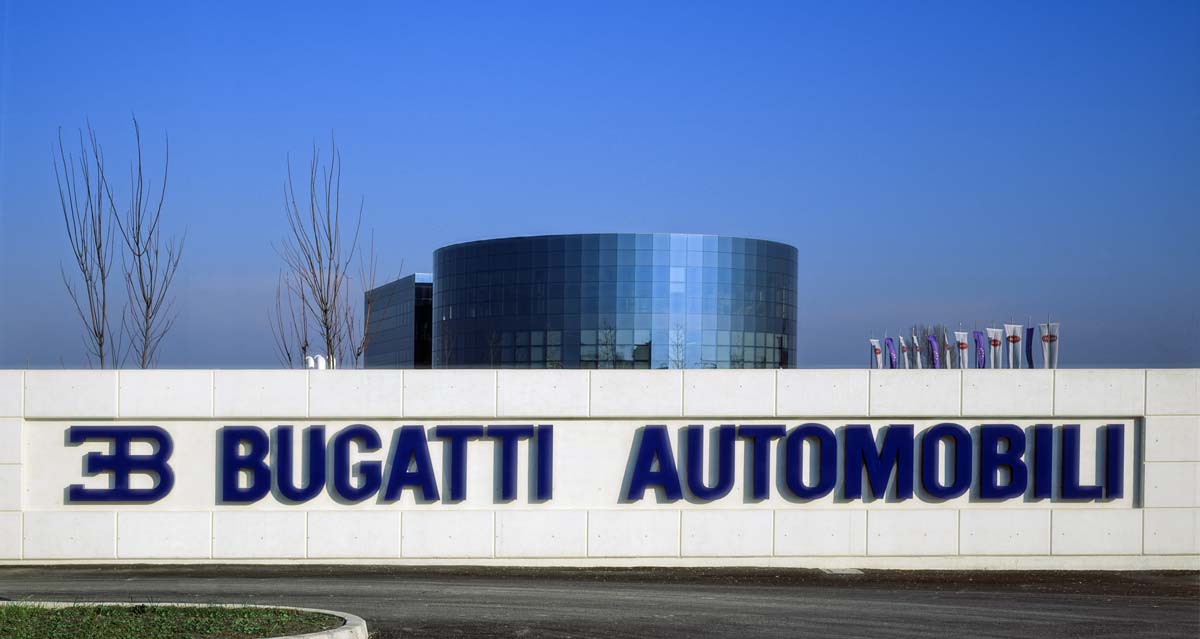
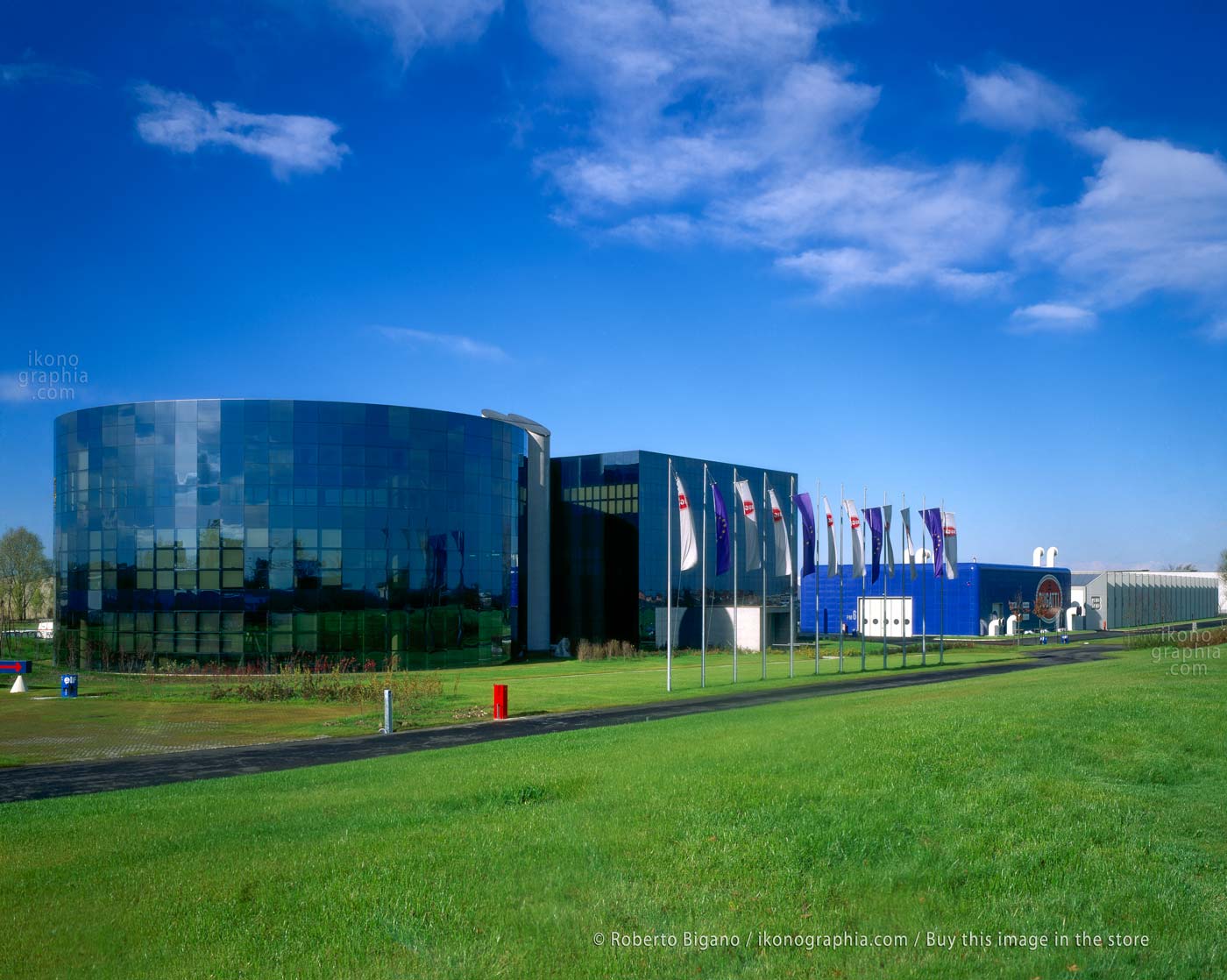
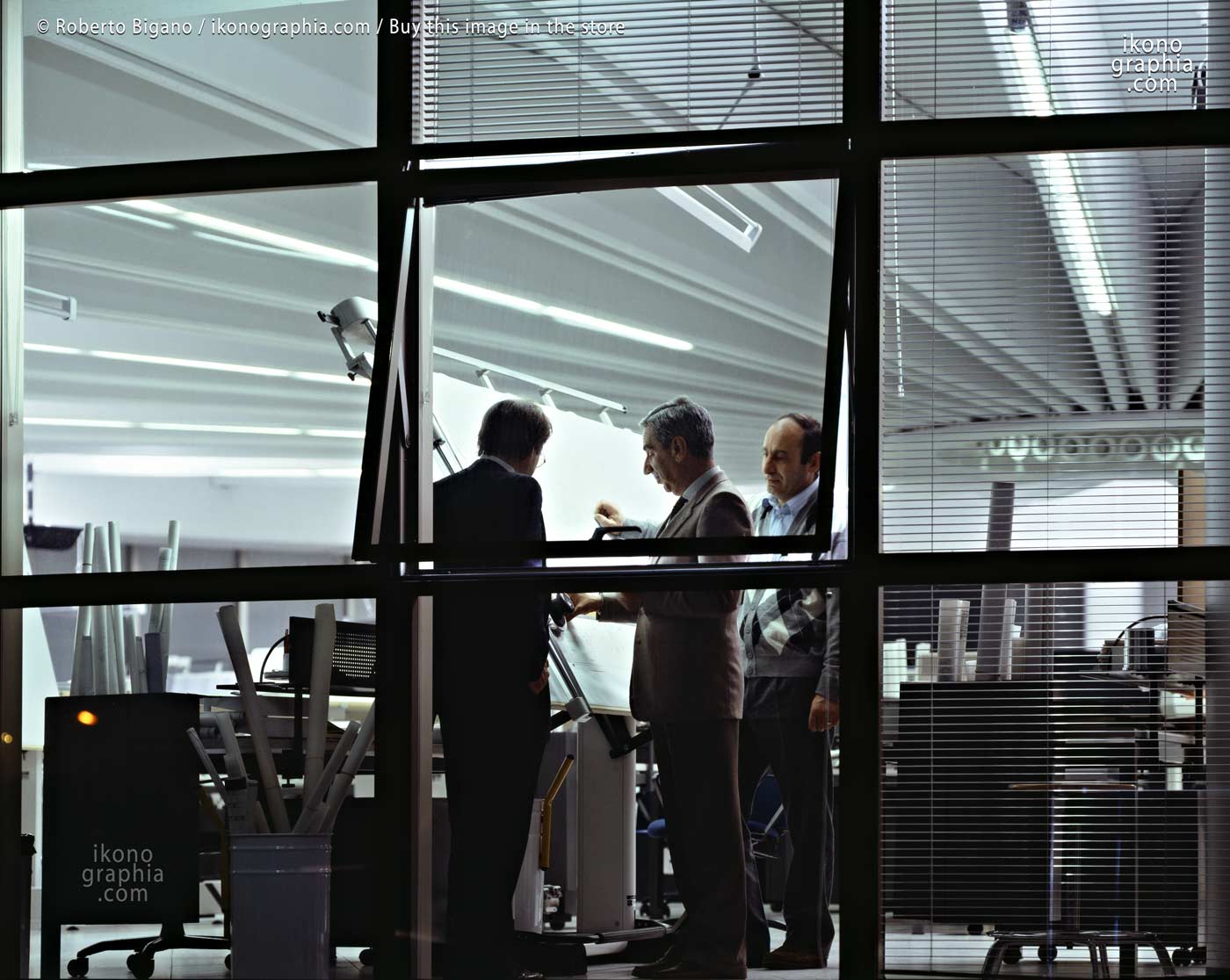
The archive was built between 1990 and 2009 by photographer Roberto Bigano, working with a level of access that no longer exists and cannot be replicated. It began with Romano Artioli — the Italian entrepreneur who revived the Bugatti name at Campogalliano — who gave Bigano unrestricted entry to the factory, the drawings archive, and every event that followed. No brief. No restrictions. No supervision.
This collection is not a celebration of the marque. It is a record made by someone who was trusted enough to be inside it, at the precise moment when its past and its future were in the same room.

Two Bugatti Type 13 Brescia — Marone-Cinzano Estate, Tuscany, 2009.
Resting in the shade during the owners' lunch — one of 120 cars gathered for the Bugatti International Meeting.
Featured image above
Ettore Bugatti's signature — Engine head of the Type 13 Brescia, 1921.
Not a badge. Not a plate. Ettore cast his own handwriting into the metal of the engine head — his name made part of the machine itself.
The Type 13 Brescia won the first four places at the 1921 Brescia Grand Prix. This is what he signed.
Five Bodies of Work — One Complete Archive
What resulted is not a single project. It is five distinct bodies of work — factory drawings, printed literature, posters, studio photography, and documentary reportage — built across two decades, most of it unpublished until now. Together they form the most complete visual record of Bugatti heritage in private hands.
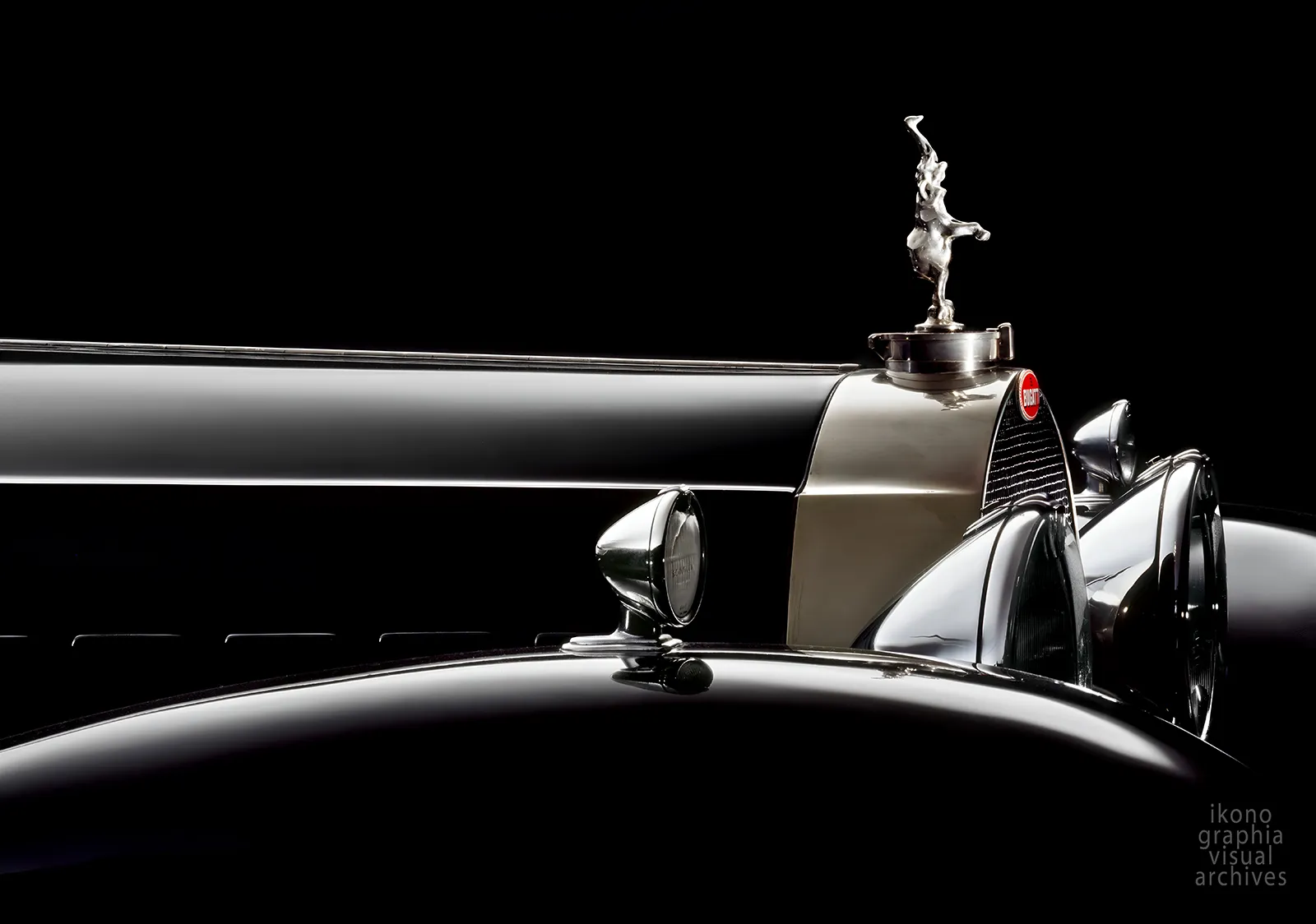
Bugatti Type 41 Royale Coupé Napoléon — Bonnet and Rampant Elephant, 1929
Ettore's personal car — 7.2 metres long, the largest automobile ever built, conceived for royalty and driven by its maker.
The elephant on the radiator was sculpted by Rembrandt Bugatti, Ettore's younger brother, one of the great animal sculptors of his generation. Six Royales were completed. This is one of them.
The Lost Factory Drawings
Between 1922 and 1935, the Molsheim factory produced the technical drawings that defined how Bugatti cars were built — body designs, mechanical specifications, production templates, drawn by hand on paper and cloth.
Reproduced in 1990 before disappearing, these images may be the only surviving record. Ikonographia presents them in three chapters — Form, Function, and Obsession — examining why they remain unique.
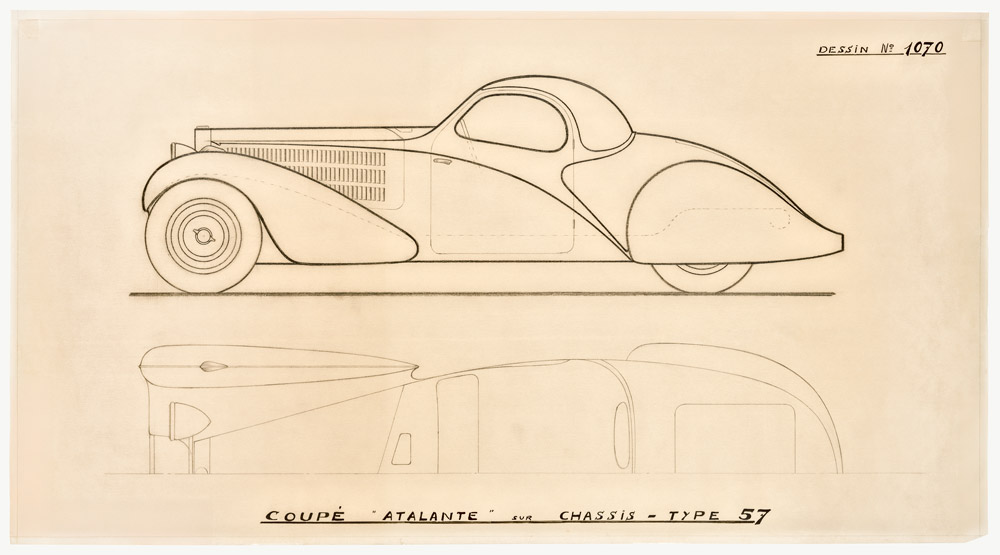
Dessin N° 1070 — Coupé Atalante sur Chassis Type 57 — 1935
Side elevation and plan view. Pencil on tracing paper. The body design was Jean Bugatti's. The factory drawings were the work of his technical team at Molsheim.
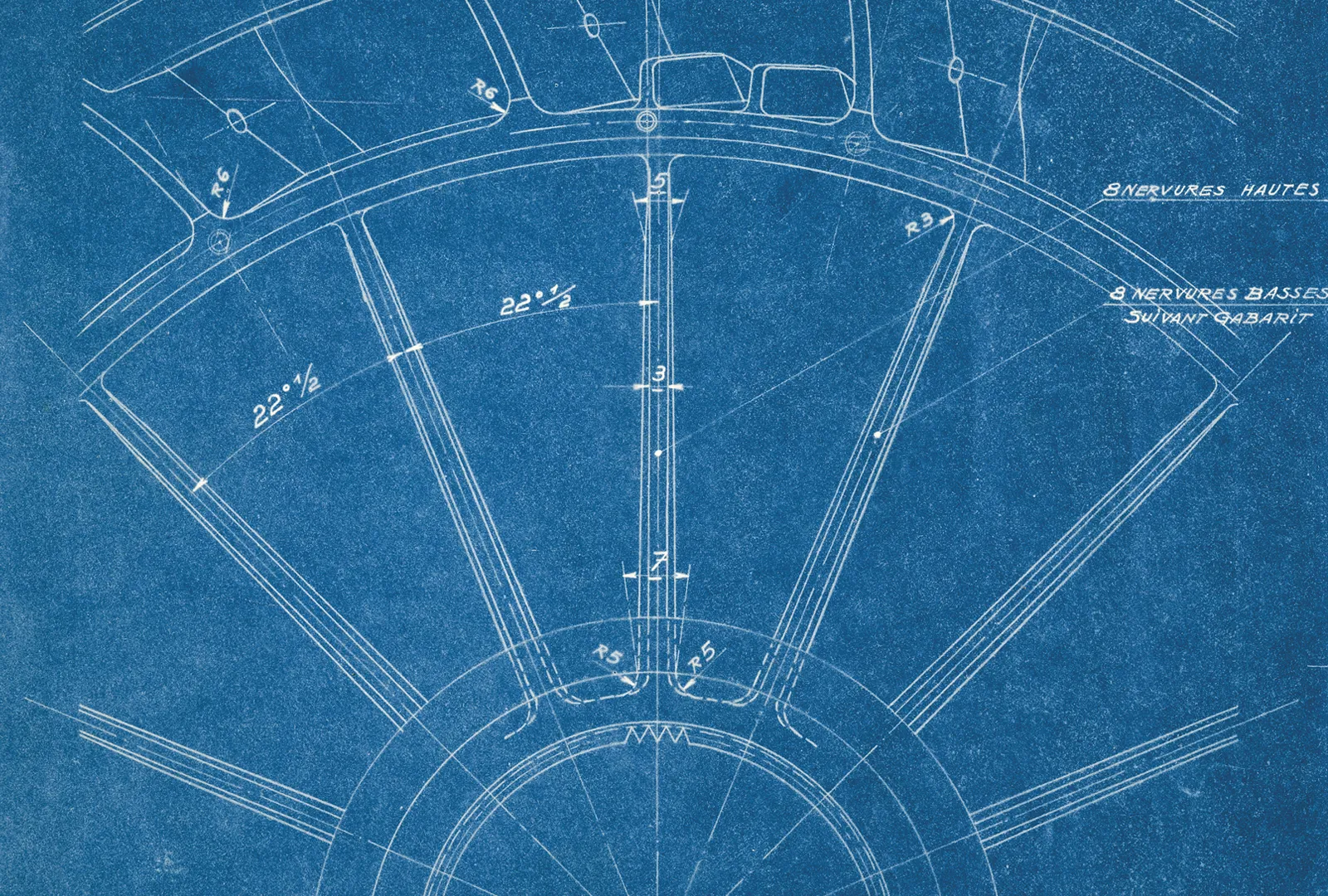
The Bugatti Monobloc Cast Aluminum Wheel — Patented 1924
The first single-piece cast aluminum wheel in automotive history. This heliographic print, dated 22 July 1932, is a first-generation factory copy made directly from the original drawing and distributed to the production department. The spoke section shown here specifies eight high ribs and eight low ribs following the template, with all radii and tolerances called out in millimeters.
The geometry is not only structural — the alternating rib heights reduce weight while maintaining rigidity, a solution that remained technically advanced for its era. Eight years after the original patent, the drawing shows no uncertainty. Every line was already resolved.
Like the Vitruvian Man, it is a study in proportion where engineering and beauty become the same thing.
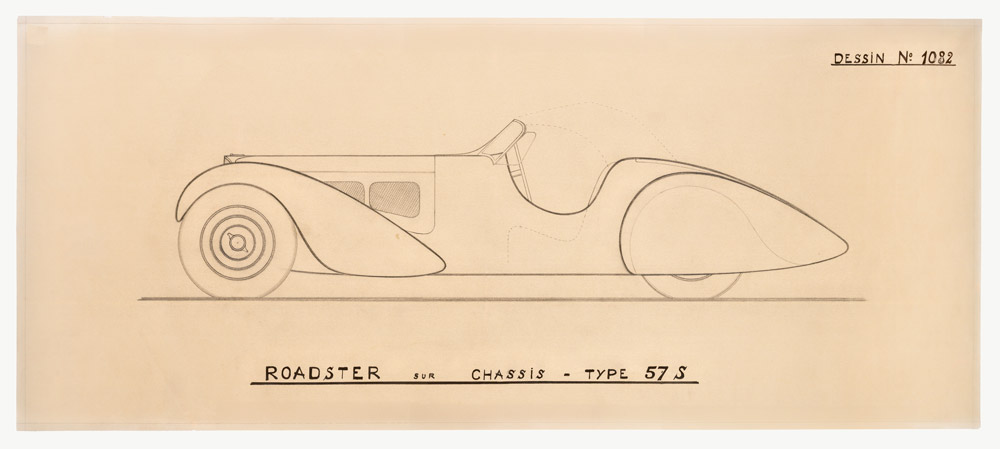
Dessin N° 1082 — Roadster sur Chassis Type 57S — 1935.
The surbaissé chassis — lowered by passing the rear axle through the frame members. Jean Bugatti's final and most aerodynamic variant of the Type 57 line. Pencil on tracing paper.
Bugatti Catalogs and Literature
Bugatti's catalogs and brochures were produced inside Molsheim under the same standards as the cars. Ettore and Jean directed everything — the typography, the photography, the choice of illustrators. The archive covers the full range of printed literature from the 1920s through 1939, the year Jean died and the pre-war chapter closed.

Dépliant Bugatti Type 44, 3 litres — Centerfold, 1929.
The centerfold of the Type 44 folder places the car in front of Château Saint-Jean — Bugatti's headquarters in Molsheim. T
he two figures beside it are Lidia and Michel Bugatti, two of Ettore's children. The photograph is not incidental. Molsheim was not a factory with a family attached. It was a domain, and the catalog knew it.

Bugatti Berline 3 places avec spider sur chassis 3 litres. — Central double spread.
Photo Carabin.
The second body variant in the same 1928 brochure series. Same photographer, same studio discipline.
The two Carabin photographs and the two Hemjic covers were designed as pairs — the machine and its ancestry, facing each other across the fold.
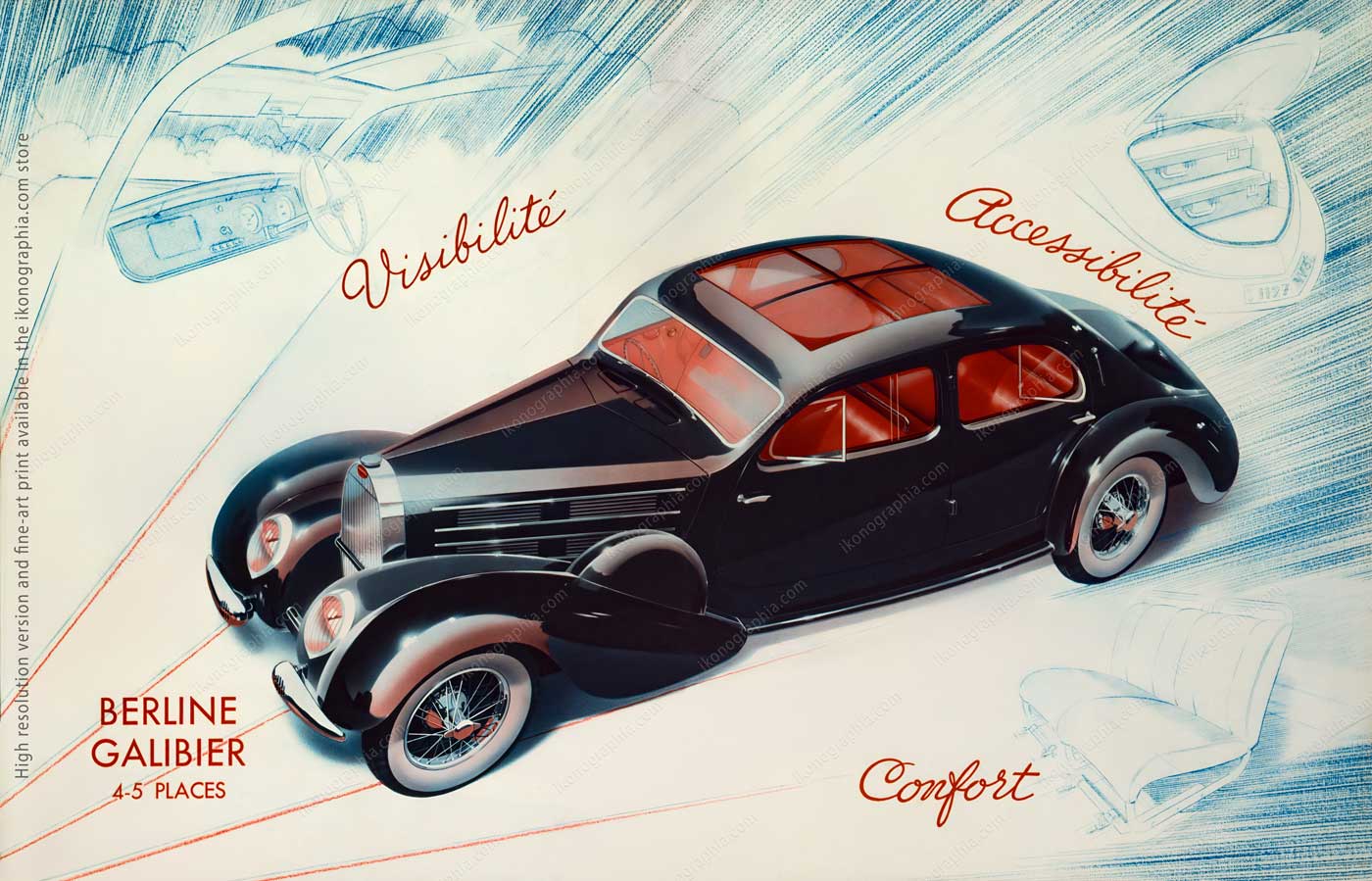
Bugatti Type 57 Modèles 1939. Berline Galibier 4-5 places. Visibilité. Accessibilité. Confort.reet and Regent Street series.
The three words beneath the model name are the brochure's argument in miniature — the same logic that organized the 1936 catalog, compressed into a single line.
The Galibier was the largest body in the Type 57 range. The claims are precise and in the correct order.
Bugatti Posters
Bugatti commissioned its advertising posters from the finest graphic artists of the era — Cassandre, Marcello Dudovich, René Vincent, Geo Ham. The results are among the most celebrated works in automotive poster art. Cassandre's 1935 Le Pur-Sang des Automobiles remains the definitive image of the marque. Dudovich's 1922 C'è una Bugatti, non si passa is a masterpiece of symbolic compression.
The originals were held in the Campogalliano archive. Roberto Bigano borrowed and reproduced them in his studio — the same access that produced the factory drawings. The archive presents the most significant surviving examples, reproduced directly from the originals.
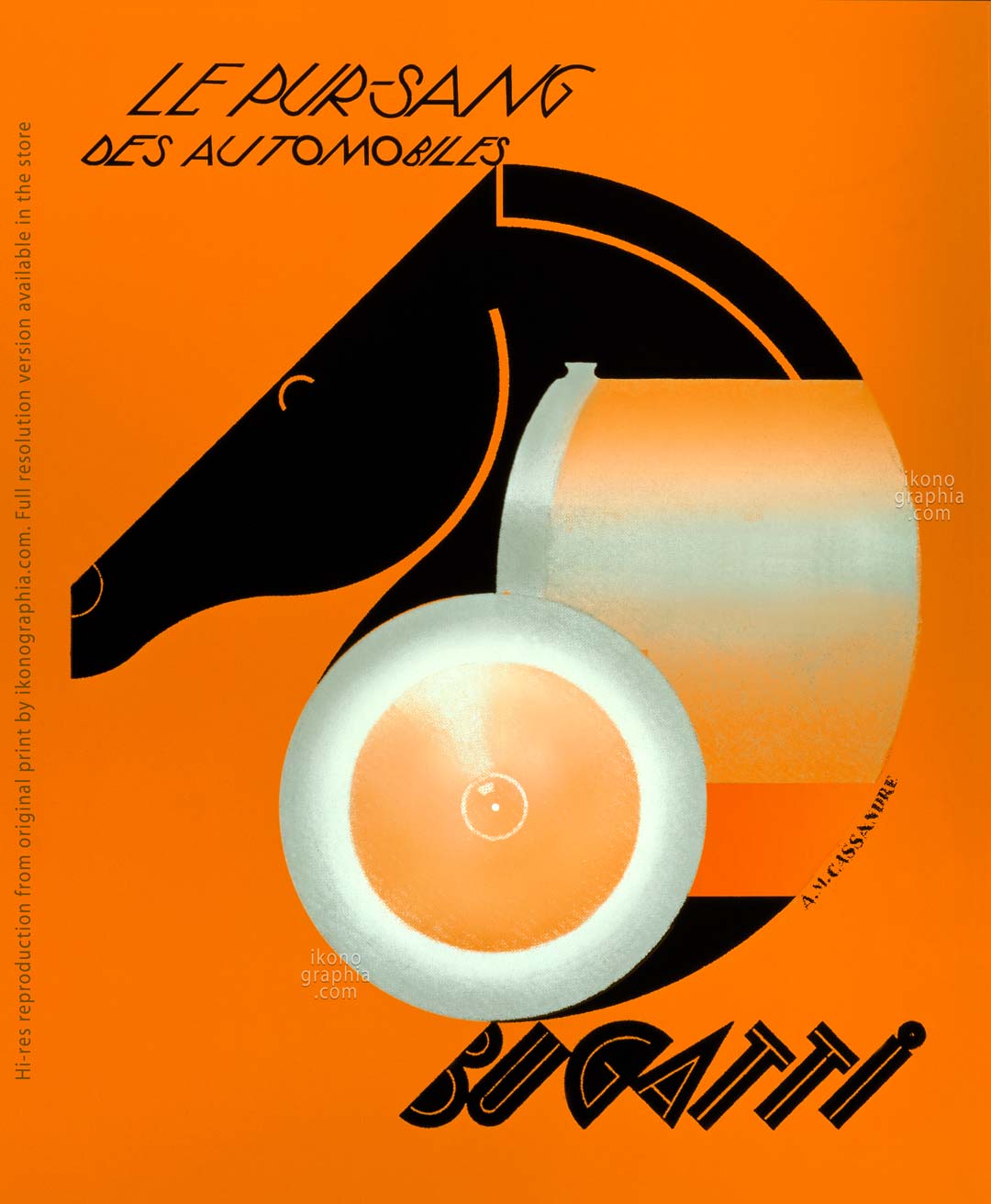
Le Pur-Sang des Automobiles — Cassandre, 1935.
The image that defined Bugatti's identity for a century — by the greatest poster artist of its time.
Reproduced from the original

C'è una Bugatti, non si passa — Marcello Dudovich, 1922
A masterpiece of symbolic compression: the title declares Bugatti's invincibility, the red scarf trailing from the figure echoes the death of Isadora Duncan — who died when her scarf caught in the wheel of a Bugatti.
Except that happened five years later. Dudovich was simply ahead of events.
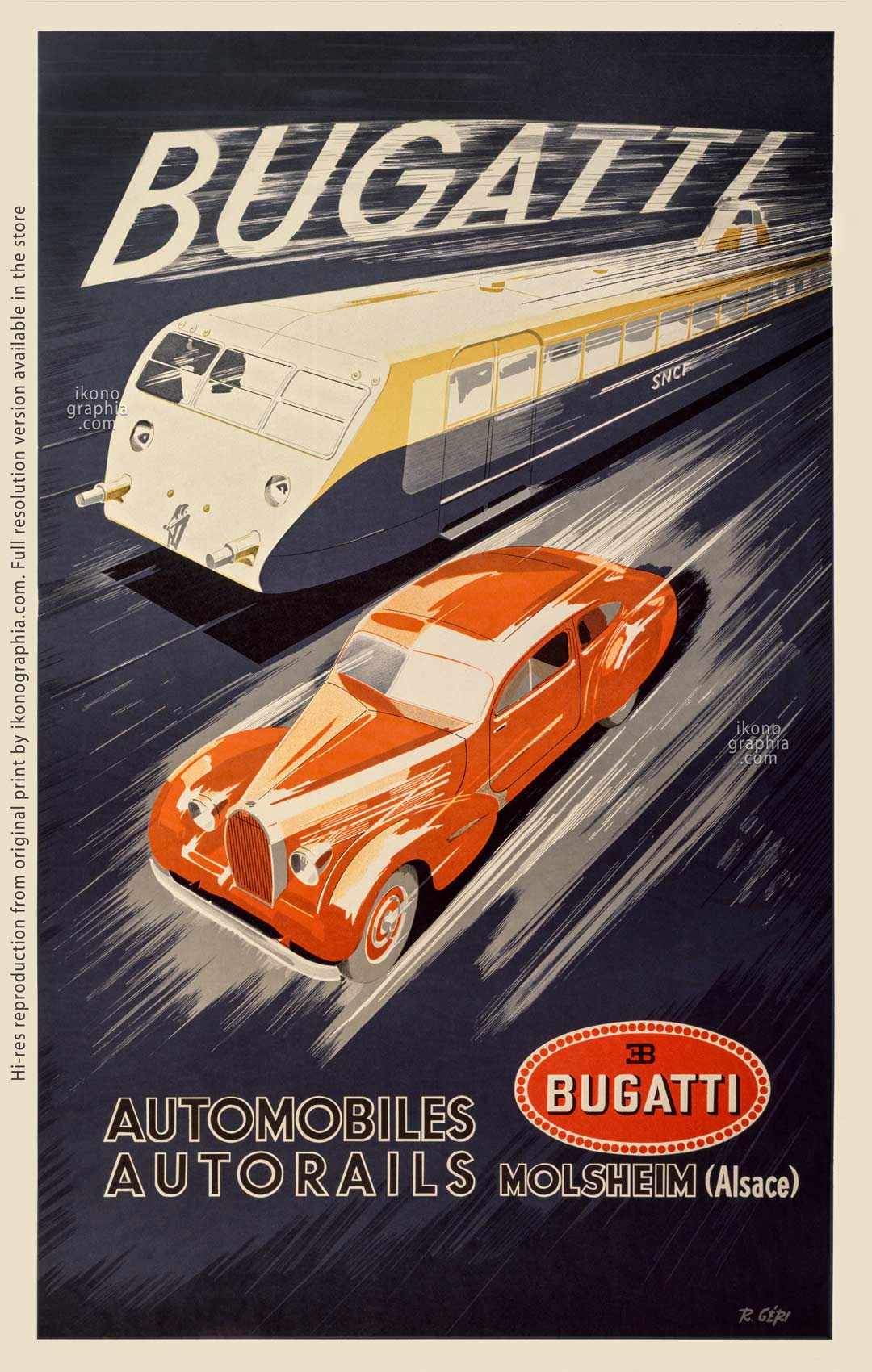
Bugatti Automobiles et Autorails — R. Geri, 1935
One of the rarest original Bugatti posters — printed in Strasbourg by A. Michel on thin paper.
The subject is the Bugatti autorail, the high-speed diesel railcar that Ettore designed for SNCF alongside his automobiles. Geri's full name remains untraced.
The poster is better documented than its maker.
Reproduced from the original.
Divina Bugatti
In 1991, Franco Maria Ricci — the most exacting publisher in Italy — commissioned Roberto Bigano to document the historic Bugatti collection at the Musée National de l'Automobile in Mulhouse.
The resulting book set the visual standard for Bugatti photography. Published in two editions of 5,000 copies each, both sold out.
One image from the session was rejected by Ricci as "not objective." It spent seventeen years in a box. It is now the profile banner of this archive.

The Elephant carved by Rembrandt Bugatti, right on top of the radiator grill of the Type 41 Royale Coupé Napoleon, the personal car of Ettore Bugatti.
It was an elephant standing on his back legs, with the erect trunk as a symbol of aggression and coupling (1929).
Courtesy: Musée National de l'Automobile, Mulhouse.

Bugatti Type 57SC Coupé Atlantic — Detail of the riveted crest, 1937.
Jean Bugatti designed the half-body ending in a crest, reversed it, and joined the two halves with rivets — one of the most daring forms in automotive history.
This image and the two Royale photographs were the only non-orthogonal pictures Franco Maria Ricci ever published. He approved them with a stern expression and a warning: "I never publish this kind of image. These are so beautiful that I must. Please don't do it again."
Courtesy: British Garage, Paris

Bugatti Type 35B Sport Two-seater, US Coachwork — Rear view, 1927.
Purists consider the American coachwork a deviation from the original design.
The photograph disagreed.
Courtesy: Musée National de l'Automobile, Mulhouse.
Bugatti Masterpieces of the 1920s and 1930s
A gallery of the most significant models documented by Roberto Bigano — from the Type 13 Brescia and the Type 35 Grand Prix to the Type 41 Royale and the Type 57 Atlantic. Each model presented with exclusive photography and historical context.

Bugatti Type 35B Grand Prix Biplace Course Two-Seater Racing — 1927.
Produced between 1924 and 1930, the Type 35 was phenomenally successful — over 1,000 race victories, 14 weekly wins at its peak, five consecutive Targa Florios from 1925 through 1929. No racing car of its era approached this record.
Photographed at Campogalliano on the rotating platform of the circular building — the same archive that held the factory drawings.
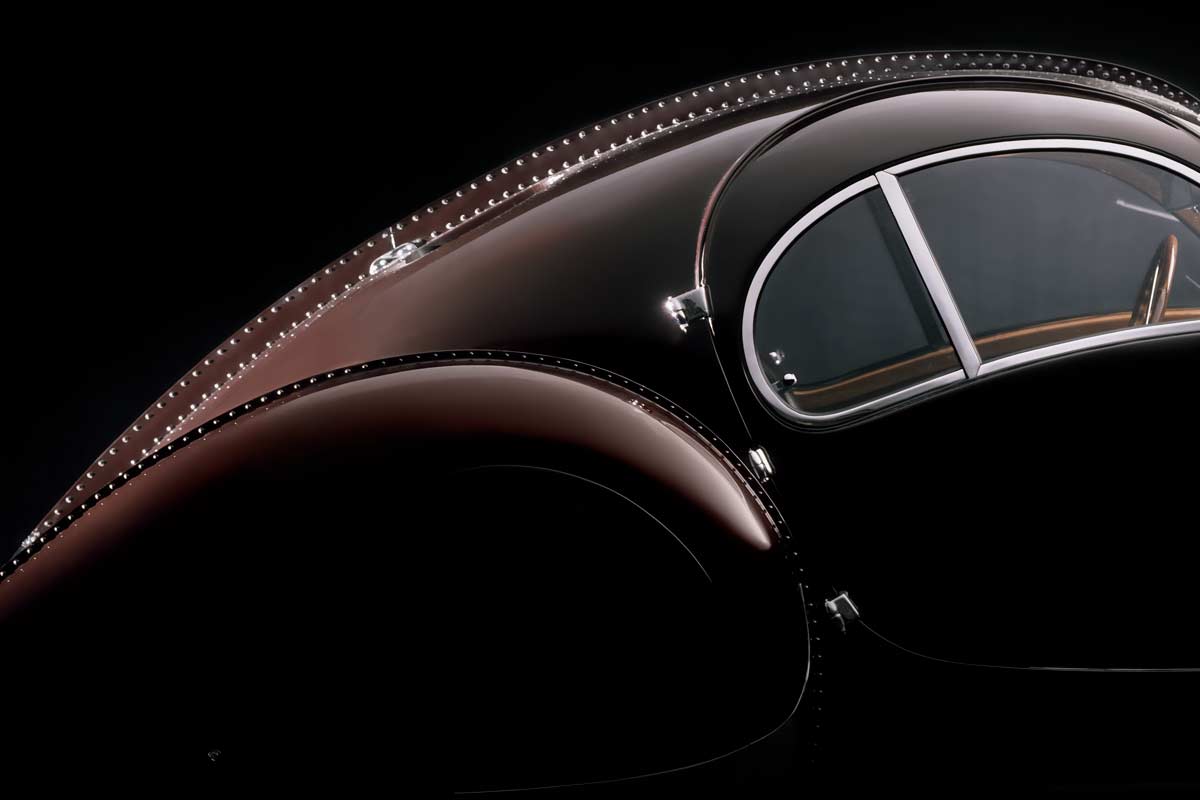
Bugatti Type 57SC Coupé Atlantic — Roofline and riveted spine, 1937.
Shot through the night at British Garage, Paris — exhausted, hungry, unable to properly light the riveted crest. My assistant was moving across the set with a Fresnel spot still open. For a moment the light caught the spine exactly as it should. "Stop." The photograph happened.
The dust on the bodywork made it unusable for twenty years, until Photoshop made the restoration possible.

Bugatti Type 32 Biplace Course "Tank" — Rear view, 1923.
One of the first racing cars designed around aerodynamic principles — the body enclosing the wheels, the silhouette a single uninterrupted form.
This rear view reveals the engineering logic: everything hidden, everything intentional. Among the first racing cars to use four-wheel braking.
Courtesy: Musée National de l'Automobile, Mulhouse.
Bugatti Glamour
Four nights of open-air studio sessions during the Centenary celebrations — the historic cars photographed not in a museum but in the hands of their owners, who followed the shoots, helped position the cars, and sometimes stepped in front of the lens themselves.
Roberto Bigano also audio-recorded the owners telling the story of their relationship with the marque. At least four of these recordings are exceptional primary source documents of Bugatti history — among them, the son of the former owner of the silhouetted Atalante.

Bugatti Type 37A "Flighty," 1928. Owners: Frederica and Simon Fitzpatrick, Guernsey.
The Fitzpatricks named and treated their 65 cars as members of the family — from their oldest Bugattis to their latest VW Golf. On the last night of the sessions, Roberto Bigano presented Frederica with a large print of this photograph. She went immediately to show it to the car. "Flighty is enthusiast," she said. Would you sell your son just because he's old?
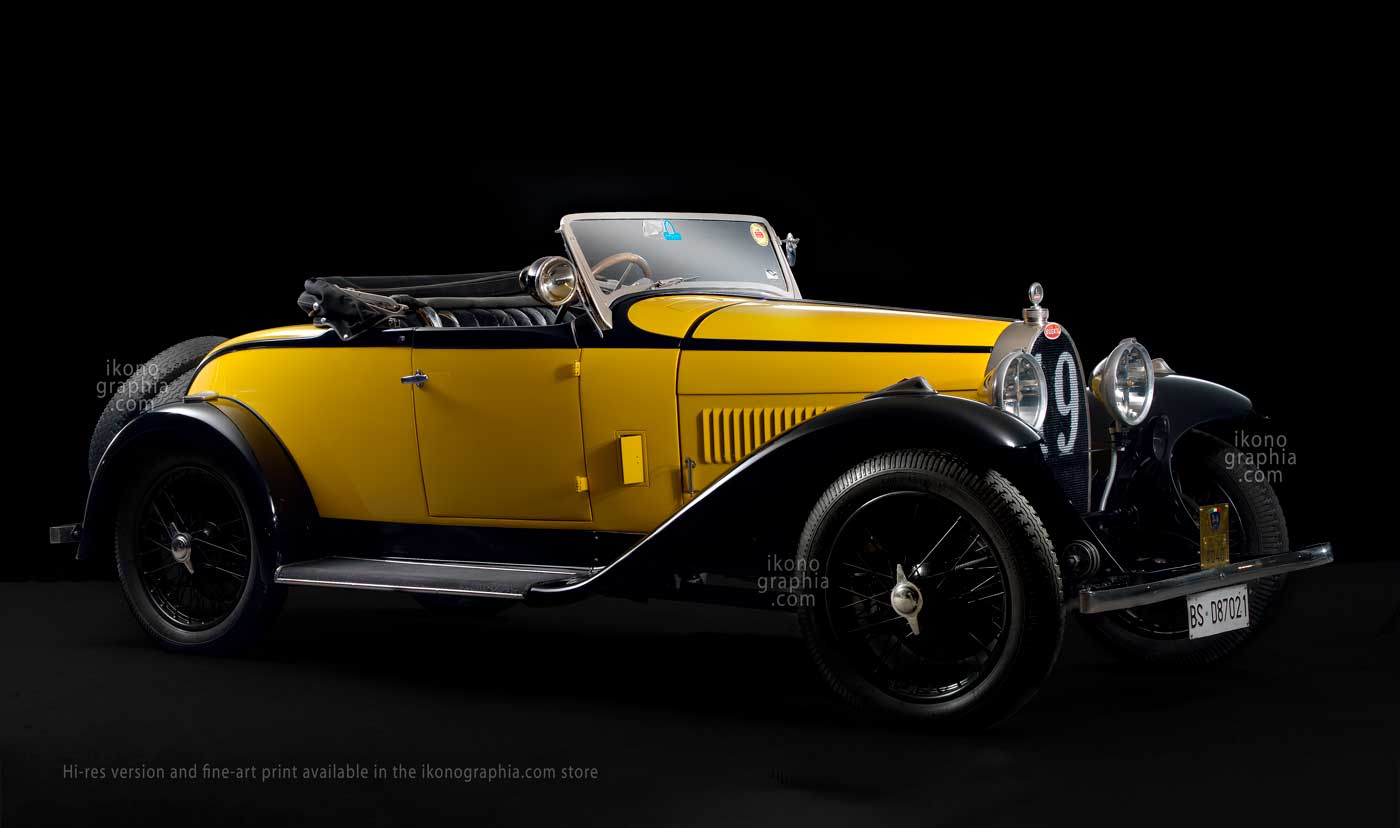
Bugatti Type 40A — Owner: Ivanno Frascari, Italy, 1931.
The yellow and black livery was the factory's own choice — Bugatti's colours from the beginning. Frascari brought it to Castiglione for the Centenary Meeting.

Bugatti Type 57S Atalante — Chassis 001, 1931. Owner: Franz Wassmer, Switzerland.
Franz Wassmer's father owned the Atalante now held at the Musée National de l'Automobile in Mulhouse. In summer, the car's cabin became unbearably hot. His mother's solution was to rest her feet out of the window. His father's solution was final: "Enlève tes pieds de la fenêtre, sinon je vends la voiture." He sold it.
Franz was a boy. He loved that car. The sale left a wound that decades of ordinary life could not close.
He became a billionaire. He bought Chassis 001.
Roberto Bigano recorded him at Castiglione telling this story. The voice on the recording is not that of a billionaire. It is that of a boy who never stopped wanting his father's car back.
This image and the full account were published in Victor, the Hasselblad magazine.
The Bugatti International Meeting — Tuscany, 2009
Developed with the Bugatti Club Italia and supported by Hasselblad and Manfrotto, this archive followed the historic cars through the Centenary celebrations — in motion, in context, in the hands of their owners.
Among its most significant chapters: 120 owners and their cars gathered in Tuscany — on the lawn at Marone-Cinzano, in the medieval piazza of Massa Marittima. The panoramic photograph of that afternoon — 13,000 pixels wide, a single stitched frame — is the most complete document of what the meeting actually was.

Bugatti International Meeting — Piazza Garibaldi, Massa Marittima, Tuscany, 2009.
One hundred and twenty Bugattis gathered in a medieval piazza in front of a thirteenth-century cathedral. Owners from across the world — Europe, the Americas, Australia.

Bugatti International Meeting — Marone-Cinzano Estate, Tuscany, 2009
The Bugatti Centenary. Two hundred and fifty owners gathered from across the world on one of Tuscany's great estates — lunching under the cypresses, Brunello di Montalcino on the table. On the lawn, 125 historic Bugattis on open display: the largest gathering of the marque ever assembled in one place.
Documented from above, stitching multiple Hasselblad frames from a 12-metre tripod into a single panoramic frame 13,000 pixels wide. An event that will not happen again, recorded as it deserved to be.
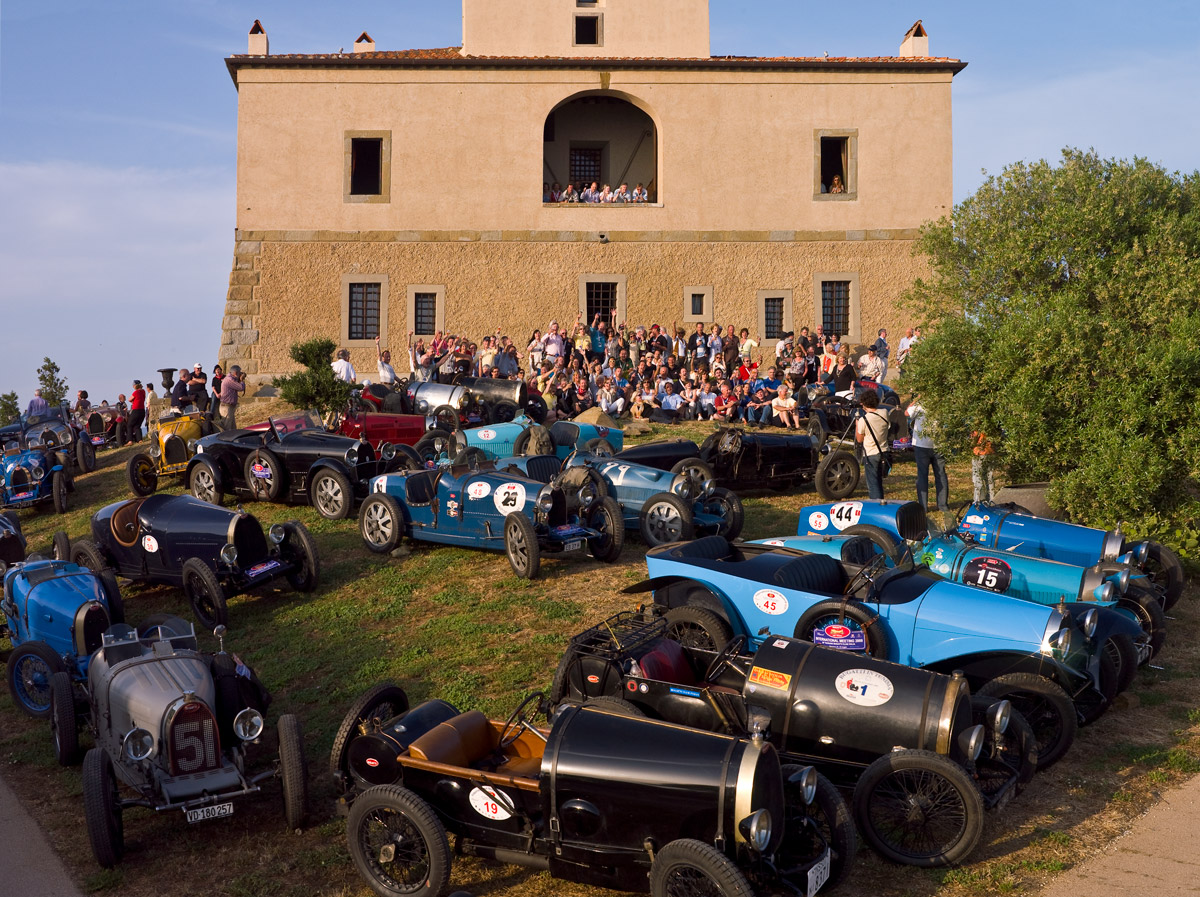
Bugatti International Meeting — Castello Colle Massari, Tuscany, 2009.
A stop at a medieval fortress in the Maremma — a toast, the cars clustered on the grass, the owners still laughing. No programme, no ceremony. Just two hundred and fifty people who shared the same unreasonable passion, in one of the most beautiful corners of Tuscany, at the end of a Bugatti day.
A collective portrait that needed no posing.
The Spirit of Bugatti — Alsace, 1990
Before the restoration of Molsheim began, Roberto Bigano documented what remained of the original Bugatti world — the factory, the château, the surroundings — in the last months before Bugatti Automobili's revival would briefly transform it. The horse on the wall of Château Saint-Jean, tangled in dead vines: Ettore's symbol surviving in a building no one was looking after.

The Portal of Château Saint-Jean — Molsheim, Alsace, 1990.
The entrance to Ettore Bugatti's former headquarters — once the center of an estate with workshops, a hotel, and a way of receiving clients that had no equivalent in the industry. If your car needed attention, you came to Molsheim. You were a guest until it was ready.
Photographed a year before the revival began. The portal was still standing. Not much else was.
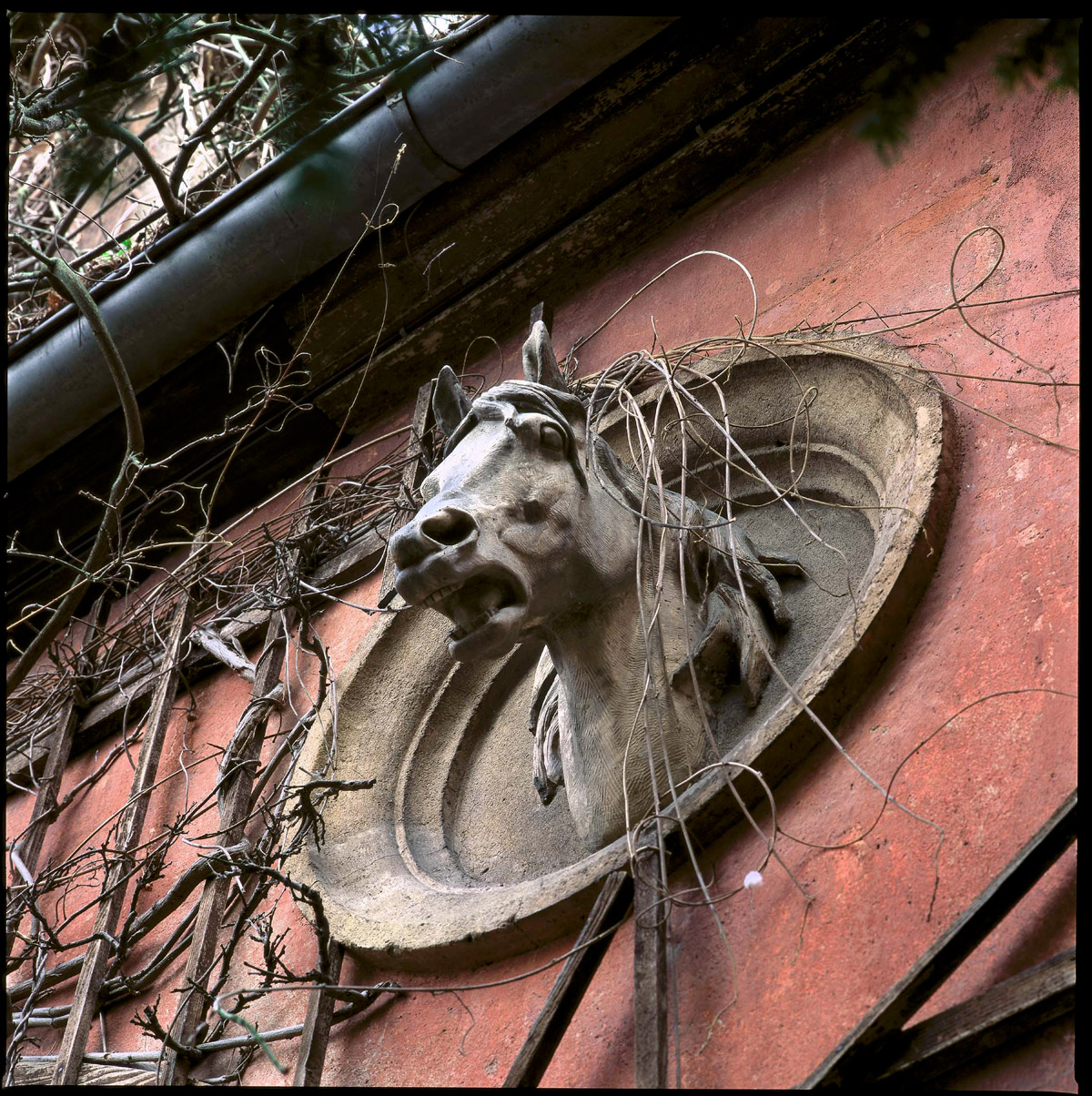
Château Saint-Jean, Molsheim, Alsace, 1990 — Ettore Bugatti's horse.
Ettore Bugatti bred thoroughbreds at Molsheim with the same obsessive standards he applied to his cars. The horse was his personal symbol — cast into the wall of Château Saint-Jean, the domain's heart, where it had presided over the estate for decades.
By 1990, no one was looking after it. The vines had grown across the facade and through the relief itself, threading through the stone as if reclaiming it. The building was between two lives.
The image was never published. It was never proposed as the symbol of the rebirth it was about to witness. It should have been.
Copyright, Links And Credits
Photography, Copyright & Credits
These images are part of the Ikonographia Visual Archives: — Bugatti Heritage Collection — Bugatti Factory Drawings Archive.
All drawings reproduced by Roberto Bigano in 1990 from originals held in the Bugatti factory archive. The current location of the originals is unknown.
All photographs © Ikonographia / Roberto Bigano — All Rights Reserved.
⸻
Terms of Use (Summary)
The images presented in this archive are copyrighted and available for licensed use only through Ikonographia Visual Archives.
You may not download, reproduce, publish, or distribute these images without a valid license. For commercial or editorial licensing, please refer to the product pages or contact Ikonographia directly. A full explanation of licensing terms is available in the Shop / Licensing Information section under "Ikonographia — Standard License" and "Ikonographia — Merchandising & Product Use Licenses"
⸻
The Ikonographia Bugatti Heritage Archive
Between 1990 and 2009, photographer Roberto Bigano documented Bugatti with a level of access that no longer exists and cannot be replicated. The relationship began with Romano Artioli — the Italian entrepreneur who had just acquired the Bugatti name and was preparing its revival at Campogalliano — who gave Roberto carte blanche to work inside the factory, the archive, and every event that followed. No brief. No restrictions. No supervision.
What resulted is not a single project but five distinct bodies of work: the factory technical drawings reproduced before they disappeared, two major photographic commissions on the historic cars, a complete documentary record of the Bugatti International Centenary Meeting in Tuscany, and an Alsatian reportage made inside Molsheim before the restoration began. Together they form one of the most complete private archives of Bugatti heritage in existence — most of it unpublished until now, some of it available nowhere else.
The archive is not a celebration of the marque. It is a record made by someone who was trusted enough to be inside it, at the precise moment when its past and its future were in the same room.
⸻
Credits & Acknowledgments
Ikonographia gratefully acknowledges the fundamental contribution of Romano Artioli, founder of Bugatti Automobili, without whose trust and unrestricted access this archive would not exist.
⸻
Ikonographia Mission Statement
Ikonographia is committed to the accurate documentation, preservation, and ethical dissemination of twentieth-century visual culture.
⸻
Archival Notes
These drawings were reproduced by Roberto Bigano in 1990, during the preparation for the revival of Bugatti Automobili at Campogalliano. Access to the Bugatti factory archive was granted by Romano Artioli. The drawings document the original Molsheim factory production.
⸻
Further Reading (Selected Sources)
- Romano Artioli, Bugatti & Lotus Thriller — A first-person account of the Bugatti Automobili project by its founder: the dream, the factory, the cars, and the dramatic events that brought it all to an end. Available in English — Amazon US · Italian — Amazon IT
- Romano Artioli — Official Website The story of a boy with a big four-wheel dream.
⸻