
Bugatti Automobili & EB110 — A Complete Visual Archive
An unprecedented visual record of the Italian Bugatti, documented from within and available nowhere else.
Between 1990 and 1995, Bugatti Automobili attempted one of the most ambitious industrial and cultural projects of the late twentieth century: the rebirth of Bugatti as a contemporary manufacturer, built from the ground up in Campogalliano, Italy.

Ikonographia holds the complete visual archive of Bugatti Automobili in Campogalliano, documenting one of the most ambitious and influential supercar projects of the 1990s.
This unique body of work records the factory, the production process, and the design philosophy behind the EB110 through first-hand documentary photography created with continuous access.
An Impossible Dream.
Redefining performance, elegance, and technological excellence.
Between 1990 and 1995, Bugatti Automobili attempted something no modern manufacturer had tried before: to resurrect a legendary marque not through nostalgia, but through an uncompromising vision of contemporary engineering, design, and culture.
Conceived and built from the ground up in Campogalliano—within the dense constellation of factories and test roads that define Italy’s supercar world—the project brought together radical ambition, avant-garde architecture, and an unprecedented level of technical refinement..
What makes this archive unique is not only its completeness, but its point of view. The story of Bugatti Automobili is told here from inside: by those who imagined it, designed it, and documented it as it happened.

The “Prove Motori” Development Building
This image reflects the almost obsessive attention to cleanliness and order that Romano Artioli required throughout the factory.
The monumental Bugatti emblem and the large white ventilation pipes—visible from miles away—symbolized the factory’s heart and soul, embodying shared ambition and pride in building something unprecedented.
The Dream Factory — La Fabbrica Blu, Campogalliano (1990–1995)
Architecture, work, and ambition as a single system.
Before the first car was assembled, Bugatti Automobili had to invent a place capable of sustaining an unprecedented ambition: not merely a factory, but an environment designed to foster precision, creativity, and human intelligence at the highest level.
Conceived and built in Campogalliano during the early 1990s, the Fabbrica Blu was unlike any contemporary automotive plant. It rejected the logic of industrial alienation in favor of natural light, controlled acoustics, advanced air quality, and spatial clarity. Architecture was not treated as a neutral container, but as an active component of production itself.
This vision did not emerge from abstraction. It was driven directly by Romano Artioli, founder of Bugatti Automobili, who believed that innovation could only thrive in a place designed for people as much as for machines.
What follows is Artioli’s own account of the principles that shaped the Fabbrica Blu — a rare first-person testimony from the origin of one of the most ambitious industrial experiments of the late twentieth century.
“To make innovative cars, I thought it was essential to motivate workers. I always had in mind the factories I visited during my life: places of alienation and suffering. What we needed instead was an environment immersed in nature, which stimulates creativity. Therefore, the plant was designed to give technicians maximum comfort and the freedom to express their talent in the best possible way.”
From “Bugatti & Lotus Thriller.
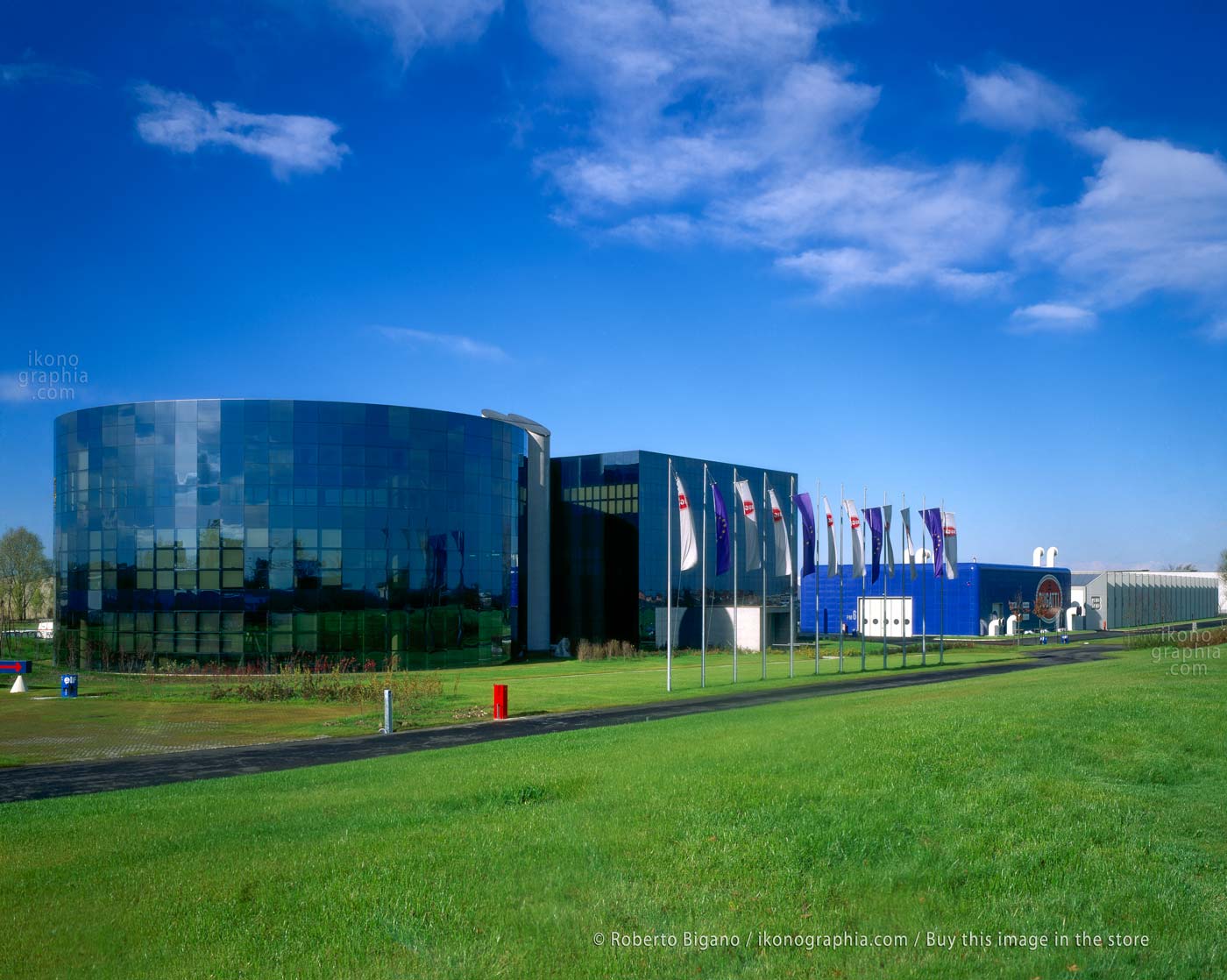
La Fabbrica Blu
Designed by architect Gianpaolo Benedini, the Campogalliano complex is built around three distinct architectural modules, conceived as a single functional and aesthetic system.
Benedini himself describes the design process that shaped one of the most radical industrial architectures of the period.

The Production Building.
The iconic modular structure bearing Ettore Bugatti’s EB logo.
Rather than long, dark factory sheds, architect Gianpaolo Benedini designed production halls flooded with natural light.
Conceived as twin buildings—one dedicated to assembly lines, the other to services—the structure achieved architectural clarity under exceptional constraints: tight deadlines required the use of pre-existing modular systems, transformed here into a coherent and distinctive industrial form.

Engineers’ Hall
The bright, futuristic engineers’ hall occupied the fully glazed upper level of the circular building.
Designed with softened radii and continuous glass surfaces, the space dissolved traditional boundaries between structure, light, and work.
Every desk was flooded with natural light. Controlled acoustics and precise climate regulation created an environment where concentration and collaboration could coexist without distraction.
Conceived as a jewel of avant-garde industrial architecture, the hall embodied Romano Artioli’s belief that innovation could only flourish in spaces designed for people as carefully as for machines.
EB110 Gran Turismo. The Making of a Dream Car at Bugatti Automobili
Behind the scenes of the EB110: people, process, and precision.
Once the factory had taken shape, the next challenge was inevitable: the car itself.
In this second chapter, we move behind the scenes of Bugatti Automobili to follow the making of the EB110 Gran Turismo—from early design decisions to the daily work that transformed an ambitious idea into a functioning automobile.
This was not only a technical process. The workplace had been conceived to place people at the center, encouraging concentration, collaboration, and creative freedom at every stage. To understand the atmosphere that defined those years, it is best to leave the story to Romano Artioli, who witnessed it from the inside.
Bugatti Automobili was an environment immersed in nature, which stimulated creativity. The entire plant was therefore designed primarily to give technicians maximum comfort and the freedom to express their talent in the best possible way.
It was exciting to see how everyone was engaged in their work and how carefully they installed or molded the materials with automated equipment. They were a group of engineers who programmed each new process with passion, without any distractions.
From Romano Artioli’s book “Bugatti & Lotus Thriller.”

Engineering staff (left to right): Antonio Cesaroni, Oliviero Pedrazzi, Stefano Mion, Federico Trombi, Achille Bevini, Nicola Materazzi, Pavel Reimisch, Tiziano Benedetti.

Design Debate Around the EB110 Wooden Model.
Marcello Gandini, Romano Artioli, and Gianpaolo Benedini gathered around the full-scale wooden model of the EB110 during an intense design review at Campogalliano.
The image captures a decisive moment in the project’s development, when vision, engineering, and architecture confronted one another directly—revealing both the creative energy and the underlying tensions that shaped the car’s final form.

Aerodynamic Development at the Pininfarina Wind Tunnel.
The full-scale wooden model of the Bugatti EB110 undergoing aerodynamic testing at the Pininfarina Wind Tunnel.
Active since 1972, the facility was a recognized center of excellence for research in aerodynamics and aeroacoustics.
This phase translated the car’s sculptural form into measurable performance, refining airflow, stability, and cooling before the transition from model to prototype.

Engineers at Work in the Designers’ Building.
Federico Trombi, Nicola Materazzi, and Achille Bevini working late inside the futuristic designers’ building at Bugatti Automobili.
Tight development deadlines often extended work well beyond regular hours, reflecting the intensity and ambition driving the EB110 project.
Bugatti EB110 — From Prototype to EB112
Design evolution from the first working EB110 to Bugatti’s final Italian concept.
Before becoming a series of models, the EB110 was a clear idea.
What follows is the evolution of that idea—from the first working prototype to the final EB112—guided by Romano Artioli’s original vision and reshaped, in its final form, by Gianpaolo Benedini.
Romano Artioli — The Gran Turismo as Vision
The reborn Bugatti had to be the most brilliant Gran Turismo ever built: the most powerful, the fastest, most beautiful, and safest. It had to be a four-wheel drive for the best tractions in all weather conditions and road surfaces.
It had to be lightweight, using superior materials like titanium, magnesium, carbon-fiber, and aluminum for maximum acceleration, shorter braking distance, and best road grip with a lightweight and rigid chassis, for improved safety.
A Necessary Redesign
The original technical and stylistic direction did not survive unchanged.
After early conflicts, Paolo Stanzani and Marcello Gandini left the project. Nicola Materazzi—formerly Ferrari’s chief engineer—assumed technical leadership, while Gianpaolo Benedini, already responsible for the design of the Fabbrica Blu, was asked to redesign the car itself.
What emerged was a form that reconnected the EB110 to Bugatti’s classical lineage—most visibly in the covered rear wheels—while preparing the ground for its final and most radical expression: the EB112.
EB110 Epowood Model
Restyled by Gianpaolo Benedini, the model introduces the covered rear wheels, a deliberate reference to the Bugatti Atlantic and Aérolithe.

EB110 Prototipo
The first fully working EB110, still carrying experimental solutions later revised for technical and thermal reasons.

EB110 Production
The definitive Gran Turismo form, refined for series production while preserving the original technical ambition.

EB110 Supersport
A performance-oriented evolution, lighter and more extreme, pushing the EB110 concept to its mechanical limits.

EB112
An Italian Bugatti concept designed by Giorgetto Giugiaro: a four-door Grand Tourer that expanded the EB110 vision beyond the supercar.
Captions for the featured images on the top of the page
The First Epowood Model of Bugatti EB110
A rare photograph of the early EB110 epowood maquette produced during the 1991 restyling phase led by architect Gianpaolo Benedini.
The model introduces the covered rear wheels, a deliberate reference to the Bugatti Atlantic and Aérolithe, reconnecting the modern EB110 project to the marque’s most radical pre-war designs and marking a decisive step toward the final EB110 GT.
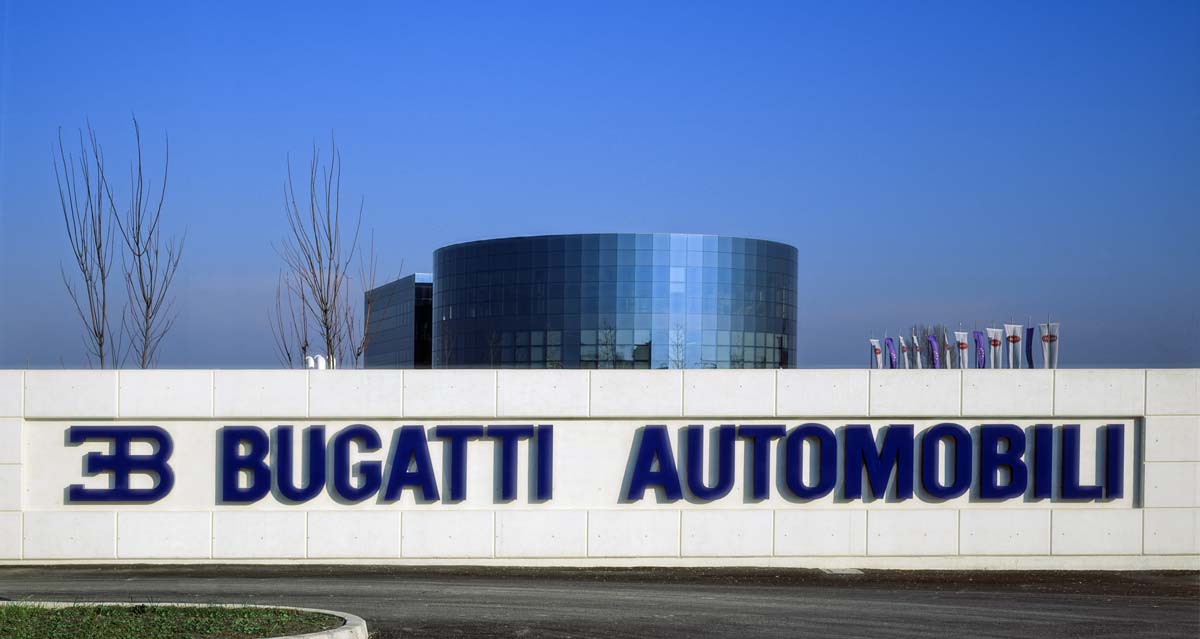
Main Entrance to Bugatti Automobili, Campogalliano
The entrance to the Campogalliano industrial complex, conceived by architect Gianpaolo Benedini for Bugatti Automobili.
The circular glass building—visible beyond the perimeter wall—embodied an avant-garde approach to industrial architecture, uniting corporate identity, transparency, and spatial rigor in a single, unmistakable form.
Explore the Bugatti Automobili Archive


