Bugatti — Photography, Drawings, Literature

Bugatti — Photography, Drawings, Literature

Bugatti — Photography, Drawings, Literature

Exclusive archives documenting Bugatti from the inside — available nowhere else.

Between 1909 and 1939, Bugatti produced fewer than 8,000 cars in Molsheim, Alsace. Ettore designed the machines and directed everything around them — the coachwork, the literature, the posters, the domain itself. Jean brought the body to its highest form. What remained was a body of objects — cars, drawings, catalogs, posters — of exceptional rarity and cultural weight.

The legendary Ettore Bugatti's signature on the engine head of a 1921 Type 13 Brescia. Photo by Roberto Bigano. Buy this image in the ikonographia.com store.

This featured story is an editorial hub, conceived as a new re-editing of multiple existing stories and archival materials. It brings together previously separate contents into a single, coherent narrative framework — photography, technical drawings, and printed literature documenting Bugatti heritage from 1909 to 1952.

The archive was built between 1990 and 2009 by photographer Roberto Bigano, working with a level of access that no longer exists and cannot be replicated. It began with Romano Artioli — the Italian entrepreneur who revived the Bugatti name at Campogalliano — who gave Bigano unrestricted entry to the factory, the drawings archive, and every event that followed. No brief. No restrictions. No supervision.

This collection is not a celebration of the marque. It is a record made by someone who was trusted enough to be inside it, at the precise moment when its past and its future were in the same room.

0360-13 Mannequin in a shop window in Braunschweig, Germany, September 1979 | From "Plastic Girls" series. Photo by Roberto Bigano. Buy this image in the ikonographia.com store.

Two Bugatti Type 13 Brescia — Marone-Cinzano Estate, Tuscany, 2009.

Resting in the shade during the owners' lunch — one of 120 cars gathered for the Bugatti International Meeting.

Featured image above


Ettore Bugatti's signature — Engine head of the Type 13 Brescia, 1921.

Not a badge. Not a plate. Ettore cast his own handwriting into the metal of the engine head — his name made part of the machine itself.

The Type 13 Brescia won the first four places at the 1921 Brescia Grand Prix. This is what he signed.

Five Bodies of Work — One Complete Archive

What resulted is not a single project. It is five distinct bodies of work — factory drawings, printed literature, posters, studio photography, and documentary reportage — built across two decades, most of it unpublished until now. Together they form the most complete visual record of Bugatti heritage in private hands.
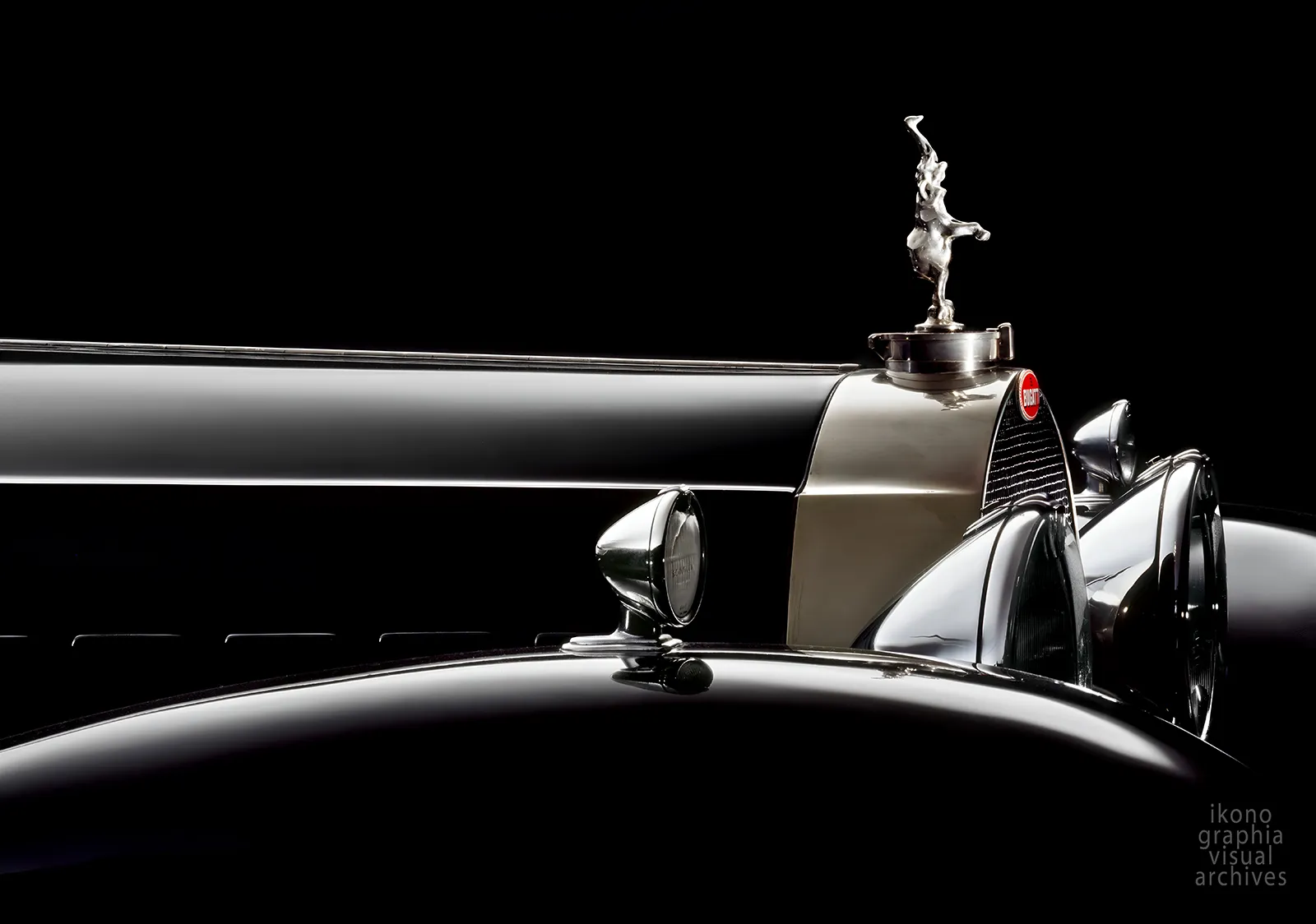
Bugatti Type 41 Royale Coupé Napoleon (1929) The personal car of Ettore Bugatti. Courtesy: Musée National de l'Automobile, Mulhouse. Photo by Roberto Bigano. Courtesy: Courtesy: Musée National de l’Automobile Mulhouse. Buy this image at Ikonographia.com store

Bugatti Type 41 Royale Coupé Napoléon — Bonnet and elephant mascot, 1929.

Ettore's personal car — 7.2 metres long, the largest automobile ever built, conceived for royalty and driven by its maker.

The elephant on the radiator was sculpted by Rembrandt Bugatti, Ettore's younger brother, one of the great animal sculptors of his generation. Six Royales were completed. This is one of them.

The Lost Factory Drawings

Between 1922 and 1935, the Molsheim factory produced the technical drawings that defined how Bugatti cars were built — body designs, mechanical specifications, production templates, drawn by hand on paper and cloth.

Reproduced in 1990 before disappearing, these images may be the only surviving record. Ikonographia presents them in three chapters — Form, Function, and Obsession — examining why they remain unique.
August 1984 - Beverly Hills, California - From "Plastic Girls" series. Photo Roberto Bigano.

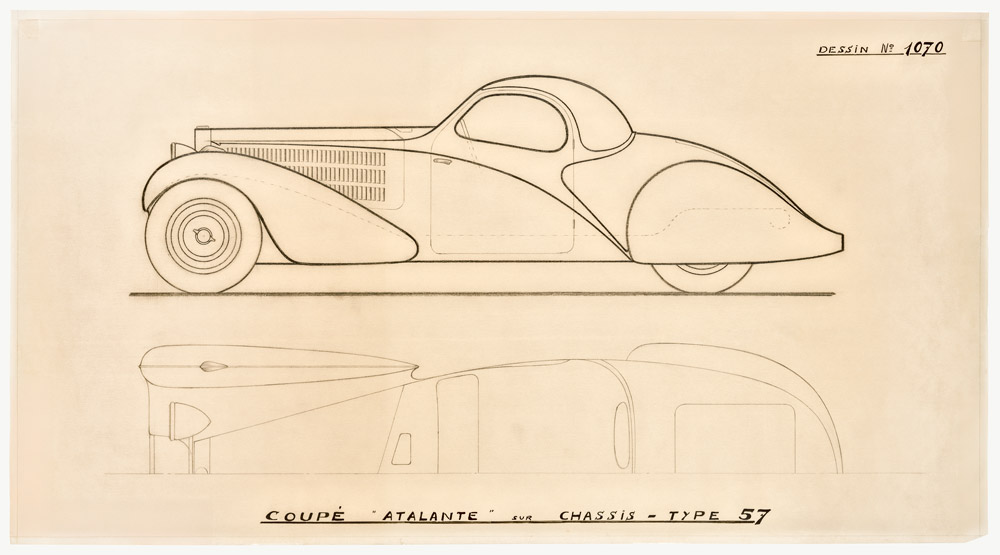
Dessin N° 1070 — Coupé Atalante sur Chassis Type 57 — 1935

Side elevation and plan view. Pencil on tracing paper. The body design was Jean Bugatti's. The factory drawings were the work of his technical team at Molsheim. 
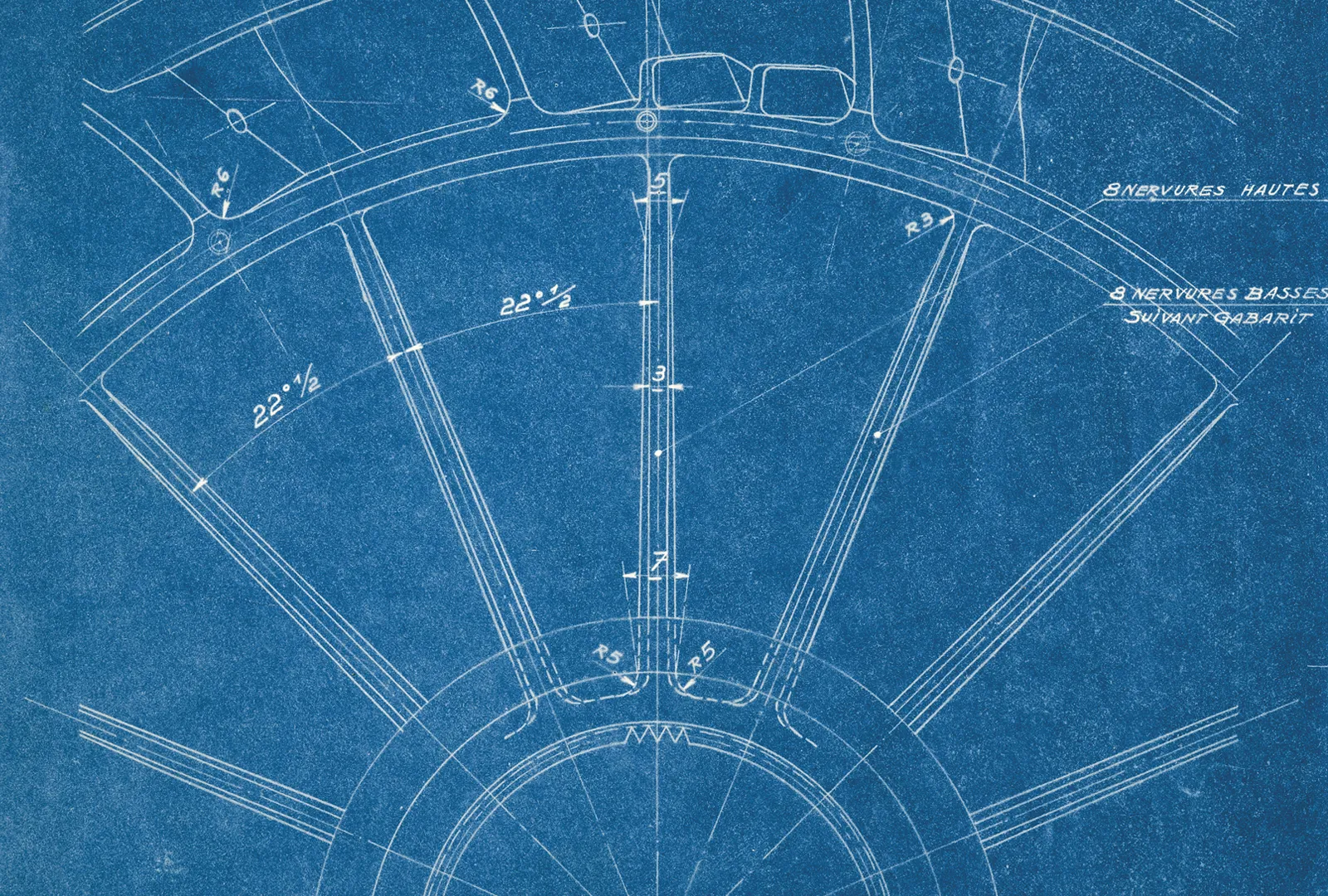
Detail of Bugatti’s patented Monobloc aluminum wheel design from a 1932 technical drawing.

The Bugatti Monobloc Cast Aluminum Wheel — Patented 1924

The first single-piece cast aluminum wheel in automotive history. This heliographic print, dated 22 July 1932, is a first-generation factory copy made directly from the original drawing and distributed to the production department. The spoke section shown here specifies eight high ribs and eight low ribs following the template, with all radii and tolerances called out in millimeters.
The geometry is not only structural — the alternating rib heights reduce weight while maintaining rigidity, a solution that remained technically advanced for its era. Eight years after the original patent, the drawing shows no uncertainty. Every line was already resolved.

Like the Vitruvian Man, it is a study in proportion where engineering and beauty become the same thing.
August 1984 - Beverly Hills, California - From "Plastic Girls" series. Photo Roberto Bigano.

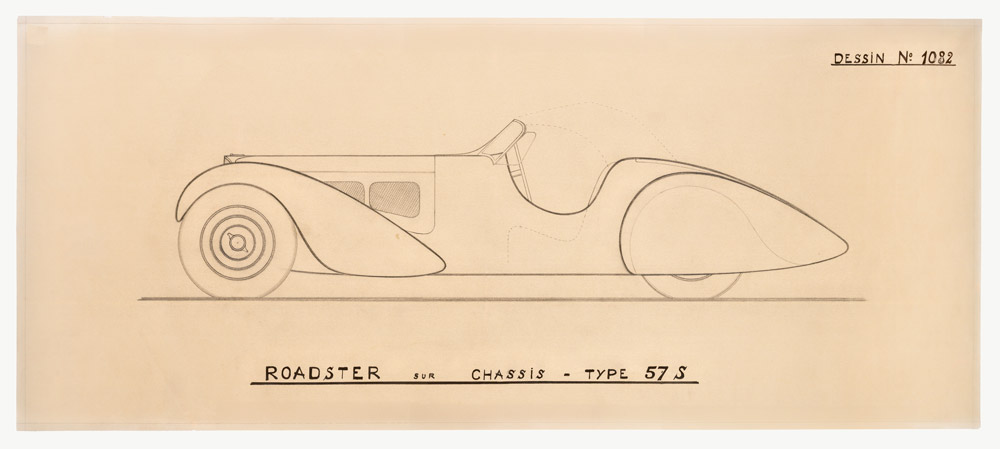
Dessin N° 1082 — Roadster sur Chassis Type 57S — 1935.

The surbaissé chassis — lowered by passing the rear axle through the frame members. Jean Bugatti's final and most aerodynamic variant of the Type 57 line. Pencil on tracing paper.

Bugatti Catalogs and Literature

Bugatti's catalogs and brochures were produced inside Molsheim under the same standards as the cars. Ettore and Jean directed everything — the typography, the photography, the choice of illustrators. The archive covers the full range of printed literature from the 1920s through 1939, the year Jean died and the pre-war chapter closed.

Depliant Bugatti Type 44 3 litres 1929

Dépliant Bugatti Type 44, 3 litres — Centerfold, 1929.

The centerfold of the Type 44 folder places the car in front of Château Saint-Jean — Bugatti's headquarters in Molsheim. T

he two figures beside it are Lidia and Michel Bugatti, two of Ettore's children. The photograph is not incidental. Molsheim was not a factory with a family attached. It was a domain, and the catalog knew it.

Bugatti Berline 3 places avec spider sur chassis 3 litres. Photo

Bugatti Berline 3 places avec spider sur chassis 3 litres. — Central double spread.
Photo Carabin.

The second body variant in the same 1928 brochure series. Same photographer, same studio discipline.

The two Carabin photographs and the two Hemjic covers were designed as pairs — the machine and its ancestry, facing each other across the fold.
Bugatti Type 57 Modeles 1939

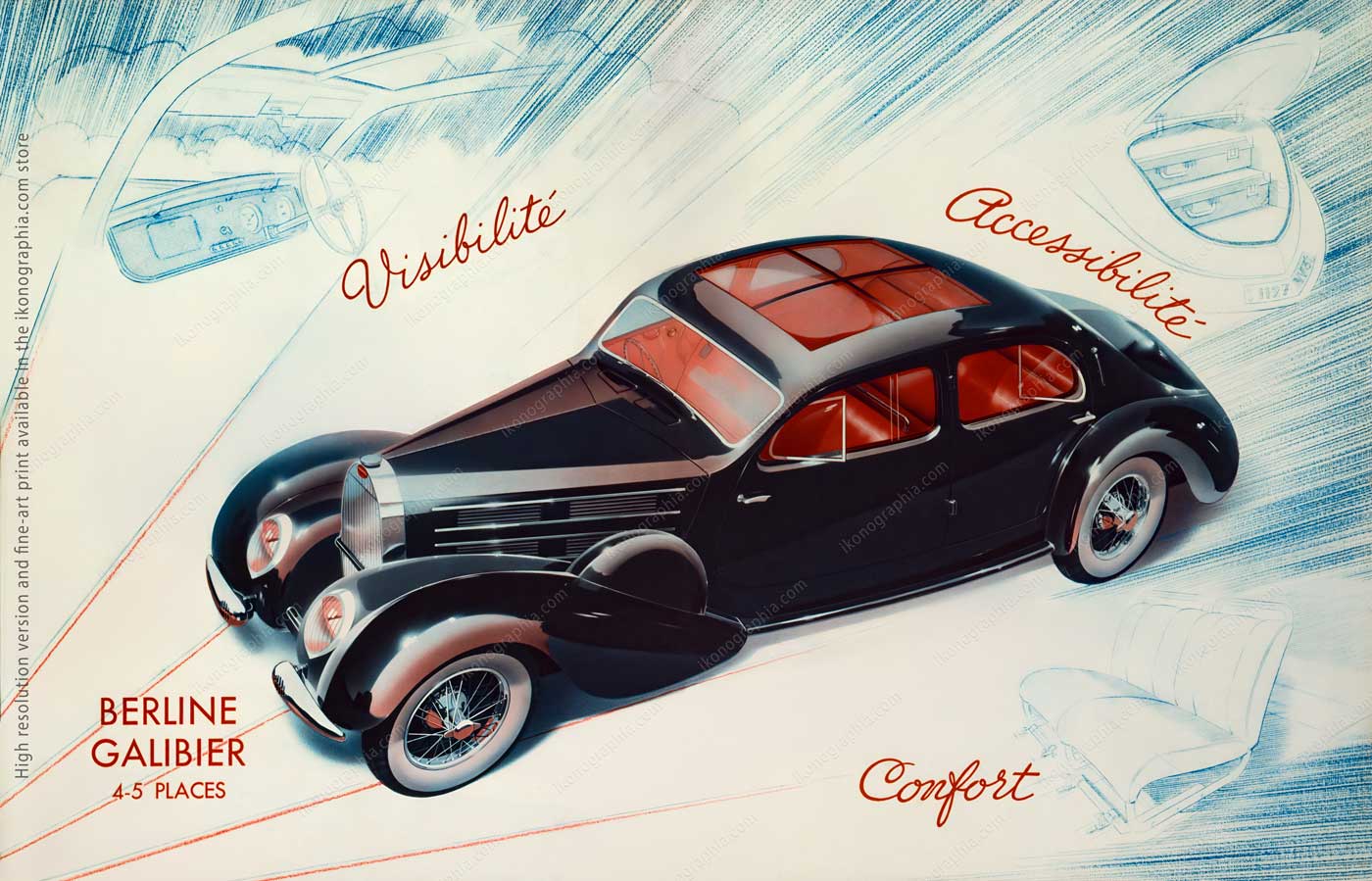
Bugatti Type 57 Modèles 1939. Berline Galibier 4-5 places. Visibilité. Accessibilité. Confort.reet and Regent Street series.

The three words beneath the model name are the brochure's argument in miniature — the same logic that organized the 1936 catalog, compressed into a single line.

The Galibier was the largest body in the Type 57 range. The claims are precise and in the correct order.

Bugatti Posters

Bugatti commissioned its advertising posters from the finest graphic artists of the era — Cassandre, Marcello Dudovich, René Vincent, Geo Ham. The results are among the most celebrated works in automotive poster art. Cassandre's 1935 Le Pur-Sang des Automobiles remains the definitive image of the marque. Dudovich's 1922 C'è una Bugatti, non si passa is a masterpiece of symbolic compression.

The originals were held in the Campogalliano archive. Roberto Bigano borrowed and reproduced them in his studio — the same access that produced the factory drawings. The archive presents the most significant surviving examples, reproduced directly from the originals.
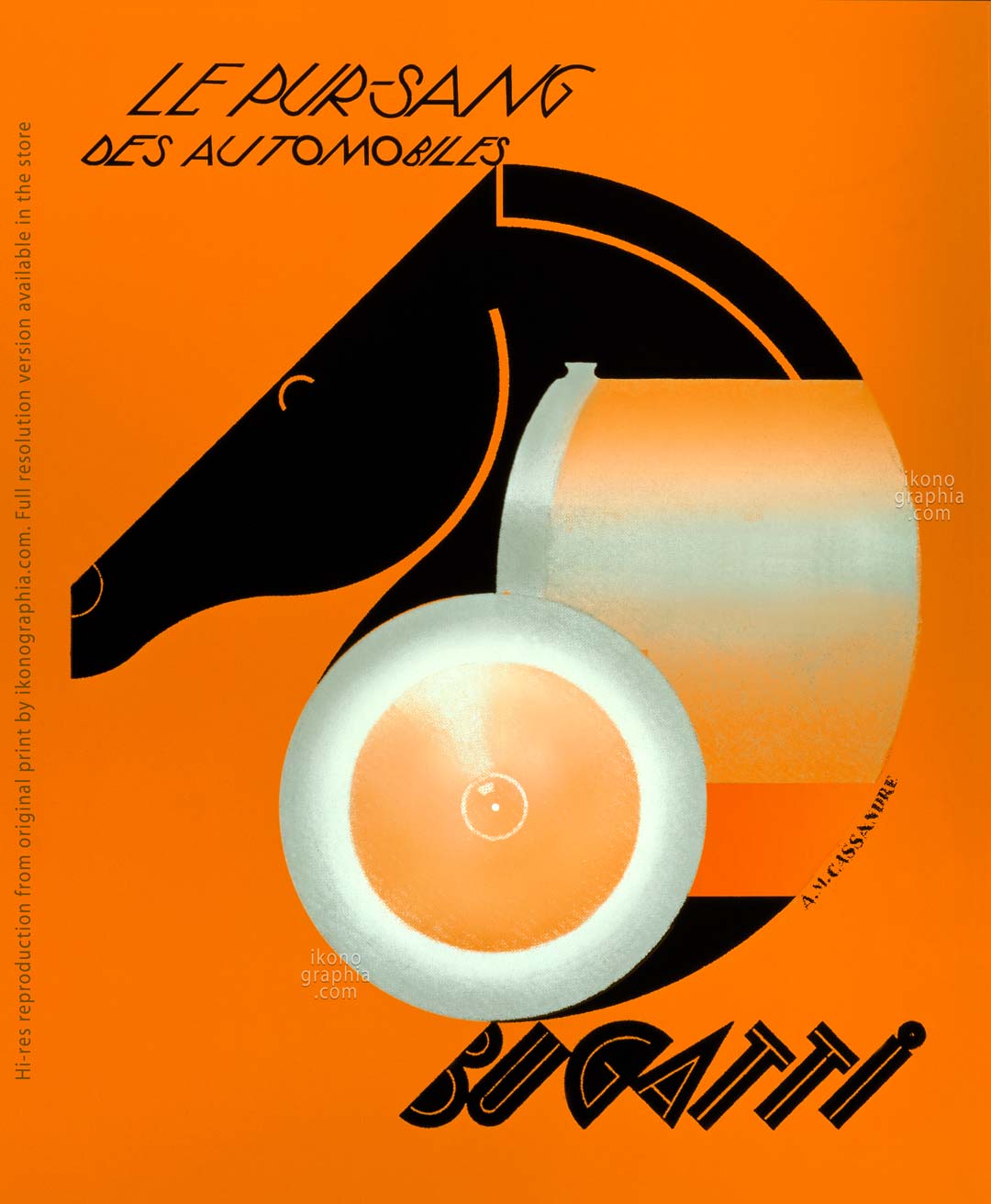
Le Pur-Sang Des Automobiles. Art by Cassandre 1935. An iconic 1935 Bugatti Poster by Cassandre, pseudonym of Adolphe Jean-Marie Mouron.

Le Pur-Sang des Automobiles — Cassandre, 1935.

The image that defined Bugatti's identity for a century — by the greatest poster artist of its time.
Reproduced from the original

C’è una Bugatti, non si passa (There's a Bugatti, you can't pass.) Poster by Marcello Dudovich 1922 Dimensions: 195x140 cm Printer: Edizioni STAR . Officine IGAP, Milano This masterpiece is rich in symbolism, beginning with the title that emphasizes Bugatti's legendary invincibility. The model portrayed is the Type 13 Brescia.

C'è una Bugatti, non si passa — Marcello Dudovich, 1922

A masterpiece of symbolic compression: the title declares Bugatti's invincibility, the red scarf trailing from the figure echoes the death of Isadora Duncan — who died when her scarf caught in the wheel of a Bugatti.

Except that happened five years later. Dudovich was simply ahead of events.
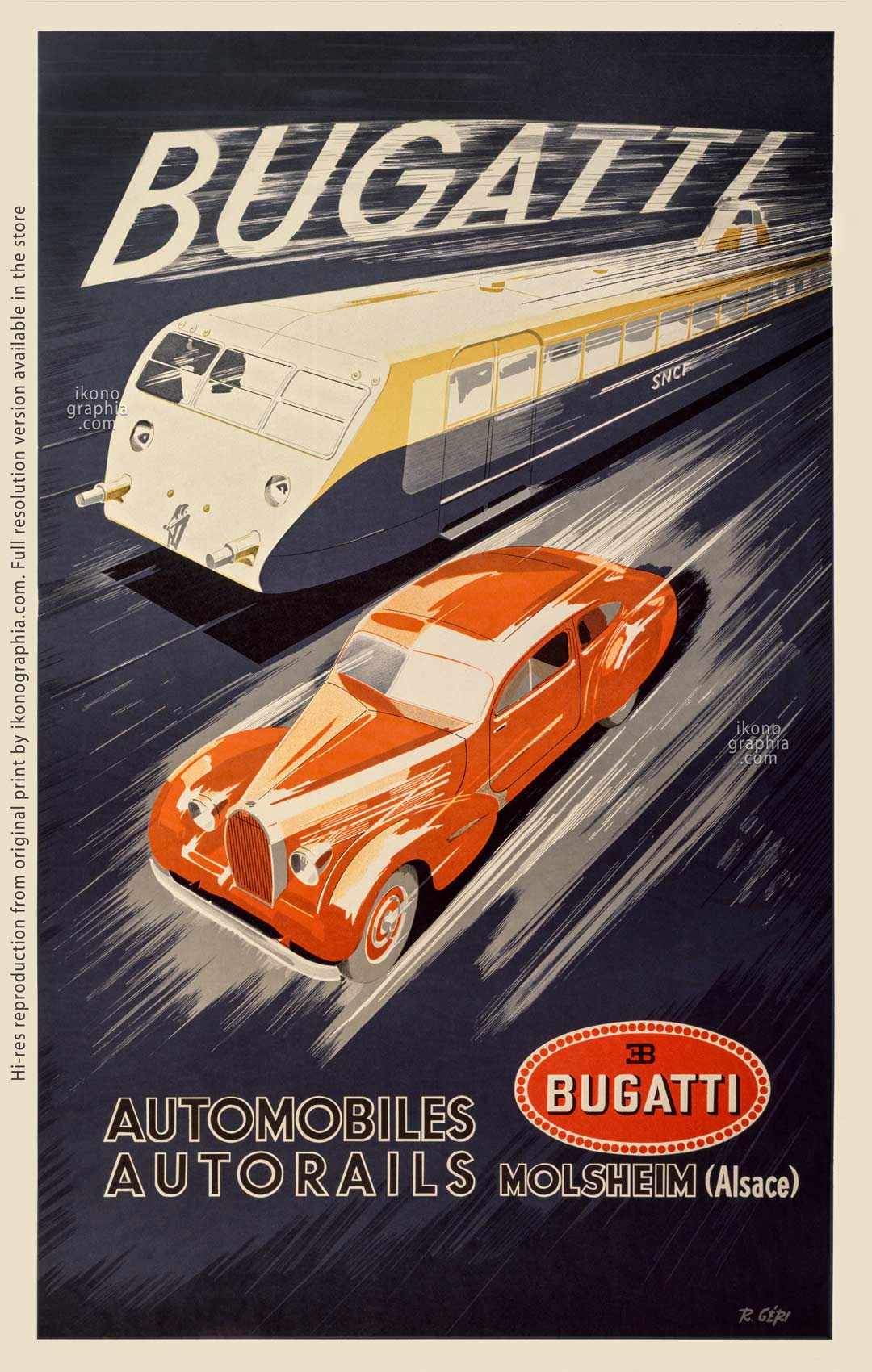
Bugatti Automobiles et Autorails. 1935 - Art by R.Geri

Bugatti Automobiles et Autorails — R. Geri, 1935

One of the rarest original Bugatti posters — printed in Strasbourg by A. Michel on thin paper.
The subject is the Bugatti autorail, the high-speed diesel railcar that Ettore designed for SNCF alongside his automobiles. Geri's full name remains untraced.

The poster is better documented than its maker.
Reproduced from the original.

Divina Bugatti

In 1991, Franco Maria Ricci — the most exacting publisher in Italy — commissioned Roberto Bigano to document the historic Bugatti collection at the Musée National de l'Automobile in Mulhouse.
The resulting book set the visual standard for Bugatti photography. Published in two editions of 5,000 copies each, both sold out.

One image from the session was rejected by Ricci as "not objective." It spent seventeen years in a box. It is now the profile banner of this archive.

The Elephant carved by Rembrandt Bugatti, right on top of the radiator grill of the Type 41 Royale Coupé Napoleon, the personal car of Ettore Bugatti. It was an elephant standing on his back legs, with the erect trunk as a symbol of aggression and coupling (1929) - Courtesy: Musée National de l'Automobile, Mulhouse. Photo by Roberto Bigano. Courtesy: Courtesy: Musée National de l’Automobile Mulhouse. Buy this image at Ikonographia.com store

The Elephant carved by Rembrandt Bugatti, right on top of the radiator grill of the Type 41 Royale Coupé Napoleon, the personal car of Ettore Bugatti.

It was an elephant standing on his back legs, with the erect trunk as a symbol of aggression and coupling (1929).

Courtesy: Musée National de l'Automobile, Mulhouse.

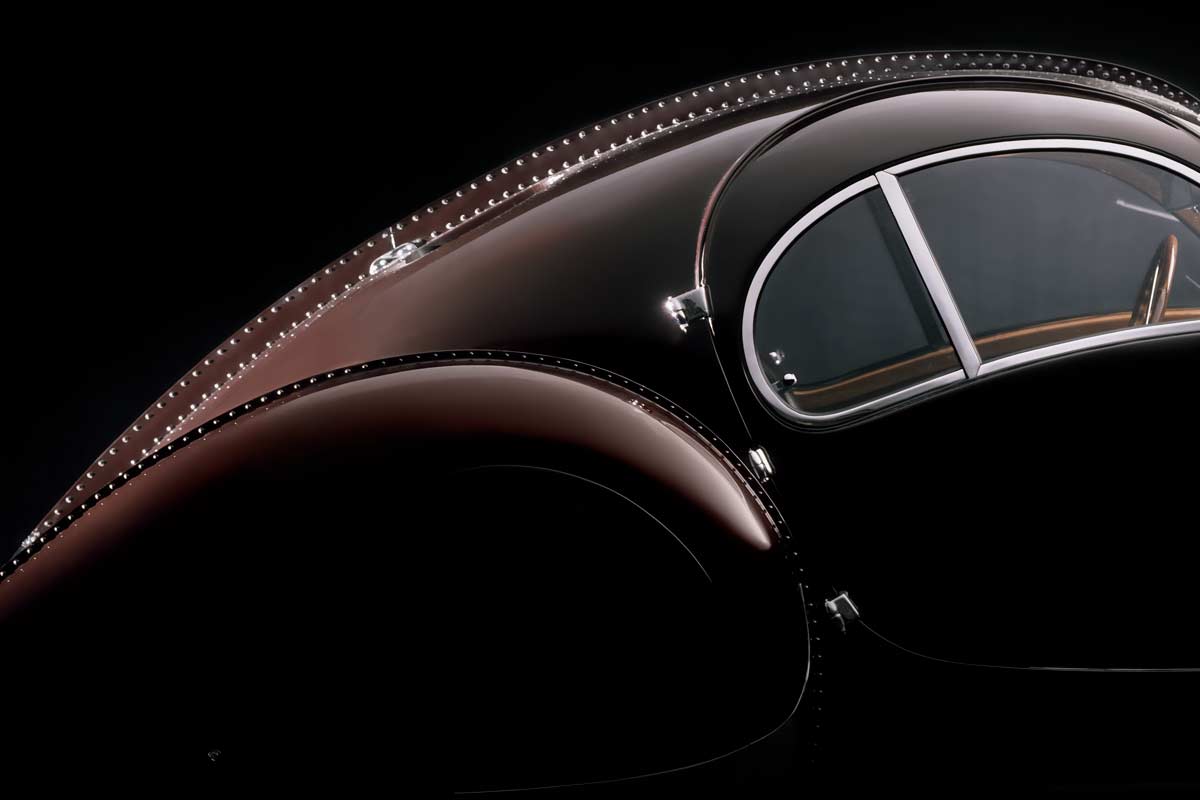
A 1937 Bugatti Type 57SC Coupé Atlantic. Detail of the windshield and wipers emphasizing the riveted crest. Jean Bugatti designed the half-body ending in a crest. He then reverted the first part right-left and finally joined the two pieces with rivets in one of the most daring automotive designs. Photo by Roberto Bigano. Courtesy: British Garage, Paris. Buy this image at Ikonographia.com store

Bugatti Type 57SC Coupé Atlantic — Detail of the riveted crest, 1937.

Jean Bugatti designed the half-body ending in a crest, reversed it, and joined the two halves with rivets — one of the most daring forms in automotive history.

This image and the two Royale photographs were the only non-orthogonal pictures Franco Maria Ricci ever published. He approved them with a stern expression and a warning: "I never publish this kind of image. These are so beautiful that I must. Please don't do it again."

Courtesy: British Garage, Paris

Bugatti Type 35B Sport Two-seater, US Coachwork (1927). Photo by Roberto Bigano. Courtesy: Courtesy: Musée National de l’Automobile Mulhouse. Buy this image at Ikonographia.com store

Bugatti Type 35B Sport Two-seater, US Coachwork — Rear view, 1927.

Purists consider the American coachwork a deviation from the original design.
The photograph disagreed.

Courtesy: Musée National de l'Automobile, Mulhouse.

Bugatti Masterpieces of the 1920s and 1930s

A gallery of the most significant models documented by Roberto Bigano — from the Type 13 Brescia and the Type 35 Grand Prix to the Type 41 Royale and the Type 57 Atlantic. Each model presented with exclusive photography and historical context.
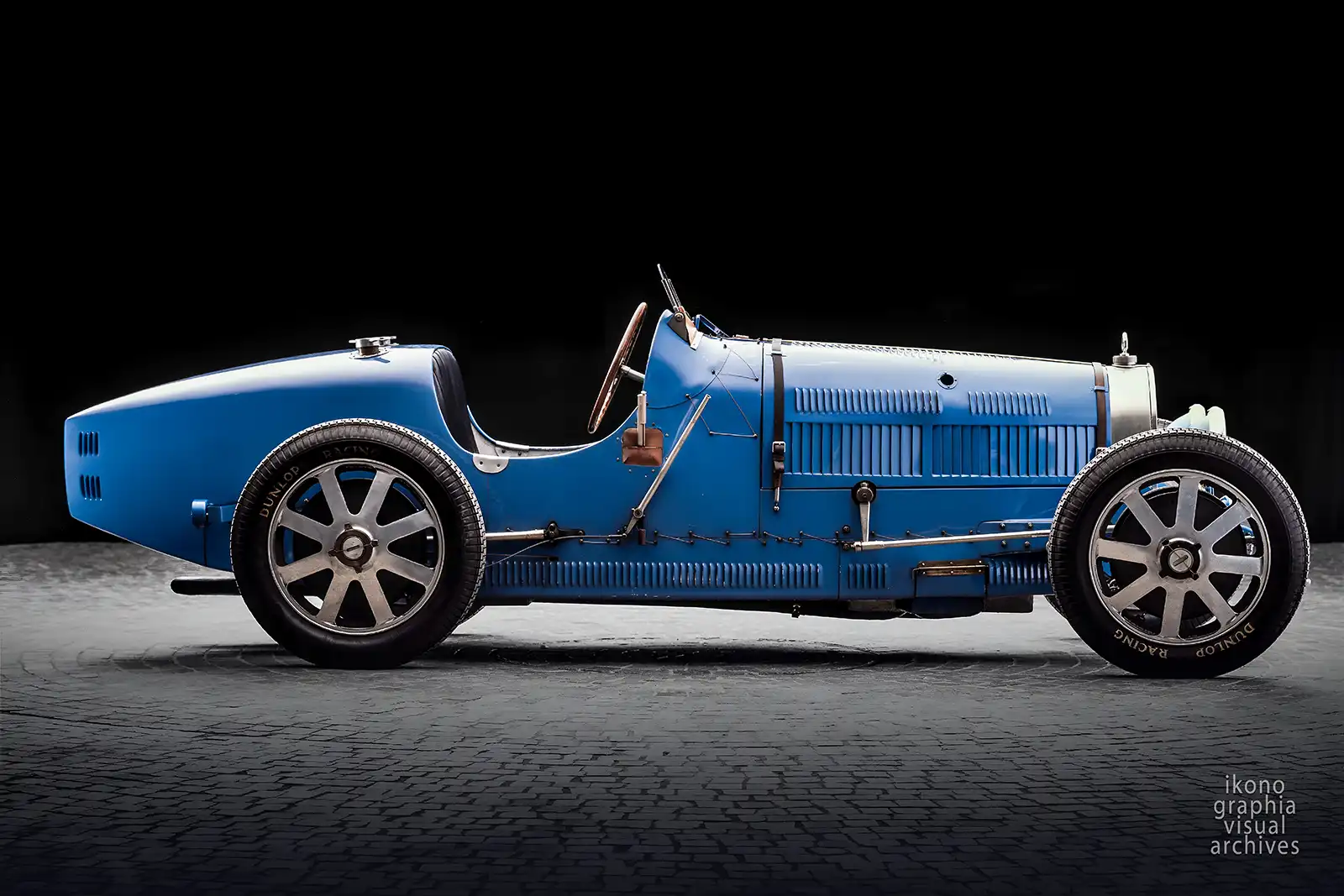
Bugatti Type 35B Grand Prix Biplace Course - Two Seater Racing

Bugatti Type 35B Grand Prix Biplace Course Two-Seater Racing — 1927.

Produced between 1924 and 1930, the Type 35 was phenomenally successful — over 1,000 race victories, 14 weekly wins at its peak, five consecutive Targa Florios from 1925 through 1929. No racing car of its era approached this record.

Photographed at Campogalliano on the rotating platform of the circular building — the same archive that held the factory drawings.

A 1937 Bugatti Type 57SC Coupé Atlantic lightened in silhouette mode to emphasize the flowing coupé lines

Bugatti Type 57SC Coupé Atlantic — Roofline and riveted spine, 1937.

Shot through the night at British Garage, Paris — exhausted, hungry, unable to properly light the riveted crest. My assistant was moving across the set with a Fresnel spot still open. For a moment the light caught the spine exactly as it should. "Stop." The photograph happened.

The dust on the bodywork made it unusable for twenty years, until Photoshop made the restoration possible.

Bugatti Type 32 Biplace Course "Tank" (1923). This striking, unexpected rear view emphasizes the aerodynamics of the design. Photo by Roberto Bigano. Courtesy: Courtesy: Musée National de l’Automobile Mulhouse. Buy this image at Ikonographia.com store

Bugatti Type 32 Biplace Course "Tank" — Rear view, 1923.

One of the first racing cars designed around aerodynamic principles — the body enclosing the wheels, the silhouette a single uninterrupted form.

This rear view reveals the engineering logic: everything hidden, everything intentional. Among the first racing cars to use four-wheel braking.
Courtesy: Musée National de l'Automobile, Mulhouse.

Bugatti Glamour

Four nights of open-air studio sessions during the Centenary celebrations — the historic cars photographed not in a museum but in the hands of their owners, who followed the shoots, helped position the cars, and sometimes stepped in front of the lens themselves.

Roberto Bigano also audio-recorded the owners telling the story of their relationship with the marque. At least four of these recordings are exceptional primary source documents of Bugatti history — among them, the son of the former owner of the silhouetted Atalante.

Bugatti Type 37A, "Flighty" (1928) - Owners, Frederica and Simon Fitzpatrick, Guernsey © Roberto Bigano/ ikonographoa.com Browse the Bugatti Archive https://www.ikonographia.com/archive/the-bugatti-archive/

Bugatti Type 37A "Flighty," 1928. Owners: Frederica and Simon Fitzpatrick, Guernsey.

The Fitzpatricks named and treated their 65 cars as members of the family — from their oldest Bugattis to their latest VW Golf. On the last night of the sessions, Roberto Bigano presented Frederica with a large print of this photograph. She went immediately to show it to the car. "Flighty is enthusiast," she said. Would you sell your son just because he's old?
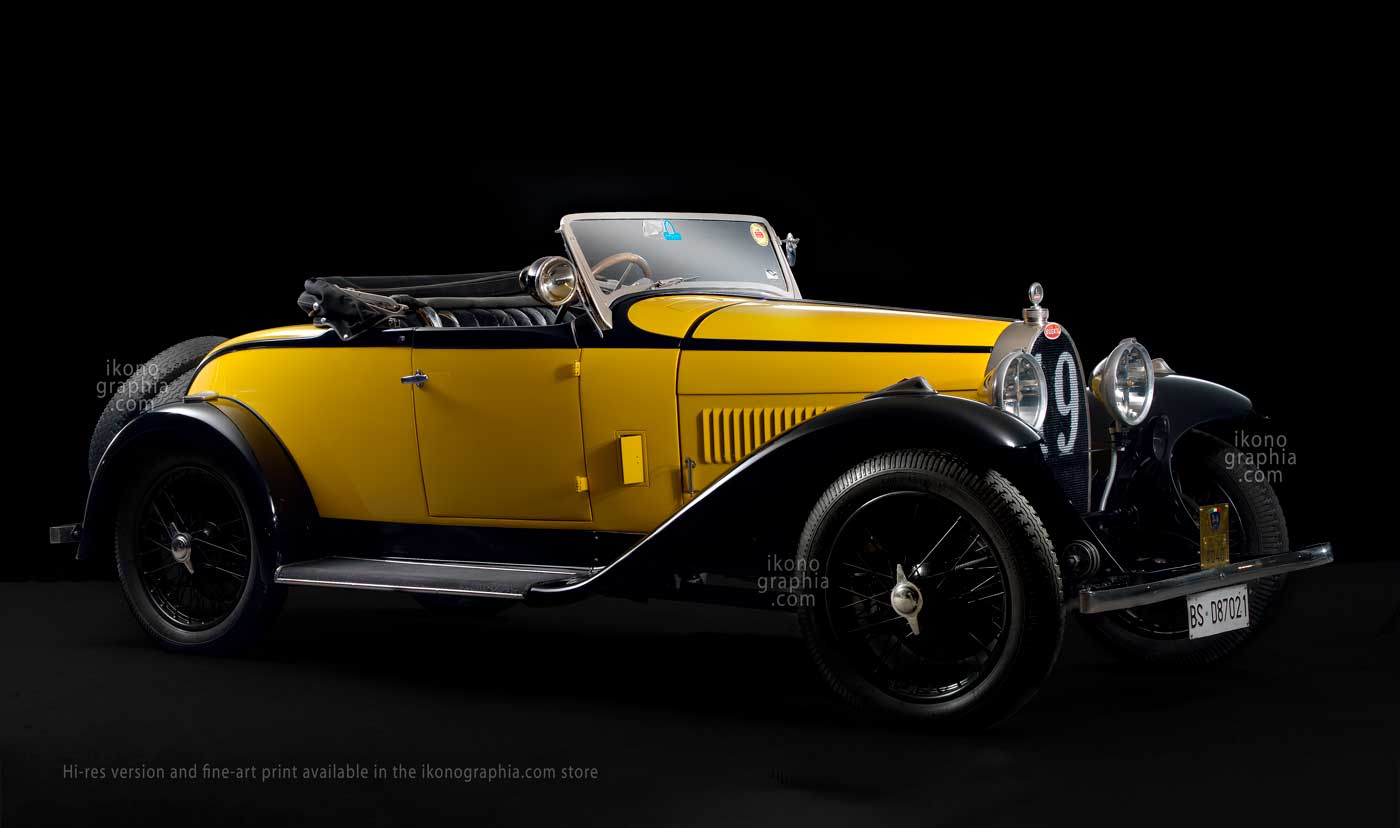
Bugatti Type 40A 1931. Owner Ivanno Frascari, Italy. Photo Roberto Bigano. https://www.ikonographia.com/archive/the-bugatti-archive/

Bugatti Type 40A — Owner: Ivanno Frascari, Italy, 1931.

The yellow and black livery was the factory's own choice — Bugatti's colours from the beginning. Frascari brought it to Castiglione for the Centenary Meeting.

Bugatti Type 57S Atalante 1931 Chassis 001, back view. Owner Franz Wassmer

Bugatti Type 57S Atalante — Chassis 001, 1931. Owner: Franz Wassmer, Switzerland.

Franz Wassmer's father owned the Atalante now held at the Musée National de l'Automobile in Mulhouse. In summer, the car's cabin became unbearably hot. His mother's solution was to rest her feet out of the window. His father's solution was final: "Enlève tes pieds de la fenêtre, sinon je vends la voiture." He sold it.

Franz was a boy. He loved that car. The sale left a wound that decades of ordinary life could not close.

He became a billionaire. He bought Chassis 001.
Roberto Bigano recorded him at Castiglione telling this story. The voice on the recording is not that of a billionaire. It is that of a boy who never stopped wanting his father's car back.

This image and the full account were published in Victor, the Hasselblad magazine.

The Bugatti International Meeting — Tuscany, 2009

Developed with the Bugatti Club Italia and supported by Hasselblad and Manfrotto, this archive followed the historic cars through the Centenary celebrations — in motion, in context, in the hands of their owners.

Among its most significant chapters: 120 owners and their cars gathered in Tuscany — on the lawn at Marone-Cinzano, in the medieval piazza of Massa Marittima. The panoramic photograph of that afternoon — 13,000 pixels wide, a single stitched frame — is the most complete document of what the meeting actually was.

0360-13 Mannequin in a shop window in Braunschweig, Germany, September 1979 | From "Plastic Girls" series. Photo by Roberto Bigano. Buy this image in the ikonographia.com store.

Bugatti International Meeting — Piazza Garibaldi, Massa Marittima, Tuscany, 2009.

One hundred and twenty Bugattis gathered in a medieval piazza in front of a thirteenth-century cathedral. Owners from across the world — Europe, the Americas, Australia.

Detail of Bugatti’s Monobloc Cast Aluminum Wheel drawing, dated July 27, 1932 (Roue Bugatti brevetée en aluminium coulé).

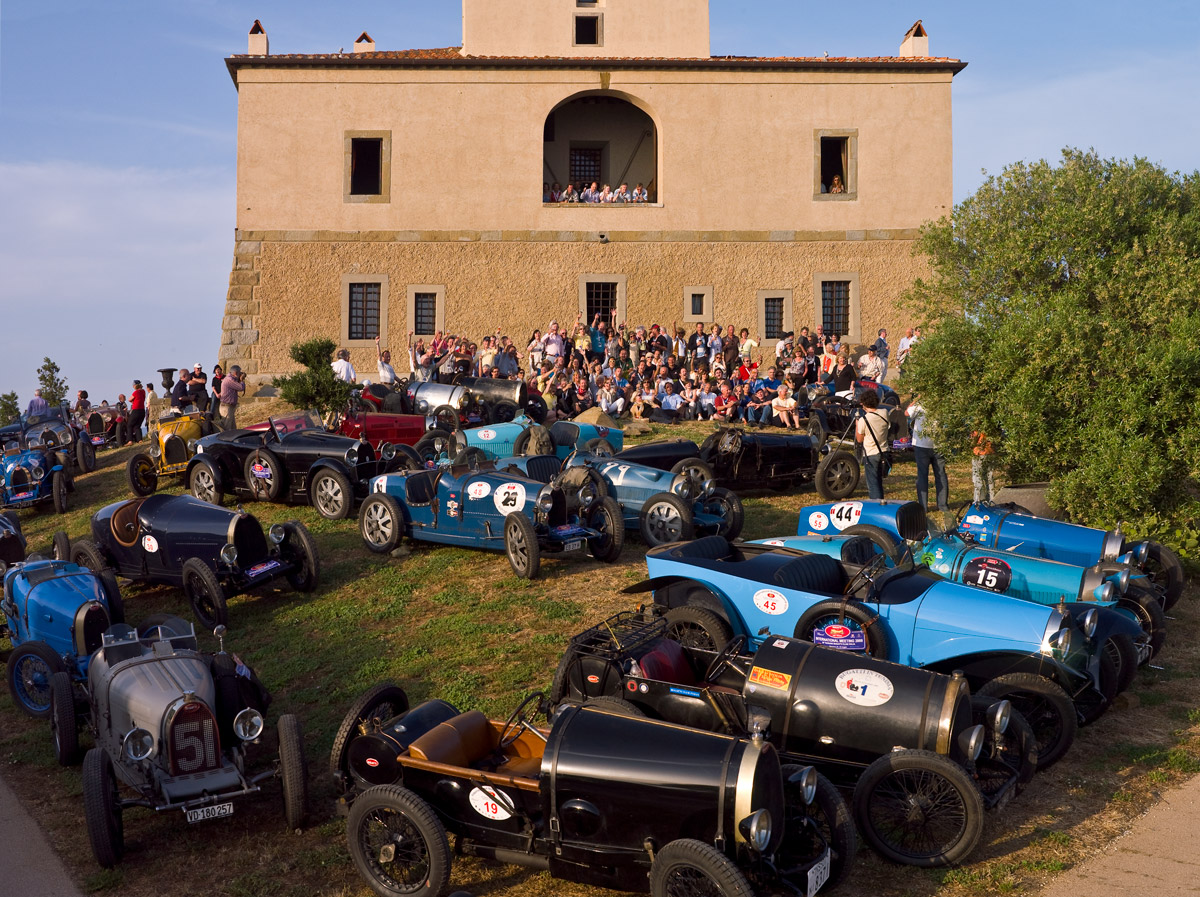
Bugatti International Meeting — Marone-Cinzano Estate, Tuscany, 2009

The Bugatti Centenary. Two hundred and fifty owners gathered from across the world on one of Tuscany's great estates — lunching under the cypresses, Brunello di Montalcino on the table. On the lawn, 125 historic Bugattis on open display: the largest gathering of the marque ever assembled in one place.

Documented from above, stitching multiple Hasselblad frames from a 12-metre tripod into a single panoramic frame 13,000 pixels wide. An event that will not happen again, recorded as it deserved to be.
Bugatti Type 57S Atalante 1931 Chassis 001, back view. Owner Franz Wassmer

Bugatti International Meeting — Castello Colle Massari, Tuscany, 2009.

A stop at a medieval fortress in the Maremma — a toast, the cars clustered on the grass, the owners still laughing. No programme, no ceremony. Just two hundred and fifty people who shared the same unreasonable passion, in one of the most beautiful corners of Tuscany, at the end of a Bugatti day.

A collective portrait that needed no posing.

The Spirit of Bugatti — Alsace, 1990

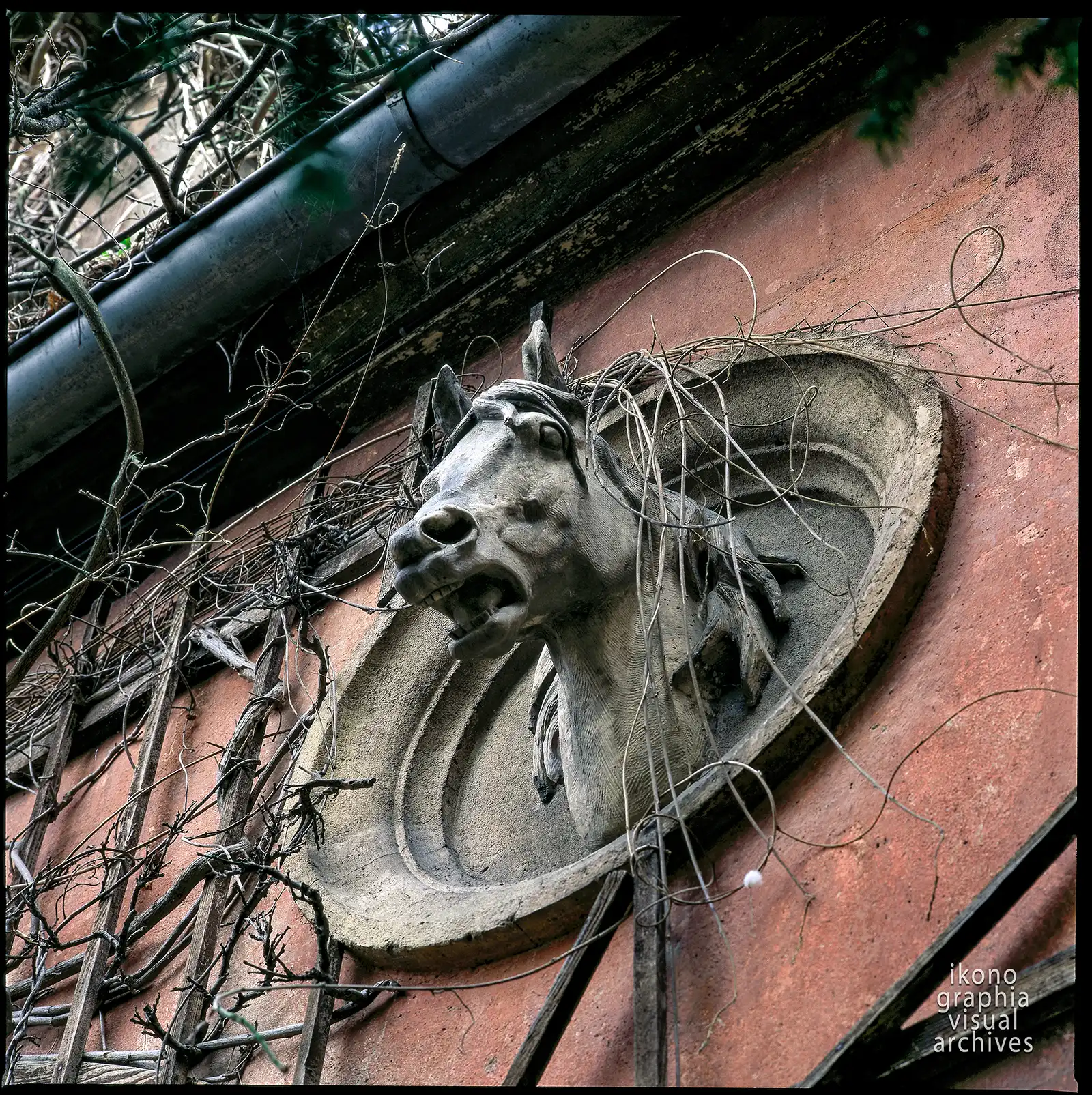
Before the restoration of Molsheim began, Roberto Bigano documented what remained of the original Bugatti world — the factory, the château, the surroundings — in the last months before Bugatti Automobili's revival would briefly transform it. The horse on the wall of Château Saint-Jean, tangled in dead vines: Ettore's symbol surviving in a building no one was looking after.

Bugatti Type 57S Atalante 1931 Chassis 001, back view. Owner Franz Wassmer

The Portal of Château Saint-Jean — Molsheim, Alsace, 1990.

The entrance to Ettore Bugatti's former headquarters — once the center of an estate with workshops, a hotel, and a way of receiving clients that had no equivalent in the industry. If your car needed attention, you came to Molsheim. You were a guest until it was ready.

Photographed a year before the revival began. The portal was still standing. Not much else was.
Detail of Bugatti’s Monobloc Cast Aluminum Wheel drawing, dated July 27, 1932 (Roue Bugatti brevetée en aluminium coulé).

Château Saint-Jean, Molsheim, Alsace, 1990 — Ettore Bugatti's horse.

Ettore Bugatti bred thoroughbreds at Molsheim with the same obsessive standards he applied to his cars. The horse was his personal symbol — cast into the wall of Château Saint-Jean, the domain's heart, where it had presided over the estate for decades.

By 1990, no one was looking after it. The vines had grown across the facade and through the relief itself, threading through the stone as if reclaiming it. The building was between two lives.

The image was never published. It was never proposed as the symbol of the rebirth it was about to witness. It should have been.

Copyright, Links And Credits

Photography, Copyright & Credits

These images are part of the Ikonographia Visual Archives: — Bugatti Heritage Collection —  Bugatti Factory Drawings  Archive.
All drawings reproduced by Roberto Bigano in 1990 from originals held in the Bugatti factory archive. The current location of the originals is unknown.
All photographs © Ikonographia / Roberto Bigano — All Rights Reserved.

Terms of Use (Summary)

The images presented in this archive are copyrighted and available for licensed use only through Ikonographia Visual Archives.

You may not download, reproduce, publish, or distribute these images without a valid license. For commercial or editorial licensing, please refer to the product pages or contact Ikonographia directly. A full explanation of licensing terms is available in the Shop / Licensing Information section under "Ikonographia — Standard License" and "Ikonographia — Merchandising & Product Use Licenses"

The Ikonographia Bugatti Heritage Archive

Between 1990 and 2009, photographer Roberto Bigano documented Bugatti with a level of access that no longer exists and cannot be replicated. The relationship began with Romano Artioli — the Italian entrepreneur who had just acquired the Bugatti name and was preparing its revival at Campogalliano — who gave Roberto carte blanche to work inside the factory, the archive, and every event that followed. No brief. No restrictions. No supervision.

What resulted is not a single project but five distinct bodies of work: the factory technical drawings reproduced before they disappeared, two major photographic commissions on the historic cars, a complete documentary record of the Bugatti International Centenary Meeting in Tuscany, and an Alsatian reportage made inside Molsheim before the restoration began. Together they form one of the most complete private archives of Bugatti heritage in existence — most of it unpublished until now, some of it available nowhere else.

The archive is not a celebration of the marque. It is a record made by someone who was trusted enough to be inside it, at the precise moment when its past and its future were in the same room.

Credits & Acknowledgments

Ikonographia gratefully acknowledges the fundamental contribution of Romano Artioli, founder of Bugatti Automobili, without whose trust and unrestricted access this archive would not exist.

Ikonographia Mission Statement

Ikonographia is committed to the accurate documentation, preservation, and ethical dissemination of twentieth-century visual culture.

Archival Notes

These drawings were reproduced by Roberto Bigano in 1990, during the preparation for the revival of Bugatti Automobili at Campogalliano. Access to the Bugatti factory archive was granted by Romano Artioli. The drawings document the original Molsheim factory production.

Further Reading (Selected Sources)

Bugatti Catalogs and Literature — 1920s and 1930s

Bugatti Catalogs and Literature — 1920s and 1930s

Bugatti Catalogs and Literature — 1920s and 1930s

Sales literature from Molsheim — spare, original, and entirely their own.

Bugatti's catalogs and brochures were rarely credited to outside agencies. With limited budgets and no inherited house style, the results reflect the same standards applied to the cars — functional, precise, occasionally brilliant. The 1937 Type 57 range catalog is the centerpiece: Alexis Kow's cover, the only signed work in the catalog, pairs the Le Mans-winning Type 57 Sport with Ettore's streamlined Autorail — the locomotive he designed in a week to keep his workforce employed.

Detail of Bugatti’s Monobloc Cast Aluminum Wheel drawing, dated July 27, 1932 (Roue Bugatti brevetée en aluminium coulé).

Ettore, Jean and the Bugatti Literature

Most people know the Bugatti posters — Cassandre, Dudovich, René Vincent, Géo Ham. The catalogs are less studied, and less understood. They should not be.

Ettore Bugatti trained at the Brera School of Art in Milan before he built his first engine. That formation never left him. Everything Bugatti produced — the cars, the furniture, the factory buildings, the printed literature — was subject to the same standard: nothing without necessity, nothing without form. The catalogs were not marketing material handed to an agency. They were made inside Molsheim, under the same scrutiny as the chassis.

From 1930, Ettore progressively passed the design pen to his son Jean, who had grown up inside the factory and understood its logic from the inside. The catalogs changed with him — leaner, more confident, the typography tightened, the illustrations more willing to let the car speak without explanation.

Bugatti Type 44 catalog double spread. Nouvelle 3 litres 8 cylindres 17 cv, Weissman Bodywork, circa 1925

Bugatti Type 44, Nouvelle 3 litres 8 cylindres 17 CV. Double spread with three body variants by Weissman, circa 1925.

Three coachwork interpretations of the same chassis on a single spread. The layout is spare — photograph, body designation, nothing more.

Weissman's bodywork is presented as a catalogue of possibilities rather than a hierarchy. The customer chose. The chassis was already resolved.

Depliant Bugatti Type 44 3 litres 1929

Dépliant Bugatti Type 44, 3 litres — Centerfold, 1929.

The centerfold of the Type 44 folder places the car in front of Château Saint-Jean — Bugatti's headquarters in Molsheim.

The two figures beside it are Lidia and Michel Bugatti, two of Ettore's children. The photograph is not incidental. Molsheim was not a factory with a family attached. It was a domain, and the catalog knew it.

A Literature Without Credits

Bugatti brochures were almost never signed. The company had no advertising department in the modern sense. Ettore and Jean directed everything, and the people who executed their directions worked without attribution.

Two exceptions: Alexis Kow, the leading French automobile illustrator of the period, signed the 1937 Type 57 catalog drawings. And the company photographer, Mr. Carabin, is credited on several of the 1928 brochure photographs. Everyone else remains anonymous — which, in Molsheim, was the norm rather than the exception.

The budget was modest by the standards of the major manufacturers. It never showed.

Bugatti Type 57 Catalog 1937. The 3 litres engine specifications.

Bugatti Type 57, 3 litres engine specifications. Double spread from the 1937 catalog.

Left: Artist Joseph Low pulling an impression on his hand press. Below: Low inside his rural New Jersey studio-print shop with its old-fashioned stove (bottom), a linoleum block locked up in a printing form, and the finished print. Right page: An enlarged detail from the same linoleum print displays the vigor and fantasy of Low’s engraving style. Photographs by Ed Feingersh. Pages 64-65

The 1928 Brochures and the Carriage Argument

The 1928 catalogs make an argument that no other car manufacturer would have dared. On the cover: a vintage carriage, drawn by Marcel Jacques Hemjic — an eighteenth-century chaise, or a mid-nineteenth century coupé à huit ressorts, rendered with the precision of a period engraving. Inside: Carabin's photographs of the current Bugatti model, the Type 44 or the Berline, sitting on its chassis in studio light.

The pairing was Ettore's idea. He collected carriages. He believed the Bugatti, in its proportions and its attention to coachwork, was the direct heir to the finest horse-drawn vehicles — not a rupture with that tradition but its continuation in a new material. The catalogs said so without a word of explanation.

Bugatti Coupè Berline 2-3 places avec spider sur chassis 3 litres. Photo by Carabin for a 1928 catalog

Bugatti Coupé Berline 2-3 places avec spider sur chassis 3 litres — Central double spread.
Photo Carabin.

Carabin was the company photographer — one of two people credited by name in the entire Bugatti catalog archive. The studio light is controlled and neutral. The car requires no setting.

Bugatti Coupè Berline 2-3 places avec spider sur chassis 3 litres. Coupé a huit resorts. Milieu du XIX Siecle.(Eight-spring coupe. Mid-19th century.) Artwork by Marcel Jacques Hemjic for a 1928 brochure cover.

Bugatti Berline 3 places avec spider sur chassis 3 litres — Cover.
Vintage carriage artwork by Marcel Jacques Hemjic.

The cover did not show the car being sold. It showed an eighteenth-century coupé à huit ressorts — an eight-spring carriage from the mid-nineteenth century, drawn with the precision of a period engraving. Ettore collected carriages. He believed the Bugatti was their direct heir, and the catalog said so without explanation.

Bugatti Berline 3 places avec spider sur chassis 3 litres. Photo

Bugatti Berline 3 places avec spider sur chassis 3 litres. — Central double spread.
Photo Carabin.

The second body variant in the same 1928 brochure series. Same photographer, same studio discipline.

The two Carabin photographs and the two Hemjic covers were designed as pairs — the machine and its ancestry, facing each other across the fold.

Bugatti Berline 3 places avec spider sur chassis 3 litres. Chaise Monte Sur son train. XVIII siècle. Artwork by Marcel Jacques Hemjic for a 1928 brochure cover.

Bugatti Berline 3 places avec spider sur chassis 3 litres — Cover — Chaise montée sur son train, XVIIe siècle.
Vintage carriage artwork by Marcel Jacques Hemjic.

A seventeenth-century travelling chaise, suspended on its carriage frame. The argument is the same as the facing cover — lineage rather than novelty.

In 1928, every other car manufacturer was selling the future. Bugatti was selling continuity with the finest things ever built on wheels.

The 1936 Blueprint Brochure

The Type 57 range brochure of 1936 took a different approach entirely. Four fold-out leaflets, each presenting one body version in blueprint-style line drawings: the Galibier, the Ventoux, the Atalante, the Stelvio. The drawing method borrowed from the factory floor — technical authority applied to a commercial document.

Two models were missing: the Atlantic and the Roadster. No explanation was given then or since.

Bugatti Type 57 Range Brochure 1936 in a blueprint style drawings.. Four pages.

Bugatti Type 57 range brochure, 1936 — Four fold-out leaflets in blueprint-style drawings: Galibier, Ventoux, Atalante, Stelvio.

The drawing method came from the factory floor — technical authority applied to a commercial document. Each model received its own leaflet, its own set of lines.

Two variants in the range were not included: the Atlantic and the Roadster. No explanation was given then or since.

The 1937 Catalog and Alexis Kow

The 1937 Type 57 range catalog is the most complete statement of Jean's commercial vision. Kow's illustrations stretch the car slightly — the proportions are pushed toward elegance, the shadow work emphasizes speed over mass. It is illustration rather than technical record, and it reads as Jean would have wanted: the car as an object of desire, not a specification sheet.

The cover pairs the Type 57 Sport — winner at Le Mans, holder of the 218 km/h speed record — with the streamlined Bugatti Autorail. Two worlds Bugatti occupied simultaneously: the road and the railway, both made faster than they had any right to be.


Bugatti Type 57 Catalog 1937. Cover drawing by Alexis Kow

Bugatti Type 57 catalog, 1937 — Cover drawing by Alexis Kow.

The cover pairs two Bugatti worlds: the Type 57 Sport, winner at Le Mans and holder of the 218 km/h speed record, and the streamlined Autorail — the locomotive Ettore designed in a week to save his workforce.

Kow's illustration was the only signed work in the catalog. Everything else was Molsheim's.

Bugatti Type 57 Catalog 1937. The T57 3 litres engine Grand Prix Winner

Bugatti Type 57, 3 litres engine. "Vainqueur." From the 1937 Type 57 range catalog.

Vainqueur — winner.
The 1936 season: Grand Prix de l'ACF, de La Marne, de Deauville, du Comminges, and the speed record at 218 km/h.

In 1937, Jean-Pierre Wimille and Robert Benoist won the 24 Hours of Le Mans and covered 3,287 kilometres in 24 hours. The catalog did not need to say more.

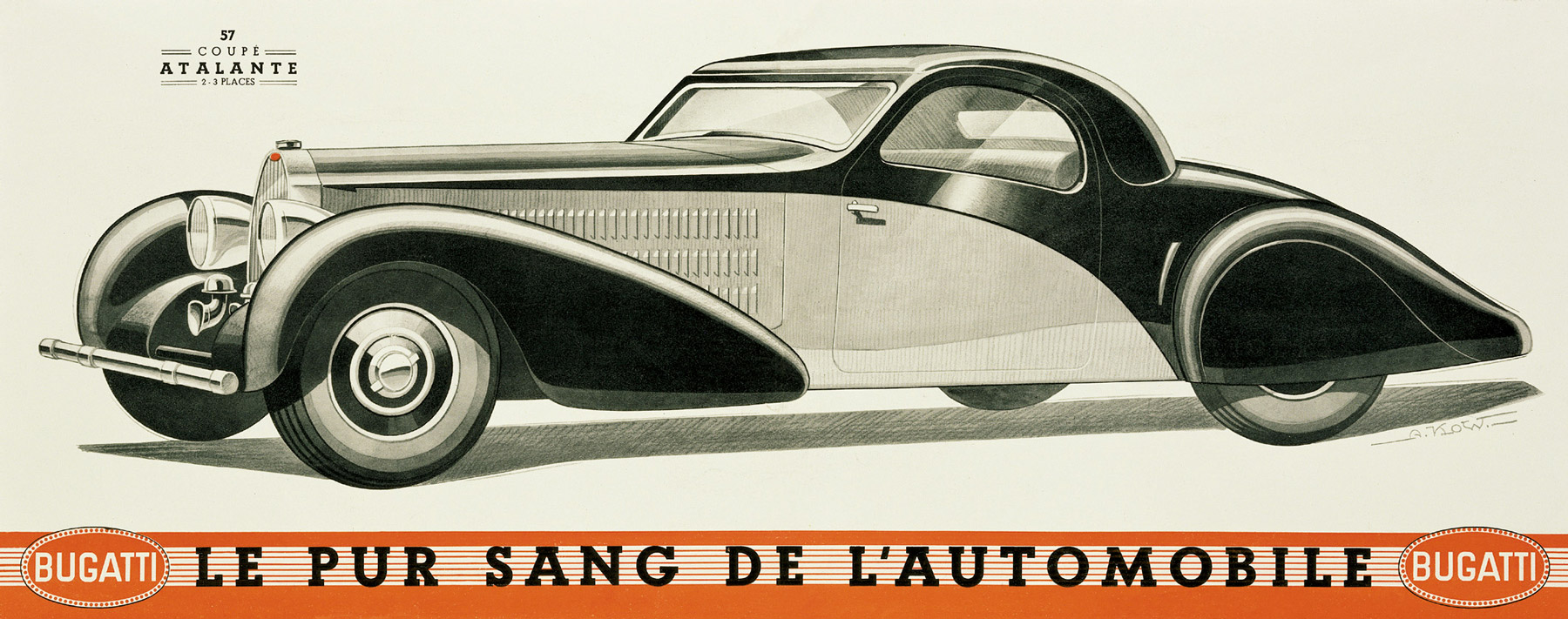
Bugatti Type 57 Brochure 1937 Coupé Atalante, page 6,7. Drawing by Alexis Kow

Bugatti Type 57 Coupé Atalante. Double spread from the 1937 catalog. Drawing by Alexis Kow.

The Atalante roofline resolves in a single continuous arc from windshield to tail — a curve that Jean drew once and never needed to revise. Kow understood that the illustration's job was to follow the line, not interpret it.

Bugatti Type 57 Catalog 1937, Coupé Atlantic. Drawing by Alexis

Bugatti Type 57S Coupé Atlantic. From the 1937 catalog. Drawing by Alexis Kow.

The Atlantic was built in four examples. Its body was riveted along the spine — the seam running from nose to tail — because the magnesium alloy panels could not be welded without risk of fire.

A constraint became the most recognizable detail in the car's history.

Bugatti Type 57 Brochure 1937 Roadster Sport, page 9. Drawing by Alexis Kow

Bugatti Type 57S Roadster Sport 2 places. From the 1937 catalog. Drawing by Alexis Kow.

The lightest body in the Type 57 range. Ultra-light alloy construction, competition-type profiling.

Kow gave it the longest shadow of any car in the catalog — the one concession to drama in an otherwise disciplined set of drawings.

Bugatti Type 57 Brochure 1937, page 10 Coach Ventoux Drawing by Alexis Kow. 4-5 Places

Bugatti Type 57 Coach Ventoux 4-5 places. From the 1937 catalog. Drawing by Alexis Kow.

The Ventoux was the family car in the Type 57 range — four to five seats, the most practical body Jean designed. It carried the same name logic as the Stelvio and the Aravis: a mountain pass, a road with a reason to be driven.

From Ettore to Jean — The 1939 Catalog

The cover of the 1939 Type 57 Modèles brochure is the last major statement in Bugatti's pre-war literature. Jean designed it, or directed its design, with the same compression he brought to the cars themselves. The typography is spare. The image carries everything.

Jean died in a car crash a few months after this catalog appeared. The brochure had no way of knowing it was a conclusion.

Bugatti Type 57 Modeles 1939

Bugatti Type 57 Modèles 1939. Brochure cover.

Jean designed this cover, or directed its design, with the same compression he brought to the cars.
The typography is spare. The image carries everything.

He died in a car crash a few months after it appeared.

Bugatti Type 57 Modeles 1939

Bugatti Type 57 Modèles 1939. Berline Galibier 4-5 places. Visibilité. Accessibilité. Confort.reet and Regent Street series.

The three words beneath the model name are the brochure's argument in miniature — the same logic that organized the 1936 catalog, compressed into a single line.

The Galibier was the largest body in the Type 57 range. The claims are precise and in the correct order.

Bugatti Type 57 Modeles 1939 Brochure Cabriolet Stelvio - Aravis Cabriolet Stelvio 4 Places Cariolet Aravis 2-3 Places

Bugatti Type 57 Modèles 1939. Cabriolet Stelvio 3 places. Cabriolet Aravis 2-3 places.

Two open bodies on the same page, the Stelvio and the Aravis distinguished by seating capacity and hood treatment.

The mountain names were Jean's choice — the Stelvio Pass, the Col de l'Aravis. He named his cars after roads worth driving.

Carrosserie Gangloff, 1935

Before Jean's body designs became the standard, Bugatti's principal coachbuilder was Carrosserie Gangloff in Colmar, Alsace.
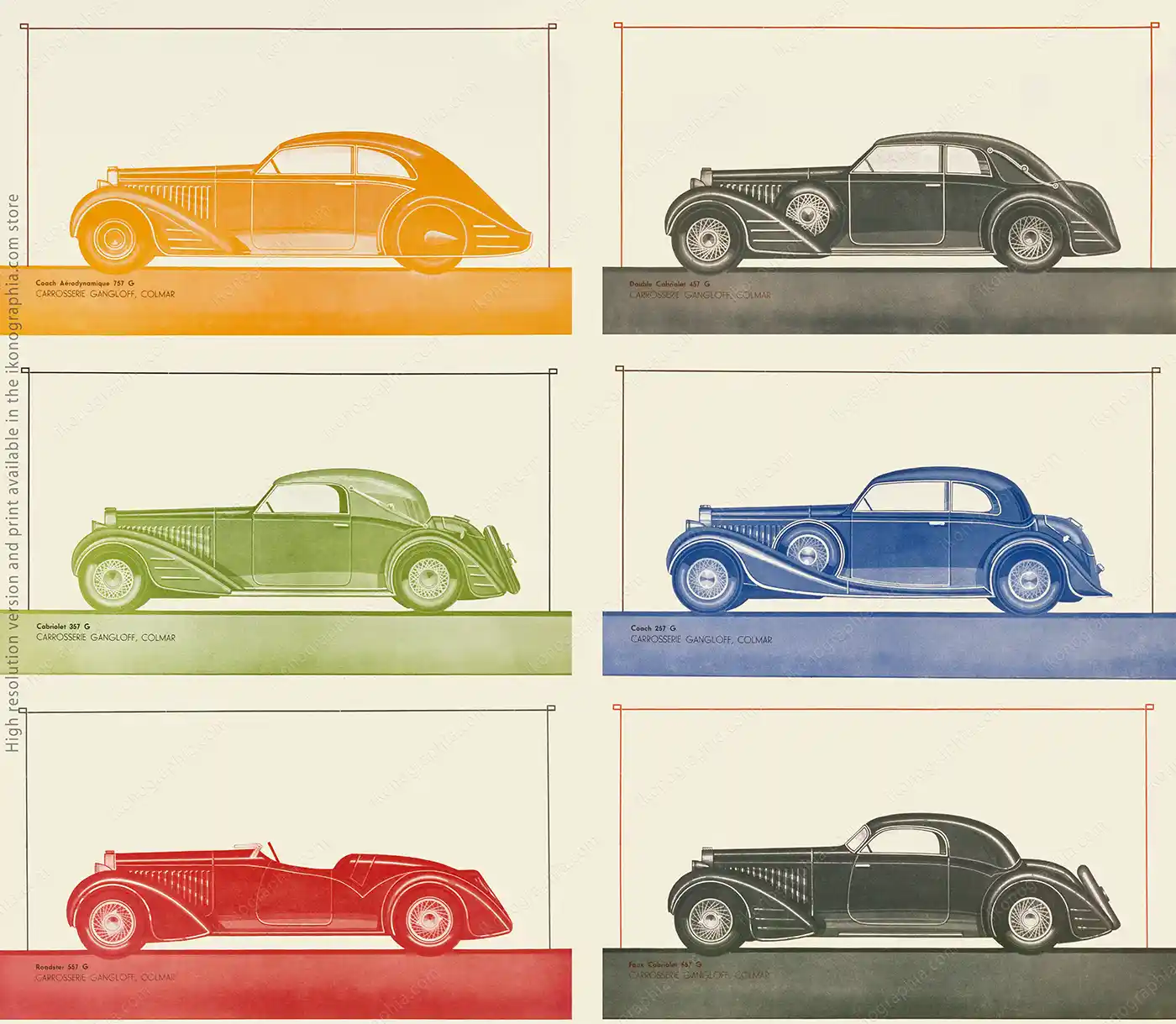
The 1935 Gangloff catalog documents six Type 57 and 57SC body variants — the Coach Aérodynamique, the Cabriolet, the Roadster, the Double Cabriolet, the Coach, the Faux Cabriolet. The photography is monochrome and functional. The cars do not need flattery.

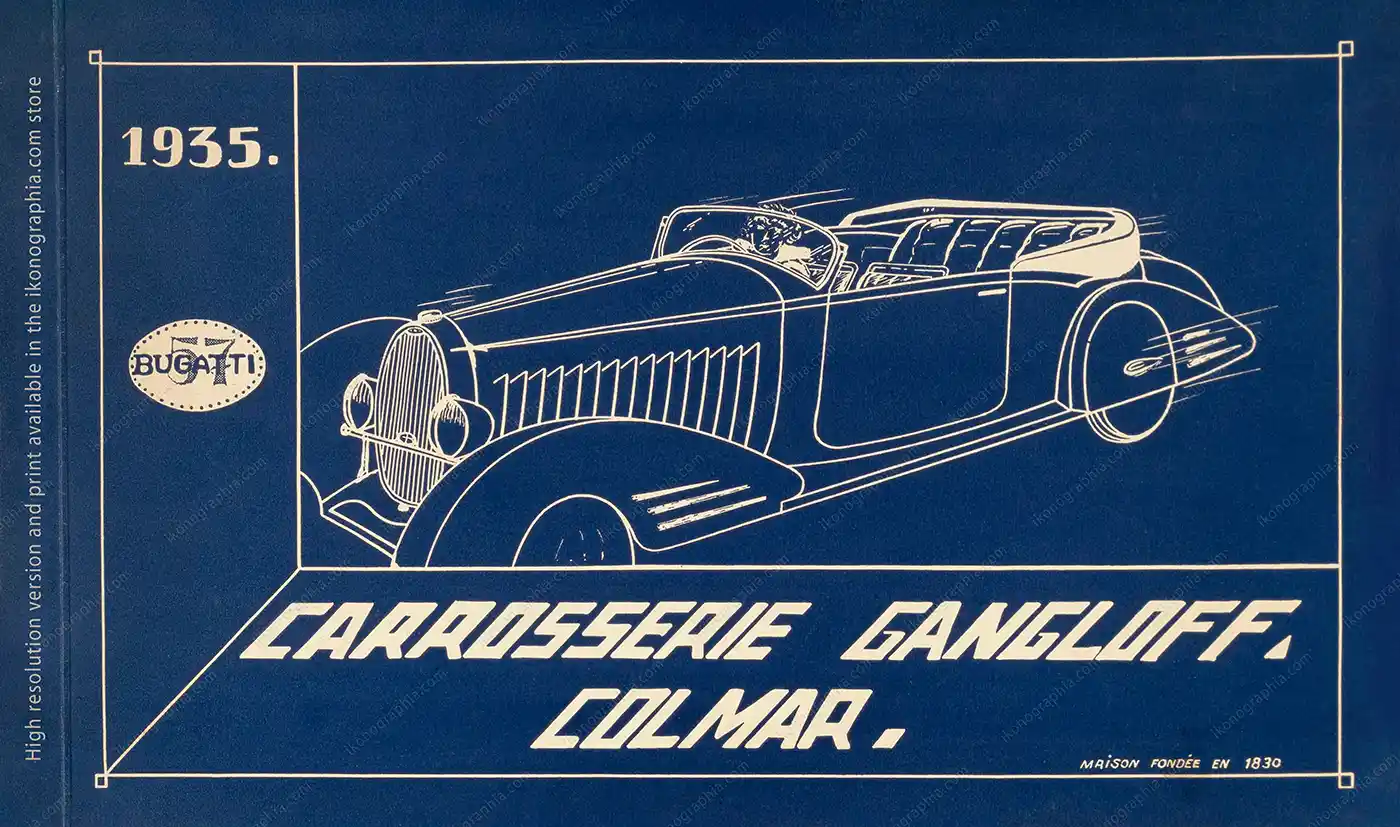
Carrosserie Gangloff, Colmar for Bugatti. The cover of the 1935 catalog.

Carrosserie Gangloff, Colmar. Cover of the 1935 catalog for the Bugatti Type 57.

Gangloff of Colmar was Bugatti's principal coachbuilder before Jean's body designs became the standard.
The 1935 catalog documented what was available before the Atalante, the Atlantic, and the Stelvio existed. A world about to be replaced.

Carrosserie Gangloff, Colmar for Bugatti. Six monochrome pages from the 1935 catalog. Coach Aérodynamique 757 G, Cabriolet 357 G, Roasdster 557 G, Double Cabriolet 147 G, Coach 257G, Faux Cabriolet 657 G.

Carrosserie Gangloff, Colmar — Six pages from the 1935 catalog: Coach Aérodynamique 757G, Cabriolet 357G, Roadster 557G, Double Cabriolet 147G, Coach 257G, Faux Cabriolet 657G.

Six body variants, each assigned a Gangloff reference number.

The Coach Aérodynamique — 757G — was the most forward-looking of the six, the one that acknowledged where design was heading. Within two years, Jean had taken it further than Gangloff had imagined.

The Trains

In the early 1930s, Bugatti faced a financial crisis serious enough that the company's accountant presented the only rational solution: reduce the workforce by at least a third.

Ettore did not respond. He disappeared for a week.

When he came back, he gathered the entire workforce and told them to move all equipment into the smaller building. When they asked why, the answer was short: they would build trains.

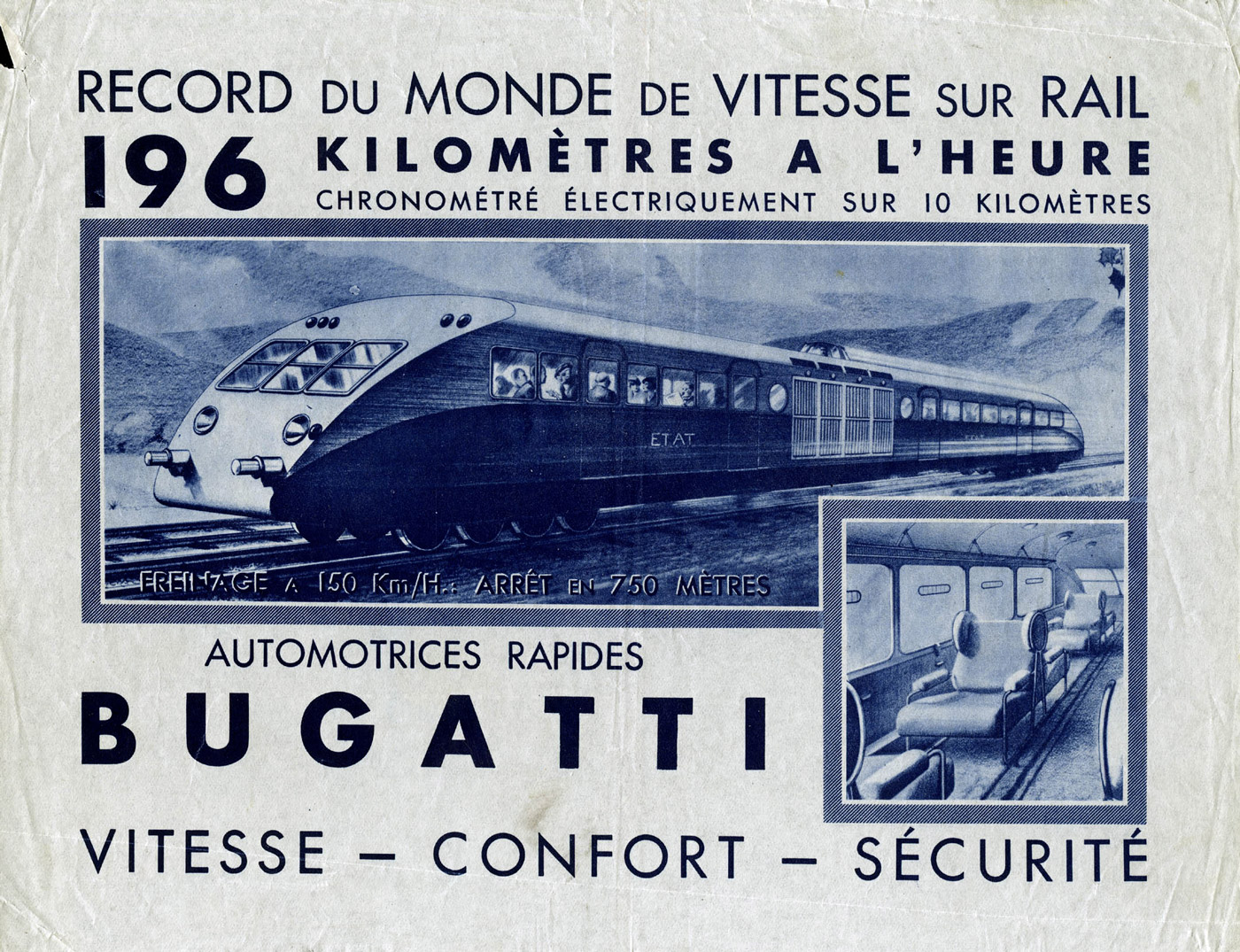
In that week alone he had already designed the program. Within two years, the Bugatti Autorail existed: a streamlined railcar unlike anything running on European tracks. Ettore designed ergonomic seats that reversed direction so passengers always faced forward, with fold-out tables built into the backrest. To power the locomotives he used four modified engines from the Type 41 Royale — 12,763cc each, the largest production car engine ever built, now repurposed for rail.

The Autorail set the world rail speed record: 196 km/h, electrically timed over 10 kilometres. The previous record was around 122. He didn't improve it. He erased it.

The French national railway bought the trains. Nobody was let go.

The brochure that documents all of this is printed in blue monochrome — the same controlled hand as every other piece of Bugatti literature. At the bottom, three words: Vitesse. Confort. Sécurité. Not a promise. A statement of fact from a man who had just proved all three.

Carrosserie Gangloff, Colmar for Bugatti. Six monochrome pages from the 1935 catalog. Coach Aérodynamique 757 G, Cabriolet 357 G, Roasdster 557 G, Double Cabriolet 147 G, Coach 257G, Faux Cabriolet 657 G.

Automotive rapides Bugatti — Vitesse — Confort - Sécurité.
Advertisement Sheet 1934.

Record du monde de vitesse sur rail — 196 Kilomètres a l'heure — Chronométreé électriquement sur 10 kilomètres.
October 24, 1934.

Copyright, Links And Credits

Photography, Copyright & Credits

These images are part of the Ikonographia Visual Archives: — Bugatti Heritage Collection —  Bugatti Factory Drawings  Archive.
All drawings reproduced by Roberto Bigano in 1990 from originals held in the Bugatti factory archive. The current location of the originals is unknown.
All photographs © Ikonographia / Roberto Bigano — All Rights Reserved.

Terms of Use (Summary)

The images presented in this archive are copyrighted and available for licensed use only through Ikonographia Visual Archives.

You may not download, reproduce, publish, or distribute these images without a valid license. For commercial or editorial licensing, please refer to the product pages or contact Ikonographia directly. A full explanation of licensing terms is available in the Shop / Licensing Information section under "Ikonographia — Standard License" and "Ikonographia — Merchandising & Product Use Licenses"

The Ikonographia Bugatti Heritage Archive

Between 1990 and 2009, photographer Roberto Bigano documented Bugatti with a level of access that no longer exists and cannot be replicated. The relationship began with Romano Artioli — the Italian entrepreneur who had just acquired the Bugatti name and was preparing its revival at Campogalliano — who gave Roberto carte blanche to work inside the factory, the archive, and every event that followed. No brief. No restrictions. No supervision.

What resulted is not a single project but five distinct bodies of work: the factory technical drawings reproduced before they disappeared, two major photographic commissions on the historic cars, a complete documentary record of the Bugatti International Centenary Meeting in Tuscany, and an Alsatian reportage made inside Molsheim before the restoration began. Together they form one of the most complete private archives of Bugatti heritage in existence — most of it unpublished until now, some of it available nowhere else.

The archive is not a celebration of the marque. It is a record made by someone who was trusted enough to be inside it, at the precise moment when its past and its future were in the same room.

Credits & Acknowledgments

Ikonographia gratefully acknowledges the fundamental contribution of Romano Artioli, founder of Bugatti Automobili, without whose trust and unrestricted access this archive would not exist.

Ikonographia Mission Statement

Ikonographia is committed to the accurate documentation, preservation, and ethical dissemination of twentieth-century visual culture.

Archival Notes

These drawings were reproduced by Roberto Bigano in 1990, during the preparation for the revival of Bugatti Automobili at Campogalliano. Access to the Bugatti factory archive was granted by Romano Artioli. The drawings document the original Molsheim factory production.

Further Reading (Selected Sources)

Bugatti Masterpieces of 1920s and 1930s. By Roberto Bigano

Bugatti Masterpieces of 1920s and 1930s. By Roberto Bigano

Bugatti Masterpieces of 1920s and 1930s. By Roberto Bigano

Two sessions, two decades apart — the museum and the meeting.

Vintage Bugatti masterpieces photographed by Roberto Bigano across two sessions. The iconic Atalante and Atlantic from the Divina Bugatti sessions at the Musée National de l'Automobile in Mulhouse — the FMR commission. The legendary Type 13, Type 35, and Type 40A from the Bugatti Glamour Sessions — four nights of open-air studio photography during the Centenary celebrations in Tuscany, with the owners present — two bodies of work. Available nowhere else.

Bugatti Type 37A, "Flighty" (1928) - Owners, Frederica and Simon Fitzpatrick, Guernsey © Roberto Bigano/ ikonographoa.com Browse the Bugatti Archive https://www.ikonographia.com/archive/the-bugatti-archive/

Bugatti Type 37A, "Flighty" (1928) - Owners Frederica and Simon Fitzpatrick, Guernsey.

Bugatti Masterpieces. A gallery of the most iconic models.


Ikonographia is proud to showcase a gallery of the most iconic vintage Bugatti models, highlighted by the splendid images of Roberto Bigano. The models range from the legendary Type 13 and Type 35 racing models to the stylish Type 57 Atalante and Atlantic designed by Jean Bugatti.
All the images are available in high-resolution or fine-art prints.
This is a work-in-progess page. We are going to add more contents. Please stay in touch.

A 1937 Bugatti Type 57SC Coupé Atlantic lightened in silhouette mode to emphasize the flowing coupé lines

A 1937 Bugatti Type 57SC Coupé Atlantic. Detail of the windshield and wipers emphasizing the riveted crest.
Jean Bugatti designed the half-body ending in a crest. He then reverted the first part right-left and finally joined the two pieces with rivets in one of the most daring automotive designs. Courtesy: British Garage, Paris.

About Ettore and Jean Bugatti.


Automobiles Ettore Bugatti was a French car manufacturer of high-performance cars, founded in 1909 in Molsheim, Alsace, France, by the Italian industrial designer Ettore Bugatti. The firm produced about 8,000 cars and is known for its design beauty and many race victories.

Ettore Bugatti himself designed his creations (together with his highly talented son Jean, who later took to the drawing board alone). This extraordinary man had attended the Brera School of Art as a youth, yielding an artistic streak inherited from his father, Carlo (a fine cabinet-maker). The founding genius of the Bugatti firm also demonstrated an astonishing ability for mechanical engineering and an amazingly eclectic mind in general.

This flair had also gone to his brother Rembrandt, the talented sculptor whose works include the little elephant triumphing on the Royale’s bonnet. 

The legendary Ettore Bugatti's signature on the engine head of a 1921 Type 13 Brescia. Photo by Roberto Bigano. Buy this image in the ikonographia.com store.

The legendary Ettore Bugatti's signature on the engine head of a 1921 Type 13 Brescia.

A gallery of Masterpieces. Let's start with the Type 13 Brescia.


The Bugatti Type 13, Brescia, was the first actual Bugatti produced from 1910 to 1926. Thanks to the race victories, Bugatti became known as pur-sang (thoroughbred), keeping with Ettore Bugatti's feelings for his designs.
The Bugatti Type 13, Brescia, was fast and technically superior, making it virtually unbeatable. This was evident in the 1921 Brescia Grand Prix, where Bugatti's cars finished in the top four places, sparking a surge in orders. With the introduction of the "Brescia," Ettore Bugatti fundamentally changed the racing scene, as his cars won almost every competition they entered in the 1920s, cementing their place in racing history.

The initial Brescia featured a basic, functional design so rudimentary and simplistic that it earned the nickname "Bagnoire" (bathtub), a term reflecting its unique shape and design.
The Brescia design was later refined, as evidenced by the exquisite yellow sample below.

Bugatti Type 13 Brescia, 1921. Photo by Roberto Bigano. Buy this image at https://www.ikonographia.com/archive/the-bugatti-archive/

Bugatti Type 13 Brescia Cabriolet, 1923.

The Bugatti Type 35.


The Bugatti Type 35 is an iconic race car design produced between 1924 and 1930. It was phenomenally successful, winning over 1,000 races in its time. In 1926, it took the Grand Prix World Championship after winning 351 races and setting 47 records in the two prior years.

At its height, the Type 35 averaged 14 weekly race wins, including the prestigious Targa Florio for five consecutive years, from 1925 through 1929.

Bugatti Type 35B Grand Prix Biplace Course - Two Seater Racing

Bugatti Type 35B Grand Prix Biplace Course Two-Seater Racing 1927.
The Type 35 is an iconic race car design produced between 1924 and 1930. It was phenomenally successful, winning over 1,000 races in its time. At its height, the Type 35 averaged 14 weekly race wins, including the prestigious Targa Florio for five consecutive years, from 1925 through 1929.

Dashboard of a Bugatti Type 35B Grand-Prix (1927) - Courtesy: Musée National de l’Automobile Mulhouse

The dashboard of a Bugatti Type 35B Grand-Prix (1927) – Courtesy: Musée National de l’Automobile Mulhouse.

Bugatti Type 35A, 1926. Owned by Gigi Baulino & Enrica Varese. © Roberto Bigano/ ikonographoa.com Browse the Bugatti Archive https://www.ikonographia.com/archive/the-bugatti-archive/

Bugatti Type 35A, 1926. Owners Gigi Baulino & Enrica Varese, Italy. Picture taken at Bugatti International Meeting 2009. Hasselblad 39 Multishot Camera High-resolution file.
The owner forbade the photographer from washing the car so as not to erase the dirt from the race, which made it fascinating.
Watch the video of this event >

The Bugatti Type 41 Royale.


The Bugatti Type 41 Royale was gorgeous in its seven-meter length. It was enormous, had the most oversized wheels, and was the longest and tallest limo. Her design and form would smoothly conceal the captivating exuberance of an eight-cylinder motor for an impressive 12,773 cubic meters capacity that defines once and for all the original idea of a car.

Only seven Royales were produced. We showcase the "Coupè Napoleon," Ettore Bugatti's car, and the Bugatti Type 41 Esders Roadster, probably the most elegant.

Bugatti Type 41 Royale Coupé Napoleon (1929) The personal car of Ettore Bugatti. Courtesy: Musée National de l'Automobile, Mulhouse. Photo by Roberto Bigano. Courtesy: Courtesy: Musée National de l’Automobile Mulhouse. Buy this image at Ikonographia.com store

Bugatti Type 41 Royale Coupé Napoleon (1929), the personal car of Ettore Bugatti. On top of the radiator grill is the symbol of the Royales, the Elephant carved by Rembrandt Bugatti. Courtesy: Museé National de l'Automobile, Mulhouse.

The Bugatti Royale's Prancing Elephant, according to Antonio Tabucchi.


There has never been such an expensive car. Only seven Bugatti Royale were built, each one different. Upon the radiator grill, the Royale and the Petit Royale had a prancing elephant carved by Rembrandt Bugatti, Ettore's brother, as a symbol.  You can find it described in Rebus, a short tale by Antonio Tabucchi. Here is an excerpt.

The Bugatti Royale, according to Antonio Tabucchi.

It really was a Bugatti Royale, a Coupé de Ville; I don't know if that means anything to you, Monsieur […] Albert couldn't believe his eyes. It's not possible; it's not possible, he repeated to himself while stroking the long-tempered bumpers.

I don't know if you understand, but a Bugatti gives one the idea of a woman's body lying down on her back with her legs forward […] The elephant was missing from the bonnet. That was the only awful surprise. Maybe you may not know, or perhaps you just haven't noticed, that Bugatti had a figurine of a silver statue of an elephant on the bonnet, right on top of the radiator grill. It was a sculpture by Ettore's brother, Rembrandt Bugatti. It wasn't only a trademark, like the Rolls Royce Winged Victory of Samothrace or the Packard's Swan, but a tangible symbol to be deciphered like every other symbol. It was an elephant standing on his back legs, with the erect trunk symbolizing aggression and coupling.

Does it seem too easy to explain? Perhaps. But think about it: a Bugatti Royale lying on its back, going slowly uphill, wings spread open, ready to speed up, ready for the thrill, with that fabulous radiator grill protecting its pulsating life and energy, and on the top an elephant with an erect trunk.
Excerpt from the short story "Rebus" in "Little Misunderstandings of No Importance" "(Piccoli equivoci senza importanza), by Antonio Tabucchi.

Leggi il testo originale italiano.

"Rebus." Da "Piccoli equivoci senza importanza."


“Era proprio una Bugatti Royale, un coupé de ville, non so se a lei dice qualcosa, Monsieur (...) Albert non credeva ai suoi occhi, non è possibile, ripeteva, non è possibile, e accarezzava i parafanghi affusolati e lunghi, non so se lei riesce a capire, ma nella Bugatti c'è l'idea del corpo femminile, una donna, appoggiata sulla schiena con le gambe in avanti (...)

Mancava l'elefante sul cofano, fu l'unica brutta sorpresa (...) Forse lei non lo sa, o non ci ha mai fatto caso, ma la Bugatti aveva sul cofano, proprio all'apice della volta della griglia, la statuetta d'argento di un elefante. Era una scultura del fratello di Ettore, Rembrandt Bugatti, e non era solo un marchio della casa, come la vittoria alata della Rolls o il cigno della Packard, quello era un vero simbolo, misterioso da decifrare come tutti i simboli, era un elefante in piedi sulle zampe posteriori e la proboscide eretta in un barrito di aggressione o di accoppiamento.

The Elephant carved by Rembrandt Bugatti, right on top of the radiator grill of the Type 41 Royale Coupé Napoleon, the personal car of Ettore Bugatti. It was an elephant standing on his back legs, with the erect trunk as a symbol of aggression and coupling (1929) - Courtesy: Musée National de l'Automobile, Mulhouse

The Elephant by Rembrandt Bugatti, right on top of the radiator grill of the Type 41 Royale Coupé Napoleon, the personal car of Ettore Bugatti (1929). It was the symbol of the Royales. 

Bugatti Type 55 Sport Roadster and Coupé


The Type 55 was introduced at the 1931 Paris Motor Show. It was produced until 1935 in 38 samples, Roadster and Coupé, most of which had factory bodywork elegantly designed by Jean Bugatti.
Like many high-end automakers, Bugatti used its success in competition to promote its road cars. This already happened with the Type 13 Brescia and the Type 35.
The Type 55 was a direct descendant of the Type 51 race car and was similarly powered by a supercharged 2.3-litre dual-overhead-cam inline-eight.

We showcase here two pictures of the Roadster and Coupé, with the classic factory bodywork by Jean Bugatti.

Bugatti Type 55 Sport Roadster 1932. Road version of the Type 51 Grand Prix, produced in 38 smaples from 1932 to 1935.

Bugatti Type 55 Roadster, as designed by Jean Bugatti.  Courtesy: Museé National de l'Automobile, Mulhouse.

Bugatti Type 55 Sport Coupe 1932. Road version of the Type 51 Grand Prix, produced in 38 smaples from 1932 to 1935.

Bugatti Type 55 Coupé, as designed by Jean Bugatti.  Courtesy: Museé National de l'Automobile, Mulhouse.

Bugatti Type 59-50B Grand Prix Monoplace Course - Single Seater 1938 - Courtesy: Musée National de l’Automobile Mulhouse

Bugatti Type 59-50B Grand Prix Monoplace Course - Single Seater 1938

Divina Bugatti. A Timeless Legend Celebrated in a Timeless Book

Divina Bugatti. A Timeless Legend Celebrated in a Timeless Book

Divina Bugatti. A Timeless Legend Celebrated in a Timeless Book

Franco Maria Ricci's most celebrated automotive book — photographed by Roberto Bigano at the Musée National de l'Automobile, Mulhouse, 1991.

In 1991, Franco Maria Ricci — the publisher Fellini called "La Perla Nera" — commissioned Roberto Bigano to photograph the historic Bugatti collection at the Musée National de l'Automobile in Mulhouse. The pictures were taken over six nights, with a 4×5 view camera, in a closed museum. Two editions of 5,000 copies each. Both sold out.

The cover of the book Divina Bugatti, Storia di un capolavoro meccanico published in 1991 by Franco Maria Ricci, with photographs by Roberto Bigano.

Divina Bugatti's Story. Characters and Background.

We will tell you the story of the book "Divina Bugatti." It was created as a joint effort between Romano Artioli, owner of Bugatti Automobili, and Franco Maria Ricci, a legendary Italian publisher—the photographs by Roberto Bigano. Before we begin, let us introduce the characters and put them in context.

Automobiles Ettore Bugatti was a French high-performance car manufacturer founded in 1909 in Molsheim, Alsace, France, by the Italian industrial designer Ettore Bugatti. The firm produced about 8,000 cars and is known for its design beauty and many race victories.

Romano Artioli is an Italian visionary entrepreneur who bought the Bugatti brand in 1987 and revived it in Campogalliano, Modena, as a builder of its time's fastest series-production car. Bugatti Automobili produced a total of 128 cars. Read all the stories here.

Franco Maria Ricci was one of the most refined editors the world had ever seen. His iconic Magazine, FMR, and splendid books are still a reference. However, FMR was also an often unattainable goal for any photographer. Laura Casalis, Franco Maria Ricci's widow, recently relaunched the FMR magazine and Publishing House with outstanding publications.

Roberto Bigano was Bugatti's photographer at the beginning of the 1990s, documenting the birth of the new Bugatti. Roberto will introduce us to the fascinating vintage Bugatti world.

Bugatti Type 57SC Coupè Atalante (1937) in two lighting modes

Use the arrows or tap on devices to see the two versions. Courtesy: Musée National de l’Automobile Mulhouse.

Roberto Bigano and Divina Bugatti

Let Roberto Bigano tell us how the Divina Bugatti book project started and went through.

"In 1991, I was working for Bugatti Automobili. One day, the refined publisher Franco Maria Ricci, who already desired to celebrate the myth of the Bugatti, suggested the idea of a book on the legendary brand to Romano Artioli, the Bugatti company owner. They reached an agreement, and the plan went through. Naturally, Artioli mentioned "the best photographer in the world" to Ricci, encouraging my candidacy for the job. Ricci, as expected, was skeptical. "I have my photographers, ones I trust," he said with a half smile. The persistence of Artioli gained me a meeting with Ricci. "Go and take a few shots; we'll see," he said to get rid of me."
From Roberto Bigano's "1976-1992. A very serious, semi-serious biography."

Dashboard of a Bugatti Type 35B Grand-Prix (1927). Photo by Roberto Bigano. Courtesy: Courtesy: Musée National de l’Automobile Mulhouse. Buy this image at Ikonographia.com store

Dashboard of a Bugatti Type 35B Grand-Prix (1927).

Courtesy: Musée National de l’Automobile Mulhouse.

Roberto Bigano and Divina Bugatti

I felt well-equipped for my departure—one hundred forty-five different accessories packed in the trunk of my station wagon. For months, I had been working on how to build a mobile set around a Bugatti on location. Before violating that holy ground, I carried out a test: I photographed a Lancia Thema in a large shed. It worked, so I decided to go ahead.

Upon arriving at the National Automobile Museum of Mulhouse in Alsace, I embarked on my nocturnal marathon. Cloaked in the atmosphere of suspense, in the eery silence, I came face to face with The Divine. The situation reminded me of one of Hemingway's stories: the bull and the lion, still before the charge. I was almost worried that the steel muscles would explode, at any time, in all their power, and the beast within would run me over like a train. I had an emotional outburst; I felt as if I were running a fever. Like a robot, I kept shooting and opening Polaroids. I looked at her, but I could not see inside her. Fatigue and tension made everything even more dramatic. "What am I doing here in France, in the middle of the night, in a dark museum? Why didn't I stay home?" I started thinking.
From Roberto Bigano's "1976-1992. A very serious, semi-serious biography."

The Turning Point Polaroid at Musée National de l’Automobile Mulhouse. Bugatti Type 35B Sport Two-seater, US Coachwork (1927).

The "Turning Point" Polaroid

Suddenly, I had reached the turning point: I opened yet another Polaroid, but this time, I found the courage to look at it with a photographer’s eye. I had recognized her, THE Bugatti, in all her dazzling beauty. “I am yours. Only you will be able to possess me,” she was saying. I started dancing as if I was in the middle of the Rio de Janeiro carnival parade. I didn’t feel tired anymore. “I’ve done it!” I said, my voice echoing in the empty museum.
I’d finally gotten a hold of the situation. I’d jumped on the wild horse and was riding as a Native American would.
From Roberto Bigano's "1976-1992. A very serious, semi-serious biography."

The Backstage for Divina Bugatti. Musée National de l'Automobile, Mulhouse, Alsace, France. June 1991. Photo by Roberto Bigano. Buy this image at Ikonographia.com store

The Backstage for Divina Bugatti — Musée National de l'Automobile, Mulhouse, Alsace, France — June 1991.

All the pictures were taken with a 4x5 Plaubel Wiew Camera, Makro Sironar 300mm lens, and Ektachrome Professional film.

The Presentation at Franco Maria Ricci.

I arrived at Franco Maria Ricci’s, feeling confident and appearing as cold-blooded as a contract killer. I knew I was in the presence of one of the most refined editors the world had ever seen. Still, I also knew that I could not fail: if he had any taste at all – and it could not be otherwise – he could not still be indifferent after seeing my work.

Ricci received me with a gentler than polite smile, the smile you would give a child showing you their drawing. His expression changed and suddenly brightened after his eyes settled on the first transparency. “But they are… lit!” he whispered to himself. “Of course they are! Did you think I would bring you the dark ones?” I answered in a friendly yet amused manner. It felt like I was watching from the outside as if I were the spectator to a film. Franco Maria Ricci picked up the phone. “Come and look at something sensational!” he said, running down the corridor enthusiastically. “Call the others and tell them to come to my office!” He looked at me excitedly in front of all his associates, as if I were a superhero, and offered me some incredible projects: on Spanish baroque style, on medieval armor, on the town of Parma, and on French cabinet-makers. He had just assigned me all his future projects.
I had managed to impress Franco Maria Ricci, the king of aesthetics!
From Roberto Bigano's "1976-1992. A very serious, semi-serious biography."

Backstage at Museé National de l'Automobile, Mulhouse. Bugatti Type 41 Royale Coupé Napoleon (1929) The personal car of Ettore Bugatti.

The Backstage for Divina Bugatti — Musée National de l'Automobile, Mulhouse, Alsace, France — June 1991.

All the pictures of the Royale were taken at night in this set, which was highly problematic. The Royale was 7.2m / 24 feet and was very difficult to lighten.

Selected pictures from the book

Selected images from the book — The most iconic Bugattis, documented under the most demanding editorial standards in the world.

Bugatti Type 41 Royale Coupé Napoleon (1929) The personal car of Ettore Bugatti. on top of the radiator grill., the symbol of the Royales, the Elephant carved by Rembrandt Bugatti. Courtesy: Museé National de l'Automobile, Mulhouse

Bugatti Type 41 Royale Coupé Napoleon (1929).

The personal car of Ettore Bugatti. On top of the radiator grill is the symbol of the Royales, the Elephant carved by Rembrandt Bugatti.

The Elephant carved by Rembrandt Bugatti, right on top of the radiator grill of the Type 41 Royale Coupé Napoleon, the personal car of Ettore Bugatti. It was an elephant standing on his back legs, with the erect trunk as a symbol of aggression and coupling (1929) - Courtesy: Musée National de l'Automobile, Mulhouse. Photo by Roberto Bigano. Courtesy: Courtesy: Musée National de l’Automobile Mulhouse. Buy this image at Ikonographia.com store

The Elephant carved by Rembrandt Bugatti placed atop the radiator grill of Ettore Bugatti's Type x41 Royale Coupé Napoleon.

An elephant standing on its back legs, with the erect trunk symbolizing aggression and coupling (1929).

A 1937 Bugatti Type 57SC Coupé Atlantic. Detail of the windshield and wipers emphasizing the riveted crest. Jean Bugatti designed the half-body ending in a crest. He then reverted the first part right-left and finally joined the two pieces with rivets in one of the most daring automotive designs. Photo by Roberto Bigano. Courtesy: British Garage, Paris. Buy this image at Ikonographia.com store

Bugatti Type 57SC Coupé Atlantic — 1937

Detail of the windshield and wipers emphasizing the riveted crest. Jean Bugatti designed the half-body ending in a crest. He then reverted the first part right-left and finally joined the two pieces with rivets in one of the most daring automotive designs.

Bugatti Type 32 Biplace Course "Tank" (1923). This striking, unexpected rear view emphasizes the aerodynamics of the design. Photo by Roberto Bigano. Courtesy: Courtesy: Musée National de l’Automobile Mulhouse. Buy this image at Ikonographia.com store

Bugatti Type 32 Biplace Course "Tank" — Rear view, 1923.

One of the first racing cars designed around aerodynamic principles — the body enclosing the wheels, the silhouette a single uninterrupted form.

This rear view reveals the engineering logic: everything hidden, everything intentional. Among the first racing cars to use four-wheel braking.

Bugatti Type 35B Sport Two-seater, US Coachwork (1927). Photo by Roberto Bigano. Courtesy: Courtesy: Musée National de l’Automobile Mulhouse. Buy this image at Ikonographia.com store

Bugatti Type 35B Sport Two-seater, US Coachwork — Rear view, 1927.

Purists consider the American coachwork a deviation from the original design.

Bugatti Type 59-50B Grand Prix Monoplace Course - Single Seater 1938 - Courtesy: Musée National de l’Automobile Mulhouse

Bugatti Type 59-50B Grand Prix Monoplace Course — Single Seater, 1938

The last racing Bugatti.

The very first EB110 model made in epowood as designed by Benedini, with the rear wheels covered reminding the Bugatti Atlantic. Photo Roberto Bigano. Buy this image in the ikonographia.com store.

The First Epowood Model of Bugatti EB110 — Unveiled in Divina Bugatti.

The early EB110 epowood maquette produced during the 1991 restyling phase led by architect Gianpaolo Benedini. The model introduces the covered rear wheels, a deliberate reference to the Bugatti Atlantic and Aérolithe, reconnecting the modern EB110 project to the marque’s most radical pre-war designs and marking a decisive step toward the final EB110 GT.

Divina Bugatti. Storia di un capolavoro meccanico. Divine Bugatti. Histoire d'un chef dœvre de la mécanique. Franco Maria Ricci Editore 1991.

DIVINA BUGATTI — Storia di un capolavoro meccanico

Divina Bugatti. Storia di un capolavoro meccanico.
Divine Bugatti. Histoire d'un chef dœuvre de la mécanique.
Franco Maria Ricci Editore 1991.
Photographs by Roberto Bigano.
Texts by Giuseppe Maghenzani, Ivo Ceci, Norbert Steinhauser, Paul Kestler.

204 pages.
72 color prints on matte-coated paper.
15 hand-applied color plates.
29 reproductions 30 x 30 cm.
Luxury Fabriano blue-laid paper.
Black "Orient" silk binding with gold impressions.
Circulation of Italian Edition, 5000 numbered copies.
Circulation of French Edition, 5000 numbered copies.

Copyright, Links And Credits

Photography, Copyright & Credits

These images are part of the Ikonographia Visual Archives: — Bugatti Heritage Collection —  Bugatti Factory Drawings  Archive.
All drawings reproduced by Roberto Bigano in 1990 from originals held in the Bugatti factory archive. The current location of the originals is unknown.
All photographs © Ikonographia / Roberto Bigano — All Rights Reserved.

Terms of Use (Summary)

The images presented in this archive are copyrighted and available for licensed use only through Ikonographia Visual Archives.

You may not download, reproduce, publish, or distribute these images without a valid license. For commercial or editorial licensing, please refer to the product pages or contact Ikonographia directly. A full explanation of licensing terms is available in the Shop / Licensing Information section under "Ikonographia — Standard License" and "Ikonographia — Merchandising & Product Use Licenses"

The Ikonographia Bugatti Heritage Archive

Between 1990 and 2009, photographer Roberto Bigano documented Bugatti with a level of access that no longer exists and cannot be replicated. The relationship began with Romano Artioli — the Italian entrepreneur who had just acquired the Bugatti name and was preparing its revival at Campogalliano — who gave Roberto carte blanche to work inside the factory, the archive, and every event that followed. No brief. No restrictions. No supervision.

What resulted is not a single project but five distinct bodies of work: the factory technical drawings reproduced before they disappeared, two major photographic commissions on the historic cars, a complete documentary record of the Bugatti International Centenary Meeting in Tuscany, and an Alsatian reportage made inside Molsheim before the restoration began. Together they form one of the most complete private archives of Bugatti heritage in existence — most of it unpublished until now, some of it available nowhere else.

The archive is not a celebration of the marque. It is a record made by someone who was trusted enough to be inside it, at the precise moment when its past and its future were in the same room.

Credits & Acknowledgments

Ikonographia gratefully acknowledges the fundamental contribution of Romano Artioli, founder of Bugatti Automobili, without whose trust and unrestricted access this archive would not exist.

Ikonographia Mission Statement

Ikonographia is committed to the accurate documentation, preservation, and ethical dissemination of twentieth-century visual culture.

Archival Notes

These drawings were reproduced by Roberto Bigano in 1990, during the preparation for the revival of Bugatti Automobili at Campogalliano. Access to the Bugatti factory archive was granted by Romano Artioli. The drawings document the original Molsheim factory production.

Further Reading (Selected Sources)

Bugatti EB110, First Model, Prototype, EB110 Supersport, EB112

Bugatti EB110, First Model, Prototype, EB110 Supersport, EB112

Bugatti EB110, First Model, Prototype, EB110 Supersport, EB112

Design evolution from the first working EB110 to Bugatti’s final Italian concept.

Before becoming a series of models, the EB110 was a clear idea. What follows is the evolution of that idea—from the first working prototype to the final EB112—guided by Romano Artioli’s original vision and reshaped, in its final form, by Gianpaolo Benedini.
The complete development sequence of the EB110 — from the Epowood model to the EB112.

The very first EB110 model made in epowood as designed by Benedini, with the rear wheels covered reminding the Bugatti Atlantic.  Photo Roberto Bigano. Buy this image in the ikonographia.com store.

Bugatti Granturismo, as imagined by Romano Artioli.

"This was the project.
The reborn Bugatti had to be the most brilliant Gran Turismo ever built: the most powerful, the fastest, most beautiful, and safest. It had to be a four-wheel drive for the best tractions in all weather conditions and road surfaces.
It had to be lightweight, using superior materials like titanium, magnesium, carbon-fiber, and aluminum for maximum acceleration, shorter braking distance, and best road grip with a lightweight and rigid chassis, for improved safety.

The aerodynamics had to allow optimal penetration and keep the car firmly pressed to the asphalt. Being a Gran Turismo, comfort has to be taken into account. Minimizing noise, designing a well-conditioned and draught-free interior, and a soft and responsive stick shift despite the gears' weight."

Excerpt from Romano Artioli's book "Bugatti & Lotus Thriller."

The very first EB110 model made in epowood as designed by Benedini, with the rear wheels covered reminding the Bugatti Atlantic. Photo Roberto Bigano. Buy this image in the ikonographia.com store.

... and re-designed by Gianpaolo Benedini

Romano Artioli chose Paolo Stanzani as Technical Director, because of his work with Lamborghini and Marcello Gandini as Designer. However, Artioli was not impressed by his angular design. Consequently, the conflict led to the respective departure of Gandini and Stanzani.

The role of Technical Director was filled by Nicola Materazzi, a former Chief Engineer at Ferrari.
Gianpaolo Benedini, who designed the "Blue Factory," was commissioned to redo the design.
Above, the maquette Benedini designed. The design is reminiscent of the classic Bugatti, including the rear-wheel covering.

Leggi in italiano

La Bugatti Granturismo come concepita da Romano Artioli.


Per me la Bugatti della rinascita doveva essere la più brillante Gran Turismo mai costruita: la più potente, la più veloce, la più bella, ma anche la più sicura. Doveva quindi avere quattro ruote motrici, perché mettere su strada un’auto potente e velocissima che non abbia il massimo dell’aderenza in ogni condizione meteorologica e di superficie stradale è un azzardo.

Doveva essere leggera, impiegando materiali speciali come titanio, magnesio, fibra di carbonio, alluminio per favorire la massima accelerazione, il minore spazio di frenata e la massima tenuta di strada. Le sospensioni dovevano garantire la migliore aderenza delle ruote alle strade di qualsiasi tipo.
Inoltre serviva un un telaio rigido, robusto, ma molto leggero, che consentisse una perfetta tenuta di strada.
L’aerodinamica doveva permettere una penetrazione dell’aria ottimale, ma assicurare che l’auto restasse saldamente pressata all’asfalto.

Trattandosi di una GT, anche il comfort era da tenere in considerazione: silenziosità, abitacolo ben condizionato e senza spifferi, condizioni di guida ottimali, una leva del cambio morbidissima e immediata, nonostante il peso degli ingranaggi che dovevano sopportare quelle fortissime pressioni sulla trasmissione e freni che riducessero al minimo le distanze in caso di emergenza.

Questo era il progetto che sottoposi a Oliviero Pedrazzi, e lui partì a razzo…

Estratto da libro di di Romano Artioli "Bugatti & Lotus Thriller."

... e disegnata da Gianpaolo Benedini


All’inizio Romano Artioli scelse Paolo Stanzani come direttore tecnico, per la sua esperienza con Lamborghini e Marcello Gandini per il design. Purtroppo lo stile troppo “rigido” del suo design non si sposava con lo stile classico Bugatti, cui si voleva fare riferimento.
In breve il conflitto s’opinioni divenne insanabile e Stanzani e Gandini se ne andarono.

Il ruolo di direttore tecnico fu assegnato a Nicola Materazzi, già capo ingegnere alla Ferrari (suo il progetto della F40). Gianpaolo Benedini, che già aveva disegnato “La Fabbrica Blu” fu invece incaricato di ridisegnare l’EB 110. Sopra il risultato del suo lavoro nel primo modello in resina Epowood.

Bugatti EB110 — From Prototype to EB112

Design evolution from the first working EB110 to Bugatti’s final Italian concept.

Before becoming a series of models, the EB110 was a clear idea.
What follows is the evolution of that idea—from the first working prototype to the final EB112—guided by Romano Artioli’s original vision and reshaped, in its final form, by Gianpaolo Benedini.

Romano Artioli — The Gran Turismo as Vision

The reborn Bugatti had to be the most brilliant Gran Turismo ever built: the most powerful, the fastest, most beautiful, and safest. It had to be a four-wheel drive for the best tractions in all weather conditions and road surfaces.
It had to be lightweight, using superior materials like titanium, magnesium, carbon-fiber, and aluminum for maximum acceleration, shorter braking distance, and best road grip with a lightweight and rigid chassis, for improved safety.

A Necessary Redesign

The original technical and stylistic direction did not survive unchanged.
After early conflicts, Paolo Stanzani and Marcello Gandini left the project. Nicola Materazzi—formerly Ferrari’s chief engineer—assumed technical leadership, while Gianpaolo Benedini, already responsible for the design of the Fabbrica Blu, was asked to redesign the car itself.

What emerged was a form that reconnected the EB110 to Bugatti’s classical lineage—most visibly in the covered rear wheels—while preparing the ground for its final and most radical expression: the EB112.

The very first EB110 model made in epowood as designed by Benedini, with the rear wheels covered reminding the Bugatti Atlantic.  Photo Roberto Bigano. Buy this image in the ikonographia.com store.

EB110 Epowood Model

Restyled by Gianpaolo Benedini, with the covered rear wheels, a deliberate reference to the Bugatti Atlantic and Aérolithe.

Bugatti EB110 GT Prototipo. The design was very similar to the model shown above, except for the rear wheels. Photo Roberto Bigano. Buy this image in the ikonographia.com store.

EB110 Prototipo

The first fully working EB110, still carrying experimental solutions later revised for technical and thermal reasons.

The final version of the EB 110 Gran Turismo, the fastest production GT in the world, capable of reaching three hundred and forty-two kilometers per hour. Photo Roberto Bigano. Buy this image in the ikonographia.com store.

EB110 Production

The definitive Gran Turismo form, refined for series production while preserving the original technical ambition.

Bugatti EB110 Supersport. This performance-oriented version reached the max speed of 351 km/h. Photo Roberto Bigano. Buy this image in the ikonographia.com store.

EB110 Supersport

A performance-oriented evolution, lighter and more extreme, pushing the EB110 concept to its mechanical limits.

The Bugatti EB 112, designed by Giorgietto Giugiaro, was a retro-style four-door fastback saloon reminiscent of legendary Bugatti models. Only two samples were built. Photo Roberto Bigano. Buy this image in the ikonographia.com store.

EB112

An Italian Bugatti concept designed by Giorgetto Giugiaro: a four-door Grand Tourer that expanded the EB110 vision beyond the supercar.

Romano Artioli about the Bugatti EB110 Supersport

"The speed performance enthusiasts are willing to give up a few accessories and increase running noise to maximize driving pleasure. Boosting power to 612hp, we removed the radio, air conditioning, and electric window. The front design was the same ff the EB110, while the tailgate was equipped with a fixed-wing, and the air intakes were designed for rough use. The newly brake ventilation, which was necessary for the event of prolonged use on the track.
The interior, in high-quality leather, had been revised to improve functional performance. A lighter polycarbonate replaced the doors crystals and rear window. All these changes reduced the weight of two hundred kilos and gave the car an aggressive image."

Leggi in italiano

La versione Supersport ottimizzata per prestazioni superiori erogava una potenza massima di 450 kW/61 cavalli. Grazie anche all sua leggerezza raggiungeva una velocità massima di 251 kmh.
Romano Artioli nel suo libro "Bugatti & Lotus Thriller." ci racconta di più:

Tra gli appassionati d’auto esiste una categoria di cultori delle prestazioni velocistiche che, pur di ottenere sensazioni più forti, è disposta a rinunciare a qualche accessorio e a ridurre la silenziosità di marcia. Per questi è nata la Supersport, che è una EB 110 GT praticamente pronta per la pista.

Incrementata la potenza a 610 CV, eliminammo dalla dotazione di serie radio, condizionatore e vetri elettrici.
Le prese d’aria erano pensate per un uso esasperato della vettura. I cerchi di nuovo disegno consentivano una maggiore ventilazione dei freni, necessaria in caso di uso prolungato in pista. L’interno, sempre in pelle di altissima qualità, era stato rivisto in chiave funzionale alle prestazioni e aveva subito drastici alleggerimenti. I cristalli porta e il lunotto posteriore erano stati sostituiti dal più leggero policarbonato.

Tutti questi interventi, visibili e non, consentirono di diminuire il peso di duecento chili e donarono alla vettura un’immagine aggressiva…

The classic Bugattis had the radiator grill in the front, which was also the symbol of the house. Benedini found this brilliant solution. Photo Roberto Bigano. Buy this image in the ikonographia.com store.

The Bone of Contention.

The classic Bugattis had the radiator grill in the front, which was also the symbol of the house. Romano Artioli believed it essential to include a nod to that grill in the EB 110. Gandini was absolutely against it, arguing that he would harm aesthetics and aerodynamics, but Benedini found a brilliant solution.

L'oggetto della discordia.

Le Bugatti classiche avevano sul frontale il radiatore che era il simbolo della casa. Romano Artioli riteneva indispensabile che, anche nell'EB 110 ci fosse un richiamo a quell'elemento. Gandini era assolutamente contrario, sostenendo che avrebbe inciso negativamente su estetica ed aereodinamica. L'architetto Benedini risolse brillantemente il problema.

 EB110GT — EB110 Supersport — EB112 Images Gallery

Photographs taken by Roberto Bigano from 1990 to 1992.

An impressive view of the Bugatti EB 110 as restyled by Gianpaolo Benedini. Photo Roberto Bigano. Buy this image in the ikonographia.com store.

EB110. 

An impressive view of the Prototype of the Bugatti EB 110 as restyled by Gianpaolo Benedini.

The engine of the Bugatti EB 110. Photo Roberto Bigano. Buy this image in the ikonographia.com store.

EB110. 

The Engine.

The interior of the Bugatti EB110. In the center of the steering wheel, the EB logo. Photo Roberto Bigano. Buy this image in the ikonographia.com store.

EB110. 

The interior of the Bugatti EB110. In the center of the steering wheel, is the EB logo.

The control panel with the steering wheel with the EB logo and the Nakamichi hi-fi system. Photo Roberto Bigano. Buy this image in the ikonographia.com store.

EB110. 

The control panel with the briar finishes, the steering wheel with the EB logo, and the Nakamichi hi-fi system.

The Bugatti Eb 110 rear wheel. Photo Roberto Bigano. Buy this image in the ikonographia.com store.

The Bugatti Monobloc Cast Aluminum Rear Wheel.

The Cast aluminum wheel was invented by Bugatti and patented in 1924.

Bugatti EB 110 Gran Turismo. The final version as Restyled by Gianpaolo Benedini. Photo Roberto Bigano. Buy this image in the ikonographia.com store.

Bugatti EB110 GT

Bugatti EB 110 Gran Turismo. The final version as restyled by Gianpaolo Benedini.

Bugatti EB 110 Gran Turismo. The final version as Restyled by Gianpaolo Benedini. Photo Roberto Bigano. Buy this image in the ikonographia.com store.

Bugatti EB110 GT

Bugatti EB 110 Gran Turismo. The final version as restyled by Gianpaolo Benedini.

Coccoi Pintau

Bugatti EB110 GT

Bugatti EB 110 Gran Turismo. The final version as restyled by Gianpaolo Benedini.

Bugatti EB110 Supersport pictured in the futuristic show-room at Campogalliano. Photo Roberto Bigano. Buy this image in the ikonographia.com store.

Bugatti EB110 Supersport.

The Supersport on the rotating platform in the futuristic showroom at Campogalliano.

The front view of the Bugatti EB 112, designed by Giorgetto Giugiaro. Photo Roberto Bigano. Buy this image in the ikonographia.com store.

EB112.

Front view of the Bugatti EB112, designed by Giorgetto Giugiaro, with luxury leather finishes by Poltroon Frau.

Bugatti EB 112. A detail of the striking design by Giorgietto Giugiaro with the catching radiator grill. Photo Roberto Bigano. Buy this image in the ikonographia.com store.

EB112 Horseshoe Grill

A detail of the nose of the EB 112, with the radiator grill taking inspiration from the classic Bugattis.

Copyright Links and Credits

Photography, Copyright & Credits

All photographs © Ikonographia / Roberto Bigano — All Rights Reserved. These images are part of the Ikonographia Visual Archives: Bugatti Automobili & EB110 Archive (1990–1995).

Roberto Bigano served as official photographer for Bugatti Automobili throughout the company's operational years in Campogalliano. This archive was produced from inside the project, with unrestricted access and no editorial constraints. The material is exclusive to Ikonographia and available nowhere else.

Credits & Acknowledgments

Ikonographia gratefully acknowledges the fundamental contribution of Romano Artioli, founder of Bugatti Automobili, and Gianpaolo Benedini, architect and designer of both the Fabbrica Blu and the EB110, without whose vision, trust, and collaboration this archive would not exist.

Excerpts from Romano Artioli's book "Bugatti & Lotus Thriller" are reproduced with the author's authorization.

Terms of Use (Summary)

The images presented in this archive are copyrighted and available for licensed use only through Ikonographia Visual Archives.

You may not download, reproduce, publish, or distribute these images without a valid license. For commercial or editorial licensing, please refer to the product pages or contact Ikonographia directly. A full explanation of licensing terms is available in the Shop / Licensing Information section under "Ikonographia — Standard License" and "Ikonographia — Merchandising & Product Use Licenses."

Ikonographia Mission Statement

Ikonographia is committed to the accurate documentation, preservation, and ethical dissemination of twentieth-century visual culture.

Archival Notes

These photographs were produced between 1990 and 1995 as part of Roberto Bigano's role as official photographer for Bugatti Automobili. The archive documents the factory, the production process, the design evolution, and the people behind one of the most ambitious automotive projects of the late twentieth century.

The story is told from inside: by the founder who initiated the enterprise, the architect-designer who shaped its form, and the photographer who followed the project throughout its development. All images follow Ikonographia's internal archival standards for resolution, color accuracy, and metadata structure to ensure long-term consistency across the collection.

Further Reading (Selected Sources)

EB110GT. The Making of a Dream Car at Bugatti Automobili

EB110GT. The Making of a Dream Car at Bugatti Automobili

EB110GT — The Making of a Dream Car at Bugatti Automobili

Behind the scenes of the EB110 — People, process, and precision

In this second chapter of the Bugatti Automobili story, we move behind the scenes of Bugatti Automobili to follow the making of the EB110 Gran Turismo—from early design decisions to the daily work that transformed an ambitious idea into a functioning automobile.

This was not only a technical process. The workplace had been conceived to place people at the center, encouraging concentration, collaboration, and creative freedom at every stage. Let Romano Artioli tell his story

Federico Trombi, Nicola Materazzi and Achille Bevini in the designer’s Building at Bugatti Auromobili. Photo by Roberto Bigano. Buy this image in the ikonographia.com store.

Focusing on the workplace and the human factor

Once the factory was made, the car had to be built.
Follow us in this second episode on Bugatti Automobil, a behind the scene journey in the various design phases that led to the new Gran Turismo’s birth. The human factor was at the center of everything.
Let’s leave it to Romano Artioli to tell the mood that had been created.

Bugatti Automobili was an environment immersed in nature, which stimulated creativity. The entire plant was therefore designed primarily to give technicians maximum comfort and the freedom to express their talent in the best possible way. 

It was exciting to see how everyone was engaged in their work and how carefully they installed or molded the materials with automated equipment. They were a group of engineers who programmed each new process with passion, without any distractions. They took advantage of moments at the lunch table to exchange suggestions and ideas to do better and better. I’d never seen anything like it before: everyone felt privileged because they had the chance to make something unique. They were never tired or stressed. They had entered the world of advanced technology, art and beauty without any pressure.
From Romano Artioli’s book Bugatti & Lotus Thriller.”

Leggi in italiano

Partendo dal fattore umano e ambiente di lavoro.


Fatta la fabbrica, bisognava mettere in atto il sogno di Romano Artioli e costruire la macchina.
Questo è la seconda parte della storia di Bugatti Automobili (qui la prima). E’ un viaggio dietro le quinte sulle varie fasi che hanno creato questa mitica Gran Turismo.
Lasciamo che sia Romano Artioli a raccontare il clima che si era creato.

Questo progetto mi permetteva di coltivare l’attenzione al fattore umano, che per me rimaneva centrale.

Era entusiasmante vedere come tutti si impegnavano nel loro lavoro, con quale attenzione installavano o plasmavano i materiali con le macchine automatiche. Erano un gruppo di tecnici che programmavano con passione ogni nuova lavorazione, senza farsi distrarre da nulla. Approfittavano dei momenti a tavola per scambiarsi suggerimenti e idee per fare sempre meglio. Non avevo mai visto qualcosa di simile: tutti si sentivano privilegiati perché avevano la possibilità di realizzare qualcosa di irripetibile. Non erano mai stanchi o stressati, erano entrati senza alcuna pressione nel mondo della tecnica più avanzata, dell’arte e del bello.

Dallo splendido libro di Romano Artioli: “Bugatti e Lotus thriller”.

Note sulle due immagini di questo capitolo.


1. Il “Reparto Esperienze” al gran completo. Di fronte, il primo prototipo della EB110 disegnato da Marcello Gandini.
2. Lo staff di ingegneri e tecnici: da sinistra Antonio Cesaroni, Oliviero Pedrazzi, Stefano Mion, Federico Trombi, Achille Bevini, Nicola Materazzi, Pavel Reimisch, Tiziano Benedetti.

1936_68 The Bugatti”Reparto Esperienze", Development Divison employees with the first EB110 Prototype as designed by Marcello Gandini. Photo by Roberto Bigano. Buy this image in the ikonographia.com store.

1936_68 The Bugatti ”Reparto Esperienze", Development Divison employees with the first EB110 Prototype as designed by Marcello Gandini. Photo by Roberto Bigano. Buy this image in the ikonographia.com store.

The “Reparto Esperienze” — Development Team and First EB110 Prototype.

Beneath the iconic Bugatti oval and the blue Prove Motori building — the technical and aesthetic heart of Romano Artioli's factory — the entire Reparto Esperienze gathers with the first EB110 prototype, designed by Marcello Gandini.

Engineering staff (left to right): Antonio Cesaroni, Oliviero Pedrazzi, Stefano Mion, Federico Trombi, Achille Bevini, Nicola Materazzi, Pavel Reimisch, Tiziano Benedetti.

The Bugatti Automobili engineering staff. Left to right: Antonio Cesaroni, Oliviero Pedrazzi, Stefano Mion, Federico Trombi, Achille Bevini, Nicola Materazzi, Pavel Reimisch, Tiziano Benedetti. Photo by Roberto Bigano. Buy this image in the ikonographia.com store.

A remarkable concentration of talent in a single frame.

Left to right: Antonio Cesaroni, Oliviero Pedrazzi, Stefano Mion, Federico Trombi, Achille Bevini, Nicola Materazzi, Pavel Reimisch, Tiziano Benedetti.

Working on the Chassis

The chassis was designed by Olivero Pedrazzi and built by the French company Aérospatiale.
It allowed an extremely fast car to grip the road perfectly, but he was also robust to provide improved safety in case of an accident; in other words, the chassis was rigid but also very light.

Pedrazzi, and he alone was the true technical creator of everything in the Bugatti’s bodywork. Pedrazzi was neither an engineer nor a technical expert but a genius with the ability to invent the most effective solutions. He then submitted them to the engineers, who only had to choose the most suitable out of two or three proposals, all impeccably designed.

Leggi in italiano

Il telaio.


Il telaio era una meraviglia. Disegnato da Oliviero Pedrazzi fu costruito dalla famosa azienda francese Aérospatiale.
Rigido ma molto leggero consentiva una perfetta tenuta di strada a un’auto estremamente veloce. Era allo stesso tempo robusto, per maggior sicurezza in caso di incidente.

Il vero artefice di tutto ciò che stava sotto la carrozzeria della Bugatti fu proprio lui, Pedrazzi, non era né ingegnere né perito tecnico, ma era un genio, con la capacità di inventare le soluzioni più efficaci. Le sottoponeva poi agli ingegneri, che dovevano solo scegliere quella più adatta, tra due o tre proposte, tutte disegnate in modo impeccabile.

Note sulle due immagini di questo capitolo.


1. Il banco di prova e misurazione con il telaio disegnato dalla azienda francese Aérospatiale.
2. Al lavoro per collegare telaio e roll-bar con la supervisione di Federico Trombi.

The measurements test-bench with the carbon fiber chassis designed by Bugatti Automobili and built expressly by the French company Aerospatiale. Photo by Roberto Bigano. Buy this image in the ikonographia.com store.

The measurements test-bench with the EB110 carbon fiber chassis built by Aérospatiale

Designed by Bugatti Automobili and built expressly by the French company Aérospatiale.

Such a powerful car required a chassis that would allow an extremely fast car to grip the road perfectly, but which also robust so as to provide improved safety in case of an accident; in other words, the chassis had to be rigid but also very light.

Connecting the roll-cage to the chassis of the Bugatti EB110. Photo by Roberto Bigano. Buy this image in the ikonographia.com store.

Connecting the EB110 roll-cage to the chassis under the supervision of Federico Trombi

A critical assembly step where precision and responsibility converge.

Working on the Engine

With five valves per cylinder, the 12-cylinder aluminum and magnesium engine block was designed in a single piece containing the six-speed transmission and two differentials: a marvel that surprised the engineering departments of all the major car manufacturers.
For the first time in such a powerful car, Pedrazzi was able to create synchronizers that allowed the gears to be changed without the slightest effort, a step forward for all manufacturers. The central differential, which provided a balanced four-wheel drive, driving pleasure, and safety under all conditions, even the most extreme, was another Oliviero invention.

Leggi in italiano

Il motore.


Il blocco del motore di alluminio e magnesio a 12 cilindri, con cinque valvole per cilindro, era stato disegnato in un unico pezzo che conteneva la trasmissione a sei marce e due differenziali: una meraviglia che sorprese tutti gli uffici tecnici delle grandi case automobilistiche. Pedrazzi riuscì a realizzare, per la prima volta in un’auto così potente, dei sincronizzatori che permettevano di cambiare le marce senza il minimo sforzo, un passo avanti per tutti i costruttori. Il differenziale centrale che assicurava trazione bilanciata alle quattro ruote, piacere di guida e sicurezza in tutte le condizioni, anche le più estreme, era un’altra invenzione di Oliviero.

Note sulle quattro immagini di questo capitolo.


1. Il motore della Bugatti EB110, un 12 cilindri a V di 60º, in monoblocco in lega di alluminio e magnesio e testate in alluminio e titanio, è sistemato in posizione posteriore centrale longitudinale che ingloba il cambio e parte della trasmissione.
Distribuzione a due alberi a camme in testa per bancata, con 5 valvole per cilindro. La cilindrata è di 3.500 cm³, l' alesaggio 81,0 mm e  la corsa 56,6 mm. Eroga una potenza di 560 CV a 8.000 giri/min.
2. Il dispositivo per verificare la perfetta esecuzione del supporto degli assi a cammes di azionamento delle trenta valvole per testata.
3 e 4. Testando il motore sotto massimo sforzo.

The Bugatti EB110 engine. A 3.5 L Bugatti quad-turbocharged V12. With five valves per cylinder, the 12-cylinder aluminum and magnesium engine block was designed in a single piece containing the six-speed transmission and two differentials: a marvel that surprised all the major car engineering departments, manufacturers. Photo by Roberto Bigano. Buy this image in the ikonographia.com store.

The 3.5 L Bugatti EB110 quad-turbocharged V12 engine

The 3.5 L Bugatti EB110 quad-turbocharged V12 engine. With five valves per cylinder, the 12-cylinder aluminum and magnesium engine block was designed in a single piece containing the six-speed transmission and two differentials.

This marvel surprised the engineering departments of all the major car manufacturers.

1936_76 Verifying the perfect execution of the support of the cam axes driving the thirty valves per head. Photo by Roberto Bigano. Buy this image in the ikonographia.com store.

Verifying camshaft support for the thirty valves per head — Bugatti EB110

A level of control pushed to extremes.

Verifying the perfect execution of the support of the cam axes driving the thirty valves per head.

1936_75 Testing the Bugatti EB1100 engine under maximum effort. Photo by Roberto Bigano. Buy this image in the ikonographia.com store.

Testing the Bugatti EB 110 engine under maximum effort.

Engineering pushed to its breaking point — by design.

1936_73 Testing the Bugatti EB1100 engine under maximum effort. Photo by Roberto Bigano. Buy this image in the ikonographia.com store.

Testing endurance under extreme thermal and mechanical stress.

Engineering pushed to its breaking point — by design.

Working on the Body

The birth was long and complicated. The first version was designed by Marcello Gandini. Still his bodywork proposal did not satisfy Romano Artioli. The front and tail were very wide and flat, as dictated by the fashion of the time, which for me was already largely outdated. Unfortunately, Gandini refused to modify it.

I asked Giampaolo Benedini to intervene and work quickly with the model designers to create a new and pleasing shape. He was very good with this as well, even though he was an architect and not a car designer. I think it was the first and only time that an architect has even attempted to create the style for a Gran Turismo car-not to mention the Bugatti rebirth!

Leggi in italiano

Il design della carrozzeria


Il parto fu lungo e complicato. La prima versione fu disegnata da Marcello Gandini. Potete vederla nella foto di gruppo con il reparto esperienze. La sua proposta però non soddisfala Romano Artioli. Muso e retro erano “piatti”, come di moda a quel tempo, che “secondo me erano largamente datati”. Sfortunatamente Gandini rifiuto di effettuare modifiche sostanziali.

“Pregai quindi Giampaolo Benedini di intervenire e di lavorare velocemente con i modellisti per realizzare una nuova e bella forma. Fu molto bravo anche in questo caso, nonostante fosse architetto e non stilista d’auto. Credo che sia stata la prima e unica volta che un architetto si sia cimentato anche a realizzare lo stile di un’auto Gran Turismo, per giunta della Bugatti della rinascita! Benedini fu capace di ammorbidire la linea e di rifinire la carrozzeria molto bene, inserendo anche la famosa calandra Bugatti, in versione ridotta. Anche l’aerodinamica era perfetta, senza turbolenze laterali e con le giuste pressioni sugli assi, grazie all’alettone retrattile.

Note sulle quattro immagini di questo capitolo.


1. Gandini, Benedini ed Artioli discutono animatamente sulle modifiche richieste.
2. Al lavoro per le ultime rifiniture del modello in legno.
3. Il modello visto di tre quarti da dietro.
4. Vista posteriore

Marcello Gandini, Romano Artioli, and Gianpaolo Benedini heatedly discussing the design with the wooden model of the EB110. Photo by Roberto Bigano. Buy this image in the ikonographia.com store.

Design Debate Around the EB110 Wooden Model.

Marcello Gandini, Romano Artioli, and Gianpaolo Benedini gathered around the full-scale wooden model of the EB110 during an intense design review at Campogalliano.

The image captures a decisive moment in the project’s development, when vision, engineering, and architecture confronted one another directly—revealing both the creative energy and the underlying tensions that shaped the car’s final form.

1937_37 The last refinements to the wooden model of the Bugatti EB110 at Campogalliano. Photo by Roberto Bigano. Buy this image in the ikonographia.com store.

Form adjusted in real time under deadline pressure — Wooden model side view

Campogalliano. Final surface refinements underway on the full-scale wooden model during the last phase of the EB110’s development.

The blurred figure records active work in progress, marking the urgency and intensity of the final design phase.

1936_64 The final version of the wooden model of the EB1110. Three-quarter rear view. Photo by Roberto Bigano. Buy this image in the ikonographia.com store.

The moment when design decisions become fixed — Wooden model three-quarter rear view.

Campogalliano. The completed wooden model of the Bugatti EB110 photographed after the final refinements.

This view documents the definitive rear proportions and surface transitions that guided the subsequent engineering and production phases.

1936_65 The wooden model of the EB1110. Rear view. Photo by Roberto Bigano. Buy this image in the ikonographia.com store.

Symmetry, balance, and final verification — Wooden model rear view.

Captured after completion, this image records the resolved geometry of the rear fascia, exhaust layout, and overall stance before translation into functional prototypes.

Optimizing Aerodynamics at Pininfarina Wind Tunnel

The birth was long and complicated. The first version was designed by Marcello Gandini. Still his bodywork proposal did not satisfy Romano Artioli. The front and tail were very wide and flat, as dictated by the fashion of the time, which for me was already largely outdated. Unfortunately, Gandini refused to modify it.

I asked Giampaolo Benedini to intervene and work quickly with the model designers to create a new and pleasing shape. He was very good with this as well, even though he was an architect and not a car designer. I think it was the first and only time that an architect has even attempted to create the style for a Gran Turismo car-not to mention the Bugatti rebirth!

Leggi in italiano

Ottimizzando l’aerodinamica alla Galleria del vento di Pininfarina.


Tutte le migliorie della carrozzeria furono realizzate nella più nota delle gallerie del vento. Pininfarina è, sino dal 1972 un Centro di eccellenza nella ricerca e sviluppo nel campo della aerodinamica e aeroacustica.

Note sulle cinque immagini di questo capitolo.


1-5.  Al lavoro per rifinire la carrozzeria alla Galleria del Vento di Pininfarina.

1937_10 Optimizing the EB110 aerodynamics in the Pininfarina Wind Gallery. Photo by Roberto Bigano. Buy this image in the ikonographia.com store.

The full-scale model of the Bugatti EB110 positioned inside the Pininfarina Wind Tunnel during aerodynamic testing.

Active since 1972, the facility was a recognized center of excellence for research in aerodynamics and aeroacoustic.

1937_10 Optimizing the EB110 aerodynamics in the Pininfarina Wind Gallery. Photo by Roberto Bigano. Buy this image in the ikonographia.com store.

Engineering decisions made in real time.

Engineers working around the Bugatti EB110 model during aerodynamic testing at the Pininfarina Wind Tunnel. Human presence and motion reflect the adjustment phase of the process, where measurements, corrections, and refinements converge.

1937_08 The EB110 Model in the Pininfarina Wind Gallery, side view. Photo by Roberto Bigano. Buy this image in the ikonographia.com store.

Side view of the Bugatti EB110 model undergoing aerodynamic evaluation at the Pininfarina Wind Tunnel.

This configuration highlights the car’s proportions, surface continuity, and airflow behavior along the body and lower sections.

1937_12 The EB110 Model in the Pininfarina Wind Gallery rear view. Photo by Roberto Bigano. Buy this image in the ikonographia.com store.

Rear view analyzing wake, turbulence, and rear aerodynamic efficiency at the Pininfarina Wind Tunnel.

The test focuses on airflow separation, rear turbulence, and the aerodynamic behavior of the exhaust and diffuser area.

Work in progress backstage

Peeking during works. A random backstage reportage.

Leggi in italiano

Lavori in corso.


Sbirciando dietro le quinte durante i lavori.

1937_60 Works in progress at Bugatti Automobili. . Photo by Roberto Bigano. Buy this image in the ikonographia.com store.

Mechanical layout exposed before final integration.

Rear view of the EB110 prototype raised on a workshop lift, with body panels removed to allow access to drivetrain and cooling components.

This stage reveals the provisional nature of early assemblies, where systems remained accessible for adjustment and testing.

1937_59 Works in progress at Bugatti Automobili. Photo by Roberto Bigano. Buy this image in the ikonographia.com store.

Form, structure, and mechanics aligned.

Technicians working beneath the raised body and open doors of the EB110 prototype designed by Marcello Gandini.

The photograph captures a transitional moment in which structural elements, bodywork, and mechanical systems were refined simultaneously.

1937_58 Works in progress at Bugatti Automobili. Photo by Roberto Bigano. Buy this image in the ikonographia.com store.

Early Assembly of the EB110 Prototype.

Technicians working on the chassis.

1937_56 Works in progress at Bugatti Automobili. Photo by Roberto Bigano. Buy this image in the ikonographia.com store.

Raw EB110 Body Under Inspection.

The unfinished aluminum body of the EB110 prototype during manual inspection and fitting.

At this stage, surface treatment and final detailing had not yet begun, allowing direct evaluation of form, tolerances, and construction quality.

1937_61 Works in progress at Bugatti Automobili. Photo by Roberto Bigano. Buy this image in the ikonographia.com store.

Parallel development of a singular vision.

Two EB110 prototypes representing Marcello Gandini’s original design version seen simultaneously inside the workshop.

The presence of multiple bodies illustrates the iterative nature of the project, where alternative solutions were developed and compared side by side.

1936_97 The EB110 ready to be revealed in the futuristic Circular Building’s showroom. Photo by Roberto Bigano. Buy this image in the ikonographia.com store.

Bugatti EB110, First Model, Prototype, EB110 Supersport, EB11

Unveiling the EB110 — EB110 Supersport - EB112

The development of the car, from the Epowood model with cover wheel to the production model of the EB110, the EB110 Supersport and the Giugiaro EB112.

Caption for the image above — Anticipation staged as spectacle.

The EB110 fully veiled inside the futuristic Circular Building showroom, moments before its public presentation. The controlled lighting and theatrical setting emphasized suspense and symbolism, framing the car as an event rather than a product.

The official unveiling took place on September 15, 1991, simultaneously at Versailles and in front of the Grande Arche de La Défense in Paris, exactly 110 years after Ettore Bugatti’s birth.

Caption for the featured Image — Engineers Working Late at Bugatti Automobili

Federico Trombi, Nicola Materazzi, and Achille Bevini working late inside the futuristic designers’ building at Bugatti Automobili.

Tight development deadlines often extended work well beyond regular hours, reflecting the intensity and ambition driving the EB110 project.

Copyright Links and Credits

Photography, Copyright & Credits

All photographs © Ikonographia / Roberto Bigano — All Rights Reserved. These images are part of the Ikonographia Visual Archives: Bugatti Automobili & EB110 Archive (1990–1995).

Roberto Bigano served as official photographer for Bugatti Automobili throughout the company's operational years in Campogalliano. This archive was produced from inside the project, with unrestricted access and no editorial constraints. The material is exclusive to Ikonographia and available nowhere else.

Credits & Acknowledgments

Ikonographia gratefully acknowledges the fundamental contribution of Romano Artioli, founder of Bugatti Automobili, and Gianpaolo Benedini, architect and designer of both the Fabbrica Blu and the EB110, without whose vision, trust, and collaboration this archive would not exist.

Excerpts from Romano Artioli's book "Bugatti & Lotus Thriller" are reproduced with the author's authorization.

Terms of Use (Summary)

The images presented in this archive are copyrighted and available for licensed use only through Ikonographia Visual Archives.

You may not download, reproduce, publish, or distribute these images without a valid license. For commercial or editorial licensing, please refer to the product pages or contact Ikonographia directly. A full explanation of licensing terms is available in the Shop / Licensing Information section under "Ikonographia — Standard License" and "Ikonographia — Merchandising & Product Use Licenses."

Ikonographia Mission Statement

Ikonographia is committed to the accurate documentation, preservation, and ethical dissemination of twentieth-century visual culture.

Archival Notes

These photographs were produced between 1990 and 1995 as part of Roberto Bigano's role as official photographer for Bugatti Automobili. The archive documents the factory, the production process, the design evolution, and the people behind one of the most ambitious automotive projects of the late twentieth century.

The story is told from inside: by the founder who initiated the enterprise, the architect-designer who shaped its form, and the photographer who followed the project throughout its development. All images follow Ikonographia's internal archival standards for resolution, color accuracy, and metadata structure to ensure long-term consistency across the collection.

Further Reading (Selected Sources)

EUR Euro