The City of Opportunity — Art Deco Grilles, Chanin Building, 1929

The City of Opportunity — Art Deco Grilles, Chanin Building, 1929

The City of Opportunity — Art Deco Grilles, Chanin Building, 1929

New York, 1929 — A City at its peak, casting its ambitions in bronze.

Completed in 1929 at the height of New York’s Jazz Age construction boom, the Chanin Building stands as one of the most intellectually ambitious expressions of American Art Deco. Its façade is admired, its lobby celebrated — but its most fully argued artworks are found in the vestibule: eight monumental gilt-bronze radiator grilles, conceived as a symbolic cycle of human development.
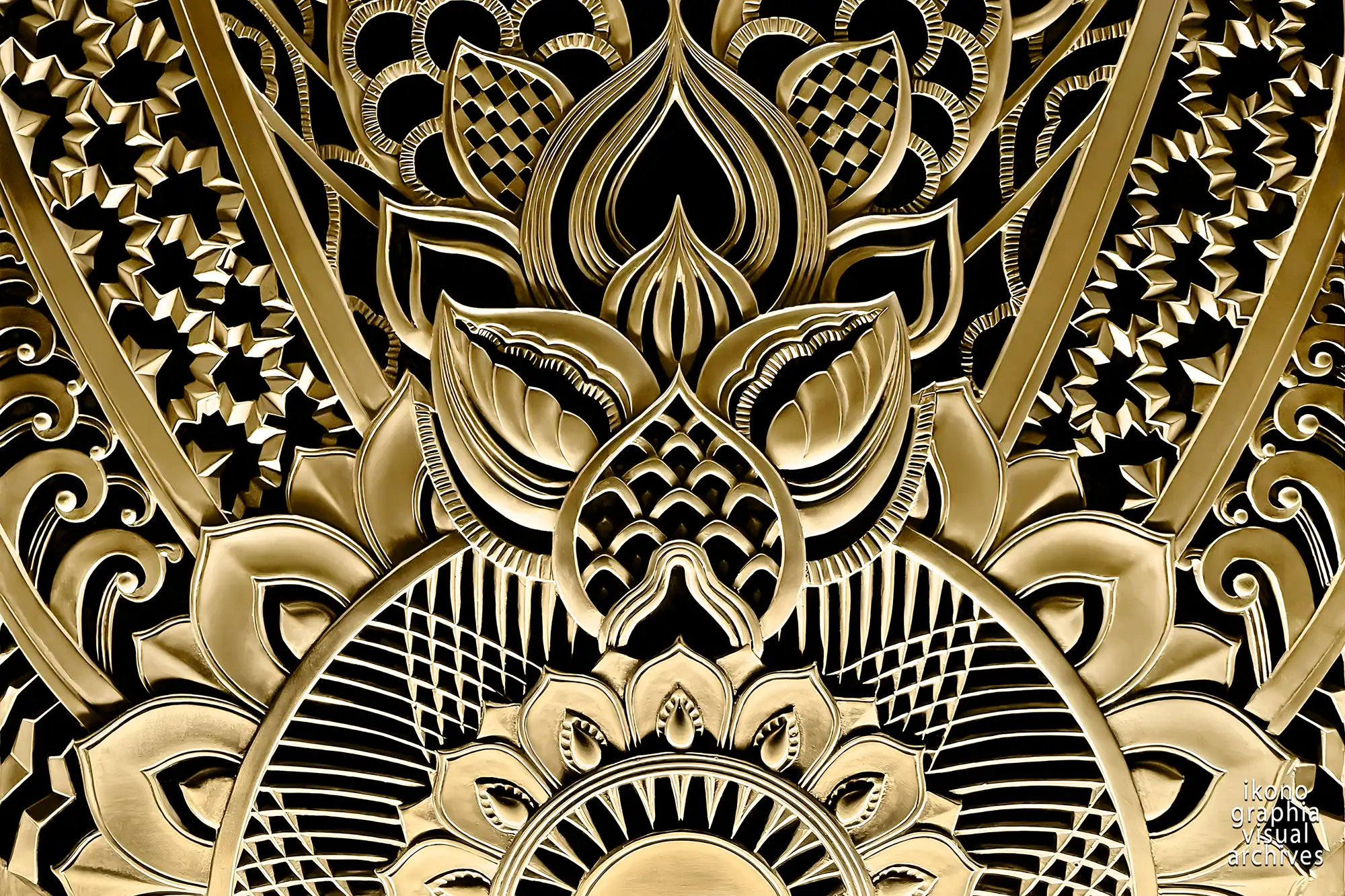
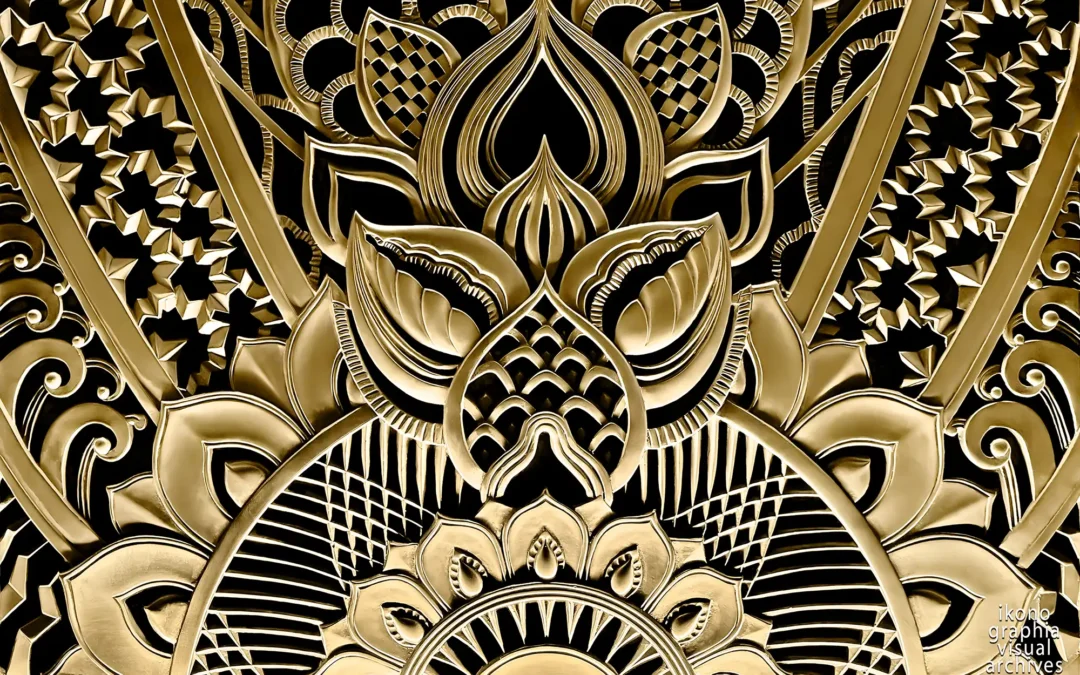
Allegory of Success — Gilded Grille, Chanin Building, New York — 1929 — René Paul Chambellan Success — The reward of sustained action. From "The City of Opportunity — Physical Series." A modern symbolic cycle in bronze. Symmetry returns, crowned with a radiant rising form. Success is rendered not as excess but as order — the balanced resolution of struggle. Spirals unfurl, energy flows upward, and the pattern resolves into harmony. Artist: René Paul Chambellan — Contributor: Jacques Delamarre Photographed by Roberto Bigano. NYC Art Deco Archive, Ikonographia. https://www.ikonographia.com/archive/the-new-york-city-art-deco-archive/

Designed by sculptor Rene Paul Chambellan and executed in collaboration with decorator Jacques Delamarre, these grilles form a complete visual philosophy. The program, titled “The City of Opportunity”, translates the psychological journey of a person’s life into geometric abstraction — a belief deeply rooted in the early 20th century fascination with symbolism, psychology, and the expressive power of line.
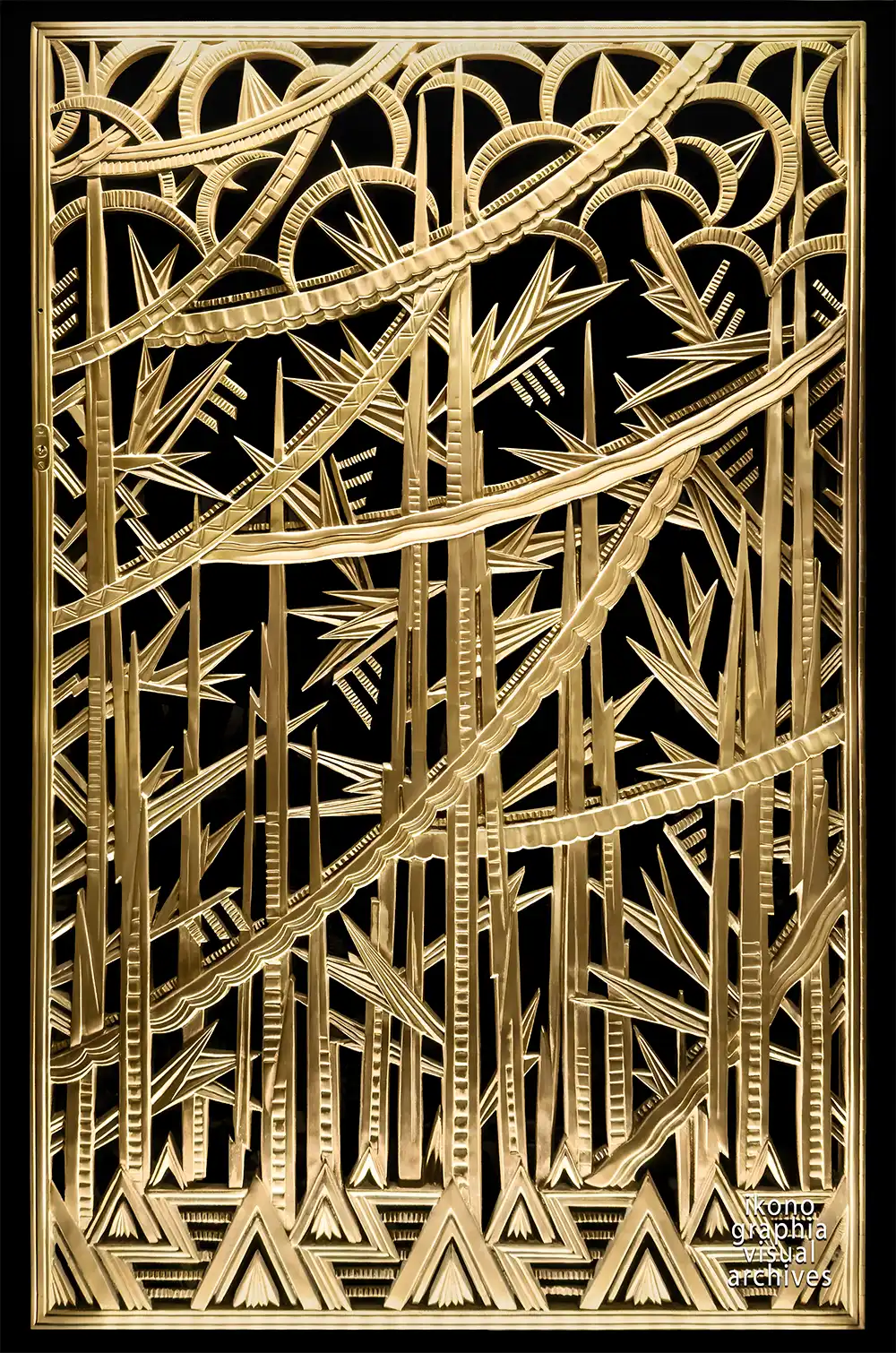
Art Deco Allegory of Agitation — gilded bronze grille by René Paul Chambellan, Chanin Building vestibule, New York, 1929.

Agitation.
The first stirrings of consciousness.
From "The City of Opportunity — Mental Series."

Sharp diagonals and restless lines convey the earliest motions of thought — the doubts, the questions, the uncertainty that precedes understanding. It is the unsettling beginning of inner life.
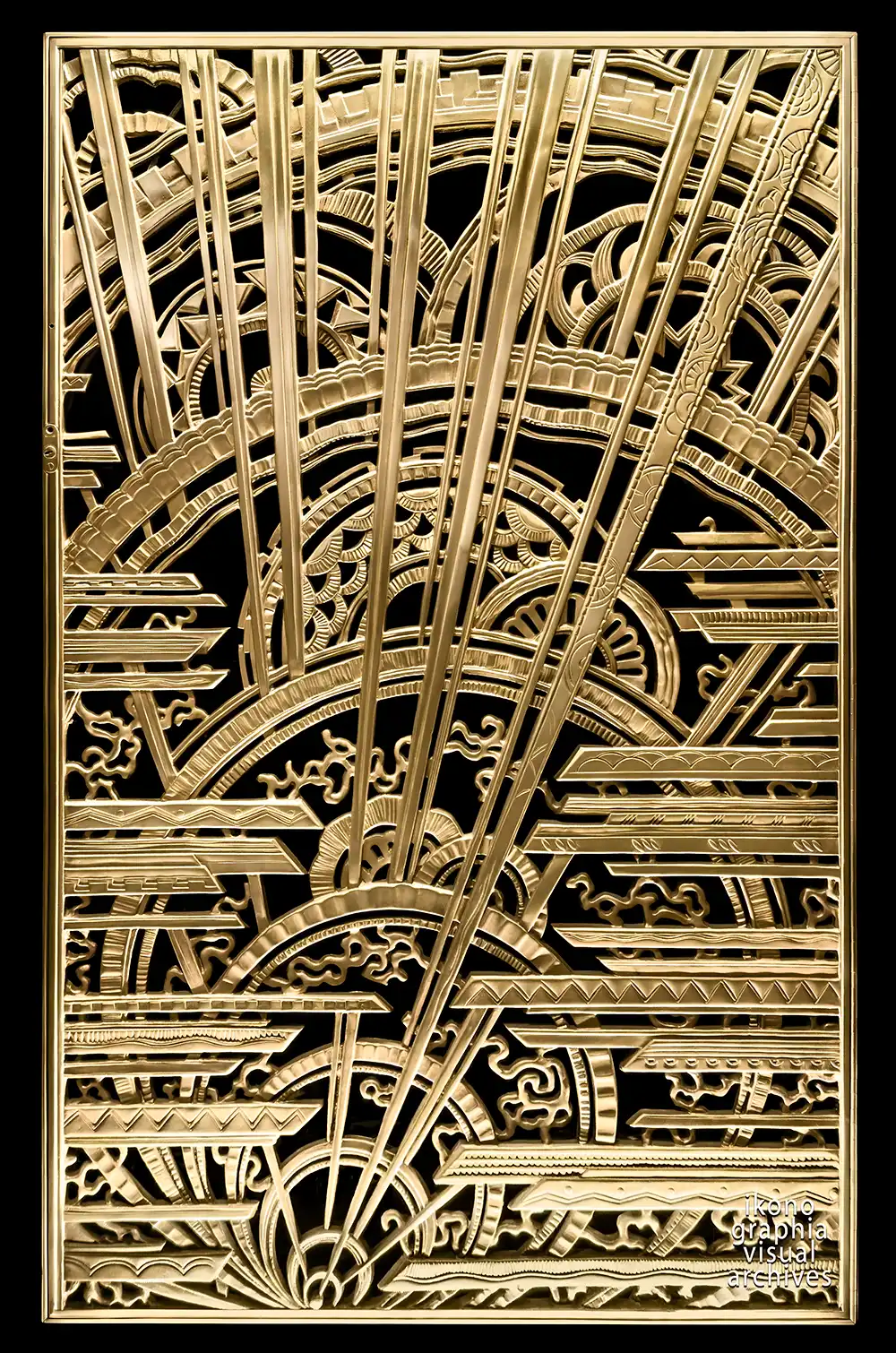
Art Deco Allegory of Vision — gilded bronze grille by René Paul Chambellan, Chanin Building vestibule, New York, 1929.

Vision.
The moment of illumination.
From “The City of Opportunity — Mental Series.”

Here, the composition centers on spiraling curves and backward radiance from the eye — Chambellan’s symbol for introspection. The bowed head of the figure suggests inward concentration, while strong supporting hands denote a gathering of intellectual strength. Vision is not simply sight — it is the birth of clarity.

The Vision Behind the Grilles

Geometry as Thought, Emotion, and Aspiration.

The Chanin program rests on a single conviction: that geometric lines and forms carry emotional meaning as precisely as figurative symbols — if designed with intention. Not decoration. Not ornament. A visual language capable of expressing the inner life of the mind and the outward force of physical action.

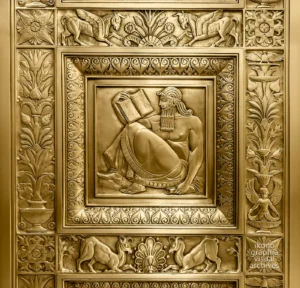
The program is divided into two parallel series, mental and physical, each tracing a complete arc of human development. The mental series moves from Agitation — the first, restless stirrings of consciousness — through Vision, Courage, and Achievement. The physical series runs alongside it: Activity, Effort, Endurance, and Success. Together they form a single argument: that the life of the mind and the life of the body are not separate, but two expressions of the same drive.

Each stage is expressed twice — once in a bas-relief figure, once in the grille beneath it. The figure shows a human state. The grille translates it into pure geometry. Spirals, rays, rings, and diagonals carry meanings as specific as words. The two read together as a complete symbolic sentence.

The source is a 1929 article in Architectural Forum, in which Rayne Adams — drawing directly on Jacques Delamarre — explains the program element by element, at the moment of completion. Not interpretation. The artists' own account.
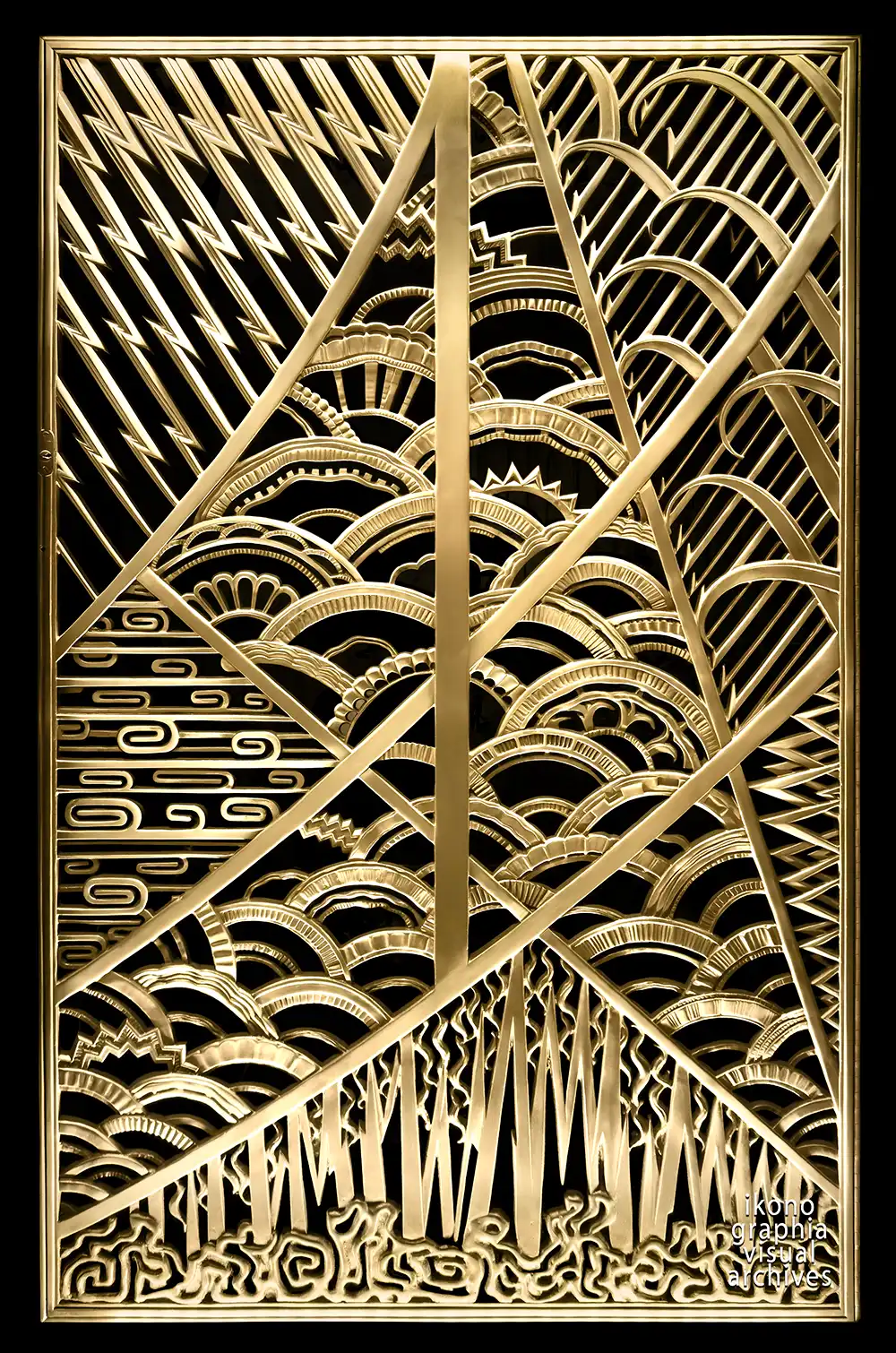
Art Deco Allegory of Courage — gilded bronze grille by René Paul Chambellan, Chanin Building vestibule, New York, 1929.

Courage.
The resolve to act despite resistance.
From "The City of Opportunity — Mental Series."

In this panel, Chambellan visualizes determination as flowing arcs and tightly woven diagonals. The struggle is present, but so is forward momentum. Obstacles appear as counter-lines, yet purpose pushes through them. It is the geometry of bravery.
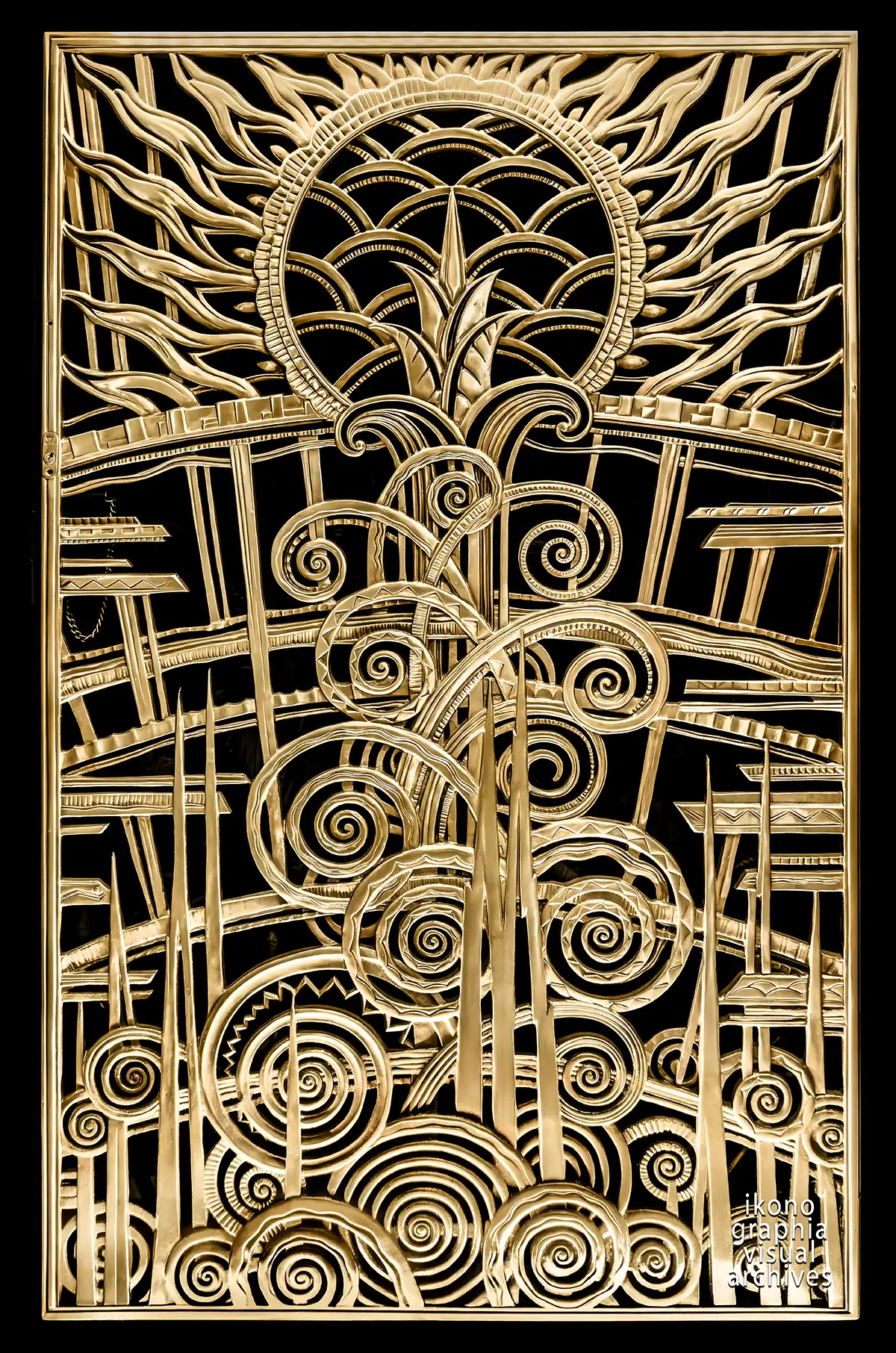
Art Deco Allegory of Achievement — gilded bronze grille by René Paul Chambellan, Chanin Building vestibule, New York, 1929.

Achievement.
The fruition of thought.
From "The City of Opportunity — Mental Series."

A rising sun, concentric spirals, and balanced symmetry mark the culmination of mental effort. The pattern is no longer restless but ordered, luminous, and harmonious. Achievement is not finality, but the moment when intention becomes reality.

The Artists Behind the Vision

Rene Paul Chambellan — Sculptor of the American Skyline.
Trained in low-relief technique, Chambellan brought to the Chanin commission a sculptor's understanding of how geometric line carries weight and movement — how a spiral tightens under pressure, how a diagonal conveys force. The nickel-silver elevator doors at 70 Pine Street and the Atlas modeling at Rockefeller Center place him among the defining contributors to New York Art Deco metalwork. The Chanin grilles are his most sustained intellectual work: a symbolic cycle that translates human psychology into architectural geometry.

Jacques Delamarre — The Program's Architect.
Delamarre's role was conceptual. Where Chambellan gave the grilles their sculptural form, Delamarre constructed the narrative — the two-series structure, the sequence from Agitation to Success, the decision to run mental and physical development as parallel arguments. The Architectural Forum article that survives as the primary document of the Chanin cycle is, in effect, Delamarre's account of his own design thinking.

Together they produced something with no direct equivalent in New York Deco: a complete symbolic program in which every geometric element carries a specific, intended meaning.
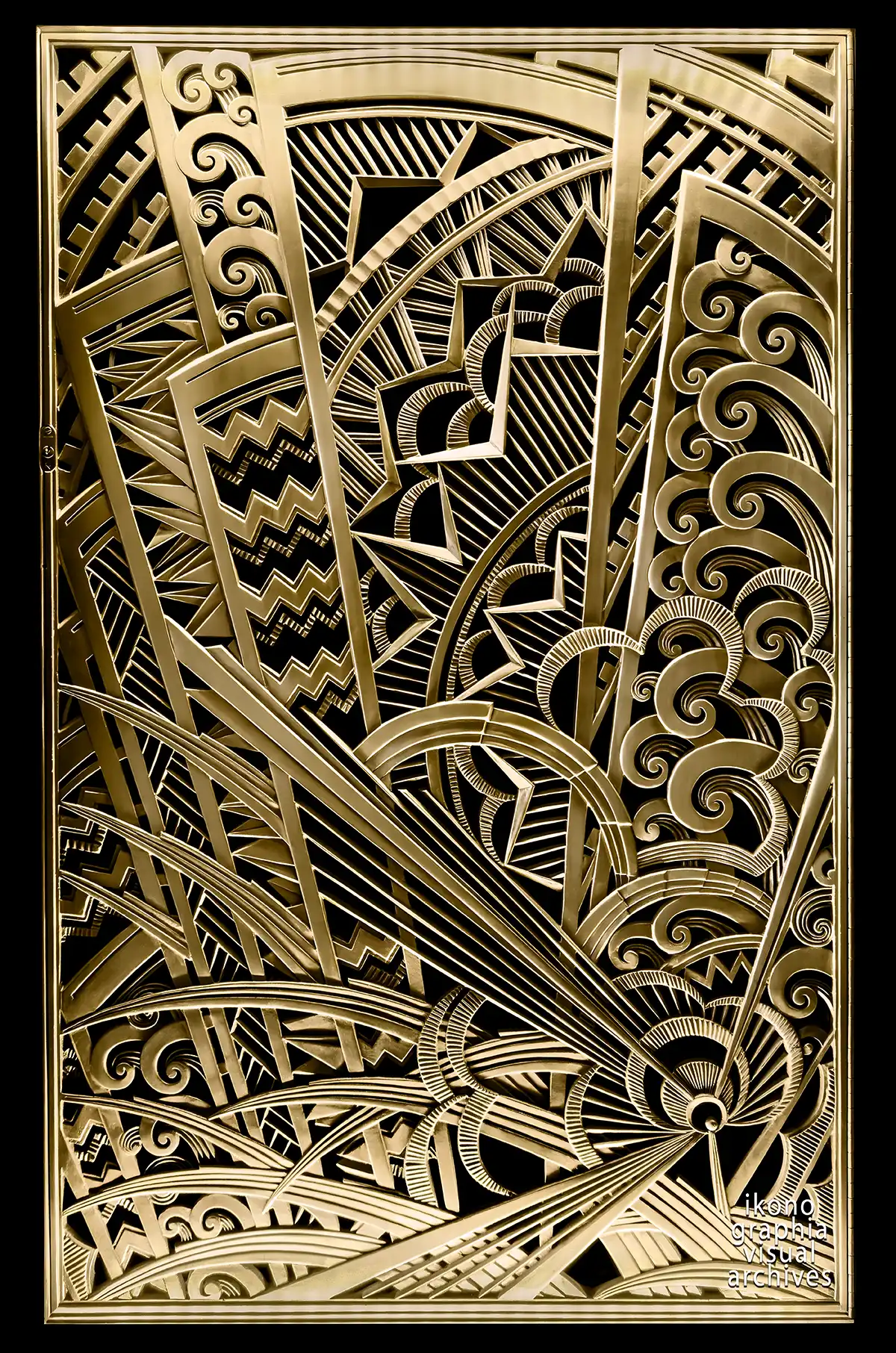
Art Deco Allegory of Activity — gilded bronze grille by René Paul Chambellan, Chanin Building vestibule, New York, 1929.

Activity.
The beginning of physical exertion. From "The City of Opportunity — Physical Series."

Interlocking rays and rising diagonals give this panel a kinetic rhythm — the first outward expression of purpose in the world. It is the geometry of initiation, the body waking into movement.

Art Deco Allegory of Effort — gilded bronze grille by René Paul Chambellan, Chanin Building vestibule, New York, 1929.

Effort.
The struggle against resistance.
From "The City of Opportunity — Physical Series."

Here, spirals tighten, diagonals collide, and curves appear compressed, as if bearing weight. The composition visualizes the tension between aspiration and the obstacles that define it. Effort is the architecture of perseverance.

Beyond Symbolism — The Human Story in Bronze

Viewed as a whole, the Chanin grilles offer something rare in architectural sculpture: a complete narrative of human development told through pure form. Geometry carries emotion. Abstraction carries argument. Eight panels, two sequences, one program — conceived in 1929 and still precise.

Nearly a century later, the panels hold their strange mixture of optimism and introspection — a Jazz Age faith in progress captured in metal. Chambellan's question was not rhetorical. It is there in every rising line, every spiraling curve, every radiant burst: what does it mean to strive? The eight grilles are the answer.
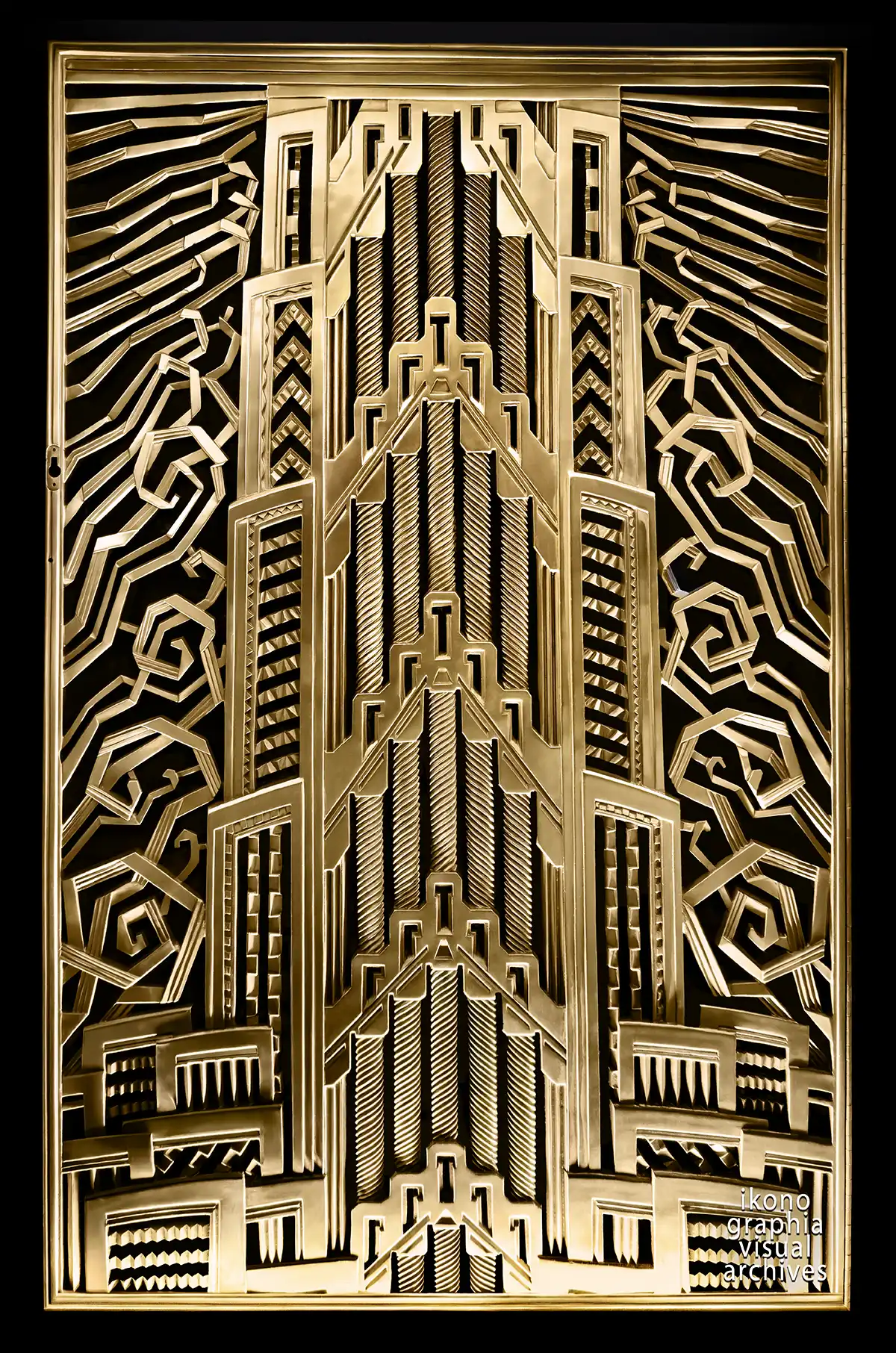
Art Deco Allegory of Endurance — gilded bronze grille by René Paul Chambellan, Chanin Building vestibule, New York, 1929.

Endurance.
The steady continuation of labor.
From "The City of Opportunity — Physical Series."

This grille stands tall and monumental — a symbolic skyscraper of human resilience. Vertical lines run uninterrupted through the panel, marking the steady, disciplined continuation of work. Its strength lies in repetition, in the refusal to break.
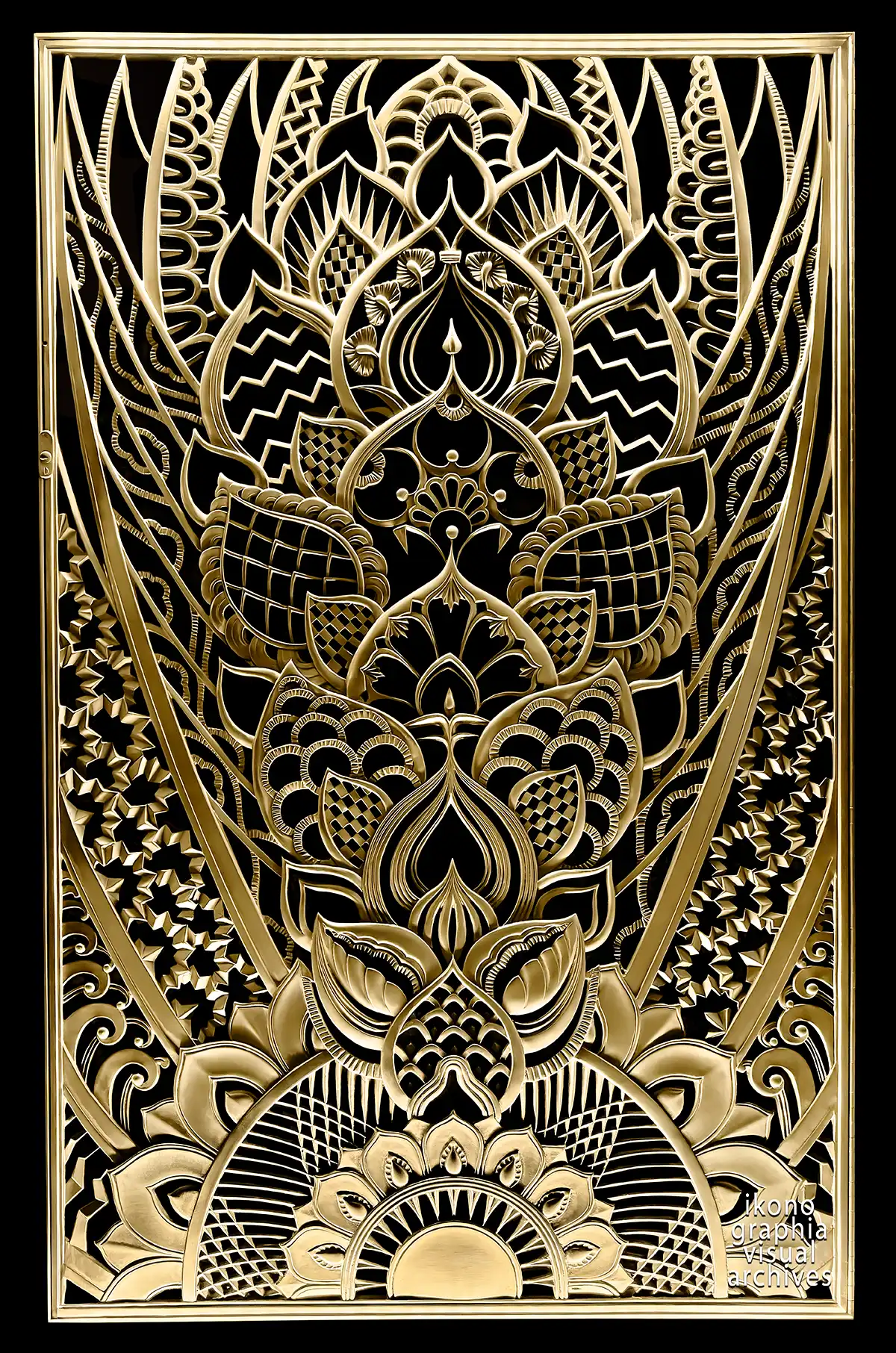
bule, New York, 1929.

Success.
The reward of sustained action.
From "The City of Opportunity — Physical Series."

Symmetry returns, crowned with a radiant rising form. Success is rendered not as excess but as order — the balanced resolution of struggle. Spirals unfurl, energy flows upward, and the pattern resolves into harmony.

The Chanin Building Symbolic Program

Eight Grilles, Eight Bas-Reliefs — A Dual Expression of Human Development

For decades, the Chanin grilles were admired but not understood. Visitors saw geometric patterns in bronze, felt their visual power, but couldn't decode their meaning. The symbolic program remained partially locked.

The key appeared in May 1929, just months after the building opened: a six-page article in The Architectural Forum written by Rayne Adams, featuring direct explanation from Jacques Delamarre—the collaborator who conceived the narrative structure with Chambellan.

This wasn't later interpretation. It was the artists explaining their own work at the moment of completion.

For Ikonographia's research, this text functioned as a Rosetta Stone: it allowed the grilles to be read as their creators intended, aligning what we see in the bronze with what Delamarre and Chambellan meant to express.
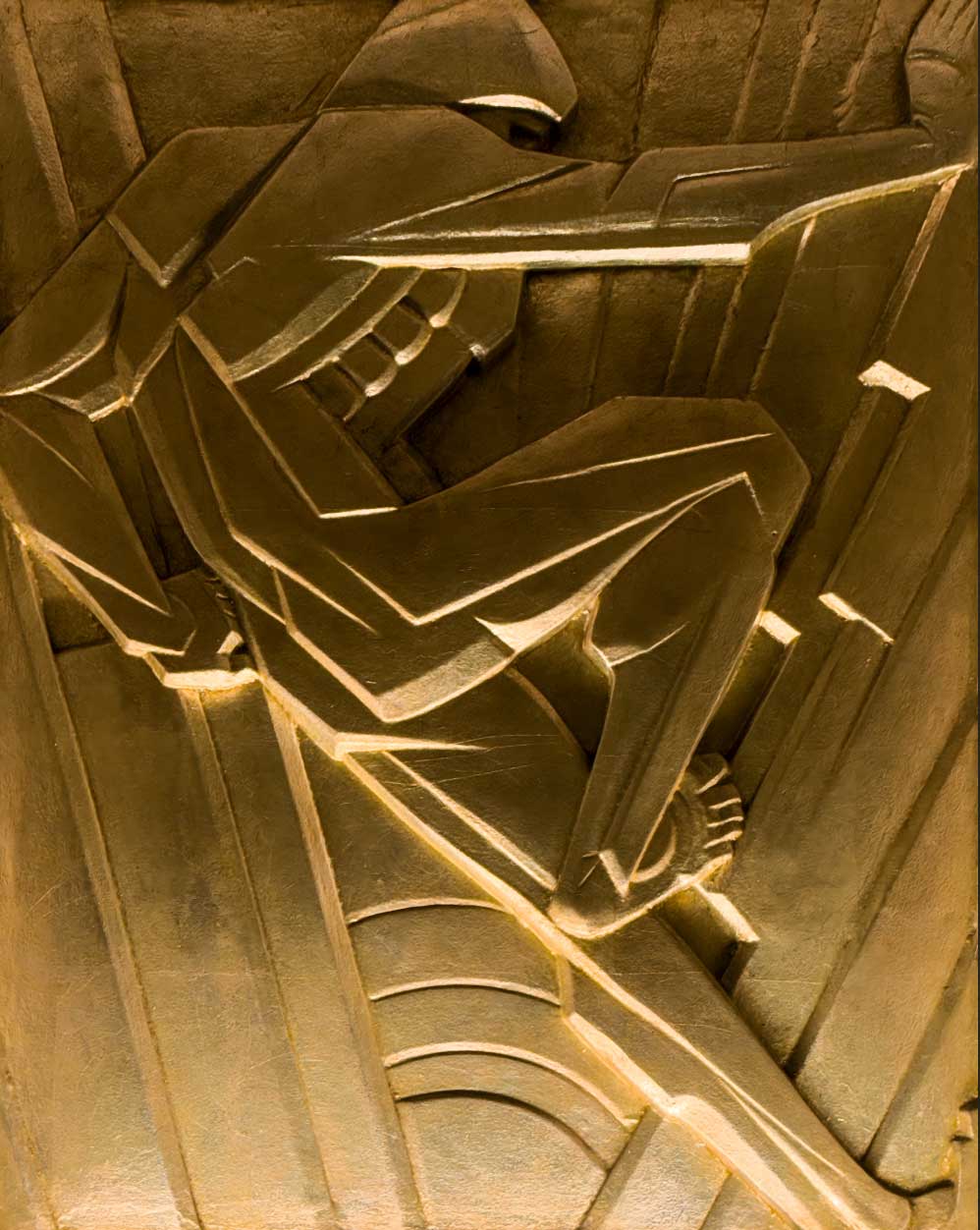
Vision bas-relief by René Paul Chambellan, Chanin Building vestibule, New York, 1929.

Vision Bas-relief.
The moment of illumination.
From "The City of Opportunity — Mental Series."

Excerpts From "Architectural Forum", May 1929 — Primary Source: Jacques Delamarre

The entire article is included in the downloadable document. What follows are the passages that most directly illuminate the symbolic program.


The Philosophical Foundation: Geometry as Emotional Language

Why geometric abstraction? Why not traditional allegory?

Rayne Adams begins by defending the decision to use pure geometric forms rather than conventional symbolism:

"Most designs are conceived and executed with little thought... The common run of decorative design follows along no intellectual line of effort which is in any way exacting. If we have to portray winter, we picture it as 'a weak old king who feels, like Lear, upon his withered face, Cordelia's tears.' And all select a bluebird as a symbol for happiness."

This conventional symbolism, Adams argues, is "labored" and "lacks subtlety." But there's another path:

"The dominant idea which they have sought to set forth is the significance of geometric lines and their capacity to symbolize emotions and abstractions of thought and deed... A consensus of opinion has established certain characteristics which are associated with types of line and of form. For vexation or perplexity we all scribble a confused scrawl; the flowing curve suggests ease and grace; the circle suggests completeness."

This is the conceptual core: geometric forms can carry emotional meaning just as powerfully as figurative symbols—if designed with intention.


The Structure: Two Parallel Series

Each grille corresponds to a stage of human development, divided into mental and physical progression:

"In these reliefs and grilles they have envisaged this life under two commonly accepted categories,—that which sets forth the physical life and that which sets forth the mental life."

"Certain phases of development under each category are presented by a panel figure in relief supplemented by a grille design placed immediately beneath."

The Mental Series (consciousness developing):

  1. Agitation — "the first conscious stirrings; the first doubts, the first questions and uncertainties"
  2. Vision — "the birth of conscious planning and the formation of a definite and compelling ideal"
  3. Courage — "the man at work,—following out, with firm resolution and steady purpose, those ideals which are his, beset by obstructions, yet achieving"
  4. Achievement — "the fulfillment of his work"

The Physical Series (action manifesting):

  • Activity, Effort and Endurance, and Success — "exemplifies in its way the characteristics presented by the series showing the mental development"

How to Read the Grilles: The Case of Vision

Adams provides a detailed reading of one grille to show how the geometric language works:

"In the relief, showing a crouching figure, we see the vacant look,—'the light drawn backwards from the eye'—betokening introspection and concentration; the bowed head characteristic of the thinker, and the supporting hands,—that gesture which has always something pathetic about it—as though the strong hands of the body were giving support to the troubled mind."

The corresponding grille translates this into pure geometry:

"The mental world of this thinker is symbolically represented by the spiral convolutions, expanding in wider and wider sweeps, while his inspirations or impulses for action are marked by the indented, radial lines."

"The deepest indentation marks the definitive and determining inspiration under the aegis of which he will, for good or ill, follow through his life to some significant end."

"The grille design supplementary to this relief bears out this thought. The dominant inspiration is represented by the continuous ray, which, passing through the barriers of doubt and ignorance, pursues its unbroken way. Other inspirations, other compulsions, are represented by the non-continuous rays; these are less perfect. The tangent rings of successively increasing diameter represent the successive phases of his life."

This is how the system works: each geometric element—spirals, rays, rings, indentations—carries specific symbolic meaning, allowing complex psychological states to be expressed through abstract pattern.


The Grilles and Reliefs as Unified Language

Critically, the grilles are not decoration—they are translation:

"The supplementary grille panels, wholly geometric in conception, present a symbolism which, interpreted, bears out the meaning of the corresponding relief figures."

The bas-relief shows a human figure embodying an emotional state. The grille beneath translates that same state into geometric abstraction. Together, they form a complete symbolic language: one figurative, one abstract, both expressing the same idea.


Adams' Final Assessment

Despite the intellectual complexity of the program, Adams judges the work on aesthetic grounds:

"Whether the union has brought forth progeny whose aesthetic quality will stand, is something for the critics to decide. As an expression of a method of achievement, the work may be characterized assuredly as not lacking in the spirit of adventure."

"For my own part, I confess that I have rarely looked upon relief figures which have struck me as more worthy of praise than these. To say that they are masterly is not enough; they hold, for those of us who care for abstractions, what is far more important,—something of genius."


Primary Source Document

The complete 1929 article by Rayne Adams is available as an attached document for researchers who wish to read the full philosophical argument and additional symbolic details.

[Download: "The Reliefs and Grilles of the Chanin Building Vestibules" – Architectural Forum, May 1929]


What this text provides:

A contemporary explanation of the grilles by their creators, allowing Ikonographia's photographic documentation to be read with the precision the artists intended—not through later guesswork, but through direct alignment between visual evidence and original meaning.
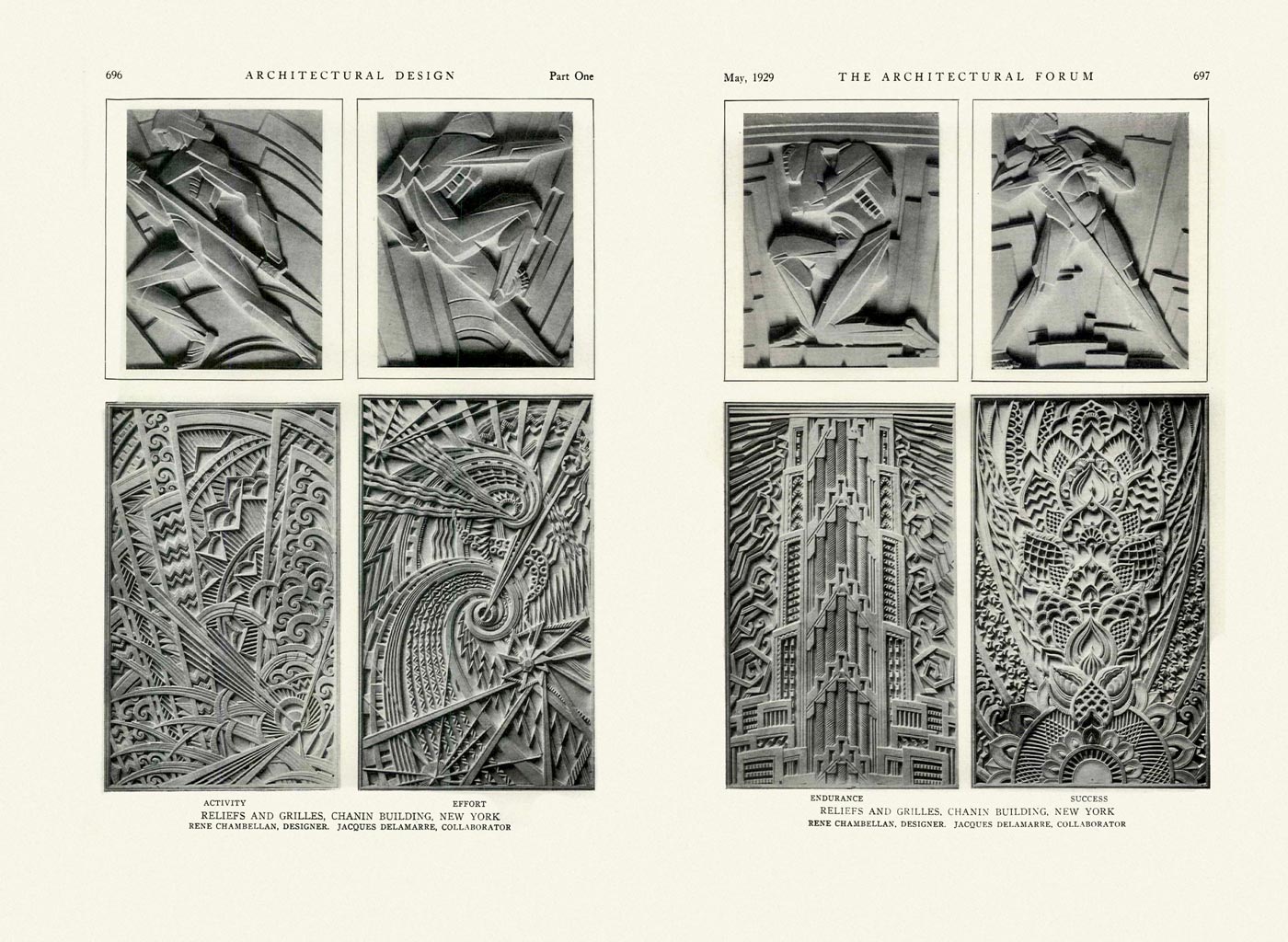
Architectural Forum, May 1929 — Chanin Building reliefs and grilles by René Paul Chambellan, with Jacques Delamarre as collaborator.

Architectural Forum, May 1929

Contemporary publication illustrating René Chambellan’s reliefs and grilles for the Chanin Building, New York.
Here the symbolic program of the vestibule bas-reliefs and grilles is explained directly by Jacques Delamarre, the collaborator responsible for articulating their narrative structure.
It is a sort of "Rosetta Stone" to decipher the complex project of "The City of Opportunity,”

CODA — Seventy Pine Street: A Related Masterwork

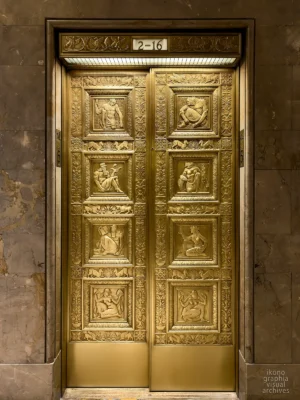
Another remarkable Chambellan work— The "Evolution of Fuel" Elevator Doors

Though separate from the Chanin cycle, the nickel-silver Evolution of Fuel elevator doors at 70 Pine Street deserve their own reading — created for the Cities Service Oil Company.

Chambellan was a master at exploring new metal alloys. Here he worked in nickel silver (German silver) — a corrosion-resistant copper-nickel-zinc alloy prized in Art Deco design for its silvery-white luster, warm tone and durability. Despite its name, it contains no actual silver; the nickel provides the distinctive metallic sheen.

On the right, a woman holds an antique oil lamp — a symbol of the past.
On the left, a man grips an electric turbine — an emblem of the future.
Together they form a transition between eras — a direct counterpart to the philosophical program of the Chanin grilles.
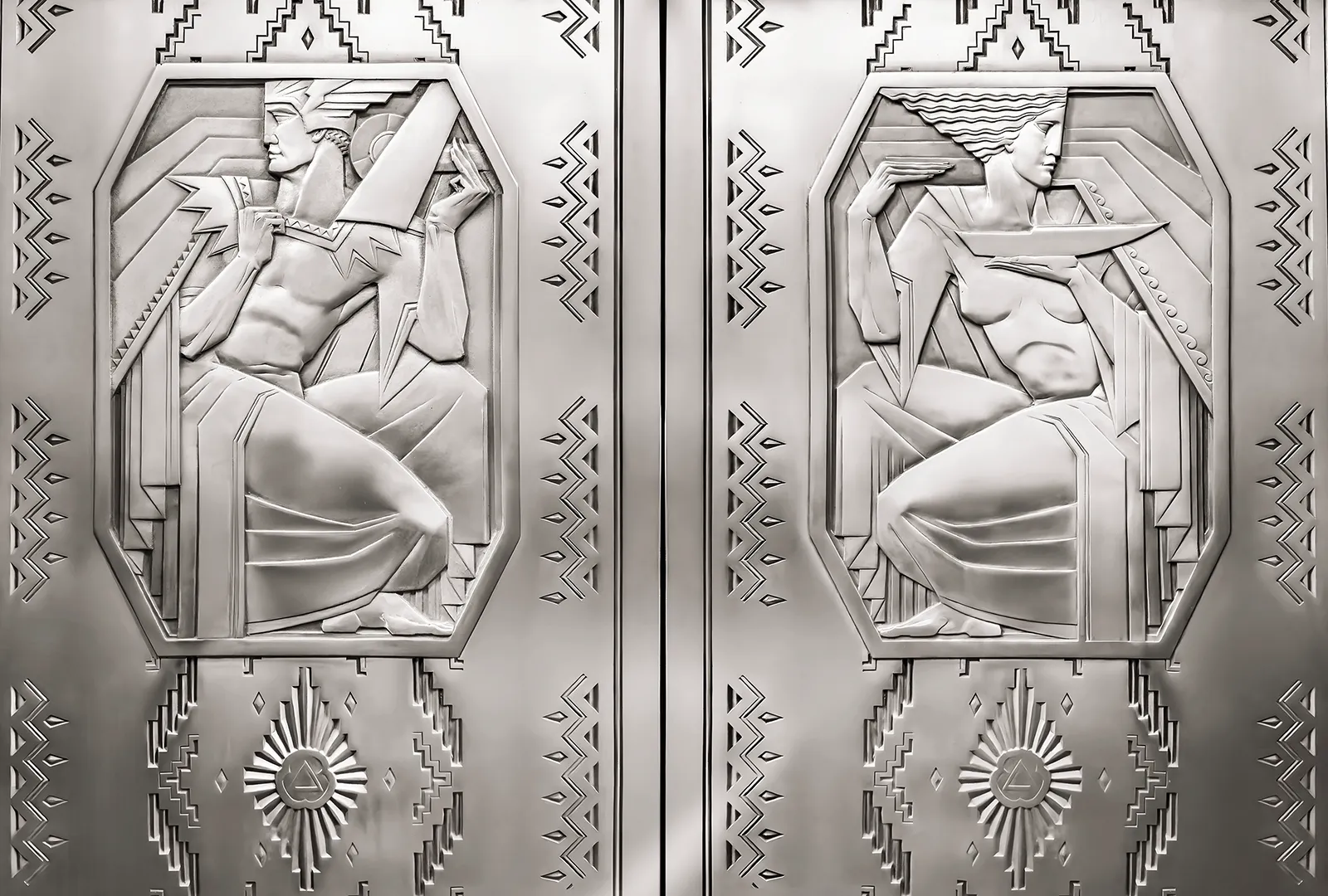
The elevator doors shows a pair of nickel-silver reliefs

The Evolution of Fuel  Elevator Doors — 1931 circa — by Rene Paul Chambellan — 70 Pine St., New York

Past and future rendered in nickel silver — the material that made the transition visible.
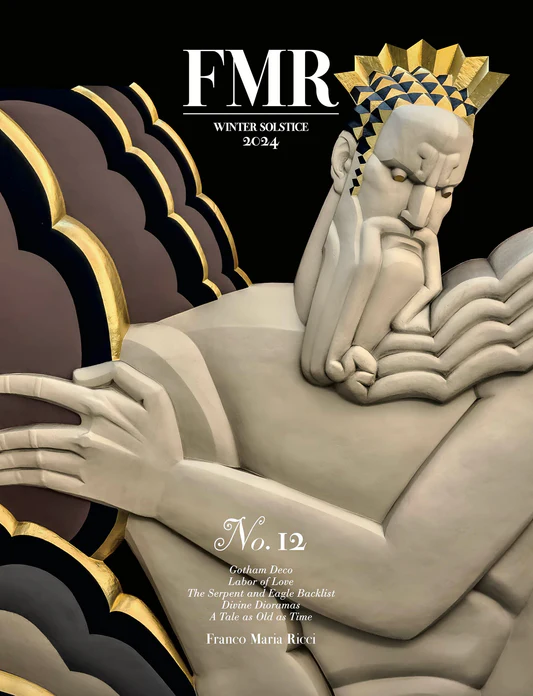
FMR Magazine — Gotham Deco

Photographs from this page were published in FMR Magazine Winter Solstice 2024.

"Gotham Deco — Modern Metropolis. This Was Tomorrow" — published in FMR Magazine with an essay by Anthony W. Robins and photographs by Roberto Bigano — documents New York Art Deco as a complete interior program: the Chanin Building radiator grilles, the Fred French Building elevator panels, the light and sound installations of Rockefeller Center, and the decorative vocabulary that ran through an entire generation of Manhattan architecture. A cover and twenty-four pages.

Robins is the pre-eminent authority on New York Art Deco. President of the Art Deco Society and author of "New York Art Deco: A Guide to Gotham's Jazz Age Architecture" — widely cited as the definitive guide to the subject.

FMR was founded in Milan in 1982 by Franco Maria Ricci. For four decades, among curators, collectors, and art historians on both sides of the Atlantic, FMR set the standard for visual scholarship and for the most demanding editorial photography.
Jacqueline Kennedy called it the most beautiful magazine in the world.

Copyright, links and credits

Photography, Copyright & Credits

All photographs © Ikonographia / Roberto Bigano — All Rights Reserved.
These images are part of the Ikonographia Visual Archives: New York City Art Deco Collection.

Terms of Use (Summary)

The images presented in this archive are copyrighted and available for licensed use only through Ikonographia Visual Archives.

You may not download, reproduce, publish, or distribute these images without a valid license. For commercial or editorial licensing, please refer to the product pages or contact Ikonographia directly. A full explanation of licensing terms is available in the Shop / Licensing Information section under "Ikonographia — Standard License" and "Ikonographia — Merchandising & Product Use Licenses"

Artwork & Building Attribution

Designed for the Chanin Building, 122 East 42nd Street, New York City, by sculptor Rene Paul Chambellan and executed in collaboration with decorator Jacques Delamarre, these grilles form a complete visual philosophy. The program, titled “The City of Opportunity”, translates the psychological journey of a person’s life into geometric abstraction — a belief deeply rooted in the early 20th century fascination with symbolism, psychology, and the expressive power of line.

Copyright Status Clarification

Building & Artwork:
The architectural design of this buildingis in the public domain under U.S. copyright law. Buildings constructed before the Architectural Works Copyright Protection Act (1990) are not protected as architectural works, and their exteriors and interiors may be freely photographed.

Photographs:
All photographs on this page, however, are copyrighted works of Ikonographia / Roberto Bigano and require a license for any reuse.

Ikonographia Mission Statement

Ikonographia is committed to the accurate documentation, preservation, and ethical dissemination of twentieth-century visual culture.

Archival Notes

These photographs were produced as part of Ikonographia’s ongoing documentation of significant examples of twentieth-century visual culture. Image preparation includes controlled lighting, accurate color management, and perspective correction to preserve architectural integrity and material detail.

Further Reading - Selected Sources

• FMR Magazine No. 12, Winter Solstice 2024 — "Gotham Deco" — Special issue devoted to the Art Deco transformation of 1920s New York, with contributions by Anthony W. Robbins and photography by Roberto Bigano. Cover and 24 pages featuring comprehensive documentation of the Chanin Building radiator grilles, the Fred French Building elevator panels and polychrome ceilings, the Light and Sound sculpture at Rockefeller Center, and a curated selection of the city's finest Art Deco interiors.

• Anthony W. Robbins, New York Art Deco: A Guide to Gotham’s Jazz Age Architecture.
• David Stravitz, The Chrysler Building: Creating a New York Icon Day by Day.
• Cervin Robinson & Rosemarie Haag Bletter, Skyscraper Style: Art Deco New York.
• Christopher Gray (archives), The New York Times, “Streetscapes” columns.
• New York City Landmarks Preservation Commission reports (Fred F. French Building).
• The Metropolitan Museum of Art – Digital Collections (historic metalwork and architectural ornament references).

Acknowledgments

Ikonographia gratefully acknowledges the institutions, archivists, scholars, and architectural historians whose research and preservation efforts help illuminate the cultural significance of New York’s Art Deco heritage.

About René Chambellan – A short bio

Rene Paul Chambellan in his Studio

Chambellan at work in his studio.

René Chambellan (1893–1955)

René Paul Chambellan was a French-born sculptor and modeler active in New York during the late 1920s. Trained in architectural ornament and low-relief techniques, he contributed to the emergence of the French Modern Style—later known as Zig-Zag Moderne or Art Deco—translating its geometric elegance into architectural sculpture.

His collaboration with Jacques Delamarre on the Chanin Building’s Mental and Physical Series stands as his most distinctive achievement, blending expressive figuration with stylized geometric structure.

Beyond the Chanin commission, Chambellan also contributed sculptural modeling to major projects of the period, including elements for the famous Atlas statue (1937) at Rockefeller Center. His work exemplifies the refined craftsmanship and symbolic vocabulary that shaped New York’s Jazz Age architecture.

The Nonexistent Knight — The Armour Collection of Ferdinand von Habsburg

The Nonexistent Knight — The Armour Collection of Ferdinand von Habsburg

The Nonexistent Knight — The Armour Collection of Ferdinand von Habsburg

Photographed by Roberto Bigano for Franco Maria Ricci. Published 1992.

From 1577, Ferdinand of Habsburg, Archduke of Tyrol, assembled the most complete armorial Wunderkammer of the Renaissance at Ambras Castle near Innsbruck. His obsession was armour worn by the most famous military figures of his era — princes, commanders, mercenary leaders. Related by blood to the ruling families of Europe, he had access no collector before or after him could replicate.

The brief from Franco Maria Ricci: "Mr Bigano, bring me ghosts coming out from nowhere."

Armet combat helmet in German Style. Owner: John of Saxony. Goldsmith: Mattheus Deutsch, Landshut 1498.

The result was Il Cavaliere Inesistente — Italo Calvino's novel as the frame, Beaufort-Spontin's preface as the historical argument, Roberto Bigano's photographs as the evidence. 176 pages. 47 hand-applied colour plates on Fabriano blue-laid paper. Black silk binding with gold impressions. 3,000 numbered copies. Sold out.

One sequence was not in the book. The transparencies documenting the Hercules ceremonial armour of Maximilian II were the result of a dedicated colour developer — a personal formula designed to produce a three-dimensional effect. The series was lost after processing. Recovered twenty years later, they are published here for the first time.

Foot Tournament Armor. Owner: JArchduke Ferdinand II of Inner Austria, from 1619 Emperor Ferdinand II Goldsmith: Master I.O. Milano, 1600 Vienna Kunsthistorisches Museum. Photo by Roberto Bigano.

Foot Tournament Armour — Milan, 1600

Gold decoration covers every surface — helmet, breastplate, pauldrons, gauntlets — worked in dense foliate patterns on darkened steel. No surface was left plain.

The armour reads as a complete object, not an assembly of parts. Commissioned for tournament, not battle. The man who wore it needed to be seen before he moved.

Owner: Archduke Ferdinand II of Inner Austria, Emperor Ferdinand II from 1619. Goldsmith: Master I.O., Milan, 1600.

Tournament costume armor in the form of Lansquenets dress, 1525. Owner: Count Wilhelm von Roggendhorf, gifted by Charles V

Iron and Rivets — Tournament Costume Armour in the Form of Landsknecht Dress — Augsburg, 1525.

Beaten iron and rivets — no gold, no engraving. The decoration is the form itself: the armour replicates the slashed and puffed costume of the Landsknecht infantry in steel. Every fold, every ribbon, every seam pressed into metal.

The most feared soldiers of the 16th century wore cloth. Their commander wore this.

Owner: Count Wilhelm von Roggendorf. Gifted by Charles V. Goldsmith: Kolman Helmschmid. Carver: Daniel Hopfer. Augsburg, 1525.

Battle Armor by Jacob Hannibal von Hohenems, 1625

Battle Armour of Jacob Hannibal von Hohenems — Innsbruck, 1625.

The Crucifixion rendered in gold on the breastplate — Christ flanked by two figures, set against blued steel with engraved borders. A soldier's declaration of faith pressed into the surface of a weapon. The goldsmith is unknown. The choice of subject is not.

Owner: Henry of Rantzau. Goldsmith: unknown, Braunschweig, 1559.

Armor with Religious Carvings Owner: Henry of Rantzau Goldsmith: Unknown, 1559 From the Armour Collection of Ferdinand Von Hapsburg Vienna Kunsthistorisches Museum. Photo by Roberto Bigano.

Armour with Religious Carvings — Henry of Rantzau —  Braunschweig, Germany 1559

The Crucifixion rendered in gold on the breastplate — Christ flanked by two figures, set against blued steel with engraved borders. A soldier's declaration of faith pressed into the surface of a weapon. The goldsmith is unknown. The choice of subject is not.

Goldsmith: Unknown.

The Iron Mask. Combat helmet owned by John of Saxony 1498

The Iron Mask — Combat Armet, Landshut, 1498.

Plain steel, no decoration. The bolt reads as a mouth. The visor slit as eyes. The geometry of the face is the geometry of the helmet — nothing added, nothing removed. The oldest piece in the sequence and the most modern looking. Five hundred years have not aged it.

Owner: John of Saxony. Goldsmith: Mattheus Deutsch, Landshut, 1498.

Elegant armour in "German" style, 1485 owned by Emperor Maximilian I

Armour of Emperor Maximilian I — Augsburg, 1485.

The breastplate reads as draped fabric — radiating folds pressed into polished steel, a V at the centre, scalloped edges in gold. The goldsmith made metal behave like cloth. A back view that reveals more about the maker's ambition than any front view could.

Owner: Emperor Maximilian I. Goldsmith: Lorenz Helmschmid, Augsburg, 1485.

Combat Armor by Ottheinrich, Count of the Rhenish Palatinate, 1516

Combat Armour of Ottheinrich, Count Palatine — Augsburg, Germany, 1516

Polished steel with engraved borders — fleurs-de-lis across the helmet, foliate scrolls at the gorget and breastplate. The decoration is restrained, the form precise. A fighting suit built for a man who became Elector of the Palatinate. The goldsmith who made it also made armour for Maximilian I.

Owner: Ottheinrich, Count of the Rhenish Palatinate, later Elector of the Palatinate. Goldsmith: Lorenz Helmschmid, Augsburg, 1516.

Elegant Horse Armor, from the collection of Ferdinand II

Horse Armour with Human Figure — Owner and Goldsmith Unknown.

The horse wears a steel face. Below the neck, pressed into the chest guard, a human figure in relief — serene, eyes closed, arms folded, holding a shield.

The figure is not a decoration. It is a presence. Owne r and goldsmith unrecorded. The image speaks without them.

The “Hercules” decorated armor of Maximilian II

The Hercules ceremonial armour of Emperor Maximilian II was designed in Paris by Etienne Delaune, court artist and engraver, and executed by the Antwerp goldsmith Eliseus Libaerts.

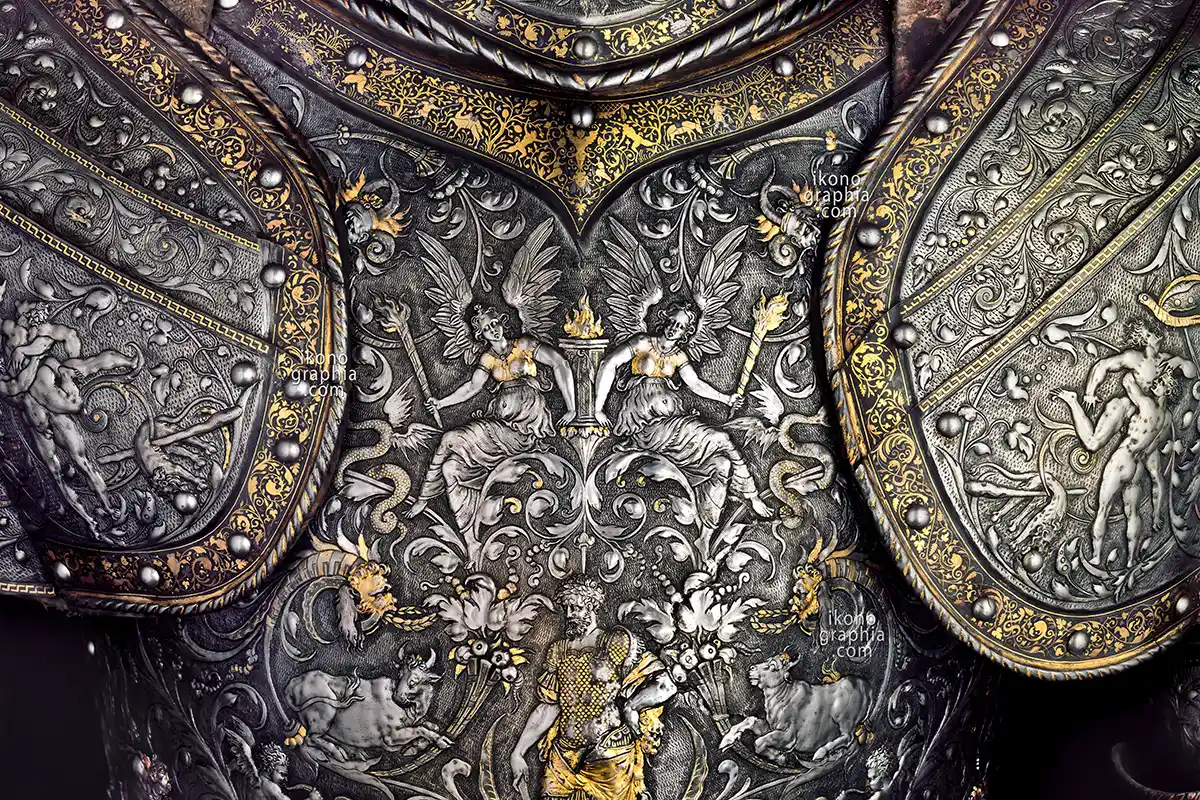
Every surface carries a program — winged figures, the labours of Hercules, mythological scenes in relief on darkened steel with gold accents. One of the most complete surviving examples of 16th-century ceremonial armour as theological and political statement. These photographs were not in the 1992 FMR publication.

The transparencies were the result of a dedicated colour developer — a personal formula designed to produce a three-dimensional effect. The series was lost after processing. Recovered twenty years later, they are published here for the first time.

Ceremonial "Hercules" Armour, 1555. Owner, Emperor Maximilian II

The "Hercules" Ceremonial Armour of Emperor Maximilian II, Breastplate detail — Paris, 1555.

Winged figures flank a central flame. Below them, Hercules among the labours — bull, lion, serpent — in high relief against a ground of gold foliate work. Delaune's program read at the distance it was designed for.

Ceremonial "Hercules" Armor, 1555. Owner, Emperor Maximilian II

The "Hercules" Ceremonial Armour of Emperor Maximilian II, Front View — Paris, 1555.

The full programme visible as a complete surface. No plain steel anywhere — helmet, gorget, breastplate, pauldrons carrying the same density of carving from crown to shoulder.

Owner: Emperor Maximilian II. Goldsmith: Eliseus Libaerts. Carver: Etienne Delaune. Paris, France, 1555.

Ceremonial "Hercules" Armor, 1555. Owner, Emperor Maximilian II

The "Hercules" Ceremonial Armour of Emperor Maximilian II, Side View — Paris, 1555.

The profile reveals the helmet's form — the visor line, the comb, the curve of the skull — all carved. Delaune designed for every angle. Libaerts executed every angle.

Owner: Emperor Maximilian II. Goldsmith: Eliseus Libaerts. Carver: Etienne Delaune. Paris, France, 1555.

Ceremonial "Hercules" Armor, 1555. Owner, Emperor Maximilian II Back view

The "Hercules" Ceremonial Armour of Emperor Maximilian II, Rear View — Paris, 1555.

The back of the helmet carries the same programme as the front. Figures among foliage, the twisted comb as spine. Nothing was left for the man behind the Emperor to see except more of the same argument.

Owner: Emperor Maximilian II. Goldsmith: Eliseus Libaerts. Carver: Etienne Delaune. Paris, France, 1555.

Ceremonial "Hercules" Armour, 1555. Owner, Emperor Maximilian II Carvings Detail

The "Hercules" Ceremonial Armour of Emperor Maximilian II, Detail — Paris, 1555.

Hercules at centre, gold on darkened steel, flanked by the labours. At this distance the individual tool marks are visible. This is what the transparencies contained. This is what twenty years preserved.

Owner: Emperor Maximilian II. Goldsmith: Eliseus Libaerts. Carver: Etienne Delaune. Paris, France, 1555.

Armor with grotesque mask-style visor owned by Wolf Dietrich von Hohenems of Lansquenets 1525

Next Episode — The Anthropomorphic Armors.

Wolf Dietrich von Hohenems led the Landsknechts — the most feared mercenary infantry of the 16th century. In 1525 he fought at the Battle of Pavia in the service of Charles V. The face on the visor was designed to be recognised. It was also designed to frighten.

Il Cavaliere Inesistente, The Non-exhisting book cover

Il Cavaliere Inesistente, The Nonexistent Knight, by Italo CalvinoFranco Maria Ricci Editore 1992.
Photographs by Roberto Bigano.
Preface by  Christian Beaufort-Spontin

This book is based on a novel by the renowned Italian writer Italo Calvino. "Il Cavaliere Inesistente" (The Nonexistent Knight) is perhaps Calvino's finest narrative masterpiece, and it is unique in that it conveys a story where clothes don't merely define the man; they become the man.

176 pages.
47 hand-applied color plates.
Luxury Fabriano blue-laid paper.
Black "Orient" silk binding with gold impressions.
Circulation: 3000 numbered copies.


The book was sold out for decades once a recent discovery made a few units available for purchase again.
Buy >

Copyright Links and Credits

Photography, Copyright & Credits

All photographs © Ikonographia / Roberto Bigano — All Rights Reserved. Photographed at the Kunsthistorisches Museum, Vienna. The armour collection of Ferdinand von Habsburg is held permanently at the Kunsthistorisches Museum, Vienna.

Roberto Bigano photographed this collection for the Franco Maria Ricci Book "Il Cavaliere Insesistente.)"

Credits & Acknowledgments

Ikonographia gratefully acknowledges Christian Beaufort-Spontin, Director of the Arms and Armour Collection at the Kunsthistorisches Museum in Vienna, whose decision to close the museum rooms and grant full access made this work possible.

Terms of Use (Summary)

The images presented in this archive are copyrighted and available for licensed use only through Ikonographia Visual Archives.

You may not download, reproduce, publish, or distribute these images without a valid license. For commercial or editorial licensing, please refer to the product pages or contact Ikonographia directly. A full explanation of licensing terms is available in the Shop / Licensing Information section under "Ikonographia — Standard License" and "Ikonographia — Merchandising & Product Use Licenses."

Ikonographia Mission Statement

Ikonographia is committed to the accurate documentation, preservation, and ethical dissemination of twentieth-century visual culture.

Bugatti Masterpieces of 1920s and 1930s. By Roberto Bigano

Bugatti Masterpieces of 1920s and 1930s. By Roberto Bigano

Bugatti Masterpieces of 1920s and 1930s. By Roberto Bigano

Two sessions, two decades apart — the museum and the meeting.

Vintage Bugatti masterpieces photographed by Roberto Bigano across two sessions. The iconic Atalante and Atlantic from the Divina Bugatti sessions at the Musée National de l'Automobile in Mulhouse — the FMR commission. The legendary Type 13, Type 35, and Type 40A from the Bugatti Glamour Sessions — four nights of open-air studio photography during the Centenary celebrations in Tuscany, with the owners present — two bodies of work. Available nowhere else.

Bugatti Type 37A, "Flighty" (1928) - Owners, Frederica and Simon Fitzpatrick, Guernsey © Roberto Bigano/ ikonographoa.com Browse the Bugatti Archive https://www.ikonographia.com/archive/the-bugatti-archive/

Bugatti Type 37A, "Flighty" (1928) - Owners Frederica and Simon Fitzpatrick, Guernsey.

Bugatti Masterpieces. A gallery of the most iconic models.


Ikonographia is proud to showcase a gallery of the most iconic vintage Bugatti models, highlighted by the splendid images of Roberto Bigano. The models range from the legendary Type 13 and Type 35 racing models to the stylish Type 57 Atalante and Atlantic designed by Jean Bugatti.
All the images are available in high-resolution or fine-art prints.
This is a work-in-progess page. We are going to add more contents. Please stay in touch.

A 1937 Bugatti Type 57SC Coupé Atlantic lightened in silhouette mode to emphasize the flowing coupé lines

A 1937 Bugatti Type 57SC Coupé Atlantic. Detail of the windshield and wipers emphasizing the riveted crest.
Jean Bugatti designed the half-body ending in a crest. He then reverted the first part right-left and finally joined the two pieces with rivets in one of the most daring automotive designs. Courtesy: British Garage, Paris.

About Ettore and Jean Bugatti.


Automobiles Ettore Bugatti was a French car manufacturer of high-performance cars, founded in 1909 in Molsheim, Alsace, France, by the Italian industrial designer Ettore Bugatti. The firm produced about 8,000 cars and is known for its design beauty and many race victories.

Ettore Bugatti himself designed his creations (together with his highly talented son Jean, who later took to the drawing board alone). This extraordinary man had attended the Brera School of Art as a youth, yielding an artistic streak inherited from his father, Carlo (a fine cabinet-maker). The founding genius of the Bugatti firm also demonstrated an astonishing ability for mechanical engineering and an amazingly eclectic mind in general.

This flair had also gone to his brother Rembrandt, the talented sculptor whose works include the little elephant triumphing on the Royale’s bonnet. 

The legendary Ettore Bugatti's signature on the engine head of a 1921 Type 13 Brescia. Photo by Roberto Bigano. Buy this image in the ikonographia.com store.

The legendary Ettore Bugatti's signature on the engine head of a 1921 Type 13 Brescia.

A gallery of Masterpieces. Let's start with the Type 13 Brescia.


The Bugatti Type 13, Brescia, was the first actual Bugatti produced from 1910 to 1926. Thanks to the race victories, Bugatti became known as pur-sang (thoroughbred), keeping with Ettore Bugatti's feelings for his designs.
The Bugatti Type 13, Brescia, was fast and technically superior, making it virtually unbeatable. This was evident in the 1921 Brescia Grand Prix, where Bugatti's cars finished in the top four places, sparking a surge in orders. With the introduction of the "Brescia," Ettore Bugatti fundamentally changed the racing scene, as his cars won almost every competition they entered in the 1920s, cementing their place in racing history.

The initial Brescia featured a basic, functional design so rudimentary and simplistic that it earned the nickname "Bagnoire" (bathtub), a term reflecting its unique shape and design.
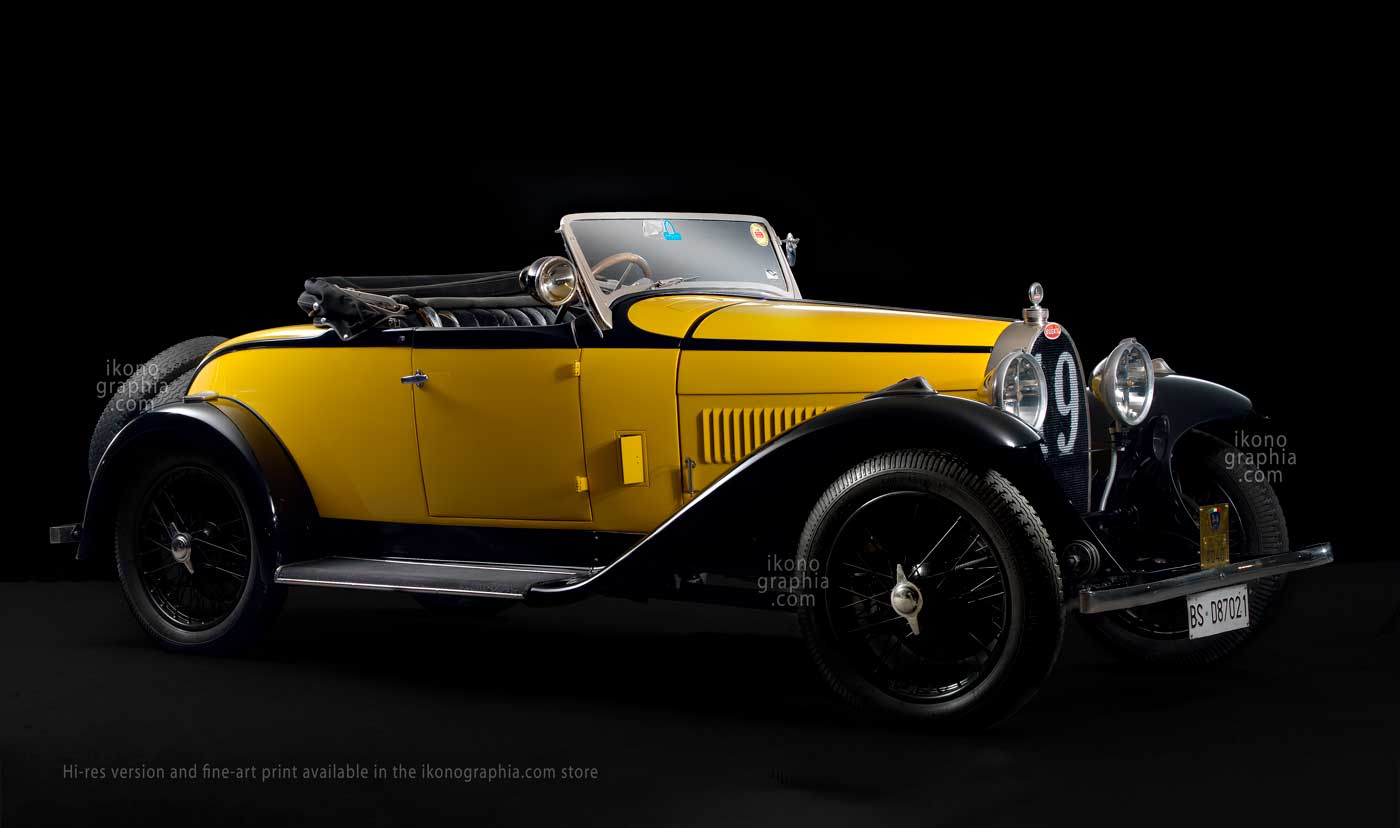
The Brescia design was later refined, as evidenced by the exquisite yellow sample below.

Bugatti Type 13 Brescia, 1921. Photo by Roberto Bigano. Buy this image at https://www.ikonographia.com/archive/the-bugatti-archive/

Bugatti Type 13 Brescia Cabriolet, 1923.

The Bugatti Type 35.


The Bugatti Type 35 is an iconic race car design produced between 1924 and 1930. It was phenomenally successful, winning over 1,000 races in its time. In 1926, it took the Grand Prix World Championship after winning 351 races and setting 47 records in the two prior years.

At its height, the Type 35 averaged 14 weekly race wins, including the prestigious Targa Florio for five consecutive years, from 1925 through 1929.

Bugatti Type 35B Grand Prix Biplace Course - Two Seater Racing

Bugatti Type 35B Grand Prix Biplace Course Two-Seater Racing 1927.
The Type 35 is an iconic race car design produced between 1924 and 1930. It was phenomenally successful, winning over 1,000 races in its time. At its height, the Type 35 averaged 14 weekly race wins, including the prestigious Targa Florio for five consecutive years, from 1925 through 1929.

Dashboard of a Bugatti Type 35B Grand-Prix (1927) - Courtesy: Musée National de l’Automobile Mulhouse

The dashboard of a Bugatti Type 35B Grand-Prix (1927) – Courtesy: Musée National de l’Automobile Mulhouse.

Bugatti Type 35A, 1926. Owned by Gigi Baulino & Enrica Varese. © Roberto Bigano/ ikonographoa.com Browse the Bugatti Archive https://www.ikonographia.com/archive/the-bugatti-archive/

Bugatti Type 35A, 1926. Owners Gigi Baulino & Enrica Varese, Italy. Picture taken at Bugatti International Meeting 2009. Hasselblad 39 Multishot Camera High-resolution file.
The owner forbade the photographer from washing the car so as not to erase the dirt from the race, which made it fascinating.
Watch the video of this event >

The Bugatti Type 41 Royale.


The Bugatti Type 41 Royale was gorgeous in its seven-meter length. It was enormous, had the most oversized wheels, and was the longest and tallest limo. Her design and form would smoothly conceal the captivating exuberance of an eight-cylinder motor for an impressive 12,773 cubic meters capacity that defines once and for all the original idea of a car.

Only seven Royales were produced. We showcase the "Coupè Napoleon," Ettore Bugatti's car, and the Bugatti Type 41 Esders Roadster, probably the most elegant.

Bugatti Type 41 Royale Coupé Napoleon (1929) The personal car of Ettore Bugatti. Courtesy: Musée National de l'Automobile, Mulhouse. Photo by Roberto Bigano. Courtesy: Courtesy: Musée National de l’Automobile Mulhouse. Buy this image at Ikonographia.com store

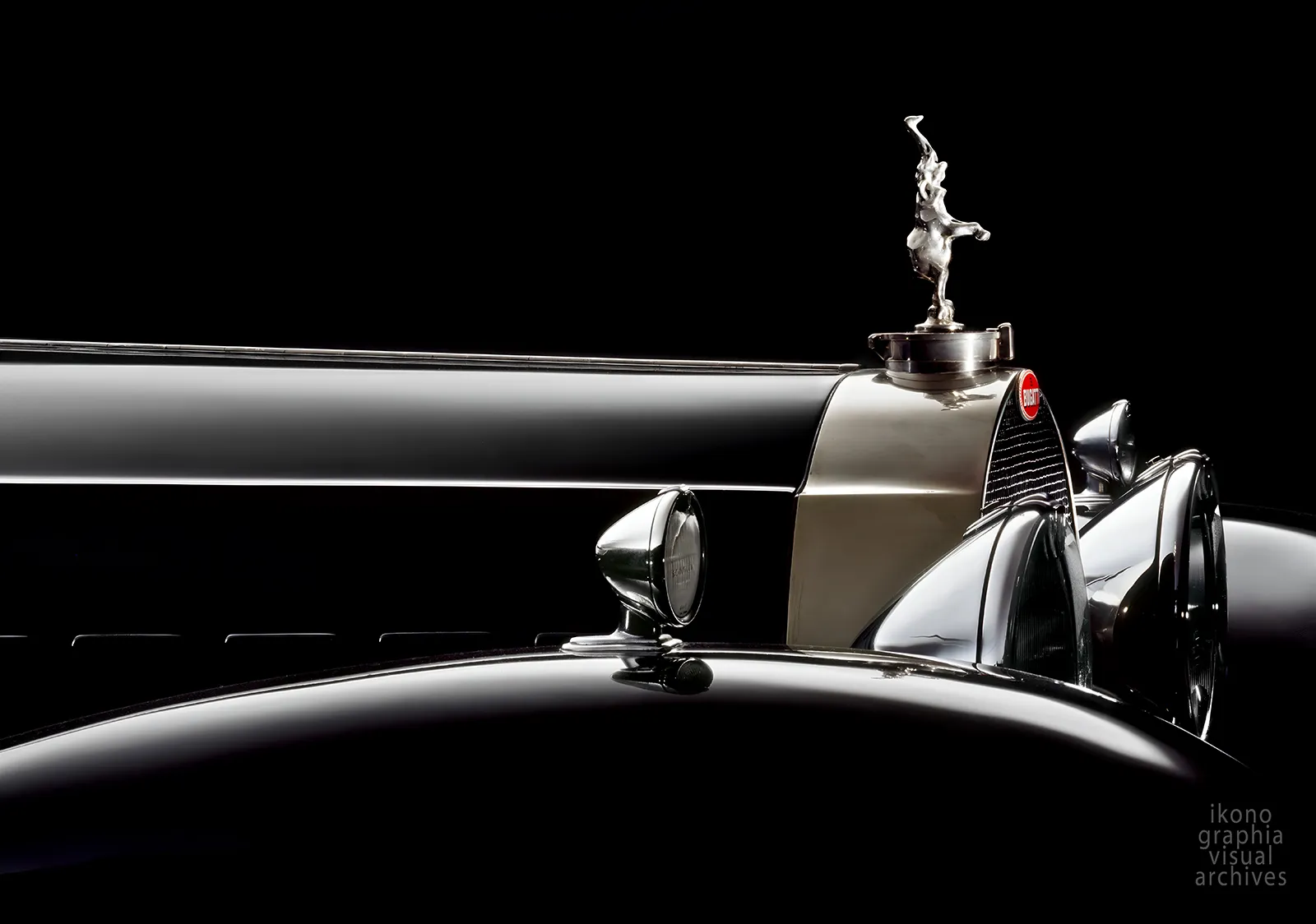
Bugatti Type 41 Royale Coupé Napoleon (1929), the personal car of Ettore Bugatti. On top of the radiator grill is the symbol of the Royales, the Elephant carved by Rembrandt Bugatti. Courtesy: Museé National de l'Automobile, Mulhouse.

The Bugatti Royale's Prancing Elephant, according to Antonio Tabucchi.


There has never been such an expensive car. Only seven Bugatti Royale were built, each one different. Upon the radiator grill, the Royale and the Petit Royale had a prancing elephant carved by Rembrandt Bugatti, Ettore's brother, as a symbol.  You can find it described in Rebus, a short tale by Antonio Tabucchi. Here is an excerpt.

The Bugatti Royale, according to Antonio Tabucchi.

It really was a Bugatti Royale, a Coupé de Ville; I don't know if that means anything to you, Monsieur […] Albert couldn't believe his eyes. It's not possible; it's not possible, he repeated to himself while stroking the long-tempered bumpers.

I don't know if you understand, but a Bugatti gives one the idea of a woman's body lying down on her back with her legs forward […] The elephant was missing from the bonnet. That was the only awful surprise. Maybe you may not know, or perhaps you just haven't noticed, that Bugatti had a figurine of a silver statue of an elephant on the bonnet, right on top of the radiator grill. It was a sculpture by Ettore's brother, Rembrandt Bugatti. It wasn't only a trademark, like the Rolls Royce Winged Victory of Samothrace or the Packard's Swan, but a tangible symbol to be deciphered like every other symbol. It was an elephant standing on his back legs, with the erect trunk symbolizing aggression and coupling.

Does it seem too easy to explain? Perhaps. But think about it: a Bugatti Royale lying on its back, going slowly uphill, wings spread open, ready to speed up, ready for the thrill, with that fabulous radiator grill protecting its pulsating life and energy, and on the top an elephant with an erect trunk.
Excerpt from the short story "Rebus" in "Little Misunderstandings of No Importance" "(Piccoli equivoci senza importanza), by Antonio Tabucchi.

Leggi il testo originale italiano.

"Rebus." Da "Piccoli equivoci senza importanza."


“Era proprio una Bugatti Royale, un coupé de ville, non so se a lei dice qualcosa, Monsieur (...) Albert non credeva ai suoi occhi, non è possibile, ripeteva, non è possibile, e accarezzava i parafanghi affusolati e lunghi, non so se lei riesce a capire, ma nella Bugatti c'è l'idea del corpo femminile, una donna, appoggiata sulla schiena con le gambe in avanti (...)

Mancava l'elefante sul cofano, fu l'unica brutta sorpresa (...) Forse lei non lo sa, o non ci ha mai fatto caso, ma la Bugatti aveva sul cofano, proprio all'apice della volta della griglia, la statuetta d'argento di un elefante. Era una scultura del fratello di Ettore, Rembrandt Bugatti, e non era solo un marchio della casa, come la vittoria alata della Rolls o il cigno della Packard, quello era un vero simbolo, misterioso da decifrare come tutti i simboli, era un elefante in piedi sulle zampe posteriori e la proboscide eretta in un barrito di aggressione o di accoppiamento.

The Elephant carved by Rembrandt Bugatti, right on top of the radiator grill of the Type 41 Royale Coupé Napoleon, the personal car of Ettore Bugatti. It was an elephant standing on his back legs, with the erect trunk as a symbol of aggression and coupling (1929) - Courtesy: Musée National de l'Automobile, Mulhouse

The Elephant by Rembrandt Bugatti, right on top of the radiator grill of the Type 41 Royale Coupé Napoleon, the personal car of Ettore Bugatti (1929). It was the symbol of the Royales. 

Bugatti Type 55 Sport Roadster and Coupé


The Type 55 was introduced at the 1931 Paris Motor Show. It was produced until 1935 in 38 samples, Roadster and Coupé, most of which had factory bodywork elegantly designed by Jean Bugatti.
Like many high-end automakers, Bugatti used its success in competition to promote its road cars. This already happened with the Type 13 Brescia and the Type 35.
The Type 55 was a direct descendant of the Type 51 race car and was similarly powered by a supercharged 2.3-litre dual-overhead-cam inline-eight.

We showcase here two pictures of the Roadster and Coupé, with the classic factory bodywork by Jean Bugatti.

Bugatti Type 55 Sport Roadster 1932. Road version of the Type 51 Grand Prix, produced in 38 smaples from 1932 to 1935.

Bugatti Type 55 Roadster, as designed by Jean Bugatti.  Courtesy: Museé National de l'Automobile, Mulhouse.

Bugatti Type 55 Sport Coupe 1932. Road version of the Type 51 Grand Prix, produced in 38 smaples from 1932 to 1935.

Bugatti Type 55 Coupé, as designed by Jean Bugatti.  Courtesy: Museé National de l'Automobile, Mulhouse.

Bugatti Type 59-50B Grand Prix Monoplace Course - Single Seater 1938 - Courtesy: Musée National de l’Automobile Mulhouse

Bugatti Type 59-50B Grand Prix Monoplace Course - Single Seater 1938

Divina Bugatti. A Timeless Legend Celebrated in a Timeless Book

Divina Bugatti. A Timeless Legend Celebrated in a Timeless Book

Divina Bugatti. A Timeless Legend Celebrated in a Timeless Book

Franco Maria Ricci's most celebrated automotive book — photographed by Roberto Bigano at the Musée National de l'Automobile, Mulhouse, 1991.

In 1991, Franco Maria Ricci — the publisher Fellini called "La Perla Nera" — commissioned Roberto Bigano to photograph the historic Bugatti collection at the Musée National de l'Automobile in Mulhouse. The pictures were taken over six nights, with a 4×5 view camera, in a closed museum. Two editions of 5,000 copies each. Both sold out.

The cover of the book Divina Bugatti, Storia di un capolavoro meccanico published in 1991 by Franco Maria Ricci, with photographs by Roberto Bigano.

Divina Bugatti's Story. Characters and Background.

We will tell you the story of the book "Divina Bugatti." It was created as a joint effort between Romano Artioli, owner of Bugatti Automobili, and Franco Maria Ricci, a legendary Italian publisher—the photographs by Roberto Bigano. Before we begin, let us introduce the characters and put them in context.

Automobiles Ettore Bugatti was a French high-performance car manufacturer founded in 1909 in Molsheim, Alsace, France, by the Italian industrial designer Ettore Bugatti. The firm produced about 8,000 cars and is known for its design beauty and many race victories.

Romano Artioli is an Italian visionary entrepreneur who bought the Bugatti brand in 1987 and revived it in Campogalliano, Modena, as a builder of its time's fastest series-production car. Bugatti Automobili produced a total of 128 cars. Read all the stories here.

Franco Maria Ricci was one of the most refined editors the world had ever seen. His iconic Magazine, FMR, and splendid books are still a reference. However, FMR was also an often unattainable goal for any photographer. Laura Casalis, Franco Maria Ricci's widow, recently relaunched the FMR magazine and Publishing House with outstanding publications.

Roberto Bigano was Bugatti's photographer at the beginning of the 1990s, documenting the birth of the new Bugatti. Roberto will introduce us to the fascinating vintage Bugatti world.

Bugatti Type 57SC Coupè Atalante (1937) in two lighting modes

Use the arrows or tap on devices to see the two versions. Courtesy: Musée National de l’Automobile Mulhouse.

Roberto Bigano and Divina Bugatti

Let Roberto Bigano tell us how the Divina Bugatti book project started and went through.

"In 1991, I was working for Bugatti Automobili. One day, the refined publisher Franco Maria Ricci, who already desired to celebrate the myth of the Bugatti, suggested the idea of a book on the legendary brand to Romano Artioli, the Bugatti company owner. They reached an agreement, and the plan went through. Naturally, Artioli mentioned "the best photographer in the world" to Ricci, encouraging my candidacy for the job. Ricci, as expected, was skeptical. "I have my photographers, ones I trust," he said with a half smile. The persistence of Artioli gained me a meeting with Ricci. "Go and take a few shots; we'll see," he said to get rid of me."
From Roberto Bigano's "1976-1992. A very serious, semi-serious biography."

Dashboard of a Bugatti Type 35B Grand-Prix (1927). Photo by Roberto Bigano. Courtesy: Courtesy: Musée National de l’Automobile Mulhouse. Buy this image at Ikonographia.com store

Dashboard of a Bugatti Type 35B Grand-Prix (1927).

Courtesy: Musée National de l’Automobile Mulhouse.

Roberto Bigano and Divina Bugatti

I felt well-equipped for my departure—one hundred forty-five different accessories packed in the trunk of my station wagon. For months, I had been working on how to build a mobile set around a Bugatti on location. Before violating that holy ground, I carried out a test: I photographed a Lancia Thema in a large shed. It worked, so I decided to go ahead.

Upon arriving at the National Automobile Museum of Mulhouse in Alsace, I embarked on my nocturnal marathon. Cloaked in the atmosphere of suspense, in the eery silence, I came face to face with The Divine. The situation reminded me of one of Hemingway's stories: the bull and the lion, still before the charge. I was almost worried that the steel muscles would explode, at any time, in all their power, and the beast within would run me over like a train. I had an emotional outburst; I felt as if I were running a fever. Like a robot, I kept shooting and opening Polaroids. I looked at her, but I could not see inside her. Fatigue and tension made everything even more dramatic. "What am I doing here in France, in the middle of the night, in a dark museum? Why didn't I stay home?" I started thinking.
From Roberto Bigano's "1976-1992. A very serious, semi-serious biography."

The Turning Point Polaroid at Musée National de l’Automobile Mulhouse. Bugatti Type 35B Sport Two-seater, US Coachwork (1927).

The "Turning Point" Polaroid

Suddenly, I had reached the turning point: I opened yet another Polaroid, but this time, I found the courage to look at it with a photographer’s eye. I had recognized her, THE Bugatti, in all her dazzling beauty. “I am yours. Only you will be able to possess me,” she was saying. I started dancing as if I was in the middle of the Rio de Janeiro carnival parade. I didn’t feel tired anymore. “I’ve done it!” I said, my voice echoing in the empty museum.
I’d finally gotten a hold of the situation. I’d jumped on the wild horse and was riding as a Native American would.
From Roberto Bigano's "1976-1992. A very serious, semi-serious biography."

The Backstage for Divina Bugatti. Musée National de l'Automobile, Mulhouse, Alsace, France. June 1991. Photo by Roberto Bigano. Buy this image at Ikonographia.com store

The Backstage for Divina Bugatti — Musée National de l'Automobile, Mulhouse, Alsace, France — June 1991.

All the pictures were taken with a 4x5 Plaubel Wiew Camera, Makro Sironar 300mm lens, and Ektachrome Professional film.

The Presentation at Franco Maria Ricci.

I arrived at Franco Maria Ricci’s, feeling confident and appearing as cold-blooded as a contract killer. I knew I was in the presence of one of the most refined editors the world had ever seen. Still, I also knew that I could not fail: if he had any taste at all – and it could not be otherwise – he could not still be indifferent after seeing my work.

Ricci received me with a gentler than polite smile, the smile you would give a child showing you their drawing. His expression changed and suddenly brightened after his eyes settled on the first transparency. “But they are… lit!” he whispered to himself. “Of course they are! Did you think I would bring you the dark ones?” I answered in a friendly yet amused manner. It felt like I was watching from the outside as if I were the spectator to a film. Franco Maria Ricci picked up the phone. “Come and look at something sensational!” he said, running down the corridor enthusiastically. “Call the others and tell them to come to my office!” He looked at me excitedly in front of all his associates, as if I were a superhero, and offered me some incredible projects: on Spanish baroque style, on medieval armor, on the town of Parma, and on French cabinet-makers. He had just assigned me all his future projects.
I had managed to impress Franco Maria Ricci, the king of aesthetics!
From Roberto Bigano's "1976-1992. A very serious, semi-serious biography."

Backstage at Museé National de l'Automobile, Mulhouse. Bugatti Type 41 Royale Coupé Napoleon (1929) The personal car of Ettore Bugatti.

The Backstage for Divina Bugatti — Musée National de l'Automobile, Mulhouse, Alsace, France — June 1991.

All the pictures of the Royale were taken at night in this set, which was highly problematic. The Royale was 7.2m / 24 feet and was very difficult to lighten.

Selected pictures from the book

Selected images from the book — The most iconic Bugattis, documented under the most demanding editorial standards in the world.

Bugatti Type 41 Royale Coupé Napoléon, 1929 — bonnet detail with Rembrandt Bugatti elephant mascot. Photographed by Roberto Bigano at the Musée National de l'Automobile, Mulhouse.

Bugatti Type 41 Royale Coupé Napoléon — Bonnet and Rampant Elephant, 1929

The personal car of Ettore Bugatti. Engine: 12,763 cc. Photographed for Divina Bugatti — Franco Maria Ricci's most celebrated automotive book.

Ricci's rule was absolute: no non-orthogonal images. His response: "We never publish this kind of photograph, but this image is so beautiful that I must. Please don't do it again." The world's most demanding publisher broke his own rule for this picture.

The Elephant carved by Rembrandt Bugatti, right on top of the radiator grill of the Type 41 Royale Coupé Napoleon, the personal car of Ettore Bugatti. It was an elephant standing on his back legs, with the erect trunk as a symbol of aggression and coupling (1929) - Courtesy: Musée National de l'Automobile, Mulhouse. Photo by Roberto Bigano. Courtesy: Courtesy: Musée National de l’Automobile Mulhouse. Buy this image at Ikonographia.com store

The Elephant carved by Rembrandt Bugatti placed atop the radiator grill of Ettore Bugatti's Type x41 Royale Coupé Napoleon.

An elephant standing on its back legs, with the erect trunk symbolizing aggression and coupling (1929).

A 1937 Bugatti Type 57SC Coupé Atlantic. Detail of the windshield and wipers emphasizing the riveted crest. Jean Bugatti designed the half-body ending in a crest. He then reverted the first part right-left and finally joined the two pieces with rivets in one of the most daring automotive designs. Photo by Roberto Bigano. Courtesy: British Garage, Paris. Buy this image at Ikonographia.com store

Bugatti Type 57SC Coupé Atlantic — 1937

Detail of the windshield and wipers emphasizing the riveted crest. Jean Bugatti designed the half-body ending in a crest. He then reverted the first part right-left and finally joined the two pieces with rivets in one of the most daring automotive designs.

Bugatti Type 32 Biplace Course "Tank" (1923). This striking, unexpected rear view emphasizes the aerodynamics of the design. Photo by Roberto Bigano. Courtesy: Courtesy: Musée National de l’Automobile Mulhouse. Buy this image at Ikonographia.com store

Bugatti Type 32 Biplace Course "Tank" — Rear view, 1923.

One of the first racing cars designed around aerodynamic principles — the body enclosing the wheels, the silhouette a single uninterrupted form.

This rear view reveals the engineering logic: everything hidden, everything intentional. Among the first racing cars to use four-wheel braking.

Bugatti Type 35B Sport Two-seater, US Coachwork (1927). Photo by Roberto Bigano. Courtesy: Courtesy: Musée National de l’Automobile Mulhouse. Buy this image at Ikonographia.com store

Bugatti Type 35B Sport Two-seater, US Coachwork — Rear view, 1927.

Purists consider the American coachwork a deviation from the original design.

Bugatti Type 59-50B Grand Prix Monoplace Course - Single Seater 1938 - Courtesy: Musée National de l’Automobile Mulhouse

Bugatti Type 59-50B Grand Prix Monoplace Course — Single Seater, 1938

The last racing Bugatti.

The very first EB110 model made in epowood as designed by Benedini, with the rear wheels covered reminding the Bugatti Atlantic. Photo Roberto Bigano. Buy this image in the ikonographia.com store.

The First Epowood Model of Bugatti EB110 — Unveiled in Divina Bugatti.

The early EB110 epowood maquette produced during the 1991 restyling phase led by architect Gianpaolo Benedini. The model introduces the covered rear wheels, a deliberate reference to the Bugatti Atlantic and Aérolithe, reconnecting the modern EB110 project to the marque’s most radical pre-war designs and marking a decisive step toward the final EB110 GT.

Divina Bugatti. Storia di un capolavoro meccanico. Divine Bugatti. Histoire d'un chef dœvre de la mécanique. Franco Maria Ricci Editore 1991.

DIVINA BUGATTI — Storia di un capolavoro meccanico

Divina Bugatti. Storia di un capolavoro meccanico.
Divine Bugatti. Histoire d'un chef dœuvre de la mécanique.
Franco Maria Ricci Editore 1991.
Photographs by Roberto Bigano.
Texts by Giuseppe Maghenzani, Ivo Ceci, Norbert Steinhauser, Paul Kestler.

204 pages.
72 color prints on matte-coated paper.
15 hand-applied color plates.
29 reproductions 30 x 30 cm.
Luxury Fabriano blue-laid paper.
Black "Orient" silk binding with gold impressions.
Circulation of Italian Edition, 5000 numbered copies.
Circulation of French Edition, 5000 numbered copies.

Copyright, Links And Credits

Photography, Copyright & Credits

These images are part of the Ikonographia Visual Archives: — Bugatti Heritage Collection —  Bugatti Factory Drawings  Archive.
All drawings reproduced by Roberto Bigano in 1990 from originals held in the Bugatti factory archive. The current location of the originals is unknown.
All photographs © Ikonographia / Roberto Bigano — All Rights Reserved.

Terms of Use (Summary)

The images presented in this archive are copyrighted and available for licensed use only through Ikonographia Visual Archives.

You may not download, reproduce, publish, or distribute these images without a valid license. For commercial or editorial licensing, please refer to the product pages or contact Ikonographia directly. A full explanation of licensing terms is available in the Shop / Licensing Information section under "Ikonographia — Standard License" and "Ikonographia — Merchandising & Product Use Licenses"

The Ikonographia Bugatti Heritage Archive

Between 1990 and 2009, photographer Roberto Bigano documented Bugatti with a level of access that no longer exists and cannot be replicated. The relationship began with Romano Artioli — the Italian entrepreneur who had just acquired the Bugatti name and was preparing its revival at Campogalliano — who gave Roberto carte blanche to work inside the factory, the archive, and every event that followed. No brief. No restrictions. No supervision.

What resulted is not a single project but five distinct bodies of work: the factory technical drawings reproduced before they disappeared, two major photographic commissions on the historic cars, a complete documentary record of the Bugatti International Centenary Meeting in Tuscany, and an Alsatian reportage made inside Molsheim before the restoration began. Together they form one of the most complete private archives of Bugatti heritage in existence — most of it unpublished until now, some of it available nowhere else.

The archive is not a celebration of the marque. It is a record made by someone who was trusted enough to be inside it, at the precise moment when its past and its future were in the same room.

Credits & Acknowledgments

Ikonographia gratefully acknowledges the fundamental contribution of Romano Artioli, founder of Bugatti Automobili, without whose trust and unrestricted access this archive would not exist.

Ikonographia Mission Statement

Ikonographia is committed to the accurate documentation, preservation, and ethical dissemination of twentieth-century visual culture.

Archival Notes

These drawings were reproduced by Roberto Bigano in 1990, during the preparation for the revival of Bugatti Automobili at Campogalliano. Access to the Bugatti factory archive was granted by Romano Artioli. The drawings document the original Molsheim factory production.

Further Reading (Selected Sources)

Plastic Girls — Glamour, Aggression, and Display (1980–1997)

Plastic Girls — Glamour, Aggression, and Display (1980–1997)

Plastic Girls — Glamour, Aggression, and Display (1980–1997)

A shared escalation toward excess, beyond style, geography, or chronology.

This chapter documents the moment when artificial femininity becomes overtly cosmetic, sexualized, and confrontational. Across different countries and contexts, mannequins adopt exaggerated makeup, exposed poses, and aggressive gazes, turning the female face and body into surfaces of visual pressure rather than neutral display. What unites these images is not style, geography, or chronology, but a shared escalation toward excess as a dominant mode of representation.

The very first EB110 model made in epowood as designed by Benedini, with the rear wheels covered reminding the Bugatti Atlantic.  Photo Roberto Bigano. Buy this image in the ikonographia.com store.

Photographed from the street, without access or intervention, these images record what shop windows openly displayed at the time. Seen together, they show how exaggerated cosmetics, exposed poses, and confrontational gazes accumulated across different contexts, forming a shared visual condition rather than isolated stylistic choices.

These photographs belong to "Plastic Girls: 50 Years of Artificial Beauty", a long-term photographic project developed over nearly five decades, in which shop windows are approached as a continuous site of cultural observation.

0462_38 Dummy in San Sebastian, Spain. 1980. Photo Roberto Bigano. Buy this image in the ikonographia.com store.

May 1980.
San Sebastian, Spain.
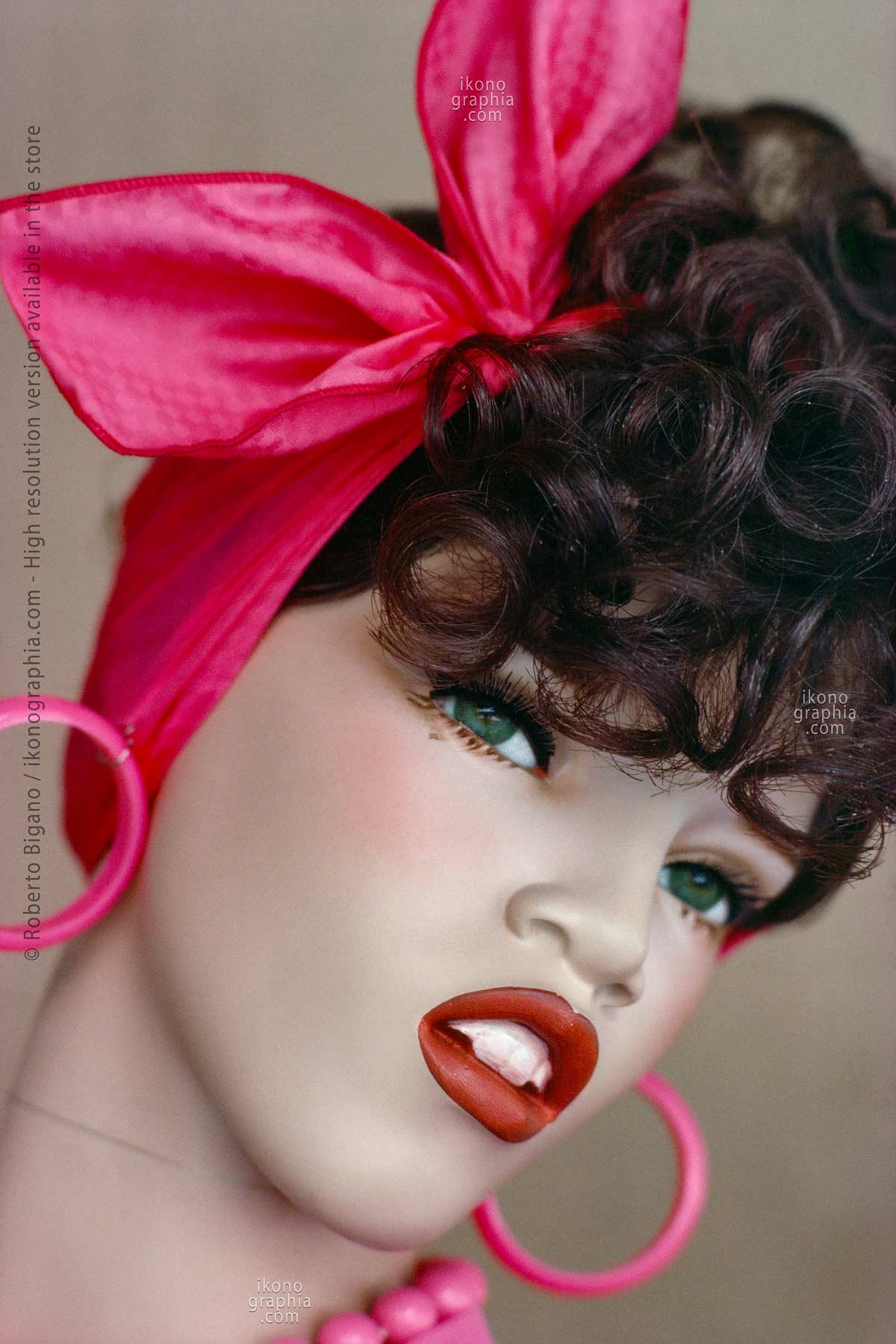
Impudent mannequin in Gitana look.

Provocative pose, and pure pin-up energy. Pink bow, oversized hoop earrings — the full costume assembled with complete conviction.

Artificial femininity at its most playful and deliberate.

0462_38 Dummy in San Sebastian, Spain. 1980. Photo Roberto Bigano. Buy this image in the ikonographia.com store.

May 1980.
San Sebastian, Spain.

Naturalistic posture and coordinated styling suggest ease and approachability rather than confrontation. At this stage, display favors balance and coherence, with realism serving persuasion without yet turning aggressive.

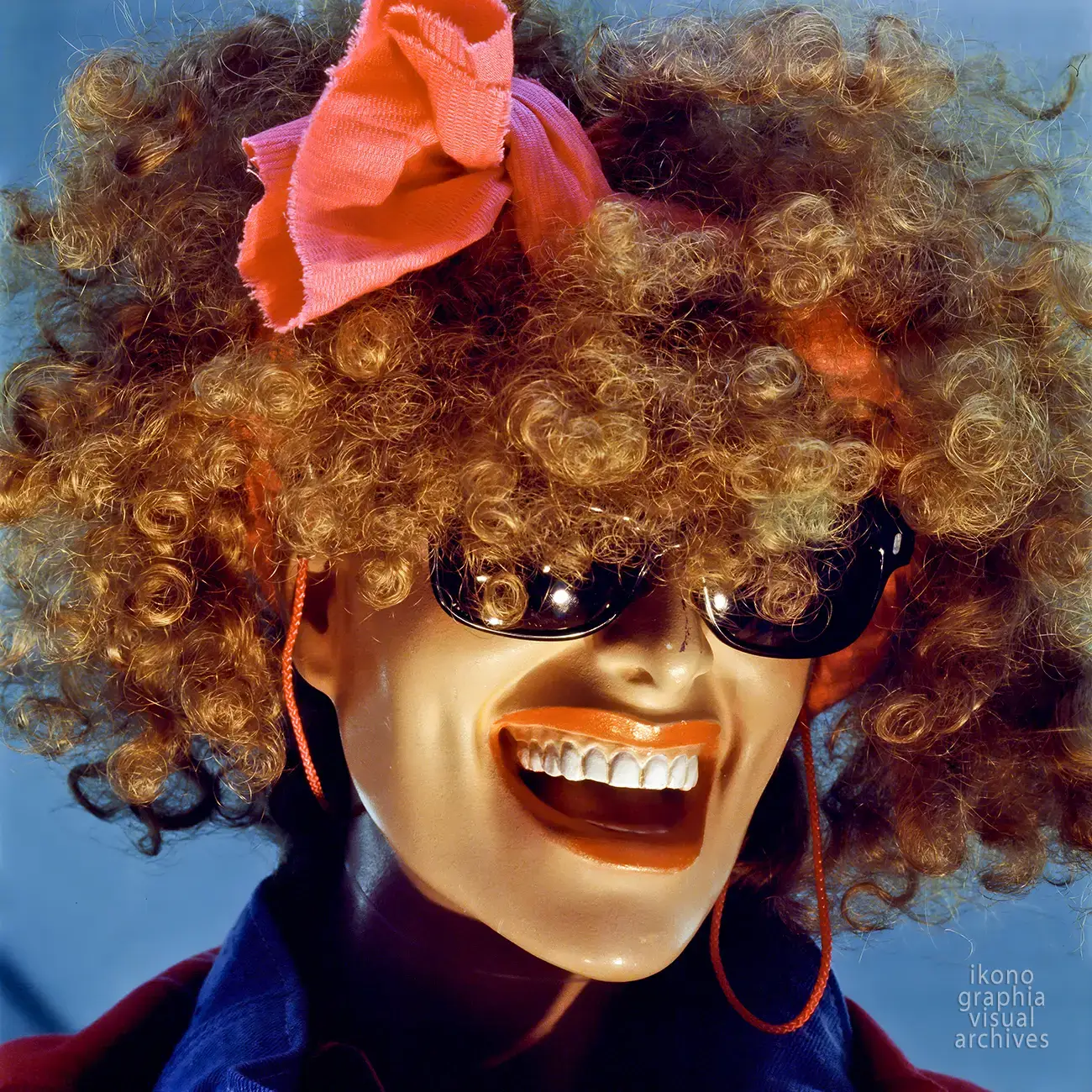
Fixed smile, exposed teeth, and dark lenses produce a hypnotic and surreal effect, holding the viewer’s attention while withholding emotional response.

August 1986.
Copenhagen, Denmark.

Fixed smile, exposed teeth, and dark lenses produce a hypnotic and surreal effect, holding the viewer’s attention while withholding emotional response.

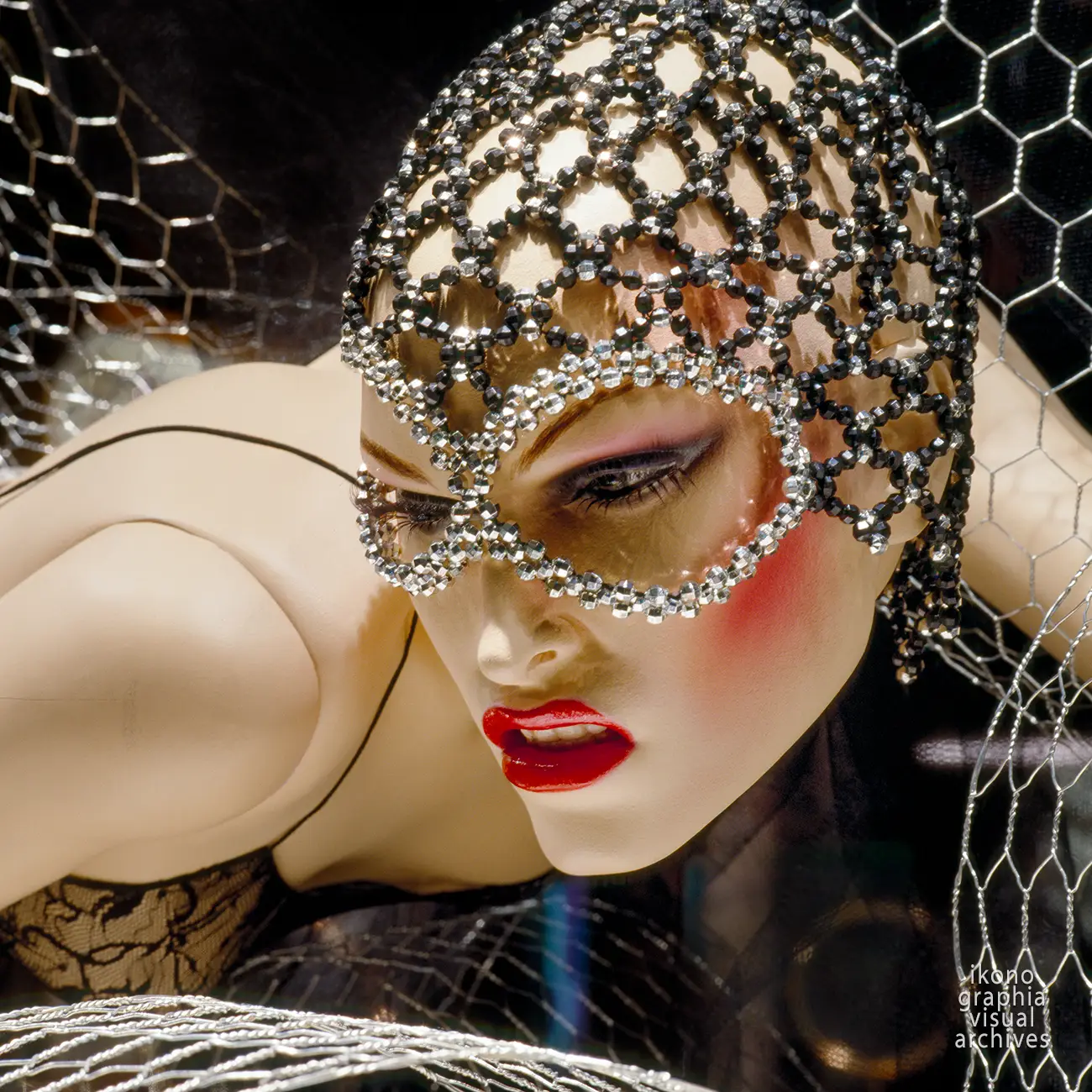
Shop-window mannequin with dramatic makeup and confrontational pose in Copenhagen boutique window, Denmark, 1986.

August 1986.
Copenhagen, Denmark — Graziano Boutique.

Cosmetics, costume, and posture collapse into a single surface of exposure.
Here, realism is pushed toward theatrical excess, reflecting a broader mid-1980s Scandinavian shift toward confrontational display, where mannequins abandon neutrality and assert presence through visual aggression.

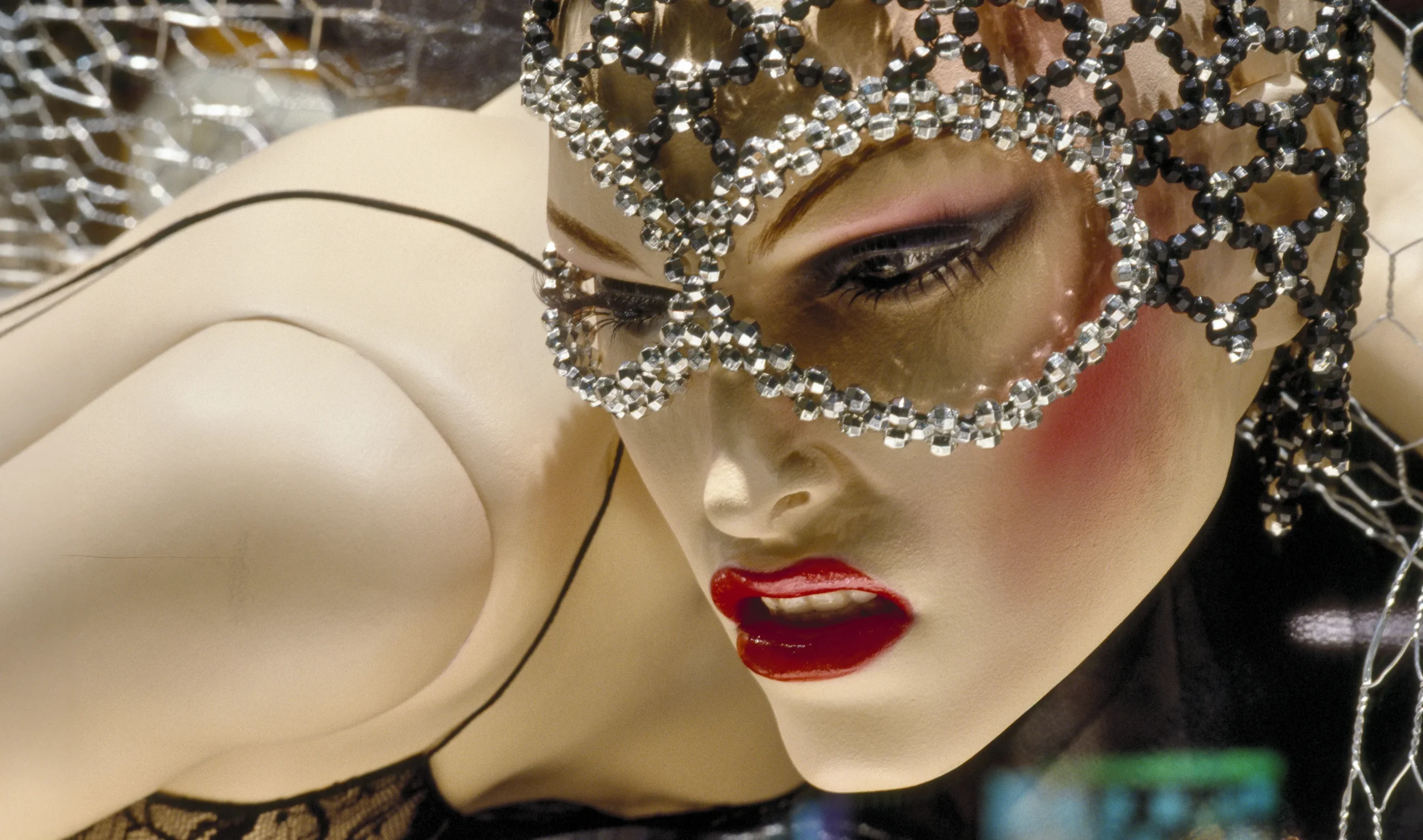
Shop-window aggressive mannequin at Annabell Boutique, Copenhagen, 1986

August 1986.
Copenhagen, Denmark — Annabell Boutique

Aggression becomes fully articulated.
Makeup, gesture, and facial tension no longer simulate life but enforce confrontation, confirming a local display language where artificial bodies are designed to provoke, not attract, and excess replaces illusion as the dominant strategy.

Spain (1997) — Glamorous Brides

Ritual, spectacle, and artificial femininity in Andalusian display culture

Within this broader escalation, bridal mannequins occupy a specific role. Ritual costume does not temper display, but intensifies it. Lace, veils, makeup, and carefully staged expressions turn the bridal figure into a concentrated surface of glamour, where idealization slips into exposure and display becomes explicit.

2588_01 Sexy mannequin in wedding dress, in Seville Spain. Photo Roberto Bigano. Buy this image in the ikonographia.com store.

March 1997.
Sevilla, Spain — Fetishized doll in a wedding shop.

In Andalusian culture, the bride carries the full weight of ceremony, tradition, and social identity.

This mannequin discards all of it. Exaggerated makeup, sculpted lips, and theatrical pose transform the ceremonial figure into a fetishized doll — artificial femininity shifted from cultural symbol to erotic object.

2587_37 Mannequin in wedding dress in Seville, Spain 1997. Photo Roberto Bigano. Buy this image in the ikonographia.com store.

March 1997.
Sevilla, Spain — Wedding dress shop.

Heavy makeup and sculpted features intensify the bridal figure beyond ceremony. Here, glamour operates as pressure, transforming the ritual costume into a vehicle for visual exposure rather than restraint.

2588_18 Charming mannequin in a wedding dress in Seville, Spain. Photo Roberto Bigano. Buy this image in the ikonographia.com store.

March 1997.
Sevilla, Spain — Wedding dress shop.

The mannequin’s face is modeled with extreme smoothness and precision: porcelain skin, sharply defined lips, and a distant upward gaze.

The bridal figure is isolated as a sculpted surface of desire, where makeup, hair, and veil function as visual intensifiers rather than cultural markers.

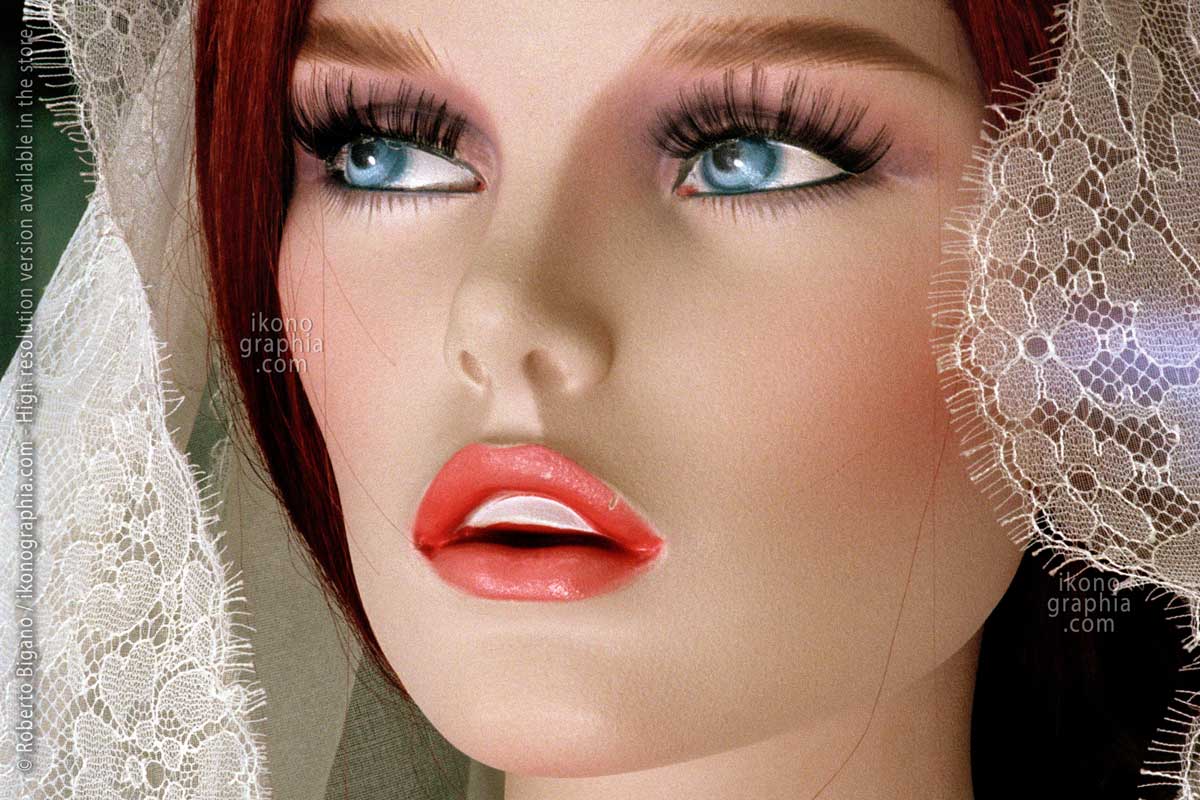
2587_27 Alluring Andalusian mannequin in Seville, Spain 1997. Photo Roberto Bigano. Buy this image in the ikonographia.com store.

March 1997.
Sevilla, Spain — Wedding dress shop.

The gaze holds. Red hair, blue eyes, lips barely parted — everything assembled for maximum presence. The veil and lace are bridal convention; the face beneath them is something else entirely.

This is the sequence's most direct confrontation — artificial femininity that neither withdraws nor performs, but simply arrests.

Copyright, Links And Credits

Photography, Copyright & Credits

All photographs © Ikonographia / Roberto Bigano — All Rights Reserved.
These images are part of the Ikonographia Visual Archives: — Plastic Girls: 50 Years of Artificial Beauty —  Plastic Girls / Mannequins Archive (1978–2026).

Terms of Use (Summary)

The images presented in this archive are copyrighted and available for licensed use only through Ikonographia Visual Archives.

You may not download, reproduce, publish, or distribute these images without a valid license. For commercial or editorial licensing, please refer to the product pages or contact Ikonographia directly. A full explanation of licensing terms is available in the Shop / Licensing Information section under "Ikonographia — Standard License" and "Ikonographia — Merchandising & Product Use Licenses"

Ikonographia Mission Statement

Ikonographia is committed to the accurate documentation, preservation, and ethical dissemination of twentieth-century visual culture.

Archival Notes — Plastic Girls: 50 Years of Artificial Beauty

This archive began in 1978 as a street photography project and is still ongoing.
All images were taken from public streets through shop-window glass without special access, permissions, or staging.

The archive's coherence was recognized retrospectively—only years later, during high-resolution digitization, did isolated images reveal themselves as a continuous visual record spanning nearly fifty years. The project documents mannequins as cultural artifacts: their evolving materials, poses, facial treatments, and display contexts across changing urban and commercial landscapes.

All images follow Ikonographia's internal archival standards for resolution, color accuracy, and metadata structure to ensure long-term consistency across the collection.

Further Reading — Selected Sources

  • Plastic Girls (1978-2011), by Roberto Bigano — A photographic monograph collecting earlier phases of this archive, published as a limited edition on Blurb.
Bugatti EB110, First Model, Prototype, EB110 Supersport, EB112

Bugatti EB110, First Model, Prototype, EB110 Supersport, EB112

Bugatti EB110, First Model, Prototype, EB110 Supersport, EB112

Design evolution from the first working EB110 to Bugatti’s final Italian concept.

Before becoming a series of models, the EB110 was a clear idea. What follows is the evolution of that idea—from the first working prototype to the final EB112—guided by Romano Artioli’s original vision and reshaped, in its final form, by Gianpaolo Benedini.
The complete development sequence of the EB110 — from the Epowood model to the EB112.

The very first EB110 model made in epowood as designed by Benedini, with the rear wheels covered reminding the Bugatti Atlantic.  Photo Roberto Bigano. Buy this image in the ikonographia.com store.

Bugatti Granturismo, as imagined by Romano Artioli.

"This was the project.
The reborn Bugatti had to be the most brilliant Gran Turismo ever built: the most powerful, the fastest, most beautiful, and safest. It had to be a four-wheel drive for the best tractions in all weather conditions and road surfaces.
It had to be lightweight, using superior materials like titanium, magnesium, carbon-fiber, and aluminum for maximum acceleration, shorter braking distance, and best road grip with a lightweight and rigid chassis, for improved safety.

The aerodynamics had to allow optimal penetration and keep the car firmly pressed to the asphalt. Being a Gran Turismo, comfort has to be taken into account. Minimizing noise, designing a well-conditioned and draught-free interior, and a soft and responsive stick shift despite the gears' weight."

Excerpt from Romano Artioli's book "Bugatti & Lotus Thriller."

The very first EB110 model made in epowood as designed by Benedini, with the rear wheels covered reminding the Bugatti Atlantic. Photo Roberto Bigano. Buy this image in the ikonographia.com store.

... and re-designed by Gianpaolo Benedini

Romano Artioli chose Paolo Stanzani as Technical Director, because of his work with Lamborghini and Marcello Gandini as Designer. However, Artioli was not impressed by his angular design. Consequently, the conflict led to the respective departure of Gandini and Stanzani.

The role of Technical Director was filled by Nicola Materazzi, a former Chief Engineer at Ferrari.
Gianpaolo Benedini, who designed the "Blue Factory," was commissioned to redo the design.
Above, the maquette Benedini designed. The design is reminiscent of the classic Bugatti, including the rear-wheel covering.

Leggi in italiano

La Bugatti Granturismo come concepita da Romano Artioli.


Per me la Bugatti della rinascita doveva essere la più brillante Gran Turismo mai costruita: la più potente, la più veloce, la più bella, ma anche la più sicura. Doveva quindi avere quattro ruote motrici, perché mettere su strada un’auto potente e velocissima che non abbia il massimo dell’aderenza in ogni condizione meteorologica e di superficie stradale è un azzardo.

Doveva essere leggera, impiegando materiali speciali come titanio, magnesio, fibra di carbonio, alluminio per favorire la massima accelerazione, il minore spazio di frenata e la massima tenuta di strada. Le sospensioni dovevano garantire la migliore aderenza delle ruote alle strade di qualsiasi tipo.
Inoltre serviva un un telaio rigido, robusto, ma molto leggero, che consentisse una perfetta tenuta di strada.
L’aerodinamica doveva permettere una penetrazione dell’aria ottimale, ma assicurare che l’auto restasse saldamente pressata all’asfalto.

Trattandosi di una GT, anche il comfort era da tenere in considerazione: silenziosità, abitacolo ben condizionato e senza spifferi, condizioni di guida ottimali, una leva del cambio morbidissima e immediata, nonostante il peso degli ingranaggi che dovevano sopportare quelle fortissime pressioni sulla trasmissione e freni che riducessero al minimo le distanze in caso di emergenza.

Questo era il progetto che sottoposi a Oliviero Pedrazzi, e lui partì a razzo…

Estratto da libro di di Romano Artioli "Bugatti & Lotus Thriller."

... e disegnata da Gianpaolo Benedini


All’inizio Romano Artioli scelse Paolo Stanzani come direttore tecnico, per la sua esperienza con Lamborghini e Marcello Gandini per il design. Purtroppo lo stile troppo “rigido” del suo design non si sposava con lo stile classico Bugatti, cui si voleva fare riferimento.
In breve il conflitto s’opinioni divenne insanabile e Stanzani e Gandini se ne andarono.

Il ruolo di direttore tecnico fu assegnato a Nicola Materazzi, già capo ingegnere alla Ferrari (suo il progetto della F40). Gianpaolo Benedini, che già aveva disegnato “La Fabbrica Blu” fu invece incaricato di ridisegnare l’EB 110. Sopra il risultato del suo lavoro nel primo modello in resina Epowood.

Bugatti EB110 — From Prototype to EB112

Design evolution from the first working EB110 to Bugatti’s final Italian concept.

Before becoming a series of models, the EB110 was a clear idea.
What follows is the evolution of that idea—from the first working prototype to the final EB112—guided by Romano Artioli’s original vision and reshaped, in its final form, by Gianpaolo Benedini.

Romano Artioli — The Gran Turismo as Vision

The reborn Bugatti had to be the most brilliant Gran Turismo ever built: the most powerful, the fastest, most beautiful, and safest. It had to be a four-wheel drive for the best tractions in all weather conditions and road surfaces.
It had to be lightweight, using superior materials like titanium, magnesium, carbon-fiber, and aluminum for maximum acceleration, shorter braking distance, and best road grip with a lightweight and rigid chassis, for improved safety.

A Necessary Redesign

The original technical and stylistic direction did not survive unchanged.
After early conflicts, Paolo Stanzani and Marcello Gandini left the project. Nicola Materazzi—formerly Ferrari’s chief engineer—assumed technical leadership, while Gianpaolo Benedini, already responsible for the design of the Fabbrica Blu, was asked to redesign the car itself.

What emerged was a form that reconnected the EB110 to Bugatti’s classical lineage—most visibly in the covered rear wheels—while preparing the ground for its final and most radical expression: the EB112.

The very first EB110 model made in epowood as designed by Benedini, with the rear wheels covered reminding the Bugatti Atlantic.  Photo Roberto Bigano. Buy this image in the ikonographia.com store.

EB110 Epowood Model

Restyled by Gianpaolo Benedini, with the covered rear wheels, a deliberate reference to the Bugatti Atlantic and Aérolithe.

Bugatti EB110 GT Prototipo. The design was very similar to the model shown above, except for the rear wheels. Photo Roberto Bigano. Buy this image in the ikonographia.com store.

EB110 Prototipo

The first fully working EB110, still carrying experimental solutions later revised for technical and thermal reasons.

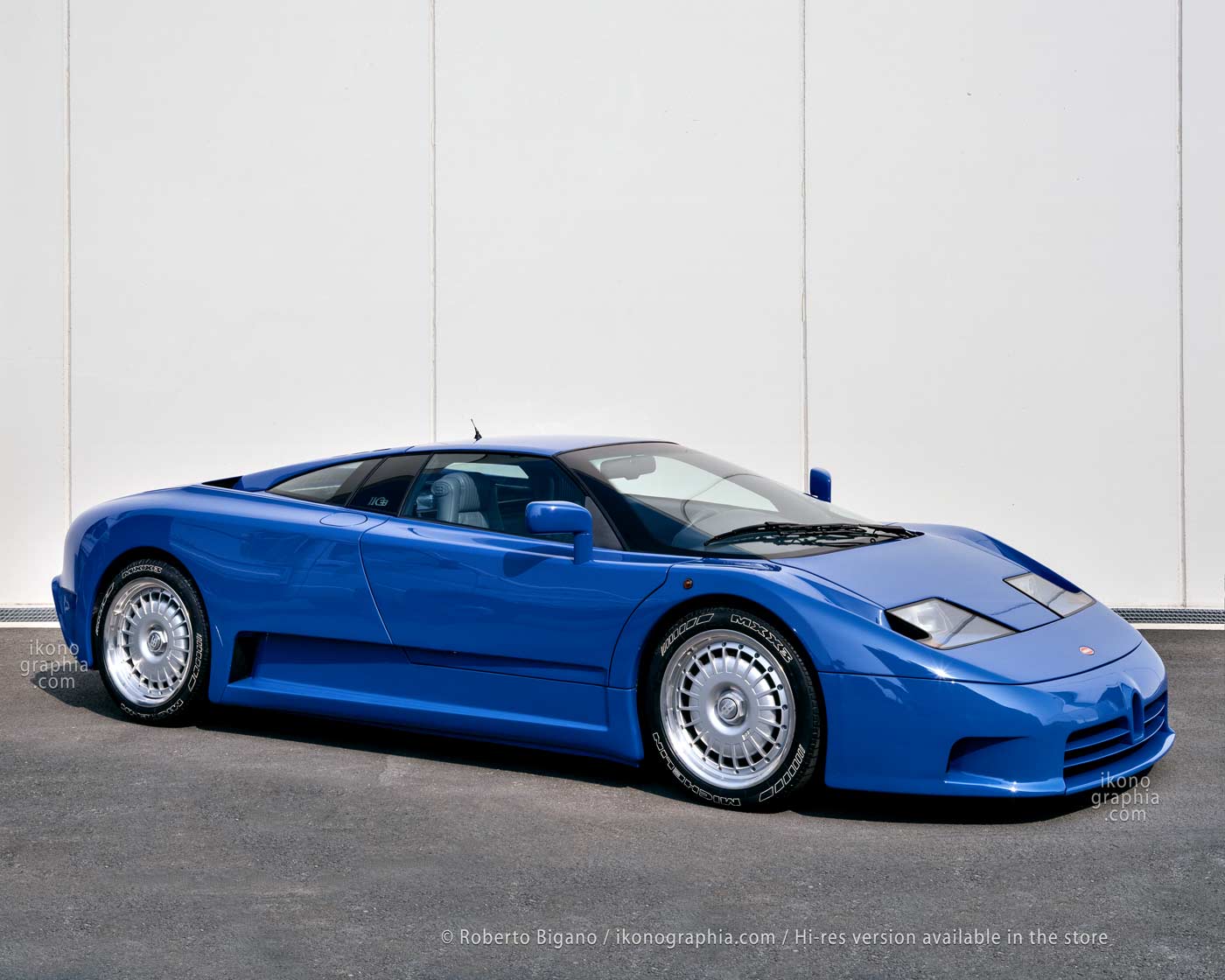
The final version of the EB 110 Gran Turismo, the fastest production GT in the world, capable of reaching three hundred and forty-two kilometers per hour. Photo Roberto Bigano. Buy this image in the ikonographia.com store.

EB110 Production

The definitive Gran Turismo form, refined for series production while preserving the original technical ambition.

Bugatti EB110 Supersport. This performance-oriented version reached the max speed of 351 km/h. Photo Roberto Bigano. Buy this image in the ikonographia.com store.

EB110 Supersport

A performance-oriented evolution, lighter and more extreme, pushing the EB110 concept to its mechanical limits.

The Bugatti EB 112, designed by Giorgietto Giugiaro, was a retro-style four-door fastback saloon reminiscent of legendary Bugatti models. Only two samples were built. Photo Roberto Bigano. Buy this image in the ikonographia.com store.

EB112

An Italian Bugatti concept designed by Giorgetto Giugiaro: a four-door Grand Tourer that expanded the EB110 vision beyond the supercar.

Romano Artioli about the Bugatti EB110 Supersport

"The speed performance enthusiasts are willing to give up a few accessories and increase running noise to maximize driving pleasure. Boosting power to 612hp, we removed the radio, air conditioning, and electric window. The front design was the same ff the EB110, while the tailgate was equipped with a fixed-wing, and the air intakes were designed for rough use. The newly brake ventilation, which was necessary for the event of prolonged use on the track.
The interior, in high-quality leather, had been revised to improve functional performance. A lighter polycarbonate replaced the doors crystals and rear window. All these changes reduced the weight of two hundred kilos and gave the car an aggressive image."

Leggi in italiano

La versione Supersport ottimizzata per prestazioni superiori erogava una potenza massima di 450 kW/61 cavalli. Grazie anche all sua leggerezza raggiungeva una velocità massima di 251 kmh.
Romano Artioli nel suo libro "Bugatti & Lotus Thriller." ci racconta di più:

Tra gli appassionati d’auto esiste una categoria di cultori delle prestazioni velocistiche che, pur di ottenere sensazioni più forti, è disposta a rinunciare a qualche accessorio e a ridurre la silenziosità di marcia. Per questi è nata la Supersport, che è una EB 110 GT praticamente pronta per la pista.

Incrementata la potenza a 610 CV, eliminammo dalla dotazione di serie radio, condizionatore e vetri elettrici.
Le prese d’aria erano pensate per un uso esasperato della vettura. I cerchi di nuovo disegno consentivano una maggiore ventilazione dei freni, necessaria in caso di uso prolungato in pista. L’interno, sempre in pelle di altissima qualità, era stato rivisto in chiave funzionale alle prestazioni e aveva subito drastici alleggerimenti. I cristalli porta e il lunotto posteriore erano stati sostituiti dal più leggero policarbonato.

Tutti questi interventi, visibili e non, consentirono di diminuire il peso di duecento chili e donarono alla vettura un’immagine aggressiva…

The classic Bugattis had the radiator grill in the front, which was also the symbol of the house. Benedini found this brilliant solution. Photo Roberto Bigano. Buy this image in the ikonographia.com store.

The Bone of Contention.

The classic Bugattis had the radiator grill in the front, which was also the symbol of the house. Romano Artioli believed it essential to include a nod to that grill in the EB 110. Gandini was absolutely against it, arguing that he would harm aesthetics and aerodynamics, but Benedini found a brilliant solution.

L'oggetto della discordia.

Le Bugatti classiche avevano sul frontale il radiatore che era il simbolo della casa. Romano Artioli riteneva indispensabile che, anche nell'EB 110 ci fosse un richiamo a quell'elemento. Gandini era assolutamente contrario, sostenendo che avrebbe inciso negativamente su estetica ed aereodinamica. L'architetto Benedini risolse brillantemente il problema.

 EB110GT — EB110 Supersport — EB112 Images Gallery

Photographs taken by Roberto Bigano from 1990 to 1992.

An impressive view of the Bugatti EB 110 as restyled by Gianpaolo Benedini. Photo Roberto Bigano. Buy this image in the ikonographia.com store.

EB110. 

An impressive view of the Prototype of the Bugatti EB 110 as restyled by Gianpaolo Benedini.

The engine of the Bugatti EB 110. Photo Roberto Bigano. Buy this image in the ikonographia.com store.

EB110. 

The Engine.

The interior of the Bugatti EB110. In the center of the steering wheel, the EB logo. Photo Roberto Bigano. Buy this image in the ikonographia.com store.

EB110. 

The interior of the Bugatti EB110. In the center of the steering wheel, is the EB logo.

The control panel with the steering wheel with the EB logo and the Nakamichi hi-fi system. Photo Roberto Bigano. Buy this image in the ikonographia.com store.

EB110. 

The control panel with the briar finishes, the steering wheel with the EB logo, and the Nakamichi hi-fi system.

The Bugatti Eb 110 rear wheel. Photo Roberto Bigano. Buy this image in the ikonographia.com store.

The Bugatti Monobloc Cast Aluminum Rear Wheel.

The Cast aluminum wheel was invented by Bugatti and patented in 1924.

Bugatti EB 110 Gran Turismo. The final version as Restyled by Gianpaolo Benedini. Photo Roberto Bigano. Buy this image in the ikonographia.com store.

Bugatti EB110 GT

Bugatti EB 110 Gran Turismo. The final version as restyled by Gianpaolo Benedini.

Bugatti EB 110 Gran Turismo. The final version as Restyled by Gianpaolo Benedini. Photo Roberto Bigano. Buy this image in the ikonographia.com store.

Bugatti EB110 GT

Bugatti EB 110 Gran Turismo. The final version as restyled by Gianpaolo Benedini.

Coccoi Pintau

Bugatti EB110 GT

Bugatti EB 110 Gran Turismo. The final version as restyled by Gianpaolo Benedini.

Bugatti EB110 Supersport pictured in the futuristic show-room at Campogalliano. Photo Roberto Bigano. Buy this image in the ikonographia.com store.

Bugatti EB110 Supersport.

The Supersport on the rotating platform in the futuristic showroom at Campogalliano.

The front view of the Bugatti EB 112, designed by Giorgetto Giugiaro. Photo Roberto Bigano. Buy this image in the ikonographia.com store.

EB112.

Front view of the Bugatti EB112, designed by Giorgetto Giugiaro, with luxury leather finishes by Poltroon Frau.

Bugatti EB 112. A detail of the striking design by Giorgietto Giugiaro with the catching radiator grill. Photo Roberto Bigano. Buy this image in the ikonographia.com store.

EB112 Horseshoe Grill

A detail of the nose of the EB 112, with the radiator grill taking inspiration from the classic Bugattis.

Copyright Links and Credits

Photography, Copyright & Credits

All photographs © Ikonographia / Roberto Bigano — All Rights Reserved. These images are part of the Ikonographia Visual Archives: Bugatti Automobili & EB110 Archive (1990–1995).

Roberto Bigano served as official photographer for Bugatti Automobili throughout the company's operational years in Campogalliano. This archive was produced from inside the project, with unrestricted access and no editorial constraints. The material is exclusive to Ikonographia and available nowhere else.

Credits & Acknowledgments

Ikonographia gratefully acknowledges the fundamental contribution of Romano Artioli, founder of Bugatti Automobili, and Gianpaolo Benedini, architect and designer of both the Fabbrica Blu and the EB110, without whose vision, trust, and collaboration this archive would not exist.

Excerpts from Romano Artioli's book "Bugatti & Lotus Thriller" are reproduced with the author's authorization.

Terms of Use (Summary)

The images presented in this archive are copyrighted and available for licensed use only through Ikonographia Visual Archives.

You may not download, reproduce, publish, or distribute these images without a valid license. For commercial or editorial licensing, please refer to the product pages or contact Ikonographia directly. A full explanation of licensing terms is available in the Shop / Licensing Information section under "Ikonographia — Standard License" and "Ikonographia — Merchandising & Product Use Licenses."

Ikonographia Mission Statement

Ikonographia is committed to the accurate documentation, preservation, and ethical dissemination of twentieth-century visual culture.

Archival Notes

These photographs were produced between 1990 and 1995 as part of Roberto Bigano's role as official photographer for Bugatti Automobili. The archive documents the factory, the production process, the design evolution, and the people behind one of the most ambitious automotive projects of the late twentieth century.

The story is told from inside: by the founder who initiated the enterprise, the architect-designer who shaped its form, and the photographer who followed the project throughout its development. All images follow Ikonographia's internal archival standards for resolution, color accuracy, and metadata structure to ensure long-term consistency across the collection.

Further Reading (Selected Sources)

EUR Euro