Flair Magazine — Fleur Cowles and the Twelve-Issue Revolution (1950)

Flair Magazine — Fleur Cowles and the Twelve-Issue Revolution (1950)

Flair Magazine — Fleur Cowles and the Twelve-Issue Revolution (1950)

Twelve issues. No budget limits. Killed by its own ambition.

In 1950, Fleur Cowles produced twelve issues of Flair — a magazine that combined art, fashion, literature, and travel into a single tactile object, with no precedent and no budget constraints. It lasted one year. Production costs made it unsustainable.

Ikonographia holds all twelve original issues and the Almanack. Full-spread reproductions from carefully unbound originals — restored to a standard the bound copies never allowed.

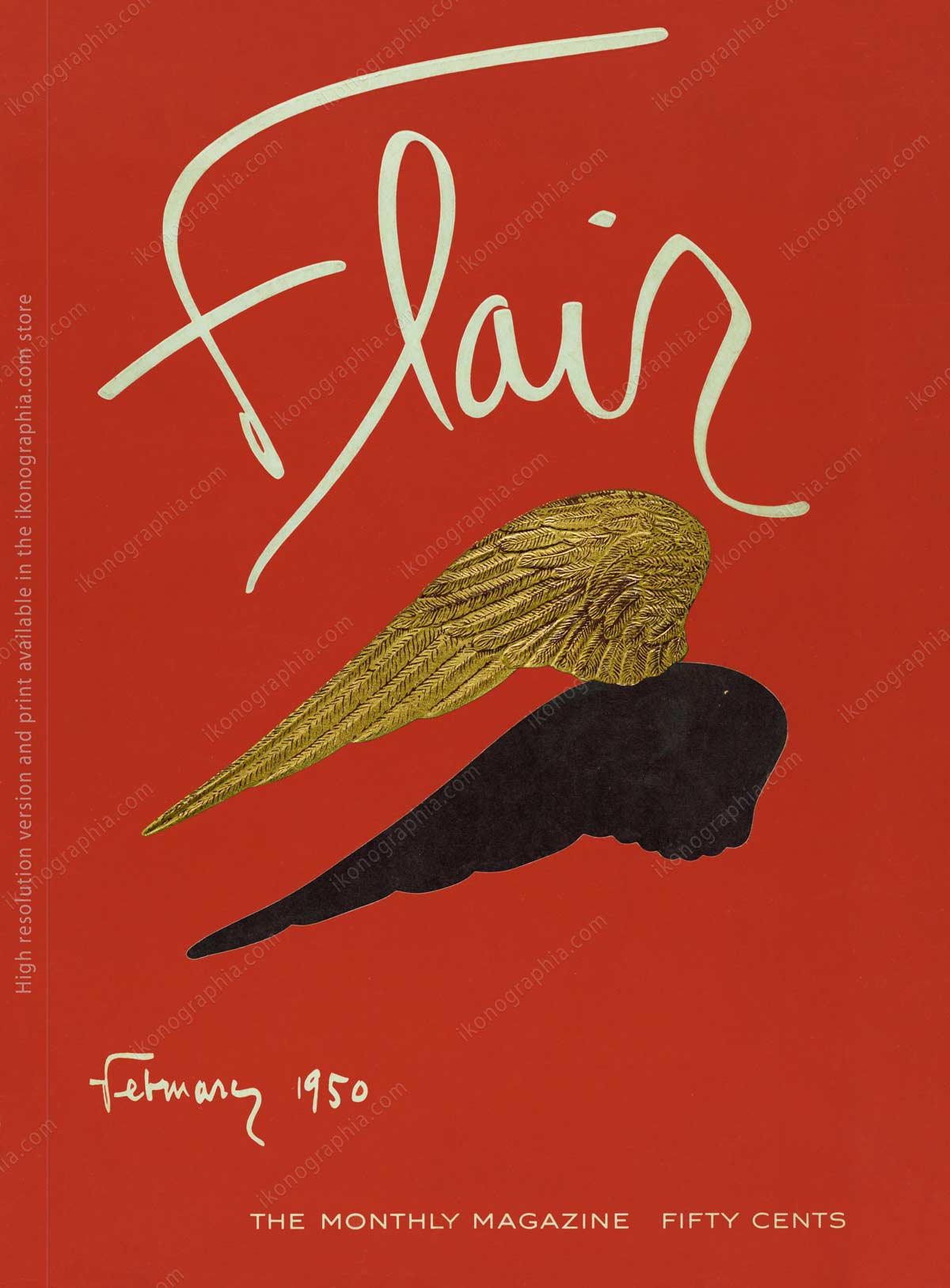
The Logo of the first number of Flair Magazine, February 1950.

1950. The Turning Point in Magazine Publishing.


In 1950, two new magazines were published. Both were highly innovative and destined to strongly influence all publishing in the following years.

The first was Portfolio, by Alexei Brodovitch, the Art Director of Harper’s Bazaar, which had revolutionized magazine design in previous years. The second one was Flair by Fleur Cowles.
Both were produced without budget limits, and both ceased publication after one year only because of the cost of production, which killed the magazines since the expensive special costs could not be supported in the long run.
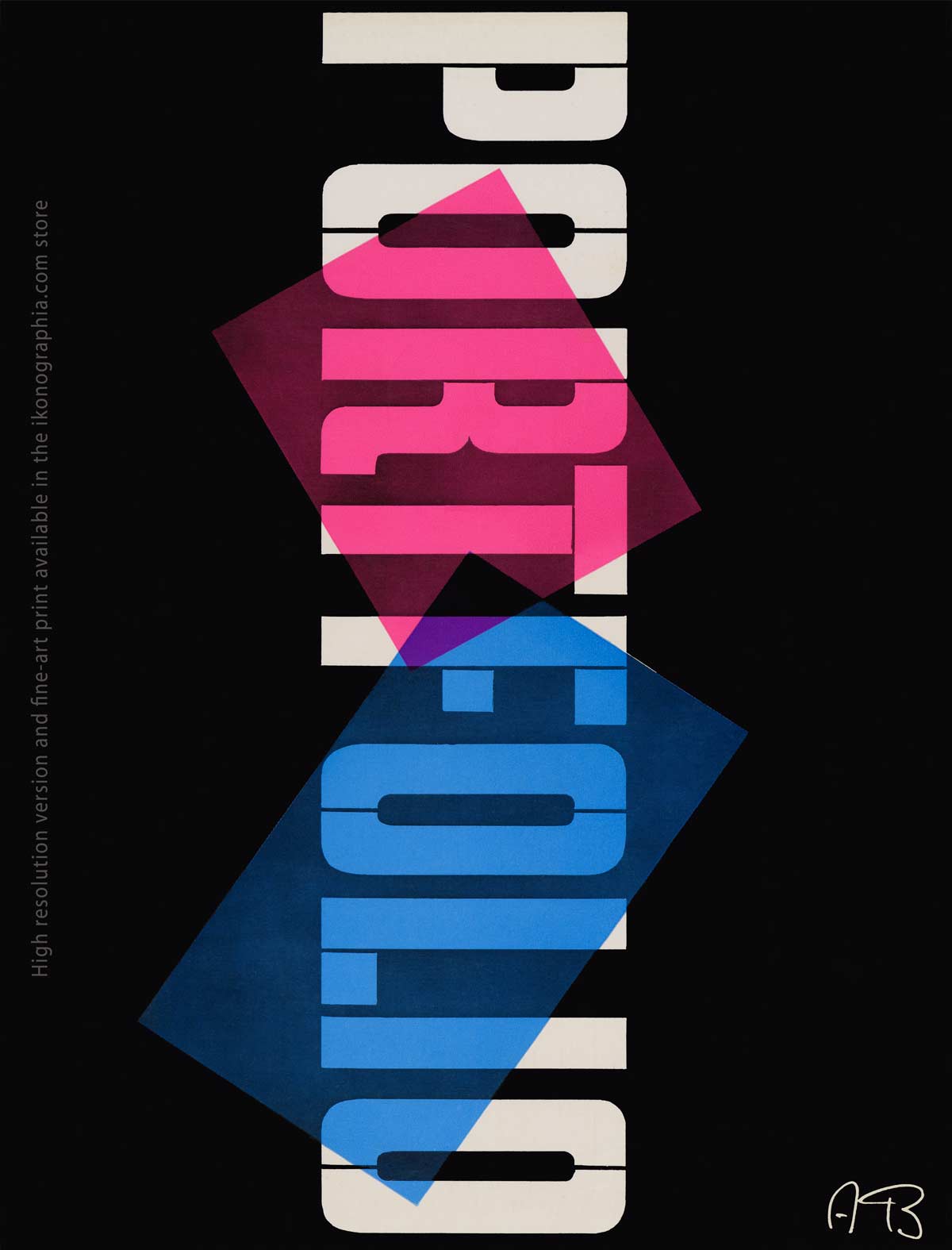
The cover of the first issue of Portfolio Magazine, winter 1950. Designed by Alexei Brodovitch with Art Director Frank Zachary. Portfolio has been widely acknowledged as perhaps the definitive graphic design magazine of the twentieth century.

The first issue of Flair Magazine, February 1950, and the first issue of Portfolio, Winter 1950.

Flair. "The Monthly Magazine for Moderns"


On September 1949, Fleur Cowles released s a pre-publication advertiser's issue announcing Flair as 'the monthly magazine for moderns.' Here is an excerpt from the Time Magazine review.

Fleur's Flair, which will be shown this week in a limited edition to 5,000 potential advertisers and subscribers, looks like a fancy bouillabaisse of Vogue, Town & Country, Holiday, etc. By covering "fashion, art, literature, travel, decor, theater and entertainment," Editor Cowles expects to lure enough readers to guarantee advertisers a circulation of 200,000 (at 50¢ a copy) at the start.

Flair's sample issue has an off-white hardcover with a second illustrated cover visible through a triangular peephole. Flair abounds with other tricks. There is an accordion-style pull-out on interior decoration, a pocket-sized book insert, a swatch of cotton fabric, and even a page written in invisible ink that can be read when heated by a lighted match.
Source >

A Strong Navy. Art by Gruau - Flair Magazine, March 1950

A strong navy. Flair Magazine, March 1950. An elegant and "modern" design printed on two different papers to emphasize Renè Gruau's art showing creation by Christian Dior, Monte Sano, Sara Ripault, Patullo-Jo Copeland, Neiman-Marcus, and John-Frederics' hats.

FULL PAGES TEXT

A Strong Navy.. Art by Gruau - Flair Magazine, March 1950

NAVY blue with white is a spring natural .. . the magnificent whiteness that Melville, writing of his Moby-Dick, calls the —colorless, all color . . . stiffens and dramatizes the classic blue of schoolgirls and seafarers.
This spring the whiteness is no small measure confined to a slender ruffle, a small piping, but is laid against the blue in dense bold strokes that catch the eye like flashes of light.

Top: White checks are giant on Monte Sano's hip-length wool coat—shoulders sloping, back flaring, sleeves folding back below the elbows in wide cuffs.
Center: Dior mounts great white piqué cuffs buttoned in bone (top button left free) on the minute sleeves of a thin wool dress. Below: White piqué triangles accent the triangular décolletage of Sara Ripault's yarn-dyed twill dress and finish the sleeves. (A pocket on one hip balances a drape on the other.)
Opposite: The vent at the back of Patullo-Jo Copeland's distinguished dress coat of silk barathea buttons twice, swings open to bestow glimpses of a snowy lining of silk surah. A loop of fur worn like a cowl; of ermine, or white mutation mink, designed by Neiman-Marcus. John-Frederics' white hat.

Flair, according to Fleur Cowles

In February 1950, Fleur Cowles wrote her manifesto by hand. It was printed in gold relief on expensive blue paper and bound into the first issue of Flair. She did not know she was writing her obituary..

There have been Great adventures in paper and in printing and in the presentation of the graphic arts in the last decade… Unhappily, few of them for the public at large.
I have longed to introduce a magazine daring enough to utilize the best of these adventures. A magazine which combines for the first time under one set of covers, the best in the arts: literature, fashion, humour, decoration, travel and entertainment.
This copy of Flair shows that it can be done; it is proof that a magazine need no longer be stolidly frozen to the familiar format. Flair can an will, vary from issue to issue, from year to year, assuring you that most delicious of rewards - a sense of surprise, a joy of discovery. For the young in heart, men and women, I believe our efforts will help give a vital contemporary direction and fullness to American life.

Fleur Cowles, Editor

"A magazine need no longer be stolidly frozen to the familiar format." Twelve issues later, production costs made it unsustainable. Flair ceased publication in January 1951.
The manifesto is still the best description of what the magazine was, and why it could not survive.

The Opening of the Social Season, from “High Society”, pages 02-03. By Anne Fish 1920 How the Members of the Beau Monde Will Spend What Is Left of Their War-time Incomes.

Flair N.1, February 1950. The presentation of Flair hand-written by the Editor, Fleur Cowles.

An innovative Magazine.


Fleur Cowles was a design catalyst, creating an innovative magazine not just for 1950.
The magazine pages had hinged doors, pamphlet inserts, and spreads with flipbooks with captions underneath the main image. The pages did not come in a single stock, with a mix of papers in the same issue, from heavy cardstock to slight, onionskin translucent prints to glossy, smooth, and slippery pages.

Flair was designed to be a sensory feast for the readers that could touch, smell and enjoy the always-different art.
Someone defined Flair's design as an "elegant cacophony"; others "a fancy bouillabaisse of Vogue, Town & Country, Holiday."
Call it as you prefer; Flair was and still is unique.

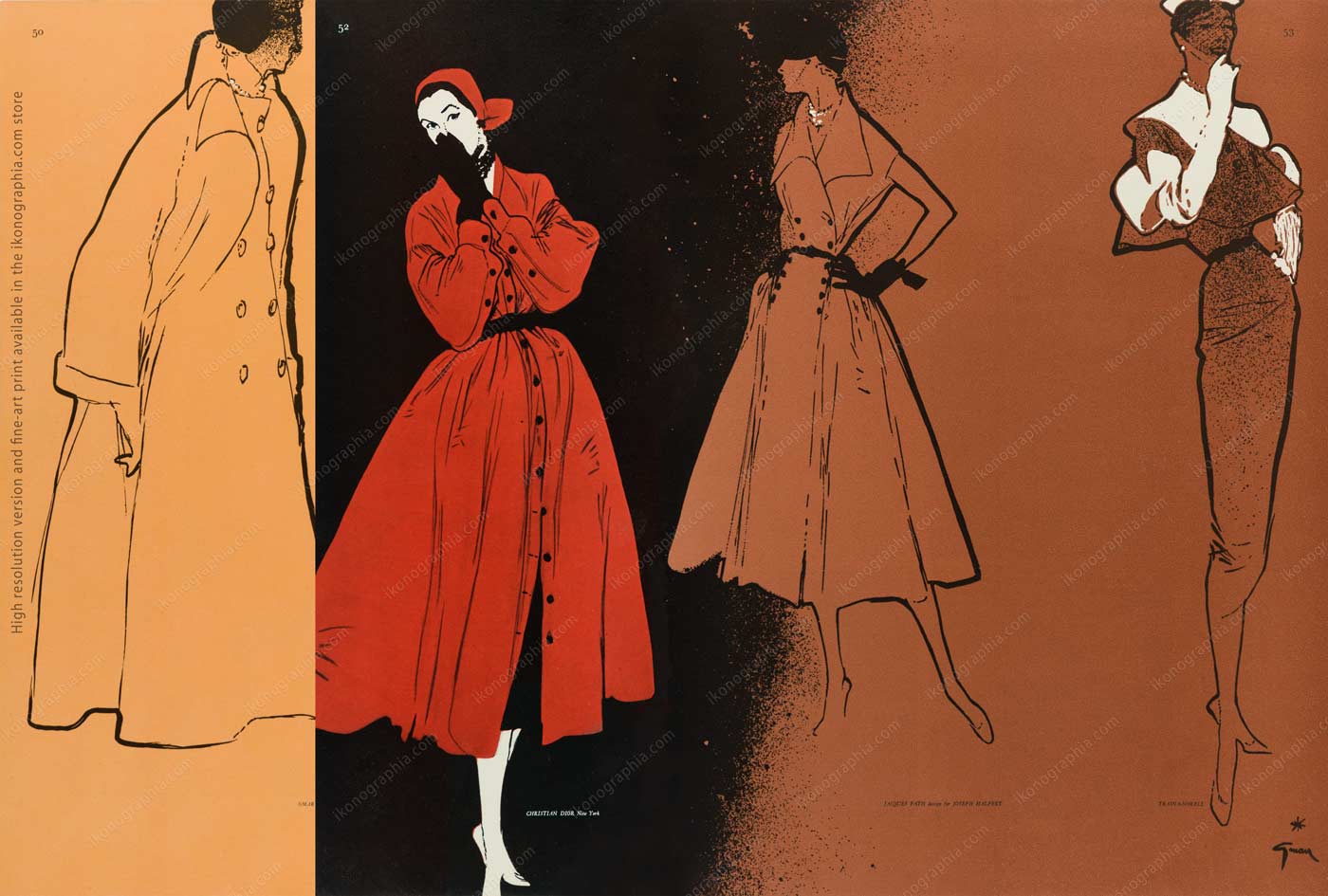
You are known by the color you keep. Flair Magazine, February 1950. Pages 50/53. Artwork by Renè Gruau.
Creations by Omar Kiam, Christian Dior of New York, Jaques Fath for Joseph Halpert, and Traina Norell.
Use arrows to flip pages.

FULL PAGES TEXT

YOU ARE KNOWN BY THE COLORS YOU KEEP.
Color may be the expression by which your world knows you best. You must unerringly know your range; perhaps the whole gamut is yours, perhaps only one color or two. The colors you wear should not be random choices: they are convictions to be carried through with unfaltering assurance.

Consider a great-coat (left), its collar jutting out like a separate jacket, in a peach beige with an affinity for navy blue. Against a wool skirt and velvet collar of black, a tawny beige cavalry twill jacket, a flash of red in the print blouse (right). Turn the flap and find spring's surprise, blazing red: a swaggering silk taffeta coat over a black strapless dress. In the beige range again, iridescent shantung takes on a true taupe cast, the sharpness of black accents. And the perennial freshness of small black and white checks is given further élan by the wand cut of a dress, a pullover jacket's starchy, winged white linen collars and cuffs.

Credits: left: OMAR KIAN of BEN REIG. center and right: TRAINA-NORELL.


Autumn is a city season. Flair Magazine, September 1950, pages 36-37. Use arrows to flip pages.
Below is the original magazine with pages 36 to 39 with flaps.

FULL PAGES TEXT

All Brim or All Crown. Photos by Maria Martel, Flair , March 1950 Pages 46, 49, including the flap page. Pages transcript: All Brim or All Crown. There are two hats this spring—the restless free shape flaring into space like a Calder mobile; or the close, crushed-to-the-head cap. The free shapes: Lilly Daché's milan wheat (page 46), its deep cantilever brim faced in black velvet. Braagaard's white organdy (above) with bands of stitching, bound in navy blue to accent its adventurous outlines. The close caps: 1. A coif, half purple and half white violets. 2. A cushion beret with a mound of pink roses shrouded in moss green veiling—the whole netted in heavy black mesh. 3. A small hillock of lilacs, green leaves and pink roses, springing from a white organdy cap. (These three, Lilly Daché.) 4. A cap and a crushed side bow of amber satin. 5. A lightly brimmed cap of lemon yellow felt, narrowly belted in rhinestones; a honey-colored face-veil. (These two, Mme. Andrée at Bonwit Teller.) 6. A minute helmet of pale blue straw with a bird on the brim and a misty black nose-veil. (Made to order at Bergdorf Goodman.)

Captions page 46: DIAMOND EARRINGS, CARTIER.
Caption, page 47: 2. RUBY AND DIAMONDS EARRINGS, VAN CLEEF & ARPELS.
Caption, page 48: PWARL AND DIAMON EARRINGS, SEAMAN SCHEPPS.
Caption, page 49: PEARL NECKLACES, DAVID WEBB.

Autumn is a city season. Flair Magazine, September 1950, pages 36/39. Drawing by René Gruau, Photos by Maria Martel.

Fashion is an Eye. Flair Magazine, February 1950. Photo by George Hoyningen-Huene.
Use arrows to flip the page

FULL PAGES TEXT

Fashion is an Eye.
You will find her, the brooding and uncertain woman opposite, wherever a dress may be bought.
The scene might be the Place Vendome, a New York store, a small-town dress shop. Maybe she hasn't even bothered to ask the price; or she might have scrimped for months to allow herself this one purchase. Whoever she may be, whatever her purse, she is a soul in misery — a fact the men in her life would never suspect. Probably she could not tell them why.
The unwelcome presence of other customers may have contributed. The most casual glance she interprets as a hard scrutiny, and her pleasant suit suddenly appears faded, worn.

The sales-girl may have held up one dress too insistently and aroused the cringing suspicion that some impossible thing is being palmed off on an easy victim. Or, worse mischance of all, this unhappy woman may have faced the mirror and found in its sly depths an unfamiliar reflection, so that every secret doubt she has ever had as to her looks and desirability now furiously possesses her.

At last she has decided; she is free to lift herself from her chair. How could she be so uncertain, so confused? Yet often she has reached the street before she regains her normal self-possession and sees, sees with her own eyes, again. What causes this temporary blindness? Not too little; perhaps too much. Ironically, as far as American women are concerned, this symptom of insecurity may be all the greater because fashion has never given them a wider choice nor made the work of the finest designers available to so many.

The public is familiar as never before with significant trends and important names in fashion — a result highly praiseworthy in all respects but one.
Fashion has ceased to be personal. In choosing a dress, the American woman is aware of many eyes upon her, and in turn she tries to judge what is before her by every high standard she knows . . . except her own. Fashion is an eye.

Every woman's eye. Your eye. And inevitably, fashion begins with the inner eye, with self-awareness, with understanding of all your powers, physical, mental, spiritual. It must calmly estimate all that you may claim as potentials for beauty. It demands the fullest expression of your own nature. It insists that you absorb the influences, the knowledges, the disciplines that will be permanently useful to you. It gives mature direction to the outer eye, guiding it to those possessions that are rightfully yours.

It forbids you from seeking refuge in those eccentricities of taste that reveal an insecurity far more destructive than the most slavish acceptance of the usual arbitrary norms.
It allows you to contemplate the fashions that FLAIR will report for you, to claim only those that are your own. Serene and sure, your eye will no longer waver from the image of beauty you have set for yourself. You will then be free to communicate your gaiety, your warmth, your self-confidence.

HOYNINGEN-HUENE. DIAMONDS BY HARRY WINSTON


All Brim or All Crown. Photos by Maria Martel, Flair, March 1950, pages 46-47. Use arrows to flip pages.

FULL PAGES TEXT

All Brim or All Crown. Photos by Maria Martel, Flair , March 1950 Pages 46, 49, including the flap page. Pages transcript: All Brim or All Crown. There are two hats this spring—the restless free shape flaring into space like a Calder mobile; or the close, crushed-to-the-head cap. The free shapes: Lilly Daché's milan wheat (page 46), its deep cantilever brim faced in black velvet. Braagaard's white organdy (above) with bands of stitching, bound in navy blue to accent its adventurous outlines. The close caps: 1. A coif, half purple and half white violets. 2. A cushion beret with a mound of pink roses shrouded in moss green veiling—the whole netted in heavy black mesh. 3. A small hillock of lilacs, green leaves and pink roses, springing from a white organdy cap. (These three, Lilly Daché.) 4. A cap and a crushed side bow of amber satin. 5. A lightly brimmed cap of lemon yellow felt, narrowly belted in rhinestones; a honey-colored face-veil. (These two, Mme. Andrée at Bonwit Teller.) 6. A minute helmet of pale blue straw with a bird on the brim and a misty black nose-veil. (Made to order at Bergdorf Goodman.)

Captions page 46: DIAMOND EARRINGS, CARTIER.
Caption, page 47: 2. RUBY AND DIAMONDS EARRINGS, VAN CLEEF & ARPELS.
Caption, page 48: PWARL AND DIAMON EARRINGS, SEAMAN SCHEPPS.
Caption, page 49: PEARL NECKLACES, DAVID WEBB.

Be like a rose. Flair, May 1950, Pages 40-41. Photo by Paul Himmel

Flair, May 1950. A double page from the Spring number. The issue, dedicated to the rose, was infused with an expensive rose fragrance, decades before scent strips became common in magazines.

FULL PAGES TEXT

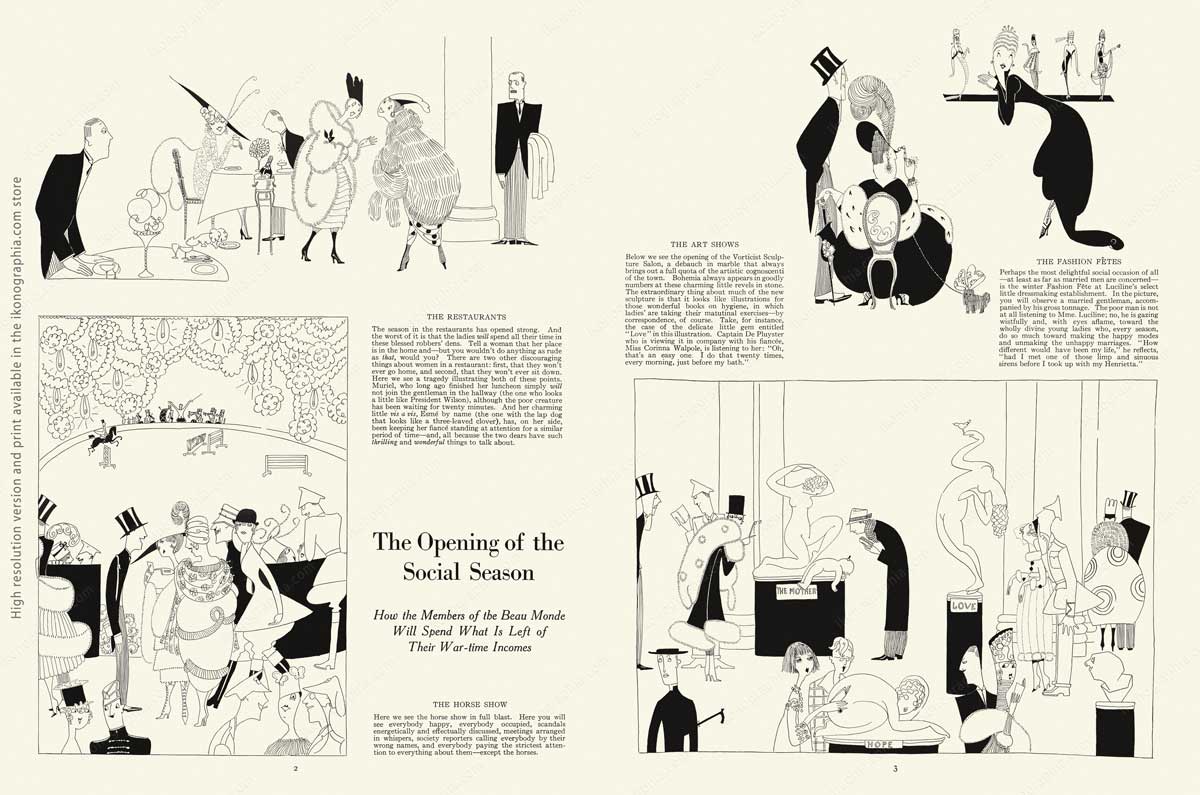
The Opening of the Social Season.

How the Members of the Beau Monde Will Spend What Is Left of Their War-Time Income.

THE RESTAURANTS.
The season in the restaurants has opened strong. And the worst of it is that the ladies will spend all their time in these blessed robbers' dens. Tell a woman that her place is in the home and — but you wouldn't do anything as rude as that, would you? There are two other discouraging things about women in a restaurant: first, that they won't ever go home, and second, that they won't ever sit down. Here we see a tragedy illustrating both of these points. Muriel, who long ago finished her luncheon simply will not join the gentleman in the hallway (the one who looks a little like President Wilson), although the poor creature has been waiting for twenty minutes. And her charming little vis a vis, Esme by name (the one with the lap dog that looks like a three-leaved clover), has, on her side, been keeping her fiance standing at attention for a similar period of time — and, all because the two dears have such thrilling and wonderful things to talk about.

THE HORSE SHOW.
Here we see the horse show in full blast. Here you will see everybody happy, everybody occupied, scandals energetically and effectually discussed, meetings arranged in whispers, society reporters calling everybody by their wrong names, and everybody paying the strictest attention to everything about them — except the horses.

THE ART SHOWS.
Below we see the opening of the Vorticist Sculpture Salon, a debauch in marble that always brings out a full quota of the artistic cognoscenti of the town. Bohemia always appears in goodly numbers at these charming little revels in stone. The extraordinary thing about much of the new sculpture is that it looks like illustrations for those wonderful books on hygiene, in which ladies' are taking their matutinal exercises—by correspondence, of course. Take, for instance, the case of the delicate little gem entitled "Love" in this illustration. Captain De Pluyster who is viewing it in company with his fiancée, Miss Corinna Walpole, is listening to her: "Oh, that's an easy one. I do that twenty times, every morning, just before my bath."

THE FASHION FÊTES:
Perhaps the most delightful social occasion of all — at least as far as married men are concerned — is the winter Fashion Fete at Luciline's select little dressmaking establishment. In the picture, you will observe a married gentleman, accompanied by his gross tonnage. The poor man is not at all listening to Mme. Luciline; no, he is gazing wistfully and, with eyes aflame, toward the wholly divine young ladies who, every season, do so much toward making the happy modes and unmaking the unhappy marriages. "How different would have been my life," he reflects, "had I met one of those limp and sinuous sirens before I took up with my Henrietta."

A visionary talent-hiring editor


Conceived and produced by visionary editor Fleur Cowles, Flair magazine existed for only one year and twelve issues, from February 1950 to January 1951. The magazine combined art, fashion, travel, and reportage to take the most out of its Editor's formidable ability to promote European and American talent.

Cowles hired the best illustrators and photographers. The most impacting was Gruau at the peak of his career.
In one year only, Flair published the work of Jean Cocteau, Lucien Freud, Saul Steinberg, Salvador Dalí, Simone De Beauvoir, Walker Evans, Bernard Baruch, George Bernard Shaw, Tennessee Williams, Gloria Swanson, Eleanor Roosevelt, Gypsy Rose Lee, and Colette.

Paris Collections Spring 1950. This is the shade of tangerine that is everywhere in Paris, will be everywhere in America. Art by René Gruau. Flair, March 1950.

Flair, March 1950. Paris Collections Spring 1950. This is the shade of tangerine that is everywhere in Paris, and will be everywhere in America. From left, creations by Dior, Dior, and Molyneux. Art by René Gruau., left page.

FULL PAGES TEXT

Paris Collections Spring 1950. This is the shade of tangerine that is everywhere in Paris, and will be everywhere in America.

Pages text transcript

FIRST . . . THIS IS THE SHADE OF TANGERINE THAT IS EVERYWHERE IN PARIS, WILL BE EVERYWHERE IN AMERICA IN NEWS: The straight and narrow silhouette sometimes relieved by a bloused back, a big bib-collar, a bow of fantastic size; or by over-all tucking, ruching, fluttering petals; a floor-length pouf or panel; a starched or pleated flare below the hips, below the knees, toward the hem.

. . .The occasional break from the straight into belling and even bouffant evening skirts.... The fluctuating hemline-in-transition—an average fifteen inches for day; every length for evening.

... IN COLOR White, white everywhere; then black and white, navy and white, and a ranging spectrum of blond and amber tones culminating in striking doses everywhere of tangerine.

. . . IN SPOT NEWS: The décolleté, cuffed, horseshoe neckline on suits and street dresses. . . . Dior's mannish dusters of silk tussor in natural or in pale colors over darker dresses; his fabulously tailored chiffon evening coats. . . . The flowing peignoir coat, often sleeveless. . . . The narrow sleeveless dress. . . . The overlong, crushed-down gloves worn with both.

... IN PROPHETIC TENDENCY: The straightening silhouette, the heightening hemline, the slowly but surely descending waistline. Opposite: Dior's black taffeta with an immense white bib-collar, starched and nun-like, tied with a whisker bow of black net. Right: Dior's black-and-white tweed smoking jacket, narrowed at the hem, its deep horseshoe neckline cuffed with tuxedo revers; over a black wool dress with a white Byronic collar, a big black taffeta bow tied outside. Far right: Molyneux's double-breasted gray wool with a bril-handy cut envelope fold at the front of its skirt, a taffeta sash tied in a bold bow. An optional straight, pleated wool overskirt changes its looks but not its lines.
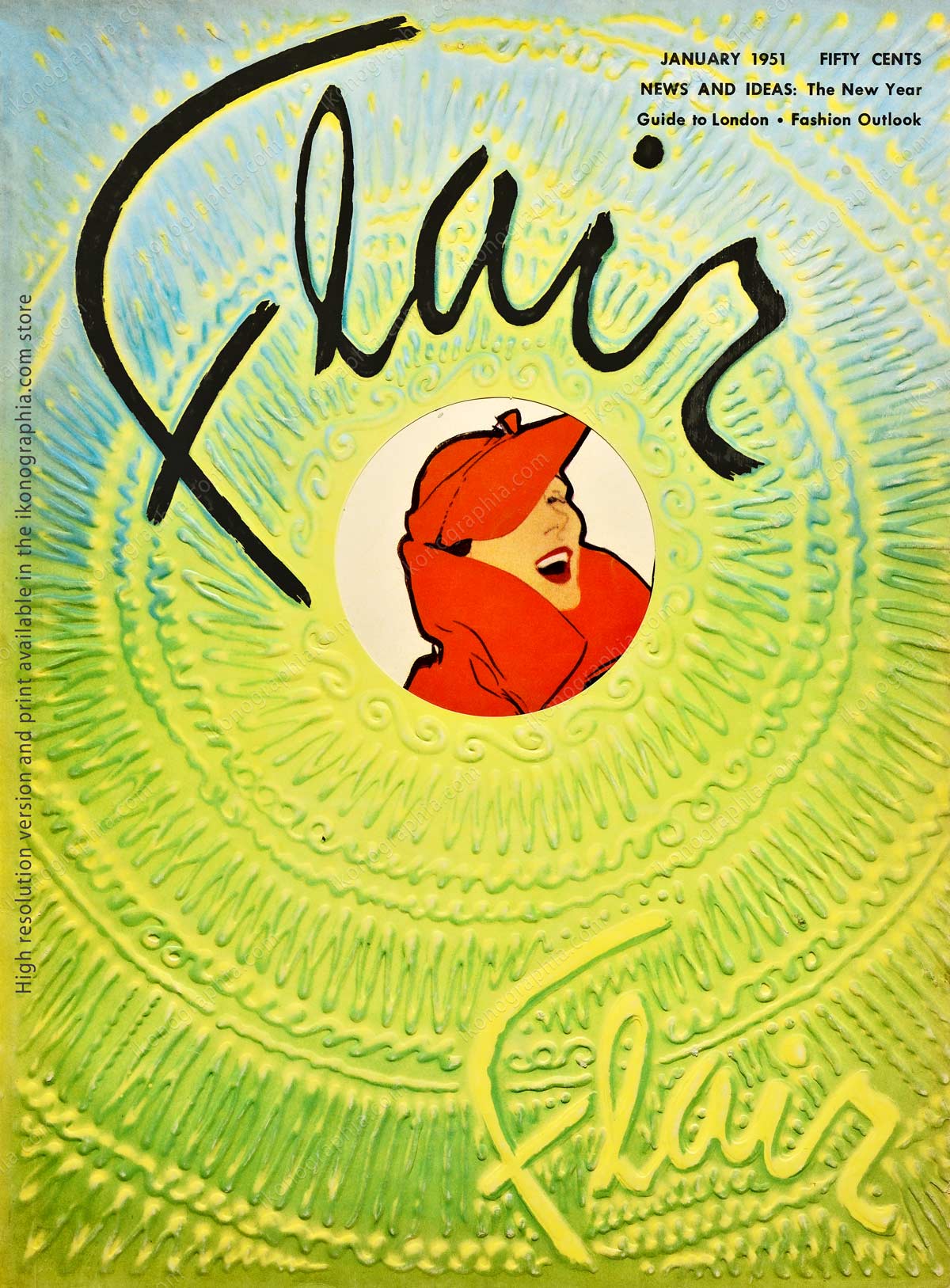
The Cover of the last number of Flair Magazine, January 1951. Painting of sun by Victor Vasarely. A cut-out door partially reveals the Undercover’ image: “Bear and Warmer”, by Rene Gruau.

The cover of the last number of Flair of January 1951 is "The Painting of Sun," by Victor Vasarely, a Master of Optical Art.
The image that comes out from the peephole, is "Bear and Warmer," by Gruau.

American 1920s High Society’s lifestyles, as seen by Anne Fish

American 1920s High Society’s lifestyles, as seen by Anne Fish

American 1920s High Society's lifestyles, as seen by Anne Fish

Illustrations by Anne Fish. Texts by Dorothy Parker and George S. Chappell. Vanity Fair, 1914–1920.

In December 1920, G.P. Putnam's Sons published High Society — a selection of double-page plates from Vanity Fair drawn by Anne Harriet Fish between 1914 and 1920. The texts were witten by Dorothy Parker and George S. Chappell.

Fish drew the social world with a line that was simultaneously elegant and merciless. Parker and Chappell matched it word for word. The combination defined the satirical register of the Jazz Age better than almost anything published in that decade.
All pages reproduced from the original book.

High Society. Hints on how to Attain, Relish – and Survive It.

The original cover by Anne Fish of the book "High Society. Hints on how to Attain, Relish - and Survive It. A Pictorial Guide to Life in our Upper Circles."

In December 1920, G.P. Putnam’s Sons published "High Society," a unique book celebrating the work of the star-illustrator Anne Fish. It’s a selection of drawings published on Vanity Fair US from 1914 to 1920.

The book provides a unique, rich lens into American and international high society’s lifestyles.
We’ll use the original presentation and book texts written by Dorothy Parker.

High Society. Hints on how to Attain, Relish - and Survive It.
A Pictorial Guide to Life in our Upper Circles.


High Society is a new collection of Fish’s remarkable drawings of life in our upper circles. In fact, it is a complete pictorial guide to the ways and habits of these strange beings who dwell in the thick, sweet atmosphere of adulation and the rich, regrant redolence of wealth.

Dowagers, divorcées and débutantes, bridge friends, trick butlers, tango addicts, amateur vampires—the fortunate reader meets them all in this book. And sees them with the amused, satirical eye, and through the clever intelligence, of one of the most distinguished of living black and white illustrators.

There is beauty in Fish’s extraordinary gallery as well as satire. The patterns of the flapper’s frocks are like laces and hangings by Beardsley. A Pomeranian on the rug becomes a patch of elegant scroller like something in a Japanese print. Even her profiteering millionaires become designs made up of deft and satisfying curves.

More contents on this book.

The Opening of the Social Season, from “High Society”, pages 02-03. By Anne Fish 1920 How the Members of the Beau Monde Will Spend What Is Left of Their War-time Incomes.

The Opening of the Social Season. How the Members of the Beau Monde Will Spend What Is left of Their War-time Incomes. First double page of the book. Originally published in Vanity Fair, November 1917.

FULL PAGES TEXT

The Opening of the Social Season.

How the Members of the Beau Monde Will Spend What Is Left of Their War-Time Income.

THE RESTAURANTS.
The season in the restaurants has opened strong. And the worst of it is that the ladies will spend all their time in these blessed robbers' dens. Tell a woman that her place is in the home and — but you wouldn't do anything as rude as that, would you? There are two other discouraging things about women in a restaurant: first, that they won't ever go home, and second, that they won't ever sit down. Here we see a tragedy illustrating both of these points. Muriel, who long ago finished her luncheon simply will not join the gentleman in the hallway (the one who looks a little like President Wilson), although the poor creature has been waiting for twenty minutes. And her charming little vis a vis, Esme by name (the one with the lap dog that looks like a three-leaved clover), has, on her side, been keeping her fiance standing at attention for a similar period of time — and, all because the two dears have such thrilling and wonderful things to talk about.

THE HORSE SHOW.
Here we see the horse show in full blast. Here you will see everybody happy, everybody occupied, scandals energetically and effectually discussed, meetings arranged in whispers, society reporters calling everybody by their wrong names, and everybody paying the strictest attention to everything about them — except the horses.

THE ART SHOWS.
Below we see the opening of the Vorticist Sculpture Salon, a debauch in marble that always brings out a full quota of the artistic cognoscenti of the town. Bohemia always appears in goodly numbers at these charming little revels in stone. The extraordinary thing about much of the new sculpture is that it looks like illustrations for those wonderful books on hygiene, in which ladies' are taking their matutinal exercises—by correspondence, of course. Take, for instance, the case of the delicate little gem entitled "Love" in this illustration. Captain De Pluyster who is viewing it in company with his fiancée, Miss Corinna Walpole, is listening to her: "Oh, that's an easy one. I do that twenty times, every morning, just before my bath."

THE FASHION FÊTES:
Perhaps the most delightful social occasion of all — at least as far as married men are concerned — is the winter Fashion Fete at Luciline's select little dressmaking establishment. In the picture, you will observe a married gentleman, accompanied by his gross tonnage. The poor man is not at all listening to Mme. Luciline; no, he is gazing wistfully and, with eyes aflame, toward the wholly divine young ladies who, every season, do so much toward making the happy modes and unmaking the unhappy marriages. "How different would have been my life," he reflects, "had I met one of those limp and sinuous sirens before I took up with my Henrietta."

High Society. Hints on how to Attain, Relish – and Survive It. A Pictorial Guide to Life in our Upper Circles. Book Cover By Anne Fish 1920

“High Society” is the smartest book of the season. It contains 156 of Miss Fish’s inimitable drawings and their entertaining captions; is attractively bound and beautifully printed.

“High Society” is published by G.P. Putnam’s Sons and is on sale at all better class book stores. Or-fill out the coupon below and mail it with your cheque to us for one of the first copies off the press. Price $5.30, postpaid.
Everybody Who IS Anybody is going to MAIL THIS COUPON.


Above is the original text from Vanity Fair's advertisement for the book launch.
The cover is in color and, although beautiful, is unrelated to the book's drawing, all in black and white with a different style. This illustration was initially used for the cover of Vanity Fair for April 1920. 
In that years, Anne Fish was the magazine's star artist getting a reputation from her inimitable black and white sketches. Still, all the 33 covers she drew for Vanity Fair are in color.

STOP!


No reader will be permitted to pass beyond this page who is not actually in society. This book is not for those who dwell in the gloom of mere respectability, or the blaze of sheer wealth. It is a pasturage intended solely for those who bask in the sunlight of the smartest society.
Those whose social standing could conceivably be classed with that of brewers, green-grocers, minor poets, munition magnates, linen drapers, provincial actors, and cubist sculptors, must not trespass within these covers.

BUT


If your name appears in all the Social Directories; if you are a member of six or eight fashionable clubs; if you never plan a dinner without unpotting a pound or so of pâté de foie gras; if you never witness an opera except from an opera box ; if you never go to the city except in an imported motor-car, why then just knock at the title page, open the door, walk in, take off your monocle — or your turreted tiara — and make yourself perfectly at home.

The Art Exhibition: Opening Day, from “High Society”, pages 13. By Anne Fish 1920 After All, There Is Nothing Like Modern Sculpture to Stimulate the Imagination

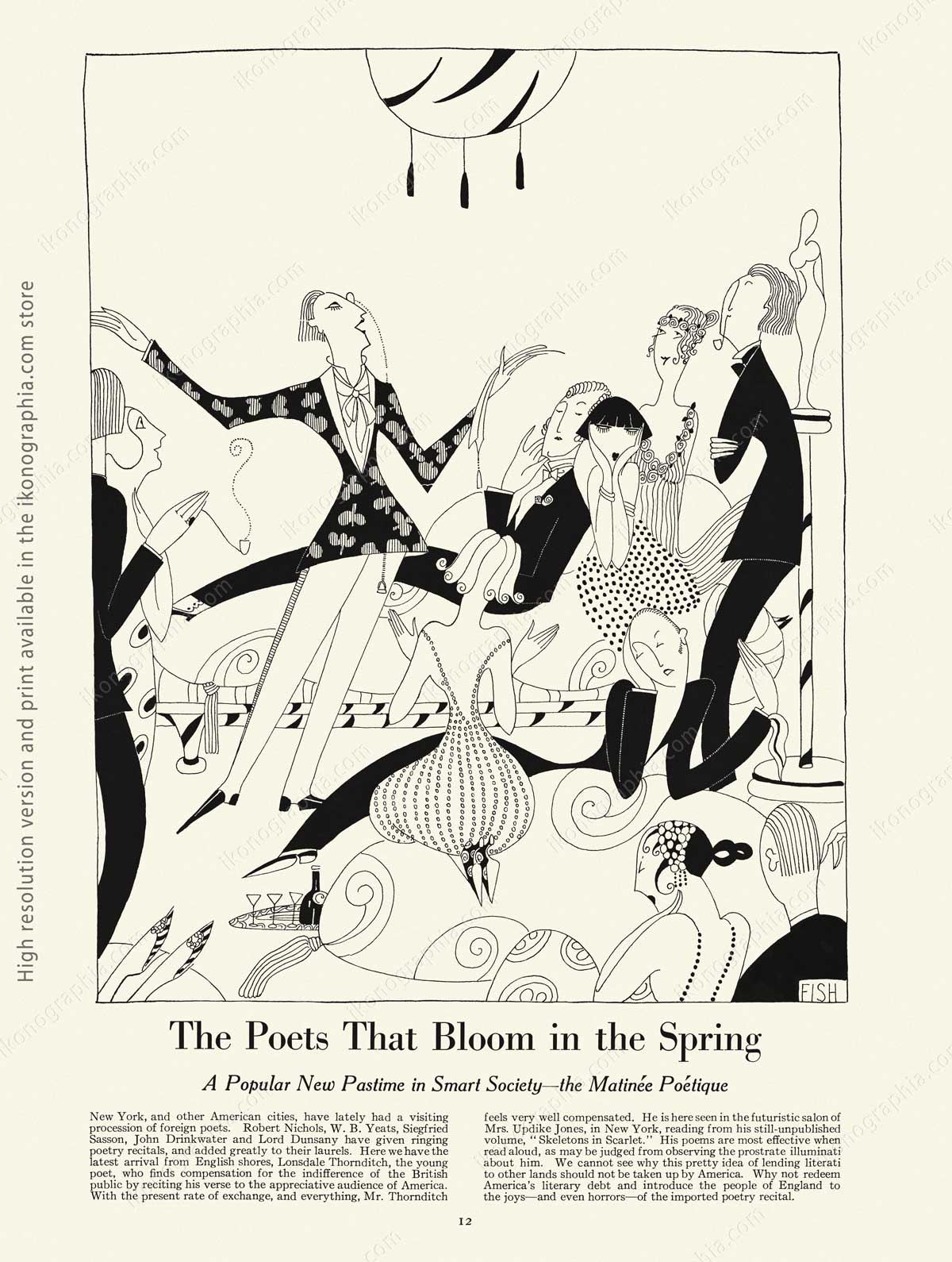
The Poets That Bloom in the Spring. A striking illustration from "High Society." Artwork by Anne Fish.

Fish, introduced by Vanity Fair's Editor Heyworth Campbell.


"When, in the summer of 1914, certain remarkable drawings of social life, by a new hand, began to appear, in Vanity Fair in New York, and in The Tatler in London, people all over the world stared at them, amazed, amused, admiring. Then they stared at each other, demanding, with one voice: "Who, under the sun, is Fish?" Meantime, a tall, slender young girl of twenty-two was drawing the pictures that were helping to keep laughter alive during those dark days — and troubling very little indeed as to whether Fame's wandering searchlight would ever find her out.
That girl was "Fish," deemed to-day, by many critics, the most distinguished of satirical black-and-white illustrators. Miss Fish has created, on that miraculous drawing-board of hers, a complete human society, as original and amusing as the worlds of George Du Maurier and Charles Dana Gibson. It is a world populated by young-old matrons, astoundingly mature young girls, Victorian lady remnants, resplendent captains of industry, pussy-footing English butlers, amourous nursemaids, race touts, yearning young lovers, swanking soldiers, blank and vapid bores, bridge-playing parsons, and middle-class millionaires. But, for all its sophistication, it is a world of innocence.

The creatures in it are of a touching simplicity, an incredible naïveté. Fish is one of the only caricaturists who has ever done this sort of satire without malice — who has ever treated the poor, misguided children of this world as if they were really children. But there is beauty in her extraordinary gallery, as well as caricature. The patterns on her flappers' gowns are like laces and hangings by Beardsley; a Pomeranian lying on a rug, becomes a patch of elegant scrollery, like a detail in a Japanese print.

There is no trace at all, in her drawings, of the hackneyed conventions of illustration : everything in them is presented through the medium of an original feeling for form. Even her profiteering millionaires become designs made up of deft and satisfying curves.
Her sketches are creations not only of a clever and sophisticated intelligence, but of a true artist. In depicting fashionable society Miss Fish is perhaps at her best, for the reason that the spectacle which seems to interest her most is that pageant of "smart" types that race, as if by magic, to her drawing-board, from every haunt of social life — from opera boxes, ballrooms, race-meets, cabarets, smart supper parties, dinners of state, musicales, and the thousand and one happy backgrounds against which the contemporary beau monde is wont to pose and posture. In the pages of this book the reader will meet only with Miss Fish's social creations: the double-decked dowagers, the amateur vampires, the horsey horsemen, the diabolically clever little debutantes, the tango addicts, the incurable bridge-players, the worn-out week-end hostesses, and the myriad types of human beings that seem perpetually to haunt the portals of our most exalted society.

For six years, Miss Fish's sketches have appeared, in America, only in Vanity Fair. For the past two years the British public has only seen her work in Vogue (the British edition), and in The Patrician, — the English edition of Vanity Fair. All the drawings in this book appear here with the permission of Conde Nast, the publisher of Vogue, Vanity Fair, and The Patrician. The Editor: Heyworth Campbell".

"The Committee of Welcome". From "A Week-End With the Recently Rich"

"The Committee of Welcome". Detail from "A Week-End With the Recently Rich"

The Bugatti Dream Factory — La Fabbrica Blu, Campogalliano, 1990–1995

The Bugatti Dream Factory — La Fabbrica Blu, Campogalliano, 1990–1995

The Bugatti Dream Factory — La Fabbrica Blu, Campogalliano, 1990–1995

Dreamed by Romano Artioli for decades. Designed by Gianpaolo Benedini in a few months. Documented  by Roberto Bigano.

A photographic exploration of the legendary Blue Factory at Campogalliano — an avant-garde industrial complex designed for creativity, comfort, and technical excellence. Natural light, architectural elegance, and uncompromising craftsmanship reveal the humanistic vision behind Bugatti's rebirth — documented as it happened.

The Bugatti “Blue Factory”, “La Fabbric Blu” at Campogal

Before the first car was assembled, Bugatti Automobili had to invent a place capable of sustaining an unprecedented ambition: not merely a factory, but an environment designed to foster precision, creativity, and human intelligence at the highest level.

Conceived and built in Campogalliano during the early 1990s, the Fabbrica Blu was unlike any contemporary automotive plant. It rejected the logic of industrial alienation in favor of natural light, controlled acoustics, advanced air quality, and spatial clarity. Architecture was not treated as a neutral container, but as an active component of production itself.

Cleaning the “Prove Motori” Building at Bugatti Automobili.

The “Prove Motori” Development Building

This image reflects the almost obsessive attention to cleanliness and order that Romano Artioli required throughout the factory.

The monumental Bugatti emblem and the large white ventilation pipes—visible from miles away—symbolized the factory’s heart and soul, embodying shared ambition and pride in building something unprecedented.

The Blue Factory — Conceived by Romano Artioli

The Bugatti factory was one of the most advanced of the time. Romano Artioli himself explains why.

"To make innovative cars, I thought it was essential to motivate workers. I always had in mind the factories I visited during my life: places of alienation and suffering. What we needed instead was an environment immersed in nature, which stimulates creativity.
Therefore, the plant was designed to give technicians maximum comfort and the freedom to express their talent in the best possible way.

All the buildings had natural lighting. The measurement equipment was the most advanced. The air in the rooms was pollutants-free. The circular building where the designers worked on the upper floor was a jewel of avant-garde architecture, all in glass. The acoustic was also ideal for allowing designers to work without disturbance. There was a circular hall with a rotating platform on which cars were displayed on the ground floor. Last but not least, the plant was properly air-conditioned as the Modena climate varies from hot, humid summers to intense winter cold".

From "Bugatti & Lotus Thriller.

Leggi in italiano

Ikonographia celebra il mito di Bugatti Automobili con una serie di post, usando le splendide immagini di Roberto Bigano, fotografo di Bugatti nei primi anni novanta. Attraverso il racconto del suo rapporto con l’azienda, sarete in grado di immergervi completamente nell’atmosfera assolutamente unica che si era creata in quegli anni.

Roberto Bigano, fotografo di Bugatti Automobili vi racconta tutta la storia.


Tutto cominciò con una telefonata di un amico copywriter che avevo conosciuto sotto naja: Beppe Maghenzani. Beppe era stato coinvolto in un progetto estremamente ambizioso: rilanciare il marchio Bugatti. Il lavoro prevedeva una serie di iniziative tra le quali la realizzazione di volumi che degnamente illustrassero la storia del mito Bugatti.

Si pensò prima di tutto ad un servizio fotografico dal tema “Lo spirito Bugatti oggi in Alsazia”, un’indagine nei luoghi natali del mito, insomma, che ne fosse non solo storica rievocazione ma anche, come diceva il titolo, evocazione “spirituale”. Per questo complesso lavoro, a mezza via tra lo scavo archeologico e la seduta medianica, l’amico Beppe pensò a me come alla persona più adatta.

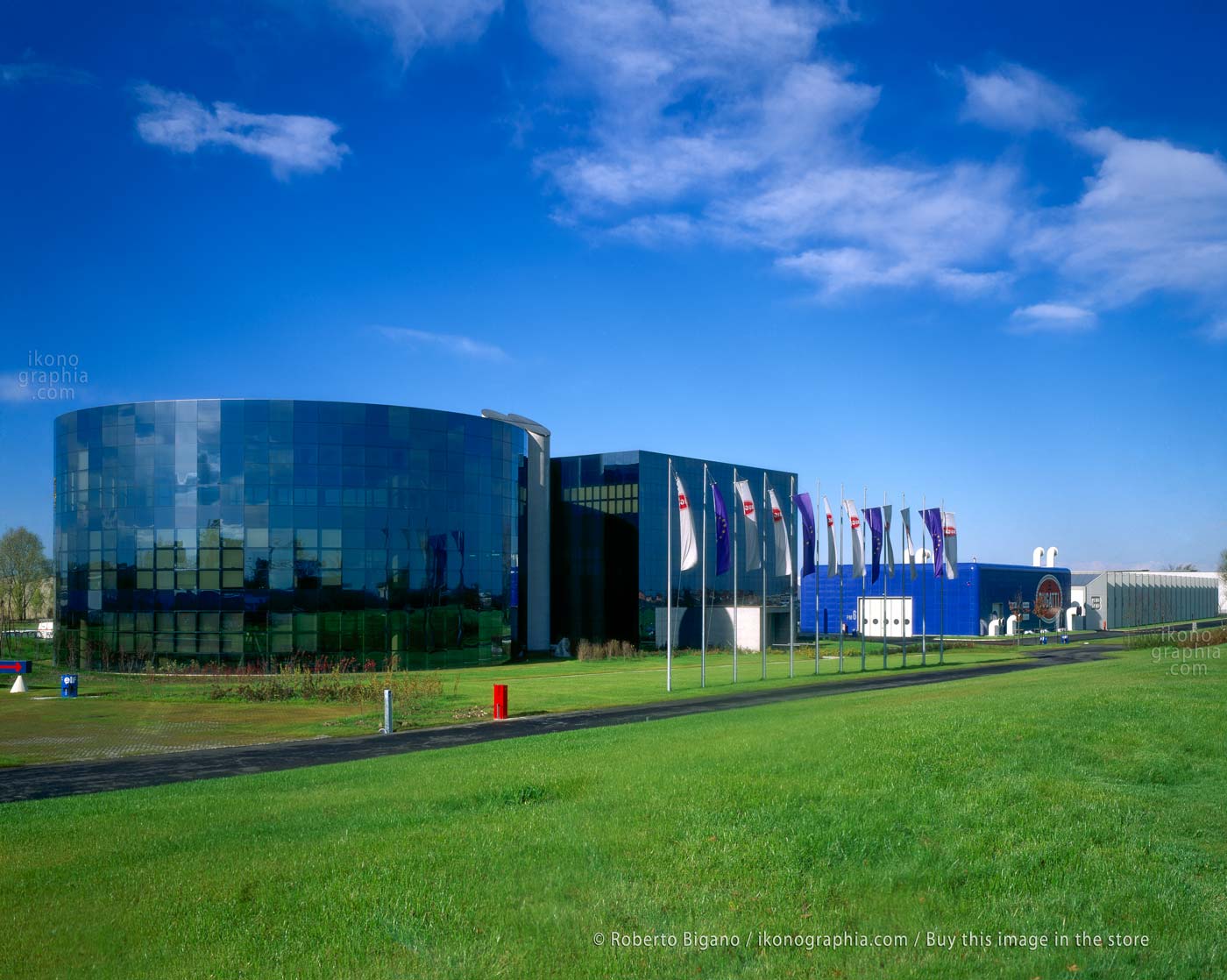
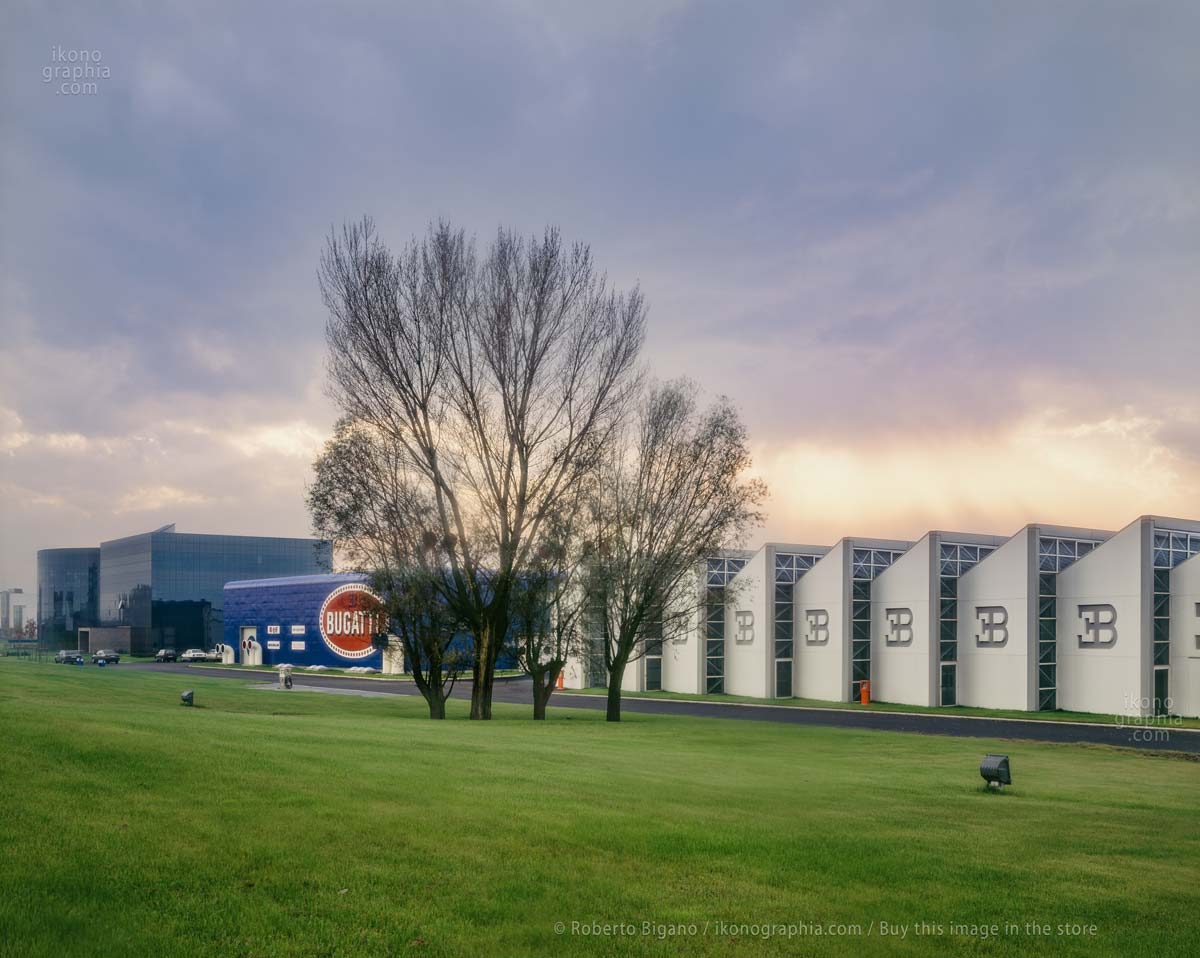
The Bugatti Head-Quarter and Factory at Campogalliano, designed by Architect Gianpaolo Benedini. Photo Roberto Bigano. Buy this image in the ikonographia.com store.

Bugatti Automobili  — General View

Winter view of the Bugatti Head-Quarter and Factory at Campogalliano

Roberto Bigano, Bugatti's photographer, tells all the story

Through his story you can dive into the incredible mood created in those years.

Through his story you can dive into the incredible mood created in those years.

Everything started with a phone call from a copywriter friend, Beppe Maghenzani. Beppe was part of an overly ambitious project: to revitalize the Bugatti brand. Part of the project comprehended, creating a book that would illustrate the story of the Bugatti legend.

The initial thought was to have a photoshoot-themed “The Bugatti spirit today in Alsace,” a study of the legend’s birthplace. It is supposed to be a historical commemoration and, as the title said, but a spiritual evocation. For this intricate work, halfway between the archeological excavation and the mediumistic session, my friend Beppe thought of me as the best person for the job.

Leggi in italiano

La Fabbrica Blu.


La fabbrica Bugatti di Campogalliano era tra le più avanzate dell’epoca.
Romano Artioli in persona ci spiega il perché.
Per realizzare auto innovative, ritenevo indispensabile motivare coloro che ci avrebbero lavorato. Avevo sempre presente gli stabilimenti visitati nel corso della mia vita: luoghi di alienazione e sofferenza. Quello che serviva invece era un ambiente immerso nella natura, che stimolasse la creatività. Tutto lo stabilimento fu quindi progettato innanzitutto per dare ai tecnici il massimo comfort e la possibilità di esprimere al meglio il loro talento.

Tutti gli edifici godevano di illuminazione naturale. Le apparecchiature di misura erano le più avanzate tecnicamente, costruite espressamente per noi dagli specialisti delle attrezzature per prestazioni estreme Schenk. L’aria delle sale prova era totalmente priva d’inquinanti, pura come quella delle Dolomiti, per effettuare le analisi delle emissioni per le omologazioni.
La palazzina circolare, ai cui piani superiori lavoravano i progettisti, era un gioiello di architettura d’avanguardia, tutta in vetro. Le sue colonne portanti fungevano anche da canali per la circolazione dell’aria condizionata. Era dotata di pavimenti galleggianti per collegare in ogni punto i computer e le attrezzature speciali.

Anche l’acustica risultò ideale per permettere ai progettisti di lavorare senza disturbi di sorta. Al piano terra, leggermente interrato, era presente un salone circolare con al centro una pedana rotante a filo pavimento per esporre le auto. Indispensabile era che gli ambienti fossero ben condizionati, perché il clima modenese varia dal caldo soffocante dell’estate al freddo intenso dell’inverno, con un’umidità costante.
Dal libro di Romano Artioli: “Bugatti & Lotus Thriller.”

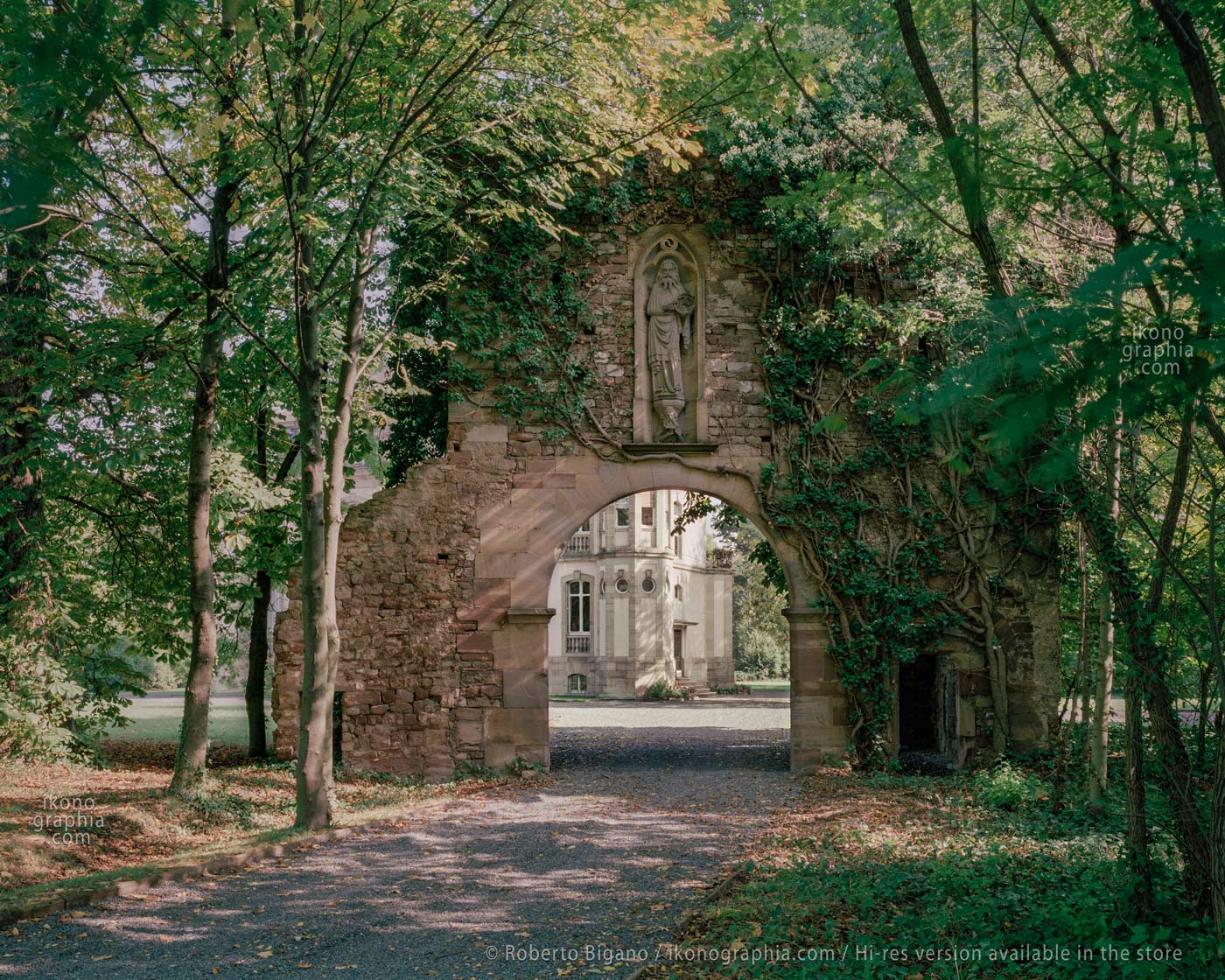
The ancient portal of Chateau St Jean The former Headquarter of Bugatti Automobiles. Photo Roberto Bigano. Buy this image in the ikonographia.com store.

Molsheim, Alsace, France. Chateau St. Jean, the former Bugatti. headquarters.

Chateau St. Jean a Molsheim in Alsazia, sede della Bugatti, a quel tempo in rovina, ma comunque affascinante.

How I met Romano Artioli.

I returned home with the fruits of my mission in Alsace. The appointment with the client was in Ora, near Bolzano. I was met by Romano Artioli’s wife, Renata Kettmeir. “Nice work,” she commented after the first few images. “And since you’re doing such a good job, please feel free to go to Campogalliano to finish it.”

At the new Bugatti premises, I was immediately received by Romano Artioli. I was literally speechless when Mr. Artioli began discussing work. “Fine, Mr. Bigano, you are to document the history of new Bugatti, its cars, and the company. You are to illustrate the birth of the legend through every stage in the journey.
I want it all: successes and failures, moments of euphoria and suffering, designing, mechanics’ sweat, the wind gallery – in short, everything right up to the presentation of the new EB110 to be released next year in Paris, and the following Gran Gala evening at Versailles.”

“But Mr. Artioli,” I replied, embarrassed and shocked. How can you be sure I’m capable of coping with it if you don’t know me and you’ve never seen a photo of mine?” “Listen,” he answered. “I’ve never yet found a photographer to please my wife. If you’ve made a good impression on her, then you must be excellent.”

Leggi in italiano

l mio incontro con Romano Artioli.

Tornai quindi alla base con il risultato della mia missione in Alsazia. L’appuntamento con il cliente era ad Ora in provincia di Bolzano. Fui ricevuto dalla moglie di Romano Artioli, Renata Kettmeir, cui piacque il lavoro. “Visto che lavora così bene vada pure a Campogalliano, così potrà completare il servizio”.

Alla sede della nuova Bugatti fui ricevuto subito da Romano Artioli. Rimasi letteralmente senza fiato quando Artioli iniziò a parlarmi di lavoro senza chiedermi di vedere una sola foto. “Bene Signor Bigano,” furono le parole con le quali esordì “lei deve documentarmi la storia della Bugatti, delle automobili, dell’azienda, deve testimoniare la nascita del mito attraverso ogni sua tappa. Voglio tutto, i successi ma anche gli insuccessi, i momenti di euforia come i periodi di sofferenza, i trionfi alle gare come gli errori, la progettazione, il sudore dei meccanici, la galleria del vento, tutto insomma fino al giorno della presentazione della nuova EB110 che faremo l’anno prossimo a Parigi, oltre al Gran Galà nella reggia di Versailles”.

“Ma Signor Artioli” gli risposi imbarazzato ed esterrefatto “Come può essere sicuro che io sia in grado di portare a termine un lavoro così complesso se non mi conosce nemmeno e non ha visto una sola mia fotografia?” “Guardi” mi rispose Romano Artioli. "Non ho mai trovato un fotografo che andasse bene a mia moglie. Se piace a lei, dev’essere bravissimo”. Ve lo giuro, mi disse proprio così.

The main entrance of Bugatti Automobili at Campogalliano with the circular building. Photo Roberto Bigano. Buy this image in the ikonographia.com store.

Main Entrance to Bugatti Automobili, Campogalliano

The entrance to the Campogalliano industrial complex, conceived by architect Gianpaolo Benedini for Bugatti Automobili.
The circular glass building—visible beyond the perimeter wall—embodied an avant-garde approach to industrial architecture, uniting corporate identity, transparency, and spatial rigor in a single, unmistakable form.

Working for Bugatti Automobili

That’s what he said, and that’s how the great adventure started – and I worked for Bugatti almost full-time for a whole year. It was a thrilling experience, an incredible situation.
The company was a true gem, and I was treated like a prince; I felt like Benvenuto Cellini at the Medici court. Wherever I went and whatever I needed, I was supported in everything and for everything by a legion of assistants.

Mr. Artioli liked my work and introduced me to a thousand potential clients. "He is an artist, the best"; "his photos have a soul." At the same time, he nicknamed me "Dolce Vita," meaning I wasn't working hard enough.

Working with Romano Artioli was stimulating because he was able to get the most out of me. Sometimes he even went so far as to give me suggestions. The post's featured photo of the "cleaning works at Campogalliano" was his idea.

Leggi in italiano

l mio incontro con Romano Artioli.

Tornai quindi alla base con il risultato della mia missione in Alsazia. L’appuntamento con il cliente era ad Ora in provincia di Bolzano. Fui ricevuto dalla moglie di Romano Artioli, Renata Kettmeir, cui piacque il lavoro. “Visto che lavora così bene vada pure a Campogalliano, così potrà completare il servizio”.

Alla sede della nuova Bugatti fui ricevuto subito da Romano Artioli. Rimasi letteralmente senza fiato quando Artioli iniziò a parlarmi di lavoro senza chiedermi di vedere una sola foto. “Bene Signor Bigano,” furono le parole con le quali esordì “lei deve documentarmi la storia della Bugatti, delle automobili, dell’azienda, deve testimoniare la nascita del mito attraverso ogni sua tappa. Voglio tutto, i successi ma anche gli insuccessi, i momenti di euforia come i periodi di sofferenza, i trionfi alle gare come gli errori, la progettazione, il sudore dei meccanici, la galleria del vento, tutto insomma fino al giorno della presentazione della nuova EB110 che faremo l’anno prossimo a Parigi, oltre al Gran Galà nella reggia di Versailles”.

“Ma Signor Artioli” gli risposi imbarazzato ed esterrefatto “Come può essere sicuro che io sia in grado di portare a termine un lavoro così complesso se non mi conosce nemmeno e non ha visto una sola mia fotografia?” “Guardi” mi rispose Romano Artioli. "Non ho mai trovato un fotografo che andasse bene a mia moglie. Se piace a lei, dev’essere bravissimo”. Ve lo giuro, mi disse proprio così.

The Bugatti “Blue Factory”, “La Fabbric Blu” at Campogal

The Blue Factory — La Fabbrica Blu

Designed by architect Gianpaolo Benedini, the Campogalliano complex is built around three distinct architectural modules, conceived as a single functional and aesthetic system.

Benedini himself describes the design process that shaped one of the most radical industrial architectures of the period.

Gianpaolo Benedini introduces the Bugatti Production Facility Complex

The industrial complex of Campogalliano was designed by the architect Gianpaolo Benedini with avant-garde criteria. It comprises three main modules, aesthetically different, creating a whole with an absolute functional and aesthetic value. Mr. Benedini himself tells us how he got there.

In the mid-spring of 1989, I got a call from Romano Artioli. He had bought a potato field in Campogalliano to build the Bugatti headquarters. I had earned his trust by converting a former factory into the Subaru Italia headquarters in record time.
Mr. Artioli put me in contact with the engineer Stanzani, the technical director, and Pedrazzi, Bevini, Benedetti, the specialized operators. Together we began to tackle the problems related to timing, different functions, and relative dimensions.

In those days, people were still designing on tracing paper with the drafting machine, and —believe me—, it was faster than today, and short times were foreseen.
Given the operational complexity, I decided to think with three different main functional typologies, the offices, the production, and the test rooms building. Once I prepared some sketches to identify each building's positions considering any future developments, I began the executive design.

I decided to proceed in parallel with the different buildings, using prefabricated parts. In this way, times were reduced and optimized. So it happened that, while the foundations were being carried out on-site, the slabs and facades of the office building were created elsewhere, with an organized path that everyone respected.

Leggi in italiano

L'architetto Gianpaolo Benedini introduce il complesso industriale di Campogalliano.

Progettato con criteri di avanguardia, lo stabilimento è composto di tre moduli principali, diversi tra loro che creano un insieme dal valore funzionale ed estetico assoluto. Gianpaolo Benedini in persona ci racconta tutta la storia.

Nella primavera del 1989, Romano Artioli mi telefonò dicendomi che aveva comprato un campo di patate a Campogalliano per costruire la sede della Bugatti. Mi ero guadagnato la sua fiducia riconvertendo a tempi record una ex fabbrica, nella sede della Subaru Italia.
Mi raccontò quale era il suo obbiettivo e mi mise in contatto con l’ing. Stanzani che aveva in quel momento la direzione tecnica e con Pedrazzi, Bevini, Benedetti, gli operativi tecnici che avevano la responsabilità di mettere in pratica il sogno di Romano. Con loro cominciai ad affrontare i problemi legati alle tempistiche, alle diverse funzioni e relative dimensioni.

Il lavoro era estremamente complesso, ed i tempi ristretti. A quei tempi si progettava ancora su carta da lucido con il tecnigrafo e devo dire che fu un vantaggio perché era un modo di lavorare snello e veloce.
Vista la complessità operativa, decisi di ragionare su tre diverse principali tipologie funzionali, uffici, produzione ed il corpo destinato ad accogliere le sale prova. Predisposti alcuni schizzi per identificare le posizioni di ogni fabbricato, considerando eventuali futuri sviluppi, cominciai la progettazione esecutiva.

Considerando la necessità di completare lo stabilimento per fasi, ma in tempi brevissimi, decisi che era necessario procedere con la costruzione in cantiere e, parallelamente in stabilimenti vari, per le parti prefabbricate. In tal modo furono ridotti e ottimizzati i tempi. Mentre si eseguivano le fondazioni in opera, solai e facciate del fabbricato uffici venivano realizzati con un percorso organizzato che tutti rispettarono. Devo dire che tutte le imprese coinvolte di qualsiasi dimensione e posizione geografica furono contagiate dalla febbre Bugatti.

I progetti furono realizzati in sinergia con l’ing. Magistrelli (che ebbe la responsabilità delle strutture e degli impianti) ritrovato dopo alcuni anni di frequentazione comune al liceo. Tutta la parte edile fu realizzata dall'impresa mantovana Martinotti.

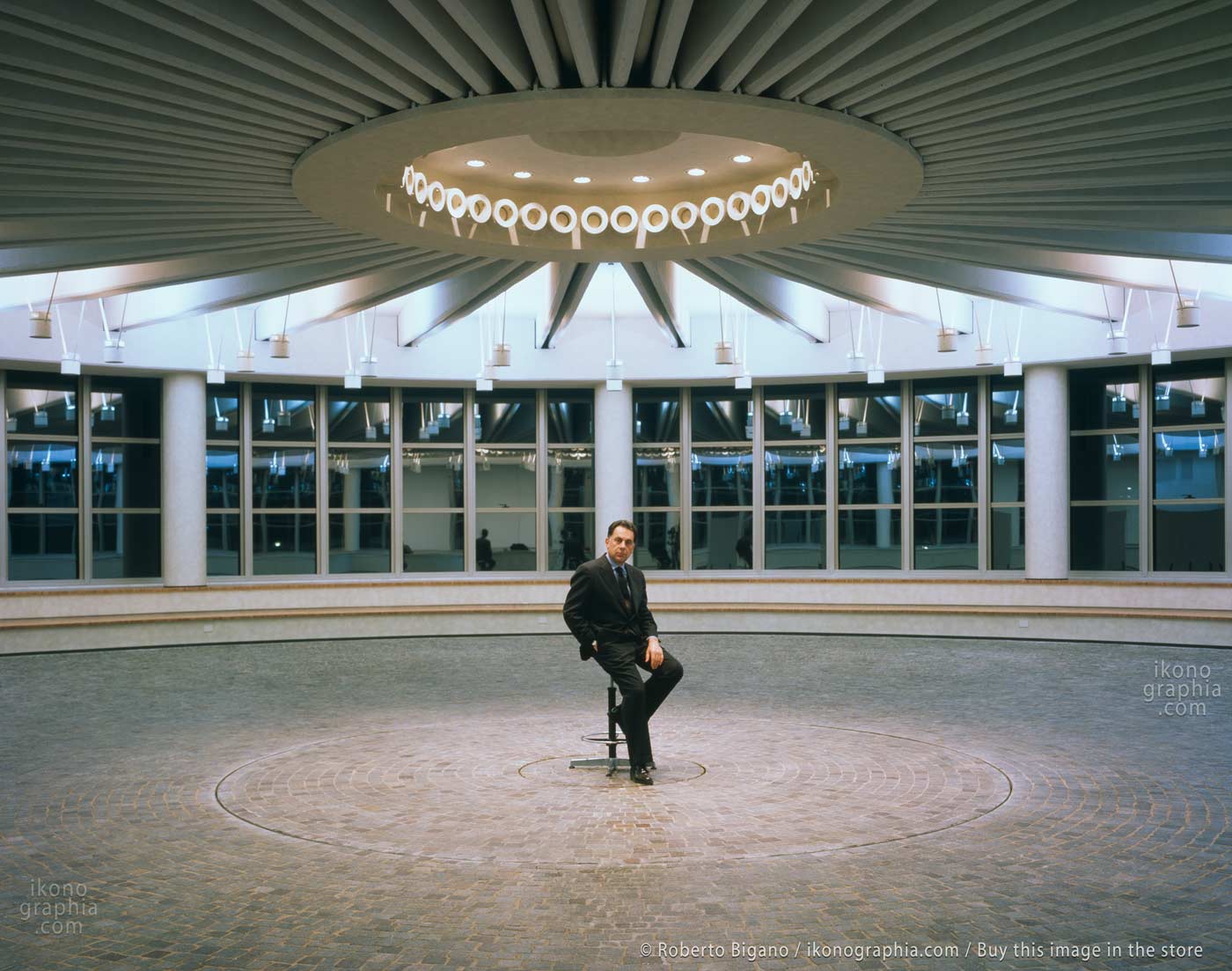
Gianpaolo Benedini in the the rotating platform

Architect Gianpaolo Benedini

Architect Gianpaolo Benedini portrayed on the rotating platform of the circular hall at Bugatti Automobili, a multifunctional space used for car displays, meetings, and photography within the avant-garde glass building.

L'architetto Gianpaolo Benedini nel centro della piattaforma rotante nel salone circolare da lui progettato.

The Circular Building

The circular building, where the designers worked on the upper floors, was a jewel of avant-garde architecture, all in glass. Its supporting columns also served as funnels for the air conditioning circulation system. It was equipped with floating floors so that computers and special equipment could be connected at every point. The acoustics were also ideal for allowing designers to work without disturbance.

On the ground floor, which was slightly underground, there was a circular hall that had a rotating platform in the middle flush with the floor on which cars were displayed and which was also used for meetings and photography sessions. It was essential that the rooms be well air conditioned as the Modena climate varies from suffocating summer heat to intense winter cold, with constant humidity.

Leggi in italiano

L'edificio circolare.

La palazzina circolare, ai cui piani superiori lavoravano i progettisti, era un gioiello di architettura all’avanguardia, tutta in vetro. Le sue colonne portanti fungevano anche da canali per la circolazione dell’aria condizionata. Era dotata di pavimenti galleggianti per collegare in ogni punto i computer e le attrezzature speciali.
Anche l’acustica risultò ideale per permettere ai progettisti di lavorare senza disturbi di sorta.

Al piano terra, leggermente interrato, era presente un salone circolare che al centro aveva una pedana rotante a filo pavimento sulla quale venivano esposte le auto, utilizzato anche per le riunioni.

Bugatti Automobili. The luminous engineers’ hall, on the first floor of the building,

Engineers' Hall

The bright, futuristic engineers' hall occupied the fully glazed upper level of the circular building. Designed with softened radii and continuous glass, the space dissolved boundaries between structure, light, and work.

Every desk flooded with natural light. Controlled acoustics and climate regulation created an environment where concentration and collaboration coexisted—embodying Romano Artioli's belief that innovation flourishes in spaces designed for people as carefully as for machines.

The Main Building housing the hall and the offices

This fully glazed cubic building houses the large luxury hall carpeted with Carrara marble and laid with mosaics and the offices. It is connected with the circular building equipped with floating floors to connect computers and special equipment at every point. Again Mr. Benedini tells.

On September 15, 1990, the facility was inaugurated with a ceremony that sealed the twinning with Molsheim. The amazement of the guests was not only for the beautiful girls who welcomed them at the reception but also for grasping a different way of considering the workplace and workers.
Visitors were also stunned by the luminosity and functionality of the buildings

Leggi in italiano

L’edificio principale per hall ed uffici.

Il luminoso edificio cubico ospitava l’ampia e lussuosa hall, con pavimenti in marmo di Carrara e decorazioni in mosaico. Era connesso con l’edificio circolare, ed i pavimenti galleggianti permettevano di connettere facilmente computer ed apparecchiature speciali. Ancora una testimonianza di Gianpaolo Benedini.

Quando il 15 settembre del 1990, lo stabilimento fu inaugurato con una cerimonia che sigillava il gemellaggio con Molsheim, lo stupore degli invitati non fu solo per le bellissime ragazze alla reception ma anche nel cogliere un modo diverso di considerare il posto di lavoro che vedeva al centro l’uomo, secondo la volontà di Romano Artioli; con grande soddisfazione di noi tecnici che eravamo riusciti a concretizzarla. La luce, la chiara corrispondenza tra l’architettura e la funzionalità di ogni diversa tipologia di quanto era stato costruito, erano riuscite a trasmettere i valori effettivi che avevamo come obiettivo.

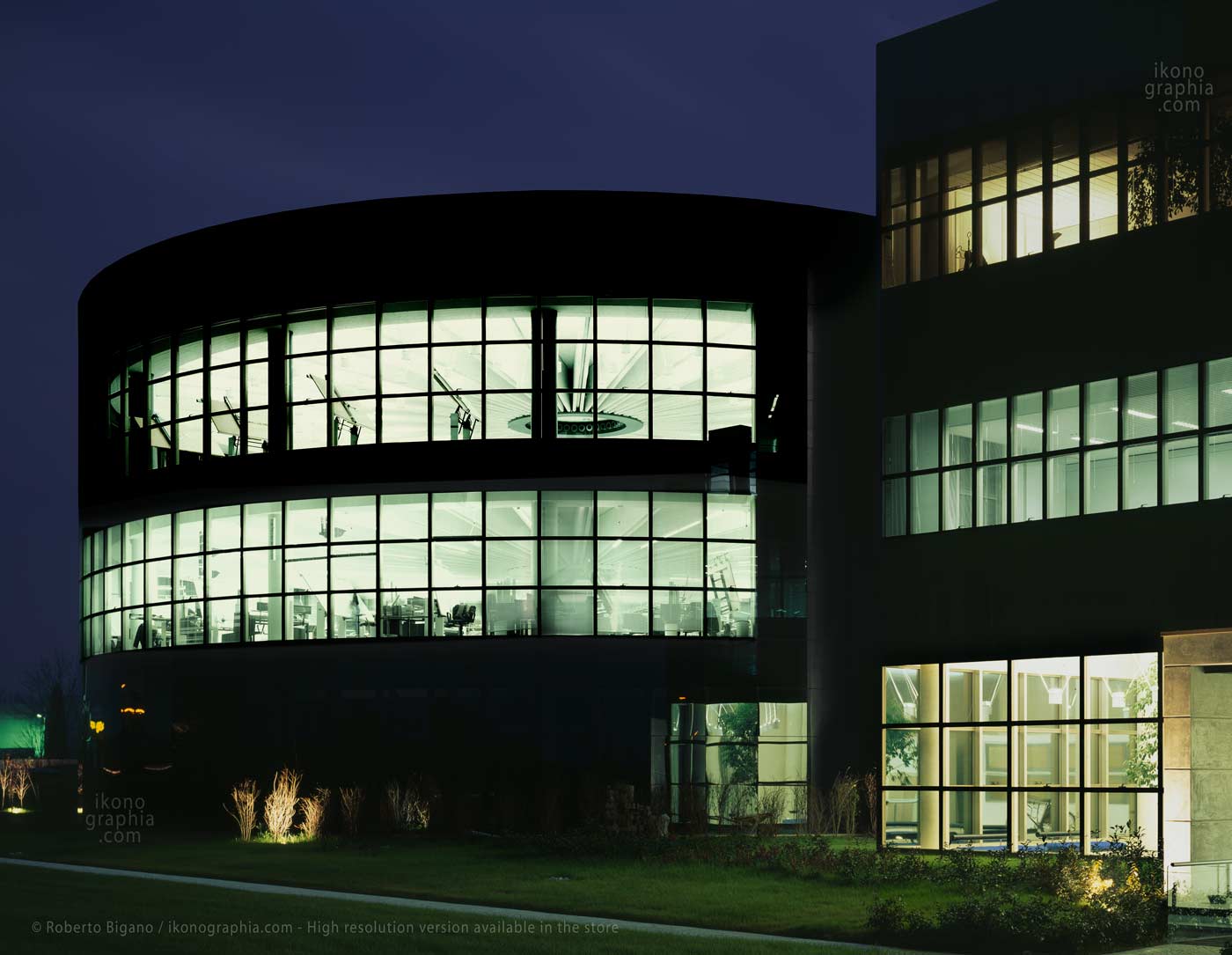
Bugatti Automobili main building night view. Photo Roberto Bigan

Bugatti Design Hall and Offices — Night View, Campogalliano

The illuminated interiors reveal an architecture conceived around openness, light, and the visibility of work—core principles of the Campogalliano project.

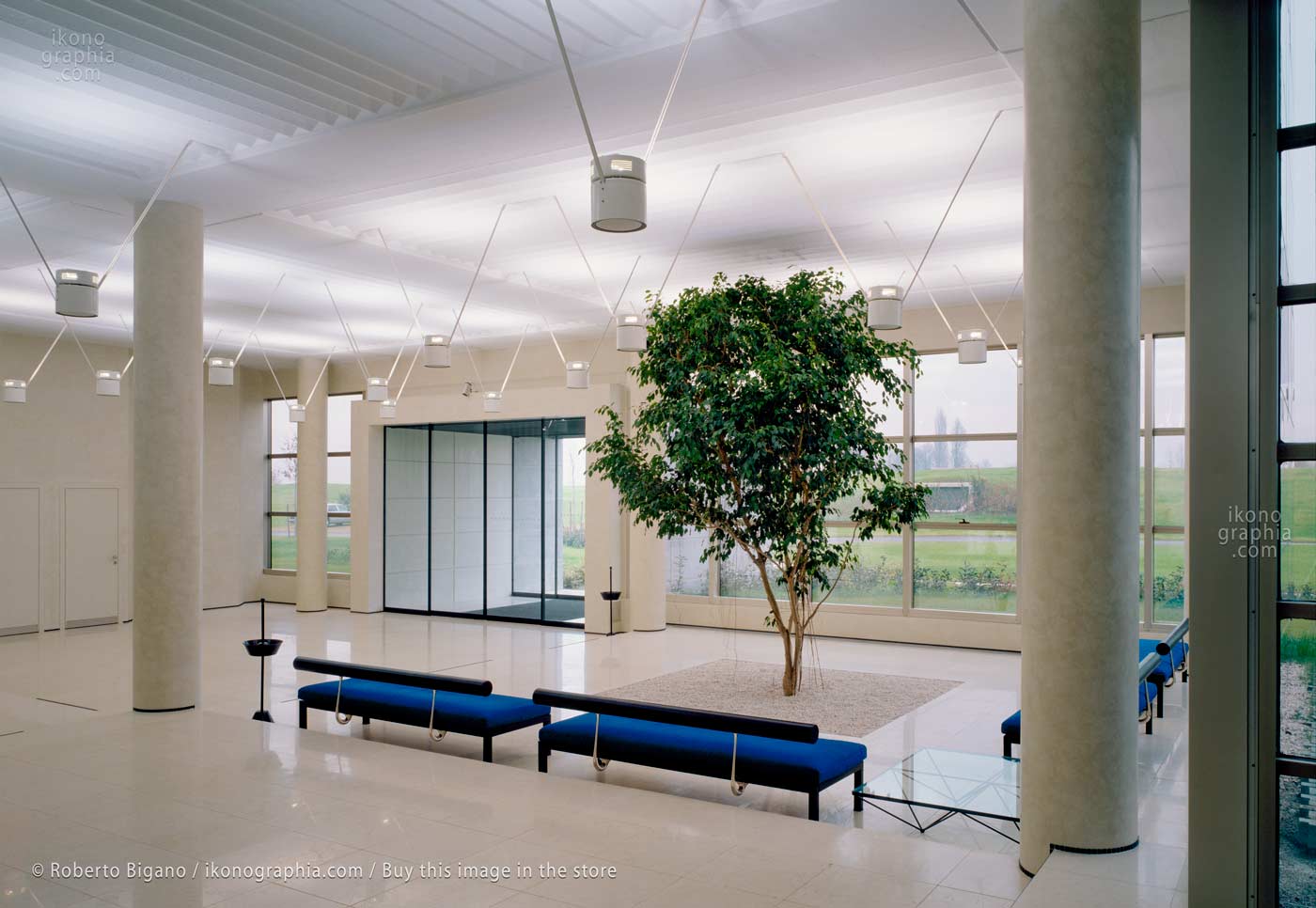
Bugatti Automobili. The large and bright luxury reception

Reception Hall at Bugatti Automobili — Carrara Marble Interior

This bright reception hall symbolized Bugatti Automobili’s renewed identity and the company’s ambition to redefine standards of quality and representation.

Bugatti Automobili. The large and bright luxury hall

The Bugatti Automobili Main Hall — Display and Reception Space

The reception hall at Bugatti Automobili combined refined luxury with warmth and restraint. Carrara marble, subtle gold detailing, and carefully balanced proportions reflected Gianpaolo Benedini’s unostentatious approach to elegance, creating a space that felt welcoming rather than intimidating.

Bugatti Automobili. The large and bright luxury hall

The Bugatti Automobili Main Hall — Light, Space, and Order

The reception hall at Bugatti Automobili combined refined luxury with warmth and restraint. Carrara marble, subtle gold detailing, and carefully balanced proportions reflected Gianpaolo Benedini’s unostentatious approach to elegance, creating a space that felt welcoming rather than intimidating.

An interior in the main Building at Bugatti Automobili

Elevator’s Hall with Ettore Bugatti Bronze Bust

The elevator’s hall featuring a bronze bust of Ettore Bugatti and leather-clad columns produced by Poltrona Frau, integrated into the refined interior design of the Campogalliano headquarters.

Bugatti Automobili. An exquisite detail of the doors of the offices on the ground floor.

Executive Office Doors, Architectural Detail

The exquisite detail of the doors of the offices on the ground floor. Design by Gian Paolo Benedini.

The "Prove Motori" Building

To follow the development of EB 110 (110 years since the birth of Ettore Bugatti), it was necessary to start with the building dedicated to development and tests on the engine.
Thus, it was the first building built with solid concrete with blue metallic skin like many racing Bugattis.

With the Bugatti emblem and the large white ventilation pipes, this impressive building symbolizes the factory's heart and soul. The immense Bugatti logo, visible from miles away, was a symbol of belonging and pride.

Leggi in italiano

Il reparto "Prove Motori".

Per procedere a pari passo con lo sviluppo dell’auto, che già si sapeva si sarebbe chiamata EB 110 (110 anni dalla nascita di Ettore Bugatti), si doveva cominciare dallo sviluppo e dai test sul motore. Per questa ragione il primo edificio da realizzare fu destinato ai banchi prova, un corpo di solido calcestruzzo con la pelle metallica blu, come molte Bugatti da competizione del passato.

Questo impressionante, originale edificio con l'emblema Bugatti  e i grandi camini angolari, rappresentavano lo spirito e l'anima dell'azienda. L'immenso marchio, visibile a chilometri di distanza era un simbolo di orgoglio ed appartenenza.

Bugatti Automobili. The “Prove Motori” development building.

The “Prove Motori” Development Building with Monumental Bugatti Emblem

Clad in blue metallic panels recalling Bugatti’s racing heritage, the engine development building became one of the factory’s strongest visual identities.

The monumental Bugatti emblem—visible from miles away—signaled belonging, shared ambition, and technical pride.

Bugatti Automobili. The “Prove Motori” development building.

"Prove Motori" Development and Production Buildings — Ventilation Pipes

This impressive building was built with solid concrete with blue metallic skin like many racing Bugattis.

Further on, the production building with the EB, Ettore Bugatti logo.

The Production Building

According to Mr. Artioli, to make innovative cars, it was essential to motivate the workers. "I always had in mind the factories I visited during my life: places of alienation and suffering". So the architect started from this brief.

Instead of long, dark factory warehouses, Benedini designed halls flooded by light. There were two twin buildings, one dedicated to production lines, the other to services, as recreational spaces and canteen. More than a canteen, it was a quality restaurant,  with no partition between workers, technicians, and managers, and even renowned guests, often including the Habsburg, expressly asked to eat there.

A clarification from Mr. Benedini.
All the projects were carried out in synergy with Engineer Magistrelli (responsible for the structures and systems), my former high school mate. The whole facility was built with the Mantuan company Martinotti.

Leggi in italiano

I reparti di Produzione.

Secondo Romano Artioli, per costruire macchine innovative era necessario motivare il personale. "Avevo sempre presente gli stabilimenti visitati nel corso della mia vita: luoghi di alienazione e sofferenza". L'architetto seguì il suo brief alla lettera.
Invece di capannoni poco luminosi e funzionali, Benedini disegnò due edifici gemelli, spaziosi ed inondati dalla luce. Il primo era dedicato alle linee di produzione, il secondo ai servizi, tra cui spazi collettivi multifunzionali e mensa.
Più che mensa era un ristorante di qualità, senza divisione tra operai, tecnici e dirigenti, ed anche ospiti blasonati, tra cui spesso figuravano gli Asburgo, chiedevano espressamente di poter mangiare lì.

Bugatti Automobili factory. The iconic modular structure with Ettore Bugatti’s EB logo and the large windows

The Production Building

The iconic modular structure bearing Ettore Bugatti’s EB logo.
Long, dark factory warehouses replaced by halls flooded with natural light.

Conceived as twin buildings—one dedicated to assembly lines, the other to services—the structure achieved architectural clarity under exceptional constraints: tight deadlines required the use of pre-existing modular systems, transformed here into a coherent and distinctive industrial form.

Bugatti Automobili. A view of the bright and tidy Production building with a Mandelli Machinery.

Production Line with Mandelli Precision Machinery 

One of the rational, highly controlled production lines at Bugatti Automobili, equipped with custom high-precision machinery by Mandelli, engineered to achieve tolerances of one-thousandth of a millimeter.

Bugatti Automobili. A view of the bright and tidy Production building.

Orderly Powertrain Machining Lines

Orderly, rational machining lines for Bugatti Automobili powertrains, built around custom high-precision systems by Mandelli, designed to achieve tolerances of one-thousandth of a millimeter.

1937_08 The EB110 Model in the Pininfarina Wind Gallery, side view. Photo by Roberto Bigano. Buy this image in the ikonographia.com store.

EB110 GT — The Making of a Dream Car at Bugatti Automobili

Behind the scenes of the EB110: people, process, and precision.

Once the factory was made, the car had to be built. Follow us in this second episode on Bugatti Automobili, a behind the scene journey in the various design phases that led to the new Gran Turismo’s birth. See all the men and women who built the EB110.

Copyright Links and Credits

Photography, Copyright & Credits

All photographs © Ikonographia / Roberto Bigano — All Rights Reserved. These images are part of the Ikonographia Visual Archives: Bugatti Automobili & EB110 Archive (1990–1995).

Roberto Bigano served as official photographer for Bugatti Automobili throughout the company's operational years in Campogalliano. This archive was produced from inside the project, with unrestricted access and no editorial constraints. The material is exclusive to Ikonographia and available nowhere else.

Credits & Acknowledgments

Ikonographia gratefully acknowledges the fundamental contribution of Romano Artioli, founder of Bugatti Automobili, and Gianpaolo Benedini, architect and designer of both the Fabbrica Blu and the EB110, without whose vision, trust, and collaboration this archive would not exist.

Excerpts from Romano Artioli's book "Bugatti & Lotus Thriller" are reproduced with the author's authorization.

Terms of Use (Summary)

The images presented in this archive are copyrighted and available for licensed use only through Ikonographia Visual Archives.

You may not download, reproduce, publish, or distribute these images without a valid license. For commercial or editorial licensing, please refer to the product pages or contact Ikonographia directly. A full explanation of licensing terms is available in the Shop / Licensing Information section under "Ikonographia — Standard License" and "Ikonographia — Merchandising & Product Use Licenses."

Ikonographia Mission Statement

Ikonographia is committed to the accurate documentation, preservation, and ethical dissemination of twentieth-century visual culture.

Archival Notes

These photographs were produced between 1990 and 1995 as part of Roberto Bigano's role as official photographer for Bugatti Automobili. The archive documents the factory, the production process, the design evolution, and the people behind one of the most ambitious automotive projects of the late twentieth century.

The story is told from inside: by the founder who initiated the enterprise, the architect-designer who shaped its form, and the photographer who followed the project throughout its development. All images follow Ikonographia's internal archival standards for resolution, color accuracy, and metadata structure to ensure long-term consistency across the collection.

Further Reading (Selected Sources)

Abdulla Cigarettes 1921. Mélisande à Monte-Carlo — Anne Fish

Abdulla Cigarettes 1921. Mélisande à Monte-Carlo — Anne Fish

Abdulla Cigarettes 1921. Mélisande à Monte-Carlo — Anne Fish

Four series. Four protagonists. One unmistakable face.

In 1921, Abdulla Cigarettes launched a twelve-episode narrative campaign in La Vie Parisienne — one protagonist across a full year of issues, each episode advancing the story. The copy, in French, matched the illustration in wit and precision.
Anne Harriet Fish drew all four series: Mélisande à Monte-Carlo (1921), Dalilah (1922), Léonie à Los Angeles (1923), Leur Mari et le Pacha (1924). Four protagonists, one unmistakable face. This is the first.

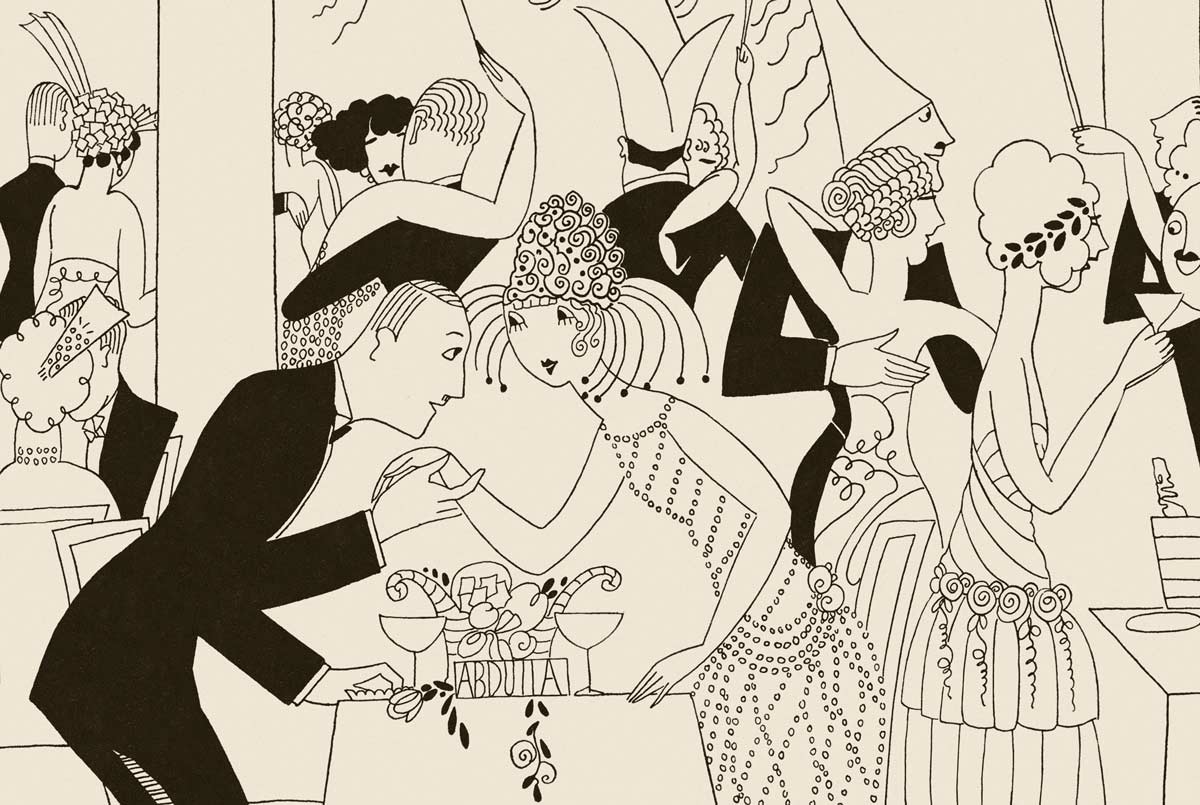
A splendid detail of Abdulla Cigarettes Ad - Melisande at Montecarlo. No. 12. LA NOUVEL AN / NEW YEAR. La Vie Parisienne. December 17, 1921.

A splendid detail of the Ad N.12 

The outstanding advertising campaigns for Abdulla Cigarettes


Abdulla & Company Ltd, founded in London, England, in 1902, was most famous for its cigarette brand, produced in various blends (Egyptian, Virginian, and Turkish).  Philip Morris, Int. currently owns the brand.

The Abdulla cigarette advertising campaigns of the 1920s and 1930s were among the most advanced of the time. They were designed and drawn in different series according to the magazines and the countries. They became famous for their humor and quality of illustration. The copy was always paradoxical but very well written.

Anne Harriet Fish illustrated at least eleven of these series, from 1919 to 1932, published in the French magazine "La Vie Parisienne" and the British magazine "Punch. Her carefree thin stroke, elegant style, and humorous wit are, in our opinion, of the utmost value.

Each illustration below is accompanied by an approximate English translation of the original ad copy, with the exception of the first ad which originally ran in English."

 Most images are available for purchase in high-resolution.
The files are professionally restored. and ready for use up to large-sized prints.
Tick the button to reach Abdulla's product page, or use the links in the description to buy that specific subject.

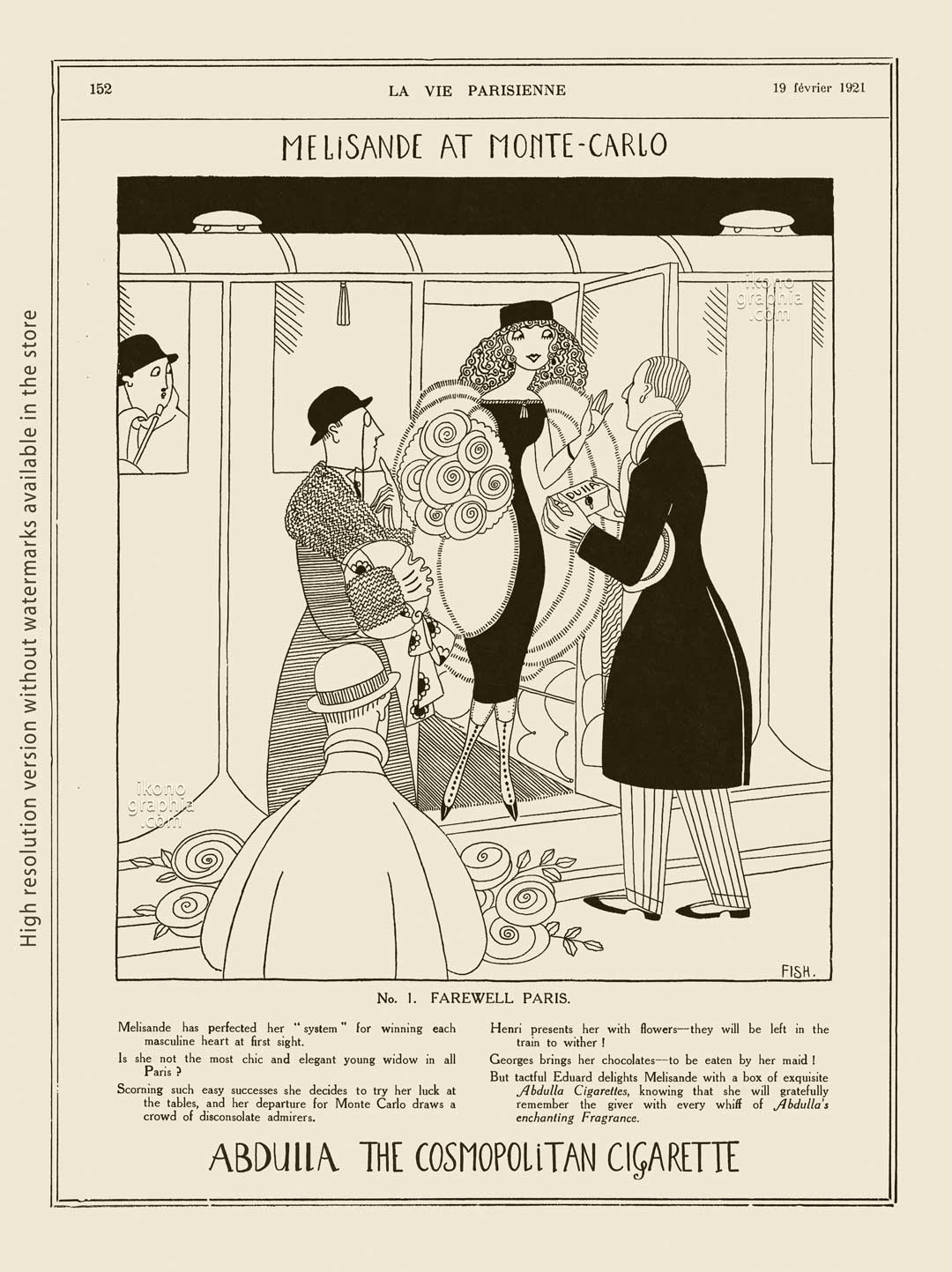
Abdulla Cigarettes Ad - Melisande at Montecarlo. No. 1. FAREWELL PARIS. La Vie Parisienne, February 19, 1921. Artwork by Anne Harriet Fish.

No. 1. FAREWELL PARIS.
February 19, 1921.

Melisande has perfected her "system" for winning each masculine heart at first sight. Is she not the most chic and elegant young widow in all Paris?
Scorning such easy successes she decides to try her luck at the tables, and her departure for Monte Carlo draws a crowd of disconsolate admirers.

Henri presents her with flowers - they will be left in the train to wither! Georges brings her chocolates — to be eaten by her maid! But tactful Eduard delights Melisande with a box of exquisite Abdulla Cigarettes, knowing that she will gratefully remember the giver with every whiff of Abdulla's enchanting Fragrance.

ABDULLA THE COSMOPOLlTAN CIGARETTE


Original ad's text in English.

Abdulla Cigarettes Ad - Melisande at Montecarlo. No. 6. AU BALCON / AT THE BALCONY. La Vie Parisienne. July 2, 1921. Artwork by Anne Harriet Fish.

No. 2. L'HOTEL DE PARIS.
March 3, 1921.

Mélisande lives in Paradise, that is to say, at the Hotel de Paris. She tastes Chinese tea,  candied chestnuts, and indulges in a spicy babbling with a charming viscountess.

Her friend's son is a young man of the world, very chic, aged 18, who succumbs at first sight to a great passion, without hope, for Mélisande.

With the burning desire to impress the beloved, he showed off his cigarette case. Look at my wonderful discovery, Madame, he said, boasting. This Hotel provides the most delicious cigarettes, Les Abdulla - Taste one.

Delicious Mélisande refrained from telling the young viscount that her cigarette case was already full of exquisite "Abdulla Roselips," and, smiling, accepted the cigarette. She inhaled the fascinating scent with genuine delight as each new cigarette is an enchanted surprise because of its infinite perfections.


Translated from the original French text.

No. 2. L'HOTEL DE PARIS - Lisez le texte original en français

Mélisande réside dans un Paradise, c'est-à-dire à l'Hôtel de Paris. Elle déguste du thé de Chine, grignote des marrons glacés, et s'abandonne à un piquant babillage avec une charmante vicomtesse.

Le fils de son amie est un jeune homme du monde, très chic, agé de 18 ans, qui succombe a première vue d’une grande passion, sans espoir, pour Mélisande. Avec le désir ardent d'impressionner l'adorée, il exhiba son porte-cigarettes. Regardez ma découverte merveilleuse, Madame dit-il en se vantant. Cet Hôtel fournit les cigarettes les plus délicieuses du monde Les Abdlulla — Goûtez-en une.

Délicieuse Mélisande, elle s'abstint de dire au jeune vicomte que déjà son porte-cigarettes était plein d'exquises Abdulla Roselips, et, souriante, accepta la cigarette offerte. Elle aspira le parfum fascinant avec un ravissement tout à fait réel, parce que chaque cigarette nouvelle est une surprise enchantée à cause de ses infinies perfections.

ABDULLA. LA CIGARETTE COSMOPOLITE

1921. Mélisande a Monte-Carlo. High Society Lifestyle saw by Anne Fish


This post showcases the full series of 1921 Abdulla advertising in the French magazine "La Vie Parisienne."
The star is Mélisande, a wealthy, young, elegant, and beautiful Parisian who goes to Monte Carlo to try her luck at the casino. Here she stays at the Hotel de Paris, where she meets an elegant Englishman who woos her and with whom she gets engaged and finally marries three days before New Year's Eve; her life unfolds between suitors, losses, and wins at the table and a lifestyle of unbridled luxury.

Interestingly, the advertisements typically showcased elegant, high-society people and lifestyle, even when the product was targeted to the middle-class, in an aspirational fashion.
The next posts will showcase more stories from 1922 to 1924, again illustrated by Anne Fish.

Abdulla Cigarettes Ad - Melisande at Montecarlo. N.3 AU CAFE DE PARIS. La Vie Parisienne. April 16, 1921. Artwork by Anne Harriet Fish.

No. 3. AU CAFE DE PARIS.
April 16, 1921.

MELISANDE has the prettiest ankles in Monte-Carlo, and thank goodness, fashion forces her to display them! Between each exquisite service from the Café de Paris, she dances with an eye-catching grace.

But suddenly-oh! horror, in the middle of a shimmy Foxtrot, she dropped her cigarette case full of adorable ABDULLA CIGARETTES! What luck! it felt beside the table of a tall and distinguished Englishman dining alone each evening and worships him in respectful silence.

He got up to pick it up before she lost momentum, and handed it to her with a sparkling look, stammering a few French words.

MELISANDE thanked him with a radiant encouraging smile. Doesn't he also smoke “ABDULLA?” And because of that, he is a charming man, educated and of good taste.

Translation from the original French text.

BUY THE HI-RES FILE


Translated from the original French text.

N.3 AU CAFE DE PARIS - Lisez le texte original en français

MELISANDE a les plus jolies chevilles de Monte-Carlo et remercions les cieux que la mode l'oblige à les exposer! Entre chaque service exquis du Café de Paris, elle danse avec une grâce qui attire les yeux.

Mais tout à coup-oh! horreur-au milieu d'un Shimmy Foxtrot elle laissa tomber son porte-cigarettes plein d'adorables CIGARETTES ABDULLA! Quelle chance! Il tomba a coté de la table d un grand et distingué Anglais qui dine seul chaque soir, et l’adore dans un silence respectueux.

II se leva pour le ramasser avant qu'elle perde la cadence, et lui remit avec un regard étincelant en bégayant quelques mots de Français. MELISANDE le remercia avec un radieux d encourageant sourire. Ne fume-t-il pas lui aussi des “ABDULLA?” Et a cause de celà, c'est un homme charmant, d'education et de bon goût.

ABDULLA LA CIGARETTE COSMOPOLITE

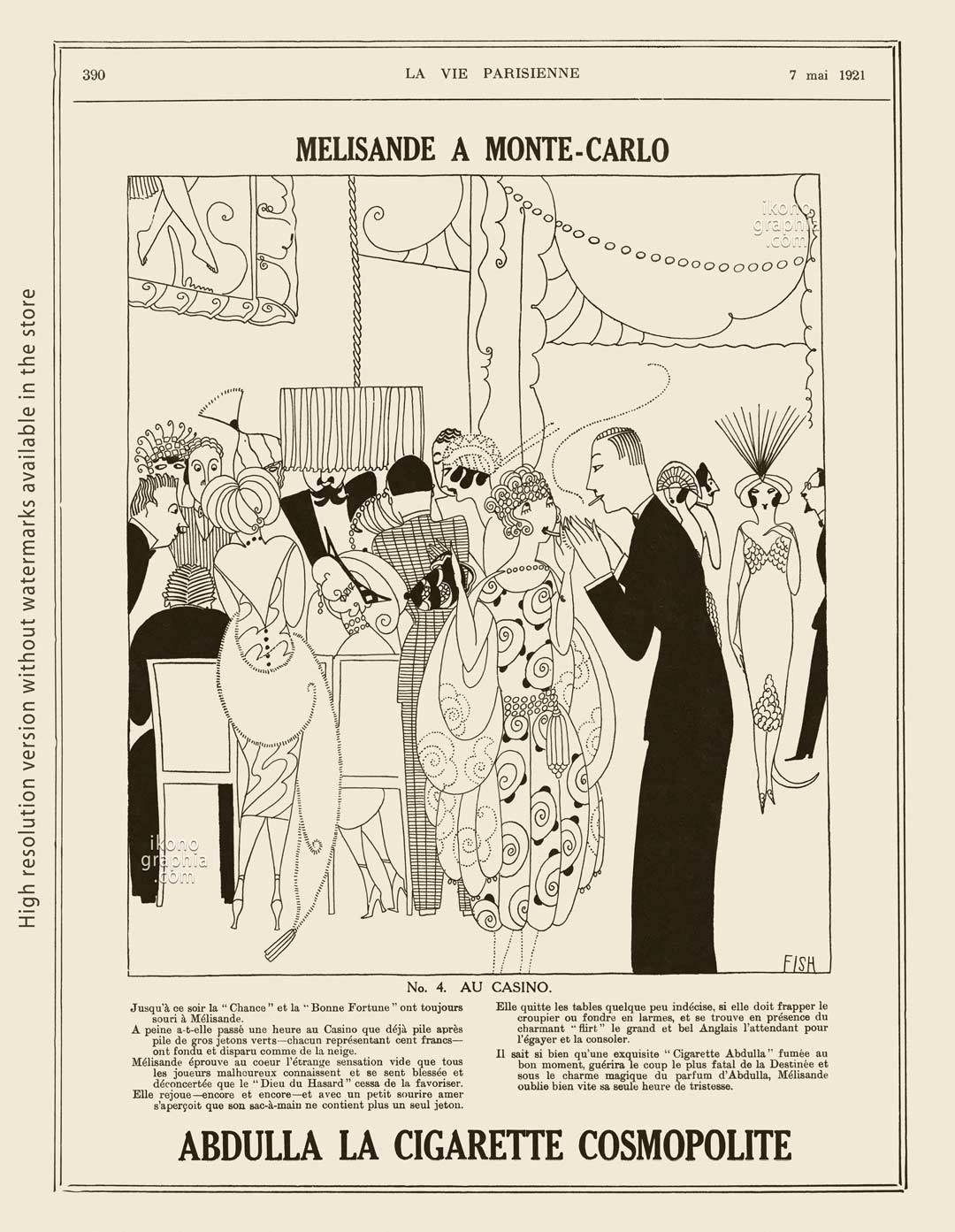
Abdulla Cigarettes Ad - Melisande at Montecarlo. No. 4. AU CASINO. La Vie Parisienne. May 7, 1921. Artwork by Anne Harriet Fish.

No. 4. AU CASINO.
May 7, 1921.

Until this evening "Luck" has always smiled on Mélisande.

She had barely spent an hour at the Casino when, stack after stack of large green tokens - each representing a hundred francs - had melted and disappeared like snow.
Mélisande feels in her heart the strange empty feeling that all unhappy players know, and feels hurt and disconcerted that the "God of Chance" has stopped favoring her. She plays it back — over and over again — and with a bitter little smile finds that her purse no longer contains a single token.

She leaves the tables somewhat undecided whether to hit the croupier or burst into tears and, in the presence of the charming flirt, the tall and handsome Englishman awaiting her to cheer and console her.
He knows so well that an exquisite "Abdulla Cigarette" smoked at the right time will cure the most fatal blow of Destiny and under the magical spell of Abdulla's perfume, Mélisande quickly forgets her only hour of sadness.

BUY THE HI-RES FILE


Translated from the original French text.

No.4. AU CASINO - Lisez le texte original en français

Jusqu'à ce soir la "Chance" et la "Bonne Fortune" ont toujours souri à Mélisande.

A peine a-t-elle passé une heure au Casino que déjà pile après pile de gros jetons verts-chacun représentant cent francs-ont fondu et disparu comme de la neige. Mélisande éprouve au coeur l'étrange sensation vide que tous les joueurs malheureux connaissent, et se sent blessée et déconcertée que le " Dieu du Hasard" cessa de la favoriser. Elle rejoue—encore et encore—et avec un petit sourire amer s’aperçoit que son sac-à-main ne contient plus un seul jeton.

Elle quitte les tables quelque peu indécise, si elle doit frapper le croupier ou fondre en larmes, et, se trouve en présence du charmant flirt le grand et bel Anglais l'attendant pour l’égayer et la consoler. Il sait si bien qu'une exquisite "Cigarette Abdulla" fumée au bon moment, guérira le coup le plus fatal de la Destinée et sous le charme magique du parfum d'Abdulla, Mélisande oublie bien vite sa seule heure de tristesse.

ABDULLA LA CIGARETTE COSMOPOLITE

A Modern Coordinated Corporate Image in the Twenties.


Interestingly, the first three ads in the series were casually designed. Logo and fonts vary every time, and the first ad is even in English (the magazine was French). Probably, the London parent company must have groomed the agency in charge of the campaign. From the fourth announcement onwards, Logo, title, and body font have been chosen. It seems normal today, but in those days, it was a very advanced thing.

Each year, theme and characters varied, and any new series had a dedicated design. In the beginning, the series was annual, then two shorter stories per year were published.

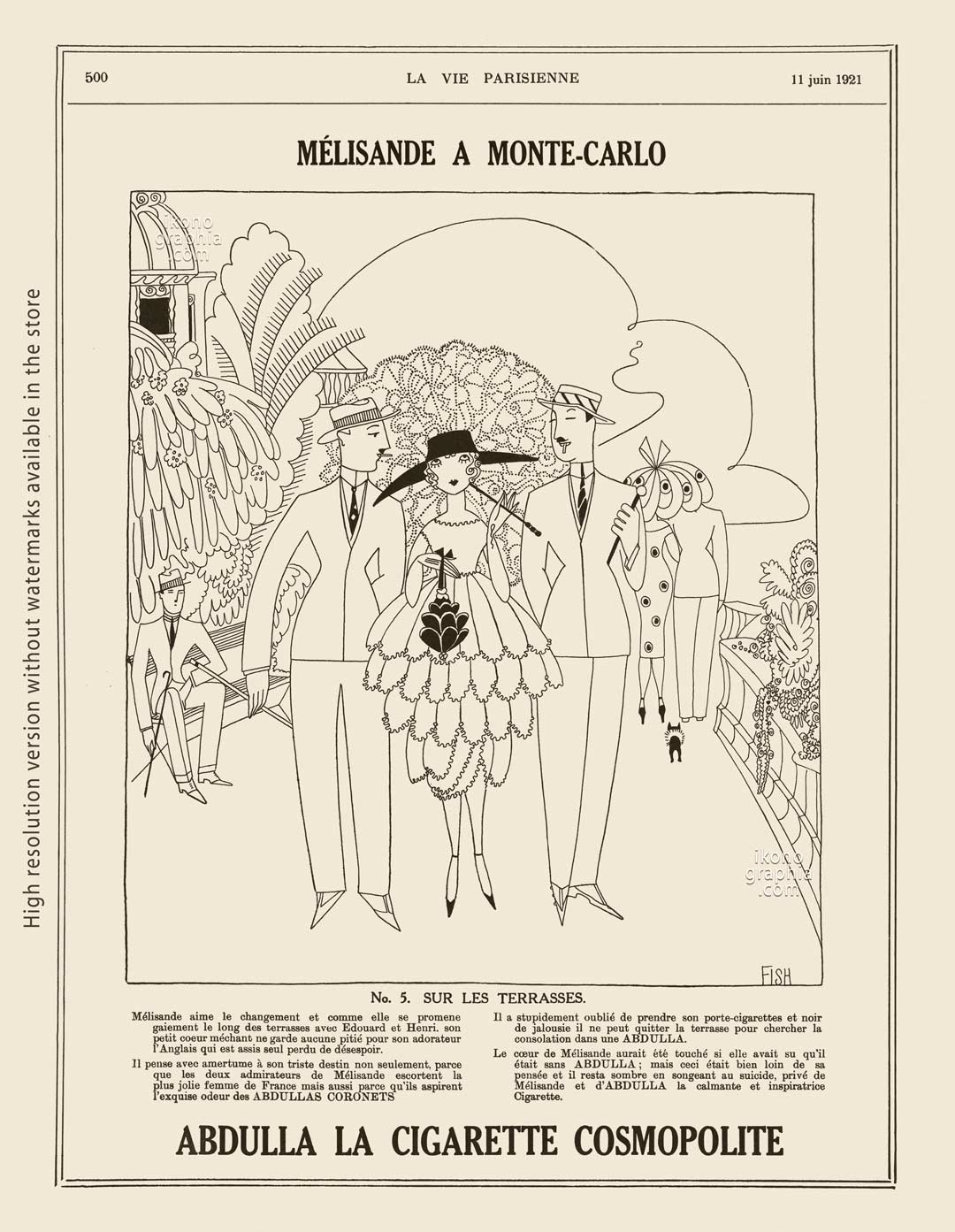
Abdulla Cigarettes Ad - Melisande at Montecarlo. No. 4. AU CASINO. La Vie Parisienne. May 7, 1921. Artwork by Anne Harriet Fish.

No. 5. SUR LES TERRASSES.
June 11, 1921.

Mélisande loves change, and as she walks happily along the terraces with Edouard and Henri, her wicked little heart has no mercy for her adorer, the Englishman who sits alone in despair.

He thinks bitterly of his sad fate, not only because the two admirers of Mélisande escort the prettiest woman in France but also because they inhale the exquisite scent of ABDULLAS CORONETS.

He stupidly forgot to take his cigarette case, and black with jealousy, he cannot leave the terrace to seek consolation in an ABDULLA.

Mélisande's heart, you would have been touched if she had known that he was without ABDULLA, but this was far from his thoughts. He remained gloomy while thinking of suicide, deprived of Mélisande and ABDULLA, the calming and inspiring Cigarette.

BUY THE HI-RES FILE


Translated from the original French text.

No. 5. SUR LES TERRASSES - Lisez le texte original en français

Mélisande aime le changement et comme elle se promène gaiement le long des terrasses avec Edouard et Henri son petit coeur méchant ne garde aucune pitié pour son adorateur l’Anglais qui est assis seul perdu de désespoir.

Il pense avec amertume à, son triste destin non seulement, parce que les deux admirateurs de Mélisande escortent la plus jolie femme de France mais aussi parce qu'ils aspirent l’exquise odeur des ABDULLAS CORONETS.

Il a stupidement oublie de prendre son porte-cigarettes et noir de jalousie il ne peut quitter la terrasse pour chercher la consolation dans une ABDULLA.

Le cœur de Mélisande tu aurait été touche si elle avait su qu'il était sans ABDULLA mais ceci était bien loin de sa pensée et il resta sombre en songeant au suicide, privé de Mélisande et d'ABDULLA la calmante et inspiratrice Cigarette.

ABDULLA LA CIGARETTE COSMOPOLITE

Abdulla Cigarettes Ad - Melisande at Montecarlo. No. 6. AU BALCON / AT THE BALCONY. La Vie Parisienne. July 2, 1921. Artwork by Anne Harriet Fish.

No. 6. AT THE BALCONY.
July 2, 1921.

Mélisande quarreled with her English admirer. Who can say why? The charms of a woman by her whims and her coldness inflame the heart of a man much more.

All-day long, he begged forgiveness for the crimes he never committed, and now like an unhappy Romeo, he remains below the balcony of his beloved. Oh! happiness. What intuition could have told him that an unforgiven sinner was crying below? In response to the whispered words of penance and adoration, she smiles, and an immense weight lifts from her heart.

He pleads in an unhappy voice for a ribbon, a flower, some precious memories of their reconciliation, but she threw him a box of divine ABDULLA Cigarettes. Each "Rose-Tipped" Cigarettes will remind him of the enchantment of an hour of moonlight while their seductive scent will recall Mélisande's fascinations.

BUY THE HI-RES FILE


Translated from the original French text.

No. 6. AU BALCON - Lisez le texte original en français

Mélisande s'est disputée avec son admirateur Anglais. Qui peut dire pourquoi? Les charmes d'une femme par ses caprices et sa froideur enflamment bien plus le coeur d'un homme.

Toute la journée il a imploré le pardon pour les crimes qu'il n'a jamais commis et maintenant comme un malheureux Roméo il reste au-dessous du balcon de son adorée. Oh ! bonheur. Quelle est l intuition qui a bien pu lui dire qu'un pécheur impardonné pleurait au-dessous. En réponse aux mots de pénitence et d'adoration murmurés elle sourit et un immense poids se soulève de son coeur.

Il plaide d'une voix malheureuse pour obtenir un ruban. une fleur, quelques précieux souvenirs de leur réconciliation mais elle lui lança une boîte de divines Cigarettes ABDULLA. Chaque Cigarettes "Rose-Tipped" lui rappellera l'enchantement d'une heure de clair de lune pendant que leur parfum séduisant rappellera les fascinations de Mélisande.

ABDULLA LA CIGARETTE COSMOPOLITE

Abdulla Cigarettes Ad - Melisande at Montecarlo. No. 7. L'APÉRITIF. La Vie Parisienne. July 30, 1921. Artwork by Anne Harriet Fish.

No. 7. APERITIF.
July 30, 1921.

Any Monte-Carlo "regular" knows that a perfect day always starts with an aperitif at the Café de Paris.

Melisande is sitting in a blue wicker chair sheltered by a bulky parasol, like the morning she looks fresh and young. At her coast is the tall, handsome Englishman who follows her like her shadow,

She cheerfully toys with icy and sweet something, and he sips a Martini, and while smoking sucks in the "chic" and tempting "ABDULLA Cigarette," which always increases a man's good mood.
Melisande is delighted to see her admirer in such a happy disposition. He will keep her company running the stores and decides that he will buy her funny novels, armfuls of beautiful flowers, a new purse, and a host of other little things. But above all and all, he must buy her a dozen boxes of these enchanted "Rose-Tipped Abdullas" at the Tobacconist near the Café de Paris.
Charming little Melisande thinks that the privilege of worshipers is to pay for what they worship.

BUY THE HI-RES FILE


Translated from the original French text.

No. 7. L'APÉRITIF - Lisez le texte original en français

 Tout "habitué" de Monte-Carlo sait qu'une journée parfaite commence toujours par un apéritif au Café de Paris?

Melisande est assise sur une chaise bleue eu osier et abritée par un volumineux parasol, comme la matinée, elle a l'air frais et jeune. A ses côtes se trouve le grand et bel Anglais qui la suit comme son ombre,

Elle folâtre gaiement avec quelque chose qui est glacé et doux, et lui, boit un Martini a petites gorgées et tout en fumant aspire la "chic" et tentante "Cigarette ABDULLA" qui augmente toujours la bonne humeur d'un homme.

Melisande se réjouit de voir son admirateur dans une si heureuse disposition. Il va lui tenir compagnie pour courir les magasins et elle a décide qu'il lui achèterait des romans amusants, des brassées de belles fleurs. un nouveau sac à main et une quantité d'autres petites choses. Mais sur tout et avant tout, il doit lui acheter une douzaine de boites de ces enchantées "Rose-Tipped Abdullas" au Bureau de tabac à coté du Café de Paris.

La Charmante petite Melisande pense que le privilège des adorateurs est de payer pour ce qu'ils adorent.

ABDULLA LA CIGARETTE COSMOPOLITE

Abdulla Cigarettes Ad - Melisande at Montecarlo. No. 8. LA MASCOTTE. La Vie Parisienne. August 20, 1921. Artwork by Anne Harriet Fish.

No. 8. MASCOT.
August 20, 1921.

Despite her recent defeat at the Casino, Mélisande has returned to the gaming tables and tonight her pretty little head is swimming in the dizzying flight of victory.

One is to wonder by what marvelous system was it able to steal such a pile of tokens of one hundred francs to the recalcitrant rake of the croupier?

Did she spend tiring hours jotting down red and black winning numbers in a nasty little notebook, or were her agitated dreams filled with good ideas and omens?

No! Mélisande's wisdom is far too strong for her to adopt gambling as a profession. A charming inspiration prompted her to play a heavy nap on the number which constantly brings her happiness and joy. Her favorite cigarette is "Turkish Abdulla," "Number Eleven" and it is no surprise that she sees the little white ball, in its mad rush, quietly fall into number eleven. The "ABDULLAS" "have always been those where luck and success have had no equivalent.

BUY THE HI-RES FILE


Translated from the original French text.

No. 8. LA MASCOTTE - Lisez le texte original en français

 Malgré sa recente défaite au Casino, Mélisande est retournée aux tables de jeux et ce soir sa jolie petite tête nage dans la fuie étourdissante de la victoire.

On est a se demander par quel merveilleux système a-t-elle pu dérober une telle pile de jetons de cent francs au râteau récalcitrant du croupier?

A-t-elle passe des heures fatigantes à prendre note dans un méchant petit calepin des numéros gagnants rouges et noirs ou est-ce que ses rêves agites on été remplis de bonnes idées et d augures?

Non! La sagesse de Mélisande est beaucoup trop forte pour qu’elle adopte le jeu comme profession. Une charmante inspiration l’a poussée à jouer une forte somme sur le numéro qui lui procure constamment du bonheur et de la joie. Sa cigarette favorite est la "Turkish Abdulla," "Numéro Onze " et c’est sans étonnement qu’elle voit la petite boule blanche, dans sa course folle, tomber tranquillement dans le numéro onze. Les " ABDULLAS" " ont toujours été celles ou la chance et la réussite n’ont pas eu d'équivalents.

ABDULLA LA CIGARETTE COSMOPOLITE

Abdulla Cigarettes Ad - Melisande at Montecarlo. No. 9. DANS UN JARDIN / IN A GARDEN. La Vie Parisienne. September 17, 1921. Artwork by Anne Harriet Fish.

No. 9. IN A GARDEN.
September 17, 1921.

Mélisande had never dreamed of an international alliance until one day, her elegant Englishman took her little fingers and whispered burning words of love in the hollow of her ear.
Her long black lashes veil his beautiful topaz eyes as he begs her again to marry him.

She wonders if she will be able to resign herself to the rain in the cold of England, and live so far away from the attractions of Paris?

She has already almost decided to reject his request; the glorious independence of a young and pretty French widow does not give up so easily: when all of a sudden, her gaze falls on a white box which contains Abdulla cigarettes.
England is the Home of delicious Abdulla, and life can become a masterpiece. If, despite the fog of London, the scent of divine Abdulla unites their hearts.

The dazzling gaze with which she responds to her plea transports the Englishman with ecstasy. He owes all his happiness to a thin "Rose Tipped" cigarette.

BUY THE HI-RES FILE


Translated from the original French text.

No. 9. DANS UN JARDIN - Lisez le texte original en français

Mélisande n’avait jamais songé à une alliance internationale jusqu'au jour où son élégant Anglais a capturé ses petits doigts et a chuchoté des mots brûlants d'amour clans le creux de l’oreille.
Ses longs cils noirs voilent ses beaux yeux de topaze pendant qu'il la supplie encore de nouveau de se marier avec lui.

Elle se demande si elle pourra se résigner, à la pluie au froid de l'Angleterre, et vivre tellement éloignée des attraits de Paris? Elle a déjà presque décidé de rejeter sa demande, la glorieuse indépendance d'une jeune et jolie veuve française ne s'abandonne pas aussi facilement: quand tout à coup son regard tombe sur une boite blanche qui contient, des cigarettes° enchantées Abdulla.

L'Angleterre est le Home des délicieuses Abdulla et la vie peut y devenir un chef-d oeuvre. si malgré le brouillard de Londres le parfum des divines Abdulla unit leurs coeurs. Le regard éblouissant avec lequel elle répond à sa plaidoirie, transporte l’Anglais avec extase. C’est à une mince cigarette “Rose Tipped" qu’il doit tout son bonheur.

ABDULLA LA CIGARETTE COSMOPOLITE

Abdulla Cigarettes Ad - Melisande at Montecarlo. No. 10. DINER DE FIANÇAILLES 7 ENGAGEMENT DINNER. La Vie Parisienne. October 15, 1921. Artwork by Anne Harriet Fish.

No. 10. ENGAGEMENT DINNER.
October 15, 1921.

A far-sighted bride mentally notes the specialties that her future husband likes to eat to be able to offer him a renewal of charms when the "treats" of married life have lost some of their novelty.

Mélisande and her devoted Englishman celebrated their engagement with a tête-à-tête dinner at the Hôtel de Paris, and each excellent dish is so appreciated by her beloved that she decides without hesitation to follow them for life.
So doing, he will never be in a bad mood, and she will never be bored.

In the meantime, they drink to the amphora of happiness and live in a golden world, idealism, which is made even more delightful by the aroma of Abdulla's Rose Tipped. Another reason to live here thinks the cunning Mélisande is that my Englishman will soon forget England with its mud and gray sky since he can get his ABDULLA Cigarettes at the Hotel de Paris itself.

BUY THE HI-RES FILE


Translated from the original French text.

No. 10. DINER DE FIANÇAILLES - Lisez le texte original en français

Une fiancée prévoyante note mentalement les spécialités que son futur mari aime à manger, afin de pouvoir lui offrir un renouveau de charmes quand les "friandises" de la vie mariée auront perdu un peu de leur nouveauté.

Mélisande et son dévoué Anglais ont célèbre leurs fiançailles par un diner tête a tête a l'Hôtel de Paris et chaque plat excellent est tellement apprécié par son adoré qu'elle décide sans hésitation à les suivre pour la vie. Ainsi faisant il ne sera jamais de mauvaise humeur et elle ne sera jamais ennuyée.

Dans l'intervalle, ils boivent à l'amour et au bonheur et vivent dans un monde doré, l’idéalisme qui est encore rendu plus ravissant par l arôme des Abdullas Rose Tipped. Encore une raison de vivre ici pense la rusée Mélisande, mon Anglais oubliera bientôt l 'Angleterre avec sa boue et son ciel gris, puisqu'il peut obtenir ses Cigarettes ABDULLA à l'Hôtel de Paris même.

ABDULLA LA CIGARETTE COSMOPOLITE

Abdulla Cigarettes Ad - Melisande at Montecarlo. No. 11. GAGE D’AMOUR / LOVE TOKEN. La Vie Parisienne. November 12, 1921. Artwork by Anne Harriet Fish.

No. 11. GAGE D'AMOUR.
November 12, 1921.

Every morning Mélisande wakes up with a happy feeling in prospect.
Her maid opens the pretty curtains letting in a golden flood of the luxurious Monte-Carlo sunshine while lazy Mélisande stretches out in her bed like a pretty Persian cat and almost purrs with pleasure,

It is wonderful to be young and pretty to stay at the Hotel de Paris and have a devoted Englishman as a fiancé.
And what a penetrating sensation to stay in bed and guess what gift your worshiper could send her today.

With her café au lait, the maid brings her a bouquet, a love letter, and a gift; sometimes it is pearls or emeralds or a beautiful handbag, chocolates or perfumes. Still, it is often a large white box of lovely "ABDULLA" Cigarettes that charming happy Mélisande.

The Cigarettes "ABDULLA" is the ideal gift for a delicate and elegant woman.

BUY THE HI-RES FILE


Translated from the original French text.

No. 11. GAGE D'AMOUR - Lisez le texte original en français

Chaque matin Mélisande se réveille avec une sensation heureuse en perspective.
Sa femme de chambre entr'ouvre les jolis rideaux laissant entrer un flot d'or du luxueux soleil de Monte-Carlo pendant que Mélisande paresseuse s étire dans son lit comme un joli chat de Perse et ronronne presque de plaisir.

C'est merveilleux d'être jeune et jolie de demeurer à l'Hôtel de Paris d de posséder comme fiancé un Anglais dévoué.
Et quelle sensation pénétrante de rester couchée et de deviner quel cadeau sou adorateur pourra bien lui envoyer aujourd'hui.

Avec son café au lait, la bonne lui apporte un bouquet, une lettre amoureuse et un cadeau, quelquefois, ce sont des perles ou des émeraudes quelquefois c'est un joli sac à main, des chocolats ou des parfums, mais souvent, c'est une grande boite blanche de ravissantes Cigarettes "ABDULLA" lesquelles charmant heureuse Mélisande. Les Cigarette* "ABDULLA" sont l'idéal cadeau pour une délicate et élégante femme du monde. ABDULLA LA CIGARETTE COSMOPOLITE

Abdulla Cigarettes Ad - Melisande at Montecarlo. No. 11. GAGE D’AMOUR / LOVE TOKEN. La Vie Parisienne. November 12, 1921. Artwork by Anne Harriet Fish.

No. 12. La NOUVEL AN.
December 17, 1921.

Mélisande est mariée avec son Anglais depuis 3 jours et ils sont, pour la nouvelle année, avec le reste, de la foule élégante au Café de Paris.

Le 1er Janvier est fêté avec du Champagne et des danses. De gais parasols de papier s'agitent folâtrement, et des tambours joujoux résonnent follement aux ébats d'une bande de joyeux réveillonneurs.
Mais Mélisande et son mari sont trop profondément heureux pour Fox-Trotter avec frénésie. Au coup de minuit l'Anglais se penche pour embrasser sa petite main avec un frissar d'adoration et de gratitude, alors solennellement, ils se jurent fidélité mutuelle au parfum des séduisantes cigarettes ABDULLA.

L’ABDULLA est la cigarette de romance et de charme subtil car c’est grâce a elle qu'ils se sont rencontrés, aimés et mariés, et comme ils quittent ces pages Mélisande et son mari souhaitent à chacun et à tous une bonne et heureuse année et beaucoup de Cigarettes ABDULLA.

ABDULLA LA CIGARETTE COSMOPOLITE

BUY THE HI-RES FILE

No. 12. THE NEW YEAR - English translation

Mélisande has been married to her Englishman for three days and celebrates the new year with an elegant crowd at the Café de Paris.
January 1 is celebrated with Champagne and dancing. Bright paper parasols stir frantically, and toy drums echo madly to the frolics of a band of merry wake-up calls.

But Mélisande and her husband are too profoundly happy to Fox-Trot with frenzy. Finally, at the stroke of midnight, the Englishman bends down to kiss her little hand with a shudder of adoration and gratitude. Solemnly, they swear to each other mutual fidelity to the scent of the alluring ABDULLA cigarettes.

ABDULLA is the cigarette of romance and subtle charm because, and thanks to her, they met, loved, and married.
Now Mélisande and her husband, leaving these pages, wish everyone good and happy years and many ABDULLA Cigarettes.

ABDULLA THE COSMOPOLITAN CIGARETTE

Copyright, links and credits

These works were published in the French Magazine "La Vie Parisienne" in 1921.
According to our records, there are no restrictions on publication, especially in the original typographical layout.

United States:
In the United States, any 1921 magazine is in the public domain due to copyright expiration.
Source 1 >, Source 2 >

France where “La Vie Parisienne” was published.
The BnF / Bibliothèque Nationale de France
, which keeps the largest archive of French magazines, considers the newspaper to be a collective work that entered the public domain 70 years after publication.
Source>
The BnF has a digital archive of seventy-nine years / 1851 issues of "La Vie Parisienne." The digital files are in black and white for reference only. Still, for us, they have been invaluable in choosing and finding the ads to reproduce.

The United Kingdom. Country of citizenship of Anne Harriet Fish.
IN the UK, copyright in the actual typographical layout of the published editions only lasts for 25 years from the end of the year in which it was published. In other words, reproducing the magazines by scanning them would not pose any problem.
Source >

Philip Morris Inc. is the current owner of the Abdulla Trade Mark.

Plastic Girls — The Age of Plastic Innocence, 1978–1980

Plastic Girls — The Age of Plastic Innocence, 1978–1980

Plastic Girls — The Age of Plastic Innocence, 1978–1980

Early Works – Shop-window mannequins before the rise of performative display.

Between 1977 and 1980, shop-window mannequins across Europe were defined by restraint. Controlled gestures, neutral composure, bodies designed to present clothing, not perform identity. Display had not yet become theatre.

This chapter marks the earliest phase of the Plastic Girls project, begun by Roberto Bigano in 1978 and still ongoing. These images are the beginning of a record that only revealed its full coherence decades later. They were not made as a project. They were made by instinct — the kind that precedes understanding by decades.

The very first EB110 model made in epowood as designed by Benedini, with the rear wheels covered reminding the Bugatti Atlantic.  Photo Roberto Bigano. Buy this image in the ikonographia.com store.

All photographs were taken from the street, through shop-window glass, without special access or permissions. Nothing is staged or arranged for the camera: the images record what is openly visible yet rarely observed with sustained attention.

Over time, this accumulation exposes patterns no single moment could reveal—recurring gestures, evolving materials, racial and anatomical codifications, and a gradual movement from abstraction to hyper-realism. The project seeks neither irony nor nostalgia, but sustained looking.

0175-17 Shop window in Rome on vintage theme, November 1978 | From "Plastic Girls" series. Photo by Roberto Bigano. Buy this image in the ikonographia.com store.

November 1978 — Rome, Italy.

A shop-window ensemble staged around a grape-harvest motif, with mannequins arranged in a shallow theatrical space. The restrained gestures and lowered gazes temper the decorative theme, shifting emphasis from seasonal display toward a composed study of collective presence and controlled femininity.

Northern Europe — Restraint and Invention, 1978–1980

Where precision and invention defined the northern window.

Germany, Scandinavia, Finland. Cities where display was precise, considered, and untheatrical — each in its own way. The windows showed what the culture valued: in Germany, controlled composure and the studied use of accessories; in Scandinavia, a restraint that the northern light made its own.
Invention appeared where least expected — a headdress of flowers and feathers in a fabric store in Braunschweig, a retro figure horizontal in a vintage boutique in Stockholm's Gamla Stan.

0360-13 Mannequin in a shop window in Braunschweig, Germany, September 1979 | From "Plastic Girls" series. Photo by Roberto Bigano. Buy this image in the ikonographia.com store.

September 1979.
Braunschweig, West Germany — Delmod Department Store.

A figure of complete stillness, seated with precise composure, the clothing subordinate to the pose. No performance, no psychological charge. The delmod logo visible at the bottom grounds it in a specific commercial moment.

0359_35 Dummy at Strick dept. store, Braunschweig, Germany. September 1979 | From "Plastic Girls" series. Photo by Roberto Bigano. Buy this image in the ikonographia.com store.

September 1979.
Braunschweig, Germany — Strick Fabrics Store.

The figure’s elongated pose and sharply articulated headpiece introduce a heightened sense of stylization within an otherwise restrained stance. Here, realism and display coexist: naturalistic body proportions support an emerging language of visual impact driven by accessories and controlled exaggeration.

0370-29 Retro Mannequin, Stockholm, Sweden, September 1979 | From "Plastic Girls" series. Photo by Roberto Bigano. Buy this image in the ikonographia.com store.

September 1979 — Stockholm, Sweden

A retro mannequin displayed in an upscale vintage second-hand boutique in Gamla Stan (The Old city) where curated accessories and restrained presentation reflect a refined approach to reuse, distinct from mass-market thrift.

0364_15 Dummy in Copenhagen, Denmark, September 1979 | From "Plastic Girls" series. Nikon FM 50mm f 1.4 – Ilford HP5 Photo by Roberto Bigano. Buy this image in the ikonographia.com store.

November 1978.
Copenhagen, Denmark

The mannequin stands frontally,the posture defined by balance and containment.
Soft facial modeling and elongated hands, held low and inactive, suppress theatricality, anticipating a late-1970s turn toward understated realism in Northern European shop-window design.

West Berlin — Avant-Garde and Contrast (1980)

Where experimental display confronted tradition in a divided city.

West Berlin's shop windows reflected the city's unique cultural position: an island of capitalist abundance surrounded by the Eastern Bloc. Avant-garde boutiques staged mannequins as sculptural provocations—angular poses, exaggerated silhouettes, and confrontational gestures—while traditional department stores maintained conservative elegance.

The contrast intensified when viewed against East Berlin's restrained, utilitarian displays visible across the Wall. These windows documented not just fashion, but competing visions of modernity separated by concrete and ideology.

0415-21 Stylish dummies at Streifen Dept. Store, Berlin, Germany, February 1980 | From "Plastic Girls" series. Photo by Roberto Bigano. Buy this image in the ikonographia.com

February 1980.
KaDeWe Luxury Dept. Store — West Berlin, West Germany — Streisen Design

A window staged — constructed, theatrical, deliberate. Two figures in conical hats, somewhere between Pierrot and Constructivism, mirror poses, a fashion sketch behind them.

Nothing is for sale in the conventional sense. The window is not saying "buy this." It is saying "this is what we believe fashion is." This window was a small version of the city.

Berlin 1980.

West Berlin in February 1980 was electric. Avant-garde boutiques staged mannequins as sculptural provocations. Traditional department stores maintained conservative elegance.

A few kilometres away, across the Wall, East Berlin shop windows presented a different world: modest clothing, limited materials, the female figure defined by role, not desire.
Five days, hundreds of images — mannequins one thread among many in a city that demanded sustained attention. This is the edit: the moments when the shop window concentrated everything the city was saying about itself.

0417-14 Frauentag / Women’s Day East Berlin, DDR, February 1980 | From "Plastic Girls" series. Photo by Roberto Bigano. Buy this image in the ikonographia.com store.

February 1980 — Berlin, East Germany — Frauentag (Woman’s Day)

A shop-window staged for International Women's Day. Modest clothing, limited materials, restrained gesture.

The female figure defined by role — a symbolic recipient of flowers, not an active presence. East Berlin, February 1980.

0419-13 Trendy dummies, West Berlin 1980, Germany, February 1980 | From "Plastic Girls" series. Photo by Roberto Bigano. Buy this image in the ikonographia.com

February 1980 — KaDeWe (Kaufhaus des Westens) — Berlin, West Germany — Streisen Design

Same city, same month, opposite side of the Wall. Four figures in military-inflected fashion, angular poses, the sketch on the back wall placing design and execution in the same frame.

The shop window as a studio for propositions about what clothing could mean.

0415-13 Mannequins in West Berlin, Germany, February 1980 | From "Plastic Girls" series. Photo by Roberto Bigano. Buy this image in the ikonographia.com store.

February 1980 — Berlin, West Germany

A conventional fashion display grounded in late-1970s aesthetics.

Naturalistic poses, familiar styling, and decorative restraint prioritize wearability and continuity over experimentation, presenting fashion as product rather than performance.

0419-05 Store window Berlin 1980, Germany, February 1980 | From "Plastic Girls" series. Photo by Roberto Bigano. Buy this image in the ikonographia.com store.

February 1980 — Berlin, West Germany

A shop-window tableau staged around intimacy and domestic fantasy rather than fashion display.

The mannequin’s reclining posture, lingerie-like styling, and surrounding household objects collapse the boundary between private interior and commercial spectacle, anticipating a late-twentieth-century shift toward lifestyle-driven retail narrative

0419_R The proof sheet of roll N.419 includes at least six interesting subjects. February 1980.

February 1980 - Berlin, West Germany

An exceptional contact sheet preserving a concentrated burst of visual discovery. Five frames from this single session—three included in this archive, two more equally compelling—capture West Berlin at a moment of extraordinary cultural intensity.

This density of compelling images reflects both the photographer's sustained attention and the city's exceptional vitality. Most contact sheets yield one or two keepers; this roll captured a moment when subject and circumstance aligned.

London — Elegance and Tradition (1980)

Refined display in the capital's iconic shopping districts.

London's Knightsbridge, Regent Street, and Oxford Street presented mannequins as bearers of restrained sophistication. Poised figures in carefully coordinated ensembles embodied British retail tradition—composure, quality, and understated aspiration.

Unlike the performative intensity emerging elsewhere, London windows maintained a language of elegance through stillness, where mannequins projected confidence without confrontation. These displays captured the final moment before globalized retail homogenized urban window culture.

0568-29 Blonde dummy, London Knightsbridge, UK September 1980 | From "Plastic Girls" series. Photo by Roberto Bigano. Buy this image in the ikonographia.com store.

September 1980 — London, Knightsbridge — United Kingdom Oxford Street and Regent Street series

The hyper-detailed facial modeling and naturalistic stance collapse the distance between mannequin and living figure.

The pose signals an early movement toward simulated presence, where realism begins to replace display as the dominant visual language

0564-23 Blonde mannequin in Regent St, London, September 1980, 1980 Nikon FM 50/1.4. Film Kodak PlusX Pan Photo by Roberto Bigano. Buy this image in the ikonographia.com store.

September 1980 — Regent Street — London, United Kingdom

Geometric severity challenging traditional femininity. The platinum hair cut in sharp architectural angles, heavy eye makeup, and dark lipstick create a face of deliberate confrontation — not glamour but refusal. The demure outfit intensifies the provocation. Propriety worn as costume.

London in 1980 was absorbing New Wave and post-punk visual language. The direct gaze reads as challenge, not invitation.

0564-23 Blonde dummy in Regent St, London, UK September 1980 | From "Plastic Girls" series. Photo by Roberto Bigano. Buy this image in the ikonographia.com store.

September 1980 — Regent Street — London, United Kingdom

Platinum hair in exaggerated volume, heavy kohl-lined eyes, and deep lipstick transform the mannequin into a figure of controlled drama.

The shell earring and crisp turtleneck ground the excess in wearable fashion. Glamour as performance — contained, precise, and deliberate.

0564-26 Mannequin in Regent St., London, UK September 1980 | From "Plastic Girls" series. Photo by Roberto Bigano. Buy this image in the ikonographia.com store.

September 1980 — Regent Street — London, United Kingdom

Sculpted platinum hair in 1940s waves, downcast eyes, contemplative pose — film-star refinement in a 1980 shop window. The dark cardigan over white collar creates tonal restraint. The hand's placement introduces vulnerability beneath composed surfaces. Beauty presented as melancholic, not aspirational.

London — The Luxury Triangle and Soho

London in September 1980 meant three distinct worlds within walking distance of each other. Knightsbridge and the luxury triangle — Regent Street, Oxford Street, Brompton Road — maintained the restrained elegance of British retail tradition.

A few streets south, Soho was something else entirely: music, fashion, and nightlife converging in the same few blocks, the underground surfacing into shop windows.

Both were documented in the same day, on the same rolls of film. A student in London for one day — no second chance, no return visit. The contrast was the point — and the choice.

Shop window in Regent St, London, UK | September 1980

September 1980 — Soho, London, United Kingdom

Three figures in coordinated formation — voluminous curls, layered chains, draped ethnic-influenced garments. Collective glamour over individual pieces. The group is the statement.

0564-33 Mannequins, Soho, London, UK September 1980 | From "Plastic Girls" series. Photo by Roberto Bigano. Buy this image in the ikonographia.com store.

September 1980 — Soho, London, Unite Kingdom

Two mannequins in close proximity, mirrored gazes, stylized accessories. Attitude foregrounded over garment.

The display is about presence, not clothing.

0564-34 Mannequin, London, UK September 1980 | From "Plastic Girls" series Nikon FM 50/1.4. Film Kodak PlusX Pan Photo by Roberto Bigano. Buy this image in the ikonographia.com store.

September 1980 — Regent Street — London, United Kingdom

Classical Hollywood elegance rendered in stillness and introspection. The sculpted platinum hair styled in 1940s waves, downcast eyes, and contemplative pose evoke film-star refinement rather than contemporary fashion energy. 

London retail maintaining connection to mid-century glamour traditions—not theatrical performance or punk defiance, but timeless feminine introspection. The mannequin presents beauty as melancholic rather than aspirational, offering an alternative visual language within the same commercial landscape.

0568-27 Elegant mannequin with greyhound, London Knightsbridge, UK September 1980 | From "Plastic Girls" series. Photo by Roberto Bigano. Buy this image in the ikonographia.com store.

September 1980.
London, United Kingdom — Knightsbridge.

An elegant shop-window composition pairing a poised mannequin with a greyhound, projecting refinement through restraint rather than display.

The controlled posture, tailored styling, and classical animal form evoke Knightsbridge’s association with discretion and status, translating luxury into a language of composure and quiet confidence.

0566-33 The Bionic Woman, London, UK September 1980 | From "Plastic Girls" series. Photo by Roberto Bigano. Buy this image in the ikonographia.com sto

September 1980.
London, United Kingdom.

Not a mannequin — a doll. The Bionic Woman, £5.74, photographed through shop-window glass like everything else in this archive. The face is indistinguishable from the mannequins beside it. That is the point.

August 1984 - Beverly Hills, California - From "Plastic Girls" series. A forty-year project by the Italian photographer Roberto Bigano documenting mannequins.

American Mannequins — Journey into Hyperreality (1982–1988)

Artificial bodies and performative realism in American retail display.

Between 1982 and 1988, American shop windows increasingly adopted mannequins modeled for presence rather than display. Lifelike faces, controlled gestures, and carefully staged interiors transformed retail figures into instruments of visual persuasion, occupying a space where realism no longer represented reality but actively produced it.

Copyright, Links And Credits

Photography, Copyright & Credits

All photographs © Ikonographia / Roberto Bigano — All Rights Reserved.
These images are part of the Ikonographia Visual Archives: — Plastic Girls: 50 Years of Artificial Beauty —  Plastic Girls / Mannequins Archive (1978–2026).

Terms of Use (Summary)

The images presented in this archive are copyrighted and available for licensed use only through Ikonographia Visual Archives.

You may not download, reproduce, publish, or distribute these images without a valid license. For commercial or editorial licensing, please refer to the product pages or contact Ikonographia directly. A full explanation of licensing terms is available in the Shop / Licensing Information section under "Ikonographia — Standard License" and "Ikonographia — Merchandising & Product Use Licenses"

Ikonographia Mission Statement

Ikonographia is committed to the accurate documentation, preservation, and ethical dissemination of twentieth-century visual culture.

Archival Notes — Plastic Girls: 50 Years of Artificial Beauty

This archive began in 1978 as a street photography project and is still ongoing.
All images were taken from public streets through shop-window glass without special access, permissions, or staging.

The archive's coherence was recognized retrospectively—only years later, during high-resolution digitization, did isolated images reveal themselves as a continuous visual record spanning nearly fifty years. The project documents mannequins as cultural artifacts: their evolving materials, poses, facial treatments, and display contexts across changing urban and commercial landscapes.

All images follow Ikonographia's internal archival standards for resolution, color accuracy, and metadata structure to ensure long-term consistency across the collection.

Further Reading — Selected Sources

  • Plastic Girls (1978-2011), by Roberto Bigano — A photographic monograph collecting earlier phases of this archive, published as a limited edition on Blurb.

Browse Plastic Girls Book


Ikonographia is proud to publish "Plastic Girls," an impressive forty years-long work by the Italian photographer Roberto Bigano 

See my published books
USD United States (US) dollar
EUR Euro