Bread-making as a form of art in Sardinia

Bread-making as a form of art in Sardinia

Bread-making as a form of art in Sardinia

From the Coccoi Pintau to the wedding sculpture — bread as form, ritual, and daily art.

In Sardinia, bread is shaped, sculpted, painted, and dressed in fabric. Symbolic and religious forms for Easter and Lent, ceremonial breads for weddings, calendar breads, toys, dolls — and among the finest, the Coccoi Pintau, an everyday bread of exceptional refinement.
A selection of these images was published on FMR Magazine N.14, Summer Solstice 2025 under the title "The Simple Luxury of Daily Bread." Photographs by Roberto Bigano.

Traditional bread from Sardina given as wedding favor.
Coccoi Pintau, Shaped Bread (literally painted bread) from Sardinia

Coccoi Pintau. 
Literally translated to "painted bread" in the Sardinian dialect, it means decorated bread, and it is for everyday use.
Settimo San Pietro, Cagliari

Coccoi Pintau. 
Letteralmente "Pane dipinto" (Pane sagomato) in dialetto sardo. Per uso quotidiano, è molto buono, con una testura particolare.

Coccoi Pintau, Shaped Bread (literally painted bread) from Sardinia

Coccoi Pintau. 
Literally translated to "painted bread" in the Sardinian dialect, it means decorated bread, and it is for everyday use. Settimo San Pietro, Cagliari.
Letteralmente "Pane dipinto" (Pane sagomato) in dialetto sardo. Per uso quotidiano, è molto buono, con una testura particolare.

Calendar Bread


Calendar bread is usually baked at the beginning of Lent, usually in the form of a doll. Every week, leading up to Easter, one leg is removed.
The second example below, with small dolls in a style reminding of Vodoo, represents the days remaining to the next baking day.

Leggi in italiano

Pane calendariale.

Il pane calendario è di solito panificato all’inizio della quaresima, in linea di massima in forma di bambola a sette gambe che vengono “mangiate” una alla settimana, fino a Pasqua. Il secondo esempio qui sotto con bamboline che ricordano un pò il Vodoo, rappresentano i giorni rimanenti alla prossima panificazione.
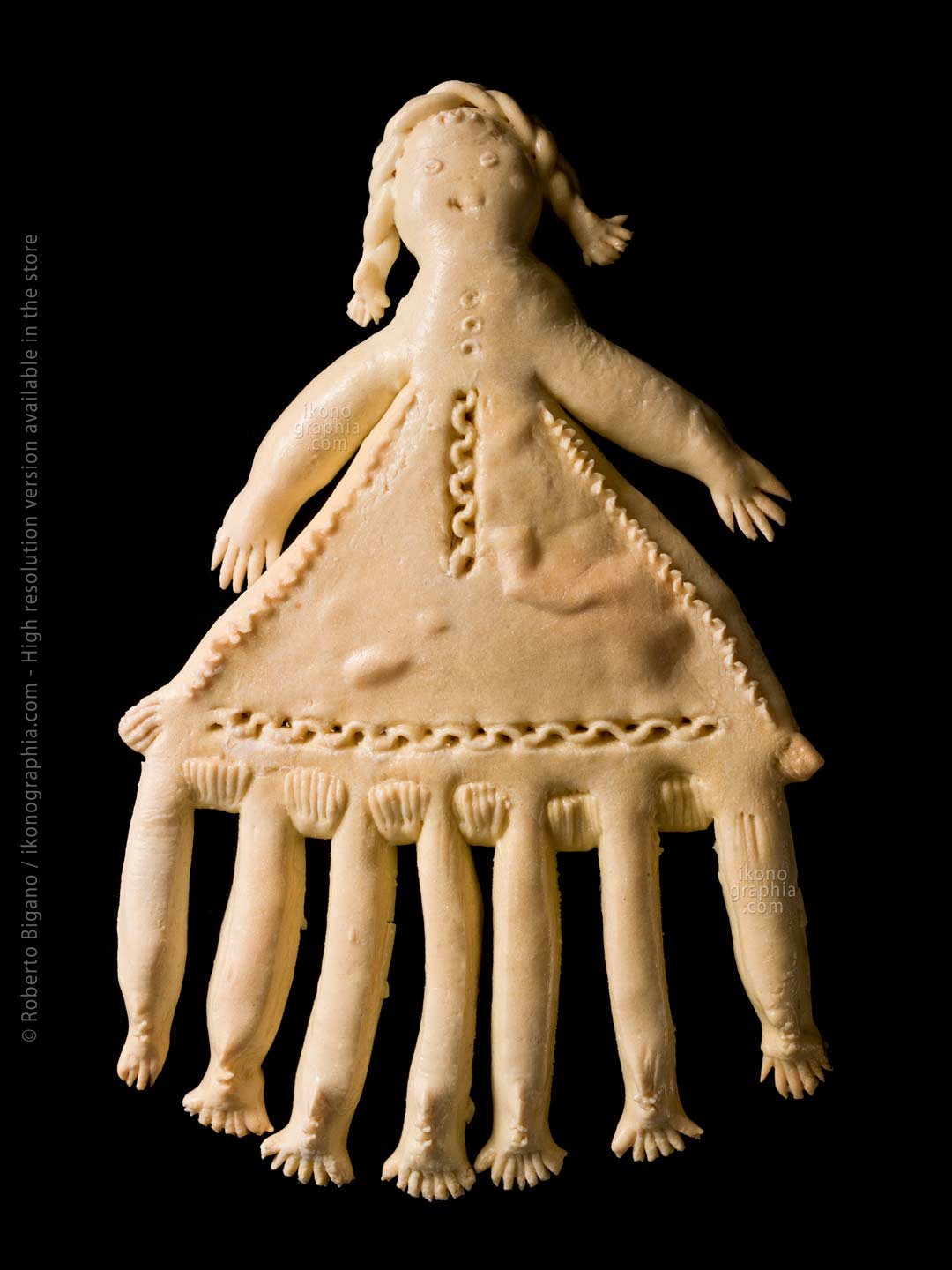
Seven legs doll. (Pippia a setti cambas “bambola a sette gambe

Pippia a setti cambas.
Seven legs doll. (Pippia a setti cambas "bambola a sette gambe). Baked at the beginning of lent. Any week a leg is removed to measure the time remaining to Easter.
Settimo San Pietro. Cagliari


Bambola a sette gambe. Pane calendariale. Panificato all'inizio della Quaresima; ogni settimana viene staccata una gamba per misurare il tempo mancante alla Pasqua.

Leggi in italiano


Pippia a setti cambas.
Bambola a sette gambe. Pane calendariale. Panificato all'inizio della Quaresima; ogni settimana viene staccata una gamba per misurare il tempo mancante alla Pasqua.
Settimo San Pietro. Cagliari


Sotto
Pane è sa gida.
Pane calendariale, le sette bamboline rappresentano i giorni della settimana e contano quelli mancanti alla successiva panificazione.
Settimo San Pietro. Cagliari

Pane è sa gida. Weekly calendar. Any day a puppet is eaten, to count the remaining days to the next baking day.

Pane è sa gida.
Weekly calendar. Any day a doll is eaten, to count the remaining days to the next baking day.
Settimo San Pietro. Cagliari.
Pane calendariale, le sette bamboline rappresentano i giorni della settimana e contano quelli mancanti alla successiva panificazione.

Wedding Bread


On the occasion of weddings, the variety and fantasy of bread creations reaches its peak. Bread of the bride, wedding party favor bread given to all of the guests and finally the apotheosis of "The bride's bread", incredibly virtuous.

Leggi in italiano

Pane in occasione di matrimoni.

Per il matrimoni la varietà e la fantasia delle creazioni con il pane, raggiunge il culmine. Pane della Sposa, Pane bomboniera, da offrire agli invitati, fino all'apoteosi della "Corona della sposa", incredibilmente virtuosa.

Pane è sposos. Bread of the spouses. Paulilatino, Nuoro, Sardin

Pane è sposos. Bread of the spouses
Pane degli sposi.
Paulilatino, Nuoro.

Good luck bread of the spouses with a sophisticated shape

Pane è sposos. Bread of the spouses
Pane degli sposi.
Paulilatino, Nuoro.

Good luck bread of the spouses with a sophisticated shape

Wedding Bread - Crown of the Bride
Tramatza, Sassari.
Pane nuziale, corona della sposa.

Traditional bread from Sardina given as wedding favor.

Wedding Favor Bread - Bomboniere di nozze
Given to all the guests. Tramatza, Sassari.

Easter Bread


Easter is another occasion in which dedicated imaginative and artistic bread is prepared, with or without hard-boiled eggs, doves, peacocks and birds in general.
Below some samples from Dorgali, in the province of Nuoro.

Leggi in italiano

Pane pasquale.

La Pasqua è un’altra occasione per creare splendide sculture di pane, spesso con uova sode ed un tripudio di colombe, pavoni ed uccelli in generale. La tradizione è diffusa in tutta la Sardegna, ma particolarmente nella provincia di Nuoro.
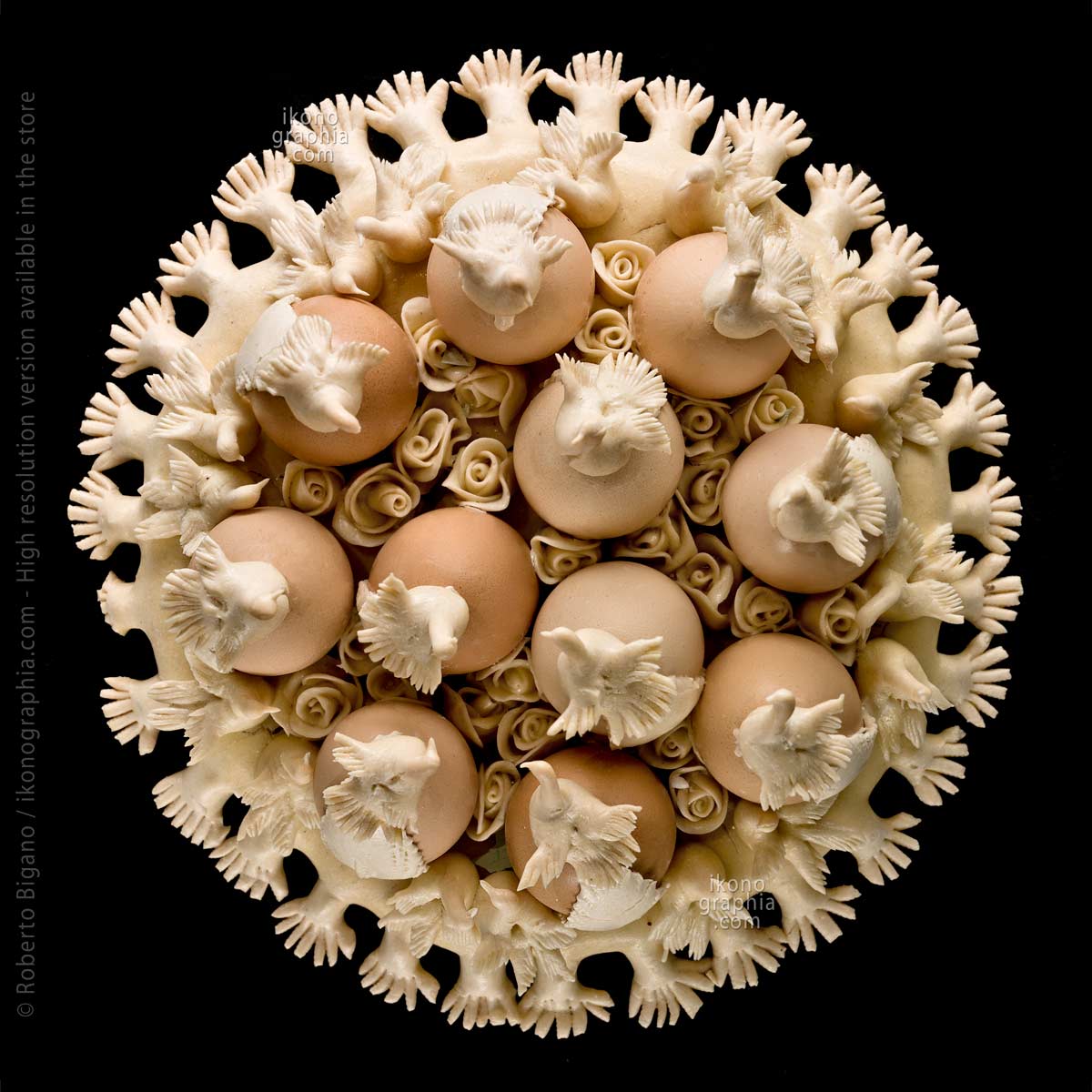
Easter Bread with hard-boiled eggs and little doves - Pane con uova e colombelle). Dorgali, Nuoro, Sardinia.

Easter Bread with hard-boiled eggs - Pane Pasquale con uova sode.
Dorgali, Nuoro.

St. Mark traditional artistic bread. Cogone de Santu Marcu (Pane di San Marco. Lei, Nuoro, Sardinia, Italy

Finely decorated bread with doves and flowers for the St. Mark feast.
Cogone de Santu Marcu (Pane di San Marco).
Lei, Nuoro.
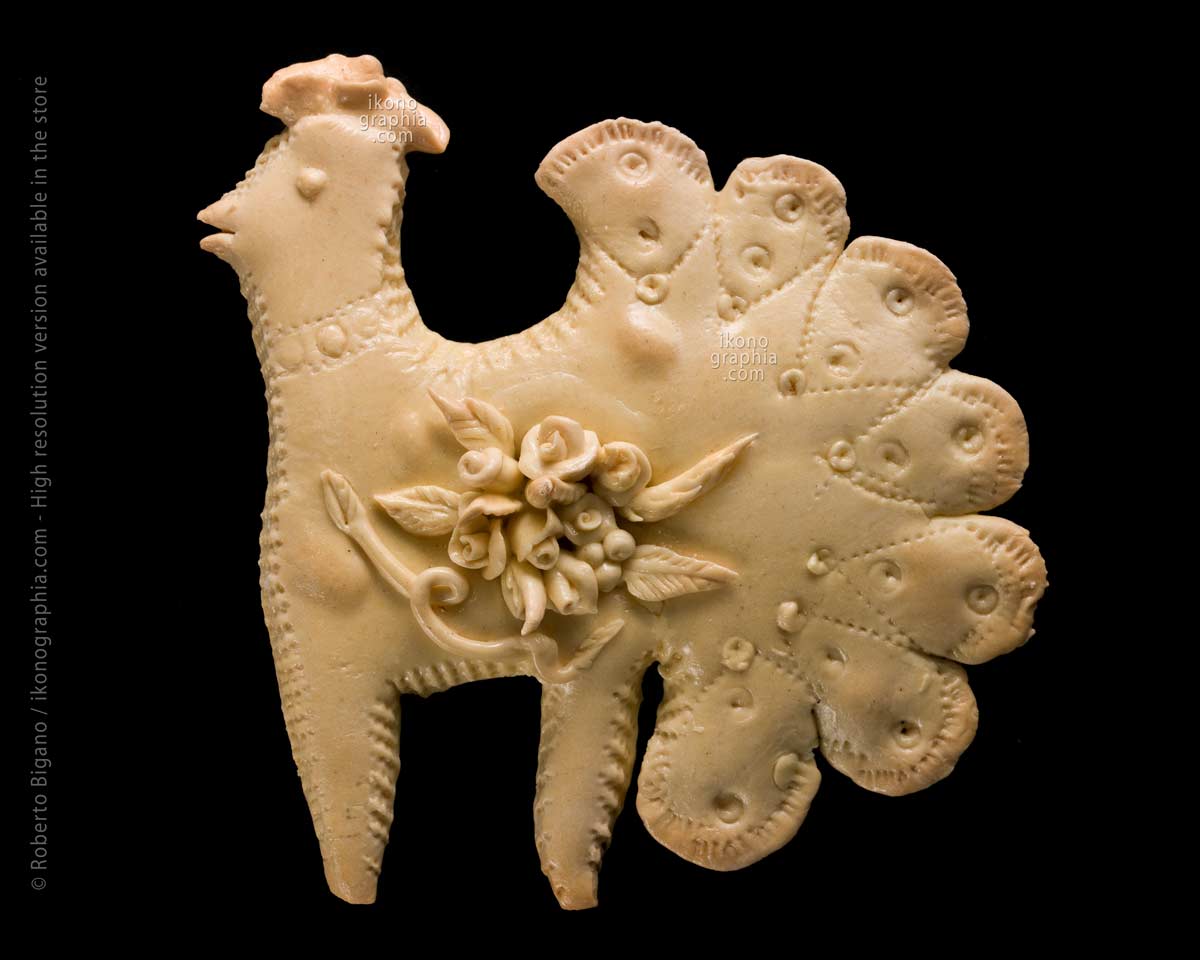
Putzoneddu, little bird. Traditional Easter bread from Sardinia.

Putzoneddos, uccellini - Little birds
Orgali, Nuoro.

Putzoneddu, little bird. Traditional Easter bread from Sardinia.

Putzoneddos, uccellini - Little birds
Orgali, Nuoro.

Symbolic and Religious Bread


The Sardinians reveal a particular talent in religious, sophisticated and imaginative subjects. Or extremely simple as in the case of the coin-bread offered as a wish for good luck.

Leggi in italiano

Pane a tema religioso o simbolico.

I sardi, tradizionalmente molto religiosi, rivelano un particolare talento nella creazioni di soggetti tipo croci, acquasantiere etc. Oppure all’opposto, estremamente semplici come queste “monete di pane” donati come augurio di buona fortuna.

Cruxi Quaresimale Lent Cross Traditional Religious Bread from Sardinia

Cruxi Quaresimale - Lent Cross.
Croce quaresimale.
Settimo San Pietro, Cagliari.

Bead Holy water stoup (Acquasantiera in Pane). Tramazza, Oristano, Sardinia

Stoup - Acquasantiera
Richly decorated.
Tramazza, Oristano.

Acquasantiera
Riccamente decorata.
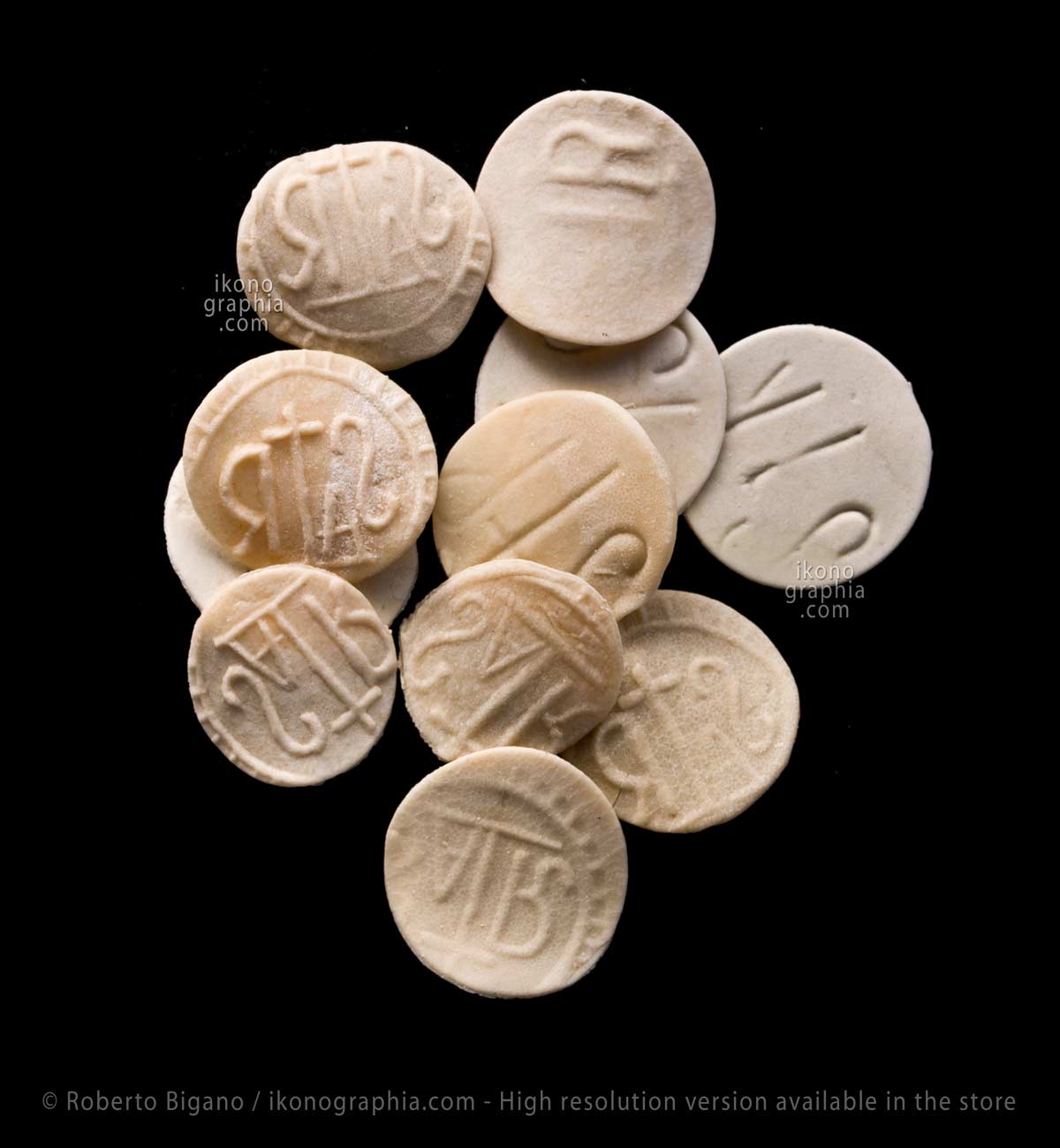
Bread coins, Santa Rita’s greeting Bread. Oliena, Nuoro.Sardinia

Bread coins, Santa Rita's Bread
Greeting Bread.
Oliena, Nuoro.

Pane di Santa Rita.
Monete di pane donate come augurio.

Toy Bread


Bread dough is also used to make toys. Sardinian mums love to tap into their creativity by creating handbags, birds, dolls. This custom is particularly widespread in the province of Nuoro.

Leggi in italiano

Pane giocattolo.

La pasta del pane è tradizionalmente usata anche per creare semplici giocattoli. Le mamme sarde danno sfogo alla loro creatività "sfornando" borse, scarpe, biciclette, draghi, uccelli e bambole. 

Toy bread in form of bag – Pane giocattolo a forma di borsa. Dorgali, Nuoro.
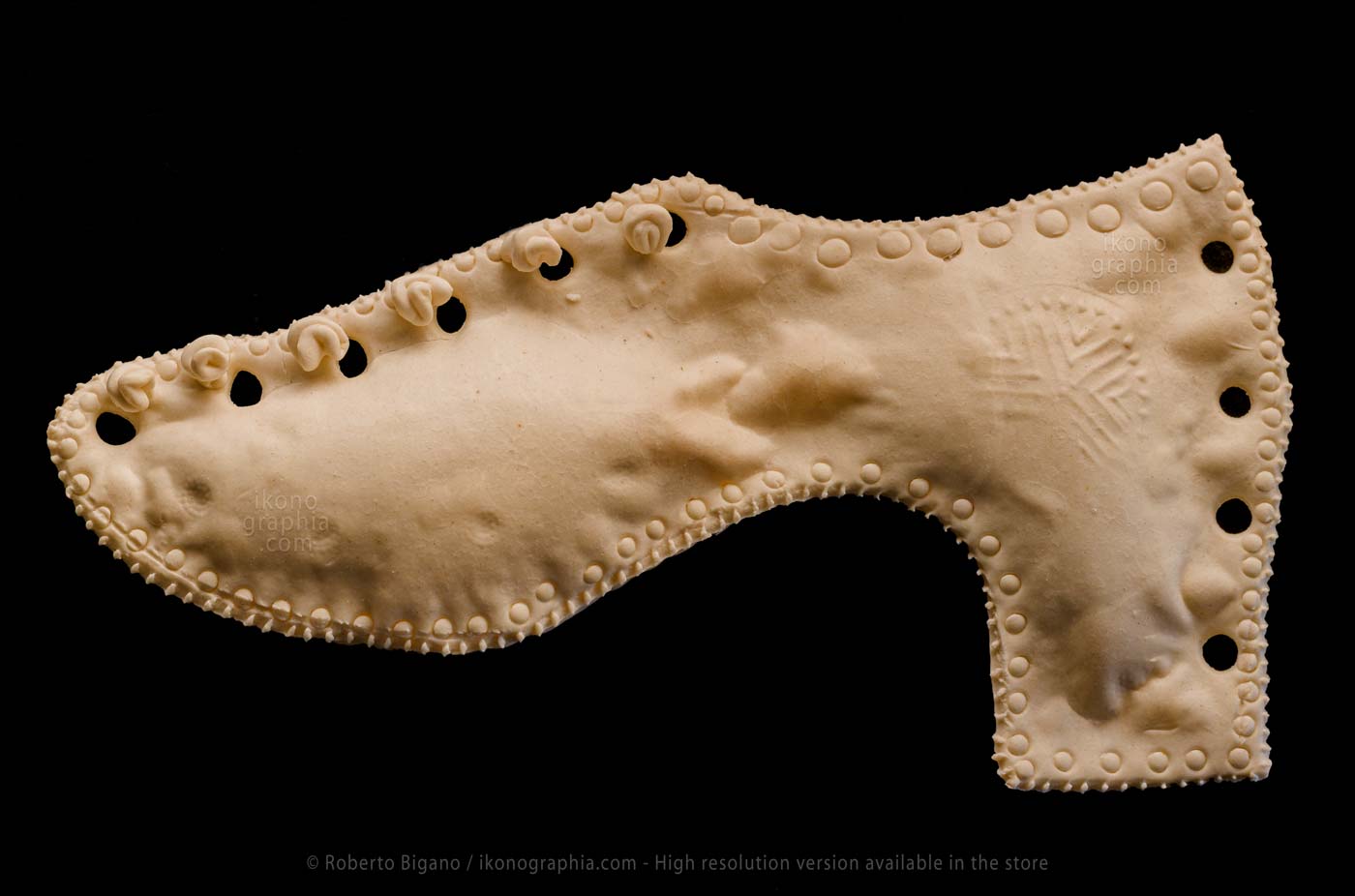
Toy bread in form of bag - Pane giocattolo a forma di borsa.
Dorgali, Nuoro.

Iscarpa, Toy Bread Shoe. Bonorva, Sassari, Sardinia

Iscarpa. Toy bread in form of shoe - Pane giocattolo a forma di scarpa 
Bonorva, Sassari.

Pitzinnas de obu. Traditional Easter Bread & Egg Dolls


These finely decorated bread and egg dolls are impressive. They are typical of the province of Nuoro and are often "dressed" with imaginative artisan fabrics.

Leggi in italiano

Pitzinnas de obu. Bambole di pane e uovo.

Queste notevoli bambole sono finemente decorate e le uova dipinte. In alcuni casi sono vestite con tessuti tradizionali sardi.

Traditional Easter Bread & Egg Dolls, dressed in traditional Sardinia fabric

Pitzzinnas de obu, egg little girl. Easter bread.
Traditional Easter Bread & Egg Dolls, dressed in traditional Sardinian fabric.

Pitzinnas de obu. Traditional Easter Bread & Egg Dolls from Sardinia

Pitzzinnas de obu, egg little girl. Easter bread.
Traditional Easter Bread & Egg Dolls,

Copyright and credits

Photographs by Roberto Bigano.
All the images in this post are copyrighted.
Tutte le immagini di questo post sono coperte da copyright.

“The Girl Of To-Day” Beauty Contest. The New York Times 1913

“The Girl Of To-Day” Beauty Contest. The New York Times 1913

Ikonographia

Dec 18, 2019

The 1913 New York Times Girl of-Today Beauty Contest. Miss Betty Skalnik

1913's American beauties revealed.


In late 1913 The New York Times organized a peculiar beauty contest, asking readers to send photographs of typical American beauties. As the NYT wrote, “hundreds of photographs came in, assuming the proportions of an avalanche.”
Ninety photographs were selected. They depict an extraordinary snapshot of the concept of beauty, elegance, and aesthetic in photography at the time. All the pictures have captions with name, address, and sometimes a phone number.

The jury was composed of famed artists: James Montgomery Flagg, C. Allan Gilbert, Clarence F. Underwood, Philip Boileau, Penrhyn Stanlaws, W. L. Jacobs and Ham­ilton King.

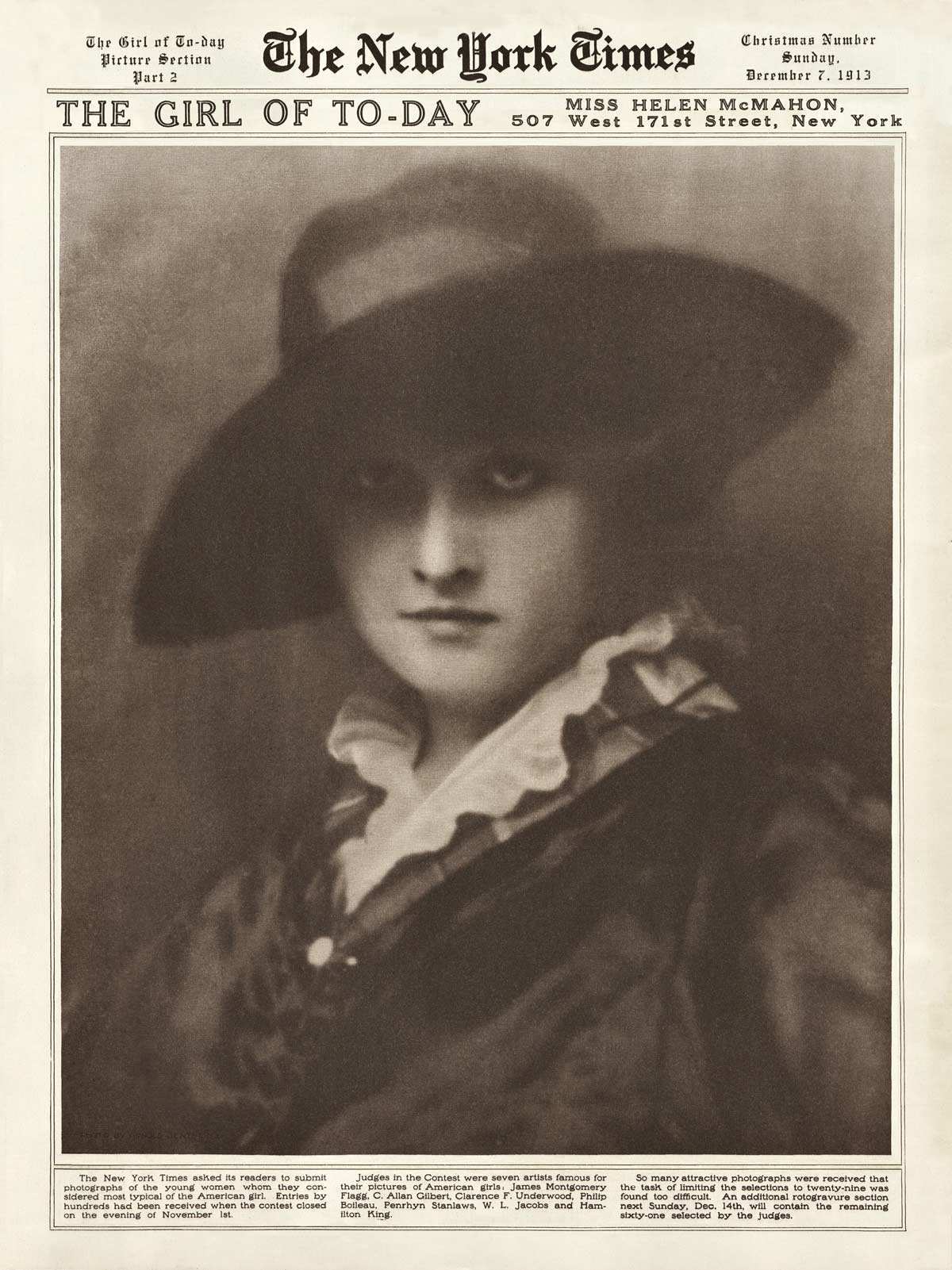
The New York Times, December 7, 1913, Christmas issue. Front Cover with the Girl of T-Day contest best voted.

Featured image above.
A splendid profile portrait of Miss Betty Skalnik, 118 West 57th Street, New York City. Photo by Mishkin.


The New York Times, December 7, 1913, Christmas issue.
This issue showcases the 29 most voted pictures. Apparently there was not an official winner, but Miss Helen McMahon, 507 West 171st, New York was placed in the cover.

It's interesting to note the soft-focus look of the image that was popular in those years.
The photograph is signed in the bottom left by Arnold Genthe.

Page Copy

The Girl of To-day Picture Section Part 2.
Christmas Number. Sunday December 7, 1913.

THE GIRL OF-TO-DAY. Miss Helen McMahon, 507 171st Street, New York.

The New York. Times asked its readers to submit photographs of the young women whom they con­sidered most typical of the American girl. Entries by hundreds had been received when the contest closed on the evening of November 1st.

Judges in the Contest were seven artists famous for their pictures of American girls: James Montgomery Flagg, C. Allan Gilbert, Clarence F. Underwood, Philip Boileau, Penrhyn Stanlaws, W. L. Jacobs and Ham­ilton King.

So many attractive photographs were received that the task of limiting the selections to twenty-nine was found too difficult. An additional rotogravure section next Sunday, Dec. 14th, will contain the remaining sixty-one selected by the Judges.

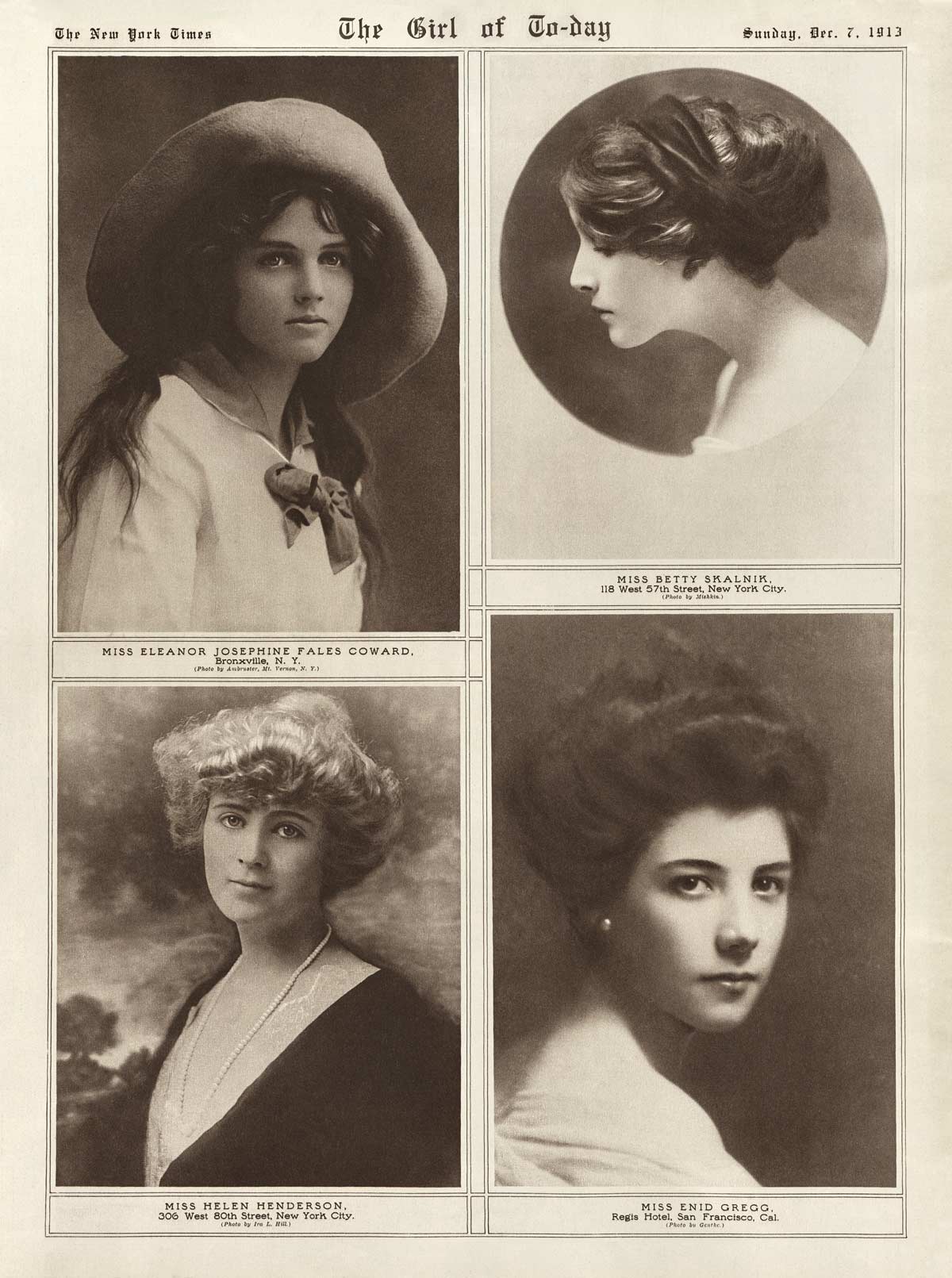
The New York Times, December 7, 1913, Christmas issue., page 2

The New York Times, December 7, 1913, Christmas issue. Page 2

Miss Eleanor Josephine Fales Coward, Bronxville. N.Y. Photo by Ambruster, Mt Vernon, N.Y.

Miss Betty Skalnik, 118 West 57th Street, New York City. Photo by Mishkin.

Miss Helen Henderson, 306 West 80th Street, New York City. Photo by Ira l. Hill.

Miss Enig Gregg, Regis Hotel, San Francisco, Cal. Photo by Arnold Genthe.

The New York Times, December 7, 1913, Christmas issue, page 3

The New York Times, December 7, 1913, Christmas issue. Page 3

Miss Helen Holden, 519 West Onondaga Street, Syracuse, N.Y. Photo by Dinturff Co.

Miss Blanche Geneva, 59 West 46th Street, New York City. Photo by Davis & Sanford Co.

Mrs. Henty Raleigh, 35 West 98th Street, New York City.  Photo by Davis & Sanford Co.

Mrs. Clarence Robbins, Douglaston, L.I. Photo by Ira Hill.

The New York Times, December 7, 1913, Christmas issue, page 4

The New York Times, December 7, 1913, Christmas issue. Page 4

Miss Vivian Rushmore. 9 West 46th Street, New York City. Photo by Ira Hill

Miss Jean Foster, 29 East 29th Street, New York City. Photo by Davis & Sanford Co.

Miss Leslie McCarten, 246 Sidney Ave., Mount Vernon, N.Y. Photo by A.D: Brittingham, Mt.Vernon.

Miss Maude Olive Minahan, Wellesley College, Wellesley, Mass. Photo by Champlain & Farrar, Boston.

The New York Times, December 7, 1913, Christmas issue, page 5

The New York Times, December 7, 1913, Christmas issue. Page 5

Miss J.H. McCluney, 4,421 McPherson Avenue, St. Louis, Mo. Photo by Mishkin.

Miss Evelyn Provost, 333 State Street, Brooklyn, N.Y. Photo by Polychromide Studios.

Miss Lottie Briscoe, 12th and Arch Streets, Philadelphia, Penn. Photo by Gilbert & Bacon, Philadelphia.

Miss Ruth Hobson, 3 Audubon Place, New Orleans, La. Photo by Mishkin.


Please compare the other three photographs on this page with the one of Miss Evelyn Provost. This last one is fresher and natural and seems to have been taken today.

A snapshot of the concept of beauty and aesthetic in photography.


These pictures are a unique catalog of the trends of the time in photography, ranging from a classic approach (soft focus, painted backgrounds, gaze not towards the camera) to a fresher modern look as, for instance, Miss Evelyn Provost on page 5.

The New York Times, December 7, 1913, Christmas issue, page 6

The New York Times, December 7, 1913, Christmas issue. Page 6

Miss Grace Brown, 1500 1,510 Broadway, New York City. Photo by A.F.Bradley, Jr.

Mrs. R.W. Otte, Elmer and Negley Avenues, Pittsburg, Penn.

Miss Eva Francis, 645 West End Avenue, New York, City, Photo by Pach Bros.

Mrs. Arthur Barnwell, Jr., 146 East 49th Street, New York City. Photo by the Misses Selby.

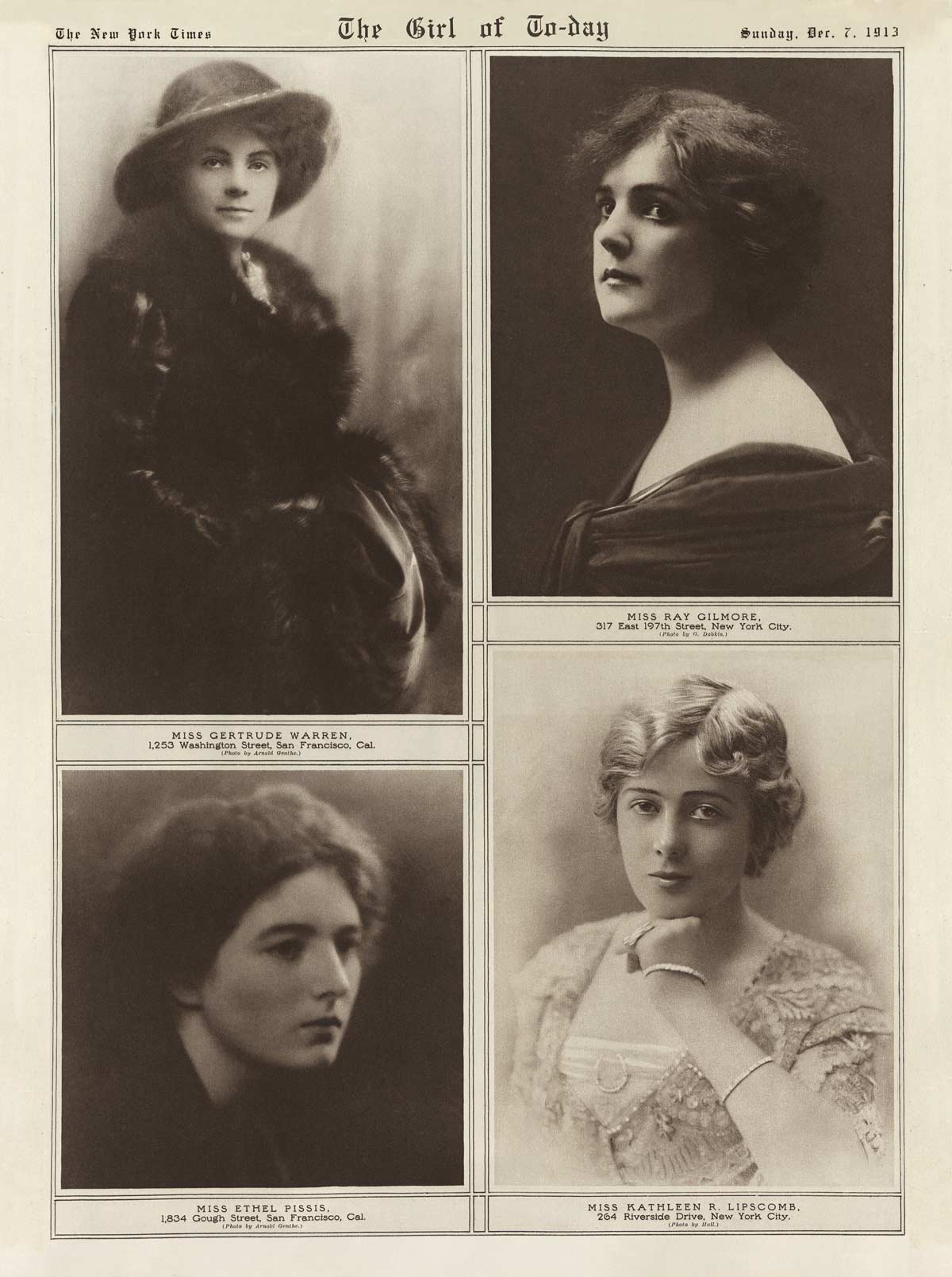
The New York Times, December 7, 1913, Christmas issue, page 7

The New York Times, December 7, 1913, Christmas issue. Page 7

Miss Gertrude Warren, 1,253 Washington Street, San Francisco, Cal. Photo by Arnold Genthe.

Miss Ray Gilmore, 317 East 197th Street, New York City. Photo by G.Dobkin.

Miss Ethel Pissis, 1,834 Gough Street, San Francisco, Cal. Photo by Arnold Genthe.

Miss Kathleen R. Lipscomb, 264 Riverside Drive, New York City. Photo by Hall.

The New York Times, December 7, 1913, Christmas issue, page 8

The New York Times, December 7, 1913, Christmas issue. Page 8

Mrs. Charles Dillingham, 8 West 40th Street, New York City, Photo by Mishkin Studio.

Miss Helen Chance, 3615 Hamilton Street, Philadelphia, Penn. Photo by Phillips Studio, Philadelphia.

Miss Louise Russel, 563 Palisade Avenue, Yonkers, N.Y. Photo by Brandeburg.

Miss Viola Fitzpatrick, 8422 10th Avenue, Brooklyn, N.Y. Photo by J. Kennedy, Toronto.


The splendid Portrait of Miss Louise Russel, completes the selection of the best 29 images published on the New Times Christmas Issue of Sunday December 7, 1913. The remaining 61 were published in the next Sunday Number. Stay in touch as we are going to publish them in the next post.

Bugatti Posters

Bugatti Posters

Bugatti Posters

Cassandre, Dudovich, Vincent, Geo Ham — the finest graphic artists of the era, commissioned by Bugatti.

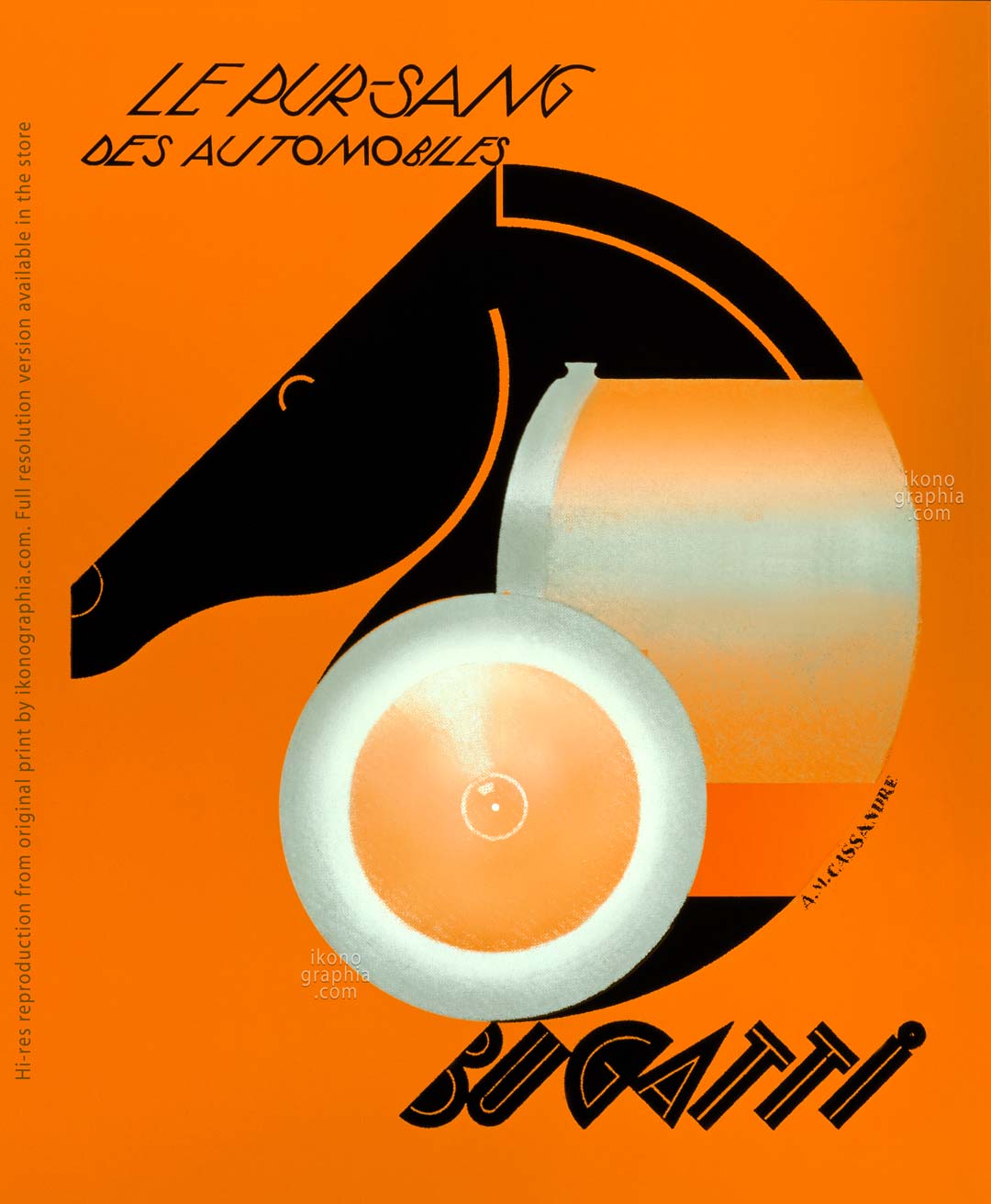
Bugatti commissioned its advertising posters from the finest graphic artists of the era — Cassandre, Marcello Dudovich, René Vincent, Geo Ham. The results are among the most celebrated works in automotive poster art. Cassandre's 1935 Le Pur-Sang des Automobiles remains the definitive image of the marque. Dudovich's 1922 C'è una Bugatti, non si passa is a masterpiece of symbolic compression.

The originals were held in the Campogalliano archive. Roberto Bigano borrowed and reproduced them in his studio — the same access that produced the factory drawings. The archive presents the most significant surviving examples, reproduced directly from the originals.

Bugatti Le Pur-Sang Des Automobiles. Art by Cassandre 1935

Obsessive attention to detail and hiring the best artists.


Ettore Bugatti designed many of his creations, as did his highly talented son Jean, who later took to the drawing board alone. This extraordinary man had attended the Brera School of Art as a youth, yielding an artistic streak.
He also demonstrated an astonishing ability for mechanical engineering and an amazingly eclectic mind in general. At the age of 20, he built his first car and personally designed everything from the “ergonomic” interiors of his company’s automobiles.
Consequently, Ettore and Jean designed and oversaw Bugatti’s literature (catalogs, advertisements, posters, and factory technical drawings).
The posters were created by great artists of the time, including Cassandre, Marcello Dudovitch, Renè Vincent, Geo Ham, and others.

C’è una Bugatti, non si passa (There's a Bugatti, you can't pass.) Poster by Marcello Dudovich 1922 Dimensions: 195x140 cm Printer: Edizioni STAR . Officine IGAP, Milano This masterpiece is rich in symbolism, beginning with the title that emphasizes Bugatti's legendary invincibility. The model portrayed is the Type 13 Brescia.

C’è una Bugatti, non si passa (There's a Bugatti, you can't pass.) 1922.
A Poster by Marcello Dudovich.

Dimensions: 195x140 cm
Printer: Edizioni STAR . Officine IGAP, Milan

This masterpiece is rich in symbolism, beginning with the title emphasizing Bugatti's legendary invincibility. The model portrayed is the Type 13 Brescia.

Apparently, there is a reference to Isadora Duncan, who died when her red scarf became entangled in the wheel of a Bugatti. But this is not possible, as this happened five years later.

1930 Bugatti Poster by René Vincent

Bugatti. 1930
A Poster by René Vincent

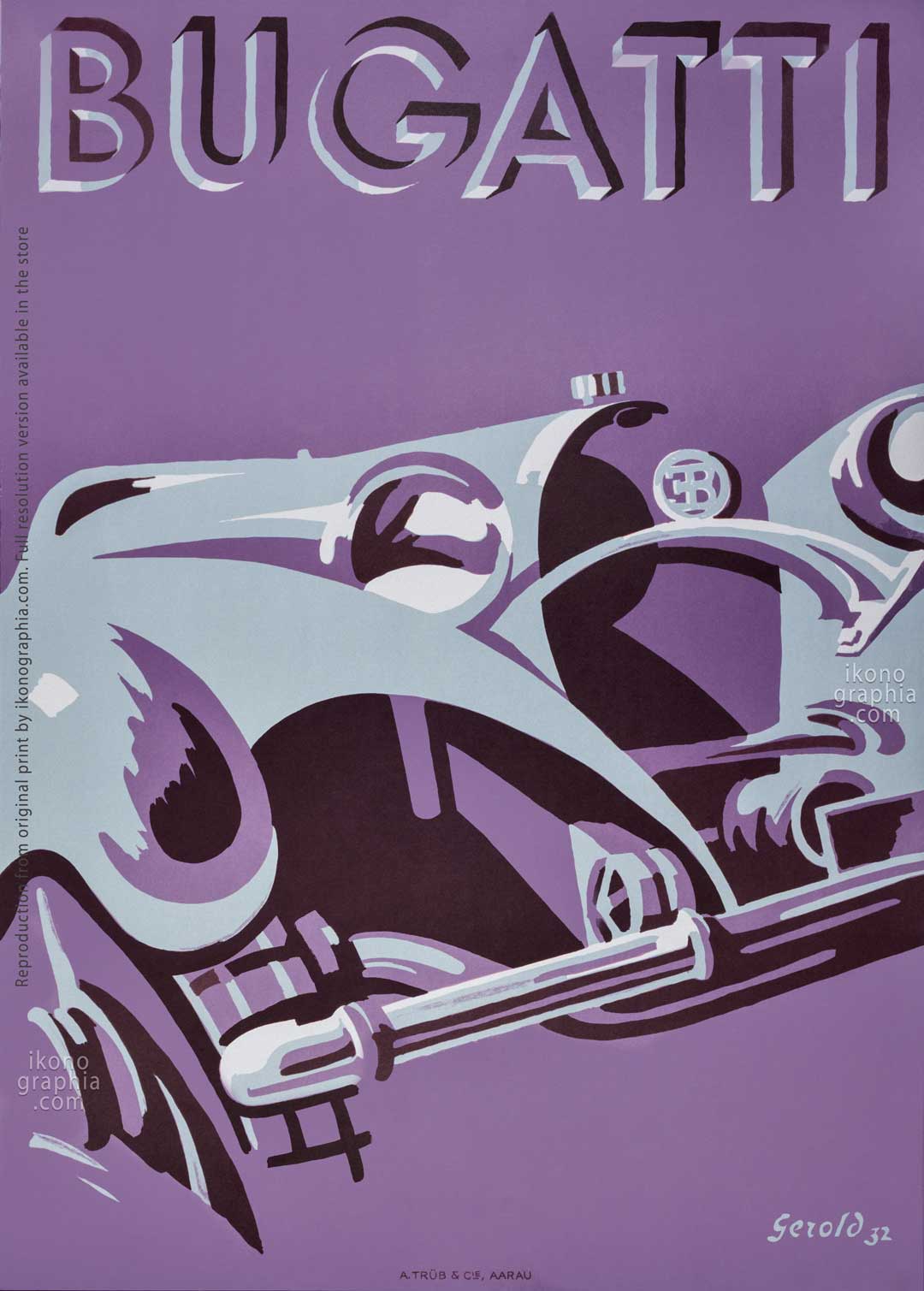
An impacting 1932 Bugatti Poster by Gerold

Bugatti Type 50 1932.
Artwork by Gerold.
Poster size: 51 x 35in / 129 x 90cm

Published by A.Trüb & Cie, Aarau, Switzerland

Le Pur-Sang Des Automobiles. Art by Cassandre 1935. An iconic 1935 Bugatti Poster by Cassandre, pseudonym of Adolphe Jean-Marie Mouron.

Le Pur-Sang Des Automobiles. 1935
An iconic 1935 Bugatti Poster by Cassandre, pseudonym of Adolphe Jean-Marie Mouron.

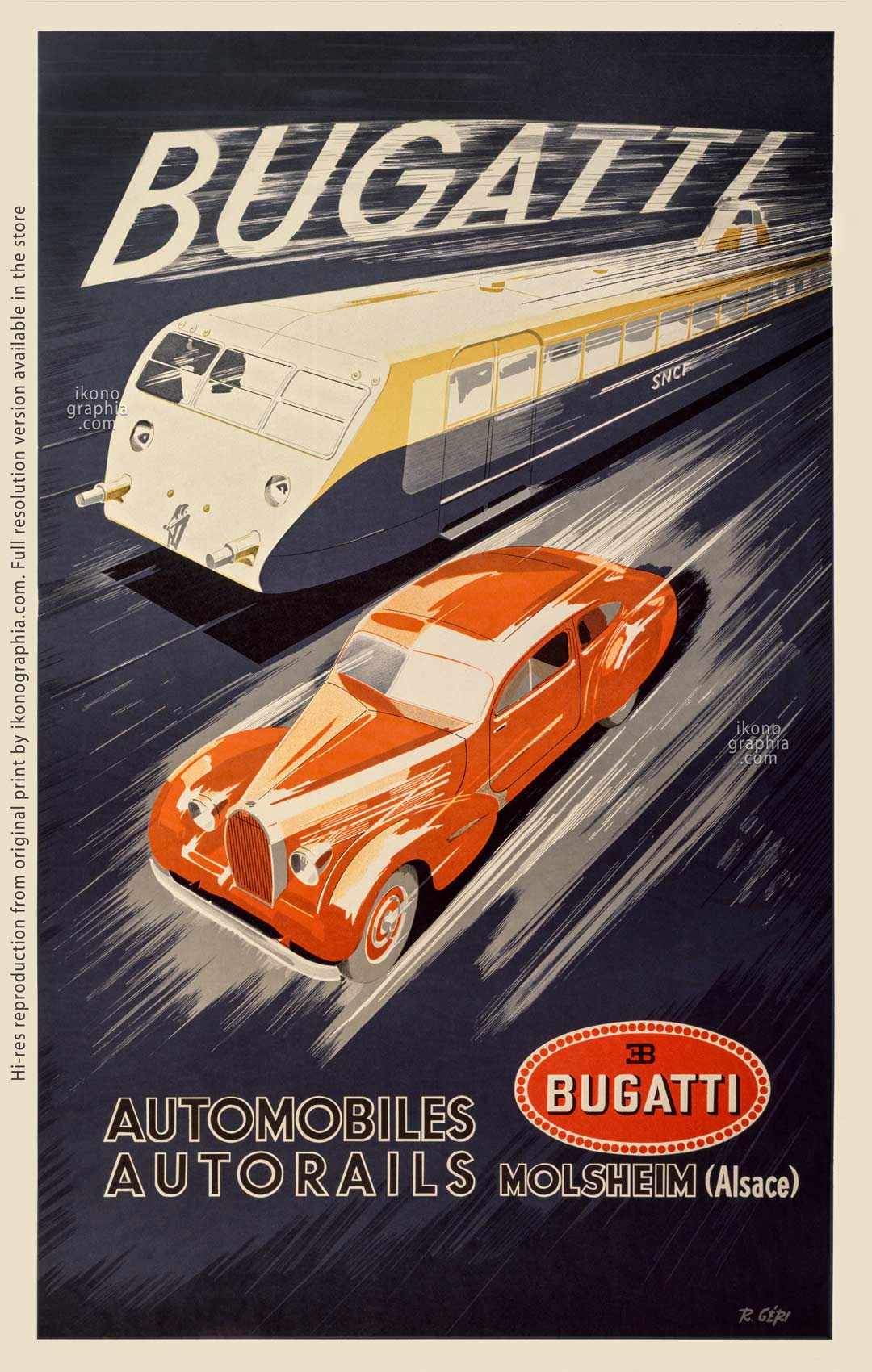
Bugatti Automobiles et Autorails. 1935 - Art by R.Geri

Bugatti Automobiles et Autorails. 1935.

Art by R.Geri
Poster size: 38 x 23in. / 97 x 59cm.

Bugatti Type 57 Modeles 1939

Bugatti Type 57 Modeles 1939.

Middle Ages Vandals

Middle Ages Vandals

Ikonographia

Dec 24, 2015

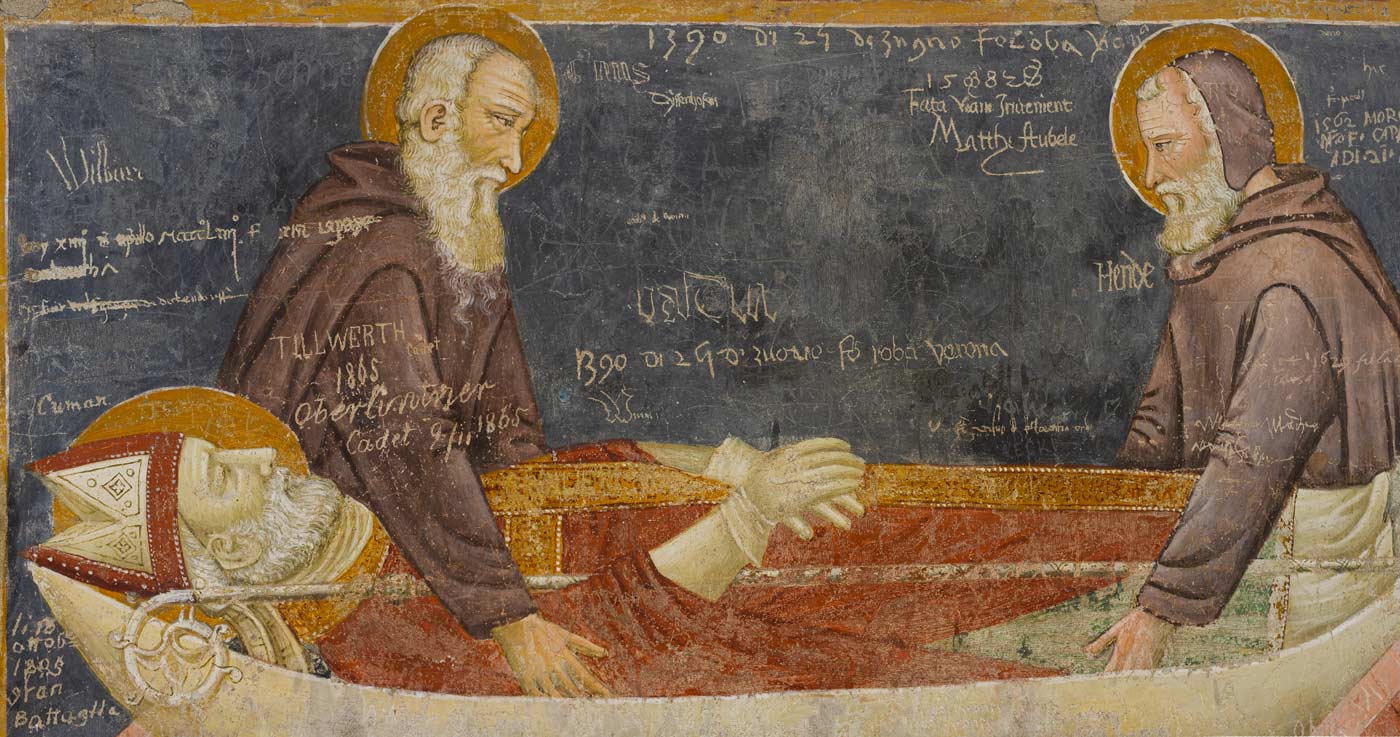
Graffiti signature. San Zeno Cathedral, Verona, Italy.

Graffiti throughout the Middle Ages


Graffiti or tagging is not only a modern artistic expression. We see examples as far back as the middle ages, and likely earlier. Below you can see several examples of this practice on the frescoes of the stunning Basilica of San Zeno in Verona, Italy built in the X-XI century.

In the fresco of San Zeno being laid to rest by Saints Benigno and Caro, for example, you can see a message left from the two men, with the date June 24, 1390. These graffiti can often be of historical importance and leave additional information about the author, circumstances, or time.

A fresco depicting the Saints Benigno and Caro burying San Zeno. The add a graffiti with the date, June 24, 1390.
1926. The Complete Love Story betweeen Tonino and Amelia

1926. The Complete Love Story betweeen Tonino and Amelia

A Passionate Kiss

Ferrara, Italy, March 1926. A passionate kiss started an aching love story told through a series of postcards between the two lovers, that always brought back to that first kiss. The correspondence lasted about two years but we believe the romance had a happy ending as the postcards were found together, as rejoined into a single story when the two protagonists finally came together.

Tonino and Amelia were an unlikely couple. Looking at the writing, we can tell that Amelia was highly educated, writing more elaborate letters, while Tonino's replies were often simple and concise. But these differences only brought them closer.

We stumbled across the first set of postcards at a flea market in Gonzaga, Italy, and were immediately swept up by the passionate story. Luck would have it, we were able to find the remaining postcards piecing together, not only Tonino and Amelia's story but also a snapshot of the time.

Testo originale italiano

Un’applicazione innovativa progettata ed ottimizzata per risoluzioni tra 1000 e 1500 px. In questa gamma rientrano quasi tutti gli utilizzi web e social di importanza sempre più determinante.

TOPICS

USD United States (US) dollar
EUR Euro