Divina Bugatti. A Timeless Legend Celebrated in a Timeless Book

Divina Bugatti. A Timeless Legend Celebrated in a Timeless Book

Divina Bugatti. A Timeless Legend Celebrated in a Timeless Book

Franco Maria Ricci's most celebrated automotive book — photographed by Roberto Bigano at the Musée National de l'Automobile, Mulhouse, 1991.

In 1991, Franco Maria Ricci — the publisher Fellini called "La Perla Nera" — commissioned Roberto Bigano to photograph the historic Bugatti collection at the Musée National de l'Automobile in Mulhouse. The pictures were taken over six nights, with a 4×5 view camera, in a closed museum. Two editions of 5,000 copies each. Both sold out.

The cover of the book Divina Bugatti, Storia di un capolavoro meccanico published in 1991 by Franco Maria Ricci, with photographs by Roberto Bigano.

Divina Bugatti's Story. Characters and Background.

We will tell you the story of the book "Divina Bugatti." It was created as a joint effort between Romano Artioli, owner of Bugatti Automobili, and Franco Maria Ricci, a legendary Italian publisher—the photographs by Roberto Bigano. Before we begin, let us introduce the characters and put them in context.

Automobiles Ettore Bugatti was a French high-performance car manufacturer founded in 1909 in Molsheim, Alsace, France, by the Italian industrial designer Ettore Bugatti. The firm produced about 8,000 cars and is known for its design beauty and many race victories.

Romano Artioli is an Italian visionary entrepreneur who bought the Bugatti brand in 1987 and revived it in Campogalliano, Modena, as a builder of its time's fastest series-production car. Bugatti Automobili produced a total of 128 cars. Read all the stories here.

Franco Maria Ricci was one of the most refined editors the world had ever seen. His iconic Magazine, FMR, and splendid books are still a reference. However, FMR was also an often unattainable goal for any photographer. Laura Casalis, Franco Maria Ricci's widow, recently relaunched the FMR magazine and Publishing House with outstanding publications.

Roberto Bigano was Bugatti's photographer at the beginning of the 1990s, documenting the birth of the new Bugatti. Roberto will introduce us to the fascinating vintage Bugatti world.

Bugatti Type 57SC Coupè Atalante (1937) in two lighting modes

Use the arrows or tap on devices to see the two versions. Courtesy: Musée National de l’Automobile Mulhouse.

Roberto Bigano and Divina Bugatti

Let Roberto Bigano tell us how the Divina Bugatti book project started and went through.

"In 1991, I was working for Bugatti Automobili. One day, the refined publisher Franco Maria Ricci, who already desired to celebrate the myth of the Bugatti, suggested the idea of a book on the legendary brand to Romano Artioli, the Bugatti company owner. They reached an agreement, and the plan went through. Naturally, Artioli mentioned "the best photographer in the world" to Ricci, encouraging my candidacy for the job. Ricci, as expected, was skeptical. "I have my photographers, ones I trust," he said with a half smile. The persistence of Artioli gained me a meeting with Ricci. "Go and take a few shots; we'll see," he said to get rid of me."
From Roberto Bigano's "1976-1992. A very serious, semi-serious biography."

Dashboard of a Bugatti Type 35B Grand-Prix (1927). Photo by Roberto Bigano. Courtesy: Courtesy: Musée National de l’Automobile Mulhouse. Buy this image at Ikonographia.com store

Dashboard of a Bugatti Type 35B Grand-Prix (1927).

Courtesy: Musée National de l’Automobile Mulhouse.

Roberto Bigano and Divina Bugatti

I felt well-equipped for my departure—one hundred forty-five different accessories packed in the trunk of my station wagon. For months, I had been working on how to build a mobile set around a Bugatti on location. Before violating that holy ground, I carried out a test: I photographed a Lancia Thema in a large shed. It worked, so I decided to go ahead.

Upon arriving at the National Automobile Museum of Mulhouse in Alsace, I embarked on my nocturnal marathon. Cloaked in the atmosphere of suspense, in the eery silence, I came face to face with The Divine. The situation reminded me of one of Hemingway's stories: the bull and the lion, still before the charge. I was almost worried that the steel muscles would explode, at any time, in all their power, and the beast within would run me over like a train. I had an emotional outburst; I felt as if I were running a fever. Like a robot, I kept shooting and opening Polaroids. I looked at her, but I could not see inside her. Fatigue and tension made everything even more dramatic. "What am I doing here in France, in the middle of the night, in a dark museum? Why didn't I stay home?" I started thinking.
From Roberto Bigano's "1976-1992. A very serious, semi-serious biography."

The Turning Point Polaroid at Musée National de l’Automobile Mulhouse. Bugatti Type 35B Sport Two-seater, US Coachwork (1927).

The "Turning Point" Polaroid

Suddenly, I had reached the turning point: I opened yet another Polaroid, but this time, I found the courage to look at it with a photographer’s eye. I had recognized her, THE Bugatti, in all her dazzling beauty. “I am yours. Only you will be able to possess me,” she was saying. I started dancing as if I was in the middle of the Rio de Janeiro carnival parade. I didn’t feel tired anymore. “I’ve done it!” I said, my voice echoing in the empty museum.
I’d finally gotten a hold of the situation. I’d jumped on the wild horse and was riding as a Native American would.
From Roberto Bigano's "1976-1992. A very serious, semi-serious biography."

The Backstage for Divina Bugatti. Musée National de l'Automobile, Mulhouse, Alsace, France. June 1991. Photo by Roberto Bigano. Buy this image at Ikonographia.com store

The Backstage for Divina Bugatti — Musée National de l'Automobile, Mulhouse, Alsace, France — June 1991.

All the pictures were taken with a 4x5 Plaubel Wiew Camera, Makro Sironar 300mm lens, and Ektachrome Professional film.

The Presentation at Franco Maria Ricci.

I arrived at Franco Maria Ricci’s, feeling confident and appearing as cold-blooded as a contract killer. I knew I was in the presence of one of the most refined editors the world had ever seen. Still, I also knew that I could not fail: if he had any taste at all – and it could not be otherwise – he could not still be indifferent after seeing my work.

Ricci received me with a gentler than polite smile, the smile you would give a child showing you their drawing. His expression changed and suddenly brightened after his eyes settled on the first transparency. “But they are… lit!” he whispered to himself. “Of course they are! Did you think I would bring you the dark ones?” I answered in a friendly yet amused manner. It felt like I was watching from the outside as if I were the spectator to a film. Franco Maria Ricci picked up the phone. “Come and look at something sensational!” he said, running down the corridor enthusiastically. “Call the others and tell them to come to my office!” He looked at me excitedly in front of all his associates, as if I were a superhero, and offered me some incredible projects: on Spanish baroque style, on medieval armor, on the town of Parma, and on French cabinet-makers. He had just assigned me all his future projects.
I had managed to impress Franco Maria Ricci, the king of aesthetics!
From Roberto Bigano's "1976-1992. A very serious, semi-serious biography."

Backstage at Museé National de l'Automobile, Mulhouse. Bugatti Type 41 Royale Coupé Napoleon (1929) The personal car of Ettore Bugatti.

The Backstage for Divina Bugatti — Musée National de l'Automobile, Mulhouse, Alsace, France — June 1991.

All the pictures of the Royale were taken at night in this set, which was highly problematic. The Royale was 7.2m / 24 feet and was very difficult to lighten.

Selected pictures from the book

Selected images from the book — The most iconic Bugattis, documented under the most demanding editorial standards in the world.
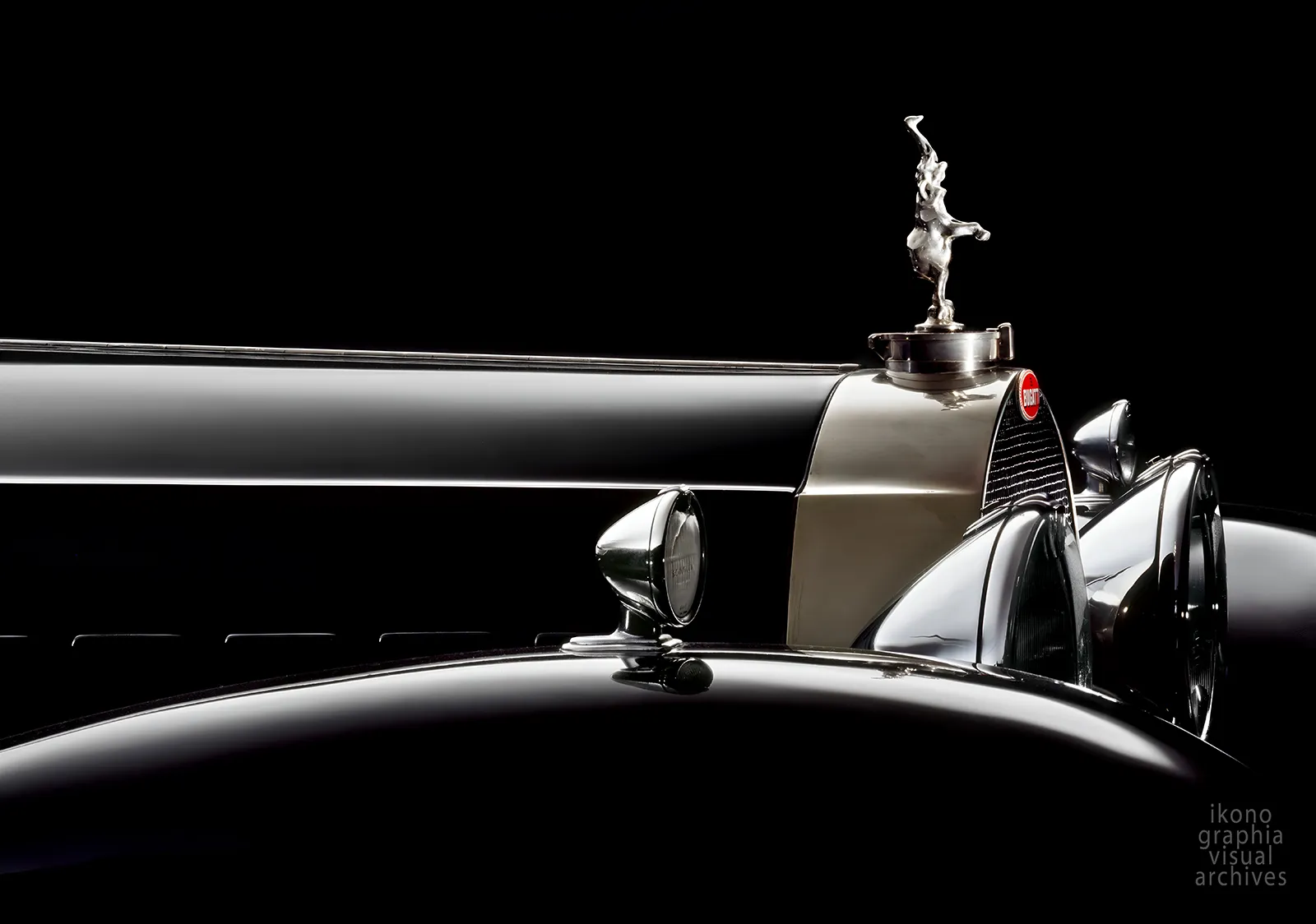
Bugatti Type 41 Royale Coupé Napoléon, 1929 — bonnet detail with Rembrandt Bugatti elephant mascot. Photographed by Roberto Bigano at the Musée National de l'Automobile, Mulhouse.

Bugatti Type 41 Royale Coupé Napoléon — Bonnet and Rampant Elephant, 1929

The personal car of Ettore Bugatti. Engine: 12,763 cc. Photographed for Divina Bugatti — Franco Maria Ricci's most celebrated automotive book.

Ricci's rule was absolute: no non-orthogonal images. His response: "We never publish this kind of photograph, but this image is so beautiful that I must. Please don't do it again." The world's most demanding publisher broke his own rule for this picture.

The Elephant carved by Rembrandt Bugatti, right on top of the radiator grill of the Type 41 Royale Coupé Napoleon, the personal car of Ettore Bugatti. It was an elephant standing on his back legs, with the erect trunk as a symbol of aggression and coupling (1929) - Courtesy: Musée National de l'Automobile, Mulhouse. Photo by Roberto Bigano. Courtesy: Courtesy: Musée National de l’Automobile Mulhouse. Buy this image at Ikonographia.com store

The Elephant carved by Rembrandt Bugatti placed atop the radiator grill of Ettore Bugatti's Type x41 Royale Coupé Napoleon.

An elephant standing on its back legs, with the erect trunk symbolizing aggression and coupling (1929).

A 1937 Bugatti Type 57SC Coupé Atlantic. Detail of the windshield and wipers emphasizing the riveted crest. Jean Bugatti designed the half-body ending in a crest. He then reverted the first part right-left and finally joined the two pieces with rivets in one of the most daring automotive designs. Photo by Roberto Bigano. Courtesy: British Garage, Paris. Buy this image at Ikonographia.com store

Bugatti Type 57SC Coupé Atlantic — 1937

Detail of the windshield and wipers emphasizing the riveted crest. Jean Bugatti designed the half-body ending in a crest. He then reverted the first part right-left and finally joined the two pieces with rivets in one of the most daring automotive designs.

Bugatti Type 32 Biplace Course "Tank" (1923). This striking, unexpected rear view emphasizes the aerodynamics of the design. Photo by Roberto Bigano. Courtesy: Courtesy: Musée National de l’Automobile Mulhouse. Buy this image at Ikonographia.com store

Bugatti Type 32 Biplace Course "Tank" — Rear view, 1923.

One of the first racing cars designed around aerodynamic principles — the body enclosing the wheels, the silhouette a single uninterrupted form.

This rear view reveals the engineering logic: everything hidden, everything intentional. Among the first racing cars to use four-wheel braking.

Bugatti Type 35B Sport Two-seater, US Coachwork (1927). Photo by Roberto Bigano. Courtesy: Courtesy: Musée National de l’Automobile Mulhouse. Buy this image at Ikonographia.com store

Bugatti Type 35B Sport Two-seater, US Coachwork — Rear view, 1927.

Purists consider the American coachwork a deviation from the original design.

Bugatti Type 59-50B Grand Prix Monoplace Course - Single Seater 1938 - Courtesy: Musée National de l’Automobile Mulhouse

Bugatti Type 59-50B Grand Prix Monoplace Course — Single Seater, 1938

The last racing Bugatti.

The very first EB110 model made in epowood as designed by Benedini, with the rear wheels covered reminding the Bugatti Atlantic. Photo Roberto Bigano. Buy this image in the ikonographia.com store.

The First Epowood Model of Bugatti EB110 — Unveiled in Divina Bugatti.

The early EB110 epowood maquette produced during the 1991 restyling phase led by architect Gianpaolo Benedini. The model introduces the covered rear wheels, a deliberate reference to the Bugatti Atlantic and Aérolithe, reconnecting the modern EB110 project to the marque’s most radical pre-war designs and marking a decisive step toward the final EB110 GT.

Divina Bugatti. Storia di un capolavoro meccanico. Divine Bugatti. Histoire d'un chef dœvre de la mécanique. Franco Maria Ricci Editore 1991.

DIVINA BUGATTI — Storia di un capolavoro meccanico

Divina Bugatti. Storia di un capolavoro meccanico.
Divine Bugatti. Histoire d'un chef dœuvre de la mécanique.
Franco Maria Ricci Editore 1991.
Photographs by Roberto Bigano.
Texts by Giuseppe Maghenzani, Ivo Ceci, Norbert Steinhauser, Paul Kestler.

204 pages.
72 color prints on matte-coated paper.
15 hand-applied color plates.
29 reproductions 30 x 30 cm.
Luxury Fabriano blue-laid paper.
Black "Orient" silk binding with gold impressions.
Circulation of Italian Edition, 5000 numbered copies.
Circulation of French Edition, 5000 numbered copies.

Copyright, Links And Credits

Photography, Copyright & Credits

These images are part of the Ikonographia Visual Archives: — Bugatti Heritage Collection —  Bugatti Factory Drawings  Archive.
All drawings reproduced by Roberto Bigano in 1990 from originals held in the Bugatti factory archive. The current location of the originals is unknown.
All photographs © Ikonographia / Roberto Bigano — All Rights Reserved.

Terms of Use (Summary)

The images presented in this archive are copyrighted and available for licensed use only through Ikonographia Visual Archives.

You may not download, reproduce, publish, or distribute these images without a valid license. For commercial or editorial licensing, please refer to the product pages or contact Ikonographia directly. A full explanation of licensing terms is available in the Shop / Licensing Information section under "Ikonographia — Standard License" and "Ikonographia — Merchandising & Product Use Licenses"

The Ikonographia Bugatti Heritage Archive

Between 1990 and 2009, photographer Roberto Bigano documented Bugatti with a level of access that no longer exists and cannot be replicated. The relationship began with Romano Artioli — the Italian entrepreneur who had just acquired the Bugatti name and was preparing its revival at Campogalliano — who gave Roberto carte blanche to work inside the factory, the archive, and every event that followed. No brief. No restrictions. No supervision.

What resulted is not a single project but five distinct bodies of work: the factory technical drawings reproduced before they disappeared, two major photographic commissions on the historic cars, a complete documentary record of the Bugatti International Centenary Meeting in Tuscany, and an Alsatian reportage made inside Molsheim before the restoration began. Together they form one of the most complete private archives of Bugatti heritage in existence — most of it unpublished until now, some of it available nowhere else.

The archive is not a celebration of the marque. It is a record made by someone who was trusted enough to be inside it, at the precise moment when its past and its future were in the same room.

Credits & Acknowledgments

Ikonographia gratefully acknowledges the fundamental contribution of Romano Artioli, founder of Bugatti Automobili, without whose trust and unrestricted access this archive would not exist.

Ikonographia Mission Statement

Ikonographia is committed to the accurate documentation, preservation, and ethical dissemination of twentieth-century visual culture.

Archival Notes

These drawings were reproduced by Roberto Bigano in 1990, during the preparation for the revival of Bugatti Automobili at Campogalliano. Access to the Bugatti factory archive was granted by Romano Artioli. The drawings document the original Molsheim factory production.

Further Reading (Selected Sources)

Gluyas Williams Cartoons — Ourselves as Others See Us (1928)

Gluyas Williams Cartoons — Ourselves as Others See Us (1928)

Gluyas Williams Cartoons — Ourselves as Others See Us (1928)

The complete run on Cosmopolitan, 1928 — the only merged reproductions known to exist.

The complete run of Gluyas Williams's double-page illustrations from the series "Ourselves as Others See Us," published in Cosmopolitan in 1928. A single issue of Cosmopolitan in that period could contain a double spread by Williams, one by Anne Fish, and one by Charles Dana Gibson. The standard was not accidental.

Cosmopolitan printed these illustrations across two separate pages, adding a blank gutter between them. Ikonographia digitally merged the two halves to restore each spread as Williams drew it. No other merged reproductions are known to exist.
The 1929 and 1930 runs follow.

Cosmopolitan 1928-10_096-097 The After Dinner Speech, by Gluyas Williams from "0urselves as Others See Us" series.

Gluyas Williams Cartoons for Cosmpolitan 1928.


Gluyas Williams was an American Cartoonist whose best work lasted from the 1920s to the 1940s. His most notable work was for Life, The New Yorker, and Cosmopolitan.

His unique style combined tiny, apparently fragile lines with solid, flat blacks without detail or shadows. The subjects were social situations where many people gathered, reaching their peak in the complex double pages. Some cartoons display hundreds of characters with mesmerizing compositions, anyone with a unique and robust personality.

We cannot write more without copying the splendid, ultimate essay of Robert C. Harvey. that we strongly encourage you to read. He called Williams the "Master of Complexity and Simplicity."

This story features the entire run of double-page illustrations published in Cosmopolitan in 1928. This was the golden age of the magazine's illustration, featuring splendid plates from artists such as Gluyas Williams, Charles Dana Gibson, and  Anne Harriet Fish in the same issues. These masterpieces finally fell into the Public Domain on January 1, 2024.

Cosmopolitan 1928-05_096-097 Going to the Movies, by Gluyas Williams from "0urselves as Others See Us" series.

Going to the Movies.
From "Ourselves as Others See Us" series. Published on Cosmopolitan in May 1928.

Cosmopolitan 1928-06_102-103 Bridge, by Gluyas Williams from "0urselves as Others See Us" series.

Bridge.
From "Ourselves as Others See Us" series. Published on Cosmopolitan in June 1928

Cosmopolitan 1928-07_104-105 The One-Arm Lunch, by Gluyas Williams from "0urselves as Others See Us" series.

The One-Arm Lunch.
Published on Cosmopolitan in July 1928.

Cosmopolitan 1928-08_106-107 The Picnic, by Gluyas Williams from "0urselves as Others See Us" series.

The Picnic.
Published on Cosmopolitan in August 1928

Cosmopolitan 1928-09_108-109 The End of Vacation, by Gluyas Williams from "0urselves as Others See Us" series.

The End of Vacation.
Published on Cosmopolitan in September 1928.

Cosmopolitan 1928-10_096-097 The After Dinner Speech, by Gluyas Williams from "0urselves as Others See Us" series.

The After Dinner Speech.
Published on Cosmopolitan in October 1928.

Cosmopolitan 1928-11_090-091 Football, by Gluyas Williams from "0urselves as Others See Us" series.

Football.
Published on Cosmopolitan in November 1928.

Cosmopolitan 1928-12_094-095 In the Diner, by Gluyas Williams from "Ourselves as Others See Us" series.

In the Diner.
Published on Cosmopolitan in December 1928.

How we reproduced the double-page images.


Cosmopolitan printed these double-page illustrations across two separate pages, adding a blank gutter between them. The original compositions were designed as a single image — split for production, never reassembled.

Ikonographia digitally merged the two halves to restore each spread as Williams drew it. These are the only merged reproductions in existence.

Cosmopolitan 1928-11_090-091 Football, by Gluyas Williams from "0urselves as Others See Us" series.
Cosmopolitan 1928-10_096-097 The After Dinner Speech, by Gluyas Williams - Original pages with Gutter

In the bound magazine, the image was visually correct. However, the plain reproduction of the two mages, including the blank gutter, was unacceptable.

Selected Contents from Portfolio No. 1 (Winter 1950)

Selected Contents from Portfolio No. 1 (Winter 1950)

Selected Contents from Portfolio No. 1 — Winter 1950

The first issue of Portfolio arrived as a shock.

Conceived and designed by Alexey Brodovitch, Portfolio No. 1 was not a magazine in the conventional sense but an editorial experiment—treating photography, typography, illustration, and sequencing as a single expressive system. Layout was no longer a container, but an active force: rhythm, contrast, and white space became instruments of meaning.

Design from the Mathematicians. By Prof. Baravalle. Portfolio N.1 1950. Page 24-25 Left page: Above, a family of lines tangent to a parabola. Upper right, design based on series of concentric circles and parallel tangents. Lower right, a family of logarithmic spirals. Opposite page: Lower left, a family of curves satisfying a differential equation (by Professor Andre Saint-Lague of Paris). Upper left, a triangle inscribed with straight lines.

This selection presents key spreads from the inaugural issue, reproduced from carefully unbound originals.
Read in sequence, they reveal Portfolio’s debut as a radical editorial experiment conceived by Alexey Brodovitch—not a conventional magazine, but a visual laboratory where photography, typography, illustration, and pacing form a single expressive system.

Alongside the images, Ikonographia preserves excerpts from the original texts, printed here in italics not as secondary commentary, but as primary material. These texts—often reproduced in full—are exceptional in their own right, defining an era and articulating Brodovitch’s vision with a precision and ambition that would be impossible to improve upon.

Most importantly, the newly unbound, full-spread reproductions restore the magazine’s true spatial architecture—alignments, axes, and transitions long obscured by binding—making visible design decisions that disappear in standard, cut-in-two reproductions.

The cover of the first issue of Portfolio Magazine, winter 1950. Designed by Alexei Brodovitch with Art Director Frank Zachary. Portfolio has been widely acknowledged as perhaps the definitive graphic design magazine of the twentieth century.

Portfolio Magazine N. 1
Winter 1950.

The first issue of Portfolio Magazine, entirely conceived and designed by Alexey Brodovitch, announcing a new editorial language built on sequence, contrast, and visual tension rather than fixed layout.

Selected Contents from Portfolio N.1 — The Bodoni Typeface

One day in 1787, in his printing shop in Philadelphia, Benjamin Franklin received a specimen sheet of typefaces from Giambattista Bodoni of Parma, Italy. This was the first time that Franklin had seen the work of the man considered Europe's foremost type designer and printer, and he was greatly impressed.

"I have had the great pleasure of receiving and perusing your excellent "Essai des Characteres de L'Imprimere," he wrote Bodoni. It is one of the most beautiful that Art has hitherto produced. As the first American to go on record in appreciation of the Bodoni typeface, sage old Ben Franklin pioneered a trend in U. S. typography, which was to have far-reaching effect on the design of printed matter in our time.

Editorial content on Giambattista Bodoni, an Italian genius who created the Bodoni, America's most widely used typeface. Portfolio Magazine N. 1, winter 1950, pages 4-5.

The Bodoni Typeface — pages 4-5

Before Giambattista Bodoni, roman letters had the form of the old-style A (opposite) with heavy stems and curving serifs, as in hand-writing.

This sheet (right) from Bodoni's Manuale Tipografica shows how he altered the design of printing types to give them a mechanical appearance. He emphasized the contrast between light and heavy strokes, with serifs forming sharp right angles with the upright strokes, producing the first modern typeface.

Florets, borders, and rules designed by Gian Battista Bodoni. Portfolio 1, winter 1950, pages 12-13.

The Bodoni Typeface — pages 12-13

Florets, borders, and rules designed by Gian Battista Bodoni. A sample from the 1200 varieties of decorations created by Gian Battista Bodoni, an Italian typographer who created America's most widely used typeface.

Left: Arabic Numerals from Bodoni's "Manuale Tipografica." Right: A reprint-as-the-original of Bodoni's Q. Horatii Flacci Opera 1791 (Horace's Opera.)

The Bodoni Typeface — pages 14-15

Left: Arabic Numerals from Bodoni's "Manuale Tipografica."

Right: A reprint-as-the-original of Bodoni's Q. Horatii Flacci Opera 1791 (Horace's Opera.) This insert reproduces four specimen pages from books designed by Giambattista Bodoni in 18th Century Parma. They are printed by offset on hand-made paper from Cartiere Milani, the 675-year-old mill in Fabriano, Italy.

Design from Mathematicians

Portfolio was not conceived as a magazine in the conventional sense, but as a radical editorial experiment. Published between 1950 and 1951, it functioned as an open laboratory in which photography, typography, illustration, and sequencing were treated as a single expressive system rather than as separate disciplines.

Under the direction of Alexey Brodovitch, each issue rejected fixed layouts, recurring formats, and commercial constraints. Pages were assembled through contrast, rhythm, and interruption, allowing images and text to interact dynamically across spreads. White space, scale shifts, and abrupt visual transitions became active elements of meaning rather than neutral containers.

Produced without advertising and printed in limited numbers, Portfolio was financially unsustainable but intellectually decisive. Only three issues were released, yet their influence proved disproportionate: the magazine established a new model of editorial authorship, redefining the role of the art director as both editor and composer of visual narratives.

Seen today as a continuous sequence rather than a set of iconic pages, Portfolio remains a foundational document of modern editorial design.

Design from the Mathematicians. Portfolio N.1 1950. Page 22-23. The beauty of geometrical forms is seen in these designs by Dr. Herman Baravalle, mathematics professor at Adelphi College, Long Island. Left: The saddle-shaped form of a hyperbolic parabaloid. Above: An electron contour map of a molecule of phthalocyanine produces an interesting amoeba-like pattern.

Design From The Mathematicians — pages 20-21

Left: The saddle-shaped form of a hyperbolic paraboloid.

Right: an electron contour map of a molecule of phthalocyanine produces an interesting amoeba-like pattern.

Design from the Mathematicians. By Prof. Baravalle. Portfolio N.1 1950. Page 24-25 Left page: Above, a family of lines tangent to a parabola. Upper right, design based on series of concentric circles and parallel tangents. Lower right, a family of logarithmic spirals. Opposite page: Lower left, a family of curves satisfying a differential equation (by Professor Andre Saint-Lague of Paris). Upper left, a triangle inscribed with straight lines.

Design From The Mathematicians — pages 22-23

Left: The saddle-shaped form of a hyperbolic paraboloid.

Right: An electron contour map of a molecule of phthalocyanine produces an interesting amoeba-like pattern.

Portfolio — The Hidden Architecture

Portfolio was bound with staples applied directly through the images. The central area of each double page — axes, alignments, transitions — was permanently obscured, even to contemporary subscribers. In the worst cases, the staples cut through figures, severing compositions that only made sense across the full width of the page.
The reconstruction process separated the pages, digitally realigned each half, and restored the complete spread. What follows is not a reproduction of Portfolio. It is Portfolio as Brodovitch designed it to be read — visible here for the first time.

Design from the Mathematicians. By Prof. Baravalle. Portfolio N.1 1950. Page 22-23 Left, wave curve with black and white parallel lines. Upper left, straight lines tangent to a hyperbole combined with a circle. Right, wave curve. Right page: Upper left, a group of tangents to an astroid (star-shaped) curve. Upper right, catacaustic curve (the kind reflected from inside a cup) made with straight lines. Below, design based on refraction of light.

Design From The Mathematicians — pages 24-25

Left: a wave curve with black and white parallel lines. Upper left, straight lines tangent to a hyperbole combined with a circle. Center, wave curve.

Right: upper left, a group of tangents to an astroid (star-shaped) curve. Upper right, catacaustic curve (reflected inside a cup) made with straight lines. Below is the design of the refraction of light.

Xerography — New Visual Effects with Powder and Electricity.

In his never-ending search for new ways of presenting the too-familiar, the experimental graphic artist has been given a new tool from an unexpected quarter—the electronics laboratory.

Recently, the Battelle Memorial Institute of Columbus, Ohio, an organization dealing in basic scientific research, began inviting selected representatives of the photographic world to a series of demonstrations of a new reproduction medium of their development, which they called Xerography, the first revolutionary development in rendering a photographic image since Daguerre coated his first plate 110 years earlier. It substitutes an electrically charged plate for the film now in use.
The Battelle demonstrator placed an ordinary plate holder into the back of a view camera. He made his exposure and disappeared with his holder into the darkroom. The onlookers settled down for a thirty-minute wait, but after one minute, the demonstrator returned, waving a dry, finished print.

1950 Xerography- New Visual Effects with Powder and Electricity. Goblets variations. Four xerographic studies of a water goblet show the various effects possible with the process. Graphic Design by Alexey Brodovitch. Portfolio 1, pages 42-43.

Xerography Art — pages 42-43

New Visual Effects with Powder and Electricity. 

Goblets variations.
Four xerographic studies of a water goblet show the various effects possible with the process.

1950 Xerography - New Visual Effects with Powder and Electricity. A portrait. This mysterious portrait resulted when the electrical charge on the xeroplate broke down. Graphic Design by Alexey Brodovitch. Portfolio 1, pages 44-45.

Xerography Art — pages 44-45

New Visual Effects with Powder and Electricity. 

This mysterious portrait resulted when the electrical charge on the xeroplate broke down.

Saul Steinberg — Drawings from his unpublished private sketchbooks.

Saul Steinberg, a Rumanian-born ex-architect, is one of the few U.S. cartoonists who also happens to be an artist at his work. When the Museum of Modern Art hung an exhibit of his drawings, one newspaper reviewer questioned the show with an article entitled "It's Funny—But Is It Art"?

But Steinberg's admirers seem to include most persons who have seen his drawings in The New Yorker, Harper's Bazaar, Town and Country, and other magazines; this was like asking if Charlie Chaplin could be taken seriously as a social critic because he wears baggy pants and crooked shoes.
Steinberg is compared with Chaplin because although the mediums they operate are two different things—their comic technique springs from the same source. Steinberg eschews the written word as Chaplin eschews the spoken word and speaks only through the pantomime of his pen.

His strange, silent world is peopled with chinless, blank-faced men, beady-eyed women with monstrous headdresses, precocious animals, and weird architectural fantasies, all drawn in a thin, wiry line that often wanders into an embellishment of scrolls and flourishes as Steinberg pauses to extract the Freudian implications of a cluttered interior, the curl of a beard, or just a plain doodle. At other times, the economy of his line is amazing, as in his drawing of the little man walking against a rain of empty clefs on a music sheet.

Reproduced here are eight pages of Steinberg drawings from his unpublished private sketchbooks.

Saul Steinberg. A beady-eyed woman and chinless, blank-faced men sit at a bar counter from an unpublished Steinberg's private sketchbook. Portfolio 1 Winter 1950, pages 84-85.

Saul Steinberg — pages 84-85

A beady-eyed woman and chinless, blank-faced men sit at a bar counter.

Illustrations reproduced from a previously unpublished Saul Steinberg's private sketchbook.

A rare example of a Steinberg's color drawing with a typical car and woman, plus an illustration of a little man walking against a rain of empty clefs on a music sheet. Illustrations reproduced from a previously unpublished Steinberg's private sketchbook. Portfolio 1 Winter 1950, pages 86-87.

Saul Steinberg — pages 86-87

A rare Steinberg colour drawing: a woman in motion, a fantastical automobile, the two figures in composition across the full spread.

On the upper left, a smaller drawing — a figure walking against a rain of empty clefs on a music sheet.

A typical example of Steinberg's weird architectural fantasies and fantastic animals, all drawn in a thin, wiry line that often wanders into an embellishment of scrolls and flourishes. Illustrations reproduced from a previously unpublished Stinberg's private sketchbook. Portfolio 1 Winter 1950, pages 88-89.

Saul Steinberg — pages 88-89

A typical example of Steinberg's weird architectural fantasies and fantastic animals, all drawn in a thin, wiry line that often wanders into an embellishment of scrolls and flourishes.

Sketches from a previously unpublished Steinberg's private sketchbook showing women figures and bearded men. Notes are almost unreadable. Portfolio 1 Winter 1950, pages 90-91.

Saul Steinberg — pages 90-91

Two pages, two registers. Left: women drawn in loose ink and wash — figures in motion, observed, incomplete. Right: bearded male portraits on black, surrounded by Steinberg's fake cursive — calligraphic marks that perform the appearance of annotation without delivering meaning. Signatures that sign nothing. Notes that say nothing.

News Portfolio

The editorial and design news section of Portfolio — a jewel of design in itself.

Saul Steinberg, a Rumanian-born ex-architect, is one of the few U.S. cartoonists who also happens to be an artist at his work. When the Museum of Modern Art hung an exhibit of his drawings, one newspaper reviewer questioned the show with an article entitled "It's Funny—But Is It Art"?


The Albro Alphabet Typeface, designed by Alexey Brodovitch. Portfolio N.1 1950, pages 118-119.

The Albro Typeface — pages 126-127

A Typeface designed by Alexey Brodovitch.

The Albro Alphabet (after the first syllables of his name) was inspired by the signs and symbols of musical notation.

It was released through Photo-Lettering, Inc., New York.

Artwork by Joan Miró. Portfolio 2, Summer 1950. Pages 128-129. For Art's Sake, from News Section playing graphically with primary CMYK colors.

For Art’s Sake, Artwork by Joan Miró — pages 128-129

Artwork by Joan Miró from the News Section.
The Alexey Brodovitxh design plays graphically with primary CMYK colors.

For Art's Sake

About 1100 art shows are held in New York annually, each of them spawning its own catalogue or brochure of the work exhibited. These publications have long since graduated from simple printed listings to productions of increasing originality. Shown here are a sampling of some of the season's more striking cover designs from 57th Street, ranging all the way from the huge serpentine signature of the Spanish painter Joan Miró (above) to bold typographic layouts and dramatic illustrations.

Copyright, Links And Credits

Portfolio Graphic Works, Copyright & Credits

© Ikonographia — Digital Restoration & Derivative Work Rights Reserved. These images are part of the Ikonographia Visual Archives: Portfolio Magazine Collection (1950–1951).

Copyright Status of Portfolio Magazine

Portfolio magazine (Issues 1–3, 1950–1951) was published in the United States and not renewed under U.S. copyright law. It is consequently in the public domain in the United States, and its editorial contents — including design, typography, and reproduced artworks — may be freely used.

Nature of Ikonographia's Work

The images presented here are not simple reproductions of the original magazine pages. They are reconstructed double-page spreads — a body of work that required the careful unbinding of original copies, precise digitization of individual pages, and their digital reassembly as unified visual fields.

This reconstruction reveals, for the first time, the complete compositions as Brodovitch intended them to be seen — hidden for decades by the tight binding of the original print edition.

Ikonographia's reconstructed spreads are original works and are protected as digital restorations and derivative works. They are available for licensed use through Ikonographia Visual Archives.

Terms of Use (Summary)

The images presented in this archive are copyrighted and available for licensed use only through Ikonographia Visual Archives.

You may not download, reproduce, publish, or distribute these images without a valid license. For commercial or editorial licensing, please refer to the product pages or contact Ikonographia directly. A full explanation of licensing terms is available in the Shop / Licensing Information section under "Ikonographia — Standard License" and "Ikonographia — Merchandising & Product Use Licenses."

Ikonographia Mission Statement

Ikonographia is committed to the accurate documentation, preservation, and ethical dissemination of twentieth-century visual culture.

Archival Notes

These reconstructed spreads were produced as part of Ikonographia's ongoing effort to preserve and make accessible significant works of twentieth-century graphic design.

Original copies of Portfolio were carefully unbound and digitized at high resolution. Individual pages were then reassembled with precision to restore the complete double-page compositions.
All images follow Ikonographia's internal archival standards for resolution, color accuracy, and metadata structure to ensure long-term consistency across the collection.

Ikonographia has made every effort to handle this material with accuracy and respect. We remain available for any inquiry or agreement regarding its use.

Credits

Portfolio magazine (1950–1951) was created by Frank Zachary and George Rosenthal (editors and co-founders) and Alexey Brodovitch (art director). Their vision produced one of the most significant editorial experiments of the twentieth century.

Further Reading — Selected Sources

Andrew Bosman, Brodovitch — The definitive monograph on Alexey Brodovitch's life and work.
Kerry William Purcell, Alexey Brodovitch — A comprehensive study of Brodovitch's design legacy, including Portfolio.

About Alexey Brodovitch. A short bio.

Alexey Brodovitch at work ,1950

Brodovitch at work in his studio.

Alexey Brodovitch (1898-1971)

Alexey Brodovitch was a Russian-born American designer, photographer, editor, and teacher whose work fundamentally reshaped twentieth-century visual culture. Best known as the art director of Harper's Bazaar (1934–1958) and the creator of Portfolio magazine, Brodovitch redefined the role of design as an active, expressive force rather than a neutral frame.

After leaving Russia, Brodovitch settled in Paris in 1920, where he absorbed Bauhaus principles, Italian Futurism, and the evolving languages of Cubism, Fauvism, Purism, and Surrealism. This plural exposure forged a visual sensibility grounded in movement, contrast, and disciplined freedom.

In the United States, Brodovitch became both a radical innovator and influential educator, mentoring generations of photographers and designers—including Richard Avedon, Irving Penn, Diane Arbus, and Garry Winogrand—establishing a legacy that continues to define modern editorial design.

Flirting, Engagement, Weddings & Divorce in 1920s High Society

Flirting, Engagement, Weddings & Divorce in 1920s High Society

Flirting, Engagement, Weddings & Divorce in 1920s High Society

Fish and Parker on love, marriage, and the divorce special.

The double-page plates of High Society are organized here into six thematic chapters. This first chapter covers flirting, engagement, weddings, and divorce — the full romantic cycle as Fish and her collaborators saw it: absurd, theatrical, and entirely inevitable.
First published in Vanity Fair between 1914 and 1920. Texts by Dorothy Parker and George S. Chappell.

All pages reproduced from the original book.

On the Trail of a Wife . Art Anne Fish 1920,. High Society, pages 24-25 Detours on the Road to Matrimony.

Detail from “Another Blow” from the plate: On the Trail of a Wife. Detours on the Road to Matrimony.

A Pictorial Guide to Life in Upper Circles.


This is the second story about Anne Fish's work documenting and satirizing High Society at the turn of 1920.
The double-page plates were first published in Vanity Fair between 1914 and 1920 and then re-published in the splendid book "High Society. Hints on how to Attain, Relish - and Survive It. A Pictorial Guide to Life in our Upper Circles.", published in December 1920.

Any double-page plate focuses on a specific topic providing a unique, rich lens into American and international high society's lifestyles of the 1910s and 1920s. Rigorously in black and white, these inimitable sketches are completed with entertaining captions.
We grouped the plates into six sections, each on a main topic. This first one is on "Flirting, Engagement, Wedding & Divorce.

Index to High Society 1920s Stories.

Advice to the Lovelorn. Art Anne Fish 1920, Text by Dorothy Parker - High Society, pages 40-41 What Every Girl Should Know, Before Choosing a Husband Initially published in Vanity Fair, May 1919

Advice to the Lovelorn.
What Every Girl Should Know, Before Choosing a Husband.
Initially published in Vanity Fair, May 1919.

EXCERPT FROM THE CAPTIONS

LE PREMIER PAS.
The love interest really must come into the life of every young girl. There's no use talking, she simply can't get along without it. Her mother may weep, and her father may become dramatic about it, but a girl should remember that choosing a husband is the first step that counts in matrimony. After a girl has once been married, a second, third or even a fourth husband are simple matters. It's the first one that's tricky. Getting a husband is rather like getting the olives out of a bottle — after you get the first one, the rest come easily.

TOPIC LIST:

BEWARE THE SOCIETY FAVORITE
BEWARE THE MODERNIST POET
THE FUTURIST—WITH A PAST
WITH THIS RING
THE RIGHT MAN—AT LAST

The full text is available in the metadata of the hi-res file in the shop.

The Throes of First Love, in Society. Art Anne Fish 1920, Text by Dorothy Parker - High Society, pages 30-31 A Few Fashionable Little Variations on the Oldest Theme in the World

The Throes of First Love, in Society.
A Few Fashionable Little Variations on the Oldest Theme in the World.
Text by Dorothy Parker. Initially published in Vanity Fair, March 1920.

EXCERPT FROM THE CAPTIONS

THE AWAKENING TO SPRING.

If you are at all interested in tracing the love interest back to its very beginnings, all you have to do is to visit the nearest park, any bright Spring morning. Little scenes like this are going on all over the place; any member of the younger set, between the ages of two and five, can give you all the information you may require on just how wonderful nature really is. There is only one difference between love and any other contagious disease: once you have had the other disease, you are immune from a second attack.

TOPIC LIST:

HAIL, THE CONQUERING HERO!
THE PROFESSIONAL SIREN.
LOVE AT FIRST SIGHT.
THE DANGEROUS DÉBUTANTE.
FIRST LOVE—THE NOBLE THEATRICAL GOD.

The full text is available in the metadata of the hi-res file in the shop.

The Strategy and Finesse of Proposing. Art Anne Fish 1920 - High Society, pages 60-61 Advance Leaves from the 1921 Handbook of Courtship.

The Strategy and Finesse of Proposing.
Advance Leaves from the 1921 Handbook of Courtship.
Text by Dorothy Parker. Initially published in Vanity Fair, January 1917.

EXCERPT FROM THE CAPTIONS

THE PROPOSAL BY TELEPHONE

In a great progressive city like ours, especially with stocks jumping up about five points a day — you can't very well expect a chap to leave the stock-ticker in his club or in his café, trot up to the social z-one and loaf round a girl's house all day. And that merely to propose to her as soon as she has — at the end of an hour or so — consented to dress and give her hair and complexion the careful treatment which she always has to give them when she receives visitors. This is a very busy little world and a proposal over the wire often saves an immense amount of time — and sometimes two or three points margin at your brokers'. So, wherever she is, telephone! Don't waste time. Call her up anywhere, even in her bedroom. This little sketch shows the delightfully intimate relationship which is sometimes established between the dining-room at a man's Club and the bathing pavilion contiguous to a lady's sleeping room. It was a scene such as this that inspired the composer who in a moment of supreme inspiration, wrote that lyrical gem entitled "Hullo, Central, Give Me Heaven." In proposing by telephone, it is of course just as well to get the right girl on the wire. A friend of ours recently became a trifle confused — after being accepted by a female voice, to learn that the houri at the other end of the telephone was no less a dignitary than his lady-love's maiden aunt.

TOPIC LIST:

THE PROPOSAL BY LETTER.
THE PROPOSAL TERPSICHOREAN.
THE PROPOSAL, A LA PASHA.
THE PROPOSAL BY TELEPHONE.
THE PROPOSAL BY PHONOGRAPH LANDED AT LAST.

The full text is available in the metadata of the hi-res file in the shop.

On the Trail of a Wife. Art Anne Fish 1920. High Society, pages 24-25. Detours on the Road to Matrimony

On the Trail of a Wife.
Detours on the Road to Matrimony.
Text by Dorothy Parker. Initially published in Vanity Fair, December 1919.

EXCERPT FROM THE CAPTIONS

THE SAD CASE OF PEGGY.

And then there was Peggy. Really, he couldn't have found a more perfect helpmate than Peggy — civil to her parents, pleasant to have around a bridge table, fond of children and potted plants. Nothing could have been sweeter — until she took him out motoring. He is here registering a silent vow that if he ever gets home all in one piece, he will never permit himself to so much as gaze upon his adorable little Peggy again.

TOPIC LIST:

ENTER THE HERO.
THE SECOND ENTRY.
EXHIBIT C.
THE ORDEAL BY AIR.
THE SAD CASE OF PEGGY.
THE BITTER END.
ANOTHER BLOW.

The full text is available in the metadata of the hi-res file in the shop.

Hints on Honeymoons For the Very Rich, from “High Society”, pages 10-11. By Anne Fish 1920 How to Make a Smart Honeymoon — Comparatively Speaking — Agreeable Initially published in Vanity Fair, May 1917 with title A LITTLE HONEYMOON IS A DANGEROUS THING

Hints on Honeymoons — For the Very Rich.
How to Make a Smart Honeymoon — Comparatively Speaking — Agreeable.
Initially published in Vanity Fair, May 1917 with title "A Little Honeymoon — Comparatively Speaking — Agreeable.

EXCERPT FROM THE CAPTIONS

ALONE, AT LAST.

The moment in the honeymoon, which is pictured below, is technically known as the enfin seuls. The parents have been banished, the best man is still in wine; the bridemaids are at the photographer's, the footmen have gone to chase up the entree, and the lovers are at last alone with their J-HOY. What a blissful moment! Six months later a moment like this is a bit of a bore. Any third person then, even a dun from the tailor, would be welcome, for love, alas, is like caviare; a little indigestible— unless consumed in very small portions.

TOPIC LIST:

PEACE HATH HER VICTORIES.
THE COTTAGE OF DREAMS.
ALONE, AT LAST.
WATER, WATER, EVERYWHERE.
THE EXPRESS TO EDEN.
AMOUR DE VOYAGE.

The full text is available in the metadata of the hi-res file in the shop.

When Marriage Is a Failure Cherchez la Femme. Art Anne Fish 1920, Text by Dorothy Parker - High Society, pages 50-51 Have You a Little Failure In Your Home?

When Marriage Is a Failure Cherchez la Femme.
Have You a Little Failure In Your Home?
Initially published in Vanity Fair, November 1916.

EXCERPT FROM THE CAPTIONS

A CATALOGUE OF WIVES.

There are only six kinds of wives. They are all shown on these two pages, but only one of them can be — on a crossed heart- warmly recommended. Fortunately marriage — which is at best but a primitive substitute for friendship — is becoming less and less fashionable, so that every year fewer of our young society leaders are sacrificed on the wedding pyre. This is especially true among clever people. And now, reader, here is our first exhibit in wives, a very terrible kind, to be sure. She is known as the DEVOTED wife. She loves — and watches out for — her husband, especially in the early morning hours. Note the restraint exercised by our artist in refusing to introduce a cuckoo clock, a device usually inevitable in pictures of this kind.

TOPIC LIST:

A CATALOGUE OF WIVES.
THE LAPLAND MODEL.
THE SECRET SOLVED.
THE SENSITIVE WIFE.
THE "DRESSY" WIFE.
THE HUMAN BANK ACCOUNT.

The full text is available in the metadata of the hi-res file in the shop.

Divorce: A Great Indoor Sport . Art Anne Fish 1920. High Society, pages 26-27 It is Beginning to Rank Among Our Fashionable and Popular Pastimes

Divorce: A Great Indoor Sport.
It is Beginning to Rank Among Our Fashionable and Popular Pastimes.
Texts by Dorothy Parker. Initially published in Vanity Fair, January 1920.

EXCERPT FROM THE CAPTIONS

THE DIVORCE SPECIAL.

Any time that you want to sec a bit of life, go to an American railway station and watch the outgoing trains to Nevada. Several ticket agents have to be constantly on duty in the window where both-way tickets to Reno are sold; one man couldn't keep up with the rush of trade. A typical line at the ticket office is shown here-it is considered de rigueur for husbands to accompany their outgoing wives to the train. If you are contemplating a jaunt to the nation's reconstruction center in the near future, it is a bit safer to book seats several weeks ahead.

TOPIC LIST:

THE ENDLESS CHAIN.
THE DAWN OF A NEW LIFE.
THE FLAW.
THE DIVORCE SPECIAL.
OLD HOME WEEK.
BACK TO THE START AGAIN.

The full text is available in the metadata of the hi-res file in the shop.

Cadillac’s World War II Iconic Advertisements

Cadillac’s World War II Iconic Advertisements

Cadillac's World War II Iconic Advertisements

How a luxury car manufacturer became a war machine — told through its own advertising.

On January 16, 1942, 39 days after Pearl Harbor, President Roosevelt created the War Production Board to convert peacetime industrial production to meet the needs of war. Only 55 days after automobile production ended, Cadillac delivered the first tank. Seventeen days later, the second was shipped.

The advertisements Cadillac ran throughout the war documented this transformation in real time — institutional campaigns replacing consumer promotion, illustrated by James Bingham, John Vickery, and others. Published in Life Magazine and reproduced here from original issues.

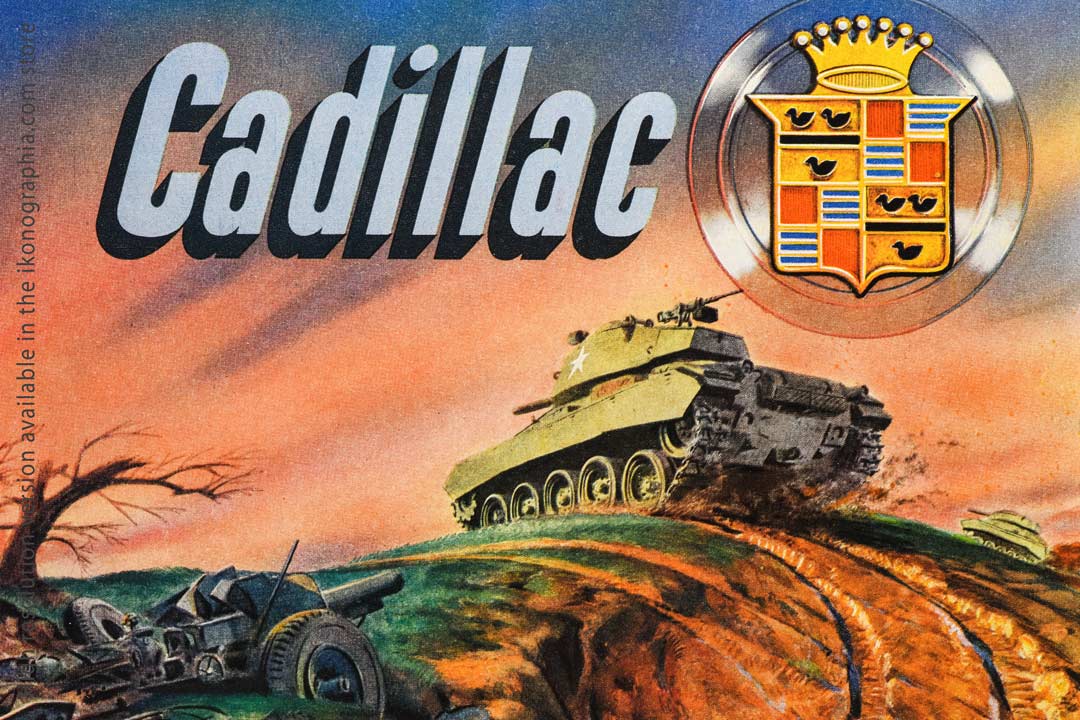
An M24 Tank in a Cadillac 1945 ad. Artwork by Artworks are by James Bingham

Cadillac Goes to War.


On January 16, 1942, 39 days after Pearl Harbor, President Roosevelt, with an executive order, created the War Production Board (WPB) to convert peacetime industrial production to meet the needs of the war, along with setting priorities and prohibiting the manufacture of non-essential goods.

Only 55 days after automobile production ended, Cadillac delivered the first tank. Just 17 days later, the second was shipped. Production was beginning to roll and soon to become a flood.

Cadillac WWII Ad. Pay-off for Pearl Harbor ! Aircrafits with Allison Engines. Art by John Vickery. Life, November 6, 1944

Pay-off for Pearl Harbor!
Artwork by John Vickery.
Life, November 6, 1944

A P-38 Lockheed Lightning Aircraft bombing Japan. The P-38 was powered by twin General Motors Allison engines, several parts of which were built by Cadillac.

Excerpt from the ad's text.
"Three years ago, the sneak attack on Pearl Harbor found America unprepared to defend its rights. Yet, even at that early date, Cadillac was in its third year of building aircraft engine parts for military use.

Cadillac World War II Production.


From 1942 to 1945, Cadillac produced 10,670 Tanks and Armored Vehicles, including 5000 M5 and M5A1 Light Tanks, 3,592 M24 Light Tanks, 1,778 M8 77mm Howitzer Motor Carriages, and 300 M19 Twin 40mm Gun Motor Carriages.

Additionally, for the Allison V-12 engine powering several aircraft, Cadillac produced several parts, including crankshafts, camshafts, connecting rods, super-charger gears, impellers, and other component units. — Source

Cadillac WWII Ad. Peacetime Power with a Wartime Job ! The M-5 Light Tank. Life, March 19, 1945

Peacetime Power with a Wartime Job!
Life, March 19 1945

When Cadillac discontinued motor car production, its engine assembly line continued to roll. For the famous Cadillac V-type engine, and Hydra-Matic transmission, had been adapted to war. This Cadillac "power-train" was first used in the M-5, a light tank designed by Cadillac under the direction of Army Ordnance technicians. Thousands of these tanks—as well as its companion, the M-8 Howitzer Motor Carriage—were produced by Cadillac, and are fighting in battles all over the world.

The M5 and M5A1 light tanks.


The M5 light tank, later replaced by an improved version, the M5A1, was used for armed reconnaissance, duties, and supporting infantry actions. It was produced by Cadillac and Massey Harris from 1942 to 1944 in 5,000 units.

The M5 was powered by two Cadillac V-8 Engines developing 110hp each with a Twin Hydramatic transmission system. The armament was a main 37mm gun, three machine guns, and a smoke mortar. — Source

An excerpt from the ad's body:
The M-5 incorporates all that is latest and best in light tank practice plus two innovations from Cadillac peace-time engineering. This accounts for its high speed and great maneuverability. Likewise entrusted to us are more than 170 vital parts manufactured to extremely close tolerances for America's foremost liquid-cooled aircraft engine.

OUTMANEUVERED at every turn by the harrying tactics of a squadron of high-speed American M-5 light tanks, this formidable Nazi Mark IV tank has been immobilized by a well-placed hit in its vital mechanism. The M-5 incorporates all that is latest and best in light tank practice plus two innovations from Cadillac peace-time engineering. This accounts for its high speed and great maneuverability. Likewise entrusted to us are more than 170 vital parts manufactured to extremely close tolerances for America's foremost liquid-cooled aircraft engine.

Making its mark.. on a Nazi Mark IV
Art by Walter Richmonds.
Life, August 30, 1943

OUTMANEUVERED at every turn by the harrying tactics of a squadron of high-speed American M-5 light tanks, this formidable Nazi Mark IV tank has been immobilized by a well-placed hit in its vital mechanism.

Note: its properties and gun system didn't allow it to compete with heavier German Panzers.

The M8 77mm Howitzer Motor Carriage.


Utilizing a Cadillac-built tank chassis—powered by two Cadillac V-type engines with Hydra-Matic transmissions—this M-8 Howitzer gives demolition artillery a degree of mobility it has never known before.

The M-8 is not only fast—it is highly maneuverable as well. This is one of the weapons Cadillac has built for the Allied arsenal. Cadillac also helped to design the M-5 light tank—and produced it in quantity. 

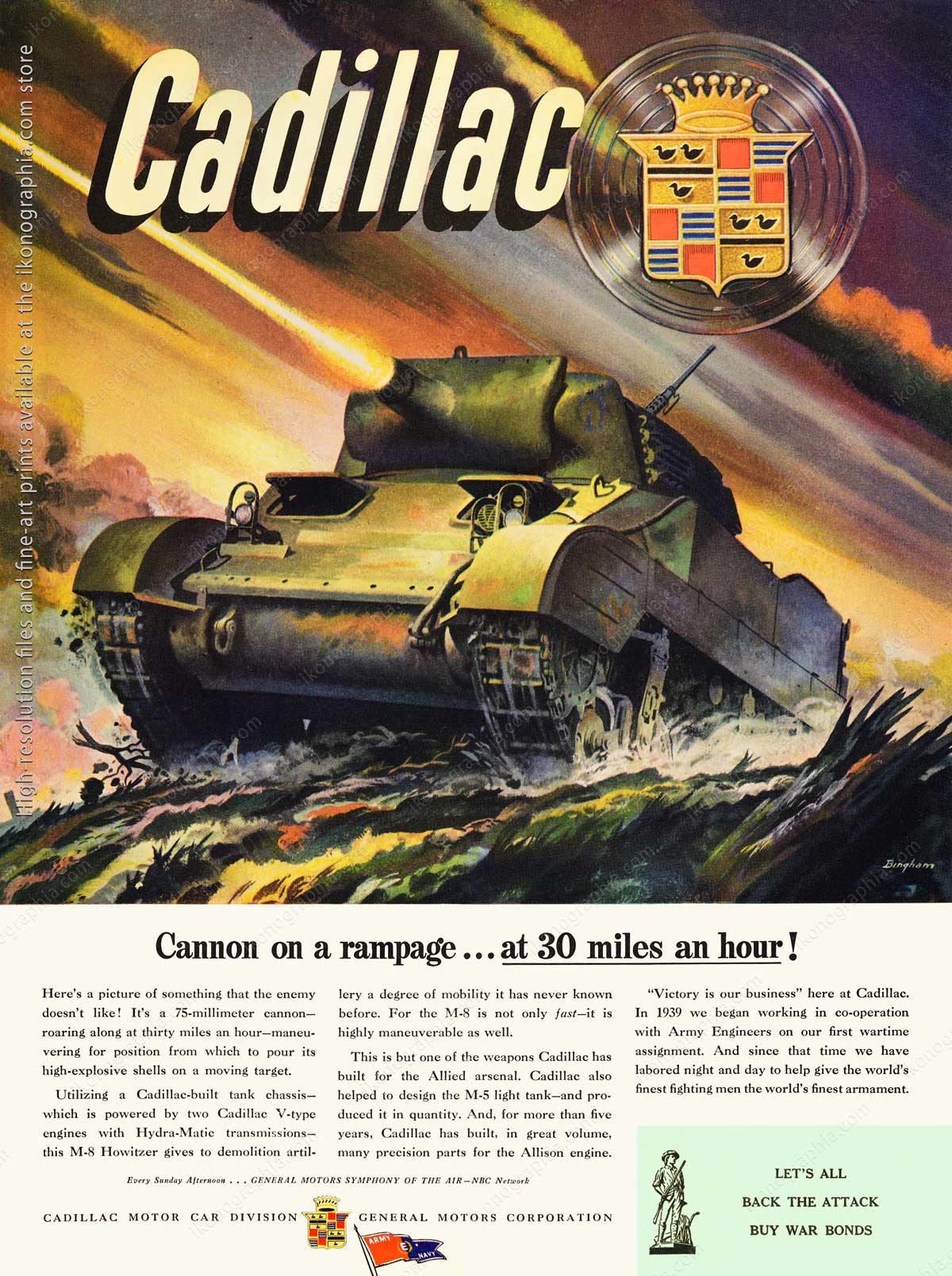
Cadillac WWII Ad. Cannon on a rampage ... at 30 miles an hour! A Cadillac-built tank chassis powered by two Cadillac V-type engines. Art by James Bingham. Life, September 18, 1944

Cannon on a rampage ... at 30 miles an hour!
Artwork by James Bingham.
Life, September 18, 1944

Here's a picture of something that the enemy doesn't like! It's a 75-millimeter cannon—roaring along at thirty miles an hour—maneuvering for position from which to pour its high-explosive shells on a moving target.

The Cadillac M24 Light Tank.


The Light Tank, M24, was an improved version of the popular M5 light tank, which was replaced in 1944. It was produced by Cadillac and Massey Harris in 3,592 units and was used for armed reconnaissance, duties, and supporting infantry actions.

The M24 was powered by two Cadillac V-type engines developing 110hp each, driving through Cadillac Hydra-Matic transmissions. The armament was a main 75mm gun, three machine guns, and a smoke mortar.

Cadillac WWII Ad. Preview of Cadillac Power. M-24 Tank. Life, February 12, 1945

Preview of Cadillac Power!
Life, February 12, 1945

If you were to watch the new M-24 wide-tread tank in action—watch it tear its way through heartbreaking mud and over all kinds of difficult terrain—you would surely conclude that it had some specially-designed, heavy-duty motive power.

But like its predecessors—the M-5 light tank and the M-8 Howitzer Motor Carriage —this new Cadillac-built weapon is powered by two Cadillac V-type engines, driving through Cadillac Hydra-Matic transmissions.

Fundamentally, these are the same famous engines and transmissions that had piled up millions of miles of service in passenger cars long before Cadillac and U. S. Army Ordnance Engineers adapted them to tank design. However, they have been vastly improved as a result of their hard usage on the battlefield.
We doubt whether any other power units originally designed for passenger car use have ever been put to such a grueling test. We feel sure they will prove a revelation when peace returns.

Cadillac WWI Ad. Imprint of Cadillac Power with the M24 Tank. Art by John Vickery Fortune, May 1945

Imprint of Cadillac Power!
Artwork by James Bingham.
Fortune Magazine, May 1945

Deep in German mud, this M-24 has left its imprint of Cadillac power. For, like more than 10,000 tanks that have gone before it, the M-24 is powered by two Cadillac V-type engines, driving through two Cadillac Hydra-Matic transmissions.

The Cadillac V-type, 8-cylinder engine.


All Tanks and Armoured Vehicles produced by Cadillac were powered by Twin V-8 engines developing 110hp each with a Twin Hydramatic transmission system.

An excerpt from the ad's body:
As a result, the Cadillac V-type engine has been carried to a remarkable state of perfection. Prior to the war, it was made available with the Cadillac Hydra-Matic Transmission.
Cadillac engines and transmissions have been installed in more than ten thousand Cadillac-built tanks—two units for each tank. They have won the highest distinction for performance and dependability on fighting fronts. Improvement, of course, has gone consistently ahead. As a result, the Cadillac "power train" is now an even greater unit than when it went to war.

Cadillac WWII Ad. Famous in Peace-Distinguished in Battle! TheV-type , 8-cylinder. Art by John Vickery. Life, June 4, 1945

Famous in Peace -Distinguished in Battle!
Life, June 4, 1945

More than thirty years ago, Cadillac built the first V-type, 8-cylinder automotive power plant ever produced in this country.

Throughout all these years, Cadillac has held to this principle of engine design. Consequently, our research and engineering have been concentrated on improvement and development—rather than on experimentation as to basic engine types.


The rhythmic roar of the P-38 tells more eloquently than words of the superb fighting qualities built into its two perfectly synchronized engines. Foremost of the American-designed and built liquid-cooled aircraft engines is the Allison, which powers several of our top fighter craft and for which we at Cadillac produce vital precision assemblies.

Thus with every Cadillac V-8 engine produced today, Cadillac literally contributes its own V to Victory. Cadillac pioneered the V-type engine 29 years ago and has continuously developed and improved it ever since.
This uninterrupted application of traditional Cadillac precision craftsmanship has naturally brought it to a high state of perfection—and, by virtue of its inherent simplicity, ruggedness, great power, and compactness of design, made it ideally adapted to the responsible task as a tank power plant.

The Cadillac-built M-5 tank has made its name on several fronts. It is widely hailed as the best and most versatile of light tanks, with speed and maneuverability unmatched by any other full-tracked vehicle. Building the M-5 is only one of our wartime assignments.

WWII Ad.Cadillac's Own V for Victory with the V-type Engine. Art by John Vickery. Life, November 15, 1943

Cadillac's Own V for Victory
Artwork by John Vickery.
Life, October 18, 1943

The fundamental soundness of the Cadillac V-type engine, that made it outstanding in the automotive world, was an important factor in its adaptation to the M-5 light tank by Cadillac and Army Ordnance Engineers.

Cadillac/Allison Engine powering Lockheed aircraft.


Cadillac produced several parts for the Allison V-12 engine powering several aircraft, including crankshafts, camshafts, connecting rods, super-charger gears, impellers, and other component units.

The Cadillac/Allison engine powered the following aircraft.
P-38 Lockheed Lightning: a fast-climbing, twin-engined, twin-fuselage aircraft. Germans referred to the 'plane as the fork-tailed devil.
P-39 Lockheed Airacobra: a speedy low-altitude fighter.
P-40 Lockheed Warhawk: favorite plane of the Flying Tigers, a daring crew of WW2 fighter pilots under General Claire Chennault.

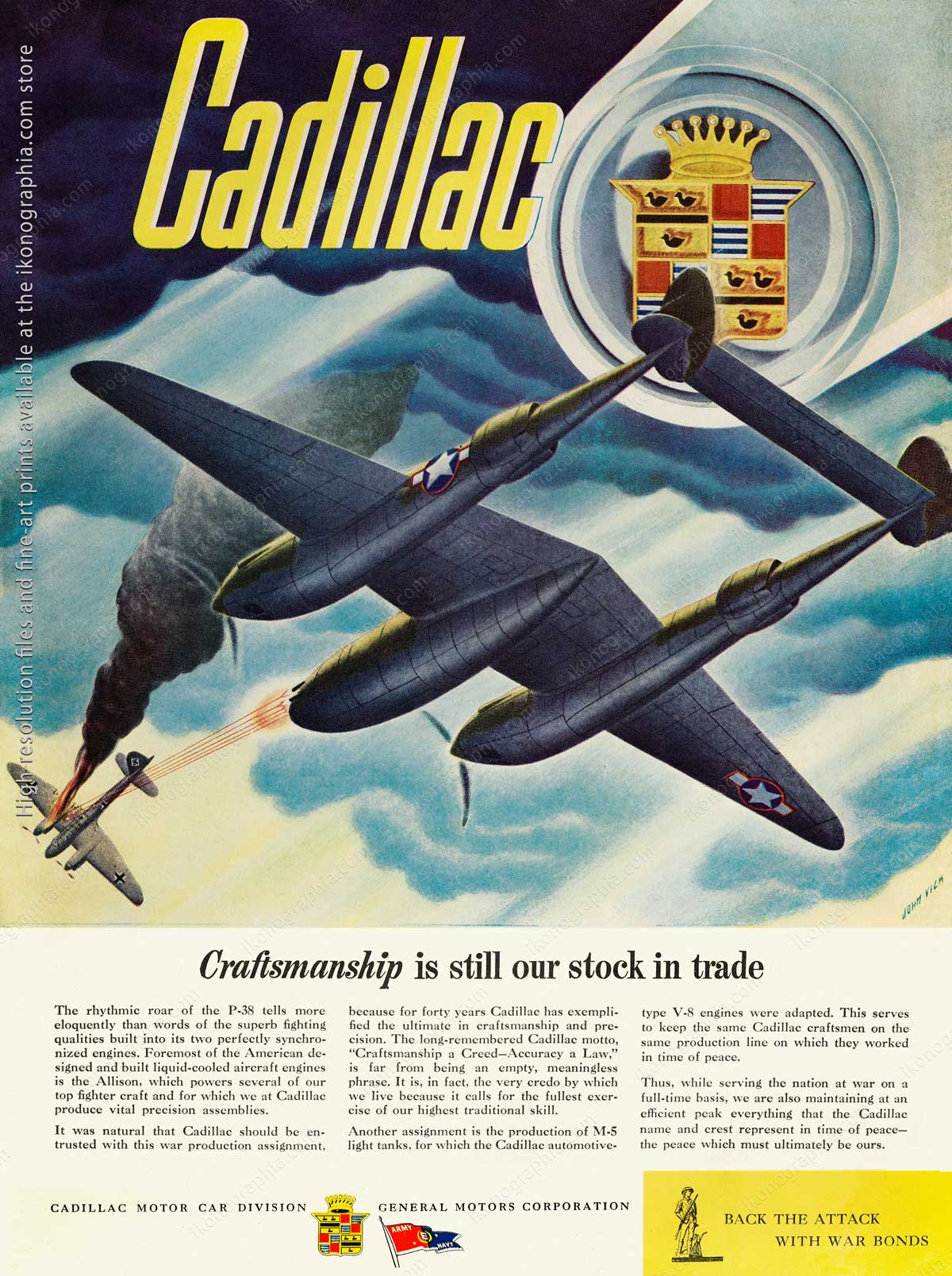
Cadillac WWII Ad. Craftsmanship is still our stock in trade, with Lockheed P38 Aircraft. Art by John Vickery. Life, October 18, 1943

Craftsmanship is still our stock in trade
Life, October 18, 1943
Artwork by John Vickery, an Australian illustrator who moved to New York in 1935.

P-38 Lockheed Lightning: A 400 mph, fast-climbing, twin-engined fighter plane, the rudders of which inspired the first fish-tail fins on the 1948 Cadillac. Germans referred to the 'plane as the fork-tailed devil. The plane was powered by twin General Motors Allison engines, several parts of which were built by Cadillac.

The rhythmic roar of the P-38 tells more eloquently than words of the superb fighting qualities built into its two perfectly synchronized engines. Foremost of the American-designed and built liquid-cooled aircraft engines is the Allison, which powers several of our top fighter craft and for which we at Cadillac produce vital precision assemblies.

It was natural that Cadillac should be entrusted with this war production assignment because, for forty years, Cadillac has exemplified the ultimate in craftsmanship and precision.

Cadillac WWII Ad. We've put 44 million man-hours in the air! with parts for the Allison Engine. Art by John Vickery. Life, February 14, 1944

We've put 44 million man-hours in the air!
Artwork by John Vickery.
Life, February 14, 1944

In March of 1939—nearly three years before Pearl Harbor—Cadillac, working in cooperation with the Army Air Forces, accepted its original arms assignment. It called for volume production of vital precision parts and assemblies for the Allison, America's first and foremost aviation engine of liquid-cooled design.

Thus, when America launched its aircraft production program "to blacken the sky with planes," Cadillac was well qualified to meet the requirements of Army Air Force technicians. The tremendous new demands made us ready—with experience, equipment, methods, and skills developed by 40 years of adherence to the principle—"Craftsmanship A Creed—Accuracy A Law."

Cadillac is proud that its background of experience has enabled it to accept so important an assignment in such a vital division of America's armament program. It has enabled us to apply 44 million man-hours in the production of these vital parts—all to the rigid specifications of one of the most exacting buyers in the world—the U. S. Army Air Forces.

Cadillac WWII Ad. Stalkers of Hidden Devilfish. with parts for the Allison Engine. Art by John Vickery. Life, May 1, 1944

Stalkers of Hidden Devilfish
Artwork by John Vickery.
Life, May 1, 1944

Searching for enemy submarines. Three P-40 Curtiss Warhawk of the "Flying Tigers," a daring crew of WW2 fighter pilots under General Claire Chennault. Cadillac produced several parts for the Allison V-12 engine powering these aircraft.

"during the five years of the war, millions of Allison parts—crankshafts, camshafts, connecting rods, super-charger gears, impellers, and other component units—have "gone to war" bearing the imprint of Cadillac's precision workmanship."

Cadillac’s “From Peace to War” 1943 booklet.


An excerpt from the booklet:
Our country has now been actively at war for two years. We have now reached a point where the story of the important war job we at Cadillac have been doing during this period can be told. In the beginning, there were those who said our country couldn't prepare for war in time to do any good.

That's what Hitler thought, and the Japs, too. It is true that overnight our war needs were enormous, and the facilities for producing such goods seemed pitifully inadequate. Our own organization, along with all other American industry, was faced suddenly with the tremendous job of building instruments of warfare in place of the peacetime products we had been accustomed to making.Source

Links, credits, and copyright

In the United States, anything published without a copyright notice between 1928 and 1977 is in the public domain and is free to use.

Works published with copyright advice in the United States until 1963 fell into the Public Domain if the copyright was not renewed with the Copyright Office during the 28th year after publication. Ad copyright was never renewed and fell into the Public Domain.

More info on our "Copyright and Public Domain" page.

Please notice that any advice or comment provided here is not and does not purport to be legal advice as defined by s.12 of Legal Services Act 2007.

EUR Euro