Selected Contents from Portfolio No. 2 (Summer 1950)

Selected Contents from Portfolio No. 2 (Summer 1950)

Selected Contents from Portfolio No. 2 — Summer 1950

The second issue of Portfolio confirmed the scope of Brodovitch’s experiment.

Conceived and designed by Alexey Brodovitch, Portfolio No. 1 was not a magazine in the conventional sense but an editorial experiment—treating photography, typography, illustration, and sequencing as a single expressive system. Layout was no longer a container, but an active force: rhythm, contrast, and white space became instruments of meaning.

Selected Contents from Portfolio No. 2 (Summer 1950) The second issue of Portfolio confirmed the scope of Brodovitch’s experiment. Conceived and designed by Alexey Brodovitch, Portfolio was not a magazine in the conventional sense but an editorial experiment—treating photography, typography, illustration, and sequencing as a single expressive system. If the first issue announced a rupture, the second demonstrated that this was not an isolated provocation but a sustained editorial vision, bringing together unpublished works and contemporary experiments into a single, fluid sequence.- detail

Portfolio No. 2 pushed further into unexplored territory.Page design became a medium of invention in itself, while fine art, graphic experimentation, poetry, and vernacular culture were treated with equal seriousness. The magazine refused hierarchies, allowing visual intelligence to emerge from radically different sources.

Alongside the images, Ikonographia preserves excerpts from the original texts, printed here in italics as primary material. These texts—often reproduced in full—are exceptional in their own right, defining an era and articulating Brodovitch’s vision with a precision and ambition that remain definitive.

The binding hid the architecture of every spread — the alignments, axes, and transitions Brodovitch designed across the full width of the page. The reconstructed full-spread reproductions make those decisions visible for the first time.

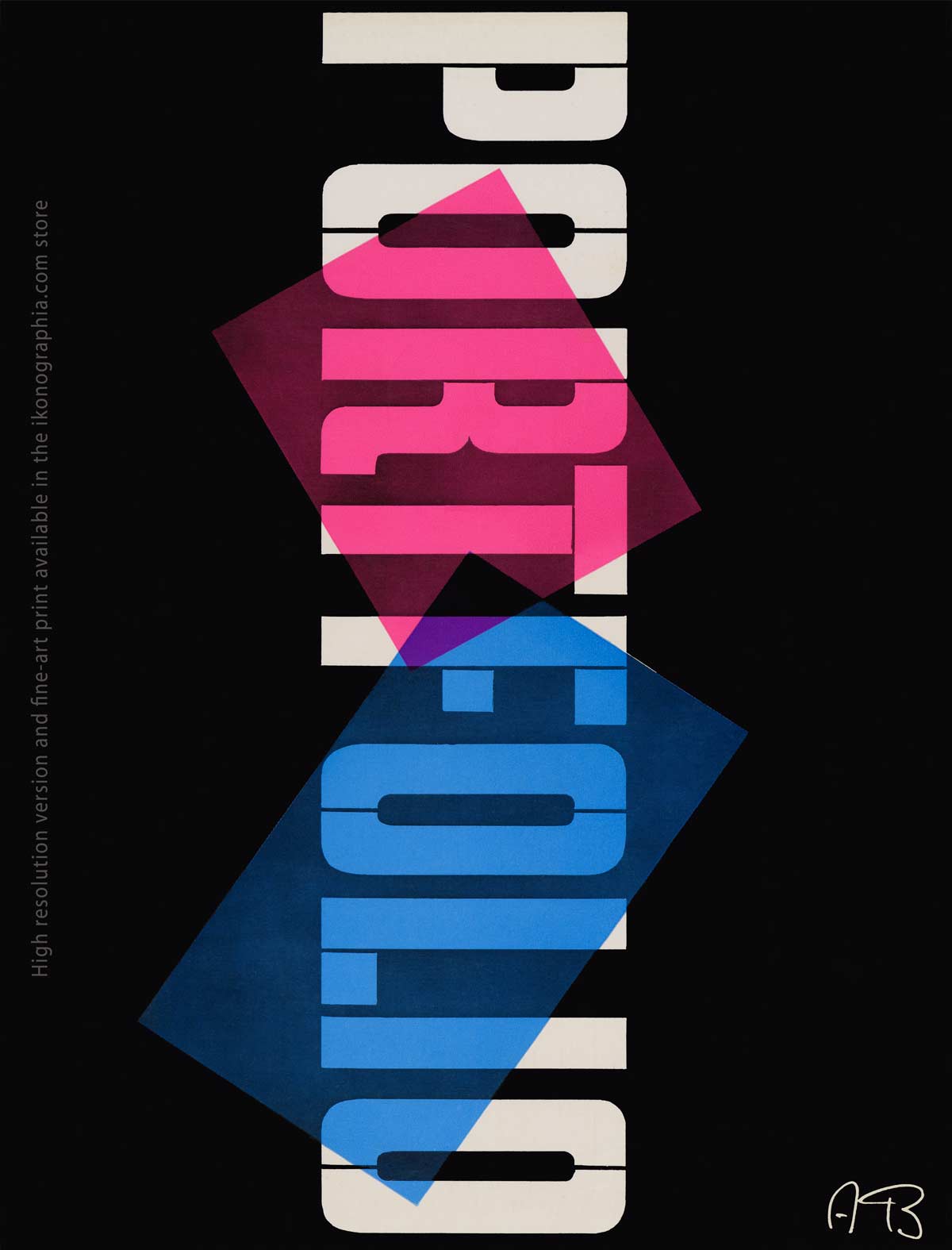
Portfolio Magazine N.2. Summer1950. Embossed cover with a design for a kite by Charles Eames, reproduced from his original paste-up made with swatches of colored tissue paper.

Portfolio Magazine N. 2 Embossed Cover — Summer 1950.

Design for a kite by Charles Eames, reproduced from his original paste-up made with swatches of colored tissue paper.

Page Design as a medium of invention

Rarely is the printed page considered a medium of plastic invention. Its design has become standardized, a machine-like element devoid of feeling and esthetic significance. This is cause for regret, for the variety of forms possible when typography and calligraphy are creatively used approaches that of abstract painting.

On the following six pages, Portfolio reproduces in facsimile a number of unusual pages which possess real visual charm and excitement.
For designers chafing under the conventional discipline of the printed page and seeking new directions, these pages should bring both pleasure and inspiration.

Guillaume Appollinaire. Il Pleut, from “Arts et Metier Graphiques,” Paris. France 1930.

Guillaume Appollinaire. Il Pleu — Page 4-5

 Il Pleut, from “Arts et Metier Graphiques,” Paris. France 1930.

The modern French poet Guillaume Apollinaire's sensitive arrangement of his poem "Il Pleut" (It Rains) trickles down through the clean white air of the page opposite like a gentle spring shower.

Two curious pages from an early Christian panegyric. Portfolio Magazine N.2, summer 1950

Two curious pages from an early Christian panegyric — Pages 6-7

Printed in 16th Century Germany and stenciled with mysterious religious symbols—a superb example of that now-extinct form of literary expression known as carmen "figurato” (figured poem).

Portfolio — The Hidden Architecture

Portfolio was bound with staples applied directly through the images. The central area of each double page — axes, alignments, transitions — was permanently obscured, even to contemporary subscribers. In the worst cases, the staples cut through figures, severing compositions that only made sense across the full width of the page.
The reconstruction process separated the pages, digitally realigned each half, and restored the complete spread. What follows is not a reproduction of Portfolio. It is Portfolio as Brodovitch designed it to be read — visible here for the first time.

A design by Brodovitch from a Pierre Reverdy' s poem, illustrated with lithographs by Picasso

From Pierre Reverdy's poem Le Chant des Morts (Song of the Dead Ones) — Pages 8-9

A contemporary spread from Pierre Reverdy's poem Le Chant des Morts (Song of the Dead Ones), with the text in the poet's script and illustrated with lithographs by Pablo Picasso, who derived the abstract form of his designs from the skull, the bone and the straight line.

A design from a poem by Wu Chang-Shih in the calligraphic style

A poem by Wu Chang-Shih — Pages 10-11

A poem by Wu Chang-Shih, one of the greatest modern Chinese calligraphers, written in the calligraphic style known as Ts‘ao-Shu, or “grass” style, because of the impromptu nature of the strokes with which the characters are formed.

Miro on the walls — Wallpapers by Joan Miro and Ilonka Karasz

Miro on the walls — Wallpapers by Joan Miro and Ilonka Karasz.

The word "wallpaper" is no longer a synonym for the musty floral patterns that writhed endlessly on the gas-lit walls of Victorian front parlors. Within the past ten years, a renascence has taken place in the field of interior decoration that is restoring to the design of wallpaper some of the contemporary charm and significance that it possessed as a graphic art in the 18th Century.

Modern masters, such as Matisse, Miro and Calder, have designed wallpapers and printed wall-panels which reflect the spirit of the 20th Century in their imaginative handling of line, color and form. Their work has brought new dignity to wallpaper and given it creative stature among the decorative arts. Simultaneously, new and improved printing methods, such as silk-screen, offset lithography and photo-chemical processes, are permitting the reproduction of various techniques of drawing and painting which could not be approximated a few years ago.
The wallpapers shown here are from Katzenbach and Warren Inc., a contemporary-minded firm which has consistently pioneered modern design in the wallpaper industry.

The original sketch with a new concept in wallpaper design by Joan Miro 1950

Miro on the wall — Pages 56-57

The original sketch for a mural design was executed for Katzenbach and Warren Inc. of New York by Joan Miro, famed modern painter, and represents a new concept in wallpaper art.
It was reproduced in the silk-screen process, on a panel measuring four feet high and six feet wide, in a limited edition of 250 copies (price:$350 each).
The artist, who lives in Spain, was sent a catalogue of American pigments to work from; below the original painting he has keyed the six colors he used to their corresponding catalogue numbers.

Wisconsin, an outstanding 1950 wallpaper design by Ilonka Karasz and machine-printed by offset lithography for Katzenbach and Warren Inc.

Wisconsin, wallpaper designed by Ilonka Karasz —  Page 61

Wisconsin, an outstanding modern wallpaper designed by Ilonka Karasz and machine-printed by offset lithography for Katzenbach and Warren Inc.

It typifies the fine design and improved reproduction that together are reviving the significance of wallpaper as a decorative art in the United States.

Joseph Low — Design with Linoleum Blocks

Joseph Low, a soft-spoken, pale-faced, 39-year-old artist whose medium is linoleum prints, is well-known to many art directors and magazine editors, although few of them have ever encountered him in the flesh.

Low, who lives a rather hermit-like existence with his wife and two young daughters in a small house deep in rural New Jersey, has impressed the force of his work and personality upon advertising and editorial people almost entirely through the mail. Every two months or so, he mails to a selected list of people a self-promotional little broadside on which is imprinted an example of his work, together with a little message, usually based on an old English nursery rhyme, gently announcing his availability.

Low, who, incidentally, is a superb typographer, sets the type for the message himself and runs off the sheets on his own hand-powered printing press. He initiated the project less than two years ago, after he had resigned from an art instructorship at the University of Indiana and came east to earn his living as a freelance advertising artist.
He quickly found that he was unable to take the emotional punishment that waiting around in advertising agency ante-rooms entailed and he withdrew to the seclusion of his home where he evolved his method of self-promotion by mail.

Linoleum Print Artist Joseph Low at work and a detail of a print displaings the vigor and fantasy of his engraving style.

Joseph Low — Design with Linoleum Blocks & Dampened Paper.

Left: Artist Joseph Low pulling an impression on his hand press. Below: Low inside his rural New Jersey studio-print shop with its old-fashioned stove (bottom), a linoleum block locked up in a printing form, and the finished print. Right page: An enlarged detail from the same linoleum print displays the vigor and fantasy of Low’s engraving style. Photographs by Ed Feingersh. Pages 64-65

Linoleum print artist Joseph Low work samples from Portfolio Magazine 1950

Sketches of dogs and mailing pieces ​— Pages 66-67

Left: Two sketches of dogs, a direct-mail circular, and a page from a brochure on horses, written, engraved, composed and printed by Joseph Low.

Right: One of Joseph Low's quaint self-promotional mailing pieces, based on an old English nursery rhyme, which he recently circularized among his clients.

Linoleum print artist Joseph Low greeting cards from Portfolio Magazine 1950.

Joseph Low's Greeting Cards — Pages 66-67

Joseph Low's greeting cards are a delightful blend of whimsy and craftsmanship.

Left: two sketches and a Valentine's Day card. Right: Low's New Year's Day greeting card.

William Steig Illustration

Joseph Low, a soft-spoken, pale-faced, 39-year-old artist whose medium is linoleum prints, is well-known to many art directors and magazine editors, although few of them have ever encountered him in the flesh.

Low, who lives a rather hermit-like existence with his wife and two young daughters in a small house deep in rural New Jersey, has impressed the force of his work and personality upon advertising and editorial people almost entirely through the mail. Every two months or so, he mails to a selected list of people a self-promotional little broadside on which is imprinted an example of his work, together with a little message, usually based on an old English nursery rhyme, gently announcing his availability.

Low, who, incidentally, is a superb typographer, sets the type for the message himself and runs off the sheets on his own hand-powered printing press. He initiated the project less than two years ago, after he had resigned from an art instructorship at the University of Indiana and came east to earn his living as a freelance advertising artist.
He quickly found that he was unable to take the emotional punishment that waiting around in advertising agency ante-rooms entailed and he withdrew to the seclusion of his home where he evolved his method of self-promotion by mail.

William Steig. Arrangements of disembodied heads. Haughty woman with her heads floating off into space and a man that can't remember where he put his head. Portfolio 2, Summer 1950, Page 84-85

William Steig — Arrangements of disembodied heads — Pages 84-85

Haughty woman with her head floating off into space and a man that can't remember where he put his head.

William Steig. Arrangements of disembodied heads. Acrobat, Daydreamer and Carouser. Portfolio 2, Summer 1950, Page 86-87.

William Steig — Arrangements of disembodied heads — Pages 86-87

Acrobat, Daydreamer, and Carouser. with their heads floating off into space. 

William Steig. Arrangements of disembodied heads. Sleepwalker, Tough Guy, Huh, Argument, Courtesy, Hatred Portfolio 2, Summer 1950, Page 88-89.

William Steig — Arrangements of disembodied heads — Pages 88-89

Sleepwalker, Tough Guy, Huh, Argument — Courtesy, Hatred Page.

Cattlebrands

Cattlebrands are a fascinating form of graphic Americana which have rarely, if ever, been considered from the standpoint of design. They represent a colorful pictorial language in which the American cowboy has expressed himself with characteristic Western pungency and humor.

The practice of branding cattle goes back to ancient Egyptian times, but the first cattlebrand in America belonged to Hernando Cortez, the Spanish Conquistador, who brought a few head of steer and a branding iron to the New World in 1540. His brand was a design of three crosses, representing the Holy Trinity. Many of the cattlebrands reproduced in the following insert have been in use on the Western range for more than one hundred years, and with practice, the greenest tenderfoot can learn to "read" these brands even though he may never get closer to a round-up than a Hopalong Cassidy telecast.

A brand usually consists of a letter, numeral, character or symbol, or a combination of one or any of these elements. Brands are read from left to right. If the characters are placed on top of one another, they are read downward. A letter that is slightly tilted is "tumbling." A letter that is lying down on its side or back is "lazy." A letter that is stretched out and has a curving flare on top is "running." A letter with wings—a dash at the left and a dash at the right on top—is "flying." A letter placed so that the bottom of it touches the inside of a curve is "rocking." Originally, many brands grew out of personal naives. Rancher T. E. Money's brand was the $ sign, Peter Coffin's brand was a P in a pine-box. The famous 6666 brand (Four-Six) in Texas was coined when its owner won his grubstake in a poker game. His winning handheld four sixes. Still other brands were designed from the shapes of everyday objects observed on the range—stirrups, saddles, dippers, guns, the sun and moon, etc., many of them showing a striking use of imagery and symbolism.

Twelve Vintage Cattlebrands from Portfolio Magazine 1950

Twelve Vintage Cattlebrands — Pages 90-91

DRAG F, O CROSS 0, ROCKING H, SITTING HEART LAY R, PINE TREE, HAT A, ARROW CRESCENT, FLYING WH SWINGING DIAMONDS, HUH CONNECTED, OWL, S SPUR.

Fifty-one vintage Texas cattlebrands from Portfolio Magazine 1950.

Fifty-one vintage Texas cattle brands — Pages 90-91

1, Half Circle Three Circle, 2. T Foot, 3. Spade, 4. 7 Circle L, 5. Fleur De Lis Half Circle, 6. DHP Connected, 7. A Coffin, 8. Bar Button Hook, 9. HTS Connected, 10. Cross A, 11. Double R , 12. H Over: T, 13. Chain 7, 14. Rising Sun, 15. Key No, 16. Mule Head, 17. Curry Comb, 18. Plus Four, 19. Diamond E, 20. Longhorn Plus, 21. Sleeping 6, 22. Pig's Eye, 23. Buzzard on a Rail, 24. Slash Pine 25. Flying JY, 26. Flying B, 27: Snake in Moon, 28. W Bar Cross, 29. Walking Tadpole, 30. Broken Circle Cross, 31. HH Connected, 32. Boot B, 33. Triangle F, 34. Ed Connected, 35. Lazy D J Connected, 36. Double Circle, 37. Two Sixes, 38. Tea Spoon, 39. My Heart, 40. U Fly, 41. H 3, 42. Vertical Double E, 43. Half Circle Q, 44. Running Sac, 45. Drunken T, 46. OK, 47. Cow Head, 48. Diamond H Diamond, 49. Windflower, 50. Crossed U, 51. 03.

Copyright, Links And Credits

Portfolio Graphic Works, Copyright & Credits

© Ikonographia — Digital Restoration & Derivative Work Rights Reserved. These images are part of the Ikonographia Visual Archives: Portfolio Magazine Collection (1950–1951).

Copyright Status of Portfolio Magazine

Portfolio magazine (Issues 1–3, 1950–1951) was published in the United States and not renewed under U.S. copyright law. It is consequently in the public domain in the United States, and its editorial contents — including design, typography, and reproduced artworks — may be freely used.

Nature of Ikonographia's Work

The images presented here are not simple reproductions of the original magazine pages. They are reconstructed double-page spreads — a body of work that required the careful unbinding of original copies, precise digitization of individual pages, and their digital reassembly as unified visual fields.

This reconstruction reveals, for the first time, the complete compositions as Brodovitch intended them to be seen — hidden for decades by the tight binding of the original print edition.

Ikonographia's reconstructed spreads are original works and are protected as digital restorations and derivative works. They are available for licensed use through Ikonographia Visual Archives.

Terms of Use (Summary)

The images presented in this archive are copyrighted and available for licensed use only through Ikonographia Visual Archives.

You may not download, reproduce, publish, or distribute these images without a valid license. For commercial or editorial licensing, please refer to the product pages or contact Ikonographia directly. A full explanation of licensing terms is available in the Shop / Licensing Information section under "Ikonographia — Standard License" and "Ikonographia — Merchandising & Product Use Licenses."

Ikonographia Mission Statement

Ikonographia is committed to the accurate documentation, preservation, and ethical dissemination of twentieth-century visual culture.

Archival Notes

These reconstructed spreads were produced as part of Ikonographia's ongoing effort to preserve and make accessible significant works of twentieth-century graphic design.

Original copies of Portfolio were carefully unbound and digitized at high resolution. Individual pages were then reassembled with precision to restore the complete double-page compositions.
All images follow Ikonographia's internal archival standards for resolution, color accuracy, and metadata structure to ensure long-term consistency across the collection.

Ikonographia has made every effort to handle this material with accuracy and respect. We remain available for any inquiry or agreement regarding its use.

Credits

Portfolio magazine (1950–1951) was created by Frank Zachary and George Rosenthal (editors and co-founders) and Alexey Brodovitch (art director). Their vision produced one of the most significant editorial experiments of the twentieth century.

Further Reading — Selected Sources

Andrew Bosman, Brodovitch — The definitive monograph on Alexey Brodovitch's life and work.
Kerry William Purcell, Alexey Brodovitch — A comprehensive study of Brodovitch's design legacy, including Portfolio.

About Alexey Brodovitch. A short bio.

Alexey Brodovitch at work ,1950

Brodovitch at work in his studio.

Alexey Brodovitch (1898-1971)

Alexey Brodovitch was a Russian-born American designer, photographer, editor, and teacher whose work fundamentally reshaped twentieth-century visual culture. Best known as the art director of Harper's Bazaar (1934–1958) and the creator of Portfolio magazine, Brodovitch redefined the role of design as an active, expressive force rather than a neutral frame.

After leaving Russia, Brodovitch settled in Paris in 1920, where he absorbed Bauhaus principles, Italian Futurism, and the evolving languages of Cubism, Fauvism, Purism, and Surrealism. This plural exposure forged a visual sensibility grounded in movement, contrast, and disciplined freedom.

In the United States, Brodovitch became both a radical innovator and influential educator, mentoring generations of photographers and designers—including Richard Avedon, Irving Penn, Diane Arbus, and Garry Winogrand—establishing a legacy that continues to define modern editorial design.

Selected Contents from Portfolio No. 1 (Winter 1950)

Selected Contents from Portfolio No. 1 (Winter 1950)

Selected Contents from Portfolio No. 1 — Winter 1950

The first issue of Portfolio arrived as a shock.

Conceived and designed by Alexey Brodovitch, Portfolio No. 1 was not a magazine in the conventional sense but an editorial experiment—treating photography, typography, illustration, and sequencing as a single expressive system. Layout was no longer a container, but an active force: rhythm, contrast, and white space became instruments of meaning.

Design from the Mathematicians. By Prof. Baravalle. Portfolio N.1 1950. Page 24-25 Left page: Above, a family of lines tangent to a parabola. Upper right, design based on series of concentric circles and parallel tangents. Lower right, a family of logarithmic spirals. Opposite page: Lower left, a family of curves satisfying a differential equation (by Professor Andre Saint-Lague of Paris). Upper left, a triangle inscribed with straight lines.

This selection presents key spreads from the inaugural issue, reproduced from carefully unbound originals.
Read in sequence, they reveal Portfolio’s debut as a radical editorial experiment conceived by Alexey Brodovitch—not a conventional magazine, but a visual laboratory where photography, typography, illustration, and pacing form a single expressive system.

Alongside the images, Ikonographia preserves excerpts from the original texts, printed here in italics not as secondary commentary, but as primary material. These texts—often reproduced in full—are exceptional in their own right, defining an era and articulating Brodovitch’s vision with a precision and ambition that would be impossible to improve upon.

Most importantly, the newly unbound, full-spread reproductions restore the magazine’s true spatial architecture—alignments, axes, and transitions long obscured by binding—making visible design decisions that disappear in standard, cut-in-two reproductions.

The cover of the first issue of Portfolio Magazine, winter 1950. Designed by Alexei Brodovitch with Art Director Frank Zachary. Portfolio has been widely acknowledged as perhaps the definitive graphic design magazine of the twentieth century.

Portfolio Magazine N. 1
Winter 1950.

The first issue of Portfolio Magazine, entirely conceived and designed by Alexey Brodovitch, announcing a new editorial language built on sequence, contrast, and visual tension rather than fixed layout.

Selected Contents from Portfolio N.1 — The Bodoni Typeface

One day in 1787, in his printing shop in Philadelphia, Benjamin Franklin received a specimen sheet of typefaces from Giambattista Bodoni of Parma, Italy. This was the first time that Franklin had seen the work of the man considered Europe's foremost type designer and printer, and he was greatly impressed.

"I have had the great pleasure of receiving and perusing your excellent "Essai des Characteres de L'Imprimere," he wrote Bodoni. It is one of the most beautiful that Art has hitherto produced. As the first American to go on record in appreciation of the Bodoni typeface, sage old Ben Franklin pioneered a trend in U. S. typography, which was to have far-reaching effect on the design of printed matter in our time.

Editorial content on Giambattista Bodoni, an Italian genius who created the Bodoni, America's most widely used typeface. Portfolio Magazine N. 1, winter 1950, pages 4-5.

The Bodoni Typeface — pages 4-5

Before Giambattista Bodoni, roman letters had the form of the old-style A (opposite) with heavy stems and curving serifs, as in hand-writing.

This sheet (right) from Bodoni's Manuale Tipografica shows how he altered the design of printing types to give them a mechanical appearance. He emphasized the contrast between light and heavy strokes, with serifs forming sharp right angles with the upright strokes, producing the first modern typeface.

Florets, borders, and rules designed by Gian Battista Bodoni. Portfolio 1, winter 1950, pages 12-13.

The Bodoni Typeface — pages 12-13

Florets, borders, and rules designed by Gian Battista Bodoni. A sample from the 1200 varieties of decorations created by Gian Battista Bodoni, an Italian typographer who created America's most widely used typeface.

Left: Arabic Numerals from Bodoni's "Manuale Tipografica." Right: A reprint-as-the-original of Bodoni's Q. Horatii Flacci Opera 1791 (Horace's Opera.)

The Bodoni Typeface — pages 14-15

Left: Arabic Numerals from Bodoni's "Manuale Tipografica."

Right: A reprint-as-the-original of Bodoni's Q. Horatii Flacci Opera 1791 (Horace's Opera.) This insert reproduces four specimen pages from books designed by Giambattista Bodoni in 18th Century Parma. They are printed by offset on hand-made paper from Cartiere Milani, the 675-year-old mill in Fabriano, Italy.

Design from Mathematicians

Portfolio was not conceived as a magazine in the conventional sense, but as a radical editorial experiment. Published between 1950 and 1951, it functioned as an open laboratory in which photography, typography, illustration, and sequencing were treated as a single expressive system rather than as separate disciplines.

Under the direction of Alexey Brodovitch, each issue rejected fixed layouts, recurring formats, and commercial constraints. Pages were assembled through contrast, rhythm, and interruption, allowing images and text to interact dynamically across spreads. White space, scale shifts, and abrupt visual transitions became active elements of meaning rather than neutral containers.

Produced without advertising and printed in limited numbers, Portfolio was financially unsustainable but intellectually decisive. Only three issues were released, yet their influence proved disproportionate: the magazine established a new model of editorial authorship, redefining the role of the art director as both editor and composer of visual narratives.

Seen today as a continuous sequence rather than a set of iconic pages, Portfolio remains a foundational document of modern editorial design.

Design from the Mathematicians. Portfolio N.1 1950. Page 22-23. The beauty of geometrical forms is seen in these designs by Dr. Herman Baravalle, mathematics professor at Adelphi College, Long Island. Left: The saddle-shaped form of a hyperbolic parabaloid. Above: An electron contour map of a molecule of phthalocyanine produces an interesting amoeba-like pattern.

Design From The Mathematicians — pages 20-21

Left: The saddle-shaped form of a hyperbolic paraboloid.

Right: an electron contour map of a molecule of phthalocyanine produces an interesting amoeba-like pattern.

Design from the Mathematicians. By Prof. Baravalle. Portfolio N.1 1950. Page 24-25 Left page: Above, a family of lines tangent to a parabola. Upper right, design based on series of concentric circles and parallel tangents. Lower right, a family of logarithmic spirals. Opposite page: Lower left, a family of curves satisfying a differential equation (by Professor Andre Saint-Lague of Paris). Upper left, a triangle inscribed with straight lines.

Design From The Mathematicians — pages 22-23

Left: The saddle-shaped form of a hyperbolic paraboloid.

Right: An electron contour map of a molecule of phthalocyanine produces an interesting amoeba-like pattern.

Portfolio — The Hidden Architecture

Portfolio was bound with staples applied directly through the images. The central area of each double page — axes, alignments, transitions — was permanently obscured, even to contemporary subscribers. In the worst cases, the staples cut through figures, severing compositions that only made sense across the full width of the page.
The reconstruction process separated the pages, digitally realigned each half, and restored the complete spread. What follows is not a reproduction of Portfolio. It is Portfolio as Brodovitch designed it to be read — visible here for the first time.

Design from the Mathematicians. By Prof. Baravalle. Portfolio N.1 1950. Page 22-23 Left, wave curve with black and white parallel lines. Upper left, straight lines tangent to a hyperbole combined with a circle. Right, wave curve. Right page: Upper left, a group of tangents to an astroid (star-shaped) curve. Upper right, catacaustic curve (the kind reflected from inside a cup) made with straight lines. Below, design based on refraction of light.

Design From The Mathematicians — pages 24-25

Left: a wave curve with black and white parallel lines. Upper left, straight lines tangent to a hyperbole combined with a circle. Center, wave curve.

Right: upper left, a group of tangents to an astroid (star-shaped) curve. Upper right, catacaustic curve (reflected inside a cup) made with straight lines. Below is the design of the refraction of light.

Xerography — New Visual Effects with Powder and Electricity.

In his never-ending search for new ways of presenting the too-familiar, the experimental graphic artist has been given a new tool from an unexpected quarter—the electronics laboratory.

Recently, the Battelle Memorial Institute of Columbus, Ohio, an organization dealing in basic scientific research, began inviting selected representatives of the photographic world to a series of demonstrations of a new reproduction medium of their development, which they called Xerography, the first revolutionary development in rendering a photographic image since Daguerre coated his first plate 110 years earlier. It substitutes an electrically charged plate for the film now in use.
The Battelle demonstrator placed an ordinary plate holder into the back of a view camera. He made his exposure and disappeared with his holder into the darkroom. The onlookers settled down for a thirty-minute wait, but after one minute, the demonstrator returned, waving a dry, finished print.

1950 Xerography- New Visual Effects with Powder and Electricity. Goblets variations. Four xerographic studies of a water goblet show the various effects possible with the process. Graphic Design by Alexey Brodovitch. Portfolio 1, pages 42-43.

Xerography Art — pages 42-43

New Visual Effects with Powder and Electricity. 

Goblets variations.
Four xerographic studies of a water goblet show the various effects possible with the process.

1950 Xerography - New Visual Effects with Powder and Electricity. A portrait. This mysterious portrait resulted when the electrical charge on the xeroplate broke down. Graphic Design by Alexey Brodovitch. Portfolio 1, pages 44-45.

Xerography Art — pages 44-45

New Visual Effects with Powder and Electricity. 

This mysterious portrait resulted when the electrical charge on the xeroplate broke down.

Saul Steinberg — Drawings from his unpublished private sketchbooks.

Saul Steinberg, a Rumanian-born ex-architect, is one of the few U.S. cartoonists who also happens to be an artist at his work. When the Museum of Modern Art hung an exhibit of his drawings, one newspaper reviewer questioned the show with an article entitled "It's Funny—But Is It Art"?

But Steinberg's admirers seem to include most persons who have seen his drawings in The New Yorker, Harper's Bazaar, Town and Country, and other magazines; this was like asking if Charlie Chaplin could be taken seriously as a social critic because he wears baggy pants and crooked shoes.
Steinberg is compared with Chaplin because although the mediums they operate are two different things—their comic technique springs from the same source. Steinberg eschews the written word as Chaplin eschews the spoken word and speaks only through the pantomime of his pen.

His strange, silent world is peopled with chinless, blank-faced men, beady-eyed women with monstrous headdresses, precocious animals, and weird architectural fantasies, all drawn in a thin, wiry line that often wanders into an embellishment of scrolls and flourishes as Steinberg pauses to extract the Freudian implications of a cluttered interior, the curl of a beard, or just a plain doodle. At other times, the economy of his line is amazing, as in his drawing of the little man walking against a rain of empty clefs on a music sheet.

Reproduced here are eight pages of Steinberg drawings from his unpublished private sketchbooks.

Saul Steinberg. A beady-eyed woman and chinless, blank-faced men sit at a bar counter from an unpublished Steinberg's private sketchbook. Portfolio 1 Winter 1950, pages 84-85.

Saul Steinberg — pages 84-85

A beady-eyed woman and chinless, blank-faced men sit at a bar counter.

Illustrations reproduced from a previously unpublished Saul Steinberg's private sketchbook.

A rare example of a Steinberg's color drawing with a typical car and woman, plus an illustration of a little man walking against a rain of empty clefs on a music sheet. Illustrations reproduced from a previously unpublished Steinberg's private sketchbook. Portfolio 1 Winter 1950, pages 86-87.

Saul Steinberg — pages 86-87

A rare Steinberg colour drawing: a woman in motion, a fantastical automobile, the two figures in composition across the full spread.

On the upper left, a smaller drawing — a figure walking against a rain of empty clefs on a music sheet.

A typical example of Steinberg's weird architectural fantasies and fantastic animals, all drawn in a thin, wiry line that often wanders into an embellishment of scrolls and flourishes. Illustrations reproduced from a previously unpublished Stinberg's private sketchbook. Portfolio 1 Winter 1950, pages 88-89.

Saul Steinberg — pages 88-89

A typical example of Steinberg's weird architectural fantasies and fantastic animals, all drawn in a thin, wiry line that often wanders into an embellishment of scrolls and flourishes.

Sketches from a previously unpublished Steinberg's private sketchbook showing women figures and bearded men. Notes are almost unreadable. Portfolio 1 Winter 1950, pages 90-91.

Saul Steinberg — pages 90-91

Two pages, two registers. Left: women drawn in loose ink and wash — figures in motion, observed, incomplete. Right: bearded male portraits on black, surrounded by Steinberg's fake cursive — calligraphic marks that perform the appearance of annotation without delivering meaning. Signatures that sign nothing. Notes that say nothing.

News Portfolio

The editorial and design news section of Portfolio — a jewel of design in itself.

Saul Steinberg, a Rumanian-born ex-architect, is one of the few U.S. cartoonists who also happens to be an artist at his work. When the Museum of Modern Art hung an exhibit of his drawings, one newspaper reviewer questioned the show with an article entitled "It's Funny—But Is It Art"?


The Albro Alphabet Typeface, designed by Alexey Brodovitch. Portfolio N.1 1950, pages 118-119.

The Albro Typeface — pages 126-127

A Typeface designed by Alexey Brodovitch.

The Albro Alphabet (after the first syllables of his name) was inspired by the signs and symbols of musical notation.

It was released through Photo-Lettering, Inc., New York.

Artwork by Joan Miró. Portfolio 2, Summer 1950. Pages 128-129. For Art's Sake, from News Section playing graphically with primary CMYK colors.

For Art’s Sake, Artwork by Joan Miró — pages 128-129

Artwork by Joan Miró from the News Section.
The Alexey Brodovitxh design plays graphically with primary CMYK colors.

For Art's Sake

About 1100 art shows are held in New York annually, each of them spawning its own catalogue or brochure of the work exhibited. These publications have long since graduated from simple printed listings to productions of increasing originality. Shown here are a sampling of some of the season's more striking cover designs from 57th Street, ranging all the way from the huge serpentine signature of the Spanish painter Joan Miró (above) to bold typographic layouts and dramatic illustrations.

Copyright, Links And Credits

Portfolio Graphic Works, Copyright & Credits

© Ikonographia — Digital Restoration & Derivative Work Rights Reserved. These images are part of the Ikonographia Visual Archives: Portfolio Magazine Collection (1950–1951).

Copyright Status of Portfolio Magazine

Portfolio magazine (Issues 1–3, 1950–1951) was published in the United States and not renewed under U.S. copyright law. It is consequently in the public domain in the United States, and its editorial contents — including design, typography, and reproduced artworks — may be freely used.

Nature of Ikonographia's Work

The images presented here are not simple reproductions of the original magazine pages. They are reconstructed double-page spreads — a body of work that required the careful unbinding of original copies, precise digitization of individual pages, and their digital reassembly as unified visual fields.

This reconstruction reveals, for the first time, the complete compositions as Brodovitch intended them to be seen — hidden for decades by the tight binding of the original print edition.

Ikonographia's reconstructed spreads are original works and are protected as digital restorations and derivative works. They are available for licensed use through Ikonographia Visual Archives.

Terms of Use (Summary)

The images presented in this archive are copyrighted and available for licensed use only through Ikonographia Visual Archives.

You may not download, reproduce, publish, or distribute these images without a valid license. For commercial or editorial licensing, please refer to the product pages or contact Ikonographia directly. A full explanation of licensing terms is available in the Shop / Licensing Information section under "Ikonographia — Standard License" and "Ikonographia — Merchandising & Product Use Licenses."

Ikonographia Mission Statement

Ikonographia is committed to the accurate documentation, preservation, and ethical dissemination of twentieth-century visual culture.

Archival Notes

These reconstructed spreads were produced as part of Ikonographia's ongoing effort to preserve and make accessible significant works of twentieth-century graphic design.

Original copies of Portfolio were carefully unbound and digitized at high resolution. Individual pages were then reassembled with precision to restore the complete double-page compositions.
All images follow Ikonographia's internal archival standards for resolution, color accuracy, and metadata structure to ensure long-term consistency across the collection.

Ikonographia has made every effort to handle this material with accuracy and respect. We remain available for any inquiry or agreement regarding its use.

Credits

Portfolio magazine (1950–1951) was created by Frank Zachary and George Rosenthal (editors and co-founders) and Alexey Brodovitch (art director). Their vision produced one of the most significant editorial experiments of the twentieth century.

Further Reading — Selected Sources

Andrew Bosman, Brodovitch — The definitive monograph on Alexey Brodovitch's life and work.
Kerry William Purcell, Alexey Brodovitch — A comprehensive study of Brodovitch's design legacy, including Portfolio.

About Alexey Brodovitch. A short bio.

Alexey Brodovitch at work ,1950

Brodovitch at work in his studio.

Alexey Brodovitch (1898-1971)

Alexey Brodovitch was a Russian-born American designer, photographer, editor, and teacher whose work fundamentally reshaped twentieth-century visual culture. Best known as the art director of Harper's Bazaar (1934–1958) and the creator of Portfolio magazine, Brodovitch redefined the role of design as an active, expressive force rather than a neutral frame.

After leaving Russia, Brodovitch settled in Paris in 1920, where he absorbed Bauhaus principles, Italian Futurism, and the evolving languages of Cubism, Fauvism, Purism, and Surrealism. This plural exposure forged a visual sensibility grounded in movement, contrast, and disciplined freedom.

In the United States, Brodovitch became both a radical innovator and influential educator, mentoring generations of photographers and designers—including Richard Avedon, Irving Penn, Diane Arbus, and Garry Winogrand—establishing a legacy that continues to define modern editorial design.

Flair Magazine — Fleur Cowles and the Twelve-Issue Revolution (1950)

Flair Magazine — Fleur Cowles and the Twelve-Issue Revolution (1950)

Flair Magazine — Fleur Cowles and the Twelve-Issue Revolution (1950)

Twelve issues. No budget limits. Killed by its own ambition.

In 1950, Fleur Cowles produced twelve issues of Flair — a magazine that combined art, fashion, literature, and travel into a single tactile object, with no precedent and no budget constraints. It lasted one year. Production costs made it unsustainable.

Ikonographia holds all twelve original issues and the Almanack. Full-spread reproductions from carefully unbound originals — restored to a standard the bound copies never allowed.

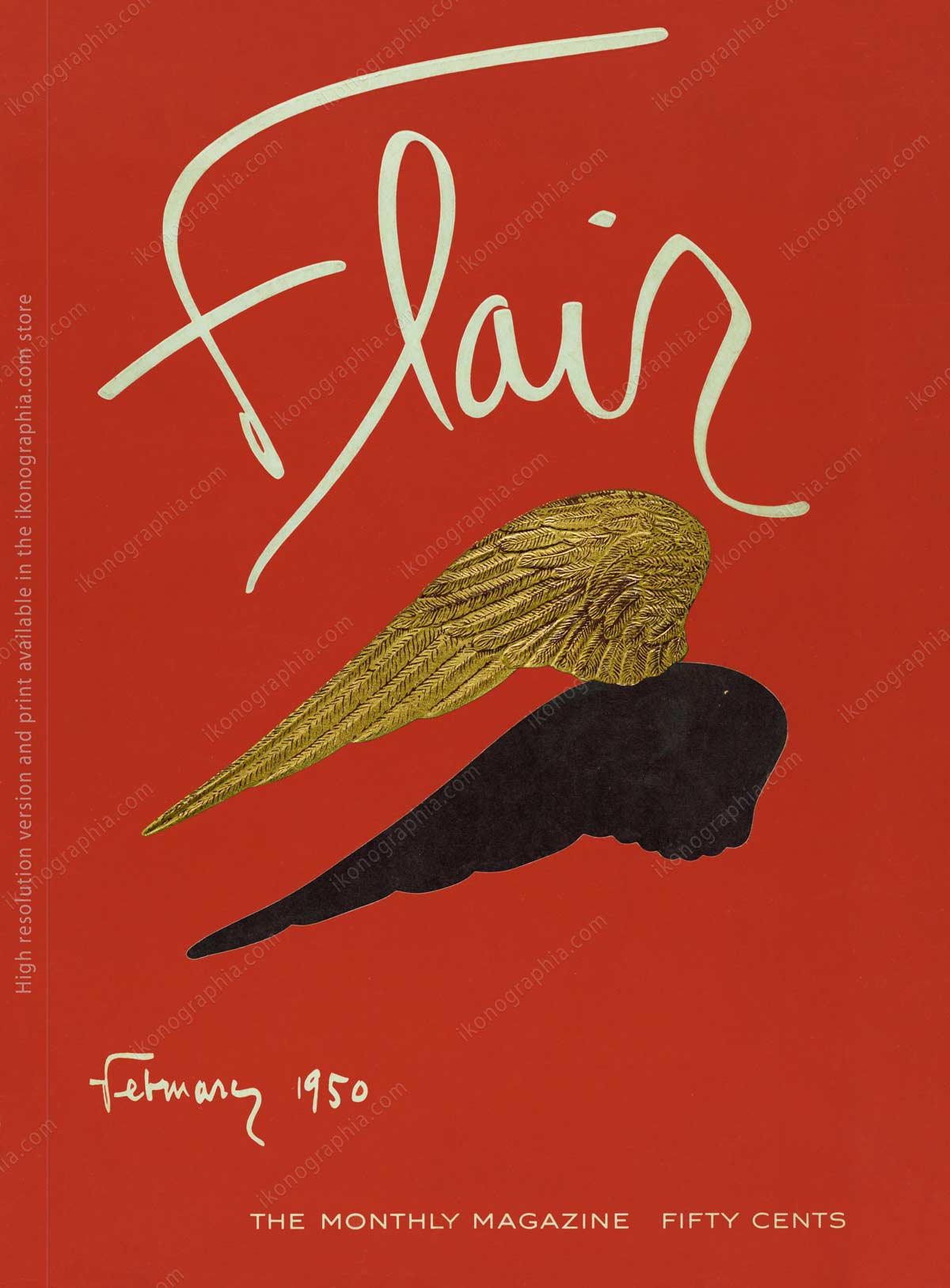
The Logo of the first number of Flair Magazine, February 1950.

1950. The Turning Point in Magazine Publishing.


In 1950, two new magazines were published. Both were highly innovative and destined to strongly influence all publishing in the following years.

The first was Portfolio, by Alexei Brodovitch, the Art Director of Harper’s Bazaar, which had revolutionized magazine design in previous years. The second one was Flair by Fleur Cowles.
Both were produced without budget limits, and both ceased publication after one year only because of the cost of production, which killed the magazines since the expensive special costs could not be supported in the long run.

The cover of the first issue of Portfolio Magazine, winter 1950. Designed by Alexei Brodovitch with Art Director Frank Zachary. Portfolio has been widely acknowledged as perhaps the definitive graphic design magazine of the twentieth century.

The first issue of Flair Magazine, February 1950, and the first issue of Portfolio, Winter 1950.

Flair. "The Monthly Magazine for Moderns"


On September 1949, Fleur Cowles released s a pre-publication advertiser's issue announcing Flair as 'the monthly magazine for moderns.' Here is an excerpt from the Time Magazine review.

Fleur's Flair, which will be shown this week in a limited edition to 5,000 potential advertisers and subscribers, looks like a fancy bouillabaisse of Vogue, Town & Country, Holiday, etc. By covering "fashion, art, literature, travel, decor, theater and entertainment," Editor Cowles expects to lure enough readers to guarantee advertisers a circulation of 200,000 (at 50¢ a copy) at the start.

Flair's sample issue has an off-white hardcover with a second illustrated cover visible through a triangular peephole. Flair abounds with other tricks. There is an accordion-style pull-out on interior decoration, a pocket-sized book insert, a swatch of cotton fabric, and even a page written in invisible ink that can be read when heated by a lighted match.
Source >

A Strong Navy. Art by Gruau - Flair Magazine, March 1950

A strong navy. Flair Magazine, March 1950. An elegant and "modern" design printed on two different papers to emphasize Renè Gruau's art showing creation by Christian Dior, Monte Sano, Sara Ripault, Patullo-Jo Copeland, Neiman-Marcus, and John-Frederics' hats.

FULL PAGES TEXT

A Strong Navy.. Art by Gruau - Flair Magazine, March 1950

NAVY blue with white is a spring natural .. . the magnificent whiteness that Melville, writing of his Moby-Dick, calls the —colorless, all color . . . stiffens and dramatizes the classic blue of schoolgirls and seafarers.
This spring the whiteness is no small measure confined to a slender ruffle, a small piping, but is laid against the blue in dense bold strokes that catch the eye like flashes of light.

Top: White checks are giant on Monte Sano's hip-length wool coat—shoulders sloping, back flaring, sleeves folding back below the elbows in wide cuffs.
Center: Dior mounts great white piqué cuffs buttoned in bone (top button left free) on the minute sleeves of a thin wool dress. Below: White piqué triangles accent the triangular décolletage of Sara Ripault's yarn-dyed twill dress and finish the sleeves. (A pocket on one hip balances a drape on the other.)
Opposite: The vent at the back of Patullo-Jo Copeland's distinguished dress coat of silk barathea buttons twice, swings open to bestow glimpses of a snowy lining of silk surah. A loop of fur worn like a cowl; of ermine, or white mutation mink, designed by Neiman-Marcus. John-Frederics' white hat.

Flair, according to Fleur Cowles

In February 1950, Fleur Cowles wrote her manifesto by hand. It was printed in gold relief on expensive blue paper and bound into the first issue of Flair. She did not know she was writing her obituary..

There have been Great adventures in paper and in printing and in the presentation of the graphic arts in the last decade… Unhappily, few of them for the public at large.
I have longed to introduce a magazine daring enough to utilize the best of these adventures. A magazine which combines for the first time under one set of covers, the best in the arts: literature, fashion, humour, decoration, travel and entertainment.
This copy of Flair shows that it can be done; it is proof that a magazine need no longer be stolidly frozen to the familiar format. Flair can an will, vary from issue to issue, from year to year, assuring you that most delicious of rewards - a sense of surprise, a joy of discovery. For the young in heart, men and women, I believe our efforts will help give a vital contemporary direction and fullness to American life.

Fleur Cowles, Editor

"A magazine need no longer be stolidly frozen to the familiar format." Twelve issues later, production costs made it unsustainable. Flair ceased publication in January 1951.
The manifesto is still the best description of what the magazine was, and why it could not survive.

The Opening of the Social Season, from “High Society”, pages 02-03. By Anne Fish 1920 How the Members of the Beau Monde Will Spend What Is Left of Their War-time Incomes.

Flair N.1, February 1950. The presentation of Flair hand-written by the Editor, Fleur Cowles.

An innovative Magazine.


Fleur Cowles was a design catalyst, creating an innovative magazine not just for 1950.
The magazine pages had hinged doors, pamphlet inserts, and spreads with flipbooks with captions underneath the main image. The pages did not come in a single stock, with a mix of papers in the same issue, from heavy cardstock to slight, onionskin translucent prints to glossy, smooth, and slippery pages.

Flair was designed to be a sensory feast for the readers that could touch, smell and enjoy the always-different art.
Someone defined Flair's design as an "elegant cacophony"; others "a fancy bouillabaisse of Vogue, Town & Country, Holiday."
Call it as you prefer; Flair was and still is unique.


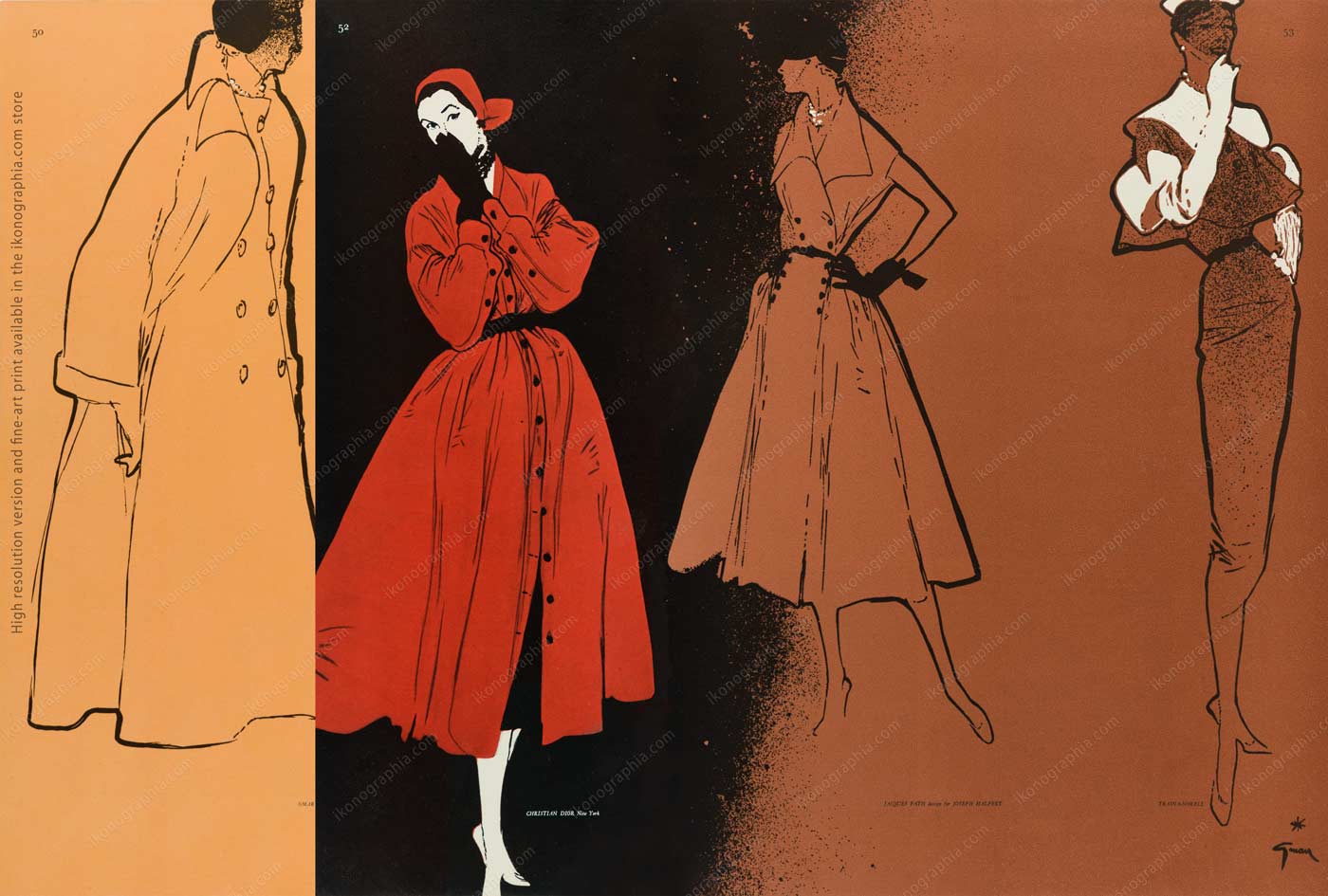
You are known by the color you keep. Flair Magazine, February 1950. Pages 50/53. Artwork by Renè Gruau.
Creations by Omar Kiam, Christian Dior of New York, Jaques Fath for Joseph Halpert, and Traina Norell.
Use arrows to flip pages.

FULL PAGES TEXT

YOU ARE KNOWN BY THE COLORS YOU KEEP.
Color may be the expression by which your world knows you best. You must unerringly know your range; perhaps the whole gamut is yours, perhaps only one color or two. The colors you wear should not be random choices: they are convictions to be carried through with unfaltering assurance.

Consider a great-coat (left), its collar jutting out like a separate jacket, in a peach beige with an affinity for navy blue. Against a wool skirt and velvet collar of black, a tawny beige cavalry twill jacket, a flash of red in the print blouse (right). Turn the flap and find spring's surprise, blazing red: a swaggering silk taffeta coat over a black strapless dress. In the beige range again, iridescent shantung takes on a true taupe cast, the sharpness of black accents. And the perennial freshness of small black and white checks is given further élan by the wand cut of a dress, a pullover jacket's starchy, winged white linen collars and cuffs.

Credits: left: OMAR KIAN of BEN REIG. center and right: TRAINA-NORELL.


Autumn is a city season. Flair Magazine, September 1950, pages 36-37. Use arrows to flip pages.
Below is the original magazine with pages 36 to 39 with flaps.

FULL PAGES TEXT

All Brim or All Crown. Photos by Maria Martel, Flair , March 1950 Pages 46, 49, including the flap page. Pages transcript: All Brim or All Crown. There are two hats this spring—the restless free shape flaring into space like a Calder mobile; or the close, crushed-to-the-head cap. The free shapes: Lilly Daché's milan wheat (page 46), its deep cantilever brim faced in black velvet. Braagaard's white organdy (above) with bands of stitching, bound in navy blue to accent its adventurous outlines. The close caps: 1. A coif, half purple and half white violets. 2. A cushion beret with a mound of pink roses shrouded in moss green veiling—the whole netted in heavy black mesh. 3. A small hillock of lilacs, green leaves and pink roses, springing from a white organdy cap. (These three, Lilly Daché.) 4. A cap and a crushed side bow of amber satin. 5. A lightly brimmed cap of lemon yellow felt, narrowly belted in rhinestones; a honey-colored face-veil. (These two, Mme. Andrée at Bonwit Teller.) 6. A minute helmet of pale blue straw with a bird on the brim and a misty black nose-veil. (Made to order at Bergdorf Goodman.)

Captions page 46: DIAMOND EARRINGS, CARTIER.
Caption, page 47: 2. RUBY AND DIAMONDS EARRINGS, VAN CLEEF & ARPELS.
Caption, page 48: PWARL AND DIAMON EARRINGS, SEAMAN SCHEPPS.
Caption, page 49: PEARL NECKLACES, DAVID WEBB.

Autumn is a city season. Flair Magazine, September 1950, pages 36/39. Drawing by René Gruau, Photos by Maria Martel.

Fashion is an Eye. Flair Magazine, February 1950. Photo by George Hoyningen-Huene.
Use arrows to flip the page

FULL PAGES TEXT

Fashion is an Eye.
You will find her, the brooding and uncertain woman opposite, wherever a dress may be bought.
The scene might be the Place Vendome, a New York store, a small-town dress shop. Maybe she hasn't even bothered to ask the price; or she might have scrimped for months to allow herself this one purchase. Whoever she may be, whatever her purse, she is a soul in misery — a fact the men in her life would never suspect. Probably she could not tell them why.
The unwelcome presence of other customers may have contributed. The most casual glance she interprets as a hard scrutiny, and her pleasant suit suddenly appears faded, worn.

The sales-girl may have held up one dress too insistently and aroused the cringing suspicion that some impossible thing is being palmed off on an easy victim. Or, worse mischance of all, this unhappy woman may have faced the mirror and found in its sly depths an unfamiliar reflection, so that every secret doubt she has ever had as to her looks and desirability now furiously possesses her.

At last she has decided; she is free to lift herself from her chair. How could she be so uncertain, so confused? Yet often she has reached the street before she regains her normal self-possession and sees, sees with her own eyes, again. What causes this temporary blindness? Not too little; perhaps too much. Ironically, as far as American women are concerned, this symptom of insecurity may be all the greater because fashion has never given them a wider choice nor made the work of the finest designers available to so many.

The public is familiar as never before with significant trends and important names in fashion — a result highly praiseworthy in all respects but one.
Fashion has ceased to be personal. In choosing a dress, the American woman is aware of many eyes upon her, and in turn she tries to judge what is before her by every high standard she knows . . . except her own. Fashion is an eye.

Every woman's eye. Your eye. And inevitably, fashion begins with the inner eye, with self-awareness, with understanding of all your powers, physical, mental, spiritual. It must calmly estimate all that you may claim as potentials for beauty. It demands the fullest expression of your own nature. It insists that you absorb the influences, the knowledges, the disciplines that will be permanently useful to you. It gives mature direction to the outer eye, guiding it to those possessions that are rightfully yours.

It forbids you from seeking refuge in those eccentricities of taste that reveal an insecurity far more destructive than the most slavish acceptance of the usual arbitrary norms.
It allows you to contemplate the fashions that FLAIR will report for you, to claim only those that are your own. Serene and sure, your eye will no longer waver from the image of beauty you have set for yourself. You will then be free to communicate your gaiety, your warmth, your self-confidence.

HOYNINGEN-HUENE. DIAMONDS BY HARRY WINSTON


All Brim or All Crown. Photos by Maria Martel, Flair, March 1950, pages 46-47. Use arrows to flip pages.

FULL PAGES TEXT

All Brim or All Crown. Photos by Maria Martel, Flair , March 1950 Pages 46, 49, including the flap page. Pages transcript: All Brim or All Crown. There are two hats this spring—the restless free shape flaring into space like a Calder mobile; or the close, crushed-to-the-head cap. The free shapes: Lilly Daché's milan wheat (page 46), its deep cantilever brim faced in black velvet. Braagaard's white organdy (above) with bands of stitching, bound in navy blue to accent its adventurous outlines. The close caps: 1. A coif, half purple and half white violets. 2. A cushion beret with a mound of pink roses shrouded in moss green veiling—the whole netted in heavy black mesh. 3. A small hillock of lilacs, green leaves and pink roses, springing from a white organdy cap. (These three, Lilly Daché.) 4. A cap and a crushed side bow of amber satin. 5. A lightly brimmed cap of lemon yellow felt, narrowly belted in rhinestones; a honey-colored face-veil. (These two, Mme. Andrée at Bonwit Teller.) 6. A minute helmet of pale blue straw with a bird on the brim and a misty black nose-veil. (Made to order at Bergdorf Goodman.)

Captions page 46: DIAMOND EARRINGS, CARTIER.
Caption, page 47: 2. RUBY AND DIAMONDS EARRINGS, VAN CLEEF & ARPELS.
Caption, page 48: PWARL AND DIAMON EARRINGS, SEAMAN SCHEPPS.
Caption, page 49: PEARL NECKLACES, DAVID WEBB.

Be like a rose. Flair, May 1950, Pages 40-41. Photo by Paul Himmel

Flair, May 1950. A double page from the Spring number. The issue, dedicated to the rose, was infused with an expensive rose fragrance, decades before scent strips became common in magazines.

FULL PAGES TEXT

The Opening of the Social Season.

How the Members of the Beau Monde Will Spend What Is Left of Their War-Time Income.

THE RESTAURANTS.
The season in the restaurants has opened strong. And the worst of it is that the ladies will spend all their time in these blessed robbers' dens. Tell a woman that her place is in the home and — but you wouldn't do anything as rude as that, would you? There are two other discouraging things about women in a restaurant: first, that they won't ever go home, and second, that they won't ever sit down. Here we see a tragedy illustrating both of these points. Muriel, who long ago finished her luncheon simply will not join the gentleman in the hallway (the one who looks a little like President Wilson), although the poor creature has been waiting for twenty minutes. And her charming little vis a vis, Esme by name (the one with the lap dog that looks like a three-leaved clover), has, on her side, been keeping her fiance standing at attention for a similar period of time — and, all because the two dears have such thrilling and wonderful things to talk about.

THE HORSE SHOW.
Here we see the horse show in full blast. Here you will see everybody happy, everybody occupied, scandals energetically and effectually discussed, meetings arranged in whispers, society reporters calling everybody by their wrong names, and everybody paying the strictest attention to everything about them — except the horses.

THE ART SHOWS.
Below we see the opening of the Vorticist Sculpture Salon, a debauch in marble that always brings out a full quota of the artistic cognoscenti of the town. Bohemia always appears in goodly numbers at these charming little revels in stone. The extraordinary thing about much of the new sculpture is that it looks like illustrations for those wonderful books on hygiene, in which ladies' are taking their matutinal exercises—by correspondence, of course. Take, for instance, the case of the delicate little gem entitled "Love" in this illustration. Captain De Pluyster who is viewing it in company with his fiancée, Miss Corinna Walpole, is listening to her: "Oh, that's an easy one. I do that twenty times, every morning, just before my bath."

THE FASHION FÊTES:
Perhaps the most delightful social occasion of all — at least as far as married men are concerned — is the winter Fashion Fete at Luciline's select little dressmaking establishment. In the picture, you will observe a married gentleman, accompanied by his gross tonnage. The poor man is not at all listening to Mme. Luciline; no, he is gazing wistfully and, with eyes aflame, toward the wholly divine young ladies who, every season, do so much toward making the happy modes and unmaking the unhappy marriages. "How different would have been my life," he reflects, "had I met one of those limp and sinuous sirens before I took up with my Henrietta."

A visionary talent-hiring editor


Conceived and produced by visionary editor Fleur Cowles, Flair magazine existed for only one year and twelve issues, from February 1950 to January 1951. The magazine combined art, fashion, travel, and reportage to take the most out of its Editor's formidable ability to promote European and American talent.

Cowles hired the best illustrators and photographers. The most impacting was Gruau at the peak of his career.
In one year only, Flair published the work of Jean Cocteau, Lucien Freud, Saul Steinberg, Salvador Dalí, Simone De Beauvoir, Walker Evans, Bernard Baruch, George Bernard Shaw, Tennessee Williams, Gloria Swanson, Eleanor Roosevelt, Gypsy Rose Lee, and Colette.

Paris Collections Spring 1950. This is the shade of tangerine that is everywhere in Paris, will be everywhere in America. Art by René Gruau. Flair, March 1950.

Flair, March 1950. Paris Collections Spring 1950. This is the shade of tangerine that is everywhere in Paris, and will be everywhere in America. From left, creations by Dior, Dior, and Molyneux. Art by René Gruau., left page.

FULL PAGES TEXT

Paris Collections Spring 1950. This is the shade of tangerine that is everywhere in Paris, and will be everywhere in America.

Pages text transcript

FIRST . . . THIS IS THE SHADE OF TANGERINE THAT IS EVERYWHERE IN PARIS, WILL BE EVERYWHERE IN AMERICA IN NEWS: The straight and narrow silhouette sometimes relieved by a bloused back, a big bib-collar, a bow of fantastic size; or by over-all tucking, ruching, fluttering petals; a floor-length pouf or panel; a starched or pleated flare below the hips, below the knees, toward the hem.

. . .The occasional break from the straight into belling and even bouffant evening skirts.... The fluctuating hemline-in-transition—an average fifteen inches for day; every length for evening.

... IN COLOR White, white everywhere; then black and white, navy and white, and a ranging spectrum of blond and amber tones culminating in striking doses everywhere of tangerine.

. . . IN SPOT NEWS: The décolleté, cuffed, horseshoe neckline on suits and street dresses. . . . Dior's mannish dusters of silk tussor in natural or in pale colors over darker dresses; his fabulously tailored chiffon evening coats. . . . The flowing peignoir coat, often sleeveless. . . . The narrow sleeveless dress. . . . The overlong, crushed-down gloves worn with both.

... IN PROPHETIC TENDENCY: The straightening silhouette, the heightening hemline, the slowly but surely descending waistline. Opposite: Dior's black taffeta with an immense white bib-collar, starched and nun-like, tied with a whisker bow of black net. Right: Dior's black-and-white tweed smoking jacket, narrowed at the hem, its deep horseshoe neckline cuffed with tuxedo revers; over a black wool dress with a white Byronic collar, a big black taffeta bow tied outside. Far right: Molyneux's double-breasted gray wool with a bril-handy cut envelope fold at the front of its skirt, a taffeta sash tied in a bold bow. An optional straight, pleated wool overskirt changes its looks but not its lines.

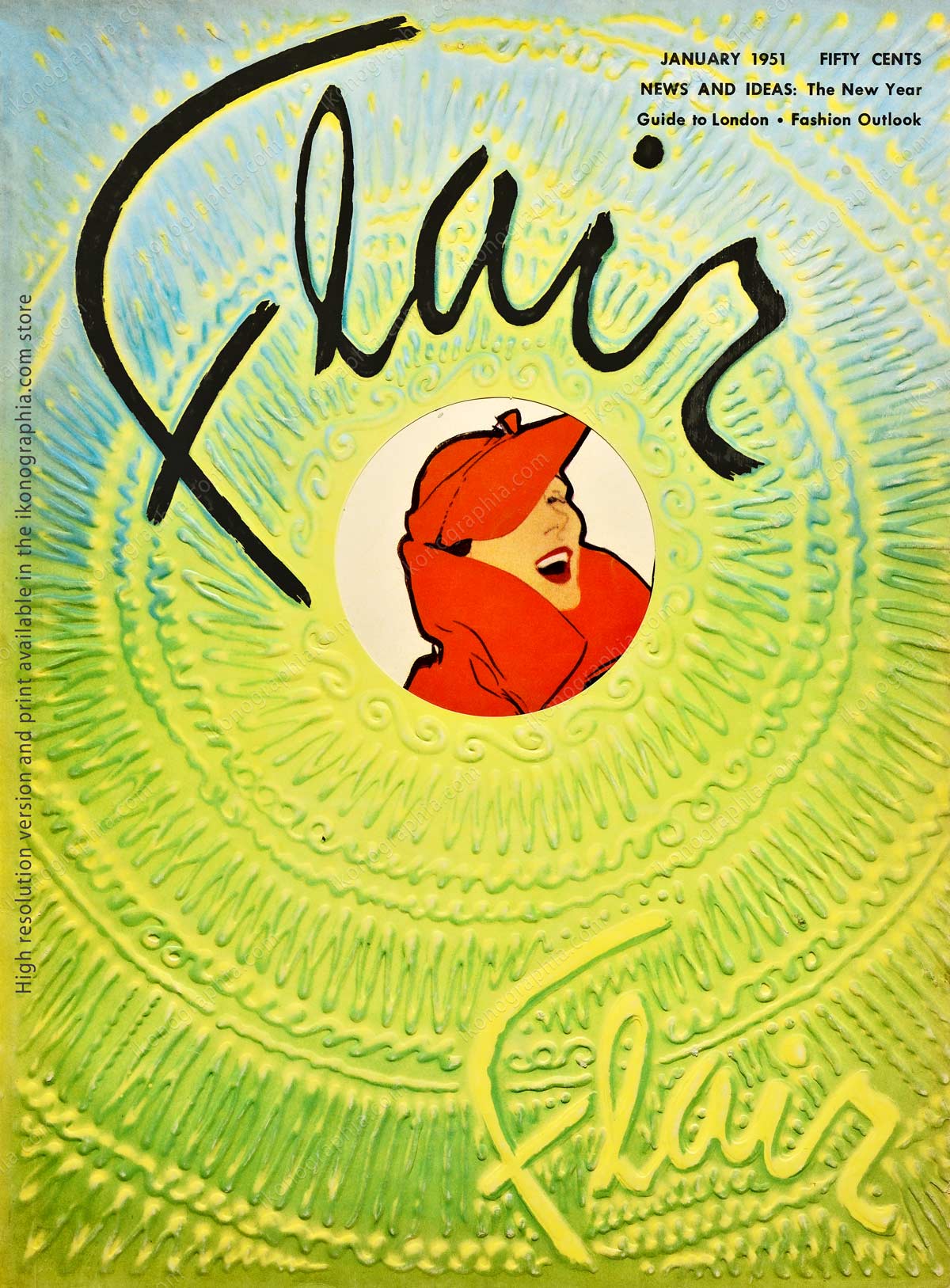
The Cover of the last number of Flair Magazine, January 1951. Painting of sun by Victor Vasarely. A cut-out door partially reveals the Undercover’ image: “Bear and Warmer”, by Rene Gruau.

The cover of the last number of Flair of January 1951 is "The Painting of Sun," by Victor Vasarely, a Master of Optical Art.
The image that comes out from the peephole, is "Bear and Warmer," by Gruau.

Bugatti Posters

Bugatti Posters

Bugatti Posters

Cassandre, Dudovich, Vincent, Geo Ham — the finest graphic artists of the era, commissioned by Bugatti.

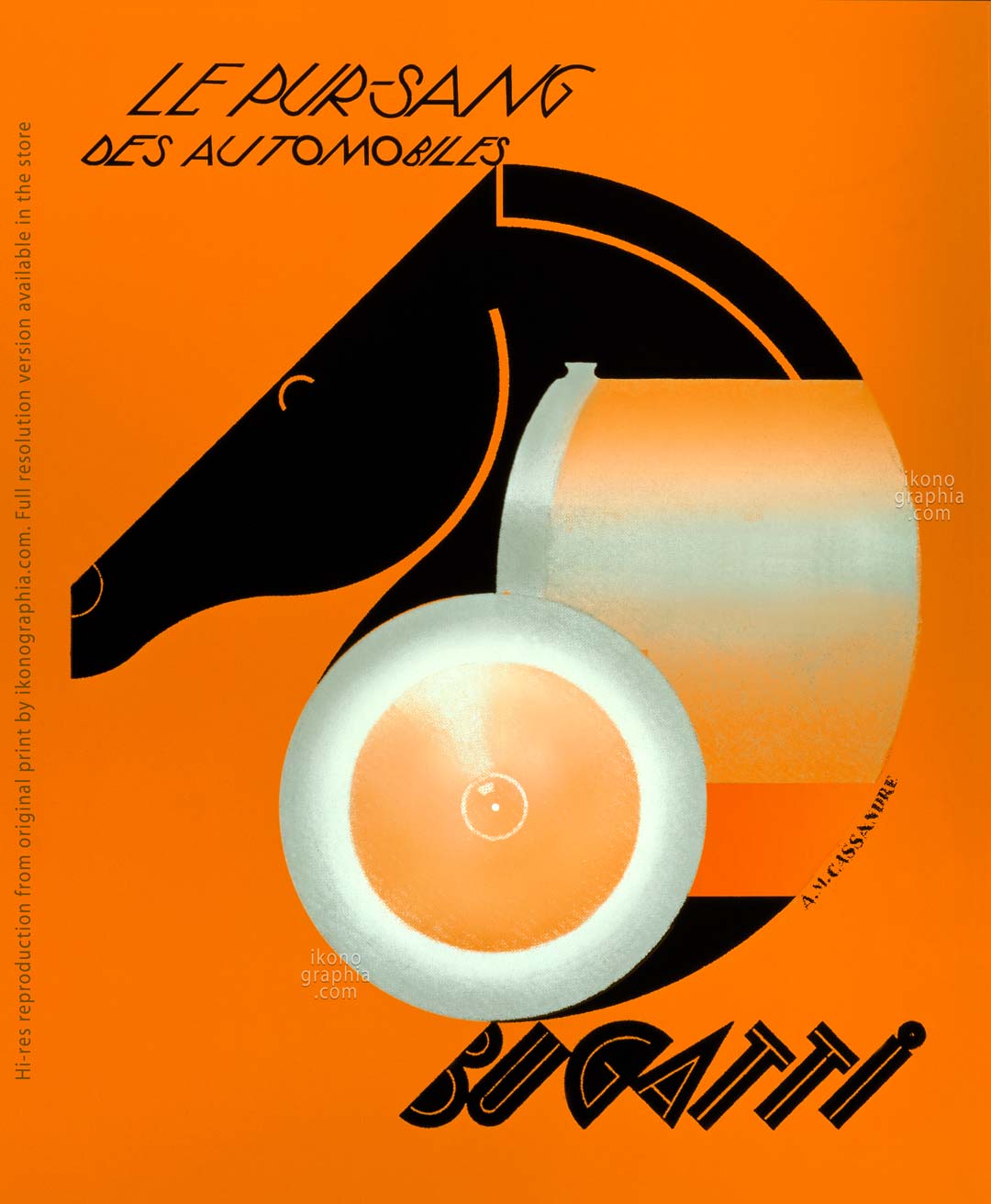
Bugatti commissioned its advertising posters from the finest graphic artists of the era — Cassandre, Marcello Dudovich, René Vincent, Geo Ham. The results are among the most celebrated works in automotive poster art. Cassandre's 1935 Le Pur-Sang des Automobiles remains the definitive image of the marque. Dudovich's 1922 C'è una Bugatti, non si passa is a masterpiece of symbolic compression.

The originals were held in the Campogalliano archive. Roberto Bigano borrowed and reproduced them in his studio — the same access that produced the factory drawings. The archive presents the most significant surviving examples, reproduced directly from the originals.

Bugatti Le Pur-Sang Des Automobiles. Art by Cassandre 1935

Obsessive attention to detail and hiring the best artists.


Ettore Bugatti designed many of his creations, as did his highly talented son Jean, who later took to the drawing board alone. This extraordinary man had attended the Brera School of Art as a youth, yielding an artistic streak.
He also demonstrated an astonishing ability for mechanical engineering and an amazingly eclectic mind in general. At the age of 20, he built his first car and personally designed everything from the “ergonomic” interiors of his company’s automobiles.
Consequently, Ettore and Jean designed and oversaw Bugatti’s literature (catalogs, advertisements, posters, and factory technical drawings).
The posters were created by great artists of the time, including Cassandre, Marcello Dudovitch, Renè Vincent, Geo Ham, and others.

C’è una Bugatti, non si passa (There's a Bugatti, you can't pass.) Poster by Marcello Dudovich 1922 Dimensions: 195x140 cm Printer: Edizioni STAR . Officine IGAP, Milano This masterpiece is rich in symbolism, beginning with the title that emphasizes Bugatti's legendary invincibility. The model portrayed is the Type 13 Brescia.

C’è una Bugatti, non si passa (There's a Bugatti, you can't pass.) 1922.
A Poster by Marcello Dudovich.

Dimensions: 195x140 cm
Printer: Edizioni STAR . Officine IGAP, Milan

This masterpiece is rich in symbolism, beginning with the title emphasizing Bugatti's legendary invincibility. The model portrayed is the Type 13 Brescia.

Apparently, there is a reference to Isadora Duncan, who died when her red scarf became entangled in the wheel of a Bugatti. But this is not possible, as this happened five years later.

1930 Bugatti Poster by René Vincent

Bugatti. 1930
A Poster by René Vincent

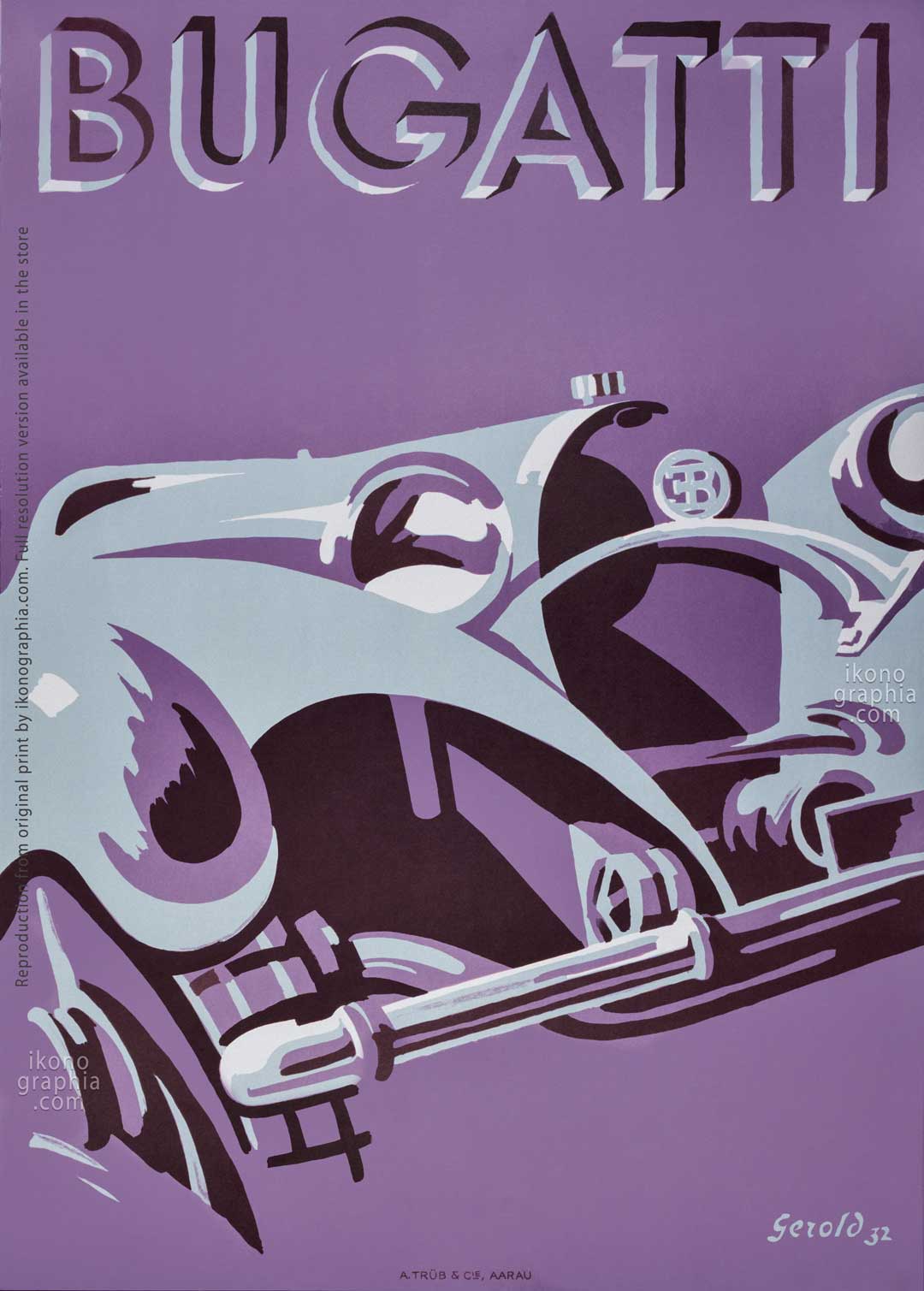
An impacting 1932 Bugatti Poster by Gerold

Bugatti Type 50 1932.
Artwork by Gerold.
Poster size: 51 x 35in / 129 x 90cm

Published by A.Trüb & Cie, Aarau, Switzerland

Le Pur-Sang Des Automobiles. Art by Cassandre 1935. An iconic 1935 Bugatti Poster by Cassandre, pseudonym of Adolphe Jean-Marie Mouron.

Le Pur-Sang Des Automobiles. 1935
An iconic 1935 Bugatti Poster by Cassandre, pseudonym of Adolphe Jean-Marie Mouron.

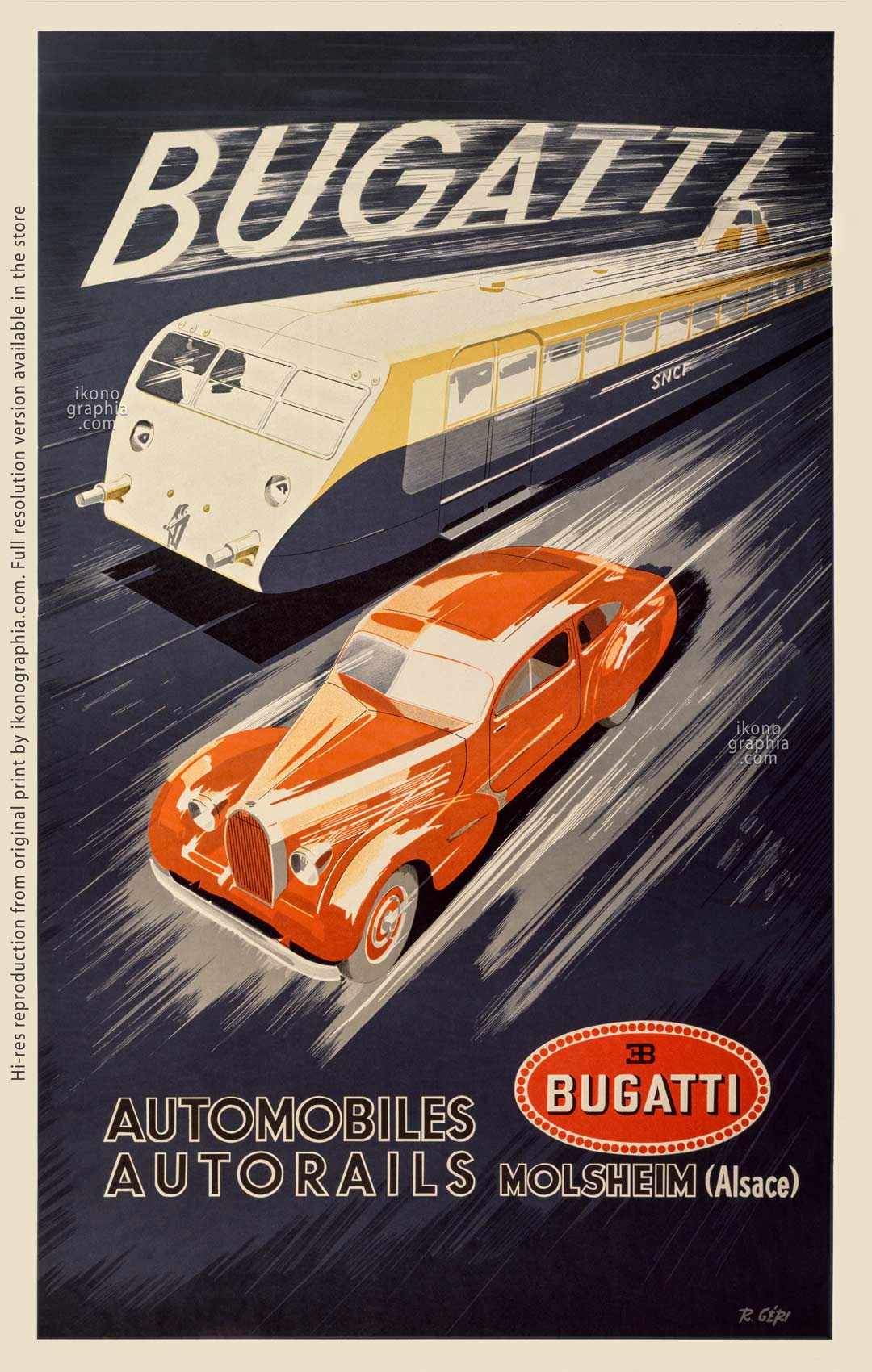
Bugatti Automobiles et Autorails. 1935 - Art by R.Geri

Bugatti Automobiles et Autorails. 1935.

Art by R.Geri
Poster size: 38 x 23in. / 97 x 59cm.

Bugatti Type 57 Modeles 1939

Bugatti Type 57 Modeles 1939.

USD United States (US) dollar
EUR Euro