Ten Buildings — Ten Masterpieces of New York Art Deco
Ten Buildings — Ten Masterpieces of New York Art Deco
The decorative programs of Art Deco Manhattan — photographed in full and documented to primary sources.
Between 1924 and 1939, a generation of architects, sculptors, and metalworkers transformed the commercial lobbies of Manhattan into complete symbolic environments. Bronze grilles, elevator doors, painted vaults, and polychrome ceilings — conceived not as decoration added to architecture, but as the architecture itself. Ten buildings document the full range of that achievement: from the first Art Deco motif on an American building to the most ambitious iconographic program ever cast in bronze.
This featured story brings together the ten buildings at the core of the NYC Art Deco Archive — each documented in sequence, in context, and against the primary sources that define it. Some stories are complete. Others are in progress. All images are available now.
The archive was built in March 2024, when Roberto Bigano spent five weeks inside sixty-five Manhattan buildings documenting interiors that most New Yorkers have never stopped to look at. Twenty-three photographs — 32 pages and a cover — were published in FMR Magazine. Gotham Deco: Modern Metropolis. This Was Tomorrow, with an essay by Anthony W. Robins
Edgar Brandt and Cheney Silk — Madison Belmont Building, 1924
First American Art Deco
This is not an Art Deco building. It is not an interior. It is here because of one object — the frozen fountain on the entrance at 181 Madison Avenue — which changed everything and is considered the first application of Art Deco on an American building. The first. The most recognizable. The most influential.
In 1924, the Cheney Brothers Silk Company commissioned the building from Warren & Wetmore — the architects of Grand Central Terminal. The building itself was Neoclassical in form, a transitional structure carrying a detail that belonged to a different world entirely.
Cheney Brothers were not a neutral client. Their silk advertising of the 1920s — placed in the New Yorker and Harper's Bazaar — was among the most visually sophisticated of the era. The same sensibility that chose Brandt chose those pages. The story of the building cannot be told without the company that built it.
Full documentation coming to the NYC Art Deco Archive. Story forthcoming.

Edgar Brandt's Frozen Fountain — Madison Belmont, New York, 1924
The frozen fountain motif on the Madison Belmont entrance was designed by French iron master Edgar Brandt. The motif — stylized water cascading in symmetrical curves — originated in Brandt's monumental gate at the 1925 Paris Exposition.
Here, in wrought iron with gold and bronze accents, it became the first major application of what would later be called Art Deco on an American building. The building itself was not in the new style. The decoration was the exception — and became the symbol.
The City of Opportunity — Chanin Building, 1929
New York, 1929 — A City at its peak, casting its ambitions in bronze.
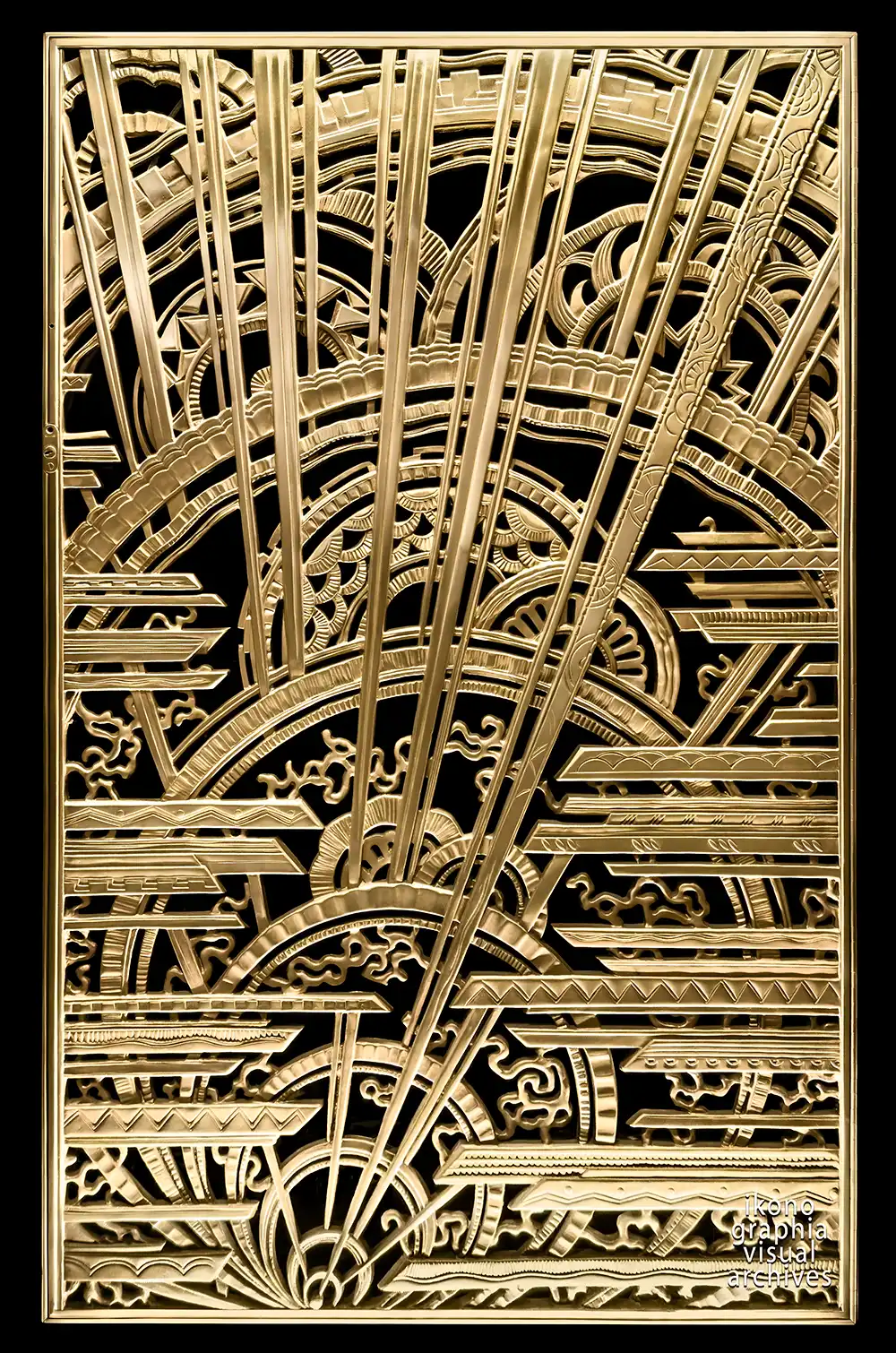
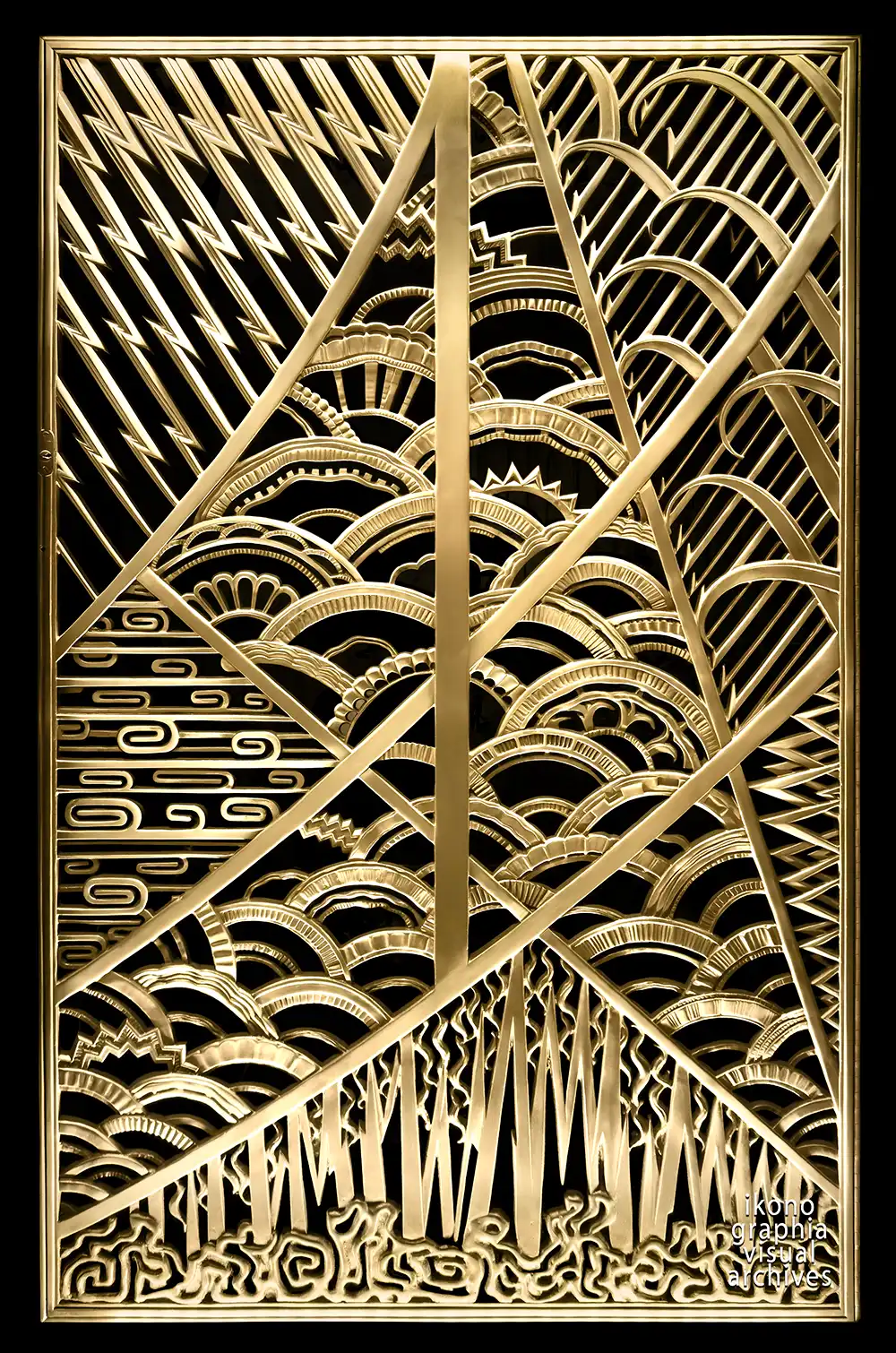
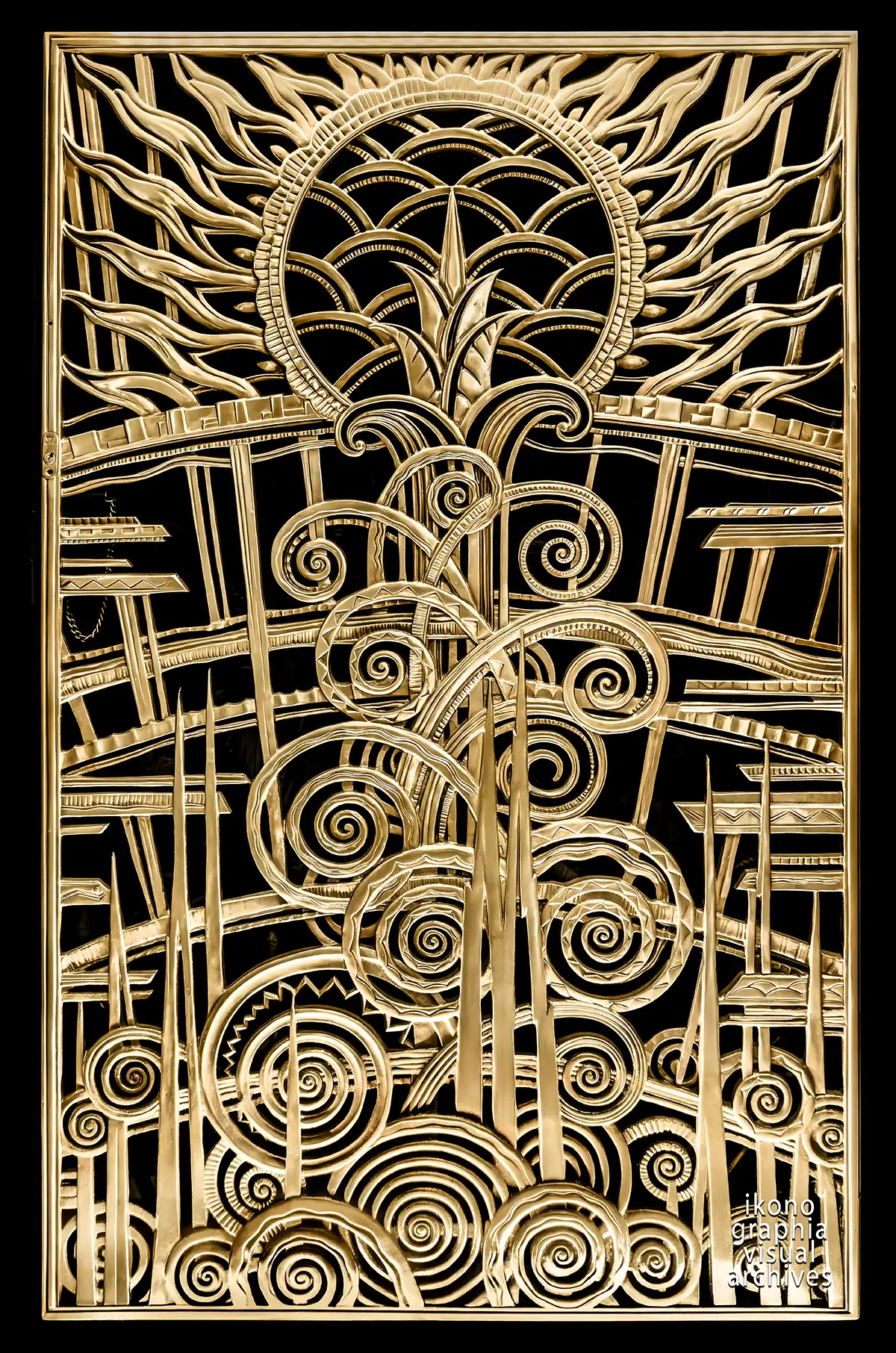
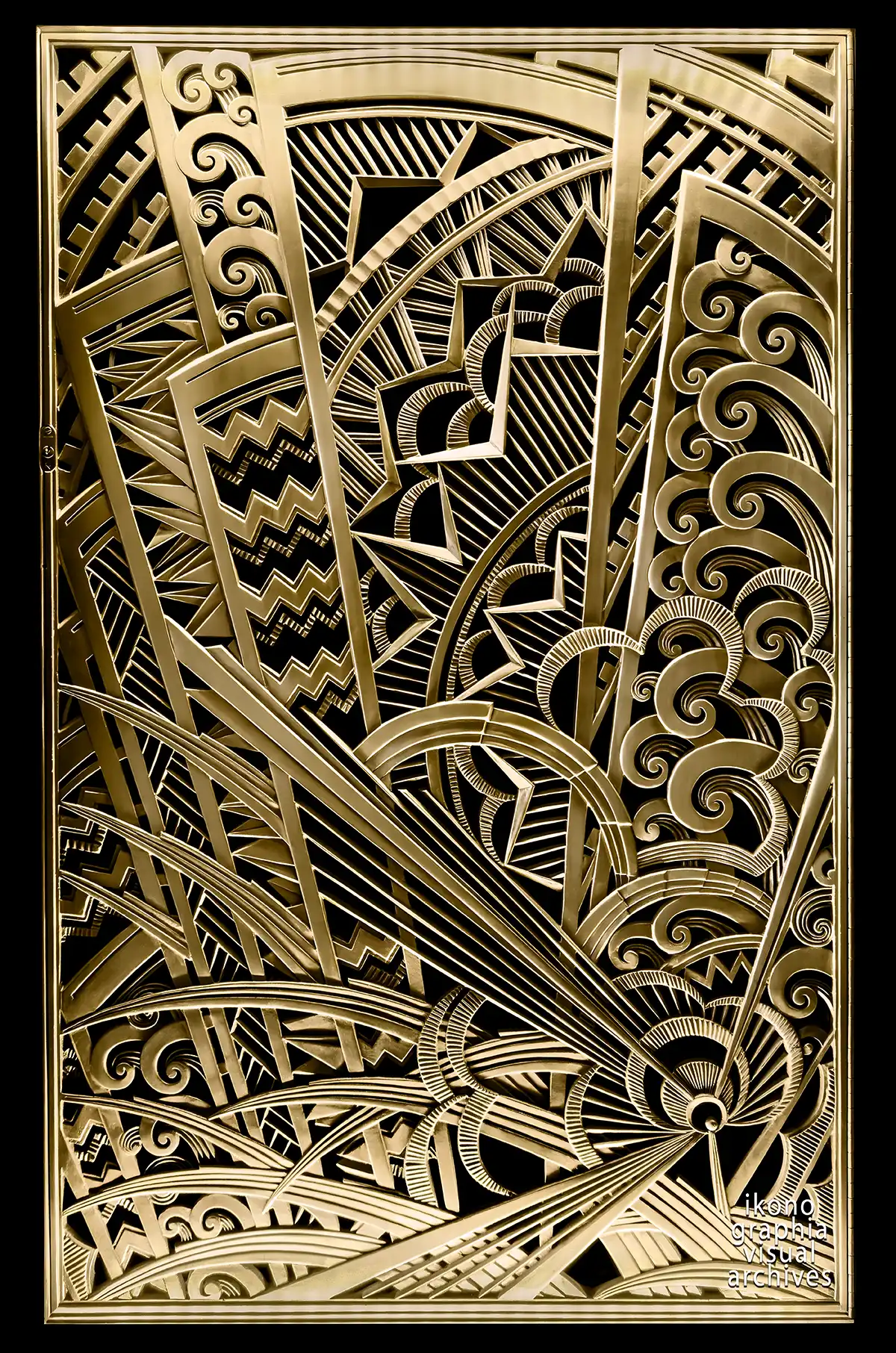
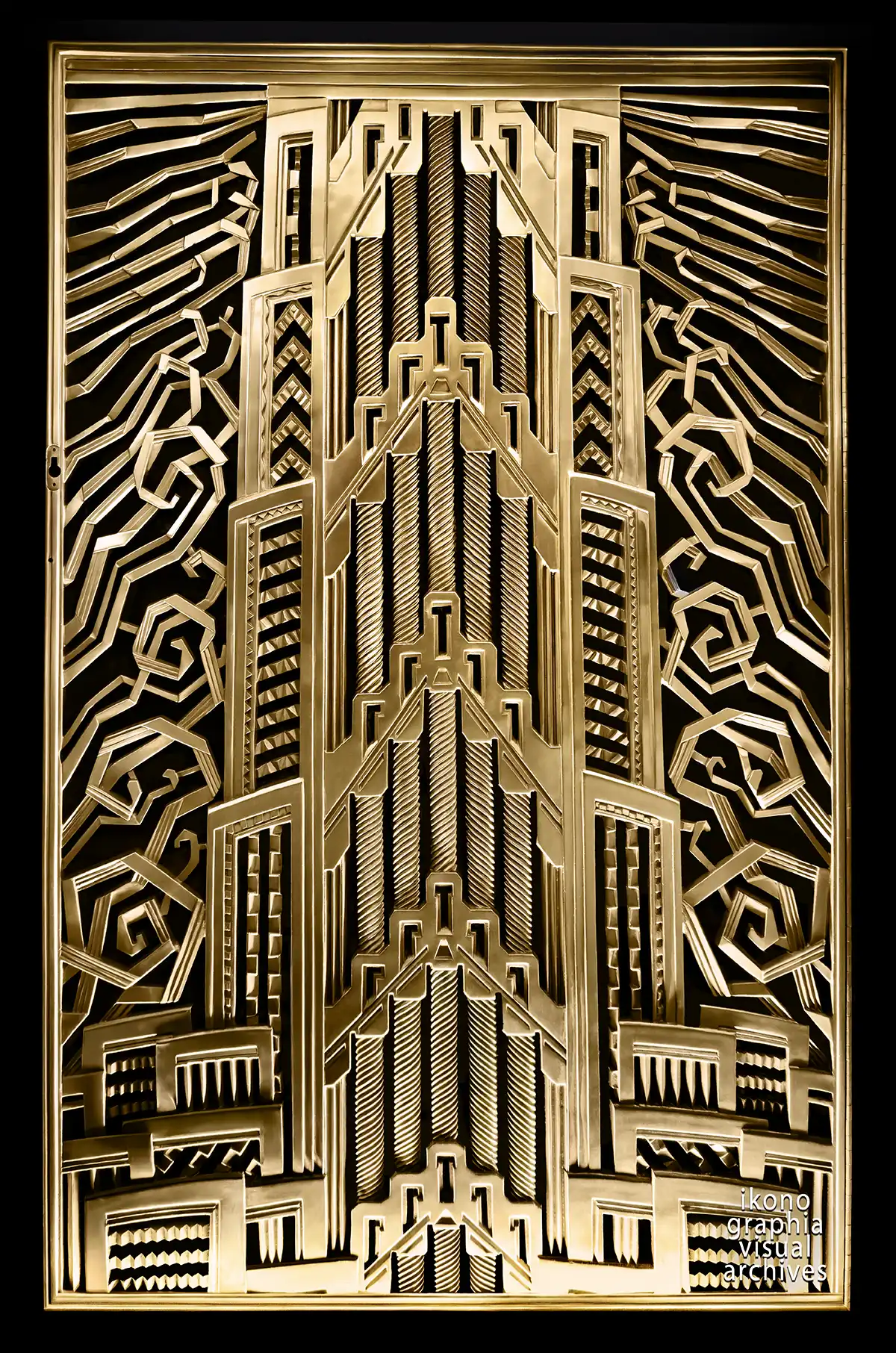
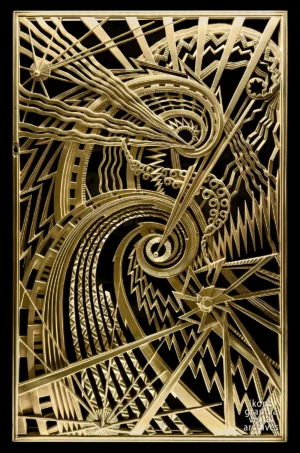
Completed in 1929 at the height of New York's Jazz Age construction boom, the Chanin Building stands as one of the most intellectually ambitious expressions of American Art Deco. Its façade is admired, its lobby celebrated — but its most fully argued artworks are found in the vestibule: eight monumental gilt-bronze radiator grilles, conceived as a symbolic cycle of human development.
René Paul Chambellan and Jacques Delamarre encoded the stages of human development in pure geometric abstraction. The program was admired for nearly a century without being fully understood.
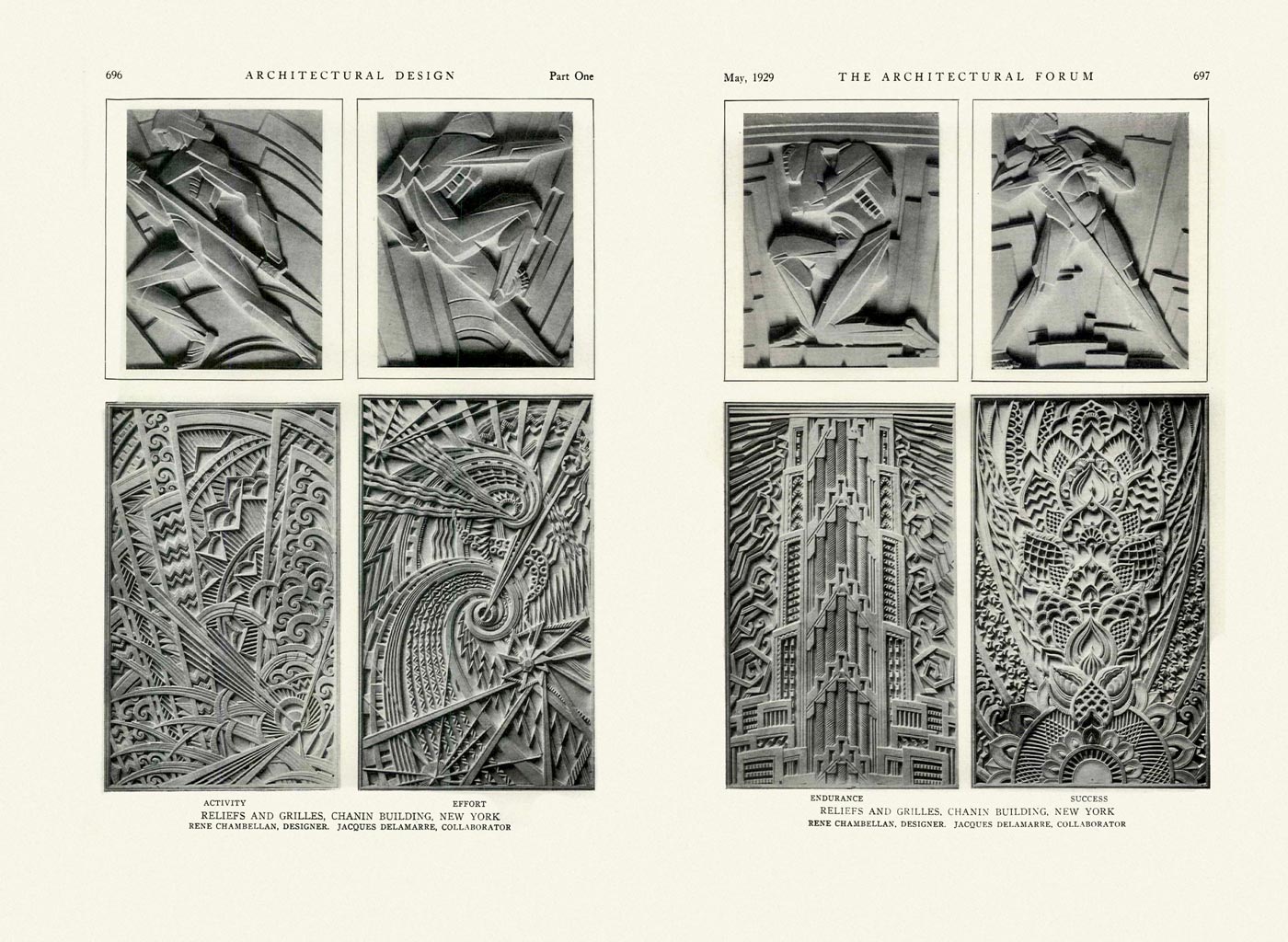
The key was a 1929 article in Architectural Forum in which Jacques Delamarre explained the complete iconographic logic at the moment of completion. The article existed. It was buried, unrecognized, unconnected to the grilles. Ikonographia identified it, paired it with high-resolution photography that makes the relief legible, and reconstructed "The City of Opportunity" as a complete iconographic cycle — for the first time.
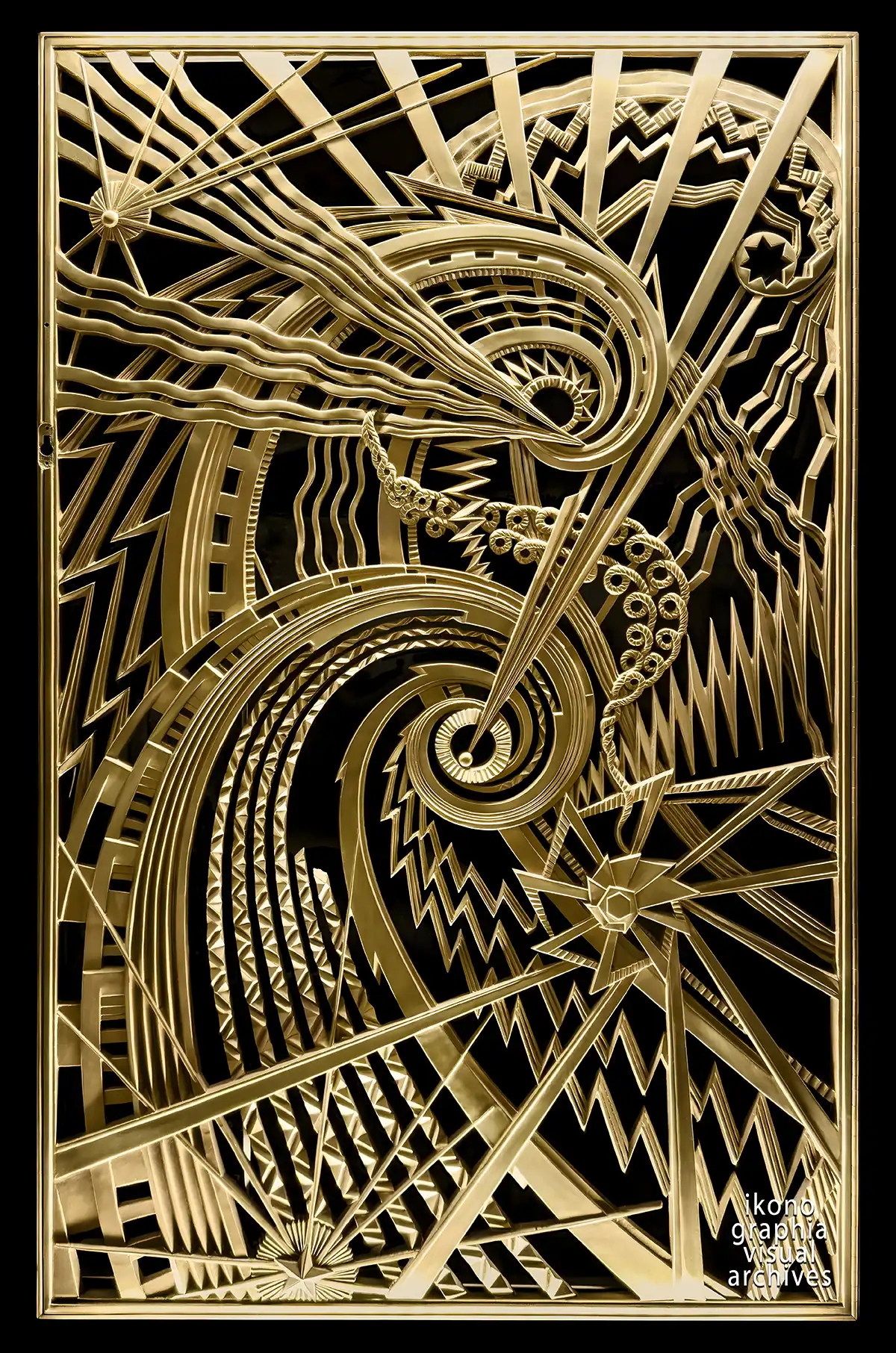
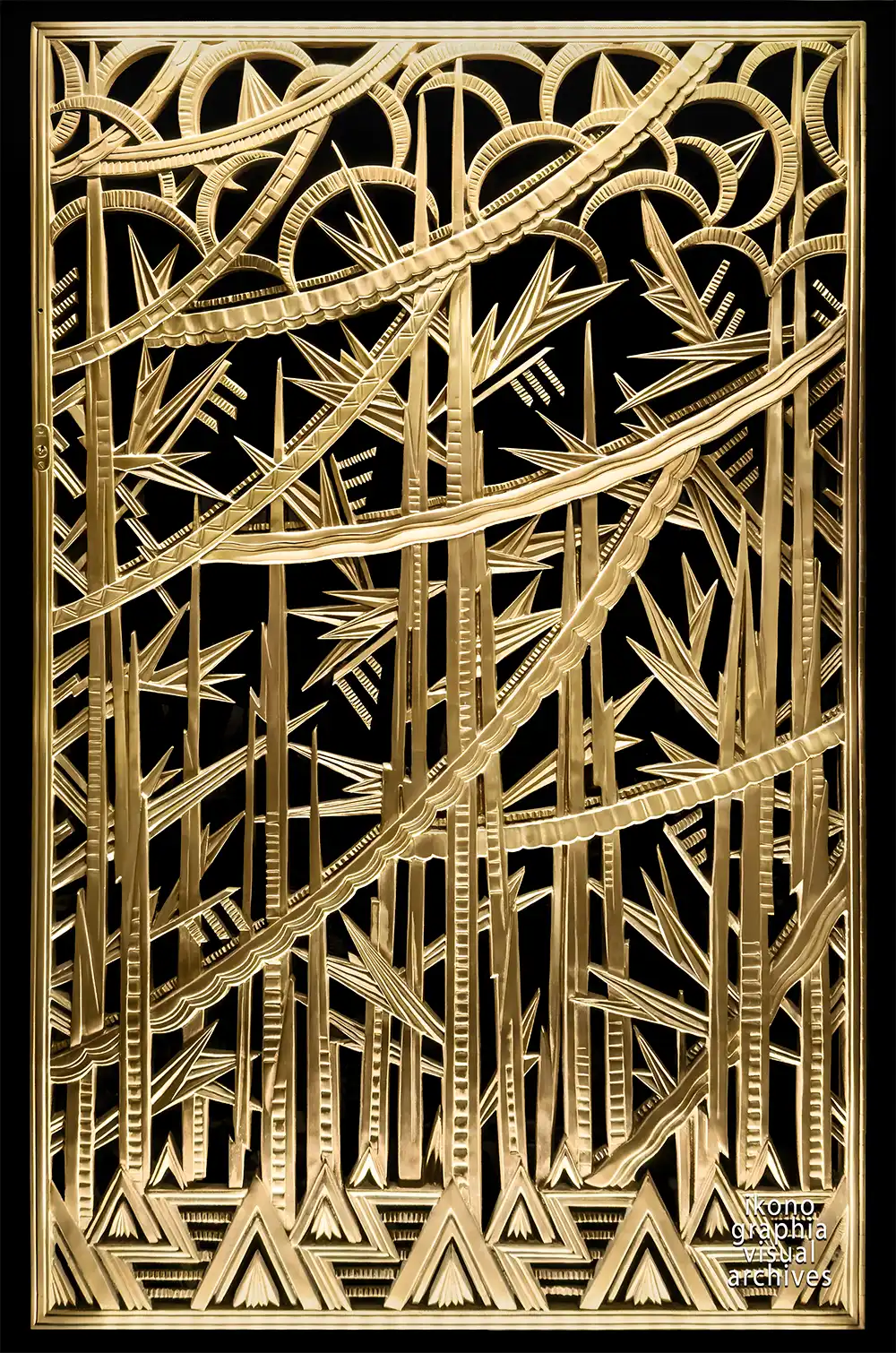
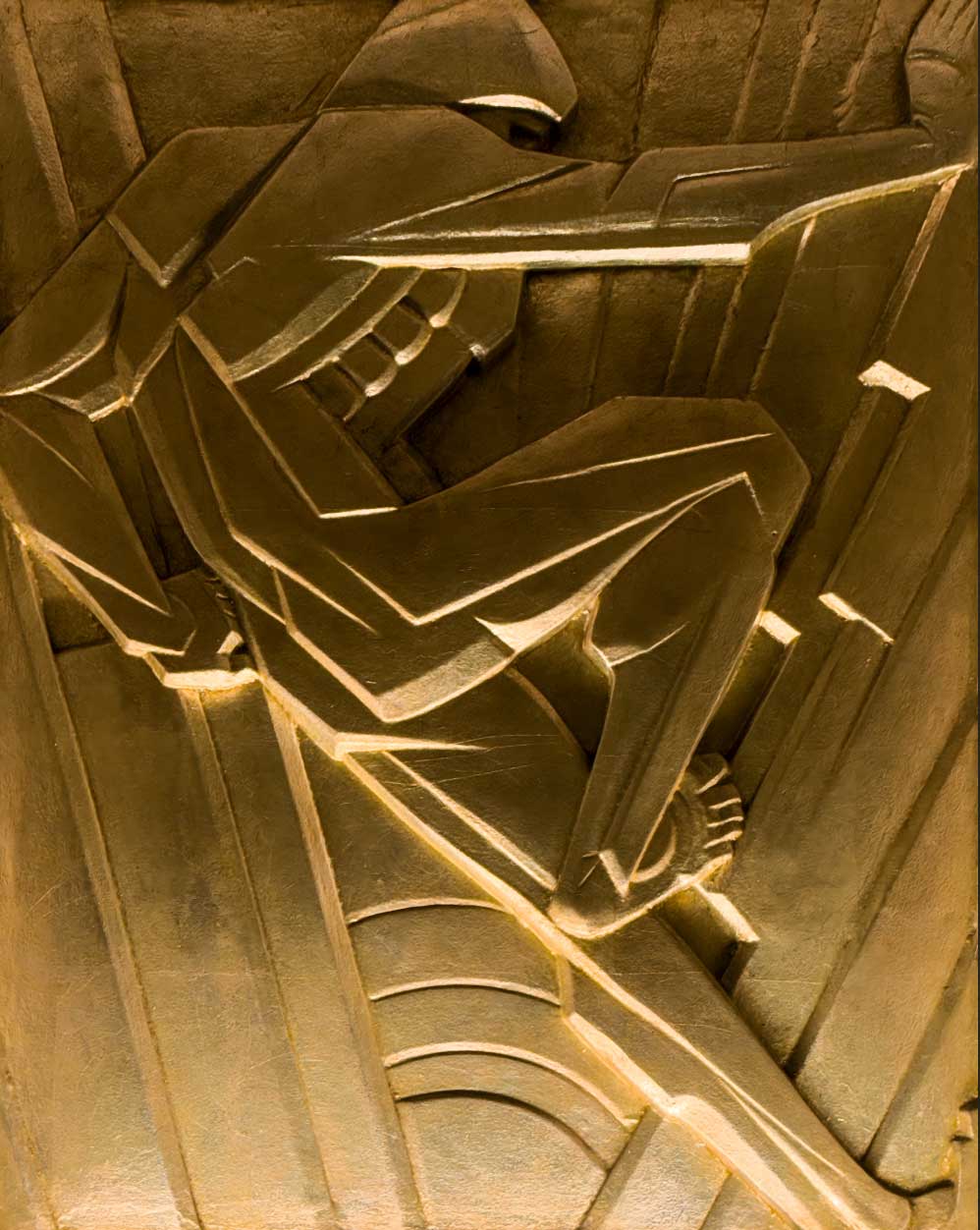
Effort.
The struggle against resistance.
From "The City of Opportunity — Physical Series."
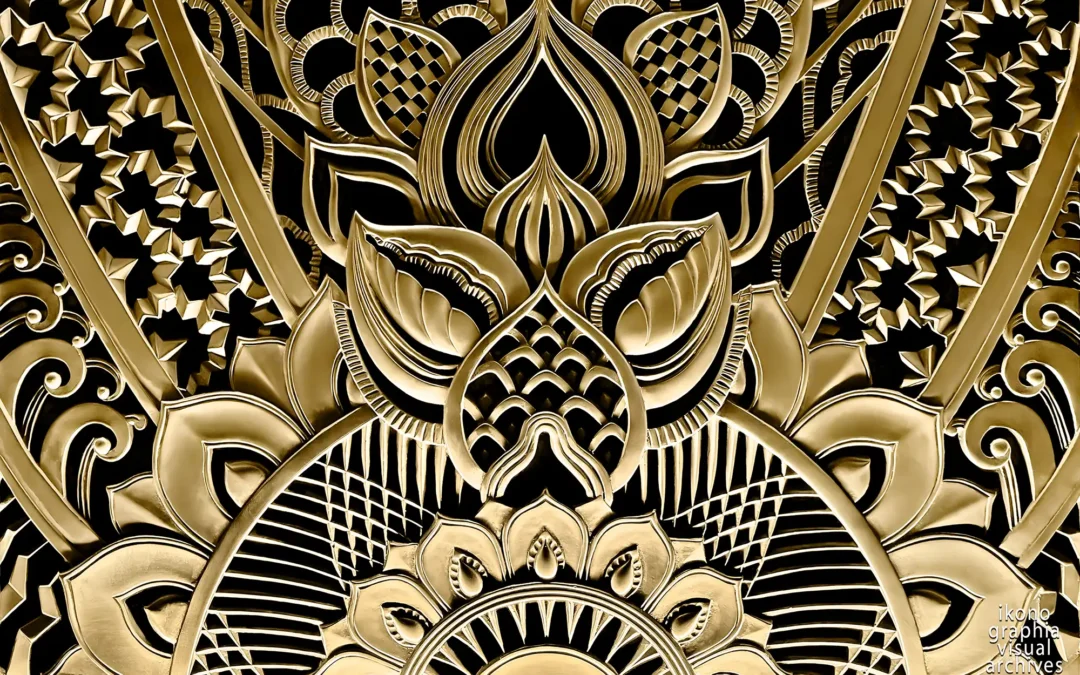
Here, spirals tighten, diagonals collide, and curves appear compressed, as if bearing weight. The composition visualizes the tension between aspiration and the obstacles that define it. Effort is the architecture of perseverance.
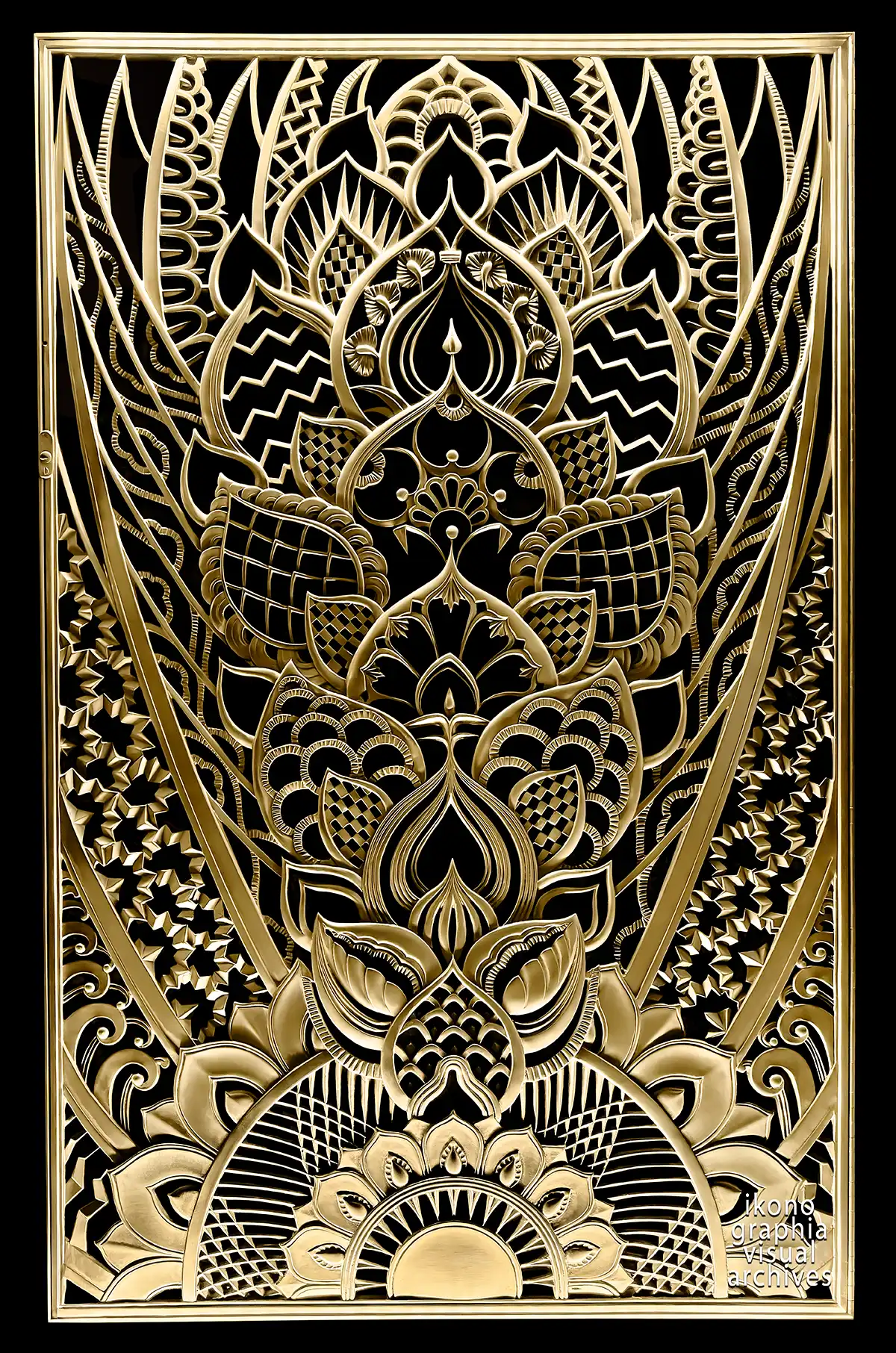
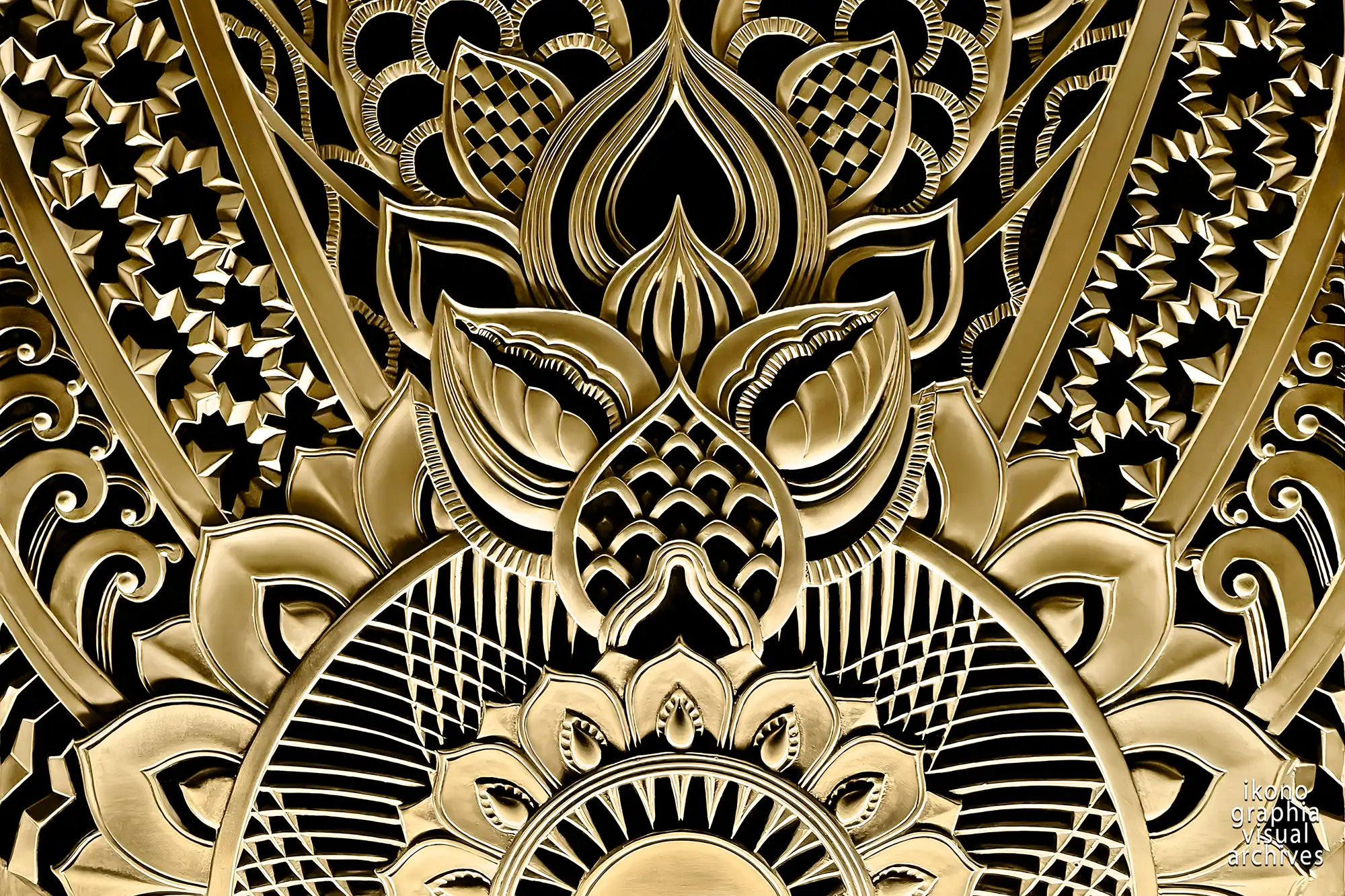
Success.
The reward of sustained action.
From "The City of Opportunity — Physical Series."
Symmetry returns, crowned with a radiant rising form. Success is rendered not as excess but as order — the balanced resolution of struggle. Spirals unfurl, energy flows upward, and the pattern resolves into harmony.
When Babylon Met Fifth Avenue — Fred French Building, 1927
One architect's obsession with ancient Babylon. One sculptor's mastery in bronze. A New York landmark unlike any other.
Completed in 1927, the Fred F. French Building stands as one of Manhattan’s finest expressions of the early Art Deco-Babylonian hybrid style.
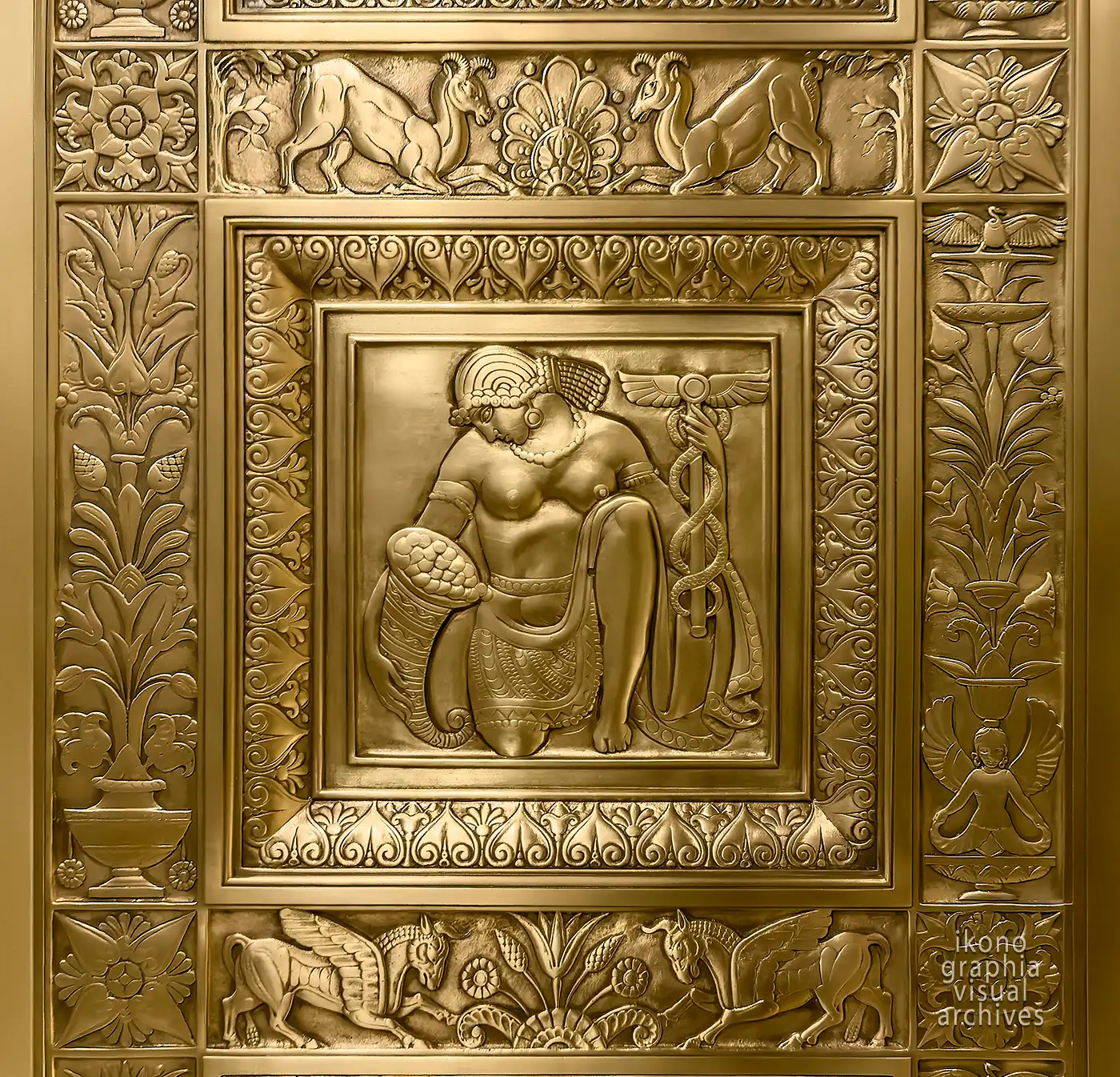
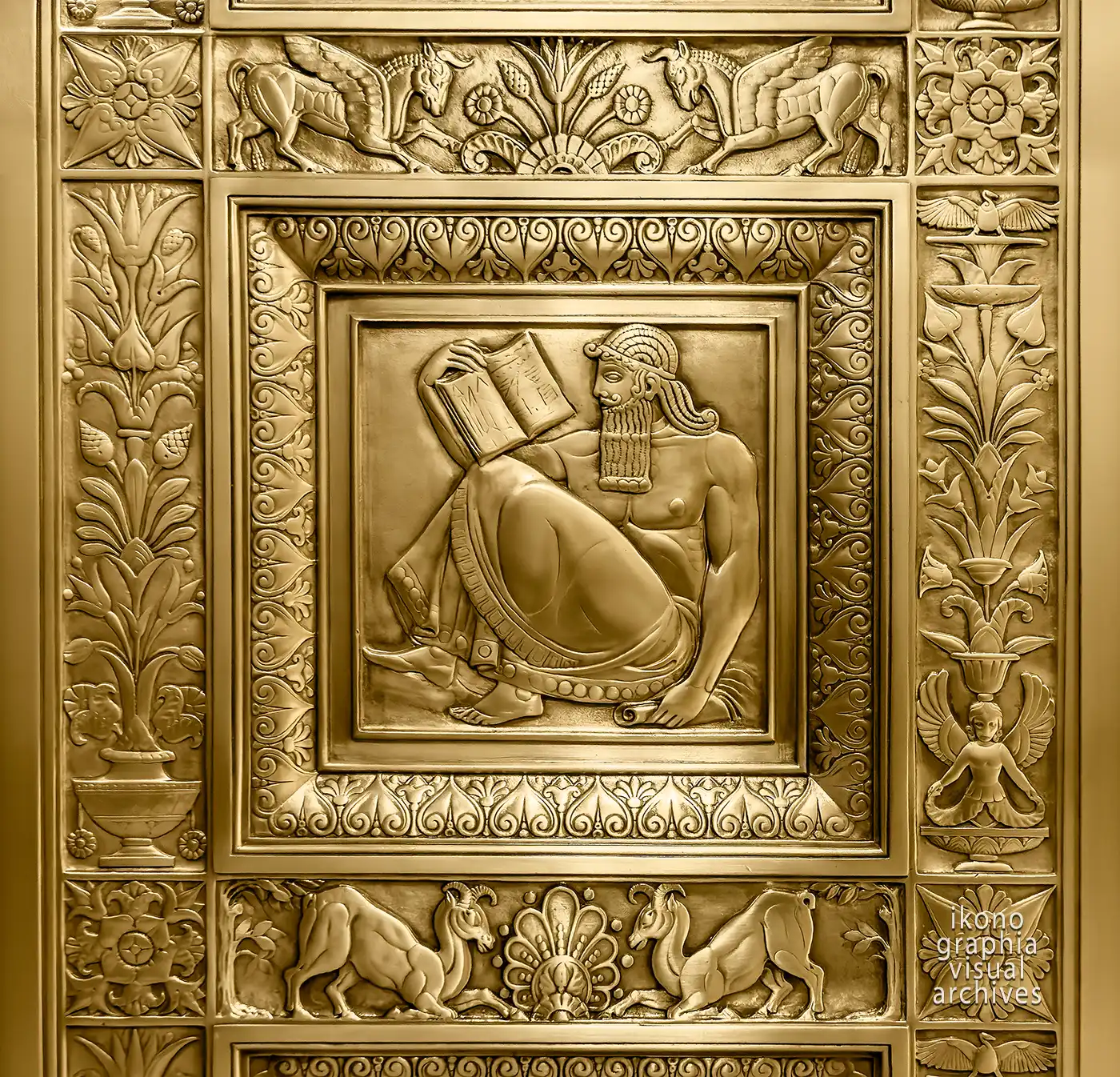
While the tower is admired for its stepped crown and gilded ornament, its most exceptional artworks lie in the lobby, conceived by Douglas H. Ives and realized by sculptor Vincent Glinsky and master metalworker Oscar Bach: eight bronze elevator panels, a monumental mailbox, and a complete bronze decoration program.
The lobby contains one of the most complete bronze programs in American Art Deco — eight gilded elevator panels, a monumental mailbox that compresses the entire symbolic argument of the building into a single object, and an entrance relief of allegorical figures dense with ancient Near Eastern imagery. Conceived by Ives, sculpted by Glinsky, cast by Bach.
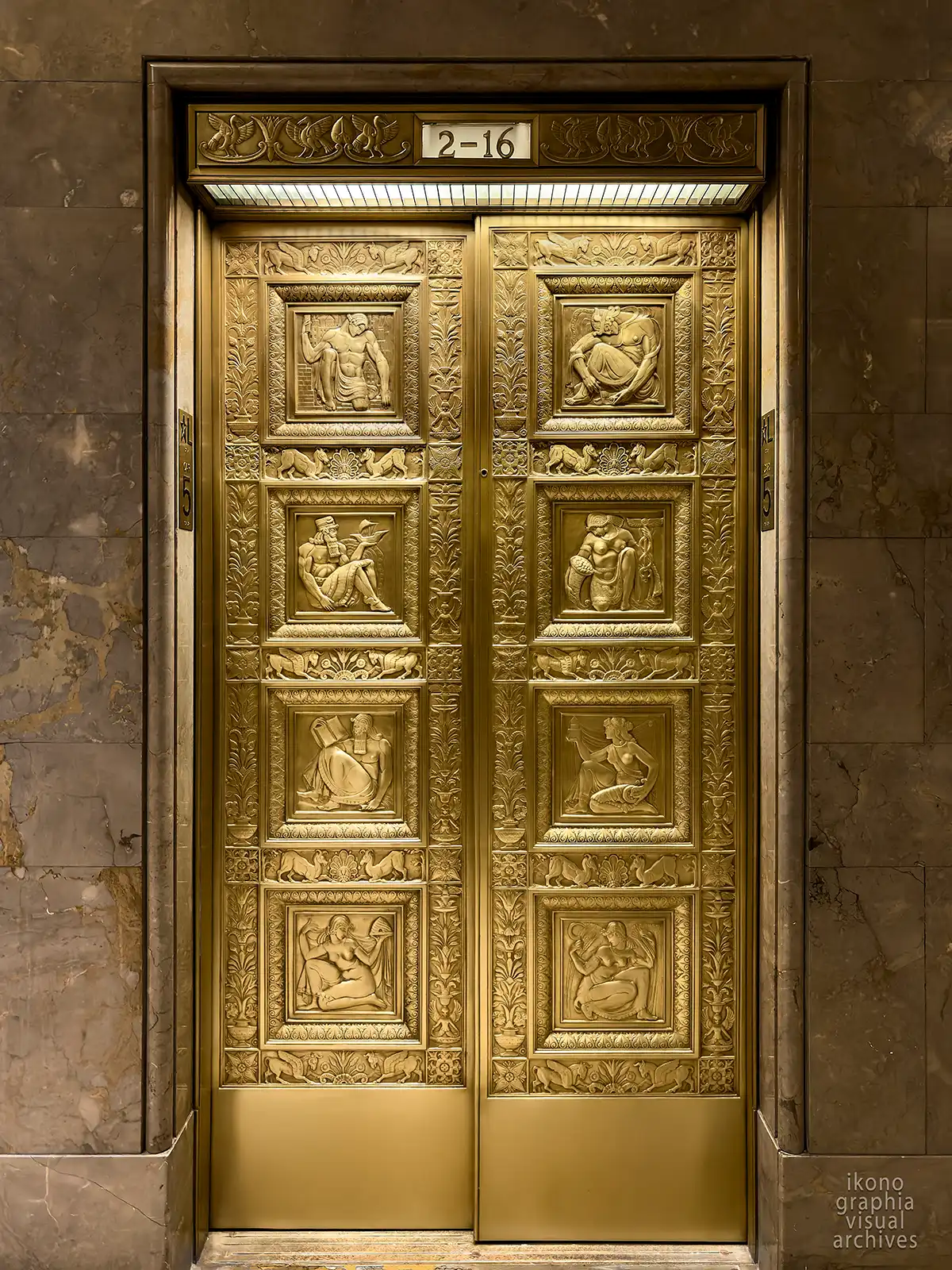
A complete symbolic program:
Commerce, Industry, Finance, and Building.
The eight gilded panels of the Fred French Building lobby — a sculptural cycle honoring the forces that powered New York's 1920s rise.
The arrangement is graphically balanced, not thematically ordered: the eye moves across figures and ornament before resolving into program. Ives's logic reveals itself slowly — four themes, eight figures, one coherent argument about what a city is and what sustains it.
The most complete Mesopotamian-themed decorative cycle in American Art Deco.
ELevator Doors
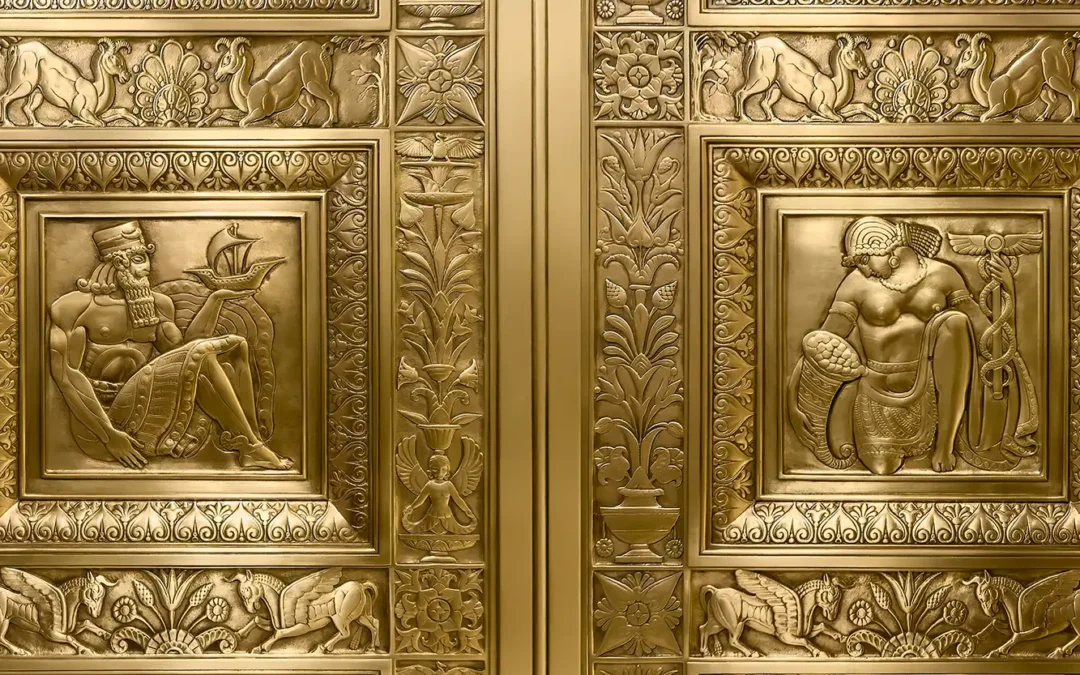
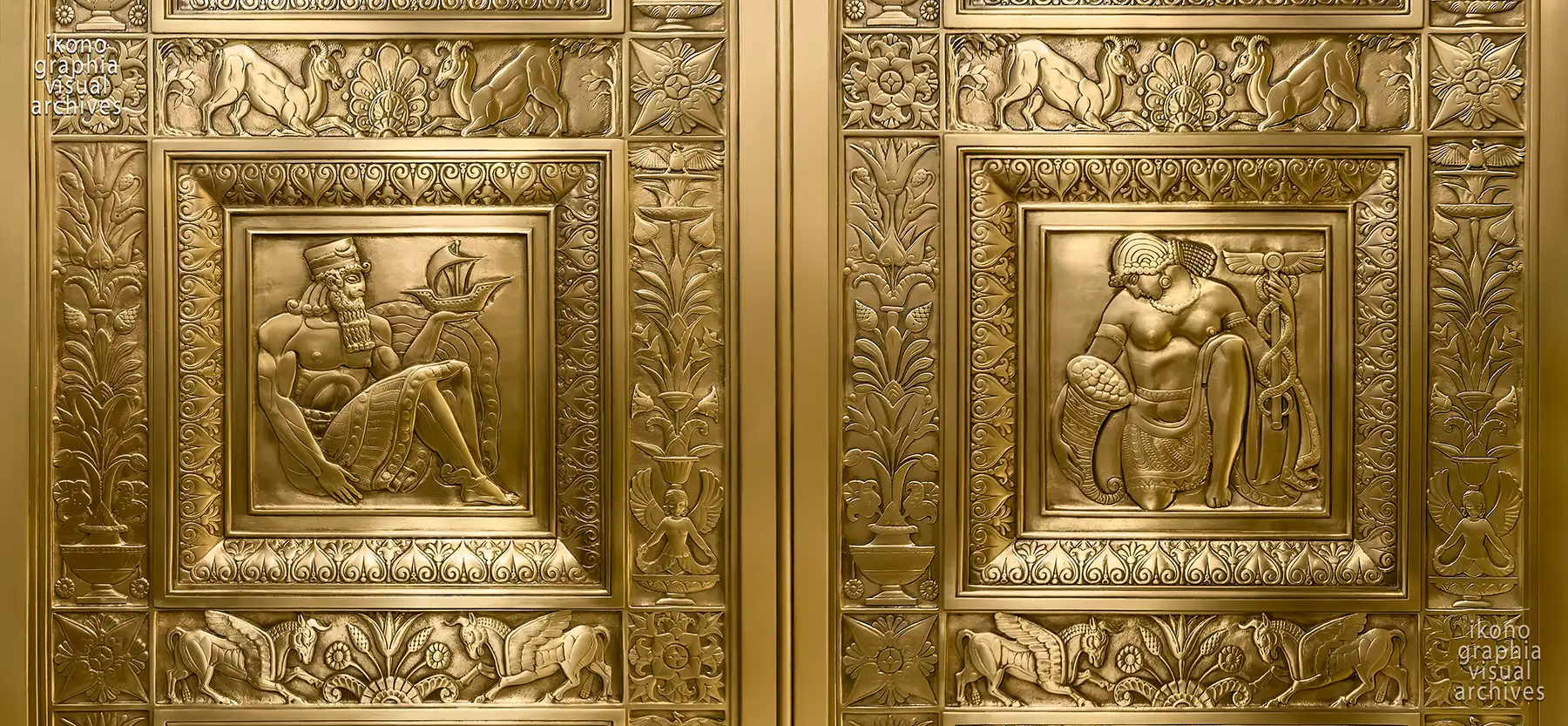
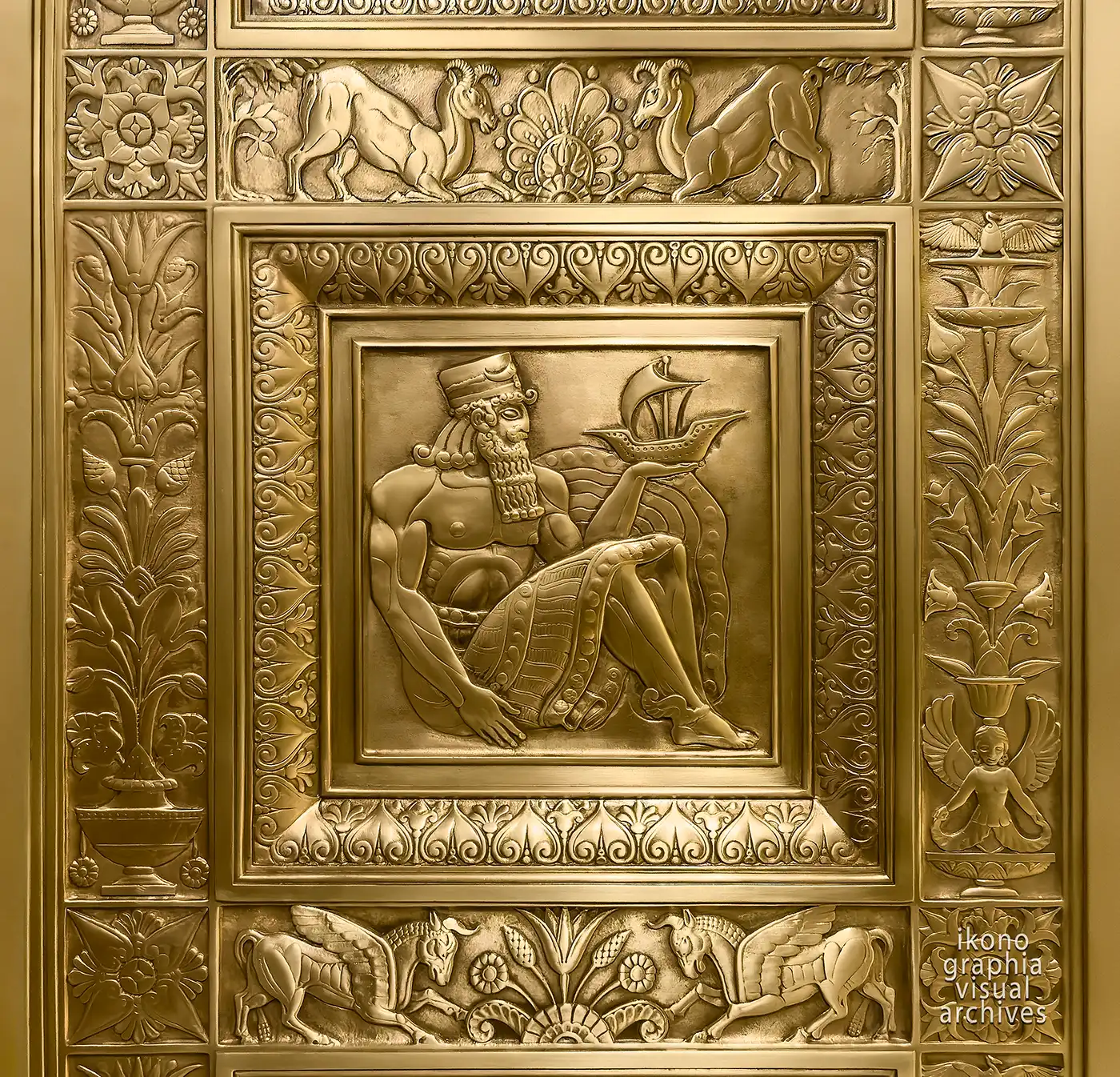
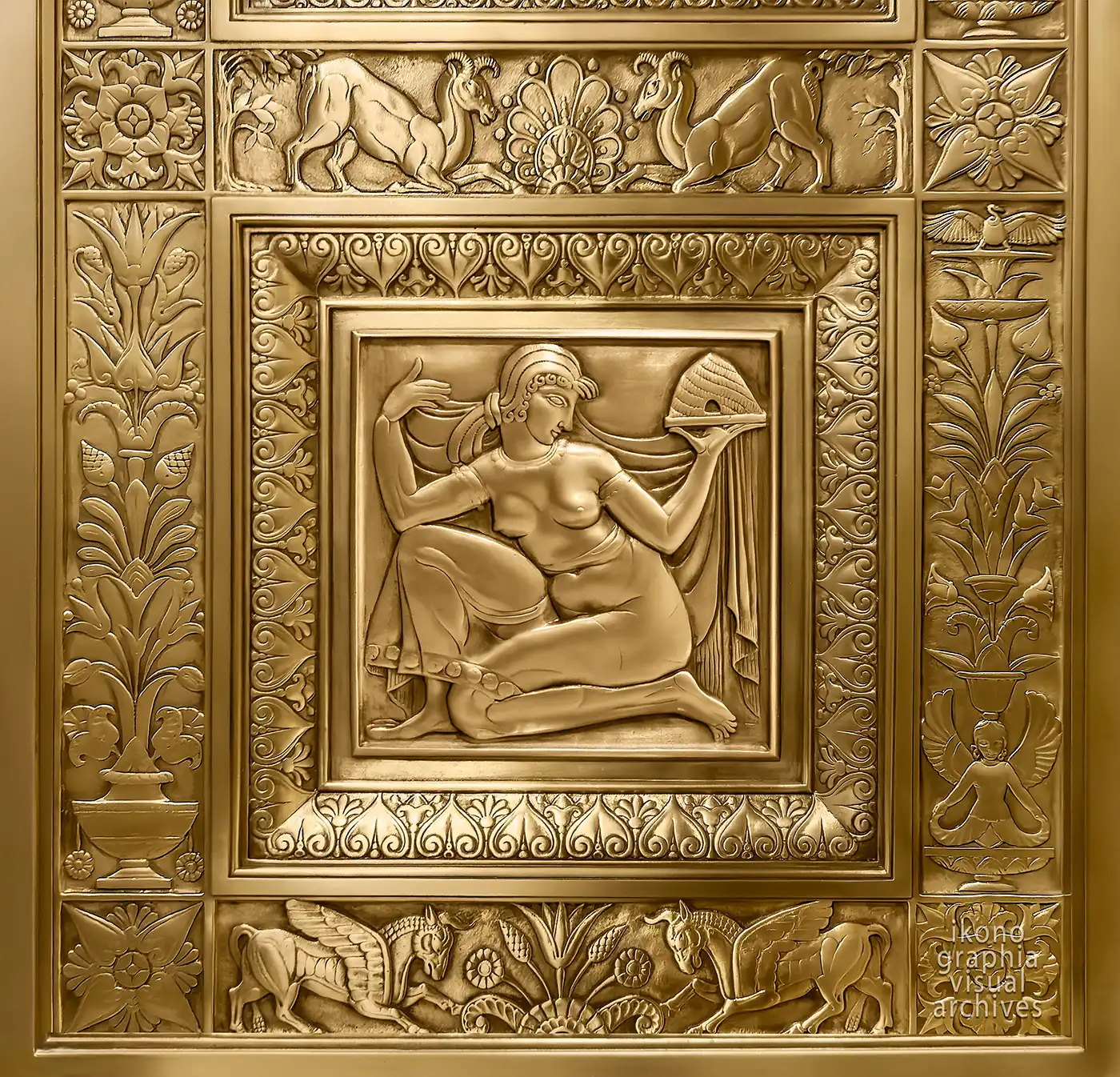
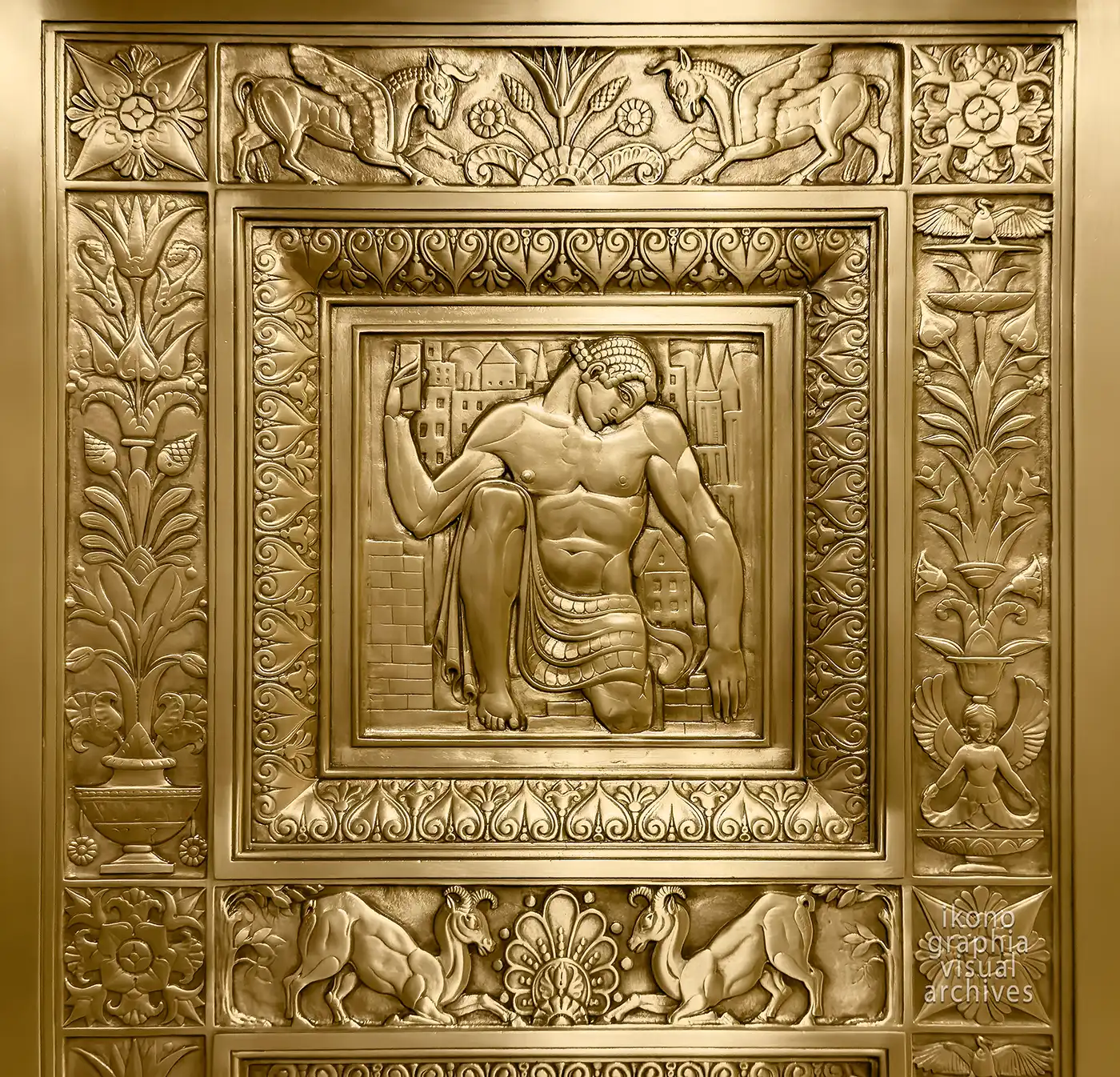
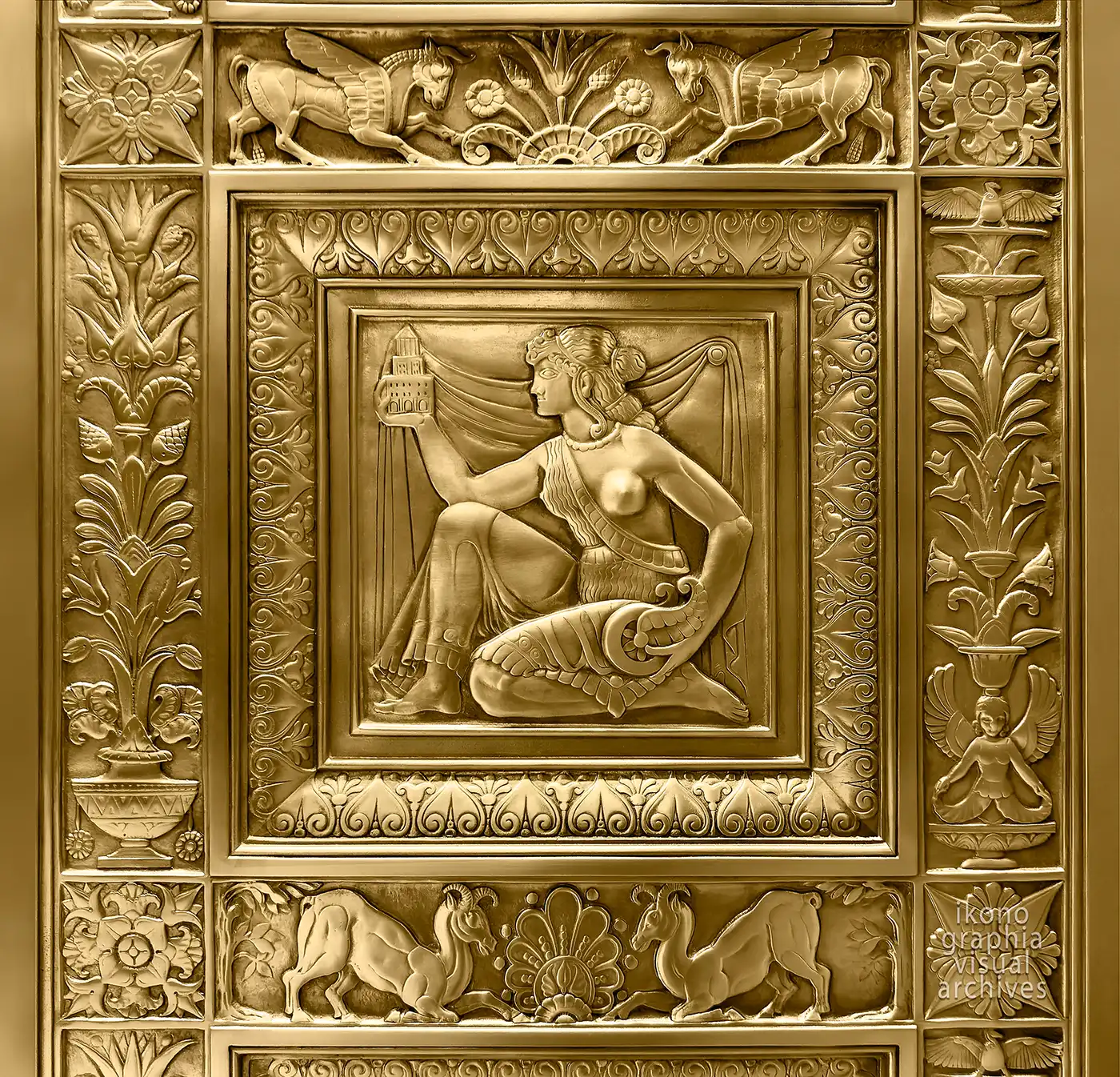
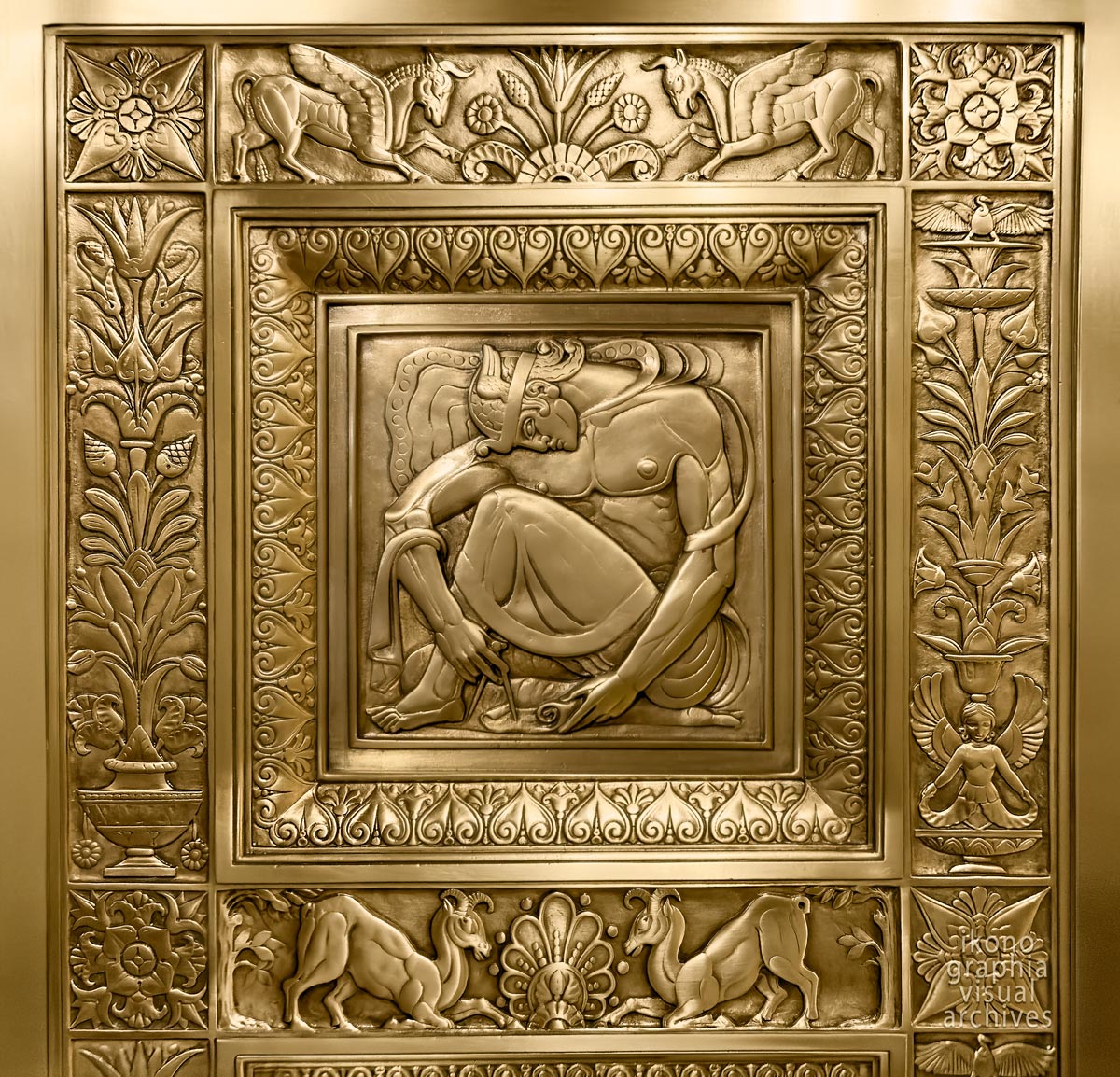
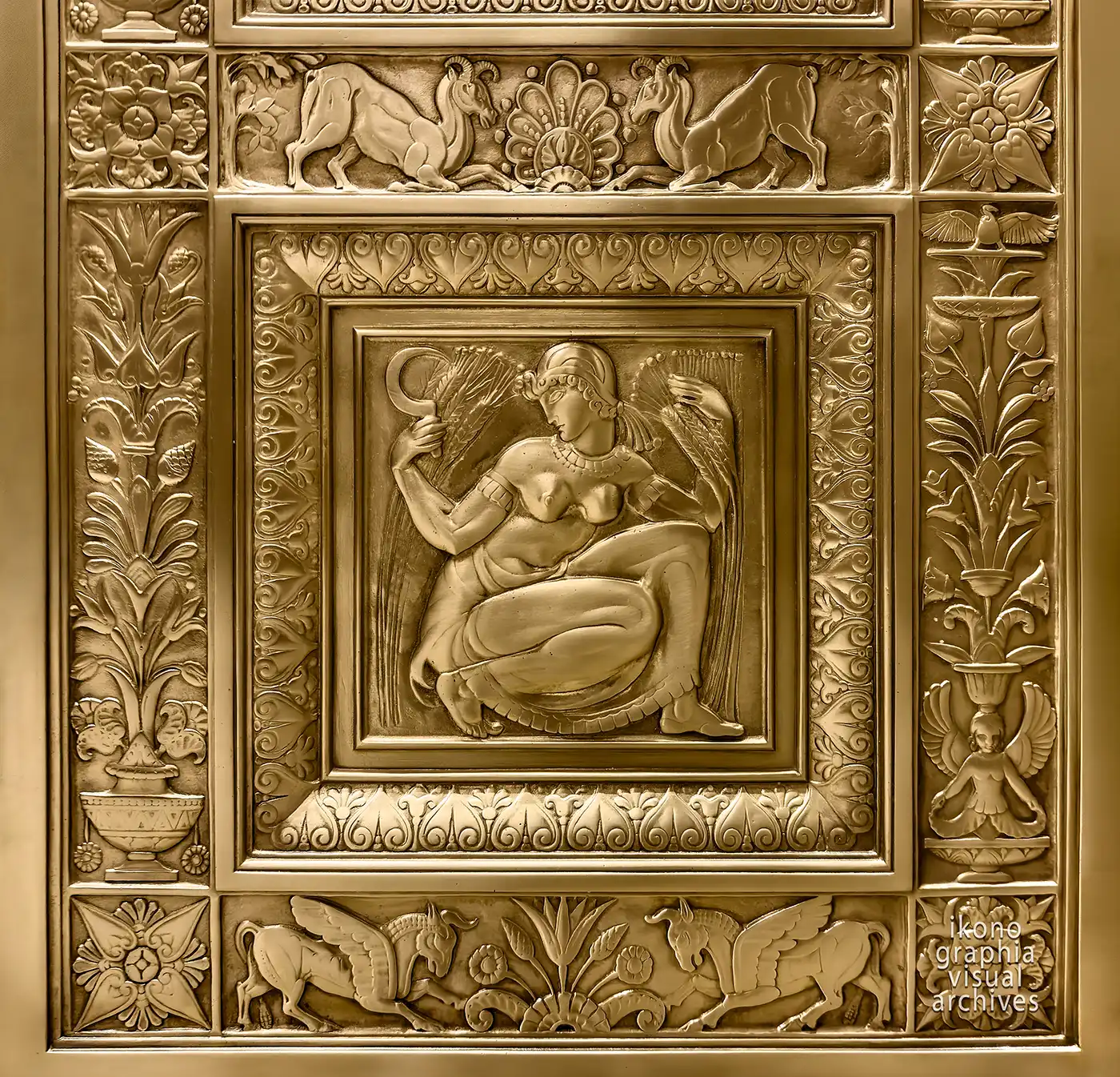
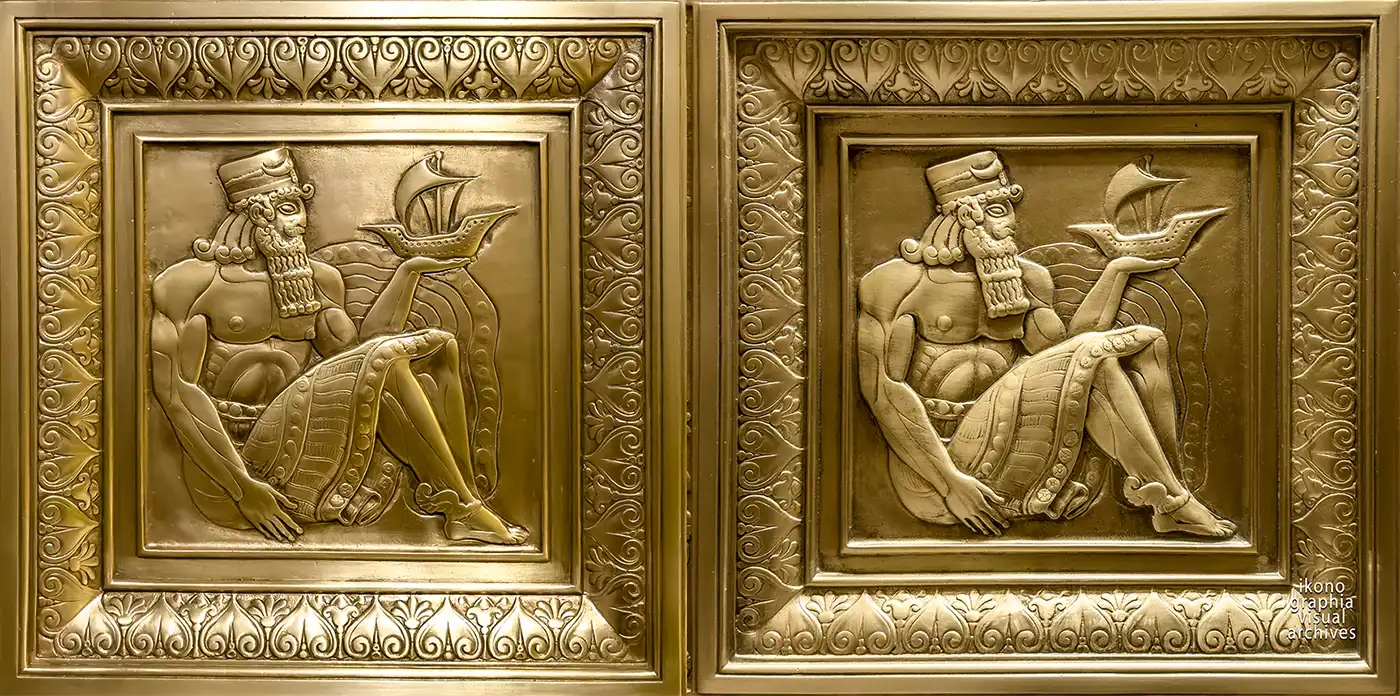
These elevator doors visualize the four pillars of Fred F. French’s real-estate empire—Industry, Commerce, Finance, Though allegorical, the imagery was designed for instant legibility. These were the forces shaping New York in the 1920s: the labor that built the skyline, the commerce animating Fifth Avenue, the financial system behind every development, and the architectural vision that defined modern urban life.
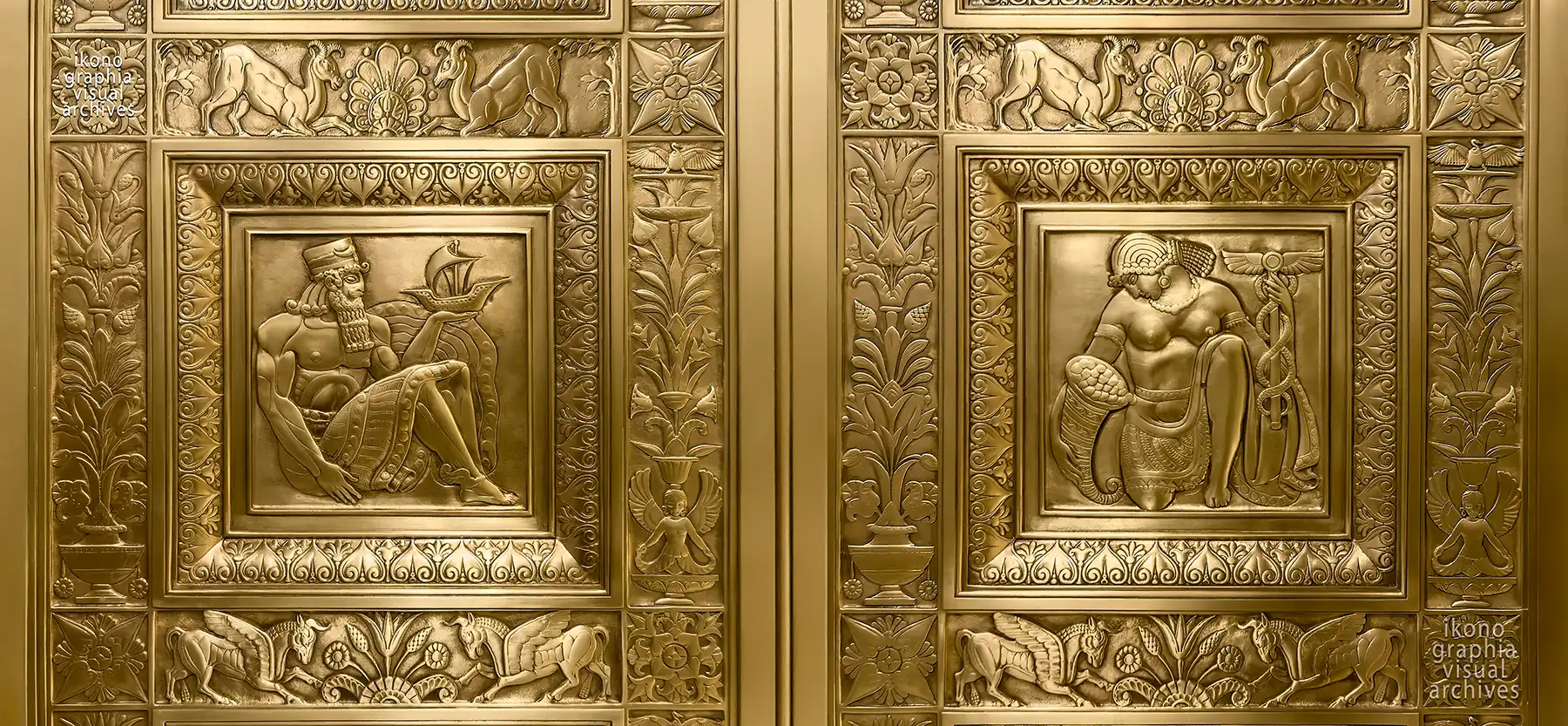
Fred French Elevator Panels — Art Deco allegories of trade and finance
The Merchant, Commerce — Symbolizing maritime trade and international exchange.
The Wealth Bearer, Finance — Symbolizing prosperity generated through investment and trade.
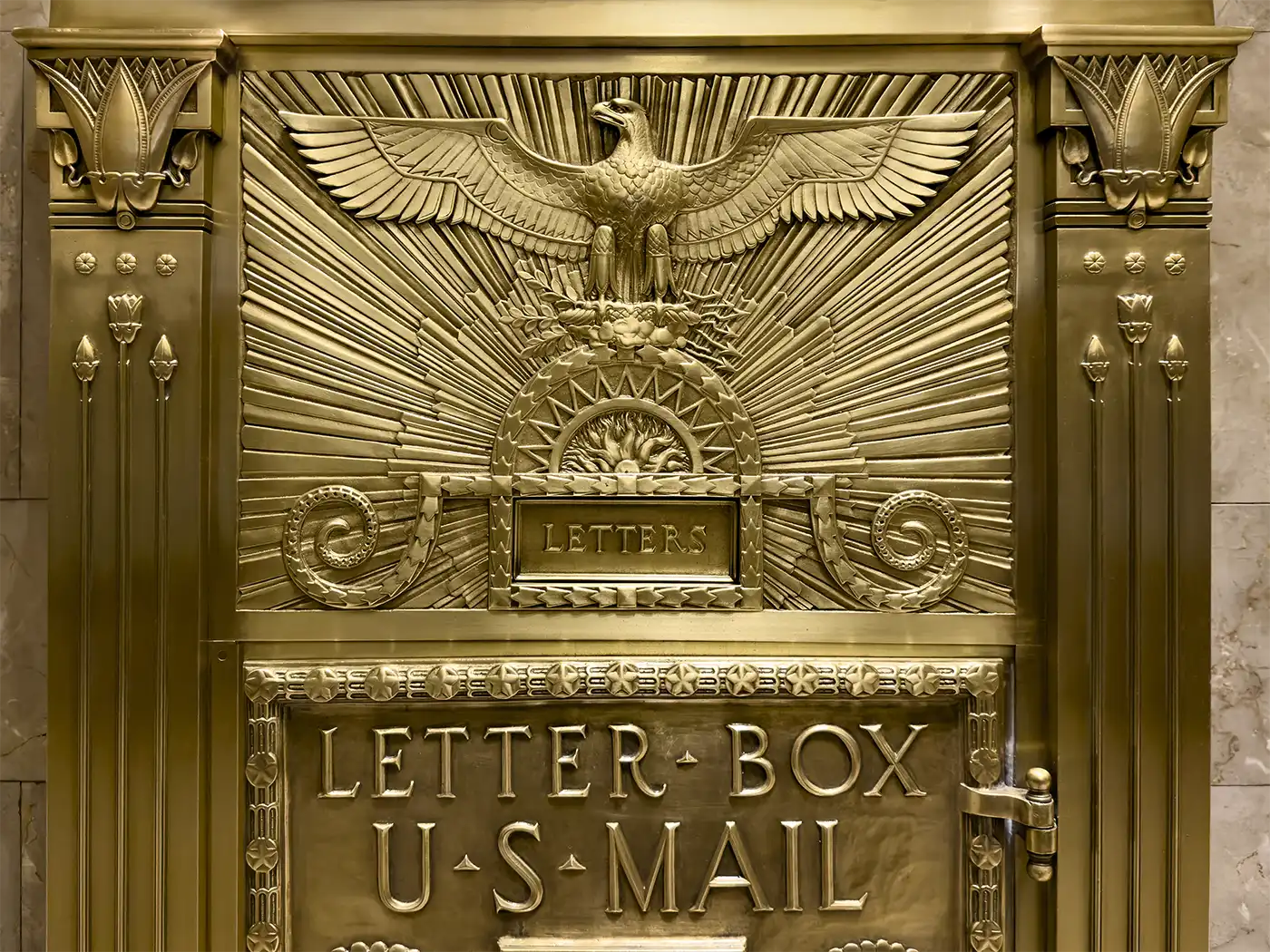
The Eagle and the Sunburst — Crowning Element.
The American eagle with outstretched wings, set against radiating sunburst rays. At this distance the precision of Bach's metalwork becomes visible — the feathering, the geometry of the rays, the weight of the form against the flat ground. National symbol and ancient ornament in a single casting.
The Mailbox
At the center of the lobby stands a gilded bronze mailbox — and it says everything twice. A monumental American eagle crowns the composition, wings spread against radiating sunburst rays. Below it, paired Babylonian griffins flank the slot — not as ornament, but as allegory: they are the eagles, translated into the visual language of ancient Mesopotamia. One of them grips a medallion bearing the Fred French Company monogram in its beak.
National symbol and ancient mythology. The same statement, in two languages simultaneously. In a single object, the entire symbolic program of the lobby — compressed.
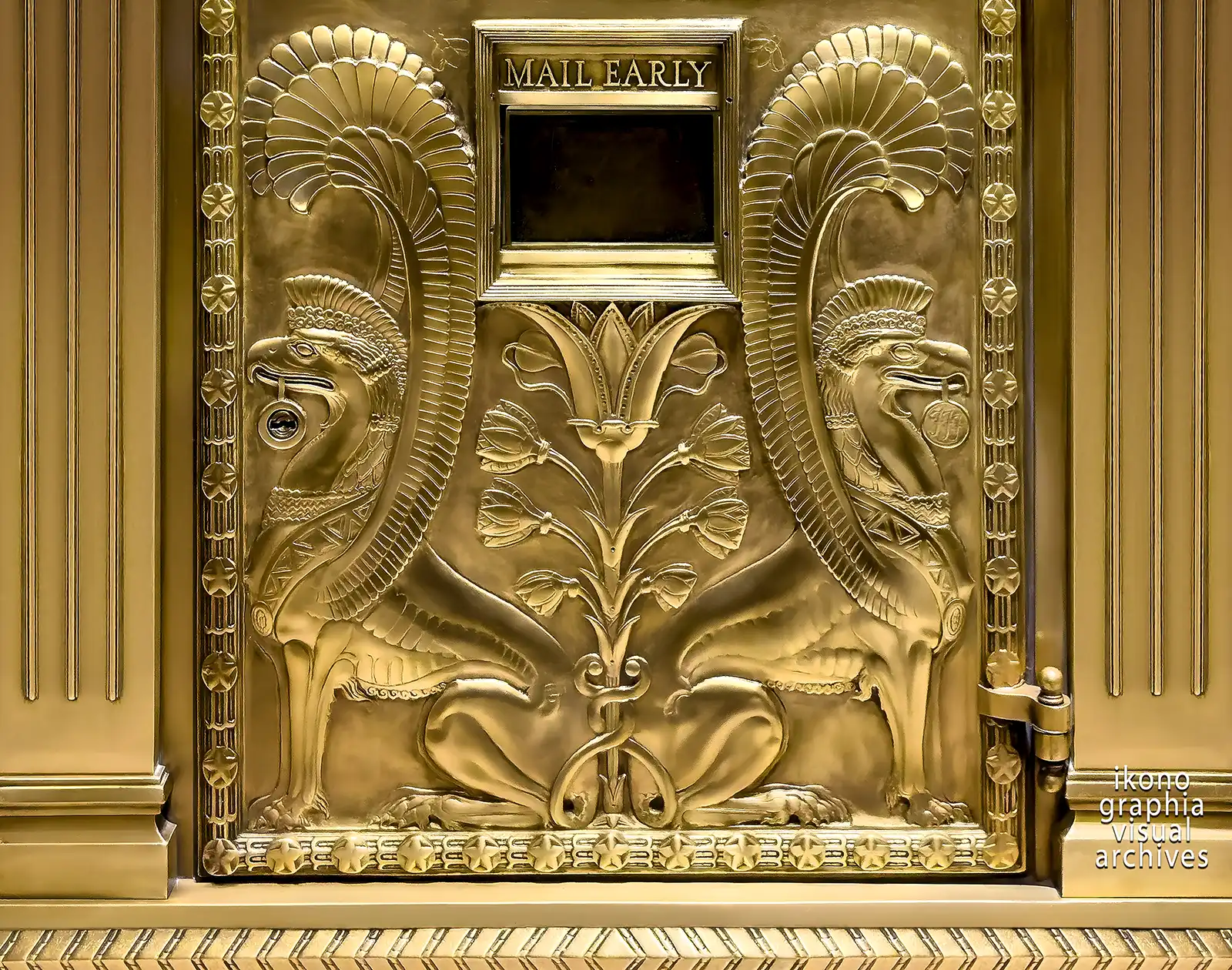
Glinsky made Babylon and America speak the same visual language.
Paired Mesopotamian griffins flank a stylized plant motif on the lower panel of the mailbox. The griffin on the right bears a medallion with the Fred French company logo — corporate identity seamlessly integrated into ancient iconography.
The creatures' muscular forms and precise geometric borders echo Assyrian palace reliefs, connecting 1920s New York commerce to the authority of ancient empires.
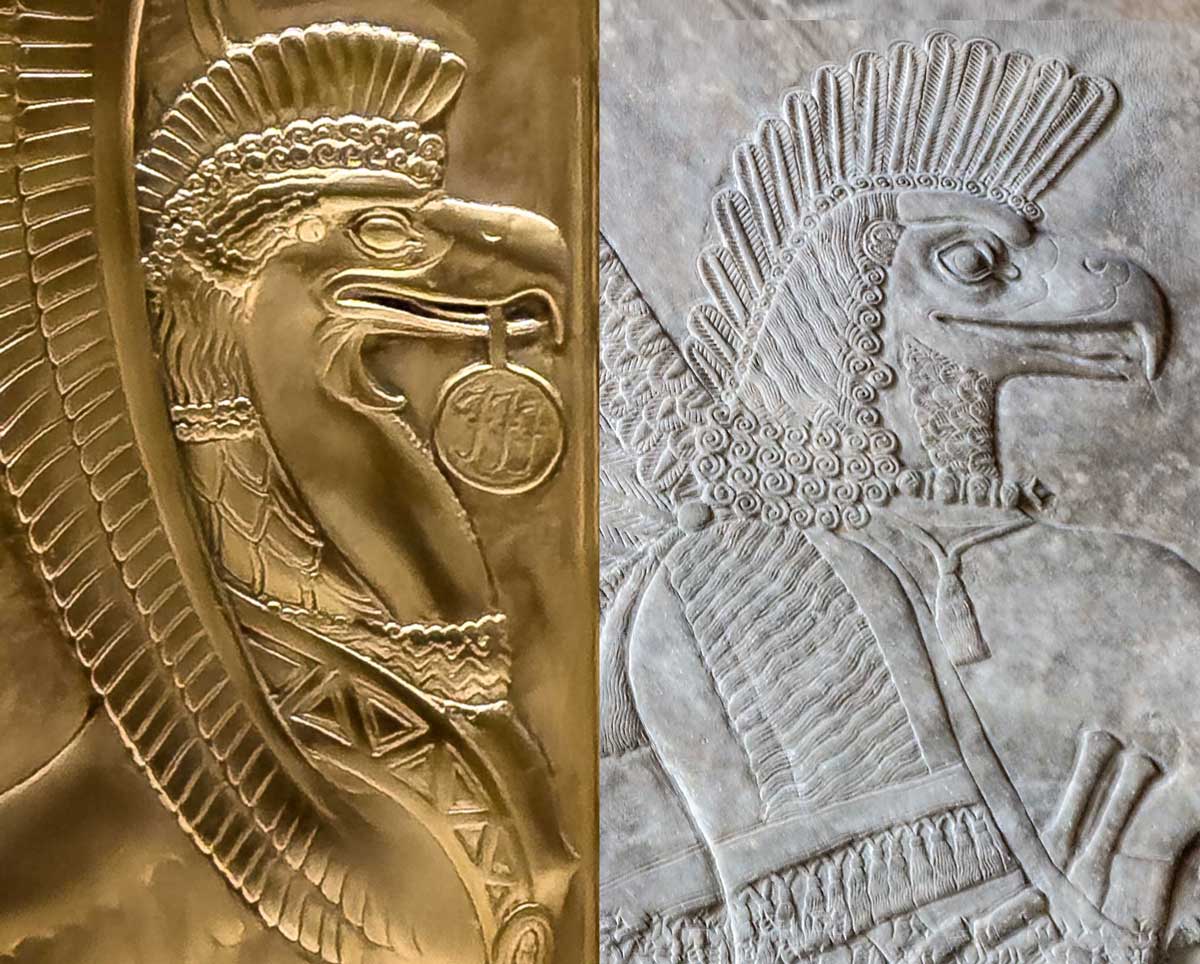
The Same Creature — Fred French Griffin and Assyrian Relief, 4,000 Years Apart
The griffin on the Fred French mailbox and its source on the Assyrian relief at the Pergamon Museum — the same feather treatment, the same headdress, the same profile. Glinsky did not adapt the form.
He quoted it directly, in gilt bronze, on Fifth Avenue, gripping a medallion with the Fred French Company monogram in its beak. Four thousand years and six thousand kilometres apart. The comparison is exact.
The Mesopotamian Connection
Ives's obsession with ancient Babylon was not aesthetic preference. It was research. The Ishtar Gate — excavated from Babylon and reconstructed in Berlin's Pergamon Museum in the early 1900s — provided the direct visual sources for the lions, dragons, and decorative borders throughout the building. Ives and Glinsky were not inventing an exotic style. They were quoting one of the oldest monumental gateways in human history, in gilt bronze, on Fifth Avenue.

The Vaulted Ceiling — Ishtar Gate Creatures in Gold and Color
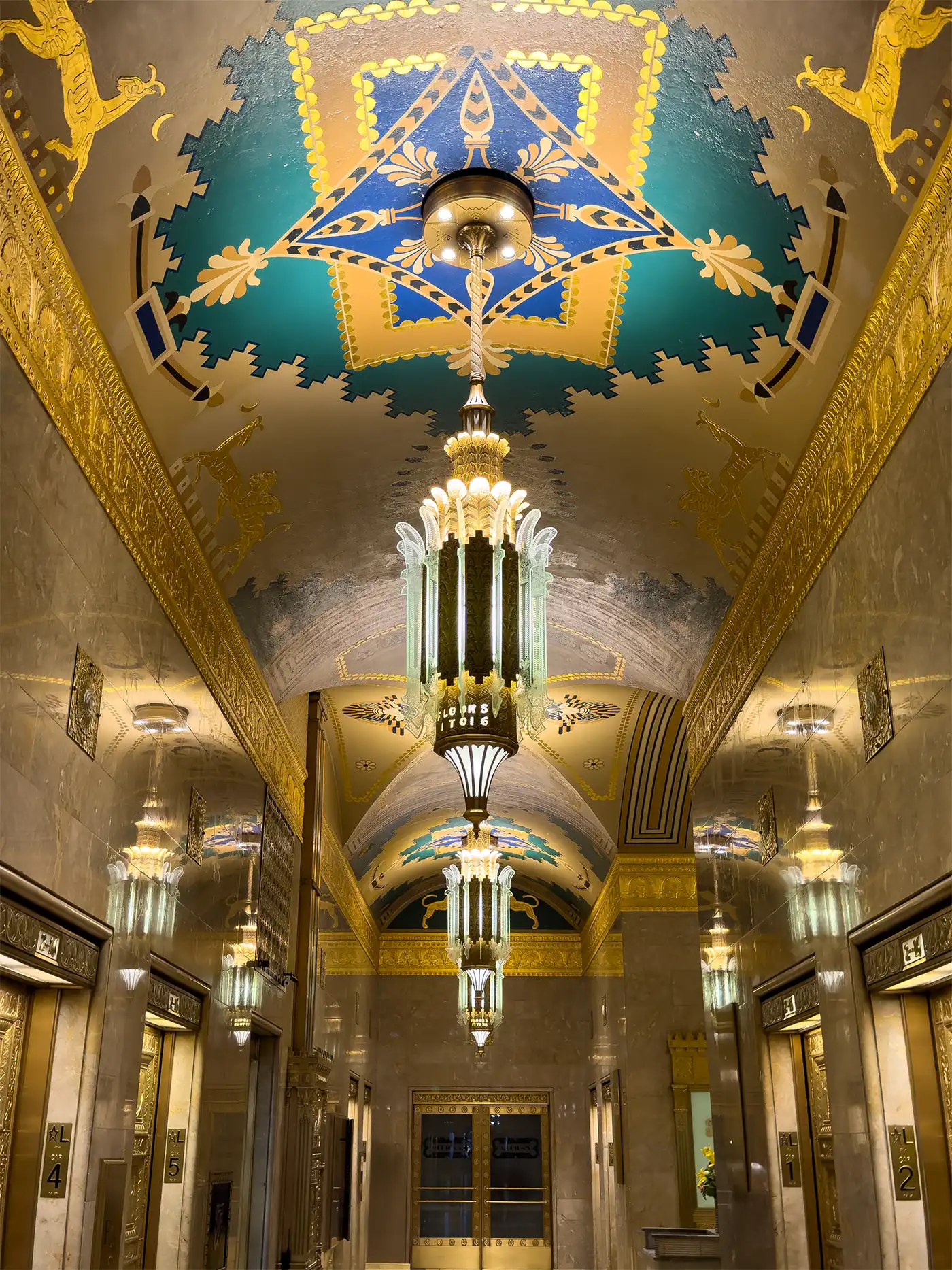
The barrel-vaulted ceiling of the Fred French Building lobby — Babylonian lions, dragons, and winged griffins painted in gold, blue, and vivid color. The same creatures Ives found in the Ishtar Gate, placed above the bronze program that quotes them below. Every surface in the lobby speaks the same language.
A Machine Age Altar — Empire State Building, 1931
A building at the center of the world
In 1931, the Empire State Building was the tallest structure ever built — 102 floors, 443 meters, constructed in 410 days at the depth of the Great Depression.
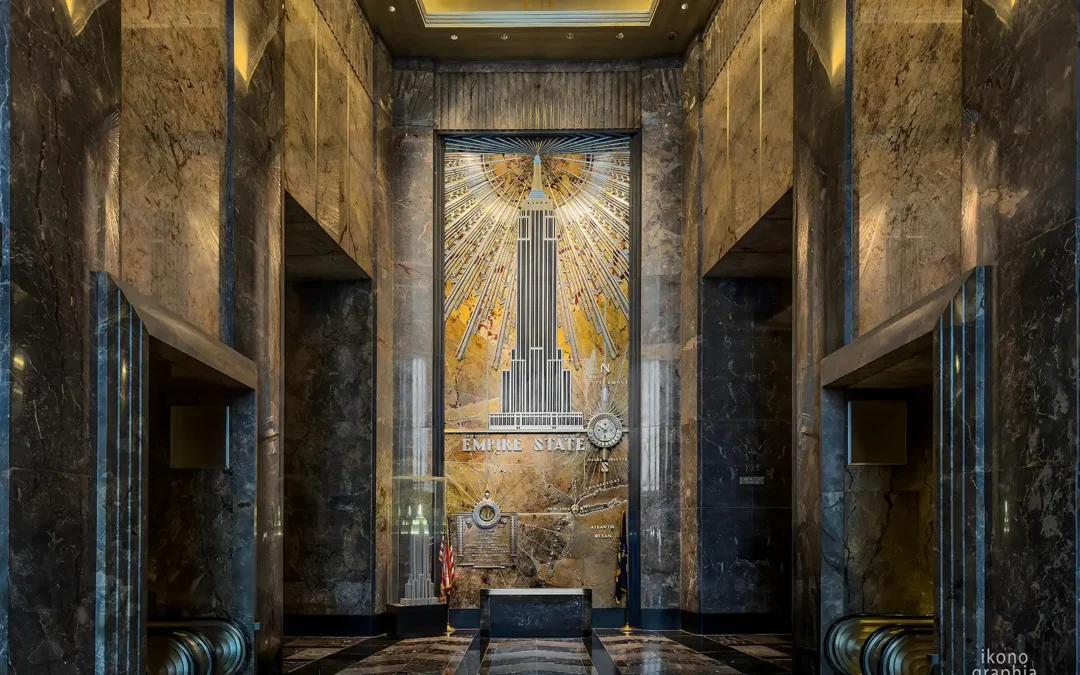
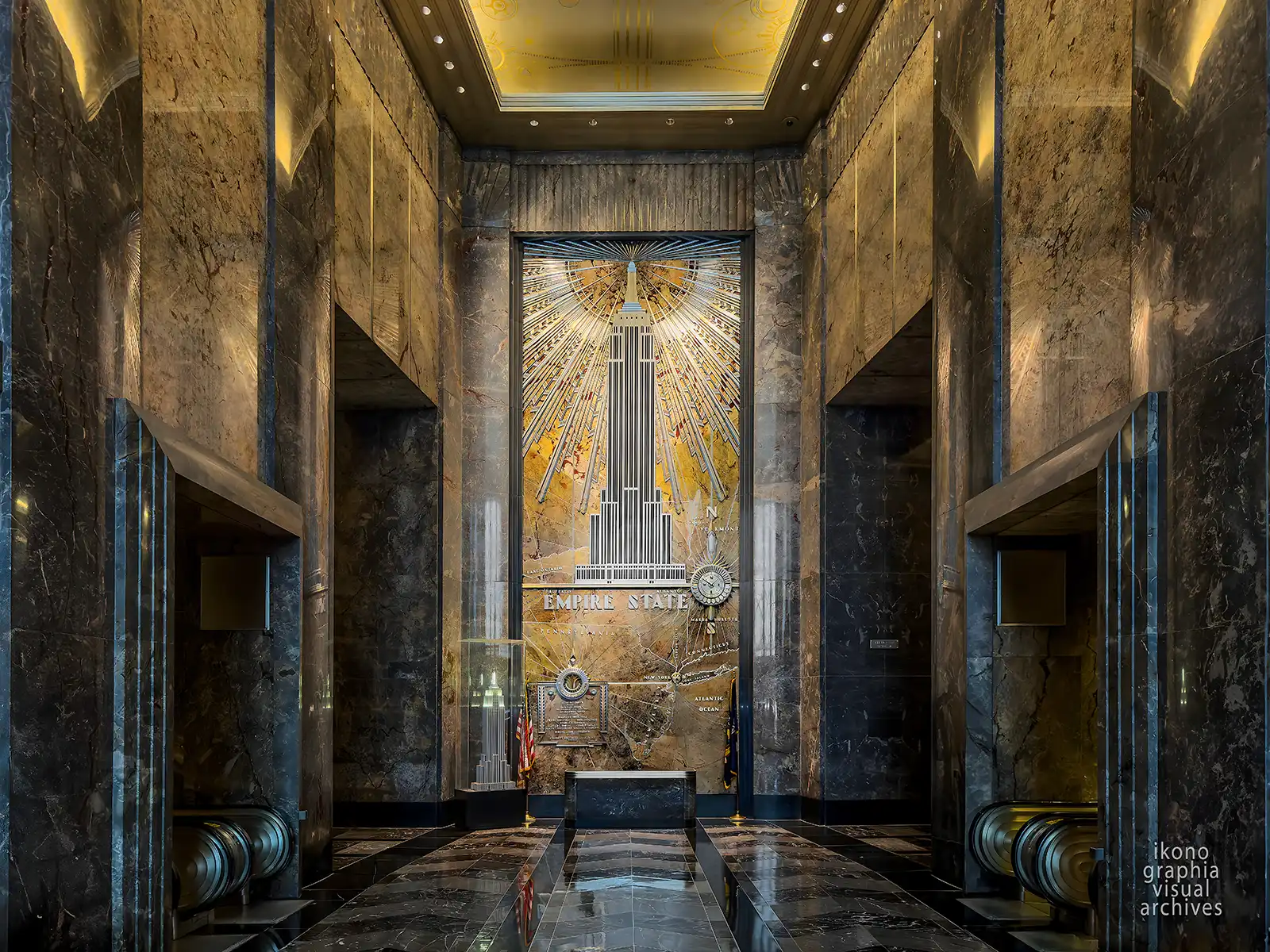
The lobby was designed to match that ambition. A ceiling mural of celestial rays by Leif Neandross converges on a single point: the aluminum bas-relief by Oscar Bach, positioned exactly where the rays meet. Bach depicted the building as the center of the world — surrounded by a map of the tristate area, radiating celestial rays. In 1931, aluminum was the material of the Machine Age: modern, industrial, the metal of human ambition. The relief was not decoration. It was the argument made permanent.
Full documentation coming to the NYC Art Deco Archive. Story forthcoming.
The Empire State Relief — A Machine Age Altar, NYC, 1931 — Oscar Bach
The Empire State Lobby, 1931. The floor, the walls, the ceiling — all calculated to deliver the visitor to one point. This is not a lobby. It is a constructed argument about what human ambition can produce — and the aluminum relief by Oscar Bach is its conclusion.
Positioned exactly where the rays of the ceiling mural converge, it was not placed there. It was designed to be there. The architecture does not decorate the relief. It worships it.
Neighbors of Nations — AT&T Long Distance Building, 1932
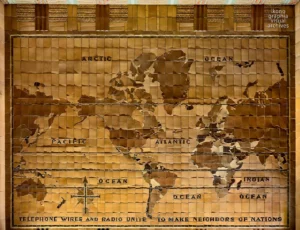
Telephone Wires and Radio Unite to Make Neighbors of Nations
Ralph Walker held that skyscrapers should be designed for mental comfort as much as physical function. At 32 Avenue of the Americas, completed in 1932, he built the operational hub of AT&T's long-distance telephone network and gave it the material richness of a cathedral.
Hildreth Meiѐre designed two programs for the lobby: a ceiling mosaic of five continental allegories connected by gold telephone wires, and a full end-wall world map in terracotta tile.
The inscription along the base defines the building's purpose: Telephone Wires and Radio Unite to Make Neighbors of Nations. Completed three years into the Depression, it was a deliberate act of optimism — the belief that connection was the answer, rendered in permanent material at architectural scale.
Full documentation coming to the NYC Art Deco Archive. Story forthcoming.
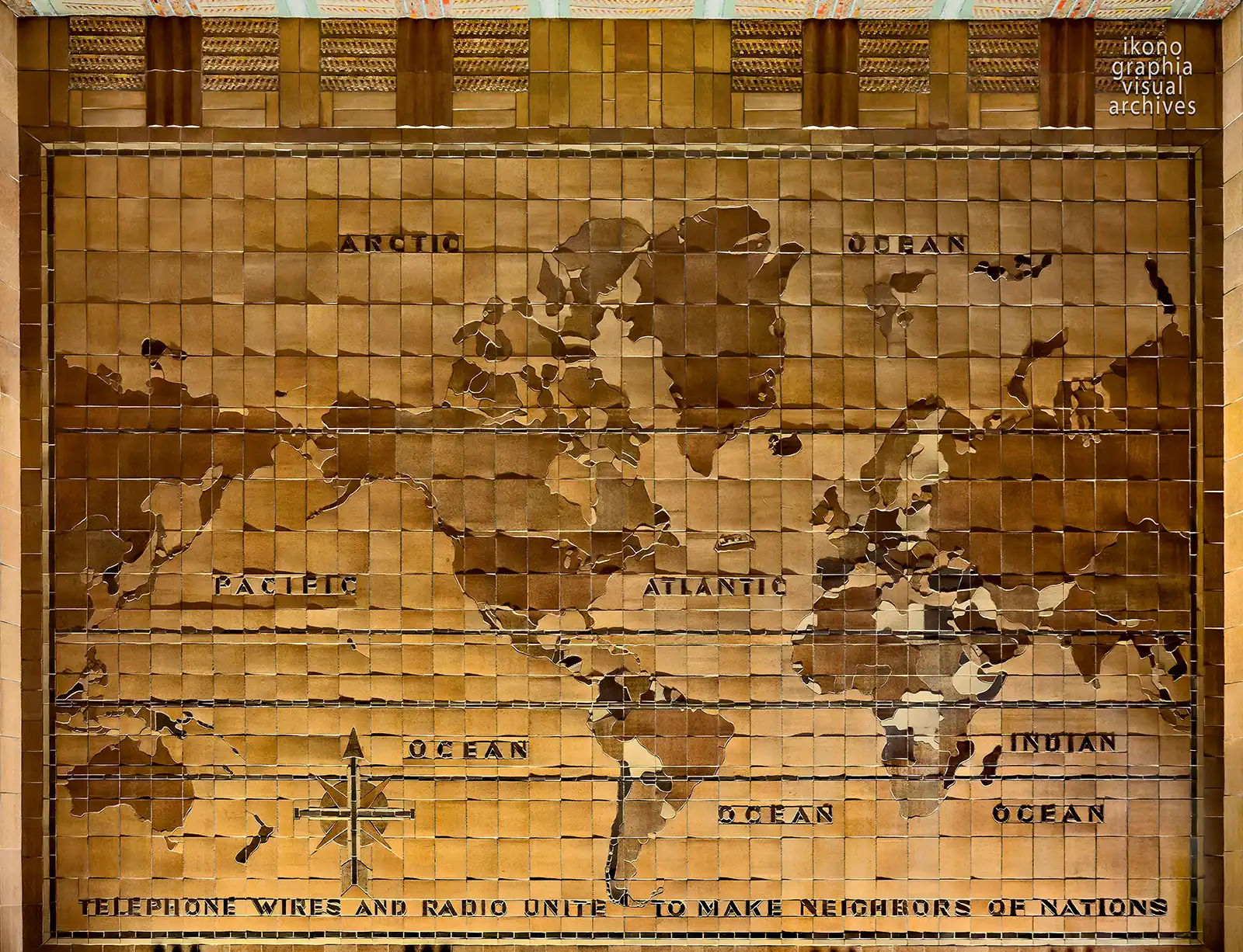
Telephone Wires and Radio Unite to Make Neighbors of Nations — Hildreth Meière
Inscription along the bottom: "Telephone Wires and Radio Unite to Make Neighbors of Nations." A statement of corporate purpose — AT&T's reason for existing — rendered in permanent material at architectural scale.
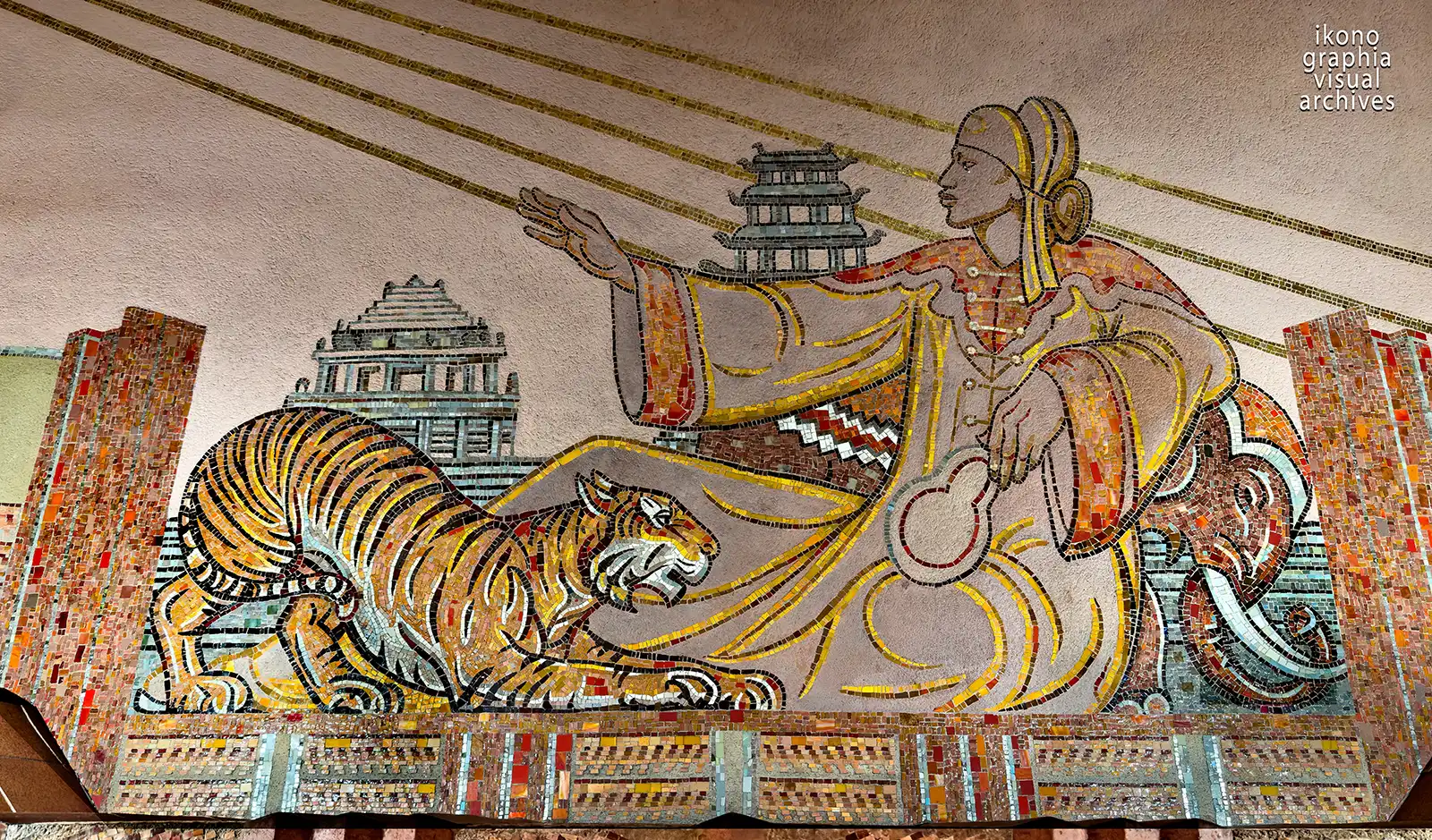
Asia — Continents Linked by Telephone and Wireless Silhouette Mosaic — Hildreth Meière, 1932
The allegorical figure of Asia — draped, seated, a pagoda balanced in her raised hand — flanked by a crouching tiger. One of five continental panels on the ceiling of the AT&T lobby, each connected to the central messenger figure by a web of gold telephone wires. The ceiling is a diagram of the network and a statement about what that network meant.
The border echoes Native American quillwork — geometric, precise, a different visual language running alongside the allegorical figures above it.
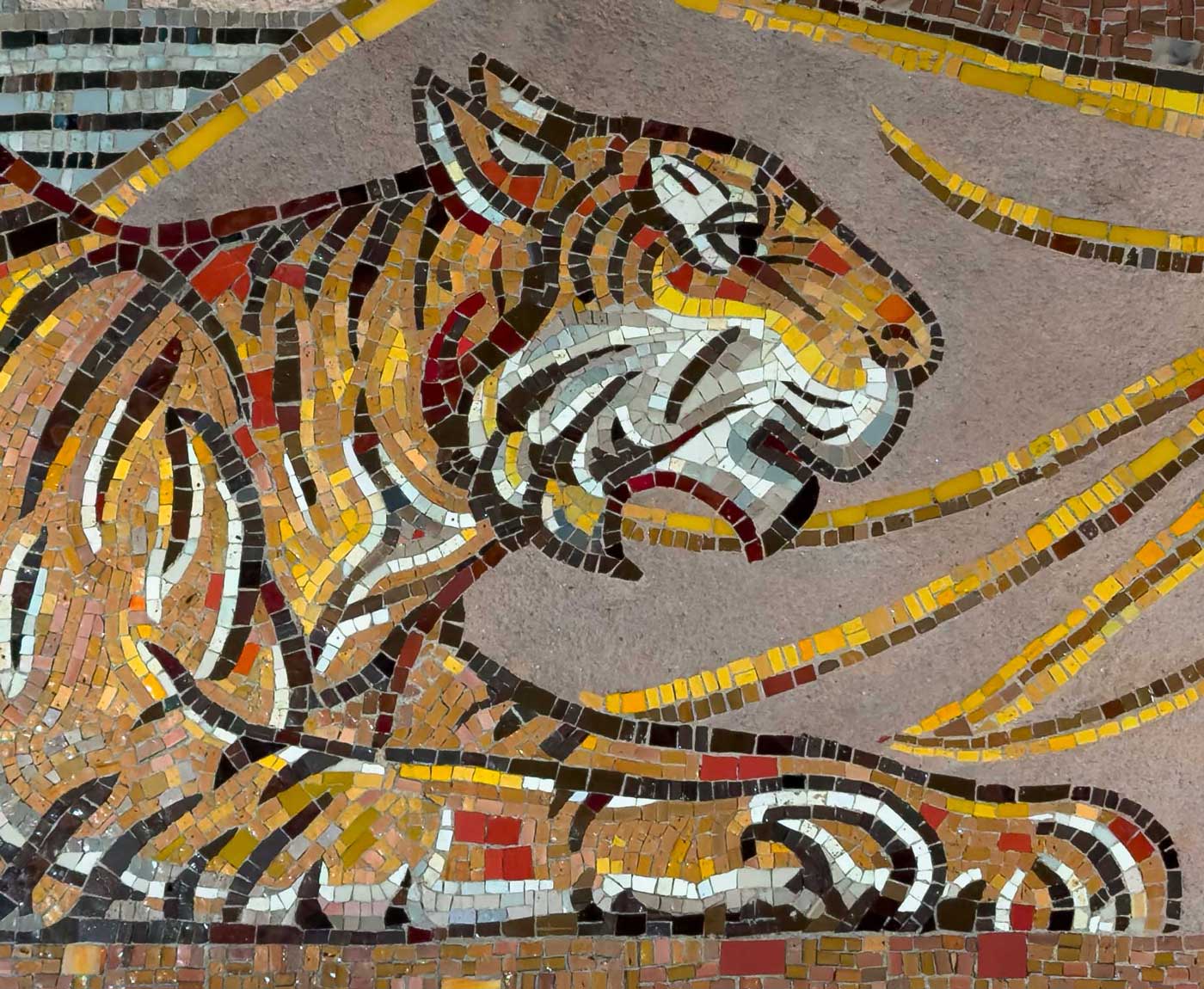
Detail of the "Asia" Mosaic
Hildreth Meière's technique — tesserae embedded in coral cement while still wet — makes the ground itself luminous. The messenger at the center holds lightning bolts: electricity as a classical attribute, telecommunications given the iconography of myth.
The ceiling is a diagram of the network and a statement about what that network meant.
The Park Avenue of the Bronx — 1150 Grand Concourse, 1937
The Fish Building, the borough’s most celebrated Art Deco apartment house
The Grand Concourse was conceived as the Park Avenue of the Bronx, its buildings designed with exceptional architectural ambition. 1150 Grand Concourse — known as the Fish Building for its polychrome mosaic facade of tropical fish and aquatic forms — is among the finest.
The terrazzo floors were executed by terazzeri from Pordenone and Spilimbergo in the Friuli region — the aristocracy of the immigrant labor force. Their names were never recorded. Their work has outlasted nearly everything around it.
The mosaic facade and the terrazzo interior share a building and a visual vocabulary — nothing else. Two separate crafts, two separate traditions, one address on the Grand Concourse that preserved both.
Full documentation coming to the NYC Art Deco Archive. Story forthcoming.
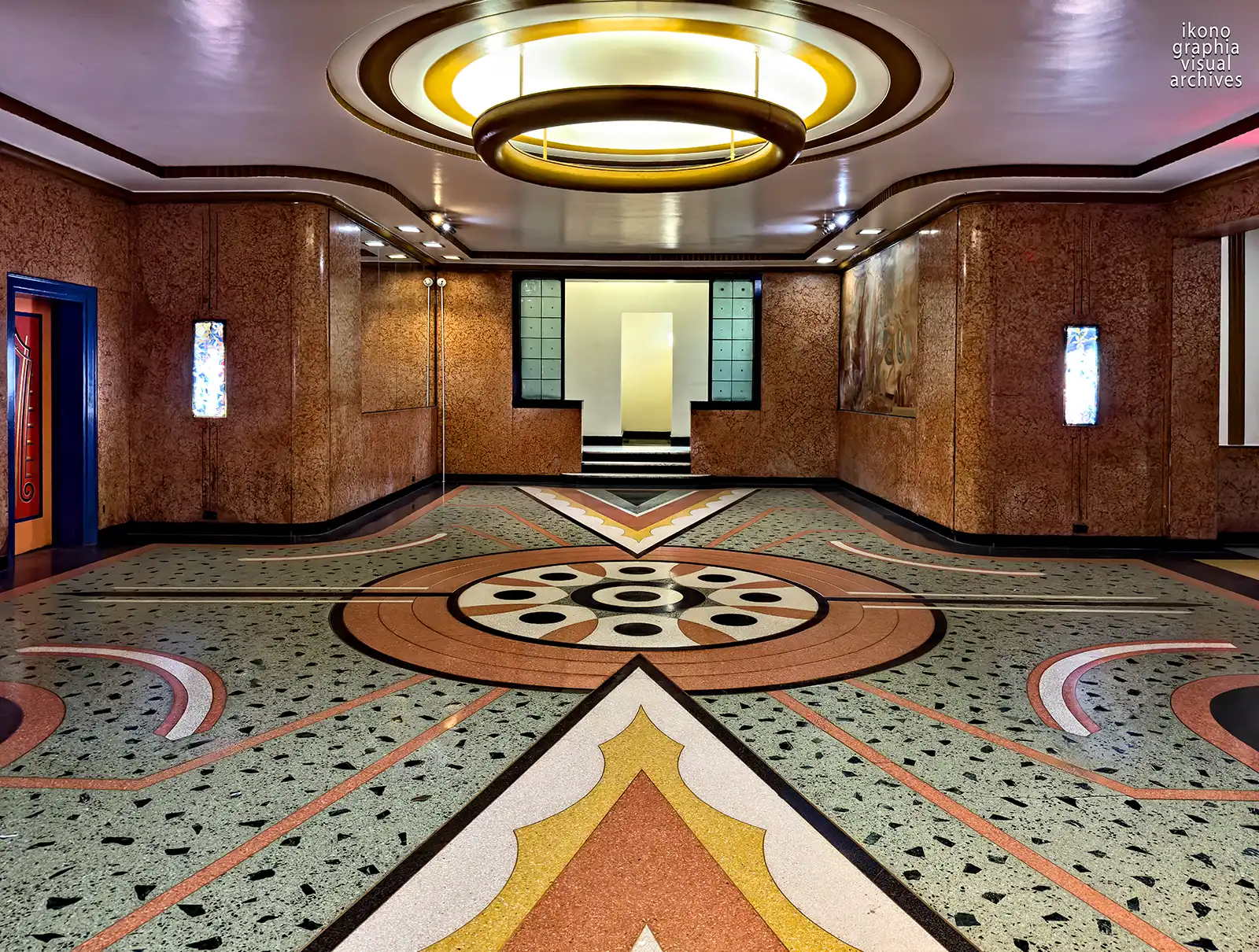
Art Deco Terrazzo Lobby and the UFO Chandelier
The circular ceiling light — bronze rings, frosted glass, the geometry of a spacecraft — dominates the lobby axis. Below it, the terrazzo floor extends wall to wall as a single geometric program: radiating forms, concentric rings, chevrons in red, green, and gold. Everything is original. Nothing is incidental.
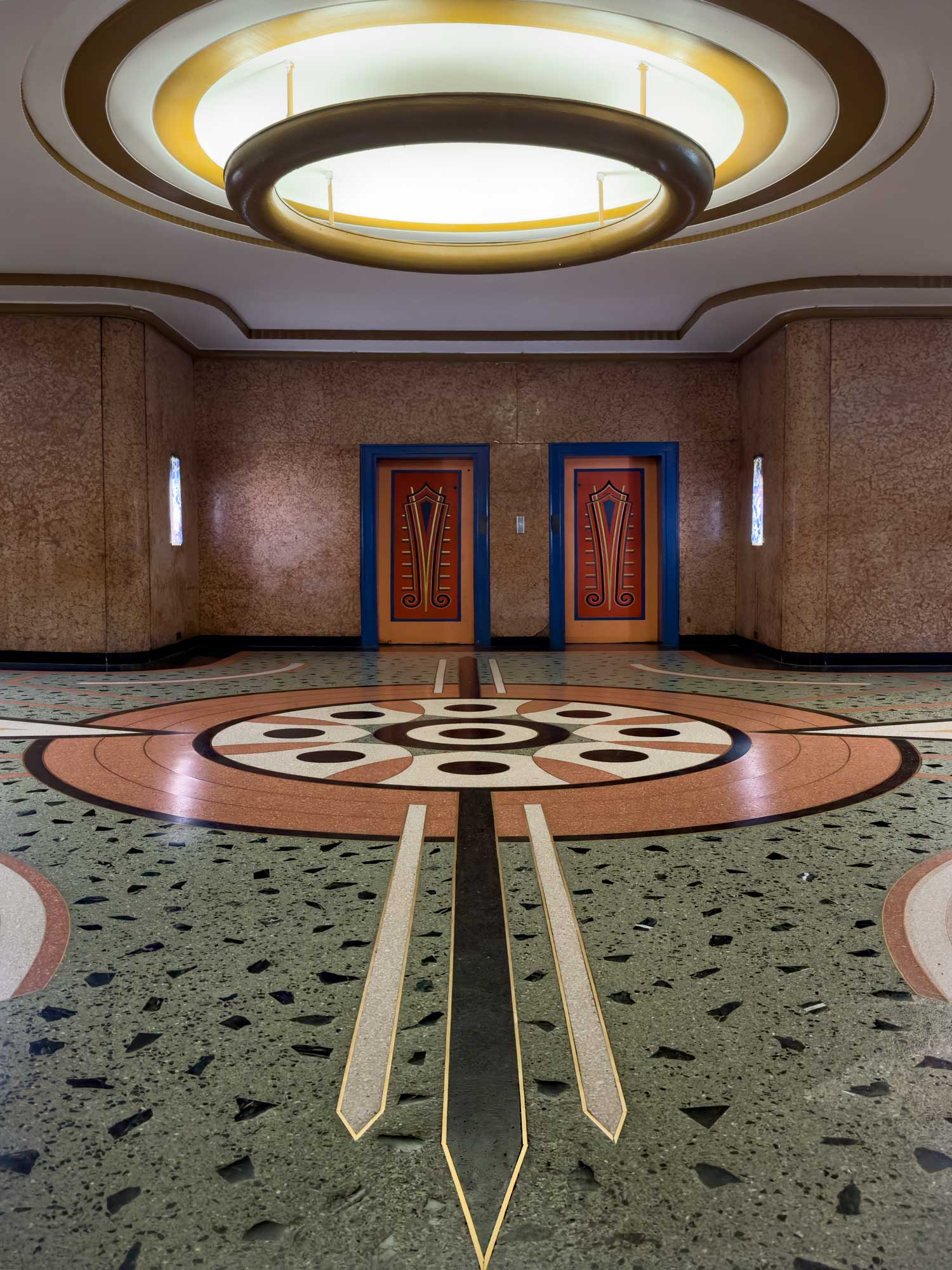
Terrazzo, Chandelier and Elevator Doors
The complete program in one frame — chandelier above, terrazzo below, elevator doors at center. The circular ceiling light in bronze and frosted glass anchors the vertical axis.
The floor radiates outward from a central medallion in red, green, and gold. The elevator doors in cobalt blue and terracotta carry the geometric vocabulary upward. Three elements, one argument.
The Geometry of Energy and Light — 70 Pine Street, 1931
The complete decorative program of an energy empire — in nickel-silver and light.
René Paul Chambellan designed the decorative program at 70 Pine Street — over fifty individual metalwork elements, from exterior aluminum reliefs to lobby grilles and elevator frames. At the center: 24 nickel-silver elevator doors titled "Evolution of Fuel." One panel shows a draped figure holding an oil lamp. The adjacent panel shows a man grasping an electric turbine. Past and future, in white metal, at the scale of architecture. They are among the finest Art Deco reliefs in New York.
Thomas J. George designed the lobby ceiling as the same argument in light. White plaster faceted into wave patterns, stepped corbels in gold, bronze, and copper-leaf, cast-glass fixtures radiating from bronze armatures. Cities Service sold energy. George built a space that made the visitor feel it — before they reached the elevators.
Full documentation coming to the NYC Art Deco Archive. Story forthcoming.
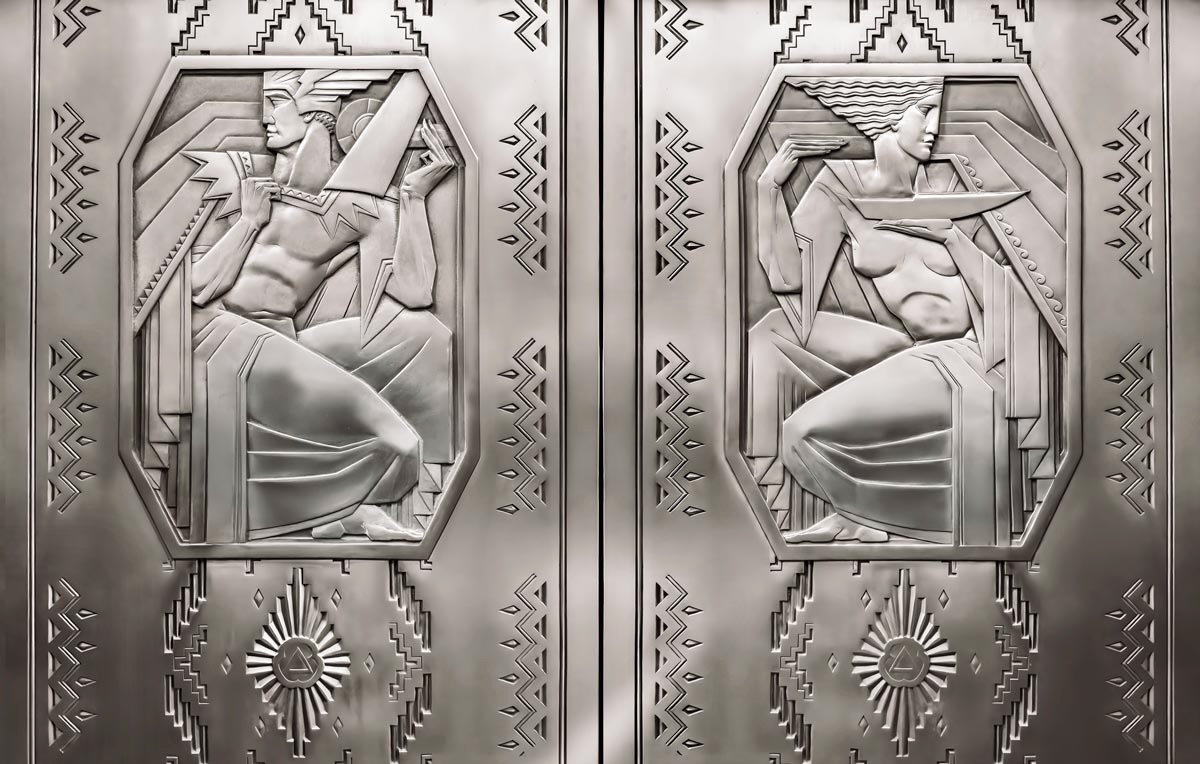
The Evolution of Fuel Elevator Doors, René Chambellan, 1931
The Evolution of Fuel Elevator Doors, René Chambellan, circa 1931. Nickel silver — a copper-nickel-zinc alloy with no actual silver content — holds fine low-relief detail with exceptional clarity. Unlike sterling silver, it does not blacken with age. The surrounding decoration incorporates Native American-inspired zigzags and sunbursts alongside the Cities Service logo.
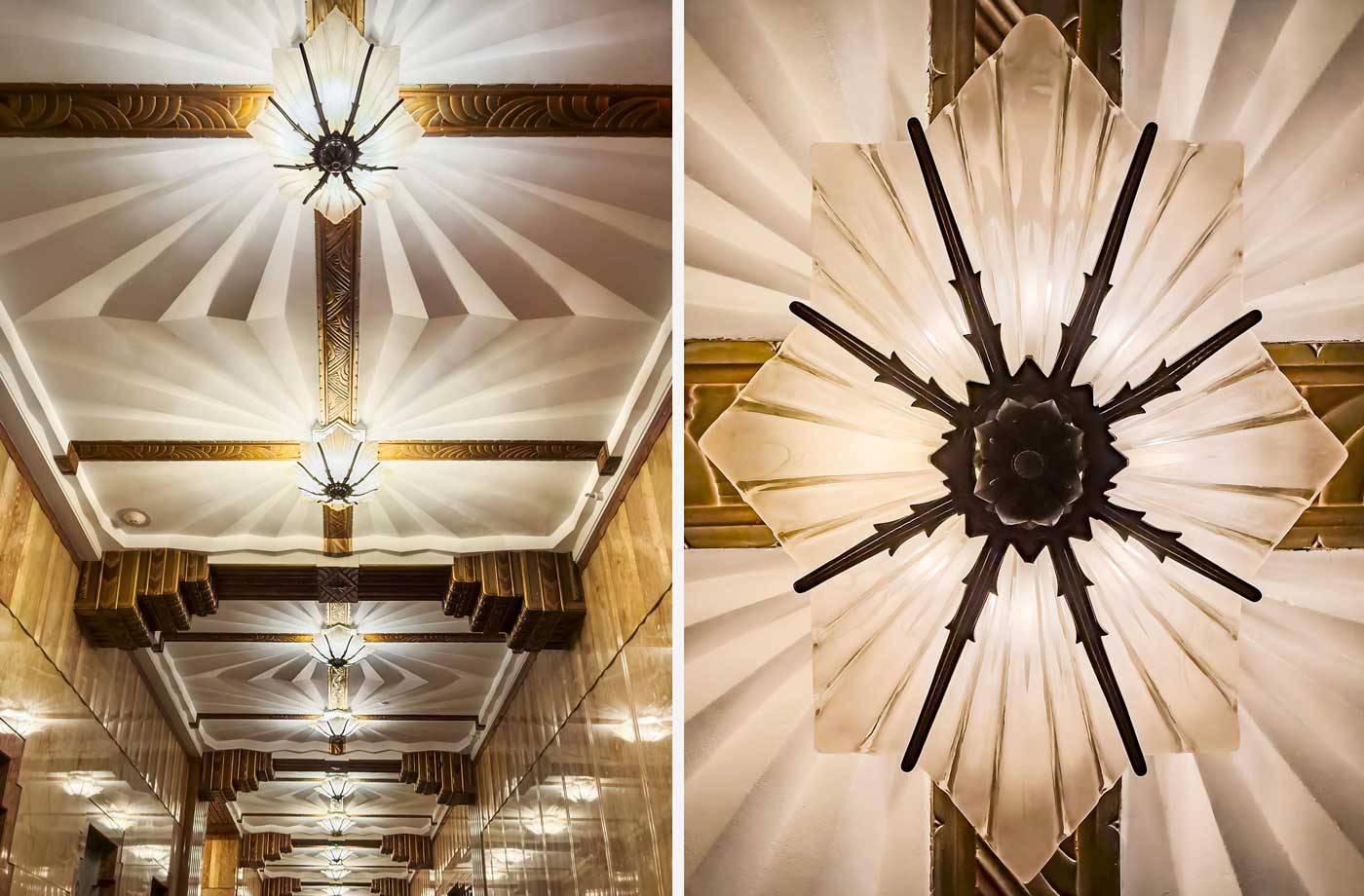
The lobby ceiling fixture an decorations — Cliff Parkhurst.
The lobby ceiling is white plaster, featuring faceted patterns and stepped polychrome corbels with gold, bronze, and copper-leaf relief bands — a thematic reference to the Cities Service Company's business in light, heat, and power.
The space is illuminated by hand-cut translucent cast-glass fixtures decorated with bronze metalwork by Cliff Parkhurst. The light ripples across the ceiling's wave patterns, reinforcing the building's identity as a monument to energy and modern progress.
The Architecture of Finance — 20 Exchange Place, 1931
René Paul Chambellan symbolic Elevator Relief and Light Fixture
At 20 Exchange Place, architects Cross & Cross chose nickel silver deliberately — a copper-nickel-zinc alloy with no actual silver content, prized for its silvery-white luster and resistance to corrosion. Unlike bronze, it does not age to color. The choice was architectural: a unified white finish to complement the building's gray and blue-tinted stone facade. At the time of completion in 1931, it was the world's tallest stone-faced skyscraper.
The iconographic program runs across dozens of entrance and elevator doors, executed under the direction of British sculptor David Evans — old means and new means, advances in industry and transportation financed by the Bank's investments, cast in white metal.
Full documentation coming to the NYC Art Deco Archive. Story forthcoming.

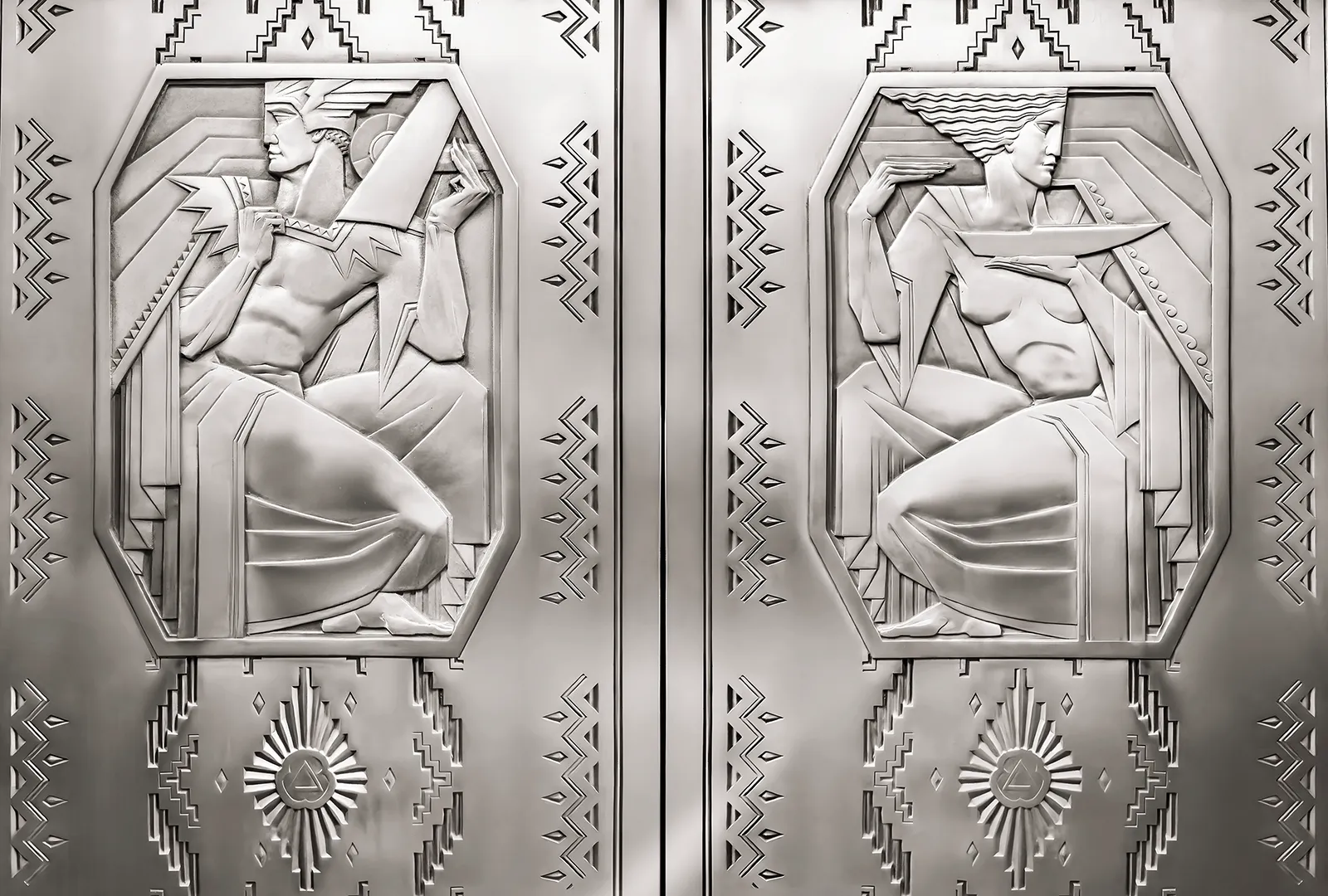
The March of Progress Elevator Doors — David Evans, 1931
Two stylized female figures in high relief — industrial precision and elegant symbolism in the same surface — representing advances in transportation financed by the Bank's investments: from sailing ships and aerial balloons to ocean liners and modern aircraft.
Nickel silver was chosen by architects Cross & Cross over bronze — a deliberate rejection of colored metal in favor of a unified white finish. The decorative program was executed under the direction of British sculptor David Evans — its visual language aligned with the Art Deco skyline of Lower Manhattan.
Federal Authority — 90 Church Street, 1937
Carl Paul Jennewein — A Federal Commission at the Highest Level of the Craft
Carl Paul Jennewein designed the complete decorative program for 90 Church Street — the sculptor responsible for the equivalent program at the Department of Justice Building in Washington, D.C.
The National Seal ceiling light in the lobby — the United States seal rendered in beveled crystal panels set in a bronze octagonal frame, backlit, with an eagle designed to rotate to face either the arrows or the olive branch — is among the most refined federal decorative commissions of the era. Monumental Art Deco eagles anchor the exterior corners.
A federal commission executed at the highest level of the craft, in a building that most visitors to Lower Manhattan have never entered. Photography by Davide Bigano.
Full documentation coming to the NYC Art Deco Archive. Story forthcoming.
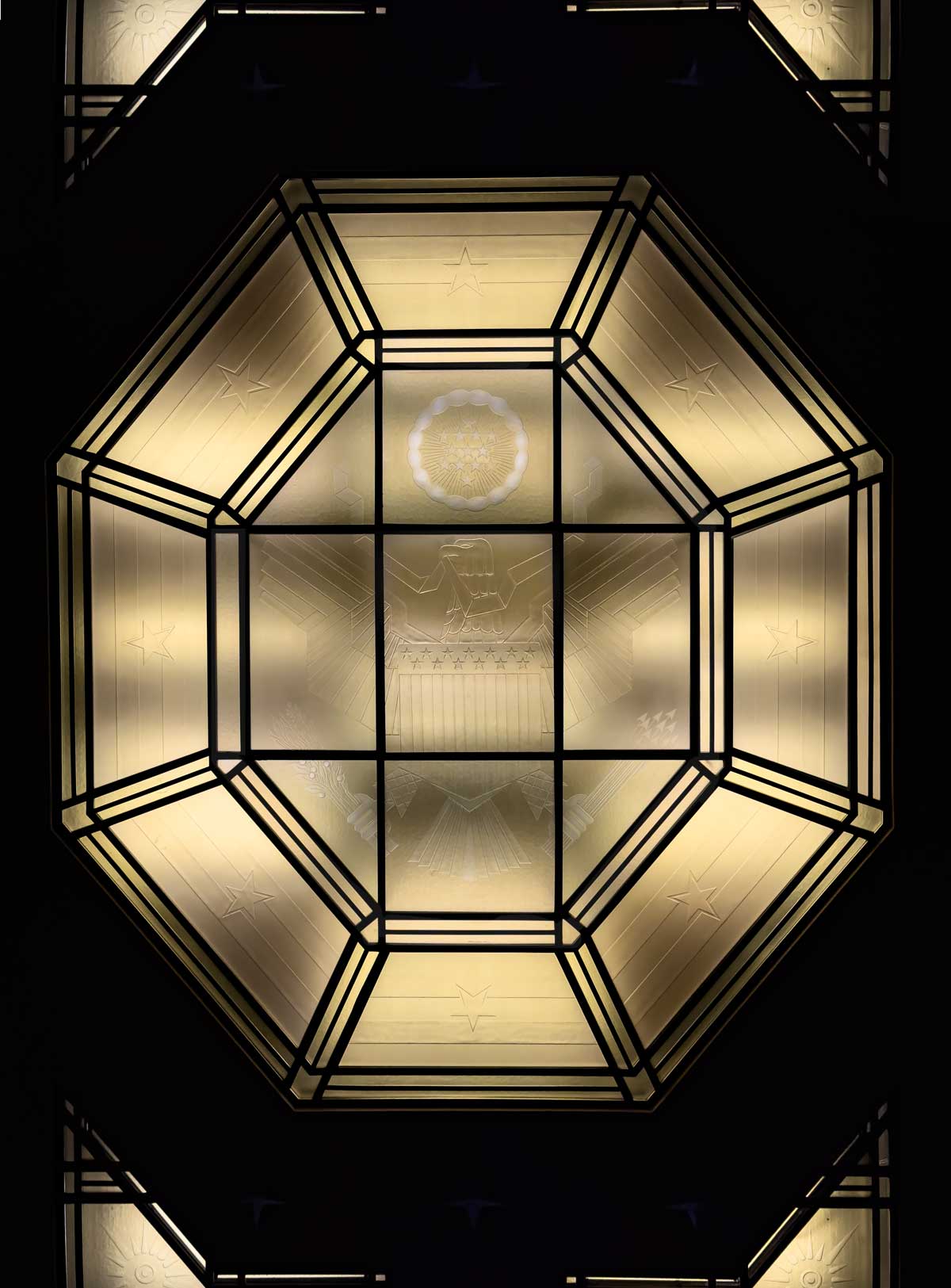
National Seal Ceiling Light — Carl Paul Jennewein
The National Seal ceiling light — the United States seal rendered in beveled crystal panels set in a bronze octagonal frame, backlit. The eagle was designed to rotate to face either the arrows or the olive branch, representing war or peace.
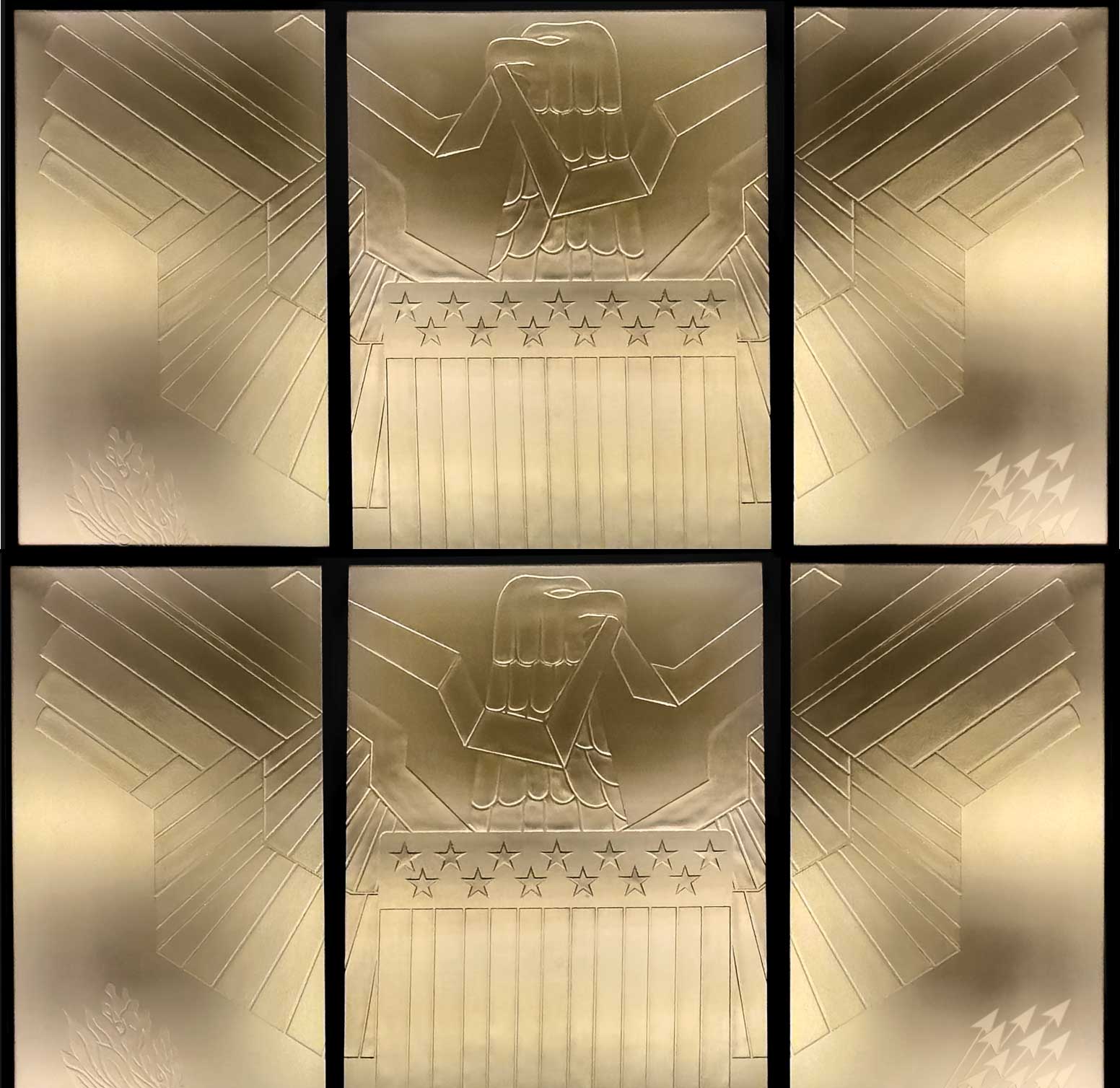
Peace & War — Carl Paul Jennewein
The United States National Seal rendered in beveled crystal panels set in a bronze octagonal frame — eagle, shield, stars, and olive branch, backlit.
The seal was designed with the capacity to rotate the eagle's head to face either the arrows or the olive branch, representing war or peace.
Wisdom, Light and Sound — Rockefeller Center, 1933
René Paul Chambellan symbolic Elevator Relief and Light Fixture
Lee Lawrie's triptych spans the main entrance of 30 Rockefeller Plaza — Wisdom flanked by Light and Sound, thirty-seven feet of Indiana limestone, color by Leon V. Solon. Wisdom holds a compass to measure the forces of the universe. Light represents television — an industry not yet public in 1933, depicted as a cosmic force equal to Wisdom itself. Sound represents radio — and the primary tenant of 30 Rockefeller Plaza was NBC.
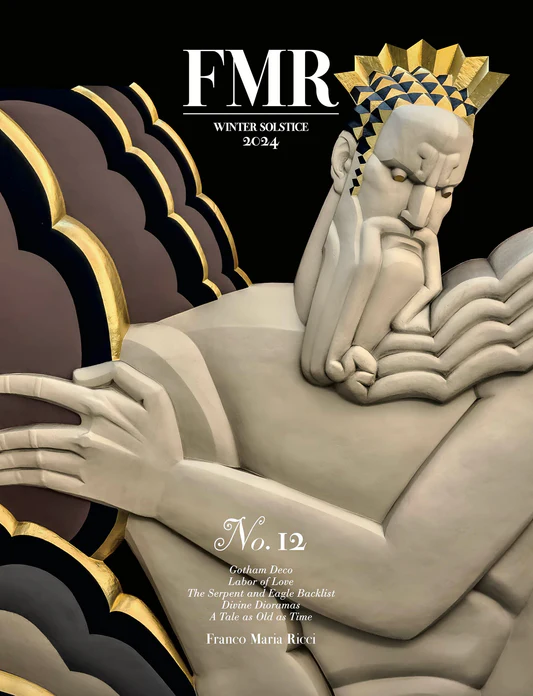
Below Wisdom, 240 cast-glass blocks by Corning Glass Works form a trifold screen. Hand-carved limestone and industrial glass: ancient authority, modern material. The Machine Age argument made visible. In 1933, Rockefeller chose both — and Lawrie designed for exactly that pairing. Published in FMR Magazine, Winter Solstice 2024.
Full documentation coming to the NYC Art Deco Archive. Story forthcoming.
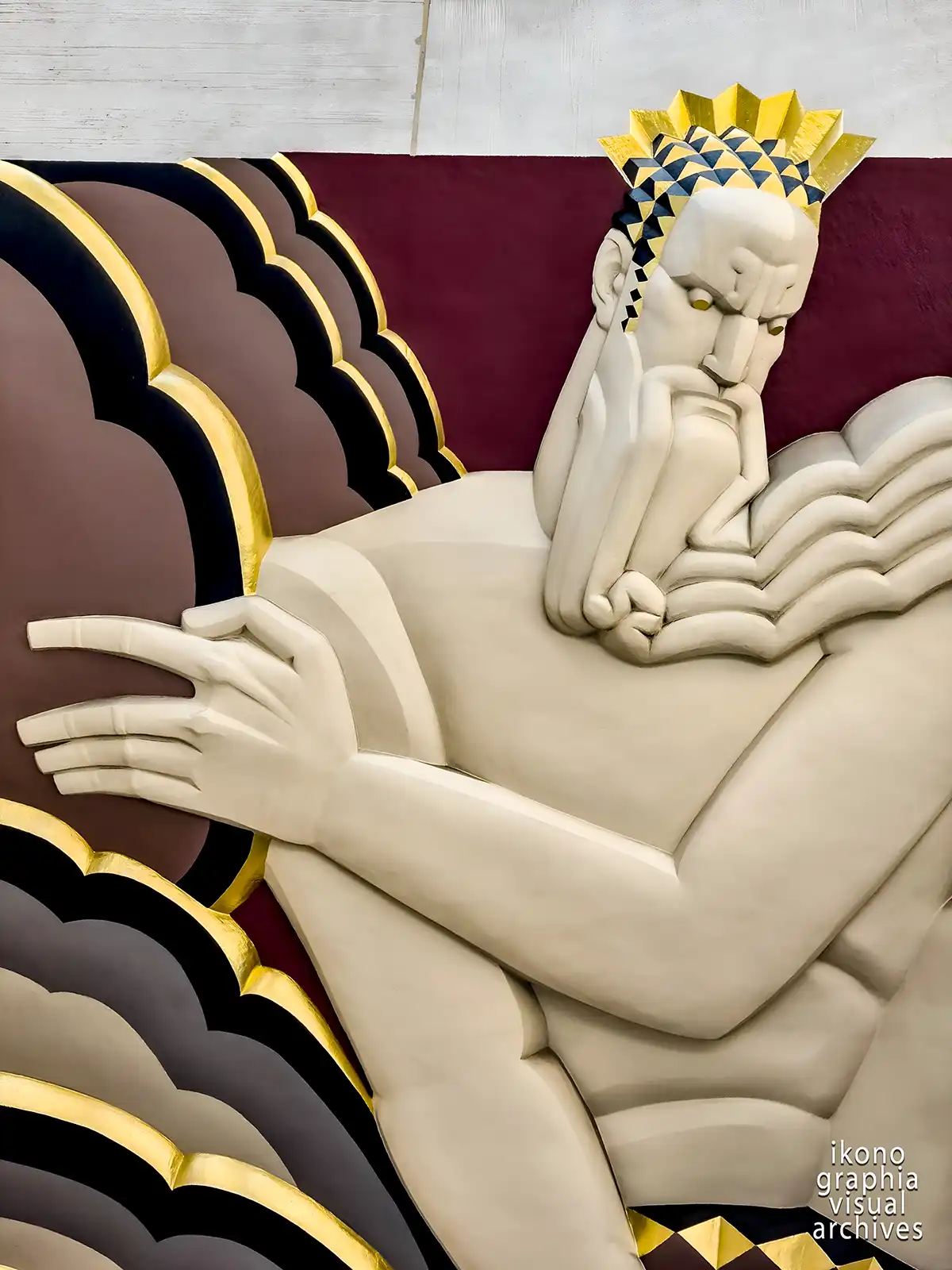
Wisdom — Lee Lawrie
The central figure of a 37-foot triptych — Wisdom, a Voice from the Clouds, with Light and Sound — spanning the main entrance. Lee Lawrie drew on William Blake's Urizen — reason and law made flesh — and gave him the vocabulary of the Machine Age. The Rockefeller complex was commissioned and built through the deepest years of the Great Depression.
At this distance, the figure reveals what the street view cannot: the precision of the polychrome crown, the geometry of each gold and black triangle, the force of a figure pushing back the clouds of ignorance. What remains is the face — looking down, in concentration.
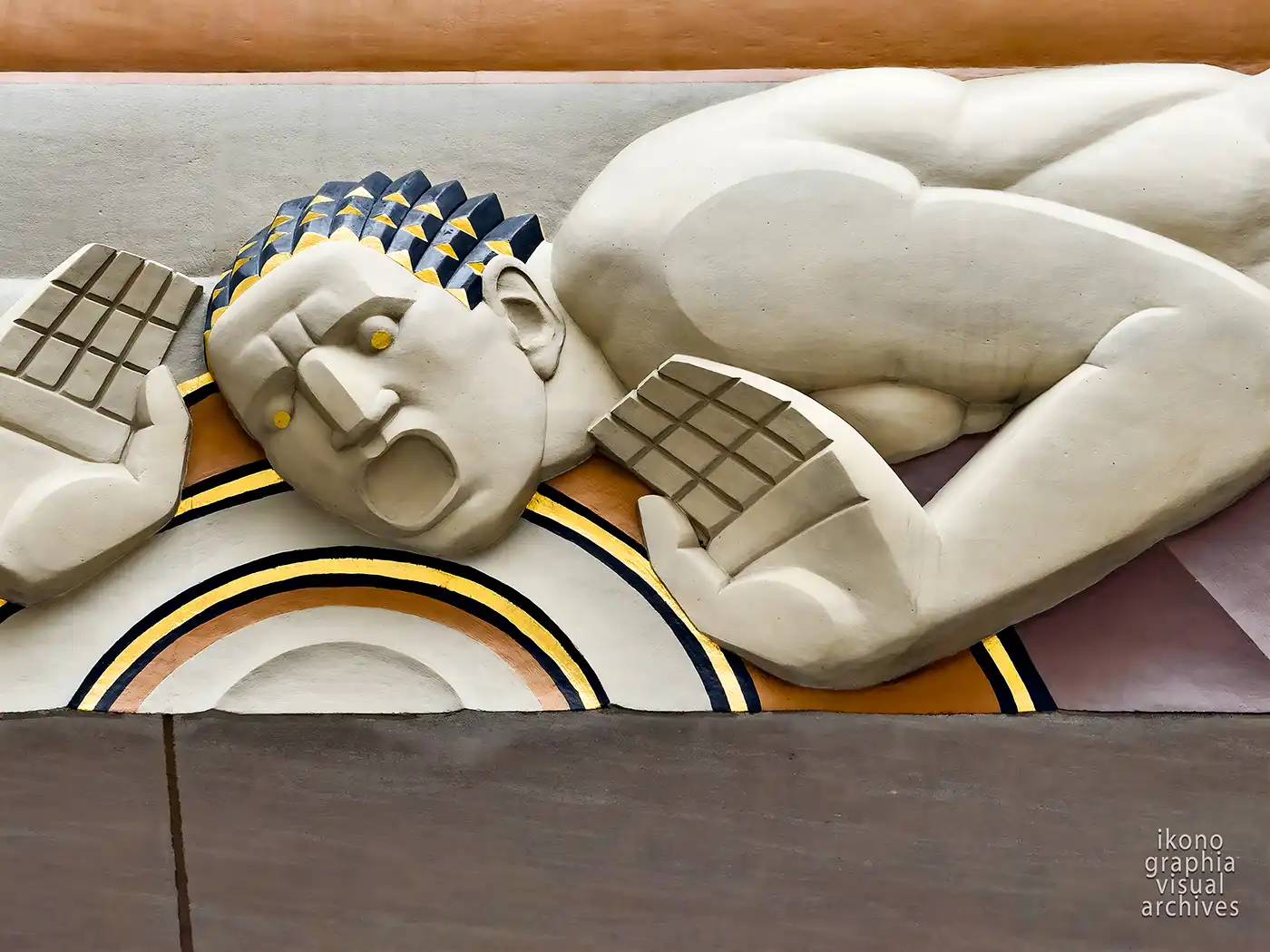
Light — The Age of Television
The figure representing television — male, arms raised like antennas, transmitting electrical signals and images through the air. The crown of sharp black-and-gold triangles does not ornament the figure. It amplifies him. Indiana limestone, color by Leon V. Solon.
Television in 1933 was not yet a public reality. Lawrie depicted an industry still finding its form and placed it on the facade of Rockefeller Center as a cosmic force equal to Wisdom itself.
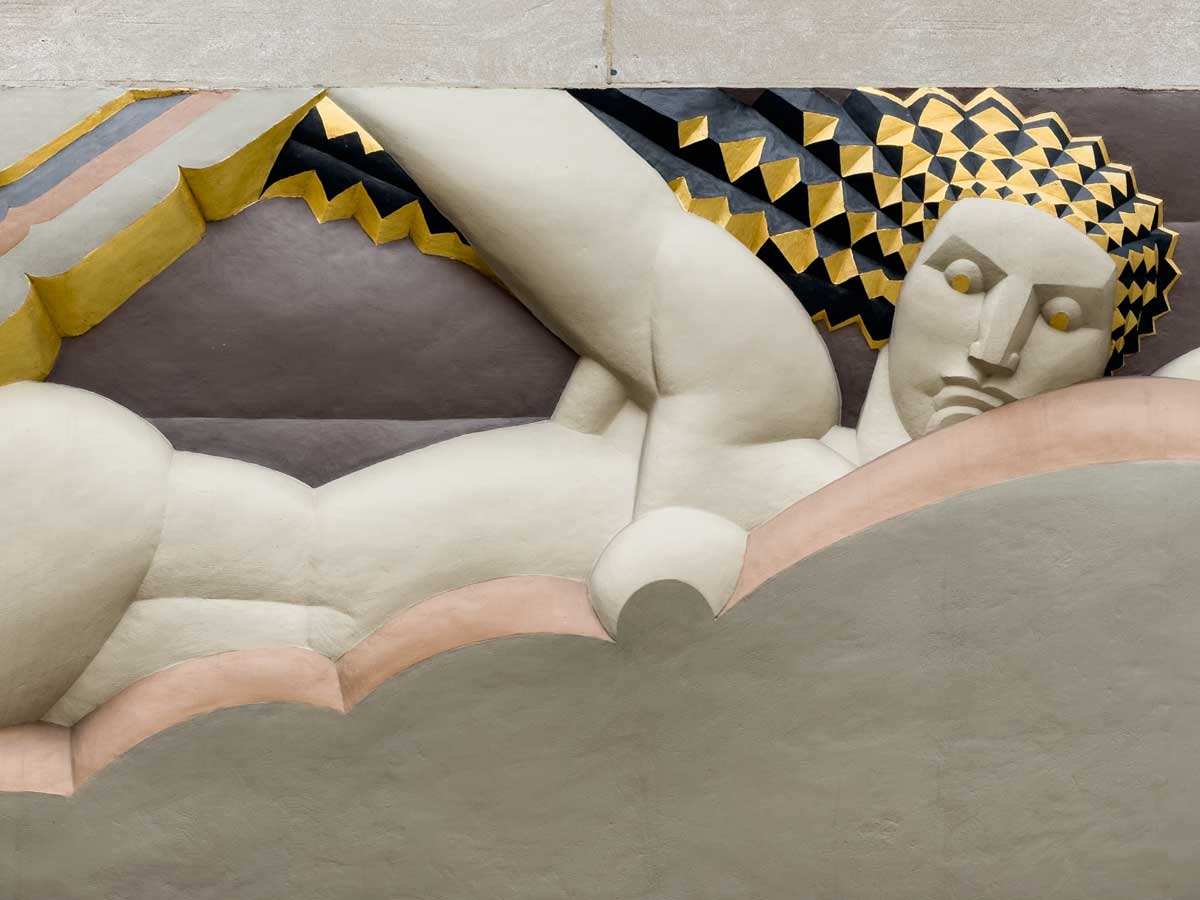
Sound, The Age of Radio
The figure representing radio — female, reclining, emerging from clouds. The concentric circles radiating from her are not decoration. They are the signal, rendered in stone. Indiana limestone, color by Leon V. Solon.
Radio in 1933 was the dominant mass medium — and the primary tenant of 30 Rockefeller Plaza was NBC. Lawrie did not illustrate a technology. He gave it a body and placed it alongside Wisdom as a force of equal weight.
Copyright, links and credits
Photography, Copyright & Credits
All photographs © Ikonographia / Roberto Bigano — All Rights Reserved.
These images are part of the Ikonographia Visual Archives: New York City Art Deco Collection.
⸻
Terms of Use (Summary)
The images presented in this archive are copyrighted and available for licensed use only through Ikonographia Visual Archives.
You may not download, reproduce, publish, or distribute these images without a valid license. For commercial or editorial licensing, please refer to the product pages or contact Ikonographia directly. A full explanation of licensing terms is available in the Shop / Licensing Information section under "Ikonographia — Standard License" and "Ikonographia — Merchandising & Product Use Licenses"
⸻
Artwork & Building Attribution
Completed in 1927, the Fred F. French Building stands as one of Manhattan's defining Art Deco towers. While its stepped crown and gilded façade are widely admired, its most exceptional achievement lies within: a decorative program conceived by architect H. Douglas Ives and executed in bronze by sculptor Vincent Glinsky — a collaboration that transformed a commercial lobby into a passage through ancient Babylon.
Ives documented his own obsession in writing: the Tower of Seven Planets at Babylon, the Ishtar Gate, Chaldean enameled brick. The iconographic program was not intuition — it was research translated into architecture.
⸻
Copyright Status Clarification
Building & Artwork:
The architectural design of this buildingis in the public domain under U.S. copyright law. Buildings constructed before the Architectural Works Copyright Protection Act (1990) are not protected as architectural works, and their exteriors and interiors may be freely photographed.
Photographs:
All photographs on this page, however, are copyrighted works of Ikonographia / Roberto Bigano and require a license for any reuse.
⸻
Ikonographia Mission Statement
Ikonographia is committed to the accurate documentation, preservation, and ethical dissemination of twentieth-century visual culture.
⸻
Archival Notes
These photographs were produced as part of Ikonographia’s ongoing documentation of significant examples of twentieth-century visual culture. Image preparation includes controlled lighting, accurate color management, and perspective correction to preserve architectural integrity and material detail.
⸻
Further Reading - Selected Sources
• FMR Magazine No. 12, Winter Solstice 2024 — "Gotham Deco" — Special issue devoted to the Art Deco transformation of 1920s New York, with contributions by Anthony W. Robins and photography by Roberto Bigano. Cover and 24 pages featuring comprehensive documentation of the Chanin Building radiator grilles, the Fred French Building elevator panels and polychrome ceilings, the Light and Sound sculpture at Rockefeller Center, and a curated selection of the city's finest Art Deco interiors.
• Anthony W. Robins, New York Art Deco: A Guide to Gotham’s Jazz Age Architecture.
• David Stravitz, The Chrysler Building: Creating a New York Icon Day by Day.
• Cervin Robinson & Rosemarie Haag Bletter, Skyscraper Style: Art Deco New York.
• Christopher Gray (archives), The New York Times, “Streetscapes” columns.
• New York City Landmarks Preservation Commission reports (Fred F. French Building).
• The Metropolitan Museum of Art – Digital Collections (historic metalwork and architectural ornament references).
⸻
Acknowledgments
Ikonographia gratefully acknowledges the institutions, archivists, scholars, and architectural historians whose research and preservation efforts help illuminate the cultural significance of New York’s Art Deco heritage.
⸻
Browse the New York City Art Deco Archive
-

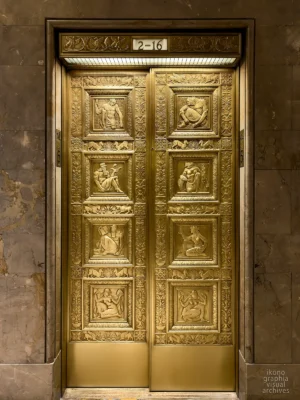
The Symbolic Program — Elevator Doors, Fred French Building, New York
€95.00 -

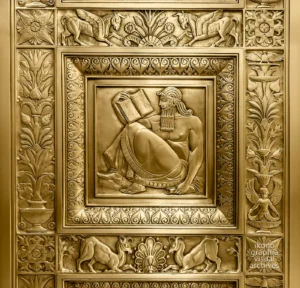
The Scholar Elevator Panel — Fred French Building, New York, 1927
€95.00 -

Art Deco Allegory of Effort — Gilded Grille, Chanin Building, New York, 1929
€95.00 -

Telephone Wires and Radio Unite to Make Neighbors of Nations — AT&T Building, New York, 1932 — Hildreth Meière
€95.00
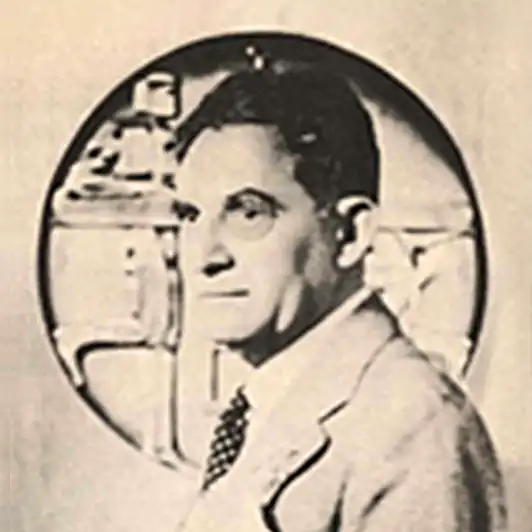
About H. Douglas Ives . A short bio

Brodovitch at work in his studio.
H. Douglas Ives (1888–1945)
H. Douglas Ives (1888–1945) was a New York architect who spent the defining years of his career as chief designer for the Fred F. French Company. Beyond the Fred French Building, his work included Tudor City, the large residential complex on Manhattan's East Side, and Knickerbocker Village on the Lower East Side.
His most celebrated work is the Fred F. French Building at 551 Fifth Avenue (1927). The building's polychromatic crown is among the most discussed Art Deco exteriors in New York. The lobby is his real achievement.
Ives studied the Ishtar Gate of Babylon, the Tower of Seven Planets, and the enameled brick of ancient Chaldea directly, and translated them into a complete decorative program — executed in gilt bronze by sculptor Vincent Glinsky and master metalworker Oscar Bach. Every element documented and justified in his own writing before a single panel was cast. The most coherent Mesopotamian-themed interior in American Art Deco.
About Vincent Glinsky. A short bio

Vincent Glinsky
Vincent Glinsky (1895–1975)
Vincent Glinsky was a Russian-born American sculptor whose work fused Beaux-Arts training with the emerging modernist vocabulary of the 1920s and 1930s. Educated in Petrograd and later active in New York, he developed a sculptural language marked by precise anatomies, architectural clarity, and an expressive narrative sense ideal for architectural relief.
By the 1920s he became a sought-after collaborator on major Art Deco projects, translating complex symbolic programs—commerce, industry, finance, and civic identity—into refined low-relief compositions. His works remain key examples of American Art Deco humanism, distinguished by rhythmic modeling, monumental simplicity, and sensitivity to architectural settings.
About Oscar Bach. A short bio.
Oscar Bach
Oscar Bach (1884–1957)
Oscar Bach was a German-born master metalworker whose technical innovation shaped some of the most celebrated interiors of early twentieth-century America. Trained in the European guild tradition, he brought exceptional skill in architectural bronze, iron, and nickel-silver to the United States after emigrating in 1911.
Working from his New York studio, Bach produced metalwork for major skyscrapers, department stores, civic buildings, and luxury residences. His style combined Old World ornament with modern geometric clarity, defining a distinctive branch of American Art Deco. His workshop became synonymous with excellence in decorative metal, leaving a legacy preserved in landmarked interiors across the country.