American Streamlined Trains — Striking Ads of the 1940s

American Streamlined Trains — Striking Ads of the 1940s

American Streamlined Trains — Striking Ads of the 1940s

The railroads told their own story. These are the words they used.

From the mid-1930s, American railroads faced competition from buses, airlines, and interstate highways. The answer was the streamliner — deluxe passenger trains built around speed, comfort, and the visual language of modernity.
The advertisements, pamphlets, and menus they produced were primary documents of rare quality. The writing matched the ambition of the trains themselves. This story presents the most significant examples — reproduced from original issues of Life Magazine and other period publications.
The series continues with two further chapters: Dining on the Train, and Trains and WWII.

Power to Pace the Future. A Streamlined train of American Railroads.

A "long streamlined giant capable of speed up to 120 miles an hour." Pennsylvania Railroad Ad on Life of January 22, 1945.

Celebrating American Technological Progress.


Starting from the mid-thirties, many railroads were driven progressively out of business due to competition from buses, airlines, and Interstate highways.
The answer was the development of deluxe passenger trains, the streamliners. Some became legendary and profoundly influenced popular culture by focusing on concepts such as power, speed, technological progress, comfort, and luxury service.

Railroads' advertisements, pamphlets, and even menus were extremely impacting, and it was not easy to select the best. We have divided this post into three parts. The second one will be "Dining on the train" and the third one on trains and WWII.
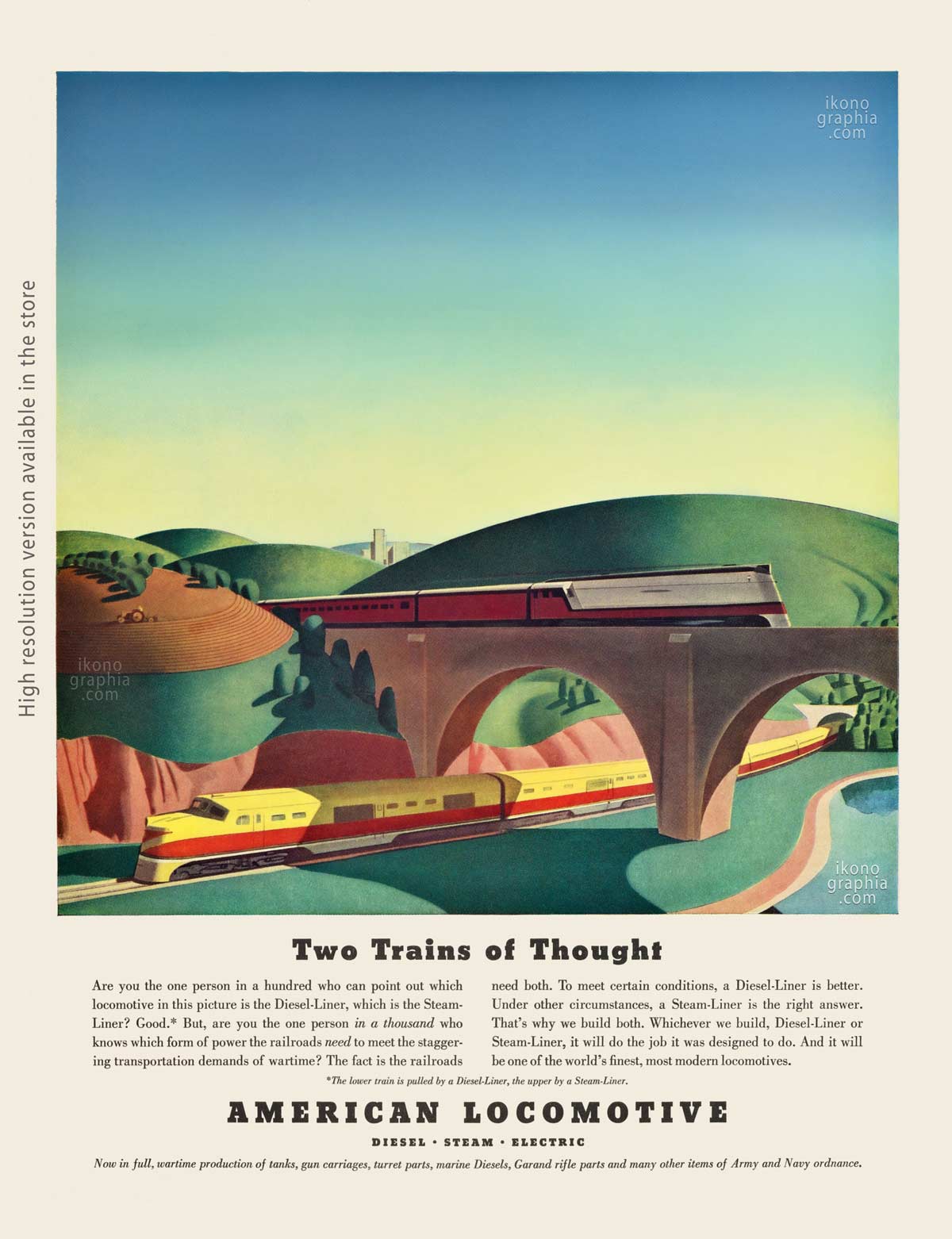
American Locomotive. Two Trains of Thought. Life Magazine. February 16, 1942

American Locomotive.
Two Trains of Thought
Life Magazine. February 16, 1942.


Are you the one person in a hundred who can point out which locomotive in this picture is the Diesel-Liner, which is the Steam-Liner? Good.*
But are you the one person in a thousand who knows which form of power the railroads need to meet the staggering transportation demands of wartime? The fact is the railroads need both. To meet certain conditions, a Diesel-liner is better. Under other circumstances, a Steam-Liner is the right answer.
That’s why we build both. Whichever we build, Diesel-Liner or Steam-Liner, it will do the job it was designed to do. And it will be one of the world’s finest, most modern locomotives.

*The lower train is pulled by a Diesel-Liner, the Upper by a Steam-Liner.

The Streamlined Trains


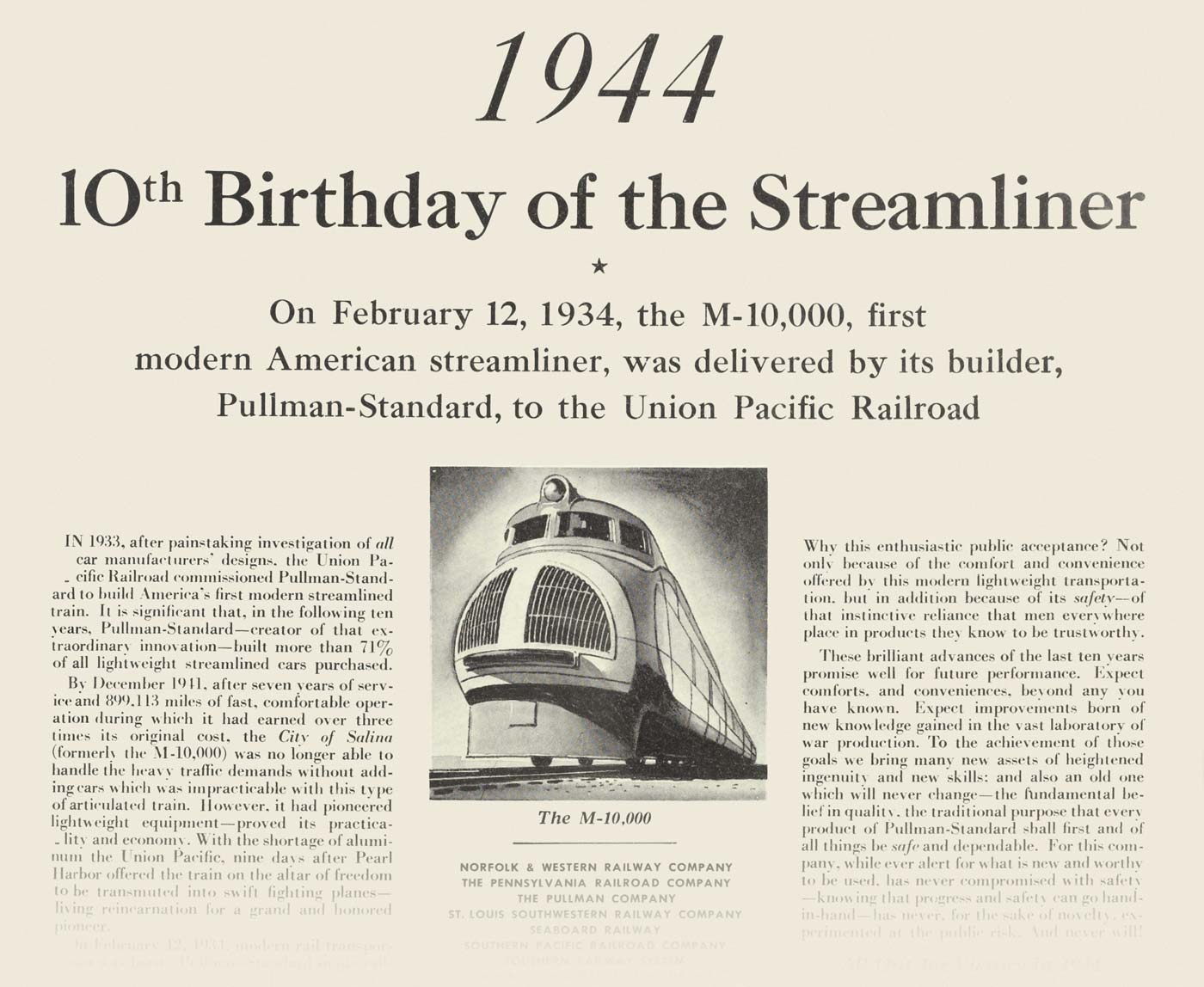
A streamliner is a vehicle designed to reduce air resistance. Let this Pullman-Standard ad tell you all the story of its birth.

In 1933, after a painstaking investigation of all car manufacturers’ design, the Union Pacific Railroad commissioned Pullman-Standard to build America’s first modern, streamlined train. It is significant that, in the following ten years, Pullman Standard—creator of that extraordinary innovation—built more than 71% of all lightweight cars purchased.

On February 12, 1934, the M-10,000, the first modern American streamliner, was delivered by his builder, Pullman Standard, to the Union Pacific Railroad.

By December 1941, after seven years of service and 899,113 miles of fast, comfortable operation during which it had earned over three times its original costs, the City of Salina (formerly the M-10,000) was no longer able to handle the heavy traffic demands without adding cars which was impracticable with this type of articulated train. However, it had pioneered lightweight equipment—proved its practicality and economy.
With the shortage of aluminum, the Union Pacific, nine days after Perl Harbor, offered the train on the altar of freedom to be transmuted into swift fighting planes—being reincarnation for a grand and honored pioneer.
Toy bread in form of bag. Nuoro, Sardinia

Pullman-Standard. 1944 - 10th Birthday of the Streamliner. Fortune Magazine, March 1944.

Power and Speed


The text of the Pennsylvania Railroad ad below perfectly summarizes what we said. It was published on Life on January 22, 1945.

Capable of speed up to 120 miles an hour, this long streamlined giant not only marks another forward stride in the science of railroading — it is indicative of the spirit of progress in an industry vital to the welfare of America. now and in the future.

Power to Pace the future - Pennsylvania Railroad ad - Life Magazine. January 22, 1945

Pennsylvania Railroad.
POWER TO PACE THE FUTURE
Life Magazine. January 22, 1945.


Here’s the drama that comes of a drawing board . . . first of a series of new engines now in service in the East-West route of the Pennsylvania Railroad!

Capable of speed up to 120 miles an hour, this long streamlined giant not only marks another forward stride in the science of railroading — it is indicative of the spirit of progress in an industry vital to the welfare of America. now and in the future.
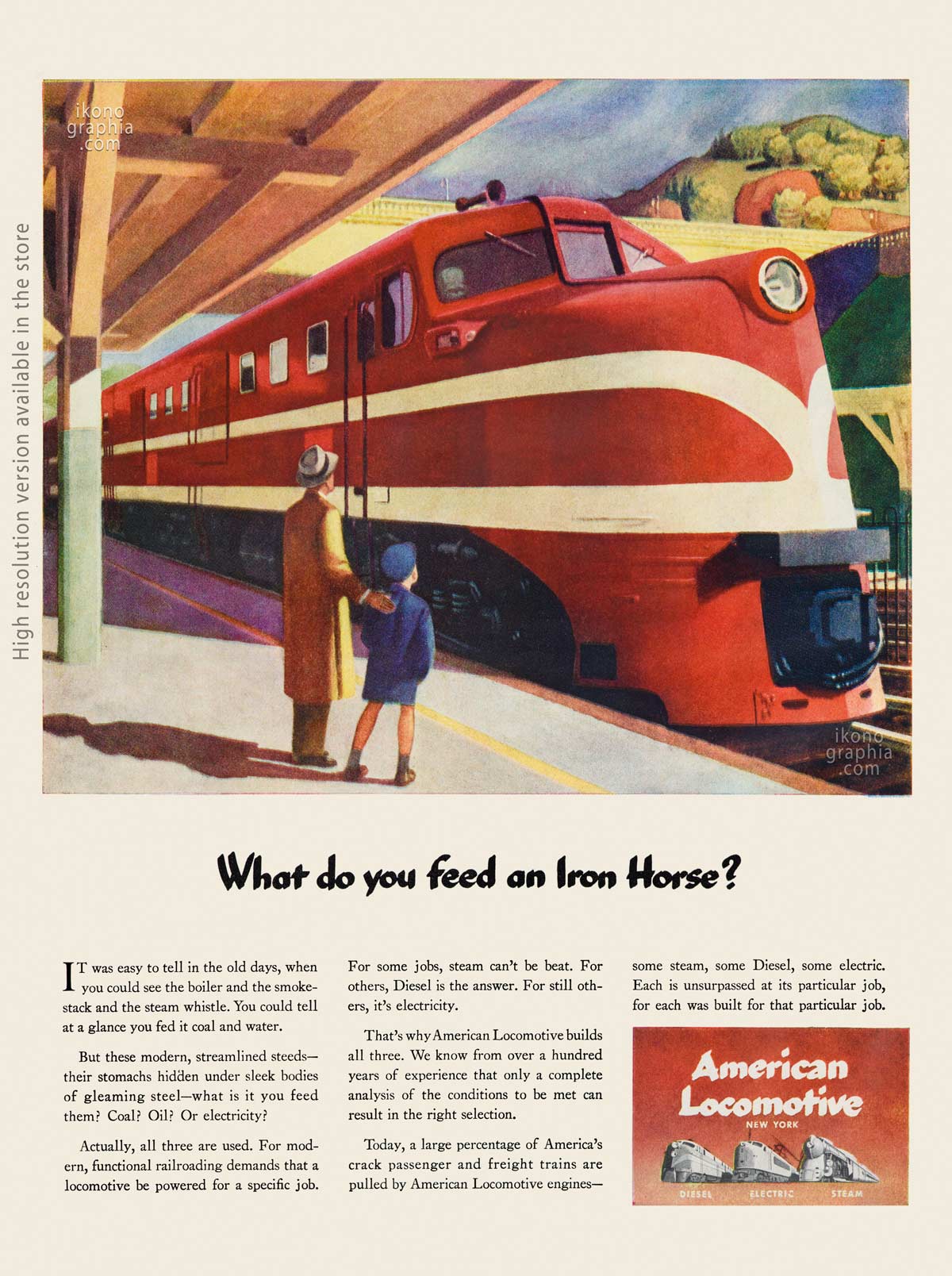

What do you feed an Iron Horse? - American Locomotive Ad - Life Magazine. February 21, 1944 - Artwork by Edward Hopper

American Locomotive.
What do you feed an Iron Horse?
Life Magazine. February 21, 1944.

Artwork with the unmistakable surreal style of Edward Hopper.

Read the ad's full text in the tab below


Read the ad's text


It was easy to tell in the old days when you could see the boiler and the smokestack and the steam whistle. You could tell at a glance you fed it coal and water.

But these modern streamliners steeds—their stomach hidden under sleek inside bodies of gleaming steel—what is it you feed them? Coal? Oil? Or electricity?
Actually, all three are used. For modern functional railroading demands that a locomotive be powered for a specific job.
For some jobs, steam can’t be beat. For others, Diesel is the answer. For still others, it’s electricity.

That’s why American Locomotives builds all there. We know from over a hundred years of experience that only a complete analysis of the conditions to be met can return in the right selection.
Today, a large percentage of America’s crack passenger and freight trains are pulled by American locomotive engines—some Steam, some Diesel, some Electric. Each is unsurpassed at its particular job, for each was built for that particular job.
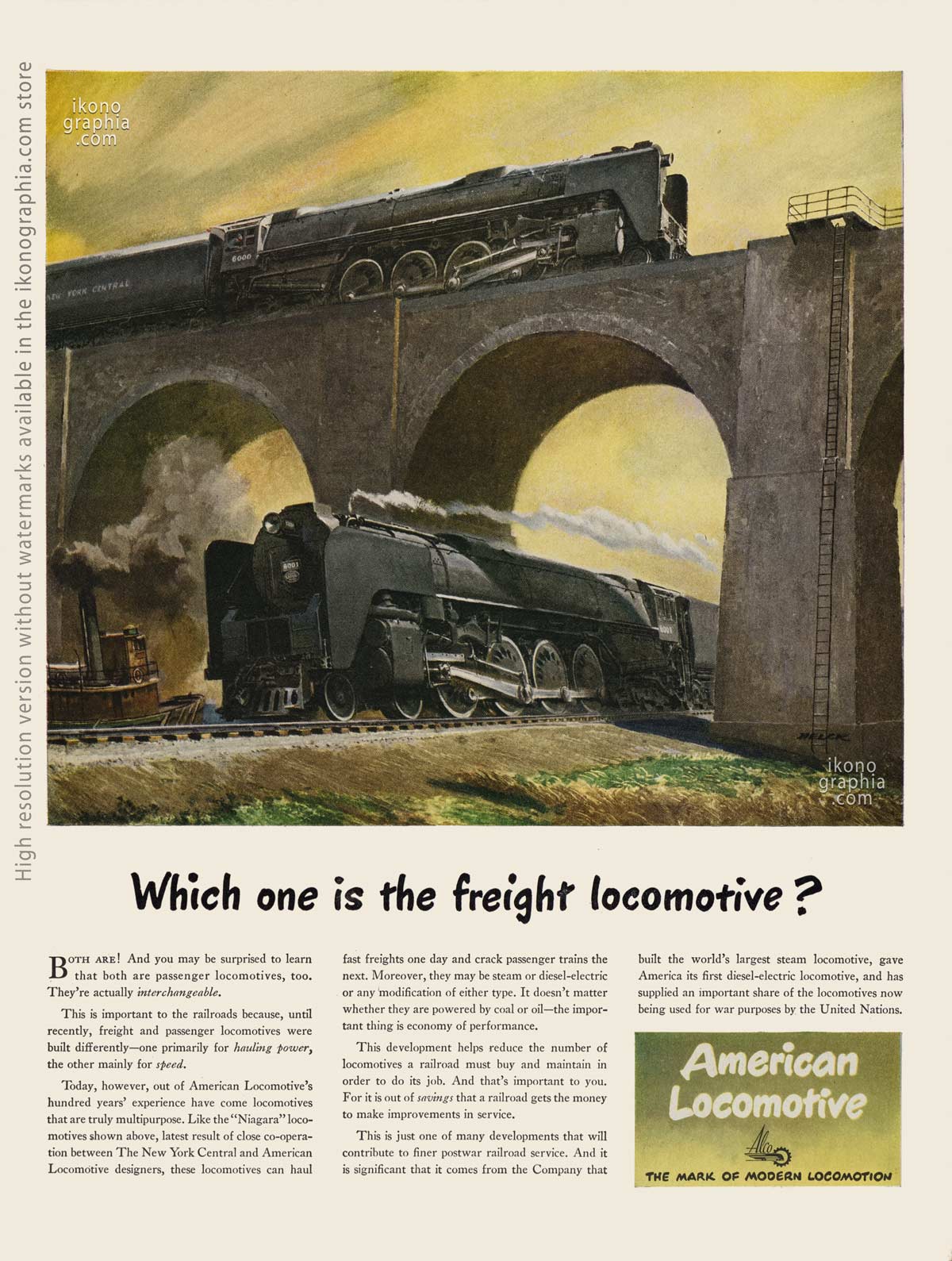
Which one is the freight locomotive? - American Locomotive ad, artwork by Peter Helck - Life Magazine. June 25, 1945

American Locomotive.
Which one is the freight locomotive?
Life Magazine. June 25, 1945.

Artwork by Peter Helck.

Read the ad's full text in the tab below.


Read the ad's text


Which one is the freight locomotive?

BOTH ARE! And you may be surprised to learn that both are passenger locomotive, too. They are actually interchangeable.

This is important to the railroads because, until recently, freight and passenger locomotives were built differently-one primarily for hauling power, the other mainly for speed.

Today, however, out of American Locomotive’s hundred years’ experience have come locomotives that are truly multipurpose. Like the “Niagara” locomotives shown above, latest result of co-operation between The New York central and American Locomotive designers, these locomotives can haul fast freights one day and crack passenger trains the next. Moreover, they may be steam or diesel-electric or any modification of either type. It doesn’t matter whether they are powered by coal or oil-the important thing is economy of performance.

This development helps reduce the number of locomotives a railroad must buy and maintain in order to do its job. And that’s important to you. For it is out of savings that a railroad gets the money to make improvements in service.

This is just one of many developments that will contribute to finer postwar railroad service. And it is significant that it comes from the Company that built the world’s largest steam locomotive, gave America its first diesel-electric locomotive, and has supplied an important share of the locomotives now being used for war purposes by the United Nations.

American Locomotive
THE MARK OF MODERN LOCOMOTION

Quick - what's it pulling, boxcars or berths? - American Locomotive ad, artwork by Peter Helck - Life Magazine. April 16, 1945

American Locomotive.
Quick - what's it pulling, boxcars or berths?
Life Magazine. April 16, 1945.

Artwork by Peter Helck.

Read the ad's full text in the tab below.


Read the ad's text


Quick - what's it pulling, boxcars or berths?

Even a railroad man couldn’t tell–until he sees more than the locomotive.
For this particular locomotive–built by American Locomotive and General Electric for the New Haven–is the product of an important development.

You see, for years, the railroads have had to bear the terrific expense of buying and maintaining different types of locomotive for freight and passenger service. But today–as a result of American Locomotive’s hundred years of experience in railroading–this problem has been licked.

Locomotives are now being built that are interchangeable–that can haul fast freight trains one day and crack passenger trains the next. And the maybe Diesel-Electric or steam or any modification of either type. It doesn’t matter whether they use oil or coal–the important thing is economy of performance.

This development means big savings for the railroads because it helps to reduce the number of locomotives a railroad must buy and maintain. And that’s important to you. For it is out of a railroad’s savings that improvements in service can be offered.

This is just one of many developments that will contribute to finer postwar railroad service. And, significantly, it comes from the Company that built the world’s largest steam locomotive, gave America its first diesel-electric locomotive, and has supplied an important share of the locomotives now being used for war purposes by the United Nations.

American Locomotive
THE MARK OF MODERN LOCOMOTION

Something New on the table! - Pennsylvania Railroad ad - Life Magazine. December 3, 1945

Pennsylvania Railroad.
Something New ON THE TABLE!

Life Magazine. December 3, 1945.


Read the ad's text


Something New ON THE TABLE!

For the first time, a way has been found to put into a locomotive the same kind of power that sends big battleships forward–turbine drive!

Developed by Pennsylvania Railroad research in conjunction with engineering staffs Westinghouse Electric Corporation and the Baldwin Locomotive Works, this new kind of locomotive power adds extra smoothness in fast runs–and many other notable advantages.

No bigger than your electric refrigerator, the steam turbine itself can produce power to pull the heaviest loads at high speeds. And the engineman controls the whole operation with a single small lever which works like a gear-shift on an automobile!

One of the most important changes in the power principle of the steam locomotive in over 100 years, the turbine drive engine gives promos of a great future in the field of train transportation.

PENNSYLVANIA RAILROAD
Serving the Nation

BUY UNITED STATES VICTORY BONDS AND STAMPS

ONE HUNDRED YEARS 1846-1946 - Pennsylvania Railroad ad - Life Magazine. February 18, 1946

Pennsylvania Railroad.
ONE HUNDRED YEARS 1846-1946

Life Magazine. February 18, 1946.


Read the ad's text


ONE HUNDRED YEARS 1846-1946

THIS YEAR–1946–marks a century of progress by the Pennsylvania Railroad in service to the American people. Reflecting the tremendous industrial growth of the Country itself, this service has steadily advanced from a few trains a day to 1,340 passenger trains and 3,170 freight trains daily, operating over 10,114 miles of line extending from the Atlantic to the Mississippi. Now, as we prepare to move into a second century, our combined research, engineering, and shop facilities are producing new trains, new locomotives, new cars, new comforts, and new technical achievements . . . to add still another chapter of transportation progress that has continued for one hundred years,

PENNSYLVANIA RAILROAD
Serving the Nation

Captions:

The “John Bull,” built in 1931–America’s oldest original locomotive

A Pennsylvania Railroad Locomotive of 1865

Power in 1902 for Pennsylvania Special, forerunner of Broadway Limited

Comfort and Service


We introduce this chapter using the text of this ad American Railroads which is an extraordinary blast into the spirit of the era.

It's a day coach. Looks pretty nice, doesn't it? And it's nice! Light, bright, roomy, and comfortably air-conditioned. Smooth riding at high speeds with pillow-soft seats that fairly invite you to sink down and relax — wide windows that provide a sweeping view of the scenic landscape — and dozens of important little travel conveniences.

• Where will you find such coaches as this? Many of them were built before the war began and are now in use. Hundreds more had been planned but never built — you know the reason why. • We haven’t been able to use scarce materials and manpower to build trains as we’d like to have them. There’s a war to win and doing our level best to meet the nation’s wartime transportation needs. • But we offer this little glimpse of the future because we want you to know, when you ride on our trains today, that railroads are looking ahead, planning better trains for tomorrow.

Like to ride on a train like this? - American Railroads artwork by John Vickery - Life. May 22, 1944

American Railroads.
Like to ride on a train like this?
Life. May 22, 1944

Artwork by John Vickery, an Australian illustrator who moved to New York in 1935.


Leisure and vacation


Excerpt from a Pennsylvania Railroad ad published on Life on June 13, 1949.

Choose your own vacationland. . . bur for extra pleasure . . . go by train!
It’s much more enjoyable. And the train is so comfortable, convenient and dependable. There’s room to roam, room to relax . . . weather you go, coach or Pullman. Your carefree vacation starts the moment you step aboard any of the 1100 daily trains that make up Pennsylvania Railroad’s great passenger fleets. No matter where you’re bound, there’s a train ready to take out on the day you play to go.

Holiday for Two! New York Central Ad - Life. May 31, 1948

New York Central.
Holidate for two! on New York Central's New Luxury Coaches.

Life Magazine. May 31, 1948.


Read the ad's text


Holidate for Two! on Mew York Central’s New Luxury Coaches We Couldn’t Budge on Our Budget! It looked a stay-home vacation for us . . . until we started figuring on New York Central’s low coach fares and round-trip savings. But Now Our Vacation Outlook’s Great . . . Water Level Route scenery’s a swell background for dining car meals. It makes great sightseeing, too, from the wide windows of our air-cooled coach. We’ll Have More to Spend at the Other End! Coach fares save us enough for extra vacation fun of our trip aboard world’s largest new luxury coach fleet. FREE-1948 Vacation Guide Are you summer-dreaming of the Adirondacks, Niagara Falls, New England, Canada, the Great Lakes or the Western Wonderlands? Then you’ll want this Vacation Guide, with its many pictures and fascinating fun map. For FREE copy, mail coupon to New York Central, Room 1334-L, 466 Lexington Avenue, New York 17, New York. New York Central System NEW YORK CENTRAL The Scenic Water Level Route

“North Western” ENLARGES ITS GREAT “400” FLEET. Pullman-Standard ad - Life. November 2, 1946

Pullman Standard.
"North Western" enlarges its great "400" fleet. Built by Pullman Standard.

Life Magazine. February 11, 1946.


Read the ad's text


“North Western” ENLARGES ITS GREAT “400” FLEET BUILT BY PULLMAN-STANDARD Fast, luxurious, dependable, the “400”s have won distinction among the great trains of America. You, the millions who have patronized the “400”s, have given them a service record which have few equals–bot in passengers volume and operating result.

Now come the first postwar additions to this busy popular fleet–new Pullman-Standard built the first lightweight, streamlined cars for any railroad. The North Western, likewise , has a long record of successful operation of this new equipment. Since 1933, we have built 141 lightweight cars for this railroad, or for its joint operation with Union Pacific and Southern Pacific. Watch for Pullman-Standard’s “Trains of Today!” For the safest and finest in modern rail transportation travel on trains which feature Pullman-Standard-built cars,

Pullman-Standard CAR MANUFACTURING COMPANY CHICAGO • ILLINOIS offices in seven cities . . .
Manufacturing plants in six cities World’s largest builders of modern streamlined railroad cars Caption:
The “400” Fleet operates between Chicago and Milwaukee, Wisconsin, southern Minnesota and the Upper Peninsula of Michigan.
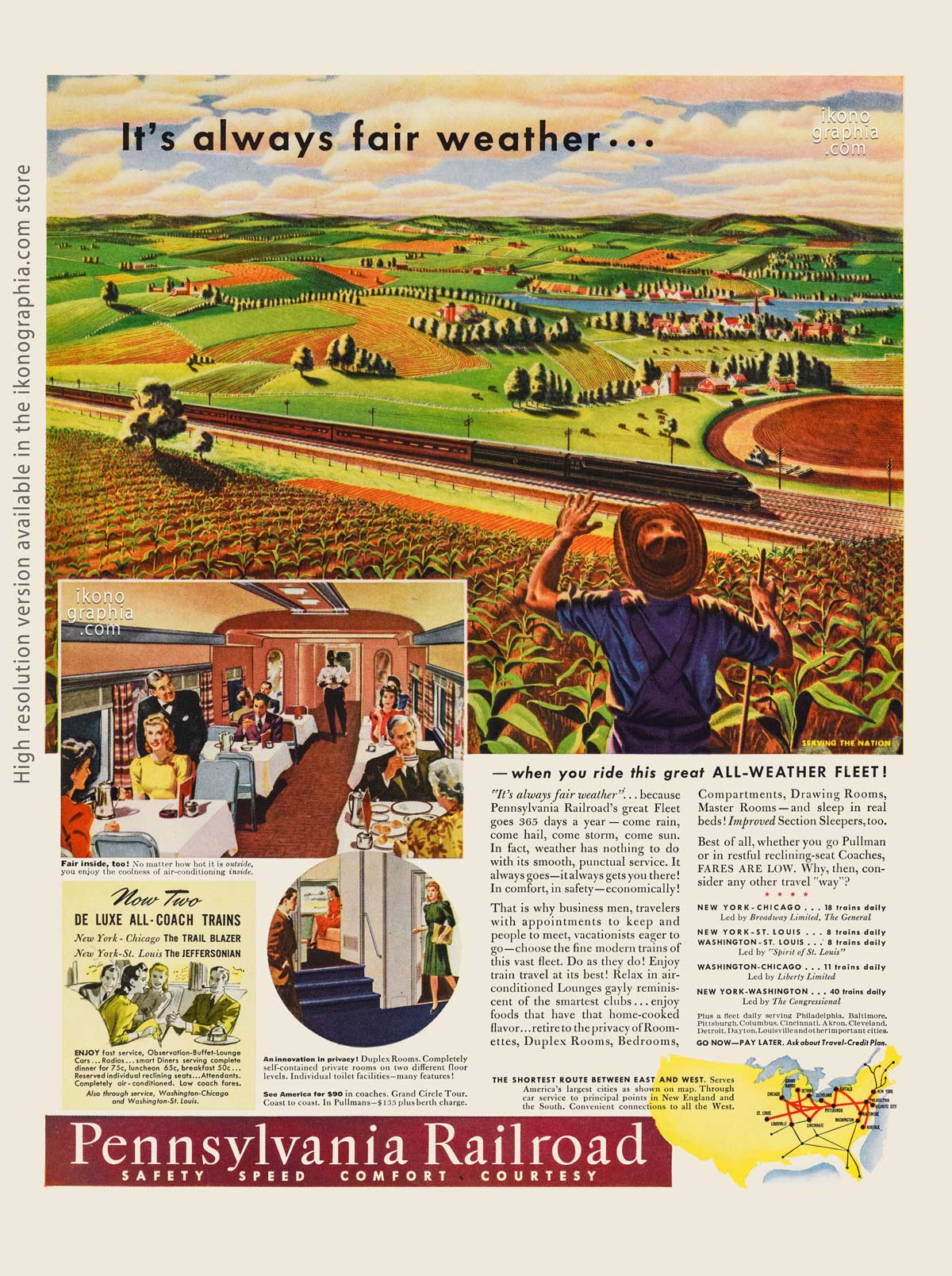
It’s always fair weather. Pennsylvania Railroad ad - Life. June 30, 1941

Pennsylvania Railroad.
It's always fair weather...when you ride this great All-WEATHER FLEET!

Life Magazine. June 30, 1941.


Read the ad's text

Pennsylvania Railroad. It’s always fair weather Life Magazine June 30, 1941

It’s always fair weather – when you ride this great ALL-WEATHER FLEET! “It’s always fair weather”. . . . because Pennsylvania’s Railroad’s great Fleet goes 365 days a year – come rain, come hail, come storm, come sun. In fact, weather has nothing to do with its smooth, punctual service.

It always goes–it always gets you there! In comfort, in safety–economically! That is why business men, travelers with appointments to keep and people to meet, vacationists eager to go–chose the fine modern trains of this vast fleet. Do as they do!

Enjoy train travel at its best! Relax in air-conditioned Lounges gayly reminiscent of the smartest clubs…enjoy foods that have home-cooked flavor…retire to the privacy of Roomettes, Duplex Rooms, Bedrooms, Compartments, Drawing Rooms, Master Rooms–and sleep in real beds! Improved Section Sleepers, too. Best of all, whether you go Pullman or in restful reclining-seat Coach, FARES ARE LOW. Why, then, consider any other travel “way”?

Box: Now Two DE LUXE ALL-COACH TRAINS New-York-Chicago The TRAILBLAZER New York-St.Louis The JEFFERSONIAN ENJOY fast service, Observation-Buffet-Lounge Cars … Radios … mart Diners serving complete dinner for 75c, luncheon 65c, breakfast 50c … Reserved individual reclining seats … Attendants. Completely air-conditioned. Low coach fares. Also through service, Washington-Chicago and Washington-St. Louis, Captions: Fair inside too! No matter how hot is outside, you enjoy the coolness of air-conditioning inside. An innovation in privacy! Duplex Rooms. Completely self-contained private rooms on two different floor levels. Individual toilet facilities–many features! THE SHORTEST ROUTE BETWEEN EAST AND WEST. Serves America’s largest cities as shown on map. Through car service to principal points in New England and the South. Convenient connections to all the West. See America for $90 in coaches. Grand Circle Tour. Coast to coast. In Pullmans –$135 plus berth charge. NEW YORK - CHICAGO . . . 18 trains daily Led by Broadway Limited, The General NEW YORK - ST. LOUIS . . . 8 trains daily WASHINGTON - ST. LOUIS . . . 8 trains daily Led by “Spirit of St. Louis” WASHINGTON - CHICAGO . . . 11 trains daily Led by Liberty Limited WASHINGTON - CHICAGO . . . 11 trains daily Led by The Congressional NEW YORK - WASHINGTON . . . 40 trains daily Led by The Congressional Plus a fleet daily serving Philadelphia, Baltimore, Pittsburgh, Columbus, Cincinnati, Akron, Cleveland, Detroit, Louisville and other important cities. GO NOW–PAY LATER. Ask about Travel-Credit Plan.

Picture your family in a train like this! American Railroads, artwork by John Clymer - Life. December 2, 1946

American Locomotive.
PICTURE YOUR FAMILY IN A TRAIN LIKE THIS!

Life Magazine. December 2, 1946.

Artwork by John Clymer


CHILDREN’S HOUR—ON WHEELS

One day soon you’ll board a brand -new train with the kids—and every hour of the trip will be “The Children’s Hour.”
Skilled attendants will entertain your youngsters in a wonder room made especially for children. There’ll be a building blocks, story books, slippery slides, movies, and games galore to keep their trip—and yours—from being tiresome.
This is not a blue-sky promise. Children’s playrooms are just one of the new features of crack postwar trains which are now going into production. There will also be club cars that convert into theaters or night clubs, telephone service en route, coaches with lounge-cars luxuries, and sleeping quarters with the comforts of a good hotel.
These improvements are all part of a modernization program estimated at $1,600,000,000—the greatest in the history of the American railroads. They’re coming—not in the vague future—but as soon as the modern postwar trains make their first runs.

LOCOMOTIVES AS REVOLUTIONARY AS THE TRAINS THEY PULL

Many of America’s trains will sweep down the tracks behind American Locomotive’s Diesel-Electric takes advantage of important wartime research. The turbo-supercharged engines, mass-produced on a moving assembly line, pack more power in less weight than any other railway diesel.
These super locomotives are years ahead in speed, power, smoothness and economy operation. The line includes passenger and freight diesels, road and yard switchers—an Also diesel for every railroad hauling job.
Builder of more locomotives than any other company in the world. Also has introduced many basic improvements in locomotives. Among many “first,” American Locomotive built the first Diesel-Electric back in 1925.
When you board the new wonder trains powered by American Locomotive, you’ll be riding behind the finest locomotives ever built.

Trains for Tomorrow


We introduce this chapter using the text taken from the Bohn ad shown below.

Today America's manufacturing processes are concentrated solidly on war materials for Victory. From this gigantic effort will spring many new developments of vast economic consequence to the entire universe. The City of the Future will be born—startling new architectural designs will be an everyday occurrence! New alloys—new materials—new applications—designs engineered by Bohn will be an important contributing factor in making possible a world of new products.
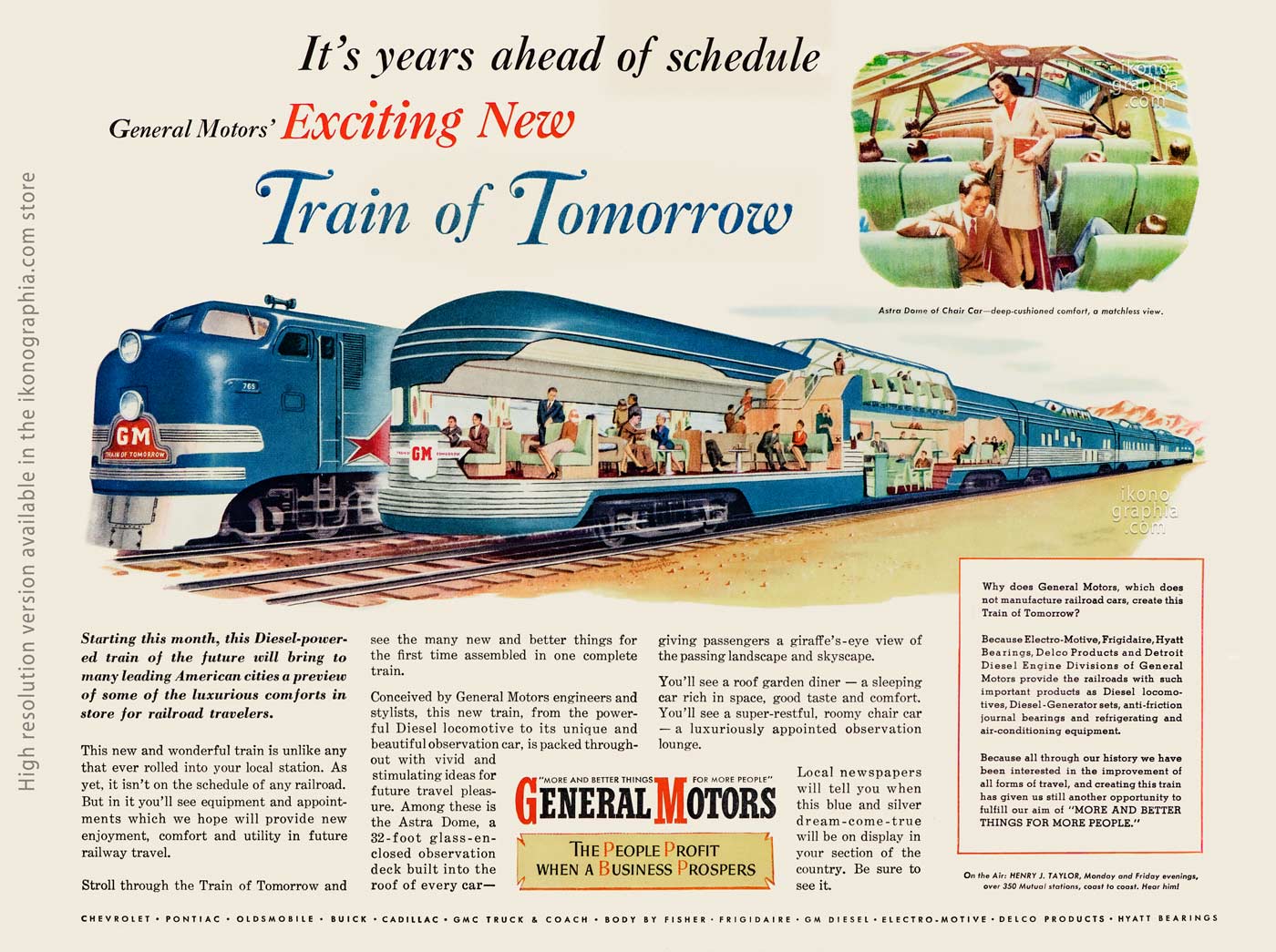
It's years ahead of schedule. General Motor's Exciting New Train of Tomorrow. artwork by John Clymer - Life. June 16, 1947

General Motors.
It's years ahead of schedule. General Motor's Exciting New Train of Tomorrow.
Life Magazine June 16, 1947


Starting from this month, this Diesel-powered train of the future will bring to many leading American cities a preview of some luxurious comforts in store for railroad travelers.
This new and wonderful train is unlike any that ever rolled into your local station. As yet, it isn’t on the schedule of any railroad. But in it you’ll see equipment and appointments which we hope will provide new enjoyment, comfort, and utility in future railway travel.
Stroll through the Train of Tomorrow and see the many new and better things for the first time assembled in one complete train.

Conceived by General Motors engineers and stylists, this new train, from the powerful Diesel locomotive to its unique and beautiful observation car, is packed throughout with vivid and stimulating ideas for future travel pleasure. Among these, there is the Astra Dome, a 32-foot glass-enclosed observation deck built into the roof of every car—giving passengers a giraffe’s-eye view of the passing landscape and skyscape.

You’ll see a roof garden diner - a sleeping car rich in space, good taste, and comfort. You’ll see a super-restful, roomy chair — a luxuriously appointed observation lounge.
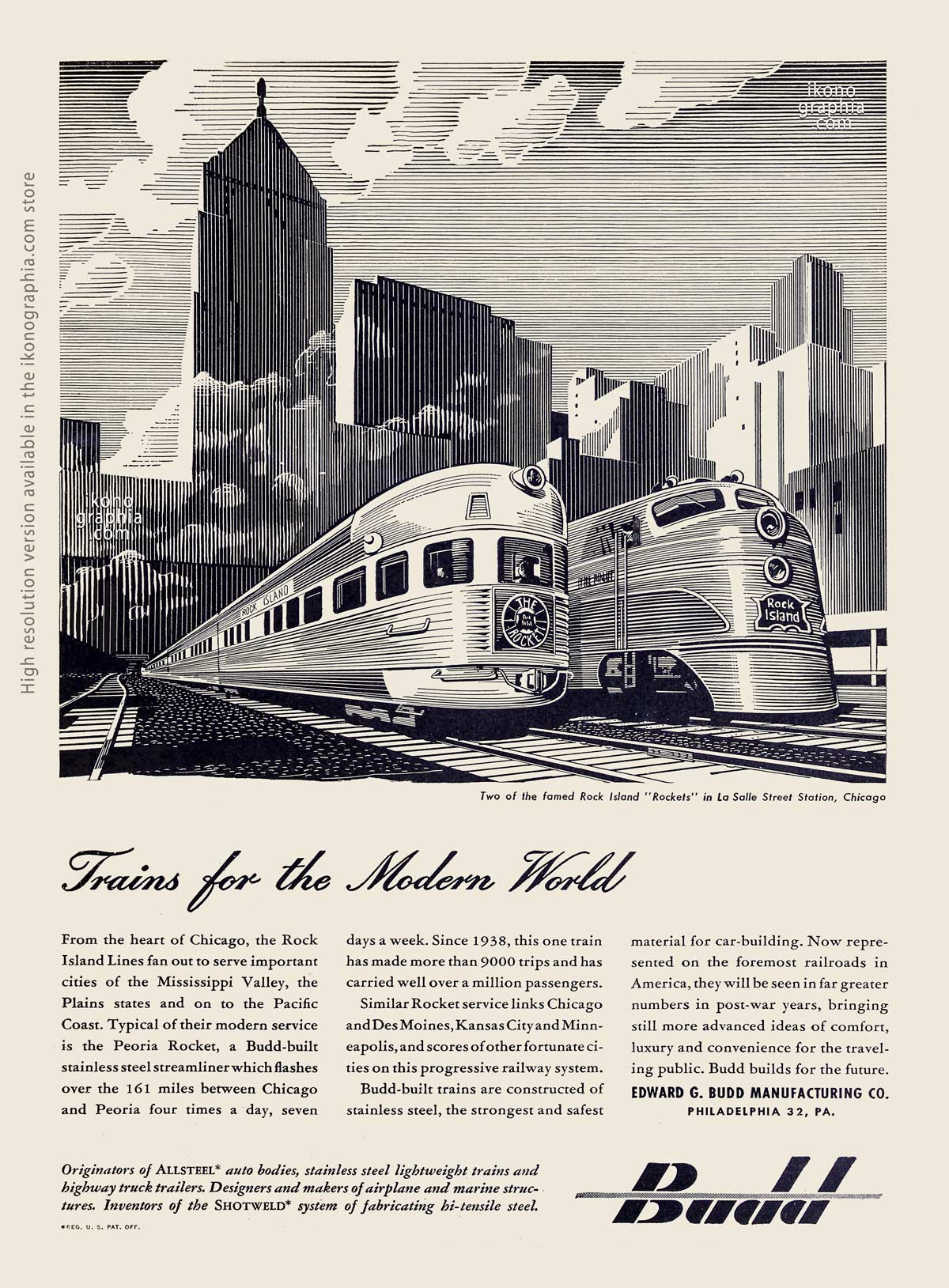
Trains for the Modern World. Budd ad - Nation's Business. September 1944

Edward G.Budd Manifacturing.
Trains for the Modern World
Nation's Business. September 1944.

Two of the famed Rock Island "Rockets" in Las Salle Street Station,Chicago.

Read the ad's text

Two of the famed Rock Island "Rockets" in Lo Salle Street Station, Chicago

Trains for the Modern World

From the heart of Chicago, the Rock Island Lines fan out to serve important cities of the Mississippi Valley, the Plains states and on to the Pacific Coast. Typical of their modern service is the Peoria Rocket, a Budd-built stainless steel streamliner which flashes over the 161 miles between Chicago and Peoria four times a day, seven days a week. Since 1938, this one train has made more than 9000 trips and has carried well over a million passengers. Similar Rocket service links Chicago and Des Moines, Kansas City and Minneapolis, and scores of other fortunate cities on this progressive railway system.

Budd-built trains are constructed of stainless steel, the strongest and safest material for car-building. Now represented on the foremost railroads in America, they will be seen in far greater numbers in post-war years, bringing still more advanced ideas of comfort, luxury and convenience for the traveling public. Budd builds for the future.
EDWARD G. BUDD MANUFACTURING CO. PHILADELPHIA 32, PA.

Originators of ALLSTEEL* auto bodies, stainless steel lightweight trains and highway truck trailers. Designers and makers of airplane and marine structures. Inventors of the SHOTWELD* system of fabricating hi-tensile steel.

BUDD

Trains of thought for the Future. American Railroads ad - Life. March 27, 1944

American Railroads.
Train of Thought for the Future

Life Magazine. March 27, 1944.

Artwork by James Bingham


Read the ad's text

TRAIN OF THOUGHT FOR THE FUTURE

Some day this war will be won by America and her Allies.
Our first duty meanwhile is to meet the demands of the war. This we are doing.
The going hasn’t always been easy or comfortable. We believe you understand the reasons, and we appreciate your patience, your good-humored acceptance of inconvenience.
And we’d like you to know our ideas of comfort and style go far beyond what we’re able to offer today. That’s why we print the picture below.
It will give you some idea of how we’d like to serve you — how we’re looking and planning ahead right now to make future railroad travel a thrillingly pleasant experience.
It can’t be done all at once. It will take money and time.
But you can be sure of one thing. Our goal is to give future America the finest transportation the world has ever seen.

ASSOCIATION OF AMERICAN RAILROADS
ALL UNITED FOR VICTORY

Forecasting the Future


We introduce this chapter using the text taken from the Bohn ad shown below.

Today America's manufacturing processes are concentrated solidly on war materials for Victory. From this gigantic effort will spring many new developments of vast economic consequence to the entire universe. The City of the Future will be born—startling new architectural designs will be an everyday occurrence! New alloys—new materials—new applications—designs engineered by Bohn will be an important contributing factor in making possible a world of new products.
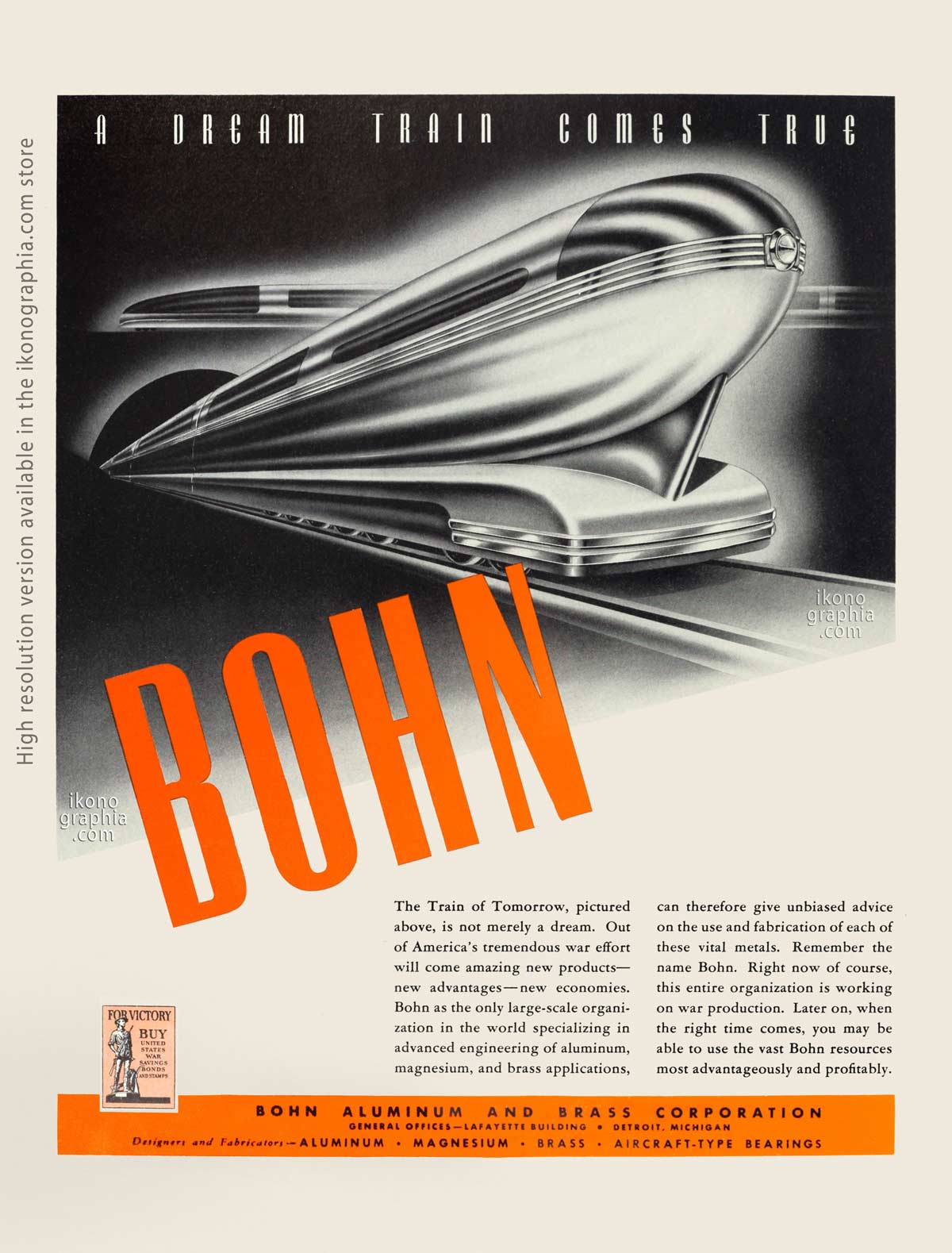
A dream train comes True - Bohn ad. atwork by George W. Walker - Fortune. January 1943

Bohn Aluminum and Brass
A DREAM TRAIN COMES TRUE

Fortune. January 1943

Artwork by George W. Walker, an American industrial and automotive designer based in Detroit. His most notable work was the original Ford Thunderbird.
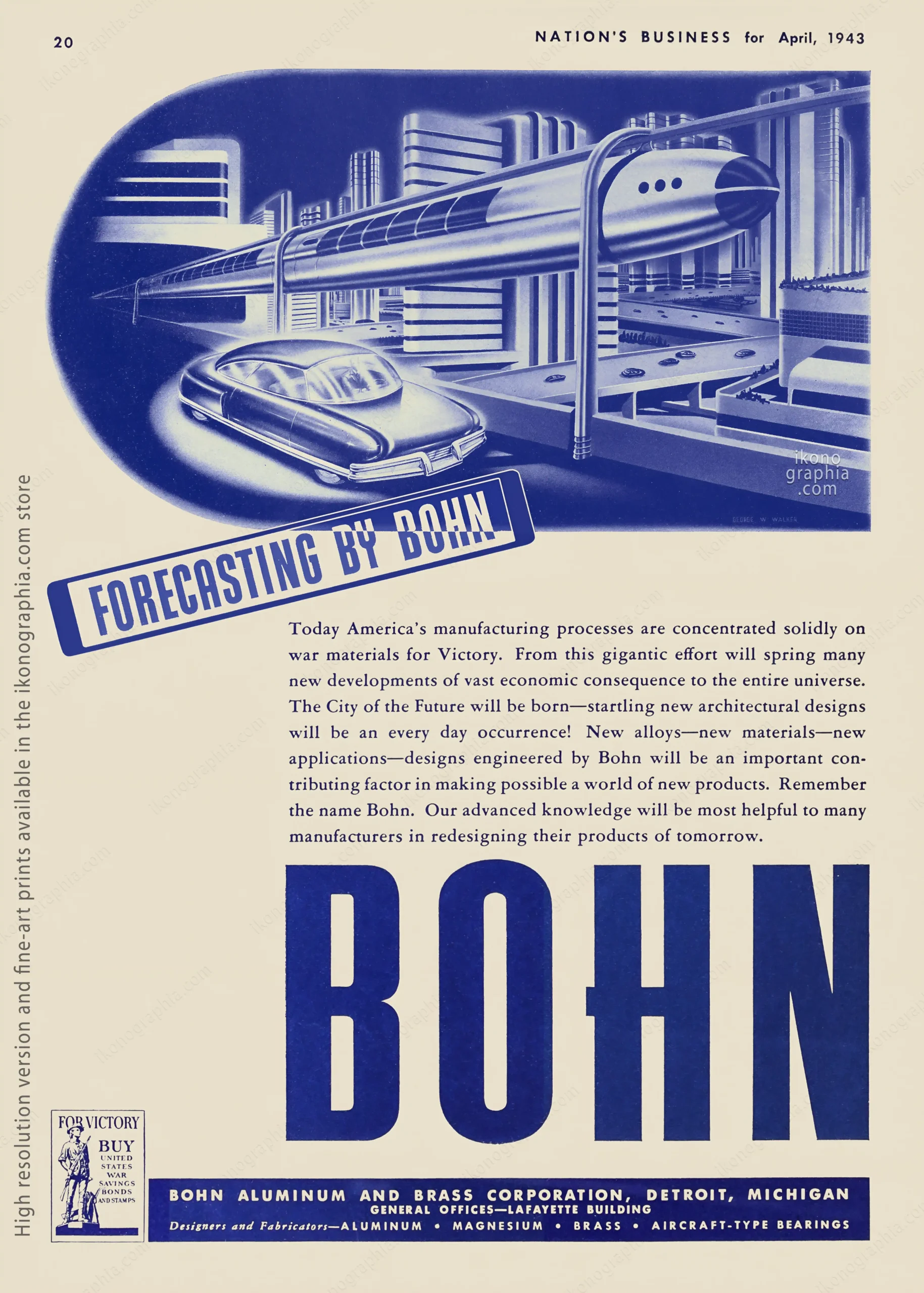

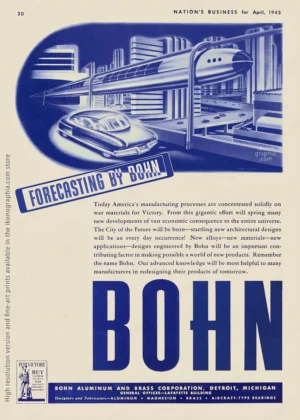
Forecasting a city of the future, art George Walker. Bohn Ad, Nation's Business, April 1943

Bohn Aluminum and Brass
Forecasting by Bohn

Nation's Business. April 1943

Artwork by George W. Walker, an American industrial and automotive designer based in Detroit. His most notable work was the original Ford Thunderbird.


Read the ad's text

NATION'S BUSINESS for April, 1943

FORECASTING BY BOHN

Today America's manufacturing processes are concentrated solidly on war materials for Victory. From this gigantic effort will spring many new developments of vast economic consequence to the entire universe. The City of the Future will be born—startling new architectural designs will be an every day occurrence! New alloys—new materials—new applications—designs engineered by Bohn will be an important contributing factor in making possible a world of new products. Remember the name Bohn. Our advanced knowledge will be most helpful to many manufacturers in redesigning their products of tomorrow.

BOHN

BOHN ALUMINUM AND BRASS CORPORATION, DETROIT, MICHIGAN
GENERAL OFFICES—LAFAYETTE BUILDING
Designers and Fabricators—ALUMINUM • MAGNESIUM • BRASS • AIRCRAFT-TYPE BEARINGS

All the Comforts of Roam. American Railroads ad, artwork by James Bingham - Life. April 24, 1944

American Railroads.
All the Comforts of Roam

Life Magazine. April 24, 1944.

Artwork by James Bingham


Read the ad's text

ALL THE Comforts OF ROAM!

The day is coming when a train trip will again be something to look forward to eagerly — something to be enjoyed at ease, in spacious comfort — and all at moderate price.
That of course will be after the war is won. It will be when the armed forces no longer need nearly half of all our passenger equipment to move fighting men. It will be when many coaches and Pullmans now busy in war service can be honorably retired to make way for new cars with comfort, convenience and thoughtful appointments beyond anything the past has known.
That will take money — vast sums of money . It will take time. But we believe that it is worth while today to tell you what we plan for tomorrow — to help you realize that the wartime service we are able to give today is by no means a sample of what’s in store for the future.

ASSOCIATION OF AMERICAN RAILROADS
ALL UNITED FOR VICTORY

A prediction by Lurelle Guild


Lurelle Van Arsdale Guild was an architect, industrial and interior designer, illustrator and writer. In this 1944 ad for the Weatherhead Company, he predicts the future of railroad cars.

The railroad car of tomorrow will make today’s deluxe cars resemble the stagecoach by comparison. I have designed for one of the country’s largest railroads a train embodying numerous new and practical features, including super-efficient heating and cooling to eliminate dust, germs, and draft.

Coach passengers will have club car comforts. You’ll experience the restful quietness of acoustically-correct, fabric coated walls; color-corrected, cold cathode lighting with pinpoint lights to spotlight at night individually reclining sets that will face the windows. Your luggage will be safely secured in individual lockers, and all cars will be wired for sound and telephone connections.
Yes, your War Bonds will buy you many delightful experiences on the railroad trains of tomorrow.
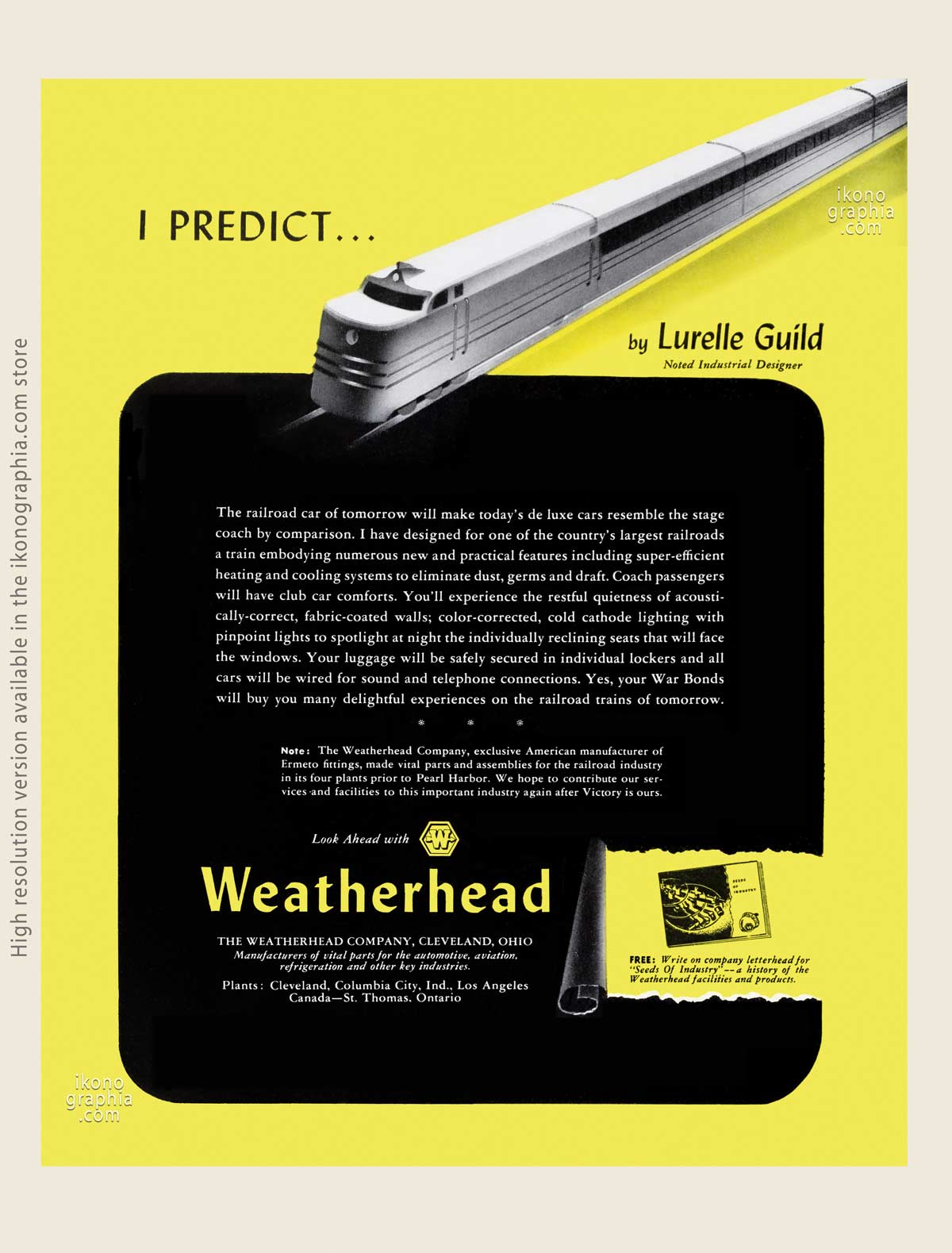
I Predict … by Lurelle Guild - The Weatherhead Company ad. artwork by Lurelle Guild

The Weatherhead Company
I Predict...by Lurelle Guild

Fortune. February 1944

Artwork by Lurelle Van Arsdale Guild, an architect, industrial and interior designer.


WWII according to Fascist Propaganda in Achille Beltrame’s Drawings

WWII according to Fascist Propaganda in Achille Beltrame’s Drawings

Roberto Bigano

Oct 18, 2020

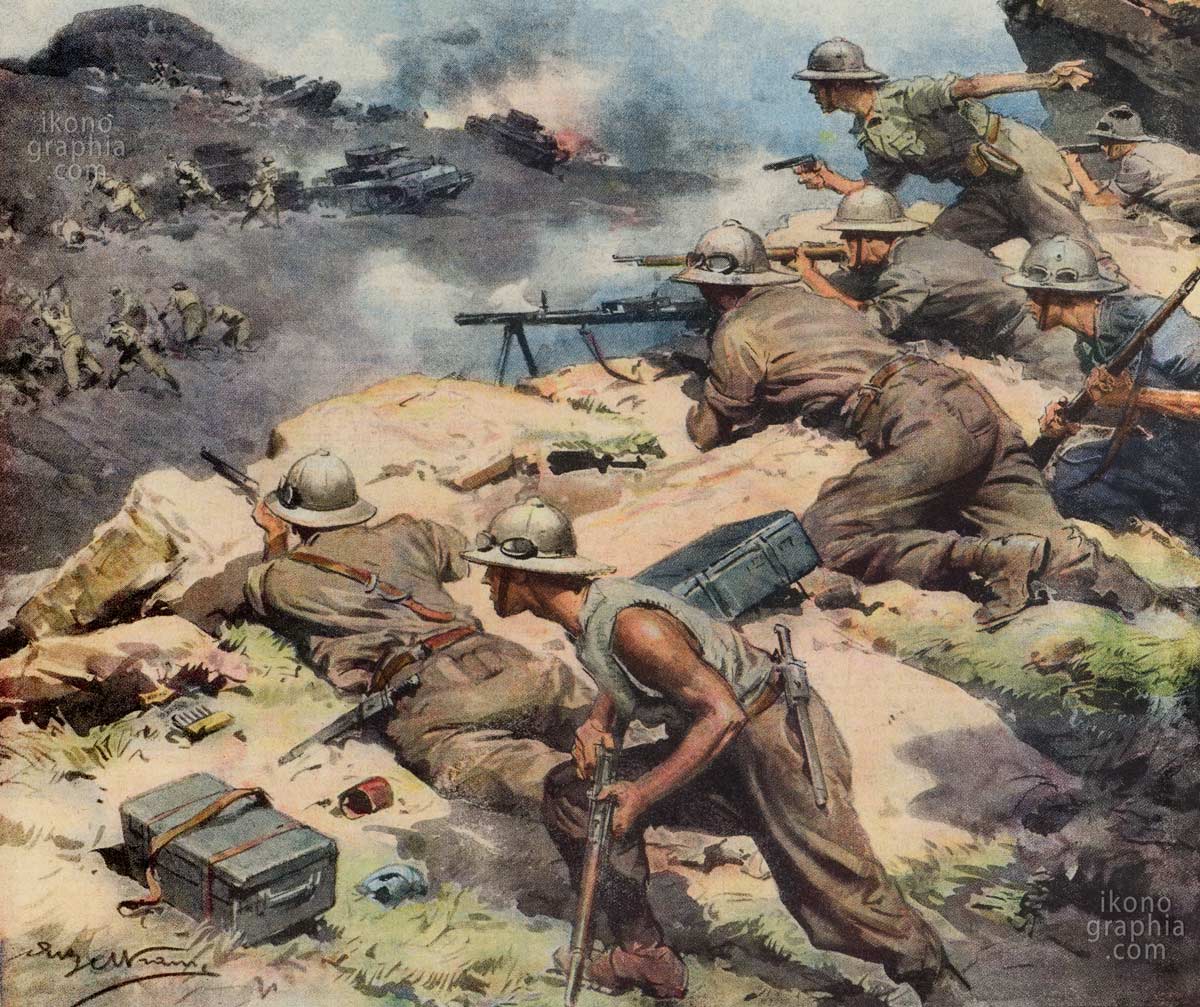
A detail for a cover of “La Domenica del Corriere”. Italian infantry against British troops in North Africa.

Achille's Beltrame war plates for "La Domenica del Corriere" 1939-1942


Like all media controlled by strict censorship, the magazine "La Domenica del Corriere" reflected the Fascist Party’s view of the war, like a good vs. bad fight, enhancing Axis victories. In some cases, they were absolutely fake-news; in other cases, they told a sort of “Alternative Truth.”

Achille Beltrame was an Italian painter and illustrator. His color plates for "La Domenica del Corriere," the most popular Italian periodical, became the magazine's hallmark. They cover the whole history of Italian customs and society of the first half of the 20th century, masterfully summarizing news, sports, and war.
Beltrame made them alive and current in the eyes of a population not yet completely out of illiteracy. He never moved from Milan, where he designed all his tables. Nevertheless, he managed to represent places, facts, people, and things he had never seen in person, thanks to his innate imagination and curiosity, combined with a rigorous sense of realism. The graphic composition of his works is still a reference.
From 1899 to 1945, he drew for the magazine 4,662 front and back covers. Below a selection in chronological order.

Leggi in italiano

Illustrazioni di Achille Beltrame sulla seconda guerra mondiale per ”La Domenica del Corriere” 1939-1942.

Come tutte le pubblicazioni italiane, sottoposte a stretta censura, anche la “Domenica” rifletteva il punto di vista del Partito Nazional Fascista, di una sorta di lotta del bene contro il male. Le vittorie dell’asse venivano enfatizzate a dismisura. Le notizie dal fronte erano spesso delle “fake-news” o per lo meno davano una “versione alternativa" della realtà.
Fanno eccezione le tavole sulla guerra in Africa del Nord o alcune battaglie nel Mediterraneo, dove gli italiani si batterono valorosamente e dettero molto filo da torcere agli inglesi.

Le tavole di Beltrame per la “Domenica del Corriere”, divennero fiore all’occhiello e marchio di fabbrica della rivista raccontando magistralmente notizie, costume, sport e guerra nella prima metà del 1900.
Le copertine di Beltrame erano vive e comprensibili ad una popolazione non ancora completamente uscita dall’analfabetismo. Nonostante non si fosse mai mosso da Milano, fu in grado di raccontare in modo preciso e realistico, fatti, persone e luoghi che non aveva mai visto di persona, grazie alla sua immaginazione, curiosità e realismo. La composizione grafica delle tavole è tuttora una riferimento di livello assoluto.

Dal 1899 al 1945, Beltrame disegnò per la rivista 4662 copertine e retro copertine. Qui sotto una selezione in ordine cronologico.

A plate by Achille Beltrame for “La Domenica del Corriere”. Mines war in the North Sea around England.

December 3, 1939.

Mines War.

Every day, in the North Sea and around England, belligerent or neutral, merchants or warships collide with the numerous mines that infest all routes. A terrible explosion shakes the steamer that has come into contact with the dangerous device, debris flying in every direction, the ship overturns wounded… And in a short time, the sea swallows a new victim.

Buy the hi-res file 


Original Italian copy.
La guerra delle mine. Ogni giorno, nel Mare del Nord e attorno all’Inghilterra, navi belligeranti o neutrali, mercantili o da guerra urtano contro le numerosissime mine che infestano tutte le rotte. Un tremendo scoppio squassa il piroscafo che è venuto a contatto col pericolosissimo ordigno, rottami volano in ogni direzione, la nave si rovescia ferita… E in poco tempo il mare inghiotte una nuova vittima.

A plate by Achille Beltrame for “La Domenica del Corriere”. Playing football and cheering in the shadow of the guns.

December 3, 1939

Cheering in the shadow of the guns.

Taking advantage of the calm that reigns on the front, the gunners of a German anti-aircraft battery organize cheerful football matches behind the Siegfried line. The fellow soldiers, all around, cheer the players on joyfully.

Buy the hi-res file 


Original Italian copy.
Il “tifo” all’ombra dei cannoni. Approfittando della calma che regna sul fronte, gli artiglieri di una batteria antiaerea tedesca organizzano, dietro la linea di Sigfrido, allegre partite di calcio. I commilitoni, tutt’intorno, incitano i giocatori festosamente.

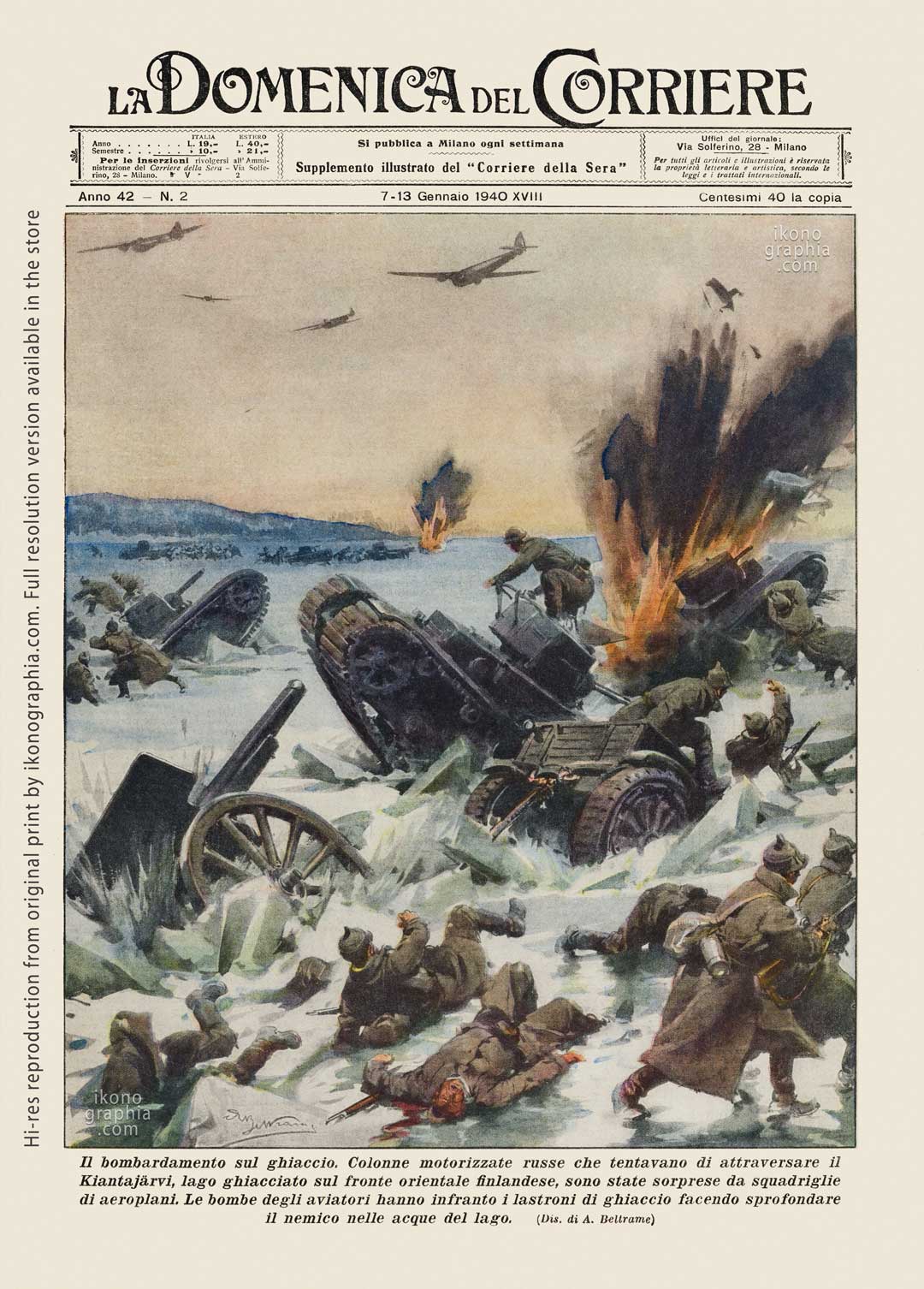
A plate by Achille Beltrame for “La Domenica del Corriere”. Bombing the Reds on the ice.

January 7, 1940.

Bombing the Reds on the ice.

Russian motorized columns attempting to cross the Kiantajärvi, a frozen lake on the Finnish eastern front, were surprised by airplanes' squadrons. The aviators' bombs broke the ice sheets causing the enemy to sink into the waters of the lake.

Buy the hi-res file 


Original Italian copy.
Il bombardamento sul ghiaccio. Colonne motorizzate russe che tentavano di attraversare il Kiantajärvi, lago ghiacciato nel fronte orientale finlandese sono state sorprese da squadriglie di aeroplani. Le bombe degli aviatori hanno infranto i lastroni di ghiaccio facendo sprofondare il nemico nelle acque del lago.

A plate by Achille Beltrame for “La Domenica del Corriere”. The war on the Indian Sea.

March 10, 1940.

The war on the Indian Sea.

An English steamship with a crew of 150 Indians was attacked by a German aircraft and fatally hit by three bombs. The ship caught fire.

Buy the hi-res file 


Original Italian copy.
La guerra sul mare. Un piroscafo inglese sul quale viaggiavano 150 indiani è stato attaccato da un aeroplano tedesco e colpito in pieno da tre bombe. La nave si è incendiata.

An iconic 1939 illustration by Achille Beltrame for “La Domenica del Corriere”. Mines War in the North Sea around England.

May 5, 1940.

The fight in Norway.

Among the deep gorges of the Gudbrand valley, German columns are advancing fighting towards Trondhjem.

Buy the hi-res file 


Original Italian copy.
La lotta in Norvegia. Fra le gole profonde della vallata di Gudbrand colonne tedesche avanzano combattendo verso Trondhjem.

A plate by Achille Beltrame for “La Domenica del Corriere”. The devastated central London with the surviving St Paul's Cathedral

January 12, 1941

The devastated central London with the surviving St Paul's Cathedral.
Among the ruins of the "City". After the German bombing, British soldiers and firefighters complete the destruction of central London, blowing up the walls still standing and crumbling with dynamite. In the background, St. Paul's  Cathedral, which has remained intact in the midst of so much decay.

Buy the hi-res file 


Original Italian copy.
Tra le rovine della “City”. Dopo i bombardamenti tedeschi, soldati inglesi e vigili del fuoco, completano la distruzione del centro di Londra, facendo saltare con la dinamite le mura rimaste ancora in piedi e pericolanti. Sullo sfondo, la cattedrale di San Paolo, rimasta intatta in mezzo a tanto sfacelo.

A plate by Achille Beltrame for “La Domenica del Corriere”. Germans greeted as liberators in a concentration camp in Russia.

July 13, 1941.

Germans greeted as liberators.

The moment of liberation. In the prison of a city taken to the Soviets, German soldiers are greeted with enthusiasm and emotion by hundreds of political prisoners, including older men and women, who greet them as liberators and beg for bread.

Buy the hi-res file 


Original Italian copy.
Il momento della liberazione. Nella prigione di una città strappata ai sovietici, i soldati tedeschi vengono accolti con entusiasmo e commozione da centinaia di detenuti politici, vecchi e donne compresi, che li salutano come libertori e implorano un pò di pane.

A plate by Achille Beltrame for “La Domenica del Corriere”. Italian infantry against British troops in North Africa.

July 13, 1941.

Italian infantry against British troops in North Africa.
The fierce Italian resistance in the Gondar area. Clinging to the ground, taking advantage of every possibility of defense, our heroic soldiers repel violent enemy attacks with indomitable courage.

Buy the hi-res file 


Original Italian copy.
La fiera resistenza italiana nella zona di Gondar. Aggrappati al terreno, sfruttando ogni possibilità di difesa, i nostri eroici soldati respingono con indomabile ardimento i violenti attacchi nemici.

A plate by Achille Beltrame for “La Domenica del Corriere”. Italians push-off the British attacks to keep Tobruk.

August 17, 1941.

Italians push-off the British attacks to keep Tobruk.
Alarm in the desert. One of the almost daily British attempts to break the iron circle around Tobruk: while the desert wind rages, enemy tanks and airplanes try to get closer to our positions; but the move is warned, and the batteries open fire on the opponent, forcing him to retreat once again.

Buy the hi-res file 


Original Italian copy.
Allarme nel deserto. Uno dei quasi quotidiani tentativi inglesi di rompere la ferrea cerchia intorno a Tobruk: mentre infuria il vento del deserto, carri armati e aereoplani nemici cercano di avvicinarsi alle nostre posizioni; ma la mossa è avvertita e le batterie aprono il fuoco contro l’avversario, costringendolo ancora una volta a ritirarsi.

The United States in Fascist Propaganda.


According to the Italian press, in the early years of war, the United States was an exhausted country that had not yet recovered from the effects of the Great Depression of 1930s.. Mussolini believed that a possible entry of the United States into the war would have been irrelevant since the American production capacity in the war sector was behind.

Even after the Japanese attack on Pearl Harbor and the subsequent declaration of war, the hypothesis of real US involvement in the conflict in the European and Mediterranean theater was considered unlikely.

Leggi in italiano

L’immagine degli Americani e dell’America nella propaganda italiana di guerra.


Gli Stati Uniti, per la stampa italiana dei primi anni del conflitto, erano un paese allo stremo non ancora risollevatosi dagli effetti della Grande Depressione degli anni ‘30. È nota la convinzione mussoliniana secondo la quale una eventuale entrata in guerra degli Stati Uniti sarebbe stata assolutamente ininfluente in quanto la capacità produttiva americana nel settore bellico era praticamente irrilevante.

Anche dopo l’attacco giapponese a Pearl Harbour e la successiva dichiarazione di guerra agli Usa, l’ipotesi di un reale coinvolgimento degli Stati Uniti nel conflitto nel teatro di operazioni europeo e sul Mediterraneo era considerata come improbabile. Fonte

A plate by Achille Beltrame for “La Domenica del Corriere”. Mines war in the North Sea around England.

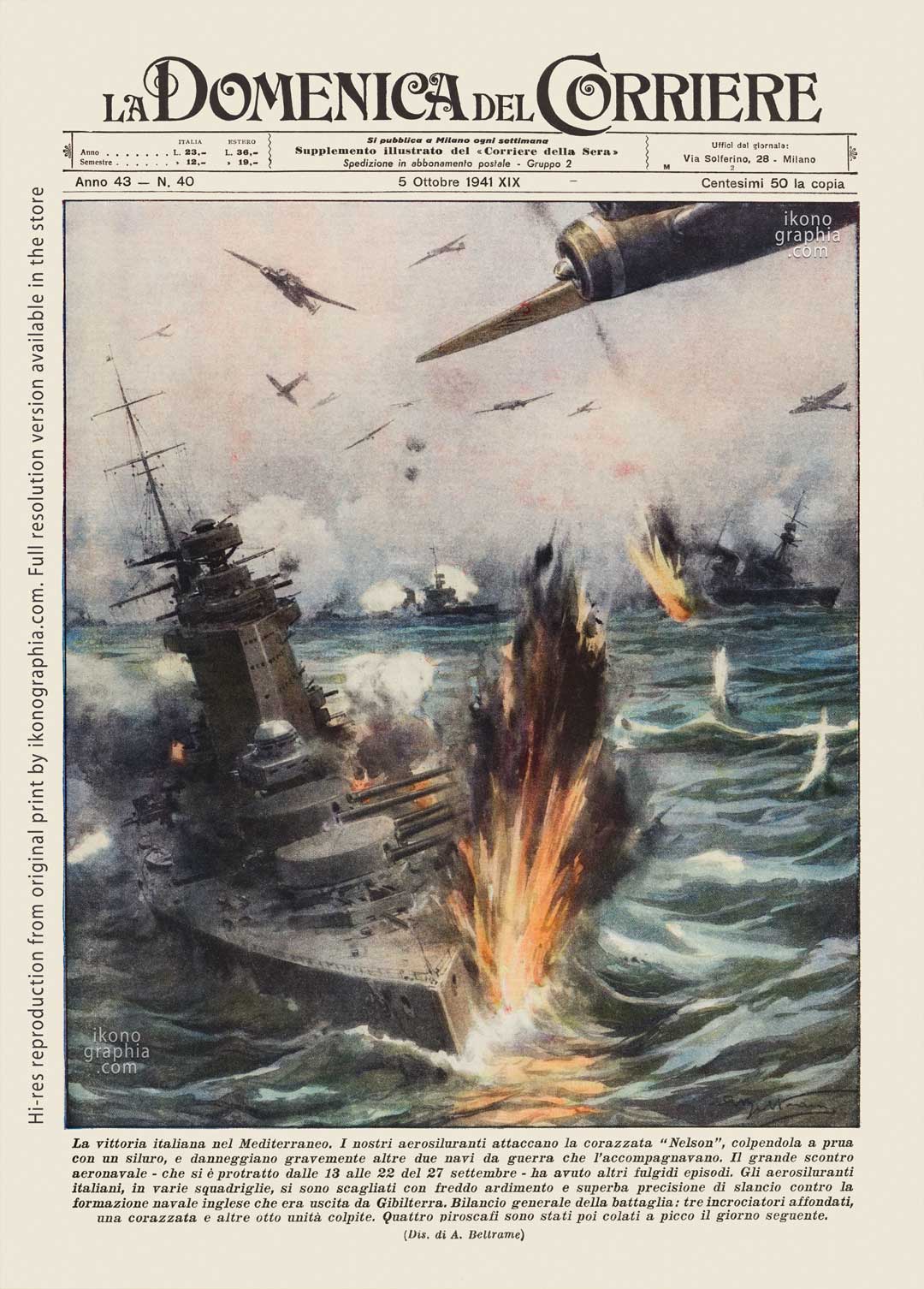
La vittoria italiana nel Mediterraneo. Original Italian Copy

La vittoria italiana nel Mediterraneo. I nostri aerosiluranti attaccano la corazzata “Nelson”, colpendola a prua con un siluro, e danneggiando gravemente altre due navi da guerra che l’accompagnavano.
Il grande scontro aeronavale - che si è protatto dalle 13 alle 22 del 27 settembre - ha avuto altri fulgidi episodi. Gli aerosiluranti italiani, in varie squadriglie, si sono scagliati con freddo ardimento e superba precisione di slancio contro la formazione navale inglese che era uscita da Gibilterra.
Bilancio generale della battaglia: tre incrociatori affondati più una corazzata e altre otto unità colpite. Quattro piroscafi sono stati poi colati a picco il giorno seguente.


October 10, 1941.

The Italian victory in the Mediterranean.

Our torpedo bombers attacked the battleship “Nelson,” hitting it in the bow with a torpedo and severely damaging two other escort warships. The great air-naval clash lasted from 1 to 10 PM on September 27 and had other shining episodes. The Italian torpedo bombers, in various squadrons, hurled themselves with cold courage and superb precision against the English naval formation that had left Gibraltar. Overall battle balance: three sunken cruisers, one battleship, and eight other units hit. Four steamers were then sunk the following day.

Buy the hi-res file 


Read the original Italian copy in the tabbed content below

A plate by Achille Beltrame for “La Domenica del Corriere”. Firestorm on the British columns.

November 30, 1941.

Firestorm on the British columns.

Axis aircraft squadrons swoop down on the British motorized columns attacking in Marmarica and heavily bombarding, smashing many wagons, and pinning others to the ground.

Buy the hi-res file 


Original Italian copy.
Tempesta di fuoco. Squadre di aeroplani dell’Asse piombano in picchiata sulle colonne motorizzate inglesi che attaccano nella Marmarica e le tempestano di bombe fracassando molti carri e inchiodandone altri al terreno.

A plate by Achille Beltrame for “La Domenica del Corriere”. The commander of an Italian submarine at the periscope. The enemy in sight!

December 28, 1941.

The commander at the periscope. The enemy in sight!

Inside one of our submarines immersed, among the thousand complicated devices of the very modern ship, the commander scrutinizes the opponent's moves, waiting to transmit the orders to the crew.

Buy the hi-res file 


Original Italian copy.
Nemico in vista! Nell’interno di un nostro sommergibile immerso, tra i mille complicati congegni della modernissima nave, il comandante scruta le mosse dell’avversario, in attesa di trasmettere gli ordini all’equipaggio.

A plate by Achille Beltrame for “La Domenica del Corriere”. An Italian submarine sinking an American tanker.

April 5, 1942.

An Italian submarine sinking an American tanker.

Italian submarines in American waters. The last moments of an enemy tanker hit with a torpedo and then with cannon fire.

Buy the hi-res file 


Original Italian copy.
I sommergibili italiani nelle acque americane. Gli ultimi istanti di una petroliera nemica colpita con un siluro e poi a cannonate.

A plate by Achille Beltrame for “La Domenica del Corriere”. Axis aircraft bombing Malta.

May 3, 1942

Axis airplanes devasting Malta.
Malta under the storm of bombs. The armor-piercing shells and two-thousand-kilo bombs, thrown by Axis airplanes on the fortifications of Malta during their relentless offensive, also led to the destruction of the English's underground deposit base. "Malta" - said an eyewitness - "is a hell of ruins"...

Buy the hi-res file 


Original Italian copy.
Malta sotto la tempesta di bombe. I proiettili perforanti e le bombe da duemila chili, gettati dagli aeroplani dell’Asse sulle fortificazioni di Malta durante la loro implacabile offensiva, hanno portato alla distruzione anche dei depositi sotterranei della base inglese. “Malta” - ha detto un testimone oculare - “è un inferno di rovine”.

A plate by Walter Molino, Beltrame's most talented pupil. for “La Domenica del Corriere. Japanese kamikaze attack on the aircraft carrier Yorktown.

1942, March 8
Artwork by Walter Molino, Beltrame's most talented pupil. He drew some covers since 1941 and then became the exclusive creator for almost thirty years

Kamikaze

"Taiatari," which means the body's impact, is the Japanese system of the suicide attack. The airplane throws itself at the target with its deadly load of bombs, guided by the pilot, who sacrifices himself but hits infallibly. With the "Taiatari," the North American aircraft carrier "Yorktown" was attacked: the bomber crashed in the middle of the aircraft lined up on the bridge, burning and destroying everything.

Buy the hi-res file 


Original Italian copy.
“Taiatari”, cioè l’urto del corpo, è il sistema giapponese di attacco in picchiata. L’aeroplano si getta sull’obbiettivo col suo mortale carico di bombe: precipita guidato dal pilota, che si sacrifica ma colpisce in maniera infallibile. Col “Taiatari” è stata assalita la portaerei nord-americana “Yorktown: il bombardiere s’è abbattuto in mezzo ai velivoli allineati sul ponte incendiando e distruggendo tutto.

A plate by Walter Molino, Beltrame's most talented pupil. for “La Domenica del Corriere. Sublime heroism in North Africa.

1941, July 13.
Artwork by Walter Molino.

Sublime heroism.

A correspondence from North Africa reports that a sergeant of the Bersaglieri, mutilated in the arm by the explosion of a grenade, took the limb and threw it at an advancing enemy tank.

Buy the hi-res file 


Original Italian copy.
Eroismo sublime. Una corrispondenza dall’Africa Settentrionale segnala che un sergente dei bersaglieri, mutilato di un braccio per lo scoppio di una granata, ha preso l’arto e lo ha scagliato contro un carro armato nemico che avanzava.

Links , copyright and credits

Links:
Wikipedia English
Wikipedia Italiano
Il “nemico” nella propaganda fascista
Politiche di propaganda nell’Italia Fascista
L'occhio del regime sulla Grande guerra: l'Istituto Luce tra informazione, memoria e propaganda
L’immagine dei nemici. L’America e gli Americani nella propaganda italiana della Seconda guerra mondiale 

Rights Advisory: "Corriere della Sera" Plates.
No known restrictions on publication.
Achille Beltrame artworks
No known restrictions on publication.
Walter Molino artworks
Ikonographia believes that this item is in the public domain under the laws of the United States, but did not make a determination as to its copyright status under the copyright laws of other countries. This item may not be in the public domain under the laws of other countries.

Ten Iconic Bburago Photographs by Roberto Bigano

Ten Iconic Bburago Photographs by Roberto Bigano

Roberto Bigano

Jul 28, 2019

For this third post of the Bburago series, I selected ten photographs that become very popular among the boys who grew up with “Bburago and milk,” or I like a much. For any image, we show you the original slide on sheet film, some times uncropped and the published version. However, the featured photo opening this article tells a different story.

1992. The Heritage of Divina Bugatti


Mario Besana, the Boss of Bburago, wanted me as a photographer after seeing the photographs of "Divina Bugatti." That book was published by Franco Maria Ricci, probably the most refined publisher of art books.
The publisher was enthusiastic about my work except for an image of a Bugatti Atalante rejected as "nonobjective, " and the transparency remained in a drawer for 17 years before to become my best seller.

Well, that photograph summarized my way of conceiving the photography and lighting a subject.
For these reasons, when I started photographing "small cars," I used shooting solutions and lighting similar to those used for the Bugattis. When I photographed the model of the Ferrari F40 shown above, I used a light pattern similar to that of the Atalante.

Please notice that the Atalante slide in 1992 when I shot the F40, was still in the drawer, and I didn't know yet that it would become my trademark, my distinctive characteristic.

Bburago 3362 side showing interiors

The Bugatti Type 57SC Coupé Atalante, a 1938 dream car designed by Jean (Gianoberto) Bugatti. This image sold very well allowing me to pay my daughter's college tuition in the United States. Watch the photographs of Divina Bugatti.

Featured image above. Bburago 3032 Ferrari F40 (1987). It was never published. This photograph was too far ahead of its time. That style of silhouetted lighting was instead appreciated by Bburago in the following years.
You can buy the original 5x7", 13x18cm. film in the store.

Leggi in italiano

Per questo terzo post sulla Bburago, ho selezionato dieci fotografie , in genere tra le più popolari tra coloro che erano cresciuti a “pane e Bburago”. Ne ho aggiunte inoltre un paio di inedite. Oltre a mostrarvi l’originale, ho aggiunto anche l’utilizzo che ne è stato fatto.

1992 L’eredità di Divina Bugatti


Mario Besana, il presidente di Bburago mi aveva voluto come fotografo dopo aver visto le fotografie di "Divina Bugatti", un lavoro pubblicato da Franco Maria Ricci, probabilmente il più raffinato editore nel campo dei libri d'arte. L'editore fu entusiasta del mio lavoro eccetto che per una immagine di una Bugatti Atalante che rifiutò perchè "non oggettiva". Quella diapositiva finì in un cassetto dove rimase quindici anni, fino a quando non la riscoprii.

Bene quella fotografia, che riassumeva il mio modo di concepire la fotografia ed illuminare un soggetto, in pochi anni divenne il mio best seller.
Per queste ragioni, quando iniziai a fotografare "piccole auto" usai soluzioni di ripresa ed illuminazioni similari a quelle usate per le Bugatti e per questa Ferrari F40 usai uno schema luci simile a quello dell'Atalante.

Interessante notare che nel 1992, quando fotografai la F40 di Bburago, l’Atalante era ancora nel cassetto e non sapevo ancora che sarebbe diventato il mio marchio di fabbrica, in mio segno distintivo.


Qui sopra: la Bugatti Type 57SC Coupé Atalante del 1938, dream cat disegnata da Jean (Gianoberto) Bugatti. Questa immagine, la mia più venduta in assoluto mi ha permesso di far laureare mia figlia negli Stati Uniti.

In apertura: Bburago 3032 Ferrari F40 fotografata nel 1992. No fu mai utilizzata. Era troppo avanti per quei tempi. Quello stile di ripresa ed illuminazione fu invece apprezzato da Bburago negli anni successivi.
Puoi acquistare acquistare la diapositiva originale 13x18 cm. nello store.

Bburago 1532 Ferrari F40 Front View isolated

Leggi in italiano

Bburago puntava alla qualità. Sempre e comunque.


Permettetemi di iniziare con un’immagine secondaria. La ripresa frontale della Ferrari F40 1:24 usata in piccolo formato per le immagini laterali del packaging e per i fogli di istruzione delle scatole di montaggio. Questi erano fatti molto bene e le immagini erano perfette come ripresa ortogonale e controlla della luce.
Stavo ancora utilizzando schemi luci e modalità di ripresa utilizzati per fotografare le vere Bugatti.

Leggi come ho lavorato per Divina Bugatti."The Bugatti Sessions for Victor by Hasselblad".

Bburago 3532 Ferrari F40 Assembly Kit Instructions

Above. Bburago 5540 Ferrari F40 (1987 used for Assembly Kit Package.

Here the instruction sheet of the same model 1:18.
You can buy this slide with the sheet in the store.

Bburago 7014 Alfa Romeo 8C GP Monaco Assembly Kit

1992. One pick from the Assembly Kits


As I told you in the first post of the series, the work of the Assembly Kits was my first assignment by Bburago. In all, I made about sixty of them, so it was not easy to choose the best. This one is very beautiful, and I can show you a scarce original print sheet. Notice the dark corner, designed to add the product name in negative.

Bburago 7014 Alfa Romeo 8C GP Monaco Assembly Kit print sheet

Above Bburago 7014 Kit Alfa Romeo 8C GP Monaco. The original picture and a scarce print sheet.

Leggi in italiano

Sopra Bburago 7014 Kit Alfa Romeo 8C GP Monaco. La fotografia originale e  un raro foglio di stampa del coperchio delle scatole di montaggio.

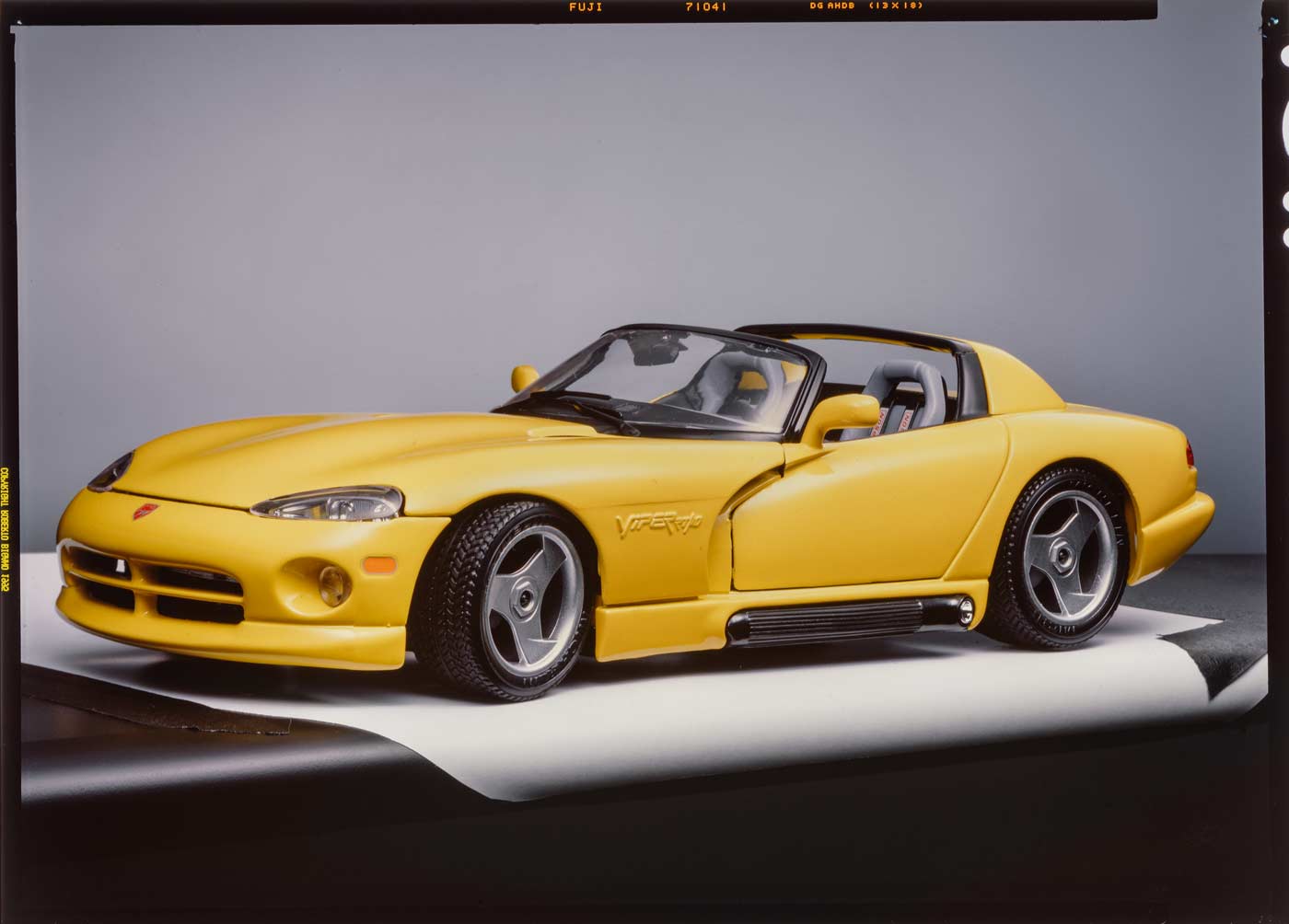
Bburago 3025 color variant Dodge Viper RT10 slide

1992. One pick from the catalog


A typical example of a dedicated shot for the Bburago catalog in 13x18cm / 5x7 "transparency, uncropped and not retouched. A little at a time I developed a sophisticated technique to control lights and reflections, creating special supports, like this one in shaped black marble that did not generate glare that instead, I created at my will by adding white cardboard.

I can't find this item in the 1993 catalog, nor in the next ones, so I imagine it was one of those color variants that we photographed as a test.


You can buy the original 5x7", 13x18cm. slide  in the store.

Leggi in italiano

1992 per il catalogo generale


Questa è un tipico esempio di fotografia per il catalogo Bburago in diapositiva 13x18cm / 5x7" non ritoccata. Per Bburago, col tempo, ho sviluppato una tecnica sofisticata per controllare luci e riflessi, creando dei supporti particolari, come questo in marmo nero sagomato che non generava riflessi che invece creavo a mia volontà aggiungendo dei cartoncini bianchi.

Non trovo questa Viper gialla nel catalogo del 1993, e nemmeno nei successivi, per cui immagino che fosse una di quelle varianti colore che fotografavo come test.


Puoi acquistare questa diapositiva nello store.

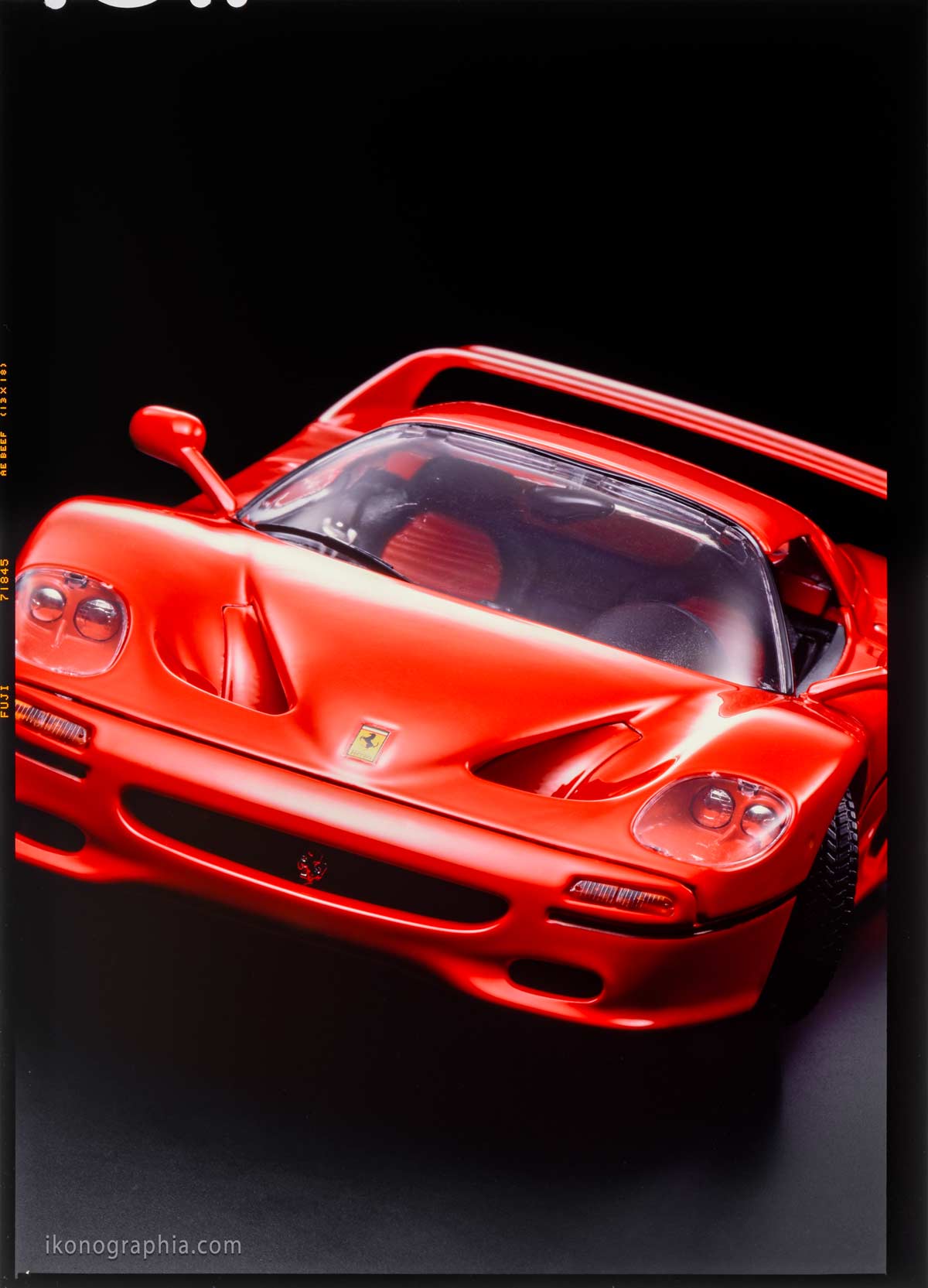
1995. The "Tipo Topolino"


Topolino was the Italian edition of Mickey Mouse. Its circulation was several millions of copies, and Bburago frequently bought the back cover for which we took dedicated photographs that we called "Tipo Topolino".
Mr. Besana was not happy with the photos I took, because "they had white spaces". He always repeated: "I pay the whole page, including the blank part, and it's costly".

With this solution, I finally succeeded in creating a beautiful, impactful image that exploited all the available space.

Leggi in italiano

Le foto "Tipo Topolino.


Topolino tirava milioni di copie e Bburago di frequente acquistava l'ultima di copertina. Le fotografie dedicate erano perciò molto importanti. Mario Besana non era contento delle foto che facevo, non perchè non gli piacessero, ma perche "avevano spazi bianchi" e ripeteva sempre "io la pagina la paga tutta, anche gli spazi bianchi“. Con questa soluzione finalmente sono riuscito a realizzare una bella immagine, impattante e che sfruttava tutto lo spazio disponibile.


Sotto, la diapositiva originale 13x18cm. non ritagliata e l'utilizzo che ne è stato fatto nella retro-copertina di Topolino del 14 novembre 1995.
Puoi acquistare questo pezzo di storia, diapositiva originale e rivista nello store.

Bburago 3353 Ferrari F50 Hard-Top for Topolino Adv

The original uncropped 13x18cm / 5x7" slide for the advertisement and the back cover of Topolino of November 14, 1995.
Click on the small image to watch it in the lightbox.

Buy the original slide plus Topolino magazine


The original uncropped 13x18cm / 5x7" slide for the advertisement and the back cover of Topolino of November 14, 1995.
Buy the original slide plus Topolino magazine

Bburago Ferrari F50 Topolino 2085 Ad

Leggi in italiano

A lato il poster che mostra, con la stessa prospettiva e luce la vera Ferrari F40, il modello 1:18 ed ancora l'originale con sopra il modellino.
Sopra un suggestivo primo piano della terza immagine, che originariamente doveva essere utilizzato per il poster.

Acquista la diapositiva originale 13x18cm e Topolino con l'annuncio in retrocopertina

Bburago 3353 Ferrari F50 Hard-Top for Topolino Adv

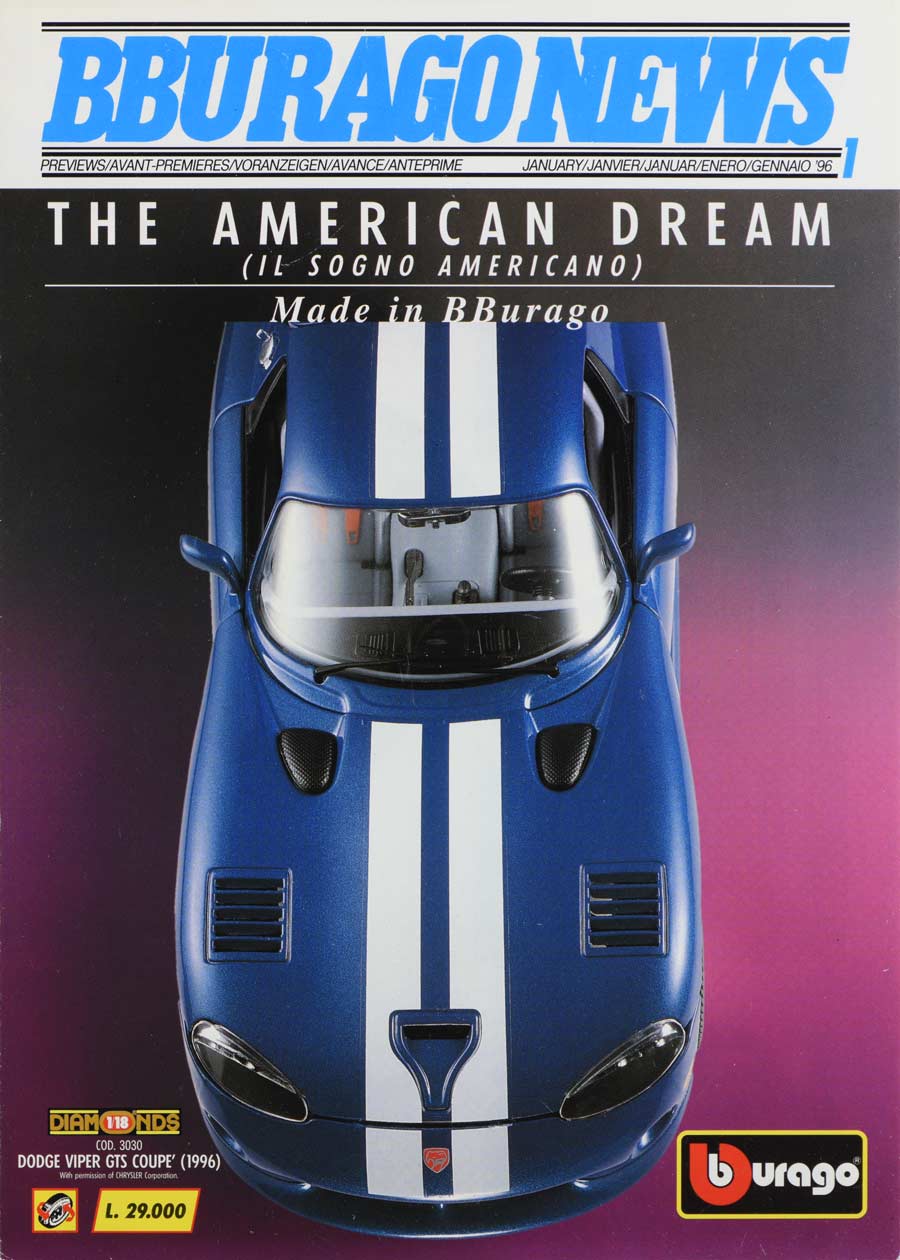
Bburago 3030 Dodge Viper Coupé. An original uncropped slide with the orthogonal view from above. I like this version more than the published one with the purple background.
Below, the cover of the January 1996 number of "Bburago News" magazine.
Buy this original vintage 5x7" 13x18 cm slide in the store.

Bburago Ferrari F50 Topolino 2085 Ad

Leggi in italiano

Bburago 3030 Dodge Viper Coupé. Diapositiva originale 13x18 senza ritaglio, vista dall’alto. Preferisco questa versione a quella con il fondo porpora usata per la copertina del Bburago News di gennaio 1996.

Puoi acquistare questa diapositiva originale nello store.

1996 / 1999. The Bburago News Magazine


I selected two images taken for Bburago News, to which the company dedicated much care.
The first is the Viper taken from above, an image that I do love. The design of the magazine was often was not good, so sometimes Bburago asked us to work on the photographs and graphic design.
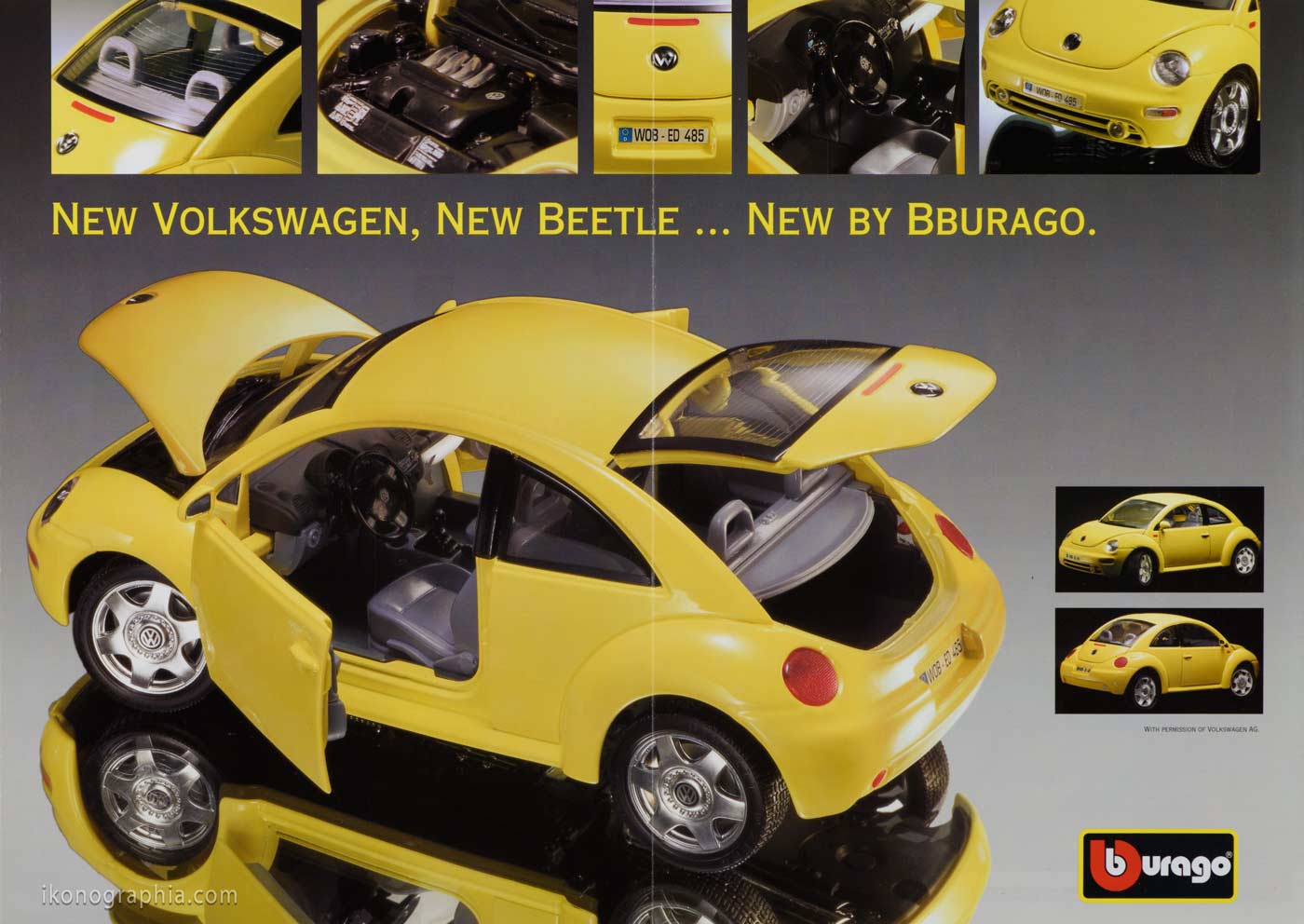
This Volkswagen New Beetle below is a splendid example of integrated photography and graphic design.

Leggi in italiano

1996/1999 La rivista Bburago News


Ho selezionato due immagini realizzate per il Bburago News, che veniva molto curato.
Il primo è la Viper presa dall'alto, un'immagine che adoro. Il design della rivista spesso non era un granché, quindi a volte Bburago ci chiedeva di lavorare su fotografie e grafica. Questo numero sulla Volkswagen New Beetle è uno splendido esempio di fotografia e graphic design integrati.

3302 Volkswagen New Beetle Bburago News open
Bburago News 53 February 1999 Two Pages Centerfold

Above, the 5x7”/13x18cm. original uncropped transparency. On the left the internal double page of the Bburago News magazine of February 1999.

Leggi in italiano

Sopra, la diapositiva originale 13x18 senza ritocchi. A lato la doppia pagina interna del Bburago News N. 53 di febbraio 1999.

Bburago 3352 side showing engine and interiors

1996 Double Page Spread Trends


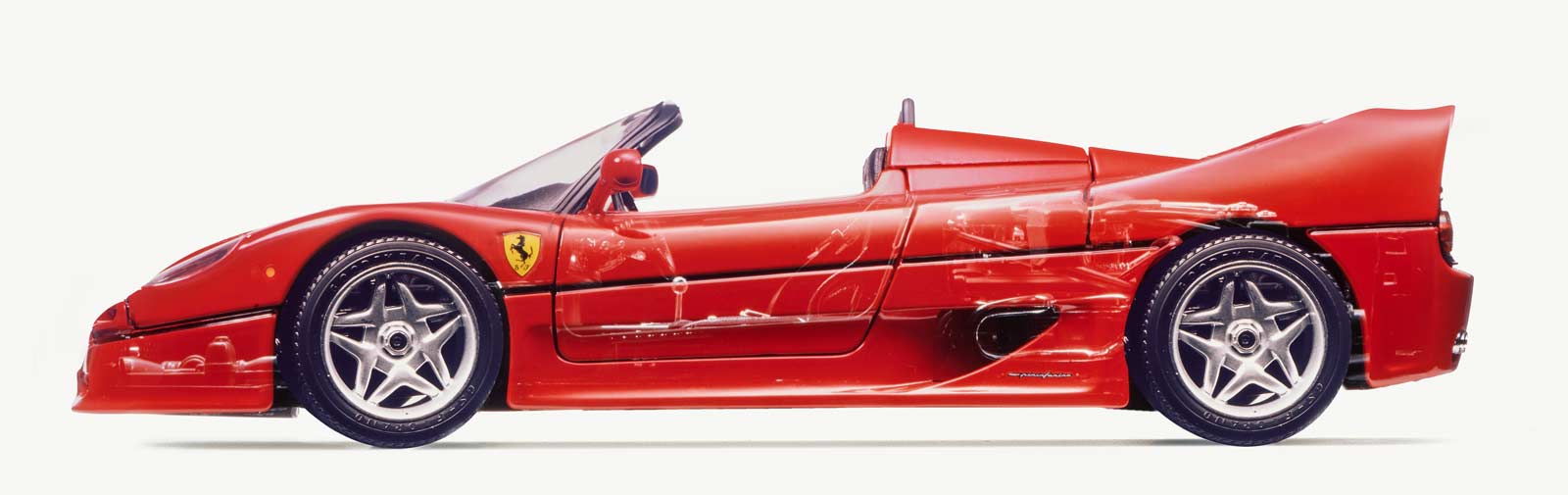
With the '96 catalog, we began to use larger and more impactful images, often spreading in double-page. Perhaps the most appreciated was this double-exposed Ferrari F50, used for the cover. The print quality was impressive, with a 3D effect.

We didn't shoot in digital yet. To get this result I followed this procedure.
1. I worked on the standard side view (without transparency) until I got what I was looking for.
2. I exposed ten further slides without developing them.
3. I removed the bodywork, adapted the light, and shot in double exposure using the already exposed slides.
4. I checked the result, removed some pieces of the interior that created confusion, improved lighting, and shot again. And so on, until the perfect effect. I can assure you that It was a titanic task.


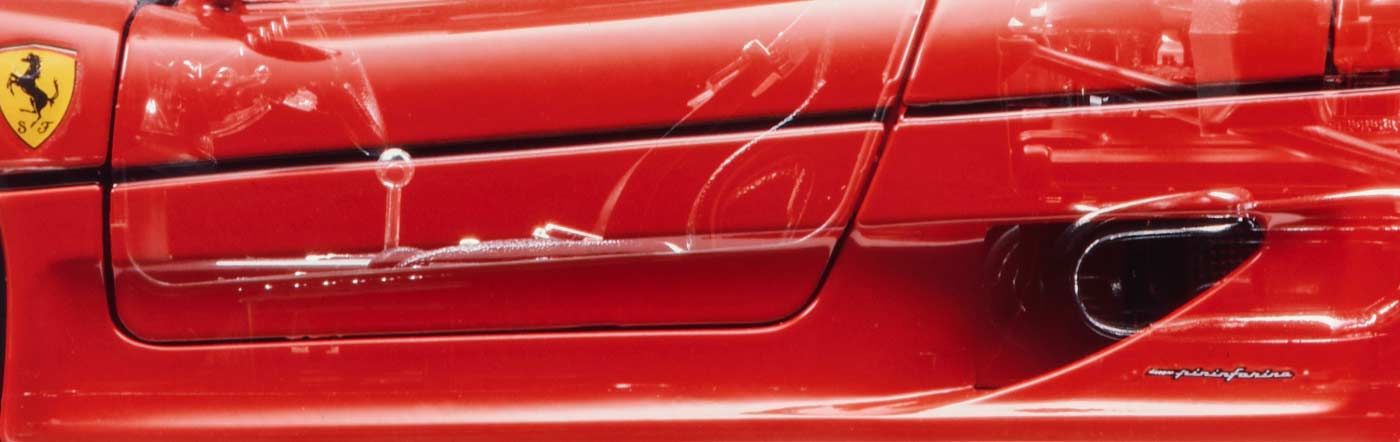
Bburago 3362 Ferrari F50 (1995) side view in double exposure and a close-up.
Below the cover of the 1996 catalog. If you notice the image was flipped horizontal to fit on the front cover. As a consequence we had to flip again the Ferrari Shield and the logo "pininfarina".

Leggi in italiano

Le nuove tendenze del '96 e le doppie pagine


Con il catalogo del ’96, Bburago iniziò ad apprezzare immagini più di impatto, che ove possibile venivano utilizzate in doppia pagina. La più apprezzata fu probabilmente questa della F50 realizzata in doppia esposizione per la copertina del catalogo. La qualità di stampa era impressionante, con un effetto ridimensionale.

Ancora non fotografavo in digitale. Per ottenere questo risultato ho usato questa procedura.
1. Ho lavorato sull’immagine base dell’auto laterale. Una volta ottenuto il risultato perfetto ho esposto dieci pellicole piane (13x18!!), che ho messo da parte.
2. Ho rimosso la carrozzeria ed adattato le luci esponendo il secondo scatto su una delle dia già esposte.
3. Valutato il risultato ho migliorato le luci, il registro ed eliminato alcune parti che generavano confusione. Dopo vari tentativi ed imprecazioni, ho ottenuto il risultato che cercavo.


Sopra: Vista laterale della Bburago 3362 Ferrari F40 in doppia esposizione ed un dettaglio.
Sotto l’immagine come utilizzata per il catalogo. Se notate l’immagine è stata specchiata orizzontalmente per adattarsi alla copertina. Di conseguenza abbiamo dovuto invertire, in fase di ritocco lo scudetto Ferrari ed il logo “pininfarina”.

Bburago 3362 side showing interiors close up
3302 Volkswagen New Beetle Bburago News open
Bburago News 53 February 1999 Two Pages Centerfold

Another example of a double-page image.

Bburago 3358/GF Ferrari 360 Modena
Above, the original image. On the left the index double-page in 1999 Catalog.

You can buy this original 4x5 original vintage slide and 1999 catalog in the store.

Leggi in italiano

Un'altro bell'esempio di doppia pagina
Bburago 3358/GF Ferrari 360 Modena
Sopra, l'immagine originale. A sinistra la doppia pagina indice del catalogo 1999.

Puoi acquistare la diapositiva 4x5" / 10x12cm originale e il Catalogo 1999 nello store.

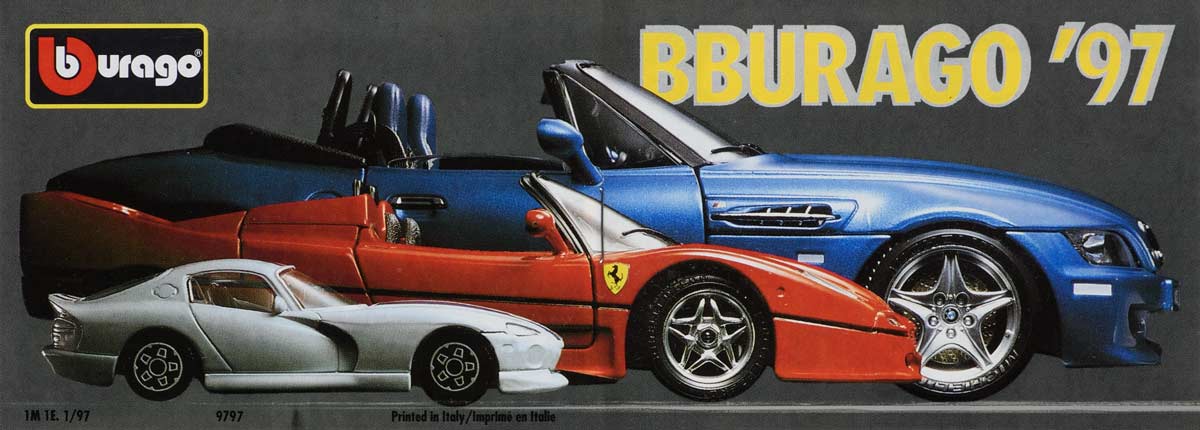
Original Double Exposure Slide for Bburago Pocket Catalog 1997

The Popular Bburago Pocket Catalog


The circulation of the pocket catalog ranged from 6 to 8 million copies, so this picture that I took for the 1997 catalog cover is undoubtedly one of the most popular ever. The idea was to get an impacting image exposing the three cars separately to blend them. I tried several solutions, and the top one was my preferred.

Unfortunately, the agency of Bburago decided to isolate the image adding and retouching the double-exposed parts. In my opinion, the final result was much less attractive.

You may wonder why there are two upside-down exposures in the same transparency. Well, film and development were expensive, and we used to try several versions. So, often, with slim horizontal images we exposed twice the film cutting a film holder slide in two parts, expose the top one, then go back in the darkroom, reverse up-down the sheet film and take the second version.

Leggi in italiano

Il popolare cataloghino Pocket

Visto che i cataloghini Bburago di quegli anni tiravano da 6 ad 8 milioni di copie, questa è senz'altro una delle mie immagini più popolari. L’idea era quella di realizzare tre scatti sovrapposti in modo da ottenere un’immagine intrigante. Tra le varie soluzioni, quella sopra è la mia preferita.
Purtroppo l’agenzia di Bburago decise di scontornare l’immagine e di ritoccare le parti con doppia esposizione. Secondo me, il risultato finale è molto meno interessante.

Vi chiederete il perché delle due esposizioni sottosopra sulla stessa pellicola piana. E’ semplice, pellicola e sviluppo erano costosi, così avevo tagliato un'antina protettiva dello chassis a metà orizzontalmente.
Scattavo perciò la prima versione proteggendo la parte sotto con la mezza anta, poi andavo in camera oscura, ruotavo sotto sopra la diapositiva ed effettuavo il secondo scatto.


Puoi acquistare la diapositiva 4x5 originale con il relativo cataloghino nello store.

The cover of the 1998 Bburago Pocket Catalog

Above the double-exposed original slide.
On the left the cover of the 1998 Pocket Catalog.

You can buy this original slide and the 1998 Pocket Catalog in the store.

Bburago MMonza Diorama Garages. 1992

Bburago MMonza Diorama Garages. 1992

Roberto Bigano

Jul 13, 2019

Vintage-1992-Bburago-3039GF-Garage-MMonza-Diorama-Ferrari-348TB-side-view

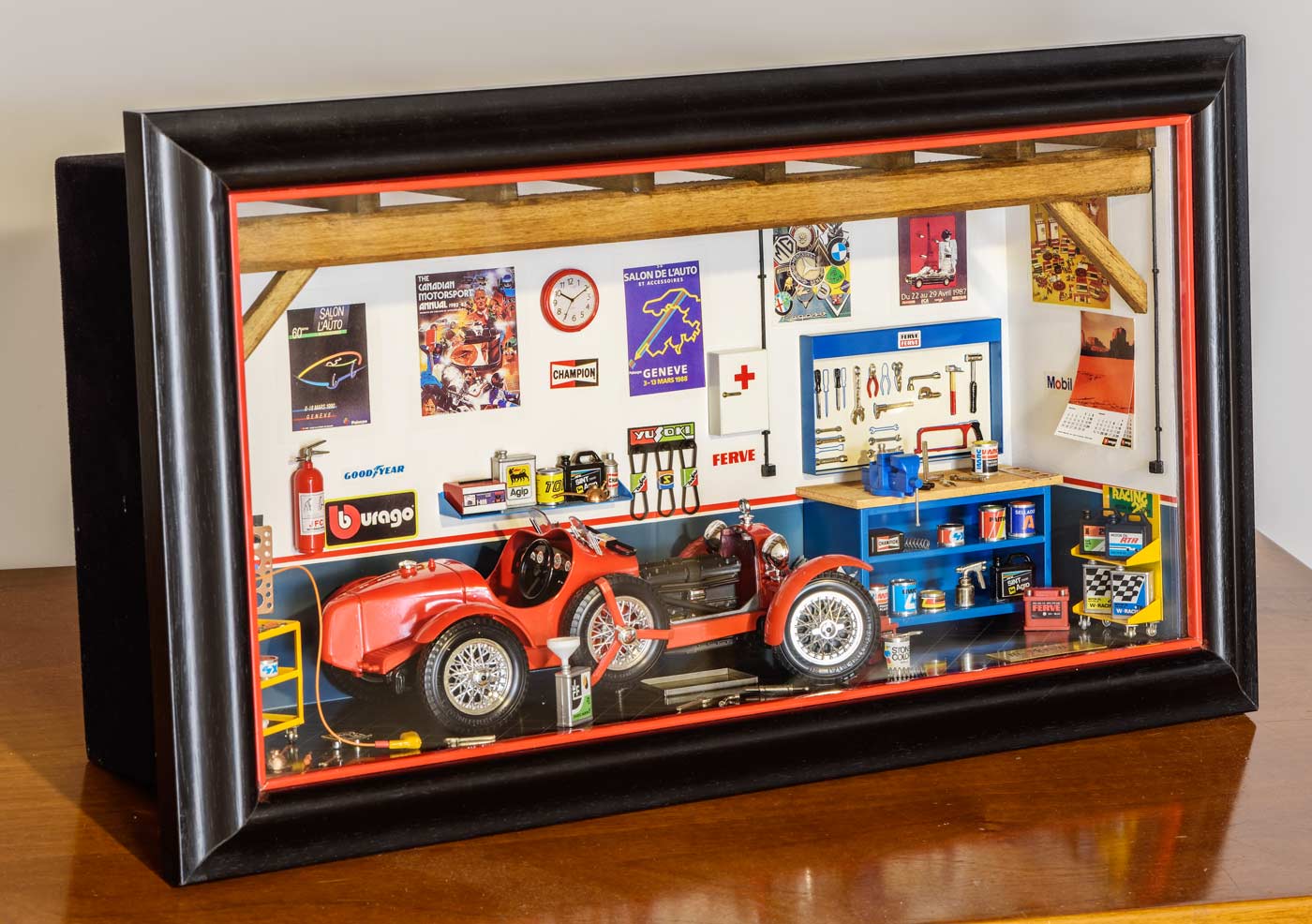
I was still working on the massive job of the photographs of the Assembly Kits when I was called for this new demanding project to create involving images showing the quality of the handcraft, so I took several kinds of pictures, but mostly frontal shootings showing the interiors and some close-ups.

An ambitious project


The MMonza Garages was probably the Bburago's most ambitious project, with an obsessive attention to detail. Produced in only five pieces per subject, towards the end of 1992 they were put on sale in a test area for 850,000 lire (about $ 700 at the time), that was about forty times the price of the basic 1:18 model and they didn't sell. Mr. Besana realized that he should have change target and dealers, from toys to collectible items, and the project was aborted. As a consequence, these items are today scarce.
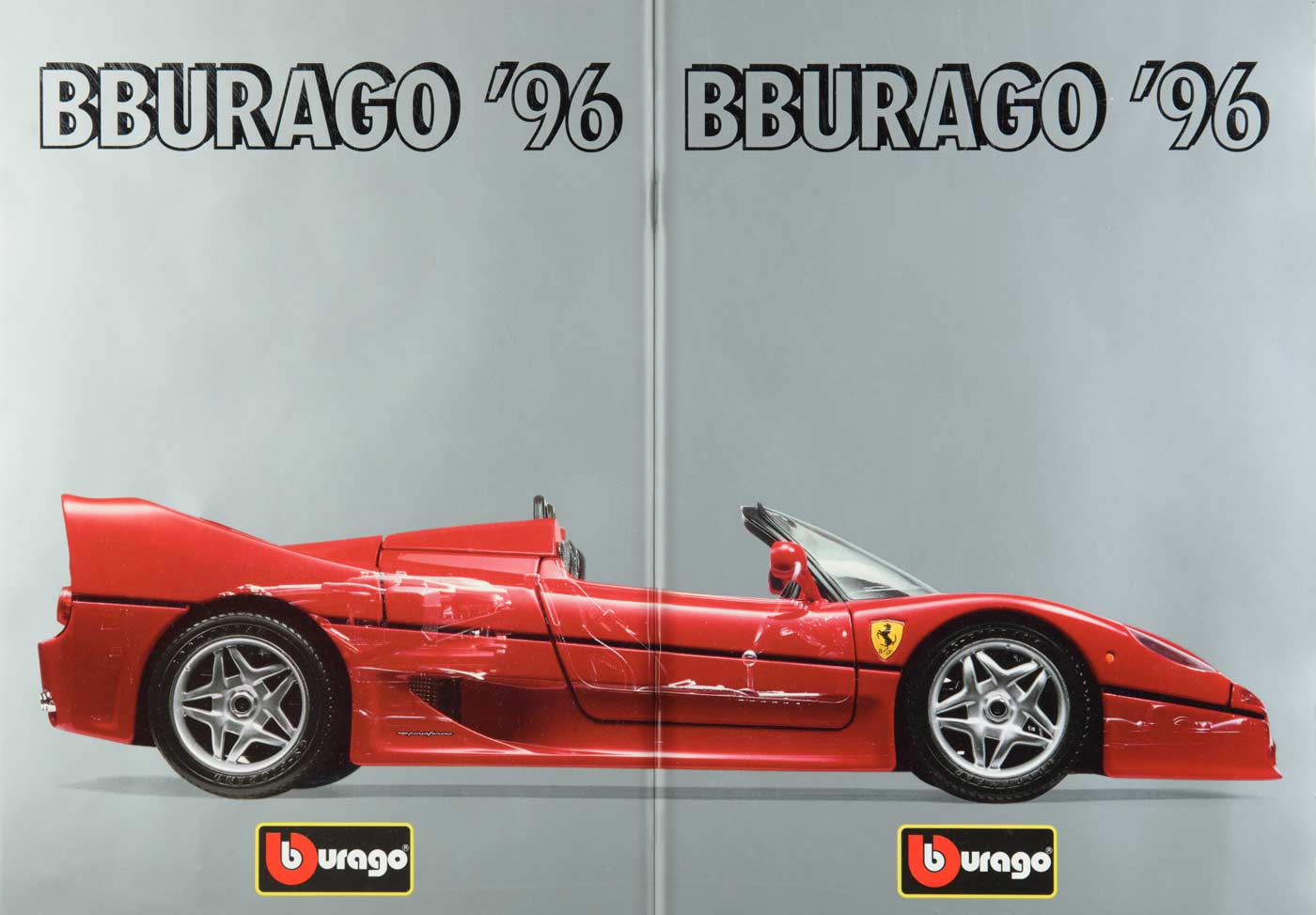

Featured image above. Bburago 3016/GF Jaguar E Cabriolet (1961) MMonza Diorama Garage, detail.

Leggi in italiano

Era ancora impegnatissimo nel titanico lavoro delle scatole di montaggio quando fui chiamato per un nuovo progetto, forse il più ambizioso della Casa, documentando l’eccezionale qualità artigianale. Dopo aver provato diverse soluzione optai per una presa frontale.

Un progetto ambizoso.


Uno dei più ambiziosi progetti di Bburago, con cura del dettaglio quasi maniacale. Prodotto in soli cinque pezzi per soggetto verso la fine del 1992, venne messo in vendita in un'area test a lire 850.000, circa quaranta volte il prezzo del modello base 1:18. Poi il prezzo venne abbassato fino a lire 700.000 senza successo. Besana si rese conto che sarebbe stato necessario cambiare target e punti vendita da giocattoli a collezionismo, per cui la linea non andò mai a catalogo.
Di conseguenza i pochi esemplari prodotti, oggi sono quasi introvabili.


Immagine in apertura. Bburago 3016/GF Jaguar E Cabriolet (1961) MMonza Diorama Garage, dettaglio.
Puoi acquistare questo esemplare unico nello store.

Bburago 3039GF Garage Mmonza Diorama Ferrari 348TB

Bburago 3039/GF Ferrari 348TB (1989) MMonza Diorama Garage.
You can buy this scarce specimen in the store.

Bburago 3021/GF Garage Mmonza Diorama Porsche 356B Coupe

Bburago 3021/GF Porsche 356B Coupé (1961) MMonza Diorama Garage.
You can buy this scarce specimen complete with the original box in the store.

Bburago 3014/GF Alfa Romeo 8C Grand Prix Monaco (1931) MMonza Diorama Garage.

Bburago 3014/GF Alfa Romeo 8C Grand Prix Monaco (1931) MMonza Diorama Garage.
You can buy this scarce specimen complete with the original box in the store.

Bburago 3014/GF Alfa Romeo 8C Grand Prix Monaco (1931) MMonza Diorama Garage.

An obsessive care of detail


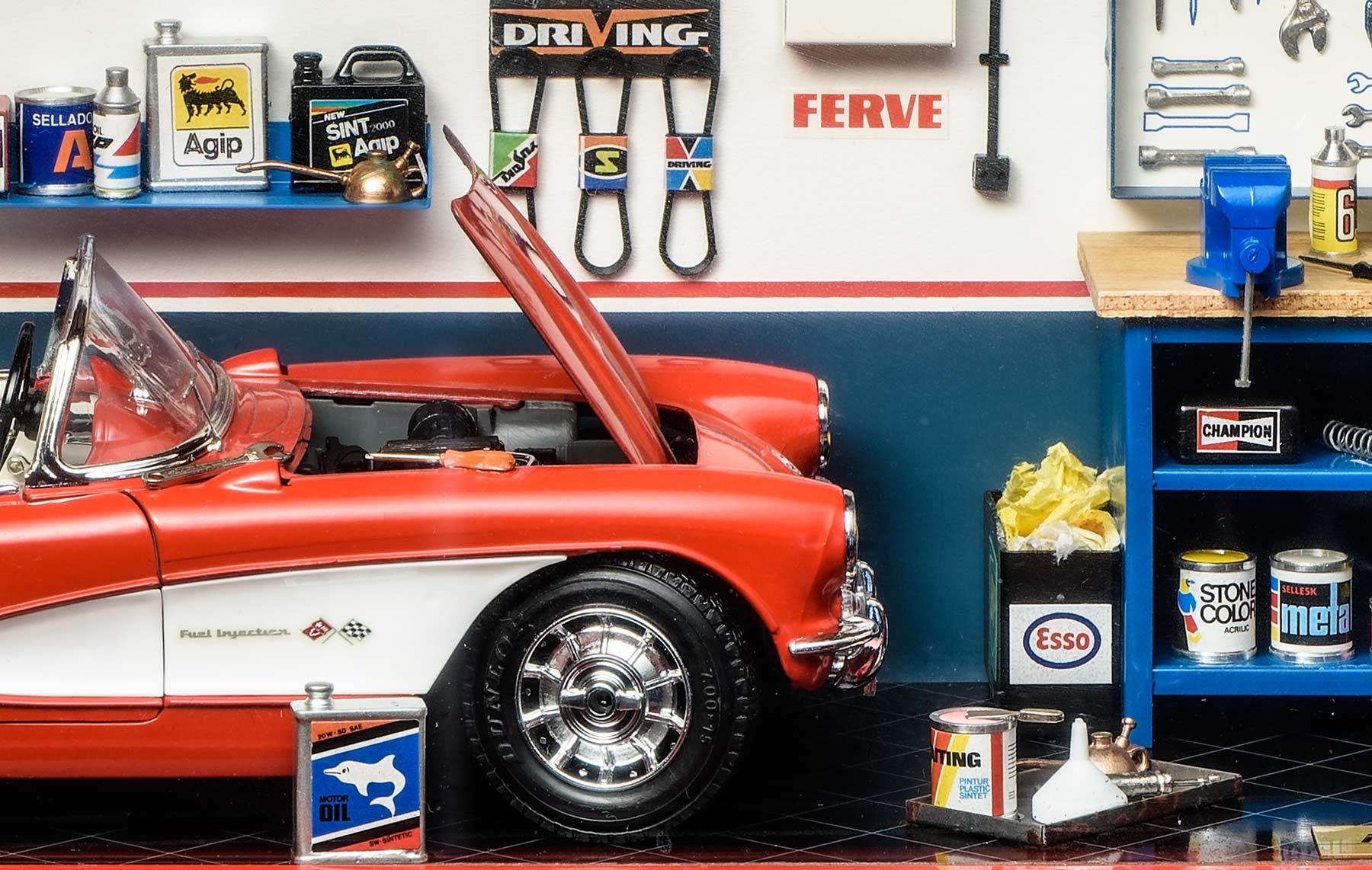
The dioramas were made with almost obsessive attention to detail. For example, the oil dispenser is like the real one, in miniature. Hence the very high selling price. To appreciate the details, click on the image below to enjoy the file in high resolution.

Leggi in italiano

Una cura del dettaglio quasi maniacale


I diorama erano realizzati con una cura dei dettagli impressionante. Per esempio il dosatore dell’olio è come quello grande in miniatura. Da qui il prezzo di vendita elevatissimo. Per apprezzare i dettagli clicca sull’immagine sotto per vedere l’immagine in alta risoluzione.

Bburago 3014/GF Alfa Romeo 8C Grand Prix Monaco (1931) MMonza Diorama Garage.

Bburago 3024/GF Chevrolet Corvette (1957) MMonza Diorama Garage.
You can buy this scarce specimen complete with the original box in the store.

A curiosity about 1992 Photoshooting for the catalog


Despite the hundreds of photoshoots I made in thirty years, I remember almost all the details of the shootings: camera, lens, tricks, and the technique used. These MMonza Garage original transparencies are the exception.

If you notice, I lighted it from above, to simulate the effect of a real garage lighting. The problem is that it would have been necessary to pierce the case of the diorama and insert a fiber optic lighting. But all the dioramas cases are still intact. I can't remember how I solved it. A mystery!

Leggi in italiano

Una curiosità sulle fotografie originali per il catalogo nel 1992.


In trenta a passa anni di professione ho fatto centinaia di servizi fotografici. Nonostante questo, di quasi tutti ricordo i dettagli delle riprese, camera ed obbiettivo, trucchi e 6tecniche utilizzati. Questi Garages Mmonza sono l’eccezione che conferma la regola.

Se notate, nella foto sotto, la luce viene dall’alto per simulare la nuce al neon di un’officina. Per far questo sarebbe stato necessario segare il tetto dei box contenenti i diorama, o per lo meno fare un piccolo foro per introdurre una luce a fibra ottica che avevo. Il fatto è che tutti i mobiletti sono tuttora integri per cui non mi spiego come ho fatto. Un mistero!!

Tutti i Garage Diorama presentati, in copia unica sono acquistabili nello store.

Sotto, una delle diapositive originali dell'epoca. La mitica Fuji Velvia 4x5".  A quei tempi usavamo una micro-stampante da camera oscura per contrassegnare direttamente sulla diapositiva il copyright, che in questo caso data con certezza la fotografia.

Bburago 3014/GF Alfa Romeo 8C Grand Prix Monaco (1931) MMonza Diorama Garage.

Bburago 3039/GF Ferrari 348TB (1989) MMonza Diorama Garage. Notice on the left the copyright printing stating the date. This picture was taken for the Bburago Dioramas catalog but was never published.


The Bburago Mmonza Diorama Garages Registry


This is the first attempt to catalog the existing Bburago Garages specimens. Please let us know if there are other samples. Obviously, the name of the owner will remain confidential, unless specifically requested.
Last update: July 23, 2019

At the moment in our records, there are only 20 specimens still existing worldwide. Below the complete original sixteen-items list. Product codes and names are as displayed on the item packaging.

Known samples: 1 - Bburago 3002/GF Mercedes-Benz 55KL (1931) MMonza Diorama Garage. Color: white.
Known samples: 1 - Bburago 3005/GF Bugatti Type 59 (1934) MMonza Diorama Garage. Color: blue.
Known samples: 1 - Bburago 3006/GF Jaguar SS100 (1937) MMonza Diorama Garage. Color: UK racing green.
Known samples: 3 - Bburago 3007/GF Ferrari 250 Testarossa (1957) MMonza Diorama Garage. Color: red.
Known samples: 1 - Bburago 3013/GF Mercedes-Benz 300SL (1954) MMonza Diorama Garage. Color: silver.
Known samples: 1 - Bburago 3014/GF Alfa Romeo 8C Grand Prix Monaco (1931) MMonza Diorama Garage. Color: red.
Known samples: 1 - Bburago 3016/GF Jaguar E Cabriolet (1961) MMonza Diorama Garage. Color: red.
Known samples: 1 - Bburago 3018/GF Jaguar E Coupé (1961) MMonza Diorama Garage. Color: red.
Known samples: 1 - Bburago 3019/GF Ferrari Testarossa (1984) MMonza Diorama Garage. Color: red.
Known samples: 1 - Bburago 3020/GF Mercedes-Benz 500K Roadster (1936) MMonza Diorama Garage. Color: black.
Known samples: 1 - Bburago 3021/GF Porsche 356B Coupé (1961) MMonza Diorama Garage. Color: pale cream.
Known samples: 0 - Bburago 3028/GF Lamborghini Diablo (1990) MMonza Diorama Garage. Color: yellow.
Known samples: 1 - Bburago 3024/GF Chevrolet Corvette (1957) MMonza Diorama Garage. Color: red and white.
Known samples: 3 - Bburago 3032/GF Ferrari F40 (1987) MMonza Diorama Garage. Color: red.
Known samples: 2 - Bburago 3037/GF Lamborghini Countach 5000 Quattrovalvole (1988) MMonza Diorama Garage. Color: black.
Known samples: 1 - Bburago 3039/GF Ferrari 348TB (1989) MMonza Diorama Garage. Color: red.

Leggi in italiano

Registro internazionale dei Garage Diorama Mmonza


Il primo tentativo di catalogare gli esemplari tuttora esistenti. Per favore, fateci sapere se ne esistono altri. Ovviamente il nome del proprietario rimarrà riservato.
Ultimo aggiornamento: 23 luglio 2019.

Al momento per quello che ne sappiamo, solo venti esemplari ancora esistono. Sopra la lista completa dei sedici modelli esistenti. Codici di prodotto e nomi delle auto, sono come stampati negli imballi originali,

Ten years with Bburago die cast models

Ten years with Bburago die cast models

Roberto Bigano

by Roberto Bigano | Jun 29, 2018

Burago 3018 Lamborghini Metal Blue Diablo

From 1991 to 2000, I worked as a photographer for Bburago, the leading manufacturer of diecast model toy cars. In this post and subsequent ones, I will tell you the story of this fascinating work relationship. We will see the original photographs, taken in large format with the study variants, Polaroids, prints and a lot of exclusive vintage material, some of which can be purchased in our store.

Index for the Bburago posts
1. Ten years with Bburago die-cast models (current).
2. The MMonza Diorama Garages 1992
3. Ten Iconic Bburago Photographs by Roberto Bigano

Bugatti, Bburago and Me


It all started at the end of 1990. I worked for Bugatti Automobili and the owner, Romano Artioli, was a big fan of my work and proudly showed it to everyone. One day he introduced me to Mario Besana, the founder and CEO of Bburago, who told me: "Mr. Bigano, congratulations, you photograph automobiles like no one else. I wonder if you can get the same results with model cars. Come and visit me and we'll talk."

You should know that it was one one of the busiest times in my professional history and I had absolutely no available days. So I answered that, unfortunately it would not be possible as I was booked for the following year. I was not trying to make myself look important, I really had no free time. Mr. Besana's eyes widened and, from that moment, it became his seemingly sole objective to get me to work for him. He was extremely persistent and I eventually gave in and accepted his invitation.

The work that impressed Mr. Besana was "Divina Bugatti". 

Leggi in italiano

Per dieci anni, dal 1991 al 2000 ho lavorato come fotografo di Bburago Die Cast Models. In questo post e successivi vi racconto la storia di questo affascinante rapporto di lavoro. Vedremo le fotografie originali, realizzate in grande formato, con le varianti di studio, le Polaroid, materiale stampato anche in bozza ed un sacco di materiale esclusivo, in parte acquistabile nel nostro store.

Io, Bugatti e Bburago


Tutto cominciò alla fine del 1990. Lavoravo per Bugatti Automobili ed il boss, Romano Artioli apprezzava molto il mio lavoro che mostrava orgogliosamente a tutti. Un giorno mi fece chiamare per presentarmi Mario Besana, il fondatore e Deus Ex-Machina della Bburago, che esordì così: “sig. Bigano, complimenti, come fotografa le macchine lei non le fotografa nessuno. Chissà se è cosi bravo anche con le macchinine. Venga a trovarmi che ne parliamo”. Dovete sapere che stavo passando uno dei periodi di maggior successo della mia storia professionale e non avevo giornate libere.

Alla mia risposta “la ringrazio, però purtroppo non è possibile perchè ho tutto il prossimo anno impegnato”, Besana sgranò gli occhi e da quel momento diventai il suo “oggetto del desiderio”. Doveva assolutamente avermi e nei mesi successivi mi corteggiò assiduamente finche cedetti e passai a trovarlo.

Ferrari F40 with A Bburago Die Cast Model on the top for a poster.

Below, the poster showcasing the real Ferrari F40, the Bburago Model and the real one again with the model on the top.
Above, a detail of the third image that originally should have been the poster.

Leggi in italiano

Sotto, il poster che mostra, con la stessa prospettiva e luce la vera Ferrari F40, il modello 1:18 ed ancora l'originale con sopra il modellino.
Sopra un suggestivo primo piano della terza immagine, che originariamente doveva essere utilizzato per il poster.

Puoi acquistare il poster in versione locandina più le dia originali ne

001005 Bburago Poster Ferrari F40 May 1992

The poster showcasing the real Ferrari F40, the Bburago Model and the real one again with the model on the top.
Above, a detail of the third image that originally should have been the poster.

Leggi in italiano

A lato il poster che mostra, con la stessa prospettiva e luce la vera Ferrari F40, il modello 1:18 ed ancora l'originale con sopra il modellino.
Sopra un suggestivo primo piano della terza immagine, che originariamente doveva essere utilizzato per il poster.

The Assembly Kits and the Ferrari F40


For the first project, Mr. Besana explained that they needed fresh ideas to restyle the packaging of the assembly kits. Their goal was to raise the quality standards of their images. They basically gave me free rein. When I delivered the project, Mr. Besana approved it without even checking it. He was confident that I was the right man for the job and commissioned, on the spot, an order of 40 kit boxes. A huge task.

At 7:30 a.m. the next day, I received a phone call from Mr. Besana's secretary who asked me to come "immediately" for an urgent job. They needed to create an important poster showcasing the Ferrari F40 - the real one compared with the Bburago model.
A fun side note on the F40. Besana had proudly shown the F40 model to Enzo Ferrari, a close friend of his. Mr. Ferrari called a meeting with the production managers scolding them because "Bburago has the F40 ready before us."

In this post, you will find a selection of catching photographs made for the assembly kits, and those, used and not, of the F40 poster. Further posts will follow soon. Stay in touch!

Leggi in italiano

I kit e il poster della Ferrari F40


Come prima richiesta Besana mi spiegò che dovevano rinnovare il packaging delle scatole di montaggio e avevano bisogno di idee fresche e di migliorare lo standard qualitativo delle loro immagini. Mi davano sostanzialmente carta bianca.
Così realizzai una serie di fotografie che componevano la scatola e consegnai il mio progetto. Besana lo approvò senza nemmeno guardarlo. Era certo che fossi l’uomo giusto e mi commissionò, seduta stante un ordine per quaranta scatole di montaggio. Un lavoro enorme.

Alle 7.30 del mattino del giorno successivo, ricevo una telefonata dalla segretaria di Besana che mi chiede di passare “subito” per un lavoro urgente.
Si trattava di realizzare un importante poster sulla Ferrari F40, quella vera ed il modello Bburago a confronto. La F40 aveva riscosso un grande successo ed era in quel momento il modello di punta.

In questo post trovate una serie di fotografie realizzate per i packaging, e quelle, utilizzate e non della F40.
Presto seguiranno altri post. Rimanete in contatto.

Original 4x5" Dia for Porsche 356B Assembly Kit Bburago code 7021

Above the Porsche 356B original 4x5" dia (code 7021), chosen as the main image of the first assembly kit. My very first photos for Bburago. Below, the original print for the packaging.

You can buy the bundle of this print and original transparencies in the store.

Leggi in italiano

Da sopra,  la diapositiva 10x12 originale della Porsche 356B, scelta come immagine principale per la scatola di montaggio. La mia prima fotografia per Bburago.

Piu sotto, la prova di stampa della scatola.
Puoi acquistare il pacchetto prova di stampa/originale nello store.

Sotto, sei polaroid che mostrano il progresso affinamento di prospettiva ed illuminazione.
Vi chiederete perché siano in bianco e nero. Semplice, le Polacolor davano un risultato di colore e contrasto molto particolare (effetto Polaroid) non adatto per simulare contrasto, e toni della diapositiva. Il Polapan 54 era invece creato proprio per questo.
Puoi acquistare il set delle sei Polapan nello store.

My very first photos for Bburago. Porsche 356B for Assembly Kits

Above the Porsche 356B original 4x5" dia (Code 70121), chosen as the main image of the first assembly kit. My very first photos for Bburago

On the left, the original print for the packaging.
You can buy the bundle of this print and original transparencies in the store.

Below, six Polaroids showing the progressive refining of perspective and lighting.
You may wonder why the Polaroids are in black and white. The Polacolors delivered artificial colors, unsuitable for previewing the result; the Polapan 54 instead, was specifically designed to simulate the contrast of the color slide.
You can buy this set of six Polaroids in the store.

Leggi in italiano

Sopra, la diapositiva 10x12 originale della Porsche 356B, scelta come immagine principale per la scatola di montaggio. La mia prima fotografia per Bburago.

A sinistra, la prova di stampa della scatola.
Puoi acquistare il pacchetto prova di stampa/originale nello store.

Sotto, sei polaroid che mostrano il progresso affinamento di prospettiva ed illuminazione.
Vi chiederete perché siano in bianco e nero. Semplice, le Polacolor davano un risultato di colore e contrasto molto particolare (effetto Polaroid) non adatto per simulare contrasto, e toni della diapositiva. Il Polapan 54 era invece creato proprio per questo.

Puoi acquistare il set delle sei Polaroid originali nello store

Six Polaroids (Polapan 54) showing the progressive refining of perspective and lighting

Six Polaroids of the Porsche 356B, showing the progressive refining of perspective and lighting.
You may wonder why the Polaroids are in black and white. The Polacolors delivered artificial colors, unsuitable for previewing the result; the Polapan 54 instead, was specifically designed to simulate the contrast of the color slide.
You can buy this set of six in the store.

001008 Bburago Lamborghini Countach for Assembly Kit

Above the original 1992 Fuji 4x5 transparency for the Black Lamborghini Diablo used for the assembly kit packaging. Bburago Code: 7041.
You can buy the original slide in the store

Leggi in italiano

Sopra la diapositiva originale Kodak EPT 4x5", 1ox12cm della Lamborghini nera per il coperchio della scatola di montaggio. Codice Bburago 7041. Puoi acquistarla nello store.

EUR Euro