Bugatti — Photography, Drawings, Literature

Bugatti — Photography, Drawings, Literature

Bugatti — Photography, Drawings, Literature

Exclusive archives documenting Bugatti from the inside — available nowhere else.

Between 1909 and 1939, Bugatti produced fewer than 8,000 cars in Molsheim, Alsace. Ettore designed the machines and directed everything around them — the coachwork, the literature, the posters, the domain itself. Jean brought the body to its highest form. What remained was a body of objects — cars, drawings, catalogs, posters — of exceptional rarity and cultural weight.

The legendary Ettore Bugatti's signature on the engine head of a 1921 Type 13 Brescia. Photo by Roberto Bigano. Buy this image in the ikonographia.com store.

This featured story is an editorial hub, conceived as a new re-editing of multiple existing stories and archival materials. It brings together previously separate contents into a single, coherent narrative framework — photography, technical drawings, and printed literature documenting Bugatti heritage from 1909 to 1952.

The archive was built between 1990 and 2009 by photographer Roberto Bigano, working with a level of access that no longer exists and cannot be replicated. It began with Romano Artioli — the Italian entrepreneur who revived the Bugatti name at Campogalliano — who gave Bigano unrestricted entry to the factory, the drawings archive, and every event that followed. No brief. No restrictions. No supervision.

This collection is not a celebration of the marque. It is a record made by someone who was trusted enough to be inside it, at the precise moment when its past and its future were in the same room.

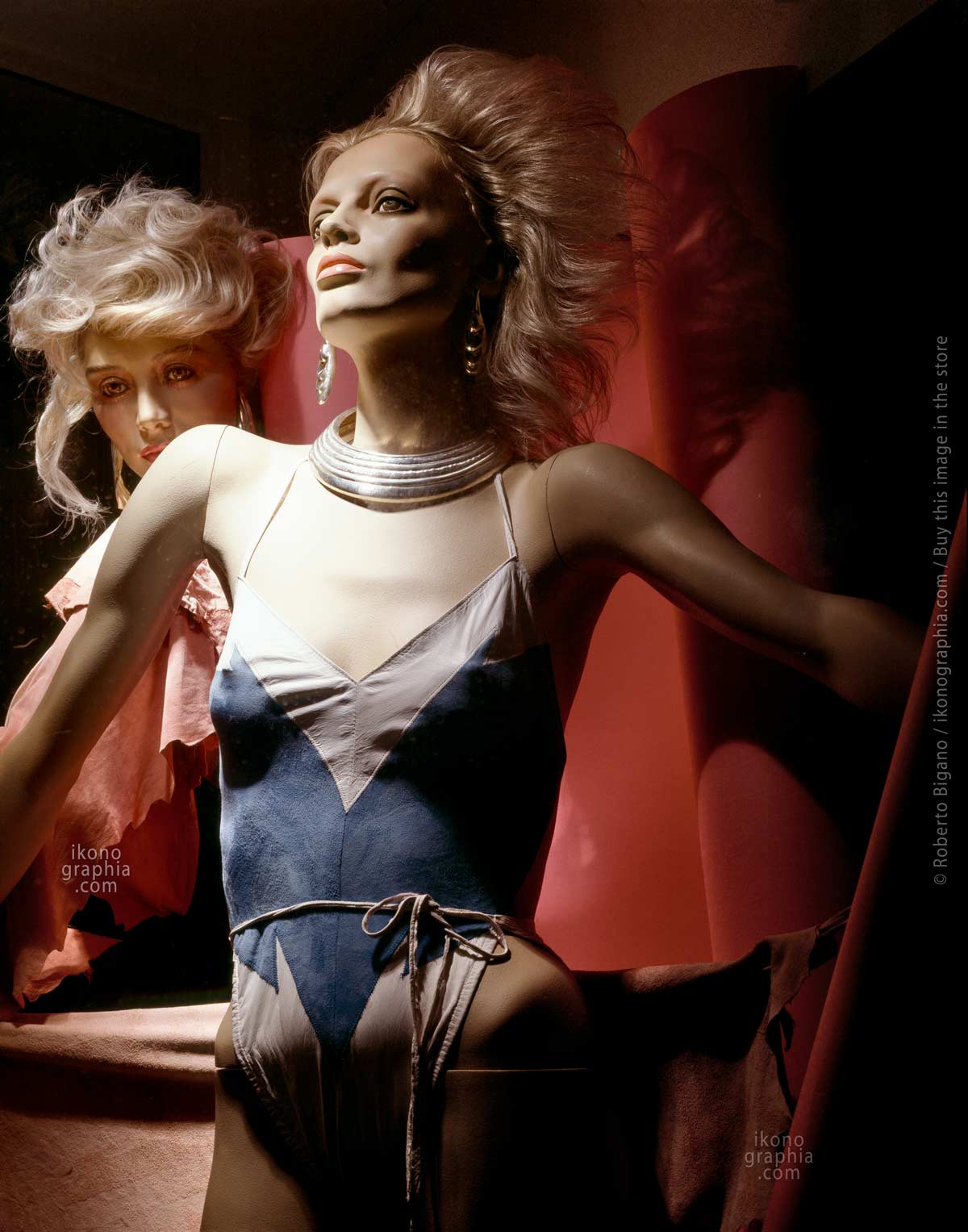
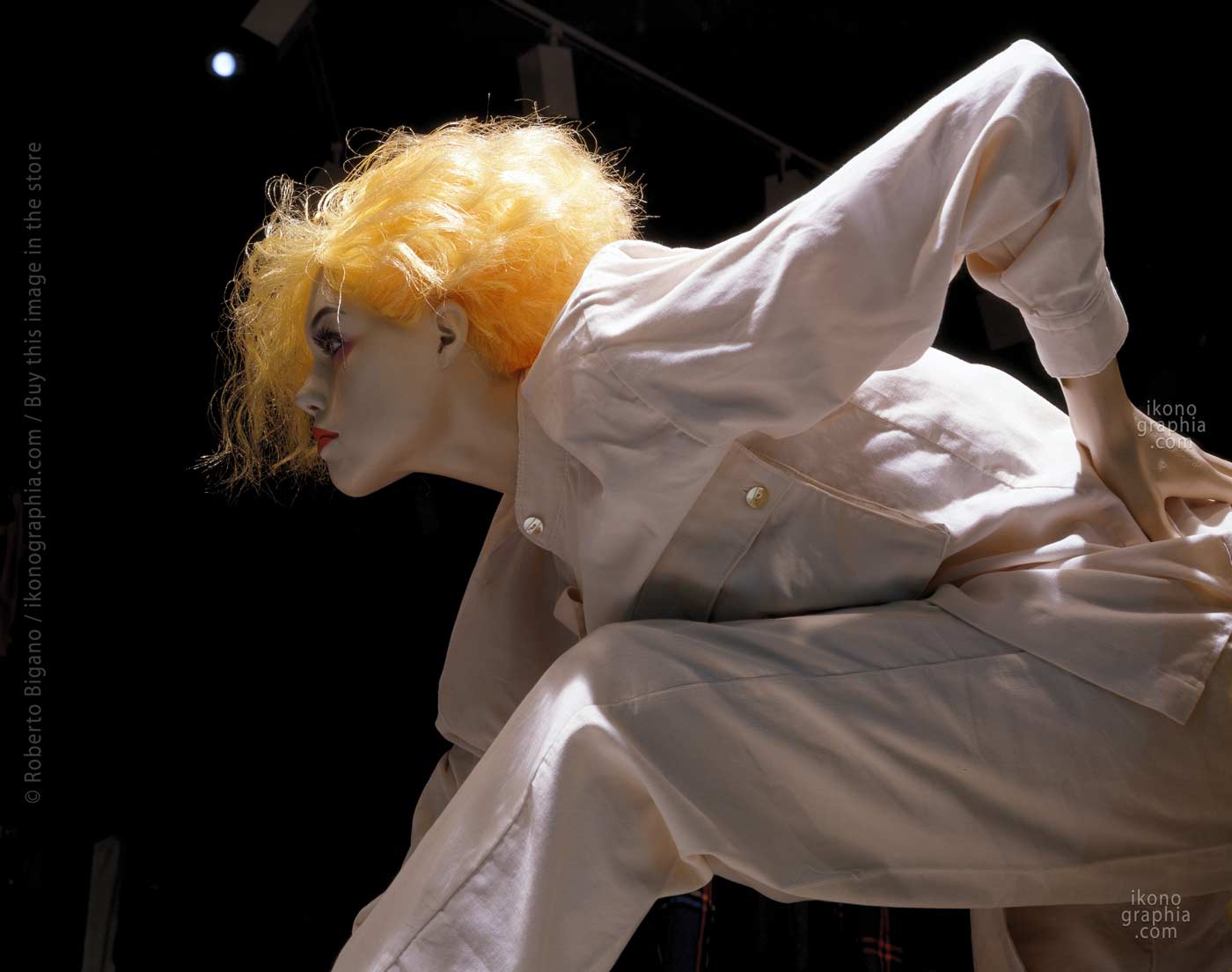
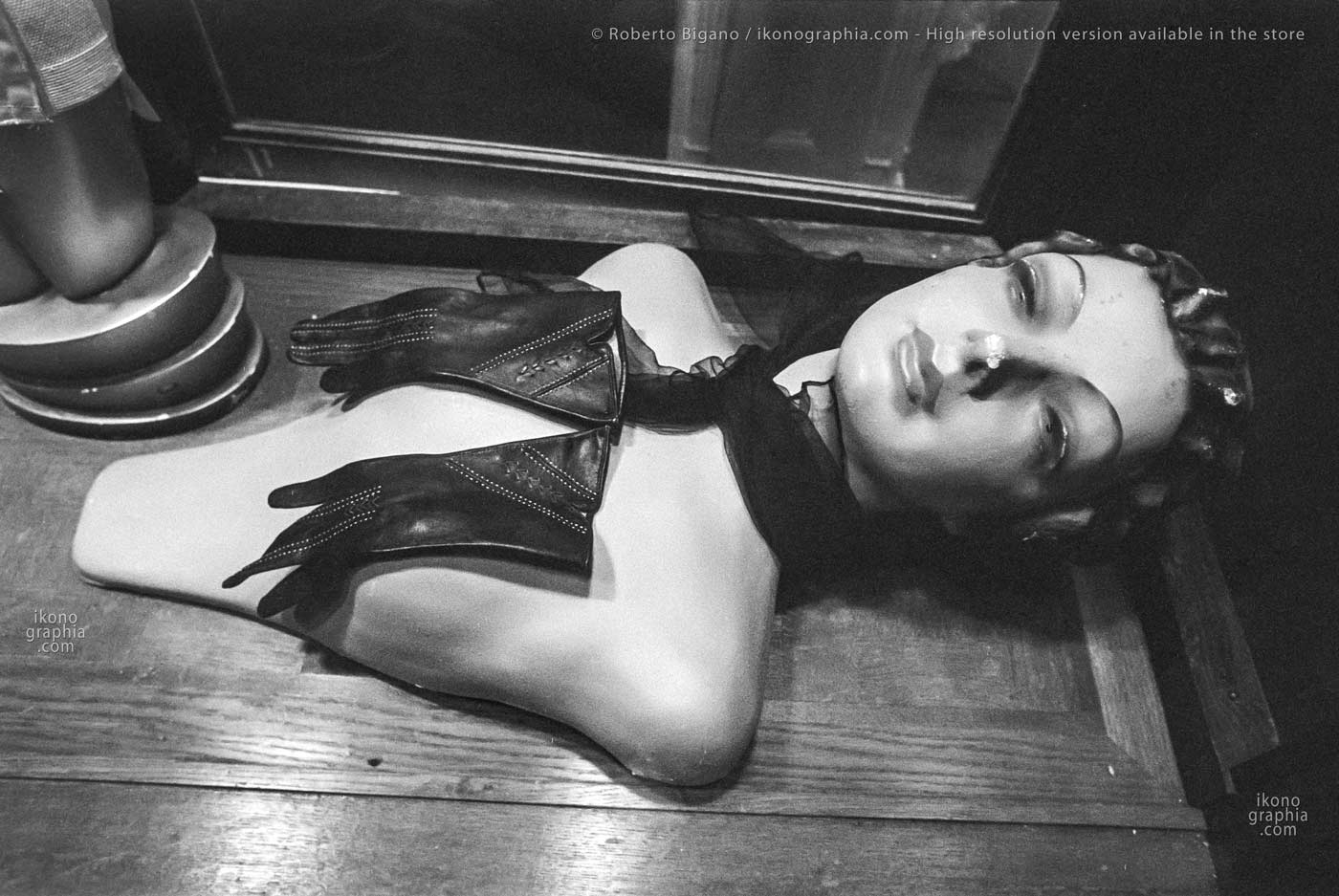
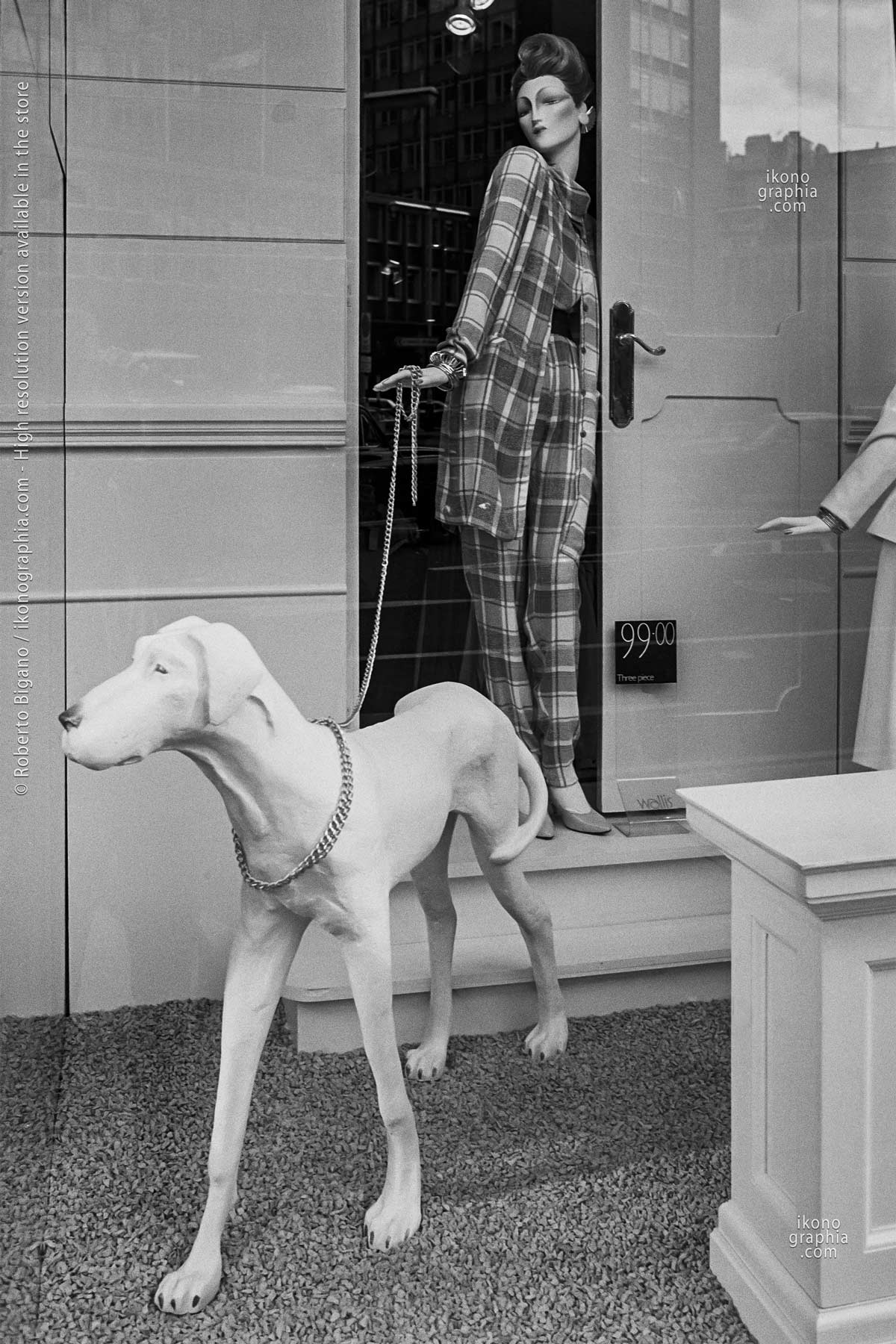
0360-13 Mannequin in a shop window in Braunschweig, Germany, September 1979 | From "Plastic Girls" series. Photo by Roberto Bigano. Buy this image in the ikonographia.com store.

Two Bugatti Type 13 Brescia — Marone-Cinzano Estate, Tuscany, 2009.

Resting in the shade during the owners' lunch — one of 120 cars gathered for the Bugatti International Meeting.

Featured image above


Ettore Bugatti's signature — Engine head of the Type 13 Brescia, 1921.

Not a badge. Not a plate. Ettore cast his own handwriting into the metal of the engine head — his name made part of the machine itself.

The Type 13 Brescia won the first four places at the 1921 Brescia Grand Prix. This is what he signed.

Five Bodies of Work — One Complete Archive

What resulted is not a single project. It is five distinct bodies of work — factory drawings, printed literature, posters, studio photography, and documentary reportage — built across two decades, most of it unpublished until now. Together they form the most complete visual record of Bugatti heritage in private hands.
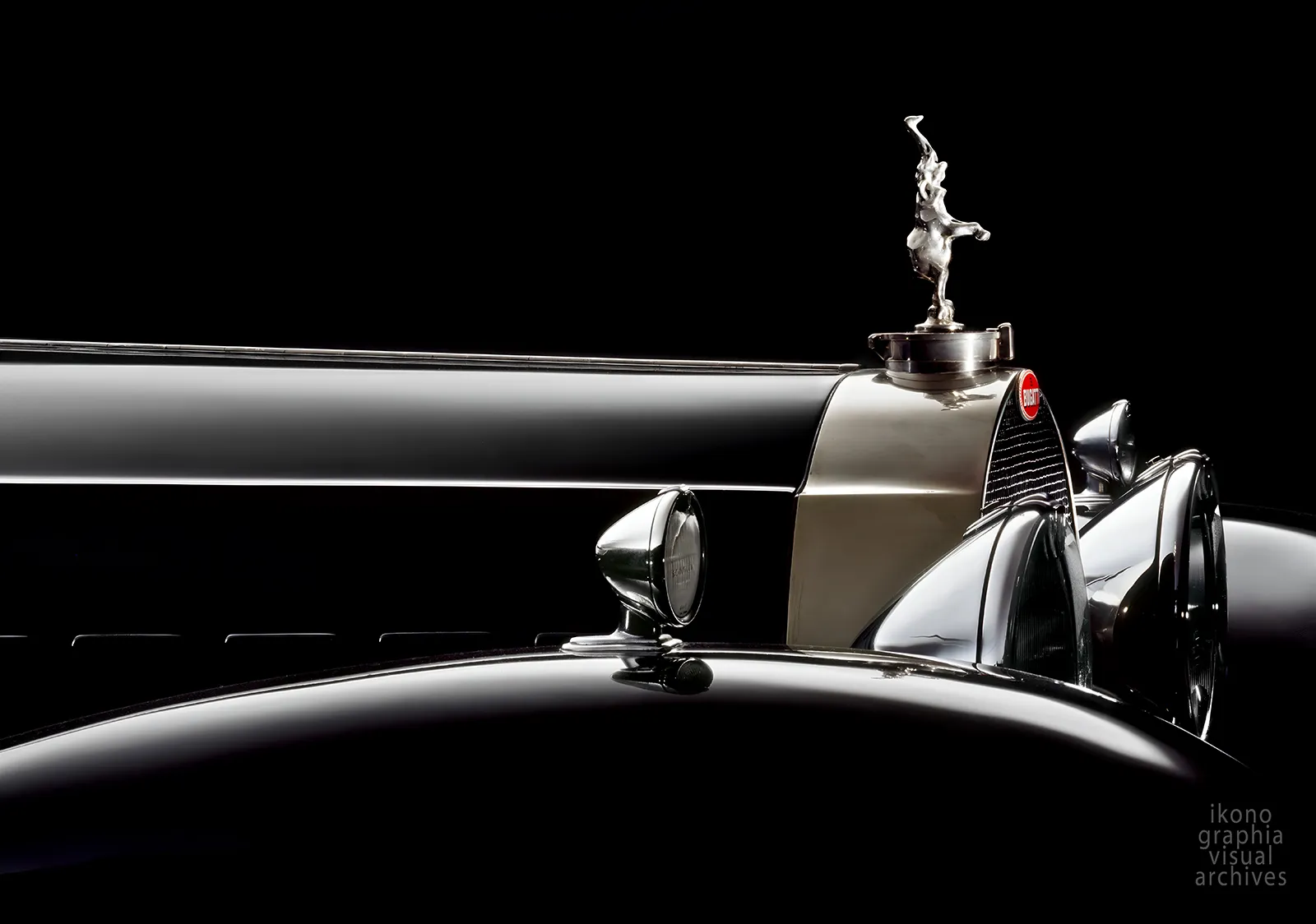
Bugatti Type 41 Royale Coupé Napoléon, 1929 — bonnet detail with Rembrandt Bugatti elephant mascot. Photographed by Roberto Bigano at the Musée National de l'Automobile, Mulhouse.

Bugatti Type 41 Royale Coupé Napoléon — Bonnet and Rampant Elephant, 1929

Ettore's personal car — 7.2 metres long, the largest automobile ever built, conceived for royalty and driven by its maker.

The elephant on the radiator was sculpted by Rembrandt Bugatti, Ettore's younger brother, one of the great animal sculptors of his generation. Six Royales were completed. This is one of them.

The Lost Factory Drawings

Between 1922 and 1935, the Molsheim factory produced the technical drawings that defined how Bugatti cars were built — body designs, mechanical specifications, production templates, drawn by hand on paper and cloth.

Reproduced in 1990 before disappearing, these images may be the only surviving record. Ikonographia presents them in three chapters — Form, Function, and Obsession — examining why they remain unique.
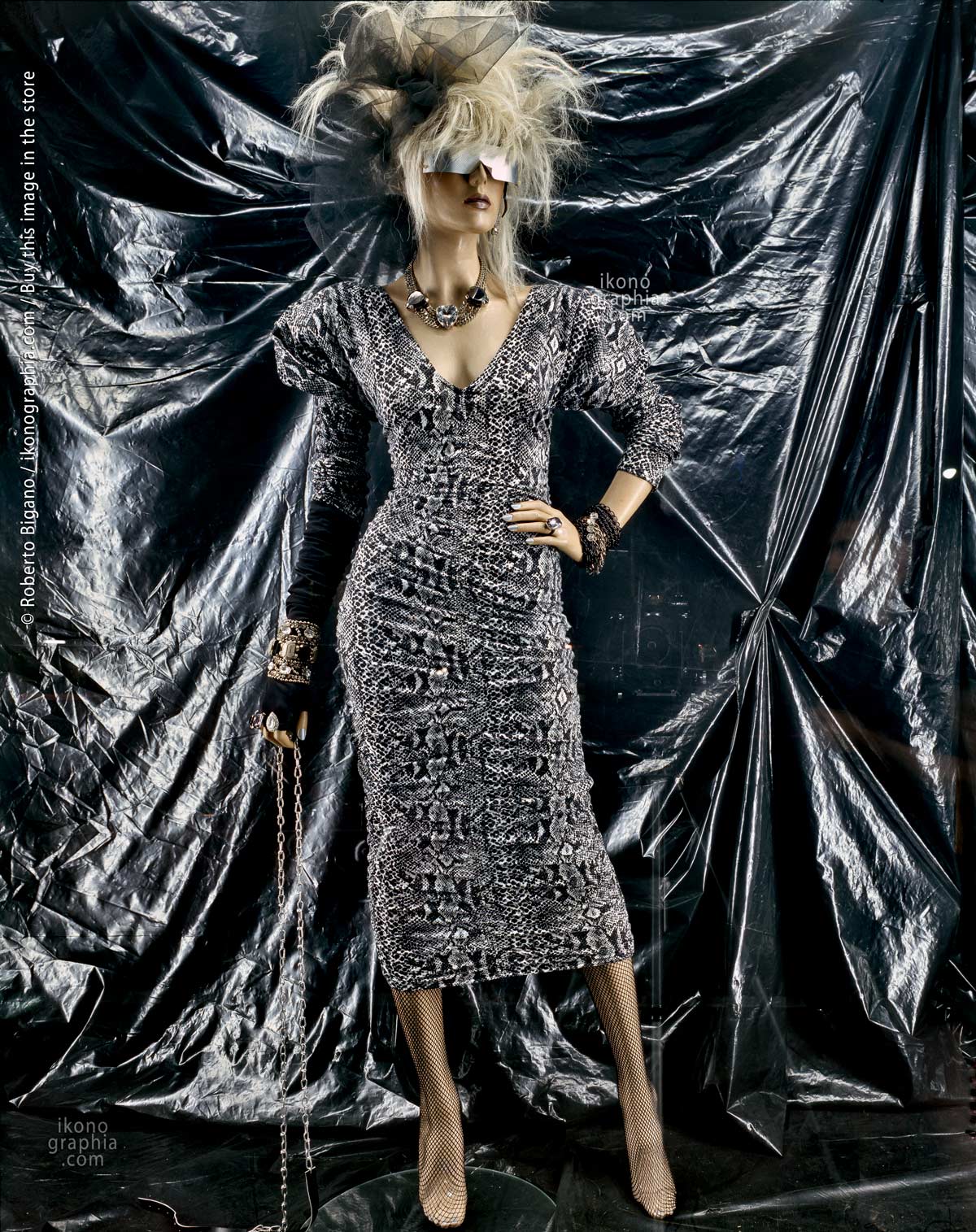
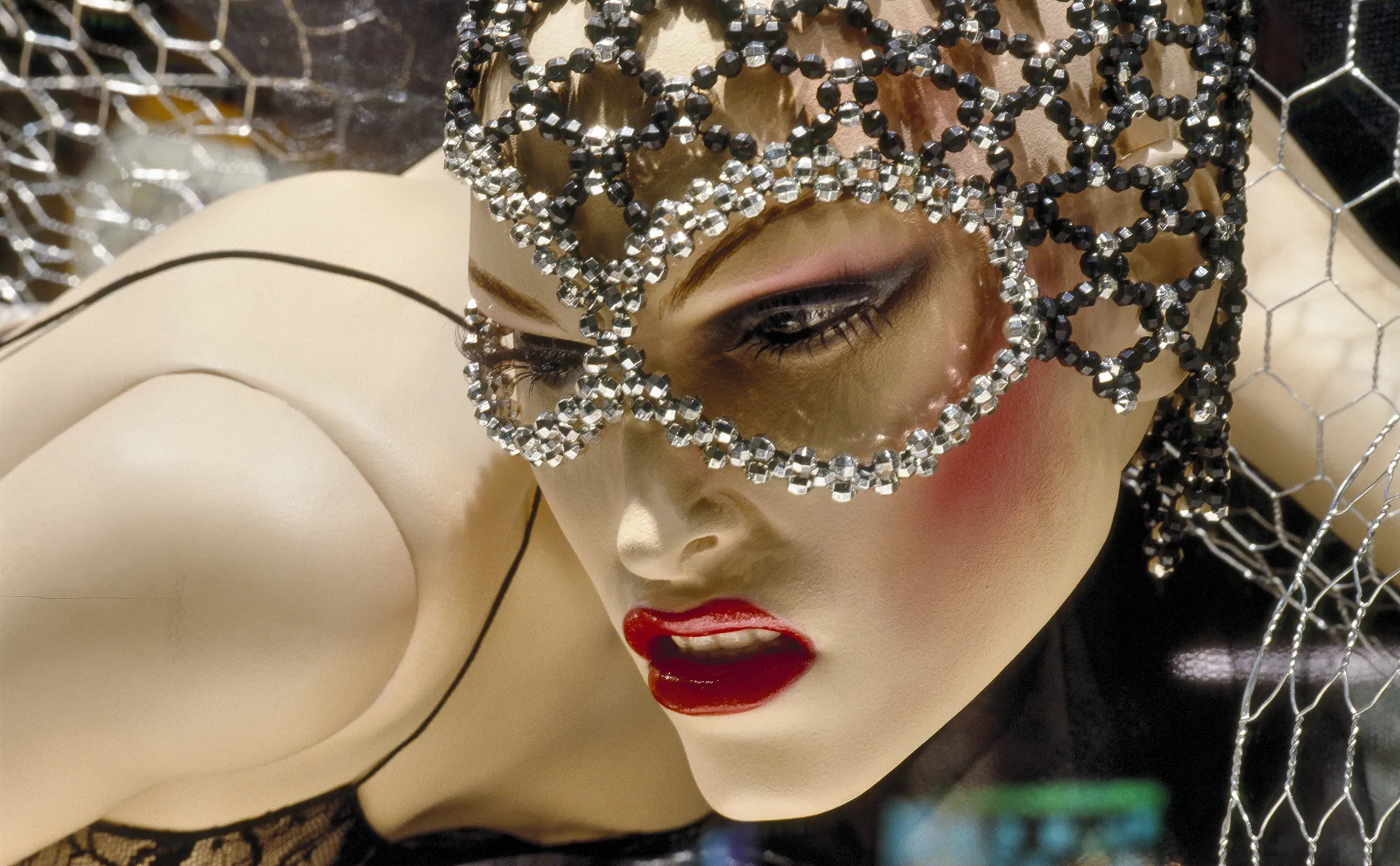
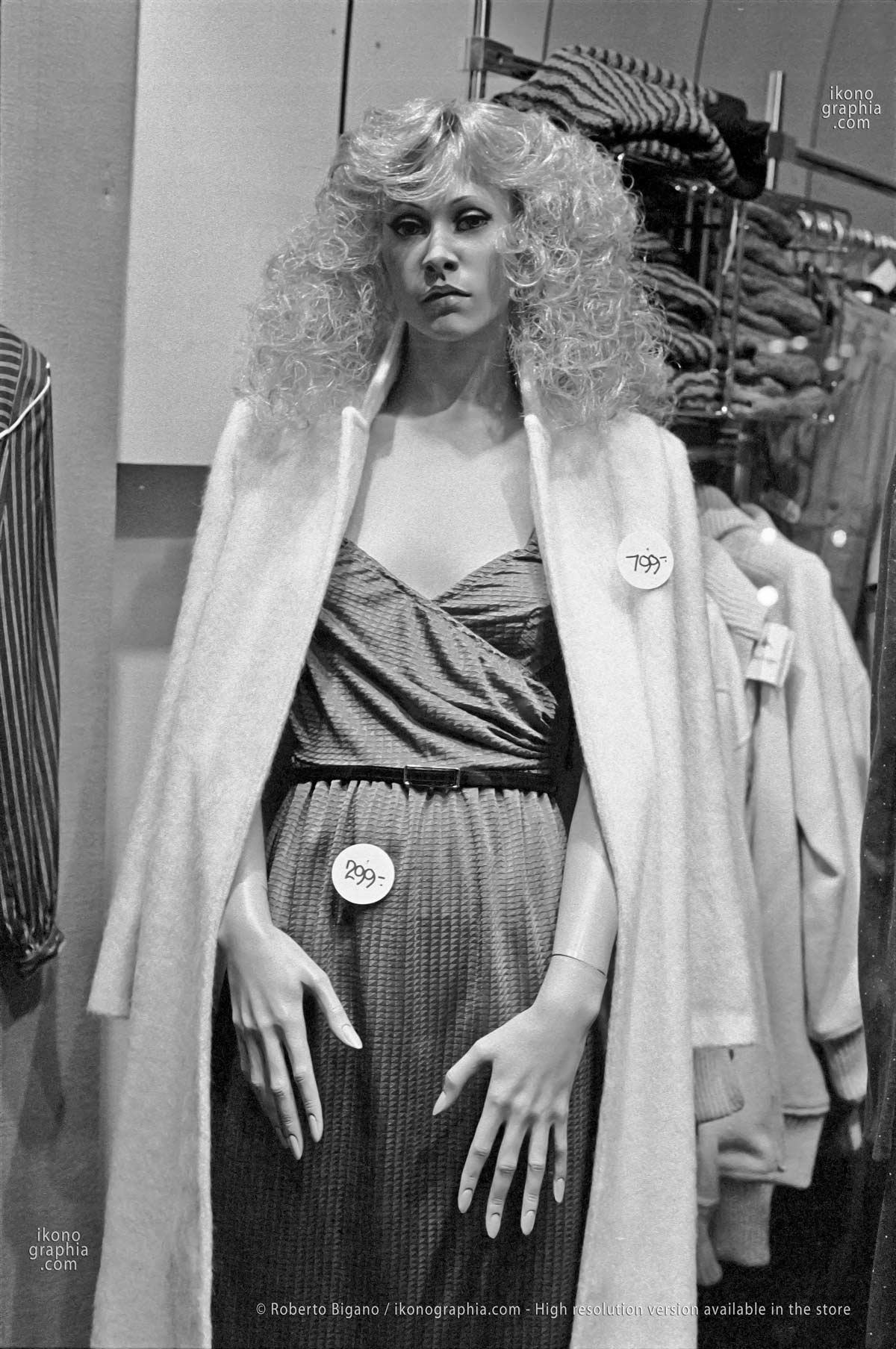
August 1984 - Beverly Hills, California - From "Plastic Girls" series. Photo Roberto Bigano.

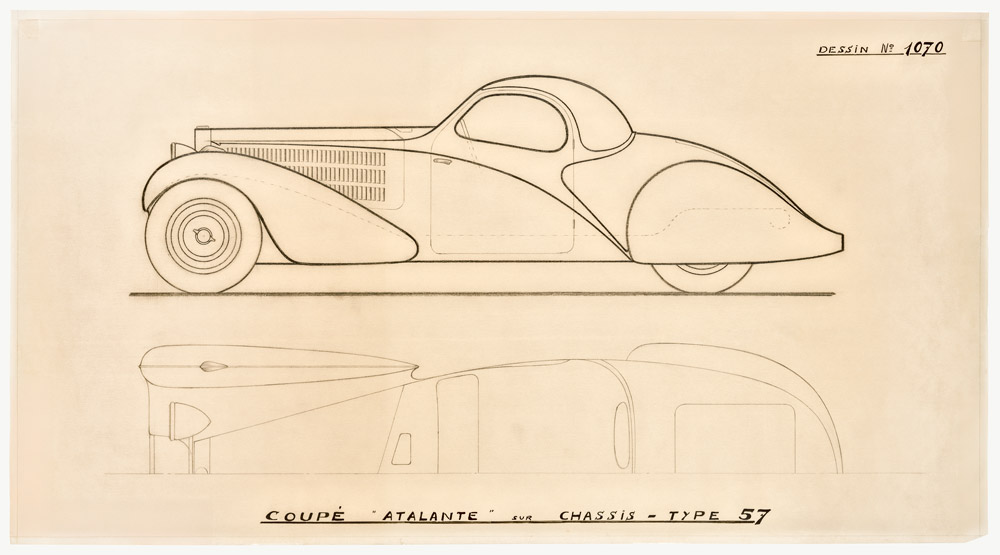
Dessin N° 1070 — Coupé Atalante sur Chassis Type 57 — 1935

Side elevation and plan view. Pencil on tracing paper. The body design was Jean Bugatti's. The factory drawings were the work of his technical team at Molsheim. 
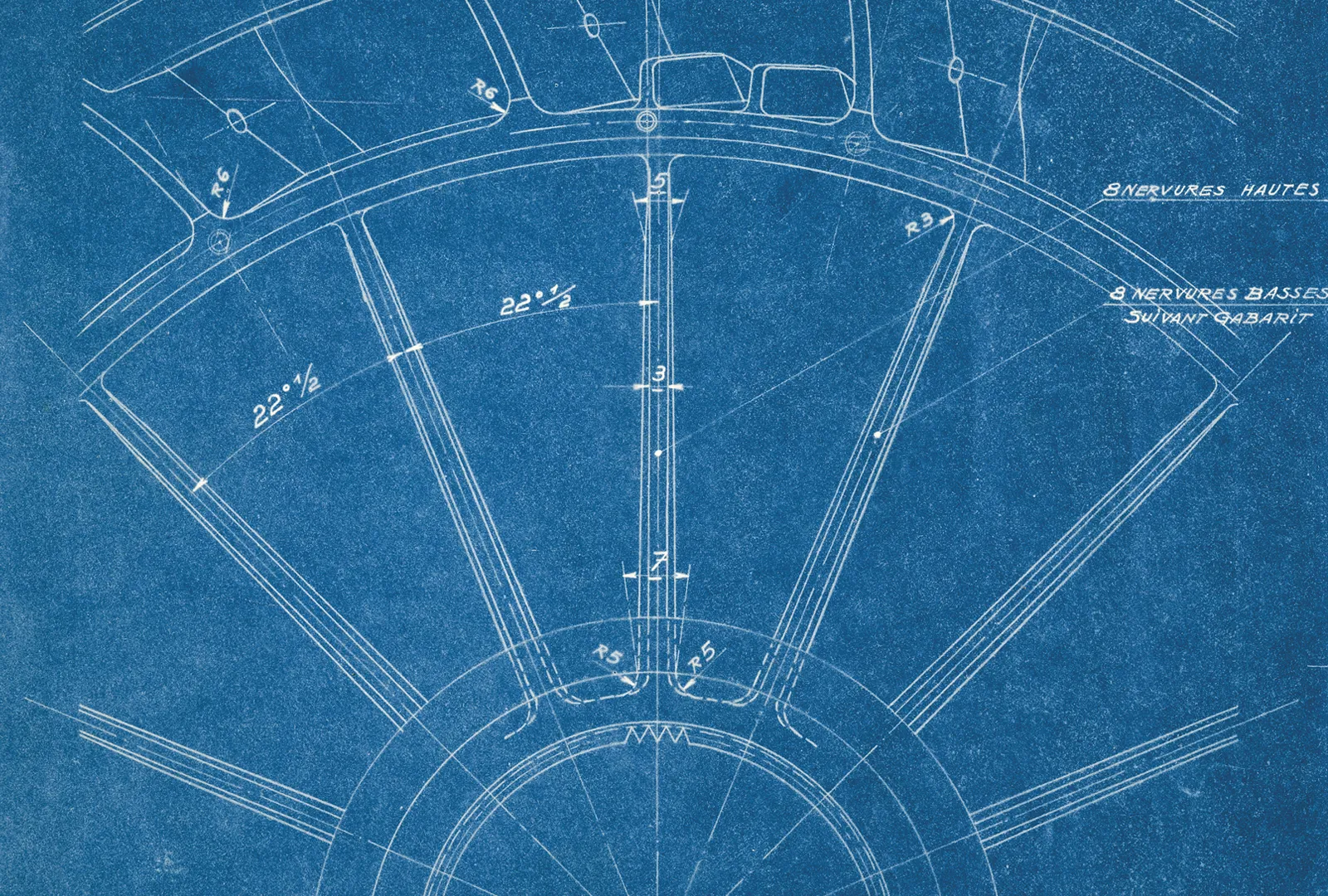
Detail of Bugatti’s patented Monobloc aluminum wheel design from a 1932 technical drawing.

The Bugatti Monobloc Cast Aluminum Wheel — Patented 1924

The first single-piece cast aluminum wheel in automotive history. This heliographic print, dated 22 July 1932, is a first-generation factory copy made directly from the original drawing and distributed to the production department. The spoke section shown here specifies eight high ribs and eight low ribs following the template, with all radii and tolerances called out in millimeters.
The geometry is not only structural — the alternating rib heights reduce weight while maintaining rigidity, a solution that remained technically advanced for its era. Eight years after the original patent, the drawing shows no uncertainty. Every line was already resolved.

Like the Vitruvian Man, it is a study in proportion where engineering and beauty become the same thing.
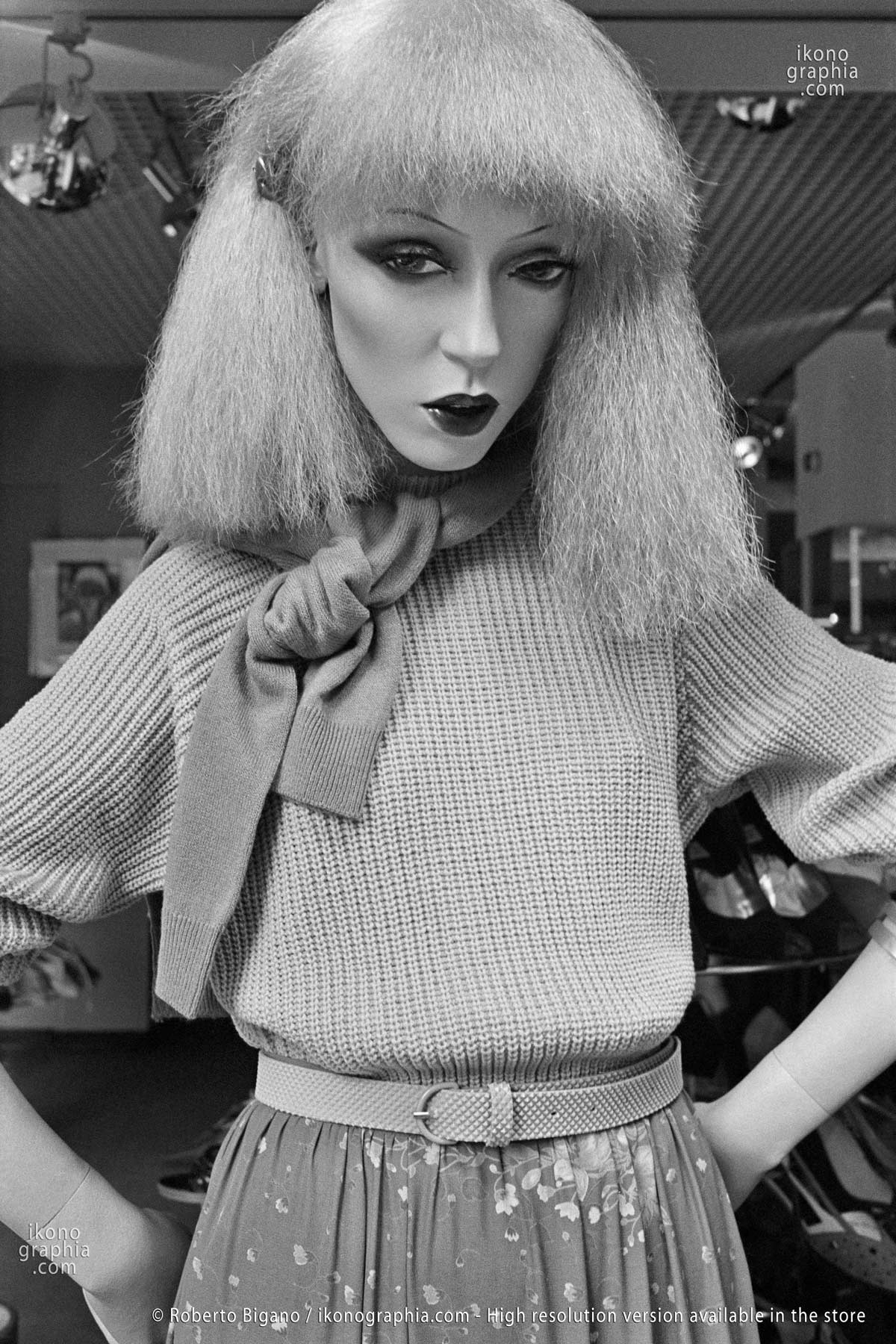
August 1984 - Beverly Hills, California - From "Plastic Girls" series. Photo Roberto Bigano.

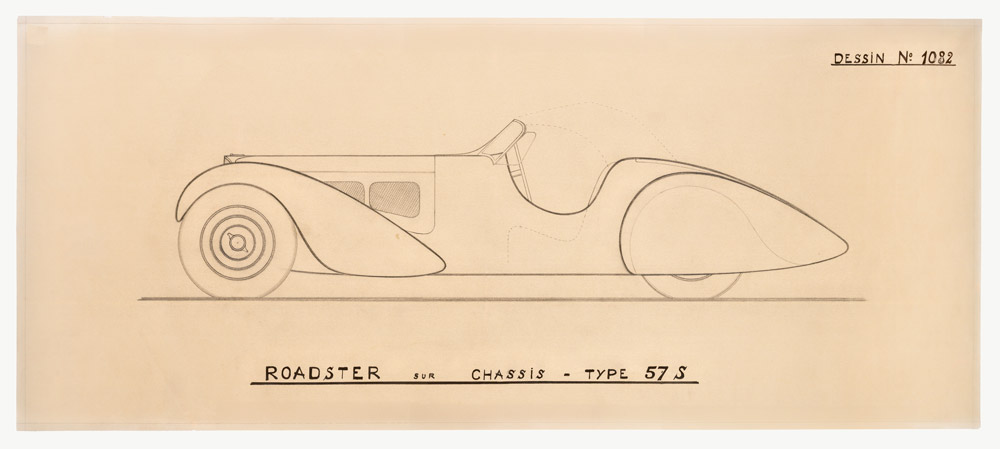
Dessin N° 1082 — Roadster sur Chassis Type 57S — 1935.

The surbaissé chassis — lowered by passing the rear axle through the frame members. Jean Bugatti's final and most aerodynamic variant of the Type 57 line. Pencil on tracing paper.

Bugatti Catalogs and Literature

Bugatti's catalogs and brochures were produced inside Molsheim under the same standards as the cars. Ettore and Jean directed everything — the typography, the photography, the choice of illustrators. The archive covers the full range of printed literature from the 1920s through 1939, the year Jean died and the pre-war chapter closed.

Depliant Bugatti Type 44 3 litres 1929

Dépliant Bugatti Type 44, 3 litres — Centerfold, 1929.

The centerfold of the Type 44 folder places the car in front of Château Saint-Jean — Bugatti's headquarters in Molsheim. T

he two figures beside it are Lidia and Michel Bugatti, two of Ettore's children. The photograph is not incidental. Molsheim was not a factory with a family attached. It was a domain, and the catalog knew it.

Bugatti Berline 3 places avec spider sur chassis 3 litres. Photo

Bugatti Berline 3 places avec spider sur chassis 3 litres. — Central double spread.
Photo Carabin.

The second body variant in the same 1928 brochure series. Same photographer, same studio discipline.

The two Carabin photographs and the two Hemjic covers were designed as pairs — the machine and its ancestry, facing each other across the fold.
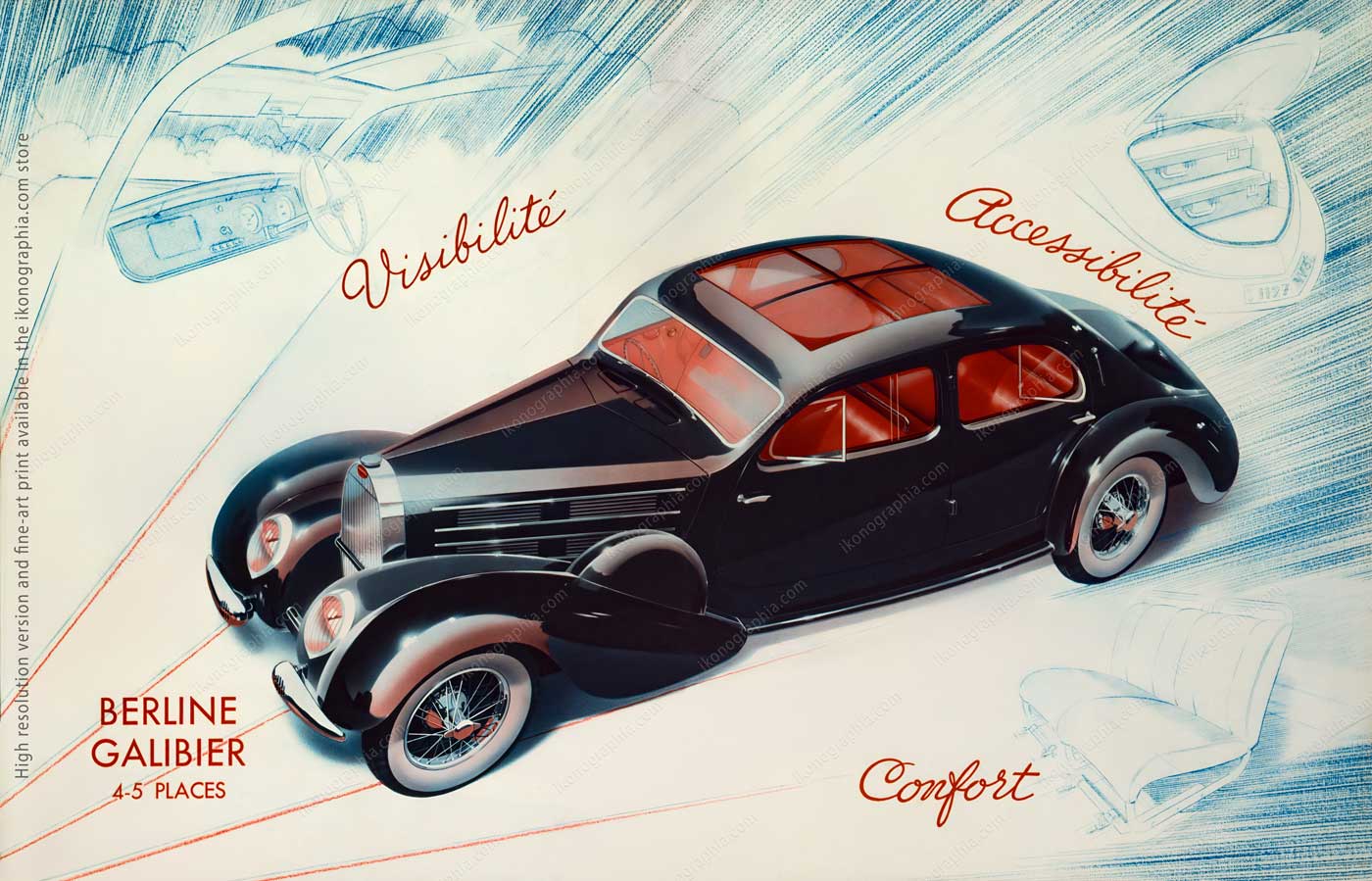
Bugatti Type 57 Modeles 1939

Bugatti Type 57 Modèles 1939. Berline Galibier 4-5 places. Visibilité. Accessibilité. Confort.reet and Regent Street series.

The three words beneath the model name are the brochure's argument in miniature — the same logic that organized the 1936 catalog, compressed into a single line.

The Galibier was the largest body in the Type 57 range. The claims are precise and in the correct order.

Bugatti Posters

Bugatti commissioned its advertising posters from the finest graphic artists of the era — Cassandre, Marcello Dudovich, René Vincent, Geo Ham. The results are among the most celebrated works in automotive poster art. Cassandre's 1935 Le Pur-Sang des Automobiles remains the definitive image of the marque. Dudovich's 1922 C'è una Bugatti, non si passa is a masterpiece of symbolic compression.

The originals were held in the Campogalliano archive. Roberto Bigano borrowed and reproduced them in his studio — the same access that produced the factory drawings. The archive presents the most significant surviving examples, reproduced directly from the originals.
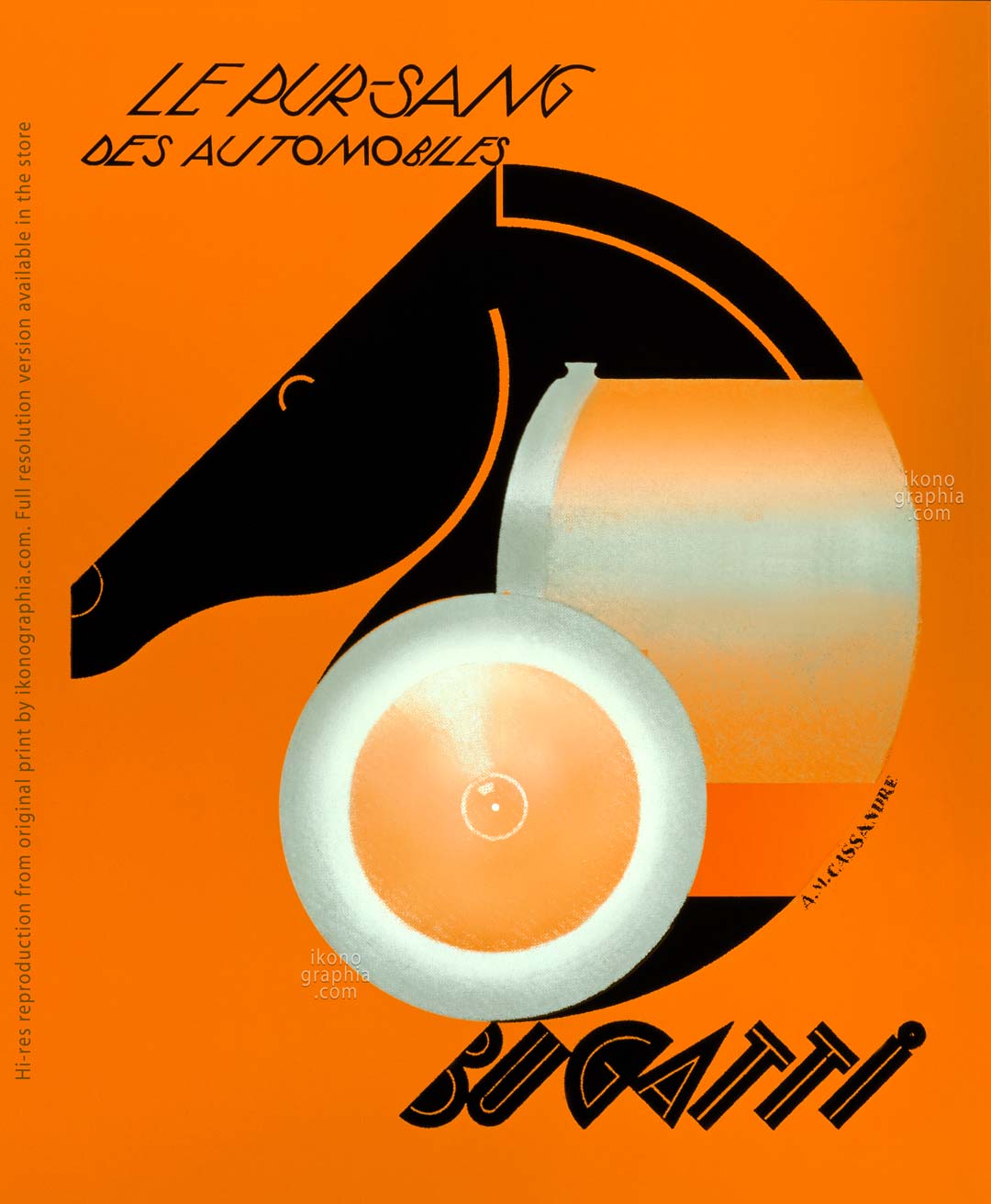
Le Pur-Sang Des Automobiles. Art by Cassandre 1935. An iconic 1935 Bugatti Poster by Cassandre, pseudonym of Adolphe Jean-Marie Mouron.

Le Pur-Sang des Automobiles — Cassandre, 1935.

The image that defined Bugatti's identity for a century — by the greatest poster artist of its time.
Reproduced from the original

C’è una Bugatti, non si passa (There's a Bugatti, you can't pass.) Poster by Marcello Dudovich 1922 Dimensions: 195x140 cm Printer: Edizioni STAR . Officine IGAP, Milano This masterpiece is rich in symbolism, beginning with the title that emphasizes Bugatti's legendary invincibility. The model portrayed is the Type 13 Brescia.

C'è una Bugatti, non si passa — Marcello Dudovich, 1922

A masterpiece of symbolic compression: the title declares Bugatti's invincibility, the red scarf trailing from the figure echoes the death of Isadora Duncan — who died when her scarf caught in the wheel of a Bugatti.

Except that happened five years later. Dudovich was simply ahead of events.
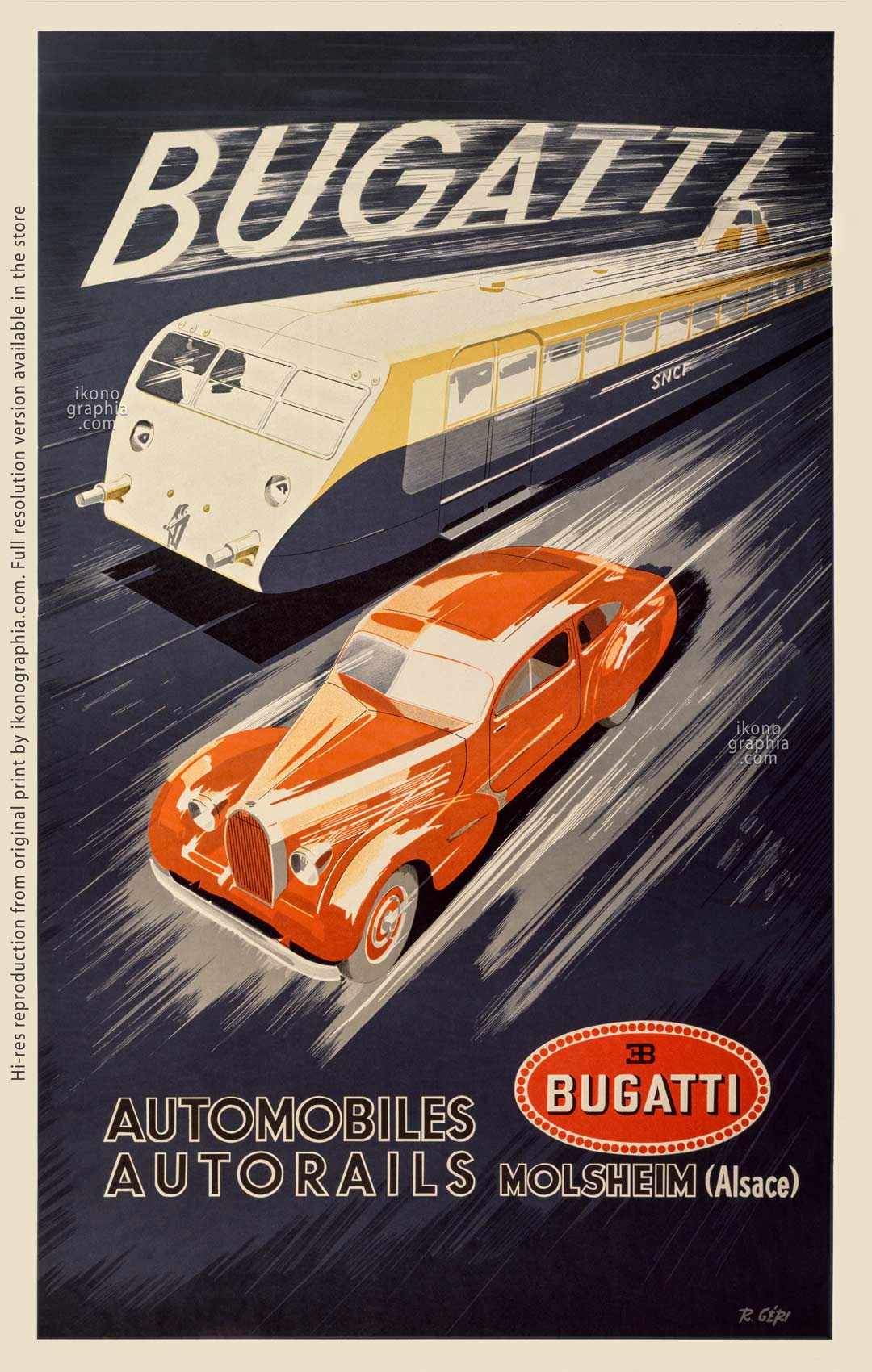
Bugatti Automobiles et Autorails. 1935 - Art by R.Geri

Bugatti Automobiles et Autorails — R. Geri, 1935

One of the rarest original Bugatti posters — printed in Strasbourg by A. Michel on thin paper.
The subject is the Bugatti autorail, the high-speed diesel railcar that Ettore designed for SNCF alongside his automobiles. Geri's full name remains untraced.

The poster is better documented than its maker.
Reproduced from the original.

Divina Bugatti

In 1991, Franco Maria Ricci — the most exacting publisher in Italy — commissioned Roberto Bigano to document the historic Bugatti collection at the Musée National de l'Automobile in Mulhouse.
The resulting book set the visual standard for Bugatti photography. Published in two editions of 5,000 copies each, both sold out.

One image from the session was rejected by Ricci as "not objective." It spent seventeen years in a box. It is now the profile banner of this archive.

The Elephant carved by Rembrandt Bugatti, right on top of the radiator grill of the Type 41 Royale Coupé Napoleon, the personal car of Ettore Bugatti. It was an elephant standing on his back legs, with the erect trunk as a symbol of aggression and coupling (1929) - Courtesy: Musée National de l'Automobile, Mulhouse. Photo by Roberto Bigano. Courtesy: Courtesy: Musée National de l’Automobile Mulhouse. Buy this image at Ikonographia.com store

The Elephant carved by Rembrandt Bugatti, right on top of the radiator grill of the Type 41 Royale Coupé Napoleon, the personal car of Ettore Bugatti.

It was an elephant standing on his back legs, with the erect trunk as a symbol of aggression and coupling (1929).

Courtesy: Musée National de l'Automobile, Mulhouse.

A 1937 Bugatti Type 57SC Coupé Atlantic. Detail of the windshield and wipers emphasizing the riveted crest. Jean Bugatti designed the half-body ending in a crest. He then reverted the first part right-left and finally joined the two pieces with rivets in one of the most daring automotive designs. Photo by Roberto Bigano. Courtesy: British Garage, Paris. Buy this image at Ikonographia.com store

Bugatti Type 57SC Coupé Atlantic — Detail of the riveted crest, 1937.

Jean Bugatti designed the half-body ending in a crest, reversed it, and joined the two halves with rivets — one of the most daring forms in automotive history.

This image and the two Royale photographs were the only non-orthogonal pictures Franco Maria Ricci ever published. He approved them with a stern expression and a warning: "I never publish this kind of image. These are so beautiful that I must. Please don't do it again."

Courtesy: British Garage, Paris

Bugatti Type 35B Sport Two-seater, US Coachwork (1927). Photo by Roberto Bigano. Courtesy: Courtesy: Musée National de l’Automobile Mulhouse. Buy this image at Ikonographia.com store

Bugatti Type 35B Sport Two-seater, US Coachwork — Rear view, 1927.

Purists consider the American coachwork a deviation from the original design.
The photograph disagreed.

Courtesy: Musée National de l'Automobile, Mulhouse.

Bugatti Masterpieces of the 1920s and 1930s

A gallery of the most significant models documented by Roberto Bigano — from the Type 13 Brescia and the Type 35 Grand Prix to the Type 41 Royale and the Type 57 Atlantic. Each model presented with exclusive photography and historical context.
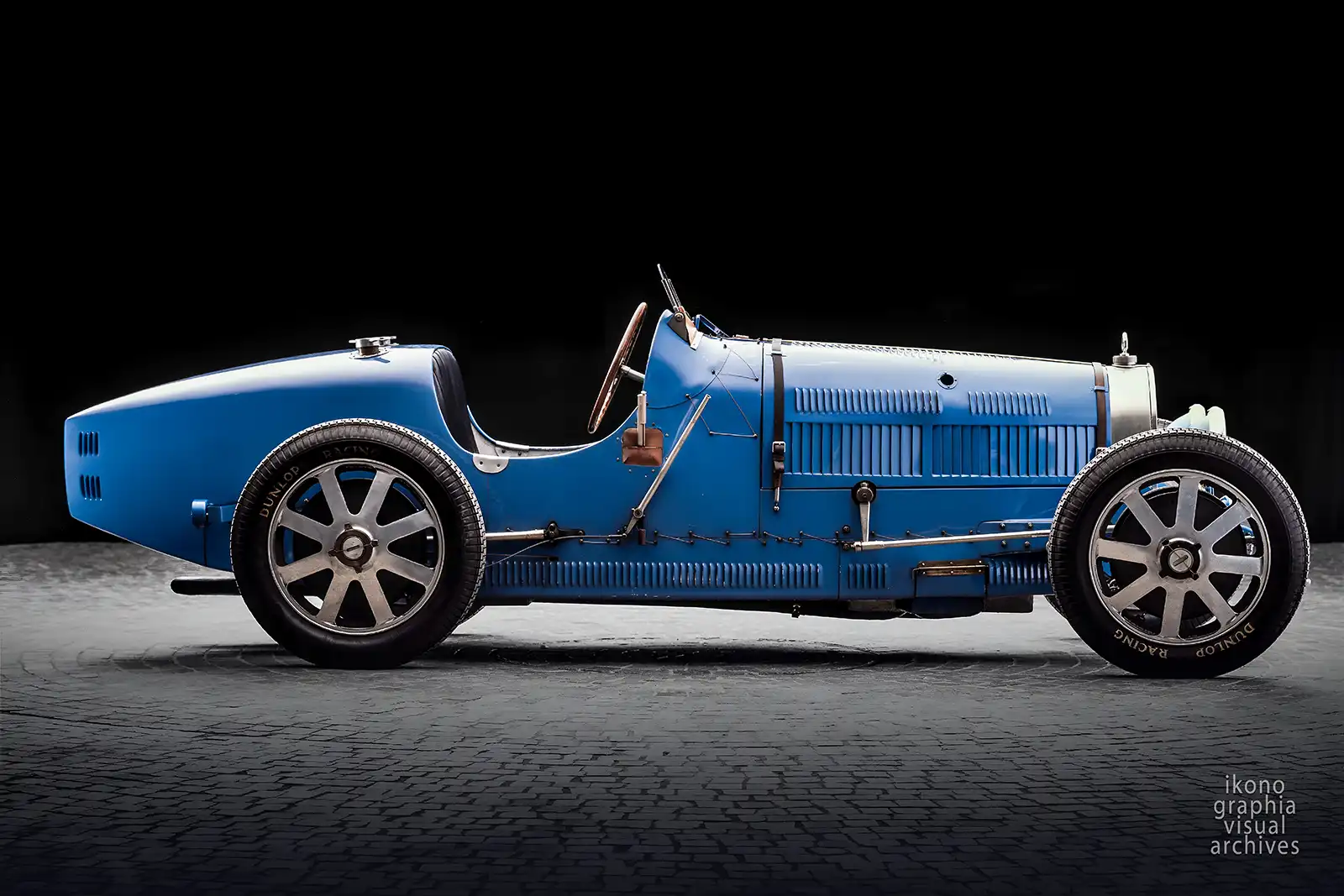
Bugatti Type 35B Grand Prix 1927 — the most successful racing car in history, photograph by Roberto Bigano at Campogalliano.

The Queen of Racing — Bugatti Type 35B Grand Prix, 1927

Produced between 1924 and 1930, the Type 35 was phenomenally successful — over 1,000 race victories, 14 weekly wins at its peak, five consecutive Targa Florios from 1925 through 1929. No racing car of its era approached this record.

Photographed at Campogalliano on the rotating platform of the circular building.
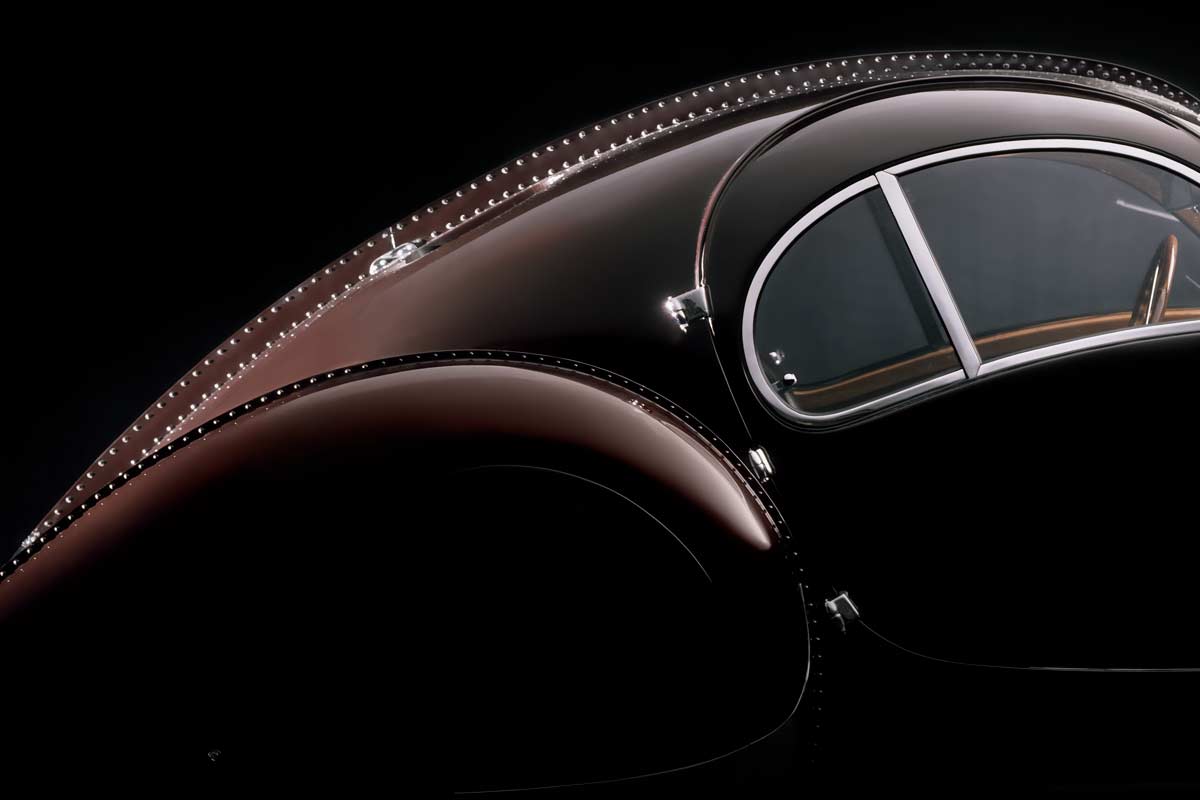
A 1937 Bugatti Type 57SC Coupé Atlantic lightened in silhouette mode to emphasize the flowing coupé lines

Bugatti Type 57SC Coupé Atlantic — Roofline and riveted spine, 1937.

Shot through the night at British Garage, Paris — exhausted, hungry, unable to properly light the riveted crest. My assistant was moving across the set with a Fresnel spot still open. For a moment the light caught the spine exactly as it should. "Stop." The photograph happened.

The dust on the bodywork made it unusable for twenty years, until Photoshop made the restoration possible.

Bugatti Type 32 Biplace Course "Tank" (1923). This striking, unexpected rear view emphasizes the aerodynamics of the design. Photo by Roberto Bigano. Courtesy: Courtesy: Musée National de l’Automobile Mulhouse. Buy this image at Ikonographia.com store

Bugatti Type 32 Biplace Course "Tank" — Rear view, 1923.

One of the first racing cars designed around aerodynamic principles — the body enclosing the wheels, the silhouette a single uninterrupted form.

This rear view reveals the engineering logic: everything hidden, everything intentional. Among the first racing cars to use four-wheel braking.
Courtesy: Musée National de l'Automobile, Mulhouse.

Bugatti Glamour

Four nights of open-air studio sessions during the Centenary celebrations — the historic cars photographed not in a museum but in the hands of their owners, who followed the shoots, helped position the cars, and sometimes stepped in front of the lens themselves.

Roberto Bigano also audio-recorded the owners telling the story of their relationship with the marque. At least four of these recordings are exceptional primary source documents of Bugatti history — among them, the son of the former owner of the silhouetted Atalante.

Bugatti Type 37A, "Flighty" (1928) - Owners, Frederica and Simon Fitzpatrick, Guernsey © Roberto Bigano/ ikonographoa.com Browse the Bugatti Archive https://www.ikonographia.com/archive/the-bugatti-archive/

Bugatti Type 37A "Flighty," 1928. Owners: Frederica and Simon Fitzpatrick, Guernsey.

The Fitzpatricks named and treated their 65 cars as members of the family — from their oldest Bugattis to their latest VW Golf. On the last night of the sessions, Roberto Bigano presented Frederica with a large print of this photograph. She went immediately to show it to the car. "Flighty is enthusiast," she said. Would you sell your son just because he's old?
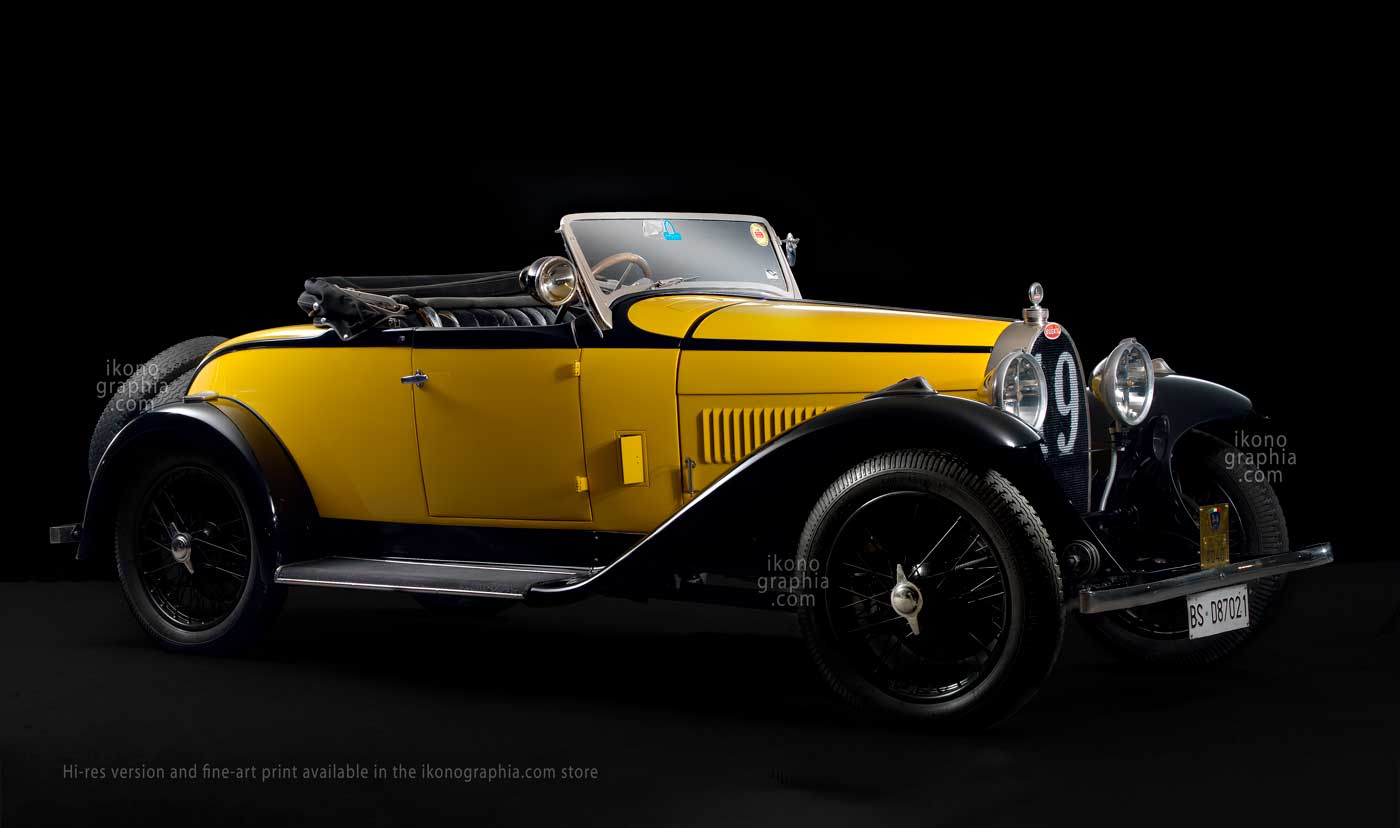
Bugatti Type 40A 1931. Owner Ivanno Frascari, Italy. Photo Roberto Bigano. https://www.ikonographia.com/archive/the-bugatti-archive/

Bugatti Type 40A — Owner: Ivanno Frascari, Italy, 1931.

The yellow and black livery was the factory's own choice — Bugatti's colours from the beginning. Frascari brought it to Castiglione for the Centenary Meeting.

Bugatti Type 57S Atalante 1931 Chassis 001, back view. Owner Franz Wassmer

Bugatti Type 57S Atalante — Chassis 001, 1931. Owner: Franz Wassmer, Switzerland.

Franz Wassmer's father owned the Atalante now held at the Musée National de l'Automobile in Mulhouse. In summer, the car's cabin became unbearably hot. His mother's solution was to rest her feet out of the window. His father's solution was final: "Enlève tes pieds de la fenêtre, sinon je vends la voiture." He sold it.

Franz was a boy. He loved that car. The sale left a wound that decades of ordinary life could not close.

He became a billionaire. He bought Chassis 001.
Roberto Bigano recorded him at Castiglione telling this story. The voice on the recording is not that of a billionaire. It is that of a boy who never stopped wanting his father's car back.

At the Bugatti Glamour Pictures Exhibition, six photographs of his Atalante were on display — he bought all six, buying back every image of what he could not keep as a boy.

This image and the full account were published in Victor, the Hasselblad magazine.

The Bugatti International Meeting — Tuscany, 2009

Developed with the Bugatti Club Italia and supported by Hasselblad and Manfrotto, this archive followed the historic cars through the Centenary celebrations — in motion, in context, in the hands of their owners.

Among its most significant chapters: 120 owners and their cars gathered in Tuscany — on the lawn at Marone-Cinzano, in the medieval piazza of Massa Marittima. The panoramic photograph of that afternoon — 13,000 pixels wide, a single stitched frame — is the most complete document of what the meeting actually was.

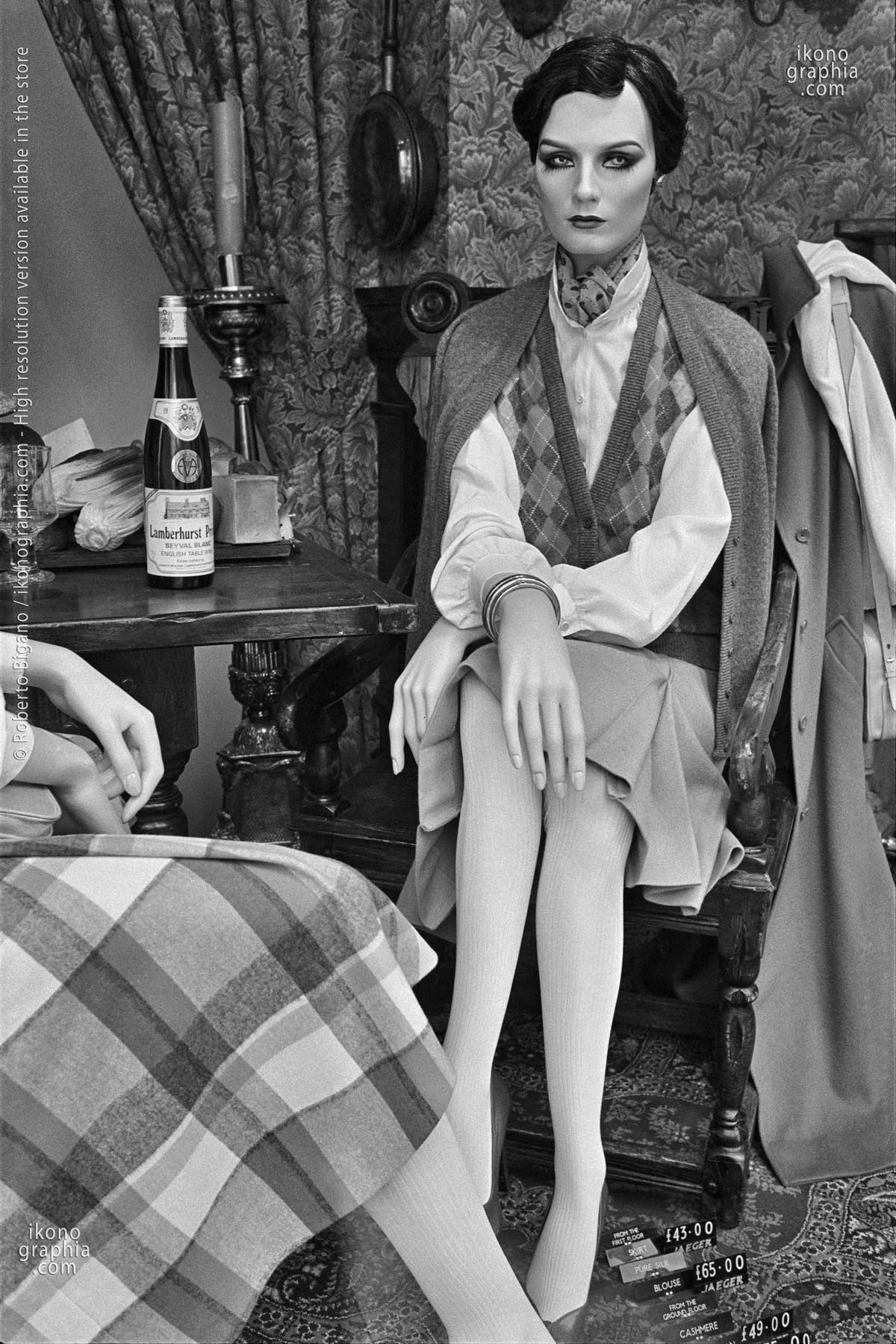
0360-13 Mannequin in a shop window in Braunschweig, Germany, September 1979 | From "Plastic Girls" series. Photo by Roberto Bigano. Buy this image in the ikonographia.com store.

Bugatti International Meeting — Piazza Garibaldi, Massa Marittima, Tuscany, 2009.

One hundred and twenty Bugattis gathered in a medieval piazza in front of a thirteenth-century cathedral. Owners from across the world — Europe, the Americas, Australia.

Detail of Bugatti’s Monobloc Cast Aluminum Wheel drawing, dated July 27, 1932 (Roue Bugatti brevetée en aluminium coulé).

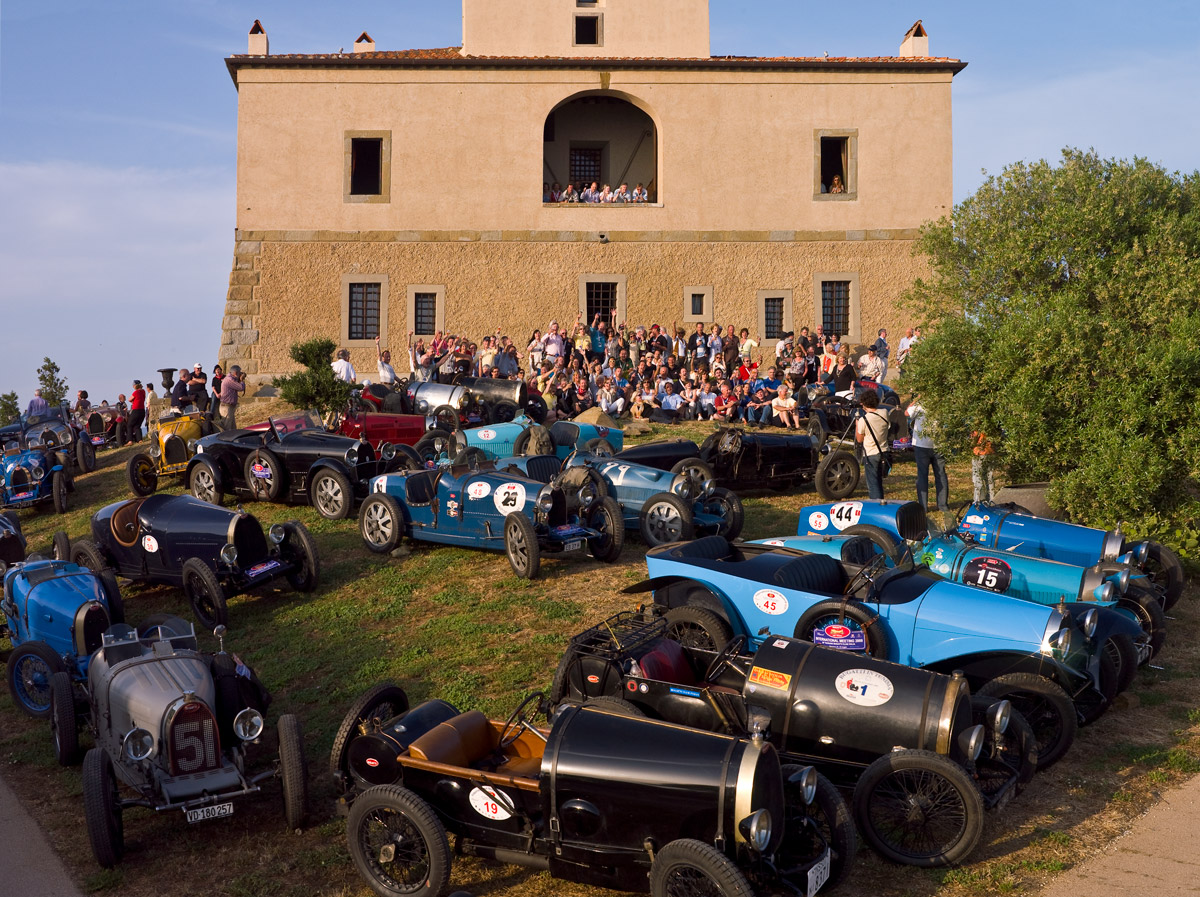
Bugatti International Meeting — Marone-Cinzano Estate, Tuscany, 2009

The Bugatti Centenary. Two hundred and fifty owners gathered from across the world on one of Tuscany's great estates — lunching under the cypresses, Brunello di Montalcino on the table. On the lawn, 125 historic Bugattis on open display: the largest gathering of the marque ever assembled in one place.

Documented from above, stitching multiple Hasselblad frames from a 12-metre tripod into a single panoramic frame 13,000 pixels wide. An event that will not happen again, recorded as it deserved to be.
Bugatti Type 57S Atalante 1931 Chassis 001, back view. Owner Franz Wassmer

Bugatti International Meeting — Castello Colle Massari, Tuscany, 2009.

A stop at a medieval fortress in the Maremma — a toast, the cars clustered on the grass, the owners still laughing. No programme, no ceremony. Just two hundred and fifty people who shared the same unreasonable passion, in one of the most beautiful corners of Tuscany, at the end of a Bugatti day.

A collective portrait that needed no posing.

The Spirit of Bugatti — Alsace, 1990

Before the restoration of Molsheim began, Roberto Bigano documented what remained of the original Bugatti world — the factory, the château, the surroundings — in the last months before Bugatti Automobili's revival would briefly transform it. The horse on the wall of Château Saint-Jean, tangled in dead vines: Ettore's symbol surviving in a building no one was looking after.

Bugatti Type 57S Atalante 1931 Chassis 001, back view. Owner Franz Wassmer

The Portal of Château Saint-Jean — Molsheim, Alsace, 1990.

The entrance to Ettore Bugatti's former headquarters — once the center of an estate with workshops, a hotel, and a way of receiving clients that had no equivalent in the industry. If your car needed attention, you came to Molsheim. You were a guest until it was ready.

Photographed a year before the revival began. The portal was still standing. Not much else was.
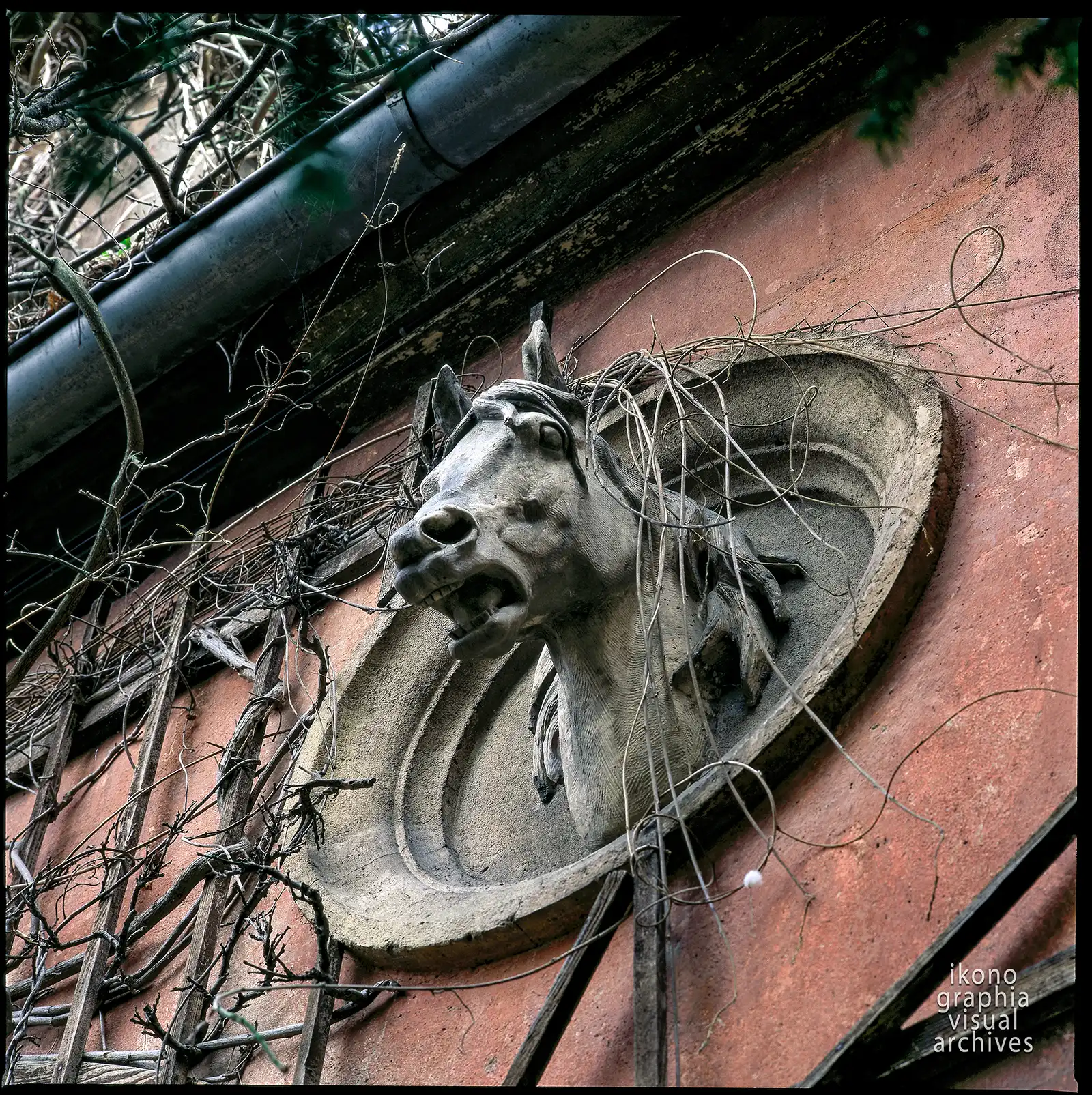
Ettore Bugatti's horse relief — Château Saint-Jean, Molsheim, Alsace, 1990. Photograph by Roberto Bigano.

Château Saint-Jean, Molsheim, Alsace, 1990 — Ettore Bugatti's horse.

Ettore Bugatti bred thoroughbreds at Molsheim with the same obsessive standards he applied to his cars. The horse was his personal symbol — cast into the wall of Château Saint-Jean, the domain's heart, where it had presided over the estate for decades.

By 1990, no one was looking after it. The vines had grown across the facade and through the relief itself, threading through the stone as if reclaiming it. The building was between two lives.

The image was never published. The rebirth of the brand was already being planned. This was its symbol, waiting on the wall. Nobody saw it that way.

Copyright, Links And Credits

Photography, Copyright & Credits

These images are part of the Ikonographia Visual Archives: — Bugatti Heritage Collection —  Bugatti Factory Drawings  Archive.
All drawings reproduced by Roberto Bigano in 1990 from originals held in the Bugatti factory archive. The current location of the originals is unknown.
All photographs © Ikonographia / Roberto Bigano — All Rights Reserved.

Terms of Use (Summary)

The images presented in this archive are copyrighted and available for licensed use only through Ikonographia Visual Archives.

You may not download, reproduce, publish, or distribute these images without a valid license. For commercial or editorial licensing, please refer to the product pages or contact Ikonographia directly. A full explanation of licensing terms is available in the Shop / Licensing Information section under "Ikonographia — Standard License" and "Ikonographia — Merchandising & Product Use Licenses"

The Ikonographia Bugatti Heritage Archive

Between 1990 and 2009, photographer Roberto Bigano documented Bugatti with a level of access that no longer exists and cannot be replicated. The relationship began with Romano Artioli — the Italian entrepreneur who had just acquired the Bugatti name and was preparing its revival at Campogalliano — who gave Roberto carte blanche to work inside the factory, the archive, and every event that followed. No brief. No restrictions. No supervision.

What resulted is not a single project but five distinct bodies of work: the factory technical drawings reproduced before they disappeared, two major photographic commissions on the historic cars, a complete documentary record of the Bugatti International Centenary Meeting in Tuscany, and an Alsatian reportage made inside Molsheim before the restoration began. Together they form one of the most complete private archives of Bugatti heritage in existence — most of it unpublished until now, some of it available nowhere else.

The archive is not a celebration of the marque. It is a record made by someone who was trusted enough to be inside it, at the precise moment when its past and its future were in the same room.

Credits & Acknowledgments

Ikonographia gratefully acknowledges the fundamental contribution of Romano Artioli, founder of Bugatti Automobili, without whose trust and unrestricted access this archive would not exist.

Ikonographia Mission Statement

Ikonographia is committed to the accurate documentation, preservation, and ethical dissemination of twentieth-century visual culture.

Archival Notes

These drawings were reproduced by Roberto Bigano in 1990, during the preparation for the revival of Bugatti Automobili at Campogalliano. Access to the Bugatti factory archive was granted by Romano Artioli. The drawings document the original Molsheim factory production.

Further Reading (Selected Sources)

Ten Buildings — Ten Masterpieces of New York Art Deco

Ten Buildings — Ten Masterpieces of New York Art Deco

Ten Buildings — Ten Masterpieces of New York Art Deco

The decorative programs of Art Deco Manhattan — photographed in full and documented to primary sources.

Between 1924 and 1939, a generation of architects, sculptors, and metalworkers transformed the commercial lobbies of Manhattan into complete symbolic environments. From gilded bronze to cast aluminum, from polychrome mosaic to terrazzo — materials and techniques that redefined what a lobby could say. Ten buildings document the full range of that achievement: from the first Art Deco motif on an American building to the most ambitious iconographic program ever cast in bronze.

Oscar Bach aluminum bas-relief, Empire State Building lobby, New York, 1931. Machine Age map with celestial rays. Photographed by Roberto Bigano.

This page brings together ten of Manhattan's most significant Art Deco interiors — each documented in sequence, in context, and against the primary sources that define it. Some stories are complete. Others are in progress. Most images are available now.

The archive was built in March 2024, when Roberto Bigano spent five weeks inside sixty-five Manhattan buildings. Documentation is selective, not exhaustive — from the virtually complete record of the Fred French lobby to a single photograph of one absolute masterpiece. Twenty-three photographs — 32 pages and a cover — were published in FMR Magazine.

Edgar Brandt and Cheney Silk — Madison Belmont Building, 1924

First American Art Deco

This is not an Art Deco building. It is here because of one object — the frozen fountain at 181 Madison Avenue. The first application of Art Deco on an American building. The most recognizable. The most influential.

The fountain was designed by Edgar Brandt — the foremost ironworker in France — and commissioned by the Cheney Brothers Silk Company for the building's first three floors. The motif, stylized water cascading in symmetrical curves, originated in Brandt's monumental gate at the 1925 Paris Exposition. The building itself was not in the new style.

The decoration was the exception — and became the symbol.

Full documentation coming to the NYC Art Deco Archive. Story forthcoming.

Frozen Fountain Decoration, inspired by Edgar Brandt's gates, exhibited at the 1925 Exposition in Paris. Madison Belmont Building, 183 Madison Avenue

Edgar Brandt's Frozen Fountain — Madison Belmont, New York, 1924

The frozen fountain motif on the Madison Belmont entrance was designed by French iron master Edgar Brandt. The motif — stylized water cascading in symmetrical curves — originated in Brandt's monumental gate at the 1925 Paris Exposition.

Here, in wrought iron with gold and bronze accents, it became the first major application of what would later be called Art Deco on an American building. The building itself was not in the new style. The decoration was the exception — and became the symbol.

The City of Opportunity — Chanin Building, 1929

New York, 1929 — A City at its peak, casting its ambitions in bronze.

Completed in 1929 at the height of New York's Jazz Age construction boom, the Chanin Building stands as one of the most intellectually ambitious expressions of American Art Deco. Its façade is admired, its lobby celebrated — but its most fully argued artworks are found in the vestibule: eight monumental gilt-bronze radiator grilles, conceived as a symbolic cycle of human development.

René Paul Chambellan and Jacques Delamarre encoded the stages of human development in pure geometric abstraction. The program was admired for nearly a century without being fully understood.

The key was a 1929 article in Architectural Forum in which Jacques Delamarre explained the complete iconographic logic at the moment of completion. The article existed. It was buried, unrecognized, unconnected to the grilles. Ikonographia identified it, paired it with high-resolution photography that makes the relief legible, and reconstructed "The City of Opportunity" as a complete iconographic cycle — for the first time.

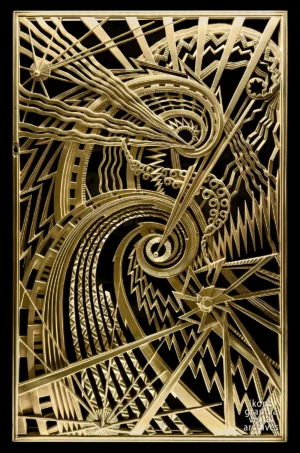
Art Deco Allegory of Effort — gilded bronze grille by René Paul Chambellan, Chanin Building vestibule, New York, 1929.

Effort.
The struggle against resistance.
From "The City of Opportunity — Physical Series."

Here, spirals tighten, diagonals collide, and curves appear compressed, as if bearing weight. The composition visualizes the tension between aspiration and the obstacles that define it. Effort is the architecture of perseverance.

bule, New York, 1929.

Success.
The reward of sustained action.
From "The City of Opportunity — Physical Series."

Symmetry returns, crowned with a radiant rising form. Success is rendered not as excess but as order — the balanced resolution of struggle. Spirals unfurl, energy flows upward, and the pattern resolves into harmony.

When Babylon Met Fifth Avenue — Fred French Building, 1927

One architect's obsession with ancient Babylon. One sculptor's mastery in bronze. A New York landmark unlike any other.

Completed in 1927, the Fred F. French Building stands as one of Manhattan’s finest expressions of the early Art Deco-Babylonian hybrid style.

While the tower is admired for its stepped crown and gilded ornament, its most exceptional artworks lie in the lobby, conceived by Douglas H. Ives and realized by sculptor Vincent Glinsky and master metalworker Oscar Bach: eight bronze elevator panels, a monumental mailbox, and a complete bronze decoration program.

The lobby contains one of the most complete bronze programs in American Art Deco — eight gilded elevator panels, a monumental mailbox that compresses the entire symbolic argument of the building into a single object, and an entrance relief of allegorical figures dense with ancient Near Eastern imagery. Conceived by Ives, sculpted by Glinsky, cast by Bach.

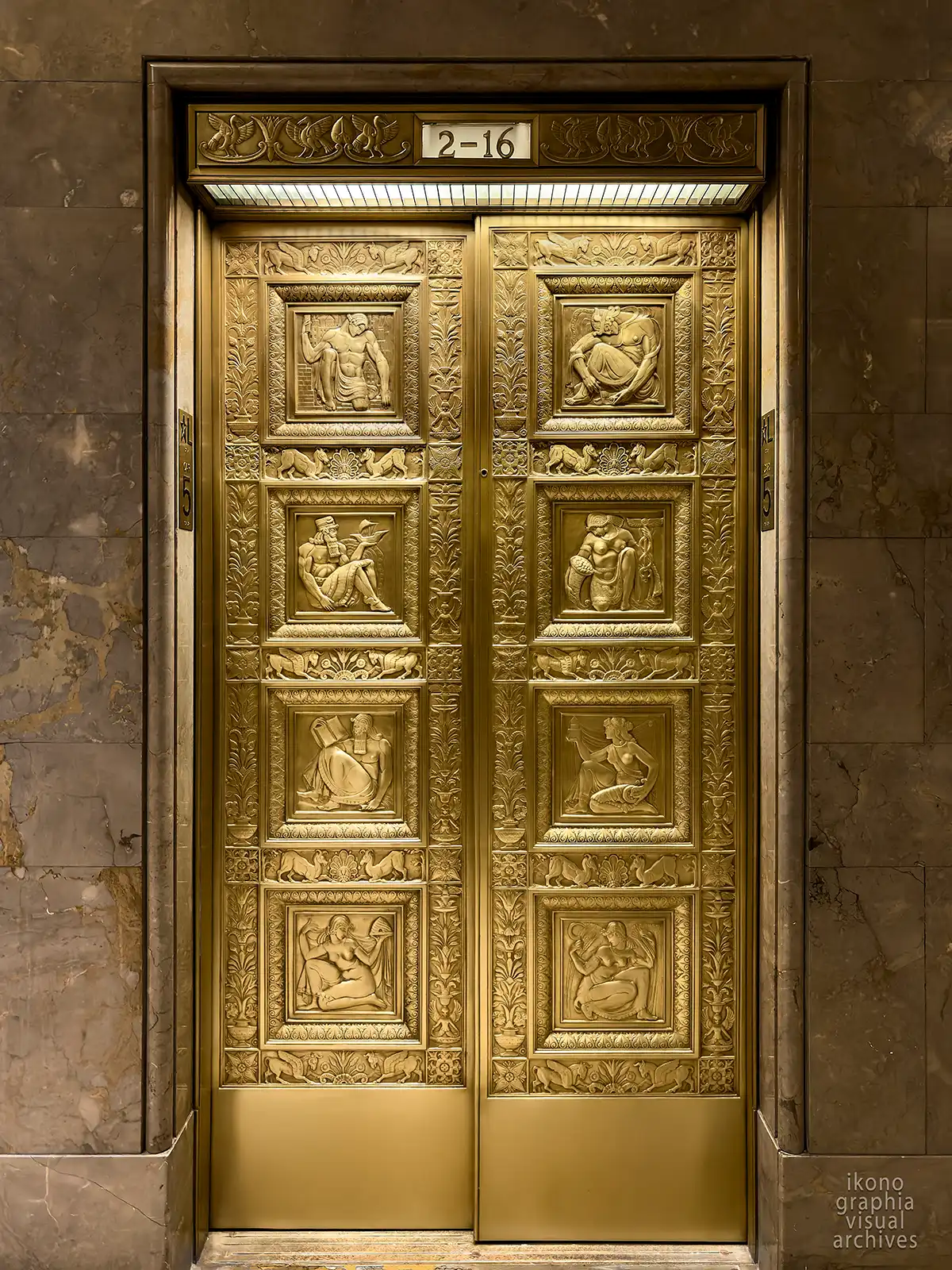
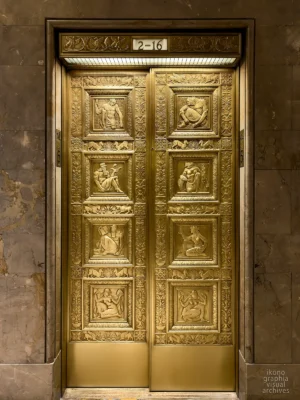
The Symbolic Program — Elevator Doors, Fred French Building, New York, 1927.

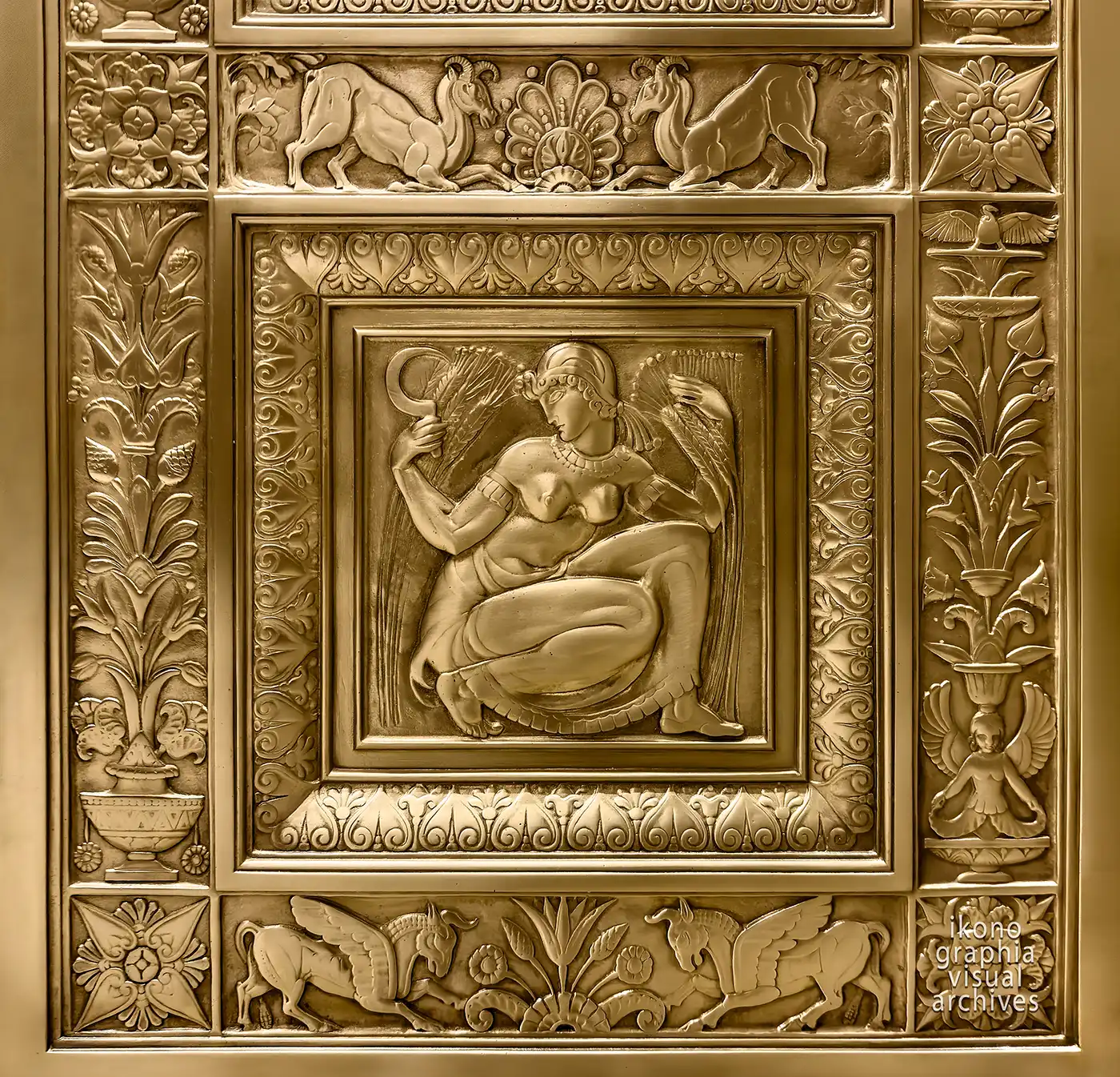
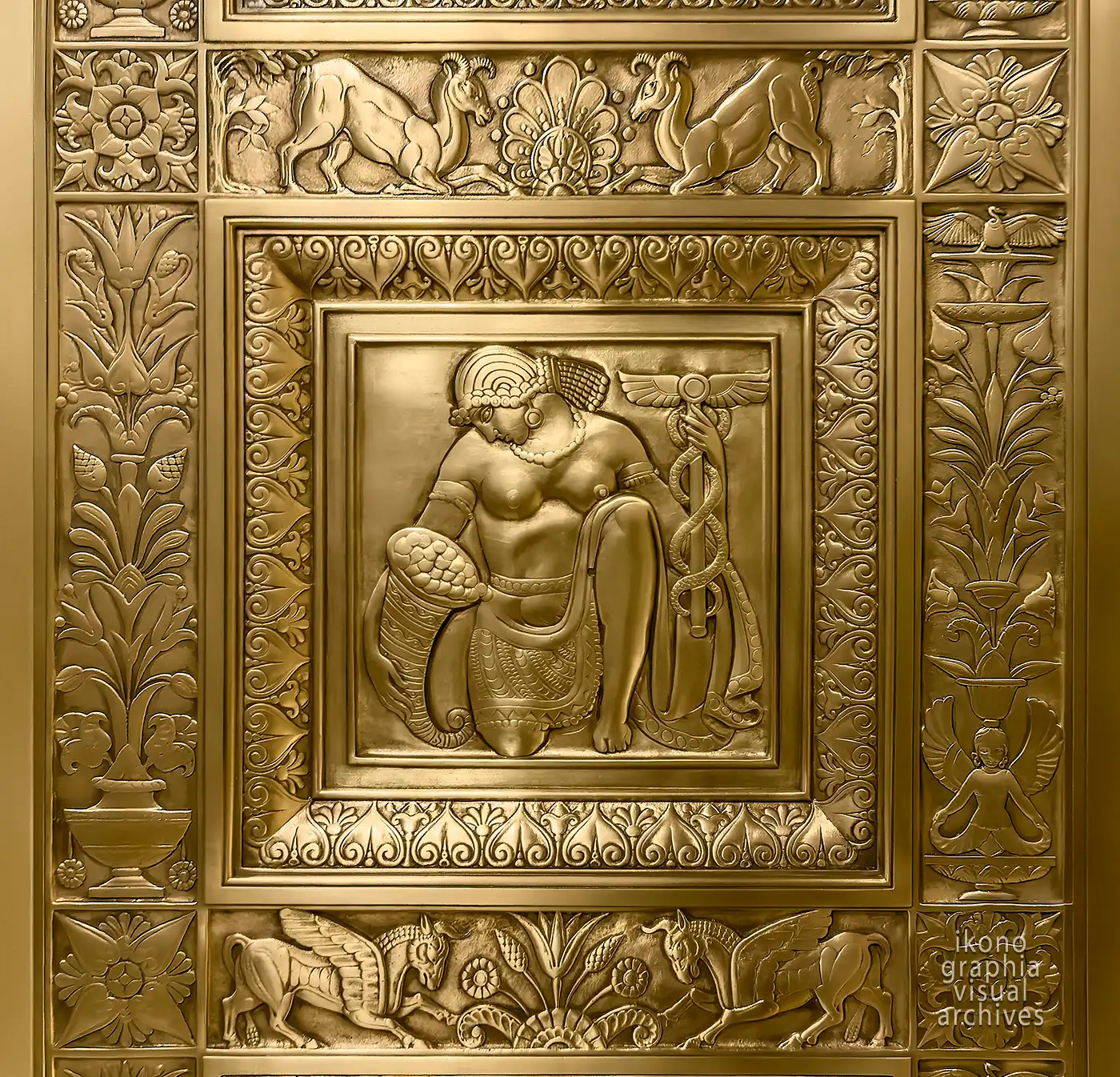
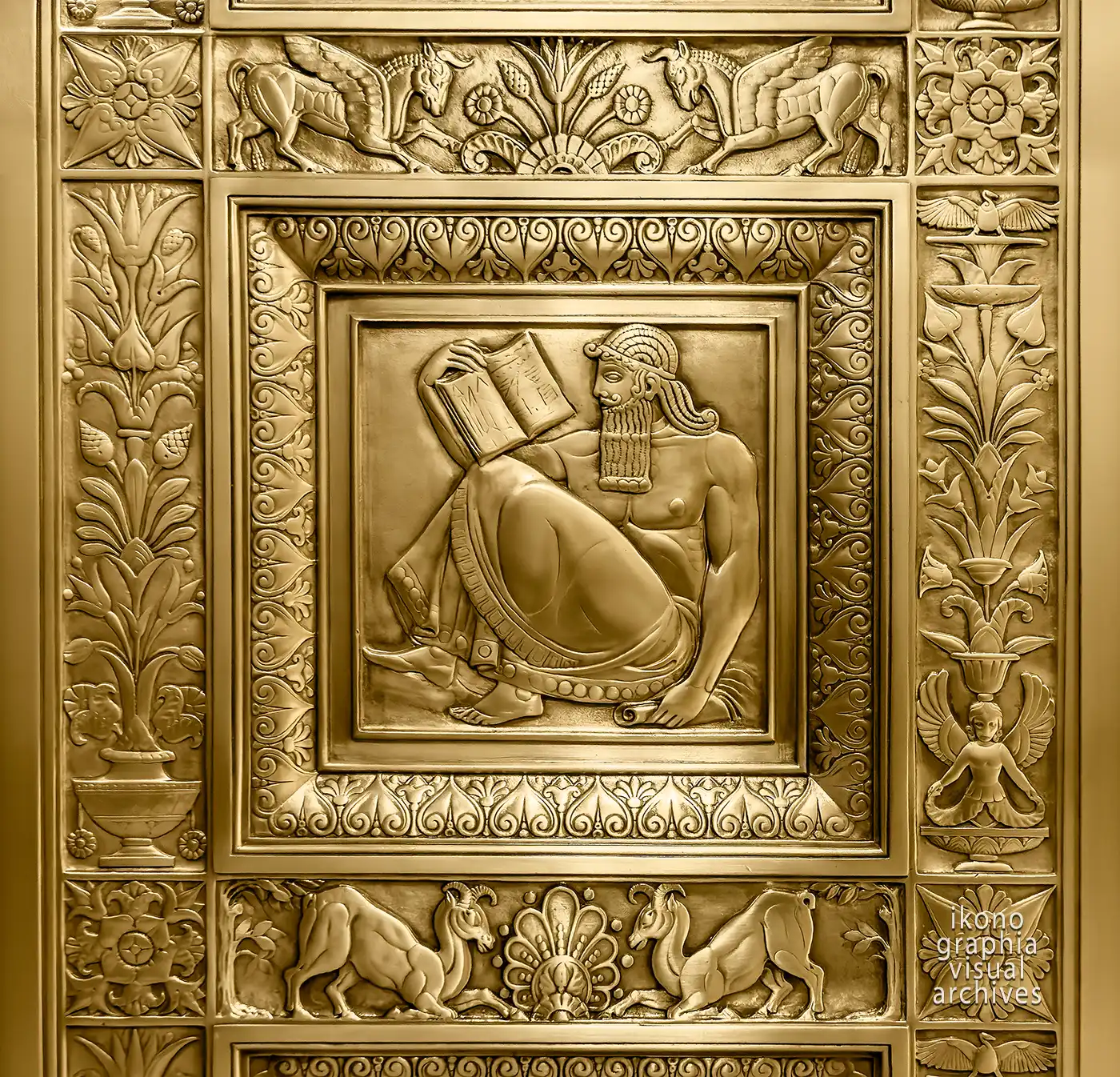
A complete symbolic program:
Commerce, Industry, Finance, and Building.

The eight gilded panels of the Fred French Building lobby — a sculptural cycle honoring the forces that powered New York's 1920s rise.

The arrangement is graphically balanced, not thematically ordered: the eye moves across figures and ornament before resolving into program. Ives's logic reveals itself slowly — four themes, eight figures, one coherent argument about what a city is and what sustains it.

The most complete Mesopotamian-themed decorative cycle in American Art Deco.

ELevator Doors

These elevator doors visualize the four pillars of Fred F. French’s real-estate empire—Industry, Commerce, Finance, Though allegorical, the imagery was designed for instant legibility. These were the forces shaping New York in the 1920s: the labor that built the skyline, the commerce animating Fifth Avenue, the financial system behind every development, and the architectural vision that defined modern urban life.

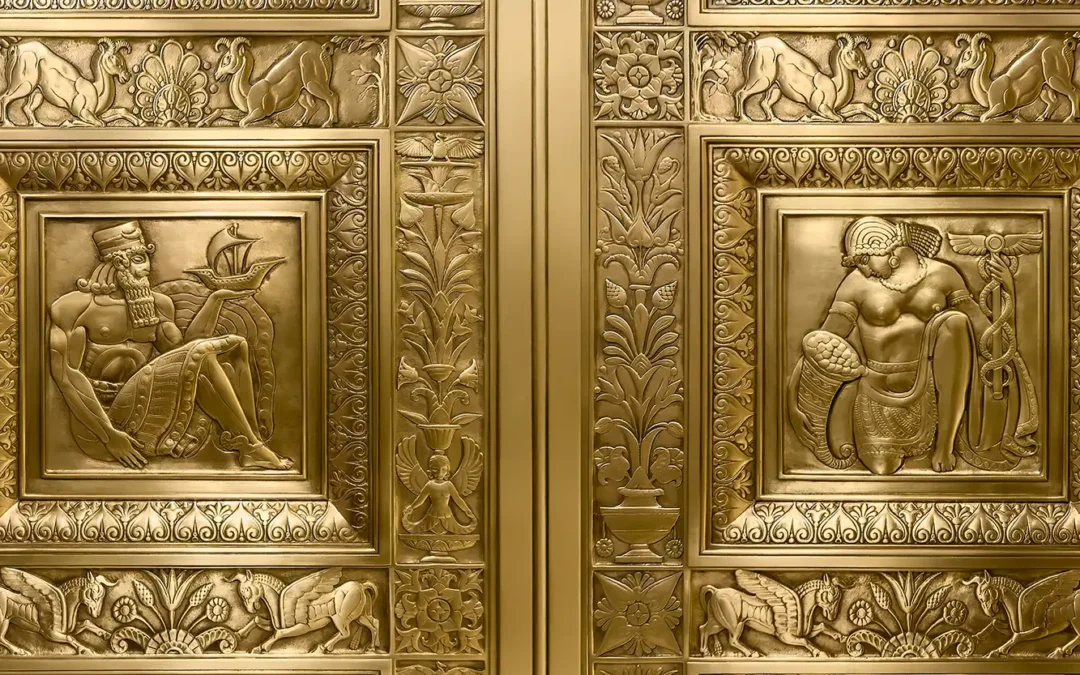
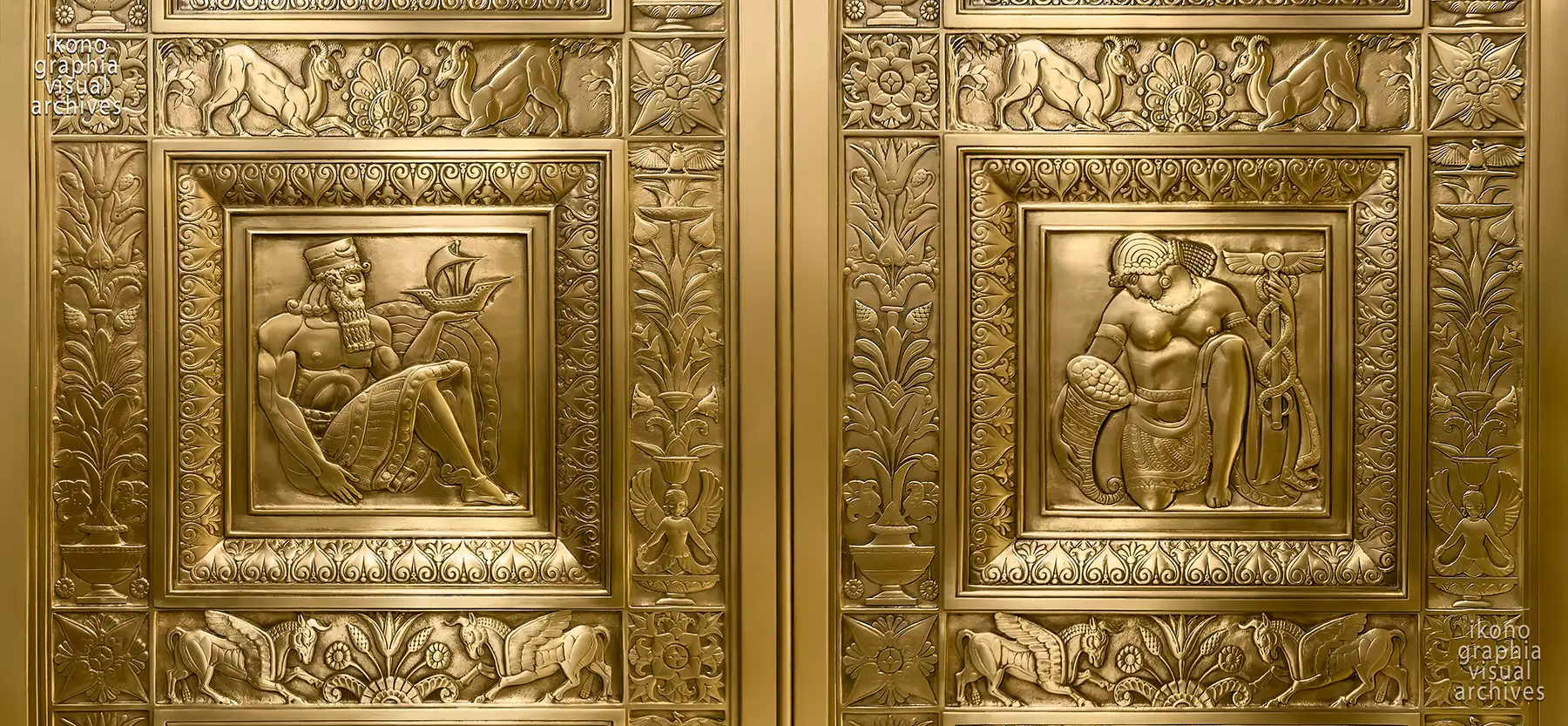
Allegories of trade and prosperity — Art Deco Elevator Panel, Fred French Building, New York, 1927 — Glinsky & Bach

Fred French Elevator Panels — Art Deco allegories of trade and finance

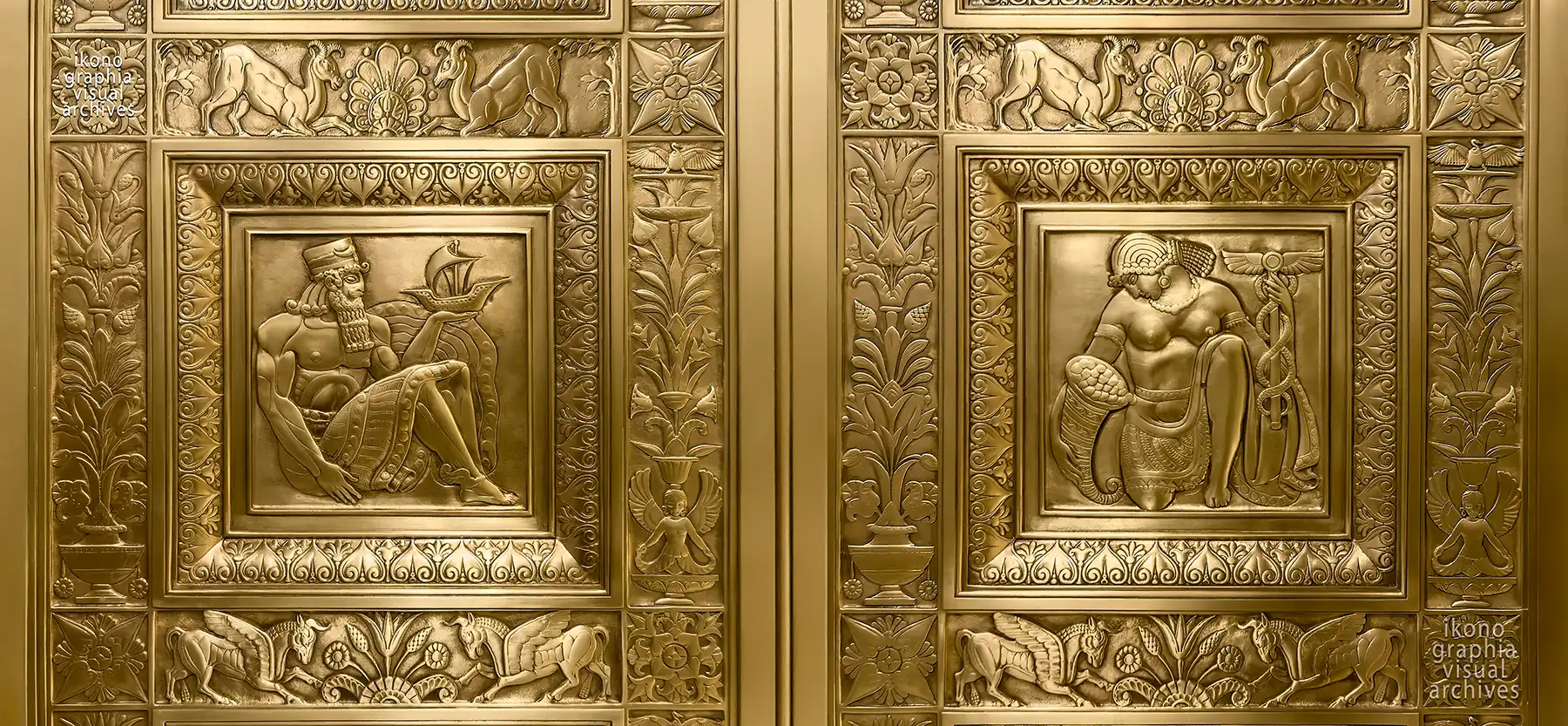
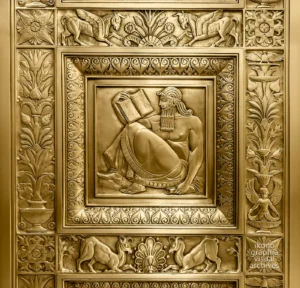
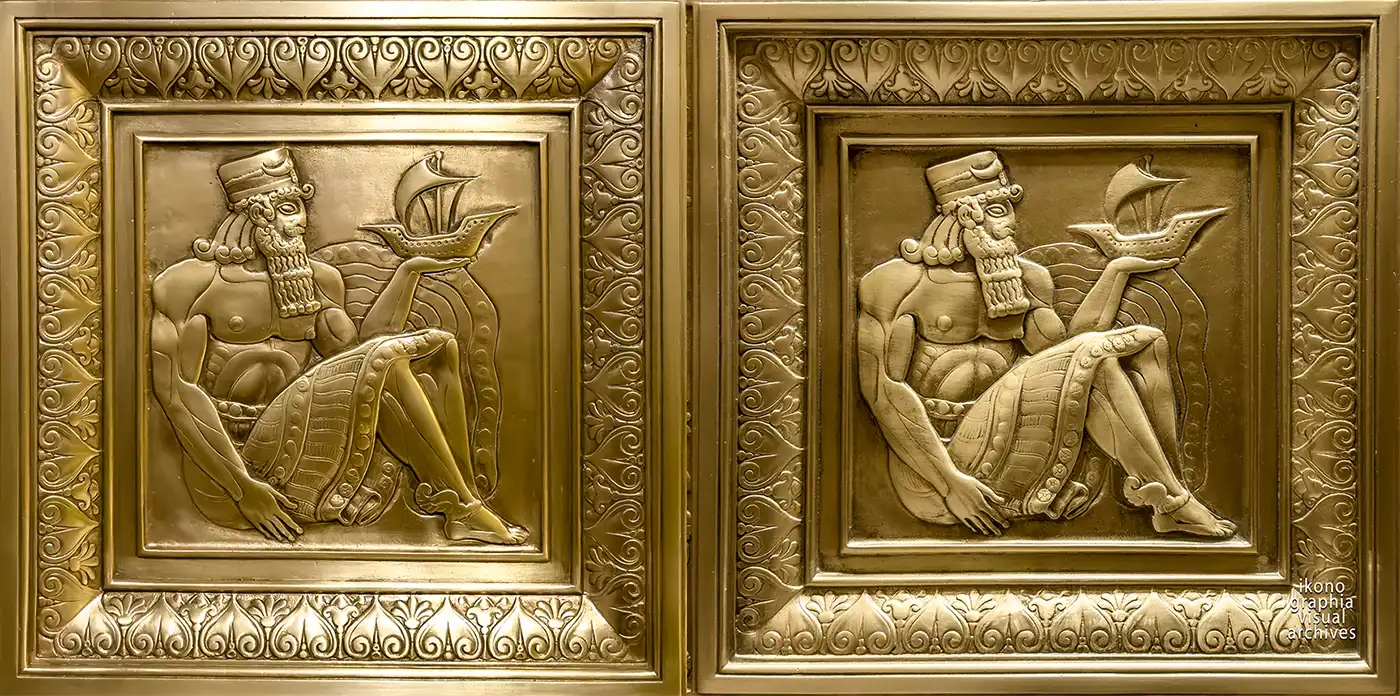
The Merchant, Commerce — Symbolizing maritime trade and international exchange.
The Wealth Bearer, Finance — Symbolizing prosperity generated through investment and trade.

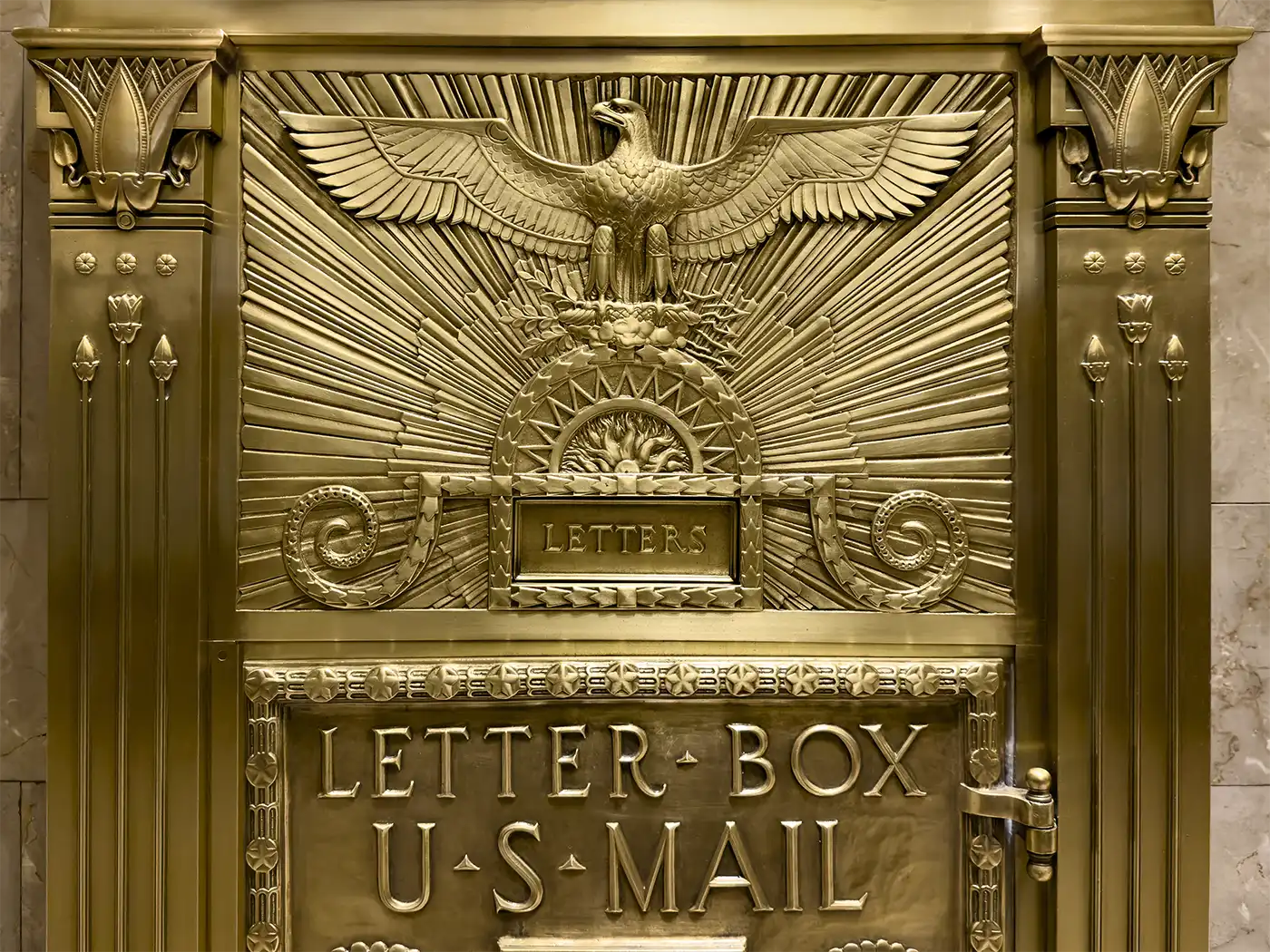
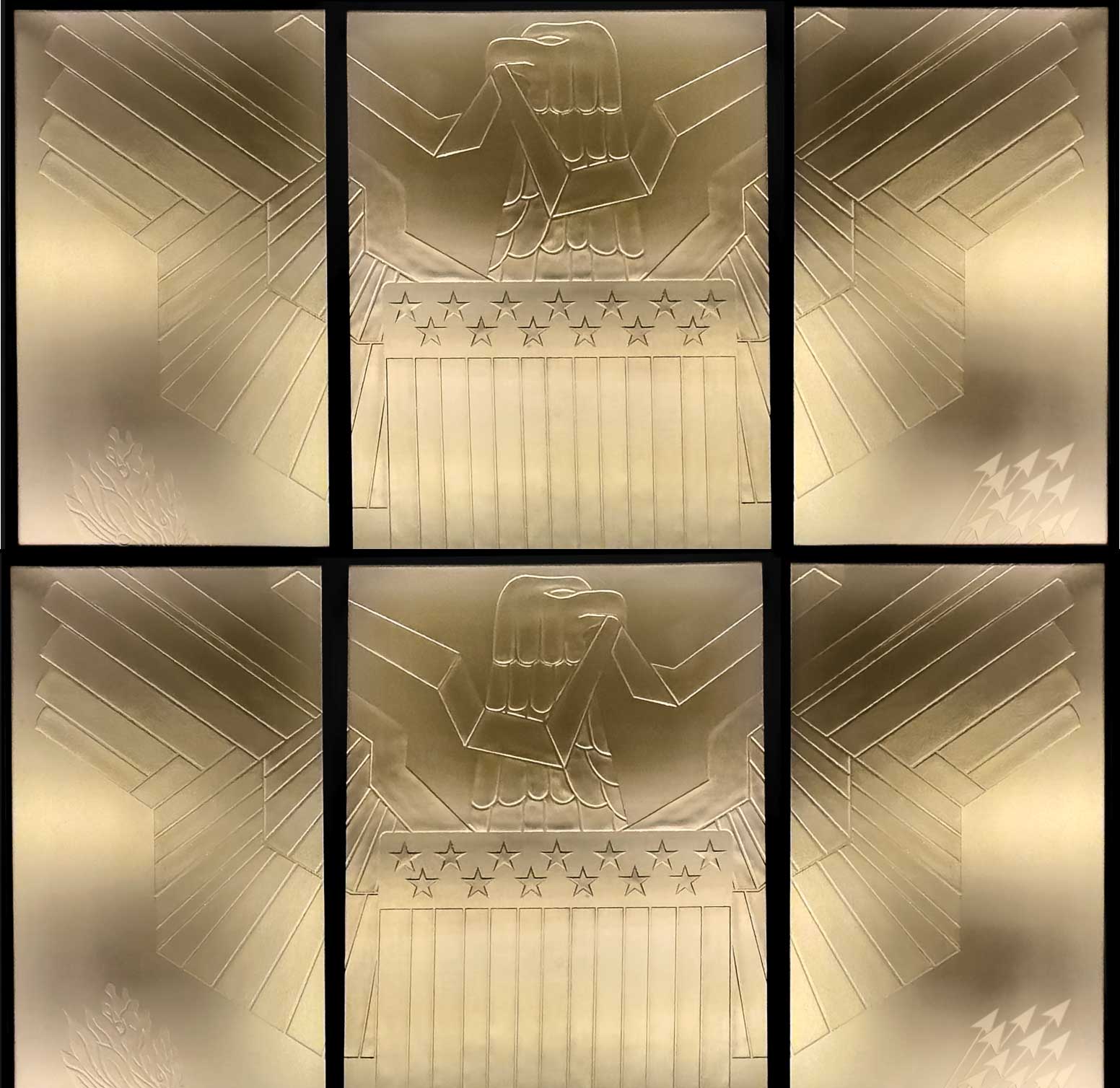
The Eagle and the Sunburst — Crowning Element.

The American eagle with outstretched wings, set against radiating sunburst rays. At this distance the precision of Bach's metalwork becomes visible — the feathering, the geometry of the rays, the weight of the form against the flat ground. National symbol and ancient ornament in a single casting.

The Mailbox

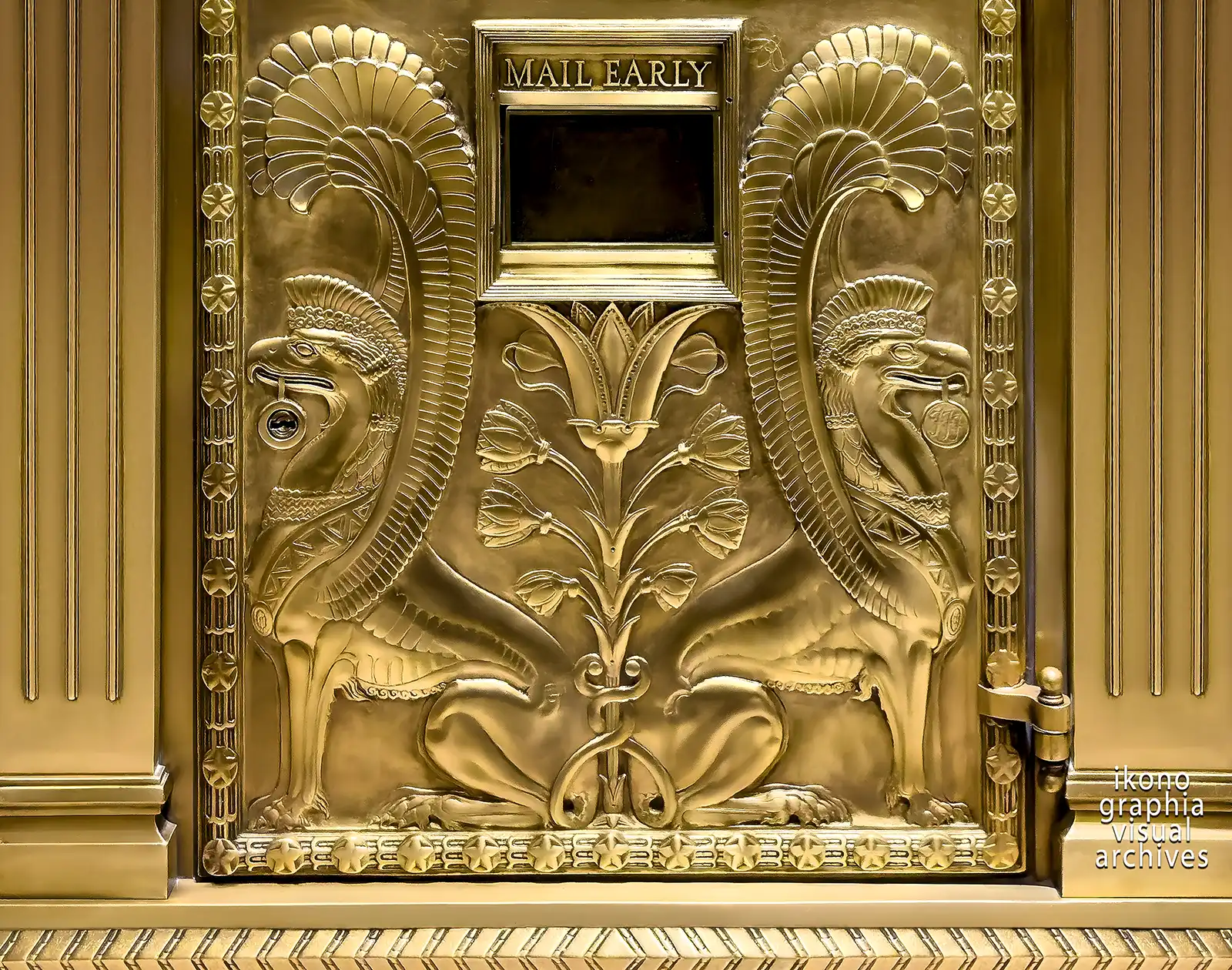
At the center of the lobby stands a gilded bronze mailbox — and it says everything twice. A monumental American eagle crowns the composition, wings spread against radiating sunburst rays. Below it, paired Babylonian griffins flank the slot — not as ornament, but as allegory: they are the eagles, translated into the visual language of ancient Mesopotamia. One of them grips a medallion bearing the Fred French Company monogram in its beak.

National symbol and ancient mythology. The same statement, in two languages simultaneously. In a single object, the entire symbolic program of the lobby — compressed.

Babylonian griffins and Tree of Life, lower panel, gilded bronze mailbox, Fred French Building, New York, 1927. Artwork by Vincent Glinsky, metalwork by Oscar Bach, program by Douglas Ives. Photographed by Roberto Bigano.

Glinsky made Babylon and America speak the same visual language.

Paired Mesopotamian griffins flank a stylized plant motif on the lower panel of the mailbox. The griffin on the right bears a medallion with the Fred French company logo — corporate identity seamlessly integrated into ancient iconography.

The creatures' muscular forms and precise geometric borders echo Assyrian palace reliefs, connecting 1920s New York commerce to the authority of ancient empires.

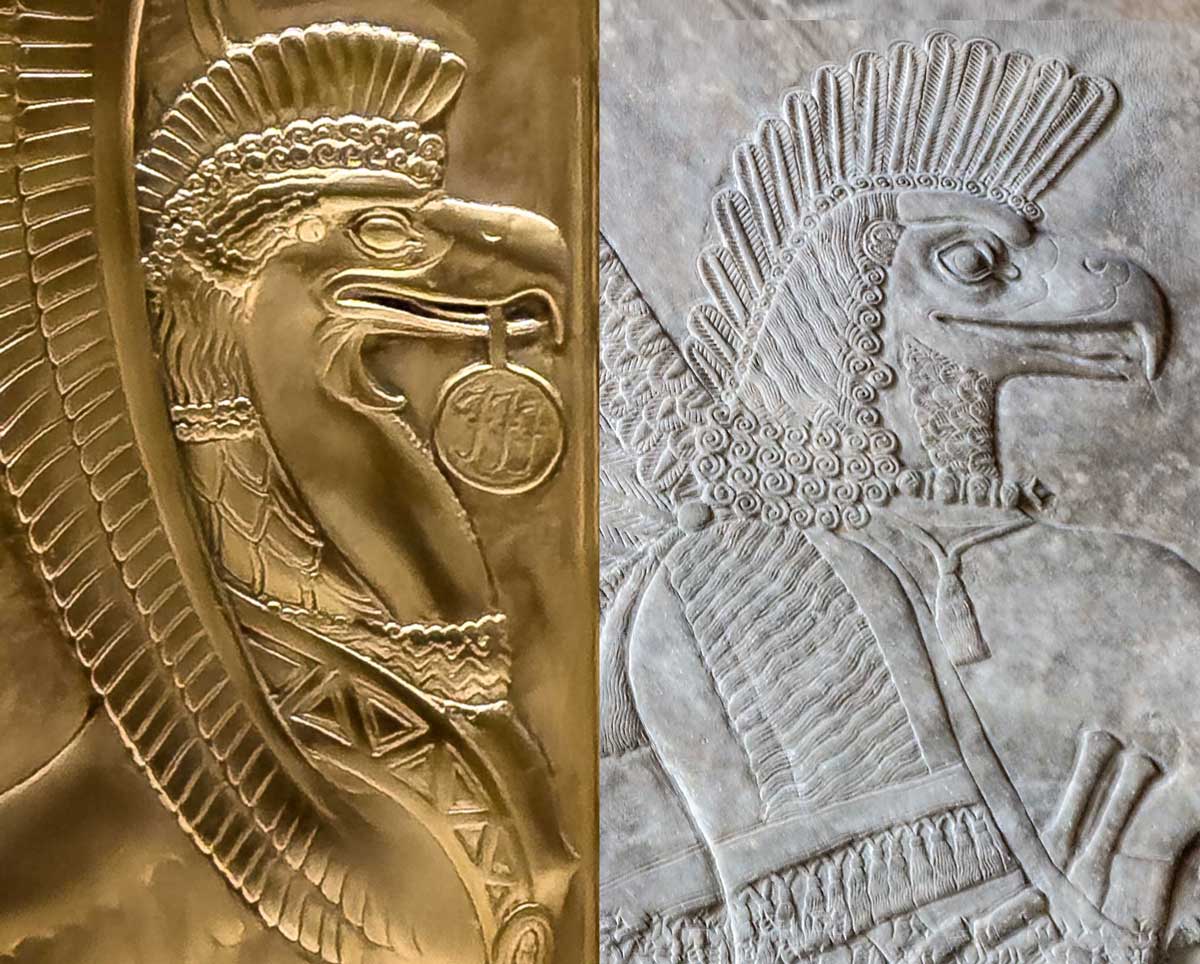
The Same Creature — Fred French Griffin and Assyrian Relief, 4,000 Years Apart

The griffin on the Fred French mailbox and its source on the Assyrian relief at the Pergamon Museum — the same feather treatment, the same headdress, the same profile. Glinsky did not adapt the form.

He quoted it directly, in gilt bronze, on Fifth Avenue, gripping a medallion with the Fred French Company monogram in its beak. Four thousand years and six thousand kilometres apart. The comparison is exact.

The Mesopotamian Connection

Ives's obsession with ancient Babylon was not aesthetic preference. It was research. The Ishtar Gate — excavated from Babylon and reconstructed in Berlin's Pergamon Museum in the early 1900s — provided the direct visual sources for the lions, dragons, and decorative borders throughout the building. Ives and Glinsky were not inventing an exotic style. They were quoting one of the oldest monumental gateways in human history, in gilt bronze, on Fifth Avenue.

The Fred French Building, New York City. The vestibule of the entrance from 45th Street, as seen from the elevator lobby. 1927

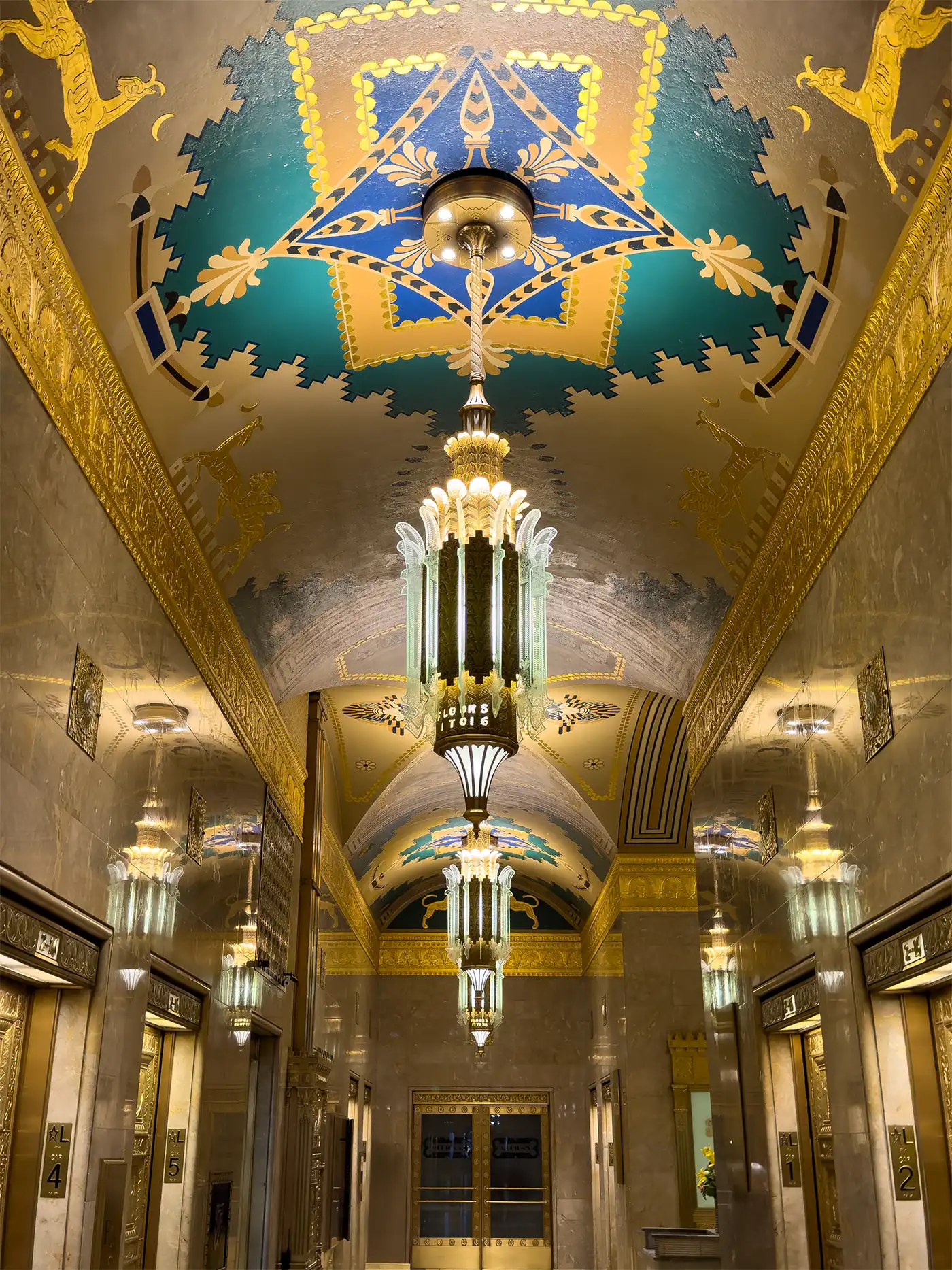
The Vaulted Ceiling — Ishtar Gate Creatures in Gold and Color

The barrel-vaulted ceiling of the Fred French Building lobby — Babylonian lions, dragons, and winged griffins painted in gold, blue, and vivid color. The same creatures Ives found in the Ishtar Gate, placed above the bronze program that quotes them below. Every surface in the lobby speaks the same language.

A Machine Age Altar — Empire State Building, 1931

A building at the center of the world

In 1931, the Empire State Building was the tallest structure ever built — 102 floors, 443 meters, constructed in 410 days at the depth of the Great Depression.

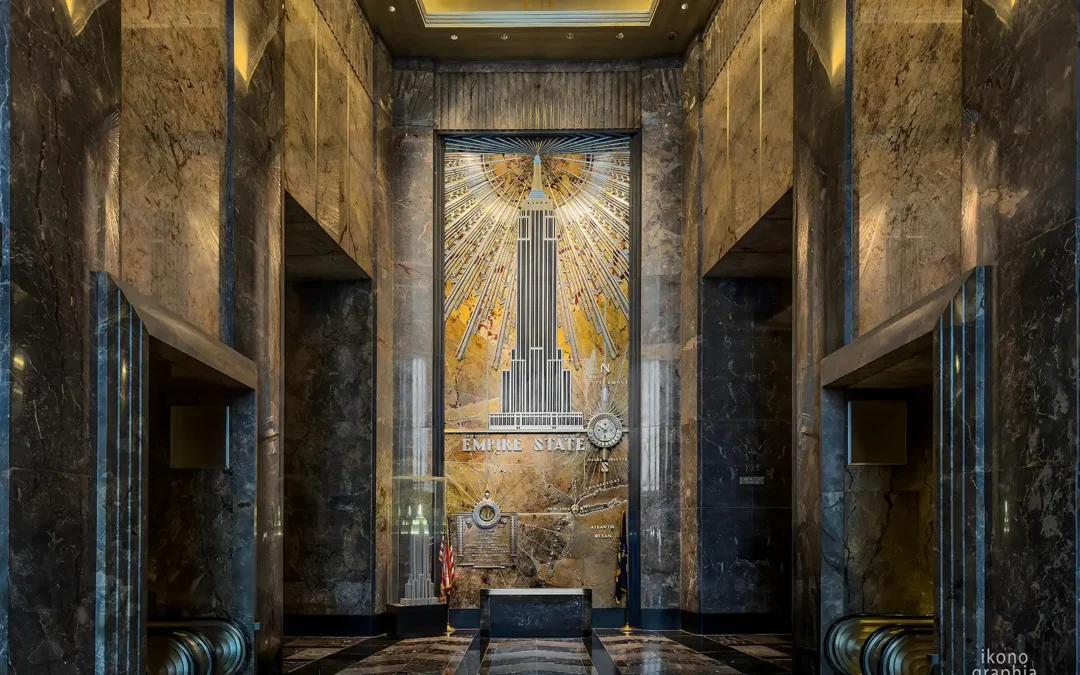
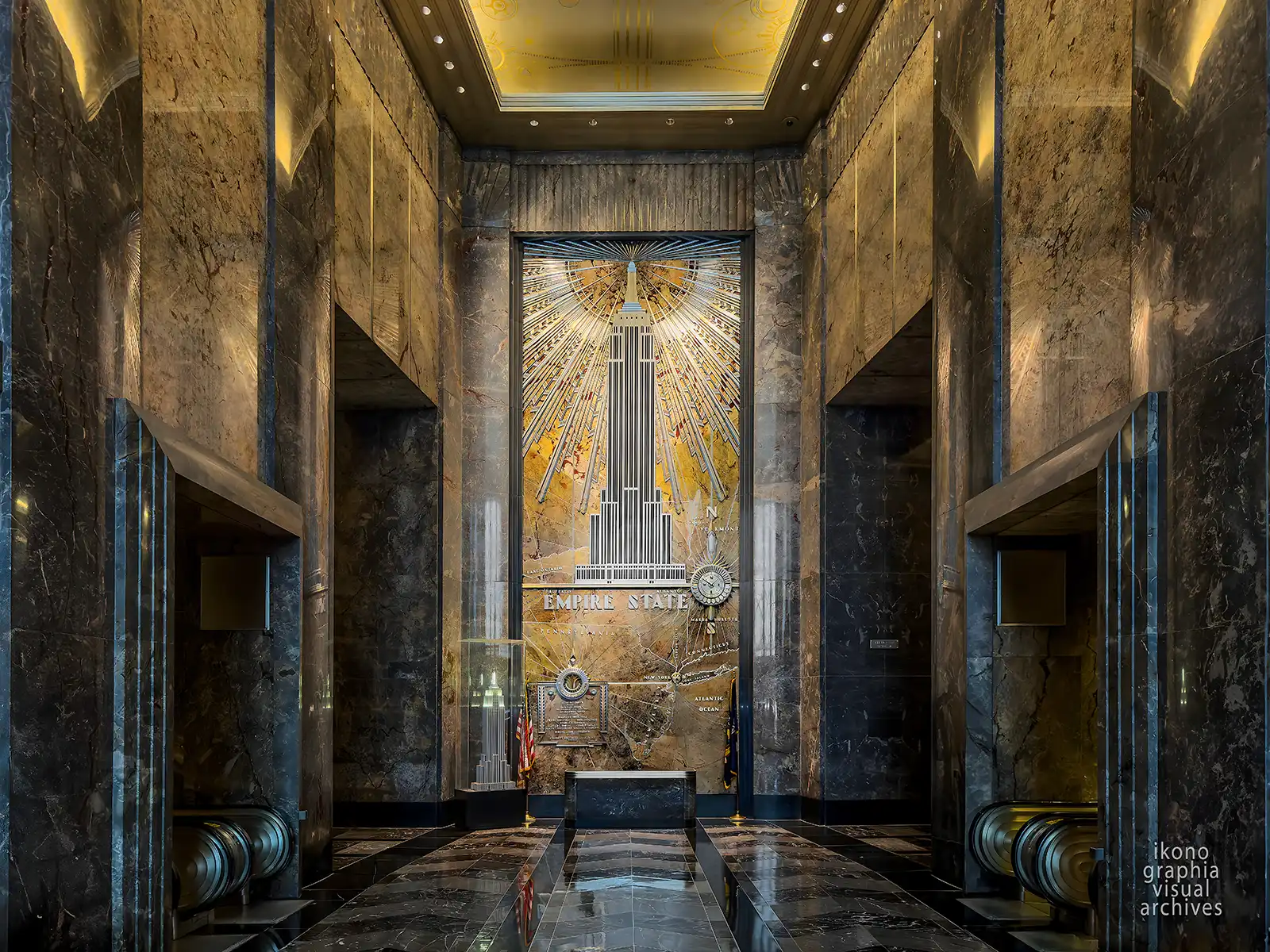
The lobby was designed to match that ambition. A ceiling mural of celestial rays by Leif Neandross converges on a single point: the aluminum bas-relief by Oscar Bach, positioned exactly where the rays meet. Bach depicted the building as the center of the world — surrounded by a map of the tristate area, radiating celestial rays. In 1931, aluminum was the material of the Machine Age: modern, industrial, the metal of human ambition. The relief was not decoration. It was the argument made permanent.

Full documentation coming to the NYC Art Deco Archive. Story forthcoming.

Oscar Bach aluminum bas-relief, Empire State Building lobby, New York, 1931. Machine Age map with celestial rays. Photographed by Roberto Bigano.

The Empire State Relief — A Machine Age Altar, NYC, 1931 — Oscar Bach

The Empire State Lobby, 1931. The floor, the walls, the ceiling — all calculated to deliver the visitor to one point. This is not a lobby. It is a constructed argument about what human ambition can produce — and the aluminum relief by Oscar Bach is its conclusion.

Positioned exactly where the rays of the ceiling mural converge, it was not placed there. It was designed to be there. The architecture does not decorate the relief. It worships it.

Neighbors of Nations — AT&T Long Distance Building, 1932

Telephone Wires and Radio Unite to Make Neighbors of Nations

Ralph Walker built the operational hub of AT&T's long-distance telephone network at 32 Avenue of the Americas and gave it the material richness of a cathedral.

The warm terracotta surfaces and accents of Native American ornament are the result of Walker and Meière working in symbiosis — the space shaped to receive the figures, the figures designed to complete the space.

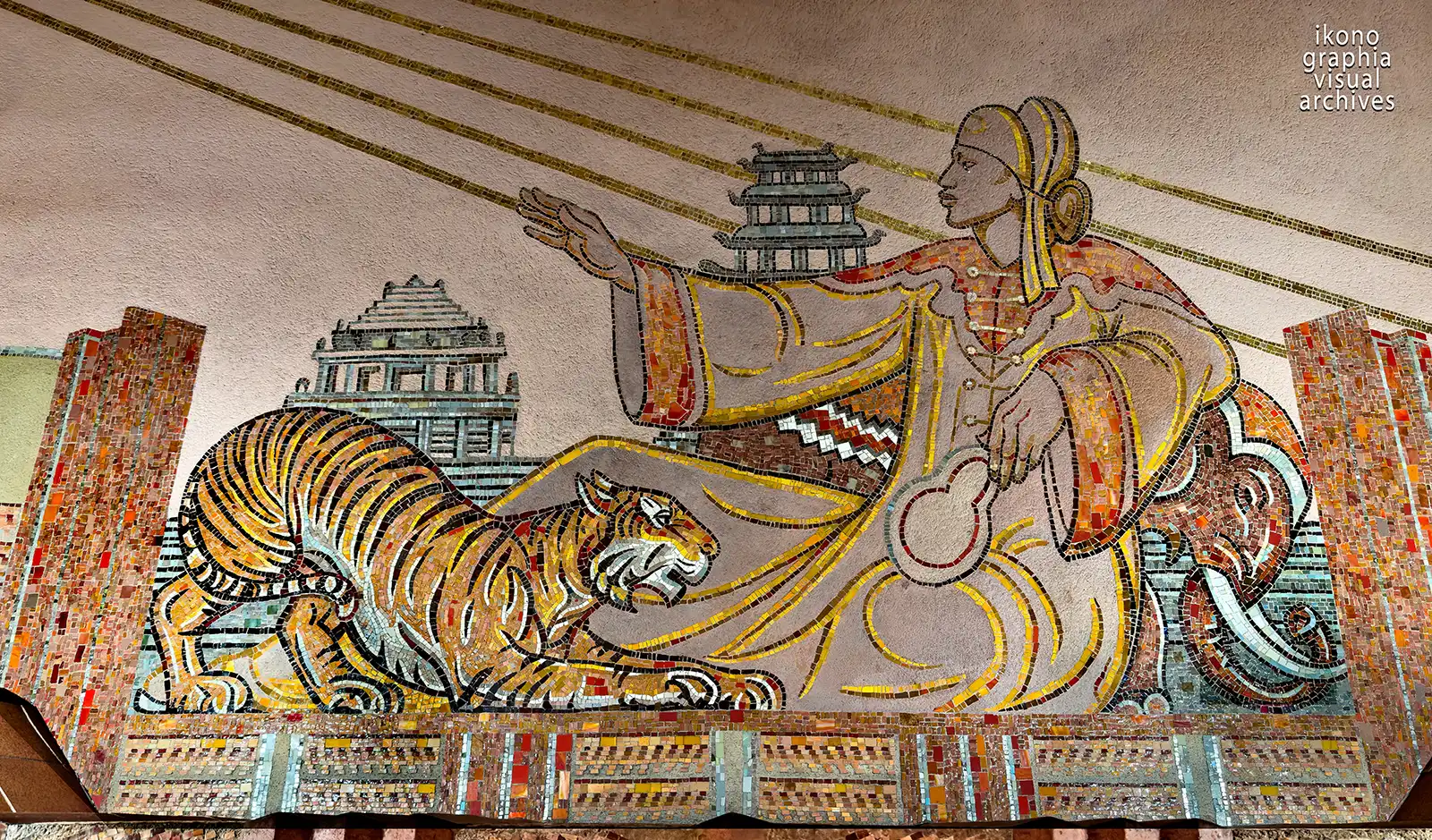
Five continental allegories on the ceiling, connected by gold telephone wires to a central messenger figure. The wires follow Walker's geometry exactly. Neither program works without the other. One vision, two authors.

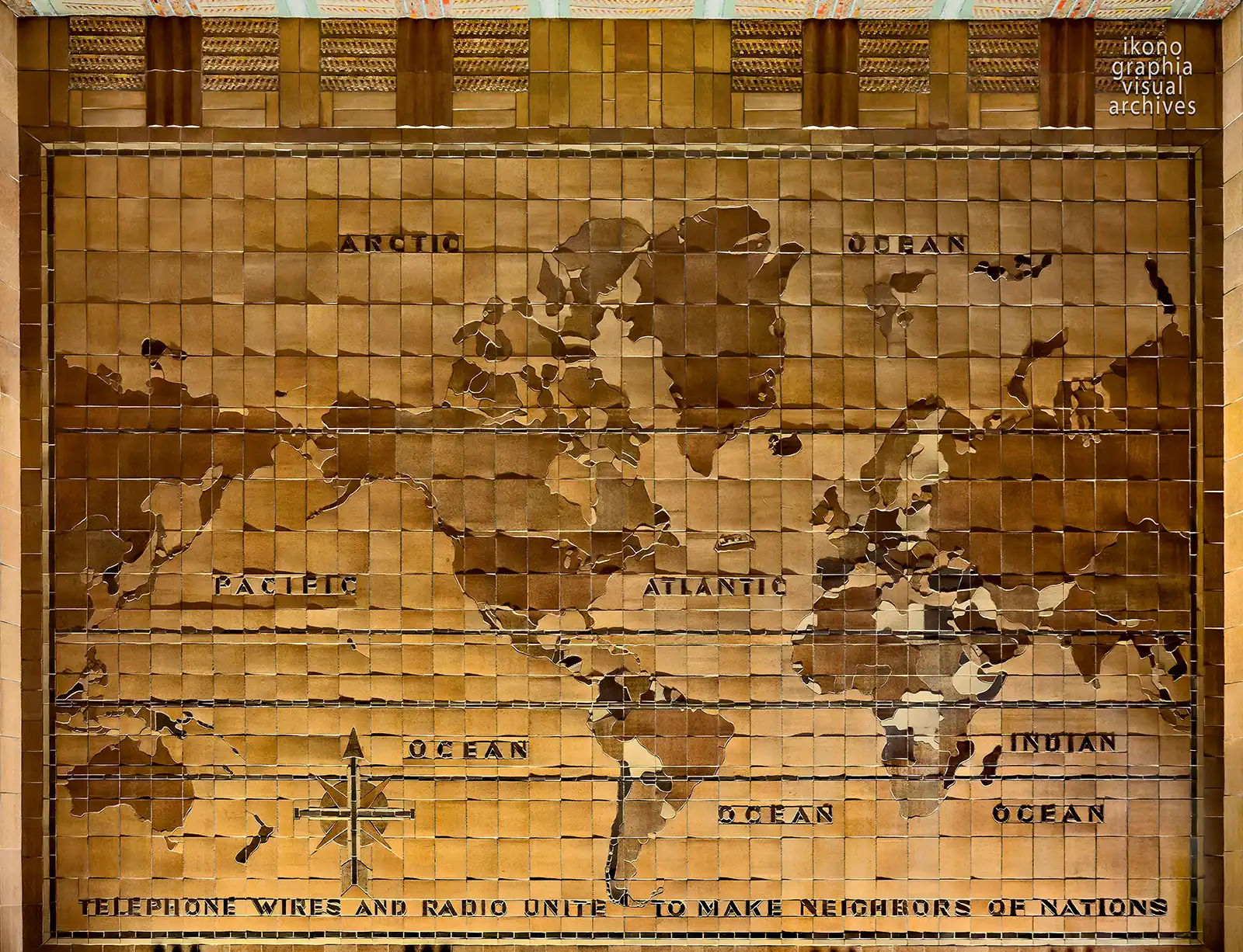
Meière's second program: a full world map in terracotta tile covering the entire entrance lobby wall — with the inscription that defines the building's purpose along its base. Telephone Wires and Radio Unite to Make Neighbors of Nations.

Full documentation coming to the NYC Art Deco Archive. Story forthcoming.

Telephone Wires and Radio Unite to Make Neighbors of Nations

Ralph Walker held that skyscrapers should be designed for mental comfort as much as physical function. At 32 Avenue of the Americas, completed in 1932, he built the operational hub of AT&T's long-distance telephone network and gave it the material richness of a cathedral.

Hildreth Meiѐre designed two programs for the lobby: a ceiling mosaic of five continental allegories connected by gold telephone wires, and a full end-wall world map in terracotta tile.

The inscription along the base defines the building's purpose: Telephone Wires and Radio Unite to Make Neighbors of Nations. Completed three years into the Depression, it was a deliberate act of optimism — the belief that connection was the answer, rendered in permanent material at architectural scale.

Full documentation coming to the NYC Art Deco Archive. Story forthcoming.

World map tile mosaic by Hildreth Meiѐre, AT&T Long Distance Building, 32 Avenue of the Americas, New York, 1932. Architect Ralph Walker. Photographed by Roberto Bigano.

Telephone Wires and Radio Unite to Make Neighbors of Nations — Hildreth Meière

Inscription along the bottom: "Telephone Wires and Radio Unite to Make Neighbors of Nations." A statement of corporate purpose — AT&T's reason for existing — rendered in permanent material at architectural scale.

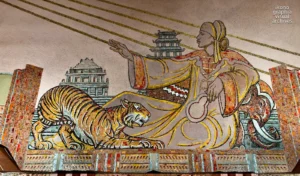
Asia — Continents Linked by Telephone and Wireless Silhouette Mosaic — Hildreth Meière, 1932 

Asia — Continents Linked by Telephone and Wireless Silhouette Mosaic — Hildreth Meière, 1932 

The allegorical figure of Asia — draped, seated, a pagoda balanced in her raised hand — flanked by a crouching tiger. One of five continental panels on the ceiling of the AT&T lobby, each connected to the central messenger figure by a web of gold telephone wires. The ceiling is a diagram of the network and a statement about what that network meant.

The border echoes Native American quillwork — geometric, precise, a different visual language running alongside the allegorical figures above it.

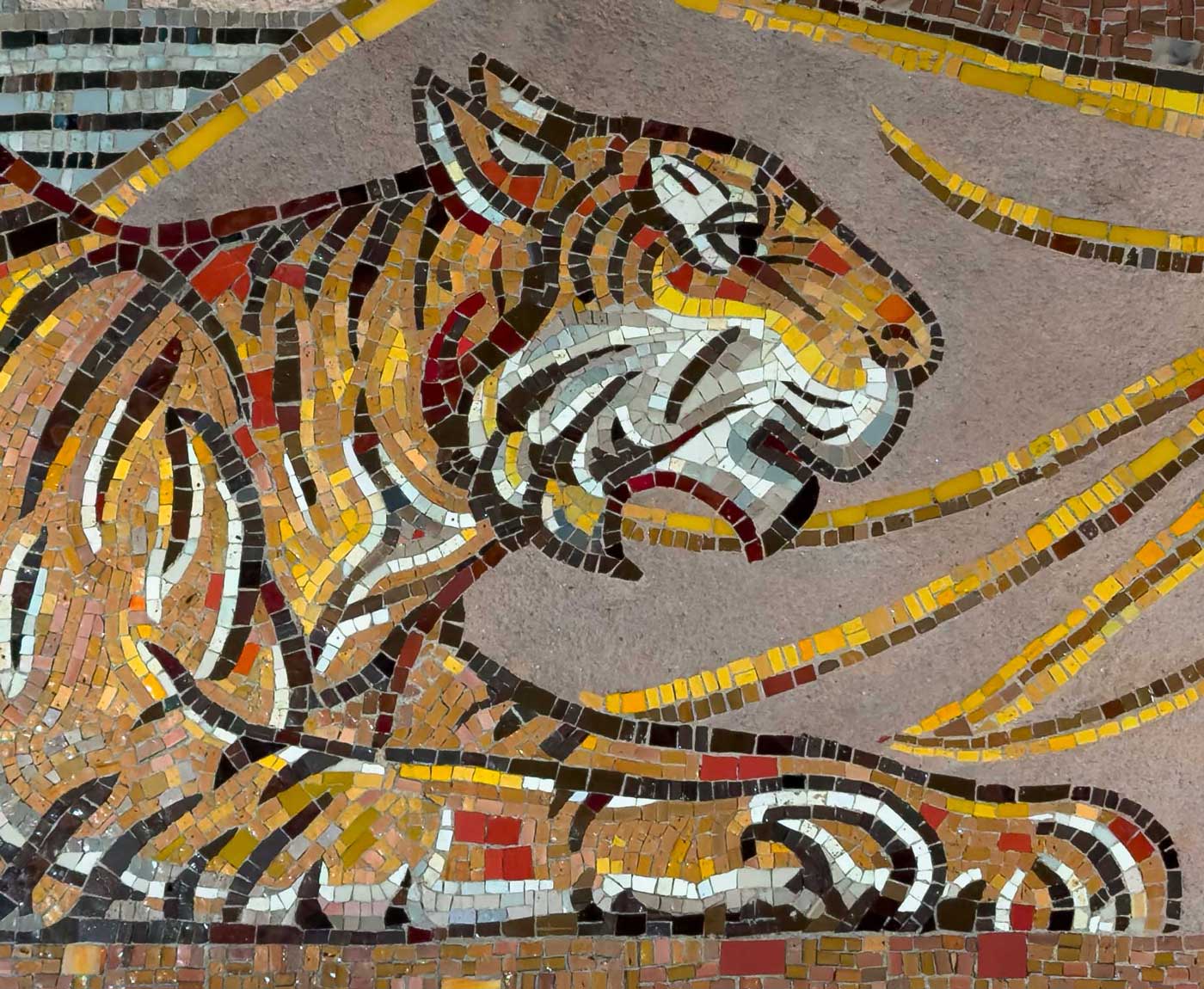
Detail of the "Asia" Mosaic

Hildreth Meière's technique — tesserae embedded in coral cement while still wet — makes the ground itself luminous. The messenger at the center holds lightning bolts: electricity as a classical attribute, telecommunications given the iconography of myth.

The ceiling is a diagram of the network and a statement about what that network meant.

The Park Avenue of the Bronx — 1150 Grand Concourse, 1937

The Fish Building, the borough’s most celebrated Art Deco apartment house

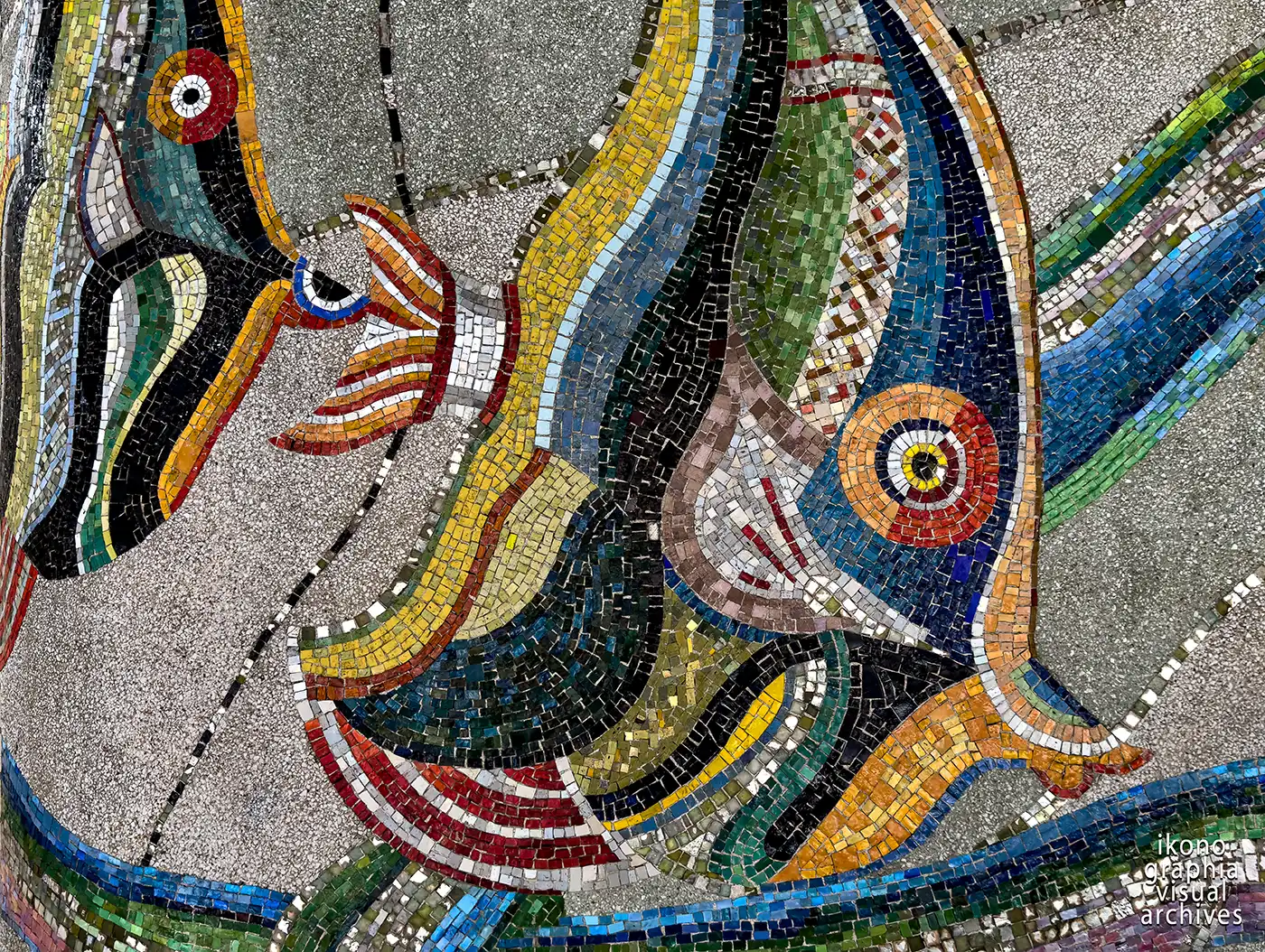
The Grand Concourse was conceived as the Park Avenue of the Bronx, its buildings designed with exceptional architectural ambition. 1150 Grand Concourse — known as the Fish Building for its polychrome mosaic facade of tropical fish and aquatic forms — is among the finest.

The terrazzo floors were executed by terazzeri from Pordenone and Spilimbergo in the Friuli region — the aristocracy of the immigrant labor force. Their names were never recorded. Their work has outlasted nearly everything around it.
The mosaic facade and the terrazzo interior — two halves of a single undersea world, conceived by the same hand. Two separate crafts, two separate traditions, one address on the Grand Concourse that preserved both.

Full documentation coming to the NYC Art Deco Archive. Story forthcoming.

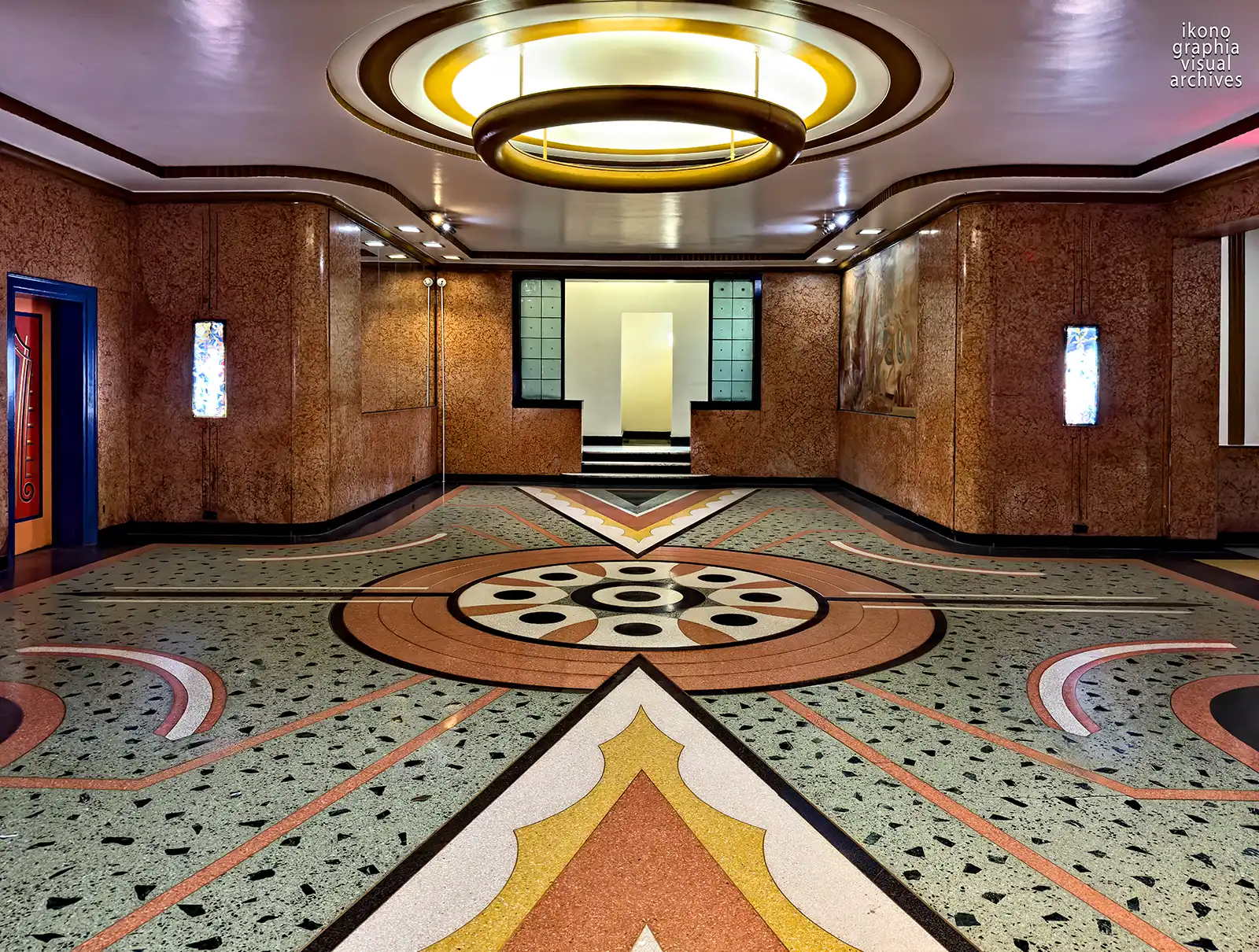
rand Concourse terrazzo UFO chandelier Art Deco 1937

Art Deco Terrazzo Lobby and the UFO Chandelier

Nothing prepares you for the lobby of 1150 Grand Concourse. The terrazzo floor stops you — radiating forms, concentric rings, chevrons in red, gold, and sage, wall to wall. Above it, a chandelier that takes a moment to resolve: bronze rings, frosted glass, the geometry of a spacecraft.

Polychrome fish mosaic detail, 1150 Grand Concourse, the Bronx, New York, 1937. Hand-laid tesserae, artist unidentified. Photographed by Roberto Bigano

A fish from the Aquatic Mosaic

A detail from the polychrome mosaic facade that gave the building its name. Hand-laid tesserae, no two identical in tone. The chromatic range is exceptional — warm ochres against cold blues, deep burgundy against yellow-green.

The artist was never identified. The mosaic and the terrazzo floor inside share a building and a visual vocabulary. Nothing else connects them.

The Geometry of Energy and Light — 70 Pine Street, 1931

The complete decorative program of an energy empire — in nickel-silver and light.

70 Pine Street was commissioned by the Cities Service Oil Company, one of the largest energy corporations of the early 1930s. The building's decorative program — inside and out — was conceived as a monument to that ambition.

René Paul Chambellan designed The Evolution of Fuel — the nickel-silver elevator doors, among the finest Art Deco reliefs in New York — and the complete exterior program. Thomas J. George designed the ceiling. Together they built a space where the visitor felt the building's purpose before reaching the elevators — and where the mountain silhouette of the tower continues overhead, in plaster and gold.

Full documentation coming to the NYC Art Deco Archive. Story forthcoming.

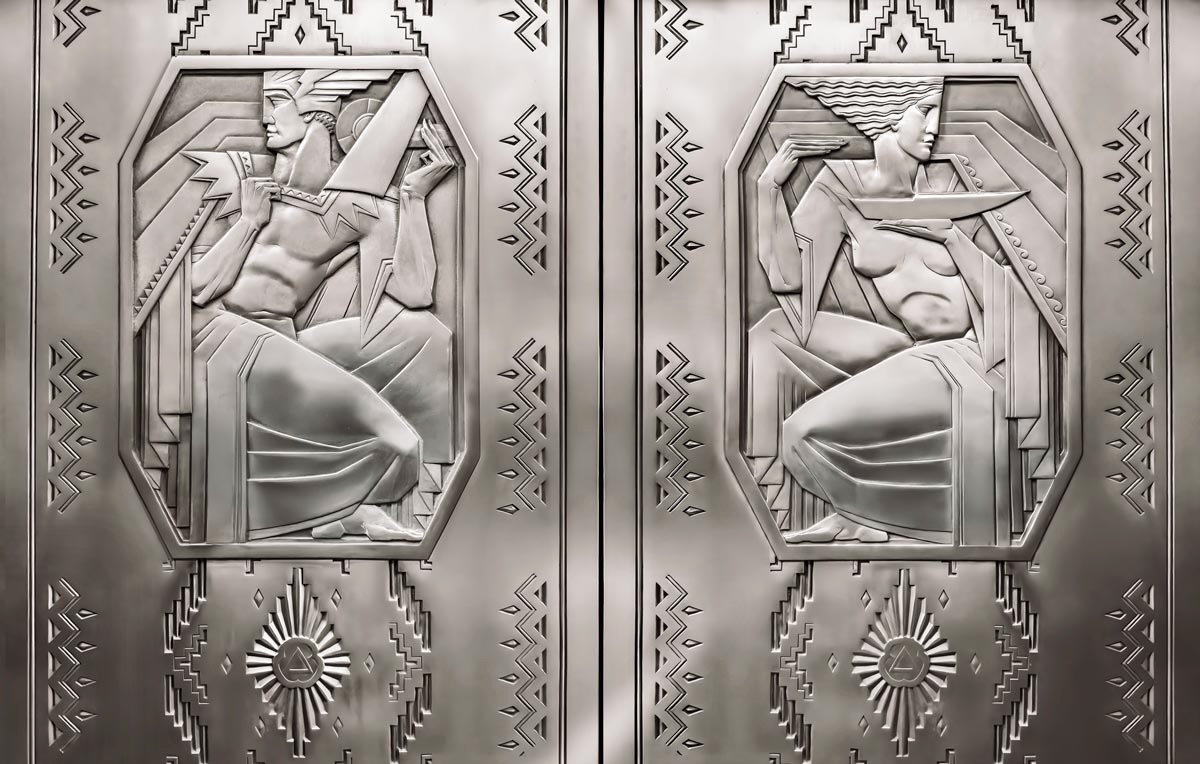
The elevator doors shows a pair of nickel-silver reliefs

The Evolution of Fuel Elevator Doors, René Chambellan, 1931

Nickel silver — a copper-nickel-zinc alloy with no actual silver content — holds fine low-relief detail with exceptional clarity. Unlike sterling silver, it does not blacken with age. The surrounding decoration incorporates Native American-inspired zigzags and sunbursts alongside the Cities Service logo.

The elevator doors shows a pair of nickel-silver reliefs

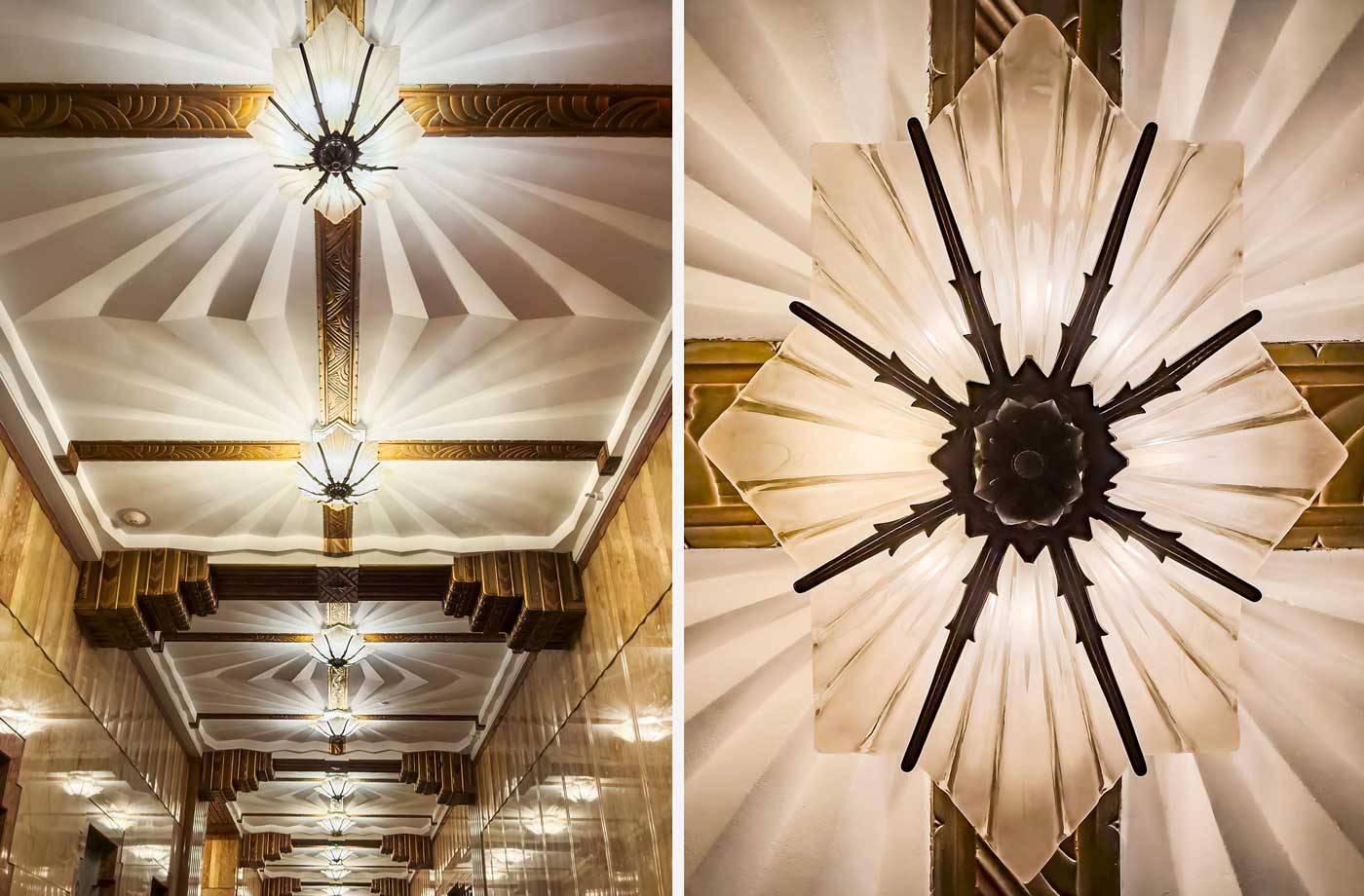
The lobby ceiling fixture an decorations — Cliff Parkhurst.

he lobby ceiling and fixtures — Thomas J. George. The ceiling is white plaster, faceted into radiating peaks and stepped polychrome corbels with gold, bronze, and copper-leaf relief bands — bringing the mountain silhouette of the tower inside. A thematic reference to the Cities Service Company's business in light, heat, and power. The space is illuminated by hand-cut translucent cast-glass fixtures with bronze metalwork, supplied by Cliff Parkhurst.

The Architecture of Finance — 20 Exchange Place, 1931

Industry, Transportation, Progress as seen by architects Cross & Cross and British sculptor David Evans

20 Exchange Place was completed in 1931 for the Cities Bank Farmers Trust Company — at the time, the world's tallest stone-faced skyscraper. Architects Cross & Cross gave it a decorative program of exceptional breadth: marble floors with nickel silver inlays, vaulted entrance ceilings, painted arches, stone reliefs on the facade, and an iconographic program running across dozens of elevator and entrance doors executed under the direction of British sculptor David Evans.

The program reads as a single argument about finance, industry, and progress — old means and new means, cast in nickel silver, carved in stone, inlaid in marble. Few buildings in New York carry a decorative vision of this completeness from street to elevator cab.

Full documentation coming to the NYC Art Deco Archive. Story forthcoming.

NYC Art Deco, Elevator Doors' Nickel-Silver Relief, 20 Exchange Place

The March of Progress Elevator Doors — David Evans, 1931

Two stylized female figures in high relief — industrial precision and elegant symbolism in the same surface — representing advances in transportation financed by the Bank's investments: from sailing ships and aerial balloons to ocean liners and modern aircraft.

Nickel silver was chosen by architects Cross & Cross over bronze — a deliberate rejection of colored metal in favor of a unified white finish. The decorative program was executed under the direction of British sculptor David Evans — its visual language aligned with the Art Deco skyline of Lower Manhattan.

Wisdom, Light and Sound — Rockefeller Center, 1933

Wisdom and Knowledge Shall Be The Stability Of Thy Times.

Lee Lawrie's triptych — Wisdom flanked by Light and Sound — spans the main entrance of 30 Rockefeller Plaza. Thirty-seven feet of Indiana limestone, hand-carved, polychrome by Leon V. Solon. Wisdom represents reason and law — the foundation. Light represents television, Sound represents radio. The primary tenant of 30 Rockefeller Plaza was NBC. Built at the depth of the Great Depression, without compromise, at a scale designed to declare before it welcomed.

Solon's palette — cobalt, red, and gold leaf — follows the Greek principle: color most intense where the eye must travel furthest. From the street, the crown of Wisdom reads as pure geometry. At close range, it reveals itself as craft. Below the figure, 240 cast-glass blocks by Corning Glass Works form a trifold screen — ancient authority, modern material. The Machine Age argument made visible.

One of the most complete examples of Greco-Deco in New York — classical mythology rendered in the geometric language of Art Deco, ancient symbols carried in modern form.

Full documentation coming to the NYC Art Deco Archive. Story forthcoming.

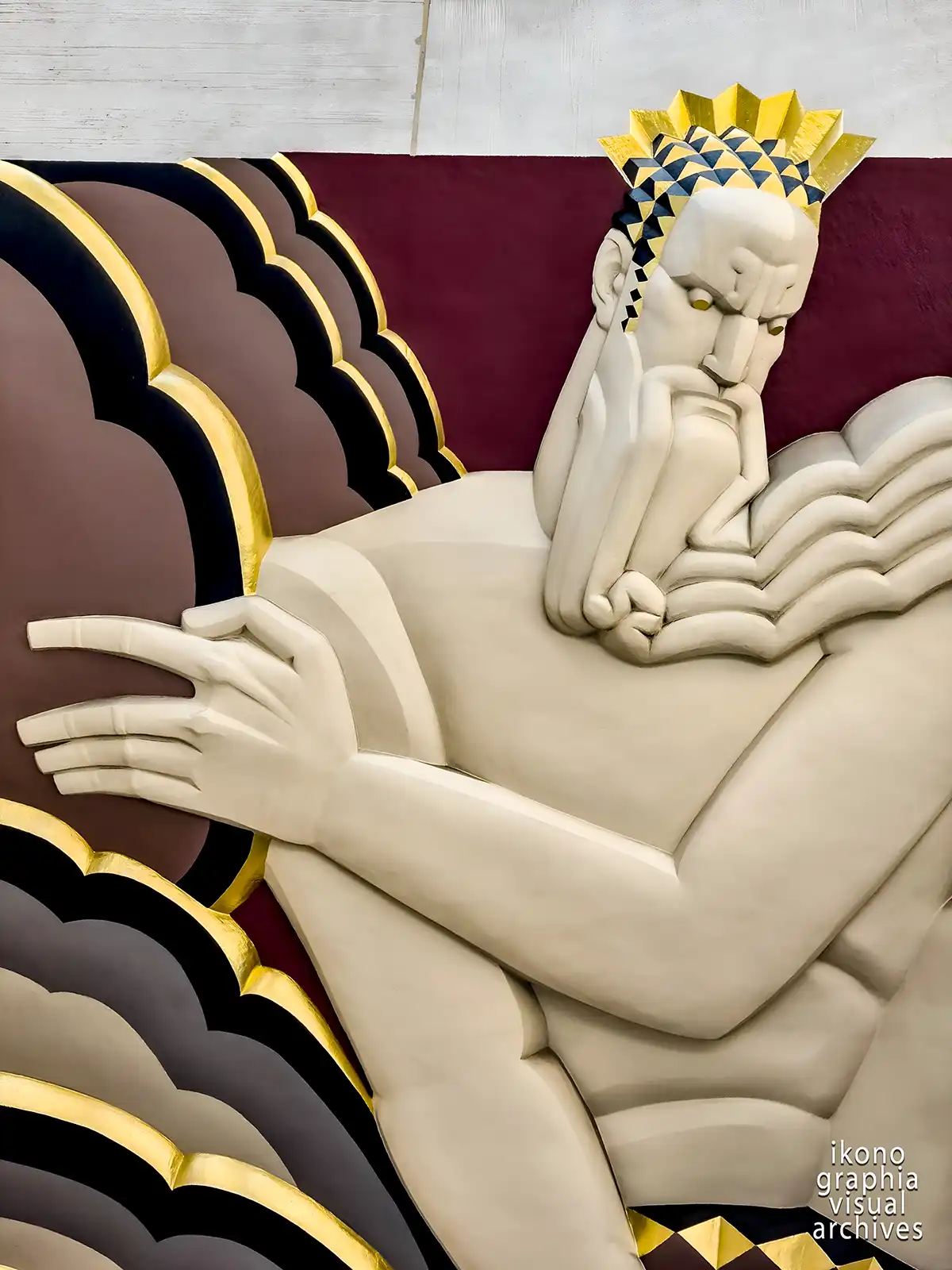
Lee Lawrie's Wisdom, close-up — polychrome crown and face, 30 Rockefeller Plaza, New York, 1933. Photographed by Roberto Bigano for FMR

Wisdom — Lee Lawrie

The central figure of a 37-foot triptych — Wisdom, a Voice from the Clouds, with Light and Sound — spanning the main entrance. Lee Lawrie drew on William Blake's Urizen — reason and law made flesh — and gave him the vocabulary of the Machine Age. The Rockefeller complex was commissioned and built through the deepest years of the Great Depression.

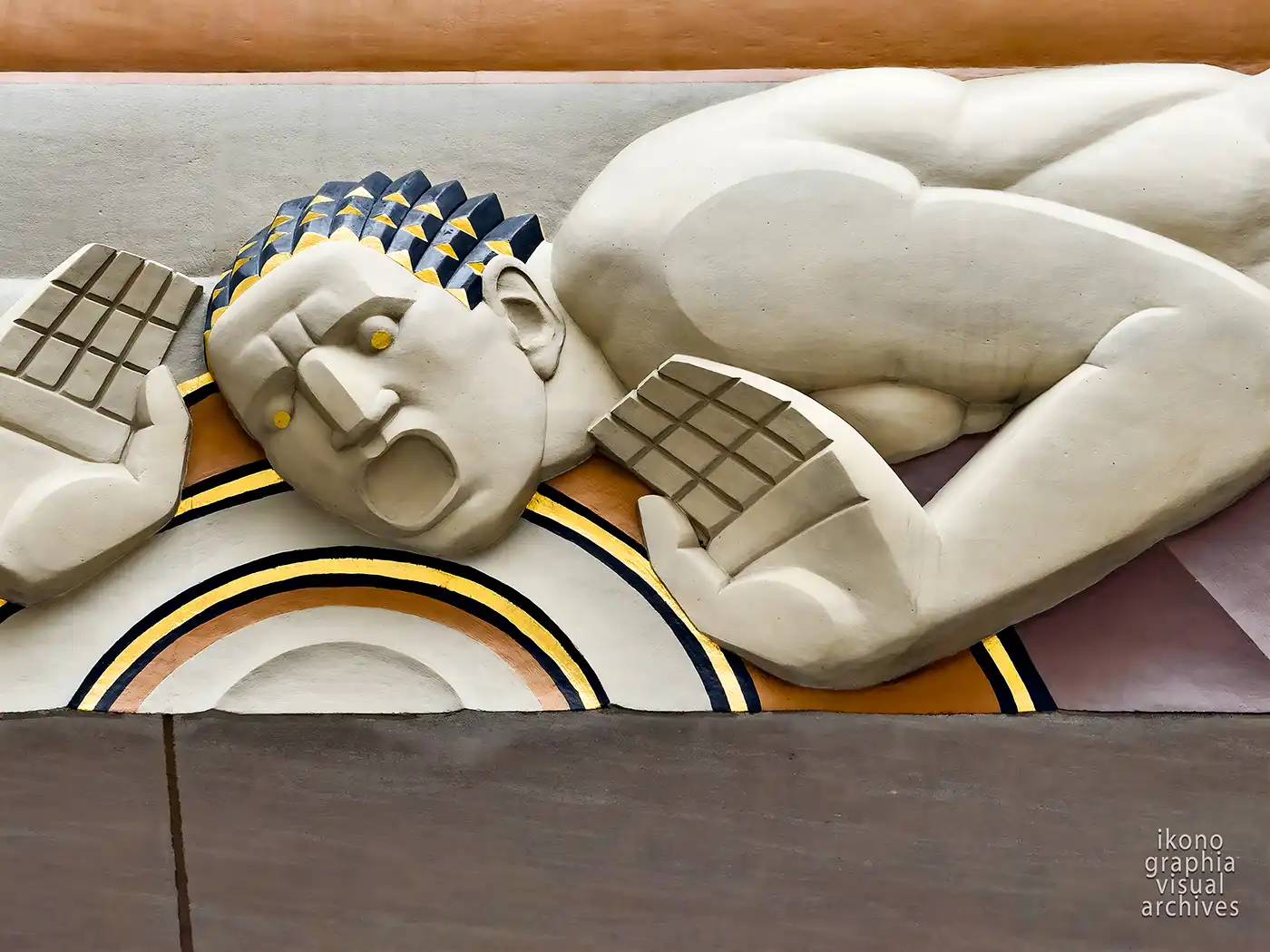
At this distance, the figure reveals what the street view cannot: the precision of the polychrome crown, the geometry of each gold and black triangle, the force of a figure pushing back the clouds of ignorance. What remains is the face — looking down, in concentration.

Light Age of Television Lee Lawrie close-up 1933

Light — The Age of Television

The figure representing television — male, arms raised like antennas, transmitting electrical signals and images through the air. The crown of sharp black-and-gold triangles does not ornament the figure. It amplifies him. Indiana limestone, color by Leon V. Solon.

Television in 1933 was not yet a public reality. Lawrie depicted an industry still finding its form and placed it on the facade of Rockefeller Center as a cosmic force equal to Wisdom itself.

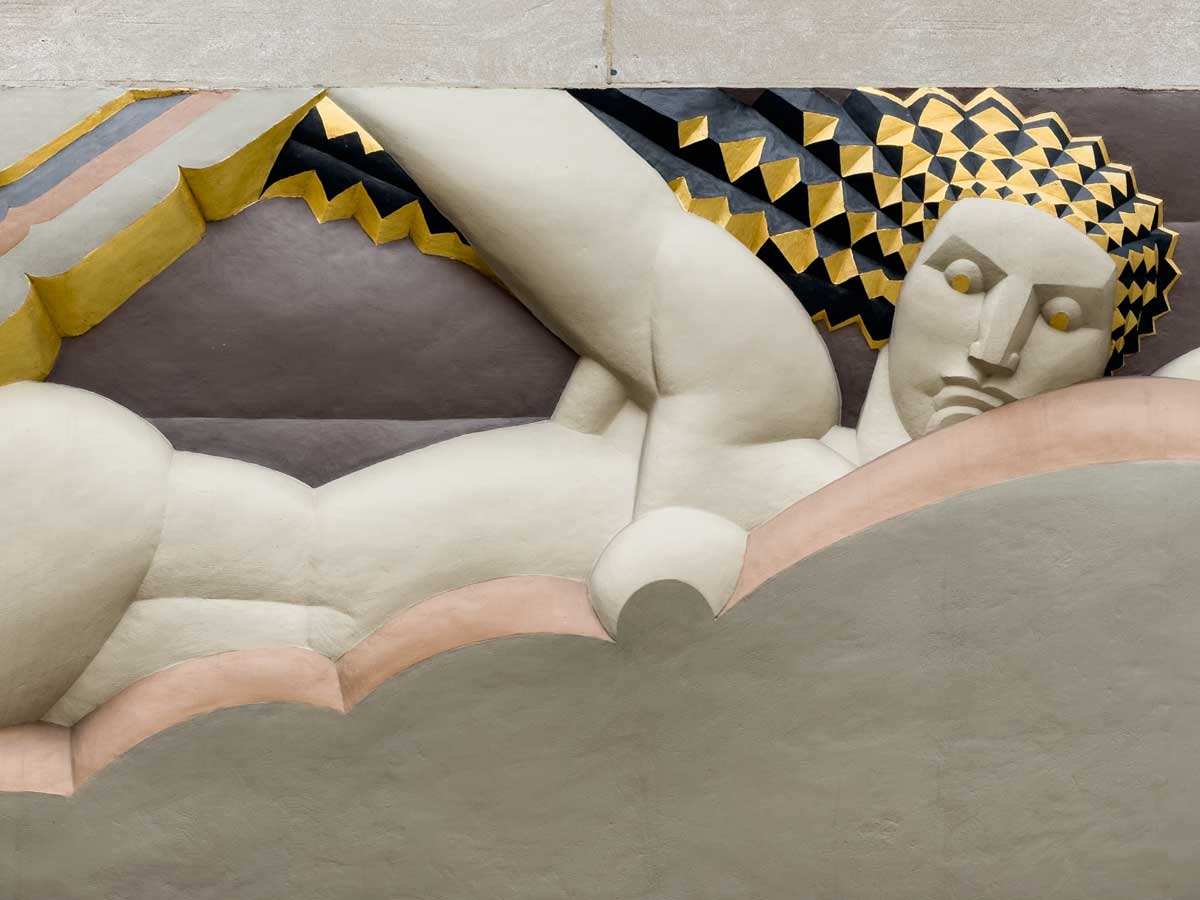
Sound, The Age of Radio

The figure representing radio — female, reclining, emerging from clouds. The concentric circles radiating from her are not decoration. They are the signal, rendered in stone. Indiana limestone, color by Leon V. Solon.

Radio in 1933 was the dominant mass medium — and the primary tenant of 30 Rockefeller Plaza was NBC. Lawrie did not illustrate a technology. He gave it a body and placed it alongside Wisdom as a force of equal weight.

Federal Authority — 90 Church Street, 1937

Carl Paul Jennewein — A Federal Commission at the Highest Level of the Craft

Cross & Cross designed the building — aluminum columns, vertical grilles, entrance screens that declare authority before the door is reached. Carl Paul Jennewein's decorative program gave them meaning: eagle capitals, star banding, the ornamental intelligence that transforms modern materials into federal power.
Inside, the National Seal ceiling light in three lobbies completes the argument — a reversible eagle that could face either the olive branch or the arrows. War or peace, built into the architecture.

A federal commission executed at the highest level of the craft, in a building that most visitors to Lower Manhattan have never entered. Photography by Davide Bigano.

Full documentation coming to the NYC Art Deco Archive. Story forthcoming.

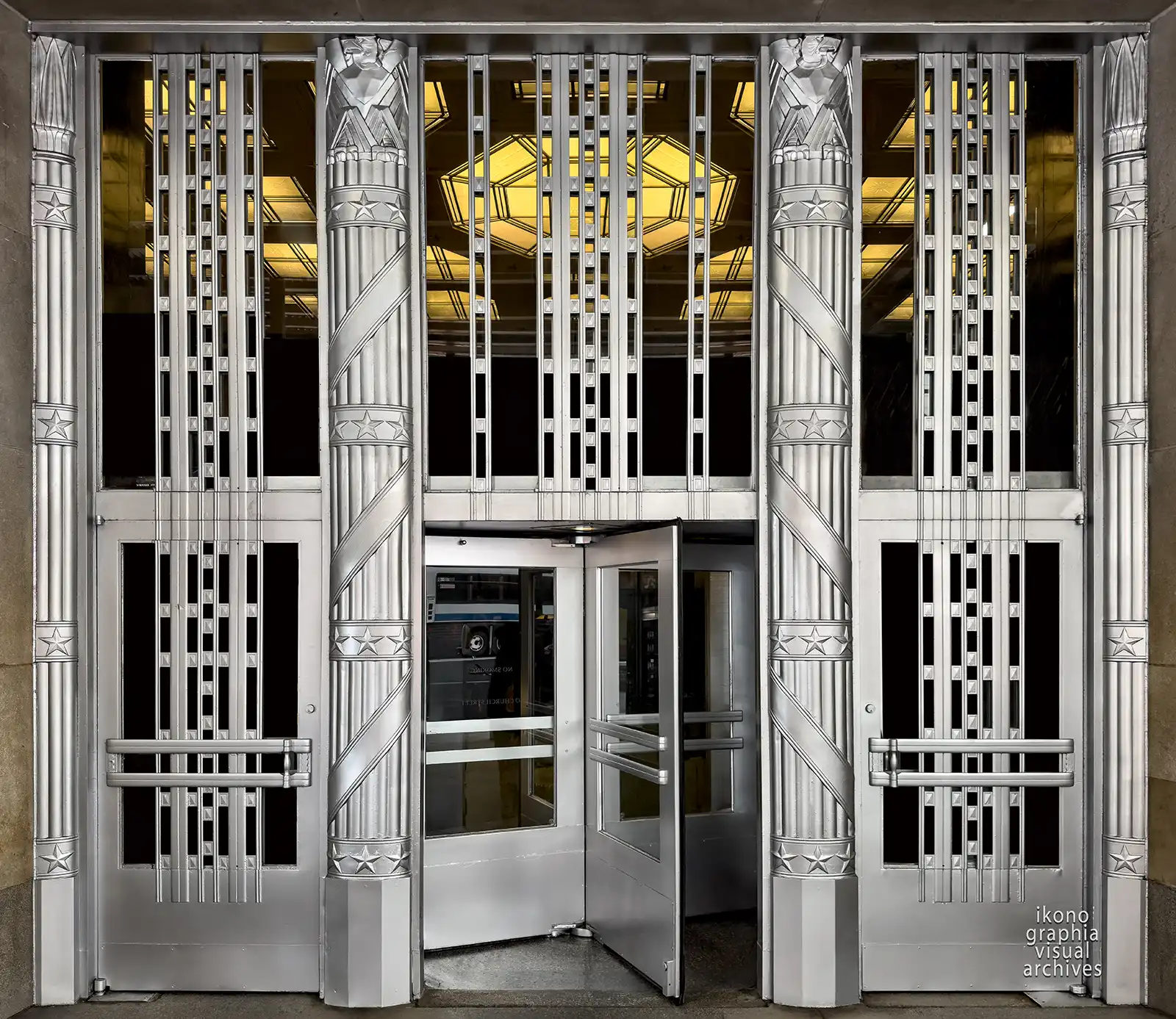
Post Office entrance, 90 Church Street Federal Office Building, New York, 1937. Aluminum grille and POST·OFFICE lettering by Carl Paul Jennewein, barrel vault and chandelier visible beyond.

Federal Entrance — 90 Church Street

Four aluminum columns, star-banded and eagle-capped, frame the entrance of 90 Church Street. Behind the vertical grille, the gold hexagonal ceiling announces the interior before the door is reached. Strength and lightness — the neoclassical shell carrying a decorative program that belongs to a different world entirely.

Carl Paul Jennewein's aluminum program at 90 Church Street was a departure from his classical work in marble, bronze, and polychrome terracotta. The aviation-era metalwork — columns, grilles, eagle capitals — gives a federal building its modernist authority. 

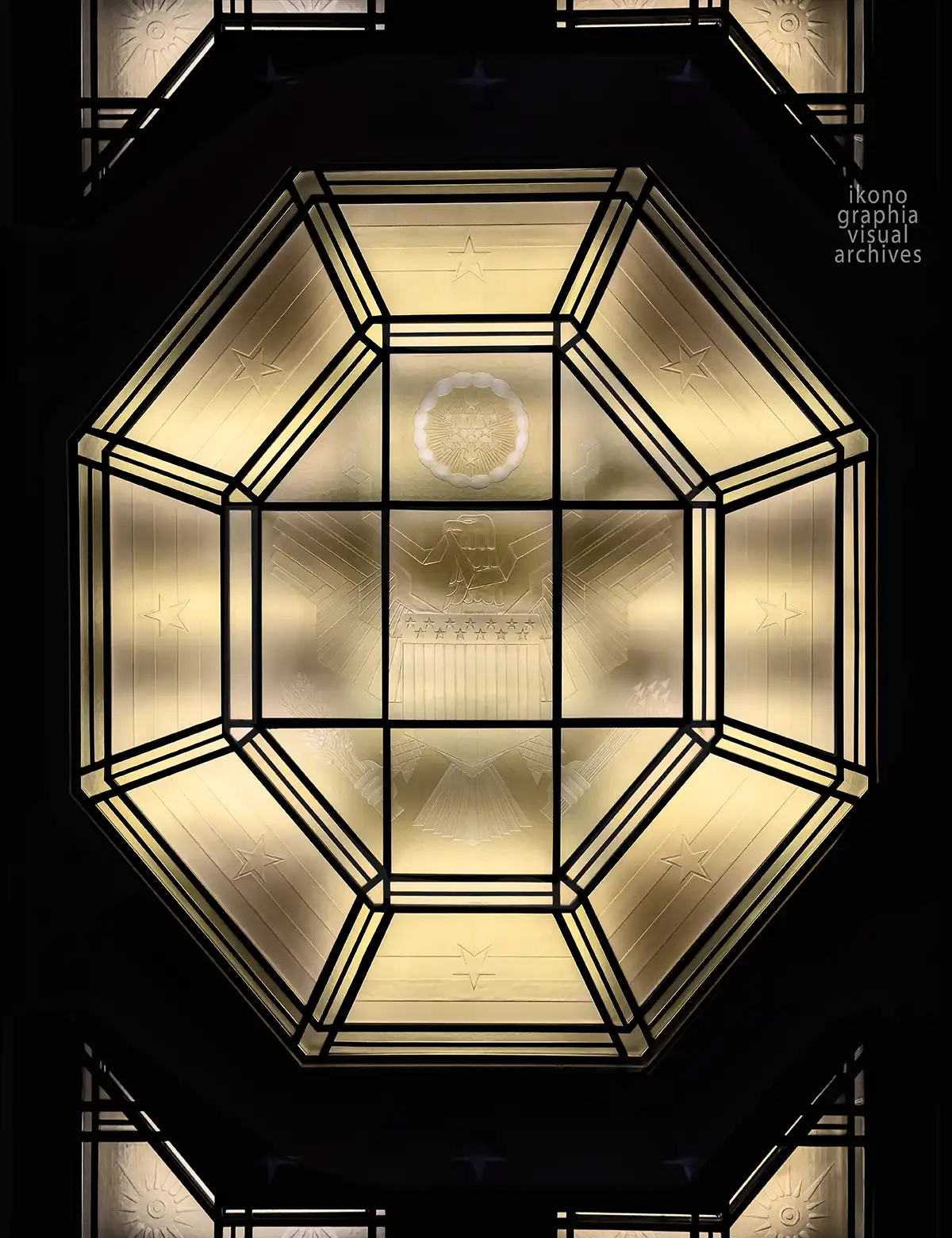
National Seal ceiling light, 90 Church Street, New York, 1937. Beveled crystal panels in bronze octagonal frame, reversible eagle by Carl Paul Jennewein. Photographed by Davide Bigano.

National Seal Ceiling Light — Carl Paul Jennewein

The National Seal ceiling light at 90 Church Street — beveled crystal panels set in a bronze octagonal frame, backlit. Three lobbies, each with an identical fixture. The ceiling's geometric program mirrors the terrazzo and marble sunburst on the floor below — light above, stone beneath, the same pattern on both surfaces.

In 1937, at the height of the New Deal, federal architecture carried political symbolism into its functional elements. The central panel was designed to be reversed — the eagle facing either the olive branch or the arrows. War or peace, built into the architecture.

Peace & War — Carl Paul Jennewein

The United States National Seal rendered in beveled crystal panels set in a bronze octagonal frame — eagle, shield, stars, and olive branch, backlit.

The central panel was designed to be reversed — the eagle facing either the olive branch or the arrows. War or peace, built into the architecture.

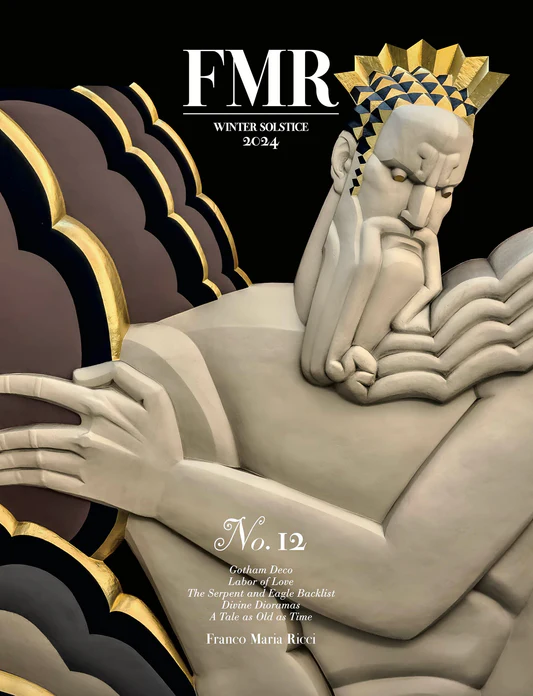
FMR Magazine — Gotham Deco

Twenty-three photographs from this Archive were published in FMR Magazine Winter Solstice 2024.

"Gotham Deco — Modern Metropolis. This Was Tomorrow" — published in FMR Magazine with an essay by Anthony W. Robins and photographs by Roberto Bigano — documents New York Art Deco as a complete interior program: the Chanin Building radiator grilles, the Fred French Building elevator panels, the light and sound installations of Rockefeller Center, and the decorative vocabulary that ran through an entire generation of Manhattan architecture. A cover and twenty-four pages.

Robins is the pre-eminent authority on New York Art Deco. President of the Art Deco Society and author of "New York Art Deco: A Guide to Gotham's Jazz Age Architecture" — widely cited as the definitive guide to the subject.

FMR was founded in Milan in 1982 by Franco Maria Ricci. For four decades, among curators, collectors, and art historians on both sides of the Atlantic, FMR set the standard for visual scholarship and for the most demanding editorial photography.
Jacqueline Kennedy called it the most beautiful magazine in the world.

Copyright, links and credits

Photography, Copyright & Credits

All photographs © Ikonographia / Roberto Bigano — All Rights Reserved.
These images are part of the Ikonographia Visual Archives: New York City Art Deco Collection.

Terms of Use (Summary)

The images presented in this archive are copyrighted and available for licensed use only through Ikonographia Visual Archives.

You may not download, reproduce, publish, or distribute these images without a valid license. For commercial or editorial licensing, please refer to the product pages or contact Ikonographia directly. A full explanation of licensing terms is available in the Shop / Licensing Information section under "Ikonographia — Standard License" and "Ikonographia — Merchandising & Product Use Licenses"

Artwork & Building Attribution

Completed in 1927, the Fred F. French Building stands as one of Manhattan's defining Art Deco towers. While its stepped crown and gilded façade are widely admired, its most exceptional achievement lies within: a decorative program conceived by architect H. Douglas Ives and executed in bronze by sculptor Vincent Glinsky — a collaboration that transformed a commercial lobby into a passage through ancient Babylon.

Ives documented his own obsession in writing: the Tower of Seven Planets at Babylon, the Ishtar Gate, Chaldean enameled brick. The iconographic program was not intuition — it was research translated into architecture.

Copyright Status Clarification

Building & Artwork:
The architectural design of this buildingis in the public domain under U.S. copyright law. Buildings constructed before the Architectural Works Copyright Protection Act (1990) are not protected as architectural works, and their exteriors and interiors may be freely photographed.

Photographs:
All photographs on this page, however, are copyrighted works of Ikonographia / Roberto Bigano and require a license for any reuse.

Ikonographia Mission Statement

Ikonographia is committed to the accurate documentation, preservation, and ethical dissemination of twentieth-century visual culture.

Archival Notes

These photographs were produced as part of Ikonographia’s ongoing documentation of significant examples of twentieth-century visual culture. Image preparation includes controlled lighting, accurate color management, and perspective correction to preserve architectural integrity and material detail.

Further Reading - Selected Sources

• FMR Magazine No. 12, Winter Solstice 2024 — "Gotham Deco" — Special issue devoted to the Art Deco transformation of 1920s New York, with contributions by Anthony W. Robins and photography by Roberto Bigano. Cover and 24 pages featuring comprehensive documentation of the Chanin Building radiator grilles, the Fred French Building elevator panels and polychrome ceilings, the Light and Sound sculpture at Rockefeller Center, and a curated selection of the city's finest Art Deco interiors.

• Anthony W. Robins, New York Art Deco: A Guide to Gotham’s Jazz Age Architecture.
• David Stravitz, The Chrysler Building: Creating a New York Icon Day by Day.
• Cervin Robinson & Rosemarie Haag Bletter, Skyscraper Style: Art Deco New York.
• Christopher Gray (archives), The New York Times, “Streetscapes” columns.
• New York City Landmarks Preservation Commission reports (Fred F. French Building).
• The Metropolitan Museum of Art – Digital Collections (historic metalwork and architectural ornament references).

Acknowledgments

Ikonographia gratefully acknowledges the institutions, archivists, scholars, and architectural historians whose research and preservation efforts help illuminate the cultural significance of New York’s Art Deco heritage.

Portfolio Magazine — Brodovitch and the Reinvention of Editorial Design (1950–1951)

Portfolio Magazine — Brodovitch and the Reinvention of Editorial Design (1950–1951)

Portfolio Magazine — Brodovitch and the Reinvention of Editorial Design

A reconstructed selection of the magazine’s original double spreads, revealing its hidden visual architecture.

Published between 1950 and 1951, Portfolio was not conceived as a magazine in the conventional sense, but as an experimental platform for a new visual language. Under the direction of Alexey Brodovitch, each issue functioned as a laboratory where photography, typography, illustration, and editorial sequencing were treated as a single, integrated system.

The Colophon of Portfolio Magazine N.1, Winter 1950. Designed by Alexey Brodovitch

This featured story is an editorial hub, conceived as a new re-editing of multiple existing stories and archival materials. It brings together previously separate contents into a single, coherent narrative framework, allowing the visitor to explore the subject in depth and as a whole rather than as isolated fragments.

Ikonographia presents here, and in related stories, selected contents as reconstructed double page spreads. For decades, much of the magazine design logic remained partially invisible: the central areas of many double-page spreads were lost in the gutter. What emerges is a clearer understanding of Portfolio not as a collection of images, but as a deliberately sequenced visual system.

The Albro Alphabet Typeface, designed by Alexey Brodovitch. Portfolio N.1 1950, pages 118-119.

The Albro Alphabet Typeface.

A Typeface designed by Alexey Brodovitch. The Albro Alphabet (after the first syllables of his name) was inspired by the signs and symbols of musical notation. It was released through Photo-Lettering, Inc., New York.

Portfolio Magazine — Brodovitch

The first issue of Portfolio arrived as a shock.

Portfolio was not conceived as a magazine in the conventional sense, but as a radical editorial experiment. Published between 1950 and 1951, it functioned as an open laboratory in which photography, typography, illustration, and sequencing were treated as a single expressive system rather than as separate disciplines.

Under the direction of Alexey Brodovitch, each issue rejected fixed layouts, recurring formats, and commercial constraints. Pages were assembled through contrast, rhythm, and interruption, allowing images and text to interact dynamically across spreads. White space, scale shifts, and abrupt visual transitions became active elements of meaning rather than neutral containers.

Produced without advertising and printed in limited numbers, Portfolio was financially unsustainable but intellectually decisive. Only three issues were released, yet their influence proved disproportionate: the magazine established a new model of editorial authorship, redefining the role of the art director as both editor and composer of visual narratives.

Seen today as a continuous sequence rather than a set of iconic pages, Portfolio remains a foundational document of modern editorial design.

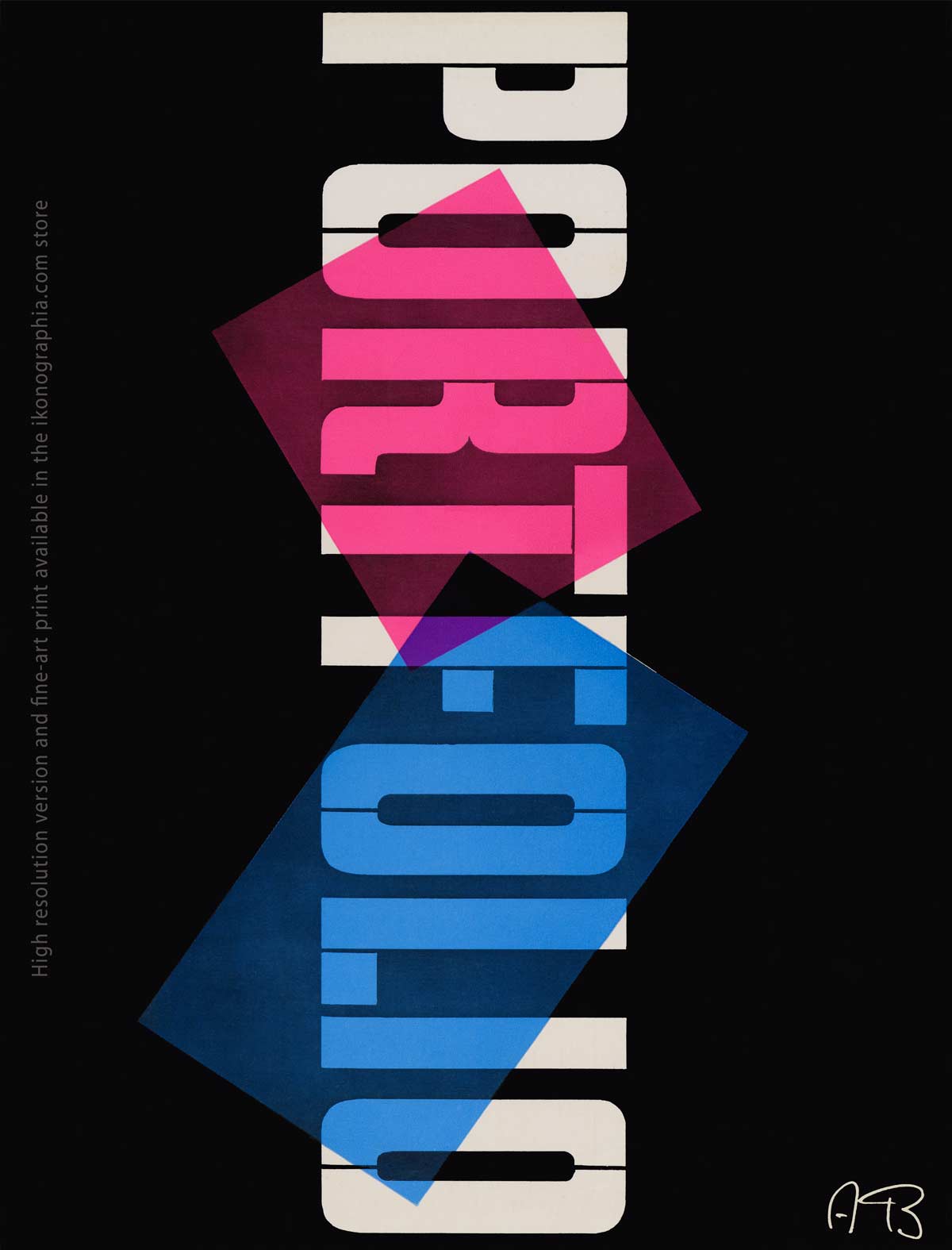
The cover of the first issue of Portfolio Magazine, winter 1950. Designed by Alexei Brodovitch with Art Director Frank Zachary. Portfolio has been widely acknowledged as perhaps the definitive graphic design magazine of the twentieth century.

Portfolio Magazine N. 1
Winter 1950.

The first issue of Portfolio Magazine, entirely conceived and designed by Alexey Brodovitch, announcing a new editorial language built on sequence, contrast, and visual tension rather than fixed layout.

Featured  image above:

The colophon of Portfolio Magazine N. 1
Winter 1950.

The featured image illustrates the philosophy of Portfolio and the importance of reconstructing its double-page spreads as unified visual fields — something period readers could never fully experience due to tight binding, scale, and print constraints.

Selected Contents from Portfolio No. 1 (Winter 1950)

The first issue of Portfolio arrived as a shock.

Radically free from editorial convention, it announced a new way of thinking about graphic design—one grounded in curiosity, experimentation, and the belief that visual culture could emerge from any discipline.

The opening article paid homage to Giambattista Bodoni, described as “an Italian genius who created Bodoni, America’s most widely used typeface.”
From there, Brodovitch’s insatiable curiosity and rejection of fixed formats led the magazine into unexpected territories, where science, technology, and art converged.

This issue includes:

  • Design from the Mathematicians — abstract structures and forms derived from mathematical research.

  • Xerography — new visual effects generated through powder and electricity.

  • Saul Steinberg — drawings selected from unpublished private sketchbooks.

Design from the Mathematicians. By Prof. Baravalle. Portfolio N.1 1950. Page 22-23 Left, wave curve with black and white parallel lines. Upper left, straight lines tangent to a hyperbole combined with a circle. Right, wave curve. Right page: Upper left, a group of tangents to an astroid (star-shaped) curve. Upper right, catacaustic curve (the kind reflected from inside a cup) made with straight lines. Below, design based on refraction of light.

Design From The Mathematicians

Page 22-23. The beauty of geometrical forms is seen in these designs by Dr. Herman Baravalle, a mathematics professor at Adelphi College, Long Island. Left: The saddle-shaped form of a hyperbolic paraboloid.
Above: An electron contour map of a molecule of phthalocyanine produces an interesting amoeba-like pattern.

1950 Xerography- New Visual Effects with Powder and Electricity. Goblets variations. Four xerographic studies of a water goblet show the various effects possible with the process. Graphic Design by Alexey Brodovitch. Portfolio 1, pages 42-43.

Xerography. New Visual Effects with Powder and Electricity.

Pages 42-43. Four xerographic studies of a water goblet show the various effects possible with the process

Left: Arabic Numerals from Bodoni's "Manuale Tipografica." Right: A reprint-as-the-original of Bodoni's Q. Horatii Flacci Opera 1791 (Horace's Opera.)

Two pages from the article on Gian Battista Bodoni

 Left: Arabic Numerals from Bodoni's "Manuale Tipografica."

Right: A reprint-as-the-original of Bodoni's Q. Horatii Flacci Opera 1791 (Horace's Opera.) This insert reproduces four specimen pages from books designed by Giambattista Bodoni in 18th Century Parma.

Portfolio Magazine N.2. Summer1950. Embossed cover with a design for a kite by Charles Eames, reproduced from his original paste-up made with swatches of colored tissue paper.

Portfolio Magazine N. 2 Embossed Cover
Summer 1950.

Design for a kite by Charles Eames, reproduced from his original paste-up made with swatches of colored tissue paper.

Selected Contents from Portfolio No. 2 (Summer 1951)

The second issue of Portfolio confirmed the scope of Brodovitch’s experiment.

If the first issue announced a rupture, the second demonstrated that this was not an isolated provocation but a sustained editorial vision. Brodovitch expanded the magazine’s range, bringing together unpublished works, historical references, and contemporary experiments into a single, fluid sequence.

Rather than consolidating a style, Portfolio No. 2 pushed further into unexplored territory. Page design became a medium of invention in itself, while fine art, graphic experimentation, poetry, and vernacular culture were treated with equal seriousness. The magazine refused hierarchies, allowing visual intelligence to emerge from radically different sources.

This issue includes:

  • Page Design as a medium of invention — classic layouts reinterpreted by Alexey Brodovitch through rhythm, contrast, and disruption.

  • Miró on the walls — experimental wallpapers by Joan Miró and Ilonka Karasz.

  • Joseph Low — graphic design produced with linoleum blocks and dampened paper.

  • William Steig — arrangements of disembodied heads, balancing humor and unease.
  • Cattlebrands — a striking example of American vernacular graphic culture.
Two curious pages from an early Christian panegyric. Portfolio Magazine N.2, summer 1950

Two curious pages from an early Christian panegyric,

Printed in 16th Century Germany and stenciled with mysterious religious symbols—a superb example of that now extinct form of literary expression known as carmen figurato” (figured poem).

Linoleum Print Artist Joseph Low at work and a detail of a print displaings the vigor and fantasy of his engraving style.

Joseph Low — Design with Linoleum Blocks & Dampened Paper.

Left: Artist Joseph Low pulling an impression on his hand press. Below: Low inside his rural New Jersey studio-print shop with its old-fashioned stove (bottom), a linoleum block locked up in a printing form, and the finished print. Right page: An enlarged detail from the same linoleum print displays the vigor and fantasy of Low’s engraving style. Photographs by Ed Feingersh. Pages 64-65

William Steig. Arrangements of disembodied heads. Sleepwalker, Tough Guy, Huh, Argument, Courtesy, Hatred Portfolio 2, Summer 1950, Page 88-89.

William Steig — Arrangements of disembodied heads.

Sleepwalker, Tough Guy, Huh, Argument, Courtesy, Hatred Portfolio 2, Summer 1950, Page 88-89.

Selected Contents from Portfolio No. 3 (Winter 1951)

The third and final issue of Portfolio was its most ambitious.

Published at a moment when the future of the magazine was already uncertain, Portfolio No. 3 appears unusually dense and expansive. The scope widens, the sequences lengthen, and the number of major contributors increases—suggesting an editorial urgency, as if Brodovitch were determined to push the experiment to its limits.

Rather than consolidating previous themes, the final issue intensifies them. Fine art, graphic experimentation, scientific vision, and calligraphic tradition coexist without hierarchy. The magazine becomes more inclusive and more radical at the same time, embracing complexity rather than resolution.

Seen in retrospect, Portfolio No. 3 reads less as a conclusion than as an open field—an unfinished manifesto for a new editorial language that would outlive the magazine itself.

This issue includes:

  • Ben Shahn — a comprehensive portfolio presenting the breadth of his graphic and pictorial work.

  • Calligraphy — the art of fine writing examined as a living visual discipline.

  • Stereography — the principles of binocular vision explored through experimental imagery.

  • Jackson Pollock — an intimate portfolio, including close-up details of his paintings.
  • Alexander Calder — an experimental portfolio emphasizing movement and structure.
  • Robert Osborn — surrealistic cartoons combining satire and graphic invention.
Portfolio Magazine N.3. Spring 1951. Cover design by Alexey Brodovitch.

The Cover of Portfolio Magazine n.3 (Winter 1951) designed by Alexey Brodovitch

Revealing the Hidden Architecture of Portfolio

Ikonographia restores the compositions Brodovitch designed but readers never saw.

Portfolio was conceived as a magazine of sequences, rhythms, and visual continuities—but its physical construction worked against that ambition.

Like many mid-century publications, it was bound extremely tightly, using metal staples and heavy glue intended to guarantee durability rather than readability. As a result, the central areas of many double-page spreads were permanently obscured. Key elements of Brodovitch’s compositions—axes, alignments, transitions—were lost in the gutter, even to contemporary subscribers.

For decades, Portfolio was therefore known through fragments: isolated pages, cropped reproductions, or partial views that never fully conveyed the logic of its design.

Ikonographia presents, for the first time, complete double-page spreads reconstructed from carefully unbound originals. By separating the pages and digitally reassembling them with precision, the original visual structures are finally revealed as Brodovitch intended them to be seen.

This is not restoration in the nostalgic sense, nor reinterpretation. It is an act of disclosure: making visible what was always there, but physically inaccessible.

Seen in this form, Portfolio emerges not as a collection of iconic pages, but as a continuous editorial architecture—one whose internal coherence can only be understood when the spreads are read in full.

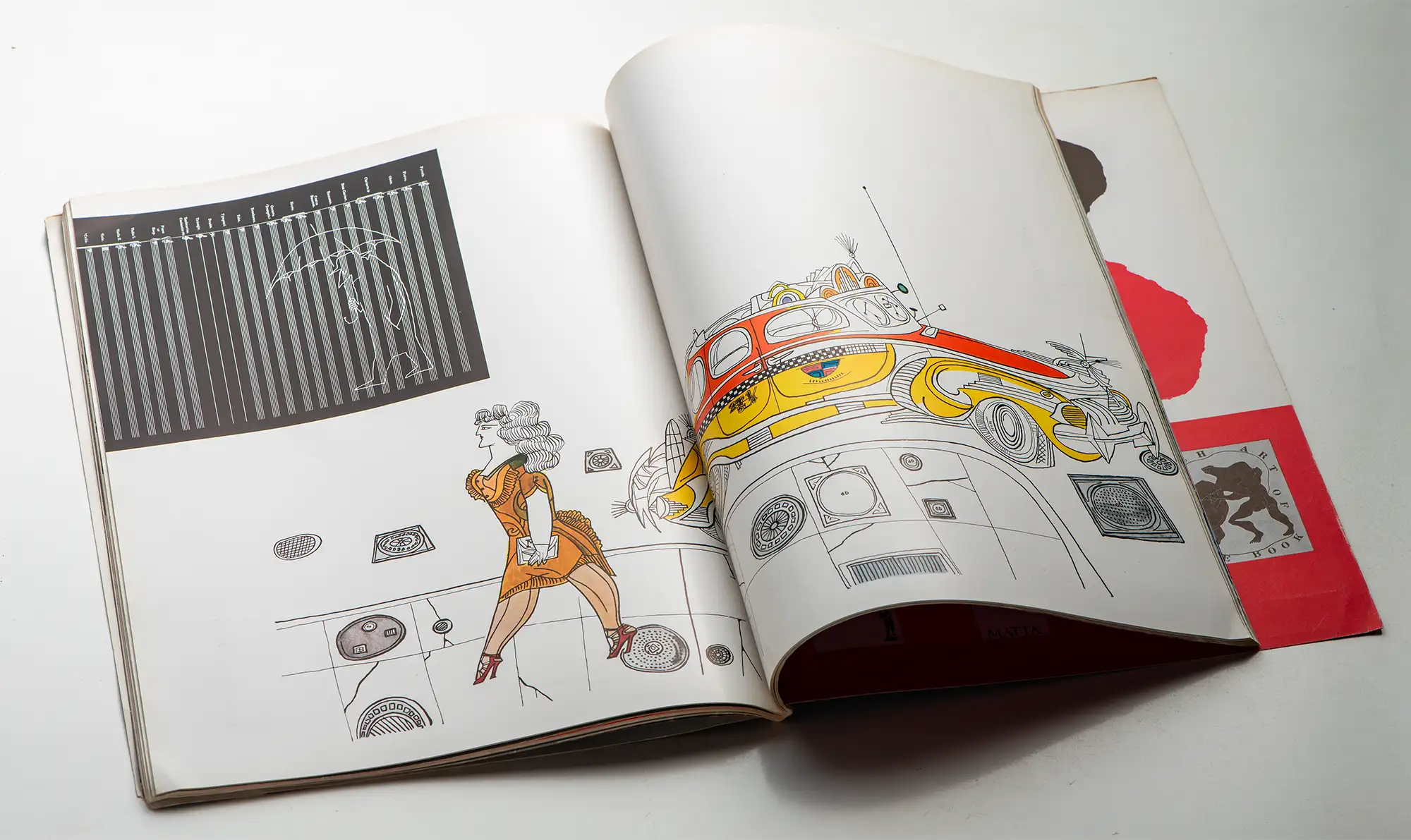
Portfolio Magazine N.1 - A double spread page with a Steinber drawing showing the binding issue
A rare example of a Steinberg's color drawing with a typical car and woman, plus an illustration of a little man walking against a rain of empty clefs on a music sheet. Illustrations reproduced from a previously unpublished Steinberg's private sketchbook. Portfolio 1 Winter 1950, pages 86-87.

Saul Steinberg. Car and Woman and a Man on a Music Sheet.

Original binding concealed the central gutter of many spreads.

These reproductions reveal the complete compositions for the first time, made visible through careful unbinding and full-spread digitization.

1950 — The Turning Point in Magazine Publishing

Portfolio and Flair Magazine

In 1950, two magazines briefly redefined what editorial publishing could be.
Portfolio, directed by Alexey Brodovitch, and Flair, created by Fleur Cowles, were conceived not as periodicals but as editorial experiments without precedent.

Both rejected conventional formats, budgetary restraint, and commercial compromise.
Both expanded the visual vocabulary of magazines beyond illustration and layout into sequencing, materiality, and authorship.
And both ceased publication after a single year—undone not by failure, but by the cost of radical ambition.

Their lifespan was brief. Their impact permanent.
What followed was not imitation, but a recalibration of what magazines could dare to be.

The cover of the first issue of Portfolio Magazine, winter 1950. Designed by Alexei Brodovitch with Art Director Frank Zachary. Portfolio has been widely acknowledged as perhaps the definitive graphic design magazine of the twentieth century.
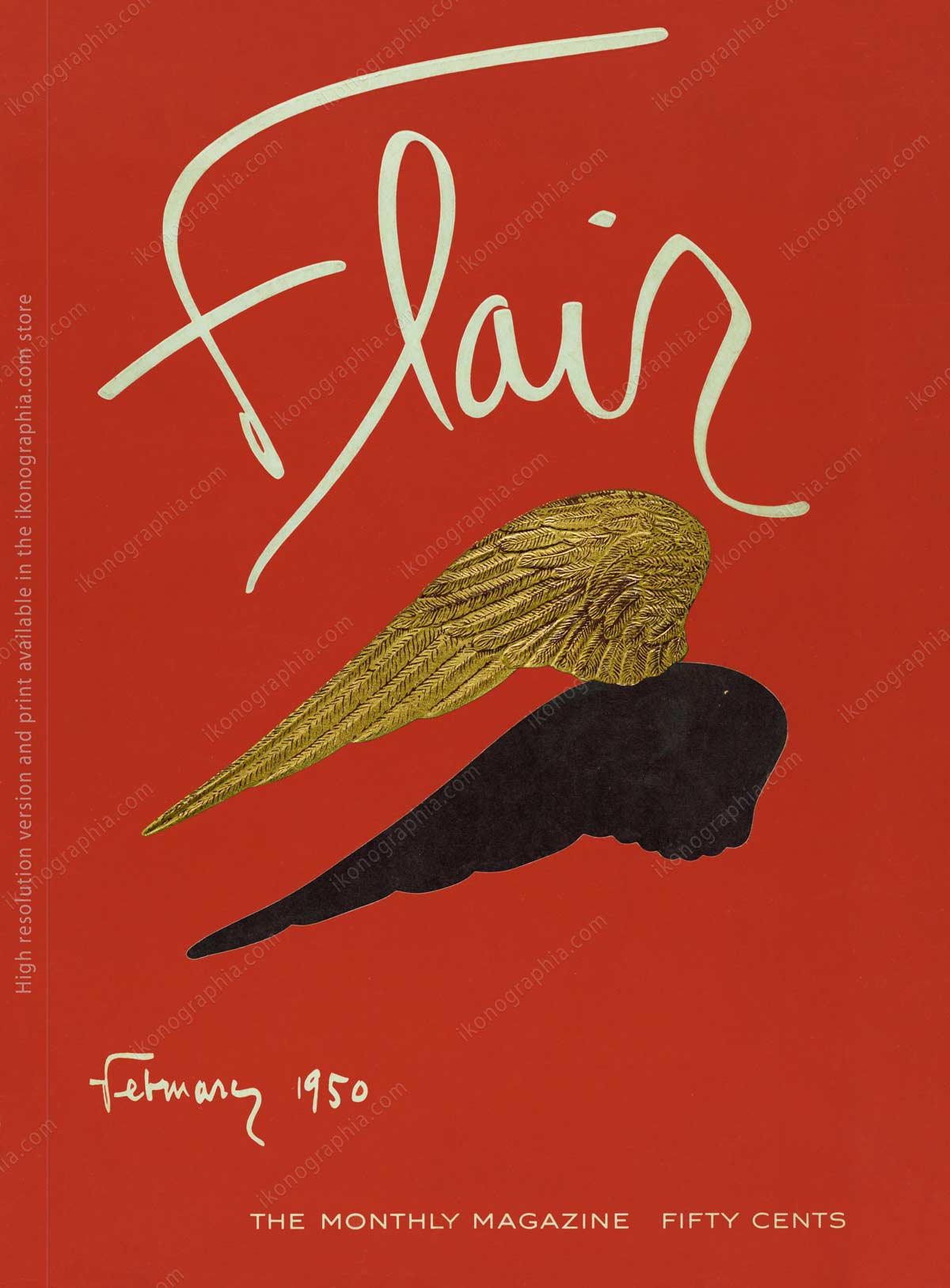
The Cover of the first number of Flair Magazine, February

The covers of the first numbers of the magazines

In 1950, Portfolio and Flair marked a turning point—proving that a magazine could be an authored work, not merely a container for content.

Copyright, Links And Credits

Portfolio Graphic Works, Copyright & Credits

© Ikonographia — Digital Restoration & Derivative Work Rights Reserved. These images are part of the Ikonographia Visual Archives: Portfolio Magazine Collection (1950–1951).

Copyright Status of Portfolio Magazine

Portfolio magazine (Issues 1–3, 1950–1951) was published in the United States and not renewed under U.S. copyright law. It is consequently in the public domain in the United States, and its editorial contents — including design, typography, and reproduced artworks — may be freely used.

Nature of Ikonographia's Work

The images presented here are not simple reproductions of the original magazine pages. They are reconstructed double-page spreads — a body of work that required the careful unbinding of original copies, precise digitization of individual pages, and their digital reassembly as unified visual fields.

This reconstruction reveals, for the first time, the complete compositions as Brodovitch intended them to be seen — hidden for decades by the tight binding of the original print edition.

Ikonographia's reconstructed spreads are original works and are protected as digital restorations and derivative works. They are available for licensed use through Ikonographia Visual Archives.

Terms of Use (Summary)

The images presented in this archive are copyrighted and available for licensed use only through Ikonographia Visual Archives.

You may not download, reproduce, publish, or distribute these images without a valid license. For commercial or editorial licensing, please refer to the product pages or contact Ikonographia directly. A full explanation of licensing terms is available in the Shop / Licensing Information section under "Ikonographia — Standard License" and "Ikonographia — Merchandising & Product Use Licenses."

Ikonographia Mission Statement

Ikonographia is committed to the accurate documentation, preservation, and ethical dissemination of twentieth-century visual culture.

Archival Notes

These reconstructed spreads were produced as part of Ikonographia's ongoing effort to preserve and make accessible significant works of twentieth-century graphic design.

Original copies of Portfolio were carefully unbound and digitized at high resolution. Individual pages were then reassembled with precision to restore the complete double-page compositions.
All images follow Ikonographia's internal archival standards for resolution, color accuracy, and metadata structure to ensure long-term consistency across the collection.

Ikonographia has made every effort to handle this material with accuracy and respect. We remain available for any inquiry or agreement regarding its use.

Credits

Portfolio magazine (1950–1951) was created by Frank Zachary and George Rosenthal (editors and co-founders) and Alexey Brodovitch (art director). Their vision produced one of the most significant editorial experiments of the twentieth century.

Further Reading — Selected Sources

Andrew Bosman, Brodovitch — The definitive monograph on Alexey Brodovitch's life and work.
Kerry William Purcell, Alexey Brodovitch — A comprehensive study of Brodovitch's design legacy, including Portfolio.

About Alexey Brodovitch. A short bio.

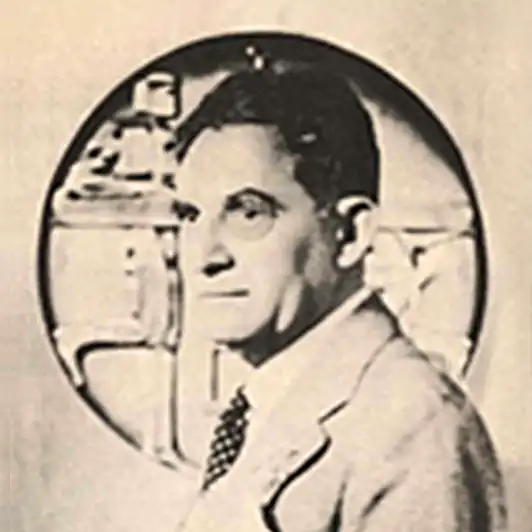
Alexey Brodovitch at work ,1950

Brodovitch at work in his studio.

Alexey Brodovitch (1898-1971)

Alexey Brodovitch was a Russian-born American designer, photographer, editor, and teacher whose work fundamentally reshaped twentieth-century visual culture. Best known as the art director of Harper's Bazaar (1934–1958) and the creator of Portfolio magazine, Brodovitch redefined the role of design as an active, expressive force rather than a neutral frame.

After leaving Russia, Brodovitch settled in Paris in 1920, where he absorbed Bauhaus principles, Italian Futurism, and the evolving languages of Cubism, Fauvism, Purism, and Surrealism. This plural exposure forged a visual sensibility grounded in movement, contrast, and disciplined freedom.

In the United States, Brodovitch became both a radical innovator and influential educator, mentoring generations of photographers and designers—including Richard Avedon, Irving Penn, Diane Arbus, and Garry Winogrand—establishing a legacy that continues to define modern editorial design.

Art Deco Elevator Panels — Fred French Building, 1927 — Glinsky & Bach

Art Deco Elevator Panels — Fred French Building, 1927 — Glinsky & Bach

Art Deco Elevator Panels — Fred French Building, 1927 — Glinsky & Bach

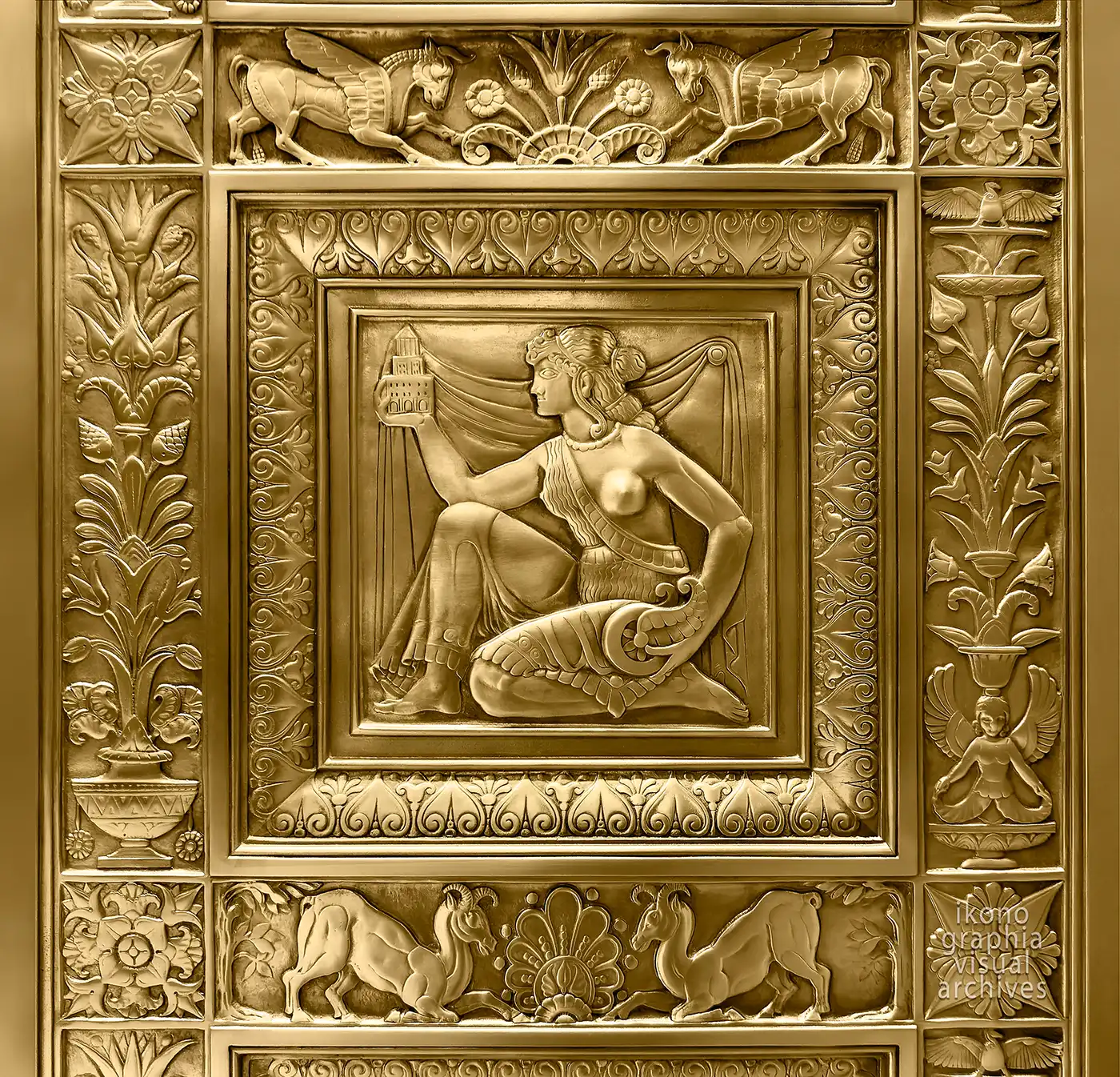
Eight gilt bronze panels — Industry, Commerce, Finance, and Building — conceived as a unified iconographic program.

A rare surviving ensemble of gilt bronze panels created in 1927 by Vincent Glinsky and Oscar Bach.

These elevator doors visualize the four pillars of Fred F. French’s real-estate empire—Industry, Commerce, Finance, and Building—through a sculptural language rooted in Art Deco geometry and documented Babylonian sources.

The Merchant and The Wealth Bearer — Art Deco elevator panels, Fred French Building, New York, 1927 — Glinsky & Bach

Completed in 1927, the Fred F. French Building stands as one of Manhattan’s finest expressions of the early Art Deco style. While the tower is admired for its stepped crown and gilded ornament, its most exceptional artworks lie hidden in the lobby: eight bronze elevator panels conceived by sculptor Vincent Glinsky and master metalworker Oscar Bach.

Commissioned to embody the vision of developer Fred Fillmore French, these doors translate the essential forces driving New York’s rise—labor, trade, wealth, and architecture—into a sophisticated visual program. Their hybrid style reflects Classical allegory, modern stylization, and the direct influence of Babylonian and Chaldean sources — documented by architect H. Douglas Ives in his own writing before a single panel was cast.

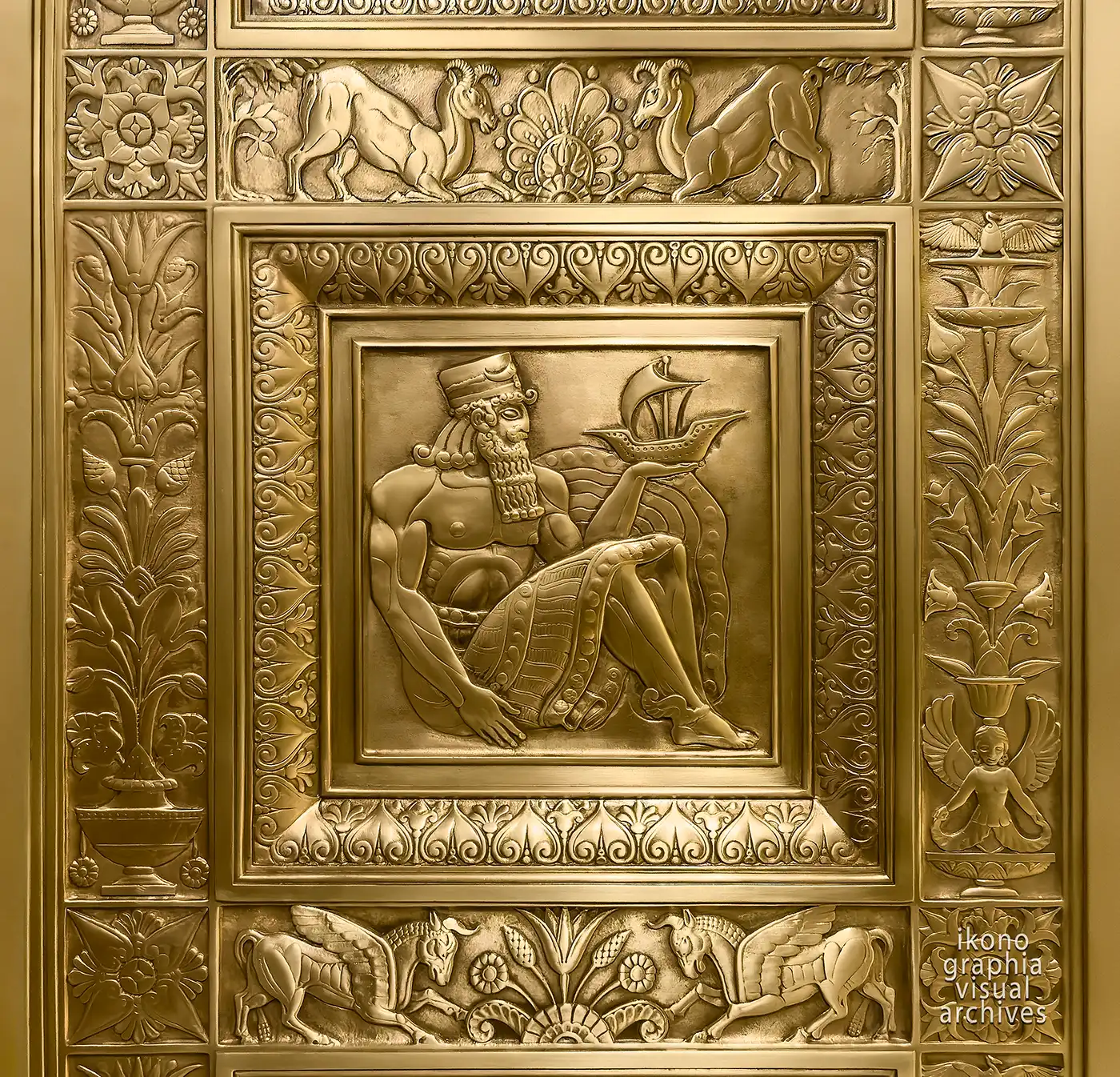
Allegory of Trade — The Merchant — Art Deco Elevator Panel, Fred French Building, New York — 1927 — Glinsky & Bach

The Merchant — Commerce.

Symbolizing maritime trade and international exchange.

Holding a ship in his hand, the bearded figure embodies maritime trade — the engine of international commerce in the early twentieth century.

His confident pose and the ship he carries identify him directly — a Mesopotamian merchant prince, translated into gilt bronze by Glinsky following Ives's documented sources.

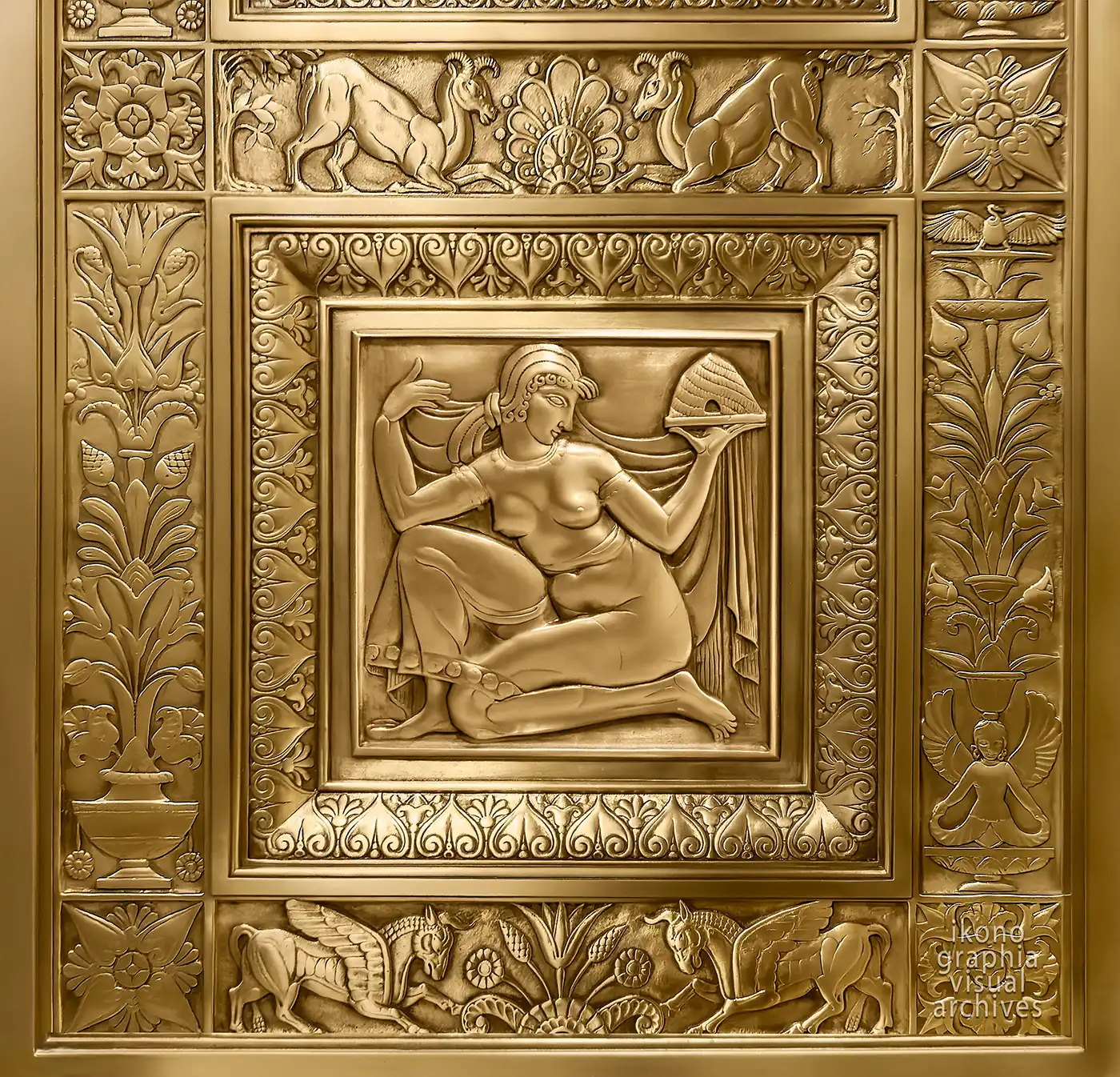
The Beehiver — Art Deco elevator panel, Fred French Building, New York, 1927 — Glinsky & Bach

The Beekeeper — Commerce.

Symbolizing industriousness, shared enterprise, and the organization of commerce.

A seated woman holds a beehive — the ancient emblem of collective effort and the wealth that organized labor produces.

Her pose and adornment place her within the same Babylonian visual tradition as the panels around: composed, frontal, deliberate. Commerce rendered not as transaction but as civilization.

The Artists & The Style

Glinsky & Bach: Sculptor and Metalwork Virtuoso.

Vincent Glinsky shaped the narrative sequences in low relief, giving the figures a compact mass and rhythmic energy typical of early Deco sculpture. Oscar Bach realized the panels in gilt bronze, applying the refined technical methods that made him one of the pre-eminent metalworkers of his era.

Together, they produced one of the most complete and coherent decorative cycles in American Art Deco. The vertical registers, crouching beasts, muscular torsos, and geometric borders follow a visual language Ives had studied directly — the Ishtar Gate of Babylon, reconstructed at Berlin's Pergamon Museum in the early twentieth century, and the enameled brick of ancient Chaldea. The source was not general fascination. It was specific research, translated into bronze.

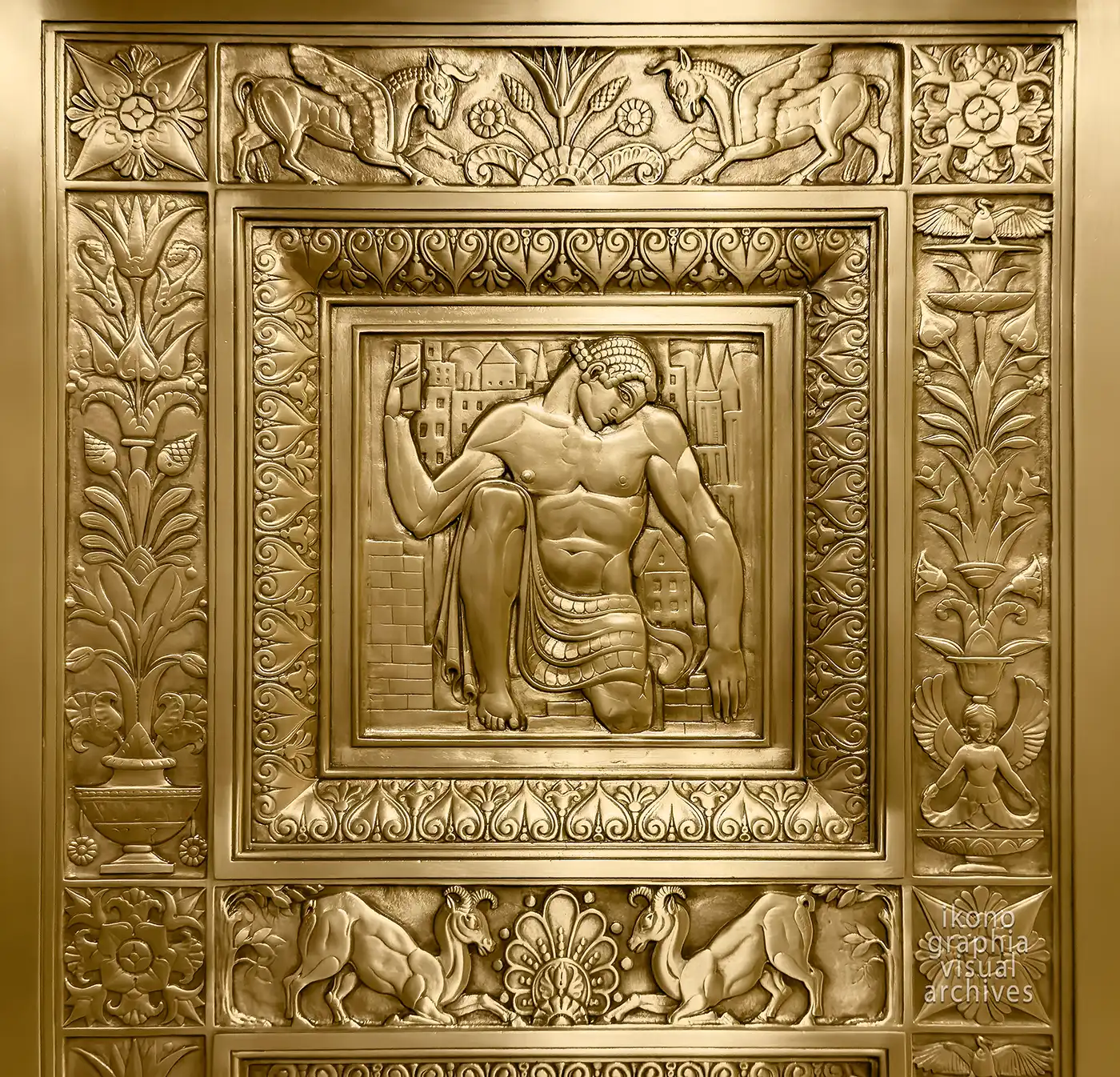
The Builder Elevator Panel — Fred French Building, New York, 1927

The Builder — Building.

Symbolizing skilled craft, technical mastery, and urban growth.

A kneeling figure, powerfully built, bends over his work with concentrated force — the architecture of the city rising behind him.

Where The Merchant carries trade and The Beehiver holds its product, the Builder is defined entirely by his labor. The body is the instrument. Glinsky's modelling here is at its most physical — the weight of the figure fully committed to the act of construction.

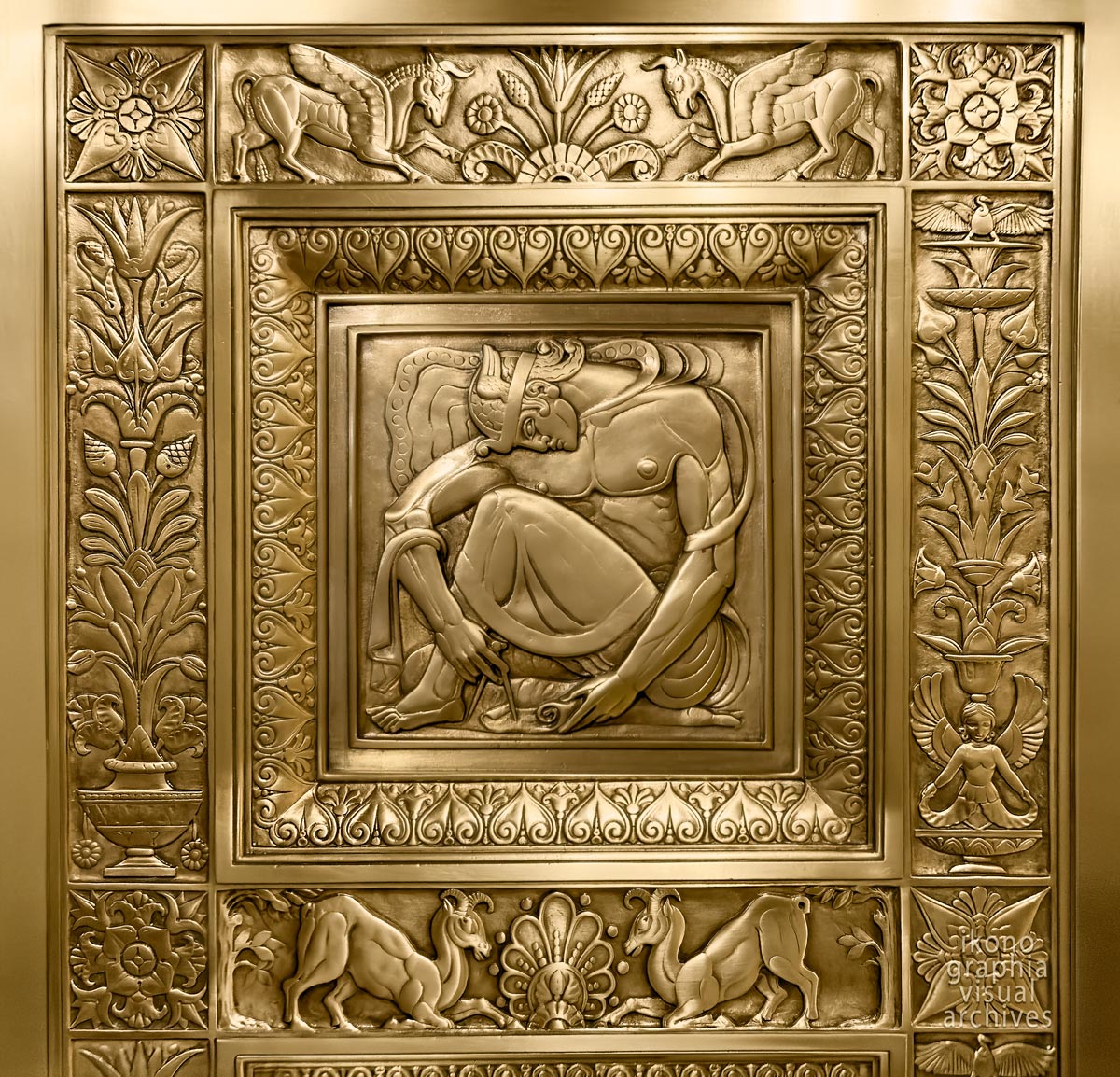
Allegory of Design — The Architect — Art Deco Elevator Panel, Fred French Building, New York — 1927 — Glinsky & Bach

The Architect — Building.

Symbolizing design, planning, and architectural vision.

A seated female figure holds a miniature building raised in her hand — the classical pose of the architect-as-creator, the city held and commanded rather than built by hand. Her posture is composed, her gaze inward.

Where the Builder is all physical effort, the Architect is stillness and conception. Together they complete Building's two movements: the idea and the labor that executes it.

The Four Pillars

Industry, Commerce, Finance, and Building.

Each elevator panel embodies one of the four sectors central to the French Companies:
 Industry — strength, engineering, infrastructure
 Commerce — exchange, trade, and refined goods
 Finance — wealth, investment, administration
 Building — architecture, planning, construction

Though allegorical, the imagery was designed for instant legibility. These were the forces shaping New York in the 1920s: the labor that built the skyline, the commerce animating Fifth Avenue, the financial system behind every development, and the architectural vision that defined modern urban life.

The Symbolic Program — Elevator Doors, Fred French Building, New York, 1927.

A complete symbolic program:
Commerce, Industry, Finance, and Building.

The eight gilded panels of the Fred French Building lobby — a sculptural cycle honoring the forces that powered New York's 1920s rise.

The arrangement is graphically balanced, not thematically ordered: the eye moves across figures and ornament before resolving into program. Ives's logic reveals itself slowly — four themes, eight figures, one coherent argument about what a city is and what sustains it.

The most complete Mesopotamian-themed decorative cycle in American Art Deco.

The Kneeling Builder — Art Deco elevator panel, Fred French Building, New York, 1927 — Glinsky & Bach

The Industrial Worker — Industry.

Symbolizing labor, engineering, and the infrastructure of the modern city.

A muscular figure crouches over his work, the full weight of his body engaged.
Where the Architect conceives and the Builder constructs, the Industrial Worker powers the infrastructure beneath both.

New York's modernization — its utilities, transport, and rising skyline — ran on this kind of labor. Glinsky gives it the same dignity as the figures of commerce.

Art Deco allegory of agriculture — The Harvester Industry Elevator Panel, Fred French Building, New York, 1927. Gilt bronze relief by Vincent Glinsky and Oscar Bach.

The Harvester — Industry.

Symbolizing production, agriculture, and foundational industry.

A reclining female figure holds a bundle of wheat and a crescent sickle — the oldest symbols of harvest, drawn directly from the Mesopotamian tradition Ives had studied.

Industry here is not mechanical but elemental. Before the city rises, the land must yield. Glinsky places her with the same authority as the figures of commerce — the foundation that makes everything above possible.

Allegory of Prosperity — The Wealth Bearer — Art Deco Elevator Panel, Fred French Building, New York — 1927 — Glinsky & Bach

The Wealth Bearer — Finance.

Symbolizing prosperity generated through investment and trade.

A seated figure holds a cornucopia and a caduceus — abundance in one hand, the instrument of exchange in the other. The objects are precisely chosen: not wealth accumulated, but wealth in motion.

Finance here is presented as a creative force, not a passive one. The building it occupies was itself a monument to that conviction — Fred French's own statement that capital, directed with ambition, builds cities.

Elevator panel, The Industrial Worker — Industry, Fred French Building, New York, 1927. Gilt bronze relief by Vincent Glinsky, metalwork by Oscar Bach, program by H. Douglas Ives. Photographed by Roberto Bigano.

The Scholar — Finance.

Symbolizing knowledge, law, and administrative order.

A bearded figure holds an open tablet close to his face, absorbed in the text — the only figure in the program who reads, not acts, not carries.

Finance rests on law, record, and precedent. Where The Wealth Bearer puts capital in motion, the Scholar is the system that governs it — the written framework without which no transaction holds.

Two lighting conditions comparison — Elevator door panel, Fred French Building, New York, 1927.

The Elevator Doors Enigma — One Century Apart

The Merchant, from two different elevator doors, as shot — two entirely different surfaces, texture, color, with tones virtually inverted. The gilded coating makes the intent legible: a surface designed to hold light. Which rendition reflects Ives and Glinsky's original intent? The darker reading, however compelling, works against the material logic of the object.

On the Photographs

Eight doors. Forty versions. Three months.

These photographs were made in available light. Eight elevator doors line the lobby, sixty-four panels in total — the same subject, across different doors, produces entirely different surfaces, texture, color, with tones sometimes inverted. The only certain element was the light from above, embedded in the original design. Every additional light source introduced over a century was a question mark. Which one is closer to Ives and Glinsky's original intent was the editorial question.

Each door was documented as a complete object, the individual panels photographed separately. The tool that made this possible was an iPhone 15 Pro Max. Unobtrusive in a working lobby, it allowed multiple versions of each subject to be produced rapidly in the available light of the lobby. Imperfections in the files were compensated by the exceptional rendition of Apple ProRAW on gilt bronze.

Back at the desk, the range of versions — sometimes inverted in light and tone — became a tool for interpretation. The gilded coating makes the intent legible: a surface designed to hold light. The darker readings, however compelling, work against the material logic of the object. Choosing which version best served that intent was a subjective editorial decision. These photographs are an interpretation, a decoding attempt, not a record.

The Merchant and The Wealth Bearer were published full page in FMR Magazine. It was the first time in decades Roberto Bigano had worked without a Multi-Shot Hasselblad reproducing works of art.

CODA — A Declaration in Bronze

The elevator doors of the Fred French Building remain among the best-preserved Art Deco bronzes in Manhattan. The program has not dated — the symbolism is as legible today as it was in 1927.

In an ordinary lobby, the elevator is a utility. Here it is an argument — about what commerce is, what a city requires, and what ambition looks like when cast in gilt bronze.

The Elevator Lobby.
Architecture as procession.

This view reveals the French Building's elevator lobby as a carefully staged passage: marble surfaces, gilded doors, and a richly painted ceiling guiding visitors toward the vertical heart of the building.

Light fixtures and ornament establish a measured rhythm, framing the elevators not as utilities but as destinations. The lobby does not simply connect — it prepares.

About Vincent Glinsky. A short bio.

Vincent Glinsky

Vincent Glinsky

Vincent Glinsky (1895–1975) was a Russian-born American sculptor whose work fused Beaux-Arts training with the emerging modernist vocabulary of the 1920s and 1930s. Educated in Petrograd and later active in New York, he developed a sculptural language marked by precise anatomies, architectural clarity, and an expressive narrative sense ideal for architectural relief.

His most ambitious commission, under the direction of architect H. Douglas Ives, was the bronze program for the Fred French Building on Fifth Avenue (1927) — eight gilded elevator panels, a monumental mailbox, and entrance reliefs forming the most complete Mesopotamian-themed decorative cycle in American Art Deco.

Realized in gilt bronze by master metalworker Oscar Bach, the panels translate four allegorical themes — Industry, Commerce, Finance, and Building — into a unified sculptural sequence of exceptional refinement. They remain the definitive example of his work at architectural scale, and among the finest surviving bronzes of the Art Deco era in New York.

About Oscar Bach. A short bio.

Oscar Bach

Oscar Bach

Oscar Bach

Oscar Bach was a German-born master metalworker whose technical innovation shaped some of the most celebrated interiors of early twentieth-century America. Trained in the European guild tradition, he brought exceptional skill in architectural bronze, iron, and nickel-silver to the United States after emigrating in 1911.

Working from his New York studio, Bach produced metalwork for major skyscrapers, department stores, civic buildings, and luxury residences. His commissions include the Empire State Building — where he executed the monumental Art Deco aluminum mural in the Fifth Avenue lobby — and Radio City Music Hall, where he realized the three eighteen-foot relief sculptures on the 50th Street facade in collaboration with artist Hildreth Meière. His style combined Old World ornament with modern geometric clarity, defining a distinctive branch of American Art Deco. His workshop became synonymous with excellence in decorative metal, leaving a legacy preserved in landmarked interiors across the country.

American Mannequins — Journey into Hyperreality (1982–1988)

American Mannequins — Journey into Hyperreality (1982–1988)

American Mannequins — Journey into Hyperreality (1982–1988)

Artificial bodies and performative realism in American retail display.

Between 1982 and 1988, American shop windows increasingly adopted mannequins modeled for presence rather than display. Lifelike faces, controlled gestures, and carefully staged interiors transformed retail figures into instruments of visual persuasion, occupying a space where realism no longer represented reality but actively produced it.

August 1984 - Beverly Hills, California - From "Plastic Girls" series. A forty-year project by the Italian photographer Roberto Bigano documenting mannequins.

Photographed from the street without staged intervention, the images were made using a 4×5 view camera, a process that imposed slowness, distance, and sustained attention. In this context, mannequins emerge not as neutral supports for clothing, but as performative bodies through which American hyperreality takes shape.

These photographs belong to "Plastic Girls: 50 Years of Artificial Beauty", a long-term photographic project developed over nearly five decades, in which shop windows are approached as a continuous site of cultural observation.

August 1982 - Rodeo Drive, Beverly Hills, California. - From "Plastic Girls" series. Photo Roberto Bigano.

August 1982
Beverly Hills, United States — Rodeo Drive.

The hyper-detailed facial modeling and naturalistic stance collapse the distance between mannequin and living figure. The pose signals an early movement toward simulated presence, where realism begins to replace display as the dominant visual language.

 Featured  image above:


August 1984 — Rodeo Drive — Beverly Hills, United States.

An earlier generation of mannequin carving, distinguished by sculpted features rather than molded realism.
The face—particularly the mouth and eyes—retains a hand-shaped expressiveness, poised between elegance and emotional distance.

Set against the quiet intrusion of national symbolism, the tilted head and relaxed arm introduce a note of vulnerability, transforming the display into a composed study of desire and aspiration.

August 1984 - Melrose Ave. Hollywood, California - From "Plastic Girls" series. Photo Roberto Bigano

August 1982.
Hollywood, United States — Melrose Avenue.

Here the mannequin recedes into light and shadow, its presence shaped more by illumination than form. The body becomes a graphic element within the window, signaling a shift toward cinematic display and atmospheric staging rather than direct representation.

August 1984 - Santa Monica Blvd. Hollywood, California - From "Plastic Girls" series. Photo Roberto Bigano

August 1984.
Los Angeles, United States — Santa Monica Blvd.

High-contrast materials, confrontational styling, and rigid posture define a form of West Coast display that flirts with provocation rather than elegance.

Set against industrial plastic backdrops, the mannequin stages the body as surface and attitude—borrowing visual cues from underground fashion, fetish aesthetics, and club culture.

August 1984 - Santa Monica Blvd. Los Angeles, California - From "Plastic Girls" series. Photo Roberto Bigano.

August 1982
Los Angeles, United States — Santa Monica Blvd.

Bold chromatic contrasts and graphic styling echo the visual optimism surrounding the Los Angeles Olympics.

Commercial display mirrors a broader corporate aesthetic, where color signals confidence and spectacle.

August 1983 - Boca Raton, Florida. - From "Plastic Girls" series..Photo Roberto Bigano.

August 1983 — Boca Raton, Florida

Close-up with glasses and red lips, photographed on 4×5" film with a 45-minute exposure.

The view camera required carefully balanced composition on the ground glass—even more critical with such a challenging long exposure.

August 1985 - Sunset Strip, Hollywood, California - From "Plastic Girls" series.. Photo Roberto Bigano.

August 1985.
Suset Strip — Hollywood, United States

An elongated posture and stylized expression detach the mannequin from narrative context.
Reduced in scale, the figure reads as an object of study rather than a theatrical presence.

August 1985 - Beverly Hills, California - From "Plastic Girls" series. Photo Roberto Bigano.

August 1985 —Two Cowgilrs, Beverly Hills, United States

Two identical mannequins in cowboy costume, arms raised. Artificial femininity performing a national identity.

August 1985 - Sunset Strip, Hollywood, California - From "Plastic Girls" series. Photo Roberto Bigano.

August 1985
Hollywood, United States — Elegant shop on Sunset Strip.

The hyperreal modeling of the face and the restrained, naturalistic pose collapse the distance between mannequin and living figure. Rather than theatrical display, the figure conveys a quiet, inward presence, signaling the rise of psychological realism in mid-1980s American shop-window design.

August 1985 - J. Magnin Dept. Store, Beverly Hills, California - From "Plastic Girls" series. Photo Roberto Bigano.

August 1985
Beverly Hills, United States — J. Magnin Dept Store

Hyperreal facial modeling, refined posture, and controlled lighting elevate the mannequin beyond display into a near-portrait.
Luxury retail adopts the visual language of high fashion photography, collapsing the distance between artificial figure and idealized reality.

August 1988. Senter & Crunes Dept Store. Rockland, Maine. From "Plastic Girls" series. Photo Roberto Bigano.

August 1988 — Rockland, Maine, United States — Senter & Crunes Dept. Store.

The contrast between photographic portrait and mannequin construction foregrounds the tension between lived presence and manufactured realism.

August 1988. A Calvin Klein Window at Lord & Taylor. New York City. Photo Roberto Bigano.

August 1988 — New York City — Lord & Taylor.

The display aligns American fashion with institutional recognition, as Lord & Taylor applauds American design through the work of Calvin Klein, presenting fashion as cultural achievement rather than seasonal novelty.

August 1988. Altman's Dept. Store. New York City. From "Plastic Girls" series. Photo Roberto Bigano.

August 1988 —  Beverly Hills, California — Altman’s Dept. Store

The extended tonal range—from luminous silk highlights to dense, articulated blacks—supports precise chromatic balance and compositional clarity.
Technical fidelity becomes inseparable from the image’s aesthetic authority, reinforcing realism as a constructed visual language.

0419-13 Trendy dummies, West Berlin 1980, Germany, February 1980 | From "Plastic Girls" series. Photo by Roberto Bigano. Buy this image in the ikonographia.com

Plastic Girls — Glamour, Aggression, and Display (1980–1997)

A shared escalation toward excess, beyond style, geography, or chronology.

This chapter documents the moment when artificial femininity becomes overtly cosmetic, sexualized, and confrontational. .

Copyright, Links And Credits

Photography, Copyright & Credits

All photographs © Ikonographia / Roberto Bigano — All Rights Reserved.
These images are part of the Ikonographia Visual Archives: — Plastic Girls: 50 Years of Artificial Beauty —  Plastic Girls / Mannequins Archive (1978–2026).

Terms of Use (Summary)

The images presented in this archive are copyrighted and available for licensed use only through Ikonographia Visual Archives.

You may not download, reproduce, publish, or distribute these images without a valid license. For commercial or editorial licensing, please refer to the product pages or contact Ikonographia directly. A full explanation of licensing terms is available in the Shop / Licensing Information section under "Ikonographia — Standard License" and "Ikonographia — Merchandising & Product Use Licenses"

Ikonographia Mission Statement

Ikonographia is committed to the accurate documentation, preservation, and ethical dissemination of twentieth-century visual culture.

Archival Notes — Plastic Girls: 50 Years of Artificial Beauty

This archive began in 1978 as a street photography project and is still ongoing.
All images were taken from public streets through shop-window glass without special access, permissions, or staging.

The archive's coherence was recognized retrospectively—only years later, during high-resolution digitization, did isolated images reveal themselves as a continuous visual record spanning nearly fifty years. The project documents mannequins as cultural artifacts: their evolving materials, poses, facial treatments, and display contexts across changing urban and commercial landscapes.

All images follow Ikonographia's internal archival standards for resolution, color accuracy, and metadata structure to ensure long-term consistency across the collection.

Further Reading — Selected Sources

  • Plastic Girls (1978-2011), by Roberto Bigano — A photographic monograph collecting earlier phases of this archive, published as a limited edition on Blurb.
Plastic Girls — The Age of Plastic Innocence, 1978–1980

Plastic Girls — The Age of Plastic Innocence, 1978–1980

Plastic Girls — The Age of Plastic Innocence, 1978–1980

Early Works – Shop-window mannequins before the rise of performative display.

Between 1977 and 1980, shop-window mannequins across Europe were defined by restraint. Controlled gestures, neutral composure, bodies designed to present clothing, not perform identity. Display had not yet become theatre.

This chapter marks the earliest phase of the Plastic Girls project, begun by Roberto Bigano in 1978 and still ongoing. These images are the beginning of a record that only revealed its full coherence decades later. They were not made as a project. They were made by instinct — the kind that precedes understanding by decades.

The very first EB110 model made in epowood as designed by Benedini, with the rear wheels covered reminding the Bugatti Atlantic.  Photo Roberto Bigano. Buy this image in the ikonographia.com store.

All photographs were taken from the street, through shop-window glass, without special access or permissions. Nothing is staged or arranged for the camera: the images record what is openly visible yet rarely observed with sustained attention.

Over time, this accumulation exposes patterns no single moment could reveal—recurring gestures, evolving materials, racial and anatomical codifications, and a gradual movement from abstraction to hyper-realism. The project seeks neither irony nor nostalgia, but sustained looking.

0175-17 Shop window in Rome on vintage theme, November 1978 | From "Plastic Girls" series. Photo by Roberto Bigano. Buy this image in the ikonographia.com store.

November 1978 — Rome, Italy.

A shop-window ensemble staged around a grape-harvest motif, with mannequins arranged in a shallow theatrical space. The restrained gestures and lowered gazes temper the decorative theme, shifting emphasis from seasonal display toward a composed study of collective presence and controlled femininity.

Northern Europe — Restraint and Invention, 1978–1980

Where precision and invention defined the northern window.

Germany, Scandinavia, Finland. Cities where display was precise, considered, and untheatrical — each in its own way. The windows showed what the culture valued: in Germany, controlled composure and the studied use of accessories; in Scandinavia, a restraint that the northern light made its own.
Invention appeared where least expected — a headdress of flowers and feathers in a fabric store in Braunschweig, a retro figure horizontal in a vintage boutique in Stockholm's Gamla Stan.

0360-13 Mannequin in a shop window in Braunschweig, Germany, September 1979 | From "Plastic Girls" series. Photo by Roberto Bigano. Buy this image in the ikonographia.com store.

September 1979.
Braunschweig, West Germany — Delmod Department Store.

A figure of complete stillness, seated with precise composure, the clothing subordinate to the pose. No performance, no psychological charge. The delmod logo visible at the bottom grounds it in a specific commercial moment.

0359_35 Dummy at Strick dept. store, Braunschweig, Germany. September 1979 | From "Plastic Girls" series. Photo by Roberto Bigano. Buy this image in the ikonographia.com store.

September 1979.
Braunschweig, Germany — Strick Fabrics Store.

The figure’s elongated pose and sharply articulated headpiece introduce a heightened sense of stylization within an otherwise restrained stance. Here, realism and display coexist: naturalistic body proportions support an emerging language of visual impact driven by accessories and controlled exaggeration.

0370-29 Retro Mannequin, Stockholm, Sweden, September 1979 | From "Plastic Girls" series. Photo by Roberto Bigano. Buy this image in the ikonographia.com store.

September 1979 — Stockholm, Sweden

A retro mannequin displayed in an upscale vintage second-hand boutique in Gamla Stan (The Old city) where curated accessories and restrained presentation reflect a refined approach to reuse, distinct from mass-market thrift.

0364_15 Dummy in Copenhagen, Denmark, September 1979 | From "Plastic Girls" series. Nikon FM 50mm f 1.4 – Ilford HP5 Photo by Roberto Bigano. Buy this image in the ikonographia.com store.

November 1978.
Copenhagen, Denmark

The mannequin stands frontally,the posture defined by balance and containment.
Soft facial modeling and elongated hands, held low and inactive, suppress theatricality, anticipating a late-1970s turn toward understated realism in Northern European shop-window design.

West Berlin — Avant-Garde and Contrast (1980)

Where experimental display confronted tradition in a divided city.

West Berlin's shop windows reflected the city's unique cultural position: an island of capitalist abundance surrounded by the Eastern Bloc. Avant-garde boutiques staged mannequins as sculptural provocations—angular poses, exaggerated silhouettes, and confrontational gestures—while traditional department stores maintained conservative elegance.

The contrast intensified when viewed against East Berlin's restrained, utilitarian displays visible across the Wall. These windows documented not just fashion, but competing visions of modernity separated by concrete and ideology.

0415-21 Stylish dummies at Streifen Dept. Store, Berlin, Germany, February 1980 | From "Plastic Girls" series. Photo by Roberto Bigano. Buy this image in the ikonographia.com

February 1980.
KaDeWe Luxury Dept. Store — West Berlin, West Germany — Streisen Design

A window staged — constructed, theatrical, deliberate. Two figures in conical hats, somewhere between Pierrot and Constructivism, mirror poses, a fashion sketch behind them.

Nothing is for sale in the conventional sense. The window is not saying "buy this." It is saying "this is what we believe fashion is." This window was a small version of the city.

Berlin 1980.

West Berlin in February 1980 was electric. Avant-garde boutiques staged mannequins as sculptural provocations. Traditional department stores maintained conservative elegance.

A few kilometres away, across the Wall, East Berlin shop windows presented a different world: modest clothing, limited materials, the female figure defined by role, not desire.
Five days, hundreds of images — mannequins one thread among many in a city that demanded sustained attention. This is the edit: the moments when the shop window concentrated everything the city was saying about itself.

0417-14 Frauentag / Women’s Day East Berlin, DDR, February 1980 | From "Plastic Girls" series. Photo by Roberto Bigano. Buy this image in the ikonographia.com store.

February 1980 — Berlin, East Germany — Frauentag (Woman’s Day)

A shop-window staged for International Women's Day. Modest clothing, limited materials, restrained gesture.

The female figure defined by role — a symbolic recipient of flowers, not an active presence. East Berlin, February 1980.

0419-13 Trendy dummies, West Berlin 1980, Germany, February 1980 | From "Plastic Girls" series. Photo by Roberto Bigano. Buy this image in the ikonographia.com

February 1980 — KaDeWe (Kaufhaus des Westens) — Berlin, West Germany — Streisen Design

Same city, same month, opposite side of the Wall. Four figures in military-inflected fashion, angular poses, the sketch on the back wall placing design and execution in the same frame.

The shop window as a studio for propositions about what clothing could mean.

0415-13 Mannequins in West Berlin, Germany, February 1980 | From "Plastic Girls" series. Photo by Roberto Bigano. Buy this image in the ikonographia.com store.

February 1980 — Berlin, West Germany

A conventional fashion display grounded in late-1970s aesthetics.

Naturalistic poses, familiar styling, and decorative restraint prioritize wearability and continuity over experimentation, presenting fashion as product rather than performance.

0419-05 Store window Berlin 1980, Germany, February 1980 | From "Plastic Girls" series. Photo by Roberto Bigano. Buy this image in the ikonographia.com store.

February 1980 — Berlin, West Germany

A shop-window tableau staged around intimacy and domestic fantasy rather than fashion display.

The mannequin’s reclining posture, lingerie-like styling, and surrounding household objects collapse the boundary between private interior and commercial spectacle, anticipating a late-twentieth-century shift toward lifestyle-driven retail narrative

0419_R The proof sheet of roll N.419 includes at least six interesting subjects. February 1980.

February 1980 - Berlin, West Germany

An exceptional contact sheet preserving a concentrated burst of visual discovery. Five frames from this single session—three included in this archive, two more equally compelling—capture West Berlin at a moment of extraordinary cultural intensity.

This density of compelling images reflects both the photographer's sustained attention and the city's exceptional vitality. Most contact sheets yield one or two keepers; this roll captured a moment when subject and circumstance aligned.

London — Elegance and Tradition (1980)

Refined display in the capital's iconic shopping districts.

London's Knightsbridge, Regent Street, and Oxford Street presented mannequins as bearers of restrained sophistication. Poised figures in carefully coordinated ensembles embodied British retail tradition—composure, quality, and understated aspiration.

Unlike the performative intensity emerging elsewhere, London windows maintained a language of elegance through stillness, where mannequins projected confidence without confrontation. These displays captured the final moment before globalized retail homogenized urban window culture.

0568-29 Blonde dummy, London Knightsbridge, UK September 1980 | From "Plastic Girls" series. Photo by Roberto Bigano. Buy this image in the ikonographia.com store.

September 1980 — London, Knightsbridge — United Kingdom Oxford Street and Regent Street series

The hyper-detailed facial modeling and naturalistic stance collapse the distance between mannequin and living figure.

The pose signals an early movement toward simulated presence, where realism begins to replace display as the dominant visual language

0564-23 Blonde mannequin in Regent St, London, September 1980, 1980 Nikon FM 50/1.4. Film Kodak PlusX Pan Photo by Roberto Bigano. Buy this image in the ikonographia.com store.

September 1980 — Regent Street — London, United Kingdom

Geometric severity challenging traditional femininity. The platinum hair cut in sharp architectural angles, heavy eye makeup, and dark lipstick create a face of deliberate confrontation — not glamour but refusal. The demure outfit intensifies the provocation. Propriety worn as costume.

London in 1980 was absorbing New Wave and post-punk visual language. The direct gaze reads as challenge, not invitation.

0564-23 Blonde dummy in Regent St, London, UK September 1980 | From "Plastic Girls" series. Photo by Roberto Bigano. Buy this image in the ikonographia.com store.

September 1980 — Regent Street — London, United Kingdom

Platinum hair in exaggerated volume, heavy kohl-lined eyes, and deep lipstick transform the mannequin into a figure of controlled drama.

The shell earring and crisp turtleneck ground the excess in wearable fashion. Glamour as performance — contained, precise, and deliberate.

0564-26 Mannequin in Regent St., London, UK September 1980 | From "Plastic Girls" series. Photo by Roberto Bigano. Buy this image in the ikonographia.com store.

September 1980 — Regent Street — London, United Kingdom

Sculpted platinum hair in 1940s waves, downcast eyes, contemplative pose — film-star refinement in a 1980 shop window. The dark cardigan over white collar creates tonal restraint. The hand's placement introduces vulnerability beneath composed surfaces. Beauty presented as melancholic, not aspirational.

London — The Luxury Triangle and Soho

London in September 1980 meant three distinct worlds within walking distance of each other. Knightsbridge and the luxury triangle — Regent Street, Oxford Street, Brompton Road — maintained the restrained elegance of British retail tradition.

A few streets south, Soho was something else entirely: music, fashion, and nightlife converging in the same few blocks, the underground surfacing into shop windows.

Both were documented in the same day, on the same rolls of film. A student in London for one day — no second chance, no return visit. The contrast was the point — and the choice.

Shop window in Regent St, London, UK | September 1980

September 1980 — Soho, London, United Kingdom

Three figures in coordinated formation — voluminous curls, layered chains, draped ethnic-influenced garments. Collective glamour over individual pieces. The group is the statement.

0564-33 Mannequins, Soho, London, UK September 1980 | From "Plastic Girls" series. Photo by Roberto Bigano. Buy this image in the ikonographia.com store.

September 1980 — Soho, London, Unite Kingdom

Two mannequins in close proximity, mirrored gazes, stylized accessories. Attitude foregrounded over garment.

The display is about presence, not clothing.

0564-34 Mannequin, London, UK September 1980 | From "Plastic Girls" series Nikon FM 50/1.4. Film Kodak PlusX Pan Photo by Roberto Bigano. Buy this image in the ikonographia.com store.

September 1980 — Regent Street — London, United Kingdom

Classical Hollywood elegance rendered in stillness and introspection. The sculpted platinum hair styled in 1940s waves, downcast eyes, and contemplative pose evoke film-star refinement rather than contemporary fashion energy. 

London retail maintaining connection to mid-century glamour traditions—not theatrical performance or punk defiance, but timeless feminine introspection. The mannequin presents beauty as melancholic rather than aspirational, offering an alternative visual language within the same commercial landscape.

0568-27 Elegant mannequin with greyhound, London Knightsbridge, UK September 1980 | From "Plastic Girls" series. Photo by Roberto Bigano. Buy this image in the ikonographia.com store.

September 1980.
London, United Kingdom — Knightsbridge.

An elegant shop-window composition pairing a poised mannequin with a greyhound, projecting refinement through restraint rather than display.

The controlled posture, tailored styling, and classical animal form evoke Knightsbridge’s association with discretion and status, translating luxury into a language of composure and quiet confidence.

0566-33 The Bionic Woman, London, UK September 1980 | From "Plastic Girls" series. Photo by Roberto Bigano. Buy this image in the ikonographia.com sto

September 1980.
London, United Kingdom.

Not a mannequin — a doll. The Bionic Woman, £5.74, photographed through shop-window glass like everything else in this archive. The face is indistinguishable from the mannequins beside it. That is the point.

August 1984 - Beverly Hills, California - From "Plastic Girls" series. A forty-year project by the Italian photographer Roberto Bigano documenting mannequins.

American Mannequins — Journey into Hyperreality (1982–1988)

Artificial bodies and performative realism in American retail display.

Between 1982 and 1988, American shop windows increasingly adopted mannequins modeled for presence rather than display. Lifelike faces, controlled gestures, and carefully staged interiors transformed retail figures into instruments of visual persuasion, occupying a space where realism no longer represented reality but actively produced it.

Copyright, Links And Credits

Photography, Copyright & Credits

All photographs © Ikonographia / Roberto Bigano — All Rights Reserved.
These images are part of the Ikonographia Visual Archives: — Plastic Girls: 50 Years of Artificial Beauty —  Plastic Girls / Mannequins Archive (1978–2026).

Terms of Use (Summary)

The images presented in this archive are copyrighted and available for licensed use only through Ikonographia Visual Archives.

You may not download, reproduce, publish, or distribute these images without a valid license. For commercial or editorial licensing, please refer to the product pages or contact Ikonographia directly. A full explanation of licensing terms is available in the Shop / Licensing Information section under "Ikonographia — Standard License" and "Ikonographia — Merchandising & Product Use Licenses"

Ikonographia Mission Statement

Ikonographia is committed to the accurate documentation, preservation, and ethical dissemination of twentieth-century visual culture.

Archival Notes — Plastic Girls: 50 Years of Artificial Beauty

This archive began in 1978 as a street photography project and is still ongoing.
All images were taken from public streets through shop-window glass without special access, permissions, or staging.

The archive's coherence was recognized retrospectively—only years later, during high-resolution digitization, did isolated images reveal themselves as a continuous visual record spanning nearly fifty years. The project documents mannequins as cultural artifacts: their evolving materials, poses, facial treatments, and display contexts across changing urban and commercial landscapes.

All images follow Ikonographia's internal archival standards for resolution, color accuracy, and metadata structure to ensure long-term consistency across the collection.

Further Reading — Selected Sources

  • Plastic Girls (1978-2011), by Roberto Bigano — A photographic monograph collecting earlier phases of this archive, published as a limited edition on Blurb.

Browse Plastic Girls Book


Ikonographia is proud to publish "Plastic Girls," an impressive forty years-long work by the Italian photographer Roberto Bigano 

See my published books
USD United States (US) dollar
EUR Euro